Cancelación de vuelos de aerolíneas afecta afluencia de turismo
La Secretaría de Turismo (SECTUR) de México ha expresado su preocupación debido a la fuerte baja de los vuelos vacacionales. Especialmente la afluencia de canadienses este año es menor a la registrada en la temporada de 2020. La cancelación de vuelos de cuatro líneas aéreas de origen canadiense afecta de manera considerable la afluencia de este segmento turístico en Acapulco.
El destino Acapulco ha sufrido un brusco descenso del número de aerolíneas operativas como así del tráfico de pasajeros entre 2020-2021. Entre las líneas aéreas que suspendieron sus vuelos a los destinos de playa como Acapulco, están las aerolíneas canadienses Canada Rouge, Air Transat, WestJet Air y Sunwing Airlines.
La Secretaría de Turismo Municipal de Acapulco, a cargo de José Luis Basilio Talavera, dijo que la afluencia de canadienses ha disminuido considerablemente. El tráfico total que atendía en 2018 era de 739.120 pasajeros, un incremento del 9,7% respecto al año anterior. En 2019, la demanda ha sido de 875.315 con un aumento de 18,4% interanual.
Las líneas aéreas operativas en el Aeropuerto Internacional Acapulco son: Aeromar, Aeroméxico, Air Transat, American Eagle (estacional), Interjet, Magni Charter, United Express (estacional), VivaAerobús, Volaris Airlines. El Aeropuerto Internacional de la Ciudad de México en la Ciudad de México, así como vuelos menos frecuentes de otras ciudades mexicanas, estadounidenses y canadienses. En 2020 tenía un registro de poco más de cinco mil turistas canadienses. «El sector turístico procedente de Canadá es muy común en Acapulco durante estos meses, pero en estos momentos está siendo afectado también y esto representa una derrama económica perdida para el sector empresarial”, sostiene el Secretario de Turismo.
Acapulco tourist difficulties
Cancellation of airline flights affects influx of tourism
The Secretariat of Tourism (SECTUR) of Mexico has expressed its concern due to the sharp decline in vacation flights. Especially the influx of Canadians this year is lower than that registered in the 2020 season. The cancellation of flights of four Canadian-origin airlines considerably affects the influx of this tourist segment in Acapulco.
The Acapulco destination has suffered a sharp decrease in the number of operating airlines as well as in passenger traffic between 2020-2021. Among the airlines that suspended their flights to beach destinations such as Acapulco are Canadian airlines Canada Rouge, Air Transat, WestJet Air, and Sunwing Airlines.
The Acapulco Municipal Tourism Secretariat, in charge of José Luis Basilio Talavera, said that the influx of Canadians has decreased considerably. Total traffic served in 2018 was 739,120 passengers, an increase of 9.7% over the previous year. In 2019, the demand was 875,315 with an increase of 18.4% year-on-year.
The airlines operating at the Acapulco International Airport are: Aeromar, Aeroméxico, Air Transat, American Eagle (seasonal), Interjet, Magni Charter, United Express (seasonal), VivaAerobús, Volaris Airlines. The Mexico City International Airport in Mexico City, as well as less frequent flights from other Mexican, American and Canadian cities. In 2020 it had a record of just over 5,000 Canadian tourists. «The tourism sector from Canada is very common in Acapulco during these months, but at the moment it is also being affected and this represents a lost economic spill for the business sector», says the Secretary of Tourism.
AW | 2020 12 26 11:04 | AIRLINES MARKET / INDUSTRY / TOURISM / GOVERNMENT
Tras acuerdo EU-Brexit, los impactos serán mínimos
La aprobación del acuerdo Unión Europea-Brexit el 24/12 ha traído alivio frente a un escenario difícil para la comunidad europea, especialmente para la británica. El acuerdo entre Bruselas y el Gobierno del Reino Unido ha permitido realizar cambios estructurales dentro de una salida por parte de Gran Bretaña de la Comunidad Europea (CE) menos accidentada de lo que se podía esperar. En el sector de la industria y las aerolíneas respiran satisfactoriamente.
Tras la próxima salida de Gran Bretaña de la Unión Europea significa que existirán ciertas barreras para la comercialización de los productos, pero no habrá ninguna clase de impuestos ni de limitaciones, a los fines de presentar certificaciones de las operaciones. Europa continuará comercializando sin inconvenientes con el Reino Unido, lo mismo que realizan los países europeos con Rusia, Marruecos, entre otros, donde hay obstáculos de diversos tipo, aún así no existen motivos que puedan frenar cambiar la relación con Gran Bretaña.
Industria, aerolíneas & turismo
Los efectos post-pandemia continuarán teniendo profundas marcas en las economías globales, mucho más que las consecuencias post-Brexit. Las economías han alcanzado cierto grado de madurez para evitar un colapso de proporciones en las mega-economías globales. Como muestra de ello, está el acuerdo de Airbus Group con el Gobierno del Reino Unido para continuar con la construcción de las partes componentes de la sección alar para los aviones del consorcio europeo.
En cuanto a las líneas aéreas, el problema persistía en las economías donde los grupos aéreos con una red globalizada podrían tener dificultades legales al tiempo de poder observarse alguna ruptura de corporaciones como el International Airlines Group, un grupo compuesto por las empresas británicas, British Airways, y las españolas, Iberia y Vueling. Tras los acuerdos preliminares, las aéreas continuarán volando al Reino Unido como un país europeo, aunque fuera de la Comunidad Europea, cumplimentando algunos requisitos extras.
En el área del turismo, los emisores británicos hacia España, Italia, Portugal, entre otros países del mediterráneo representan destinos con alta demanda británica. El impacto en el sector turístico será imperceptible. El mismo ejemplo de los países del bloque de la Comunidad Europea que deseen disfrutar de sus vacaciones en países que no son miembros de la CE como Rusia, Suiza, Noruega, Ucrania, lo podrán hacer sin inconvenientes también en Gran Bretaña.
Introducing Europe-Brexit changes
After the EU-Brexit agreement, the impacts will be minimal
The approval of the European Union-Brexit agreement on 12/24 has brought relief from a difficult scenario for the European community, especially for the British. The agreement between Brussels and the Government of the United Kingdom has allowed structural changes to be made within a less uneven exit by Great Britain from the European Community (EC) than could be expected. In the industry sector and airlines they breathe satisfactorily.
After the next exit of Great Britain from the European Union it means that there will be certain barriers to the commercialization of the products, but there will be no kind of taxes or limitations, in order to present certifications of operations. Europe will continue to trade smoothly with the United Kingdom, the same as European countries do with Russia, Morocco, among others, where there are obstacles of various kinds, even so there are no reasons that could stop changing the relationship with Great Britain.
Industry, airlines & tourism
The post-pandemic effects will continue to have deep marks on global economies, far more so than the post-Brexit consequences. The economies have reached a certain degree of maturity to avoid a collapse of proportions in the global mega-economies. Proof of this is the Airbus Group agreement with the United Kingdom Government to continue with the construction of the component parts of the wing section for the European consortium’s aircraft.
As for airlines, the problem persisted in economies where airline groups with a globalized network could have legal difficulties at the time of being able to observe some breakdown of corporations such as the International Airlines Group, a group made up of British companies, British Airways, and the Spanish, Iberia and Vueling. Following the preliminary agreements, the airlines will continue to fly to the UK as a European country, albeit outside the European Community, fulfilling some extra requirements.
In the area of tourism, British issuers to Spain, Italy, Portugal, among other Mediterranean countries represent destinations with high British demand. The impact on the tourism sector will be imperceptible. The same example of the countries of the bloc of the European Community who wish to enjoy their holidays in countries that are not members of the EC such as Russia, Switzerland, Norway, Ukraine, will be able to do so without inconvenience also in Great Britain.
Conflicto entre aerolínea y las agencias de viajes
La Asociación Paraguaya de Agencias de Viajes y Empresas de Turismo (ASATUR) y la Asociación de Agencias de Viajes IATA del Paraguay (AAVIP) manifestaron su total rechazo a las pretensiones de Latam AirlinesParaguay de eliminar el pago de las comisiones establecidas por ley a las agencias de viajes por la venta de pasajes, en contravención a lo establecido en la Ley Nº 2828/05 del Turismo, bajo la excusa de los efectos causados por la pandemia de Covid-19. “Latam Airlines, a diferencia de otras líneas aéreas, decidió imponer un cambio de modelo en la relación comercial, abusando de su posición dominante en el mercado local y la condición crítica de supervivencia del sector de las agencias de viajes”, aseguraron ambos gremios turísticos en un comunicado. Ante esta situación, Asatur y Aavip indican que, de ninguna manera, pueden ser aceptadas las imposiciones de esta aerolínea, ya que son derechos consagrados el percibir una comisión mínima establecida en el Art. 33 de la Ley de Turismo, que es de carácter irrenunciable. “La acciones realizadas por Latam Airlines, además de sentar un peligroso precedente, intentan pisotear una ley, que generará el cierre en cadena de más puestos de trabajo en el sector turismo e implicará mayores costos para el consumidor final, como lo exponen claramente en su propuesta de comercialización”, expresa el comunicado de ASATUR y AAVIP.
Los gremios denunciantes recuerdan que Latam Airlines recibió, a inicios de la pandemia, beneficios importantes y casi inmediatos por parte del Gobierno de Paraguay en su carácter de accionista minoritario de la misma. Por tanto, ante el rechazo de parte de Latam a entablar un diálogo con los gremios que agrupan a las agencias de viajes locales y ante la nula respuesta a la nota fechada del 9 de Diciembre 2020, ASATUR y AAVIP continúan reclamando al Gobierno paraguayo el cumplimiento de las leyes nacionales vigentes en el país.
Latam conflict in Paraguay
Conflict between airline and travel agencies
The Paraguayan Association of Travel Agencies and Tourism Companies (ASATUR) and the Association of IATA Travel Agencies of Paraguay (AAVIP) expressed their total rejection of Latam Airlines Paraguay‘ claims to eliminate the payment of commissions established by law to the agencies of trips for the sale of tickets, in contravention of the provisions of Law No. 2828/05 of Tourism, under the excuse of the effects caused by the Covid-19 pandemic. «Latam Airlines, unlike other airlines, decided to impose a change of model in the commercial relationship, abusing its dominant position in the local market and the critical condition of survival of the travel agency sector», both tourism associations assured it’s a statement. Faced with this situation, Asatur and Aavip indicate that, in no way, can the impositions of this airline be accepted, since they are consecrated rights to receive a minimum commission established in Art. 33 of the Tourism Law, which is non-waivable. “The actions carried out by Latam Airlines, in addition to setting a dangerous precedent, are trying to trample on a law, which will generate the chain closure of more jobs in the tourism sector and will imply higher costs for the final consumer, as clearly stated in their commercialization proposal”, states the ASATUR and AAVIP statement.
The complaining unions recall that Latam Airlines received, at the beginning of the pandemic, important and almost immediate benefits from the Government of Paraguay in its capacity as a minority shareholder of the same. Therefore, given the refusal by Latam to enter into a dialogue with the unions that group local travel agencies and given the null response to the note dated December 9, 2020, ASATUR and AAVIP continue to demand compliance with the Paraguayan Government. of the national laws in force in the country.
Después de un largo período de invernación de las economías regionales producto de la parálisis mundial por la crisis sanitaria, los principales centros turísticos de Argentina comienzan a recibir visitantes en esta temporada de verano 2020/21, con protocolos establecidos en unas vacaciones atípicas por la pandemia de Coronavirus.
Costa Atlántica
Aunque la reactivación comienza muy lentamente, las distintas alternativas de precios y aumentos de alrededor de 30% respecto al año anterior 2019 se hacen sentir. Según Rodrigo Alejandro Sanz, del Colegio de Martilleros y Corredores Públicos de General Pueyrredón, «por la quincena se planteó un costo base promedio [de alquileres] en Mar del Plata desde AR$ 23 mil para un departamento de dos ambientes y AR$ 42 mil para un chalet de tres ambientes. Los precios simplemente sirven como una orientación, ya que puede haber diferentes variaciones, que implican un aumento de 30% con respecto a la anterior». Desde la Cámara de Empresarios de Balnearios y Afines (CEBRA) indicaron que «los precios varían según la zona y la variedad de servicios. En la zona norte la carpa para toda la temporada está AR$ 95 mil y la sombrilla AR$ 75 mil; en la zona del Torreón del Monje la carpa se ofrece a AR$ 100 mil y la sombrilla a AR$ 80 mil; y en los balnearios del sur, por Punta Mogotes, desde AR$ 65 mil a AR$ 120 mil», precisaron. Marcelo Gómez, responsable de un balneario de Playa Grande, informó que «una carpa para seis personas por toda la temporada ronda los AR$ 120 mil, mientras que una sombrilla (para cuatro), AR$ 100 mil; por día una carpa costará AR$ 3.500 y una sombrilla AR$ 2.300». Fuentes de la Asociación Empresaria Hotelera Gastronómica marplatense confirmaron que una habitación doble en un hotel tres estrellas rondará entre AR$ 3.000 y AR$ 4.000 la noche en una habitación doble, y los superiores entre AR$ 6.000 y AR$ 10.000.
A la hora de comer, en la zona del microcentro de Mar del Plata se ofrecen promociones de pizzas entre AR$ 300 y AR$ 600, empanadas entre AR$ 500 a AR$ 630 la docena, menú fijo con plato principal, bebida sin alcohol y postre a entre AR$ 650 y AR$ 850; hamburguesa, con guarnición y bebida cola a AR$ 400 y helado de dos bochas a AR$ 120, pero varían en la zona de calle Güemes, Olavarría, Playa Grande y el puerto de marplatense. Juan Pierino, mozo de un local del Puerto dijo que «una porción de rabas cuesta AR$ 700, mientras que una bandeja de frutos de mar para compartir entre dos personas ronda los AR$ 1.300; una porción individual de pastas, entre AR$ 400 y AR$ 550, un filet de lenguado con acompañamiento AR$ 780, una ensalada AR$ 380 y una porción de torta AR$ 280». Por otra parte, Germán Repeto, Gerente de una cervecería, contó que «una pinta cuesta entre AR$ 120 y AR$ 160, y unas papas gratinadas para compartir cuestan AR$ 350», además de «Happy Hour» con promociones 2×1 y guarniciones a mitad de precio. El precio de los helados también varía: un kilo está entre AR$ 800 y AR$ 1.100, y un cucurucho con dos bocas entre AR$ 130 y AR$ 210.
En el caso del transporte, las opciones van desde los vuelos de Aerolíneas Argentinas, con pasajes desde AR$ 6.650 en clase económica desde la ciudad de Buenos Aires. Los pasajes en micro, desde Buenos Aires a Mar del Plata rondan entre AR$ 1.500 y AR$ 2.300. En el caso de los trenes, «las tarifas no sufrirán incrementos por lo que los pasajes de ida se mantendrían en AR$ 660 en Primera Clase y AR$ 795 en Pulman», informó Martín Marinucci, el Presidente de Trenes Argentinos. Los trenes incrementarán sus frecuencias diarias de dos a cinco entre Plaza Constitución (Buenos Aires) y Mar del Plata durante este período estival 2020-2021.
Córdoba
En Villa Carlos Paz (Córdoba), el incremento en los precios de hoteles, gastronomía y teatros «ronda entre un 20 y 30% respecto a la temporada pasada», aseguraron fuentes de la Secretaría de Turismo local. La villa serrana, máxima localidad turística de Córdoba con unas 75.000 plazas de alojamiento disponibles, marcha a buen ritmo en cuanto a la demanda de turistas que ya realizaron reservas para pasar vacaciones entre Enero y Febrero 2021. Las tarifas aproximadas para este verano en locales gastronómicos son: pizza con gaseosa o cerveza a AR$ 400, lomo con papas y gaseosa o cerveza a AR$ 450, parrillada para dos a AR$ 1.600, milanesas con papas a AR$ 500, rabas para dos personas a AR$ 750, pastas a AR$ 350, cerveza de litro a AR$ 300, Gaseosa de litro a AR$ 130, vino a AR$ 350, agua a AR$ 120 y sushi 45 piezas a AR$ 1.250. El paseo en catamarán cuesta AR$ 700 (adultos) y AR$ 400 (menores); y la aerosilla, AR$ 500 (mayores), AR$ 400 (menores) y AR$ 300 (jubilados). En Potrero de Garay, Valle de Calamuchita, para Enero 2021 las reservas de cabañas y casas de alquiler alcanzan a 90%, con precios desde AR$ 4.000 hasta AR$ 15.000 por día para cuatro personas.
Mendoza
En Mendoza no se registran aumentos en los precios de hospedaje mayores a 20% en Diciembre 2020 pero se esperan incrementos mayores a partir de Enero 2021. Según Noelia Sahar, de la Asociación Empresaria Hotelero Gastronómica y Afines de Mendoza, los aumentos en las tarifas de hospedaje para diciembre en ciudad capital «no llegan al 20%, pero si habrá un aumento mayor a partir de Enero, siempre y cuando tengamos una reactivación y mayor demanda». Ese aumento sería de otro 20%, por lo que «para 2021 las tarifas tendrían un incremento del 40% en ciudad. Debido a la pandemia por Covid-19 no hay un mayor nivel de reservas turísticas respecto a esta misma fecha del año pasado, pero las reservas pueden variar día día debido a que el turista está contratando a último momento», dijo Noelia Sahar. Desde el Ministerio de Turismo de Mendoza indicaron que los precios de las habitaciones en hoteles con base doble con desayuno van desde AR$ 2.200 a AR$ 12.000 y las cabañas van desde AR$ 5.200 (para cuatro personas), AR$ 6.200 (seis personas) y AR$ 7.200 (ocho personas).
Perspectivas turísticas
Aunque se señalas solo algunos destinos principales más concurridos del país, las posiciones de los precios y disponibilidades varían en diferentes lugares. Es importante recalcar que los precios establecidos corresponden a tarifas vigentes y recordando que complementarán los protocolos sanitarios en todo el país.
Tourism in Argentina post-pandemic
Reactivating the country’s tourism economies
After a long period of wintering of the regional economies as a result of the global paralysis due to the health crisis, the main tourist centers in Argentina begin to receive visitors in this summer 2020/21 season, with protocols established in an atypical vacation due to the pandemic of Coronavirus.
Atlantic Coast
Although the reactivation begins very slowly, the different price alternatives and increases of around 30% compared to the previous year 2019 are being felt. According to Rodrigo Alejandro Sanz, from the College of Auctioneers and Public Brokers of General Pueyrredón, «for the fortnight an average base cost [of rentals] was raised in Mar del Plata from AR$ 23 thousand for a two-room apartment and AR$ 42 thousand for a chalet with three rooms. The prices simply serve as an orientation, since there may be different variations, which imply an increase of 30% compared to the previous one». From the Chamber of Businessmen of Spas and Related (CEBRA) they indicated that «prices vary according to the area and the variety of services. In the northern area the tent for the whole season is AR$ 95 thousand and the umbrella AR$ 75 thousand; in the Torreón del Monje area the tent is offered at AR$ 100,000 and the umbrella at AR$ 80 thousand; and in the southern resorts, by Punta Mogotes, from AR$ 65 thousand to AR$ 120 thousand», they specified. Marcelo Gómez, head of a beach resort in Playa Grande, reported that «a tent for six people for the entire season is around AR$ 120 thousand, while an umbrella (for four), AR$ 100 thousand; per day a tent will cost AR$ 3,500 and an umbrella AR$ 2,300». Sources from the Mar del Plata Gastronomic Hotel Business Association confirmed that a double room in a three-star hotel will be between AR$ 3,000 and AR$ 4,000 per night in a double room, and the superior ones between AR$ 6,000 and AR$ 10,000.
At lunchtime, in the downtown area of Mar del Plata pizza promotions are offered between AR$ 300 and AR$ 600, empanadas between AR$ 500 and AR$ 630 a dozen, fixed menu with main course, non-alcoholic drink and dessert between AR$ 650 and AR$ 850; hamburger with garnish and cola at AR$ 400 and ice cream with two bowls at AR$ 120, but they vary in the area of Güemes street, Olavarría, Playa Grande and the port of Mar del Plata. Juan Pierino, a porter at a local port said that «a portion of squid costs AR$ 700, while a tray of seafood to share between two people is around AR$ 1,300; an individual portion of pasta costs AR$ 400 and AR$ 550, a filet of sole with accompaniment AR$ 780, a salad AR$ 380 and a portion of cake AR$ 280». On the other hand, Germán Repeto, manager of a brewery, said that «a pint costs between AR$ 120 and AR$ 160, and some gratin potatoes to share cost AR$ 350», in addition to «Happy Hour» with 2×1 promotions and garnishes half-price. The price of ice cream also varies: a kilo is between AR$ 800 and AR$ 1,100, and a cone with two mouths between AR$ 130 and AR$ 210.
In the case of transportation, the options range from Aerolíneas Argentinas flights, with tickets starting at AR$ 6,650 in economy class from the city of Buenos Aires. Bus tickets from Buenos Aires to Mar del Plata are between AR$ 1,500 and AR$ 2,300. In the case of trains, «fares will not increase, so the one-way tickets will remain at AR$ 660 in First Class and AR$ 795 in Pulman», reported Martín Marinucci, the President of Argentine Trenes. The trains will increase their daily frequencies from two to five between Plaza Constitución (Buenos Aires) and Mar del Plata during this summer period 2020-2021.
Cordoba
In Villa Carlos Paz (Córdoba), the increase in the prices of hotels, gastronomy and theaters «is between 20 and 30% compared to last season», sources from the local Tourism Secretariat assured. The mountain village, the maximum tourist town in Córdoba with some 75,000 accommodation places available, is going at a good pace in terms of the demand of tourists who have already made reservations to spend vacations between January and February 2021. The approximate rates for this summer in gastronomic places They are: pizza with soda or beer at AR$ 400, loin with potatoes and soda or beer at AR$ 450, barbecue for two at AR$ 1,600, Milanese with potatoes at AR$ 500, rabas for two at AR$ 750, pasta at AR$ 350, liter beer at AR$ 300, liter soda at AR$ 130, wine at AR$ 350, water at AR$ 120 and sushi 45 pieces at AR$ 1,250. The catamaran ride costs AR $ 700 (adults) and AR$ 400 (minors); and the chairlift, AR$ 500 (seniors), AR$ 400 (minors) and AR$ 300 (retired). In Potrero de Garay, Valle de Calamuchita, for January 2021 the reservations of cabins and rental houses reach 90%, with prices from AR$ 4,000 to AR$ 15,000 per day for four people.
Mendoza
In Mendoza, there are no increases in lodging prices greater than 20% in December 2020, but greater increases are expected from January 2021. According to Noelia Sahar, from the Asociación Empresarial Hotelero Gastronómica y Afines de Mendoza, the increases in the rates of accommodation for December in the capital city «does not reach 20%, but there will be a greater increase from January, as long as we have a reactivation and greater demand». That increase would be another 20%, so «by 2021 the rates would have an increase of 40% in the city. Due to the Covid-19 pandemic there is no higher level of tourist reservations compared to this same date last year, but reservations can vary from day to day because the tourist is hiring at the last minute», said Noelia Sahar. From the Ministry of Tourism of Mendoza they indicated that the prices of the rooms in hotels with double base with breakfast go from AR$ 2,200 to AR$ 12,000 and the cabins go from AR$ 5,200 (for four people), AR$ 6,200 (six people ) and AR$ 7,200 (eight people).
Tourism perspectives
Although only some of the busiest main destinations in the country are pointed out, the price positions and availabilities vary in different places. It is important to emphasize that the established prices correspond to current rates and remembering that they will complement the sanitary proctocolos throughout the country.
Perspectivas alivio restricciones a viajes en el mundo
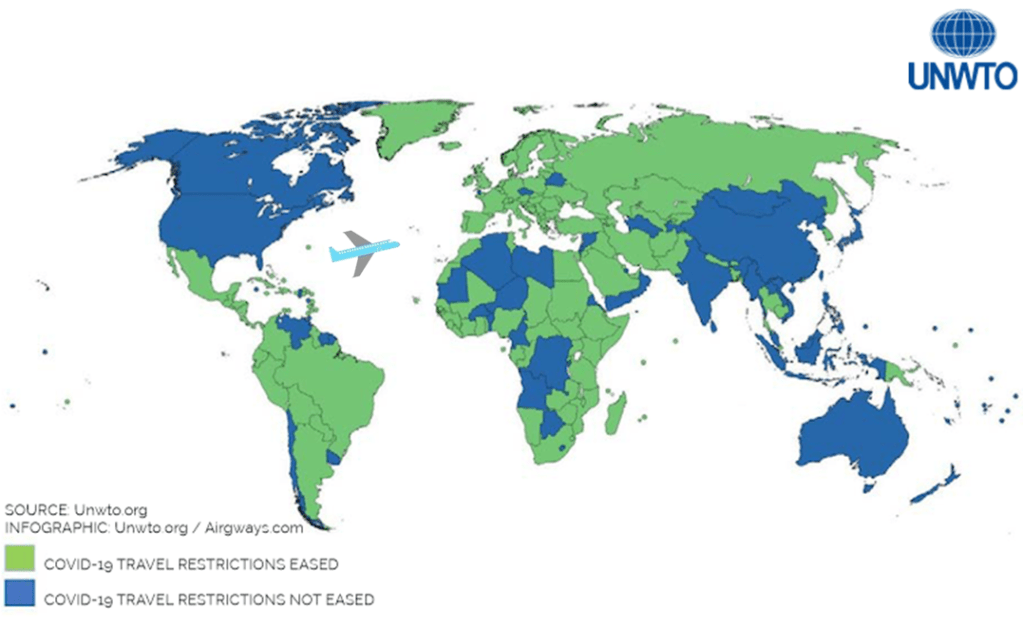
La Organización Mundial del Turismo (OMT) ha publicado un informe en el que se revela que el 70 por ciento de los destinos de todo el mundo han suavizado las restricciones de viaje en respuesta a la pandemia de Coronavirus (Covid-19). Las conclusiones se examinaron en la octava edición del Informe sobre restricciones a los viajes de la OMT, un documento presentado al comienzo de la pandemia para realizar un seguimiento de las medidas adoptadas en 217 destinos mundiales en todo el mundo. Los resultados tienen como objetivo «apoyar los esfuerzos de mitigación y recuperación del sector turístico».
El informe muestra que 152 destinos han suavizado las restricciones al turismo internacional a partir del 1 de Noviembre de 2020, lo que representa un aumento con respecto a los 115 registrados el 1 de Septiembre de 2020. Mientras tanto, uno de cada cuatro destinos sigue manteniendo sus fronteras cerradas a los turistas internacionales, esto ha disminuido de 93 a 59 en el período de dos meses. Europa sigue liderando el camino en el levantamiento de las restricciones, seguida de las Américas, África y Oriente Medio. Asia y el Pacífico, sin embargo, tienen cierres fronterizos más completos en respuesta a la actual pandemia. El Reino Unido levantó su prohibición de viajar internacional para Inglaterra el 2 de Diciembre de 2020, mientras que Estados Unidos está considerando actualmente levantar las restricciones a las llegadas de Europa y Brasil. El estudio también examinó las razones detrás del levantamiento o fortalecimiento de las restricciones, afirmando que aquellos destinos con puntuaciones más altas en indicadores de salud e higiene, así como en el índice de rendimiento ambiental han suavizado las restricciones más rápidamente. Por el contrario, los países y territorios que han mantenido sus fronteras cerradas, la mayoría de los cuales se encuentran en Asia y el Pacífico, tienden a estar dentro de las economías emergentes con puntuaciones relativamente bajas en estos dos factores. El informe también mira hacia el futuro, destacando que los gobiernos pueden desempeñar un papel fundamental en la recuperación del turismo. En la actualidad, seis de los diez mercados de fuentes de turismo más importantes han emitido regulaciones de viaje de acuerdo con evaluaciones de riesgos basadas en evidencia.
Al comentar las conclusiones, el Secretario General de la OMT, Zurab Pololikashvili, dijo: «El levantamiento de las restricciones de viaje es esencial para impulsar nuestra recuperación más amplia de los impactos sociales y económicos de la pandemia. Los gobiernos tienen un papel importante que desempeñar en la prestación de consejos de viaje responsables y dirigidos por los datos y en el trabajo conjunto para levantar las restricciones tan pronto como sea seguro hacerlo».
WTO travel restrictions relief
Prospects for relief from travel restrictions in the world
The World Tourism Organization (UNWTO) has released a report revealing that 70 percent of destinations around the world have eased travel restrictions in response to the Coronavirus (Covid-19) pandemic. The findings were discussed in the eighth edition of the UNWTO Travel Restrictions Report, a document released at the start of the pandemic to track actions taken at 217 global destinations around the world. The results are intended to «support the mitigation and recovery efforts of the tourism sector».
The report shows that 152 destinations have eased restrictions on international tourism as of November 1, 2020, which represents an increase from the 115 registered on September 1, 2020. Meanwhile, one in four destinations continues to maintain its borders closed to international tourists, this has decreased from 93 to 59 in the two-month period. Europe continues to lead the way in lifting restrictions, followed by the Americas, Africa and the Middle East. Asia and the Pacific, however, have more comprehensive border closures in response to the current pandemic. The United Kingdom lifted its international travel ban for England on December 2, 2020, while the United States is currently considering lifting restrictions on arrivals from Europe and Brazil. The study also examined the reasons behind the lifting or strengthening of restrictions, stating that those destinations with higher scores in health and hygiene indicators, as well as in the environmental performance index, have relaxed the restrictions more quickly. In contrast, countries and territories that have kept their borders closed, most of which are in Asia and the Pacific, tend to be among emerging economies with relatively low scores on these two factors. The report also looks to the future, highlighting that governments can play a critical role in the recovery of tourism. Currently, six of the top ten tourism source markets have issued travel regulations based on evidence-based risk assessments.
Commenting on the findings, UNWTO Secretary-General Zurab Pololikashvili said: «The lifting of travel restrictions is essential to further our broader recovery from the social and economic impacts of the pandemic. Governments have an important role to play. play in providing data-driven and responsible travel advice and working together to lift restrictions as soon as it is safe to do so«.
A contrarreloj de la tan ansiada apertura de operaciones en Argentina, el reciente inicio de la obra en el Aeropuerto Mar del Plata/Astor Piazzolla ha provocado malestar en las diferentes agrupaciones turísticas por las fuertes expectativas que hay para la próxima temporada, remarcando la acción como una locura, apuntaron.
En las puertas de un fin de semana largo que abre fuertes expectativas para los operadores turísticos, Mar del Plata no podrá recibir visitantes por la vía aérea a raíz de una serie de obras de remodelación que se iniciaron en los últimos días en la pista del Aeropuerto Internacional Astor Piazzolla de la ciudad balnearia más representativa de Argentina. El reciente comienzo de los trabajos despertó fuerte malestar e indignación en las autoridades locales por el caudal de visitas que se espera recibir con motivo de los feriados nacionales. «Es una locura que no hayan esperado unos días más. No avisaron ni consultaron a nadie», expresaron fuentes oficiales.
En el Ente Municipal de Turismo (Emtur) no tenían ninguna información ni notificación previa sobre el inicio de las tareas que lleva adelante la constructora Pasalto Materiales SRL. La expectativa de Aeropuertos Argentina 2000 (AA2000) es culminar con los trabajos el Viernes 04/12 si las condiciones climáticas lo permiten y reanudar la actividad durante la tarde del Domingo 06/12.
Temporada 2021
Las reservas para el primer fin de semana largo de Diciembre 2020 llegan al 60%. Este fin de semana largo abre expectativas para los empresarios del sector de la ciudad porque se trata de la primera experiencia turística ya con la temporada de verano septentrional declarada desde el 1 de Diciembre de 2020, después de lo que fue durante el mes de Noviembre la prueba con la llegada de miles propietarios no residentes.
En la Asociación Empresaria Hotelera Gastronómica de Mar del Plata (AEHG) confirmaron que las reservas para este fin de semana largo ascienden al 60 por ciento, un número que lleva cierto alivio y esperanza después de más de ocho meses sin ningún tipo de trabajo. Sin embargo, la fuerte limitación en los viajes que suponen las tareas en el aeropuerto abren una nueva incógnita en la actividad.
El movimiento de la estación aérea también se retomó formalmente y de manera paulatina con el correr de Noviembre 2020 a partir de la autorización que concedió el Ministerio de Transporte de la Nación, primero para los trabajadores considerados como esenciales en el contexto de la pandemia del Coronavirus. Durante la etapa de cuarentena más estricta, las puertas solamente se abrieron para distintos vuelos de práctica e instrucción por parte de la Fuerza Aérea Argentina (FAA).
Mar del Plata Airport closed
Mar del Plata Airport closed for works
Against the clock of the long-standing opening of operations in Argentina, the recent start of the work at the Mar del Plata/Astor Piazzolla Airport has caused discomfort in the different tourist groups due to the strong expectations that there are for the next season, highlighting the action as crazy, they pointed out.
On the eve of a long weekend that opens strong expectations for tour operators, Mar del Plata will not be able to receive visitors by air as a result of a series of remodeling works that began in recent days on the airport runway International Astor Piazzolla of the most representative seaside resort of Argnentina. The recent start of the works aroused strong discontent and indignation in the local authorities due to the flow of visits that are expected to be received on the occasion of national holidays. «It is crazy that they did not wait a few more days. They did not notify or consult anyone», said official sources.
In the Municipal Tourism Authority (Emtur) they did not have any information or prior notification about the start of the tasks carried out by the construction company Pasalto Materiales SRL. The expectation of Airports Argentina 2000 (AA2000) is to complete the work on Friday 04/12 if the weather conditions allow it and resume the activity during the afternoon of Sunday 06/12.
Season 2021
Reservations for the first long weekend of December 2020 reach 60%. This long weekend opens up expectations for entrepreneurs in the city sector because it is the first tourist experience with the northern summer season declared since December 1, 2020, after what was during the month of November the test with the arrival of thousands of non-resident owners.
The Mar del Plata Hotel Business Association (AEHG) confirmed that reservations for this long weekend amount to 60 percent, a number that brings some relief and hope after more than eight months without any type of work. However, the strong limitation in the trips that the tasks in the airport suppose opens a new incognito in the activity.
The movement of the air station was also formally and gradually resumed with the running of November 2020 from the authorization granted by the Ministry of Transportation of the Nation, first for workers considered essential in the context of the Coronavirus pandemic . During the strictest quarantine stage, the doors were only opened for different practice and instruction flights by the Argentine Air Force (FAA).
AW | 2020 11 30 10:23 | CONGRESS / TOURISM / AIRLINES
Aerolíneas & Turismo aliadas para superar la crisis
Tourism Innovation Summit (TIS) es la plataforma profesional para transformar el sector turístico a través de la innovación, la tecnología y la sostenibilidad. Los avances tecnológicos han cambiado la forma en que viajamos, aumentando la experiencia del cliente. Además, estar al día con las últimas soluciones y modelos de negocio que replantan nuestra industria es clave para la supervivencia de cualquier negocio que quiera seguir operando. La TIS se ha desarrollado en 2020 en la Ciudad de Sevilla, España, del 25 al 27 de Noviembre de 2020. Tourism Innovation Summit 2020 ha proporcionado a los líderes de la industria turística un espacio de intercambio de estrategias, soluciones tecnológicas y reuniones de negocios para definir las acciones del sector turístico para la próxima década. Donde los más fuertes y los más audaces se reunirán para impulsar el renacimiento del sector.
Aviación & turismo
El mundo del turismo y las aerolíneas han reconocido que se necesitan mutuamente para sortear la crisis y han resaltado que deberán colaborar intensamente en los próximos años, con el objetivo de sumar sinergias que atraigan a los mercados emergentes. Una de las mesas redondas que tuvieron lugar el Viernes 27/11 en el marco del Tourism Innovation Summit 2020 (TIS 2020), ha reunido a más de 200 expertos del sector turístico. En el evento han participado el Director de Ventas y Marketing de American Airlines para España y Portugal, José Antonio Blázquez; la Directora General de Turisme de Barcelona, Marian Muro; el Director de Turismo de Madrid Destino, Héctor Coronel; y el Director del Aeropuerto de Sevilla, Jesús Caballero.
El Director de Agenttravel, Juan Carlos Cavero, ha destacado la importancia de la colaboración público-privada entre destinos, aeropuertos y aerolíneas; la necesidad de redireccionar la promoción a mercados estratégicos como Asia, sin olvidar el refuerzo de otros como Iberoamérica; y la importancia de los corredores seguros y los tests para estimular la demanda. José Antonio Blázquez ha manifestado que las aerolíneas se encuentran actualmente en modo de supervivencia y ha reconocido que de cara al futuro la mayoría reducirá su tamaño en un 30 o 40%. El Directivo de American Airlines ha hecho hincapié en que “no hay compañías aéreas que puedan volar si no se llenan de carga” en el contexto actual, y ha reclamado apoyo a las administraciones. “Necesitamos que los destinos nos ayuden”, ha explicado, al tiempo que admitía que American Airlines le planteó a Barcelona que ante las dificultades que enfrentan para continuar volando. “Para marzo tenemos cinco vuelos a Madrid y cinco a Barcelona, pero si no funciona, en dos o tres semanas cambiamos porque no podemos quemar cash y prefiero poner el avión en el desierto”, ha reafirmado. Para el directivo de American Airlines, la clave es la adaptabilidad y ha pronosticado que si la colaboración con los destinos no funciona, otros sectores turísticos como las agencias, los cruceros o incluso los taxistas, sufrirán el impacto.
Elegir los mercados prioritarios
Tanto José Antonio Blázquez como Marian Muro han coincidido en reclamar con insistencia que se realicen test, tanto en origen como en destino. “Si hay fronteras cerradas y cuarentenas, no salimos adelante”, ha lamentado el Directivo de American Airlines. Adicionalmente, la Directora de Turisme de Barcelona ha manifestado que los destinos deben “tener la capacidad de decidir con el gestor aeroportuario medidas de incentivos para compañías aéreas, que sean acordes con los intereses del destino”. Marian Muro considera que no se debe incentivar a todas las compañías, sino tan solo a las que transporten a los visitantes que son prioritarios para Barcelona, en base a los mercados en los que ha potenciado la promoción de cara a los dos próximos años. “Tenemos claro los mercados por los que queremos apostar”, ha asegurado. Entre ellos, destaca China, para lo cual el organismo está dando clases a agentes de viajes del país asiático sobre Barcelona; otros destinos del sudeste asiático y Estados Unidos, un mercado, este último, vital para los cruceros, expresó Marian Muro.
Madrid también está interesada en atraer al mercado asiático, además de seguir dando cariño a el continente americano, según Héctor Coronel, quien ha puesto el foco en que “el parón tiene que servir de oportunidad para repensar y replantear el futuro”. El Director de Madrid Destino ha enumerado tres medidas en este sentido: el desarrollo del hub de Barajas para reforzar la conectividad, liderar el puente entre América Latina y Asia y pontenciar la entrada a Europa desde estos mercados; y crear el hub intermodal enlazando la T4 con el AVE, aprovechando los fondos europeos. Al igual que el resto de participantes, Héctor Coronel cree que en la atracción de mercados emergentes la colaboración público-privada es esencial y ha puesto como ejemplo la alianza que la capital española está desarrollando con Iberia de cara a la extensión de las estancias de los viajeros latinoamericanos en Madrid.
Para terminar, Jesús Caballero, Director del Aeropuerto Sevilla, ha mostrado su satisfacción por el crecimiento de la aeroestación, que en 2013 ha transportado 3,5 millones de pasajeros y en 2019, superó los 7,5 millones, y ha precisado que estas cifras son fruto de la colaboración entre el Ayuntamiento, los hoteleros, las agencias de viajes, las aerolíneas y el propio aeropuerto, entre otros. “Tenemos que trabajar con los destinos. Damos soporte en información, conocimiento, Big data o análisis. Los aeropuertos somos un eslabón más y debemos adaptarnos a lo que necesitan los destinos, las aerolíneas y los pasajeros”, ha expresado.
Tourism Innovation Summit 2020
Airlines & Tourism allied to overcome the crisis
Tourism Innovation Summit (TIS) is the professional platform to transform the tourism sector through innovation, technology and sustainability. Technological advances have changed the way we travel, increasing the customer experience. In addition, staying up-to-date with the latest solutions and business models that are replacing our industry is key to the survival of any business that wants to continue operating. The TIS has been developed in 2020 in the City of Seville, Spain, from November 25 to 27, 2020. Tourism Innovation Summit 2020 has provided the leaders of the tourism industry with a space for exchanging strategies, technological solutions and business meetings to define the actions of the tourism sector for the next decade. Where the strongest and the most daring will come together to drive the rebirth of the sector.
Aviation & tourism
The world of tourism and airlines have recognized that they need each other to overcome the crisis and have stressed that they will have to collaborate intensively in the coming years, with the aim of adding synergies that attract emerging markets. One of the round tables that took place on Friday 11/27 within the framework of the Tourism Innovation Summit 2020 (TIS 2020), has brought together more than 200 experts from the tourism sector. The event was attended by the Director of Sales and Marketing of American Airlines for Spain and Portugal, José Antonio Blázquez; the Director General of Turisme de Barcelona, Marian Muro; the Director of Tourism of Madrid Destino, Héctor Coronel; and the Director of the Seville Airport, Jesús Caballero.
The Director of Agenttravel, Juan Carlos Cavero, has highlighted the importance of public-private collaboration between destinations, airports and airlines; the need to redirect the promotion to strategic markets such as Asia, without forgetting the reinforcement of others such as Latin America; and the importance of safe corridors and testing to stimulate demand. José Antonio Blázquez has stated that the airlines are currently in survival mode and has recognized that in the future most will reduce their size by 30 or 40%. The Director of American Airlines has emphasized that «there are no airlines that can fly if they are not filled with cargo» in the current context, and has requested support from the administrations. «We need destinations to help us», he explained, while admitting that American Airlines told Barcelona that given the difficulties they face to continue flying. «For March we have five flights to Madrid and five to Barcelona, but if it does not work, in two or three weeks we change because we cannot burn cash and I prefer to put the plane in the desert», he reaffirmed. For the American Airlines executive, the key is adaptability and he has predicted that if collaboration with destinations does not work, other tourism sectors such as agencies, cruise ships or even taxi drivers will suffer the impact.
Choose priority markets
Both José Antonio Blázquez and Marian Muro have concurred in insistently demanding that tests be carried out, both at origin and destination. «If there are closed borders and quarantines, we will not move forward», lamented the Director of American Airlines. Additionally, the Director of Turisme de Barcelona has stated that destinations must «have the ability to decide with the airport manager incentive measures for airlines that are consistent with the interests of the destination». Marian Muro considers that not all companies should be encouraged, but only those that transport visitors who are a priority for Barcelona, based on the markets in which the promotion has been promoted for the next two years. «We are clear about the markets we want to bet on», he assured. Among them, China stands out, for which the organization is giving classes to travel agents from the Asian country on Barcelona; other destinations in Southeast Asia and the United States, a market, the latter, vital for cruise ships, said Marian Muro.
Madrid is also interested in attracting the Asian market, in addition to continuing to give affection to the American continent, according to Héctor Coronel, who has emphasized that «the break must serve as an opportunity to rethink and rethink the future». The Director of Madrid Destino has listed three measures in this regard: the development of the Barajas hub to strengthen connectivity, lead the bridge between Latin America and Asia and promote the entry into Europe from these markets; and create the intermodal hub linking T4 with the AVE, taking advantage of European funds. Like the rest of the participants, Héctor Coronel believes that public-private collaboration is essential in attracting emerging markets and has given as an example the alliance that the Spanish capital is developing with Iberia with a view to extending the stays of the Latin American travelers in Madrid.
Finally, Jesús Caballero, Director of the Sevilla Airport, has shown his satisfaction with the growth of the air station, which in 2013 has transported 3.5 million passengers and in 2019, exceeded 7.5 million, and has specified that these figures They are the result of collaboration between the City Council, hoteliers, travel agencies, airlines and the airport itself, among others. “We have to work with destinations. We support information, knowledge, Big data or analysis. Airports are one more link and we must adapt to what destinations, airlines and passengers need , he said.
Embratur ha festejado sus 54 años de vida este Martes 17/11, marcando la ceremonia conmemorativa con un sello personalizado emitido por la Oficina de Correos de Brasil para la agencia turística. Al acto asistieron el Presidente de Embratur, Gilson Machado Neto y el Presidente de la República, Jair Bolsonaro. Desde Mayo 2020, cuando se sancionó la Medida Provisional 907, Embratur se ha convertido, definitivamente, en un organismo con estatuto de servicio social autónomo, bajo el régimen jurídico de derecho privado, sin ánimo de lucro, de interés colectivo y de utilidad pública. En este formato, puede recibir recursos privados, como contribuciones del Sistema S y ha adquirido más autonomía administrativa para promover productos y servicios turísticos en Brasil y en el extranjero.
Según Gilson Machado, aunque el sector se vio muy afectado durante la pandemia, la recuperación del turismo en Brasil ya se está reflejando en las estadísticas. «Brasil es el país con mayor potencial en el período post-pandemia. Hoy en día, según datos del Ministerio de Turismo, ya tenemos recuperado el 88% de nuestro flujo turístico nacional. Pocos países en el mundo pueden decir eso. Tenemos nuestras aerolíneas volviendo a trabajar alrededor del 80% de las operaciones, y algunos centros ya son 100%, como el Aeropuerto de Recife, que ya ha superado los números de 2019». La semana pasada, el gobierno federal puso en marcha un paquete de medidas para estimular la reanudación del turismo en el país.
Oficina de OMT
Brasil debería albergar una de las oficinas de la Organización Mundial del Turismo (OMT), según Gilson Machado Neto. Durante su intervención, destacó la visita del Director General de la OMT, Zurab Pololikashvili. «Tenemos aquí a la Organización Mundial del Turismo, trayendo excelentes noticias, de que Brasil fue elegido para recibir una de las cuatro oficinas de OMT en el mundo», expresó el Presidente de Embratur.
El Lunes 16/11, Zurab Pololikashvili se ha reunido en Brasilia con el Presidente Jair Bolsonaro. El Director General de la OMT, que es uno de los organismos de las Naciones Unidas, también cumplió una agenda oficial en Río de Janeiro, junto con el Ministro de Turismo, Marcelo Alvaro Antonio. La oficina de OMT en Brasil será la primera de la entidad en América Latina y debería concentrar los esfuerzos para desarrollar el turismo en el continente. Gilson Machado incluso citó a Río de Janeiro, Brasilia y Manaos como posible sede de la oficina de OMT.
54th Anniversaries of EMBRATUR
Embratur Brazil celebrates 54 years of experience
Embratur celebrated its 54 years of life this Tuesday 11/17, marking the commemorative ceremony with a personalized stamp issued by the Brazilian Post Office for the tourist agency. The event was attended by the President of Embratur, Gilson Machado Neto and the President of the Republic, Jair Bolsonaro. Since May 2020, when Provisional Measure 907 was sanctioned, Embratur has definitely become a body with autonomous social service status, under the legal regime of private law, non-profit, collective interest and public utility. In this format, it can receive private resources, such as contributions from the S System and has acquired more administrative autonomy to promote tourism products and services in Brazil and abroad.
According to Gilson Machado, although the sector was severely affected during the pandemic, the recovery of tourism in Brazil is already being reflected in the statistics. «Brazil is the country with the greatest potential in the post-pandemic period. Today, according to data from the Ministry of Tourism, we have already recovered 88% of our national tourist flow. Few countries in the world can say that. We have our airlines returning to work around 80% of the operations, and some centers are already 100%, such as the Recife eAport, which has already exceeded the numbers of 2019». Last week, the federal government launched a package of measures to stimulate the resumption of tourism in the country.
OMT Office
Brazil should host one of the offices of the World Tourism Organization (UNWTO), according to Gilson Machado Neto. During his speech, he highlighted the visit of the Director General of UNWTO, Zurab Pololikashvili. «We have here the World Tourism Organization, bringing excellent news, that Brazil was chosen to host one of the four UNWTO offices in the world», expressed the President of Embratur.
On Monday 11/16, Zurab Pololikashvili met in Brasilia with President Jair Bolsonaro. The Director General of the UNWTO, which is one of the United Nations agencies, also fulfilled an official agenda in Rio de Janeiro, together with the Minister of Tourism, Marcelo Alvaro Antonio. UNWTO’s office in Brazil will be the entity’s first in Latin America and should concentrate efforts to develop tourism on the continent. Gilson Machado even cited Rio de Janeiro, Brasilia and Manaus as possible headquarters for the OMT office.
54º Aniversários da EMBRATUR
Embratur Brasil comemora 54 anos de experiência
A Embratur completou 54 anos de vida nesta terça-feira, 17/11, marcando a solenidade comemorativa com um selo personalizado emitido pelos Correios para a agência de turismo. O evento contou com a presença do presidente da Embratur, Gilson Machado Neto e do presidente da República, Jair Bolsonaro. Desde maio de 2020, quando foi sancionada a Medida Provisória 907, a Embratur tornou-se definitivamente um órgão com caráter autônomo de serviço social, sob o regime jurídico de direito privado, sem fins lucrativos, de interesse coletivo e de utilidade pública. Nesse formato, pode receber recursos privados, como contribuições do Sistema S e adquiriu mais autonomia administrativa para promover produtos e serviços turísticos no Brasil e no exterior.
Segundo Gilson Machado, embora o setor tenha sido bastante afetado durante a pandemia, a recuperação do turismo no Brasil já está refletindo nas estatísticas. “O Brasil é o país com maior potencial no período pós-pandêmico. Hoje, segundo dados do Ministério do Turismo, já recuperamos 88% do nosso fluxo turístico nacional. Poucos países no mundo podem dizer isso. Temos nossas companhias aéreas voltam a trabalhar cerca de 80% das operações, e alguns centros já estão 100%, como o eAport Recife, que já ultrapassou os números de 2019”. Na semana passada, o Governo Federal lançou um pacote de medidas para estimular a retomada do turismo no país.
OMT Office
O Brasil vai sediar um dos escritórios da Organização Mundial do Turismo (OMT), segundo Gilson Machado Neto. Durante seu discurso, ele destacou a visita do Diretor-Geral da OMT, Zurab Pololikashvili. “Temos aqui a Organização Mundial do Turismo, trazendo uma excelente notícia, de que o Brasil foi escolhido para sediar um dos quatro escritórios da OMT no mundo”, expressou o presidente da Embratur.
Na segunda-feira, 16/11, Zurab Pololikashvili se reuniu em Brasília com o presidente Jair Bolsonaro. O Diretor-Geral da OMT, que é uma das agências das Nações Unidas, também cumpriu uma agenda oficial no Rio de Janeiro, ao lado do Ministro do Turismo, Marcelo Alvaro Antonio. O escritório da OMT no Brasil será o primeiro da entidade na América Latina e deve concentrar esforços para desenvolver o turismo no continente. Gilson Machado chegou a citar Rio de Janeiro, Brasília e Manaus como possíveis sedes para o escritório da OMT.
CyberMonday un modelo que tiene réplicas en otros países
Este Lunes 02/11 se inició una nueva edición del CyberMonday, el evento de compras organizado por la Cámara Argentina de Comercio Electrónico (CACE). El evento de grandes ofertas y bonificaciones está habilitado desde el 2 al 4 de Noviembre de 2020. Con el anuncio de la extensión del Plan PreViaje hasta el 15/11y los tres días de descuentos, el sector turístico ve una oportunidad de levantar las ventas. El Travel Sale, un evento similar dedicado íntegramente a la categoría turismo y viajes había sido suspendido por la crisis sanitaria, CyberMonday retoma su arribo para estimular las economías y tirar un pequeño salvavidas a las atribuladas economías de las aerolíneas y el turismo. El CyberMonday 2020 se inicia con récord de marcas ofreciendo en esta modalidad vía internet descuentos, ofertas y cuotas.
Desde las 00.00 horas del 2 al 4 de Noviembre 2020, a través la web www.cybermonday.com.ar se podrá accederse a la lista de beneficios de las empresas adheridas al evento de ofertas económicas para desarrollar las economías del país. Durante el proceso de pandemia el Hot Sale, en Julio 2020, permitió ventas récord en Aerolíneas Argentinas con cerca de 200.000 tickets, superando la marca de 2018, con un 48% más de transacciones realizadas. CyberMonday, organizado por la CACE donde participan más de 800 empresas, entre ellas se encuentran agencias de turismo, aerolíneas y una poluralidad de empresas que activarán sus economías gracias a la ventana que ofrece CyberMonday.
Aerolíneas Argentina participará del evento ofreciendo 12 cuotas sin interés, acceso al programa Pre-viaje y una serie de beneficios que revelarán durante los tres días. Los viajeros podrán acceder a través del sitio web oficial, e incluyen tanto para viajes de cabotaje como internacionales.
Por su parte, las agencias de viajes, en esta oportunidad, apuntan más al turismo interno con el incentivo del plan lanzado por el gobierno. Sin embargo, con la lenta apertura de las fronteras, también ofrecen paquetes y vuelos al extranjero, con la posibilidad de fechas flexibles y las cuotas en pesos.
Assist Card aseguraron que los argentinos se inclinan principalmente por los destinos nacionales cuyas búsquedas en septiembre tuvieron un aumento intermensual del 63%. Entre los beneficios para esta edición, los viajeros argentinos podrán acceder hasta un 50% de descuento en la contratación de sus asistencias en viajes nacionales e internacionales, con opciones según modalidad: diaria o múltiples viajes anuales. Adicionalmente, dispondrán de hasta un 20% de descuento en la contratación de bloques de días, para aquellos que aún no tengan la certeza de su próximo viaje y prioricen la flexibilidad. Alexia Keglevich, CEO Global de Assist Card, afirmó: “Desde la compañía nos unimos al Cyber Monday con el objetivo de apoyar la reactivación de la industria y seguir cuidando de nuestros viajeros. Ya sea en destinos internacionales, donde contar con una asistencia es un requisito obligatorio en más de 40 países, como en destinos nacionales, donde ofrecemos mayores prestaciones que cualquier plan de salud local”.
Argentina launches CiberMonday
CyberMonday a model that has replicas in other countries
This Monday 02/11 began a new edition of CyberMonday, the shopping event organized by the Argentine Chamber of Electronic Commerce (CACE). The event of great offers and bonuses is enabled from November 2 to 4, 2020. With the announcement of the extension of the Pre-Trip Plan until 11/15 and the three days of discounts, the tourism sector sees an opportunity to raise sales. The Travel Sale, a similar event dedicated entirely to the tourism and travel category that had been suspended due to the health crisis, CyberMonday resumes its arrival to stimulate economies and throw a small lifeline to the troubled economies of airlines and tourism. CyberMonday 2020 begins with a record of brands offering discounts, offers and fees in this mode via the internet.
From 00.00 hours from 2 to 4 November 2020, through the website www.cybermonday.com.ar you can access the list of benefits of the companies adhering to the event of economic offers to develop the economies of the country. During the pandemic process, the Hot Sale, in July 2020, allowed record sales in Aerolíneas Argentinas with nearly 200,000 tickets, surpassing the 2018 mark, with 48% more transactions carried out. CyberMonday, organized by the CACE where more than 800 companies participate, among them are tourism agencies, airlines and a multitude of companies that will activate their economies thanks to the window offered by CyberMonday.
Aerolineas Argentina will participate in the event offering 12 interest-free installments, access to the Pre-trip program and a series of benefits that they will reveal during the three days. Travelers can access through the official website, and include both for domestic and international trips.
For their part, travel agencies, this time, are targeting more domestic tourism with the incentive of the plan launched by the government. However, with the slow opening of the borders, they also offer packages and flights abroad, with the possibility of flexible dates and quotas in pesos.
Assist Card assured that Argentines are mainly inclined towards national destinations whose searches in September had a month-on-month increase of 63%. Among the benefits for this edition, Argentine travelers will be able to access up to a 50% discount on hiring their assistance on national and international trips, with options depending on the modality: daily or multiple annual trips. Additionally, they will have up to a 20% discount on the hiring of blocks of days, for those who still do not have the certainty of their next trip and prioritize flexibility. Alexia Keglevich, Global CEO of Assist Card, stated: “From the company we join Cyber Monday with the aim of supporting the reactivation of the industry and continuing to take care of our travelers. Either in international destinations, where having assistance is a mandatory requirement in more than 40 countries, or in national destinations, where we offer greater benefits than any local health plan”.
La República Argentina reanudó los vuelos nacionales regulares el Jueves 22/10 después de una interrupción de siete meses debido a la pandemia de Coronavirus. Los servicios se limitan a los trabajadores esenciales y a aquellos que necesitan tratamiento médico por ahora, y sólo Formosa mantiene la prohibición de la aviación. «El resurgimiento de la conectividad será gradual, dando prioridad a la salud», declaró el Ministerio de Transporte, permitiendo únicamente que los trabajadores esenciales y las personas que necesitan viajar por razones de salud aborden vuelos por ahora. El protocolo requiere que los pasajeros lleven una máscara facial y muestren un certificado de viaje, mientras que algunas provincias también requieren una prueba de prueba negativa para Covid-19 antes de abordar la aeronave o la llegada.
Seguridad sanitaria
Los vuelos regulares en Argentina se interrumpieron el 20 de Marzo de 2020, cuando el Gobierno había decretado una cuarentena general que restringía el transporte público y las fronteras, aunque desde entonces se han levantado gradualmente otras restricciones a las actividades industriales y comerciales, así como la recreación al aire libre. Argentina se convirtió recientemente en uno de los seis países del mundo en alcanzar un total de siete dígitos de casos con una cifra de muertos que superó los 27.000.
Vuelos internacionales
Las fronteras en Argentina permanecen cerradas, mientras que las aerolíneas internacionales solo pueden operar vuelos para transportar a ciudadanos argentinos o residentes que deben observar 14 días de cuarentena a su llegada. Esta semana, en la Argentina se reanudaron los vuelos regulares de cabotaje y se espera que en los próximos días se habilite la operación regular también para los vuelos internacionales. Hasta el momento, las líneas aéreas internacionales y las locales operan vuelos especiales desde y hacia otros países.
Vuelos domésticos
A partir del Jueves 22/10 se reanudaron los servicios aéreos regulares en el mercado de cabotaje. Aerolíneas Argentinas principió con tres vuelos desde el Aeropuerto Ezeiza, que lograron un nivel de ocupación, promedio del 70%.
El dato ha resultado alentados para las otras líneas aéreas domésticas en el mercado aerocomercial argentino JetSmart Airlines Argentina, Flybondi Líneas Aéreas y Andes Líneas Aéreas que continúan evaluando el mejor momento para reanudar sus operaciones aéreas para determinar la rentabilidad que podrán obtener por cada vuelo en un contexto donde todavía hay muchas restricciones para que las personas puedan subirse a un avión. Volar con aviones casi vacíos significa volar a pérdidas.
JetSmart Argentina reiniciará sus operaciones regulares a partir este 23/10 desde el Aeropuerto El Palomar, realizando vuelos hacia Córdoba y Mendoza, según dijo el Gerente General de la empresa, Gonzalo Pérez Corral. También hará un vuelo triangular hacia Tucumán y Salta, como una estrategia para optimizar costos. Flybondi tiene previsto reanudar los vuelos a partir del Lunes 26/10, también desde elAeropuerto El Palomar. La compañía ultra low cost espera la autorización oficial y la confirmación de los requisitos que fija cada provincia para poder programar sus servicios, pero no descarta la opción de arrancar a principios de Noviembre 2020.
Andes Líneas Aéreas reactivaría los vuelos en Diciembre 2020 con dos vuelos por semana, desde el Aeropuerto Buenos Aires/Ezeiza a Jujuy y Salta, pero además estudiaría opciones de rutas triangulares en lugar de vuelos directos, con el fin de reducir costos operativos.
Turismo interno
El Ministerio de Turismo de Argentina adelantaron hace unas semanas que están trabajando en una prueba piloto para recibir a turistas uruguayos en la ciudad de Buenos Aires, que llegarían a través de la empresa Buquebús, previa presentación de test negativos de Coronavirus. De acuerdo a lo que se analiza, la llegada de los turistas de Uruguay que serían los primeros luego de siete meses de fronteras cerradas podría concretarse a principios de Noviembre 2020. Pero solo para pasar una estadía corta, de un par de días, en la ciudad de Buenos Aires. El tipo de cambio hoy resulta muy atractivo para los ciudadanos de los países vecinos que, como en otras épocas, podrían aprovechar la visita para realizar un tour de compras. “La idea avanza, pero aun falta la aprobación final”, explicaron fuentes del Ministerio. Con todo, también están estudiando la posibilidad de una apertura de fronteras para turistas de los demás países limítrofes: Brasil, Chile, Paraguay y Bolivia.
Por ahora, sería para recibir a turistas que lleguen solo por vía aérea y con destino a la ciudad de Buenos Aires por un plazo corto de tiempo, con un máximo de diez días. Deberán presentar un test negativo de coronavirus, pero aun no se definió en qué momento del viaje. El objetivo también es facilitar la llegada de turistas que se pueden ver atraídos por el tipo de cambio para realizar compras en la Argentina. Pero es una idea menos madura que la de Uruguay.
Sin embargo, la iniciativa de una apertura limitada a los turistas uruguayos no será recíproca. Esta semana, el Presidente uruguayo Luis Lacalle Pou anunció que el país no abrirá sus fronteras en la próxima temporada turística del verano por la situación sanitaria. Actualmente Uruguay acumula 2.701 casos positivos, con un promedio de 45 contagios diarios en la última semana. Desde el inicio de la pandemia se produjeron 53 fallecimientos. “Tendremos un verano restringido, de fronteras cerradas. Es una decisión difícil para nosotros. La estiramos todo lo posible”, dijo Lacalle Pou. Durante el año pasado, Uruguay recibió a cerca de 3,5 millones de turistas extranjeros y más del 50% fueron argentinos, que alcanzaron un total de 1,8 millones.
A pesar de la situación sanitaria, con récord de casos de Coronavirus en las últimas semanas, desde el Ministerio de Turismo aseguran que habrá temporada de verano para los turistas locales. Están trabajando en varias medidas para asegurar que pueda haber movimiento turístico en los próximos meses. Estiman que durante el verano se podrán movilizar entre 7 y 9 millones de turistas locales. En las buenas temporadas de los años anteriores, ese número se ubicó en los 15 millones de turistas.
Argentina aviation and tourism
Government evaluation of the reactivation of flights and tourism
The Argentine Republic resumed regular domestic flights on Thursday 10/22 after a seven-month interruption due to the Coronavirus pandemic. Services are limited to essential workers and those who need medical treatment for now, and only Formosa maintains the aviation ban. «The resurgence of connectivity will be gradual, prioritizing health», the Transport Ministry declared, allowing only essential workers and people who need to travel for health reasons to board flights for now. The protocol requires passengers to wear a face mask and show a travel certificate, while some provinces also require a negative proof test for Covid-19 before boarding the aircraft or arrival.
Health security
Regular flights in Argentina were interrupted on March 20, 2020, when the Government had decreed a general quarantine that restricted public transport and borders, although since then other restrictions on industrial and commercial activities have been gradually lifted, as well as the outdoor recreation. Argentina recently became one of only six countries in the world to reach a seven-digit total of cases with a death toll that exceeded 27,000.
International flights
The borders in Argentina remain closed, while international airlines can only operate flights to transport Argentine citizens or residents who must observe 14 days of quarantine upon arrival. This week, in Argentina the regular domestic flights were resumed and it is expected that in the next few days regular operation will also be enabled for international flights. So far, international and local airlines operate special flights to and from other countries.
Domestic flights
As of Thursday 10/22, regular air services were resumed in the cabotage market. Aerolineas Argentinas began with three flights from Ezeiza Airport, which achieved an average occupancy level of 70%.
The data has been encouraged for the other domestic airlines in the Argentine commercial aviation market JetSmart Airlines Argentina, Flybondi Líneas Aéreas and Andes Líneas Aéreas, which continue to evaluate the best moment to resume their air operations to determine the profitability they can obtain for each flight in a context where there are still many restrictions for people to get on a plane. Flying with almost empty planes means flying at a loss.
JetSmart Argentina will restart its regular operations starting this 10/23 from the El Palomar Airport, making flights to Córdoba and Mendoza, according to the General Manager of the company, Gonzalo Pérez Corral. It will also make a triangular flight to Tucumán and Salta, as a strategy to optimize costs. Flybondi plans to resume flights from Monday 10/26, also from El Palomar Airport. The ultra lowcost company awaits the official authorization and confirmation of the requirements set by each province to be able to program its services, but does not rule out the option of starting at the beginning of November 2020.
Andes Lineas Aereas would reactivate flights in December 2020 with two flights per week, from the Buenos Aires/Ezeiza Airport to Jujuy and Salta, but it would also study options for triangular routes instead of direct flights, in order to reduce operating costs.
Internal tourism
The Ministry of Tourism of Argentina announced a few weeks ago that they are working on a pilot test to receive Uruguayan tourists in the city of Buenos Aires, who would arrive through the Buquebús company, after presenting negative tests for Coronavirus. According to what is analyzed, the arrival of tourists from Uruguay, who would be the first after seven months of closed borders, could take place at the beginning of November 2020. But only to spend a short stay, of a couple of days, in the Buenos aires city. The exchange rate today is very attractive for citizens of neighboring countries who, as in other times, could take advantage of the visit to go on a shopping tour. «The idea is moving forward, but the final approval is still missing», ministry sources explained. However, they are also studying the possibility of opening borders for tourists from other neighboring countries: Brazil, Chile, Paraguay and Bolivia.
For now, it would be to receive tourists who arrive only by air and bound for the city of Buenos Aires for a short period of time, with a maximum of ten days. They must present a negative test for coronavirus, but it has not yet been defined at what time of the trip. The objective is also to facilitate the arrival of tourists who may be attracted by the exchange rate to make purchases in Argentina. But it is a less mature idea than Uruguay’s.
However, the initiative of a limited opening to Uruguayan tourists will not be reciprocal. This week, Uruguayan President Luis Lacalle Pou announced that the country will not open its borders in the next summer tourist season due to the health situation. Uruguay currently accumulates 2,701 positive cases, with an average of 45 infections a day in the last week. Since the beginning of the pandemic there have been 53 deaths. “We will have a restricted summer, with closed borders. It is a difficult decision for us. We stretch it as much as possible”, said Lacalle Pou. During the past year, Uruguay received about 3.5 million foreign tourists and more than 50% were Argentine, who reached a total of 1.8 million.
Despite the health situation, with a record of Coronavirus cases in recent weeks, the Ministry of Tourism assures that there will be a summer season for local tourists. They are working on various measures to ensure that there can be a tourist movement in the coming months. They estimate that during the summer it will be possible to mobilize between 7 and 9 million local tourists. In the good seasons of previous years, that number stood at 15 million tourists.























 airgways.com