Sin novedades del vuelo MH370

mh370_youtube

AW | 2018 05 01 19:08 | AVIATION SAFETY / AIR INVESTIGATION

El vuelo MH370 de Malaysia Airlines sigue desaparecido después de que AW-70083772el escáner en el fondo del océano no haya encontrado ningún signo de restos

Un nuevo escaneo del fondo del Océano Índico para el vuelo MH370 de Malaysia Airlines ha registrado casi 80.000 kilómetros cuadrados desde Enero 2018 sin encontrar ningún rastro de los restos del Boeing 777-200ER. Pero la compañía que busca el avión, que ha estado desaparecida durante más de cuatro años, dijo que todavía está decidido a encontrarlo.

Esto se produce a pesar de las esperanzas iniciales de que se haya identificado un área de 25.000 kilómetros cuadrados con la mayor probabilidad de contener el avión desaparecido.

Ocean Infinity, la compañía de tecnología estadounidense que realiza la última búsqueda, dijo en una actualización el lunes que había escaneado hasta 1.300 kilómetros cuadrados por día desde que lanzó su misión lejos de la costa oeste de Australia a fines de Enero 2018. Ha buscado tanto dentro como fuera de un área identificada por las autoridades australianas.

«Aunque es decepcionante que no haya señales de MH370 en el área de búsqueda de la Oficina de Seguridad del Transporte de Australia y más al norte, todavía queda algo de tiempo de búsqueda», dijo el Director Ejecutivo de Ocean Infinity, Oliver Plunkett, en un comunicado. «Todos en Ocean Infinity permanecen absolutamente determinados para el resto de la búsqueda», dijo.

El vuelo MH370 desapareció el 8 de Marzo de 2014, mientras se dirigía de Kuala Lumpur, Malasia, a Beijing con 239 personas a bordo. No se recibieron transmisiones de la aeronave después de los primeros 38 minutos de vuelo, pero se cree que se estrelló en el extremo sur del Océano Índico en base a los patrones de deriva de los restos del choque que llegaron a las playas distantes.

Los gobiernos de Malasia, China y Australia suspendieron la búsqueda oficial de casi tres años en enero de 2017. El informe final de la Oficina de Seguridad del Transporte de Australia confirmó que las autoridades no estaban más cerca de saber las razones de la desaparición del avión o su ubicación exacta.

En Enero 2018, el gobierno malasio se comprometió a pagarle a Ocean Infinity, con sede en Texas, hasta U$S 70 millones si pudiera encontrar los restos o las cajas negras del avión dentro de los 90 días. Ocean Infinity usa hasta ocho vehículos autónomos capaces de operar en profundidades de hasta 6.000 metros (19.685 pies), y Plunkett lanzó la búsqueda diciendo que su compañía tenía «una perspectiva realista» para encontrar el avión. Dijo el lunes que su tecnología se había desempeñado «excepcionalmente bien», con «cantidades significativas de datos de alta calidad» recopilados.

El buque de investigación Seabed Constructor de la compañía se detendrá en el puerto de Fremantle, en Australia Occidental, para reabastecimiento y rotación de la tripulación antes de volver a la búsqueda hasta que se vea obligado a abandonar en el invierno del hemisferio sur. La declaración de Plunkett indicó que la búsqueda de Ocean Infinity podría detenerse antes de mediados de Junio debido a las condiciones climáticas en el mar.

El informe final de la Oficina de Seguridad del Transporte Australiano (ASTB) sobre la búsqueda reconoció que las autoridades no estaban más cerca de saber las razones de la desaparición del avión o su ubicación exacta.  AIRWAYS® AW-Icon TXT

Resultado de imagen para ocean infinity mh370

No news of flight MH370

Malaysia Airlines flight MH370 is still missing after the scanner at the bottom of the ocean has not found any signs of debrisin-memory-of-mh370-1170x200c-1

A new scan of the bottom of the Indian Ocean for Malaysia Airlines flight MH370 has registered almost 80,000 square kilometers since January 2018 without finding any trace of the remains of the Boeing 777-200ER. But the company that seeks the plane, which has been missing for more than four years, said it is still determined to find it.

This occurs despite initial hopes that an area of ​​25,000 square kilometers has been identified as having the best chance of containing the missing plane.

Resultado de imagen para Ocean infinity logoOcean Infinity, the US technology company that performs the last search, said in an update on Monday that it had scanned up to 1,300 square kilometers per day since it launched its mission away from the west coast of Australia at the end of January 2018. inside as well as outside an area identified by the Australian authorities.

«Although it is disappointing that there are no signs of MH370 in the search area of ​​the Australian Transportation Security Bureau and further north, there is still some time to search», Ocean Infinity CEO Oliver Plunkett said. a statement. «Everyone at Ocean Infinity remains absolutely determined for the rest of the search», he said.

Flight MH370 disappeared on March 8, 2014, while it was heading from Kuala Lumpur, Malaysia, to Beijing with 239 people on board. Transmissions of the aircraft were not received after the first 38 minutes of flight, but it is believed that it crashed at the southern end of the Indian Ocean based on the drift patterns of the wreckage that reached the distant beaches.

The governments of Malaysia, China and Australia suspended the official search for nearly three years in January 2017. The final report from the Australian Transportation Security Office confirmed that the authorities were no closer to knowing the reasons for the disappearance of the plane or its exact location.

In January 2018, the Malaysian government committed to pay Ocean Infinity, based in Texas, up to $ 70 million if it could find the wreckage or black boxes of the plane within 90 days. Ocean Infinity uses up to eight autonomous vehicles capable of operating at depths of up to 6,000 meters (19,685 feet), and Plunkett launched the search saying that their company had «a realistic perspective» to find the plane. He said on Monday that his technology had performed «exceptionally well,» with «significant amounts of high-quality data» being compiled.

The company’s Seabed Constructor research vessel will stop at the port of Fremantle, in Western Australia, for refueling and crew rotation before returning to the search until it is forced to leave in the southern hemisphere winter. Plunkett’s statement indicated that the search for Ocean Infinity could be stopped before mid-June due to weather conditions at sea.

The final report from the Australian Transportation Security Office on the search acknowledged that the authorities were no closer to knowing the reasons for the disappearance of the aircraft or its exact location. A \ W

MH370 SEARCH WEEKLY REPORT 13

Desarrollos clave de la búsqueda operativa actualizaciones semanales # 13; 27/04/2018

Desarrollos clave:

  • Todos los AUV disponibles se lanzaron para la operación de búsqueda
  • Ocean Infinity ha completado el levantamiento del Sitio 1 / Áreas 01, 02 y 03 y el Sitio 2 / Áreas 01, 02 y 03 y se ha trasladado al Sitio 3 / Área 01 y Área 02
  • Se espera que Ocean Infinity abandone el área de búsqueda de Fremantle a fines de esta semana para un cambio técnico de personal, reabastecimiento de combustible y reabastecimientos
  • El área total cubierta dentro del Sitio 1 y el Sitio 2 es de 53,000 kilómetros cuadrados y 11,500 kilómetros cuadrados dentro del Sitio 3
  • El clima y la condición del mar son favorables para las operaciones de búsqueda, excepto el 21 de abril y el 22 de abril de 2018, cuando se encontraron condiciones climáticas marginales. A \ W

MH370 SEARCH WEEKLY REPORT 13

Operational search key developments weekly updates #13; 27/04/2018

MH370 SEARCH WEEKLY REPORT 13
Key developments of the operational search weekly updates # 13; 04/27/2018

Key developments:

•  All available AUVs were launched for the search operation
•  Ocean Infinity has completed the survey of Site 1 / Areas 01, 02 and 03 and Site 2 / •  Areas 01, 02 and 03 and has been moved to Site 3 / Area 01 and Area 02
•  Ocean Infinity is expected to leave the Fremantle search area later this week for a technical change in personnel, refueling and refueling
•  The total area covered within Site 1 and Site 2 is 53,000 square kilometers and 11,500 square kilometers within Site 3
•  The climate and the condition of the sea are favorable for the search operations, except on April 21 and April 22, 2018, when marginal climatic conditions were found. A\W


Ξ A I R G W A Y S Ξ
SOURCE:  Airgways.com
DBk:  Oceaninfinity.com / Ainonline.com / Airgways.com
AW-POST: 2018051908AR

A\W   A I R G W A Y S ®

Informe Final LMI2933 LaMia Airlines

Resultado de imagen para LaMia AVRO RJ85

AW | 2018 04 28 08:35 | AIR INVESTIGATION / AVIATION SAFETY

Informe final sobre el accidente del vuelo LMI 2933 de LaMia confirma la falta de combustible de la aeronave AVRO RJ-85 como causa de la tragedia

Según Aeronáutica Civil de Colombia, la aeronave «tenía un déficit de 2,303 kilogramos de combustible, ya que para recorrer la ruta Santa Cruz-Rionegro las disposiciones del sector exigían una cantidad mínima de combustible de 11,603 kilogramos y esta aeronave solo contaba con 9,300 kgs».

La falta de combustible y la mala gestión de riesgo fue la causa del accidente del avión de la empresa boliviana LaMia que cobró 71 vidas, según el informe final de Aeronáutica Civil de Colombia dado a conocer este viernes.

Resultado de imagen para LaMia AVRO RJ85

Según destaca el reporte, la empresa LaMia planeó sin escalas el vuelo charter donde iba en su mayoría el club brasileño de fútbol Chapecoense que cubría la ruta Santa Cruz y Rionegro en el cual «no cumplió con los requisitos de cantidad mínima de combustible exigidos en las normas internacionales, pues no tuvo en cuenta el combustible requerido para volar a un aeropuerto alterno, el de contingencia, el de reserva ni el combustible mínimo de aterrizaje», dice el comunicado escrito.

Según reza el reporte, la aeronave «tenía un déficit de 2,303 kilogramos de combustible, ya que para recorrer la ruta Santa Cruz-Rionegro las disposiciones del sector exigían una cantidad mínima de combustible de 11,603 kilogramos y esta aeronave solo contaba con 9,300 kgs».

El factor humano fue determinante en todos los procedimientos que llevaron a uno de los peores accidentes aéreos de la historia de Colombia básicamente porque la tripulación tomó malas decisiones al no hacer una escala para recargar combustible ni alertar a tiempo a la torre de control en Rionegro de su estado de emergencia.

Solo seis personas lograron sobrevivir al accidente. El plan original del Chapecoense era volar directamente desde Brasil a Colombia en un vuelo fletado. La Agencia Nacional de Aviación Civil (ANAC) de Brasil no lo autorizó. El Chapecoense cambió sus planes y voló hasta Santa Cruz de la Sierra, donde tomó el vuelo de LaMia.

Una de las conclusiones más impactantes del informe final de Aeronáutica Civil es que «ni la empresa ni la tripulación, aunque eran conscientes de la escasa cantidad de gasolina para terminar el vuelo en Rionegro, tomaron la decisión de no aterrizar en otro aeropuerto en ruta para reabastecer y completar así la cantidad mínima de combustible para proceder con seguridad a su destino final. La tripulación descartó un aterrizaje en Bogotá, u otro aeropuerto, para reabastecer».

Con respecto a la mala gestión, el informe establece que LaMia tenía deficiencias organizacionales, una difícil situación económica, inconvenientes en la dotación de cargos y problemas en su sistema de gestión de seguridad operacional y en el cumplimiento de las políticas de combustibles: «Pese a que estaban establecidas en los manuales, no se cumplían en la práctica».

Unos 22 técnicos participaron en la investigación que determinó que la aeronave estaba en buenas condiciones, tenía el mantenimiento actualizado y que además contaba con una tribulación experimentada.

La Aeronáutica Civil de Colombia enfatizó en que los operadores aéreos deben cumplir las normas establecidas en todo sentido, «sobre todo en este caso que tiene que ver con las cantidades mínimas de combustible. Esta es una norma que no se puede incumplir», remarcó.

Asimismo, la OACI recibió la recomendación de revisar la normatividad acerca de los vuelos chárter para que oriente «cómo se puede mejorar esa exigencia de requisitos que pueden ser poco permisivos».

El 27 de abril de 2018, el GRIAA de Colombia dio a conocer su informe final y concluyó que las causas probables del accidente fueron:

Inadecuada planificación y ejecución del vuelo con una cantidad de combustible que no incluía combustible para el desvío del destino a un aeropuerto alternativo, cualquier contingencia, cualquier reserva, el combustible mínimo requerido después del aterrizaje como lo hubieran requerido las regulaciones para el tipo de vuelo internacional realizado por CP-2933.

Los cuatro motores se apagaron en secuencia mientras la aeronave descendía hacia el patrón de espera en GEMLI como resultado del agotamiento del combustible.

La toma de decisiones inadecuadas dentro de la administración del operador resulta en la falta de seguridad operacional.

Pérdida del conocimiento situacional y toma de decisiones inadecuada por parte de la tripulación, que mantuvo su fijación para completar el vuelo con una cantidad extremadamente limitada de combustible. La tripulación era consciente del bajo nivel de combustible restante, sin embargo, no tomó las medidas correctivas necesarias, por ejemplo, para aterrizar en un aeródromo y reponer el combustible.

Los factores que contribuyeron fueron:

configuración prematura de la aeronave para el aterrizaje durante el descenso hacia el patrón de espera en GEMLI. Considerando la ausencia de empuje, esta configuración afectó la distancia de vuelo a la pista del aeropuerto de Rionegro.

Deficiencias latentes en la planificación y ejecución de vuelos de transporte no regulares por el operador, en particular suministro insuficiente de combustible.

Deficiencias específicas en la planificación del vuelo del accidente por parte del operador de la aeronave.

Falta de supervisión y control operacional del vuelo por parte del operador que no supervisó la planificación del vuelo ni su ejecución y no siguió el vuelo para ayudar a la tripulación en la toma de decisiones.

Ausencia de llamadas oportunas que solicitan urgencia o declaración de emergencia (o similar) por la tripulación del avión durante el vuelo, especialmente cuando el agotamiento del combustible ya era inminente durante el descenso, lo que podría haber alertado al control del tráfico aéreo para proporcionar el apoyo necesario.

Desviación organizativa y operativa de los procedimientos de gestión de combustible por parte del operador, que en la práctica no cumplió con la aprobación de la DGCA de Bolivia durante la certificación de la empresa.

Retraso durante el acercamiento de la aeronave a la pista de Rionegro debido a su solicitud de prioridad tardía y la solicitud de emergencia tardía para el combustible agregado a la densidad de tráfico en el patrón de espera VOR RNG.

El GRIAA informó en 2015 que una inspección reveló deficiencias operacionales dentro del operador, en particular debido a la administración inadecuada de combustible. En 2016, el operador realizó tres vuelos desde Río Negro a Cobija (como destino declarado del vuelo), pero continuó hacia Viru Viru (que fue declarado aeródromo alternativo pero era el destino real), por lo que era probable que el operador no cumpliera con los requisitos mínimos de combustible.

El CP-2933 fue originalmente creado para realizar dos vuelos, uno desde Sao Paulo hasta Río Negro y luego desde Río Negro hasta Chapeco. Las Autoridades de Brasil denegaron la autorización para el vuelo en base a sus reglamentaciones impidiendo vuelos desde Brasil a un tercer país (Brasil como punto de origen, Bolivia para el operador y Colombia como destino). Por lo tanto, otra compañía realizó el vuelo Sao Paulo-Santa Cruz y el CP-2933 debía volar desde Santa Cruz a Río Negro con un equipo diferente al originalmente programado para realizar los vuelos.

El operador logró obtener la solicitud del vuelo no rechazado por la Autoridad Aeronáutica Colombiana que no tenía una Secretaría de Seguridad Aérea ni hizo un estudio del seguro actual que excluyó la operación del avión en Colombia.

La oficina de ARO / AIS notó que el plan de vuelo presentado por el operador mostraba un tiempo de ruta estimado (EET) similar a la resistencia de la aeronave. Esta observación no fue considerada por el operador y el plan de vuelo fue archivado.

El avión partió de Santa Cruz con un total de 9,073 kg de combustible. El combustible mínimo requerido para realizar el vuelo a Río Negro de acuerdo con las regulaciones fue de 12,052 kg, sin embargo, por encima de la capacidad del tanque de combustible de la aeronave. El avión partió de Santa Cruz con un peso calculado de despegue de 42.148 kh, 348 kg por encima del peso máximo de despegue. No hubo evidencia de una hoja de carga en la oficina del operador en Santa Cruz.

De acuerdo con el CVR, la tripulación discutió repetidamente la situación del combustible y la optimización de los cruceros y los descensos, incluida una posible desviación a Bogotá para reabastecerse de combustible.

El ATC de Colombia había despejado el vuelo para la ruta más directa desde el punto de entrada al espacio aéreo colombiano hasta Río Negro. Una autorización del Centro de Control del Área de Bogotá para proceder directamente a NIRSO, cerca del aeropuerto de destino, motivó a la tripulación a descartar definitivamente una desviación a Bogotá. La grabación del CVR terminó prematuramente a 550 nm de Río Negro, 100 minutos antes del accidente. La investigación no pudo determinar por qué el CVR detuvo eso temprano. Las grabaciones de datos de vuelo cesaron a aproximadamente 180 nm de VOR RNG. Aproximadamente 40 minutos antes de la última grabación de FDR, se había producido una advertencia de bajo nivel de combustible.En ese punto, el avión estaba a 77 nm de Bogotá y a 135 nm de Cali. Sin embargo, la tripulación no informó al ATC sobre la situación del combustible.

Mientras tanto, ATC se ocupó de una aeronave que sospechaba una fuga de combustible al acercarse a Río Negro, lo que retrasó el CP-2933 (ya que la situación del combustible era desconocida para ATC) y otros tres aviones. 68nm de VOR RNG ATC dio instrucciones a la tripulación para que ingrese a la bodega de RNG sin proporcionar una estimación del tiempo previsto de aproximación. De nuevo, la tripulación no informó sobre la situación crítica del combustible.

A 24nm del RNG VOR, la tripulación solicitó y se aprobó su mantenimiento en GEMLI, nuevamente sin informar sobre la baja cantidad de combustible restante. El avión completó una ronda en la explotación, antes de comenzar el segundo circuito, la tripulación pidió prioridad debido a problemas de combustible. ATC informó que serían transferidos al localizador en 7 minutos. La tripulación aceptó nuevamente sin declarar emergencia.

Unos 71 segundos después de que CP-2933 había solicitado prioridad, ATC despejó el otro avión que llegaba con una presunta fuga de combustible para el acercamiento a Río Negro.

Durante el segundo circuito en la bodega, 195 segundos después de que la tripulación pidió prioridad, la tripulación declaró Mayday, giró inmediatamente a la izquierda fuera del patrón de espera y salió de FL210. ATC canceló la autorización de aproximación para la otra aeronave y ordenó a otras aeronaves en la bodega de RNG que vuelen hacia el oeste para salir del camino.

Al salir de FL210, la tripulación desplegó los frenos de velocidad, extendió el tren de aterrizaje en FL205 y en FL180 comenzó a extender las aletas llegando a 24 grados de flaps. ATC aprobó el CP-2933 para el acercamiento, proporcionó información de tráfico sobre el otro avión en el área y avisó que la pista estaba mojada. En el motor FL196 n. ° 3 apagado, a 18,876 pies el motor n. ° 4 se apagó, a 17,946 pies las compuertas se ajustaron a lleno, a 17,290 pies se paró el motor n. ° 2 y a 15942 pies se paró el motor n. ° 1. Siete segundos después del apagado del último motor, el FDR dejó de registrar 15.5nm antes del umbral de la pista 01 en un CAS de 115 KIAS, 142 nudos sobre el suelo y una altitud de 15,943 pies. La tripulación informó una falla eléctrica total y solicitó vectores repetidamente. Después de que el último motor se apagó, el avión se deslizó otros 5.5nm hasta el impacto. 71 personas murieron en el accidente. AIRWAYS® AW-Icon TXT

Al menos 76 muertos al estrellarse un avión en Colombia en el que...

Final Report LMI2933 LaMia Airlines

Final report on the accident of flight LMI 2933 of LaMia confirms the lack of fuel of the aircraft AVRO RJ-85 as cause of the tragedy

According to Civil Aeronautics of Colombia, the aircraft «had a deficit of 2,303 kilograms of fuel, since to travel the route Santa Cruz-Rionegro the provisions of the sector required a minimum amount of fuel of 11,603 kilograms and this aircraft only had 9,300 kgs».

The lack of fuel and poor risk management was the cause of the plane crash of the Bolivian company LaMia that claimed 71 lives, according to the final report of Colombia’s Civil Aeronautics released on Friday.

According to the report, the company LaMia planned without stopovers the charter flight where most of the Brazilian soccer club Chapecoense covered the route Santa Cruz and Rionegro in which «it did not meet the requirements of minimum amount of fuel required in the international standards, because it did not take into account the fuel required to fly to an alternate airport, the contingency airport, the reserve airport or the minimum landing fuel», the written statement said.

According to the report, the aircraft «had a deficit of 2,303 kilograms of fuel, since to travel the route Santa Cruz-Rionegro the provisions of the sector required a minimum amount of fuel of 11,603 kilograms and this aircraft only had 9,300 kgs».

The human factor was decisive in all the procedures that led to one of the worst air accidents in the history of Colomnia basically because the crew made bad decisions by not making a stop to refuel or alert the control to Rionegro in time. your state of emergency.

Only six people survived the accident. The original Chapecoense plan was to fly directly from Brazil to Colombia on a chartered flight. The National Agency of Civil Aviation (ANAC) of Brazil did not authorize it. The Chapecoense changed his plans and flew to Santa Cruz de la Sierra, where he took the LaMia flight.

One of the most striking conclusions of the final report of Civil Aeronautics is that «neither the company nor the crew, although they were aware of the small amount of gasoline to finish the flight in Rionegro, made the decision not to land at another airport en route to replenish and complete the minimum amount of fuel to proceed safely to its final destination.The crew ruled out a landing in Bogota, or another airport, to replenish».

With regard to mismanagement, the report states that LaMia had organizational deficiencies, a difficult economic situation, inconveniences in the allocation of positions and problems in its safety management system and compliance with fuel policies: «Despite that were established in the manuals, were not met in practice».

Some 22 technicians participated in the investigation that determined that the aircraft was in good condition, had maintenance updated and also had an experienced tribulation.

The Civil Aeronautics of Colombia emphasized that air operators must comply with the rules established in every sense, «especially in this case that has to do with the minimum amounts of fuel. This is a rule that can not be breached», he said.


In addition, ICAO received the recommendation to revise the regulations on charter flights so that it can guide «how to improve that requirement of requirements that may be less permissive».

On Apr 27th 2018 Colombia’s GRIAA released their final report concluding the probable causes of the crash were:

Inappropriate planning and execution of the flight with an amount of fuel that did not include any fuel for a diversion from destination to an alternate airport, any contingency, any reserve, the required minimum fuel after landing as would have been required by regulations for the type of international flight performed by CP-2933.

The four engines shut down in sequence while the aircraft descended towards the holding pattern at GEMLI as result of depletion of fuel.

Inadequate decision making within the operator’s management resulting in lack of assurance of operational safety.

Loss of situational awareness and inadequate decision making by the crew which maintained their fixation to complete the flight with an extremely limited amount of fuel. The crew was aware of the low level of remaining fuel, however, did not take corrective actions required, e.g. to land at an aerodrome and replenish the fuel.

Contributing factors were:

Premature configuration of the aircraft for landing during the descent towards the holding pattern at GEMLI. Considering the absence of thrust this configuration affected the gliding distance to Rionegro Airport’s runway.

Latent deficiencies in the planning and execution of non-regular transportation flights by the operator, in particular insufficient supply of fuel.

Specific deficiencies in the planning of the accident flight by the operator of the aircraft.

Lack of supervision and operational control of the flight by the operator who did not supervise the planning of the flight nor its execution and did not follow up on the flight to assist the crew in decision making.

Absence of timely calls requesting urgency or declaring emergency (or similiar) by the crew of the aircraft during the flight, especially when fuel depletion was already imminent during the descent, which could have alerted air traffic control to provide the support needed.

Organizational and operational deviation from fuel management procedures by the operator, who in practise did not comply with the approval by Bolivia’s DGCA during certification of the company.

Delay during the approach of the aircraft to Rionegro runway due to its late priority request and late emergency call for fuel added to the traffic density in the VOR RNG holding pattern.

The GRIAA reported in 2015 an inspection revealed operational deficiencies within the operator, in particular due to inadequate fuel management. In 2016 the operator performed three flights from Rio Negro to Cobija (as declared destination of the flight), however continued to Viru Viru (which was declared alternate aerodrome but was the real destination), as such it was likely the operator did not comply with the minimum fuel requirements.

CP-2933 was originally chartered to perform two flights, one from Sao Paulo to Rio Negro and then from Rio Negro to Chapeco. Brazil’s Authorities had denied authorization for the flight based on their regulations preventing flights from Brazil to a third country (Brazil as point of origin, Bolivia for the operator and Colombia as destination). Therefore another company performed the flight Sao Paulo-Santa Cruz and CP-2933 was to fly from Santa Cruz to Rio Negro with a crew different from the one that had originally been scheduled to perform the flights.

The operator managed to get the request for the flight not rejected by Colombian Aeronautical Authority who did not have an Air Safety Secretariat nor made a study of the current insurance which excluded operation of the aircraft in Colombia.

The ARO/AIS office noticed, that the flight plan presented by the operator showed an estimated enroute time (EET) similiar to the endurance of the aircraft. This observation was not considered by the operator and the flight plan was filed.

The aircraft departed Santa Cruz with a total of 9,073 kg of fuel. The minimum fuel required to perform the flight to Rio Negro in accordance with regulations was 12,052kg however, above the aircraft’s fuel tank capacity. The aircraft departed Santa Cruz with a computed takeoff weight of 42,148 kh, 348kg above maximum takeoff weight. There was no evidence of a load sheet at the operator’s office in Santa Cruz.

According to the CVR the crew repeatedly discussed the fuel situation and optimization of cruise and descent, including a possible diversion to Bogota for refueling.

Colombia’s ATC had cleared the flight for the most direct route from point of entry into Colombian Airspace to Rio Negro. A clearance by Bogota Area Control Center to proceed direct to NIRSO, near the destination airport, motivated the crew to definitely rule out a diversion to Bogota. The CVR recording ended prematurely about 550nm from Rio Negro, 100 minutes prior to the accident. The investigation was unable to determine why the CVR stopped that early. The flight data recordings ceased about 180nm from VOR RNG. About 40 minutes prior to the last FDR recording a low fuel level warning had occurred. At that point the aircraft was 77nm from Bogota and 135nm from Cali. However, the crew did not inform ATC about the fuel situation.

In the meantime ATC dealt with an aircraft suspecting a fuel leak on approach to Rio Negro, which delayed CP-2933 (as the fuel situation was unknown to ATC) and three other aircraft. 68nm from VOR RNG ATC instructed the crew to enter the hold of RNG without providing an estimate for the anticipated time of approach. Again, the crew did not advise of the critical fuel situation.

24nm from RNG VOR the crew requested and was approved to hold at GEMLI, again without advising of the low fuel quantity remaining. The aircraft completed one round in the holding, before starting the second circuit the crew requested priority due to fuel problems. ATC advised they would be vectored onto the localizer in 7 minutes. The crew accepted again without declaring emergency.

71 seconds after CP-2933 had requested priority ATC cleared the other aircraft arriving with a suspected fuel leak for the approach to Rio Negro.

During the second circuit in the hold, 195 seconds after the crew requested priority, the crew declared Mayday, immediately veered left out of the holding pattern and left FL210. ATC cancelled the approach clearance for the other aircraft and instructed other aircraft in the hold of RNG to fly towards the west to get out of the way.

When leaving FL210 the crew deployed the speed brakes, extended the landing gear at FL205 and at FL180 began to extend the flaps reaching 24 degrees of flaps. ATC cleared CP-2933 for the approach, provided traffic information about the other aircraft in the area and advised the runway was wet. At FL196 engine #3 shut down, at 18,876 feet engine #4 shut down, at 17,946 feet the flaps were set to full, at 17,290 feet engine #2 shut down and at 15942 feet engine #1 shut down. Seven seconds after the last engine shut down the FDR ceased recording 15.5nm before the runway 01 threshold at an CAS of 115 KIAS, 142 knots over ground and an altitude of 15,943 feet. The crew reported a total electrical failure and requested vectors repeatedly. After the last engine shut down the aircraft glided a further 5.5nm until impact. 71 people perished in the crash, 6 people survived. A \ W


INFORME FINAL VUELO LMI2933
FINAL REPORT FLIGHT LMI2933

377593630-Aerocivil-Col-Informe-final-sobre-el-accidente-de-la-empresa-LaMia


Ξ A I R G W A Y S Ξ
SOURCE:  Airgways.com
DBk: Aerocivil.gov.co / Icao.int / Getty Images
AW-POST: 201804280835AR

A\W   A I R G W A Y S ®

DNR entrega a Holanda restos del MH17

Resultado de imagen para donetsk MH17

AW | 2018 04 23 05:23 | AIR INVESTIGATION / AVIATION SAFETY

La República Popular de Donetsk entrega a los Países Bajos restos del MH-017

La Oficina del Fiscal General de la autoproclamada República Popular de Donetsk (DNR) ha entregado a los Países Bajos algunos de los restos del accidente del vuelo MH-017 del avión derribado Boeing 777-200ER de Malaysia Airlines.

La catástrofe tuvo lugar el 17 Julio 2014 en el área de conflicto militar entre representantes de las repúblicas de Lugansk y Donetsk no reconocidas y las tropas del gobierno ucraniano.

El Boeing 777-200ER, fue derribado en el espacio aéreo sobre el Donbass. El jefe del Ministerio de Asuntos Exteriores de Rusia, Sergey Lavrov, antes de eso anunció que la Federación de Rusia está ayudando a estudiar las circunstancias del accidente del vuelo MH-017. A bordo había 298 personas, incluidas mujeres y niños. La Comisión Internacional de Estudios cree que el avión fue derribado desde el territorio controlado por la milicia, con la ayuda del sistema de defensa aérea Buk-M1, que llegó al Donbass desde la Federación Rusa. AIRWAYS® AW-Icon TXT


DNR delivers to the Netherlands remains accident of the MH17

The People’s Republic of Donetsk delivers to the Netherlands remains of the MH-017

The Office of the General Prosecutor of the self-proclaimed Donetsk People’s Republic (DNR) has delivered to the Netherlands some of the wreckage of Flight MH-017 of Malaysia Airlines’ Boeing 777-200ER plane downed.

The catastrophe took place on July 17, 2014 in the area of ​​military conflict between representatives of the unrecognized Lugansk and Donetsk republics and the Ukrainian government troops.

The Boeing 777-200ER, was shot down in the airspace over the Donbass. The head of the Ministry of Foreign Affairs of Russia Sergey Lavrov, before that announced that the Russian Federation is helping to study the circumstances of the accident of flight MH-017. On board there were 298 people, including women and children. The International Commission of Studies believes that the plane was shot down from the territory controlled by the militia, with the help of the air defense system Buk-M1, which arrived in Donbass from the Russian Federation. A \ W


DNR поставляет в Нидерланды, остается несчастным случаем MH17

Народная Республика Донецка доставляет в Нидерланды остатки MH-017

Канцелярия Генерального прокурора самопровозглашенной Донецкой Народной Республики (DNR) доставила в Нидерланды часть обломков самолета MH-017 самолета Boeing 777-200ER авиакомпании «Малайзия».

Катастрофа состоялась 17 июля 2014 года в области военного конфликта между представителями непризнанных Луганской и Донецкой республик и украинских правительственных войск.

Boeing 777-200ER, был сбит в воздушном пространстве над Донбасом. Глава МИД России Сергей Лавров, до этого, объявил, что Российская Федерация помогает изучить обстоятельства аварии полета MH-017. На борту находилось 298 человек, включая женщин и детей. Международная комиссия по исследованиям считает, что самолет был сбит с территории, контролируемой милицией, с помощью системы противовоздушной обороны «Бук-М1», которая прибыла в Донбасс из Российской Федерации. A\W


Ξ A I R G W A Y S Ξ
SOURCE:  Airgways.com
DBk: Navkolo.me
AW-POST: 201804230523AR

A\W   A I R G W A Y S ®

Frustran atentado en Australia en 2017

Resultado de imagen para Etihad Airways australia

AW | 2018 04 22 13:20 | AVIATION SAFETY / AIR INVESTIGATION

Frustran posible atentado terrorista en vuelo de Etihad Airways en 2017 en Australia

La policía australiana acusó a dos hermanos de un presunto plan de derribar un vuelo de Etihad Airways que viajaba de Sydney a Abu Dhabi 15 de Julio 2017. Las autoridades han dicho que el supuesto plan estaba vinculado al grupo Estado Islámico. En ese momento, la policía australiana dijo que una bomba casera, escondida dentro de un picadora de carne, debía ser transportada a un vuelo el 15 de Julio 2017, pero no pasó de la seguridad después de que el plan fue abortado por un motivo desconocido. La policía dijo que cuando la trama de la bomba falló, los dos sospechosos comenzaron una segunda trama que involucró la creación de un dispositivo químico improvisado diseñado para liberar sulfuro de hidrógeno, o «gas huevo podrido». Los hermanos libaneses y australianos Khaled Khayat, de 49 años, y Mahmoud Khayat, de 32, fueron luego arrestados en Sydney y acusados ​​de «prepararse para un ataque terrorista o planearlo».

En un discurso en Jerusalén el miércoles, el Primer Ministro israelí, Benjamin Netanyahu, atribuyó a las agencias de inteligencia de su país la prevención de «una matanza inimaginable». Israel no reveló qué vuelo estaba en el centro de su advertencia.

El Ministro de Asuntos Interiores de Australia, Peter Dutton, dijo que Israel estaba involucrado «directamente» en descubrir la supuesta conspiración. «El vuelo de Etihad casi desapareció del cielo y habría provocado la muerte de cientos de personas, por lo que estamos muy agradecidos por la asistencia que Israel brindó en ese asunto», dijo Dutton a la estación de radio local 2GB. Líbano ha dicho que también proporcionó información a Australia sobre el caso. El supuesto complot fue uno de los más sofisticados que se haya intentado en Australia, dijo la policía. AIRWAYS® AW-Icon TXT

Frustrated terrorist attack in Australia in 2017

Frustrated possible terrorist attack in flight of Etihad Airways in 2017 in Australia

Australian police accused two brothers of an alleged plan to shoot down an Etihad Airways flight traveling from Sydney to Abu Dhabi July 15, 2017. Authorities have said that the alleged plan was linked to the Islamic State group. At that time, the Australian police said that a homemade bomb, hidden inside a meat grinder, was to be transported to a flight on July 15, 2017, but did not go beyond security after the plan was aborted for an unknown reason . Police said that when the plot of the bomb failed, the two suspects began a second plot that involved the creation of an improvised chemical device designed to release hydrogen sulfide, or «rotten egg gas». The Lebanese and Australian brothers Khaled Khayat, 49, and Mahmoud Khayat, 32, were later arrested in Sydney and accused of «preparing for a terrorist attack or planning it».

In a speech in Jerusalem on Wednesday, Israeli Prime Minister Benjamin Netanyahu attributed the prevention of «unimaginable killing» to his country’s intelligence agencies. Israel did not reveal which flight was at the center of its warning.

Australian Interior Minister Peter Dutton said Israel was «directly» involved in uncovering the alleged conspiracy. «The Etihad flight almost disappeared from the sky and would have killed hundreds of people, so we are very grateful for the assistance that Israel provided in that matter», Dutton told the 2GB local radio station. Lebanon has said that it also provided information to Australia about the case. The alleged plot was one of the most sophisticated in Australia, police said. A \ W


Ξ A I R G W A Y S Ξ
SOURCE:  Airgways.com
DBk: Atsb.gov.au
AW-POST: 201804221320AR

A\W   A I R G W A Y S ®

Inconsistencias BS 211 US-Bangladesh

AW-706665433

AW | 2018 04 22 12:43 | AVIATION SAFETY / AIR INVESTIGATION

us-bangla-airlinesUS-Bangladesh Airlines encuentra inconsistencias en el informe del accidente del Bombardier Q400

Contradicciones en el informe del accidente del vuelo BS211 de la aerolínea US-Bangla Airlines en el Aeropuerto de Katmandú, Nepal, ha llevado a las autoridades de la aerolínea a revisar el informe inicial de la prueba proporcionado por la Autoridad de Aviación Civil de Nepal sobre el accidente de su avión Bombardier 8-Q400 en el Aeropuerto Internacional Tribhuvan de Katmandú el 12 de Marzo 2018.

El Presidente Ejecutivo de la compañía, Asif Kabir, ha emitido un informe sobre el informe en una conferencia de prensa en el Hotel Sonargaon en la ciudad de Katmandú hoy Domingo.

Informe de la Autoridad Aviación Civil Nepal

Las autoridades nepalesas proporcionaron el informe un mes después del trágico accidente aéreo. «En el informe, se afirmó que las autoridades involucradas de Nepal comenzaron a apagar el incendio dos minutos después del accidente del avión, pero después de hablar con los testigos y las víctimas lesionadas, descubrimos que el número de bajas habría sido menor si las autoridades de Nepal hubieran comenzado su trabajo dos minutos del accidente».

Postura de US-Bangla Airlines

El CEO de US-Bangla airlines expresó: «A pesar de nuestra completa fe en todos los involucrados, diremos que el informe no cubre todos los temas que se suponía que debía hacer. No rechazamos el informe, pero hay algunas inconsistencias en el mismo. También dijo en el informe inicial que no pudieron llegar a una conclusión sobre la interrupción en la conversación entre el piloto del avión y la torre de control de tráfico aéreo en el Aeropuerto Internacional Tribhuvan».

Accidente BS211

El 12 de Marzo 2018, el vuelo BS 211 de la aerolínea US-Bangla Airlines salió de Dhaka rumbo a Katmandú con 67 pasajeros y cuatro tripulantes. El avión se estrelló durante el aterrizaje en el aeropuerto de Katmandú, matando a 49 en el acto y dos más después de que fueron trasladados al hospital. Veintisiete de los muertos eran ciudadanos de Bangladesh.

El Bombardier de 76 asientos transportaba 71 personas, incluidos cuatro miembros de la tripulación, a bordo cuando se estrelló en un campo cerca del Aeropuerto Internacional Tribhuvan de Katmandú el 12 de marzo, matando a 50 personas e hiriendo a otras. Entre los fallecidos, 27 son bangladesíes (incluidos los cuatro miembros de la tripulación), 22 nepalíes y uno es ciudadano chino.

Desarrollo de investigaciones

De acuerdo con las reglas de la Organización de Aviación Civil Internacional (OACI), se debe presentar un informe inicial dentro de un mes de cualquier accidente. Una investigación del gobierno de Nepal presentó un informe de cinco páginas sobre el accidente el 9 de Abril 2018. Según el informe, el avión modelo Bombardier 8-Q400 no estaba en ‘comunicación estándar’ con el control del tráfico aéreo antes de estrellarse al costado de la pista. La sonda no llegó a ninguna conclusión sobre por qué las líneas de comunicación entre el piloto y la sala de control de tráfico aéreo se vieron obstaculizadas en ese momento o por qué el avión se estrelló.

Resultado de imagen para BS211 Us-Bangla AirlinesBOMBARDIER 8-Q400 ACCIDENTADO EN EL AEROPUERTO INTERNACIONAL DE KATMANDÚ, NEPAL

El 12 de Abril, el representante de Bangladesh ante la comisión, el consultor de operaciones de vuelo de la Asociación de Aviación Civil de Bangladesh, Salauddin M Rahmatullah, dijo en una conferencia de prensa que el motivo del accidente se determinaría en el informe final de la investigación. Según el informe inicial, la pista Tribhuvan, la calle de rodaje y la pista de aterrizaje fueron preparadas para el modelo de avión involucrado en el choque. El servicio de bomberos y los trabajadores de rescate pudieron comenzar a trabajar en el accidente dentro de los dos minutos establecidos en las regulaciones, dijo.

Las autoridades de US-Bangla Airlines también plantearon una pregunta sobre la transferencia de seis oficiales de tránsito aéreo estacionados en la torre de control de tráfico del Aeropuerto Internacional Tribhuvan después del incidente. Respondiendo a una pregunta, Asif dijo: «Esperamos que el informe final de la prueba sea justo y se sepa con qué motivo se debe el accidente. Por lo que escuchamos de los testigos locales y los pasajeros heridos, creemos que los trabajadores de rescate no llegaron al avión en dos minutos. Si lo hicieran habría habido muchas menos víctimas».

La grabadora de voz y el registrador de datos de vuelo del avión accidentado el Bombardier 8-Q400 se enviaron a Canadá para su análisis de los parámetros y estudio para determinar las causas del accidente del vuelo BS211 en el Aeropuerto de Katmandú. Su investigación está en curso.  AIRWAYS® AW-Icon TXT

Imagen relacionada

Inconsistencies BS 211 US-Bangladesh Airlines

US-Bangladesh Airlines finds inconsistencies in Bombardier Q400 accident report

Contradictions in the report of the BS211 flight accident of the US-Bangla Airlines at the Kathmandu Airport, Nepal, has prompted the airline authorities to review the initial test report provided by the Civil Aviation Authority of Nepal. the crash of his Bombardier Q400 aircraft at the Tribhuvan International Airport in Kathmandu on March 12, 2018.

The Executive President of the company, Asif Kabir, has issued a report on the report at a press conference at the Hotel Sonargaon in the city of Kathmandu today Sunday.

Report of the Civil Aviation Authority Nepal

The Nepalese authorities provided the report a month after the tragic plane crash. «In the report, it was stated that the involved authorities in Nepal began to put out the fire two minutes after the plane crash, but after speaking with the witnesses and the injured victims, we discovered that the number of casualties would have been lower if the authorities from Nepal would have started their work two minutes after the accident».

Posture of US-Bangla Airlines

The CEO of US-Bangla airlines said: «Despite our complete faith in all involved, we will say that the report does not cover all the issues that it was supposed to do, we do not reject the report, but there are some inconsistencies in it. He also said in the initial report that they could not reach a conclusion about the interruption in the conversation between the pilot of the plane and the air traffic control tower at Tribhuvan International Airport».

Accident BS211

On March 12, 2018, the BS 211 flight of the US-Bangla Airlines airline left Dhaka for Kathmandu with 67 passengers and four crew members. The plane crashed during the landing at Kathmandu airport, killing 49 on the spot and two more after they were taken to the hospital. Twenty-seven of the dead were citizens of Bangladesh.

The 76-seat Bombardier was carrying 71 people, including four crew members, on board when it crashed in a field near the Tribhuvan International Airport in Kathmandu on March 12, killing 50 people and wounding others. Among those killed, 27 are Bangladeshi (including the four crew members), 22 are Nepalese and one is a Chinese citizen.

Development of investigations

In accordance with the rules of the International Civil Aviation Organization (ICAO), an initial report must be submitted within one month of any accident. An investigation by the government of Nepal presented a five-page report on the accident on April 9, 2018. According to the report, the model DASH-8 Q400 aircraft was not in ‘standard communication’ with air traffic control before crashing to the side track. The probe did not come to any conclusion as to why the lines of communication between the pilot and the air traffic control room were hampered at that time or why the plane crashed.

On April 12, the Bangladeshi representative to the commission, the flight operations consultant of the Bangladesh Civil Aviation Association, Salauddin M Rahmatullah, told a press conference that the cause of the accident would be determined in the final report of the investigation. According to the initial report, the Tribhuvan runway, the taxiway and the runway were prepared for the aircraft model involved in the crash. The fire service and rescue workers could start working on the accident within the two minutes established in the regulations, he said.

The US-Bangla Airlines authorities also raised a question about the transfer of six air traffic officers stationed in the traffic control tower of Tribhuvan International Airport after the incident. Responding to a question, Asif said: «We hope that the final report of the test is fair and we know for what reason the accident is due. From what we hear from local witnesses and injured passengers, we believe that the rescue workers They arrived at the plane in two minutes, and if they did, there would have been far fewer casualties».

The voice recorder and the flight data recorder of the crash aircraft Bombardier 8-Q400 were sent to Canada for analysis of the parameters and study to determine the causes of the BS211 flight accident at the Kathmandu Airport. Your investigation is ongoing. A\W


Ξ A I R G W A Y S Ξ
SOURCE:  Airgways.com
DBk: Caanepal.org.np/en / Icao.org / Bombardier.com / Us-banglaairlines.com
AW-POST: 201804221243AR

A\W   A I R G W A Y S ®

Caribbean resarcimiento pax accidente

Resultado de imagen para caribbean airlines BW 523

AW | 2018 03 29 12:19 | AVIATION SAFETY / AIR INVESTIGATION

Resultado de imagen para caribbean airlinesJusticia ordena a resarcir a pasajera accidente aéreo de Caribbean Airlines

Un Juez Federal en los Estados Unidos ordenó a Caribbean Airlines que pague unos U$S 272,000 en daños a una mujer de Connecticut lesionada en un accidente aéreo en Sudamérica en 2011. El juez Michael Shea en Hartford dictaminó el martes que Caribbean Airlines fue responsable de las lesiones del residente de Waterbury, Indrawatie Shiwbodh.

El Vuelo BW523 de Caribbean Airlines fue un vuelo desde Nueva York a Georgetown, Guyana con escala intermedia en Puerto España, Trinidad el 30 de julio de 2011. El Boeing 737-8BK registro 9Y-PBM aterrizó en el Aeropuerto Internacional Cheddi Jagan, pero no logró detener el avión debido al clima lluvioso, saliéndose de la pista a las 01:32 hora local, e impactó con la valla perimetral. El avión se detuvo cien metros después de la cabecera de pista 06 tras pasar por encima de una carretera y romperla en dos secciones.​ El equipo de respuesta en emergencia de apareció dos horas después del incidente.

La decisión vino en la demanda de Shiwbodh contra la aerolínea y después de un juicio sin jurado ante Shea. Las demandas de otros pasajeros se resolvieron, y el caso de Shiwbodh fue el único que fue a juicio. Shiwbodh, de 47 años, se encontraba entre los 157 pasajeros y seis miembros de la tripulación en un Boeing 737-800 que sobrepasó la pista y se rompió por la mitad en el Aeropuerto Internacional Cheddi Jagan en Guyana. Nadie murió, pero docenas de personas resultaron heridas. El vuelo se originó en el aeropuerto Kennedy de Nueva York.

Los investigadores concluyeron que la coordinación entre el capitán y el copiloto se rompió cuando el avión aterrizó, y que los pilotos no pudieron reducir el exceso de potencia durante el aterrizaje y no utilizaron las capacidades de desaceleración total del avión. Los documentos en el caso judicial de Shiwbodh dicen que su cabeza golpeó el asiento frente a ella, causando una laceración en la frente que requirió varios puntos de sutura. Al salir del naufragio, tuvo que saltar desde un ala a unos 12 pies sobre el suelo, agravando una lesión en la parte inferior de la espalda y lesionándose la rodilla derecha y el tobillo derecho, dicen los documentos.

Decepcionado por premio

Shiwbodh había buscado casi U$S 2 millones de dólares en facturas médicas, salarios perdidos en el pasado y en el futuro, y dolor y sufrimiento. Su abogado, Steven Jacobs, dijo el miércoles que él y Shiwbodh están decepcionados con el monto del premio y están considerando una apelación.

La aerolínea liquidó todas las demás reclamaciones en demandas presentadas en relación con el accidente por más de 150 pasajeros, incluido el esposo y la hija adulta de Shiwbodh, según los abogados de Caribbean Airlines. Los términos de los acuerdos son confidenciales, y la aerolínea no ha admitido ninguna irregularidad en ninguno de los casos, dijeron los abogados. Los abogados de la aerolínea, John Maggio, Zachary Groendyk y Vincent Marino, dijeron que la aerolínea admitió que era responsable de pagar daños y perjuicios, pero cuestionaron el alcance de las lesiones reclamadas por Shiwbodh. AIRWAYS® AW-Icon TXT

Resultado de imagen para caribbean airlines BW 523

Caribbean Airlines compensation for accident pax

Justice orders to compensate passenger airline accident of Caribbean Airlines

A Federal Judge in the United States ordered Caribbean Airlines to pay about US $ 272,000 in damages to a Connecticut woman injured in a plane crash in South America in 2011. Judge Michael Shea in Hartford ruled on Tuesday that Caribbean Airlines was responsible for the injuries of the Waterbury resident, Indrawatie Shiwbodh.

The BW523 Flight of Caribbean Airlines was a flight from New York to Georgetown, Guyana with intermediate stopover in Port of Spain, Trinidad on July 30, 2011. The Boeing 737-8BK registration 9Y-PBM landed at the Cheddi Jagan International Airport, but not managed to stop the plane due to the rainy weather, leaving the track at 01:32 local time, and hit the perimeter fence. The plane stopped 100 meters after runway header 06 after passing over a road and breaking it into two sections.The emergency response team appeared two hours after the incident.

The decision came in Shiwbodh’s lawsuit against the airline and after a non-jury trial before Shea. The demands of other passengers were resolved, and the case of Shiwbodh was the only one that went to trial. Shiwbodh, 47, was among 157 passengers and six crew members on a Boeing 737-800 that passed the runway and broke in half at the Cheddi Jagan International Airport in Guyana. No one died, but dozens of people were injured. The flight originated at the Kennedy airport in New York.

The investigators concluded that the coordination between the captain and the co-pilot broke down when the plane landed, and that the pilots could not reduce the excess power during the landing and did not use the aircraft’s total deceleration capabilities. The documents in the Shiwbodh court case say that her head hit the seat in front of her, causing a laceration on her forehead that required several stitches. Upon leaving the wreck, he had to jump from a wing about 12 feet above the ground, aggravating a lower back injury and injuring his right knee and right ankle, the documents say.

Disappointed with prize

Shiwbodh had sought almost $ 2 million in medical bills, lost wages in the past and in the future, and pain and suffering. His lawyer, Steven Jacobs, said on Wednesday that he and Shiwbodh are disappointed with the prize amount and are considering an appeal.

The airline settled all other claims in lawsuits filed in connection with the accident by more than 150 passengers, including the husband and the adult daughter of Shiwbodh, according to Caribbean Airlines’ lawyers. The terms of the agreements are confidential, and the airline has not admitted any irregularity in any of the cases, the lawyers said. The airline’s lawyers, John Maggio, Zachary Groendyk and Vincent Marino, said the airline admitted it was responsible for paying damages, but questioned the extent of the injuries claimed by Shiwbodh. A \ W


Ξ A I R G W A Y S Ξ
SOURCE:  Airgways.com
DBk: Caribbean-airlines.com
AW-POST: 201803291219AR

A\W   A I R G W A Y S ®

Suicidio piloto acusado derribo MH-017

 OSCE employees and experts work at Malaysia Airlines Boeing 777 crash site 51 items

AW | 2018 03 19 01:38 | AIR INVESTIGATION

Suicidio de piloto acusado de derribar vuelo MH017 de Malaysia Airlines

El piloto ucraniano Vladislav Voloshin, al que Rusia había acusado de derribar en 2014 el vuelo MH-017 de Malaysia Airlines, se suicidó hoy en su domicilio de la ciudad ucraniana de Mykolaiv, según informaron medios locales.

Vladislav Voloshin llegó a ser acusado por Rusia, de haber derribado en 2014 el vuelo MH17 de Malaysia Airlines. “La familia se encontraba en casa con el hombre y su esposa escuchó un disparo desde la habitación. La víctima fue hospitalizada de urgencia, pero murió en el hospital debido a la gravedad de las heridas”, señala un comunicado de la Policía.

El piloto de 29 años utilizó una pistola de combate sin número de licencia para quitarse la vida. Sus familiares aseguraron que en los últimos años Vladislav Voloshin que era director del aeropuerto regional de Mykolaiv se encontraba deprimido.

El Gobierno de Rusia había acusado a Voloshin de la catástrofe del vuelo MH17 de Malaysia Airlines, que fue abatido en Julio 2014 mientras sobrevolaba el este de Ucrania. No obstante, más tarde una investigación realizada por las autoridades holandesas desmintió esa versión. AIRWAYS® AW-Icon TXT

Resultado de imagen para Ukrainian pilot Vladislav Voloshin MH-17

Suicide pilot accused shot down MH-017

Suicide of pilot accused of shooting down MH017 flight of Malaysia Airlines

The Ukrainian pilot Vladislav Voloshin, whom Russia had accused of shooting down Malaysia Airlines flight MH-017 in 2014, committed suicide today at his home in the Ukrainian city of Mykolaiv, according to local media reports.

Vladislav Voloshin came to be accused by Russia of having shot down Malaysia Airlines MH17 in 2014. «The family was at home with the man and his wife heard a shot from the room. The victim was hospitalized urgently, but died in hospital due to the severity of the injuries», said a police statement.

The 29-year-old pilot used a combat pistol without a license number to kill himself. His relatives said that in recent years Vladislav Voloshin, who was director of the Mykolaiv regional airport, was depressed.

The Government of Russia had accused Voloshin of the catastrophe of flight MH17 of Malaysia Airlines, which was shot down in July 2014 while flying over eastern Ukraine. However, later an investigation carried out by the Dutch authorities denied that version. A \ W


Ξ A I R G W A Y S Ξ
SOURCE:  Airgways.com
DBk: Sputniknews.com
AW-POST: 2018030138AR

A\W   A I R G W A Y S ®

Posibles rastros del Malaysia MH370

Resultado de imagen para searching MH370

AW | 2018 03 18 17:58 | AIR INVESTIGATION / AVIATION SAFETY

AW-70083772.pngLas primeras imágenes podrían localizar al vuelo MH370 cerca de la Isla Mauricio. Hermetismo por las derivaciones del caso

El investigador Crash Peter McMahon un ingeniero mecánico australiano afirma haberlo rastreado cerca de la Isla Mauricio, en el Océano Índico, imágenes de Google Earth y de la NASA sobre los supuestos restos del vuelo MH370 de Malaysia Airlines. Además advierte que las autoridades mantienen al público en la oscuridad.

El vuelo MH370 mantiene al mundo consternado por no hallar respuestas. ¿Qué pasó con el vuelo de Malaysia Airlines? El 8 de marzo de 2014, el vuelo de Malaysia Airlines despegaba de Kuala Lumpur hacia Beijing para pronto desaparecer del radar sobre el Océano Índico. A pesar de la mayor búsqueda en la historia, el avión no se encontró incluso después de cuatro años de intensa labor mancomunada.

Peter McMahon, que según los informes ha trabajado en investigaciones de accidentes durante más de 25 años, ha estado buscando el MH370 desde que desapareció en 2014.

New Ocean Infinity Search ha estado asignada en la búsqueda del avión Boeing 777-200ER de Malaysia Airlines hasta ahora sin grandes detalles.

Búsqueda en la Isla Mauricio

McMahon, de 64 años, dice que finalmente ha encontrado lo que cree que es el jet con imágenes de la NASA y Google Earth y ha identificado su ubicación a 16 kilómetros al sur de Round Island, al norte de la Isla Mauricio. Es un área que aún no ha sido buscada por los investigadores.

En una de las imágenes, el contorno de una parte de un avión es visible justo debajo de la superficie del agua. Aunque el hallazgo genera ciertas contradicciones por la figura marcada de un avión, no deja de pensar la gran profundidad a la que los objetos se encuentran sumergidos. Igualmente, afirma haber enviado su evidencia a la Oficina de Transporte y Seguridad de Australia (ATSB), que ha confirmado que podría ser el avión desaparecido. Sin embargo, alega que los funcionarios estadounidenses se negaron a buscar en el área y están ocultando información.

Peter McMahon, perturbó aún más con la noticia con el mensaje de que el caso del vuelo MH370 es una búsqueda infructuosa porque se trata de una conspiración.

McMahon dijo que había encontrado un vuelo MH370 usando imágenes satelitales. Pasó varios meses explorando imágenes de Google Earth y la NASA y encontró una nave espacial aplastada 10 millas al sur de la deshabitada Isla Round y al norte de Mauricio. McMahon envió una foto a la Organización de Seguridad del Transporte de Australia diciendo que podría haber sido un avión perdido.

Sin embargo, los funcionarios estadounidenses han anunciado que se debe detener una búsqueda en el Océano Índico. Peter McMahon cree que tiene una respuesta a esta pregunta: «No quieren encontrarlo porque los restos del avión están llenos de balas, y entonces la investigación tendría lugar en una dirección completamente diferente. Cuatro estadounidenses fueron enviados a Australia para supervisar los hallazgos del MH370. Se han asegurado de que toda la información recibida se haya ocultado al público».

El vuelo 370 de Malaysia Airlines se desvaneció del radar en ruta desde Kuala Lumpur a Beijing el 8 de marzo de 2014. No se envió ninguna señal de socorro ni mensaje y se presume que los 239 pasajeros y la tripulación del Boeing 777-200ER están muertos. Se cree que el avión hizo un cambio radical de rumbo menos de una hora después de despegar y se estrelló en el océano frente a Australia Occidental seis horas después. AIRWAYS® AW-Icon TXT

Resultado de imagen para MH370

Possible traces of the Malaysia MH370

The first images could locate MH370 flight near Mauritius. Hermeticism by the derivations of the case

Crash researcher Peter McMahon an Australian mechanical engineer claims to have tracked him near Mauritius, in the Indian Ocean, images of Google Earth and NASA on the alleged remains of Malaysia Airlines flight MH370. He also warns that the authorities keep the public in the dark.

Flight MH370 keeps the world dismayed for not finding answers. What happened to the Malaysia Airlines flight? On March 8, 2014, the Malaysia Airlines flight took off from Kuala Lumpur to Beijing to soon disappear from the radar over the Indian Ocean. Despite the greatest search in history, the plane was not found even after four years of intense joint work.

Resultado de imagen para MH370

Peter McMahon, who has reportedly worked on accident investigations for more than 25 years, has been searching for the MH370 since he disappeared in 2014.

New Ocean Infinity Search has been assigned in the search for Malaysia Airlines Boeing 777-200ER aircraft so far without great details.

Search in Mauritius

McMahon, 64, says he has finally found what he thinks is the jet with images from NASA and Google Earth and has identified his location 16 kilometers south of Round Island, north of Mauritius. It is an area that has not yet been sought by researchers.

In one of the images, the outline of a part of an airplane is visible just below the surface of the water. Although the finding generates certain contradictions by the marked figure of an airplane, it does not stop thinking about the great depth at which the objects are submerged. Likewise, he claims to have sent his evidence to the Australian Transportation and Safety Office (ATSB), which has confirmed that it could be the missing plane. However, he alleges that US officials refused to search the area and are hiding information.

Peter McMahon, further disturbed by the news with the message that the case of flight MH370 is an unsuccessful search because it is a conspiracy.

McMahon said he had found an MH370 flight using satellite images. He spent several months exploring images of Google Earth and NASA and found a crushed spacecraft 10 miles south of the uninhabited Round Island and north of Mauritius. McMahon sent a photo to the Transport Security Organization of Australia saying it could have been a lost plane.

However, US officials have announced that a search in the Indian Ocean should be stopped. Peter McMahon believes he has an answer to this question: «They do not want to find it because the wreckage is full of bullets, and then the investigation would take place in a completely different direction.» Four Americans were sent to Australia to monitor the MH370’s findings. They have ensured that all the information received has been hidden from the public».

Malaysia Airlines flight 370 vanished from the radar en route from Kuala Lumpur to Beijing on March 8, 2014. No distress or message was sent and it is presumed that the 239 passengers and crew of the Boeing 777-200ER are dead. It is believed that the plane made a radical change of course less than an hour after takeoff and crashed into the ocean off Western Australia six hours later. A \ W

Resultado de imagen para MH370

Jejak yang mungkin di Malaysia MH370

Gambar pertama dapat mencari penerbangan MH370 berhampiran Mauritius. Hermetisme dengan terbitan kes itu

Jurucakap kejuruteraan Crash Peter McMahon, seorang jurutera mekanikal Australia, mendakwa dia telah mengesan dia berhampiran Mauritius, di Lautan Hindi, imej Google Earth dan NASA mengenai tuduhan jenazah pesawat Malaysia Airlines MH370. Beliau juga memberi amaran bahawa pihak berkuasa menjaga orang ramai dalam gelap.

Penerbangan MH370 menjadikan dunia cemas kerana tidak mencari jawapan. Apa yang berlaku dengan penerbangan Malaysia Airlines? Pada 8 Mac 2014, penerbangan Malaysia Airlines berlepas dari Kuala Lumpur ke Beijing untuk segera hilang dari radar di Lautan Hindi. Walaupun pencarian hebat dalam sejarah, pesawat itu tidak dijumpai walaupun selepas empat tahun kerja bersama yang sengit.

Peter McMahon, yang dilaporkan bekerja dalam siasatan kemalangan selama lebih 25 tahun, telah mencari MH370 sejak dia hilang pada tahun 2014.

New Ocean Infinity Search telah ditugaskan untuk mencari pesawat Malaysia Airlines Boeing 777-200ER setakat ini tanpa butiran terperinci.

Cari di Mauritius

McMahon, 64, berkata dia akhirnya mendapati apa yang difikirkannya adalah jet dengan imej dari NASA dan Google Earth dan telah mengenal pasti lokasinya 16 kilometer di selatan Pulau Round, utara Mauritius. Ia adalah kawasan yang belum dicari para penyelidik.

Di salah satu imej, garis besar sebahagian daripada kapal terbang kelihatan tepat di bawah permukaan air. Walaupun penemuan ini menghasilkan percanggahan tertentu oleh tokoh pesawat yang bertanda, ia tidak berhenti memikirkan kedalaman yang besar di mana benda-benda itu tenggelam. Begitu juga, dia mendakwa telah menghantar keterangannya ke Pejabat Pengangkutan dan Keselamatan Australia (ATSB), yang telah mengesahkan bahawa ia mungkin pesawat yang hilang. Walau bagaimanapun, beliau mendakwa bahawa pegawai AS menolak untuk mencari kawasan itu dan menyembunyikan maklumat.

Peter McMahon, terganggu lagi dengan berita dengan mesej bahawa kes penerbangan MH370 adalah carian yang tidak berjaya kerana ia adalah konspirasi.

McMahon berkata beliau telah menemui penerbangan MH370 menggunakan imej satelit. Dia menghabiskan beberapa bulan menerokai imej Google Earth dan NASA dan menemui kapal angkasa yang dihancurkan 10 kilometer ke selatan dari Pulau Pusingan yang tidak didiami dan utara Mauritius. McMahon menghantar foto ke Pertubuhan Keselamatan Pengangkutan Australia mengatakan ia mungkin merupakan pesawat yang hilang.

Walau bagaimanapun, para pegawai AS telah mengumumkan bahawa pencarian di Lautan Hindi harus dihentikan. Peter McMahon percaya dia mempunyai jawapan kepada soalan ini: «Mereka tidak mahu mencarinya kerana bangkai penuh dengan peluru, dan kemudian siasatan akan berlaku dalam arah yang sama sekali berbeza. Empat orang Amerika dihantar ke Australia untuk memantau penemuan MH370. Mereka telah memastikan semua maklumat yang diterima disembunyikan daripada orang awam».

Penerbangan Malaysia Airlines 370 hilang dari radar dalam perjalanan dari Kuala Lumpur ke Beijing pada 8 Mac 2014. Tiada kesusahan atau mesej telah dihantar dan dianggap bahawa 239 penumpang dan anak kapal Boeing 777-200ER mati. Adalah dipercayai bahawa pesawat itu membuat perubahan radikal tentu kurang dari satu jam selepas berlepas dan terhempas di lautan di Australia Barat enam jam kemudian. A \ W

Resultado de imagen para MH370

马来西亚MH370的可能痕迹

第一张图片可以在毛里求斯附近找到MH370航班。赫尔曼主义由案例推导

澳大利亚机械工程师Crash研究员彼得麦克马洪宣称已在毛里求斯附近的印度洋地区追踪了他在Google Earth和美国国家航空航天局关于马来西亚航空公司MH370号航班遗体的图像。他还警告说,当局将公众置于黑暗中。

航班MH370让世界因找不到答案而感到沮丧。马来西亚航空公司航班发生了什么? 2014年3月8日,马来西亚航空公司从吉隆坡起飞前往北京,很快从雷达上空消失在印度洋上空。尽管有史以来最大的搜索,即使经过四年紧张的联合工作,飞机仍未找到。

据报道,事故调查已超过25年的Peter McMahon自2014年失踪后一直在寻找MH370。

新海洋无限搜索已被分配到搜索马航波音777-200ER飞机到目前为止没有很多细节。

在毛里求斯搜索

64岁的麦克马洪说,他终于通过美国宇航局和谷歌地球公司的图像发现了他认为的飞机,并确定了他位于毛里求斯以北圆岛以南16公里处的位置。这是一个尚未被研究人员追捧的领域。

在其中一幅图像中,一部分飞机的轮廓在水面下可见。虽然该发现通过飞机的标记图形产生了某些矛盾,但它并不会停止考虑物体被淹没的深度。同样,他声称已将他的证据发送给澳大利亚运输安全办公室(ATSB,该办公室已证实它可能是失踪的飞机。不过,他声称美国官员拒绝搜查该地区并隐瞒信息。

彼得·麦克马洪对这则消息进一步感到不安,因为消息说MH370航班的情况是一次不成功的搜查,因为这是一起阴谋。

麦克马洪说,他发现了一架使用卫星图像的MH370航班。他花了几个月的时间探索谷歌地球和美国国家航空航天局的图像,并在无人居住的圆岛以南和毛里求斯以北10英里处发现了一颗破碎的太空船。麦克马洪给澳大利亚运输安全组织发了一张照片,称它可能是一架失落的飞机。

但是,美国官员宣布应该停止在印度洋的搜索。彼得麦克马洪认为他对这个问题有一个答案:“他们不想找到它,因为残骸里充满了子弹,然后调查将发生在一个完全不同的方向。”四名美国人被派往澳大利亚监测MH370的发现。他们确保所有收到的信息都被公众隐藏起来“。

2014年3月8日,马来西亚航空公司的370航班从吉隆坡飞往北京的雷达消失。没有遇险或消息被发送,据推测,波音777-200ER的239名乘客和机组人员已经死亡。据信,这架飞机在起飞后不到一个小时发生了根本性的变化,并在6小时后坠入西澳大利亚的海域。 A \ W


Ξ A I R G W A Y S Ξ
SOURCE:  Airgways.com
DBk: Dailymail.co.uk / Dailytelegraph.com.au / Thesun.co.uk / Ibtimes.com / Airgways.com
AW-POST: 201803181758AR

A\W   A I R G W A Y S ®


Reporte US-Bangla Airlines Dash 8 Q400

Delay in signing Montreal Convention affects air crash compensation

AW | 2018 03 17 12:02 | AIR INVESTIGATION / AVIATION SAFETY

Resultado de imagen para Bombardier 8 Q400 US-Bangla pngSigue la investigación por el accidente del vuelo BS211 Imagen relacionadadel Bombardier 8 Q400 de US-Bangla Airlines en Katmandú, Nepal

Resultado de imagen para Bombardier 8 Q400 US-Bangla pngEl vuelo BS211 de US-Bangla Airlines, un DHC-8-Q400 con registro S2-AGU, se estrelló mientras se acercaba para aterrizar en el aeropuerto de Katmandú-Tribhuvan, Nepal.

El Bombardier Dash 8-Q400 partió de Dhaka, Bangladesh a las 12:52 horas, hora local (06:52 UTC), con 67 pasajeros y cuatro miembros de la tripulación a bordo. El vuelo ascendió a una altitud de crucero de FL240 y siguió hacia Katmandú. En el momento de la llegada cerca de Katmandú, una tormenta eléctrica estaba pasando por el aeropuerto con nubes cumulonimbus que pasaban a 2500 pies.

La aeronave fue autorizada para un acercamiento a la pista 02. Al parecer, el abordaje fue abortado y la tripulación de vuelo comunicó por radio que estaban realizando una órbita de la mano derecha. Inicialmente, el controlador de tránsito aéreo respondió que no podían aterrizar en la dirección opuesta (pista 20) porque otros trafican en las finales. El controlador solicitó que se acercara el tráfico para abordar y preguntó al vuelo 211 si querían aterrizar en la pista 02 o 20. La tripulación respondió: «nos gusta aterrizar en dos ceros». Luego se despejó el vuelo para aterrizar en la pista 20 con viento reportado a 260 grados, 6 nudos. Inicialmente, la tripulación de vuelo no tenía la pista a la vista, pero el vuelo luego se transmitió por radio: «Afirmativo, tenemos […] una pista a la vista, solicitando aterrizar, señor». El vuelo fue nuevamente autorizado para aterrizar. El piloto leyó de nuevo: «autorizado para aterrizar en la pista 02», aunque se había dado autorización para la pista 20 inicialmente. El controlador de tránsito aéreo luego también leyó la autorización para la pista 02.

El Director de CAAN declaró a los medios locales: «El avión tomó una aproximación final, desde una altura baja, entre la torre noroeste y del Ejército de Nepal, y aterrizó en el medio de la pista, pasando el drenaje, rompiendo la valla, después que se zambulló en la zanja antes de encenderse».

Bangladesh y el Convenio de Montreal

El retraso en la firma del Convenio de Montreal afecta la compensación por accidente aéreo del Bombardier 8Q400 de US-Bangla Airlines

Las víctimas de un accidente aéreo entre US-Bangladesh recibirán menos cantidad de compensación de la que se supone que recibirán, ya que tanto Nepal como Bangladesh han retrasado la adopción del Convenio de Montreal de 1999.

La razón detrás de la demora en la adopción del Convenio de Montreal todavía no se conoce. Aunque Bangladesh ha firmado la Convención, está esperando que el gobierno la ratifique. Por otro lado, el gobierno de Nepal ha estado postergando la firma de la convención.

Según Hari Bhakta Shrestha, experto en legislación aeronáutica, «el Convenio de Montreal es beneficioso para todas las aerolíneas en términos de protección y obligación. Les beneficia tanto como a los pasajeros».

Una vez que el país ratifique el Convenio de Montreal, dijo, todas las compañías aéreas están obligadas a operar sus servicios según las reglas y regulaciones de la convención. Aunque es beneficioso tanto para el país como para los pasajeros, el gobierno se muestra indiferente hacia él, agregó.

Nepal había emprendido el proceso para firmar el Convenio de Montreal hace cinco años. Sin embargo, está atrapado en el ministerio. Hari Bhakta Shrestha, experto en legislación aeronáutica. «Nepal comenzó el proceso de firma del Convenio de Montreal hace cinco años. Sin embargo, está estancado en el ministerio», dijo Shrestha.

El avión bombardero estadounidense US-Bangla Bombardier Dash Q-400 con Call Sigh BS-211 se estrelló en el Aeropuerto Internacional Tribhuvan a las 2:18 pm del lunes pasado cuando intentaba aterrizar a corto plazo. La aeronave transportaba 32 pasajeros de Bangladesh, 33 de Nepal, uno de China y uno de Maldivas. El accidente mató a 49 personas, incluidos los miembros de la tripulación. Los sobrevivientes están siendo tratados en diferentes hospitales en Katmandú.

Según Shrestha, es probable que las víctimas del accidente aéreo de US-Bangla Airlines reciban una indemnización basada en la Convención de Varsovia. Las compañías aéreas temen que su responsabilidad por la compensación aumente si el país firma el Convenio de Montreal. A \ W

Resultado de imagen para Bombardier 8 Q400 US-Bangla air crashResultado de imagen para Bombardier 8 Q400 US-Bangla air crash

Report US-Bangla Airlines Dash 8 Q400

Resultado de imagen para Bombardier 8 Q400 logoFollow-up on the accident of the BS211 flight of the Bombardier 8 Q400 of US-Bangla Airlines in Kathmandu, Nepal
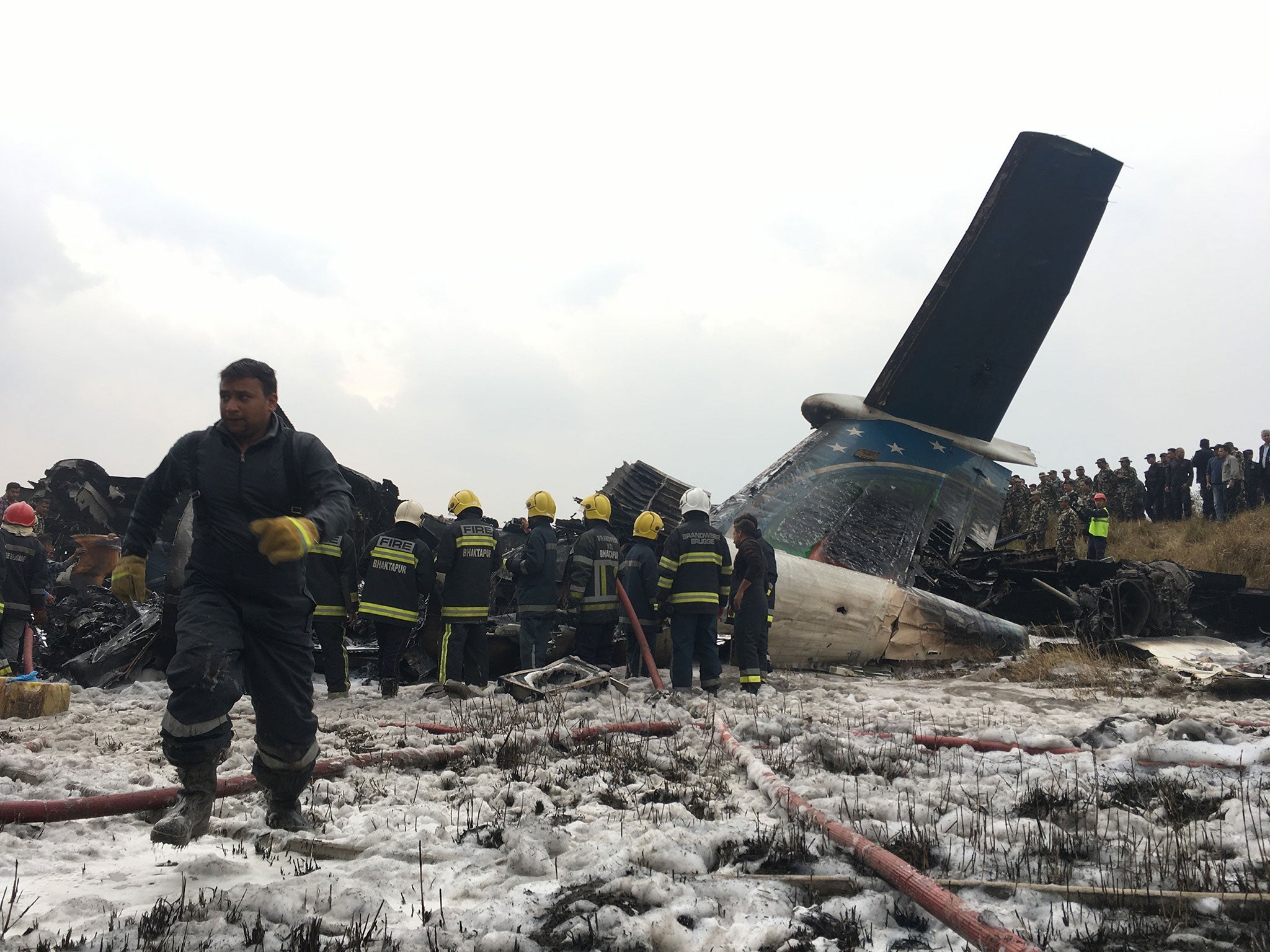
Flight BS211 of US-Bangla Airlines, a DHC-8-Q400 with registration S2-AGU, crashed as it approached to land at Kathmandu-Tribhuvan airport, Nepal.

The Bombardier Dash 8-Q400 departed from Dhaka, Bangladesh at 12:52, local time (06:52 UTC), with 67 passengers and four crew members on board. The flight climbed to a cruising altitude of FL240 and continued towards Kathmandu. At the time of arrival near Kathmandu, a thunderstorm was passing through the airport with cumulonimbus clouds passing at 2500 feet.

The aircraft was authorized for an approach to runway 02. Apparently, the boarding was aborted and the flight crew reported by radio that they were performing a right-hand orbit. Initially, the air traffic controller responded that they could not land in the opposite direction (runway 20) because others traffic in the finals. The controller requested that traffic be approached to board and asked Flight 211 if they wanted to land on runway 02 or 20. The crew replied: «We like to land on two zeros». Then the flight was cleared to land on runway 20 with wind reported at 260 degrees, 6 knots. Initially, the flight crew did not have the runway in sight, but the flight was then transmitted by radio: «Yes, we have a […] track in sight, requesting to land, sir. The flight was again authorized to land». The pilot read again: «authorized to land on runway 02», although authorization had been given for runway 20 initially. The air traffic controller then also read the authorization for runway 02.

The CAAN Director told the local media: «The plane took a final approach, from a low altitude, between the northwest tower and the suspension of the Nepal Army, and landed in the middle of the runway, passing the drainage, breaking the fence, after he dived into the ditch before going on».

Bangladesh and the Montreal Convention

The delay in signing the Montreal Convention affects the compensation for air crash of Bombardier 8Q400 of US-Bangla Airlines

Victims of an air crash between US-Bangladesh will receive less compensation than they are supposed to receive, as both Nepal and Bangladesh have delayed adoption of the 1999 Montreal Convention.

The reason behind the delay in adopting the Montreal Convention is not yet known. Although Bangladesh has signed the Convention, it is waiting for the government to ratify it. On the other hand, the government of Nepal has been postponing the signing of the convention.

According to Hari Bhakta Shrestha, an expert in aviation legislation, «the Montreal Convention is beneficial to all airlines in terms of protection and obligation, it benefits them as well as passengers».

Once the country ratifies the Montreal Convention, he said, all airlines are obliged to operate their services according to the rules and regulations of the convention. Although it is beneficial for both the country and the passengers, the government is indifferent to him, he added.

Nepal had embarked on the process to sign the Montreal Convention five years ago. However, he is stuck in the ministry. Hari Bhakta Shrestha, expert in aeronautical legislation. «Nepal started the process of signing the Montreal Convention five years ago, but it is stuck in the ministry», Shrestha said.

The US-Bangla Bombardier Dash Q-400 bomber aircraft with Call Sigh BS-211 crashed at Tribhuvan International Airport at 2:18 pm last Monday when it was trying to land in the short term. The aircraft was carrying 32 passengers from Bangladesh, 33 from Nepal, one from China and one from the Maldives. The accident killed 49 people, including crew members. The survivors are being treated in different hospitals in Kathmandu.

According to Shrestha, the victims of the US-Bangla Airlines plane crash are likely to receive compensation based on the Warsaw Convention. Airlines fear that their liability for compensation will increase if the country signs the Montreal Convention. A \ W


Ξ A I R G W A Y S Ξ
SOURCE:  Airgways.com
DBk: Aljazeera.com
AW-POST: 201803171202AR

A\W   A I R G W A Y S ®

Accidente Q400 de US-Bangla en Nepal

Resultado de imagen para US-Bangla Q400 air crash

AW | 2018 03 12 10:57 | AIR INVESTIGATION

Un Bombardier Q400 de US-Bangla Airlines se estrella en Nepal

Un Bombardier Q8-400, de US-Bangla Airlines se accidenta en Katmandú, Nepal. La aeronave con registro S2-AGU había efectuado el vuelo BS-211 desde Dhaka (Bangladesh) a Katmandú (Nepal) con 67 pasajeros y 4 tripulantes. El Q400 se encontraba en fase de descenso y aproximación a la pista 02 de Katmandú despejada para aterrizar.

La tripulación solicitó aterrizar en la pista 20, la torre despejó el avión para aterrizar en la pista 20. Cuando la Torre preguntó al avión si tenían la pista a la vista, la tripulación respondió «negativo». La Torre de Control preguntó si tenían a la vista la pista 02, afirmó la tripulació de la aeronave Q400, la torre despejó el vuelo nuevamente para aterrizar en la pista 02. La aeronave colisionó contra el suelo y estalló en llamas a eso de las 14:25 L (0835Z), la torre detuvo todo el tráfico dentro y fuera de Katmandú.

Los servicios de rescate llevaron a 39 ocupantes a los hospitales, sin embargo, ocho de ellos fueron declarados muertos al llegar al hospital. 31 cuerpos fueron recuperados de los restos.

Los observadores terrestres informaron que el avión giró repentinamente a la izquierda, sobrevoló, llegó muy cerca de la torre de control y desapareció de la vista. Una gran nube de humo comenzó a levantarse segundos más tarde. El aeropuerto informó que el avión viró hacia la derecha de la pista y se deslizó por unos 300 metros hasta detenerse en un campo de fútbol y estallar en llamas.  AIRWAYS® AW-Icon TXT

S2-AGU en el suelo (Foto: Narayan Amrit)

Resultado de imagen para US-Bangla Q400 air crash

US-Bangla Q400 accident in Nepal

A Bombardier Q400 from US-Bangla Airlines crashes in Nepal

A Bombardier Q8-400 from US-Bangla Airlines crashes in Kathmandu, Nepal. The aircraft with registration S2-AGU had flown BS-211 from Dhaka (Bangladesh) to Kathmandu (Nepal) with 67 passengers and 4 crew members. The Q400 was in descent phase and approach to runway 02 of Kathmandu cleared to land.

The crew requested to land on runway 20, the tower cleared the plane to land on runway 20. When the Tower asked the plane if they had the runway in sight, the crew responded «negative». The Control Tower asked if they had track 02 in view, said the crew of aircraft Q400, the tower cleared the flight again to land on runway 02. The aircraft collided with the ground and burst into flames at about 14:25 L (0835Z), the tower stopped all traffic in and out of Kathmandu.

The rescue services took 39 occupants to hospitals, however, eight of them were declared dead upon arrival at the hospital. 31 bodies were recovered from the remains.

The ground observers reported that the plane suddenly turned to the left, flew over, came very close to the control tower and disappeared from sight. A large cloud of smoke began to rise seconds later. The airport reported that the plane veered to the right of the runway and slid for about 300 meters to stop at a football field and burst into flames. A\W


DATA: La información procesada puede actualizarse debido al tipo de datos cambiantes, por lo que le sugerimos consultar periódicamente esta información.

DATA: The processed information can be updated due to the type of changing data, so we suggest you consult this information periodically.


US-BANGLA AIRLINES BS-211


reboot-800x444 UPDATES > 2018 03 12 11:33 -3UTC

El número de muertos en la caída de un avión hoy, durante las maniobras de aterrizaje, en el aeropuerto de Katmandú, subió a 49 y hay 22 personas heridas, según el último balance de las autoridades nepalesas.

El portavoz de la policía de Nepal, Manoj Neupane, declaró a la agencia de noticias EFE que todos los cuerpos ya fueron recuperados del avión desde la línea aérea US-Bengala, donde viajaban 67 pasajeros y cuatro tripulantes. A\W

The death toll in the fall of an airplane today, during the landing maneuvers, at Kathmandu airport, rose to 49 and there are 22 people injured, according to the latest balance of the Nepalese authorities.

Nepalese police spokesman Manoj Neupane told the EFE news agency that all bodies were recovered from the US-Bengal airline, where 67 passengers and four crew members were traveling. A\W

SOURCE: http://kathmandupost.ekantipur.com


Ξ A I R G W A Y S Ξ
SOURCE:  Airgways.com
DBk: Avherald.net / Narayan Amrit / Nytimes.com / Independent.co.uk
AW-POST: 2018030121057AR

A\W   A I R G W A Y S ®