
AW | 2017 05 04 20:23 | MRO / INDUSTRY

Boeing está estudiando un modelo de avión comercial para competir con el Airbus A321NEO/LR. Rolls-Roys ofrece su motorización
Rolls-Royce Holdings Plc hará una oferta para impulsar un nuevo avión de corto alcance diseñado por The Boeing Co. como fabricante de motores de Reino Unido busca volver a entrar en un mercado que dejó en 2011.
Rolls está preparando un lanzamiento para Boeing, ya que el fabricante estadounidense trabaja en el caso de negocios para un llamado avión de mediano nivel, dijo el presidente ejecutivo Warren East en comentarios después de la junta general anual de la compañía.
«La respuesta es que lo estamos persiguiendo», dijo East el jueves en la reunión de accionistas cerca de su principal centro de fabricación en Derby, Inglaterra. «El motor estaría disponible para el 2025, cuando el avión Boeing esté programado para entrar en servicio», dijo.
Rolls ha estado estudiando las maneras de volver a entrar en el mercado para impulsar los aviones de corto alcance, con el proyecto de Boeing presentándolo con la oportunidad de hacerlo varios años antes de la probable sustitución de los actuales modelos 737 y Airbus SE A321 de pasillo único.
Mientras que el fabricante de motores europeo ha agarrado una parte importante del lucrativo sector de motores de largo alcance con su serie de motores Trent y también es proveedor de aviones regionales y corporativos, los aviones de corta distancia representan la columna vertebral de la industria aérea, con las ventas empequeñeciendo Para modelos más grandes.
El motor que se diseña para el jet de Boeing se basa en los dos principales programas de tecnología en marcha en Rolls-Royce, Paul Stein, director de tecnología de la compañía, dijo a los periodistas en la AGM. Esos son el núcleo de motor Advance que se construirá para el año 2020 y el diseño UltraFan con una nueva «caja de engranajes de potencia» y una mejora de la eficiencia del 25 por ciento sobre los actuales modelos Rolls.
Todavía no está claro si Rolls-Royce seguirá el proyecto con un socio, aunque la compañía está dispuesta a hacerlo en principio si las condiciones del negocio son correctas, dijo East. «Lo hemos hecho antes», dijo el CEO. «Si esa es la manera práctica de hacerlo, entonces podríamos hacerlo bien». Agregó que las decisiones sobre asociaciones industriales pueden llegar «a los años del proceso, en lugar de meses».
Rolls tenía anteriormente una participación del 33 por ciento en el pacto internacional de Aero Engines AG con Pratt & Whitney, dándole una presencia importante en el mercado de corto alcance. Salió en 2011, en parte debido a un desacuerdo sobre la tecnología futura para el segmento con Pratt que empuja su desarrollo engranado-turbofan para las mejoras de A320NEO y de 737 MAX.
Tras la salida de IAE Rolls exploró un nuevo acuerdo de 50:50 con Pratt, antes de abandonar el plan en 2013 en medio de preocupaciones antimonopolio. Un retorno solo al sector lo enfrentaría contra la unidad de United Technologies Corp. y la alianza CFM International de General Electric Co. y Safran SA.
Stein dijo que el turbofan ultrafan y geared no son en última instancia diseños compatibles. El motor Rolls se está desarrollando con un rango de empuje de 25.000 a 110.000 libras, lo que lo hace adecuado para toda la gama de aviones Boeing y Airbus, incluyendo el nuevo avión de mediano en el mercado, que podría requerir de 40.000 a 50.000 libras de empuje.
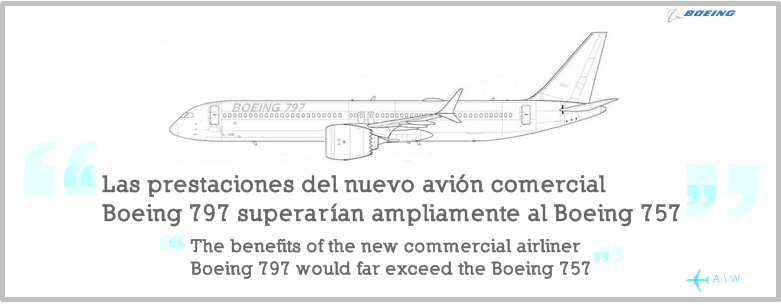
El avión, que probablemente será nombrado el Boeing 797, tendrá un asiento entre 225 y 260 pasajeros, colocándolo entre el 737 más grande y el 787 Dreamliner más pequeño. Inicialmente considerado como el sucesor del 757, el avión de más estrecha carrocería, que dejó de producirse en 2004, el avión está ahora concebido como un pequeño modelo de pasillo doble más cercano en proporción al 767.

El rango operativo del nuevo Boeing 797 estaría entre las 3500nm a los 4000nm. (6400-7000 KM) dependiendo de las variantes a fabricar. Tal como recordamos al Boeing 757-200 y Boeing 757-200ER (Rango Extendido), la Boeing estaría planificando diferentes variantes para distintas demandas.
El Boeing 797, tendría prestaciones parecidas o aproximadas al Boeing 757, que aún en la actualidad, este avión no tiene un competidor directo, a pesar de que su fabricación ya ha terminado.
El objetivo de la Boeing es poder recuperar el mercado perdido del Boeing 757 y hacer frente a la competencia de los cielos frente al Airbus A321NEO LR. Las capacidades del Boeing 797 pondría en ventaja a la industria americana. 
Rolls-Royce wants to put Its engines in the Boeing 797
Boeing is studying a commercial aircraft model to compete with the Airbus A321NEO / LR. Rolls-Royce offers its motorization
Rolls-Royce Holdings Plc will bid to power a new short-haul jetliner being designed by The Boeing Co. as the U.K. engine maker seeks to re-enter a market it quit in 2011.
Rolls is preparing a pitch to Boeing as the U.S. manufacturer works on the business case for a so-called middle-of-market plane, Chief Executive Officer Warren East said in comments after the company’s annual general meeting.

MOTORIZATION OF BOEING 737 MAX, LEAP 1B
“The answer is that we are pursuing it,” East said Thursday at the shareholder gathering near its main manufacturing site in Derby, England. “It’s not ‘will we be pursuing it.’ We are pursuing it.” The engine would be available by 2025, when the Boeing jet is slated to enter service, he said.
Rolls has been mulling ways of getting back into the market for powering short-haul jets, with the Boeing project presenting it with an opportunity to do so several years before the likely replacement of the existing 737 and Airbus SE A321 single-aisle models.
While the European engine maker has grabbed a major slice of the lucrative long-haul engine sector with its Trent engine series and is also a supplier to regional and corporate planes, short-haul jets represent the backbone of the airline industry, with sales dwarfing those for bigger models.
The engine being designed for the Boeing jet draws on the two main technology programs underway at Rolls-Royce, Paul Stein, the company’s chief technology officer, told reporters at the AGM. Those are the Advance engine core due to be built by 2020, and the UltraFan design featuring a new “power gearbox” and targeting a 25 percent efficiency improvement over current Rolls models.
It’s not yet clear whether Rolls-Royce will pursue the project with a partner, though the company is open to doing so in principle if the business conditions are right, East said. “We’ve done it before,” the CEO said. “If that’s the practical way of doing it, then we might well.” He added that decisions on industrial partnerships can come “years into the process, rather than months.”
Rolls previously had a 33 percent stake in the International Aero Engines AG pact with Pratt & Whitney, giving it a major presence in the short-haul market. It exited in 2011, partly because of a disagreement over future technology for the segment with Pratt pushing its geared-turbofan development for the A320NEO and 737 MAX upgrades.
Following the exit from IAE Rolls explored a new 50:50 deal with Pratt, before abandoning the plan in 2013 amid antitrust concerns. A solo return to the sector would pit it against both the United Technologies Corp. unit and the CFM International alliance of General Electric Co. and Safran SA.
Stein said that the ultrafan and geared turbofan aren’t ultimately compatible designs. The Rolls engine is being developed with a thrust range of 25,000 pounds to 110,000, making it suitable for the entire span of Boeing and Airbus jetliners, including the new middle-of-market plane, which could require 40,000 to 50,000 pounds of thrust.
The aircraft, likely to be named the Boeing 797, would seat between 225 and 260 passengers, placing it between the biggest 737 and the smallest 787 Dreamliner. Initially envisaged as a successor to the 757, the longest-ever narrow-body plane, which ceased production in 2004, the aircraft is now conceived as a small twin-aisle model closer in proportions to the 767.
The operating range of the new Boeing 797 would be between 3500nm to 4000nm. (6400-7000 KM) depending on the variants to be manufactured. As we remember the Boeing 757-200 and Boeing 757-200ER (Extended Range), Boeing would be planning different variants for different demands.
The Boeing 797, would have similar or approximate benefits to the Boeing 757, which even today, this aircraft does not have a direct competitor, despite the fact that its manufacture is finished.
The objective of Boeing is to be able to recover the lost market of the Boeing 757 and to face the competition of the skies against Airbus A321NEO LR. The capabilities of the Boeing 797 would put american industry at an advantage. A \ W
Ξ A I R G W A Y S Ξ
SOURCE: Bloomberg.com / AIRGWAYS
DBk: AIRGWAYS
AW-POST: 201705042023AR
A \ W A I R G W A Y S ®
 airgways.com