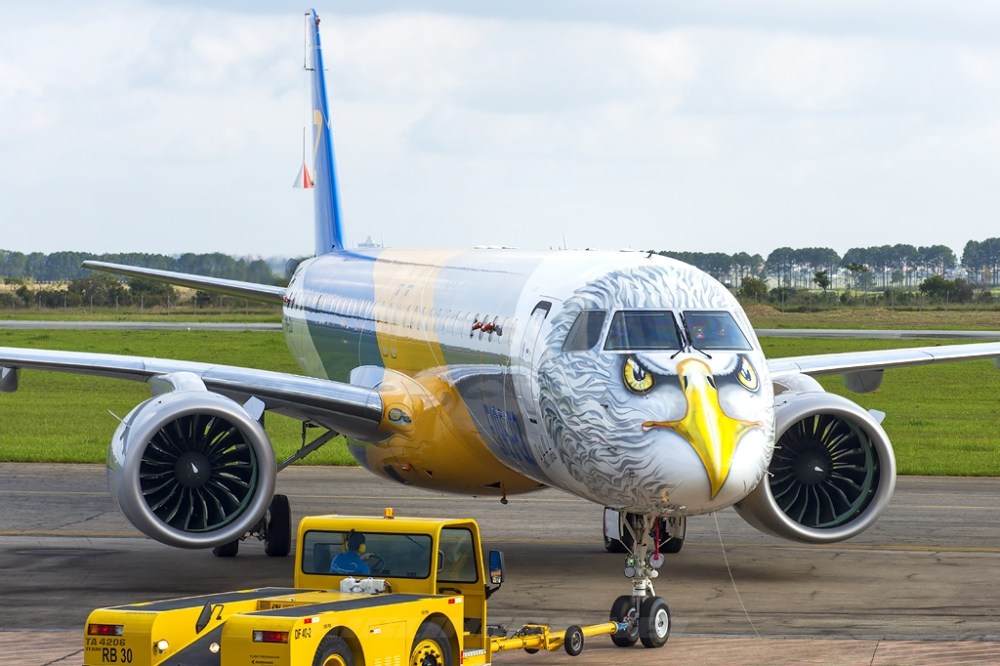
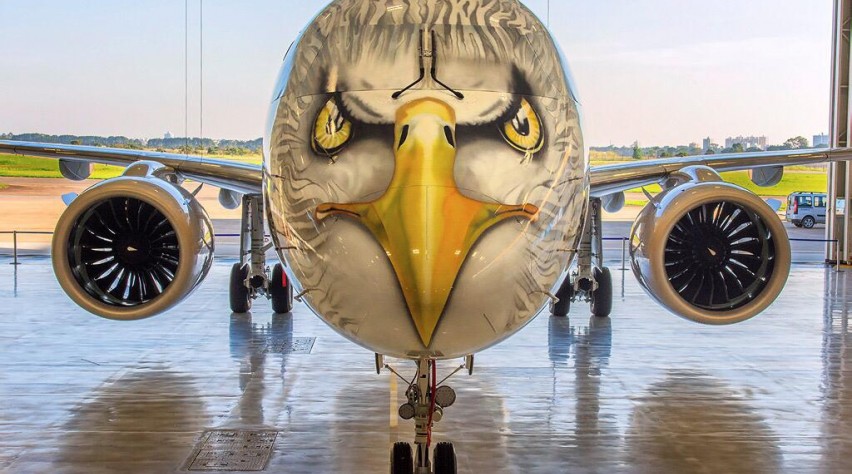
Embraer E195-E2 en Paris Air Show 2017

Embraer E195-E2

AW | 2017 05 30 16:02 | AIR SHOW

Resultado de imagen para Embraer logoEmbraer con E195-E2 especialmente pintado para el Paris Air ShowResultado de imagen para Paris Air Show 2017 logo 2017

Sao Paulo, Brasil · El constructor de aviones Embraer muestra su nuevo orgullo, el E195-E2, durante el Air Show Paris 2017. Tiene que registrar contra los dispositivos de Airbus y Boeing y cuenta con una pintura especial. «El cazador de ganancias», por lo que el CEO John Slattery llama a la máquina amorosamente.

El prototipo E195-E2 de Embraer voló a finales de marzo 2017 y es una versión ampliada del E190-E2. A finales de 2019, Azul tomará el tipo de primera aerolínea. El E195-E2 puede transportar hasta 146 pasajeros, llevando a Embraer a Bombardier, Boeing y el campo de juego de Airbus. El alcance del dispositivo es de unos 4.500 kilómetros. AIRGWAYS ® Icon-AW

AW-4392221

Presence E195-E2 at Paris Air Show 2017

Embraer with specially painted E195-E2 to Paris Air Show 2017


Sao Paulo, Brazil · Aircraft builder Embraer shows her new pride, the E195-E2, during the Paris Air Show 2017. It has to record against Airbus and Boeing devices and features a special painting. «The profit hunter», so CEO John Slattery calls the machine lovingly.

The Embraer E195-E2 prototype flew at the end of March and is an extended version of the E190-E2. At the end of 2019, Azul will take the type of first airline. The E195-E2 can carry up to 146 passengers, bringing Embraer to Bombardier, Boeing and Airbus’s playing field. The range of the device is around 4,500 kilometers. A \ W

Ξ A I R G W A Y S Ξ
SOURCE: Luchtvaartnieuws.nl
DBk: Luchtvaartnieuws.nl / Charin De Silva
AW-POST: 201705301602AR

A \ W   A I R G W A Y S ®

Norwegian iniciará vuelos USA sin «MAX»

78320_1494502529

AW | 2017 05 30 15:37 | AIRLINES ROUTES

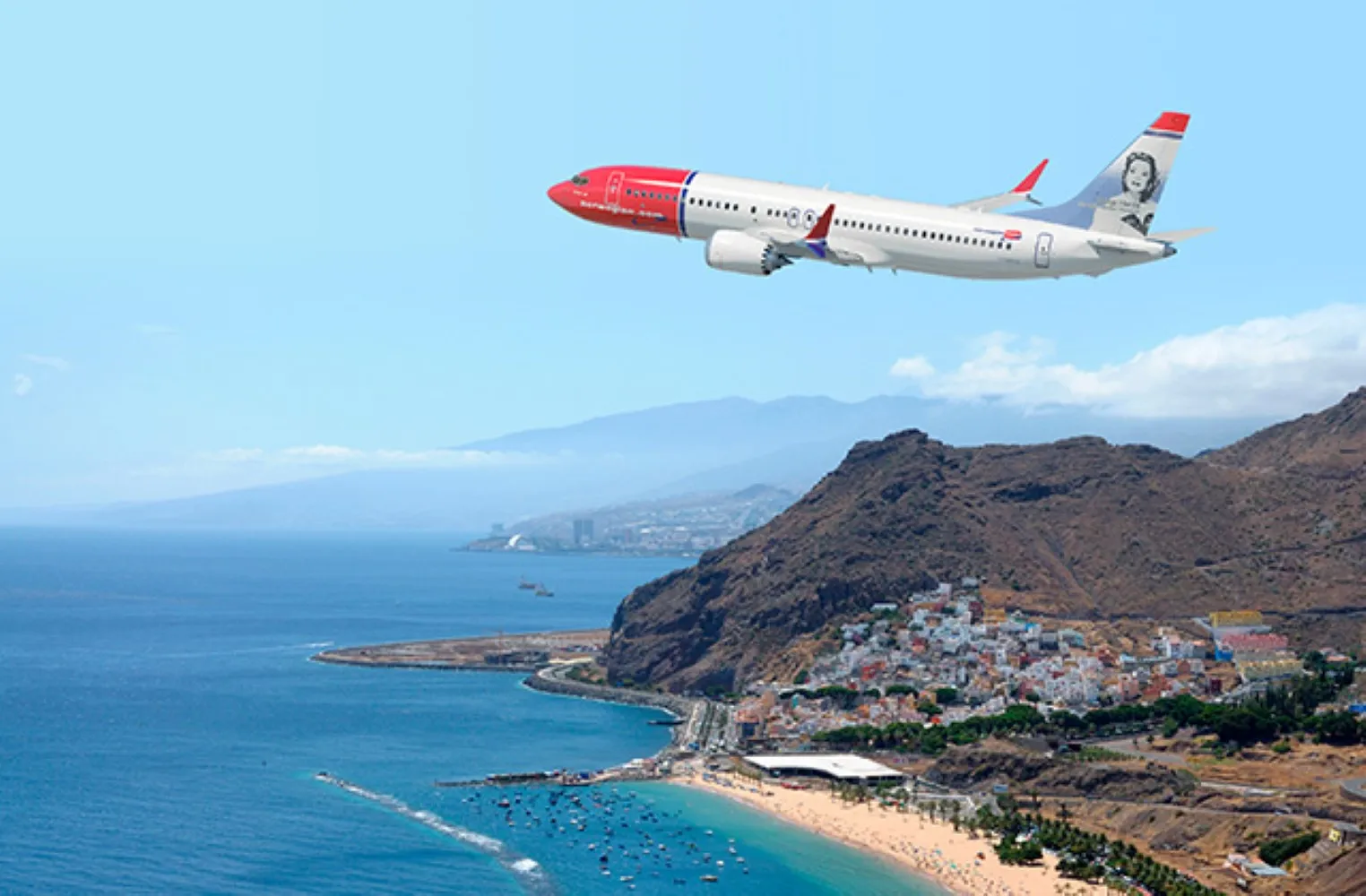
La compañía aérea Norwegian Air iniciará sus vuelos transatlánticos pero sin los Boeing 737 MAXResultado de imagen para Norwegian Air Boeing 737 MAX

El fabricante de aviones comerciales Boeing, tiene retrasados algunas entregas de losaviones más nuevos de la familia Boeing 737. De esta manera el retraso en la entrega de los nuevos aviones Boeing 737-8 MAX a Norwegian Air pone en jaque a la aerolínea a escasos días del lanzamiento de los vuelos transatlánticos, en donde ya tenía programados realizar su vuelo inaugaral con los 737 MAX.

Unos contratiempos surgieron en la Boeing debido a unas fallas detectadas por el fabricante General Electric-Snecma en los motores LEAP 1B y que originó la paralización de los vuelos de prueba por parte del fabricante Boeing, empiezan a trastocar los planes de las aerolíneas que contaban con sus entregas este mes de mayo para iniciar sus vuelos a EEUU.

iwln7lk4dl6263floyja

Ante las demoras en las entregas, Norwegian Air ha reestructurado la planificación de sus vuelos transatlánticos y demorar el inicio de las operaciones previstas con los nuevos aviones Boeing 737-8 MAX, hasta que el constructor norteamericano recomponga la línea de entregas previstas.

A mediados del mes de junio, parece ser la fecha aproximada de entrega de los nuevos aviones Boeing 737-8 MAX a Noerwegian Air un cliente especial de la Boeing, ya que ha encomendado más de 100 aeronaves MAX.

Norwegian Air tenía planificado realizar la primer hazaña histórica de volar comercialmente un Boeing 737 MAX cruzando el atlántico. Por lo visto, las rutas transatlánticas tendrán que ser operadas por aviones 737-800 y ha supuesto que la previsión de que los Boeing 737-8 MAX operasen un total de 42 frecuencias semanales, hayan sido reducidas a 14. Todo un traspié para un cliente que mantiene un pedido de 108 aviones Boeing 737 MAX. AIRGWAYS ® Icon-AW

https://runwaygirl-5389.kxcdn.com/wp-content/uploads/2017/03/gallery-large-07-Custom.jpg

Norwegian to start flights to USA without «MAX»


Norwegian Air carrier to start transatlantic flights but without Boeing 737 MAX


The commercial aircraft maker Boeing has delayed some deliveries of the Boeing 737 family’s newest aircraft. In this way the delay in the delivery of the new Boeing 737-8 MAX aircraft to Norwegian Air puts the airline in check in a few days Of the launch of the transatlantic flights, where it had already scheduled to make its inaugaral flight with the 737 MAX.

Some setbacks arose in Boeing due to flaws detected by the manufacturer General Electric-Snecma in the LEAP 1B engines and that caused the paralysis of the test flights by the manufacturer Boeing, they begin to disrupt the plans of the airlines that counted on Their deliveries this May to begin their flights to the US.

In the face of delays in deliveries, Norwegian Air has restructured its transatlantic flight planning and delayed the start of planned operations with the new Boeing 737-8 MAX aircraft until the North American manufacturer rebuilds the planned delivery line.

In mid-June, it appears to be the approximate date of delivery of the new Boeing 737-8 MAX aircraft to Noerwegian Air, a special customer of Boeing, as it has commissioned more than 100 MAX aircraft.

Norwegian Air had planned to perform the first historic feat of commercially flying a Boeing 737 MAX across the Atlantic. It seems that the transatlantic routes will have to be operated by 737-800 aircraft and has meant that the expectation that the Boeing 737-8 MAX operated a total of 42 weekly frequencies, have been reduced to 14. A stumbling block for a customer Which holds an order for 108 Boeing 737 MAX aircraft. A \ W


Ξ A I R G W A Y S Ξ
SOURCE: Airgways.com
DBk: HA_KLS / Norwegian Air
AW-POST: 201705301537AR

A \ W   A I R G W A Y S ®

4ª terminal para el Aeropuerto de Sydney

https://upload.wikimedia.org/wikipedia/commons/6/64/Qantas_%28VH-OQH%29_Airbus_A380-842_at_the_international_terminal_at_Sydney_Airport.jpg

AW | 2017 05 30 15:00 | AIRPORTS

Imagen relacionadaUna cuarta terminal en el aeropuerto de Sydney para los viajeros internacionales que está conectada a las terminales domésticas existentes es parte de los planes para ayudarle a hacer frente al crecimiento fuerte del pasajero ya un aeropuerto que compite en la cala de Badgerys en el oeste de la ciudad.

Según los planes preliminares, la Terminal 4 estaría en el sitio de la base de chorro de Qantas entre la Terminal 3 y Qantas Drive en el perímetro del aeropuerto. Un muelle para la nueva terminal también se extendería hacia el sur desde el recinto doméstico, mientras que «delantales remotos» podrían ser construidos cerca del límite norte en Airport Drive.

Un mes después de rechazar su «derecho de preferencia» para construir y operar el nuevo aeropuerto en Badgerys Creek, el presidente del aeropuerto de Sydney, Trevor Gerber, dijo a los accionistas que tres años de consultas con el gobierno federal sobre el aeropuerto de Sydney occidental le habían forzado a desarrollar planes detallados Para ampliar sus operaciones existentes.

«Creemos que el momento es justo para tener una expansión significativa», dijo el martes, cuando se le preguntó cómo el aeropuerto de Western Sydney afectará su rentabilidad a largo plazo. «Creemos que la demanda está claramente allí, también.»

El número de pasajeros que pasaron por el aeropuerto más grande de Australia aumentó casi un 6 por ciento a 41,9 millones el año pasado, respaldado por un fuerte crecimiento en los viajeros de China y otras partes de Asia.

Mientras que una cuarta terminal es parte de los planes a largo plazo, la prioridad del aeropuerto para los próximos cinco años es una expansión de $ 500 millones de la terminal internacional que incluirá tres puertas nuevas, puentes aéreos y una ampliación de áreas de reclamo de equipaje.

Kerrie Mather, directora ejecutiva del aeropuerto de Sydney, dijo que el plazo para la construcción de la terminal 4 dependía del continuo crecimiento de la demanda de pasajeros y la capacidad de reconstruir la base de aviones Qantas, en la que la aerolínea tenía un contrato de arrendamiento a largo plazo hasta 2020. «Sería difícil establecer un cronograma sobre [el desarrollo de la Terminal Cuatro], dependerá de la demanda y un precursor es poder tener acceso a la base jet», dijo.

https://i0.wp.com/www.smstransport.com.au/images/Services/airport-4.jpg

La remoción de la base de los aviones permitirá la construcción de la nueva terminal requerirá la reubicación de los hangares de Qantas a otras partes del aeropuerto, muy probablemente a su sureste, cerca de la tercera pista y de la unidad General Holmes.

Los hangares en la base de los aviones se utilizan sobre todo para el mantenimiento de la aeronave. El Aeropuerto de Sydney compró de nuevo el arriendo a largo plazo en la terminal 3 de Qantas hace casi dos años por $ 535 millones; Debía expirar en 2019. Como parte del acuerdo, el aeropuerto dio a Qantas garantías sobre tener acceso a T3 hasta 2025.

La Sra. Mather, quien reveló en marzo sus planes de abandonar el cargo una vez que se encuentre un reemplazo, dijo que una nueva terminal «proporcionaría nuevas puertas internacionales adyacentes» a T2 y T3. «Es importante que estos planes sigan siendo flexibles y ofrezcamos una solución integrada para pasajeros, conectividad de terminales y acceso a tierra», dijo.

Ella advirtió que había una «gama completa de planificación» escenarios a considerar antes de la construcción de una nueva terminal podría comenzar. Hace seis años, el aeropuerto dio a conocer planes para romper la división entre los terminales nacionales e internacionales mediante la creación de dos recintos con base aérea.

Bajo esa propuesta de más de 1.000 millones de dólares, Qantas, Jetstar y los socios de la alianza del grupo se alojarían bajo un mismo techo en las terminales domésticas T2 y T3, mientras que Virgin Australia cambiaría todas sus operaciones de T2 a la terminal internacional.

Sin embargo, el aeropuerto cayó silenciosamente los planes menos de un año más tarde porque Virgin creía que el movimiento lo pondría en una desventaja significativa a Qantas. La oposición de Virgin se basó en el argumento de que sus pasajeros tomarían más tiempo para conducir desde la ciudad central a sus operaciones si se basaban en T1. AIRGWAYS ® Icon-AW

A fourth terminal at the airport will be built on what is now the Qantas jet base.

Fourth terminal for Sydney Airport

A fourth terminal at Sydney Airport for international travellers that is connected to the existing domestic terminals is part of plans to help it cope with strong passenger growth and a competing airport at Badgerys Creek in the city’s west.

According to the preliminary plans, Terminal 4 would be on the site of Qantas’ jet base sandwiched between Terminal 3 and Qantas Drive on the airport’s perimeter. A pier for the new terminal would also extend south from the domestic precinct, while «remote aprons» could be built near the northern boundary in Airport Drive.

A month after turning down its «right of first refusal» to build and operate the new airport at Badgerys Creek, Sydney Airport chairman Trevor Gerber told shareholders that three years of consultation with the federal government over Western Sydney Airport had forced it to develop detailed plans to expand its existing operations. «We think the time is about right to have some significant expansion,» he said on Tuesday, when asked how Western Sydney Airport will affect its long-term profitability. «We think the demand is clearly there, too.»

The number of passengers passing through Australia’s largest airport rose almost 6 per cent to 41.9 million last year, underpinned by a strong growth in travellers from China and other parts of Asia.

While a fourth terminal is part of the long-term plans, the airport’s priority for the next five years is a $500 million expansion of the international terminal that will include three new gates, air bridges and an expansion of baggage-claim areas.

Sydney Airport chief executive Kerrie Mather said the timeframe for construction of Terminal 4 depended on continued growth in passenger demand and the ability to redevelop the Qantas jet base, on which the airline had a long-term lease until 2020. «It would be difficult to put a timeline on [development of Terminal Four]. It will depend on demand and a precursor is being able to access the jet base,» she said.

A map showing the proposed Terminal 4 development.

A map showing the proposed Terminal 4 development. Photo: Sydney Airport

The removal of the jet base to allow for construction of the new terminal will require the relocation of Qantas hangars to other parts of the airport, most likely to its south-east, near the third runway and General Holmes Drive.

The hangars at the jet base are used mostly for aircraft maintenance. Sydney Airport bought back the long-term lease on Terminal 3 from Qantas almost two years ago for $535 million; it had been due to expire in 2019. As part of the deal, the airport gave Qantas assurances about it having access to T3 until 2025.

Ms Mather, who revealed in March her plans to leave the top job once a replacement is found, said a new terminal would «provide new, international gates adjoining» T2 and T3. «It is important these plans remain flexible, and that we deliver an integrated solution for passengers, terminal connectivity and ground access,» she said.

She cautioned there was a «whole range of planning» scenarios to consider before construction of a new terminal could begin. Six years ago, the airport unveiled plans to break the divide between the domestic and international terminals by creating two airline-based precincts.

Under that $1 billion-plus proposal, Qantas, Jetstar and the group’s alliance partners were to be housed under one roof at the domestic terminals T2 and T3, while Virgin Australia would shift all its operations from T2 to the international terminal.

However, the airport quietly dropped the plans less than a year later because Virgin believed the move would place it at a significant disadvantage to Qantas. Virgin’s opposition was based on the argument that its passengers would take longer to drive from the central city to its operations if they were based at T1. A \ W


Ξ A I R G W A Y S Ξ
SOURCE: Smh.com.au
DBk: AAP / Sydney Airport / Wikipedia.org / Smstransport.com.au
AW-POST: 201705301500AR

A \ W   A I R G W A Y S ®
73ª Asamblea de IATA en Cancún

https://pbs.twimg.com/media/DAFyaBbU0AM-bxj.jpg

AW | 2017 05 30 14:30 | CONGRESS

Imagen relacionadaLa 73ª Asamblea Anual de la Asociación de Transporte Aéreo Internacional (IATA), organismo que agrupa a 268 líneas aéreas comerciales de 117 países se efectuará en Cancún, México, desde el domingo 4 y hasta el martes 6 de junio 2017

Se darán cita los CEO’s de las aerolíneas comerciales tradicionales más importantes e influyentes del mundo, como así también la problemática sobre los grandes retos que tiene la aviación en un futuro inmediato.

Resultado de imagen para cancún  logo

La agenda del evento incluye una revisión de oportunidades y amenazas que enfrenta Latinoamérica, pero también se centrará en los dilemas que el nuevo proteccionismo derivado de las situaciones específicas de Estados Unidos y Gran Bretaña, una industria que es la más global de todas. Se abordarán temas de la agenda estratégica de la organización, como las cifras del último año, tecnología, seguridad operacional y en tierra, medio ambiente e incluso habrá un tema relativo a la trata de personas, un problema creciente en el mundo. Otro tema en el tapete son el uso de los dispositivos electrónicos a bordo, un problema que puede amenazar los viajes de negocios en primer lugar, y los efectos que pueden derivar de las medidas a implementar.  AIRGWAYS ® Icon-AW

http://i0.wp.com/enelaire.mx/wp-content/uploads/AEROMEXICO011.jpg?resize=1380%2C600

73rd IATA Assembly in Cancún

Resultado de imagen para cancún pirámides pngThe 73rd Annual Assembly of the International Air Transport Association (IATA), which brings together 268 commercial airlines from 117 countries will be held in Cancun, Mexico, from Sunday 4 to Tuesday 6 June 2017Resultado de imagen para cancún pirámides png

The CEOs of the most important and influential traditional commercial airlines of the world will meet, as well as the problematic one on the great challenges that aviation has in the immediate future.

The agenda of the event includes a review of opportunities and threats facing Latin America, but will also focus on the dilemmas that the new protectionism derived from the specific situations of the United States and Great Britain, an industry that is the most global of all. Topics on the organization’s strategic agenda, such as last year’s figures, technology, safety and on the ground, the environment will be addressed and there will even be a theme on human trafficking, a growing problem in the world. Another issue on the table is the use of electronic devices on board, a problem that can threaten business travel in the first place, and the effects that can be derived from the measures to implement. A \ W

Ξ A I R G W A Y S Ξ
SOURCE: Airgways.com / Iata.org
DBk: Iata.org / Enelaire.mx
AW-POST: 201705301430AR

A \ W   A I R G W A Y S ®

IATA, propuesta para mejorar slots para líneas aéreas en México

https://i0.wp.com/info7.blob.core.windows.net.optimalcdn.com/images/2016/11/08/608108_aeropuerto-ciudad-de-mexico-suspende-operaciones.jpg

AW | 2017 05 30 13:56 | AIR TRAFFIC

 La Asociación Internacional de Transporte Aéreo (IATA) pidió realizar cambios al proyecto de Secretaría de Comunicaciones y Transportes (SCT) en materia de horarios de despegue y aterrizaje para la industria aeronáutica (slots), como asegurar la independencia y neutralidad del coordinador de esos espacios.

El organismo internacional consideró que los cambios al proyecto deben proporcionar certidumbre a las aerolíneas, y asegurar un proceso riguroso, pero justo en la asignación de franjas horarias en México, por lo que propuso garantizar la independencia del coordinador de los slots, así como reconsiderar los criterios de puntualidad para mantener los slots históricos.

Recientemente, la Dirección General de Aeronáutica Civil mandó a la Comisión Federal de Mejora Regulatoria (Cofemer) el anteproyecto de las bases sobre la asignación slots en aeropuertos saturados como el Aeropuerto Internacional de la Ciudad de México (AICM).

https://i0.wp.com/www.zonalider.com/sites/default/files/styles/scale_max_width_auto_height/public/article/image/aeropuerto_internacional_para_ensenada.jpg

Entre las propuestas, se encuentran la creación de un Comité de Operación y Horarios y Subcomité de Demoras, un coordinador de horarios que será designado por la DGAC, además de que las franjas horarias deberán tener prioridad que hayan operado como mínimo 85 por ciento del tiempo asignado en la temporada anterior y con un tiempo de demora de hasta 15 mínimos.

La IATA afirmó que apoya el seguimiento del uso de las franjas horarias y el logro de la puntualidad, “pero rechaza completamente el uso de los datos de puntualidad como criterio para mantener los slots históricos”. Este requisito, opinó, es peor que en Brasil, el único país del mundo que estableció un criterio de 75 por ciento y 30 minutos de tolerancia, para mantener los históricos y cuyo resultado “ha demostrado ser muy problemática para las aerolíneas. Todas las regulaciones de slots, recalcó, deben de reflejar las mejores prácticas globales”, indicó.  AIRGWAYS ® Icon-AW

https://i0.wp.com/enelaire.mx/wp-content/uploads/aicm-slots.jpg

IATA, proposed to improve slots for airlines in Mexico


The International Air Transport Association (IATA) asked to make changes to the draft Ministry of Communications and Transport (SCT) in terms of takeoff and landing times for the aeronautics industry (slots), as to ensure the independence and neutrality of the coordinator of those spaces .

The international organization considered that the changes to the project should provide certainty to the airlines, and ensure a rigorous but fair process in the allocation of slots in Mexico, so it proposed to guarantee the independence of the slots coordinator, as well as to reconsider the Punctuality criteria to maintain historical slots.

Recently, the General Directorate of Civil Aeronautics sent the Federal Commission for Regulatory Improvement (Cofemer) the preliminary draft of the bases on the allocation slots in saturated airports such as the International Airport of Mexico City (AICM).

Proposals include the creation of an Operating Committee and Timetables and Subcommittee on Delays, a scheduling coordinator to be designated by the DGCA, and slots should be prioritized and operated at least 85 percent of the time Assigned in the previous season and with a delay time of up to 15 minimums.

IATA said it supports tracking slot use and achieving punctuality, «but completely rejects the use of punctuality data as a criterion for maintaining historic slots.» This requirement, he said, is worse than in Brazil, the only country in the world that established a criterion of 75 percent and 30 minutes of tolerance, to maintain the historical and whose result «has proven to be very problematic for airlines. All slots regulations, he stressed, should reflect global best practices»,  he said. A \ W

Ξ A I R G W A Y S Ξ
SOURCE: Cronica.com.mx
DBk: Enelaire.mx / CQ AT MMTJ TRACON / Info7.mx
AW-POST: 201705301356AR

A \ W   A I R G W A Y S ®

Aeropuerto Tucumán cerrará por 3 meses

https://i0.wp.com/tucumanconstruccion.com/wp-content/uploads/2016/10/aeropuerto.jpg

AW | 2017 05 30 13:41 | AIRPORTS

Aeropuerto Tucumán cerrará por tres meses. Los traslados se realizarán desde el Aeropuerto de Termas de Río Hondo

Entre el 1 de junio y el 31 de agosto todos los vuelos programados desde Tucumán serán derivados hacia el Aeropuerto de Termas de Río Hondo, en Santiago del Estero. Durante estos tres meses, el Aeropuerto de Tucumán, estará cerrado debido a las obras destinadas a la prolongación y reconstrucción de la pista, junto con la ampliación y la rehabilitación de márgenes pavimentados.

El sistema de traslado se encuentra previsto para pasajeros con vuelos de partida hacia y desde Buenos Aires y Córdoba, en vuelos de Aerolíneas Argentinas, Austral y LATAM. El Ente de Turismo dispondrá información sobre movimiento de ómnibus y vuelos tanto en su oficina de Informes (24 de Septiembre esquina 9 de Julio), como en las terminales de Ómnibus de San Miguel de Tucumán y aeroportuaria Benjamín Matienzo.

Cada pasajero que desee acceder al traslado desde el aeropuerto tucumano deberá presentarse en forma personal e individual, al menos con 30 minutos de antelación a la partida de cada unidad terrestre y sin necesidad de informar previamente el uso del servicio. Para el traslado a Tucumán encontrarán disponibilidad de ómnibus sin tiempo de espera, ya que partirán media hora después de la llegada de cada vuelo. La prioridad siempre será para aquel pasajero que se encuentre más próximo a volar. En todos los casos deberán presentar:

Documento Nacional de Identidad, o identificación que exija cada aerolínea; constancia de viaje (boarding pass; web check-in o itinerario de viaje); un bolso de mano y una valija por cada pasajero – quienes excedan esa cantidad, cuenten con equipaje de grandes dimensiones (oversize), equipos deportivos (sporting equipment) o animales (caniles) deberán trasladarse por sus medios-; la accesibilidad está garantizada, por lo que se podrá incluir en traslado terrestre a las sillas de ruedas y tendrán prioridad. En las unidades de transporte terrestre podrá viajar un acompañante por cada pasajero que requiera de asistencia por discapacidad.

Quienes deseen trasladarse en su propio vehículo al aeropuerto de Tucumán, este será gratuito durante el cierre del mismo y, por su capacidad, sujeto a disponibilidad. Todos los servicios habituales del aeropuerto se encontrarán habilitados durante este período: bar, sanitarios, cajero automático, kiosco, remises, alquiler de autos y espacios de espera. AIRGWAYS ® Icon-AW

https://i.ytimg.com/vi/EKlHcwGtmsQ/maxresdefault.jpg

Tucumán Airport will close for three months


The International Airport of Tucumán, in Argentina, will be closed for three months due to maintenance. Transfers will be made from the Airport of Termas de Río Hondo


Between June 1 and August 31 all scheduled flights from Tucumán will be shipped to the Río Hondo Thermal Airport in Santiago del Estero. During these three months, the Airport of Tucumán will be closed due to the works destined to the prolongation and reconstruction of the track, along with the extension and the rehabilitation of paved margins.

The transfer system is provided for passengers with departures to and from Buenos Aires and Córdoba, on flights from Aerolíneas Argentinas, Austral and LATAM. The Tourism Entity will have information on the movement of buses and flights both in its Office of Reports (24 de Septiembre corner 9 de Julio), as well as in the bus terminals of San Miguel de Tucumán and Benjamín Matienzo Airport.

Each passenger who wishes to access the transfer from the Tucuman airport must be presented personally and individually, at least 30 minutes before the departure of each land unit and without prior notification of the use of the service. For the transfer to Tucumán you will find availability of buses without waiting time, since they will leave half an hour after the arrival of each flight. The priority will always be for that passenger who is closest to flying. In all cases they must present:

National Identity Document, or identification required by each airline; proof of travel (boarding pass, web check-in or travel itinerary); a handbag and a suitcase for each passenger – who exceeds that amount, have oversize luggage, sporting equipment or animals (kennels) must be transferred by their means; accessibility is guaranteed, so it can be included in ground transportation to wheelchairs and will have priority. In the terrestrial transport units, a companion may travel for each passenger who requires disability assistance.

Those who wish to transfer in their own vehicle to the airport of Tucumán, this will be free during the closing of the same and, by its capacity, subject to availability. All the usual services of the airport will be enabled during this period: bar, sanitary, ATM, kiosk, remises, car rental and waiting spaces. A \ W


Ξ A I R G W A Y S Ξ
SOURCE: Tucumanalas7.com.ar
DBk: Tucumanconstruccion.com / Youtube.com
AW-POST: 201705301341AR

A \ W   A I R G W A Y S ®

Aeropuerto Internacional Rosario cierre por mantenimiento

DMi 687

AW | 2017 05 30 12:47 | AIRPORTS

Reprograman 38 vuelos por el cierre del aeropuerto desde hoy hasta el viernes. Copa, Latam, Aerolíneas Argentinas y Gol cancelaron sus servicios desde la terminal aérea local. Los pasajeros pueden optar por Ezeiza

A partir de hoy, el Aeropuerto Internacional Islas Malvinas se someterá a tres días intensos de reparación en la pista de aterrizaje y en una de las calles de rodaje. Esto implicará su cese total de operaciones, que afectará a cuatro compañías de aeronavegación que ofrecieron varias alternativas a sus pasajeros y reprogramaron sus vuelos. A partir del viernes se normalizarán todos los servicios aéreos.

Según lo dispuso la Administración Nacional de Aviación Civil (ANAC), se puso en marcha el Plan de Rehabilitación de Pavimentos que hasta el 1º de junio inclusive abarcará dos intervenciones sobre la pista de aterrizaje y la intersección de la misma con la calle de rodaje «Bravo».

Las obras incluirán la demolición de losas y reconstrucción de las mismas. También se hará una «descontaminación» de la pista. Esto implica retirar el material de los neumáticos y asfáltico que contamina el ambiente. Dichos elementos se adhieren en cada aterrizaje al tocar la pista. «Serán 72 horas continuas que finalizarán a la cero hora del 2 junio. Es decir, que el viernes se volverá a la normalidad», expresó una vocera de la estación aérea local.

Según habían explicado en un comunicado las autoridades del aeropuerto, los trabajos de demolición y reconstrucción de losas, que ya se encuentran acordados con la Anac, responden a la necesidad de incrementar la seguridad operativa para el normal desarrollo de las actividades aeronáuticas en el marco del crecimiento de la conectividad aérea de Rosario y la región.

En cuanto a los vuelos previstos en estos tres días, existen cuatro compañías que operan habitualmente. El vuelo diario de Copa Airlines (martes, miércoles y jueves) cambiará su operatividad a Ezeiza. Allí arribarán sus aeronaves desde Panamá y partirán luego hacia ese destino.

Latam también mudará a Ezeiza sus vuelos diarios a Lima (Perú) al igual que los vuelos de martes y jueves a San Pablo (Brasil). En tanto Gol Líneas Aéreas que tenía un vuelo a Río de Janeiro ofreció a sus pasajeros acomodarse en otros aviones de la misma compañía antes o después del cierre de la pista, la devolución del importe del ticket o una reubicación si existe disponibilidad en los vuelos con destino Ezeiza.

Aerolíneas Argentinas suspendió toda su programación desde Rosario y ofreció a sus clientes tres opciones: llegar o partir adelantando o retrasando la fecha, reintegrarles el billete o volar desde otra terminal en vuelos que tengan butacas vacantes.

En concreto, Copa reprogramó 6 vuelos a Ezeiza, son 3 arribos desde Panamá y 3 despegues a ese destino. Latam reprogramó a Ezeiza 6 vuelos a Lima (3 arribos y 3 salidas) , 4 vuelos a San Pablo (2 arribos y 2 salidas), Aerolíneas cancelo 18 vuelos y le dio la opción al pasajero de volar desde otra terminal, cambio de fecha o devolución del dinero. Gol canceló 4 vuelos (2 arribos y 2 salidas) a Río y dio las mismas opciones que Aerolíneas

La rehabilitación de la pista y calles de rodaje tiene una primera etapa, para la que se han invertido más de 27.000.000 de pesos en la reparación y adecuación del pavimento deteriorado.

A partir de la segunda mitad del año se procederá a ejecutar obras de rehabilitación integral por una inversión total de 400.000.000 de pesos destinada a la puesta a punto del sector operativo.

La decisión de clausurar la pista se da en forma coincidente con el desarrollo de Agroactiva, la expo de máquinas agropecuarias y ganaderas más importante de la región, que tendrá lugar en Armstrong del 31 de este mes al 3 de junio. La llegada de los visitantes será mayoritariamente terrestre, por lo que el cierre del aeropuerto no afectará la puesta en marcha de este tradicional evento.  AIRGWAYS ® Icon-AW

manos a la obra. El plan de rehabilitación abarca la pista y calle de rodaje.

Rosario Airport closing for maintenance


They reschedule 38 flights by closing the airport from today until Friday. Copa, Latam, Aerolíneas Argentinas and Gol canceled their services from the local air terminal. Passengers can opt for Ezeiza


As of today, Islas Malvinas International Airport will undergo intense three days of repair on the landing strip and on one of the taxiways. This will involve a total cessation of operations, which will affect four air carriers that offered various alternatives to their passengers and rescheduled their flights. Starting Friday, all air services will be standardized.

As stated by the National Civil Aviation Administration (ANAC), the Pavement Rehabilitation Plan was implemented, which until June 1 will include two interventions on the runway and the intersection of the same with the taxiway «Bravo».

The works will include the demolition of slabs and reconstruction of them. There will also be a «decontamination» of the track. This involves removing the material from the tires and asphaltic polluting the environment. These elements adhere to each landing on the runway. «It will be 72 continuous hours that will end at zero on June 2. That is, on Friday it will return to normal,» said a spokeswoman for the local air station.

As the airport authorities explained in a press release, the demolition and reconstruction of slabs, already agreed with ANAC, respond to the need to increase operational safety for the normal development of aeronautical activities in the framework of the Growth of Rosario and the region.

As for the flights scheduled in these three days, there are four companies that operate regularly. The Copa Airlines daily flight (Tuesday, Wednesday and Thursday) will change its operation to Ezeiza. There, their aircraft will arrive from Panama and then leave for that destination.

Latam will also change to Ezeiza its daily flights to Lima (Peru) as well as Tuesday and Thursday flights to San Pablo (Brazil). While Gol Líneas Aéreas, which had a flight to Rio de Janeiro, offered its passengers to be accommodated in other aircraft of the same company before or after the closing of the runway, the refund of the ticket amount or a relocation if there is availability on flights with Destination Ezeiza.

Aerolíneas Argentinas suspended all its programming from Rosario and offered its clients three options: to arrive or to leave ahead or delaying the date, to reintegrate the ticket to them or to fly from another terminal in flights that have vacant seats.

In particular, Copa reprogrammed 6 flights to Ezeiza, 3 arrivals from Panama and 3 takeoffs to that destination. Latam reprogrammed to Ezeiza 6 flights to Lima (3 arrivals and 3 exits), 4 flights to San Pablo (2 arrivals and 2 exits), Airlines canceled 18 flights and gave the option to the passenger to fly from another terminal, change of date or Money back Gol canceled 4 flights (2 arrivals and 2 exits) to Rio and gave the same options as Airlines

The rehabilitation of the runway and taxiways has a first stage, for which more than 27,000,000 pesos have been invested in the repair and adequacy of deteriorated pavement.

As of the second half of the year, we will carry out comprehensive rehabilitation works for a total investment of 400,000,000 pesos for the development of the operating sector.

The decision to close the runway coincides with the development of Agroactiva, the most important agricultural and livestock machinery Expo in the region, which will take place at Armstrong from June 31 to June 3. The arrival of the visitors will be mostly terrestrial, so the closure of the airport will not affect the start of this traditional event. A \ W

Ξ A I R G W A Y S Ξ
SOURCE: Lacapital.com.ar
DBk: Héctor Rio / Airgways.com
AW-POST: 201705301247AR

A \ W   A I R G W A Y S ®

TAP Portugal gana premio «Marketeer» a la mejor aerolínea

http://azores-adventures.com/.a/6a017d41330de8970c01b7c8b8fa2d970b-pi

AW | 2017 05 30 12:15 | AWARDS

La compañía aérea de Portugal, TAP, fue elegida como la ‘Mejor aerolínea’ por su trabajo en Portugal en materia de Marketing, Publicidad y Comunicación, durante el año 2016.

Los premios fueron presentados días atrás en el Convento do Beato, en la ciudad de Lisboa. Así, en la categoría de ‘Aerolíneas’, participaban como candidatas cinco compañías aéreas internacionales. Los votos de los lectores tenían una prevalencia del 50% en la decisión final, y el restante 50% era obtenido por el voto de los miembros del consejo de los fundadores de la publicación, según detallan desde TAP. AIRGWAYS ® Icon-AW

TAP wins «Marketeer» award for best airline


The airline of Portugal, TAP, was chosen as the ‘Best airline’ for its work in Portugal in the field of Marketing, Advertising and Communication, during the year 2016.

The prizes were presented days ago in the Convento do Beato, in the city of Lisbon. Thus, in the category of ‘Airlines’, five international airlines participated as candidates. Readers’ votes had a 50% prevalence in the final decision, and the remaining 50% was obtained by the vote of board members of the founders of the publication, according to TAP. A \ W


Ξ A I R G W A Y S Ξ
SOURCE: Airgways.com / Flytap.com
DBk: Azores-adventures.com
AW-POST: 201705301215AR

A \ W   A I R G W A Y S ®

Disminución mercado aéreo alemán

https://fortunedotcom.files.wordpress.com/2015/03/457588206.jpg

AW | 2017 05 30 12:00 | AIRLINES MARKET

Cuota de mercado de las aerolíneas alemanas cae por debajo del 60 por ciento


La cuota de mercado de las compañías aéreas alemanas en el espacio aéreo local está disminuyendo, según una encuesta BDF durante años. Ahora, su cuota de caer por debajo de la marca de 60 por ciento. Básica había aumentado los costes.

Desde 2012, las compañías aéreas alemanas pierden cuota de mercado de forma continua en el espacio aéreo nacional. Esta tendencia continuó durante el año pasado y el primer trimestre de este año. Al mismo tiempo, las cuotas de mercado de las compañías aéreas extranjeras crecieron. Esto es evidente a partir de cálculos de la Asociación Federal de Aerolíneas Alemanas (BDF).

Mientras que las compañías aéreas extranjeras a su disponibilidad de asientos en los vuelos hacia, desde y aumentó a Alemania el año pasado, de acuerdo BDF 10,1 por ciento, las compañías aéreas alemanas fueron capaces de ampliar su gama en sólo aproximadamente un 1,3 por ciento.

Como resultado, los operadores extranjeros en 2016 alcanzaron una cuota de mercado superior al 40 por ciento del tráfico aéreo local, mientras que la cuota de mercado de las compañías aéreas alemanas en el último año cayó por debajo de la marca de 60 por ciento. Incluso en los primeros meses del año en curso y esta tendencia continuó:

Foto: © BDF

Desde 2012, las compañías aéreas alemanas por lo tanto pierden 6,7 puntos porcentuales, lo que representa una pérdida de alrededor de 15 millones de pasajeros. «Esto corresponde a la capacidad de toda una compañía aérea alemana con cerca de 80 aviones y 6.400 empleados,» dijo el CEO BDF Michael Engel. Esto se debe sobre todo al aumento de los gastos de control de tráfico aéreo, tasas y cánones.
«Tasas distorsionan la competencia»

«Estos cargos ahora representan el 30 por ciento del costo total de una compañía aérea alemana,» dijo Engel «y distorsiona la competencia entre las compañías aéreas alemanas y extranjeras.» Él por lo tanto reafirmar un reproche muy conocido. Los transportistas extranjeros generan sus ingresos por ventas, con salidas desde su casa al aeropuerto, donde no hay ningún ejemplo de control del tráfico aéreo. «Este competidores extranjeros tienen un mayor margen de maniobra en su política de precios, que utilizan en la feroz competencia en Alemania.»

La situación competitiva es poco probable que sea más fácil para las compañías aéreas alemanas en el futuro. Así podría ser la desaparición de Air Berlin, según los expertos muchos atractivos derechos de aterrizaje (slots) de las acciones y así sucesivamente abriendo el mercado alemán en los principales aeropuertos para aerolíneas de bajo coste. Mientras tanto, Ryanair tiene pronto también vuelos de larga distancia para la venta. AIRGWAYS ® Icon-AW

https://i0.wp.com/www.gtp.gr/MGfiles/travel/image38364%5B8027%5D.jpg

Decrease in German air travel

Market share of German airlines falls below 60 percent


According to a BDF survey, the market share of German airlines in local airspace has been declining for years. Now their share falls below the 60 percent mark. This is due to increased costs.

Since 2012, the German airlines have been losing market shares in domestic airspace. This trend continued in the past year and in the first quarter of this year. At the same time the market shares of foreign airlines grew. This is the result of calculations by the Federal Association of German Airlines (BDF).

While the foreign airlines increased their seat offer for flights to and from Germany last year according to BDF by 10.1 per cent, the German airlines could expand their offer by only 1.3 per cent.

As a result, the foreign carriers achieved a market share of more than 40 percent in local air traffic in 2016, while the market share of German airlines dropped below the 60 percent mark last year. This trend also continued in the first months of the current year:

Photo: © BDF

Since 2012 the German airlines lost a total of 6.7 percentage points, which corresponds to a loss of about 15 million passengers. «This corresponds to the capacity of a whole German airline with about 80 aircraft and 6400 employees,» says BDF’s managing director Michael Engel. This is mainly due to the increase in charges from air transport taxes, fees and charges.


«Charges distort competition»

«These burdens now account for 30 percent of the total costs of a German airline,» Engel said, «and distort competition between German and foreign airlines.» He thus confirms a well-known accusation. Foreign carriers earned their sales primarily with departures from Heimatairports, where, for example, there was no air transport tax. «As a result, foreign competitors have larger margins in their pricing, which they use in the tough repression competition in Germany.»

The competition situation will not be easier for German airlines in the future. For example, the disappearance of Air Berlin, according to experts, could release many attractive slots (slots) and thus open the German market even at central airports for low-cost airlines. Meanwhile Ryanair also offers long-haul flights for sale. A \ W

https://global.handelsblatt.com/wp-content/uploads/2017/03/75537469-e1490704269700.jpg

Deutsch luftfahrt marktrückgang

Marktanteil deutscher Airlines fällt unter 60 Prozent

Der Marktanteil deutscher Airlines am hiesigen Luftraum ist laut einer BDF-Erhebung seit Jahren rückläufig. Nun fällt ihr Anteil unter die 60-Prozent-Marke. Grund seien gestiegene Kosten.

Die deutschen Fluggesellschaften verlieren seit 2012 kontinuierlich Marktanteile im heimischen Luftraum. Dieser Trend setzte sich auch im vergangenen Jahr und im ersten Quartal dieses Jahres fort. Gleichzeitig wuchsen die Marktanteile ausländischer Airlines. Dies geht aus Berechnungen des Bundesverbands der Deutschen Fluggesellschaften (BDF).

Während die ausländischen Airlines ihr Sitzplatzangebot für Flüge in, von und nach Deutschland im vergangenen Jahr laut BDF um 10,1 Prozent steigerten, konnten die deutschen Fluggesellschaften ihr Angebot nur um rund 1,3 Prozent ausbauen.

In der Folge erreichten die ausländischen Carrier 2016 einen Marktanteil von über 40 Prozent am hiesigen Luftverkehr, wohingegen der Marktanteil der deutschen Fluggesellschaften im vergangenen Jahr unter die 60-Prozent-Marke sank. Auch in den ersten Monaten des laufenden Jahres setzte sich diese Entwicklung fort:

Foto: © BDF

Seit 2012 verloren die deutschen Fluggesellschaften damit insgesamt 6,7 Prozentpunkte, was einem Verlust von rund 15 Millionen Passagieren entspricht. «Dies entspricht der Kapazität einer ganzen deutschen Fluggesellschaft mit etwa 80 Flugzeugen und 6400 Beschäftigten», so BDF-Geschäftsführer Michael Engel. Dies liege vor allem am Anstieg der Belastungen aus Luftverkehrssteuer, Gebühren und Entgelten.

«Gebühren verzerren Wettbewerb»

«Diese Belastungen machen mittlerweile 30 Prozent der Gesamtkosten einer deutschen Fluggesellschaft aus», sagte Engel, «und verzerren den Wettbewerb zwischen deutschen und ausländischen Airlines.» Er bekräftige damit einen bekannten Vorwurf. Ausländische Carrier erwirtschafteten ihre Umsätze vor allem mit Abflügen von Heimatairports, an denen es beispielsweise keine Luftverkehrssteuer gebe. «Dadurch haben ausländische Wettbewerber größere Spielräume in ihrer Preiskalkulation, die sie im harten Verdrängungswettbewerb in Deutschland nutzen.»

Die Wettbewerbssituation dürfte für die deutschen Airlines in Zukunft nicht einfacher werden. So könnte gerade das Verschwinden der Air Berlin laut Experten viele attraktive Landerechte (Slots) freigeben und so den deutschen Markt auch an zentralen Flughäfen weiter für Billigflieger öffnen. Derweil bietet Ryanair bald auch Langstreckenflüge zum Verkauf an. A \ W


Ξ A I R G W A Y S Ξ
SOURCE: Airliners.de
DBk: Dpa, Arne Dedert / Fortune.com / Gtp.gr / Handelsblatt.com
AW-POST: 201705301200AR

A \ W   A I R G W A Y S ®

Fly Mid Africa nueva aerolínea de Gambia

https://i0.wp.com/www.newrest.eu/wp-content/uploads/2017/05/17-05-18-Ghana-mozaique.jpg

AW | 2017 05 30 11:35 | AIRLINES

 Aerolíneas basadas en Gambia expanden sus alas en África


Fly Mid Africa, una nueva aerolínea con sede en Gambia, obtuvo el permiso para comenzar a operar vuelos a Liberia, Guinea y Costa de Marfil en un ambicioso intento de frenar los perpetuos desafíos del transporte aéreo que afectan a África Occidental. (Seis veces por semana), Accra en Ghana, Lagos, Nigeria (cuatro veces por semana) y Freetown, Sierra Leona (dos veces por semana).

Según un comunicado emitido el lunes por la directora comercial de la aerolínea, la señora Euriza Carrilho, la aerolínea está preparada para proporcionar servicios de transporte aéreo fiables, seguros y eficientes a los pasajeros que utilicen sus vuelos en todos estos destinos.

Fly Mid Africa se dice que es la última compañía aérea registrada en la industria de la aviación de Gambia. Se produce dos años después del cierre de las líneas aéreas Gambia Bird debido a lo que los funcionarios calificaron de «desfavorable» en las condiciones operacionales.

La aerolínea de Mid Africa dijo que está decidida a reducir las dificultades de transporte aéreo que enfrenta el continente, especialmente con África Occidental, situación que hace extremadamente costosos los vuelos dentro de la región. AIRGWAYS ® Icon-AW

Resultado de imagen para Fly Mid Africa

Fly Mid Africa new airline of Gambia

Gambia-based airlines spreads wings across Africa

Fly Mid Africa, a new airline headquartered in The Gambia has obtained the all-clear to begin operating flights to Liberia, Guinea and Ivory Coast in an ambitious attempt to curb perpetual air transport challenges blighting West Africa.Since May 15, the airline has been operating air services between Banjul and neighbouring Dakar, Senegal (six times a week), Accra in Ghana, Lagos, Nigeria (four times a week) and Freetown, Sierra Leone (twice weekly).

According to a statement issued by the airline’s Commercial Director, Mrs. Euriza Carrilho on Monday, the airline is poised to provide reliable, safe and efficient air transport services for passengers using their flights in all these destinations.

Fly Mid Africa is said to be the latest airline company registered in The Gambia’s aviation industry. It comes two years after the closure of Gambia Bird airlines due to what officials described as «unfavorable» operational conditions.

Mid Africa airline said it is determined to reduce air transport difficulties faced by the continent with especially West Africa, a situation which makes flights within the region extremely expensive. A \ W

Ξ A I R G W A Y S Ξ
SOURCE: Journalducameroun.com
DBk: Newrest.eu
AW-POST: 201705301135AR

A \ W   A I R G W A Y S ®