Vuelos transatlánticos «low cost»

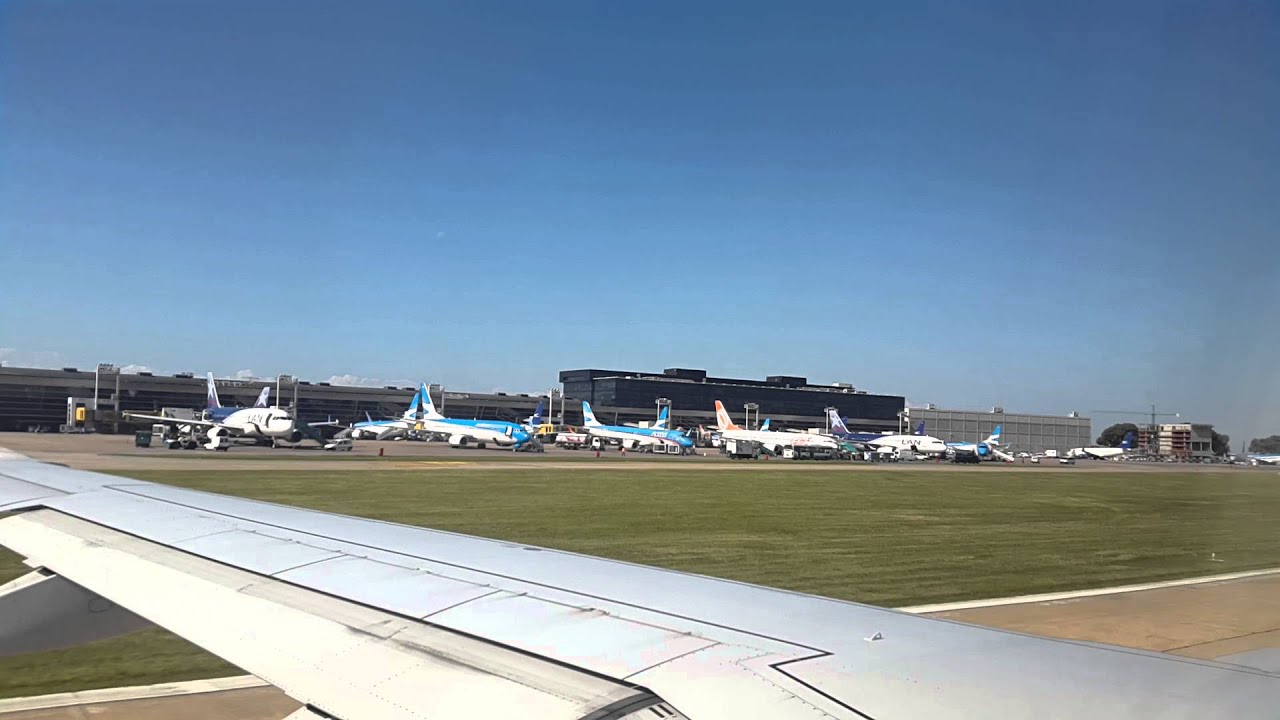
Avión en el momento del despegue | Foto: dcviking para Pixabay

AW | 2017 04 17 09:53 | AIRLINES ROUTES / MARKET

Dos compañías aéreas, Norwegian y Level, han empezado a vender vuelos a bajo coste entre Europa y América. ¿Es sostenible este modelo de negocio?

¿Puede una aerolínea operar vuelos transatlánticos a 99 euros? Nadie lo ha intentado desde que la recesión económica de la década de 1980 acabara con el proyecto pionero de Laker Airways, la aerolínea británica de Sir Freddie Laker, que entre 1977 y 1982 voló trayectos con tarifas muy bajas (para el estándar de la época) entre Londres y Nueva York.

Aunque en 1971 ya había comenzado a surcar los cielos la primera aerolínea de bajo coste en vuelos nacionales, la norteamericana Southwest, “no fue hasta después de los atentados del 11 de septiembre de 2001 cuando se desarrolló ese tipo de vuelos baratos, empujados por la caída de la demanda global”, explica Arturo Benito Ruiz, responsable de Transporte Aéreo de la Universidad Politécnica de Madrid. El modelo de negocio de las aerolíneas de bajo coste llegó a Europa en la década de 1990, con la liberalización del transporte aéreo.

A principios de 2017, Norwegian Air ha dado la campanada lanzándose de nuevo a los vuelos de bajo coste y larga distancia con el anuncio de operaciones entre Barcelona y el continente americano a precios de entre 99 y 150 euros por trayecto. Hace unas semanas el grupo IAG, propietario de British Airways, Iberia y Vueling, anunció el lanzamiento de Level. Se trata de la marca bajo la que Iberia operará vuelos a América a precios de derribo. O eso promocionan. Porque la realidad es que si se intenta hacer una reserva para el mes de octubre de 2017, los precios para viajar entre Barcelona y Los Ángeles no bajan de los 200 euros por trayecto.

Hasta ahora el segmento del largo recorrido era patrimonio de las aerolíneas tradicionales porque “en largo radio el mercado es más complejo” al “no estár totalmente liberalizado y muchos vuelos requieren tener derechos de tráfico, concedidos a través de acuerdos bilaterales entre Estados, no pudiendo las compañías aéreas entrar y salir de esos mercados libremente”, añade Benito.

Compañías como Easyjet, Ryanair u otras similares consiguen la rentabilidad con estrategias de control de costes muy radicales, operando rutas de punto a punto y obteniendo la mayor productividad de sus tripulaciones y los aparatos de que disponen. El Parlamento Europeo elaboró un estudio en 2007 en el que señalaba otras fuentes de ingresos para las aerolíneas de bajo coste: comisiones por la reserva de hoteles, alquiler de coches, comisiones por la compra con tarjetas de crédito, cargos por equipaje y espacio para anuncios, entre otras posibilidades. La cuestión es si este modelo se puede trasladar al largo radio.

Norwegian Air parece haberlo conseguido pero la rentabilidad de Level “es mucho más dudosa”, según Federico Soto, profesor del Máster Universitario en Gestión de Empresas del Transporte Aéreo de la Universidad Europea. Soto indica que Norwegian Air ha iniciado las operaciones a bajo coste con aviones 737Max y un modelo low cost, mientras que el movimiento de IAG ha sido más “reactivo”, en el sentido de que no quieren perder cuota en este nuevo mercado, pero que Level no cuenta con un modelo de bajo coste refinado.

A su favor juega, en opinión del profesor Benito Ruiz, que Level “va a contar con las conexiones que le puede ofrecer otra compañía del grupo IAG, Vueling, que es la número uno en el aeropuerto de Barcelona” porque, añade el responsable de Transporte Aéreo de la Politécnica, “una diferencia importante con el medio radio de bajo coste es que éste se basa en tráfico punto a punto con aviones de entre 150 y 200 plazas, sin conexiones, mientras que el largo radio (a excepción del chárter) necesita alimentación de vuelos de medio radio y opera con aviones mayores (250-350 plazas)”.

Soto mantiene que la mayor parte del precio que paga el cliente por su billete de bajo coste se corresponde con el gasto de combustible “y ahí ambos modelos [el tradicional y el de bajo coste] juegan con las mismas cartas”. El alto gasto que supone el combustible en la estructura de costes de una compañía aérea explica por qué las aerolíneas low cost no han entrado en el negocio de vuelos transatlánticos mucho antes. Además, el experto de la Universidad Europea considera que no está claro que las compañías tradicionales vayan a desaparecer de este mercado, sobre todo cuando acaben de incorporar a sus flotas modelos más eficientes de aeronaves, incrementen el número de asientos en clase turista, contraten tripulaciones a precios más bajos y, sobre todo, sigan contando con clase business, la clave para conseguir la rentabilidad de las rutas operadas.

¿Se puede volar más de 6.000 km por 99 euros?
“Habría que ver si esos 99 euros incluyen la tasa de combustible y tasas aeroportuarias”, explica Soto. Este redactor ha intentado, en días diferentes, realizar una reserva por 99 euros en la web de Norwegian y de Level, y le ha sido imposible encontrar los precios que se anuncian, incluso reservando con meses de antelación. La conclusión es que los vuelos de larga distancia a este precio son un reclamo publicitario al que hay que sumar otros costes como tasas, combustible, equipaje, etcétera.

“Ya veremos cómo se mueve el mercado y cómo evoluciona el precio según la demanda y según la competencia. Lógicamente la mayoría de las plazas se venderán a precios más altos”, añade Benito.

Las aerolíneas que pretenden reducir el precio de los vuelos trasatlánticos tienen ante sí la difícil tarea de replicar en el largo radio el modelo de bajo coste que funciona en los vuelos nacionales o europeos. Federico Soto explica que algunos aspectos del modelo low cost sí pueden trasladarse, como incluir más filas de asientos en el interior del avión, usar aviones con costes operativos menores, aprobar con los trabajadores convenios colectivos más flexibles, operar en aeropuertos secundarios con tasas más baratas, recurrir sólo a la venta online o tirar de ingeniería fiscal para intentar tributar lo menos posible dentro de la ley.

A la hora de recortar gastos laborales, las aerolíneas deberían reducir el sueldo o aumentar la productividad de los tripulantes. “Los convenios laborales de las empresas suelen fijar un número máximo de horas voladas inferior al máximo permitido por motivos de seguridad por la Agencia Europea de Seguridad Aérea (EASA)”, explica Benito. El profesor de la Universidad Politécnica refiere que si se vuelan más horas por el mismo sueldo, se reducen los costes. Benito ahonda en que “el número de tripulantes a bordo [de la aeronave] puede también disminuir [porque se reduce el servicio] hasta los límites marcados por las normas de seguridad”.

Sin embargo, Soto señala que otros ingredientes del bajo coste pierden fuerza al trasladarlos a un modelo de largo radio: el menor tiempo de los aviones en tierra, los altos coeficientes de ocupación o las subvenciones de las autoridades locales. Hay que considerar que un vuelo de largo alcance requiere unas seis horas como mínimo (si se viaja desde Barcelona a la costa Este de los EEUU, por ejemplo). Durante ese tiempo, el avión sólo realiza un trayecto con un pasaje concreto. Sin embargo, en seis horas, dentro de Europa, un avión puede realizar hasta tres viajes consecutivos, por lo que se maximiza el beneficio que se puede obtener de su uso.

Hay otro detalle interesante: estas aerolíneas no cuentan con aviones de reserva, “por lo que cuando hay algún problema, recolocar al pasaje les cuesta mucho más, porque no tienen un avión parado cuando hay incidencias”, explica Eduardo Cadenas, director de relaciones institucionales del Sindicato Español de Pilotos de Líneas Aéreas (SEPLA).

Combustible por las nubes
Cadenas indica, además, que no sólo es una cuestión de los costes laborales, sino que el pasajero deberá pagarse la comida u optar por permanecer seis horas sin comer, o bien viajar sin maleta si no quiere pagar gastos por equipaje. “Se puede ir a Londres con equipaje de mano, pero en un viaje de larga distancia lo normal es que se necesite facturar una maleta”, explica. “Los ingresos de las compañías aéreas por estos ‘sobrecargos’ no hacen sino crecer en los últimos años”, reflexiona el responsable de Transporte Aéreo de la Politécnica de Madrid, para quien “los futuros clientes” deberían “enterarse bien de su coste antes de hacer la reserva, para evitar sorpresas de última hora”.

Cadenas, del SEPLA, también refiere que, dentro de la legalidad, estas compañías pueden tener una política más agresiva de combustible, cargando los aviones con menos queroseno, pero siempre dentro de los márgenes de seguridad que marca la normativa. “En las compañías low cost de largo radio el coste del combustible, a los precios actuales, puede ser hasta un 40% del coste total, por lo que este es un factor decisivo”, añade el profesor Benito Ruiz. “Una subida rápida del precio del petróleo arrastraría una subida paralela del queroseno y, posiblemente, obligaría a elevar tarifas o recurrir, como ya se ha hecho otras veces, a cobrar un suplemento especial ‘de combustible’ en el precio del billete”

Así que la cuestión de los costes es primordial para que la operativa tenga sentido. El profesor de la Universidad Europea sostiene que en el plazo de 12 meses, los principales costes vienen dados por los acuerdos que haya firmado la aerolínea, como personal, combustible, mantenimiento, etcétera. A más largo plazo, “todos los costes son variables”, de tal manera que se puede hacer una previsión de combustible adecuada, comprándolo a un precio fijo, negociando buenos acuerdos con proveedores, reduciendo plantillas o incluso bajando los salarios de los trabajadores.

Otro aspecto a tener en cuenta, sobre todo cuando se trabaja en el mercado internacional, son los tipos de cambio. Las aerolíneas pueden ingresar en libras o euros, pero pagar el combustible en dólares, por ejemplo. En los tipos de cambio se puede perder mucho dinero, según la moneda que se utilice para funcionar con normalidad. En definitiva, un juego de equilibrio muy complicado como para justificar precios tan bajos. AIRGWAYS ® Icon-AW

Low cost transatlantic flights

Two airlines, Norwegian and Level, have started selling low-cost flights between Europe and America. Is this business model sustainable?

Can an airline operate transatlantic flights for 99 euros? No one has tried since the economic recession of the 1980s ended the pioneering project of Laker Airways, the British airline of Sir Freddie Laker, who flew between 1977 and 1982 with very low fares (for the standard of the time) Between London and New York.

Although the first low-cost airline on domestic flights, the Southwest, had started to cross the skies in 1971, «it was not until after the September 11, 2001 attacks that such cheap flights, Drop in global demand», explains Arturo Benito Ruiz, head of Air Transport at the Polytechnic University of Madrid. The business model of low-cost airlines came to Europe in the 1990s, with the liberalization of air transport.

At the beginning of 2017, Norwegian Air has launched the campaign to launch again on low cost and long distance flights with the announcement of operations between Barcelona and the American continent at prices of between 99 and 150 euros per way. A few weeks ago the group IAG, owner of British Airways, Iberia and Vueling, announced the launch of Level. This is the brand under which Iberia will operate flights to America at demolition prices. Or that promote. Because the reality is that if you try to make a reservation for the month of October 2017, the prices for traveling between Barcelona and Los Angeles do not fall below 200 euros per way.

Until now, the long-haul segment has been owned by traditional airlines because «the radio market is more complex» and «not fully liberalized and many flights require traffic rights, granted through bilateral agreements between States, not being able to Airlines enter and exit those markets freely», adds Benito.

Companies such as Easyjet, Ryanair or other similar companies achieve profitability with very radical cost control strategies, operating point-to-point routes and obtaining the highest productivity of their crews and the equipment they have. The European Parliament drew up a study in 2007 that identified other sources of revenue for low-cost airlines: hotel reservation fees, car rentals, credit card commissions, baggage charges and ad space , Among other possibilities. The question is whether this model can be moved over the long radius.

Norwegian Air seems to have succeeded but Level’s profitability «is much more dubious», according to Federico Soto, professor of the University Master in Management of Air Transport Companies of the European University. Soto points out that Norwegian Air has started low-cost operations with 737Max and a low-cost model, while the IAG movement has been more «reactive» in the sense that they do not want to lose share in this new market, but that Level does not have a refined low-cost model.

In his favor, in the opinion of Professor Benito Ruiz, Level «will have the connections that can be offered by another company of the group IAG, Vueling, which is the number one in Barcelona airport» because, adds the head of «an important difference with the low-cost radio medium is that it is based on point-to-point traffic with planes of between 150 and 200 seats, without connections, while the long radio (with the exception of the charter) Needs to feed half-radio flights and operates with larger aircraft (250-350 seats). «

Soto maintains that most of the price paid by the customer for his low-cost ticket corresponds to the fuel expense «and there both models [traditional and low cost] play with the same cards.» The high cost of fuel in an airline’s cost structure explains why low-cost airlines have not entered the transatlantic business long before. In addition, the European University expert believes that it is not clear that traditional companies will disappear from this market, especially when they finish incorporating to their fleets more efficient models of aircraft, increase the number of seats in tourist class, hire crews At lower prices and, above all, continue to count on business class, the key to achieving the profitability of the routes operated.

Can you fly more than 6,000 km for 99 euros?
«It would be necessary to see if those 99 euros include the rate of fuel and airport taxes,» explains Soto. This editor has tried, on different days, to make a reservation for 99 euros in the web of Norwegian and Level, and it has been impossible to find the prices that are announced, even reserving months in advance. The conclusion is that long distance flights at this price are an advertising claim to which we must add other costs such as taxes, fuel, luggage, and so on.

«We will see how the market moves and how the price evolves according to the demand and according to the competition. Logically most of the places will be sold at higher prices, «adds Benito.

Airlines wishing to reduce the price of transatlantic flights have the difficult task of replicating the low-cost model that runs on domestic or European flights over the long haul. Federico Soto explains that some aspects of the low cost model can be transferred, such as adding more rows of seats inside the plane, using airplanes with lower operating costs, approving with workers more flexible collective agreements, operating at secondary airports with cheaper rates , Resort only to online sales or pull engineering tax to try to tax as little as possible within the law.

When cutting labor costs, airlines should reduce salaries or increase crew productivity. «Employee labor agreements usually set a maximum number of hours flown less than the maximum allowed for safety reasons by the European Aviation Safety Agency (EASA),» explains Benito. The professor of the Polytechnic University says that if you fly more hours for the same salary, you reduce costs. Benito goes on to say that «the number of crew on board [of the aircraft] can also decrease [because the service is reduced] to the limits set by the safety standards.»

However, Soto points out that other low-cost ingredients lose strength by moving them to a long-haul model: the shorter aircraft time on the ground, high occupancy rates, or subsidies from local authorities. Consider that a long-range flight requires at least six hours (if you travel from Barcelona to the US East Coast, for example). During that time, the airplane only makes a trip with a specific passage. However, within six hours, within Europe, an airplane can make up to three consecutive trips, so that the benefit that can be obtained from its use is maximized.

There is another interesting detail: these airlines do not have spare airplanes, «so when there is a problem, getting the ticket costs a lot more, because they do not have a plane stopped when there are incidents,» explains Eduardo Cadenas, director of institutional relations Of the Spanish Union of Airline Pilots (SEPLA).

Fuel by the clouds
Cadenas also points out that not only is it a matter of labor costs, but the passenger must pay for the food or choose to remain six hours without eating, or travel without a suitcase if he does not want to pay for luggage. «You can go to London with carry-on luggage, but on a long-distance journey, it’s normal that you need to check in a suitcase,» he explains. «The revenues of airlines for these ‘overloads’ only grow in recent years,» reflects the head of Air Transport of the Polytechnic of Madrid, for whom «future customers» should «know their cost well before Make the reservation, to avoid last minute surprises «.

Cadenas, of SEPLA, also says that, within the legality, these companies can have a more aggressive fuel policy, loading the aircraft with less kerosene, but always within the margins of safety that mark the norm. «In low-cost long-distance companies the cost of fuel, at current prices, can be up to 40% of the total cost, so this is a decisive factor,» adds Professor Benito Ruiz. «A rapid rise in the price of oil would lead to a parallel rise in kerosene and possibly to raise tariffs or resort, as has already been done before, to charge a special ‘fuel surcharge’ on the price of the ticket».

So the question of costs is paramount for the operation to make sense. The professor of the European University argues that within 12 months, the main costs are given by the agreements signed by the airline, such as personnel, fuel, maintenance, and so on. In the longer term, «all costs are variable», so that an adequate fuel forecast can be made, buying it at a fixed price, negotiating good deals with suppliers, reducing staffing or even lowering workers’ wages.

Another aspect to take into account, especially when working in the international market, are the exchange rates. Airlines can enter pounds or euros, but pay for fuel in dollars, for example. In exchange rates you can lose a lot of money, depending on the currency used to operate normally. In short, a game of balance very complicated to justify such low prices. A\W

Ξ A I R G W A Y S Ξ
SOURCE: Revista80dias.es
DBk: Pixabay.com / Norwegian Air
AW-POST: 201704170953AR

A\W A I R G W A Y S ®
Brasil permitirá la propiedad extranjera de aerolíneas al 100%

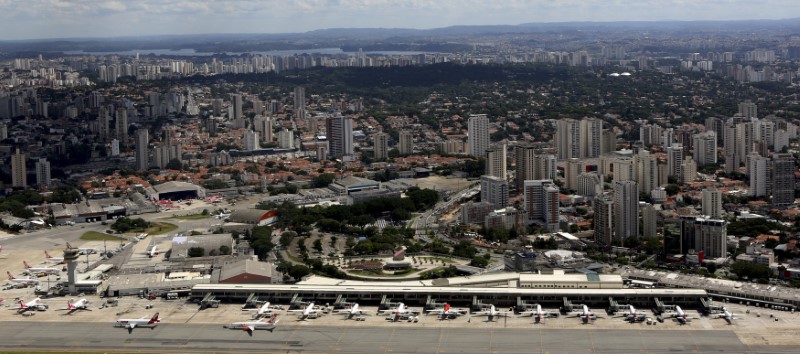
© Reuters. Brasil permitirá la propiedad extranjera de aerolíneas al 100 por cien

AW | 2017 04 11 05:21 | AIRLINES MARKET

El presidente de Brasil, Michel Temer, firmará el martes un decreto que permitirá a compañías extranjeras poseer el 100 por ciento de aerolíneas con sede en el país, como parte de unas medidas destinadas a aumentar la inversión en el sector turístico.

Temer firmará el decreto en una ceremonia con el ministro de Turismo, Marx Beltrão, dijo la fuente. Reuters informó por primera vez en enero de que el Gobierno estaba redactando la medida.

El año pasado, la ex presidenta Dilma Rousseff emitió un decreto para elevar el límite de propiedad extranjera en aerolíneas desde un 20 por ciento a un 49 por ciento.

Como parte de las nuevas medidas el Gobierno también, según la fuente, subsidiará a las aerolíneas para que cubran áreas remotas que no cuentan con suficientes vuelos, como partes de la Amazonía.

Brazil to allow 100% foreign ownership of airlines


Brazilian President Michel Temer will sign a decree on Tuesday that will allow foreign companies to own 100 percent of airlines based in the country as part of measures to increase investment in the tourism sector.

Temer will sign the decree in a ceremony with Tourism Minister, Marx Beltrão, the source said. Reuters reported for the first time in January that the government was drafting the measure.

Last year, former President Dilma Rousseff issued a decree to raise the foreign ownership limit on airlines from 20 percent to 49 percent.

As part of the new measures the government also, according to the source, will subsidize the airlines to cover remote areas that do not have enough flights, as parts of the Amazon. A\W

Brasil permitirá ao 100% propriedade estrangeira em companhias aéreas


Presidente do Brasil, Michel Temer, vai assinar um decreto que permitirá que as empresas estrangeiras a deter 100 por cento das companhias aéreas baseadas no país como parte das medidas destinadas a aumentar o investimento no sector do turismo na terça-feira.

Temer assinou o decreto em uma cerimônia com o ministro do Turismo, Marx Beltrão, disse a fonte. Reuters relatada pela primeira vez em janeiro que o governo estava elaboração do acto.

No ano passado, o ex-presidente Dilma Rousseff emitiu um decreto para aumentar o limite de participação estrangeira em companhias aéreas de 20 por cento para 49 por cento.

Como parte das novas medidas do governo também, de acordo com a fonte, vai subsidiar companhias aéreas para cobrir áreas remotas que não têm número suficiente de voos, como partes da Amazônia. A\W

Ξ A I R G W A Y S Ξ
SOURCE: Reuters.com
DBk: Reuters.com
AW-POST: 201704110521AR

A\W   A I R G W A Y S ®

ATSSSAN reclama cargos a aerolíneas

ATSSSAN flays airlines over nonremittance of charges

AW | 2017 04 10 05:25 | AIRLINES MARKET

 La Asociación de Altos Funcionarios del Servicio de Transporte Aéreo de Nigeria (ATSSSAN) también se ha sumado a la polémica por la negativa de las aerolíneas a remitir los cargos por venta de boletos y cargas de cinco por ciento.

El presidente de ATSSSAN, el camarada Ahmadu Illitrus, defendió la Autoridad de Aviación Civil de Nigeria (NCAA), señalando que los operadores aéreos han estado engañando a los nigerianos por los cargos.

Hablando con los periodistas durante el fin de semana, Illitrus dijo: «Lo que hemos visto a lo largo de los años es que las aerolíneas nacionales, es decir, los miembros de AON y los no miembros colectan el TSC del 5% de los pasajeros y se niegan a remitir a NCAA y / Porcentaje insignificante del dinero y utilizar ilegalmente el mayor porcentaje no reimportado, creando así un enorme déficit de la parte no devuelta del dinero que ahora forma lo que se denomina deuda».

El Presidente subrayó que el cargo del cinco por ciento no equivale a ningún impuesto sobre las compañías aéreas, diciendo que la no renuncia del dinero dificulta el buen funcionamiento de las agencias.

«Si podemos preguntarnos, ¿de qué manera el régimen del 5% TSC ha afectado negativamente la operación o supervivencia de las compañías aéreas nacionales nigerianas que realmente cobran el Cargo de los pasajeros y lo embolsan? Hoy las líneas aéreas domésticas han codiciado ilegalmente más de 16 mil millones 5% de TSC», dijo Illitrus. Aconsejó a las aerolíneas no «no remolcar el camino de la desobediencia a las leyes existentes»AIRGWAYS ® Icon-AW

ATSSSAN flays airlines over nonremittance of charges

Air Transport Services Senior Staff Association of Nigeria (ATSSSAN) has also joined the raging controversy over airlines’ refusal to remit the five per cent ticket and cargo sale charges, saying the action of airlines as illegal.

ATSSSAN President, Comrade Ahmadu Illitrus defended the Nigeria Civil Aviation Authority (NCAA), noting that airline operators have been misleading Nigerians over the charges.

Speaking with newsmen over over the weekend, Illitrus said, «What we have witnessed over the years is that the domestic airlines i.e AON members and non-members alike collect the 5% TSC from passengers and refuse to remit to NCAA and or remit only a negligible percentage of the money and illegally utilize the larger unremitted percentage, thereby creating a huge deficit of unremitted portion of the money which now forms what is termed debt».

The President stressed that the five per cent charge does not amount to any tax on airlines, saying the nonremittance of the monies hampers the smooth running of the agencies.

«If we may ask, in what way has the regime of the 5% TSC affected in the negative the operation or survival of Nigerian indigenous airlines who actually collect the Charge from passengers and pocket it? Today the domestic airlines have illegally coveted over 16 billion 5% TSC», Illitrus said. He advised the airlines not «not to tow the path of disobedience to existing laws.» A\W

Ξ A I R G W A Y S Ξ
SOURCE: Dailytrust.com.ng
DBk: Dailytrust.com.ng
AW-POST: 201704100525AR

A\W   A I R G W A Y S ®

Norwegian plan inversion en Argentina

AW | 2017 04 07 12:53 | AIRLINES MARKET

Norwegian lanzó su plan de inversión en el país por US$ 4300 millones

La aerolínea low cost pidió a la autoridad del sector 146 rutas locales, regionales e internacionales; pondrá 70 aviones.

Norwegian lanzó su plan de inversión en el país por US$ 4300 millones. La aerolínea low cost pidió a la autoridad del sector 146 rutas locales, regionales e internacionales; pondrá 70 aviones

presentación de 680 páginas que ingresó en la Administración Nacional de Aviación Civil (ANAC) la aerolínea low cost Norwegian Air Shuttle pesaba más de lo común. En su interior contenía la mayor propuesta de inversión que haya formulado una compañía de su tipo en el país: la empresa noruega planea desembolsar US$ 4300 millones en un plazo de entre cinco y ocho años.

Pero no sólo eso. Según adelantó a LA NACION desde España Alfons Claver, responsable de comunicación de Norwegian, la presentación efectuada el viernes pasado ante la ANAC incluye la petición de 146 rutas, tanto en el mercado de cabotaje como en el regional e intercontinental. «Con ello esperamos crear entre 3000 y 3500 empleos directos en el país», afirmó el vocero.

Según una fuente muy cercana a la operación, la firma escandinava sería la única de todas las low cost que intentan operar en el mercado argentino que está en condiciones de volar a Europa y Estados Unidos. «Lo que falta ahora es que la ANAC lo apruebe, lo que supongo que será en mayo, y que el Gobierno llame a audiencia. Ésos son los requisitos que restan para que se concrete la operación», comentó la fuente.

El plan además incluye la idea de poner en operación en el país 70 aviones (50 Boeing 737, de corto rango, y 20 Boeing 787, de largo rango). «Norwegian tiene con qué cubrir esa demanda porque hace dos años hizo el pedido de aviones más grande de la historia para una línea aérea europea y tiene en espera 250 aviones Boeing en producción», explicó Claver.

Claro que no todos estos aviones llegarán el primer año. Según el cronograma entregado por la empresa, a partir del día en que comiencen las operaciones, habrá seis aviones en la Argentina, todos de corto rango y para fines de año ya se estaría hablando de 10 aviones. Doce meses después del primer vuelo, ya habrá 15 aeronaves (11 de corto rango y 4 de largo), y 30 meses después habrá 35 (25 de corto rango y 10 de largo).

Entre el quinto y el octavo año de operaciones, la empresa escandinava ya tendría 70 aviones (50 de corto rango y 20 de largo). «Con esto seríamos capaces de operar las 146 rutas y transportar cada año 18,2 millones de pasajeros a unos 90 destinos, distribuidos en 25 países», precisó Claver.

Los vuelos de Norwegian ya para noviembre podrán despegar del aeropuerto de Gatwick (Londres) y conectar con Buenos Aires, desde donde se hará la distribución con su red doméstica. «Así, habrá una línea aérea doméstica, Norwegian Air Argentina, que es la que presentó los papeles, que podrá volar vuelos de cabotaje y de largo alcance internacional. Esto hace más eficiente y sólida la red», explicó la fuente.

«Este plan no se limita a Buenos Aires, sino que tendríamos cuatro bases operativas: Ezeiza, Aeroparque, Córdoba y Mendoza. En estas bases pernoctarán los aviones y sus tripulaciones y se hará el mantenimiento ligero», detalló Claver.

Si bien los empleos directos que generará el plan son de entre 3000 y 3500 (entre pilotos, aeromozos y técnicos), la compañía cree que el empleo indirecto sumaría entre 55.000 a 60.000 puestos de trabajo. Según Norwegian, la propuesta incrementará el PBI argentino por año en un 1,5%-2% respecto del nivel actual, dependiendo del crecimiento del PBI en los próximos años.

Norwegian es la tercera low cost de Europa y la sexta del mundo. El año pasado facturó US$ 3100 millones y tuvo un beneficio neto de US$ 136 millones. Además, transportó 29,7 millones de pasajeros. Su flota actual es de 126 aviones (113 de corto rango y 13 de largo rango).

Los US$ 4300 millones que proyecta invertir Norwegian en el país tienen un sustento: según explican en el sector, hay muchísimo mercado por explotar, sin afectar a Aerolíneas Argentinas y Latam. «Algunos dicen que el mercado actual se puede duplicar, pero yo digo que, con los estímulos adecuados, se puede triplicar», estimó la fuente.

La noticia para los potenciales pasajeros también es esperanzadora, ya que se baraja que las low cost manejarán tarifas que serán 40% menores que las que hoy tienen las aerolíneas principales.  AIRGWAYS ® Icon-AW

Norwegian investment plan in Argentina

Norwegian launched its investment plan in the country for US $ 4.3 billion

The low-cost airline asked the sector authority for 146 local, regional and international routes; will put 70 aircraft.

Norwegian launched its investment plan in the country for US $ 4.3 billion. The low-cost airline asked the sector authority for 146 local, regional and international routes; will put 70 aircraft

 Presentation of 680 pages that entered the National Civil Aviation Administration (ANAC) the low cost airline Norwegian Air Shuttle weighed more than the average. Inside it contained the largest investment proposal ever made by a company of its kind in the country: the Norwegian company plans to spend US $ 4.3 billion over five to eight years.

But not only that. As announced to LA NATION from Spain Alfons Claver, responsible for communication of Norwegian, the presentation made last Friday before the ANAC includes the request for 146 routes, both in the regional and intercontinental cabotage market. «With this we hope to create between 3000 and 3500 direct jobs in the country,» said the spokesperson.

According to a source very close to the operation, the Scandinavian firm would be the only one of all the low cost that tries to operate in the Argentine market that is able to fly to Europe and the United States. «What is missing now is that the ANAC approve it, which I suppose will be in May, and that the government will call the hearing. Those are the remaining requirements for the operation to be completed,» the source said.

The plan also includes the idea of operating 70 aircraft in the country (50 Boeing 737, short range, and 20 Boeing 787, long range). «Norwegian has to cover that demand because two years ago it ordered the largest aircraft in history for a European airline and has on hold 250 Boeing aircraft in production,» Claver said.

Of course, not all of these planes will arrive the first year. According to the schedule provided by the company, from the day the operations start, there will be six aircraft in Argentina, all of short range and by the end of the year would be talking about 10 aircraft. Twelve months after the first flight, there will be 15 aircraft (11 short range and 4 long), and 30 months later there will be 35 (25 short range and 10 long).

Between the fifth and eighth year of operations, the Scandinavian company would already have 70 aircraft (50 short range and 20 long). «With this we would be able to operate the 146 routes and carry 18.2 million passengers each year to about 90 destinations, distributed in 25 countries,» said Claver.

Norwegian flights for November will be able to take off from Gatwick Airport (London) and connect with Buenos Aires, from where the distribution will be done with their home network. «Thus, there will be a domestic airline, Norwegian Air Argentina, which presented the papers, which will be able to fly cabotage and international long-haul flights, which makes the network more efficient and solid,» the source explained.

«This plan is not limited to Buenos Aires, but we would have four operational bases: Ezeiza, Aeroparque, Córdoba and Mendoza, and the planes and their crews will stay overnight and light maintenance will be done,» Claver said.

While the direct jobs generated by the plan are between 3000 and 3500 (between pilots, flight attendants and technicians), the company believes that indirect employment would add between 55,000 to 60,000 jobs. According to Norwegian, the proposal will increase the Argentine GDP per year by 1.5% -2% from the current level, depending on GDP growth in the coming years.

Norwegian is the third low cost of Europe and the sixth of the world. Last year it invoiced US $ 3.1 billion and had a net profit of US $ 136 million. It also carried 29.7 million passengers. Its current fleet is 126 aircraft (113 short range and 13 long range).

The US $ 4.3 billion that Norwegian plans to invest in the country have a livelihood: as explained in the sector, there is a lot of market to exploit, without affecting Aerolíneas Argentinas and Latam. «Some say the current market can double, but I say that with the right stimuli, it can triple,» the source said.

The news for potential passengers is also hopeful, as it is shuffled that the low cost will handle rates that will be 40% lower than those currently held by the main airlines. A\W


Ξ A I R G W A Y S Ξ
SOURCE: Lanacion.com.ar
DBk: Wikipedia.org
AW-POST: 201704071253AR

A\W   A I R G W A Y S ®

FlyBondi comenzará a volar en Argentina a partir de septiembre

https://airgways.com/wp-content/uploads/2017/04/623c7-flibondi.jpg

AW | 2017 04 02 13:00 | AIRLINES MARKET

 ‘Eficiente es mejor palabra que low cost’, dice Cook, el CEO de la empresa

La compañía FlyBondi comenzará avolar en Argentina a partir de septiembre, desde Aeroparque hacia, en principio, cinco destinos: Córdoba, Iguazú, Bariloche, Mendoza y Salta. De todas formas, la empresa aclara que, para poder ofrecer vuelos mucho más económicos, necesitan que el Gobierno elimine el piso de tarifas mínimas ya establecido.

«Preferimos vender un pasaje a $10 a volar con un asiento vacío». Cuando Julian Cook, el empresario suizo y CEO de la low cost FlyBondi, repite con su acento extranjero «sí, 10 pesos argentinos» no pone énfasis en la cifra ni trata de sorprender. Sólo describe lo que pretende sea la aerolínea que ya tiene mes de despegue en la Argentina: septiembre. Una vez que presente la flota de aviones, la compañía que ganó 78 de las 99 rutas que pidió en una audiencia pública tiene como objetivo comenzar a valor en el segundo semestre desde Buenos Aires a Córdoba, Iguazú, Bariloche, Mendoza y Salta.

Este año lo hará desde Aeroparque y en 2018 desde El Palomar, tras la puesta a punto de la pista del aeropuerto, la construcción de una terminal y una calle de acceso. La obra forma parte de la inversión de USD 75 millones que promete la aerolínea con fondos de inversión europeos y norteamericanos, aunque no especificaron cuáles.

Pero para siquiera vender pasajes promocionales tan económicos, FlyBondi hoy le pide al Gobierno que elimine la banda mínima, un piso de tarifas aéreas que está establecido por tramo. De esta forma, Cook asegura que se podrá hacer el tramo Aeroparque-Córdoba (sólo ida) por unos $500 y por $800 a Bariloche ($200 en baja temporada). «Es un pedido que se le hizo al Gobierno, aún no sabemos qué pasará», dice Cook.

Con todo, FlyBondi buscará transportar 8 millones de pasajeros en cinco años y llegar a los 1.500 empleados. «Eficiente es mejor palabra que low cost», dice Cook, quien adelanta que se le pedirá 75 horas de vuelo por mes a cada piloto. «Estamos en conversaciones con los gremios del sector. Nuestros pilotos cobrarán más que en otras aerolíneas, pero deberán ser más productivos». Como parte del directorio de la compañía, el empresario Michael Cawley llega a la mesa con 17 años en Ryanir, la low cost que transportó 117 millones de pasajeros en 2016. «Cuando se reduce la tarifa, la demanda aumenta. Y para tener precios bajos, hay que tener costos bajos», dice Cawley, y enfatiza: «La oportunidad en el mercado argentino es mejor que hace 20 años en Europa».  AIRGWAYS ® Icon-AW

FlyBondi to begin flying in Argentina from September


«Efficient is better word than low cost,» says Cook, the CEO of the company


The FlyBondi company will start flying in Argentina from September, from Aeroparque to, in principle, five destinations: Córdoba, Iguazú, Bariloche, Mendoza and Salta. In any case, the company clarifies that, in order to offer much cheaper flights, they need the Government to eliminate the floor of minimum tariffs already established.

«We prefer to sell a $ 10 ticket to fly with an empty seat.» When Julian Cook, the Swiss businessman and CEO of the low cost FlyBondi, repeats with his foreign accent «yes, 10 argentine pesos» does not emphasize the figure or try to surprise. It only describes what it intends to be the airline that already has takeoff month in Argentina: September. Once the aircraft fleet is presented, the company that won 78 of the 99 routes it requested at a public hearing aims to begin value in the second semester from Buenos Aires to Córdoba, Iguazú, Bariloche, Mendoza and Salta.

This year it will do it from Aeroparque and in 2018 from El Palomar, after the tuning of the airport runway, the construction of a terminal and an access road. The work is part of the investment of USD 75 million that promises the airline with European and North American investment funds, but did not specify which.

But to even sell promotional tickets that are so cheap, FlyBondi today asks the government to eliminate the minimum band, an air fare floor that is set by stretch. In this way, Cook assures that it will be possible to make the section Aeroparque-Córdoba (one way) for about $ 500 and for $ 800 to Bariloche ($ 200 in low season). «It is a request that was made to the Government, we still do not know what will happen,» says Cook.

However, FlyBondi will seek to transport 8 million passengers in five years and reach 1,500 employees. «Efficient is better word than low cost,» says Cook, who anticipates that he will be asked 75 flight hours per month for each pilot. «We are in talks with the guilds of the sector. Our pilots will charge more than other airlines, but they must be more productive.» As part of the company’s board of directors, entrepreneur Michael Cawley comes to the table at Ryanir, the low-cost carrier that carried 117 million passengers in 2016. «When the rate is reduced, demand increases. , You have to have low costs,» says Cawley, and emphasizes: «The opportunity in the Argentine market is better than 20 years ago in Europe.» A\W


Ξ A I R G W A Y S Ξ
SOURCE: Elintransigente.com
DBk: Flybondi
AW-POST: 201704021300AR

A\W   A I R G W A Y S ®

Inversiones en mercado aéreo de EE.UU.

103912086-GettyImages-589723198

AW | 2017 04 01 13:38 | AIRLINES MARKET

 La industria se ha consolidado considerablemente desde que se desreguló. A pesar de la consolidación de la industria sigue siendo competitivo hasta cierto punto. Warren Buffett recientemente compró acciones en las cuatro principales aerolíneas después de evitar la industria durante años

Warren Buffett ha advertido a los inversionistas acerca de poner dinero en acciones de la aerolínea varias veces. Incluso tuvo su propia malograda inversión en US Air en 1989 (aunque finalmente obtuvo ganancias). Sin embargo, después de décadas de desacreditar los méritos de inversión de la industria aérea, este pasado febrero, ha sacado un 180 y ha comprado importantes sumas de acciones de las cuatro aerolíneas Delta Air Lines, United Airlines, Southwest Airlines y American Airlines. Entonces, ¿deberían los inversionistas seguir el ejemplo de Buffett y comprar algunas acciones de la aerolínea? Para responder a la pregunta, tenemos que ver cómo ha evolucionado la industria aérea en las últimas décadas y cómo se ve el entorno empresarial actual.

La industria de la línea aérea entonces y ahora

La industria aérea se desreguló en 1978. En ese momento había más de 400 transportistas aéreos certificados con cerca de 10 líneas aéreas principales que proporcionaban el 90% de todos los vuelos domésticos. Después de la desregulación la industria aérea perdió un colectivo $ 60B y más de 160 líneas aéreas se declararon en bancarrota. De los originales 400 transportistas sólo quedan unos 68. La gran recesión en 2008 forzó la consolidación en la industria. Bajo la administración de Obama, la industria pasó de 7 grandes aerolíneas a sólo cuatro.

AW-7M&A7

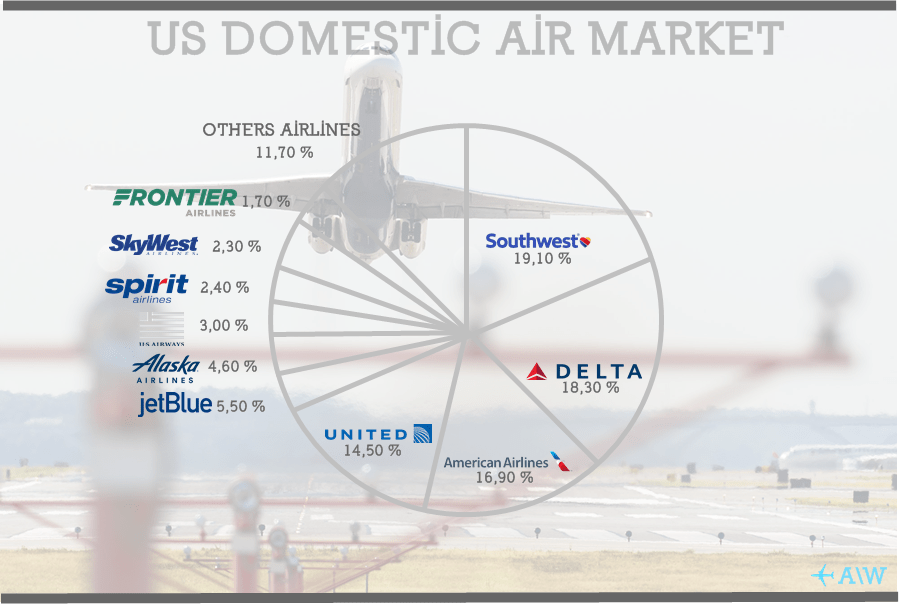
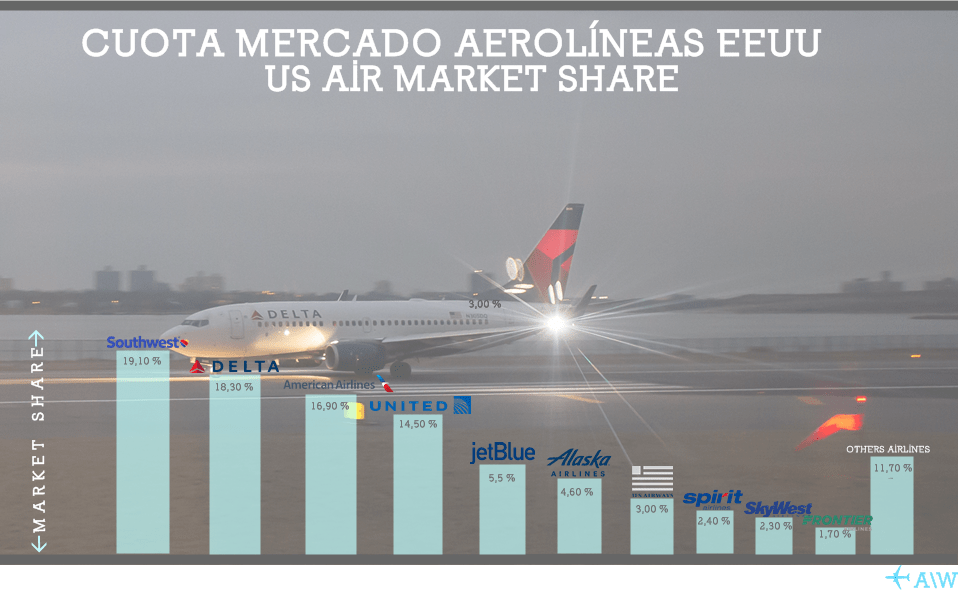
Hoy en día, la cuota de mercado de las aerolíneas nacionales se ve así

La consolidación de la industria, junto con los bajos precios del combustible, ha permitido a las aerolíneas pasar de pérdidas a un beneficio de $ 25.6B en 2015. Sabemos que las aerolíneas son rentables ahora, pero ¿continuarán? ¿La actual estructura del mercado se presta a beneficios estables o la brutal competencia del retorno de antaño?

¿Oligopolio o mercado competitivo?

Según algunas definiciones, la industria aérea actual es un oligopolio. Las cinco principales empresas poseen una cuota de mercado superior al 50% (las cinco principales tienen el 74,3% del mercado). También es difícil para los nuevos grandes competidores entrar en el mercado interno. Se necesitarían miles de millones para arrendar una flota de aviones y construir la infraestructura necesaria para competir en las principales rutas rentables. En cambio, la competencia se limita principalmente a las rutas regionales más pequeñas, donde los beneficios son bajos y los nuevos jugadores pueden entrar más fácilmente en el mercado.

Por otro lado, los mercados más grandes deben seguir siendo competitivos. La industria de las líneas aéreas no cumple con los cuatro criterios de concentración de la empresa de una cuota de mercado del 80% o superior (las cuatro primeras empresas controlan sólo el 68,5% del mercado). La industria de las líneas aéreas tampoco se clasifica muy alta utilizando el índice Herfindahl-Hirschman (HHI) que mide la concentración del mercado. Calculamos un número HHI de .127 para la industria aérea, que está muy por debajo del número de .25 utilizado por Estados Unidos al bloquear las fusiones debido a la falta de competencia. Nuestro cálculo del número de HHI para la industria está abajo.

AW-788770

Utilizamos los números de cuota de mercado de antes en el artículo y luego asumimos que el 11,7% restante del mercado interno estaba dividido en partes iguales entre las 79 compañías aéreas certificadas restantes que proporcionan vuelos nacionales de pasajeros. Como puede ver, la cuota de mercado exacta de los 79 restantes es en su mayoría irrelevante para el cálculo, ya que sólo cambia el dígito de diez milésimas del número HHI. Así que la cuota de mercado real del resto de los transportistas es en su mayoría irrelevante y sólo asumiendo un peso igual no afectará el cálculo.

Por lo tanto, por la mayoría de las medidas de la industria aérea en este momento está en una especie de limbo. No es un oligopolio atractivo, como decir el mercado de tarjetas de crédito (Visa, MasterCard y un distante American Express y Discover) y no es el brutalmente competitivo, perder dinero, pozo sin fondo para el capital inversor que fue en los años 1980 y 1990.

Hay una razón adicional para que los inversores en el sector de las aerolíneas sean optimistas. Hay estudios que han demostrado que cuando las empresas de una determinada industria comparten la propiedad común tiende a mejorar los márgenes de beneficio de la industria.

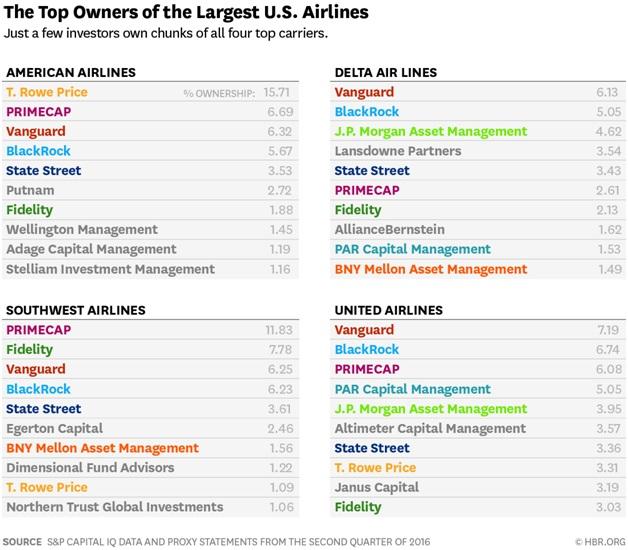
Las compañías aéreas más grandes comparten un buen número de inversores comunes como muestra este gráfico de HBR.

607954-14909847164667752

La propiedad común significa que hay una intensa presión externa para que las compañías se concentren en aumentar los beneficios haciéndose más eficientes en comparación con el aumento de las ventas y la cuota de mercado a través de la competencia con los rivales. Después de todo, ¿por qué querría Warren Buffett animar a Delta Air Lines a entrar en una guerra de precios para aumentar su cuota de mercado cuando es probable que ese aumento en la cuota de mercado provenga de United, Southwest y American Airlines? Sólo estaría moviendo dinero de un bolsillo a otro en el mejor escenario (con toda probabilidad la cantidad de ganancias caería a medida que la competencia disminuiría los márgenes).
Resumen

En resumen, es fácil ver por qué Buffett ha cambiado de opinión con la industria aérea. La industria ha sufrido un cambio drástico. No sólo el número de aerolíneas principales se ha consolidado de 10 a cuatro, sino que la propiedad de esas aerolíneas se ha vuelto más concentrada también. Sin embargo, todavía no creo que ciegamente después de Buffett y la compra de aerolíneas es una gran idea. Todavía es un negocio altamente competitivo donde muchos clientes compran por precio solo (o al menos ponen énfasis en el precio). El negocio sigue siendo cíclico con altos costos fijos y sigue siendo muy intensivo en capital. Si desea invertir en un negocio con esas características, muchos fabricantes de automóviles están negociando con menor P / Es y rendimientos de dividendos más altos que las principales aerolíneas. Si desea seguir a un inversor bien conocido en un negocio cíclico, intensivo en capital, escogeríamos a David Einhorn en GM antes de buscar en la industria de aerolíneas ideas.  AIRGWAYS ® Icon-AW

103912086-GettyImages-589723198

Investments in the US air market

The industry has consolidated significantly since being deregulated. Despite consolidation the industry still appears competitive to a certain degree. Warren Buffett recently bought stock in the four major airlines after avoiding the industry for years.

Warren Buffett has warned investors about putting money in airline stocks several times. He even had his own ill-fated investment in US Air in 1989 (although he eventually turned a profit on it). However, after decades of disparaging the investment merits of the airline industry, this past February he has pulled a 180 and bought significant sums of stock of the four major airlines Delta Air Lines, United Airlines, Southwest Airlines, and American Airlines. So should investors follow Buffett’s lead and buy some airline stocks? To answer the question, we need to look at how the airline industry has evolved over the past few decades and what the current business environment looks like.

The Airline Industry Then and Now

The airline industry was deregulated in 1978. At the time there were over 400 certified air carriers with about 10 major airlines providing 90% of all domestic flights. Following deregulation the airline industry lost a collective $60B and over 160 airlines filed for bankruptcy. Out of the original 400 carriers only about 68 are left. The great recession in 2008 forced more consolidation in the industry. Under the Obama administration the industry went from 7 major airlines to just four.

AW-7M&A7

Today the domestic airline market share looks like this

Industry consolidation coupled with low fuel prices has allowed airlines to go from losses to turning a profit of $25.6B in 2015. We know airlines are profitable now but will that continue? Does the current market structure lend itself to steady profits or will the brutal competition of yesteryear return?

Oligopoly or Competitive Market?

By some definitions, the current airline industry is an oligopoly. The top five firms have greater than a 50% market share (the top five have 74.3% of the market). It’s also hard for new major competitors to enter the domestic market. It would take billions to lease a fleet of aircraft and build out the infrastructure necessary to compete on the major profitable routes. Instead, competition is mainly limited to smaller regional routes where profits are low and new players can more easily enter the market.

On the other hand, the larger markets should still be competitive. The airline industry doesn’t meet the four firm concentration ratio test of 80% or greater market share (the top four firms control only 68.5% of the market). The airline industry also doesn’t rank very high using the Herfindahl-Hirschman Index (HHI) which measures market concentration. We calculated a HHI number of .127 for the airline industry, which is well below the .25 number the US uses when blocking mergers due to lack of competition. Our calculation of the HHI number for the industry is below.

AW-788770

We used the market share numbers from earlier in the article and then assumed that the remaining 11.7% of the domestic market was evenly split between the remaining 79 certified air carriers that provide domestic passenger flights. As you can see the exact market share of the remaining 79 is mostly irrelevant to the calculation as it only changes the ten-thousandths digit of the HHI number. So the actual market share of the rest of the carriers is mostly irrelevant and just assuming an equal weight will not affect the calculation.

Therefore, by most measures the airline industry right now is in sort of a limbo. It’s not an attractive oligopoly like say the credit card market (Visa, MasterCard and a distant American Express and Discover) and it’s not the brutally competitive, money losing, bottomless pit for investor capital that it was in the 1980s and 1990s.

There is an additional reason for investors in the airline industry to be optimistic. There are studies that have shown that when companies in a particular industry share common ownership it tends to improve industry profit margins.

The largest airline companies share quite a few common investors as this chart from HBR shows.

607954-14909847164667752

Common ownership means that there is intense outside pressure for companies to focus on increasing profits by becoming more efficient versus increasing sales and market share through competition with rivals. After all, why would Warren Buffett want to encourage Delta Air Lines to get in a price war to increase market share when that increase in market share is likely to come from United, Southwest, and American Airlines, which he already owns? He would just be moving money from one pocket to another in the best scenario (in all likelihood the amount of profit would drop as more competition would drop margins).
Summary

In summary, it’s easy to see why Buffett has changed his mind with the airline industry. The industry has undergone a drastic change. Not only has the number of major airlines consolidated from 10 to four but ownership of those airlines has become more concentrated as well. However, we still do not think blindly following Buffett and buying airlines is a great idea. It is still a highly competitive business where many customers shop on price alone (or at least put an emphasis on price). The business is still cyclical with high fixed costs and is still very capital intensive. If you want to invest in a business with those characteristics, many automakers are trading with lower P/Es and higher dividend yields than the major airlines. If you want to follow a well-known investor into a cyclical, capital intensive business, we’d pick following David Einhorn in GM before we looked at the airline industry for ideas. A\W

Ξ A I R G W A Y S Ξ
SOURCE: Seekingalpha.com
DBk: Airgways
AW-POST: 2017041338AR

A\W   A I R G W A Y S ®

GOL negocia alianzas para ampliar los servicios a destinos regionales

https://airgways.com/wp-content/uploads/2016/09/0bdf2-116_5447_fotor.jpg

AW | 2017 03 31 21:07 | AIRLINES MARKET

Gol Linhas Aéreas está negociando alianzas con las compañías aéreas más pequeñas para aumentar destinos regionales servidos por la compañía, dijo el jueves el director ejecutivo de asuntos corporativos, Alberto Fajerman.

«El objetivo es llegar a 80 destinos en todo el país a finales de este año, cerca del comienzo,» dijo a Reuters el ejecutivo, con un aumento de servicio a través de asociaciones para destinos regionales.

Según él, Gol actualmente transporta a los clientes a 63 destinos en Brasil, 52 con propios aviones a destinos nacionales (incluyendo 18 regional) y 9 con Passaredo Airlines, a través de la asociación en la que el Gol vende billetes de la compañía.

Además de profundizar la combinación con Passaredo, una empresa con la que las negociaciones están ya muy avanzados, Fajerman dijo que la Gol también está en proceso de evaluación asociación con otras tres compañías, incluyendo Two Flex de Jundiaí (SP).

Él dijo que la búsqueda de Gol estos acuerdos una mayor integración de las operaciones y conectar la malla principalmente a la empresa asociada.

La aviación regional se vio fuertemente afectada por la crisis en la economía brasileña, que redujo la demanda de pasajeros y llevó a las empresas a reducir la oferta con el fin de mantener la rentabilidad de sus vuelos.

De acuerdo con Fajerman, Gol no renuncia a mantener una flota estandarizada para la eficiencia, por lo que las ciudades que vieron la caída de la demanda y no justifican un avión de 138 lugares, por ejemplo, pueden ser satisfechas por la empresa por aviones más pequeños socios.

«Gol quiere servir al mayor número de destinos, pero con la rentabilidad, y que necesita un avión acorde a su demanda», dijo. «Sin cambiar el concepto de flota que llegaremos a ciudades que no alcanzó».

También dijo que estos acuerdos son un medio para posicionar a la empresa en el caso del plan de aviación regional desatar gobierno federal. «Está claro que no quiere perder la oportunidad de proporcionar el servicio aéreo a estas ciudades.»

El movimiento de Gol es también un medio para hacer frente a las compañías de la competencia azul, que tiene en su flota de aviones de turbohélice, con un menor número de asientos disponibles y recibió la inyección de 450 millones china de Hainan Airlines año pasado.  AIRGWAYS ® Icon-AW

https://i.ytimg.com/vi/oL5RHasGGuI/maxresdefault.jpg

Gol negotiates partnerships to expand service to regional destinations


Gol Airline
s is negotiating partnerships with smaller airlines to increase the regional destinations served by the company, executive director of corporate affairs Alberto Fajerman said Thursday.

«The goal is to reach 80 destinations across the country by the end of this year and the beginning of the next,» the executive told Reuters, increasing service via partnerships to regional destinations.

https://i1.wp.com/niteroimais.com.br/novo/wp-content/uploads/2016/06/000-60.jpg

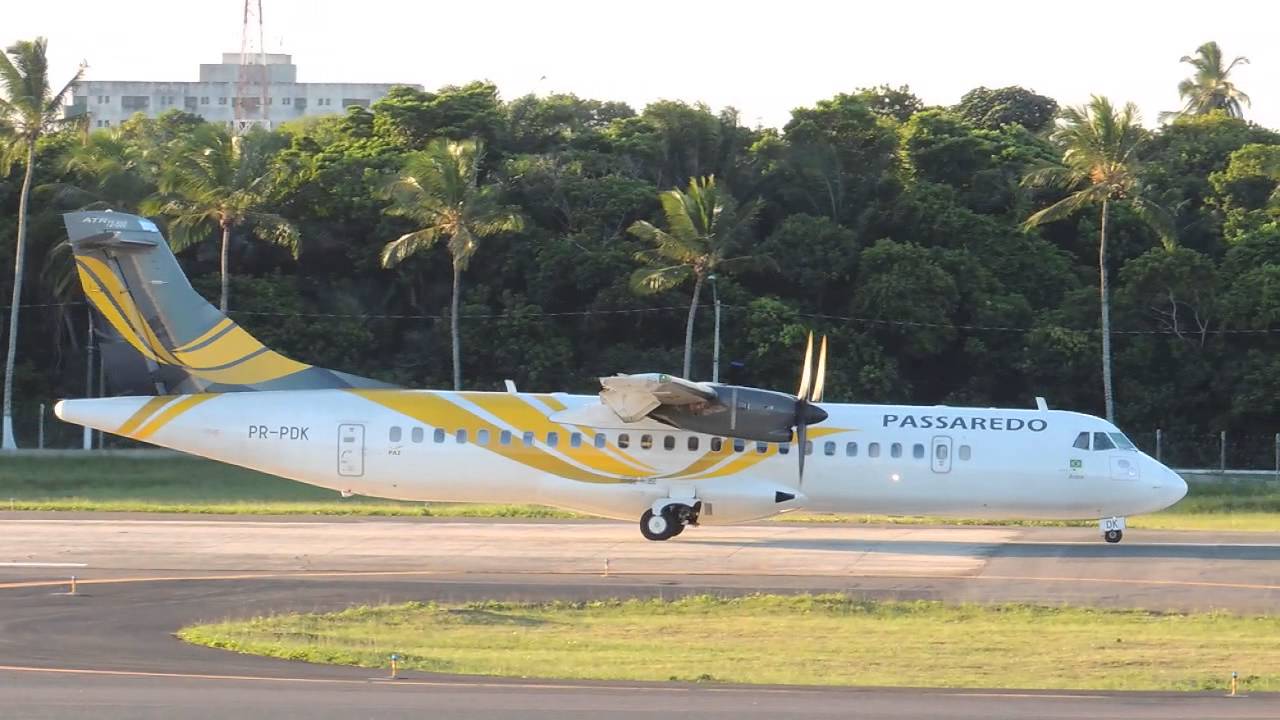
ATR-72 DE PASSAREDO LINHAS AÉREAS


According to him, Gol currently transports customers to 63 destinations in Brazil, 52 of which have domestic airplanes (of which 18 are regional) and 9 with Passaredo Linhas Aéreas through the association in which Gol sells company tickets .

In addition to deepening the partnership with Passaredo, a company with which negotiations are already well advanced, Fajerman said Gol is also in the process of evaluating partnerships with three other companies, including Two Flex, in Jundiaí, São Paulo.

Imagen relacionada

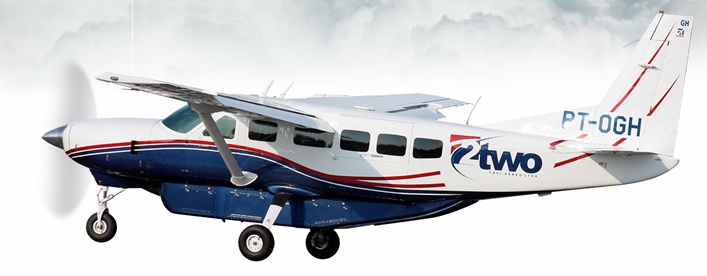
2Flex Air Taxi

He said that Gol seeks these agreements to integrate more operations and mainly connect the network of the partners to the company.

Regional aviation was heavily affected by the crisis in the Brazilian economy, which reduced passenger demand and led airlines to cut supply in order to maintain the profitability of their flights.

According to Fajerman, Gol does not give up maintaining a fleet standardized for efficiency reasons, so cities that have seen demand fall and do not justify a 138-seat aircraft, for example, can be served by the company through smaller aircraft Of partners.

«Gol wants to serve the largest number of destinations, but with profitability, and for that it needs a plane with the right number of seats,» said the executive. «Without changing the concept of fleet we will reach cities that we did not reach.»

He further stated that these agreements are a means of the company to stand in the case of the regional aviation plan of the federal government take off. «Of course we would not want to miss the opportunity to provide air service to these cities.»

Gol’s move is also a means of confronting rival Azul Linhas Aéreas, which has fewer turboprop aircraft in its fleet, and received a $ 450 million injection from China’s Hainan Airlines last year. A\W

https://airgways.com/wp-content/uploads/2017/03/00b63-two-flex-caravan.jpg

Gol negocia parcerias para ampliar atendimento a destinos regionais

A Gol Linhas Aéreas está negociando parcerias com companhias aéreas de menor porte para aumentar os destinos regionais atendidos pela empresa, afirmou nesta quinta-feira o diretor-executivo de assuntos corporativos, Alberto Fajerman.

«A meta é chegar a 80 destinos em todo o país até o fim deste ano e começo do próximo», disse o executivo à Reuters, com aumento do atendimento via as parcerias para destinos regionais.

De acordo com ele, a Gol transporta atualmente clientes para 63 destinos no Brasil, sendo 52 com aviões próprios para destinos domésticos (dos quais 18 são regionais) e 9 com a Passaredo Linhas Aéreas, através da associação na qual a Gol vende bilhetes da companhia.

Além de aprofundar a combinação com a Passaredo, companhia com quem as negociações já estão bem adiantadas, Fajerman disse que a Gol também está em processo de avaliação de parcerias com outras três empresas, entre elas a Two Flex, de Jundiaí (SP).

Ele disse que a Gol busca nesses acordos integrar mais as operações e principalmente conectar a malha das parceiras à da companhia.

A aviação regional foi fortemente afetada pela crise na economia brasileira, que reduziu a demanda de passageiros e levou as companhias a cortarem a oferta a fim de manter a rentabilidade de seus voos.

De acordo com Fajerman, a Gol não abre mão de manter uma frota padronizada por questões de eficiência, assim, cidades que viram a demanda cair e não justificam um avião de 138 lugares, por exemplo, podem ser atendidas pela empresa por meio de aeronaves menores de parceiros.

«A Gol quer servir o maior número de destinos, mas com rentabilidade; e para isso precisa de um avião com número de lugares certo», disse o executivo. «Sem mudar o conceito de frota vamos atingir cidades que não chegávamos.»

Ele afirmou ainda que esses acordos são um meio da empresa se posicionar no caso do plano de aviação regional do governo federal deslanchar. «É evidente que não gostaríamos de perder a oportunidade de prover serviço aéreo para essas cidades.»

O movimento da Gol também é um meio de enfrentar a concorrente Azul Linhas Aéreas, que tem em sua frota aviões turboélices, com menor número de assentos disponíveis e que recebeu injeção de 450 milhões de dólares da chinesa Hainan Airlines no ano passado. A\W

Ξ A I R G W A Y S Ξ
SOURCE: Reuters.com / Globo.com
DBk: Wp.blogspot.com / Spotter in JPA
AW-POST: 201703312107AR

A\W   A I R G W A Y S ®

«Efecto Brexit» en aerolíneas europeas

https://s3.amazonaws.com/runwaygirl-production/wp-content/uploads/2016/07/Brexit-Airport.jpg

AW | 2017 03 30 14:17 | AIRLINES MARKET

https://i0.wp.com/www.paxnews.com/storage/app/uploads/public/578/4f5/349/5784f53497cee107275886.jpgAerolíneas advierten de interrupciones en servicios si no hay acuerdo rápido de aviación tras el «Brexit»

Las aerolíneas con sede en la UE tienen derecho a volar a, desde y en el interior de cualquier país del bloque gracias al mercado único de aviación creado en los años 90, pero Reino Unido tiene ahora dos años para renegociar el acceso o aportar un sistema alternativo.

Reino Unido debe priorizar los temas de aviación en las negociaciones sobre el «Brexit» si quiere evitar importantes interrupciones en los viajes aéreos, advirtió este miércoles la aerolínea de bajo costo Ryanair, haciendo eco de las preocupaciones del sector en la jornada en que Reino Unido inició formalmente su salida de la Unión Europea.

«Hay una posibilidad inequívoca de que no haya vuelos entre Reino Unido y Europa durante un periodo de tiempo después de marzo de 2019», dijo el miércoles el jefe de marketing de Ryanair, Kenny Jacobs.

Las aerolíneas de bajo costo con sede en Reino Unido, principalmente easyJet, que opera desde Luton, están entre las más afectadas por el «Brexit», ya que hacen habitualmente un mayor uso de los derechos de la UE para volar entre otros países miembros y no sólo con origen y destino en Reino Unido.

https://i0.wp.com/theloadstar.co.uk/wp-content/uploads/%C2%A9-Giovanni-Gagliardi-59624197.jpg

Tras el «Brexit», estas aerolíneas podrían perder ese derecho. EasyJet dijo el miércoles que estaba a punto de solicitar una licencia para crear una compañía que opere en la UE para proteger los vuelos en el interior del bloque. Su sede y cotización bursátil seguirían en Reino Unido, añadió.

Jacobs dijo que no había tiempo que perder para alcanzar un acuerdo de aviación entre Reino Unido y la UE, ya que las aerolíneas tienen que finalizar sus itinerarios del verano boreal de 2019 en la primera mitad del próximo año.

Desde el referendo del 23 de junio que selló la salida de Reino Unido de la UE, las acciones de easyJet han caído un 35%, las de Wizz Air han perdido un 18%, las de Ryanair han subido un 4% y las de IAG, propietaria de British Airways, han ganado un 0,7%. AIRGWAYS ® Icon-AW

https://i2.wp.com/www.flyorbitnews.com/wp-content/uploads/2016/09/Ryanairs-experience-and-sway-at-airports-across-Europe-will-give-it-extra-clout-in-the-market.-Image-.jpg?resize=1170%2C878
Ryanair dejaría de volar a Europa tras el Brexit

La irlandesa Ryanair ha amenazado con cancelar todas sus rutas que operan entre Reino Unido y Europa tras la activación oficial del Brexit. Su director de marketing, Kenny Jacobs, ha señalado que “cabe la posibilidad clara de que no haya vuelos entre Reino unido y Europa durante un periodo posterior a marzo de 2019”, publica Okdiario.

La compañía de bajo coste ha hecho un llamamiento al gobierno de Theresa May con la idea de perfilar una estrategia que les permita operar sus vuelos como lo venía haciendo hasta ahora. “Nos preocupa que Gran Bretaña no sea capaz de negociar un acuerdo que llegue a tiempo apara planificar los vuelos posteriores a marzo de 2019”, ha señalado Jacobs.

Además ha pedido al Gobierno inglés que responda a las aerolíneas y a sus clientes mientras negocia el Brexit con Bruselas porque necesitan “soluciones reales y rápidas”. Reprocha también que después de nueve meses desde el referéndum en el Reino Unido, “aún no sabemos el efecto que va a tener sobre la aviación” y acusa a May de haber activado el artículo 50 sin “tener un plan B para mantener a Reino Unido dentro del tratado de ‘cielos abiertos’”.  AIRGWAYS ® Icon-AW

http://prod-upp-image-read.ft.com/3ac99f34-dcdc-11e5-8541-00fb33bdf038

«Brexit effect» on european airlines

Resultado de imagen para IATA BrexitAirlines warn of service interruptions if there is no quick aviation agreement after the «Brexit»

EU-based airlines have the right to fly into and out of any bloc country thanks to the single aviation market created in the 1990s, but the UK now has two years to renegotiate access or provide a system alternative.

Britain should prioritize aviation issues in the «Brexit» talks if it wants to avoid major air travel disruptions, Ryanair said on Wednesday, echoing industry concerns on the day that the United Kingdom Formally began its departure from the European Union.

EU-based airlines have the right to fly into and out of any bloc country thanks to the single aviation market created in the 1990s, but the UK now has two years to renegotiate access or provide a system alternative.

«There is an unequivocal possibility that there will be no UK-European flights for a period of time after March 2019,» Ryanair’s chief marketing officer Kenny Jacobs said on Wednesday.

The low-cost airlines based in the United Kingdom, mainly easyJet, operating from Luton, are among the most affected by the «Brexit», as they routinely make greater use of EU rights to fly between other member countries and Not only with origin and destination in United Kingdom.

After the «Brexit», these airlines could lose that right. EasyJet said on Wednesday it was about to apply for a license to set up a company operating in the EU to protect flights within the bloc. Its headquarters and stock exchange would continue in the United Kingdom, he added.

Jacobs said there was no time to waste to reach a UK-EU aviation deal, as airlines have to finalize their summer 2019 summer itineraries in the first half of next year.

Since the 23 June referendum that sealed the exit of the UK from the EU, easyJet shares have fallen 35%, Wizz Air shares have lost 18%, Ryanair shares have risen by 4% and IAG shares , Owner of British Airways, have gained 0.7%. A\W


Resultado de imagen para IATA Brexit

Ryanair to stop flying to Europe after Brexit

Irish Ryanair has threatened to cancel all routes operating between UK and Europe following the official activation of Brexit. Its marketing director, Kenny Jacobs, has pointed out that «there is a clear possibility that there will be no flights between the United Kingdom and Europe for a period after March 2019,» Okdiario reports.

The low-cost carrier has appealed to the government of Theresa May with the idea of outlining a strategy that will allow them to operate their flights as it has been doing so far. «We are concerned that Britain will not be able to negotiate a timely agreement to plan flights after March 2019,» Jacobs said.

He has also asked the British Government to respond to airlines and their customers while negotiating Brexit with Brussels because they need «real and fast solutions.» He also notes that after nine months since the referendum in the United Kingdom, «we still do not know what effect it will have on aviation» and accuses May of having activated Article 50 without «having a B plan to keep the UK Within the treaty of ‘open skies’ «. A\W

Ξ A I R G W A Y S Ξ
SOURCE: Reuters.com / Preferente.com
DBk: Amazonaws.com / Infacts.org / Ft.com / Theloadstar.co.uk / Flyorbitnews.com
AW-POST: 201703301417AR

A\W   A I R G W A Y S ®

Volar en la República Argentina ahora es ni tan «low-cost» ni tan «low-fare»

https://i.ytimg.com/vi/-CpJR1ZHXqk/maxresdefault.jpg

AW | 2017 03 26 12:03 | AIRLINES MARKET

El Ministro de Transporte Guillermo Dietrich expresó que las compañías aéreas que han pasado por la Audiencia Pública son líneas aéreas que manejan «precios bajos», pero que no tienen el mismo modelo empresarial que las low cost europeas

 «En Argentina no hay aerolíneas low cost» comunicó el Ministro de Transporte de Argentina

El ministro de Transporte de la Nación, Guillermo Dietrich, explicó que las líneas aéreas que operan hoy en la Argentina «no son low cost, son empresas que tienen tarifas bajas y el costo de las mismas es a arbitrio exclusivo de cada empresa». «Las nuevas compañías se están instalando en el país, son empresas que se registran en el país y compran aviones y ponen oficinas en Argentina y contratan personal local, esa es la realidad».

Las declaraciones del Ministro de Transporte vienen a aclarar la confusión generalizada en la opinión argentina sobre el término «low-cost» utilizado para definir a las empresas que tienen un modelos de trabajo «low-cost, low fare», «bajo cost, bajo precio».

Una aerolínea «low cost-low fare», son aerolíneas que poseen un costo operativo bajo y promueven pasajes a precios muy convenientes en el mercado donde sólo comprende el transporte punto a punto, un servicio básico, en la que el pasajero puede decidir si decide comprar otros servicios que puede recibir durante el vuelo.

Modelos low-cost y modelo tradicional
Un modelos bien establecido en Europa es la compañía irlandesa Ryanair, donde es posible obtener un boleto desde Dublin a Roma, por ejemplo, a tan sólo 50 euros, pero esto habilita al pasajero a llevar solamente un equipaje de mano. En este mismo vuelo, una valija de 15 kilogramos de peso tendrá un costo adicional de 15 euros; una de 20 kilos 25 euros y el monto se duplica si hay una tercera valija, siempre que se abonen de manera anticipada. Además, el servicio de a bordo hay que abonarlo aparte.

En tanto, el mismo trayecto en una compañía «tradicional» como Lufthansa, por ejemplo, tiene un costo de 249 euros, e incluye el equipaje así como el servicio de a bordo.

Hay condiciones esenciales que hacen a una verdadera low cost, como por ejemplo aviones nuevos que permiten mayor eficacia y productividad, una única flota que ahorra costos en mantenimiento, capacitación, tripulación y stock de repuesto, entre otras cuestiones.

También convenios laborables flexibles, y aeropuertos de segundo nivel dispuestos inclusive a subvencionar a las aerolíneas para que operen allí. También la venta de pasajes se hace de manera directa vía internet, evitando la mediación de las agencias de viajes, entre otras cuestiones.

La realidad indica que ninguna de las empresas existentes ni las que aspiran a entrar en Argentina reúnen las condiciones de las aerolíneas denominadas de «bajo costo». Al menos no en términos similares a los que existen en el mercado aerocomercial internacional.

De las firmas que se presentaron a la licitación, sólo Flybondi intenta parecerse a fuerza de declaraciones en los medios a una «low cost» porque, una vez que reciba la aprobación gubernamental, promete operar fuera de Aeroparque y ofrece por ejemplo volar a Córdoba por un costo cercano a los $ 600 pesos por tramo.

https://i0.wp.com/www.aeropuertos.net/wp-content/uploads/2016/06/EsperandoAEPSABE-1.jpg

Aerolíneas Argentinas y Latam están lejos de ser «low cost», aunque desde comienzos de este año hayan imitado algunas de las prácticas de esas empresas, como por ejemplo suprimir en los vuelos de menos de dos horas el servicio de a bordo; o cobrar extra las ubicaciones preferenciales o más cómodas, así como contar con la posibilidad de cambiar fechas y horarios.

La tercera aerolínea que está operando en el cabotaje local, Andes, se define a sí misma como «una compañía con precios baratos», y no como «low cost».

«Nosotros estamos operando desde hace 10 años con un alto grado de eficiencia y calidad y ofrecemos precios bajos, pero no somos una aerolínea de bajo costo. Tenemos servicio de a bordo, operamos en los aeropuertos principales y tenemos estándares de seguridad reconocidos a nivel internacional«, dijo a Télam el gerente General de la firma, Horacio Preneste.

No obstante, hay aerolíneas «low cost» operando en Argentina que son extranjeras y no realizan vuelos de cabotaje local como la chilena SKY Airline y las brasileras GOL Linheas Aéreas y Azul Linheas Aéreas. Son de bajo costo en su país, pero en territorio argentino operan con «precios bajos» y servicio normal en cuanto a equipaje y gastronomía a bordo.

En tanto la compañía Level, la nueva aerolínea modelo «low cost» del grupo IAG (International Airlines Group) anunció para junio la puesta en marcha de la ruta Barcelona – Buenos Aires con aviones A330-200 y capacidad para 293 asientos, a un costo de 249 euros por trayecto.

Distintos operadores aéreos consultados por Télam aclararon que una oferta o una promoción especial por parte de una línea aérea nada tienen que ver con las empresas que solamente permiten llevar un bolso de mano, un objeto personal -como la cartera- y un abrigo con la compra del boleto, cobrando aparte el equipaje despachado, la elección del asiento, la comida a bordo y, en algunos casos, hasta el entretenimiento.

Añadieron que «hoy Argentina no tiene empresas low cost operando en el mercado de cabotaje», y pusieron en duda que en algún momento cercano pueda haberlas, debido a que la infraestructura y los costos operativos y aeroportuarios no dan margen para que eso ocurra». AIRGWAYS ® Icon-AW

https://i0.wp.com/aviacionaldia.com/wp-content/uploads/2016/08/avion.png

Flying in the Argentine Republic is now neither so «low-cost» nor so «low-fare»

Transport Minister Guillermo Dietrich said that the airlines that have passed the Public Hearing are airlines that handle «low prices» but do not have the same business model as the European low cost airlines

«In Argentina there are no low cost airlines,» said the Minister of Transport of Argentina

The Minister of Transportation of the Nation, Guillermo Dietrich, explained that the airlines that operate today in Argentina «are not low cost, they are companies that have low rates and the cost of the same is at the exclusive discretion of each company.» «The new companies are being installed in the country, they are companies that register in the country and buy planes and set up offices in Argentina and hire local personnel, that’s the reality.»

The declarations of the Minister of Transport clarify the general confusion in the Argentine opinion about the term «low-cost» used to define the companies that have a «low-cost, low fare», «low cost, low price».

A «low cost-low fare» airline is an airline that has a low operating cost and promotes very convenient fares in the market where it only includes point-to-point transport, a basic service, in which the passenger can decide if he decides Purchase other services you may receive during the flight.

https://i0.wp.com/www.eldiario24.com/d24ar/fotos/cache/notas/2017/03/26/750x380_396204_20170326100725.jpg

MINISTER OF TRANSPORT OF ARGENTINA, GUILLERMO DIETRICH

Low-cost models and traditional model
A well-established model in Europe is the Irish company Ryanair, where it is possible to get a ticket from Dublin to Rome, for example, only 50 euros, but this enables the passenger to carry only hand luggage. In this same flight, a bag of 15 kilograms of weight will have an additional cost of 15 euros; One of 20 kilos 25 euros and the amount is doubled if there is a third bag, provided they are paid in advance. In addition, the onboard service must be paid separately.

Meanwhile, the same journey in a «traditional» company as Lufthansa, for example, costs 249 euros, and includes luggage as well as the on-board service.

There are essential conditions that make a real low cost, such as new aircraft that allow greater efficiency and productivity, a single fleet that saves costs in maintenance, training, crew and spare stock, among other issues.

Also flexible labor agreements, and second-level airports even willing to subsidize airlines to operate there. Also the sale of tickets is done directly via the internet, avoiding the mediation of travel agencies, among other issues.

The reality is that none of the existing companies or those aspiring to enter Argentina meet the conditions of the so-called «low cost» airlines. At least not in terms similar to those that exist in the international air-trade market.

Of the signatures submitted to the bidding, only Flybondi tries to resemble media statements at a «low cost» because, once it receives government approval, it promises to operate outside of Aeroparque (Buenos Aires) and offers, for example, flying to Córdoba by a cost close to $ 600 pesos (U$D 38,50) per tranche.

Aerolíneas Argentinas and Latam are far from being «low cost», although since the beginning of this year they have imitated some of the practices of these companies, such as eliminating on board flights of less than two hours on board; or charge extra preferential or more comfortable locations, as well as having the possibility to change dates and times.

The third airline that is operating in local cabotage, Andes, defines itself as «a company with cheap prices,» not as «low cost.»

«We have been operating for 10 years with a high degree of efficiency and quality and offer low prices, but we are not a low cost airline. We have on board service, we operate at the main airports and we have internationally recognized safety standards «Horacio Preneste, general manager of the firm, told Télam.

However, there are «low cost» airlines operating in Argentina that are foreign and do not operate local coastal flights such as the Chilean SKY Airline and the Brazilian GOL Linheas Aéreas and Azul Linheas Aéreas. They are of low cost in their country, but in Argentine territory they operate with «low prices» and normal service as for luggage and gastronomy on board.

Meanwhile, the company Level, the new low cost airline of the group IAG (International Airlines Group) announced for June the start of the route Barcelona – Buenos Aires with airplanes A330-200 and capacity for 293 seats, at a cost Of 249 euros per way.

Different air operators consulted by Télam clarified that a special offer or promotion by an airline has nothing to do with companies that only carry a handbag, a personal object – such as the wallet – and a coat with the purchase Of the ticket, charging separately checked baggage, choice of seat, food on board and, in some cases, even entertainment.

They added that «today Argentina does not have low cost companies operating in the cabotage market, and they questioned than at some point in time there may be them, because infrastructure and operating and airport costs do not allow room for that to occur». A\W

Ξ A I R G W A Y S Ξ
SOURCE: Telam.com.ar / Airgways
DBk: Ytimg.com / Aeropuertos.net / Aviacionaldia.com
AW-POST: 201703261203AR

A\W   A I R G W A Y S ®

El gobierno argentino dio a conocer el «Plan Nacional de Transporte Aéreo»

https://i0.wp.com/www.telam.com.ar/advf/imagenes/2016/11/58303b964f95d_1920x835.jpg

AW | 2017 03 23 13:35 | AIRLINES MARKET

El Ministro de Transporte, Guillermo Dietrich, presentó el «Plan Nacional de Transporte Aéreo». Dietrich realizó la presentación junto al ministro de Turismo, Gustavo Santos, y al presidente de la Empresa Argentina de Navegación Aérea (EANA), Agustín Rodríguez, en el Auditorio de Radio Nacional ante 200 personas.

Entre los asistentes estuvieron intendentes cordobeses, responsables de turismo y de transporte de las diferentes localidades, representantes de las cámaras de turismo, de las agencias y demás actores del sector turístico.

Dietrich expuso los ejes que conforman el plan estratégico para duplicar la cantidad de vuelos de cabotaje, basado en un importante estudio que confirma que existen 12 millones de pasajeros al año que hoy no usan el avión para viajar y podrían hacerlo de existir una alternativa.

El primer pilar del plan es la consolidación de Aerolíneas Argentinas como líder en cabotaje mediante una estrategia que le permita continuar su crecimiento -enero fue récord histórico de pasajeros trasladados y febrero fue el mejor de su historia-, absorbiendo así 4 millones de pasajeros.

En ese sentido, para fortalecer su red federal, Aerolíneas eligió a la ciudad Córdoba como nuevo centro distribuidor de vuelos a partir de abril, según lo anunció Mario Dell Acqua, presidente de la compañía estatal.

El segundo pilar del plan es la transformación de la infraestructura y del espacio aéreo para aumentar la capacidad de los aeropuertos, modernizar instalaciones, equipos y tecnología de navegación aérea, gracias a una inversión de 23.800 millones de pesos.

Para el Aeropuerto de Córdoba, donde las obras de renovación terminaron el año pasado, el ministro adelantó que van a «ampliar el estacionamiento, a repavimentar la pista y modernizar su balizamiento». Se pasará de 13 conexiones dentro del país a 27; y de ocho conexiones internacionales a 17. Entre las nuevas líneas que operarán se encuentra «Alas del Sur», que tendrá base de operaciones en Córdoba. «Estamos también incorporando nueva tecnología y un sistema ILS para que los vuelos puedan aterrizar con condiciones climáticas adversas», precisó Dietrich.

Por último, el plan incluye la incorporación de nuevas líneas aéreas para brindar mayores alternativas de conexión. «Estas son empresas que se instalan en Argentina, que compran aviones que cuestan millones de dólares y los registran en nuestro país, que contratan pilotos, tripulantes de cabina, azafatas y mecánicos todos argentinos. El aéreo es un sector muy aspiracional que va a generar entre directos e indirectos 25 mil puestos de trabajo», precisó el funcionario nacional. El Gobierno espera que se sumen 50 nuevos aviones al transporte de pasajeros.

«Vamos a generar una explosión de conectividad en todo el país necesaria para el impulso del turismo, que representa trabajo digno. Estamos recuperando el tiempo perdido», detalló el ministro de Turismo. AIRGWAYS ® Icon-AW

AW-7043737

The Argentine government unveiled the «National Air Transport Plan»


The Minister of Transportation, Guillermo Dietrich, presented «The National Plan of Air Transport». Dietrich made the presentation with the Minister of Tourism, Gustavo Santos, and the president of the Argentine Air Navigation Company (EANA), Agustín Rodríguez, in the National Radio Auditorium to 200 people.

Among the attendants were Cordovan intendants, responsible for tourism and transportation of the different localities, representatives of the chambers of tourism, agencies and other actors in the tourism sector.

Dietrich explained the axes that make up the strategic plan to double the number of cabotage flights based on an important study confirming that there are 12 million passengers a year that today do not use the plane to travel and could do so if there is an alternative.

The first pillar of the plan is the consolidation of Aerolíneas Argentinas as a leader in cabotage by means of a strategy that will allow it to continue its growth -energy was the historical record of passengers transferred and February was the best in its history-, thus absorbing 4 million passengers.

In that sense, to strengthen its federal network, Aerolíneas chose the city of Córdoba as a new hub for flights from April, according to Mario Dell Acqua, president of the state-owned company.

The second pillar of the plan is the transformation of infrastructure and airspace to increase airport capacity, modernize facilities, equipment and air navigation technology, thanks to an investment of 23.8 billion pesos.

For the airport of Cordoba, where renovation works were completed last year, the minister said that they will «expand the parking lot, reshuffle the track and modernize its beaconing.» It will move from 13 connections within the country to 27; And of eight international connections to 17. Among the new lines that will operate is «Alas del Sur», that will have base of operations in Cordova. «We are also incorporating new technology and an ILS system so flights can land in adverse weather conditions», said Dietrich.

Finally, the plan includes the incorporation of new airlines to provide greater connection alternatives. «These are companies that settle in Argentina, who buy planes that cost millions of dollars and register them in our country, which hire pilots, cabin crew, stewardesses and mechanics all Argentines. Aerial is a very aspirational sector that will generate Between direct and indirect 25 thousand jobs», said the national official. The Government expects 50 new aircraft to be added to passenger transport.

«We are going to generate an explosion of connectivity throughout the country necessary to boost tourism, which represents decent work. We are recovering the lost time,» the Tourism Minister said. A\W

Ξ A I R G W A Y S Ξ
SOURCE: Airgways / Ambito.com
DBk:Telam.com.ar
AW-POST: 201703231335AR

A\W   A I R G W A Y S ®