Programa B737 MAX continúa pruebas

maxresdefault (2)

AW | 2016 07 05 11:07 | INDUSTRY

img60596081

Habiendo volado cerca de 300 vuelos de prueba con aviones de prueba de cuatro de vuelo, Boeing dice que su programa 737 Max 8 se mantiene firmemente en la fecha prevista como ingenieros de la compañía trabajan para cerrar la prueba en el primer avión a finales de septiembre. Programado para la certificación y la puesta en servicio con Southwest Airlines durante el tercer trimestre de 2017, los ejecutivos de Boeing dicen que, además de estar a la altura de su «derecha en el primer vuelo», el programa también ha ejecutado una campaña de ensayos en vuelo prácticamente sin defectos.

En declaraciones a la prensa en el Centro de Pruebas de vuelo de Boeing en Seattle el mes pasado, el ingeniero jefe de proyecto 737 Max Michael Teal explicó que Boeing ha realizado la mayor parte de la estabilidad y el control de la labor del programa, incluyendo las características de manejo y las pruebas de aleteo con el primer artículo de la prueba de vuelo.

El segundo avión, descrito por Teal como uno de los aviones de propulsión del programa, comenzó su vida la realización de pruebas de rendimiento de combustible aeronáuticas y desde entonces ha terminado su estudio de cargas de vuelo. También lleva a cabo pruebas de gran altitud en La Paz, Bolivia. «No ha habido ningún drama por aquí,» dijo Teal. «La prueba ha ido muy bien. Ha estado golpeando las expectativas por lo que estamos muy contentos con cómo va «.

En el momento de su exposición, mecánicos habían acabado de quitar la instrumentación del motor para los cálculos y los horarios llamada «empuje-contra-arrastre» para que vaya a Montana, siguiente, para las pruebas de ruido a la población.

Boeing utiliza el tercer avión, dijo Teal, principalmente para la propulsión y sistemas de trabajo, tales como las pruebas de aterrizaje automático y el «head-up display», así como pruebas de drenaje del motor.

En el Salón Aeronáutico de Farnborough, el cuarto avión de ensayo está participando en exhibiciones de vuelo de la serie. Ese avión, equipado con gran parte del nuevo interior para el lanzamiento de los clientes de Southwest Airlines, realiza pruebas ambientales del programa, incluyendo el humo y la detección de Halon. Después del espectáculo, Boeing planea llevarlo a Rusia para las pruebas de clima frío.

«También es un avión que estamos haciendo el trabajo del cliente,» dijo Teal. «En nuestro derecho K66365a iniciativa del primer vuelo, estamos trabajando en lo que llamamos» volar como las aerolíneas. «En dos días, hicimos ocho vuelos simulados. Nos gustaría volar durante una hora y media, nos gustaría tierra y luego nos pretendemos Nos taxi y entonces podríamos hacer todas las comprobaciones de tierra, nos dirigimos a los motores fuera, tendríamos combustible que, nos diera hacer cualquier tipo de mantenimiento una aerolínea normalmente haría en el suelo durante un giro de treinta minutos, entonces empezaría a tomar los motores y de marcha atrás «.

Boeing tiene la intención y eficacia de depurar el avión con el ejercicio, explica Teal, asegurando con ello el avión estará preparado para el cliente a la entrega. «Esa prueba fue muy exitosa», dijo. «Nos encontramos un par de graznidos, pero eso es lo que deseo encontrar y resultó que los dos que hemos encontrado que ya teníamos en nuestra lista de cosas que tenía que arreglar».

Ahora volar con motores CFM LEAP-1B, los motores de los aviones de cumplimiento, dos, tres y cuatro eventualmente llegaremos equipados con motores de distribución final que tienen los nuevos compresores de baja presión (LPC). Esos motores, que Teal según dijo, comenzarán a llegar alrededor de agosto 2016, requerirán lo que caracterizó como algunas pruebas adicionales de menor importancia.

El año pasado CFM descubrió la necesidad de modificar la LPC para mejorar el margen de calado. Con los motores originales, Boeing tiene que usar por debajo del subóptimo sangreo de desarrollo, dejando las hemorragias que abran más de lo deseado para la mejor eficiencia de combustible posible. «Queremos que las hemorragias estén cerradas para un mejor rendimiento de combustible», explicó el trullo. «Podríamos haber certificado y entregado estos motores, pero queríamos los mejores motores. Así, en los que estamos volando ahora las hemorragias se abren un poco más de lo que deseamos, pero cuando los 2s bloques finales que entren y se obtenengan los horarios de extracción final, y que va a determinar la configuración final. «

Una vez que el equipo regrese a Seattle desde Farnborough, planes de llamada para la evaluación de la función y fiabilidad para iniciar con los motores de entrega final instaladas en el tercer y cuarto aviones y acabado en el cuarto trimestre, probablemente en octubre o noviembre.

Mientras tanto, continúa la construcción de la producción del Boeing  Max 8s, a razón de uno por mes, y continuará haciéndolo hasta que la primera entrega a Southwest. A finales del mes pasado, dos aviones de producción se sentaron frente a la fábrica de Renton pintados en colores Southwest y otros dos fueron sometidos a montaje final en el interior. Mientras que los aviones también esperan la instalación del bloque 2 de motores, Teal espera que ellos requieran cambios mínimos de incorporación. «Hemos puesto juntos un plan de lo mucho que prevemos que el cambio incorporación», dijo Teal. «En este momento estamos considerablemente por debajo de nuestra previsión, así que estoy muy feliz con eso», concluyó.

Por otra parte, Boeing durante la tercera semana de junio libera el 90 por ciento de los dibujos para la siguiente variante, el 737 Max 9. La compañía ya ha comenzado largueros de construcción para el primer Espíritu Aerosystems suministrado por el fuselaje y los planes para iniciar la primera construcción del ala en septiembre. Los tiempos de desarollos piden lanzamiento y primer vuelo por el finales de marzo de de 2017. AIRGWAYS ® Icon-AW

B737 MAX continues testing program

Having now flown close to 300 test flights with four flight test airplanes, Boeing says its 737 Max 8 program remains firmly on schedule as company engineers work to close testing on the first airplane by the end of September. Scheduled for certification and entry into service with Southwest Airlines during the third quarter of 2017, Boeing executives say that as well as living up to its “Right at First Flight” mantra, the program has also executed a virtually flawless flight test campaign.

Speaking to reporters at Boeing’s Seattle Flight Test Center last month, 737 Max chief project engineer Michael Teal explained that Boeing has performed most of the program’s stability and control work, including handling characteristics and flutter testing with the first flight test article.

The second airplane, described by Teal as one of the program’s propulsion airplanes, started life performing nautical air fuel mileage tests and since has finished its flight loads survey. It also performed high-altitude testing in La Paz, Bolivia. “There’s been no drama around here,” said Teal. “The testing has been going very well. It’s been hitting the expectations so we’re very happy with how it’s going.”

At the time of his briefing, mechanics had just removed engine instrumentation for thrust-versus-drag calculations and schedules called for it to go to Montana next for community noise testing.

Boeing uses the third airplane, said Teal, mainly for propulsion and systems work such as autoland and head-up display testing, as well as engine drainage tests.

Here at the Farnborough International Airshow, the fourth test airplane is participating in the show’s flying displays. That airplane, equipped with much of the new interior for launch customer Southwest Airlines, performs the program’s environmental testing, including smoke and Halon detection. After the show, Boeing plans to take it to Russia for cold weather testing.

“It’s also an airplane we’re doing customer work on,” said Teal. “In our Right at First Flight initiative, we’re working on what we call ‘fly like the airlines.’ In two days, we did eight simulated flights. We’d fly for an hour and a half, we’d land, and then we’d pretend we taxied in and then we would do all the ground checks, we’d turn the engines off, we’d fuel it, we’d do any maintenance an airline would typically do on the ground during a thirty minute turn, then we’d start the engines and take back off.”

Boeing intended to effectively de-bug the airplane with the exercise, explained Teal, thereby ensuring the airplane is customer-ready upon delivery. “That testing was very successful,” he said. “We did find a couple of, I’ll call them squawks, but that’s what you want to find and it turned out that the two that we found we already had on our list of things we had to fix.”

Now flying with CFM Leap-1B compliance engines, airplanes two, three and four will eventually get fitted with final delivery engines that have new low-pressure compressors (LPC). Those engines, which Teal said would start arriving around August, will require what he characterized as some minor additional testing.

Last year CFM discovered the need to modify the LPC to improve stall margin. With the original engines, Boeing has to use suboptimum bleed schedules, leaving the bleeds open more than desired for the best possible fuel efficiency. “We want the bleeds closed for better fuel mileage,” explained Teal. “We could have certified and delivered these engines, but we wanted the best engines. So in the ones we’re flying now the bleeds are opened a little bit more than we desire, but when the final Block 2s come in and we get the final bleed schedules, and that will determine the final configuration.”

Once the team returns to Seattle from Farnborough, plans call for the function and reliability testing to start with the final delivery engines installed on the third and fourth airplanes and finish in the fourth quarter, likely in October or November.

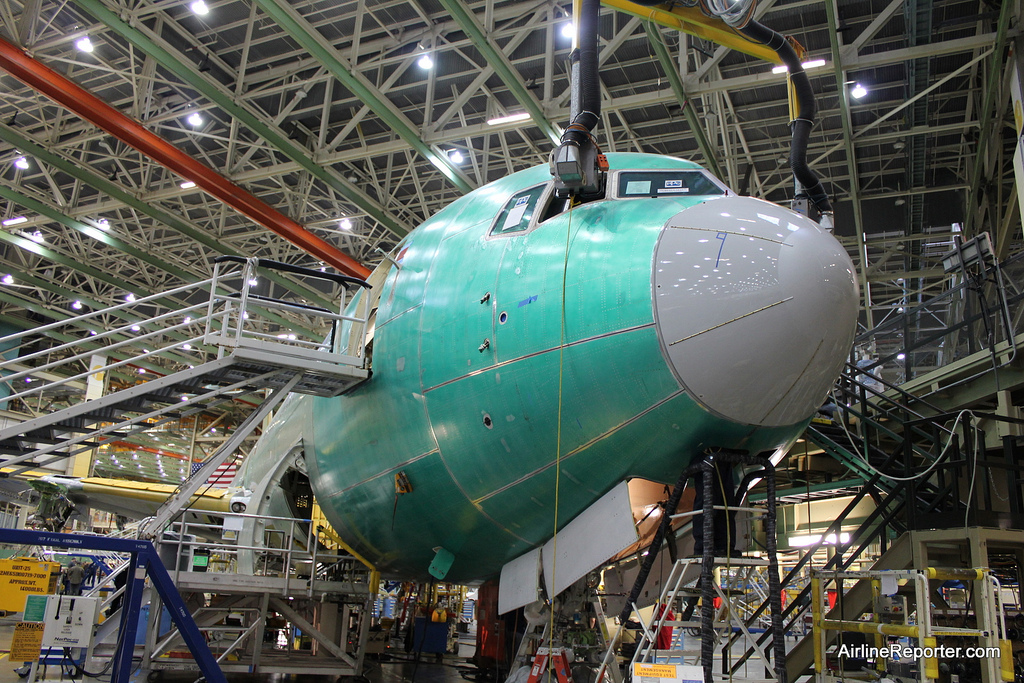
Meanwhile, Boeing continues building production Max 8s at a rate of one per month, and will continue to do so until first delivery to Southwest. By the end of last month, two production airplanes sat outside the Renton factory painted in Southwest colors and another two underwent final assembly inside. While those airplanes also await installation of the Block 2 engines, Teal expects them to require minimal change incorporation. “We’ve put a plan together of how much we forecast the change incorporation,” said Teal. “Right now we are considerably under our forecast, so I’m very happy with that,” he concluded.

Separately, Boeing during the third week of June released 90 percent of the drawings for the next variant, the 737 Max 9. The company has already started building stringers for the first Spirit Aerosystems-supplied fuselage and plans to start the first wing build in September. Schedules call for rollout and first flight by the end March 2017. A\W

Ξ A I R G W A Y S Ξ
SOURCE: ainonline.com
DBk: Photographic © Boeing / Aviationweek / Maxresdefault
AW-POST: 201607051107AR

Boeing diseña nuevo avión intermedio entre el B737 y B787

AW | 2016 07 04 00:18 | INDUSTRY

Boeing perfecciona diseños para el nuevo avión de gama media entre el B737 y B787

Boeing dice que el mercado potencial para su primer avión completamente nuevo de pasajeros desde el 787 Dreamliner está entrando en un enfoque nítido – y que podría ser enorme.

El fabricante de aviones de Estados Unidos está perfeccionando los diseños de aviones de gama media para batir los viajeros procedentes de Nueva York a Londres, Sydney a Shanghai o Dubai a Oslo. El avión llena el vacío en su línea de productos entre el más grande de un solo pasillo, el B787 y el 737, un mercado relativamente sin explotar, donde Airbus está empezando a extender su alcance.

Boeing estima que las ventas podrían alcanzar entre 4.000 y 5.000 aviones medianos de mercado ya que las aerolíneas encuentran nuevas rutas para los aviones. El fabricante estadounidense estaría a punto de sacar provecho, siempre que pueda mantener los costos de producción bajo control y los precios razonables, dijo Mike Delaney, director general de desarrollo del avión. Se utiliza el término «cuando», no es «si», mientras se discuten las perspectivas de la nueva familia de aviones, que comenzaría vuelos comerciales en la próxima década.

Las recientes discusiones con los clientes de 36 líneas aéreas han dado a Delaney la confianza de que Boeing está al borde de un gran avance tras años de búsqueda de un reemplazo para su Boeing 757 que está fuera de la producción. Mike Sinnett, que dirige el desarrollo de productos para aviones comerciales de la compañía, que ha profundizado en los precios de las compañías aéreas estarían dispuestos a pagar, y el rendimiento que cabría esperar, por chorros de ese asiento entre 200 y 270 personas con el rango de volar alrededor de 5.000 millas náuticas.

CROSS-SECTION FUTURO AVIÓN INTERMEDIO DE BOEING

«No es fácil, no es imposible. No estamos allí todavía», Delaney, a periodistas en una sesión informativa el mes pasado por delante de la feria aeronáutica de Farnborough. «Sin embargo, en los últimos seis meses, el equipo de Mike ha cerrado la brecha bastante bueno.»

Caso de negocio

El directorio de Boeing aún debe dar luz verde a los esfuerzos, y el modelo de negocio es un reto. Los analistas han vinculado la demanda de manera más conservadora, en alrededor de 1.500 aviones, dijo el consultor de la industria aeroespacial Kevin Michaels. El desarrollo de un diseño de hoja limpia costaría al menos $ 10 mil millones, y que Boeing está asumiendo, evita los tropiezos que retrasaron el debut del Dreamliner en 2011 por más de tres años.

«La economía va a ser todo a causa de los costos de entrada», dijo Michaels, director general de Aerodinámico Asesor en Ann Arbor, Michigan. «Creo que el escenario más probable es tal que obtienen la aprobación del directorio para iniciar su venta a finales de este año.»

Delaney no le daría una línea de tiempo para una decisión. «Estamos trabajando con nuestra junta y con nuestros clientes de aerolíneas,» dijo. «Está llegando más rápido de lo que piensas.»

Airbus ha ganado las ventas al lanzar su A320neo como heredera del Boeing 757.El fabricante europeo de aviones más grande de fuselaje estrecho se ha apuntado 1.125 pedidos a 222 737 por su rival Max 9 de Boeing, según datos compilados por George Ferguson, analista de Bloomberg Inteligencia. Pero el modelo de Airbus más grande no se puede estirar para llegar a la zona de acción del mercado que Boeing prevé, dijo Delaney.

Mercado sin explotar

Es sin explotar debido a la dificultad en la construcción del avión con algo de la complejidad estructural de un modelo de doble pasillo, pero a un costo que se acercan más a las de un cuerpo estrecho, dijo Randy Tinseth, vicepresidente de Boeing para su comercialización. Las mejoras de fabricación, incluida la eficiencia intensificación de la producción en el año 787, están impulsando la confianza de la compañía en la adopción de un nuevo modelo.

«La tecnología ha avanzado tanto en términos de lo que podemos hacer, cómo construimos el avión», dijo. «Hemos avanzado los sistemas de producción también. Es por eso que es muy interesante.»

El avión propuesto sería construido en un tempo que se ubica entre la del 737, que ruede fuera de la fábrica del área de Seattle de Boeing a un ritmo de dos por día, y la salida mensual del 787 de 12 aviones, dijo Tinseth.

Boeing no ha decidido si el marco del nuevo avión podría ser metálica o de fibra de carbono como el hilado 787, o si tendría uno o dos pasillos.

Michaels piensa Boeing puede construir el nuevo avión con un solo pasillo lo suficientemente amplia como para que dos personas se colocan de lado a lado. Eso resolvería uno de los dilemas de un avión de tamaño medio: conseguir pasajeros y su equipaje en y fuera rápidamente. Y, presumiblemente, de fuselaje totalmente nuevos, cabina, los sistemas y la producción de electricidad de todo el avión de pasajeros podrían ser probado en combate para el avión que reemplazará algún día el 737, la mayor fuente de ganancias de Boeing, dijo.

El fabricante de aviones está en conversaciones con los tres más grandes del motor de decisiones para una nueva turbina para alimentar la aeronave, ya que busca mejoras en el rendimiento de al menos 20 por ciento en comparación con los 757 y 767 aviones Boeing introducido para servir a la media del mercado en la década de 1980 .

«Habría que ver enormes ganancias en eficiencia y costo», dijo Tinseth. AIRGWAYS ® Icon-AW

Boeing designs new intermediate plane between B737 and B787

Boeing honing designs for new mid-range plane between 737 and 787

Boeing says the potential market for its first all-new passenger jet since the 787 Dreamliner is coming into sharp focus – and it could be huge.

The US planemaker is honing designs for mid-range planes to whisk travellers from New York to London, Sydney to Shanghai or Dubai to Oslo. The aircraft would fill the gap in its product line between the largest single-aisle 737 and smallest widebody 787, a relatively untapped market where Airbus is starting to extend its reach.

Boeing estimates that sales could reach between 4,000 and 5,000 middle-of-market jetliners as airlines find new routes for the planes. The US manufacturer would be poised to capitalise, provided it can keep production costs in check and prices reasonable, said Mike Delaney, general manager of airplane development. He used the term “when», not “if», while discussing the prospects for the new aircraft family, which would begin commercial flights next decade.

Recent discussions with 36 airline customers have given Delaney confidence that Boeing is on the verge of a breakthrough after years spent seeking a replacement for its out-of-production 757. Mike Sinnett, who heads product development for the company’s commercial planes, has delved into the prices airlines would be willing to pay, and performance they’d expect, for jets that seat between 200 and 270 people with the range to fly about 5,000 nautical miles.

Image

“It is not easy, it is not impossible. We are not there yet,» Delaney told reporters in a briefing last month ahead of the Farnborough International Airshow. “But in the last six months, Mike’s team has closed the gap pretty good.«

Business case

Boeing’s board must still green-light the effort, and the business case is challenging. Analysts have pegged demand more conservatively, at around 1,500 planes, said aerospace consultant Kevin Michaels. Developing a clean-sheet design would cost at least $10 billion, and that’s assuming Boeing avoids the stumbles that delayed the Dreamliner’s 2011 debut by more than three years.

“The economics are going to be everything because of the entry costs,» said Michaels, managing director of Aerodynamic Advisory in Ann Arbor, Michigan. “I think the likely scenario is maybe they get board approval to begin selling it later this year.»

Delaney wouldn’t give a timeline for a decision. “We’re working with our board and with our airline customers,» he said. “It’s coming faster than you think.»

Airbus has gained sales by pitching its A320neo as the 757’s heir. The European planemaker’s largest narrow-body has notched 1,125 orders to 222 for Boeing’s rival 737 Max 9, according to data compiled by George Ferguson, senior analyst with Bloomberg Intelligence. But the largest Airbus model can’t be stretched to reach the sweet spot of the market that Boeing envisions, Delaney said.

Untapped market

It’s untapped because of the difficulty in building the plane with some of the structural complexity of a twin-aisle model but at costs that are closer to those of a narrow body, said Randy Tinseth, Boeing’s vice president for marketing. Manufacturing improvements, including stepped-up efficiency in 787 production, are boosting the company’s confidence in taking on a new model.

“Technology has advanced both in terms of what we can do, how we build the airplane,» he said. “We’ve advanced the production systems as well. That’s why it’s very interesting.»

The proposed airplane would be built at a tempo that falls somewhere between that of the 737, which roll out of Boeing’s Seattle-area factory at a pace of two a day, and the 787’s monthly output of 12 jets, Tinseth said.

Boeing hasn’t decided if the new plane’s frame would be metallic or made from spun-carbon fibre like the 787, or if it would have one or two aisles.

Michaels thinks Boeing may build the new jet with a single aisle wide enough for two people to stand side-by-side. That would solve one of the quandaries for a mid-size jet: getting passengers and their bags on and off quickly. And the jetliner’s presumably all-new fuselage, cockpit, electric systems and production could all be battle-tested for the plane that will some day replace the 737, Boeing’s largest source of profit, he said.

The planemaker is in discussions with the three largest engine-makers for a new turbine to power the aircraft as it seeks performance gains of at least 20 per cent compared with the 757 and 767 jetliners Boeing introduced to serve the middle of the market in the 1980s.

“You’d have to see tremendous gains in efficiency and cost,» Tinseth said. A\W

Ξ A I R G W A Y S Ξ
SOURCE: thenational.ae
DBk: Photographic ©
AW-POST: 201607040018AR

Boeing estira su B777-10X

AW | 2016 06 30 23:50 | INDUSTRY

Boeing puede estirar su modelo 777 para competir con Airbus A380

Boeing Co. está considerando la posibilidad de estirar su mayor modelo Boeing 777 para crear un avión bimotor en un intento de rivalizar con el A380 de Airbus.

El fabricante de aviones con sede en Chicago ha tenido conversaciones privadas con varios transportistas sobre la llamada Boeing 777-10X, incluidas Emirates, el mayor operador mundial de ambos Boeing 777 y el avión de dos pisos de Airbus, según el informe.

Se espera que el nuevo modelo para llevar a alrededor de 450 pasajeros, mientras que el A380 de Airbus puede transportar entre 489 y 517. Sin embargo, para dar cabida a las 450 personas, Boeing tendría que estirar el marco de su Boeing 777-9 y añadir al menos en cuatro filas adicionales de asientos. El Boeing 777-9, que se dará a conocer a finales de este década, será el primer modelo bimotor a invadir el territorio del Jumbo Boeing 747 capaz de transportar 400-425 pasajeros y el producto más caro de Boeing hasta el momento.

«Siempre estamos evaluando tecnologías, la configuración del avión y las necesidades del mercado,» portavoz de Boeing Doug Alder, habría dicho. «Si bien se han tomado decisiones, vamos a seguir para estudiar 777X derivados y buscar información del cliente para desarrollar productos que proporcionan el mayor valor para los clientes.»

Según el informe, un representante de United no estaba disponible para hacer comentarios. Una fuente, sin embargo, dijo que Emirates examinó el nuevo modelo 777, pero no fue muy vendido en el concepto. El transportista ha ordenado 289 aviones de la serie Boeing 777, incluyendo 150 de las versiones actualizadas conocido como el 777X. Hace dos años, Boeing lanzó  su Jumbo B747-8 como un reemplazo potencial del A380 pero no tuvo éxito.

Boeing está a la caza de una ventaja, mientras que la incertidumbre sobre el futuro de la A380 y la tensión en la relación de Airbus con Emirates todavía existen. El transportador del Golfo ha estado presionando a Airbus para actualizar sus motores para impulsar el ahorro de combustible, pero el fabricante de aviones europeo se ha mostrado renuente a hacer la inversión de miles de millones de dólares para un cliente.

El presidente de Emirates, Tim Clark, dijo antes de que las conversaciones con Airbus para actualizar el A380 motores haya caducado: «Mi principal preocupación es que se dejen de producir el avión», dijo.

Boeing está buscando ampliar su actual línea de productos en nuevos nichos de mercado. La compañía también está tratando de rediseñar su pequeño Boeing 737 MAX. Con unas ventas de Airbus A380 y 747 de comienzan a fallar, estirar el Boeing 777-9 puede atraer a los consumidores potenciales a Boeing. El A380 vio una sequía de dos años en ventas, que finalmente se rompió en 2016 cuando se clavó dos grandes acuerdos con la japonesa All Nippon Airways y de Iran Air en una semana.

Las ventas de 777X de Boeing también han disminuido desde el fabricante del avión dio a conocer el avión en el Salón Aeronáutico de Dubai en noviembre de 2013. La última venta de Boeing se produjo hace más de un año, cuando un cliente sin identificar ordenó 10 de los planos. Cathay Pacific y All Nippon Airways también son clientes de la aeronave. AIRGWAYS ® Icon-AW


Boeing stretches his B777-10X

Boeing (BA) May Stretch Its 777 Model To Rival Airbus (AIR) A380 Superjumbo Jet

Boeing Co. is considering stretching its largest 777 model to create a twin-engine aircraft in an attempt to rival Airbus Group SE’s ailing A380 superjumbo jet.

The Chicago-based airplane manufacturer has had private talks with several carriers about the so-called 777-10X, including Emirates, the world’s largest operator of both Boeing’s 777 and Airbus’s double-decker plane, the report said.

The new model is expected to carry about 450 passengers while the Airbus’ A380 can carry between 489 and 517. But to accommodate the 450 people, Boeing would have to stretch the frame of its 777-9 to add in at least four extra rows of seats. The 777-9, which will be unveiled later this decade, will be the first twin-engine model to encroach on the jumbo territory capable of ferrying 400-425 passengers and Boeing’s most expensive product so far.

“We are always evaluating technologies, airplane configurations and market needs,” Boeing spokesman Doug Alder reportedly said. “While no decisions have been made, we will continue to study 777X derivatives and seek customer input to develop products that provide the most value for customers.”

The report said that an Emirates representative wasn’t available for comment. A source, however, told Bloomberg that Emirates reviewed the new 777 model but wasn’t quite sold on the concept. The carrier has ordered 289 jets from Boeing’s 777 series, including 150 of the upgraded versions known as the 777X. Two years ago, Boeing pitched Emirates on its 747-8 jumbo as a potential A380 replacement but was unsuccessful.

Continue Reading Below

Boeing is hunting for an advantage while the uncertainty over the future of the A380 and strain in Airbus’ relationship with Emirates still exists. The Gulf carrier has been pressing Airbus to upgrade its engines to bolster fuel savings but the European aircraft manufacturer has been reluctant to make the multibillion-dollar investment for one customer.

Emirates President Tim Clark told Bloomberg earlier that talks with Airbus to upgrade the A380 engines have lapsed. “My main concern is that they stop producing the plane,” he said.

Boeing is looking to expand its current product line-up into new market niches. The company is also looking to redesign its smallest 737 Max. With sales of Airbus’ A380 and 747 starting to falter, stretching the already jumbo 777-9 may attract potential consumers to Boeing. The A380 saw a two-year drought in sales that was finally broken in 2016 when it nailed two big deals with Japan’s All Nippon Airways and Iran Air in one week.

Sales of Boeing’s 777X have also slowed since the airplane manufacturer unveiled the plane at the Dubai Airshow in November 2013. Boeing’s last sale came more than a year ago when an unidentified customer ordered 10 of the planes. Cathay Pacific and All Nippon Airways are also customers of the aircraft. A\W

Ξ A I R G W A Y S Ξ
SOURCE: Bloomberg.com
DBk: Photographic © Boeing
AW-POST: 201606302350AR

Primeras piezas del E175-E2 en Portugal

AW | 2016 06 30 15:59 | INDUSTRY

Embraer esta semana corta la primera pieza de metal a su primer prototipo de E175-E2 en la fábrica en Évora, Portugal. El componente es una estructura que conecta las alas al fuselaje de la aeronave, que será la más «joven» de la nueva generación de los E-Jets

«Esta pieza se mecanizó por una máquina de un bloque sólido de aluminio. Es una parte muy importante del avión, es como el corazón de la E175-E2 «, dijo Luis Carlos Affonso, vicepresidente de Embraer de la aviación comercial, durante la gira con la prensa en la planta portuguesa, el martes (28).

Como dijo Affonso, el primero de tres aviones de prueba E175-E2 está programado para volar en la segunda mitad de 2018, con entregas a partir de 2020. «Estamos en el diseño del proceso de congelación», dijo, en referencia el procedimiento de configuración de la aeronave para el desing producción.

Además de producir la estructura que conecta las alas, planta de Embraer en Évora también se está preparando para producir el estabilizador horizontal E175-E2, que en este caso se produce a partir de material compuesto. El E190-E195-E2 y E2 tienen estabilizadores metálicos horizontales.

«Esta es una de las principales características de la nueva generación de E-Jets para obtener resultados más eficientes en términos de consumo de combustible y el rendimiento. A pesar de que comparten una serie de componentes, cada uno de los tres planos tienen partes exclusiva desarrollada precisamente para hacer el avión más eficiente «, dijo João Pedro Taborda, director de relaciones externas de Embraer para Europa, Oriente Medio y África.

Los dos aviones Bombardier de la serie CS, el principal competidor de Embraer, por ejemplo, comparten la misma ala de 35,1 metros. Ya la próxima generación de E-Jets tendrán cada uno un ala tamaño diferente, que hace que el diseño y fabricación de aviones complejo, pero a cambio de reducir los costes para el operador.

E-Jets E2

El primer prototipo del E190-E2 despegó el 23 de mayo. Según Embraer, el jet está cerca de completar 40 horas de vuelo y el programa de pruebas se está aplicando sin problemas y en la fecha prevista. Como se preveía el vicepresidente de Aviación Embraer en Évora, el avión tiene una buena oportunidad de volar a la demostración de aire en Farnborough, Inglaterra, el próximo mes.

También de acuerdo con Alfonso, el segundo prototipo del E190-E2 aún debe despegar en la primera semana de julio. La aeronave, una versión intermedia de la serie E2 E-Jets para un máximo de 97 pasajeros, está programado para entrar en servicio a mediados de 2018. Desde el E195-E2, el modelo más grande de la familia, tendrá espacio para 116 ocupantes.

Embraer ha recibido más de 300 pedidos para el nuevo E-Jets entre pedidos en firme y las intenciones de compra. AIRGWAYS ® Icon-AW


First pieces of E175E2 in Portugal

Embraer this week cut the first metal piece to its first prototype of E175-E2 at the factory in Évora, Portugal. The component is a structure that connects the wings to the fuselage of the aircraft, which will be the «youngest» of the new generation of the E-Jets.

«This piece was machined by a machine from a solid block of aluminum. It is a very important part of the plane, is like the heart of the E175-E2,» said Luis Carlos Affonso, Embraer vice president of Commercial Aviation, during the tour with the press in the Portuguese plant, on Tuesday (28).

As Affonso said, the first of three E175-E2 test aircraft is scheduled to fly in the second half of 2018, with deliveries from 2020. «We are in the design of freezing process», he said, in reference the setting procedure of the aircraft desing for production.

In addition to producing the structure that connects the wings, Embraer’s plant in Évora is also preparing to produce the horizontal stabilizer E175-E2, which in this case will be produced from composite material. The E190-E195-E2 and E2 have horizontal metal stabilizers.

«This is one of the main features of the new generation E-Jets to get more efficient results in terms of fuel consumption and performance. Although they share a number of components, each of the three planes have exclusive parts precisely developed to make the most efficient aircraft,» said João Pedro Taborda, director of external relations of Embraer for Europe, Middle East and Africa.

The two jets Bombardier CS Series, the main competitor of Embraer, for example, share the same wing of 35.1 meters. Already the next generation of E-Jets will each have a different size wing, which makes the design and manufacture of complex aircraft, but in return reduce costs for the operator.

E-Jets E2

The first prototype of the E190-E2 took off on May 23. According to Embraer, the jet is close to complete 40 hours of flight and the test program is being implemented smoothly and on schedule. As anticipated the vice president of Commercial Aviation Embraer in Évora, the plane has a good chance of flying to the air show in Farnborough, England, next month.

Also according to Affonso, the second prototype of the E190-E2 should still take off in the first week of July. The aircraft, an intermediate version of the E-Jets E2 series for up to 97 passengers, is scheduled to enter service in mid 2018. Since the E195-E2, the largest model of the family, will have space for 116 occupants.

Embraer has received more than 300 orders for the new E-Jets between firm orders and purchase intentions. A\W

Ξ A I R G W A Y S Ξ
SOURCE: airway.uol.com.br
DBk: Photographic © EMBRAER
AW-POST: 201606301559AR

Boeing inaugura segundo siglo de liderazgo aeroespacial

AW | 2016 06 29 10:54 | INDUSTRY / AIR SHOW

Boeing celebrará su centenario en el Salón Aeronáutico de Farnborough, en el que mostrará sus avanzadas plataformas comerciales y de defensa e inaugurará una exhibición singular para conmemorar sus primeros cien años y presentar su visión del futuro

El primer avión del segundo siglo de Boeing, el B737 MAX, hará su debut en vuelos de exhibición del 11 al 14 de julio. Boeing planea entregar el primer 737 MAX 8 en el primer semestre de 2017, antes de lo programado.

También realizará vuelos de exhibición, del 11 al 13 de julio, un 787-9 Dreamliner que se entregará a ANA, la mayor aerolínea japonesa. El avión será el primero en participar en el Salón de Farnborough con los colores de una aerolínea japonesa.

Otros aviones comerciales de Boeing que estarán expuestos incluyen el nuevo 747-8 Carguero de Volga-Dnepr, que estará en el salón del 11 al 13 de julio. El avión multi-misión P-8A, un derivado militar del 737-800 Next-Generation con equipamiento avanzado de ataque anti-submarino y anti-superficie, y el caza multifunción F/A-18F Super Hornet de Boeing harán gala de su versatilidad en vuelos de exhibición diarios. El avión P-8A también estará expuesto junto con un F/A-18E Super Hornet y un F-15E Strike Eagle.

Boeing celebra sus 100 años de innovaciones con un pabellón especial que estará abierto todos los días. Además de pantallas interactivas que muestran las tecnologías pasadas, presentes y futuras de la compañía, el pabellón Centennial Experience contará con terminales de acceso a una galería digital con todos los números de la revista ‘Aviation Week & Space Technology’, que también celebra su centenario.

El pabellón (OE5) estará situado frente al chalet principal de Boeing (B 1-6), al otro lado de Bofors Hill, junto al Hall 2. Se ha creado una aplicación llamada Boeing Innovations para que los visitantes la utilicen durante su visita al pabellón; se podrá descargar en julio mediante App Store y Google Play.

Como parte de la celebración de su primer centenario, Boeing patrocina ‘Above and Beyond’, una nueva exposición interactiva sobre las maravillas de la aviación y el extraordinario viaje del ser humano al espacio.

Esta exposición para todos los públicos, creada en colaboración con la NASA, tiene como objetivo inspirar a la próxima generación de ingenieros, pilotos y astronautas.

Además, los amantes de la aviación podrán comprar productos exclusivos, como los diseños de Boeing Centennial, la colección heritage y maquetas de aviones en la zona de merchandising en la puerta B.

Aviones históricos de Boeing también realizarán exhibiciones o estarán expuestos durante el fin de semana en el que la feria se abre al público; entre ellos se incluyen un P-51D Mustang, un B-17 Flying Fortress, un DC-3 Dakota y un B-25 Mitchell. Junto con la Royal Aeronautical Society, Boeing presentará los aviones RANS Coyote II construidos por estudiantes gracias a la iniciativa ‘Schools Build a Plane Challenge’, un concurso escolar ‘Construye un avión’, dirigido a estudiantes de instituto del Reino Unido.AIRGWAYS ® Icon-AW

Boeing opened its second century of aerospace leadership

Boeing will celebrate its centenary in Farnborough Airshow, which will show its advanced commercial and defense platforms and open a unique exhibition to commemorate its first hundred years and present his vision of the future

The first aircraft of the second century of Boeing, the 737 MAX will debut in exhibition flights from 11 to 14 July. Boeing plans to deliver the first 737 MAX 8 in the first half of 2017, ahead of schedule.

Also perform display flights, from 11 to 13 July, 787-9 Dreamliner to be delivered to ANA, Japan’s largest airline. The aircraft will be the first to participate in Farnborough with the colors of a Japanese airline.

Other Boeing commercial aircraft that will be exposed include the new 747-8 Freighter Volga-Dnepr Airlines, which will be in the room from 11 to 13 July. The multi-mission aircraft P-8A, a military derivative of the Next-Generation 737-800 with advanced equipment anti-submarine and anti-surface attack, and multifunction fighter F / A-18F Super Hornet Boeing will display their versatility daily flight display. The P-8A aircraft will also be on display along with an F / A-18E Super Hornet and F-15E Strike Eagle.

Boeing celebrates 100 years of innovation with a special pavilion will be open every day. In addition to interactive displays that show the past, present and future of the company’s technologies, the pavilion Centennial Experience will have access terminals to a digital gallery with all the numbers of the magazine Aviation Week & Space Technology ‘, which also celebrates its centenary .

The flag (SO5) is located opposite the main Boeing chalet (B 1-6), on the other side of Bofors Hill, next to Hall 2. It has created an application called Boeing Innovations for visitors to use it during his visit to pavilion; You may be downloaded via App Store in July and Google Play.

As part of the celebration of its centenary, Boeing sponsors ‘Above and Beyond’, a new interactive exhibit about the wonders of aviation and the extraordinary journey of the human being into space.

This exhibition for all audiences, created in collaboration with NASA, aims to inspire the next generation of engineers, pilots and astronauts.

In addition, aviation enthusiasts can buy exclusive products, such as Boeing designs Centennial, the heritage collection and model airplanes in the area of merchandising at the door B.

Historic aircraft Boeing also conducted exhibitions or will be exposed during the weekend where the show opens to the public; among them include Mustang P-51D, a B-17 Flying Fortress, a DC-3 Dakota and a B-25 Mitchell. Together with the Royal Aeronautical Society, Boeing presented RANS Coyote II aircraft built by students through the ‘Schools Build a Plane Challenge’, a school contest ‘Build a plane’ initiative, aimed at high school students in the UK. A\W

Farnborough International airshow

Farnborough International Airshow del Reino Unido comenzará entre los días 11 – 17 de julio de 2016
Farnborough International Airshow in the UK starts from 11 – 17 July 2016

AIRGWAYS está redactando para sus lectores una edición especial de los 100 años de la Boeing

AIRWAYS is writing for your readers a special edition of the 100 years of the Boeing
Ξ A I R G W A Y S Ξ
SOURCE: expreso.info
DBk: Photographic © Boeing.com
AW-POST: 201606291054AR

Entrega primer CS100 a Swiss Air Lines

AW | 2016 06 29 10:24 | INDUSTRY

Bombardier hace entrega del primer CS100 a una compañía aérea, iniciando con la Swiss Air Lines la introducción comercial del CSeries canadiense

Después de años de retraso y excesos grandes costos, programa CSeries de Bombardier finalmente está recibiendo en el exterior con la entrega de su primer avión de Swiss International Air Lines.

ENTREGA DEL PRIMER BOMBARDIER CS100 A SWISS INTERNATIONAL AIR LINES

El avión CS100 será oficialmente entregado a la empresa europea en una ceremonia el día de hoy en el aeropuerto de Mirabel de Montreal a la que asistieron los ministros del gobierno, proveedores y empleados de Bombardier.

El avión, el primero de los 30 pedidos en firme de aviones CSeries por Swiss International, partirá a Zurich el jueves por la mañana y empezar el servicio regular 15 de julio.

Los CSeries está programado para hacer sus primeros vuelos de pasajeros en América del Norte el miércoles con miembros de los medios de comunicación, así como los proveedores e invitados a bordo de dos vuelos de una hora alrededor del aeropuerto.

Quebec establece cronograma de $ 1B Bombardier rescate
Bombardier en conversación con los federales ‘durante bastante tiempo «, pero PM no dicen si se planea una inversión.

Un vuelo similar tuvo lugar el 3 de junio entre Dublín y Zurich. Un avión de la prueba también llevará a cabo vuelos de pasajeros el próximo mes en el Salón Aeronáutico de Farnborough, cerca de Londres.

Los CSeries de 110 a 160 asientos es de dos años de retraso y sobre los US $ 2 mil millones en el presupuesto. La primera versión de la CS300 más grande está programado para ser entregado a finales de este año para Air Baltic.

Bombardier con sede en Montreal ha tenido problemas financieros como los de la serie C se encontró con vientos en contra ya que la empresa comenzó a construir su plano más grande jamás desde cero.

Se ha cerrado un acuerdo con el gobierno de Quebec en $ 1 mil millones de inversión de Estados Unidos, a cambio de una participación del 49,5 por ciento en los CSeries. La provincia hará dos US $ 500 millones de pagos, el 30 de junio y el 1 de septiembre.

Bombardier también está buscando una contribución similar por parte del gobierno federal. Sin embargo, según los informes de Ottawa Bombardier ha empujado a cambiar su estructura de votación, algo que la familia fundadora que controla la empresa a través de múltiples acciones de voto insiste en que tiene intención de hacerlo.

apoyo financiero del gobierno ha atraído la ira de su rival brasileña Embraer, que amenazaba con lanzar un desafío a la Organización Mundial del Comercio después de Bombardier firmó grandes pedidos de los CSeries de Delta Air Lines y Air Canada.

La compañía ha asegurado 370 pedidos en firme y 252 opciones y derechos de compra para los dos tamaños de aeronaves. AIRGWAYS ® Icon-AW


Bombardier delivers first CS100 to Swiss Airlines

Bombardier delivers the first CS100 to an airline, starting with the Swiss Air Lines commercial introduction of the canadian CSeries

After years of delay and big cost overruns, Bombardier’s CSeries program is finally getting off the ground with the delivery of its first aircraft to Swiss International Air Lines.

The CS100 plane will officially be handed over to the European carrier at a ceremony later today at Montreal’s Mirabel airport attended by government ministers, suppliers and Bombardier employees.

The aircraft, the first of 30 firm orders for CSeries aircraft by Swiss International, will leave for Zurich on Thursday morning and begin regular service July 15.

The CSeries is slated to make its first passenger flights in North America on Wednesday with members of the news media as well as suppliers and guests invited aboard two one-hour flights around the airport.

Quebec lays out timeline for $1B Bombardier bailout
Bombardier in talk with feds ‘for quite a while,’ but PM won’t say if investment is planned
A similar flight took place June 3 between Dublin and Zurich. A test aircraft will also conduct passenger flights next month at the Farnborough Air Show near London.

The 110- to 160-seat CSeries is two years late and about US$2 billion over budget. The first of the larger CS300 version is slated to be delivered later this year to Air Baltic.

Montreal-based Bombardier has struggled financially as the CSeries ran into headwinds as the company began building its largest plane ever from scratch.

It has finalized an agreement with the Quebec government on a US$1 billion investment in exchange for a 49.5 per cent stake in the CSeries. The province will make two US$500 million payments, on June 30 and Sept. 1.

Bombardier is also seeking a similar contribution from the federal government. However, Ottawa has reportedly pushed Bombardier to change its voting structure, something the founding family that controls the company through multiple voting shares insists it has no intention of doing.

Government financial support has attracted the ire of Brazilian rival Embraer, which threatened to launch a challenge at the World Trade Organization after Bombardier signed large orders for the CSeries from Delta Air Lines and Air Canada.

The company has secured 370 firm orders and 252 options and purchase rights for the two aircraft sizes. A\W

 
Ξ A I R G W A Y S Ξ
SOURCE: cbc.ca
DBk: Photographic © canadianaviationnews / world-of-swiss.com
AW-POST: 2016062910240AR

Primer vuelo comercial del ARJ21

AW | 2016 06 28 11:47 | INDUSTRY
Chengdu Airlines recibe el primer ARJ21-700 inaugurando la apertura comercial del ARJ21
Chengdu Airlines receives first ARJ21-700 inaugurating the commercial opening of the ARJ21

Pekín, China · El primer reactor de pasajeros chino para vuelos regionales, el COMAC ARJ21, realizó hoy su primer vuelo comercial, en lo que supone un pequeño hito para la incipiente industria aeronáutica civil del gigante asiático.

El aparato, de la compañía Chengdu Airlines, realizó el trayecto entre
Chengdu (capital de la provincia de Sichuan) y Shanghái, con 70 pasajeros a bordo, informaron medios locales.

Funcionarios, ejecutivos del fabricante y periodistas chinos figuraron entre los primeros pasajeros del vuelo, que despegó tras una ceremonia oficial que incluyó el corte de una cinta.

El ARJ21 es en realidad un derivado del antiguo McDonnell Douglas DC-9/MD-80, que fue producido bajo licencia en China con equipos traídos desde Estados Unidos, y del que toma la característica configuración de los dos motores traseros, uno a cada lado del fuselaje.

El avión, del que se han recibido ya más de 300 pedidos de 19 aerolíneas (sobre todo chinas, pero también de otros países de Asia y África) ha tenido varios años de retraso en su desarrollo y uso comercial por problemas en el desarrollo técnico.

De hecho, este avión, que busca ser un rival de aparatos regionales como los de la brasileña Embraer y la canadiense Bombardier, comenzó como proyecto en 2002 y realizó su primer vuelo de pruebas en 2008, pero su uso comercial no ha podido hacerse realidad hasta ahora.

La Corporación de Aeronaves Comerciales de China (COMAC) es un conglomerado estatal de varias empresas aeronáuticas creado en 2008 para unificar los proyectos de aviación civil del gigante asiático, y «heredó» el proyecto del AJR21 de una de las compañías que lo constituyeron.

COMAC ha ultimado también del desarrollo de un avión de mayor tamaño, el C919, que aspira a competir con el Airbus A320 y el Boeing B737, y que tiene más de 500 encargos de una veintena de aerolíneas y gestoras de aviones.

Sin embargo, el C919 también ha sufrido grandes retrasos. Tras ser presentado oficialmente en noviembre pasado, este avión con capacidad para entre 158 y 174 pasajeros podría entrar en servicio en 2017 si no hay más demoras.

A pesar de que el diseño y el desarrollo de ambos modelos es chino, una buena parte de los componentes más sofisticados son de fabricación extranjera, especialmente los motores.

PRUEBAS EN EL ARJ21-700

La metamorfosis del DC-9

The metamorphosis of the DC-9

ARJ21 Xiangfeng (en chino: 翔凤 xiángfèng, traducido al español: Fénix volador) es un avión de pasajeros regional desarrollado por la empresa COMAC. Es el primer avión a reacción para pasajeros desarrollado y fabricado en serie en República Popular de China. Este programa aeronáutico está apoyado por diecinueve proveedores aeronáuticos europeos y estadounidenses, incluyendo a General Electric (en el desarrollo del motor), Honeywell (sistemas fly-by-wire) y Rockwell Collins (aviónica)

El fabricante aeronáutico COMAC se refiere al ARJ21 como un avión «diseñado por chinos, con derechos de propiedad totalmente independientes», aunque este avión se parece exteriormente al avión Boeing 717 (MD-95). El modelo McDonnell Douglas MD-80 ya había sido fabricado anteriormente bajo licencia en territorio chino.

En consecuencia, el ARJ21 tiene numerosos rasgos que hacen recordar a los reactores McDonnell Douglas MD-95, con un fuselaje, morro y sección de cola similares. En cambio tiene unas alas rediseñadas por el fabricante ucraniano Antonov.

Los miembros del consorcio COMAC, que fue creado con el propósito de desarrollar esta aeronave, se encargan de la fabricación y ensamblaje de las piezas del ARJ21:

 Chengdu Aircraft Industry Group: construcción del morro de la aeronave.
 Xian Aircraft Company: construcción de las alas y del fuselaje.
 Shenyang Aircraft Corporation: construcción del empenaje.
 Shanghai Aircraft Company: ensamblaje final del aparato.

Variantes del ARJ21
ARJ21-700
Modelo base con una capacidad de 70 a 95 pasajeros.
ARJ21-900
Versión alargada del ARJ21-700, con capacidad de 95 a 105 pasajeros.
ARJ21F
Versión carguera de ARJ21-700.
ARJ21B
Versión de reactor de negocios del ARJ21-700.


The metamorphosis of the DC-9

ARJ21 Xiangfeng (Chinese: 翔凤 Xiangfeng, translated into Spanish: Flying Phoenix) is a regional airliner developed by the company COMAC. It is the first passenger jet developed and manufactured in series in People’s Republic of China. This aircraft program is supported by nineteen European and US aviation suppliers, including General Electric (engine development), Honeywell (systems fly-by-wire) and Rockwell Collins (avionics)

The aircraft manufacturer COMAC ARJ21 refers to as a plane «designed by Chinese, with independent property rights fully,» although this plane outwardly resembles the Boeing 717 aircraft (MD-95). The model McDonnell Douglas MD-80 had been previously manufactured under license in China.

Accordingly, the ARJ21 has many features that are reminiscent reactors 95 McDonnell Douglas MD-with a fuselage nose and tail section similar. Wings instead has redrawn by the Ukrainian manufacturer Antonov.

COMAC members of the consortium, which was created with the purpose of developing this aircraft, are responsible for the manufacture and assembly of parts ARJ21:

 Chengdu Aircraft Industry Group: Construction of the nose of the aircraft.
 Xian Aircraft Company: construction of the wings and fuselage.
 Shenyang Aircraft Corporation: Construction of the empennage.
 Shanghai Aircraft Company: final assembly of the apparatus.

Variants of the ARJ21
ARJ21-700
base with a capacity of 70 to 95 passenger model.
ARJ21-900
ARJ21-700 elongated version, with a capacity of 95-105 passengers.
ARJ21F
ARJ21-700 freighter version.
ARJ21B
Business jet version of the ARJ21-700.

Swissair-044

First commercial flight of the ARJ21

Beijing, China · The first reactor of Chinese passengers for regional flights, the Comac ARJ21, today made its first commercial flight, in what amounts to a small milestone for the fledgling civil aviation industry of China.

The appliance company Chengdu Airlines, made the journey from Chengdu (capital of Sichuan Province) and Shanghai with 70 passengers on board, local media reported.

Officials, executives manufacturer and Chinese journalists were among the first passengers on the flight, which took off after an official ceremony included a ribbon cutting.

The ARJ21 is actually a derivative of the old McDonnell Douglas DC-9/MD-80, which was produced under license in China brought from US teams, and taking the configuration characteristic of the two rear engines, one on each side of the fuselage.

The aircraft, which have already received more than 300 orders from 19 airlines (especially Chinese, but also from other countries in Asia and Africa) has had several years behind in their development and commercial use problems in technical development.

In fact, this plane, which seeks to be a rival for regional aircraft such as Brazil’s Embraer and Canada’s Bombardier, began as a project in 2002 and made its first test flight in 2008, but its commercial application has failed to become a reality until now.

Commercial Aircraft Corporation of China (COMAC) is a state-owned conglomerate of several aeronautical companies established in 2008 to unify the civil aviation projects in the Asian giant, and «inherited» the project AJR21 of one of the companies that formed.

COMAC has also completed the development of a larger jet, the C919, which aims to compete with the Airbus A320 and Boeing B737, which has more than 500 orders for twenty aircraft carriers and managers.

However, the C919 has also suffered long delays. After being officially presented last November, this aircraft can accommodate between 158 and 174 passengers could enter service in 2017 if no further delay.

Although the design and development of both models is Chinese, much of the most sophisticated components are manufactured abroad, especially engines. A\W

Ξ A I R G W A Y S Ξ
SOURCE: lavanguardia.com / A I R G W A Y S
DBk: Photographic © chinaaviationdaily.com / Rediff.com 
AW-POST: 201606281147AR

Bombardier firma ayuda con Québec

AW | 2016 06 23 16:51 | INDUSTRY

Bombardier obtiene una inversión de $ 1 billón de Québec, bajo los ojos en conversaciones federales

El fabricante de aviones Bombardier dijo el jueves que firmó un acuerdo con Québec, provincia canadiense, que se espera invertir $ 1 mil millones en su programa de aviones CSeries, que ha luchado con años de retrasos y sobrecostes.

El acuerdo deja al fabricante con sede en Montreal libre para centrarse en conversaciones con el gobierno federal de Canadá sobre una posible inversión, un acuerdo que está resultando mucho más difícil de lograr.

Québec y Bombardier quieren que el gobierno federal de luz verde con la inversión de la provincia $ 1 mil millones en el programa de aviones de un solo pasillo. Pero las negociaciones se han prolongado, con fuentes cercanas a las conversaciones diciendo que el gobierno liberal de Justin Trudeau quiere cambios en la estructura de doble clase de acciones de la aeronave CSeries y la fabricación de trenes.

El ministro de Transporte de Quebec Jacques Daoust dijo que el acuerdo contiene una cláusula que permitiría a la provincia para que coincida con los términos de cualquier futura inversión del gobierno federal.

«Tengo la opción de pedir en los mismos términos», dijo Daoust en una entrevista, añadiendo que él todavía cree que un acuerdo con el gobierno federal fue posible a pesar de las conversaciones prolongadas.

Québec Premier Philippe Couillard, dijo a principios de este mes, los términos de las ofertas federales y de Québec tendrían que ser complementaria, pero no necesariamente el mismo.

En caso de no materializarse la inversión federal, Daoust dijo que la provincia no descartaría un inversor extranjero en la CSeries. Sin embargo, dijo Québec que conservaría los derechos de veto mientras que las condiciones ya negociados por la provincia, como el mantenimiento de la sede central de Bombardier en Québec, tendría que ser respetado.

Bombardier dijo que la transferencia de los activos, pasivos y obligaciones del programa para una sociedad limitada de nueva creación, en el que la compañía llevará a cabo una participación del 50,5 por ciento y el resto de Quebec.

La inversión se realizará en dos cuotas de $ 500 millones, la primera el 30 de junio y el segundo 1 de septiembre, dijo Bombardier.

«Entendemos que la estructura de la transacción es legal desde una perspectiva de la OMC (Organización Mundial del Comercio),» los analistas de BMO Capital Markets en una nota.

Brasil y Canadá han bloqueado los cuernos en repetidas ocasiones en la OMC durante las últimas dos décadas más de la cuestión del apoyo gubernamental para Embraer SA  y Bombardier, mayores fabricantes de aviones comerciales del mundo por detrás de Boeing Co. y el Grupo de Airbus.

Las acciones de Bombardier subieron un 1,5 por ciento en C $ 1.98 operaciones de la tarde.

La compañía también dijo el jueves que había ganado un contrato, en colaboración con la empresa australiana Downer EDI, para suministrar y mantener 10 trenes de cercanías en Perth, Australia. Su participación en el contrato asciende a $ 46 millones.

Bombardier dijo que mantendrá el control operativo de los de la serie C y consolidar sus resultados financieros.AIRGWAYS ® Icon-AW

Bombardier to get $1 billion Québec investment, eyes on federal talks

Planemaker Bombardier Inc. said on Thursday it signed a long-expected deal with Quebec for the Canadian province to invest $1 billion in its CSeries aircraft program, which has struggled with years of delays and cost overruns.

The agreement leaves the Montreal-based manufacturer free to focus on talks with Canada’s federal government over possible investment, a deal which is proving much harder to pull off.

Québec and Bombardier want the federal government to match the province’s $1 billion investment in the narrowbody jet program. But negotiations have dragged on, with sources close to the talks saying Justin Trudeau’s Liberal government wants changes to the plane-and-train-maker’s dual class share structure.

Québec Transport Minister Jacques Daoust said the deal contains a clause that would allow the province to match the terms of any future investment from the federal government.

«I have the option to ask for the same terms,» Daoust said in an interview, adding that he still believed a deal with the federal government was possible despite the protracted talks.

Québec Premier Philippe Couillard said earlier this month the terms of the federal and Québec deals would need to be complementary, but not necessarily the same.

Should federal investment not materialize, Daoust said the province would not rule out a foreign investor in the CSeries. But he said Québec would retain veto rights while conditions already negotiated by the province, like keeping Bombardier’s head office in Québec, would have to be respected.

Bombardier said it would transfer the assets, liabilities and obligations of the program to a newly created limited partnership, in which the company will hold a 50.5 percent equity stake and Québec the rest.

The investment will be made in two installments of $500 million, the first on June 30 and the second Sept. 1, Bombardier said.

«We understand that the deal structure is legal from a WTO (World Trade Organization) perspective,» analysts at BMO Capital Markets wrote in a note.

Brazil and Canada have locked horns repeatedly at the WTO over the past two decades over the issue of government support for Embraer SA and Bombardier, the world’s biggest commercial planemakers after Boeing Co  and Airbus Group .

Bombardier shares were up about 1.5 percent at C$1.98 in afternoon trading.

The company also said on Thursday that it had won a contract, in partnership with Australian firm Downer EDI, to supply and maintain 10 commuter trains in Perth, Australia. Its share of the contract is worth $46 million.

Bombardier said it will maintain operational control of the CSeries and consolidate its financial results. The limited partnership’s board will consist of five directors, three proposed by Bombardier and two by Québec. A\W

 
Ξ A I R G W A Y S Ξ
SOURCE: reuters.com
DBk: Photographic © Bombardier / theglobeandmail.com
AW-POST: 201606231651AR

Vista preliminar de primeros B737-8 MAX para la línea aérea Southwest Airlines

27718151515_868bf8e5ce_b

AW | 2016 06 22 20:08 | INDUSTRY

En la sede de Boeing, en Renton, Washington, el día 18 de junio de 2016, los primeros B737MAX hacen aparición pública con los colores de la Southwest Airlines.

La primera producción de los Boeing 737-8 Max para el Southwest están pintados con la nueva librea incorporada, faltanto el anclaje de los motores LEAP 1B a los dos prototipos del serie 8-MAX.

Las primeras aeronaves  son: N8706W Southwest Airlines Boeing 737-8 MAX – C / N 42559/5902 LN y N8705Q Southwest Airlines Boeing 737-8 MAX – C / N 42558/5852 LN.

La siguiente fase comprende el montaje de los motores y las pruebas de todos los sistemas, incluyendo sus primeros vuelos de prueba.

Southwest Airlines tiene pendiente de recibir el primer avión de esa raza en la primera mitad del próximo año. La aerolínea ha puesto en pedidos en firme por 30 de la variante 7-MAX  y 170 de la 8-MAX. AIRGWAYS ® Icon-AW

27440185010_61229ef257_b

BOEING 737-8 MAX’S IN RENTON , WA

27440187250_0843709e4a_b

First B737MAX for Southwest Airlines

At the headquarters of Boeing in Renton, Washington, on June 18, 2016, the first public appearance B737MAX make the colors of the Southwest Airlines.

The first production of the Boeing 737-8 Max for the Southwest are painted with the new livery built, I faltanto anchor the LEAP 1B engines to the two prototypes of the series 8-MAX.

The first aircraft are: N8706W Southwest Airlines Boeing 737-8 MAX – C / N 42559/5902 LN and N8705Q Southwest Airlines Boeing 737-8 MAX – C / N 42558/5852 LN.

The next phase includes the engine assembly and testing of all systems, including its first test flights.

Southwest Airlines is due to receive the first aircraft of that race in the first half of next year. The airline has firm orders for 30 of the variant 7-MAX and 170 of the 8-MAX. A\W

Ξ A I R G W A Y S Ξ
SOURCE: A I R W A Y S
DBk: Photographic © Woodys Aeroimages
AW-POST: 201606222008AR

Irán espera aprobación Tesoro EE.UU para la compra de 100 aviones Boeing

iran-air-boeing-747-aircraft

AW | 2016 06 19 18:03 | INDUSTRY

Las partes están a la espera de la aprobación del Departamento del Tesoro del EU para firmar el contrato.

Irán alcanzó un acuerdo para adquirir 100 aviones a la estadounidense Boeing y las partes están a la espera de la aprobación del Departamento del Tesoro del país norteamericano, dijo el domingo el jefe de la organización de aviación civil de Teherán, citado el domingo por medios locales.

Hasta la fecha, a Boeing sólo se le ha concedido permiso para presentar sus productos a IranAir y a un puñado de otras aerolíneas, en un intento por mantenerse al nivel de su rival europeo Airbus, que este año selló un acuerdo provisional de 188 aviones por un valor de 27,000 millones de dólares.

Reuters reportó el 6 de junio que Irán estaba a puertas de cerrar un histórico acuerdo para comprar aeronaves a Boeing por primera vez desde la Revolución Islámica de 1979, el cual podía concretarse dentro de poco.

«De los 250 aviones (de pasajeros) en Irán, 230 tienen que ser reemplazados», dijo Ali Abedzadeh, jefe de la organización de Aviación Civil del país, al diario estatal Irán, y añadió que las autoridades firmaron un acuerdo con Boeing para comprar 100 aeronaves.

Abedzadeh sostuvo que no podía ofrecer un calendario preciso para la implementación del acuerdo antes de que el Departamento del Tesoro estadounidense emita una autorización.

Añadió que Boeing presentó una solicitud oficial al Gobierno estadounidense para la aprobación a la venta de aviones y que «el contrato final deberá ser firmado entre las dos partes después de que se obtenga esa licencia».

La aerolínea nacional de Irán obtiene finalmente algo de alivio. El miércoles pasado, surgieron noticias desde Teherán, Iranair ha llegado a un acuerdo con los informes por la compra a Boeing por 100 aviones.

En caso de que el acuerdo Boeing rumoreado alcanzar la terminación, sería la segunda adquisición de miles de millones de avión de Iran Air de este año.

En enero de IranAir y Airbus llegaron a un acuerdo histórico para 118 aviones con un valor de la lista superando los $ 25 mil millones.

La Comisión Europea anunció que permitirá a la compañía aérea para volar una vez más en el espacio aéreo europeo. «Después de mi visita a Irán en abril, una evaluación técnica se llevó a cabo con éxito en mayo», dijo el comisionado de transporte de la UE Violeta Bulc en un comunicado.  «Con base en esto, estoy feliz de anunciar que ahora también somos capaces de permitir que la mayoría de aeronaves de Iran Air de nuevo en los cielos europeos.»

Desde la revolución de 1979, el país ha sufrido a través de décadas de sanciones económicas severas que han tenido un efecto devastador en la industria de la aviación comercial del país y su línea aérea nacional.

Iran Air, una vez que una de las mejores aerolíneas de la región, ha caído en tiempos difíciles.

Airbus A300B4 de Iran AirEste A300B4 Airbus fue entregado a Iran Air en 1994 y es uno de los aviones más nuevos de la aerolínea. Flickr / Anna Zvereva

Durante gran parte de los últimos 30 años, las sanciones comerciales han impedido la línea aérea de la adquisición de nuevos aviones directamente de los fabricantes de billetes occidentales.

Como resultado, Iran Air se ha visto obligado a conformarse con una flota de aviones de Airbus de primera generación y aviones Boeing Jumbo antiguos. De acuerdo con Airfleets.net, la flota de Iran Air de 46 aviones tienen una edad promedio de 27 años, con su flota de aviones Boeing 747 de 40 años de servicio.

IMPRESIONANTE FOTOGRAFÍA DE UN BOEING 747-SP DE IRAN AIR

Y lo que los aviones que tienen, generalmente las compañías se esfuerza por encontrar las piezas de repuesto adecuadas para que sigan funcionando correctamente.

Los accidentes que resulten de fallos mecánicos se hicieron cada vez más común, lo que lleva a la UE a prohibir la mayoría de los aviones de Iran Air en 2010.

Boeing 747 de Iran AirEl Boeing 747-100 fue entregado a Iran Air en 1979. Flickr / Allen Watkin

Pero incluso con el anuncio de esta semana, de la línea  Boeing 747 y Fokker 100  todavía se consideran demasiado peligroso que se le permitiera volar sobre Europa.

Por desgracia para Iran Air, esos dos tipos de aeronaves representan casi la mitad de su flota, de acuerdo con Airfleets.net.

Iran Air posee A320-200 y Fokker 100 en su flota de medio radio de acción. Los Fokker 100 han tenido algunos inconvenientes debido a problemas logísticos y técnicos con la Fokker.

282204

Pero con el acuerdo de referencia del país para frenar las actividades nucleares en enero, le espera el resurgimiento de incremento del sector de la aviación de Irán en ritmo en los próximos años.

Con cerca de 220 aviones en orden, Iran Air y su gestión están buscando para devolver el soporte de clase mundial, su brillo anterior que una vez tuvo. A este ritmo, Emirates, Etihad Airways y Qatar podrán obtener una nueva potencia regional con el cual lidiar. AIRGWAYS ® Icon-AW

Iran expects US Treasury approval for the purchase of 100 Boeing aircraft

The parties are awaiting approval from the US Treasury Department to sign the contract.

Iran reached an agreement to acquire 100 aircraft to US-based Boeing and the parties are awaiting approval from the Treasury Department of the North American country, said Sunday the head of the civil aviation organization of Tehran, quoted Sunday by local media .

To date, Boeing has only been granted permission to present their products to IranAir and a handful of other airlines, in an attempt to keep up with its European rival Airbus, which this year sealed an interim agreement of 188 aircraft for value of 27,000 million dollars.

Reuters reported on June 6 that Iran was close doors of a historic deal to buy Boeing aircraft for the first time since the Islamic Revolution of 1979, which could materialize soon.

«Of the 250 aircraft (passenger) in Iran, 230 have to be replaced,» said Ali Abedzadeh, head of the organization of Civil Aviation of the country, the state-run newspaper Iran, adding that the authorities signed an agreement with Boeing to buy 100 aircraft.

Abedzadeh said he could not provide a precise timetable for the implementation of the agreement before the US Treasury Department issued a release calendar.

He added that Boeing submitted an official request to the US government for approval to the sale of aircraft and that «the final contract should be signed between the two parties after the license is obtained». Iran’s beleaguered national airline is finally getting some relief. On Wednesday, news emerged from Tehran, the Iran Air has reportedly reached an agreement with Boeing for 100 airliners.

Should the rumored Boeing deal reach completion, it would be Iran Air’s second multibillion airplane acquisition this year.

In January, Iran Air and Airbus agreed to a historic deal for 118 airliners with a list value topping $25 billion.

The European Commission announced that it will allow the airline to once again fly into European airspace. «Following my visit to Iran in April, a technical assessment was successfully carried out in May,» EU transport commissioner Violeta Bulc said in a statement.  «Based on this I am happy to announce that we are now also able to allow most aircraft from Iran Air back into European skies.»

Since the Revolution of 1979, the country has suffered through decades of severe economic sanctions that have had a devastating effect on the country’s commercial aviation industry and its national airline.

Iran Air, once one of the region’s most respected airlines, has fallen on hard times.

Airbus A300B4 Iran AirThis Airbus A300B4 was delivered to Iran Air in 1994 and is one of the airline’s newer planes.Flickr/Anna Zvereva

For much of the past 30 years, trade sanctions have prevented the airline from acquiring new planes directly from western airplane makers.

As a result, Iran Air have been forced to make do with an aging fleet of early generation Airbus aircraft and pre-revolution Boeing jumbo jets. According to Airfleets.net, Iran Air’s fleet of 46 jets have an average age of 27 years with its fleet of Boeing 747s pushing 40 years of service.

And what planes they do have, the airline often struggles to find adequate spare parts to keep them running properly.

Accidents resulting for mechanical failures became increasingly common, leading the EU to ban most of Iran Air’s planes in 2010.

Iran Air Boeing 747The Boeing 747-100 was delivered to Iran Air in 1979.Flickr/Allen Watkin

But even with this week’s announcement, the airline’s Boeing 747s and Fokker 100s are still considered too unsafe to be allowed to fly over Europe.

Unfortunately for Iran Air, those two aircraft types account for nearly half of its fleet, according to Airfleets.net.

But with the country’s landmark deal to curb nuclear activities in January, expect the resurgence of Iran’s aviation sector increase in pace over the next few years.

With nearly 220 planes on order, Iran Air and its management are looking to return the once world-class carrier to its previous luster. At this rate, Emirates, Etihad, and Qatar Airways may have a new regional power with which to contend. A\W

Ξ A I R G W A Y S Ξ
SOURCE: expansion.mx
DBk: Photographic © Flickr / irantrip.com
AW-POST: 201606191803AR