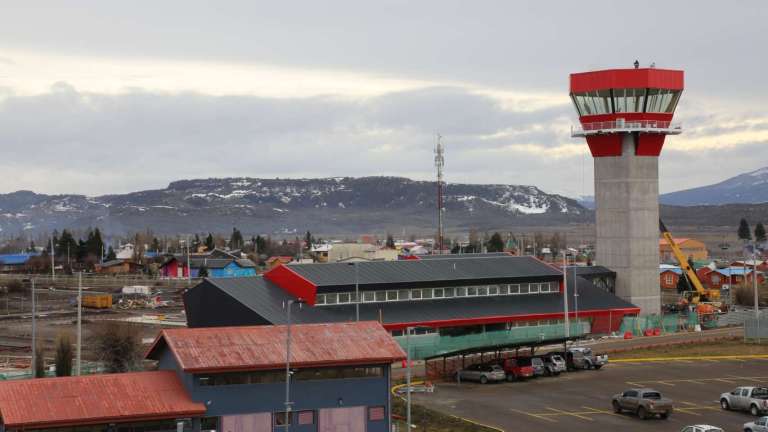
El Aeródromo Balmaceda de la Región Aysén, en la República de Chile iniciará la primera obra concesionada par ala ampliación de la superficie del Terminal aérea, pasará de los actuales 2.400 m2 a 12.391 m2, lo que representa un incremento de 416%. El aumento de capacidad también contempla 272 estacionamientos, entre otros. Esta obra ocupará 160 personas como mano de obra mensual y ocasionará importante movimiento en la economía local y regional, acción que ha impulsado el Gobierno de Chile en el marco del Plan Paso a Paso Chile se Recupera.
El Ministerio de Obras Públicas en la Región Metropolitana, el Secretario Regional Ministerial de Obras Públicas Néstor Mera Muñoz junto al Director Regional de Aeropuertos del MOP, Alejandro Cifuentes Celedón participaron en la apertura de las ofertas técnicas para construir y concesionar un nuevo Aeródromo en la localidad de Balmaceda, Región Aysén. Con este acto administrativo se pone en marcha el proceso que continuará el próximo 22 de Diciembre de 2020 con la apertura de las ofertas económicas y cronograma programado, la adjudicación de esta obra podría realizarse el primer semestre del año 2021. Al respecto, la Directora Nacional de Aeropuertos indicó “este es un hito muy importante en el desarrollo del Plan de Aeropuertos que anunció el presidente Sebastián Piñera en junio del año 2019. Hoy con esta apertura de las ofertas técnicas estamos dando un avance importante en este proceso que involucra tanto a la región de Aysén como a Magallanes, quienes van a poder contar con una infraestructura ampliada duplicando capacidad y con equipamiento de última tecnología, todo gracias a la licitación que se abrió hoy en la que hemos recibido esta oferta, lo que nos tiene muy contentos”.
Por su parte, el SEREMI del MOP, Néstor Mera Muñoz luego de terminar el proceso de recepción de ofertas de la futura concesión de la Red Aeroportuaria Austral, destacó: “Nosotros estamos muy interesados como región de Aysén en lo que va a ocurrir en Balmaceda, en donde esperamos tener un cambio realmente profundo y completo respecto de lo que va a ser nuestro sistema de transporte aéreo. Ha llegado una oferta del Consorcio Austral de Aeropuertos conformado por la empresa Cointer Chile S.A. que tiene experiencia en esta área en la zona norte del país y que presenta un grupo de inversionistas muy potente, por lo tanto esta única oferta que se ha recibido esperamos que cumpla con todos los requisitos y de aquí a un mes más, 22/12, abramos la oferta económica para dar paso al anhelado sueño que tenemos como región de Aysén, de hacer este profundo cambio para la principal puerta de entrada a esta zona del país. Esta obra considera un presupuesto estimado de 166 millones de dólares (UF 3.965) permitirá atender a un mayor número de vuelos de pasajeros y de carga, y en su etapa de construcción generará 160 empleos promedio mensuales, lo que contribuirá a la reactivación económica de nuestra región”.
Hasta Septiembre 2020, se han atendido 229.457 pasajeros en el Aeródromo de Balmaceda y en el año 2019 se embarcaron 684.470 pasajeros. En este contexto, el Director de Aeropuertos del MOP en la región de Aysén, Alejandro Cifuentes Celedón, señaló que con esta apertura de ofertas se concluye un largo proceso, y agregó “esta obra ha sido muy esperada por la comunidad y ha significado llegar al final de una larga etapa de trabajo conjunto por varios años con nuestra Dirección Nacional de Aeropuertos. Hoy llegamos al término de un proceso, el que da paso a un nuevo comienzo para tener en Balmaceda, que es nuestra Red Primaria Aeroportuaria, un Aeródromo de la envergadura que se merece la región”.
Balmaceda Aerodrome expansion
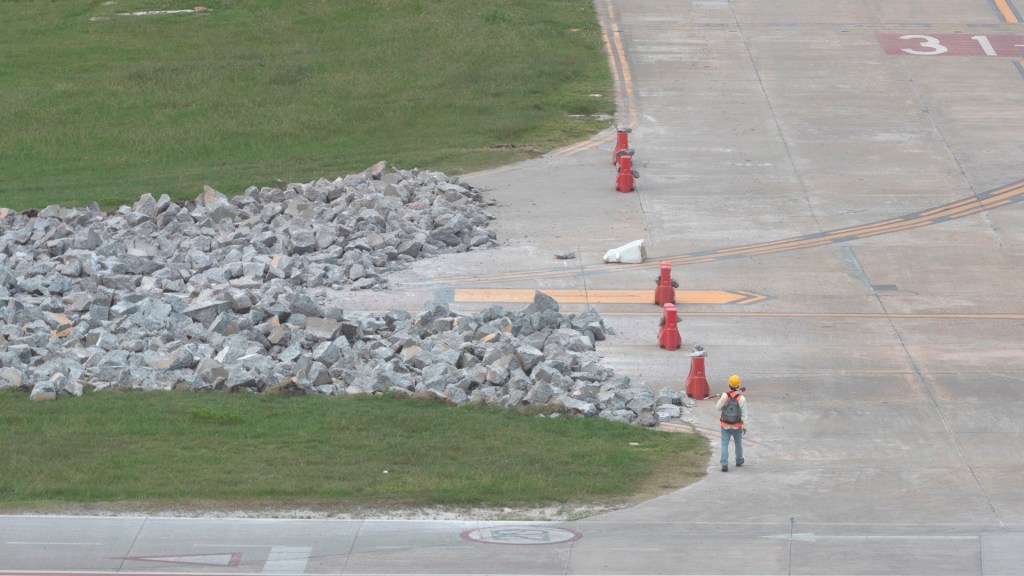
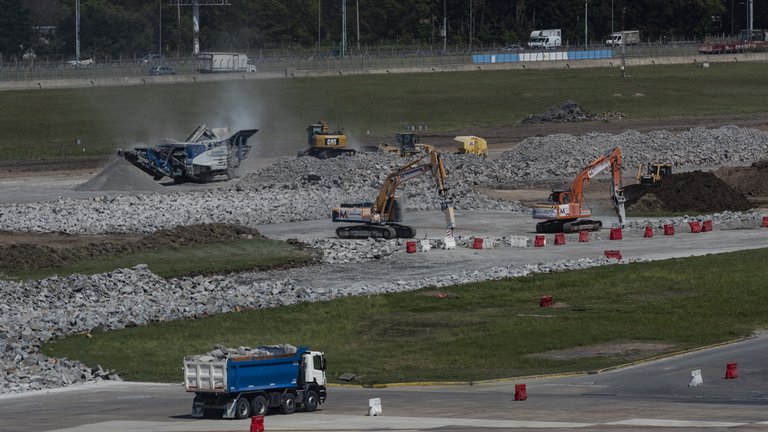
Balmaceda Aerodrome reconditioning, Chile
The Balmaceda Aerodrome in the Aysén Region, in the Republic of Chile, will begin the first work under concession for the expansion of the air terminal area, going from the current 2,400 m2 to 12,391 m2, which represents an increase of 416%. The capacity increase also includes 272 parking spaces, among others. This work will employ 160 people as a monthly workforce and will cause significant movement in the local and regional economy, an action promoted by the Government of Chile within the framework of the Chile Se Recupera Step by Step Plan.
The Ministry of Public Works in the Metropolitan Region, the Ministerial Regional Secretary of Public Works Néstor Mera Muñoz together with the Regional Director of Airports of the MOP, Alejandro Cifuentes Celedón participated in the opening of the technical offers to build and concession a new Aerodrome in the town from Balmaceda, Aysén Region. With this administrative act, the process that will continue on December 22, 2020 with the opening of the economic offers and scheduled schedule, the award of this work could be carried out in the first half of 2021. In this regard, the National Director of Airports indicated “this is a very important milestone in the development of the Airports Plan announced by President Sebastián Piñera in June 2019. Today with this opening of the technical offers we are making an important advance in this process that involves both the Aysén region as well as Magallanes, who will be able to count on an expanded infrastructure, doubling capacity and with the latest technology equipment, all thanks to the tender that was opened today in which we have received this offer, which makes us very happy”.
For his part, the SEREMI of the MOP, Néstor Mera Muñoz, after finishing the process of receiving offers for the future concession of the Austral Airport Network, highlighted: “As the Aysén region, we are very interested in what is going to happen in Balmaceda , where we hope to have a really deep and complete change regarding what our air transport system is going to be. An offer has arrived from the Austral Airports Consortium made up of the company Cointer Chile S.A. that has experience in this area in the northern part of the country and that presents a very powerful group of investors, therefore this single offer that has been received we hope that it will meet all the requirements and within another month, 12/22 Let’s open the economic offer to give way to the longed-for dream that we have as the Aysén region, of making this profound change for the main gateway to this area of the country. This work considers an estimated budget of 166 million dollars (UF 3,965) will allow serving a greater number of passenger and cargo flights, and in its construction stage it will generate 160 average monthly jobs, which will contribute to the economic reactivation of our region».
At the Balmaceda Aerodrome, the works consider expanding, repairing, conserving and replacing the existing infrastructure, equipment and facilities, carrying out the necessary civil works and providing the facilities so that airlines, passengers and users have the conditions of service, comfort and security in accordance with the requirements of regional airports with an international character. The new Passenger Terminal Building will be located in front of the current enclosure, which will become a cargo terminal, and will have five boarding bridges, currently there are two, three security posts (AVSEC), currently there are two and seventeen counters for airlines, there are currently ten. In addition, there will be two luggage retrieval belts. Additionally, support facilities are included for the Directorate General of Civil Aeronautics (DGAC) and the airlines. In general, the project proposes an increase in the surface of the Terminal, going from the current 2,400 m2 to 12,391 m2, which represents an increase of 416%. The capacity increase also includes 99 new vehicle parking spaces, which add to the current 173, allowing the completion of 272 parking spaces, which represents a 57% increase. Regarding the number of parking lots for commercial aircraft, it doubles from three to six; Additionally, thirteen new parking lots are created for general aviation (corresponding to small planes that are in charge of serving isolated areas), and with this, it will be possible to serve 1.2 million passengers per year.
Until September 2020, 229,457 passengers have been served at the Balmaceda Aerodrome and in 2019 684,470 passengers were boarded. In this context, the Director of Airports of the MOP in the Aysén region, Alejandro Cifuentes Celedón, pointed out that with this opening of offers a long process is concluded, and added “this work has been highly anticipated by the community and has meant reaching the end of a long stage of joint work for several years with our National Directorate of Airports. Today we come to the end of a process, which gives way to a new beginning to have in Balmaceda, which is our Primary Airport Network – an Aerodrome of the size that the region deserves”.
Gobierno Argentina pronuncia preliminarmente por El Palomar
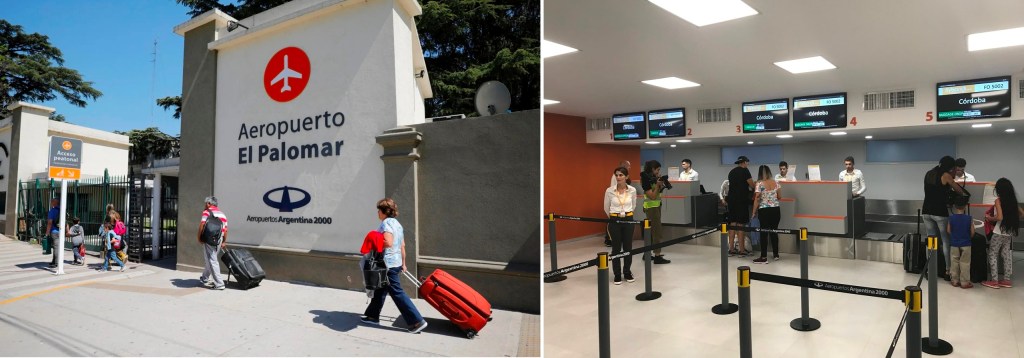
El Gobierno de Argentina, por intermedio del Ministerio de Transporte a cargo del Ministro Mario Meoni ha transmitido este Sábado 21/11 apreciaciones respecto a la posición del Gobierno respecto al futuro del Aeropuerto internacional El Palomar. La posición del Gobierno actual respecto a la actual situación está relacionada a las garantías de seguridad y capacidades de la aeroestación para cumplimentar los requerimientos sanitarios por los efectos de la pandemia.
En el día 21/11 el Ministro de Transporte ha acercado algunos detalles sobre las perspectivas del destino del Aeropuerto El Palomar, que ha expresado: «Hay que evaluar muy bien tener tres aeropuertos abiertos en el área metropolitana», ha agregado una comparación que «Nueva York tiene tres pero con 160 millones de pasajeros por año, mientras que acá tenemos 27 millones”. Como ocurre con muchas comparaciones, pueden tener un relato acertado, pero las realidades son un tanto diferentes, porque estamos considerando que es un aeropuerto low cost muy diferente de las aeroestaciones clásicas. Es importante tomar en consideración que el aeropuerto low cost de El Palomar es una aeroestación que ha crecido exponencialmente favoreciendo la diversidad de oportunidades para volar, como ocurre en los diferentes aeropuertos de Londres y Gran Londres donde operan un número importante de aerolíneas low cost que contribuyen a estimular el transporte polivalente británico y europeo.
Desarrollo de El Palomar
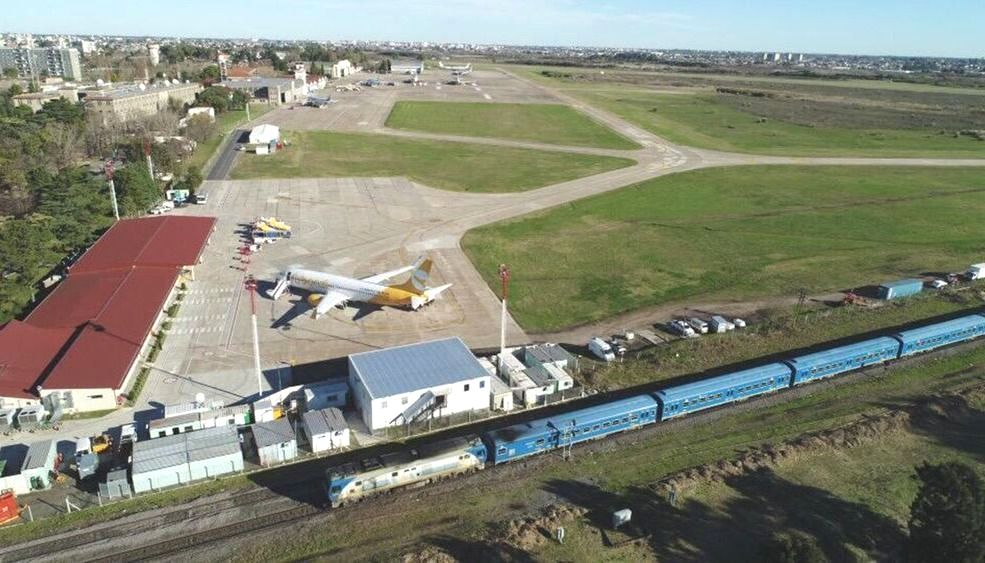
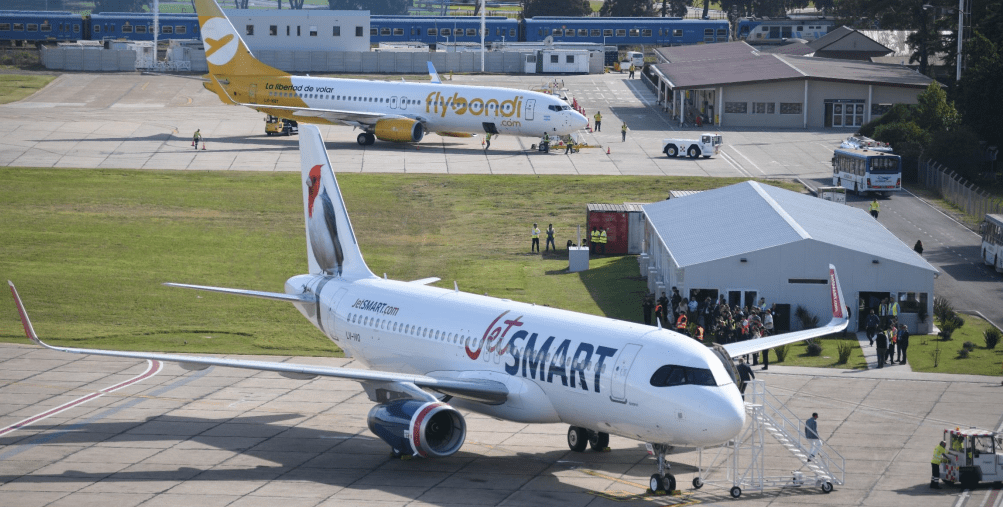
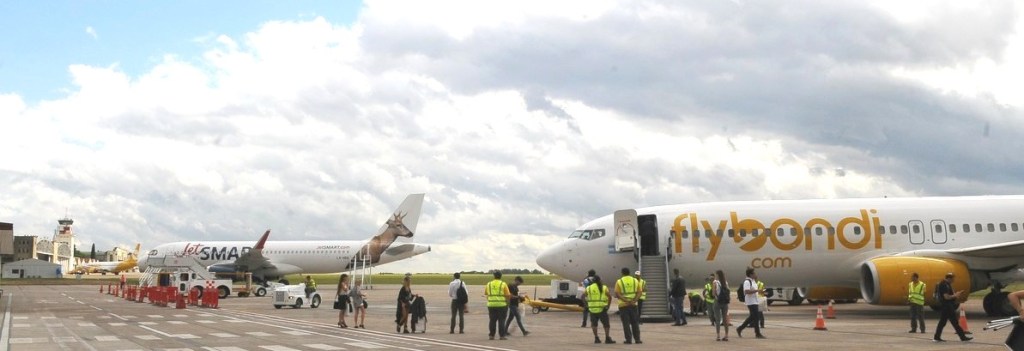
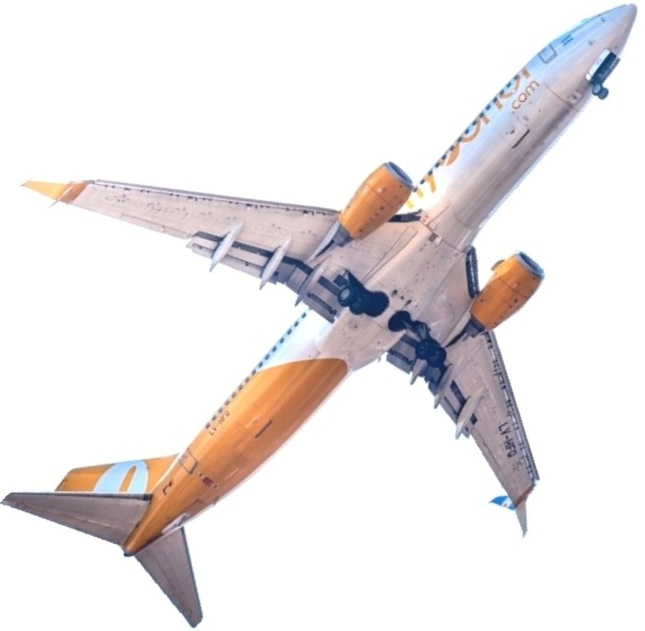
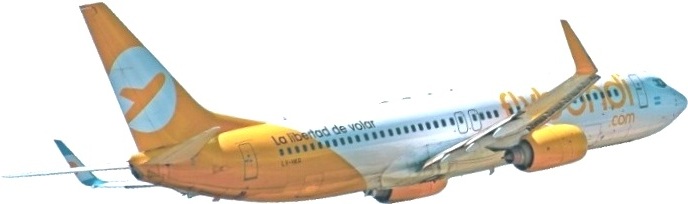
Inicialmente esta aeroestación low cost estaba siendo utilizada como un anexo para el Aeropuerto Jorge Newbery, después que el Aeropuerto Internacional de Ezeiza, debido al mantenimiento de sus pistas en Noviembre de 2010. Poseía operaciones diarias de aviones privados, militares de la Fuerza Aérea Argentina, y comerciales de Líneas Aéreas del Estado (LADE), Flybondi Líneas Aéreas, JetSmart Airlines Chile y JetSmart Airlines Argentina. En tanto, la aerolínea trasandina Sky Airline, había sido fue autorizada a operar desde el aeropuerto. La filial local de JetSmart inició el 10 de Abril de 2019 sus vuelos de cabotaje. El Aeropuerto Internacional El Palomar operaban cuatro aerolíneas sirviendo a catorce destinos de cabotaje y siete internacionales hacia Brasil, Paraguay, Chile y Uruguay, este último destino de manera estacional. El tráfico entre 2018-2019 para muchos destinos han desarrollado incrementos del orden promedio entre los 90% a 170% en la mayorías de los destinos, mostrando una clara tendencia hacia un mercado muy apreciado por los usuarios del transporte que ha estimulado a muchos a volar por primera vez en su vida.
Aun con estas consideraciones, el Gobierno muestra una política de achicamiento o reducción de las aeroestaciones indicando «porque cuando somos un país pobre, no tenemos que tener por tener aeropuertos. En el mundo tienen en función de la cantidad de pasajeros, que las empresas low cost tendrán que operar desde Aeroparque». Apuntando nuevamente a la particularidad de la aeroestación, low cost, eso es lo que representa como objetivo, estimular en virtud de los costos operativos a que los usuarios del transporte utilicen la navegación aérea como un transporte eficaz a un meyor costo.
Aeropuerto Jorge Newbery
Mario Meoni explicó respecto al Aeroparque: «Que la reforma es muy importante en el Jorge Newbery, que va a permitir que tenga mucho más capacidad y debemos sostenerlo, terminada la pandemia, vamos a tener 6.5 millones de aviones despegando”. De esta manera perfiló sus comentarios hacia las aerolíneas low cost: «JetSmart está realizando vuelo desde el Aeropuerto de Ezeiza, lo mismo podría suceder con Flybondi ya que no presenta ninguna prohibición ni restricción para la realización de sus operaciones aéreas». Hasta que se resuelva finalmente lo que va a suceder con El Palomar, el funcionario nacional expresó: “La empresa Flybondi pude volar, puede hacerlo sin ningún inconveniente desde Ezeiza; lo que está restringido es el uso del vuelo de pasajeros desde dicha terminal aérea [El Palomar], ya que desde allí se están realizando solo vuelos de carga”, concluye el Ministro de Transporte.
Perspectivas aéreas
Desde el Ministerio de Transporte han arrojado presumiblemente algunos detalles respectos a las intenciones para las operaciones en el Área Metropolitana de Buenos Aires (AMBA), que están relacionados con la intención de cerrar el Aeropuerto Internacional El Palomar previa negociación con las aerolíneas de presupuesto para que operen desde el renovado Aeropuerto Jorge Newbery, según se desprende de las palabras del Ministro de Transporte de Argentina. Mientras tanto, las aerolíneas continuarán presentando batalla para conseguir retornar a la anhelada normalidad con la cura de la enfermedad del Coronavirus, como una luz al final del túnel.
Position Transport Argentina by El Palomar
Government of Argentina preliminarily pronounces for El Palomar
The Government of Argentina, through the Ministry of Transportation led by Minister Mario Meoni, has transmitted this Saturday, November 21, appreciations regarding the Government’s position regarding the future of El Palomar International Airport. The current government’s position regarding the current situation is related to the security guarantees and capabilities of the air station to comply with the health requirements due to the effects of the pandemic.
On 11/21, the Minister of Transportation provided some details on the prospects for the destination of El Palomar Airport, which stated: «We must evaluate very well having three airports open in the metropolitan area», he added a comparison that «New York has three but with 160 million passengers per year, while here we have 27 million”. As with many comparisons, they may have an accurate story, but the realities are somewhat different, because we are considering that it is a low cost airport very different from classic air stations. It is important to take into account that the low cost airport of El Palomar is an air station that has grown exponentially favoring the diversity of opportunities to fly, as occurs in the different airports of London and Greater London where a number of important of low cost airlines that help stimulate British and European multipurpose transport.
El Palomar development
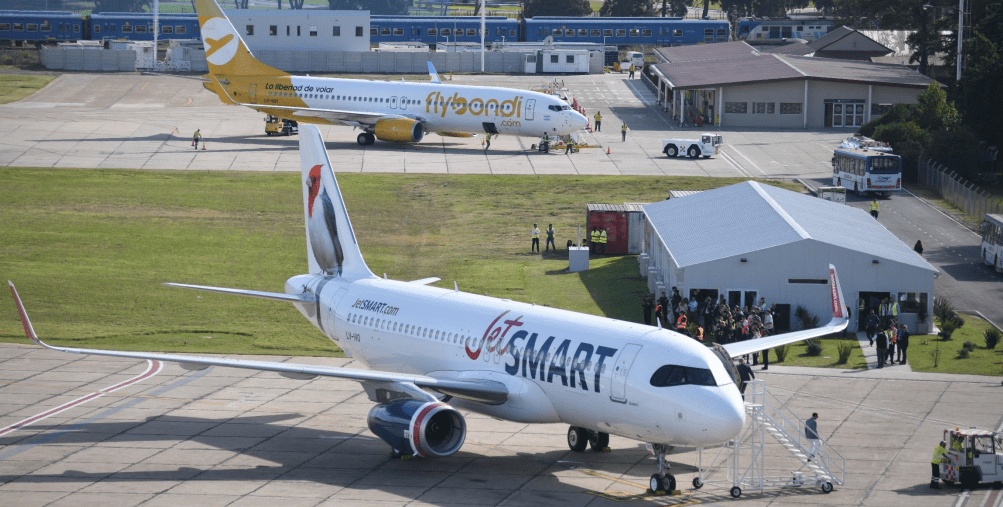
Initially, this low-cost airstation was being used as an annex to the Jorge Newbery Airport, after the Ezeiza International Airport, due to the maintenance of its runways in November 2010. It had daily operations of private planes, Argentine Air Force military, and of the State Air Lines (LADE), Flybondi Lineas Aereas, JetSmart Airlines Chile and JetSmart Airlines Argentina. Meanwhile, the trans-Andean airline Sky Airline had been authorized to operate from the airport. The local subsidiary of JetSmart began its domestic flights on April 10, 2019. The El Palomar International Airport operated four airlines serving fourteen domestic and seven international destinations to Brazil, Paraguay, Chile and Uruguay, the latter destination on a seasonal basis. Traffic between 2018-2019 for many destinations has developed increases of the average order between 90% to 170% in most destinations, showing a clear trend towards a market highly appreciated by transport users that has stimulated many to fly by. first time in his life.
Even with these considerations, the Government shows a policy of downsizing or reducing air stations, stating «because when we are a poor country, we do not have to have airports. In the world they have depending on the number of passengers, which companies low cost will have to operate from Aeroparque». Aiming again at the particularity of the airstation, low cost, that is what it represents as an objective, to stimulate, by virtue of operating costs, transport users to use air navigation as an efficient transport at a lower cost.
Jorge Newbery Airport
Mario Meoni explained regarding the Aeroparque: «That the reform is very important in the Jorge Newbery, which will allow it to have much more capacity and we must sustain it, once the pandemic is over, we are going to have 6.5 million planes taking off«. his comments towards low cost airlines: «JetSmart is making a flight from Ezeiza Airport, the same could happen with Flybondi since it does not present any prohibition or restriction for carrying out its air operations«. Until what is going is finally resolved to happen with El Palomar, the national official said: «The Flybondi company can fly, it can do so without any inconvenience from Ezeiza; what is restricted is the use of the passenger flight from said air terminal [El Palomar], since from there only cargo flights are being carried out”, concludes the Minister of Transport.
Aerial perspectives
The Ministry of Transportation has presumably released some details regarding the intentions for operations in the Buenos Aires Metropolitan Area (AMBA), which are related to the intention to close the El Palomar International Airport after negotiation with budget airlines so that operate from the renovated Jorge Newbery Airport, according to the words of the Minister of Transportation of Argentina. Meanwhile, the airlines will continue to fight to return to the desired normality with the cure of the Coronavirus disease, like a light at the end of the tunnel.
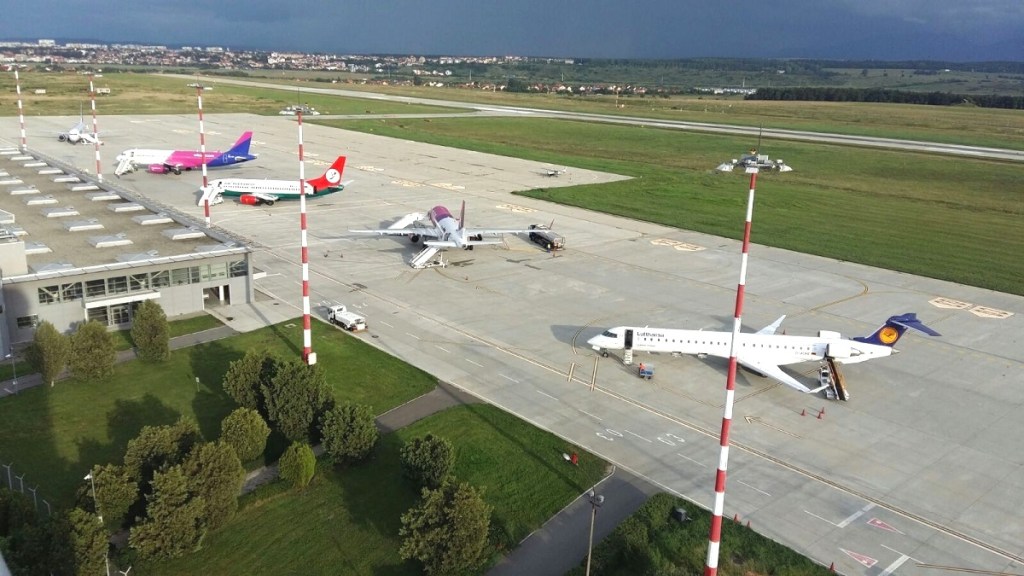
La Comisión Europea (CE) ha aprobado, de conformidad con las normas de la Unión Europea (UE) sobre ayudas estatales, un plan rumano de € 1,7 millones de Euros para las aerolíneas que reanudan o inician vuelos desde y hacia el Aeropuerto de Sibiu en Rumania. El Aeropuerto de Sibiu representa un papel importante en la conectividad regional e internacional del país. Este plan proporciona ayuda en forma de subvenciones directas y será accesible de manera transparente a todas las aerolíneas interesadas que inicien o reanuden sus operaciones en el Aeropuerto de Sibiu.
El objetivo de la medida es apoyar la actividad de los operadores aéreos y apoyar la recuperación económica y la viabilidad estructural de la región afectada por la pandemia del coronavirus. La Comisión constató que el régimen rumano se ajusta a las condiciones establecidas en el marco temporal. En particular, la ayuda no superará los € 800 000 Euros por empresa y se concederá antes del 30 de Junio de 2021. La Comisión concluyó que “la medida es necesaria, adecuada y proporcionada para remediar una perturbación grave en la economía de un Estado miembro”.
EC approves aid Romania
EU extends aid to Romanian plan to airlines
The European Commission (EC) has approved, in accordance with the rules of the European Union (EU) on state aid, a Romanian plan of € 1.7 million Euros for airlines that resume or start flights to and from the Airport of Sibiu in Romania. Sibiu Airport plays an important role in the country’s regional and international connectivity. This scheme provides support in the form of direct grants and will be transparently accessible to all interested airlines starting or resuming operations at the Sibiu eAport.
The objective of the measure is to support the activity of air operators and support the economic recovery and structural viability of the region affected by the coronavirus pandemic. The Commission found that the Romanian scheme complies with the conditions set out in the time frame. In particular, the aid will not exceed € 800,000 Euros per company and will be granted before June 30, 2021. The Commission concluded that “the measure is necessary, adequate and proportionate to remedy a serious disturbance in the economy of a Member State”.
CE aprobă ajutorul României
UE extinde ajutorul pentru planul românesc companiilor aeriene
Comisia Europeană (CE) a aprobat, în conformitate cu normele Uniunii Europene (UE) privind ajutorul de stat, un plan românesc de 1,7 milioane de euro pentru companiile aeriene care reiau sau încep zborurile către și de la Aeroportul Sibiu din România. Aeroportul Sibiu joacă un rol important în conectivitatea regională și internațională a țării. Acest sistem oferă sprijin sub formă de subvenții directe și va fi accesibil în mod transparent tuturor companiilor aeriene interesate care încep sau reiau operațiunile la portul electronic Sibiu.
Obiectivul măsurii este de a sprijini activitatea operatorilor aerieni și de a sprijini redresarea economică și viabilitatea structurală a regiunii afectate de pandemia de coronavirus. Comisia a constatat că schema românească respectă condițiile stabilite în intervalul de timp. În special, ajutorul nu va depăși 800.000 EUR pentru fiecare companie și va fi acordat înainte de 30 iunie 2021. Comisia a concluzionat că „măsura este necesară, adecvată și proporțională pentru a remedia o perturbare gravă a economiei unui stat membru”.
El Aeropuerto Internacional Felipe Ángeles/AIFA iniciará su apertura aerocomercial en Febrero 2021, según han anunciado la Secretaría de Comunicaciones y Transportes de México. El primer avión está establecido para aterrizar en el Aeropuerto de Santa Lucía el 19 de Febrero de 2021, inaugurando el nuevo aeropuerto de la Ciudad de Santa Lucía. El Presidente Andrés Manuel López Obrador será el encargado de estrenar las pistas del Nuevo Aeropuerto de México para ese día memorable, aunque la inauguración de los vuelos comerciales sigue prevista en el calendario para el 21 de Marzo de 2022, anunció el titular de la Secretaría de Comunicaciones y Transportes, Jorge Arganis Díaz-Leal.
Actualmente se están trabajando estrechamente con las autoridades del Estado de México para que se puedan concluir los trabajos de conectividad terrestre entre los aeropuertos de Toluca, Ciudad de México y el de Santa Lucía, una vez que comience a funcionar el sistema. En 10/2020, tras un recorrido por la construcción, López Obrador aseguró que la obra ya estaba al 40% y con un avance financiero del 27%.
El proyecto inicial del Aeropuerto de Santa Lucía comprendía 2.300 hectáreas, pero se adquirieron 1.400 hectáreas más para un total de 3.700, más de cinco veces la extensión del actual Aeropuerto Internacional de la Ciudad de México, que es de 750 hectáreas. El futuro aeropuerto mexicano tendrá capacidad para unos 20.5 millones de usuarios al año y espera recibir unos 85 millones en varias etapas de construcción que se cumplirán en las próximas tres décadas 2030, 2040 y 2050. Santa Lucía operará a la par del actual Aeropuerto Internacional de la Ciudad de México (AICM) y con el de Toluca, también en el Estado de México, y entre todos tendrán un total de seis pistas.
AIFA Airport opening around 02/2021
Felipe Ángeles Airport opens around 02/2020
The Felipe Ángeles International Airport/AIFA will begin its commercial opening in February 2021, as announced by the Ministry of Communications and Transportation of Mexico. The first aircraft is set to land at Santa Lucia Airport on February 19, 2021, inaugurating the new airport in the City of Santa Lucia. President Andrés Manuel López Obrador will be in charge of opening the runways of the New Mexico Airport for that memorable day, although the inauguration of commercial flights is still scheduled on the calendar for March 21, 2022, announced the head of the Secretariat of Communications and Transportation, Jorge Arganis Díaz-Leal.
Currently, they are working closely with the authorities of the State of Mexico so that the ground connectivity works between the Toluca, Mexico City and Santa Lucía airports can be completed, once the system begins to operate. In 10/2020, after a tour of the construction, López Obrador assured that the work was already at 40% and with a financial advance of 27%.
The initial Santa Lucía Airport project comprised 2,300 hectares, but 1,400 more hectares were acquired for a total of 3,700, more than five times the extension of the current Mexico City International Airport, which is 750 hectares. The future Mexican airport will have capacity for about 20.5 million users per year and expects to receive about 85 million in various construction stages that will be completed in the next three decades 2030, 2040 and 2050. Santa Lucia will operate alongside the current International Airport of Mexico City (AICM) and Toluca, also in the State of Mexico, and together they will have a total of six tracks.
Continúan obras remodelación en Aeropuerto Jorge Newbery
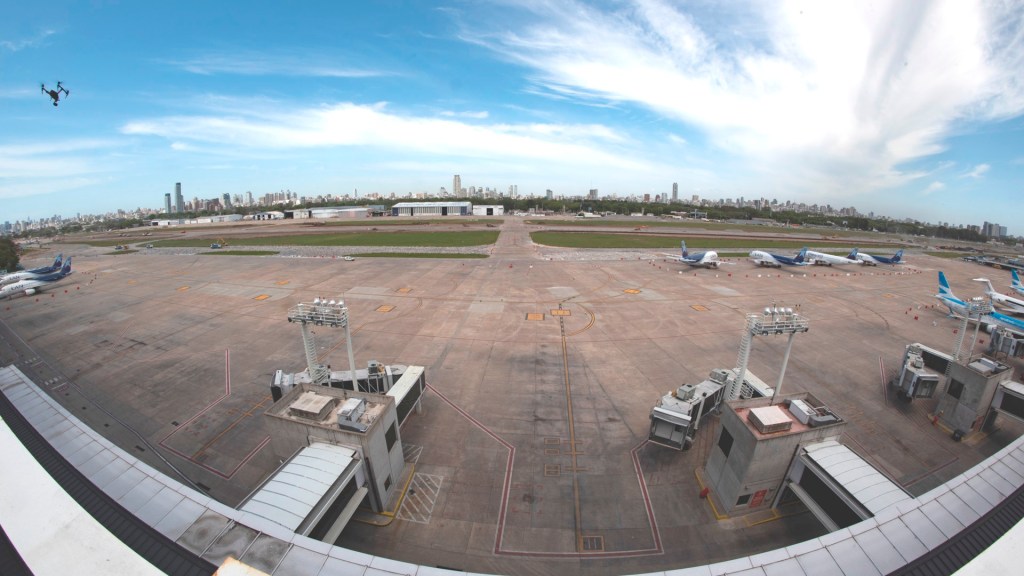
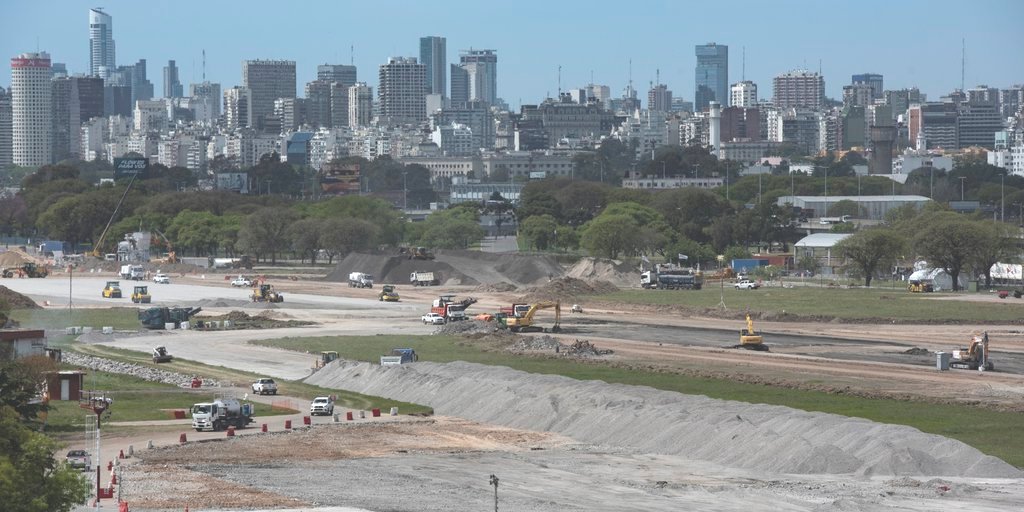
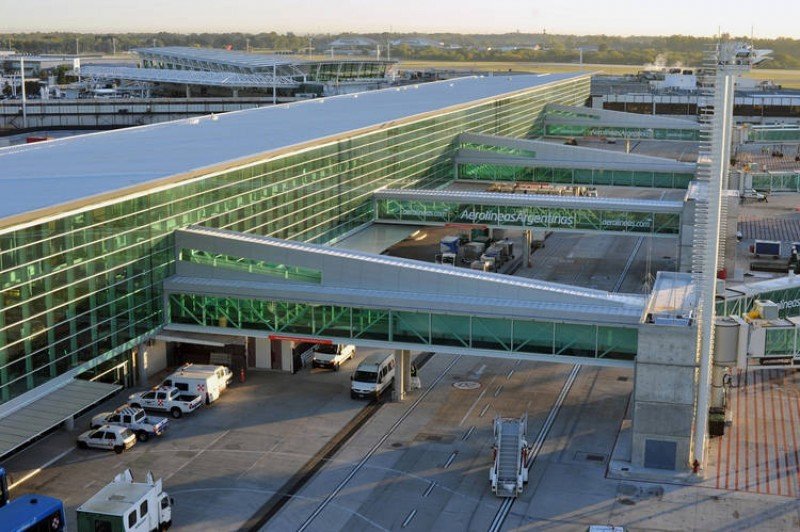
El Aeropuerto Jorge Newbery (AEP/SABE) continúa con las obras proyectadas para aprovechar mejor los espacios de la aeroestación más importante de Argentina por número de tráfico aéreo. Aeropuertos Argentina 2000 (AA2000) continúa con la diagramación de las obras de modernización en la pista y en el sector de la terminal aérea en el que operarán un número mayor de frecuencias a partir de Febrero 2021, cuando reabra la estación aérea para convertirse nuevamente en el aeropuerto regional. Los trabajos en la terminal porteña demandarán una inversión total de unos AR$ 5.000 millones de Pesos.
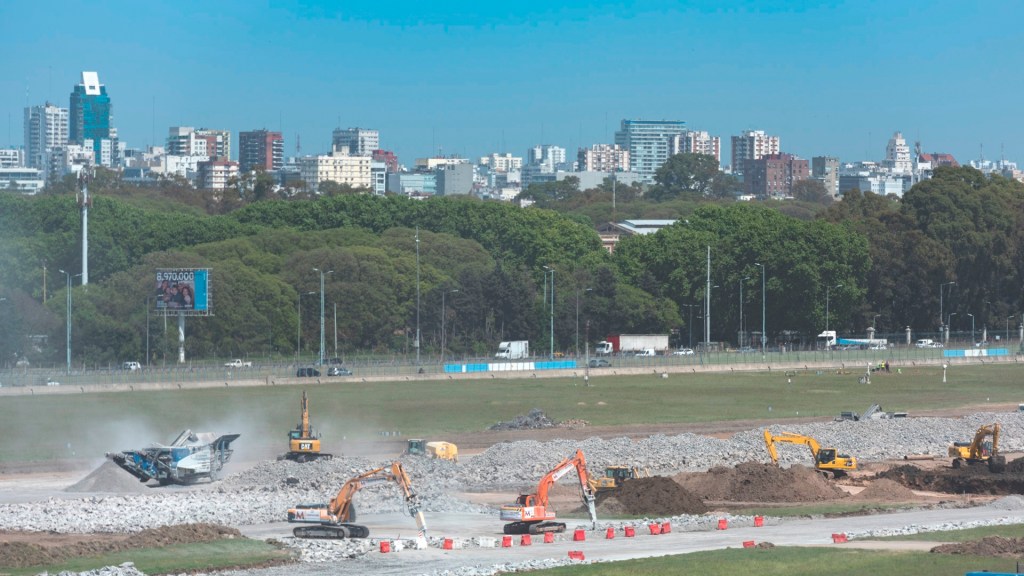
Las obras en pista y en la terminal comenzaron hace unas semanas, tendrán una duración de entre 4 y 5 meses y se espera que en febrero la terminal funcione nuevamente con normalidad y trazado renovado. Se trata de trabajos financiados por el Fideicomiso de Fortalecimiento del Sistema Nacional de Aeropuertos que administra el Ministerio de Transporte y ejecuta el ORSNA. Aeropuertos Argentina 2000 las lleva adelante.
Líneas aéreas
En el contexto, las líneas aéreas que funcionan desde Aeroparque trasladaron sus operaciones al Aeropuerto Internacional Ezeiza, una terminal que cuenta con capacidad e infraestructura para albergar a todas las empresas que operan en el país, más aún en esta situación particular que implicará la salida gradual de la pandemia. Los vuelos de cabotaje parten de la Terminal C y los internacionales desde la Terminal A.
Pandemia; obras mayores
La planificación de las obras en Aeroparque tenía previsto trabajos de menor mantenimiento que implicaban el cierre temporario de casi dos meses, un plan de menor escala. tras el advenimiento y prolongación de la crisis sanitaria y la afección de las operaciones aéreas en el contexto mundial, se ha aprovechando este momento particular que atraviesa la industria aerocomercial en medio de la pandemia, para solicitar por medio del ORSNA al concesionario aeroportuario AA2000 el estudio de la factibilidad para realizar una obra de mayor envergadura, con vistas a plazos más largos y así mejorar la categoría de la pista actual. “Se aprovechó la parálisis de la industria y la vuelta gradual de operaciones para una obra a largo plazo”, aseguraron desde el concesionario aéreo. Los trabajos en la terminal aérea también son fiscalizados de cerca por la Administración Nacional de Aviación Civil Argentina (ANAC), que participó y aprobó el diseño y será quien realice la habilitación cuando finalice la obra. “Aeroparque se recupera como una cabecera internacional; esto es importante apuntando al crecimiento del turismo receptivo, fundamentalmente de países limítrofes. Es algo que va a posibilitar que miles de turistas internacionales que estaban volcados a Ezeiza pasen a Aeroparque. La gente tenía que hacer combinaciones costosas y muchos vienen desde el exterior para visitar destinos nacionales. Se beneficia la conexión de esos turistas”, explicaron desde el organismo de la ANAC. En el contexto de la pandemia, el ORSNA le solicitó a AA2000 un estudio de la factibilidad para realizar una obra de mayor envergadura que la prevista.
Pista 13/31 Aeroparque
La pista del Aeropuerto Jorge Newbery tiene 2.100 metros y sumará 275 metros hacia el sur y 340 metros hacia el norte, unos 615 metros adicionales, que corresponderán a una nueva longitud de 2.715 metros de largo. Según detallaron en la empresa que pertenece a Corporación América, “la obra viene a complementar la transformación que está viviendo Aeroparque en el contexto de su regionalización, nuevos estacionamientos Sur y subsuelos en tierra ganada al río debajo del nuevo parque costero, check-in, capacidad de la terminal, paseo costero, entre otros”. Los trabajos en la pista permitirán «optimizar las operaciones regionales y mejorar la seguridad y la conectividad con el exterior”, asegura AA2000. Además de la prolongación de la pista en 2.715 metros, se ensanchará 20 metros adicionales, que permitirá optimizar las operaciones regionales y mejorar la seguridad y la conectividad con el exterior.
Plataforma aérea
Las obras también contempla la ampliación de la plataforma aerocomercial para alojar más aeronaves. El Sector Internacionales se encuentra en proyección de sumar 800 m2 de superficie, y se refuncionalizará el sector de partidas internacionales en la terminal de pasajeros, que abarcará una superficie aproximada de 4.630 m2. De esta forma se prioriza un diseño fluido y agradable con foco en la seguridad de los usuarios.
Las obras que se están llevando adelante permitirán mejoras adicionales como albergar operaciones de seis vuelos/hora, cuando anteriormente se operaba un promedio de entre 3,5 a 4 vuelos/hora. Habrá mayor capacidad de procesamiento de pasajeros con la incorporación de un scanner PSA en el sector de Partidas y doce puestos de migraciones. Reordenamiento y mejoramiento de flujos de circulación de pasajeros. Mejoras en distribución de áreas no operativas. Incorporación Gate Flex compartido entre cabotaje e internacional, según requiera la operación, las Puertas 12 y 13 de vuelos nacionales se podrá utilizar para embarcar vuelos internacionales. Ampliación del sector de conexiones. Modernización de las mangas telescópicas. Habrá modificaciones además en el sector de Pre-embarque Internacional, que se diagramó para poder dirigir operaciones de seis vuelos en una unidad horaria. Las cintas de equipajes anteriormente eran tres y se separarán para brindar mayor comodidad. Se quintuplicará la superficie de oficinas para Aduana y Migraciones. En la zona pública de arribos internacionales habrá nuevos locales comerciales.
Entre las mejoras técnicas se detalló que se instalará un nuevo sistema de balizamiento para sumar seguridad operacional en los despegues y aterrizajes. “Se trata de un nuevo sistema de alta intensidad en configuración de Categoría Operacional III, rodajes y salidas rápidas, que incluye luces de eje pista, bordes, umbral y fin de pista, y nuevos sistemas de luces de aproximación en ambas cabeceras. También, se incorporará un nuevo sistema instrumental para el aterrizaje (ILS CAT. III). Dichas instalaciones mejorarán sustancialmente la seguridad de las operaciones y permitirán operar en condiciones de baja visibilidad”, detalló el operador aeroportuario AA2000.
Además, de las obras, Aeroparque es parte, desde comienzos del 2018, del programa global de encuestas ASQ (Airport Service Quality) de ACI (Consejo Internacional de Aeropuertos), en el que el pasajero evalúa entre otras cosas la infraestructura y los servicios de la terminal. “Esta herramienta permite conocer cuáles son las expectativas de los pasajeros que visitan el aeropuerto, y llevar adelante medidas tendientes a mejorar su experiencia”, dijeron en AA2000. Desde esa medición y hasta el primer trimestre de este año, el aeropuerto mejoró su puntuación de satisfacción general, obteniendo un puntaje por parte de los pasajeros de 4,08 sobre 5 en la última medición de satisfacción general. Además, el año pasado, la terminal estrenó un nuevo Centro de Control de Operaciones (CCO). Su objetivo es alcanzar mayor eficiencia en la gestión operativa y centralizar todas las novedades, incidentes y reclamos en un solo sector. El Smart CCO opera las 24 horas los 365 días del año. El CCO tiene acceso a las cámaras de CCTV, los sistemas que controlan las cintas de equipaje (BHS) y aquellos que controlan el aire acondicionado en cada sector, las mangas y los ascensores (BMS). Por otra parte, también está a cargo del sistema de información de vuelos llamado TAMS y todos los datos registrados por los distintos sectores son cargados en un nuevo sistema llamado eRod, desde donde se gestionan los reclamos y se dejan asentados los procedimientos llevados a cabo para solucionarlos. Contará con un equipo de 16 personas para atender todas las consultas que trabaja en turnos de 12 horas y está compuesto por el Gerente del área, 5 jefes y 10 encargados que relevan constantemente las operaciones de la terminal.
Contexto parálisis
El Aeropuerto Jorge Newbery ha aprovechado la puesta a tierra de la aviación comercial para mejorar su posición como aeropuerto regional, perfilando sus operaciones como lo es el Aeropuerto Sao Paulo/Congonhas (CGH). A la par de la misma situación general, otros aeropuertos del mundo aprovecharon la parálisis producida por la crisis del Covid-19 para adelantar trabajos de infraestructura que serían muy difíciles o imposibles de realizar en condiciones de operaciones normales. Es el caso, por ejemplo, del Louisville Muhammad Ali International (SDF), en EEUU, donde se puso en marcha el proyecto SDF Next con una inversión de US$ 400 millones para remodelar y renovar áreas dentro de la terminal y fuera de ella. Otro ejemplo se da en Holanda, en el Aeropuerto Amsterdam/Schiphol (AMS), cuya remodelación se dio en un período de dos meses. Brasil ha abierto un proceso de licitación para recuperar el pavimento de la pista principal del Aeropuerto Sao Paulo/Congonhas (CGH), en la zona sur de la ciudad de San Pablo. La pista principal del ese aeropuerto tiene casi 2 kilómetros de largo y 45 metros de ancho. Durante la renovación, la pista principal permanecerá cerrada y la operación tendrá lugar en la pista auxiliar para aeronaves de menor porte.
Perspectivas Aeroparque
El nuevo aeropuerto remodelado permitirá un mejoramiento exponencial de los recursos de Aeroparque que proyectará nueva pista con mayores longitudes, más plataforma de estacionamiento de aeronaves, mejoramiento de las Terminales aéreas, entre otros muchos detalles importantes para elevar la categoría como aeroestación en un nuevo escenarios aerocomercial en la región de Sudamérica. El Aeropuerto Jorge Newbery estaría en condiciones operativas hacia Febrero 2021 y con él se proyecta un nuevo despegue en la aeroestación más importante de Argentina.
Aeroparque works progress
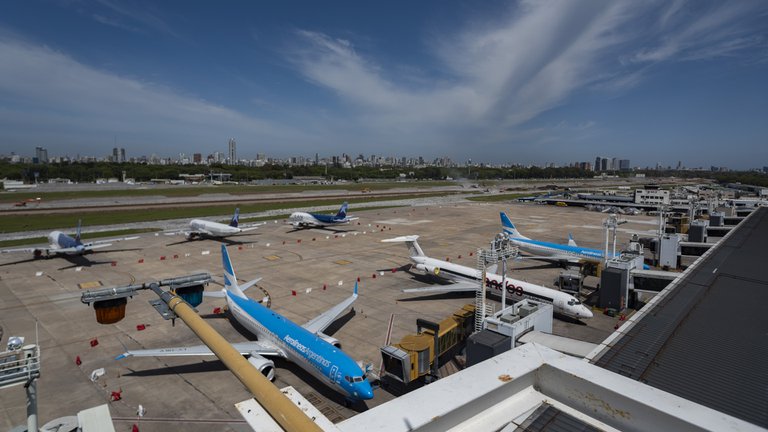
Remodeling works continue at Jorge Newbery Airport
Jorge Newbery Airport (AEP/SABE) continues with the works planned to make better use of the spaces of the most important air station in Argentina by number of air traffic. Aeropuertos Argentina 2000 (AA2000) continues with the layout of the modernization works on the runway and in the air terminal sector in which a greater number of frequencies will operate as of February 2021, when the air station reopens to become a the regional airport. The works in the Buenos Aires terminal will require a total investment of some AR$ 5,000 million Pesos.
The works on the runway and in the terminal began a few weeks ago, will last between 4 and 5 months and it is expected that in February the terminal will function normally again and with a renewed layout. These are works financed by the Trust for the Strengthening of the National Airport System administered by the Ministry of Transportation and executed by Orsna. Airports Argentina 2000 takes them forward.
Airlines
In the context, the airlines that operate from Aeroparque transferred their operations to the Ezeiza International Airport, a terminal that has the capacity and infrastructure to house all the companies that operate in the country, even more so in this particular situation that will involve gradual departure of the pandemic. Domestic flights depart from Terminal C and international flights from Terminal A.
Pandemic; major works
The planning of the works at Aeroparque had planned minor maintenance works that implied the temporary closure of almost two months, a smaller-scale plan. After the advent and prolongation of the health crisis and the impact of air operations in the world context, this particular moment that the commercial aviation industry is going through in the midst of the pandemic has been used to request through the ORSNA the AA2000 airport concessionaire study of the feasibility to carry out a larger work, with a view to longer terms and thus improve the category of the current track. «They took advantage of the paralysis of the industry and the gradual return to operations for a long-term work», they assured from the air concessionaire. The work at the air terminal is also closely supervised by the Argentine National Civil Aviation Administration (ANAC), which participated and approved the design and will be the one to carry out the authorization when the work is finished. “Aeroparque recovers as an international head; this is important pointing to the growth of receptive tourism, mainly from neighboring countries. It is something that will allow thousands of international tourists who were focused on Ezeiza to go to Aeroparque. People had to make expensive combinations and many come from abroad to visit national destinations. The connection of these tourists benefits”, they explained from the ANAC agency. In the context of the pandemic, the ORSNA asked AA2000 for a feasibility study to carry out a larger project than planned.
Runway 13/31 Aeroparque
The Aeropoerto Jorge Newbery runway is 2,100 meters long and will add 275 meters to the south and 340 meters to the north, an additional 615 meters, which will correspond to a new length of 2,715 meters. As detailed in the company that belongs to Corporación América, “the work complements the transformation that Aeroparque is experiencing in the context of its regionalization, new South parking lots and subsoils on land reclaimed from the river below the new coastal park, check-in, capacity of the terminal, coastal walk, among others”. The works on the runway will allow «optimizing regional operations and improving safety and connectivity with the outside world», says AA2000. In addition to the extension of the runway by 2,715 meters, an additional 20 meters will be widened, which will optimize regional operations and improve safety and connectivity with the outside world.
Aerial platform
The works also include the expansion of the commercial aviation platform to accommodate more aircraft. The International Sector is in the projection of adding 800 m2 of surface, and the international departures sector will be re-functionalized in the passenger terminal, which will cover an approximate surface of 4,630 m2. In this way, a fluid and pleasant design is prioritized with a focus on user safety.
The works that are being carried out will allow additional improvements such as hosting operations of six flights/hour, when previously an average of between 3.5 to 4 flights/hour was operated. There will be greater passenger processing capacity with the incorporation of a PSA scanner in the Departures sector and twelve migration posts. Reordering and improvement of passenger traffic flows. Improvements in the distribution of non-operating areas. Incorporation of Gate Flex shared between domestic and international, as required by the operation, Gates 12 and 13 of domestic flights can be used to board international flights. Expansion of the connections sector. Modernization of the telescopic sleeves. There will also be modifications in the International Pre-shipment sector, which was designed to be able to direct operations of six flights in one hourly unit. The luggage belts were previously three and will be separated for greater comfort. The area of offices for Customs and Immigration will be quintupled. In the public area of international arrivals there will be new commercial premises.
Among the technical improvements, it was detailed that a new beaconing system will be installed to add operational safety during takeoffs and landings. “It is a new high-intensity system in Operational Category III configuration, taxiing and rapid departures, which includes runway center line, edge, threshold and runway end lights, and new approach light systems at both headwaters. Also, a new instrument system for landing (ILS CAT. III) will be incorporated. These facilities will substantially improve the safety of operations and will allow to operate in low visibility conditions”, detailed the airport operator AA2000.
In addition, to the works, Aeroparque is part, since the beginning of 2018, of the global survey program ASQ (Airport Service Quality) of ACI (International Council of Airports), in which the passenger evaluates, among other things, the infrastructure and the services of the terminal. «This tool allows us to know what the expectations of the passengers who visit the airport are, and carry out measures to improve their experience», they said in AA2000. Since that measurement and until the first quarter of this year, the airport improved its overall satisfaction score, obtaining a score by passengers of 4.08 out of 5 in the last general satisfaction measurement. In addition, last year, the terminal opened a new Operations Control Center (CCO). Its objective is to achieve greater efficiency in operational management and centralize all news, incidents and complaints in a single sector. The Smart CCO operates 24 hours a day, 365 days a year. The CCO has access to the CCTV cameras, the systems that control the baggage tapes (BHS) and those that control the air conditioning in each sector, the hoses and the elevators (BMS). On the other hand, it is also in charge of the flight information system called TAMS and all the data registered by the different sectors are loaded into a new system called eRod, from where claims are managed and the procedures carried out for fix them. It will have a team of 16 people to attend to all inquiries that works in 12-hour shifts and is made up of the Area Manager, 5 bosses and 10 managers who constantly review the operations of the terminal.
Paralysis context
Jorge Newbery Airport has taken advantage of the commercial aviation grounding to improve its position as a regional airport, shaping its operations such as the Sao Paulo/Congonhas Airport (CGH). Along with the same general situation, other airports in the world took advantage of the paralysis produced by the Covid-19 crisis to carry out infrastructure works that would be very difficult or impossible to carry out under normal operating conditions. This is the case, for example, of Louisville Muhammad Ali International (SDF), in the US, where the SDF Next project was launched with an investment of US$ 400 million to remodel and renovate areas inside the terminal and outside it. Another example is in the Netherlands, at Amsterdam/Schiphol Airport (AMS), which was refurbished in a period of two months. Brazil has opened a bidding process to restore the pavement of the main runway of the Sao Paulo/Congonhas Airport (CGH), in the southern area of the city of São Paulo. The main runway of that airport is almost 2 kilometers long and 45 meters wide. During the renovation, the main runway will remain closed and the operation will take place on the auxiliary runway for smaller aircraft.
Prospects Aeroparque
The new remodeled airport will allow an exponential improvement of Aeroparque resources that will project a new runway with greater lengths, more aircraft parking apron, improvement of air terminals, among many other important details to raise the category as an aerospace in a new commercial aviation scenarios. in the South America region. Jorge Newbery Airport would be in operational conditions by February 2021 and with it a new takeoff is projected at the most important air station in Argentina.
Nuevas protestas por continuidad del Aeropuerto El Palomar
En el marco del conflicto por el cierre del Aeropuerto El Palomar por la postura del Gobierno acerca de la falta de las garantías sanitaria, este Sábado 21 de Noviembre de 2020 desde las 15:00 horas habrá otra nueva movilización por parte de vecinos, quienes solicitarán el retorno de las actividades aerocomerciales en la aeroestación low cost.
Las protestas continúan por la reapertura del aeropuerto con una nueva marcha de vecinos solicitando el retorno de los vuelos de las aerolíneas de presupuesto, porque consideran que han traído actividad a la región. Por parte de las aerolíneas de presupuestos vienen solicitando ante la Justicia Argentina poder volver a operar y reanudar sus actividades comerciales.
Postura gubernamental
Desde el Organismo Regulador del Sistema Nacional de Aeropuertos (ORSNA) sostuvieron mediante un comunicado dirigido hacia la Administración Nacional de Aviación Civil (ANAC), que el único aeropuerto habilitado para operar en el marco de la pandemia del Coronavirus es el Aeropuerto Internacional Ezeiza, sosteniendo que el Aeropuerto El Palomar no se puede garantizar la seguridad sanitaria por las dimensiones de la Terminal aérea. Ante esta situación, JetSmart Airlines Argentina, una de las compañías que operaba en el aeropuerto ubicado en el Partido de Morón definió reprogramar sus vuelos y comenzar a operar desde Ezeiza, mientras que Flybondi Líneas Aéreas se ha negado a llevar adelante ese cambio y continúa solicitando realizar sus vuelos desde El Palomar, porque considera que su estructura no es compatible económicamente para la empresa y los usuarios con mudar las operaciones a Ezeiza, además de afectar el personal que es oriundo de la Ciudad de El Palomar.
Un grupo de vecinos, nuevamente que se movilizará este Sábado 20/11 en la intersección de las calles Itacumbú y Matienzo, sostienen que el aeropuerto es fuente de trabajo no sólo para los trabajadores de las empresas, sino también para los comercios que se encuentran en las inmediaciones del lugar.
Mobilization 21N for El Palomar
New protests for the continuity of El Palomar Airport
Within the framework of the conflict over the closure of El Palomar Airport due to the Government’s position on the lack of health guarantees, this Saturday, November 21, 2020 from 3:00 p.m. there will be another new mobilization by neighbors, who will request the return of commercial air activities in low cost air stations.
The protests continue over the reopening of the airport with a new march of neighbors requesting the return of flights from budget airlines, because they consider that they have brought activity to the region. On the part of the budget airlines, they have been requesting before the Argentine Justice to be able to operate again and resume their commercial activities.
Government position
From the Regulatory Body of the National Airport System (ORSNA) they sustained through a statement addressed to the National Civil Aviation Administration (ANAC), that the only airport enabled to operate in the framework of the Coronavirus pandemic is the Ezeiza International Airport, holding that El Palomar Airport cannot guarantee health security due to the size of the Air Terminal. Faced with this situation, JetSmart Airlines Argentina, one of the companies that operated at the airport located in the Morón district, decided to reschedule its flights and start operating from Ezeiza, while Flybondi Líneas Aéreas has refused to carry out this change and continues to request make its flights from El Palomar, because it considers that its structure is not economically compatible for the company and the users with moving operations to Ezeiza, in addition to affecting the staff that comes from the City of El Palomar.
A group of neighbors, again who will mobilize this Saturday 20/11 at the intersection of Itacumbú and Matienzo streets, maintain that the airport is a source of work not only for company workers, but also for businesses that are located in the vicinity of the place.
Juntos por el Cambio exigen reapertura Aeropuerto El Palomar
Después de los reclamos del 13N por la reapertura del Aeropuerto El Palomar, los dirigentes políticos de Juntos por el Cambio (JXC) reclamaron la reapertura de la aeroestación low cost de Argentina. El partido político que lidera la gestación del primer aeropuerto low cost del país y de Sudamérica ha exigido a las autoridades presentes el restablecimiento de las operaciones aerocomerciales: “Representa un daño inconmensurable a la economía y al comercio de la zona, [mientras que] condena a la pobreza y al atraso a los vecinos de Morón, Hurlingham y Tres de Febrero”, expusieron los Legisladores nacionales y provinciales consideraron que la decisión del Gobierno de mantener inactiva esta terminal va en detrimento del progreso y la libertad de volar en un país federal.
Mientras que una aerolínea ha migrado sus operaciones al Aeropuerto Ezeiza, la única base habilitada por el momento, en el caso de Flybondi Líneas Aéreas adelantaron que van a solicitar que se revise la medida tomada por la Administración Nacional de Aviación Civil (ANAC) y el Organismo Regulador del Sistema Nacional de Aeropuertos (ORSNA) porque entienden que los costos no le permitirían llevar adelante sus modelos de negocio de bajo costo/bajo precio.
Presencia política
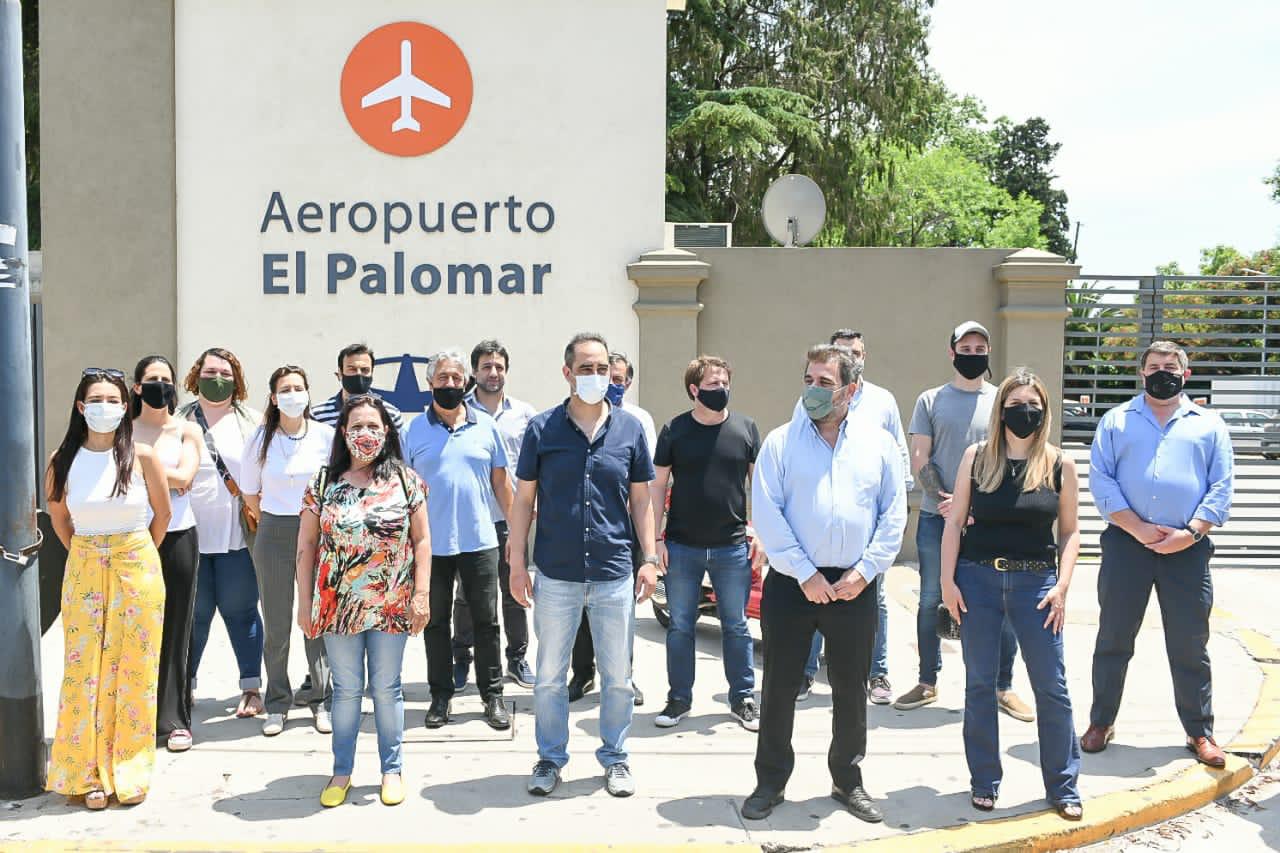
Tras un mes del retorno de los vuelos de cabotaje en la República Argentina y tras varios meses de cuarentena estricta en algunas regiones del país, diputados nacionales y provinciales de Juntos por el Cambio, así como también otros dirigentes de esta misma fuerza, se reunieron en el Aeropuerto de El Palomar y cuestionaron la decisión del Gobierno de mantener inhabilitada esta terminal. Referentes del espacio opositor liderados por el presidente del bloque PRO en la Cámara baja, Cristian Ritondo, se concentraron para reclamar la reapertura de las operaciones en ese lugar, que es utilizado especialmente por las compañías low cost. “Con el cierre definitivo de El Palomar quedarían miles de trabajadores desocupados por los efectos perniciosos en los empleos directos e indirectos que genera la terminal”, sostuvo Cristian Ritondo durante el acto.
En el acto estuvieron también los diputados María Luján Rey, Silvia Gabriela Lospennato, Dina Rezinovsk y Miguel Bazze, entre otros. El ex-Intendente de Morón, Ramiro Tagliaferro, opinó que, al no permitir la reapertura de este aeropuerto, las autoridades nacionales les dan la espalda a los vecinos del municipio que administró durante cuatro años. El ex jefe comunal expresó que esta medida “se trata de un gran error que profundiza la crisis económica del oeste de la Provincia y le quita trabajo, conectividad y desarrollo al territorio bonaerense. Además de los perjuicios económicos que provoca la clausura de la terminal, se desconoce el reclamo de la inmensa mayoría de los vecinos que está a favor del funcionamiento del aeropuerto”.
“Es increíble este ataque a una fuente de trabajo y de conectividad tan grande. El aeropuerto de El Palomar en pocos años se convirtió en una referencia de conectividad y federalismo, ya viajaron más de 2.800.000 pasajeros, de los cuales el 20% viajó en avión por primera vez en su vida. En lugar de trabajar para generar oportunidades de crecimiento y desarrollo el Gobierno las cierra. Parece estar más preocupado por destruir todo lo que sumamos en 4 años de gestión que en solucionar los enormes problemas generados por su falta de respuestas para manejar la crisis”, agregó el legislador provincial del PRO Alex Campbell.
Del acto también participaron, entre otros, diputados nacionales como María Luján Rey, Silvia Gabriela Lospennato, Dina Rezinovsk y Miguel Bazze; y los legisladores bonaerenses María Eugenia Brizzi y Daniela Reich, todos integrantes de Juntos por el Cambio.
Desde mediados de Octubre 2020, los vuelos de cabotaje ya funcionan bajo la modalidad de vuelos regulares, aunque en esta primera etapa es para trabajadores esenciales y personas que tengan que hacer un tratamiento de salud, junto a sus acompañantes. También para pasajeros que vienen del exterior y deban llegar a las provincias donde residen. Pero en ningún caso se autorizan viajes por motivos turísticos.
Leaders demand for El Palomar
Together for Change demand reopening of El Palomar Airport
After the 13N demands for the reopening of El Palomar Airport, the political leaders of Juntos por el Cambio (JXC) demanded the reopening of the low cost air station in Argentina. The political party that leads the gestation of the first low-cost airport in the country and South America has demanded that the authorities present the reestablishment of commercial air operations: “It represents immeasurable damage to the economy and commerce of the area, [while] condemning to poverty and backwardness to the residents of Morón, Hurlingham and Tres de Febrero”, stated the national and provincial legislators considered that the Government’s decision to keep this terminal inactive is detrimental to the progress and freedom of flying in a federal country .
While an airline has migrated its operations to Ezeiza Airport, the only base enabled for the moment, in the case of Flybondi Líneas Aéreas they announced that they are going to request that the measure taken by the National Civil Aviation Administration (ANAC) and the Regulatory Body of the National Airport System (ORSNA) because they understand that the costs would not allow them to carry out their low cost/low price business models.
Political presence
After a month of the return of the domestic flights in the Argentine Republic and after several months of strict quarantine in some regions of the country, national and provincial deputies of Juntos por el Cambio, as well as other leaders of this same force, met in El Palomar Airport and questioned the Government’s decision to keep this terminal disabled. Referents of the opposition space led by the president of the PRO bloc in the lower house, Cristian Ritondo, gathered to demand the reopening of operations in that place, which is used especially by low cost companies. «With the definitive closure of El Palomar, thousands of workers would be unemployed due to the harmful effects on direct and indirect jobs generated by the terminal», said Cristian Ritondo during the event.
The deputies María Luján Rey, Silvia Gabriela Lospennato, Dina Rezinovsk and Miguel Bazze, among others, were also present at the event. The former Mayor of Morón, Ramiro Tagliaferro, said that, by not allowing the reopening of this airport, the national authorities turn their backs on the residents of the municipality that he administered for four years. The former communal chief expressed that this measure “is a great mistake that deepens the economic crisis in the west of the Province and takes away work, connectivity and development from the Buenos Aires territory. In addition to the economic damages caused by the closure of the terminal, the claim of the vast majority of residents who is in favor of the operation of the airport is unknown».
“This attack on such a large source of work and connectivity is incredible. El Palomar airport in a few years became a benchmark for connectivity and federalism, more than 2,800,000 passengers have already traveled, of which 20% traveled by plane for the first time in their lives. Instead of working to generate growth and development opportunities, the Government closes them. He seems to be more concerned with destroying all that we have added in 4 years in office than in solving the enormous problems generated by his lack of answers to handle the crisis”, added PRO provincial legislator Alex Campbell.
The event was also attended by, among others, national deputies such as María Luján Rey, Silvia Gabriela Lospennato, Dina Rezinovsk and Miguel Bazze; and the Buenos Aires legislators María Eugenia Brizzi and Daniela Reich, all members of Together for Change.
Since mid-October 2020, domestic flights already operate under the modality of regular flights, although in this first stage it is for essential workers and people who have to undergo health treatment, together with their companions. Also for passengers who come from abroad and must reach the provinces where they reside. But in no case are trips authorized for tourist reasons.
Aeropuerto Internacional Ezeiza acreditado como seguro
El Consejo de Aeropuertos Internacional para América Latina y el Caribe, ACI-LAC, entregó al Aeropuerto Internacional Ministro Pistarini de Ezeiza en Buenos Aires, operado por Aeropuertos Argentina 2000 (AA2000), una certificación que lo acredita como un aeropuerto seguro en relación a los estándares internacionales de prevención alcanzados, para prevenir la propagación de la pandemia, centrándose en la salud de los pasajeros y del personal que trabaja en la terminal aérea.
Con esta acreditación de la ACI-LAC, el Aeropuerto Internacional Ministro Pistarini de Ezeiza, se suma en Sudamérica a otros como el Bogotá/El Dorado y Sao Pulo/Guarulhos, como así también la acreditación reciente del Lima/Jorge Chávez de Perú, entre los que han alcanzado esta codiciada certificación de seguridad sanitaria.
ACI-LAC es la región de América Latina y el Caribe de Airports Council International, la única asociación profesional mundial de operadores aeroportuarios. ACI-LAC representa más de 270 aeropuertos en 34 países y territorios. Los aeropuertos miembros manejan el 95% del tráfico aéreo comercial en América Latina y el Caribe, dando la bienvenida a más de 570 millones de pasajeros, 5.4 millones de toneladas de carga y más de 9.0 millones de movimientos de aeronaves cada año.
Ezeiza receives ACI-LAC certification
Ezeiza International Airport accredited as safe
The International Airports Council for Latin America and the Caribbean, ACI-LAC, delivered to the Ministro Pistarini de Ezeiza International Airport in Buenos Aires, operated by Aeropuertos Argentina 2000 (AA2000), a certification that accredits it as a safe airport in relation to international prevention standards achieved, to prevent the spread of the pandemic, focusing on the health of passengers and staff working at the air terminal.
With this accreditation from the ACI-LAC, the Ministro Pistarini International Airport of Ezeiza, joins in South America others such as Bogotá/El Dorado and Sao Pulo/Guarulhos, as well as the recent accreditation of Lima/Jorge Chávez of Peru, among those who have achieved this coveted health safety certification.
ACI-LAC is the Latin American and Caribbean region of Airports Council International, the world’s only professional association of airport operators. ACI-LAC represents more than 270 airports in 34 countries and territories. Member airports handle 95% of commercial air traffic in Latin America and the Caribbean, welcoming more than 570 million passengers, 5.4 million tons of cargo and more than 9.0 million aircraft movements each year.
AW | 2020 11 13 14:37 | AIRLINES / AIRPORTS / GOVERNMENT
Movilización 13N por la continuidad del aeropuerto low cost
Las manifestaciones del día Viernes 13/11 ha reunido a empleaods de las líneas aéreas low cost, cámaras de comercio para impedir que el Aeropuerto Internacional El Palomar/EPA deje de funcionar como proponen desde el Gobierno. El firme reclamo continúa bajo la consigna y argumentos de peso por la conservación de puestos de trabajo como así también por la diversidad de oportunidades que genera un aeropuerto para la región y hasta federal en virtud de los mensajes que reciben desde otras localidades donde los vuelos low cost generan más oportunidades de progreso. Los organizadores de la nueva movilización expresaron: «Llegan notas y llamados de cámaras comerciales de distintos puntos del país. Nos sorprendió el apoyo brindado desde distintos puntos del país, por que se ven afectados por la no apertura del Aeropuerto El Palomar, que impacta directamente en el empleo». Otras voces del sector comercial expresaron: «Desde El Palomar se logró tener conectividad en todo el país, a un bajo costo, incrementando el intercambio comercial, aumentando el Turismo y generando un mayor estacionalidad turística, le dio la posibilidad a miles de personas de viajar por primera vez, muchos pudieron ver a sus familiares de mucho tiempo».
La lista de adhesiones en la movilización del 13N concurrieron la Asociación Comercial e Industrial de Morón, de Comerciantes, Industriales y Profesionales de Hurlingham, Cámara de Turismo, Comercio, Industria y Afines de Villa Pehuenia, Cámaras de Comercio de Tres de Febrero Caseros, Ciudalela, Martín Coronado, Pablo Podestá, Primero de Mayo, Sáenz Peña, Santos Lugares, Villa Bosch, V. Rafo. También la Federación Económica de la Provincia de Buenos Aires (FEBA), Unión de Cámaras Empresariales de Morón (UCEM).
Flyboondi Líneas Aéreas ha manifestado que el Aeropuerto El Palomar tiene implementados los mismos protocolos de prevención contra la pandemia que el resto de los aeropuertos del país, producto de la ejecución realizada meses atrás por el concesionario Aeropuertos Argentina 2000 (AA2000). Además recuerda que es la primera aeroestación low cost de Argentina y única en su modelo en América Latina que genera empleo a más de 1.000 personas de manera directa, de los cuáles el 80% son personas que viven en la zona. El Palomar ya es el cuarto aeropuerto de Argentina con mayor cantidad de pasajeros de cabotaje y el sexto con pasajeros totales. A su vez, fue el aeropuerto de Argentina que mayor crecimiento tuvo entre 2019-2020.
Claim against closure of El Palomar
13N mobilization for the continuity of the low cost airport
The demonstrations on Friday 11/13 have brought together employees of the low cost airlines, chambers of commerce to prevent the El Palomar International Airport/EPA from ceasing to function as proposed by the Government. The firm claim continues under the slogan and weighty arguments for the conservation of jobs as well as for the diversity of opportunities generated by an airport for the region and even federal by virtue of the messages they receive from other locations where low-cost flights cost generate more opportunities for advancement. The organizers of the new mobilization expressed: «Notes and calls come from commercial chambers from different parts of the country. We were surprised by the support provided from different parts of the country, because they are affected by the non-opening of El Palomar Airport, which directly impacts in employment «. Other voices from the commercial sector expressed: «From El Palomar it was possible to have connectivity throughout the country, at a low cost, increasing commercial exchange, increasing tourism and generating greater tourist seasonality, it gave thousands of people the possibility to travel for the first time, many were able to see their longtime relatives».
The list of adhesions in the mobilization of the 13N was attended by the Commercial and Industrial Association of Morón, of Merchants, Industrialists and Professionals of Hurlingham, Chamber of Tourism, Commerce, Industry and Related of Villa Pehuenia, Chambers of Commerce of Tres de Febrero Caseros, Ciudalela, Martín Coronado, Pablo Podestá, May Day, Sáenz Peña, Santos Places, Villa Bosch, V. Rafo. Also the Economic Federation of the Province of Buenos Aires (FEBA), Union of Business Chambers of Morón (UCEM).
Flyboondi Líneas Aéreas has stated that the El Palomar Airport has implemented the same prevention protocols against the pandemic as the rest of the country’s airports, as a result of the execution carried out months ago by the concessionaire, Aeropuertos Argentina 2000 (AA2000). It also remembers that it is the first low cost airstation in Argentina and the only one in its model in Latin America that directly generates employment for more than 1,000 people, of which 80% are people who live in the area. El Palomar is already the fourth airport in Argentina with the largest number of cabotage passengers and the sixth with total passengers. In turn, it was the airport in Argentina with the highest growth between 2019-2020.
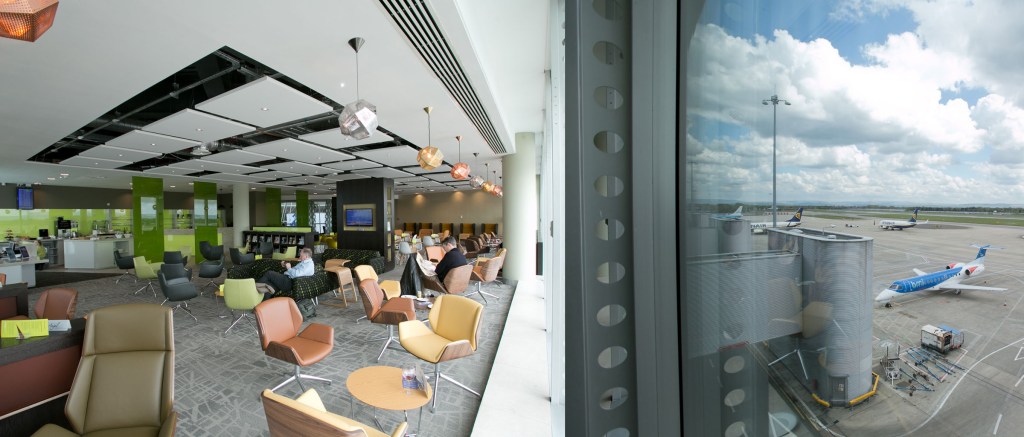
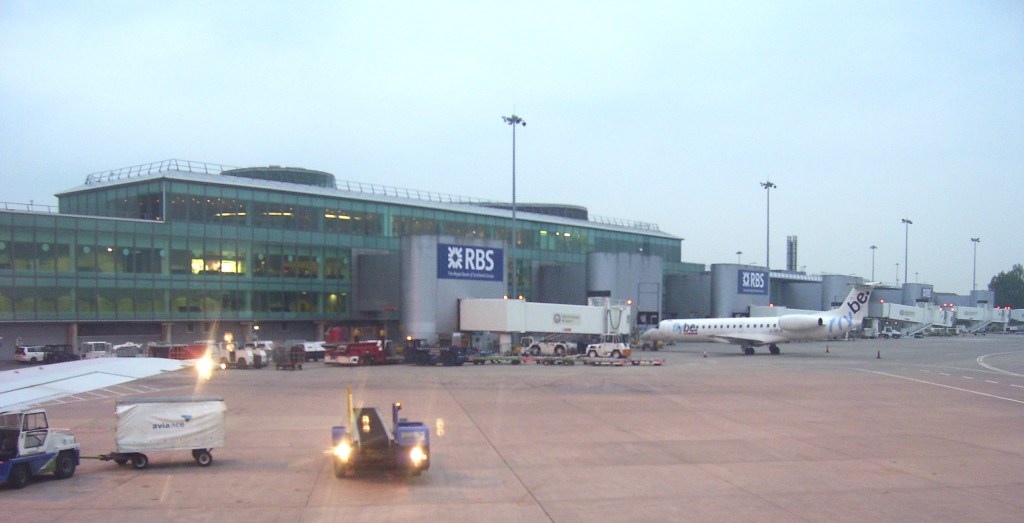
El Aeropuerto de Manchester volverá a cerrar la Terminal 2
El Aeropuerto de Manchester consolidará una vez más las operaciones en una sola terminal, tras el inicio de un segundo encierro en Inglaterra. El aeropuerto cerró las Terminales 2 y 3 en Marzo 2020, tras el inicio de la pandemia de Coronavirus, con todos los vuelos restantes saliendo de la Terminal 1.
La Terminal 3 reabrió a principios de 07/2020 a medida que se suavizaron las restricciones de viaje, siguió a la Terminal 2 más tarde ese mes, pero la falta de demanda de vuelos llevó al aeropuerto a volver a cerrar la Terminal 2 hasta nuevo aviso en Septiembre 2020. El aeropuerto ha confirmado que la Terminal 3 ha cerrado ahora una vez más a partir del 11 de Noviembre de 2020, en preparación para una disminución significativa de los clientes en las próximas semanas.
En un comunicado, el aeropuerto dijo: «El Gobierno del Reino Unido sigue desaconsejando todos los viajes extranjeros, excepto los esenciales, e ignorar esta orientación puede invalidar las pólizas de seguro de los viajeros. Como resultado del bloqueo, esperamos que varias aerolíneas reduzcan o cancelen los servicios durante este período».
Todos los puntos de venta también cerrarán en la Terminal 1, con la excepción de Pret a Manger, Greggs, Boots and Spar landside, y Pret a Manger, Boots y WHSmith airside. El aparcamiento de varias plantas de la Terminal 3 permanecerá abierto, y el MAG dijo que se pondría en contacto con cualquier pasajero con vehículos en las instalaciones que lleguen al aeropuerto después del 11 de noviembre, para informarles del cambio en los procedimientos de llegada. A principios de este mes, el CEO de Manchester Airports Group, Charlie Cornish, dijo que «las aerolíneas y los aeropuertos están efectivamente cerrados y advirtió que partes del sector tendrán que decidir rápidamente qué deben hacer para asegurar su futuro hasta que la situación mejore».
Al comentar sobre las noticias Karen Smart, Directora General del Aeropuerto de Manchester, dijo: «La pandemia de coronavirus plantea un desafío sin precedentes para nuestro aeropuerto y para nuestra industria en general, pero estamos decididos a proporcionar a los pasajeros el mejor servicio posible en las circunstancias, garantizando tanto su seguridad como su comodidad. Cuando se hizo evidente que Inglaterra entraría en un segundo cierre nacional, nos movimos rápidamente para poner en marcha un plan de acción adecuado, que salvaguardaría la operación continua de nuestro aeropuerto durante estos tiempos inciertos. Esto incluye el cierre de la Terminal Tres desde el miércoles 11 de noviembre hasta nuevo aviso. Cambiar nuestra operación de esta manera no es sencillo y me gustaría agradecer a nuestros equipos dedicados por su arduo trabajo en la preparación para este escenario. Mantendremos esta decisión bajo revisión constante y comunicaremos cualquier cambio adicional a nuestros clientes. Animo a todos los pasajeros que viajen por el aeropuerto de Manchester este mes a que se aseguren de que estén familiarizados con todas las orientaciones en vigor, tanto del Gobierno del Reino Unido como de su destino. Finalmente, quiero agradecer a todos nuestros clientes por su comprensión y cooperación en este momento».
Manchester Airport closes Terminal 3
Manchester Airport to close Terminal 2 again
Manchester Airport will once again consolidate operations into a single terminal, following the start of a second lockdown in England. The airport closed Terminals 2 and 3 in March 2020, following the start of the Coronavirus pandemic, with all remaining flights leaving Terminal 1.
Terminal 3 reopened in early 07/2020 as travel restrictions were eased, it followed Terminal 2 later that month, but lack of flight demand led the airport to close Terminal 2 again until further notice in September 2020. The airport has confirmed that Terminal 3 has now closed once again as of November 11, 2020, in preparation for a significant decrease in customers in the coming weeks.
In a statement, the airport said: «The UK Government continues to advise against all foreign travel except essential ones, and ignoring this guidance may invalidate travelers’ insurance policies. As a result of the lockdown, we expect several airlines to reduce or cancel services during this period».
All points of sale will also close in Terminal 1, with the exception of Pret a Manger, Greggs, Boots and Spar landside, and Pret a Manger, Boots and WHSmith airside. Terminal 3’s multi-story car park will remain open, and MAG said it would contact any passengers with vehicles in the facility arriving at the airport after November 11, to inform them of the change in arrival procedures. Earlier this month, Manchester Airports Group CEO Charlie Cornish said that «airlines and airports are effectively closed and warned that parts of the industry will have to quickly decide what to do to secure their future until the situation improves».
Commenting on the news Karen Smart, Managing Director of Manchester Airport, said: «The coronavirus pandemic poses an unprecedented challenge for our airport and for our industry as a whole, but we are determined to provide passengers with the best possible service in circumstances, ensuring both your safety and comfort.When it became clear that England would enter a second national closure, we moved quickly to put in place a suitable plan of action, which would safeguard the continued operation of our airport during these uncertain times. This includes the closure of Terminal Three from Wednesday, November 11 until further notice. Changing our operation this way is not easy and I would like to thank our dedicated teams for their hard work in preparing for this scenario. We will keep this decision under review. constant review and we will communicate any additional changes to our customers tes. I encourage all passengers traveling through Manchester Airport this month to ensure that they are familiar with all current guidance, both from the UK Government and their destination. Finally, I want to thank all of our customers for their understanding and cooperation at this time».





































 airgways.com