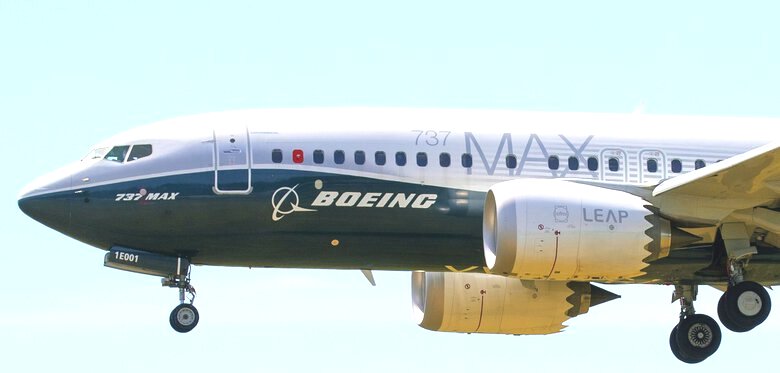
Boeing 737 MAX someterá a vuelo evaluación por la FAA la próxima semana
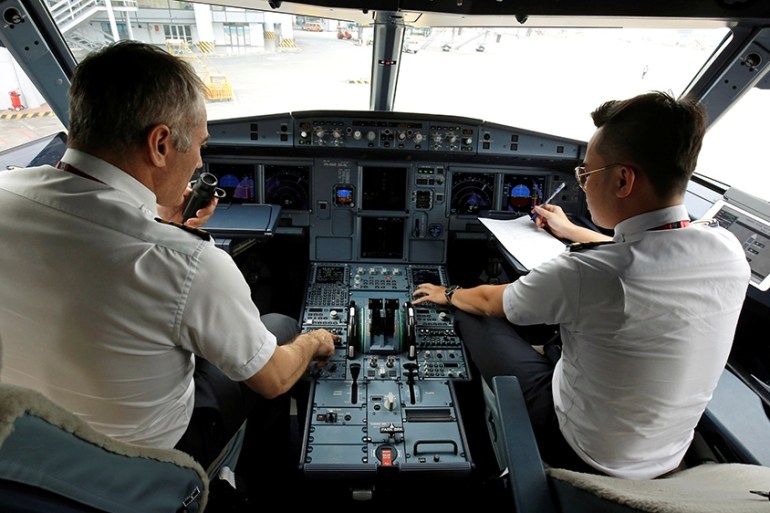
El Jefe de la Administración Federal de Aviación (FAA), Steve Dickson, llevará a cabo un vuelo de evaluación a los controles de mando en un Boeing 737 MAX la próxima semana, un hito importante mientras el fabricante de aviones estadounidense trabaja para obtener la aprobación hacia la recertificación del modelo que ha sido interrumpido para volar en más de un año. El Boeing 737 MAX ha estado en tierra desde Marzo 2019 después de que dos accidentes aéreos mataran a 346 personas. Steve Dickson, que anteriormente era piloto de una aerolínea comercial, estará recibiendo entrenamiento en simulador antes del vuelo de prueba y luego compartirá sus observaciones con el personal técnico de la FAA.
La Agencia FAA ha expresado a los legisladores de Estados Unidos que Steve Dickson y el Administrador Adjunto de la FAA, Dan Elwell, estarán en Seattle la próxima semana para tomar la capacitación recomendada. La tripulación del próximo vuelo junto a Steve Dickson cumplirá la promesa de volar la aeronave antes de que la FAA apruebe su regreso al servicio. El Viernes 25/09, el principal regulador de seguridad de la aviación de Europa dijo que el Boeing 737 MAX podría recibir la aprobación regulatoria para reanudar los vuelos en Noviembre y entrar en servicio hacia finales de año. “Por primera vez en un año y medio, puedo decir que hay un final a la vista para trabajar en el MAX”, dijo Patrick Ky, Director Ejecutivo de la Agencia de Seguridad Aérea de la Unión Europea (EASA).
Patrick Ky dijo que Boeing acordó instalar el Sistema computarizado de tercer sensor en la próxima versión del modelo de avión, el 737-10 MAX de 230 asientos, seguido de modificaciones en el resto de la flota existente más adelante y de sus nuevas unidades de producción.
FAA next test Boeing 737 MAX
Boeing 737 MAX to undergo FAA evaluation next week
The Chief of the Federal Aviation Administration (FAA), Steve Dickson, will conduct an assessment flight to the command controls on a Boeing 737 MAX next week, a major milestone as the US aircraft manufacturer works to gain approval. towards the recertification of the model that has been interrupted to fly in more than a year. The Boeing 737 MAX has been on the ground since March 2019 after two plane crashes killed 346 people. Steve Dickson, a former commercial airline pilot, will be receiving simulator training prior to the test flight and will then share his observations with FAA technical staff.
The FAA Agency has expressed to US lawmakers that Steve Dickson and FAA Deputy Administrator Dan Elwell will be in Seattle next week to take the recommended training. The next flight’s crew alongside Steve Dickson will fulfill the promise to fly the aircraft before the FAA approves its return to service. On Friday 09/25, Europe’s top aviation safety regulator said the Boeing 737 MAX could receive regulatory approval to resume flights in November and enter service by the end of the year. «For the first time in a year and a half, I can say that there is an end in sight to working on the MAX», said Patrick Ky, Executive Director of the European Union Aviation Safety Agency (EASA).
Patrick Ky said Boeing agreed to install the Computerized Third Sensor System in the next version of the model airplane, the 230-seat 737-10 MAX, followed by modifications to the rest of the existing fleet later on and its new production units.
EASA aprobaría recertificación Boeing 737 MAX hacia 11/2020
El regulador europeo de aviación, European Union Aviation Safety Agency (EASA) proyecta las aprobaciones respectivas para la recertificación del Boeing 737 MAX hacia Noviembre 2020. La compañía americana aeroespacial observaría una luz al final del túnel para su modelo más moderno en el continente europeo posibilitando recibir la aprobación regulatoria para reanudar los vuelos en Noviembre 2020 y entrar en servicio antes de fin de año, dijo el Viernes 25/09 el principal regulador de seguridad de la aviación de Europa. “Por primera vez en un año y medio puedo decir que hay un final a la vista para trabajar en el MAX”, dijo Patrick Ky, Director Ejecutivo de la Agencia de Seguridad Aérea de la Unión Europea (EASA).
La EASA, con sede en Colonia, que regula la seguridad aérea en 32 países principalmente de la Unión Europea, se ha enfrentado a la FAA y a Boeing sobre el alcance de una revisión internacional de los sistemas 737 MAX luego de dos accidentes fatales en 2018 y 2019. La EASA espera levantar su prohibición técnica no mucho después de la Administración Federal de Aviación (FAA) de Estados Unidos, probablemente en Noviembre 2020, pero las autorizaciones operativas nacionales necesarias para que las aerolíneas individuales reanuden sus vuelos en Europa podrían demorar más. Se espera que China tarde más en dar su propia aprobación, dijo, sin dar más detalles.
Resolviendo diferencias
Casi todas las diferencias se han resuelto entre la compañía aeroespacial y la EASA, aunque falta finiquitar detalles, ha expresado Patrick Ky. La EASA ha solicitado a los pilotos puedan realizar acciones correctivas realizando un corte manual de la energía a un Sistema de Alarma vibrador, que ha sido puesto bajo estudio, sospechoso de distraer a la tripulación de vuelo JT-610 de Lion Air y ET-302 de Ethiopian Airlines. El enfoque principal de la revisión ha rodeado la evidencia de caja negra de que los datos incorrectos de un solo sensor de ángulo de vuelo defectuoso activaron un sistema de software de cabina que apuntó repetidamente el morro del avión hacia abajo y abrumó a la tripulación en ambos vuelos.
The Boeing Company ha comunicado que las entradas de ambos sensores de Ángulo de Ataque (AOA) en el 737 MAX se utilizarán en la aeronave modificada, en lugar de solo uno empleado en el pasado, pero EASA ha pedido un tercer sensor sintético para proporcionar datos computados de forma independiente. Patrick Ky dijo que Boeing acordó instalar el sistema computarizado de tercer sensor en la próxima versión del avión, el 737-10 MAX de 230 asientos, seguido de actualizaciones en el resto de la flota más adelante. «Estamos comprometidos a abordar todas las preguntas de los reguladores y cumplir con todos los requisitos regulatorios y de certificación», dijo un portavoz de la compañía Boeing.
En cuanto al próximo desarrollo de Boeing, la EASA ha advertido que examinaría el desarrollo del 777X de 400 asientos mucho más de cerca de lo que lo habría hecho si no hubiera ocurrido la conexión a tierra del 737 MAX y prestaría especial atención a los sistemas de Control de Vuelo.
EASA would approve 737 MAX recertification
EASA would approve Boeing 737 MAX recertification by 11/2020
The European aviation regulator, European Union Aviation Safety Agency (EASA) projects the respective approvals for the recertification of the Boeing 737 MAX around November 2020. The American aerospace company would observe a light at the end of the tunnel for its most modern model on the European continent, enabling receive regulatory approval to resume flights in November 2020 and enter service before the end of the year, Europe’s main aviation security regulator said on Friday 09/25. «For the first time in a year and a half I can say that there is an end in sight to working on the MAX», said Patrick Ky, Executive Director of the European Union Aviation Safety Agency (EASA).
The Cologne-based EASA, which regulates aviation safety in 32 countries mainly in the European Union, has clashed with the FAA and Boeing over the scope of an international review of 737 MAX systems following two fatal accidents in 2018 and 2019. EASA expects to lift its technical ban not long after the US Federal Aviation Administration (FAA), probably in November 2020, but the national operational clearances required for individual airlines to resume their flights in Europe could take longer. China is expected to take longer to give its own approval, he said, without elaborating.
Resolving differences
Almost all the differences have been resolved between the aerospace company and EASA, although details remain to be finalized, Patrick Ky said. EASA has asked the pilots to take corrective actions by manually cutting off the power to a vibrating Alarm System, which has been put under study, suspected of distracting the flight crew JT-610 of Lion Air and ET-302 of Ethiopian Airlines. The main focus of the review has surrounded black box evidence that incorrect data from a single faulty flight angle sensor triggered a cockpit software system that repeatedly pointed the nose of the aircraft downward and overwhelmed the crew on both. flights.
The Boeing Company has announced that the inputs from both Angle of Attack (AOA) sensors on the 737 MAX will be used on the modified aircraft, rather than just one used in the past, but EASA has requested a third synthetic sensor to provide data. computed independently. Patrick Ky said Boeing agreed to install the computerized third-sensor system on the next version of the plane, the 230-seat 737-10 MAX, followed by upgrades to the rest of the fleet later on. «We are committed to addressing all questions from regulators and meeting all regulatory and certification requirements», a Boeing company spokesman said.
As for Boeing’s next development, EASA has warned that it would examine the development of the 400-seat 777X much more closely than it would have if the 737 MAX had not been grounded and would pay particular attention to the systems of Flight Control.
OACI aconseja a Pakistán suspender emisión nuevas licencias piloto
La Organización de Aviación Civil Internacional (OACI) ha aconsejado a la República de Pakistán que emprenda «acciones correctivas inmediatas» y suspenda la emisión de nuevas licencias de piloto a raíz de un escándalo por licencias falsificadas. Las recomendaciones de la OACI, una agencia especializada de las Naciones Unidas que trabaja para garantizar la seguridad en el transporte aéreo internacional, se producen días después de que Pakistán abriera una investigación criminal contra 50 pilotos y cinco funcionarios de aviación civil que supuestamente los ayudaron a falsificar credenciales para obtener licencias de piloto. «Pakistán debe mejorar y fortalecer su sistema de licencias para garantizar que tiene en cuenta todos los procesos y procedimientos necesarios y evitar incoherencias y malas prácticas antes de que se emitan nuevas licencias y se restablezcan los privilegios de las licencias suspendidas», dijo la OACI en una carta que no se informó anteriormente a la Autoridad de Aviación Civil de Pakistán (PCAA) la semana pasada.
Un funcionario del Ministerio de Aviación de Pakistán dijo que el país no ha emitido nuevas licencias desde Julio 2020, a raíz del escándalo. Las recomendaciones de la agencia con sede en Montreal se adelantan a una auditoría de la OACI para evaluar los sistemas de gestión de la seguridad operacional de la aviación del país. La auditoría de la OACI, programada originalmente para Noviembre de 2020, se ha trasladado a Junio 2021, lo que le da a la PCAA más tiempo para trabajar en las reformas, dijo el funcionario. La OACI está ayudando a Pakistán a reconocer las preocupaciones, y si no toman medidas rápidas al respecto, notificaremos activamente a otros países sobre ellas.
El escándalo de los pilotos ha contaminado la industria de la aviación de Pakistán y ha perjudicado a la aerolínea de bandera Pakistan International Airlines (PIA) a la que se le ha prohibido volar a Europa y Estados Unidos. Además de revocar las licencias de 50 pilotos, Pakistán también ha suspendido a otros 32 pilotos durante un año.
ICAO Pakistan suspend licenses
ICAO advises Pakistan to suspend issuance of new pilot licenses
The International Civil Aviation Organization (ICAO) has advised the Republic of Pakistan to take «immediate corrective action» and suspend the issuance of new pilot licenses in the wake of a counterfeit license scandal. The recommendations by ICAO, a specialized United Nations agency that works to ensure safety in international air transport, come days after Pakistan opened a criminal investigation against 50 pilots and five civil aviation officials who allegedly helped them falsify credentials to obtain pilot licenses. «Pakistan must improve and strengthen its licensing system to ensure that it takes into account all necessary processes and procedures and to avoid inconsistencies and malpractices before new licenses are issued and the privileges of suspended licenses are restored», ICAO said in a letter that was not previously reported to the Pakistan Civil Aviation Authority (PCAA) last week.
An official with Pakistan’s Aviation Ministry said the country has not issued new licenses since July 2020, in the wake of the scandal. The Montreal-based agency’s recommendations come forward to an ICAO audit to assess the country’s aviation safety management systems. The ICAO audit, originally scheduled for November 2020, has been moved to June 2021, giving the PCAA more time to work on reforms, the official said. ICAO is helping Pakistan recognize the concerns, and if they do not take swift action on them, we will actively notify other countries about them.
The pilot scandal has polluted Pakistan’s aviation industry and hurt the flag carrier Pakistan International Airlines (PIA), which has been banned from flying to Europe and the United States. In addition to revoking the licenses of 50 pilots, Pakistan has also suspended another 32 pilots for a year.
AW | 2020 09 24 14:41 | AIR INVESTIGATION / GOVERNMENT /AVIATION SAFETY
Defensa Consumidor EEUU informa fallas Congreso sobre 737 MAX
Un informe del Congreso de Estados Unidos que documenta las fallas administrativas que llevaron a dos choques de Boeing 737 MAXs tiene fallas debido a una omisión importante, dice la Defensa del Consumidor, Federal Trade Commision (FTC) a cargo de Ralph Nader. «El informe no abordó la cuestión inminente de volver a poner en servicio el 737 MAX. Tal retorno nunca debería ocurrir sin abordar y corregir las inestabilidades aerodinámicas básicas que lo volvieron inactivo», dijo Ralph Nader en un comunicado el 18 de Septiembre de 2020 en su sitio web. El titular del importante organismo en Estados Unidos, coautor de «Collision Course: The Truth About Airline Safety», había perdido a su sobrina nieta, Samya Stumo, en el accidente del vuelo ET-302 de Ethiopian Airlines 737-8 MAX en Marzo de 2019.
Los Legisladores de la Cámara de Representantes prometieron introducir una legislación para que los fabricantes de aviones y los reguladores que supervisan la seguridad de los aviones sean más responsables, pero Ralph Nader dice que ahora que el informe está publicado, el público debe asegurarse de que las promesas políticas se traduzcan en nuevas leyes. «El Congreso se encuentra en una fase histórica en cámara lenta de su historia. Depende de los viajeros aéreos, los sindicatos de aerolíneas, las familias de las víctimas de Boeing, los grupos de consumidores y los medios de comunicación mantener el centro de atención y la presión sobre el Congreso y la FAA», dijo Ralph Nader en su sitio web.
Injerencia política
El representante de los Derechos del Consumidor de Estados Unidos ha señalado que los legisladores Republicanos usarán su influencia para bloquear las reformas. «Boeing es dueño del Senado dominado por los Republicanos bajo Mitch McConnell, así como del Departamento de Transporte (DOT) dirigido por la Secretaria Elaine Chao, la esposa de McConnell», dijo Ralph Nader. Mientras que una portavoz de Boeing no ha expresado respuestas sobre los comentarios de Ralph Nader sobre el Boeing 737 MAX o las relaciones políticas de la compañía con los republicanos.
El Comité de la Cámara informó que Boeing sabía que el Sistema de Control de Vuelo MCAS de su línea 737 MAX tenía fallas y podría causar que los pilotos sufrieran una pérdida catastrófica de control de la aeronave ya en 2012 y nuevamente entre 2015 y 2018, pero nunca lo había informado a la Agencia de la FAA.
Boeing emitió su propia declaración después del informe del Congreso la semana pasada, diciendo que la compañía cooperó total y extensamente con la investigación del Comité de la Cámara. Esa cooperación incluyó el testimonio privado de Keith Leverkuhn, ex-Vicepresidente de Boeing y Gerente General del Programa 737 en Renton, quien dijo a los investigadores: «Desafío la sugerencia de que el desarrollo del avión 737 MAX fue un fracaso».
FTC Report on Congress 737 MAX
US Consumer Defense reports Congress faults on 737 MAX
A US Congress report documenting the administrative failures that led to two Boeing 737 MAX crashes is at fault due to a major omission, says Consumer Advocacy, Federal Trade Commision (FTC), led by Ralph Nader. «The report did not address the imminent issue of bringing the 737 MAX back into service. Such a return should never occur without addressing and correcting the basic aerodynamic instabilities that rendered it inactive«, Ralph Nader said in a statement on September 18, 2020 at your website. The head of the important agency in the United States, co-author of «Collision Course: The Truth About Airline Safety», had lost his great-niece, Samya Stumo, in the accident of Ethiopian Airlines flight ET-302 737-8 MAX in March of 2019.
House of Representatives Lawmakers promised to introduce legislation to hold aircraft manufacturers and regulators who oversee aircraft safety more accountable, but Ralph Nader says that now that the report is published, the public must ensure that the political promises are translated into new laws. «Congress is in a slow-motion historic phase of its history. It is up to air travelers, airline unions, families of Boeing victims, consumer groups, and the media to keep the spotlight and pressure on Congress and the FAA», Ralph Nader said on his website.
Political interference
The representative of the Rights of the Consumer of the United States has indicated that the Republican legislators will use their influence to block the reforms. «Boeing owns the Republican-dominated Senate under Mitch McConnell, as well as the Department of Transportation (DOT) led by Secretary Elaine Chao, McConnell’s wife», said Ralph Nader. While a Boeing spokeswoman has not responded to Ralph Nader’s comments about the Boeing 737 MAX or the company’s political relations with Republicans.
The House Committee reported that Boeing knew that the MCAS Flight Control System on its 737 MAX line was faulty and could cause pilots to suffer a catastrophic loss of control of the aircraft as early as 2012 and again between 2015 and 2018, but He had never reported it to the FAA Agency.
Boeing issued its own statement after the congressional report last week, saying the company fully and extensively cooperated with the House Committee’s investigation. That cooperation included private testimony from Keith Leverkuhn, former Boeing Vice President and General Manager of the 737 Program at Renton, who told investigators: «I defy the suggestion that the 737 MAX aircraft development was a failure».
Pilotos de APA solicitan a FAA modificaciones Boeing 737 MAX
La asociación de Pilotos de líneas Aéreas de Estados Unidos, Allied Pilots Association (APA), ha presentado comentarios respecto al proceso de recertificación del modelo Boeing 737 MAX. Mientras las aerolíneas se preparan para devolver el Boeing 737 MAX en operaciones, los pilotos de American Airlines han objetado que las regulaciones federales con respecto a la aeronave deben tener mejor en cuenta la probable respuesta humana a las emergencias.
El Lunes 21/09 por la noche, la Asociación de Pilotos Aliados, que representa a 15.000 pilotos estadounidenses, presentó comentarios a la Administración Federal de Aviación (FAA), que ha solicitado comentarios públicos sobre los cambios de seguridad de la aeronave. APA dijo que las posibles respuestas a dos eventos críticos deben guardarse en la memoria, no publicarse en la Tarjeta de Referencia Rápida (QRC), una gran tarjeta de plástico que se encuentra en la cabina, que la FAA permite actualmente. «Los procedimientos memorizados son los más apropiados para las emergencias relacionadas con el estabilizador fuera de control, cuando el estabilizador no se estabiliza en los ajustes seleccionados por los pilotos, y también para las condiciones de velocidad aérea poco confiable”, dijo el Sindicato APA.
«Hacer referencia a la tarjeta requiere tiempo. Para los incidentes descontrolados de estabilizador y velocidad aérea no confiable, los elementos que salvarán su vida deben memorizarse, no colocarse en una tarjeta», dijo el portavoz de la APA, Dennis Tajer.
«Tanto el Estabilizador de Fugitivo como la velocidad del aire no confiable son condiciones anormales que pueden conducir rápidamente a la pérdida del control de la aeronave si no se reconocen inmediatamente con las acciones correctivas apropiadas tomadas por las tripulaciones de vuelo. Depender únicamente del QRC para abordar estas fallas podría resultar en un retraso inaceptable en la respuesta de la tripulación a estos eventos», escribió APA en su presentación. Además de buscar un mejor entrenamiento de la memoria, la APA recomendó un elemento de referencia de la lista de verificación para deshabilitar las advertencias erróneas de sobrevelocidad de activación del vibrador. Las ruidosas advertencias de exceso de velocidad pueden distraer. «Boeing no tiene un escalón en el que se pueda tirar de la perilla del disyuntor para detener una alerta errónea», dijo Dennis Tajer. En su presentación, APA dijo: «La activación errónea continua del sistema de advertencia de pérdida (vibrador) resultó en una distracción considerable e innecesaria, comprometiendo significativamente el proceso de manejo de la condición anormal y recuperación de la aeronave».
En otras recomendaciones, APA dijo que la lista de verificación de estabilizadores fuera de control debería condensarse. “Los pilotos del sindicato que participaron recientemente en una evaluación del 737 MAX indican que habrían manejado de manera más segura una condición de estabilizador fuera de control a baja altitud si la lista de verificación les hubiera indicado que apagaran los interruptores de corte del ajuste del estabilizador más rápidamente”, dijo el Sindicato.
Además, el sindicato dijo que la FAA debe incluir un elemento de la lista de verificación que indique que el uso de la moldura eléctrica principal puede no ser posible en todos los eventos de estabilizador fuera de control, porque no funciona en todas las situaciones, y la lista de verificación de emergencia debe ampliarse para incluir un método de Relajar la presión de la columna de control para ayudar al ajuste manual.
El Lunes 21/09, American Airlines dijo que comenzaría el entrenamiento de pilotos para el 737 MAX en Noviembre 2020. Pero Dennis Tajer dijo que es demasiado pronto. “Es prematuro programar la capacitación para algo que aún está en etapas de desarrollo”, dijo.
Los aviones Boeing 737 MAX han sido puestos en tierra en todo el mundo en Marzo de 2019 después de que dos accidentes aéreos involucraran a 346 personas a bordo. Los accidentes del vuelo JT-610 de Lion Air el 29 de Octubre de 2018 y del vuelo ET-302 de Ethiopian Airlines el 10 de Marzo de 2019 estuvieron relacionados con la instalación del Sistema de Control de Vuelos MCAS, un sistema de aumento de características de maniobra en la aeronave. Pero las recomendaciones de la APA no abordan específicamente el MCAS. Al igual que otras agencias de seguridad internacionales, la FAA se está moviendo responsablemente para permitir que la aeronave vuelva a volar.
Pilots request 737 MAX changes
APA pilots request to FAA modifications Boeing 737 MAX
The United States Airline Pilots Association, Allied Pilots Association (APA), has submitted comments regarding the recertification process for the Boeing 737 MAX. As airlines prepare to return the Boeing 737 MAX into operation, American Airlines pilots have objected that federal regulations regarding the aircraft should better take into account the likely human response to emergencies.
On Monday evening 09/21, the Allied Pilots Association, representing 15,000 American pilots, submitted comments to the Federal Aviation Administration (FAA), which has requested public comment on the aircraft’s safety changes. APA said possible responses to two critical events should be kept in memory, not posted on the Quick Reference Card (QRC), a large plastic card found in the cockpit, which the FAA currently allows. «The memorized procedures are most appropriate for emergencies related to the out of control stabilizer, when the stabilizer does not stabilize in the settings selected by the pilots, and also for unreliable airspeed conditions,» said the APA Union.
«Referencing the card takes time. For uncontrolled stabilizer and unreliable airspeed incidents, the items that will save your life should be memorized, not placed on a card», said APA spokesman Dennis Tajer.
«Both Fugitive Stabilizer and unreliable airspeed are abnormal conditions that can quickly lead to loss of control of the aircraft if not immediately recognized with the appropriate corrective actions taken by flight crews. Relying solely on the QRC to addressing these failures could result in unacceptable delay in crew response to these events«, APA wrote in its presentation. In addition to seeking better memory training, the APA recommended a checklist checklist to disable erroneous vibrator overspeed warnings. Loud speeding warnings can be distracting. «Boeing doesn’t have a step where you can pull the circuit breaker knob to stop a misleading alert», said Dennis Tajer. In its presentation, APA said: «The continued erroneous activation of the stall warning system (vibrator) resulted in considerable and unnecessary distraction, significantly compromising the process of handling the abnormal condition and recovery of the aircraft».
In other recommendations, APA said the runaway stabilizer checklist should be condensed. “Union pilots who recently participated in an evaluation of the 737 MAX indicate that they would have more safely handled an out-of-control stabilizer condition at low altitude if the checklist had instructed them to turn off the stabilizer trim cut-off switches. more quickly”, the Union said.
In addition, the union said the FAA must include a checklist item stating that the use of the main electrical trim may not be possible in all out of control stabilizer events, because it does not work in all situations, and the emergency checklist should be expanded to include a method of Relaxing Control Column Pressure to aid manual adjustment.
On Monday 09/21, American Airlines said it would begin pilot training for the 737 MAX in November 2020. But Dennis Tajer said it is too early. «It is premature to schedule training for something that is still in the development stages,» he said.
Boeing 737 MAX aircraft have been grounded around the world in March 2019 after two plane crashes involved 346 people on board. The accidents of Lion Air flight JT-610 on October 29, 2018 and Ethiopian Airlines flight ET-302 on March 10, 2019 were related to the installation of the MCAS Flight Control System, a feature enhancement system. maneuvering in the aircraft. But the APA recommendations do not specifically address MCAS. Like other international security agencies, the FAA is moving responsibly to allow the aircraft to fly again.
Boeing otorga licencia a Healthe, Inc. para contrarrestar COVID-19
The Boeing Company ha firmado este 22/09 una licencia de patente y tecnología con Healthe® Inc., con sede en Florida, según la cual Healthe fabricará una varilla ultravioleta (UV) diseñada para desinfectar el interior de los aviones. Boeing diseñó y desarrolló la varita ultravioleta como parte de la Iniciativa de Viaje Confidente (CTI) de la compañía para apoyar a los clientes y mejorar la seguridad y el bienestar de los pasajeros y tripulaciones durante la pandemia de COVID-19. La varita portátil desarrollada por Boeing inactivará virus y bacterias en los aviones
«La varilla ultravioleta está diseñada para ser más efectiva que dispositivos similares. Desinfecta rápidamente las superficies de un avión y fortalece aún más otras capas de protección para los pasajeros y la tripulación. Boeing pasó seis meses transformando una idea para la varita en un modelo funcional, y Healthe ahora tomará ese prototipo y lo pondrá a disposición del mundo en general», dijo Mike Delaney, quien dirige los esfuerzos de CTI de la compañía aeroespacial americana.
Healthe Inc. producirá y distribuirá la varita comercial, ayudando a las aerolíneas y potencialmente a otros a combatir la pandemia del coronavirus. La tecnología podría estar disponible para las aerolíneas a fines del otoño. El dispositivo se suma a las medidas de desinfección y protección ya implementadas, que incluyen el uso de filtros de aire de partículas de alta eficiencia que atrapan más del 99,9% de las partículas y evitan que vuelvan a circular hacia la cabina. «Estamos orgullosos de ayudar a Boeing mientras trabajan con sus aerolíneas asociadas para mejorar los esfuerzos de desinfección de aviones en la cabina. Esto también podría beneficiar a escuelas, hospitales, oficinas, dondequiera que vayan los patógenos. A medida que aumentamos el despliegue de nuestras soluciones de luz UVC y Far-UVC 222 de vanguardia en muchos sectores, esta nueva varita de grado comercial será otra herramienta poderosa en el arsenal de desinfección para proteger a los pasajeros contra la propagación de virus dañinos», dijo Abe Morris, Presidente Ejecutivo de Healthe Inc.
La varilla UV utiliza luz UVC de 222 nanómetros. Las investigaciones indican que la UVC de 222 nanómetros inactiva los patógenos de manera efectiva. Usando el aparato autónomo que se asemeja a una maleta de mano, los equipos pueden pasar luz ultravioleta sobre superficies de alto contacto, desinfectando todos los lugares donde llega la luz. La varilla UV es particularmente efectiva en espacios compactos y desinfecta una cabina de vuelo en menos de 15 minutos.
Como parte de CTI, Boeing solicitó comentarios de múltiples fuentes de la industria, lo que ayudó a validar rápidamente esta tecnología. Etihad Airways fue el primero en evaluar el dispositivo, y el 21 de Agosto 2020 se hizo una demostración de la varilla ultravioleta en el avión Etihad 787-10 ecoDemonstrator. La misión de Confident Travel Initiative de Boeing es ser un líder en el esfuerzo global para brindar a los pasajeros y la tripulación una experiencia de viaje segura, saludable y eficiente.
Boeing fights COVID on aviation
Boeing licenses to Healthe, Inc. to counter COVID-19
The Boeing Company has signed this 09/22 a patent and technology license with Healthe® Inc., based in Florida, according to which Healthe will manufacture an ultraviolet (UV) wand designed to disinfect the interior of aircraft. Boeing designed and developed the UV wand as part of the company’s Confident Travel Initiative (CTI) to support customers and enhance the safety and well-being of passengers and crews during the COVID-19 pandemic. Boeing-developed wearable wand will inactivate viruses and bacteria on airplanes.
«The UV wand is designed to be more effective than similar devices. It quickly disinfects aircraft surfaces and further strengthens other layers of protection for passengers and crew. Boeing spent six months transforming an idea for the wand into a working model, and Healthe will now take that prototype and make it available to the world at large», said Mike Delaney, who leads the American aerospace company’s CTI efforts.
Healthe Inc. will produce and distribute the trade wand, helping airlines and potentially others combat the coronavirus pandemic. The technology could be available to airlines in late fall. The device adds to the disinfection and protection measures already implemented, which include the use of high-efficiency particulate air filters that trap more than 99.9% of the particles and prevent them from circulating back into the cabin. «We are proud to assist Boeing as they work with their partner airlines to improve aircraft disinfection efforts in the cabin. This could also benefit schools, hospitals, offices, wherever pathogens go. As we increase the deployment of our Cutting edge UVC and Far-UVC 222 light solutions in many industries, this new commercial-grade wand will be another powerful tool in the disinfection arsenal to protect passengers against the spread of harmful viruses», said Abe Morris, CEO of Healthe Inc.
The UV rod uses 222 nanometer UVC light. Research indicates that the 222 nanometer UVC effectively inactivates pathogens. Using the self-contained device that resembles a carry-on, teams can pass ultraviolet light onto high-contact surfaces, disinfecting all places where light reaches. The UV wand is particularly effective in compact spaces and disinfects a flight deck in less than 15 minutes.
As part of CTI, Boeing solicited feedback from multiple industry sources, which helped quickly validate this technology. Etihad Airways was the first to evaluate the device, and on August 21, 2020, a demonstration of the ultraviolet rod was demonstrated on the Etihad 787-10 ecoDemonstrator aircraft. Boeing’s Confident Travel Initiative mission is to be a leader in the global effort to provide passengers and crew with a safe, healthy and efficient travel experience.
AW | 2020 09 22 19:17 | AVIATION SAFETY / INDUSTRY
Aproximación regreso del Boeing 737 MAX a los cielos
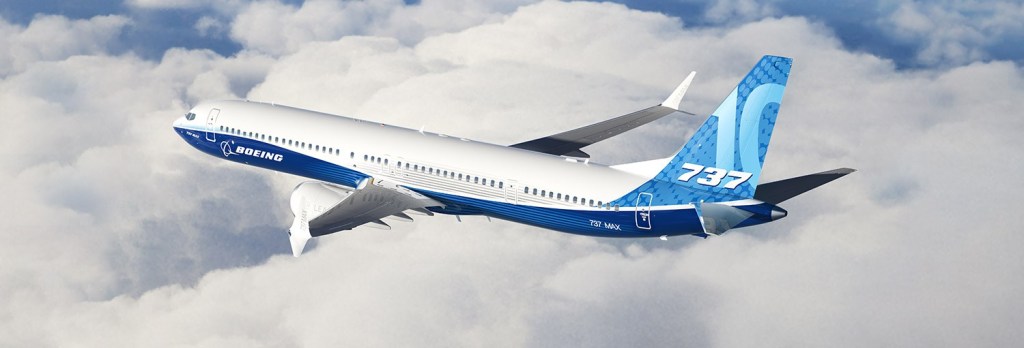
El Boeing 737 MAX se acerca más a su regreso a los cielos. La aeronave de cuarta generación de la línea 737 ha alcanzado otro hito en el avance al pasar la fecha límite reglamentaria impuesta por los organismos reguladores para recusaciones por parte de agencias, representaciones de instituciones para contraargumentos acerca de la seguridad homologada por la Federal Aviation Administration (FAA).
La FAA un aviso de la regla propuesta el 06/08 para su Directiva de Aeronavegabilidad (AD) para el Boeing 737 MAX, la lista de cambios que la compañía Boeing debe hacer para que el avión pueda volver a entrar en servicio comercial. La audiencia mundial tenía hasta este Lunes 21/09 para responder a las nuevas certificaciones.
El 737 MAX ha estado conectado a tierra en todo el mundo desde mediados de Marzo de 2019 luego de dos accidentes aéreos con una diferencia de cinco meses. Boeing ha estado trabajando con los reguladores de la aviación global durante meses solucionando puntos que incluyen problemas con el software de Control de Vuelo del avión conocido como MCAS y los sensores de Ángulo de Ataque (AOA) de mide la inclinación de la aeronave.
Desde la publicación el aviso de la AD por parte de la FAA, se recogieron 212 comentarios, muchos de ellos de personas con antecedentes aeroespaciales. Un comentario notable fue publicado por NATCA, el sindicato que representa a los controladores de tránsito aéreo. El sindicato dio cinco recomendaciones, dos tienen que ver con las alertas. El grupo quiere que se reconfiguren las alertas sobre el Ángulo de Ataque (AOA) y la velocidad aérea, así como cambios en las notificaciones del Acelerador, refiriendo a la posición del Timón de Profundidad que ayuda a controlar el ascenso y descenso del avión. La NATCA quiere que se ajusten algunos procedimientos.
Ninguno de los problemas planteados es nuevo, siendo la novedad los ajustes a las correcciones propuestas de un grupo notable, los controladores de tráfico aéreo. No está claro exactamente cómo la FAA integra los comentarios en una directiva final. Tampoco se sabe con certeza cuánto trabajo implicaría para Boeing cambiar los procedimientos o reconfigurar las alertas. Un portavoz de la FAA dijo que la agencia revisará y responderá a los comentarios como parte del proceso regulatorio federal. El sindicato y Boeing no estuvieron disponibles de inmediato para comentar.
La dirección de Boeing cree que puede volver a poner en servicio el 737 MAX para finales de 2020. American Airlines ha comunicado que podría comenzar a entrenar a sus pilotos en simuladores de vuelo MAX en Noviembre 2020.
Los avances alcanzados es otra pequeña señal de progreso para el 737 MAX, pero nada parece escrito en piedra. «No hemos hecho ningún plan definitivo con respecto al MAX. Hemos iniciado el proceso de programación de la formación de pilotos, que se puede ajustar en función de cuándo se recertifique el MAX. Seguimos en contacto con la FAA y Boeing en el proceso de recertificación», dijo la Portavoz estadounidense Shannon Gilson en un comunicado. Los pilotos del 737 MAX recibirán más entrenamiento cuando el avión vuelva a volar.
Boeing 737 MAX approaches return
Approach return of the Boeing 737 MAX to the skies
The Boeing 737 MAX gets closer to its return to the skies. The fourth-generation aircraft of the 737 line has reached another milestone in progress by passing the regulatory deadline imposed by regulatory bodies for challenges by agencies, representations of institutions for counter-arguments about safety approved by the Federal Aviation Administration (FAA).
The FAA issued a notice of the proposed rule on 08/06 for its Airworthiness Directive (AD) for the Boeing 737 MAX, the list of changes that the Boeing company must make in order for the aircraft to re-enter commercial service. The worldwide audience had until this Monday 09/21 to respond to the new certifications.
The 737 MAX has been grounded around the world since mid-March 2019 following two plane crashes five months apart. Boeing has been working with global aviation regulators for months fixing issues that include problems with the aircraft’s Flight Control software known as MCAS and the Angle of Attack (AOA) sensors that measure the aircraft’s pitch.
Since the publication of the AD notice by the FAA, 212 comments have been collected, many of them from people with aerospace backgrounds. A notable comment was posted by NATCA, the union that represents air traffic controllers. The union gave five recommendations, two have to do with the alerts. The group wants the alerts on the Angle of Attack (AOA) and airspeed to be reconfigured, as well as changes in the Throttle notifications, referring to the position of the Depth Rudder that helps control the ascent and descent of the aircraft. NATCA wants some procedures adjusted.
None of the issues raised is new, the novelty being the adjustments to the proposed corrections from a notable group, air traffic controllers. It is not clear exactly how the FAA integrates the comments into a final directive. It’s also not clear how much work it would take for Boeing to change procedures or reconfigure alerts. An FAA spokesperson said the agency will review and respond to comments as part of the federal regulatory process. The union and Boeing were not immediately available for comment.
Boeing management believes that it can return the 737 MAX to service by the end of 2020. American Airlines has announced that it could begin training its pilots in MAX flight simulators in November 2020.
The progress made is another small sign of progress for the 737 MAX, but nothing seems set in stone. «We have not made any definitive plans regarding the MAX. We have started the pilot training scheduling process, which can be adjusted based on when the MAX is recertified. We remain in contact with the FAA and Boeing in the recertification process». US Spokeswoman Shannon Gilson said in a statement. Pilots of the 737 MAX will receive more training when the plane returns to fly.
Nuevos estudios indican COVID-19 puede propagarse vuelos largos
Dos nuevos estudios publicados en una revista científica plantean dudas sobre si la transmisión del Coronavirus en vuelos de aerolíneas comerciales prolongados podría ser más común de lo que se pensaba. Uno observó a dos pasajeros y dos asistentes de vuelo en el mismo vuelo de 15 horas desde Boston a Hong Kong, quienes luego dieron positivo por COVID-19. Se encontró que la secuencia genética del virus en los cuatro era idéntica, lo que según el estudio «sugiere fuertemente que el virus puede transmitirse durante los viajes aéreos». El otro estudio examinó un vuelo de 10 horas desde Londres a Hanoi, Vietnam, en el que se encontró que 16 a bordo tenían el virus, 12 de los cuales estaban sentados en clase ejecutiva dentro de dos asientos o filas de la única persona sintomática. «La proximidad de los asientos estaba fuertemente asociada con un mayor riesgo de infección», concluyó el estudio.
Los estudios, ambos publicados en la revista Emerging Infectious Diseases (CDC), son significativos porque los viajeros han regresado lentamente al aire a medida que se sabe más sobre cómo evitar contraer COVID-19. Ambos involucran vuelos que ocurrieron en Marzo 2020 y no especifican si los pasajeros llevaban máscaras.
Profilaxis
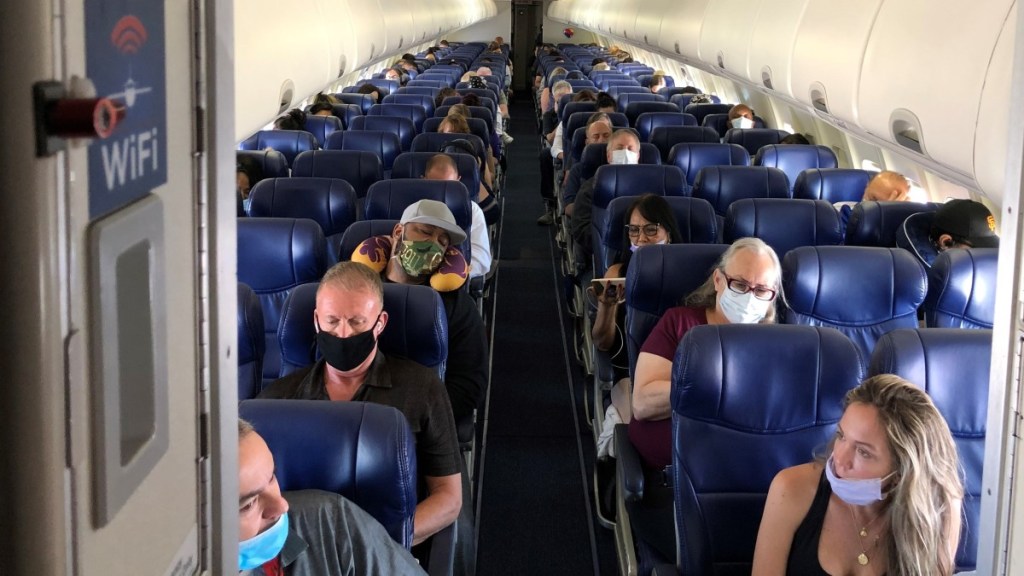
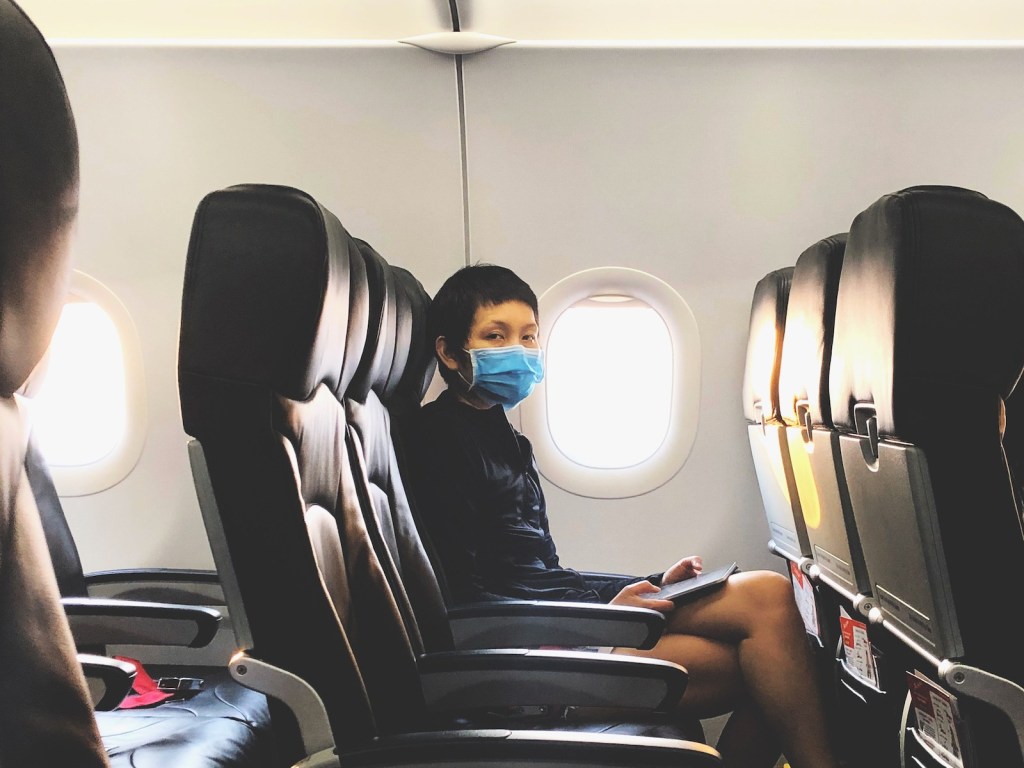
Las aerolíneas ahora exigen que todos los pasajeros y la tripulación a bordo de los vuelos usen máscaras. Además, muchas aerolíneas han estado volando sus aviones a capacidad reducida, bloqueando los asientos del medio para permitir una mayor distancia entre los pasajeros. Los pasajeros deben usar máscaras mientras viajan en un avión para las principales aerolíneas de Estados Unidos y en el aeropuerto. Se sabía menos sobre cómo limitar la transmisión del coronavirus cuando ocurrieron los vuelos estudiados y antes de que las precauciones como las máscaras y el distanciamiento social se volvieran comunes, al menos en los Estados Unidos.
El primer estudio, realizado por investigadores en el Reino Unido y Hong Kong, comenzó examinando los registros de 1.110 que habían contraído COVID-19 para ver quién había viajado, lo que llevó al descubrimiento del grupo de cuatro que habían estado a bordo del mismo vuelo largo. en un Boeing 777. El estudio pudo demostrar que la secuencia viral era exclusiva de los cuatro, con la clara posibilidad de que dos pasajeros, una pareja casada sentada uno detrás del otro en clase ejecutiva, hubieran contraído COVID-19 antes de abordar el vuelo. «El único lugar donde las cuatro personas estuvieron muy cerca durante un período prolongado fue dentro del avión», afirma el estudio. El otro estudio fue realizado por investigadores vietnamitas y australianos, identificando a una mujer de negocios de 27 años que había estado experimentando dolor de garganta y tos como la que probablemente había propagado la infección. Después del viaje en el vuelo 54 de Vietnam Airlines, se montó un esfuerzo de rastreo de contactos para tratar de limitar la propagación. Se encontró que 11 de los pasajeros infectados en clase ejecutiva estaban sentados relativamente cerca de la mujer. El estudio señala que la clase ejecutiva ya está mucho menos concurrida que la económica, lo que parecería hacer menos probable la transmisión. El pasajero infectado estaba sentado en un asiento de la ventana del lado derecho. Los infectados más tarde incluyeron a los dos pasajeros frente a ella y nueve en los pasillos centrales más cercanos a ella. Solo uno estaba en el lado izquierdo de la cabina. Dos pasajeros en la sección económica del avión también contrajeron el virus, pero el estudio sugiere que sus casos podrían provenir de entrar en contacto con el virus durante la inmigración y el reclamo de equipaje, ya que los pasajeros en las clases se mantienen separados.
«La última guía de la industria de viajes aéreos internacionales clasifica el riesgo de transmisión en vuelo como muy bajo y recomienda solo el uso de máscaras faciales sin medidas adicionales para aumentar la distancia física a bordo, como bloquear los asientos del medio. Nuestros hallazgos desafían estas recomendaciones», afirma el estudio.
Airlines vs long flights transmission
New studies indicate COVID-19 may spread over long flights
Two new studies published in a scientific journal raise questions about whether transmission of the Coronavirus on long commercial airline flights could be more common than previously thought. One observed two passengers and two flight attendants on the same 15-hour flight from Boston to Hong Kong, who later tested positive for COVID-19. The genetic sequence of the virus in all four was found to be identical, which the study said «strongly suggests that the virus can be transmitted during air travel». The other study examined a 10-hour flight from London to Hanoi, Vietnam, in which 16 on board were found to have the virus, 12 of whom were sitting in business class within two seats or rows of the single symptomatic person. «The proximity of the seats was strongly associated with an increased risk of infection», the study concluded.
The studies, both published in the journal Emerging Infectious Diseases (CDC), are significant because travelers have slowly returned to the air as more is known about how to avoid contracting COVID-19. Both involve flights that occurred in March 2020 and do not specify whether the passengers were wearing masks.
Prophylaxis
Airlines now require that all passengers and crew on board flights wear masks. Additionally, many airlines have been flying their planes at reduced capacity, blocking the middle seats to allow greater distance between passengers. Passengers must wear masks while traveling on a plane for major United States airlines and at the airport. Less was known about limiting the transmission of the coronavirus when the flights studied occurred and before precautions such as masks and social distancing became common, at least in the United States.
The first study, conducted by researchers in the UK and Hong Kong, began by examining the records of 1,110 who had contracted COVID-19 to see who had traveled, leading to the discovery of the group of four who had been aboard the same flight. long. in a Boeing 777. The study was able to show that the viral sequence was unique to the four, with the clear possibility that two passengers, a married couple sitting behind each other in business class, had contracted COVID-19 before boarding the flight. «The only place where the four people were very close for an extended period was inside the plane», the study states. The other study was conducted by Vietnamese and Australian researchers, identifying a 27-year-old businesswoman who had been experiencing a sore throat and cough as the one that had likely spread the infection. After the trip on Vietnam Airlines Flight 54, a contact tracing effort was mounted to try to limit the spread. Eleven of the infected business class passengers were found to be seated relatively close to the woman. The study notes that the business class is already much less crowded than the economy class, which would appear to make transmission less likely. The infected passenger was sitting in a window seat on the right side. Those infected later included the two passengers in front of her and nine in the central aisles closest to her. Only one was on the left side of the cabin. Two passengers in the economy section of the plane also contracted the virus, but the study suggests their cases could stem from coming into contact with the virus during immigration and baggage claim, as passengers in classes are kept separate.
«The latest international air travel industry guide classifies the risk of in-flight transmission as very low and recommends only the use of face masks without additional measures to increase physical distance on board, such as blocking the middle seats. Our findings challenge these recommendations», states the study.
Boeing recibe recomendaciones del 737 MAX por parte de la NTSB
La Junta Nacional de Seguridad en el Transporte (NTSB) ha comunicado que las soluciones propuestas por The Boeing Company para el avión 737 MAX con problemas son adecuadas. Esas son buenas noticias para la empresa. La NTSB es una agencia gubernamental que realiza investigaciones independientes de accidentes de aviación. Analizó ambos accidentes de Boeing 737-8 MAX y realizó siete recomendaciones en Septiembre de 2019 luego de dos trágicos accidentes que han envuelto a aeronaves del mismo modelo. Las recomendaciones se centraron en tres áreas: supuestos sobre la respuesta piloto a circunstancias imprevistas. Sin embargo, hay otro aspecto que es importante.
737 MAX vs Legal
Esto no es simplemente un problema de diseño o fabricación, sino también un problema legal. La Regulación Federal 14CFR25.1309 aborda cómo los diseñadores de aeronaves deben realizar evaluaciones de seguridad. Este reglamento no se siguió al menos de dos maneras. Uno, una falla de un solo punto de un elemento de seguridad crítico con altas tasas de falla conocidas conduce a una condición de falla catastrófica, y dos, la configuración final del diseño del Sistema de Aumento de Características de Maniobra (MCAS) no reflejaba la evaluación de seguridad original (errónea).
La acogedora relación entre Boeing y la Administración Federal de Aviación (FAA) con un enfoque extremo en maximizar las ganancias para inversores y ejecutivos está bien documentada. Sin embargo, las regulaciones federales anteriores, si se siguieran, no habrían permitido que este diseño se implementara en primer lugar. Cuando las leyes son dobladas o violadas por individuos, las consecuencias se acarrean. La compañía Boeing había iniciado una carrera alocada para alcanzar la marca de mercado, cuando el constructor europeo Airbus Group comenzaba a liderar con la nueva versión A320NEO. Boeing no estaba dispuesto a perder mercado ni tiempo valioso, peor no siempre el más veloz gana la carrera.
NTSB welcomes 737 MAX
Boeing receives 737 MAX recommendations from NTSB
The National Transportation Safety Board (NTSB) has reported that The Boeing Company proposed solutions for the troubled 737 MAX aircraft are adequate. That is good news for the company. The NTSB is a government agency that conducts independent investigations of aviation accidents. It analyzed both Boeing 737-8 MAX accidents and made seven recommendations in September 2019 after two tragic accidents involving aircraft of the same model. The recommendations focused on three areas: assumptions about the pilot response to unforeseen circumstances. However, there is another aspect that is important.
737 MAX vs Legal
This is not simply a design or manufacturing issue, but also a legal issue. Federal Regulation 14CFR25.1309 addresses how aircraft designers must conduct safety assessments. This regulation was not followed in at least two ways. One, a single point failure of a critical safety element with known high failure rates leads to a catastrophic failure condition, and two, the final configuration of the Maneuvering Characteristics Augmentation System (MCAS) design did not reflect the original (flawed) security assessment.
The welcoming relationship between Boeing and the Federal Aviation Administration (FAA) with an extreme focus on maximizing returns for investors and executives is well documented. However, previous federal regulations, if followed, would not have allowed this design to be implemented in the first place. When laws are bent or violated by individuals, the consequences follow. The Boeing company had started a mad race to reach the market mark, when the European manufacturer Airbus Group began to lead with the new version A320NEO. Boeing was not willing to lose market or valuable time, but not always the fastest wins the race.
Tormenta Tropical Beta se encuentra desarrollada en el Golfo de México. La 23ª tormenta con récord hasta la fecha, podría producir un pie de lluvia a lo largo de la costa del Estado de Texas entre el Domingo 20/09 y la próxima semana. La tormenta tropical fue nombrada en el oeste del Golfo de México el Viernes 18/09 por la tarde y se prevé que se convierta en un huracán mientras afecta la costa de Texas con vientos racheados y lluvias potencialmente inundantes.
La Tormenta Tropical Beta es la tercera tormenta con nombre nuevo del 18/09, la mayor cantidad en un solo día desde que comenzaron los registros en 1933, y la sexta tormenta con nombre nuevo en los últimos seis días. La tormenta tropical Wilfred se formó en el Atlántico oriental, mientras que la tormenta subtropical Alpha, la primera tormenta en 15 años en ser etiquetada con una letra griega, se materializó cerca de la costa de Portugal. Posteriormente, Alpha tocó tierra y causó » daños importantes».
El día récord para la actividad de tormentas tropicales en el Atlántico llega durante un año récord. La Tormenta Tropical Beta es la 23ª tormenta con nombre de 2020, la mayor cantidad registrada hasta el 18 de Septiembre 2020. Todavía quedan seis semanas en la temporada oficial de huracanes de 2020.
Trayectoria Tormenta Beta
Se pronostica que la Tormenta Tropical Beta trazará un camino serpenteante a través del Golfo de México, su trayectoria exacta es muy incierta. Si bien el núcleo de sus vientos puede o no cruzar tierra, se pronostican lluvias importantes y posibles inundaciones para la costa de Texas. «Existe un riesgo creciente de fuertes lluvias e inundaciones a lo largo de la costa noroeste del Golfo el domingo hasta al menos la mitad de la próxima semana, ya que se pronostica que Beta se moverá lentamente hacia y a lo largo o mar adentro de la costa durante ese tiempo», escribió el Centro Nacional de Huracanes. También advirtió que es probable que se emitan alertas de marejada ciclónica, tormenta tropical y/o huracán el Viernes 18/09 por la noche o el Sábado 19/09 para la costa occidental del Golfo.
Algunos lugares a lo largo de la costa de Texas podrían ver un pie de lluvia al final de la semana. Las áreas del suroeste del Estado de Louisiana, que aún se están recuperando del asalto del Huracán Laura hace tres semanas, también podrían ver lluvias sustanciales.
Un satélite matutino que pasó sobre lo que antes se había llamado Depresión Tropical 22 reveló una circulación estrecha y organizada, pero falta de vientos con fuerza de tormenta tropical. Eso significaba que el sistema estaba funcionando bien, pero aún no era lo suficientemente fuerte como para recibir un nombre o una designación de tormenta tropical.
El instrumento, conocido como dispersómetro, es un dispositivo que emite pulsos de radiación que se propaga y luego estima los vientos en función de las características de la señal que se recupera de las olas del océano. Este instrumento ha arrojado datos que sugieren vientos de unas 40 mph al norte del centro a última hora de la tarde, y nació la Tormenta Tropical Beta.
Actualmente, la tormenta tropical Beta se encuentra a unas 250 millas al sureste de la desembocadura del Río Grande, o la frontera entre Estados Unidos y México. Durante los próximos días, Beta se fortalecerá gradualmente a medida que avanza hacia el norte, convirtiéndose potencialmente en un huracán en alta mar a fines del fin de semana.
Eventualmente, la alta presión y un frente frío que se aproxima hacia el norte suprimirán el avance de Beta hacia el norte, lo que obligará a la tormenta a correr hacia el oeste hacia la costa del Golfo de Texas. Las fuertes lluvias podrían llegar a lo largo de la costa inmediata desde el Domingo 20/09 por la noche hasta el Lunes 21/09, y avanzar lentamente hacia el noreste.
En este momento, parece que muchos lugares cerca de las playas podrían ver a ambos lados de un pie de lluvia, pero ese pronóstico de precipitación de alto riesgo apenas comienza a enfocarse. La lluvia de Beta probablemente caminará un fuerte gradiente de oeste a este, lo que significa que los cambios sutiles de la trayectoria de un poco más hacia el interior o mar adentro tendrían implicaciones significativas sobre la cantidad exacta de lluvia y dónde cae. Además, también existe la posibilidad de que un evento de lluvia predecesor (PRE), se desarrolle en partes del este de Texas y Louisiana mucho antes de Beta. Eso significa que la humedad extraída del sistema hacia el norte podría desencadenar fuertes aguaceros en áreas alejadas del centro de la tormenta. En este caso, el frente frío que se acerca podría ayudar a concentrar la humedad lo suficiente como para que se produzcan lluvias intensas y provoquen inundaciones tierra adentro, pero la confianza en si y dónde podrían producirse lluvias tan fuertes es muy baja.
Beta Storm Approaches Texas
Tropical Storm Beta over the Gulf of Mexico
Tropical Storm Beta is developed in the Gulf of Mexico. The 23rd record storm to date, could produce a foot of rain along the Texas State coast between Sunday 09/20 and next week. The tropical storm was named in the western Gulf of Mexico on Friday afternoon 09/18 and is expected to become a hurricane as it hits the Texas coast with gusty winds and potentially flooding rains.
Tropical Storm Beta is the third renamed storm on 09/18, the most in a single day since records began in 1933, and the sixth renamed storm in the past six days. Tropical Storm Wilfred formed in the eastern Atlantic, while Subtropical Storm Alpha, the first storm in 15 years to be labeled with a Greek letter, materialized off the coast of Portugal. Subsequently, Alpha made landfall and caused «significant damage».
The record day for tropical storm activity in the Atlantic comes during a record year. Tropical Storm Beta is the 23rd named storm of 2020, the most on record as of September 18, 2020. There are still six weeks left in the official 2020 hurricane season.
Beta Storm Path
Tropical Storm Beta is forecast to wind its way across the Gulf of Mexico, its exact trajectory highly uncertain. While the core of its winds may or may not cross land, significant rainfall and possible flooding are forecast for the Texas coast. «There is an increasing risk of heavy rain and flooding along the northwestern Gulf coast Sunday through at least the middle of next week, as Beta is forecast to move slowly to and from along or offshore the coast. during that time», wrote the National Hurricane Center. He also warned that storm surge, tropical storm, and / or hurricane alerts are likely to be issued on Friday night 09/18 or Saturday 09/19 for the western Gulf Coast.
Some places along the Texas coast could see a foot of rain at the end of the week. Areas of southwestern Louisiana, which are still recovering from Hurricane Laura three weeks ago, could also see substantial rainfall.
A morning satellite passing over what had previously been called Tropical Depression 22 revealed a tight and organized circulation, but a lack of tropical storm force winds. That meant the system was working fine, but was not yet strong enough to receive a tropical storm name or designation.
The instrument, known as a scatterometer, is a device that emits pulses of radiation that spreads and then estimates winds based on the characteristics of the signal that is recovered from ocean waves. This instrument has yielded data suggesting winds of about 40 mph north of the center in the late afternoon, and Tropical Storm Beta was born.
Currently, Tropical Storm Beta is located about 250 miles southeast of the mouth of the Rio Grande, or the United States-Mexico border. Over the next few days, Beta will gradually strengthen as it moves north, potentially turning into an offshore hurricane by the end of the weekend.
Eventually, high pressure and an approaching northward cold front will suppress Beta’s northward advance, forcing the storm to rush west toward the Texas Gulf Coast. Heavy rains could arrive along the immediate coastline from Sunday night 9/20 through Monday 9/21, and move slowly to the northeast.
Right now, it seems like many places near beaches could see both sides of a foot of rain, but that high-risk precipitation forecast is just beginning to come into focus. The Beta rain will likely walk a strong gradient from west to east, meaning that subtle changes in the trajectory a little further inland or offshore would have significant implications on the exact amount of rain and where it falls. Additionally, there is also the possibility of a Predecessor Rain Event (PRE) developing in parts of East Texas and Louisiana long before Beta. That means moisture drawn from the system to the north could trigger heavy downpours in areas far from the center of the storm. In this case, the approaching cold front could help concentrate moisture enough for heavy rain to occur and cause flooding inland, but confidence in whether and where such heavy rains could occur is very low.
Aviso público de tormenta tropical Beta
000
WTNT32 KNHC 182052
TCPAT2

BOLETÍN
Alerta número 5 de tormenta tropical Beta
Centro Nacional de Huracanes NWS Miami FL AL222020
400 p.m. CDT vie.18 de septiembre de 2020

... LA DEPRESIÓN EN EL GOLFO DE MÉXICO SE CONVIERTE EN BETA DE TORMENTA TROPICAL ...


RESUMEN DE 400 PM CDT ... 2100 UTC ... INFORMACIÓN
----------------------------------------------
UBICACIÓN ... 24,3N 93,1W
UNOS 335 MI ... 545 KM AL ENE DE TAMPICO MÉXICO
UNOS 280 MI ... 450 KM ESE DE BOCA DEL RIO GRANDE
VIENTOS MAXIMOS SOSTENIDOS ... 40 MPH ... 65 KM / H
MOVIMIENTO ACTUAL ... NNE O 25 GRADOS A 9 MPH ... 15 KM / H
PRESIÓN CENTRAL MÍNIMA ... 1004 MB ... 29.65 PULGADAS


RELOJES Y ADVERTENCIAS
--------------------
Los intereses a lo largo de la costa occidental del Golfo de México deben monitorear
progreso de Beta. Marejada ciclónica y tormenta tropical o huracán
Es probable que se requieran relojes para partes del Golfo occidental
costa esta noche o el sábado.


DISCUSIÓN Y PERSPECTIVAS
----------------------
A las 400 PM CDT (2100 UTC), el centro de la Tormenta Tropical Beta estaba
ubicado cerca de la latitud 24.3 Norte, longitud 93.1 Oeste. Beta es
moviéndose hacia el norte-noreste cerca de 9 mph (15 km / h), y esto
Se espera una moción general hasta el sábado. Un lento hacia el oeste
Se pronostica que el movimiento comenzará a última hora del sábado o el sábado por la noche, y
este movimiento probablemente continuará hasta principios de la próxima semana. Sobre el
pista de pronóstico, el centro de Beta se acercará a la costa occidental de
el Golfo de México el domingo por la noche y el lunes.

Los vientos máximos sostenidos han aumentado a cerca de 40 mph (65 km / h)
con rachas más fuertes. Se espera un fortalecimiento lento adicional
durante el fin de semana, y Beta podría estar cerca de la fuerza de un huracán
Domingo o domingo por la noche.

Los vientos con fuerza de tormenta tropical se extienden hacia afuera hasta 105 millas (165 km)
desde el centro.

La presión central mínima estimada es de 1004 mb (29,65 pulgadas).


PELIGROS QUE AFECTAN A LA TIERRA
----------------------
SURF: Se espera que el oleaje aumente y llegue a la costa de Texas
y la Costa del Golfo de México durante el fin de semana, generado por un
combinación de Beta y un frente frío que entra al norte del Golfo de
México Es probable que estas marejadas provoquen oleaje potencialmente mortal y
Rip las condiciones actuales. Consulte los productos de su localidad.
oficina meteorológica.


PRÓXIMA ADVERTENCIA
-------------
Siguiente aviso completo a las 1000 PM CDT.

$$
Pronosticador Beven
Tropical Storm Beta Public Advisory
000
WTNT32 KNHC 182052
TCPAT2

BULLETIN
Tropical Storm Beta Advisory Number   5
NWS National Hurricane Center Miami FL       AL222020
400 PM CDT Fri Sep 18 2020

...DEPRESSION IN THE GULF OF MEXICO BECOMES TROPICAL STORM BETA...


SUMMARY OF 400 PM CDT...2100 UTC...INFORMATION
----------------------------------------------
LOCATION...24.3N 93.1W
ABOUT 335 MI...545 KM ENE OF TAMPICO MEXICO
ABOUT 280 MI...450 KM ESE OF MOUTH OF THE RIO GRANDE
MAXIMUM SUSTAINED WINDS...40 MPH...65 KM/H
PRESENT MOVEMENT...NNE OR 25 DEGREES AT 9 MPH...15 KM/H
MINIMUM CENTRAL PRESSURE...1004 MB...29.65 INCHES


WATCHES AND WARNINGS
--------------------
Interests along the western Gulf of Mexico coast should monitor the
progress of Beta.  Storm Surge and Tropical Storm or Hurricane
Watches will likely be required for portions of the western Gulf
coast tonight or on Saturday.


DISCUSSION AND OUTLOOK
----------------------
At 400 PM CDT (2100 UTC), the center of Tropical Storm Beta was
located near latitude 24.3 North, longitude 93.1 West. Beta is
moving toward the north-northeast near 9 mph (15 km/h), and this
general motion is expected through Saturday. A slow westward
motion is forecast to begin late Saturday or Saturday night, and
this motion will likely continue into early next week.  On the
forecast track, the center of Beta will approach western coast of
the Gulf of Mexico Sunday night and Monday.

Maximum sustained winds have increased to near 40 mph (65 km/h)
with higher gusts.  Additional slow strengthening is expected
through the weekend, and Beta could be near hurricane strength
Sunday or Sunday night.

Tropical-storm-force winds extend outward up to 105 miles (165 km)
from the center.

The estimated minimum central pressure is 1004 mb (29.65 inches).


HAZARDS AFFECTING LAND
----------------------
SURF:  Swells are expected to increase and reach the coast of Texas
and the Gulf Coast of Mexico over the weekend, generated by a
combination of Beta and a cold front entering the northern Gulf of
Mexico.  These swells are likely to cause life-threatening surf and
rip current conditions.  Please consult products from your local
weather office.


NEXT ADVISORY
-------------
Next complete advisory at 1000 PM CDT.

$$
Forecaster Beven














![[Imagen de probabilidades de vientos de 34 kt]](https://www.nhc.noaa.gov/storm_graphics/AT22/refresh/AL222020_wind_probs_34_F120+png/025959.png)


