Airgways® estimula a nuestros entusiastas lectores a continuar participando con sus comentarios que contribuyen a engrandecer a la aviación comercial mundial. Estamos complacidos por continuar volando junto a nosotros. ¡Bienvenidos a bordo, siempre!
Airgways® encourages our enthusiastic readers to continue participating with their comments that contribute to magnify global commercial aviation. We are pleased to continue flying alongside us. Welcome aboard, always!
Suscríbase a Airgways®!
Airgways es una editorial de noticias de aviación comercial, turismo y afines de alcance mundial. Donde quiera que usted se encuentre, puede suscribirse a Airgways.com de manera gratuita, accediendo en su bandeja de entrada de su e-mail con las mejores noticias, accediendo a beneficios y premios para nuestros aero-entusiastas. Estamos seguros que se deleitará junto a nuestro equipo con la pasión por volar todos los días, un día más. ¡Amamos volar, siempre!
Subscribe to Airgways®!
Airgways is a global publisher of commercial aviation, tourism and related news. Wherever you are, you can subscribe to Airgways.com for free, accessing your e-mail inbox with the best news, accessing benefits and prizes for our aero-enthusiasts. We are sure that you will delight with our team with the passion for flying every day, one more day. We love to fly, always!
Día Mundial Turismo objetivo marcar valor cultural de la humanidad
El Día Mundial del Turismo se celebra anualmente el 27 de Septiembre, desde 1980. Como cada 27/09, tiene como objetivo principal destacar el valor económico, político, social y cultural de esta actividad, pretendiendo fomentar el turismo entre los países pertenecientes a la Organización Mundial del Turismo (OMT).
Este 2020, por primera vez en los cuarenta años de historia del Día Mundial del Turismo, la celebración oficial no está auspiciada por un único estado miembro de la OMT, organismo especializado de las Naciones Unidas, sino por las naciones del bloque de Mercosur, el cual está conformado por: Argentina, Brasil, Paraguay y Uruguay, mientras que Chile será el país observador, y en conjunto con el bloque de Mercosur, actuará como anfitrión. Este acuerdo de celebración conjunta del Día Mundial del Turismo ejemplifica el espíritu de solidaridad internacional que recorre el turismo y que la OMT ha reconocido como esencial para la recuperación de esta actividad de frente a la pandemia de Coronavirus (COVID-19).
El Día Mundial del Turismo llega en un momento crítico, cuando los países de todo el mundo miran al turismo para impulsar la recuperación económica tras la pandemia, y lo hacen también las comunidades rurales, donde el sector es un empleador importante y un pilar económico. “En todo el mundo, el turismo empodera a las comunidades rurales, ofreciendo empleo y oportunidades, sobre todo para las mujeres y los jóvenes. El turismo permite también a las comunidades rurales celebrar su excepcional patrimonio cultural y sus tradiciones, y es un sector vital para salvaguardar los hábitats y las especies en peligro. Este Día Mundial del Turismo es una ocasión para reconocer el papel que el turismo desempeña fuera de las grandes ciudades y su capacidad de construir un futuro mejor para todos”, expresó Zurab Pololikashvili, Secretario General de la OMT.
Día Mundial del Turismo
En Septiembre de 1979 la Asamblea General de la Organización Mundial del Turismo «decidió instituir el Día Mundial del Turismo a partir del año 1980. Esta fecha se eligió por coincidir con un hito importante en el turismo mundial: el aniversario de la aprobación de los Estatutos de la OMT el 27 de Septiembre de 1970».
Carta de Naciones Unidas
Reconstruir el turismo de manera segura, equitativa y respetuosa con el clima
El turismo ha sido uno de los sectores más afectados por el COVID-19 y ningún país ha salido ileso, con restricciones de viaje y una caída repentina de la demanda de los consumidores que ha provocado una caída sin precedentes en el número de turistas internacionales.
Las mujeres, los jóvenes y los trabajadores de la economía informal son los que corren mayor riesgo de perder sus puestos de trabajo por el cierre de empresas del sector.
La crisis del turismo también representa una amenaza para la conservación de la vida silvestre y la protección del patrimonio cultural. La caída repentina de los ingresos del turismo ha cortado la financiación para la conservación de la biodiversidad y, dado que los medios de vida están en riesgo en las áreas protegidas y sus alrededores, se teme que aumenten la caza furtiva y el saqueo. Además, con el cierre del 90% de los sitios del patrimonio mundial como resultado de la pandemia, tanto el patrimonio tangible como el intangible están en peligro en todas partes del mundo.
En este Día Mundial del Turismo, la pandemia de COVID-19 representa una oportunidad para repensar el futuro del sector turístico, incluida la forma en que contribuye a los objetivos de desarrollo sostenible, a través de su valor social, cultural, político y económico. Con el tiempo, el turismo puede ayudarnos a superar la pandemia, uniendo a las personas y promoviendo la solidaridad y la confianza, ingredientes cruciales para impulsar la cooperación mundial que se necesita con tanta urgencia en este momento.
El impacto del COVID-19 en el turismo La Organización Mundial del Turismo de las Naciones Unidas (OMT) estima que entre 100 y 120 millones de empleos turísticos directos están actualmente en riesgo. La Conferencia de las Naciones Unidas sobre Comercio y Desarrollo (UNCTAD) predice una pérdida del 1,5% al 2,8% del PIB mundial. Ver el último Informe del Secretario General sobre el impacto de la pandemia en el turismo y la ruta a seguir para lograr un sector turístico más sostenible e inclusivo.
La comunidad mundial se une para celebrar el «turismo y el desarrollo rural» La edición 2020 del Día Mundial del Turismo, bajo el lema “Turismo y desarrollo rural”, celebrará la capacidad excepcional del sector para crear oportunidades fuera de las grandes ciudades y preservar el patrimonio cultural y natural en todo el mundo.
Naciones Unidas
Día mundial del turismo
El Día Mundial del Turismo llega en un momento crítico, ya que los países de todo el mundo esperan que el turismo impulse la recuperación económica después de la pandemia, al igual que las comunidades rurales, donde el sector es un importante pilar económico y empleador. “En todo el mundo, el turismo empodera a las comunidades rurales, ofreciendo empleo y oportunidades, especialmente para mujeres y jóvenes. El turismo también permite a las comunidades rurales celebrar su excepcional patrimonio cultural y tradiciones, y es un sector vital en la protección de hábitats y especies en peligro de extinción. Este Día Mundial del Turismo es una ocasión para reconocer el papel que juega el turismo fuera de las grandes ciudades y su capacidad para construir un futuro mejor para todos”, dijo Zurab Pololikashvili, Secretario General de la OMT. En Septiembre de 1979 la Asamblea General de la Organización Mundial del Turismo decidió instituir el Día Mundial del Turismo a partir del año 1980. Esta fecha fue elegida para coincidir con un hito importante en el turismo mundial: el aniversario de la aprobación de los Estatutos de la OMT el 27 de Septiembre de 1970.
Airgways & Tourism
La editorial Airgways se encuentra comprometida con la industria del turismo como una verdadera fuente de motor que desarrolla e impulsa las economías regionales del mundo entero, es una herramienta eficaz y una industria que cuida y respalda de manera responsable el patrimonio de la humanidad, nuestro planeta Tierra. Nuestra participación activa a través de los diferentes organismos internacionales brindan la oportunidad de fomentar el acercamiento de culturas y personas, fomentando la integración de los pueblos por medio del turismo mundial.
Ξ World Tourism Day Ξ
World Tourism Day aims to mark the cultural value of humanity
World Tourism Day is celebrated annually on September 27, since 1980. As every September 27, its main objective is to highlight the economic, political, social and cultural value of this activity, aiming to promote tourism among the countries belonging to the World Tourism Organization (UNWTO).
This 2020, for the first time in the forty-year history of World Tourism Day, the official celebration is not sponsored by a single member state of the UNWTO, a specialized agency of the United Nations, but by the nations of the Mercosur bloc, the which is made up of: Argentina, Brazil, Paraguay and Uruguay, while Chile will be the observer country, and together with the Mercosur bloc, will act as host. This agreement to jointly celebrate World Tourism Day exemplifies the spirit of international solidarity that runs through tourism and that the UNWTO has recognized as essential for the recovery of this activity in the face of the Coronavirus pandemic (COVID-19).
AIRGWAYS CONTINUES WITH THE COMMITMENT TO STIMULATE THE GLOBAL TOURISM INDUSTRY | FIT 2019 ARGENTINA FAIR
World Tourism Day comes at a critical time, as countries around the world look to tourism to drive economic recovery after the pandemic, and so do rural communities, where the sector is a major employer and economic pillar. “Around the world, tourism empowers rural communities, offering employment and opportunities, especially for women and youth. Tourism also enables rural communities to celebrate their exceptional cultural heritage and traditions, and is a vital sector in safeguarding endangered habitats and species. This World Tourism Day is an occasion to recognize the role that tourism plays outside the big cities and its ability to build a better future for all”, said Zurab Pololikashvili, UNWTO Secretary General.
World Tourism Day
In September 1979 the General Assembly of the World Tourism Organization «decided to institute World Tourism Day from the year 1980. This date was chosen to coincide with an important milestone in world tourism: the anniversary of the approval of the Statutes of the OMT on September 27, 1970».
United Nations Charter
Rebuilding tourism in a safe, equitable, and climate-friendly manner
Tourism has been one of the sectors hardest hit by COVID-19 and no country has been unscathed, with travel restrictions and a sudden drop in consumer demand that has caused an unprecedented drop in the number of international tourists.
Women, youth, and workers in the informal economy are those most at risk of losing their jobs due to the closure of companies in the sector.
The tourism crisis also poses a threat to the conservation of wildlife and the protection of cultural heritage. The sudden drop in income from tourism has cut off funding for biodiversity conservation, and as livelihoods are at risk in and around protected areas, poaching and looting are feared to increase. Furthermore, with the closure of 90% of world heritage sites as a result of the pandemic, both tangible and intangible heritage are in danger in all parts of the world.
On this World Tourism Day, the COVID-19 pandemic represents an opportunity to rethink the future of the tourism sector, including the way it contributes to sustainable development goals, through its social, cultural, political, and economic value. Over time, tourism can help us overcome the pandemic, bringing people together, and promoting solidarity and trust, crucial ingredients in advancing the global cooperation that is so urgently needed at this time.
The impact of COVID-19 on tourism The United Nations World Tourism Organization (UNWTO) estimates that between 100 and 120 million direct tourism jobs are currently at risk. The United Nations Conference on Trade and Development (UNCTAD) predicts a loss of 1.5% to 2.8% of world GDP. See the latest Report of the Secretary-General on the impact of the pandemic on tourism and the route to be traced to achieve a more sustainable and inclusive tourism sector.
The Global Community Unites to Celebrate «Tourism and Rural Development» The 2020 Edition of World Tourism Day, under the theme “Tourism and Rural Development”, will celebrate the sector’s exceptional ability to create opportunities outside of big cities and preserve cultural and natural heritage around the world.
United Nations
World Tourism Day
World Tourism Day comes at a critical time, as countries around the world look to tourism to drive economic recovery after the pandemic, and so do rural communities, where the sector is a major employer and economic pillar. “Around the world, tourism empowers rural communities, offering employment and opportunities, especially for women and youth. Tourism also enables rural communities to celebrate their exceptional cultural heritage and traditions, and is a vital sector in safeguarding endangered habitats and species. This World Tourism Day is an occasion to recognize the role that tourism plays outside the big cities and its ability to build a better future for all”, said Zurab Pololikashvili, UNWTO Secretary General.In September 1979 the General Assembly of the World Tourism Organization decided to institute World Tourism Day from the year 1980. This date was chosen to coincide with an important milestone in world tourism: the anniversary of the approval of the Statutes of the OMT on September 27, 1970.
Airgways & Tourism
The Airgways editorial is committed to the tourism industry as a true source of engine that develops and drives regional economies around the world, it is an effective tool and an industry that responsibly cares for and supports the heritage of humanity, our planet. Earth. Our active participation through different international organizations provide the opportunity to promote the rapprochement of cultures and people, promoting the integration of peoples through world tourism.
Boeing 737 MAX someterá a vuelo evaluación por la FAA la próxima semana
El Jefe de la Administración Federal de Aviación (FAA), Steve Dickson, llevará a cabo un vuelo de evaluación a los controles de mando en un Boeing 737 MAX la próxima semana, un hito importante mientras el fabricante de aviones estadounidense trabaja para obtener la aprobación hacia la recertificación del modelo que ha sido interrumpido para volar en más de un año. El Boeing 737 MAX ha estado en tierra desde Marzo 2019 después de que dos accidentes aéreos mataran a 346 personas. Steve Dickson, que anteriormente era piloto de una aerolínea comercial, estará recibiendo entrenamiento en simulador antes del vuelo de prueba y luego compartirá sus observaciones con el personal técnico de la FAA.
La Agencia FAA ha expresado a los legisladores de Estados Unidos que Steve Dickson y el Administrador Adjunto de la FAA, Dan Elwell, estarán en Seattle la próxima semana para tomar la capacitación recomendada. La tripulación del próximo vuelo junto a Steve Dickson cumplirá la promesa de volar la aeronave antes de que la FAA apruebe su regreso al servicio. El Viernes 25/09, el principal regulador de seguridad de la aviación de Europa dijo que el Boeing 737 MAX podría recibir la aprobación regulatoria para reanudar los vuelos en Noviembre y entrar en servicio hacia finales de año. “Por primera vez en un año y medio, puedo decir que hay un final a la vista para trabajar en el MAX”, dijo Patrick Ky, Director Ejecutivo de la Agencia de Seguridad Aérea de la Unión Europea (EASA).
Patrick Ky dijo que Boeing acordó instalar el Sistema computarizado de tercer sensor en la próxima versión del modelo de avión, el 737-10 MAX de 230 asientos, seguido de modificaciones en el resto de la flota existente más adelante y de sus nuevas unidades de producción.
FAA next test Boeing 737 MAX
Boeing 737 MAX to undergo FAA evaluation next week
The Chief of the Federal Aviation Administration (FAA), Steve Dickson, will conduct an assessment flight to the command controls on a Boeing 737 MAX next week, a major milestone as the US aircraft manufacturer works to gain approval. towards the recertification of the model that has been interrupted to fly in more than a year. The Boeing 737 MAX has been on the ground since March 2019 after two plane crashes killed 346 people. Steve Dickson, a former commercial airline pilot, will be receiving simulator training prior to the test flight and will then share his observations with FAA technical staff.
The FAA Agency has expressed to US lawmakers that Steve Dickson and FAA Deputy Administrator Dan Elwell will be in Seattle next week to take the recommended training. The next flight’s crew alongside Steve Dickson will fulfill the promise to fly the aircraft before the FAA approves its return to service. On Friday 09/25, Europe’s top aviation safety regulator said the Boeing 737 MAX could receive regulatory approval to resume flights in November and enter service by the end of the year. «For the first time in a year and a half, I can say that there is an end in sight to working on the MAX», said Patrick Ky, Executive Director of the European Union Aviation Safety Agency (EASA).
Patrick Ky said Boeing agreed to install the Computerized Third Sensor System in the next version of the model airplane, the 230-seat 737-10 MAX, followed by modifications to the rest of the existing fleet later on and its new production units.
América Latina avanza hacia las reaperturas aéreas
La aviación comercial en Latinoamérica se va reactivando poco a poco a medida que la pandemia continúa su perspectiva de dejar su paso. Los gobiernos de diferentes países de la región han tomado medidas dispares en el mundo de los permisos de circulación, algunos flexibles y otros más estrictos.
Algunos gobiernos no clausuraron sus vuelos domésticos durante la emergencia sanitaria, la mayoría se vio obligado a suspender las rutas internacionales como así también los vuelos de cabotaje. Actualmente, los países continúan con algunas restricciones, pero hacia una tendencia a la liberalización del transporte aéreo de manera progresiva.
Argentina y Venezuela
Ambos países continúan con el espacio aéreo cerrado a vuelos comerciales autorizando únicamente los vuelos humanitarios y prolongando la fecha de reanudación de operaciones debido a la propagación de la pandemia. Actualmente la República Argentina proyectaría reanudar la aviación comercial hacia mediados de Octubre 2020, luego de la segunda postergación impuesta por el Gobierno. La República de Venezuela está analizando también el reinicio de las operaciones aéreas, pero sin fecha establecida.
Brasil
El Gobierno de Brasil no ha suprimido los vuelos domésticos durante la emergencia sanitaria, aunque los viajes internacionales tuvieron ciertas restricciones hasta el 29 de Julio de 2020 cuando se ha dado inicio al levantamiento progresivo.
México
Aunque el país no ha cerrado los aeropuertos durante la pandemia, ha registrado un desplome tanto en operaciones como en pasajeros transportados. Solo en el mes de Julio 2020, los aeropuertos del país transportaron 2,42 millones de pasajeros (1,67 millones en vuelos nacionales y 743.139 en vuelos internacionales), lo que supone una disminución del 74,6% en comparación con el mismo mes de 2019, según el Instituto Mexicano del Transporte.
El Aeropuerto Internacional Cancún transportó entre Enero y Julio 2020 a 2.4 millones de turistas, 2.9 millones menos que en los primeros siete meses del año pasado, es decir, una disminución del 59 por ciento y una cuota de mercado del 40.8 por ciento.
Colombia
El 1 de Septiembre de 2020 se ha reactivado los vuelos nacionales con aerolíneas como Avianca Airlines, Latam Airlines Colombia volviendo a surcar los cielos. El organismo de la IATA ha manifestado su satisfacción sobre la reapertura de quince aeropuertos, incluido el de Bogotá, lo que es un paso importante para el necesario reinicio de la aviación en el país..
Chile
La República de Chile es otro país que no ha cerrado su espacio aéreo a vuelos de cabotaje. Al 31 de Agosto de 2020 operaban todos los aeropuertos del país con las medidas sanitarias estipuladas, excepto el Aeródromo Mocopulli, que continúa sin funcionar.
Latam Airlines Chile ha anunciado en Julio 2020 la reapertura de las rutas internacionales desde Santiago de Chile hacia Montevideo, Nueva York y Los Ángeles, tras suspender el 95% de sus vuelos en marzo a raíz de la pandemia. Asimismo, señaló que incorporará 11 rutas para alcanzar 35 frecuencias diarias dentro del territorio durante septiembre. Sin embargo, en agosto anunció la suspensión de otras rutas internacionales.
Perú
Los vuelos nacionales se iniciaron el 15 de Julio 2020. El aeropuerto Jorge Chávez de Lima ha sido el eje de la reactivación que busca, asimismo, estimular la economía del país, que cayó 32,75% en Mayo 2020.
Según el Ministerio de Comercio Exterior y Turismo de Perú, en octubre se podría llevar a cabo la Fase 4 de reactivación económica, lo que incluiría la reapertura de los vuelos internacionales.
Uruguay y Paraguay
Ambos países implementaron un plan piloto a través de los llamados vuelos burbuja que conectarán exclusivamente los aeropuertos Silvio Petirossi de Asunción, con el de Carrasco en Montevideo.
Ecuador
Los vuelos nacionales e internacionales están permitidos desde el 1 de Junio de 2020, y en Guayaquil desde el 15 del mismo mes. En ese país Latam incrementará un 50% las frecuencias semanales respecto a Agosto 2020.
Reactivating aviation Latin America
Latin America moves towards air reopening
Commercial aviation in Latin America is gradually reactivated as the pandemic continues its prospect of leaving its wake. The governments of different countries in the region have taken different measures in the world of driving licenses, some flexible and others more strict.
Some governments did not close their domestic flights during the health emergency, most were forced to suspend international routes as well as domestic flights. Currently, the countries continue with some restrictions, but towards a trend towards the liberalization of air transport progressively.
Argentina and Venezuela
Both countries continue with the airspace closed to commercial flights, authorizing only humanitarian flights and extending the date of resumption of operations due to the spread of the pandemic. Currently, the Argentine Republic plans to resume commercial aviation around mid-October 2020, after the second postponement imposed by the Government. The Republic of Venezuela is also analyzing the resumption of air operations, but without an established date.
Brazil
The Brazilian Government has not abolished domestic flights during the health emergency, although international travel had certain restrictions until July 29, 2020, when the progressive lifting began.
Mexico
Although the country has not closed airports during the pandemic, it has seen a drop in both operations and passengers transported. Only in the month of July 2020, the country’s airports transported 2.42 million passengers (1.67 million on domestic flights and 743,139 on international flights), representing a 74.6% decrease compared to the same month 2019, according to the Mexican Institute of Transportation.
The Cancun International Airport transported 2.4 million tourists between January and July 2020, 2.9 million less than in the first seven months of last year, that is, a decrease of 59 percent and a market share of 40.8 percent.
Colombia
On September 1, 2020, domestic flights with airlines such as Avianca Airlines, Latam Airlines Colombia have been reactivated, taking to the skies again. The IATA body has expressed its satisfaction over the reopening of fifteen airports, including Bogotá, which is an important step for the necessary restart of aviation in the country.
Chile
The Republic of Chile is another country that has not closed its airspace to domestic flights. As of August 31, 2020, all the airports in the country were operating with the stipulated sanitary measures, except the Mocopulli Aerodrome, which continues not to function.
Latam Airlines Chile announced in July 2020 the reopening of international routes from Santiago de Chile to Montevideo, New York and Los Angeles, after suspending 95% of its flights in March due to the pandemic. He also indicated that it will incorporate 11 routes to reach 35 daily frequencies within the territory during September. However, in August it announced the suspension of other international routes.
Peru
Domestic flights began on July 15, 2020. The Jorge Chávez airport in Lima has been the axis of the reactivation that also seeks to stimulate the country’s economy, which fell 32.75% in May 2020.
According to Peru’s Ministry of Foreign Trade and Tourism, Phase 4 of economic reactivation could be carried out in October, which would include the reopening of international flights.
Uruguay and Paraguay
Both countries implemented a pilot plan through so-called bubble flights that will exclusively connect the Silvio Pettirossi airports in Asunción with the Carrasco airport in Montevideo.
Ecuador
National and international flights are allowed from June 1, 2020, and in Guayaquil from the 15th of the same month. In that country, Latam will increase weekly frequencies by 50% compared to August 2020.
El nuevo escenario post-pandemia ha insertado la activación de protocolos en el mundo social, laboral, para la reactivación de la sociedad. El turismo no ha sido la excepción a la norma. Los organismos internacionales de turismos han exhortado a los países del mundo a activar protocolos de seguridad consensuados.
El Consejo Mundial de Viajes y Turismo (WTTC) ha advertido el escenario devastador de la pausa en el turismo mundial, solicitando a los gobiernos la unificación de las reglas como medida para una reactivación más rápida y responsable. En la última petición del consejo hacia los estados miembros del Grupo de los Veinte (G20) uno de los ejes principales se basa en asegurar un acuerdo internacional generalizado sobre los protocolos de prueba estandarizados a la salida de la crisis sanitaria mundial, incluida la no cuarentena para los viajeros. De acuerdo al WTTC, la falta de paridad en las reglas de contención del virus y las reglas de entrada y salida de viajeros en lis países han provocado el colapso de los viajes internacionales y el número de visitantes.
La Asociación Latinoamericana y del Caribe de Transporte Aéreo (ALTA), el Consejo Internacional de Aeropuertos (ACI) y la Asociación de Transporte Aéreo Internacional (IATA) hicieron un llamado a los gobiernos para minimizar las cuarentenas en los países. La solicitud de los organismos de aviación expresa que los gobiernos homologuen sus estrategias para combatir el virus y se logre un reinicio claro, coordinado y rápido del transporte aéreo. La falta de unificación de protocolos no sólo provoca incertidumbre entre los viajeros entre países, sino que no favorece la restauración de su confianza por lo que merma la reactivación del turismo a nivel mundial.
Perspectivas
El área del turismo a nivel mundial ha sido uno de los sectores con mayor impacto negativo, por lo que exhortan a los gobiernos a tomar medidas correctivas a las restricciones para viajes y turismo,. Las estimaciones de las pérdidas para el turismo mundial podrían elevarse a más de 197.000.000 millones de empleos perdidos y US$ 5.543 billones de Dólares en perspectivas hacia finales de 2020.
Unify protocols in tourism
WTTC urges unification of protocols for Tourism
The new post-pandemic scenario has inserted the activation of protocols in the social and labor world, for the reactivation of society. Tourism has not been the exception to the norm. International passenger car organizations have urged the countries of the world to activate agreed safety protocols.
The World Travel and Tourism Council (WTTC) has warned of the devastating scenario of the pause in world tourism, asking governments to unify the rules as a measure for a more rapid and responsible reactivation. In the latest request of the council to the member states of the Group of Twenty (G20) one of the main axes is based on ensuring a generalized international agreement on standardized test protocols after the global health crisis, including the non-quarantine According to the WTTC, the lack of parity in the virus containment rules and the rules of entry and exit of travelers in the countries have caused the collapse of international travel and the number of visitors.
The Latin American and Caribbean Air Transport Association (ALTA), the Airports Council International (ACI) and the International Air Transport Association (IATA) called on governments to minimize quarantines in countries. The request of the aviation organizations expresses that the governments approve their strategies to combat the virus and achieve a clear, coordinated and rapid restart of air transport. The lack of unification of protocols not only causes uncertainty among travelers between countries, but also does not favor the restoration of their confidence, thus reducing the reactivation of tourism worldwide.
Perspectives
The area of tourism worldwide has been one of the sectors with the greatest negative impact, for which they urge governments to take corrective measures to restrictions on travel and tourism. Estimates of losses for world tourism could rise to more than 197,000,000 million jobs lost and US$ 5.543 trillion in outlook by the end of 2020.
Gobierno elimina restricciones ingreso extranjeros post-pandemia
El Gobierno de la República Federal de Brasil ha autorizado el ingreso al país de extranjeros de cualquier nacionalidad en todos los aeropuertos de Brasil. La medida fue publicada en una edición adicional del Boletín Oficial aprobando el ingreso de extranjeros por vía aérea pero demorando la por unos treinta días adicionales la reapertura por carretera, marítima y fluvial. El país es uno de los más dinámicos en toda Latinoamérica en el avance de las reaperturas de accesos al transporte, pero al mismo tiempo, ha representado un alto índice de contagios y muertes por causa de pandemia.
Sincronización aperturas
Desde que en Marzo 2020 se restringieron los vuelos internacionales y el ingreso de extranjeros por otras rutas, debido a la pandemia de Coronavirus, el Gobierno viene evaluando mes a mes las medidas que deben mantenerse. En Julio 2020, el Gobierno había comenzado a liberar parcialmente la entrada de extranjeros por vía aérea, manteniendo la restricción en los aeropuertos de Mato Grosso do Sul, Paraíba, Rondônia, Rio Grande do Sul y Tocantins. El mes pasado, la restricción llegó a los aeropuertos de los estados de Goiás, Mato Grosso do Sul, Rio Grande do Sul, Rondônia, Roraima y Tocantins.
La entrada de extranjeros por vía aérea está permitida siempre que se cumplan los requisitos migratorios adecuados a su condición, incluido el visado de entrada, cuando se requiera. Quienes vienen a Brasil para un viaje corto, de hasta 90 días, deben presentar a la aerolínea, antes de embarcar, comprobante de compra de seguro válido en Brasil, para gastos de salud.
La ordenanza conjunta suscrita por los ministerios de Salud, Infraestructura, Justicia y Seguridad Pública autoriza, excepcionalmente, al extranjero que se encuentra en un país fronterizo terrestre con Brasil y necesita cruzarlo para abordar un vuelo de regreso a su país de origen de residencia, para ingresar con autorización de la Policía Federal e ir directamente al aeropuerto. Para ello, debe presentar una demanda oficial de la embajada o consulado de su país y los boletos de avión correspondientes.
Government lifts restrictions in Brazil
Government eliminates post-pandemic foreign entry restrictions
The Government of the Federal Republic of Brazil has authorized foreigners of any nationality to enter the country at all airports in Brazil. The measure was published in an additional edition of the Official Gazette approving the entry of foreigners by air but delaying the reopening by road, sea and river for an additional thirty days. The country is one of the most dynamic in all of Latin America in the advance of the reopening of access to transport, but at the same time, it has represented a high rate of infections and deaths due to the pandemic.
Opening synchronization
Since international flights and the entry of foreigners through other routes were restricted in March 2020, due to the Coronavirus pandemic, the Government has been evaluating the measures that should be maintained every month. In July 2020, the Government had begun to partially release the entry of foreigners by air, maintaining the restriction at the airports of Mato Grosso do Sul, Paraíba, Rondônia, Rio Grande do Sul and Tocantins. Last month, the restriction reached the airports in the states of Goiás, Mato Grosso do Sul, Rio Grande do Sul, Rondônia, Roraima and Tocantins.
The entry of foreigners by air is allowed as long as the immigration requirements appropriate to their condition are met, including the entry visa, when required. Those who come to Brazil for a short trip, of up to 90 days, must present to the airline, before boarding, proof of purchase of insurance valid in Brazil, for health expenses.
The joint ordinance signed by the Ministries of Health, Infrastructure, Justice and Public Security authorizes, exceptionally, the foreigner who is in a land border country with Brazil and needs to cross it to board a flight back to her country of origin of residence, to. enter with authorization from the Federal Police and go directly to the airport. To do this, you must submit an official request from the embassy or consulate of your country and the corresponding plane tickets.
Governo levanta restrições no Brasil
Governo elimina restrições de entrada estrangeira pós-pandemia
O Governo da República Federativa do Brasil autorizou estrangeiros de qualquer nacionalidade a entrar no país em todos os aeroportos do Brasil. A medida foi publicada em uma edição adicional do Diário Oficial que aprova o ingresso de estrangeiros por via aérea, mas adia por mais trinta dias a reabertura rodoviária, marítima e fluvial. O país é um dos mais dinâmicos de toda a América Latina no avanço da reabertura do acesso ao transporte, mas, ao mesmo tempo, tem representado um alto índice de infecções e mortes devido à pandemia.
Abrindo sincronização
Como os voos internacionais e a entrada de estrangeiros por outras rotas foram restringidos em Março de 2020, em função da pandemia do Coronavírus, o governo avalia mês a mês as medidas que devem ser mantidas. Em Julho de 2020, o governo havia começado a liberar parcialmente a entrada de estrangeiros por via aérea, mantendo a restrição nos aeroportos de Mato Grosso do Sul, Paraíba, Rondônia, Rio Grande do Sul e Tocantins. No mês passado, a restrição chegou aos aeroportos de Goiás, Mato Grosso do Sul, Rio Grande do Sul, Rondônia, Roraima e Tocantins.
A entrada de estrangeiros por via aérea é permitida desde que atendidos os requisitos de imigração adequados à sua condição, incluindo o visto de entrada, quando exigido. Quem vier ao Brasil para uma viagem curta, de até 90 dias, deve apresentar à companhia aérea, antes do embarque, o comprovante de contratação do seguro válido no Brasil, para despesas de saúde.
A portaria conjunta assinada pelos ministérios da Saúde, Infraestrutura, Justiça e Segurança Pública autoriza, excepcionalmente, o estrangeiro que se encontre em país fronteiriço terrestre com o Brasil e precise cruzá-lo a embarcar em vôo de volta ao país de origem de residência, a entrar com autorização da Polícia Federal e seguir direto para o aeroporto. Para tal, deve apresentar um pedido oficial da embaixada ou consulado do seu país e os bilhetes de avião correspondentes.
EASA aprobaría recertificación Boeing 737 MAX hacia 11/2020
El regulador europeo de aviación, European Union Aviation Safety Agency (EASA) proyecta las aprobaciones respectivas para la recertificación del Boeing 737 MAX hacia Noviembre 2020. La compañía americana aeroespacial observaría una luz al final del túnel para su modelo más moderno en el continente europeo posibilitando recibir la aprobación regulatoria para reanudar los vuelos en Noviembre 2020 y entrar en servicio antes de fin de año, dijo el Viernes 25/09 el principal regulador de seguridad de la aviación de Europa. “Por primera vez en un año y medio puedo decir que hay un final a la vista para trabajar en el MAX”, dijo Patrick Ky, Director Ejecutivo de la Agencia de Seguridad Aérea de la Unión Europea (EASA).
La EASA, con sede en Colonia, que regula la seguridad aérea en 32 países principalmente de la Unión Europea, se ha enfrentado a la FAA y a Boeing sobre el alcance de una revisión internacional de los sistemas 737 MAX luego de dos accidentes fatales en 2018 y 2019. La EASA espera levantar su prohibición técnica no mucho después de la Administración Federal de Aviación (FAA) de Estados Unidos, probablemente en Noviembre 2020, pero las autorizaciones operativas nacionales necesarias para que las aerolíneas individuales reanuden sus vuelos en Europa podrían demorar más. Se espera que China tarde más en dar su propia aprobación, dijo, sin dar más detalles.
Resolviendo diferencias
Casi todas las diferencias se han resuelto entre la compañía aeroespacial y la EASA, aunque falta finiquitar detalles, ha expresado Patrick Ky. La EASA ha solicitado a los pilotos puedan realizar acciones correctivas realizando un corte manual de la energía a un Sistema de Alarma vibrador, que ha sido puesto bajo estudio, sospechoso de distraer a la tripulación de vuelo JT-610 de Lion Air y ET-302 de Ethiopian Airlines. El enfoque principal de la revisión ha rodeado la evidencia de caja negra de que los datos incorrectos de un solo sensor de ángulo de vuelo defectuoso activaron un sistema de software de cabina que apuntó repetidamente el morro del avión hacia abajo y abrumó a la tripulación en ambos vuelos.
The Boeing Company ha comunicado que las entradas de ambos sensores de Ángulo de Ataque (AOA) en el 737 MAX se utilizarán en la aeronave modificada, en lugar de solo uno empleado en el pasado, pero EASA ha pedido un tercer sensor sintético para proporcionar datos computados de forma independiente. Patrick Ky dijo que Boeing acordó instalar el sistema computarizado de tercer sensor en la próxima versión del avión, el 737-10 MAX de 230 asientos, seguido de actualizaciones en el resto de la flota más adelante. «Estamos comprometidos a abordar todas las preguntas de los reguladores y cumplir con todos los requisitos regulatorios y de certificación», dijo un portavoz de la compañía Boeing.
En cuanto al próximo desarrollo de Boeing, la EASA ha advertido que examinaría el desarrollo del 777X de 400 asientos mucho más de cerca de lo que lo habría hecho si no hubiera ocurrido la conexión a tierra del 737 MAX y prestaría especial atención a los sistemas de Control de Vuelo.
EASA would approve 737 MAX recertification
EASA would approve Boeing 737 MAX recertification by 11/2020
The European aviation regulator, European Union Aviation Safety Agency (EASA) projects the respective approvals for the recertification of the Boeing 737 MAX around November 2020. The American aerospace company would observe a light at the end of the tunnel for its most modern model on the European continent, enabling receive regulatory approval to resume flights in November 2020 and enter service before the end of the year, Europe’s main aviation security regulator said on Friday 09/25. «For the first time in a year and a half I can say that there is an end in sight to working on the MAX», said Patrick Ky, Executive Director of the European Union Aviation Safety Agency (EASA).
The Cologne-based EASA, which regulates aviation safety in 32 countries mainly in the European Union, has clashed with the FAA and Boeing over the scope of an international review of 737 MAX systems following two fatal accidents in 2018 and 2019. EASA expects to lift its technical ban not long after the US Federal Aviation Administration (FAA), probably in November 2020, but the national operational clearances required for individual airlines to resume their flights in Europe could take longer. China is expected to take longer to give its own approval, he said, without elaborating.
Resolving differences
Almost all the differences have been resolved between the aerospace company and EASA, although details remain to be finalized, Patrick Ky said. EASA has asked the pilots to take corrective actions by manually cutting off the power to a vibrating Alarm System, which has been put under study, suspected of distracting the flight crew JT-610 of Lion Air and ET-302 of Ethiopian Airlines. The main focus of the review has surrounded black box evidence that incorrect data from a single faulty flight angle sensor triggered a cockpit software system that repeatedly pointed the nose of the aircraft downward and overwhelmed the crew on both. flights.
The Boeing Company has announced that the inputs from both Angle of Attack (AOA) sensors on the 737 MAX will be used on the modified aircraft, rather than just one used in the past, but EASA has requested a third synthetic sensor to provide data. computed independently. Patrick Ky said Boeing agreed to install the computerized third-sensor system on the next version of the plane, the 230-seat 737-10 MAX, followed by upgrades to the rest of the fleet later on. «We are committed to addressing all questions from regulators and meeting all regulatory and certification requirements», a Boeing company spokesman said.
As for Boeing’s next development, EASA has warned that it would examine the development of the 400-seat 777X much more closely than it would have if the 737 MAX had not been grounded and would pay particular attention to the systems of Flight Control.
Kanfei Nesharim Aviation adquiera 43% acciones de aerolínea israelí
Kanfei Nesharim Aviation (KNA) ha adqquirido una participación del 43% en la aerolínea de bandera de Israel EL AL Airlines. El transportista de bandera israelí se opone a la compra de una participación controladora por parte de Eli Rozenberg, titular de KNA, alegando que es un testaferro de su padre, que no es ciudadano israelí como exige la ley, según una carta de sus abogados. En la carta, la junta del grupo con problemas financieros solicita a los Ministros del Gobierno de Israel que reconsideren otorgarle a Eli Rozenberg, de 27 años, el control de la aerolínea de bandera de Israel.
La recién creada Kanfei Nesharim Aviation de Rozenberg compró por un valoir de US$ 107 millones de Dólares en acciones en una oferta la semana pasada que le otorgó una participación de casi el 43% en la aerolínea de bandera de Israel. KNA ha comunicado a la aerolínea El Al esta semana que asumía el control de la aerolínea y que haría cambios en la junta. Eli Rozenberg, que es ciudadano israelí y reside en Israel, es hijo de Kenny Rozenberg, director ejecutivo de la cadena de hogares de ancianos Centers Health Care, con sede en Nueva York.
«De acuerdo con las leyes y los términos de El Al, está prohibido comprar una participación de control por parte de un extranjero», escribieron los abogados de El Al Airlines en la carta, agregando que el control por parte de un estadounidense podría causar problemas con los derechos de vuelo a otros países. Los datos obtenidos por El Al muestran que Kenny Rozenberg controla a Kanfei Nesharim. La junta y los representantes de El Al solicitaron una reunión urgente con los funcionarios gubernamentales pertinentes. Un portavoz de Eli Rozenberg dijo que la respuesta legal a las preocupaciones de El Al llegaría más tarde el Jueves 1 Octubre 2020.
Capitalization in EL AL Airlines
Kanfei Nesharim Aviation acquires 43% shares of Israeli airline
Kanfei Nesharim Aviation (KNA) has acquired a 43% stake in Israel’s flag carrier. The EL AL Airlines Israeli flag carrier opposes the purchase of a controlling stake by Eli Rozenberg, head of KNA, claiming that he is a front man for his father, who is not an Israeli citizen as required by law, according to a letter from his lawyers. In the letter, the board of the financially troubled group asks Israel’s Government Ministers to reconsider giving Eli Rozenberg, 27, control of Israel’s flag carrier.
Rozenberg’s newly created Kanfei Nesharim Aviation bought US$ 107 million worth of shares in an offering last week that gave it a nearly 43% stake in Israel’s flag carrier. KNA told El Al airline this week that it was taking over the airline and would make changes to the board. Eli Rozenberg, who is an Israeli citizen and resides in Israel, is the son of Kenny Rozenberg, CEO of the New York-based chain of nursing homes Centers Health Care.
«Under the laws and terms of El Al, it is prohibited to purchase a controlling stake by a foreigner», El Al Airlines’ lawyers wrote in the letter, adding that control by an American could cause problems. with flight rights to other countries. The data obtained by El Al shows that Kenny Rozenberg controls Kanfei Nesharim. The board and El Al representatives requested an urgent meeting with the relevant government officials. A spokesperson for Eli Rozenberg said the legal response to El Al’s concerns would come later on Thursday 1 October 2020.
היוון בחברת התעופה אל על
כנפי נשרים תעופה רוכשת 43% ממניות חברת התעופה הישראלית
כנפי נשרים תעופה (KNA) אל על רכשה 43% ממניות הדגל בישראל. חברת דגל ישראל של חברת התעופה אל על מתנגדת לרכישת מניות שליטה על ידי אלי רוזנברג, ראש KNA וטוען כי הוא איש חזית לאביו, שאינו אזרח ישראלי כנדרש בחוק, על פי מכתב שכתב עורכי דין. במכתב, מועצת המנהלים של הקבוצה בעייתית כלכלית מבקשת משרי ממשלת ישראל לשקול מחדש לתת לאלי רוזנברג (27) את השליטה במוביל הדגל של ישראל.
חברת כנפי נשרים, שנוצרה לאחרונה של רוזנברג, רכשה בשבוע שעבר מניות בשווי 107 מיליון דולר בהנפקה שהעניקה לה כמעט 43% ממניות הדגל בישראל. KNA אמרה השבוע לחברת התעופה אל על כי היא משתלטת על השליטה בחברת התעופה ותבצע שינויים בדירקטוריון. אלי רוזנברג, שהוא אזרח ישראלי ומתגורר בישראל, הוא בנו של קני רוזנברג, מנכ»ל הרשת של בתי אבות במרכזים הבריאותיים בניו יורק.
«על פי החוקים והתנאים של אל על, חל איסור לרכוש מניות שליטה על ידי זר«, כתבו עורכי הדין של אל על איירליינס במכתב והוסיפו כי שליטה של אמריקאי עלולה לגרום לבעיות. עם זכויות טיסה למדינות אחרות. מהנתונים שהשיגה אל על עולה כי קני רוזנברג שולט בכנפי נשרים. הדירקטוריון ונציגי אל על ביקשו פגישה דחופה עם גורמי הממשלה הרלוונטיים. דוברו של אלי רוזנברג אמר כי התגובה המשפטית לחששותיה של אל על תגיע מאוחר יותר ביום חמישי 1 באוקטובר 2020.
Big Charter y Aviation Connectivity con proceso AOC por DGCA
El Gobierno de la India se encuentra reforzando la conectividad aérea regional, a pesar de la profunda crisis en el sector aéreo mundial. Dos nuevos operadores aéreos se encuentran en las etapas finales de certificación por parte del regulador de la aviación Dirección General de Aviación Civil (DGCA) de la República de la India como aerolíneas regionales. Dado que el gobierno se centra en el esquema de conectividad regional (RCS) bajo su esquema Udey Desh ka Aam Naagarik (UDAN), es probable que los dos operadores también vuelen solo en rutas regionales. El Director General de la DGCA, Arun Kumar, confirmó que han otorgado permisos de vuelo a dos aerolíneas: Big Charter y Aviation Connectivity. Las nueva aerolíneas con conexión regional de la India emplearán aeronaves turbohélice de menor porte, entre ellas se encuentra selecxcionado el ATR 72 para sus operaciones de vuelo.
Las principales fuentes del Ministerio de Transporte han informado que estas dos aerolíneas son compañías del país y se espera que puedan comenzar sus operaciones pronto. Un alto funcionario del Ministerio dijo: «Las dos aerolíneas, se encuentran en la etapa de certificación final. Estas aerolíneas están mirando las rutas de RCS».
Un funcionario de la Autoridad de Aeropuertos de la India (AAI) dijo que, excepto Star Air, con sede en Bengaluru, que comenzó sus operaciones en Enero 2019, actualmente ninguna aerolínea en servicio tiene operaciones UDAN dedicadas.
Con el objetivo de hacer que los viajes aéreos sean asequibles y conectar ciudades de Nivel II y Nivel III, UDAN se anunció en Octubre de 2016 y el primer vuelo bajo este esquema despegó en Abril de 2017. Desde entonces, 271 rutas han comenzado sus operaciones de vuelo UDAN. El Ministerio de Aviación ha sancionado recientemente por un valor de Rs 108 Crore bajo UDAN para la mejora de tres aeropuertos de Chhattisgarh. A principios de esta semana, también identificó 78 nuevas rutas y las aprobó en la primera fase de UDAN 4.0.
Next Indian startup certifications
Big Charter and Aviation Connectivity with AOC process by DGCA
The Government of India is strengthening regional air connectivity, despite the deep crisis in the global air sector. Two new air operators are in the final stages of certification by the aviation regulator Directorate General of Civil Aviation (DGCA) of the Republic of India as regional airlines. Given that the government focuses on the regional connectivity scheme (RCS) under its Udey Desh ka Aam Naagarik (UDAN) scheme, the two operators are also likely to fly only on regional routes. DGCA Director General Arun Kumar confirmed that they have granted flight permits to two airlines: Big Charter and Aviation Connectivity. The new airlines with regional connections in India will use smaller turboprop aircraft, among them the ATR 72 is selected for their flight operations.
The main sources of the Ministry of Transport have informed that these two airlines are companies of the country and it is expected that they can begin their operations soon. A senior Ministry official said: «The two airlines are in the final certification stage. These airlines are looking at the RCS routes».
An official from the Airports Authority of India (AAI) said that except for Bengaluru-based Star Air which began operations in January 2019, currently no airlines in service have dedicated UDAN operations.
With the aim of making air travel affordable and connecting Tier II and Tier III cities, UDAN was announced in October 2016 and the first flight under this scheme took off in April 2017. Since then, 271 routes have started operations. flight UDAN. The Ministry of Aviation has recently sanctioned Rs 108 crore under UDAN for the upgrade of three Chhattisgarh airports. Earlier this week, it also identified 78 new routes and approved them in the first phase of UDAN 4.0.
अगला भारतीय स्टार्टअप प्रमाणपत्र
डीजीसीए द्वारा एओसी प्रक्रिया के साथ बिग चार्टर और एविएशन कनेक्टिविटी
वैश्विक हवाई क्षेत्र में गहरे संकट के बावजूद, भारत सरकार क्षेत्रीय हवाई संपर्क को मजबूत कर रही है। दो नए एयर ऑपरेटर्स क्षेत्रीय एयरलाइंस के रूप में भारतीय गणराज्य के विमानन नियामक महानिदेशालय (DGCA) द्वारा प्रमाणन के अंतिम चरण में हैं। यह देखते हुए कि सरकार अपनी उडे देश का आम नागरिकी (UDAN) योजना के तहत क्षेत्रीय संपर्क योजना (RCS) पर ध्यान केंद्रित करती है, दोनों ऑपरेटरों के भी केवल क्षेत्रीय मार्गों पर उड़ान भरने की संभावना है। DGCA के महानिदेशक अरुण कुमार ने पुष्टि की कि उन्होंने दो एयरलाइनों को उड़ान परमिट दिए हैं: बिगचार्टर और एविएशन कनेक्टिविटी। भारत में क्षेत्रीय कनेक्शन वाली नई एयरलाइन छोटे टर्बोप्रॉप विमान का उपयोग करेंगी, उनमें से एटीआर 72 को उनके उड़ान संचालन के लिए चुना गया है।
परिवहन मंत्रालय के मुख्य सूत्रों ने जानकारी दी है कि ये दोनों एयरलाइंस देश की कंपनियां हैं और उम्मीद है कि वे जल्द ही अपना परिचालन शुरू कर सकती हैं। मंत्रालय के एक वरिष्ठ अधिकारी ने कहा: «दो एयरलाइन अंतिम प्रमाणन चरण में हैं। ये एयरलाइंस आरसीएस मार्गों को देख रही हैं»।
भारतीय विमानपत्तन प्राधिकरण (एएआई) के एक अधिकारी ने कहा कि जनवरी 2019 में परिचालन शुरू करने वाले बेंगलुरु स्थित स्टार एयर को छोड़कर, वर्तमान में सेवा में किसी भी एयरलाइंस ने यूडीएएन परिचालन को समर्पित नहीं किया है।
हवाई यात्रा को सस्ती बनाने और टियर II और टियर III शहरों को जोड़ने के उद्देश्य से, UDAN की घोषणा अक्टूबर 2016 में की गई थी और इस योजना के तहत पहली उड़ान अप्रैल 2017 में उड़ान भरी थी। तब से, 271 मार्गों ने संचालन शुरू कर दिया है। उड़ान UDAN। उड्डयन मंत्रालय ने हाल ही में तीन छत्तीसगढ़ हवाई अड्डों के उन्नयन के लिए UDAN के तहत 108 करोड़ रुपये मंजूर किए हैं। इस हफ्ते की शुरुआत में, इसने 78 नए मार्गों की पहचान की और उन्हें UDAN 4.0 के पहले चरण में मंजूरी दी।
Aéreas solicitan retornar al Aeropuerto de Bogotá, Colombia
Más de media docena de aerolíneas están solicitando pista para retornar las operaciones en el Aeropuerto Internacional Bogotá/El Dorado de la República de Colombia, cuya conectividad aérea internacional se podría reactivar a partir de Octubre 2020, informó este Viernes 25/09 la Agencia Estatal de promoción ProColombia. «De forma coordinada y bajo estrictos protocolos de bioseguridad, aerolíneas están pidiendo pista en Bogotá, una de las ciudades más importantes para las conexiones aéreas internacionales y la cual hace parte de la primera fase de reactivación para comenzar sus operaciones de manera gradual», explicó la Presidenta de ProColombia, Flavia Santoro.
Las aerolíneas Aeroméxico, American Airlines, Delta Air Lines, Spirit Airlines, United Airlines, Wingo Air y Avianca Airlines han confirmado su aterrizaje al Aeropuerto Internacional El Dorado a partir del mes de Octubre 2020. «La reapertura del Aeropuerto El Dorado es una gran noticia para todos los colombianos, sabemos que la operación de vuelos nacionales e internacionales tendrá un impacto positivo en la reactivación económica del país. Contamos con la colaboración de todos los viajeros para que este proceso sea seguro y cómodo. Este paso nos permite conectar de nuevo al país con el mundo», expresó Natali Leal, Gerente de Asuntos Institucionales y Legales de Opain, operadora de la terminal aérea.
El Gobierno colombiano proyecta que la reactivación permita el reinicio de operaciones de rutas a países como Estados Unidos, Bolivia, Brasil, Ecuador, Guatemala, México y República Dominicana. Por ello Aeroméxico comenzará vuelos desde Ciudad de México; American Airlines desde Dallas y Miami; Delta Air Lines desde Atlanta; Spirit Airlines desde Fort Lauderdale, United Airlines desde Newark y Houston; Wingo Air desde Santo Domingo, Punta Cana, Quito, Guayaquil y Cancún y Avianca Airlines desde ciudades de EE.UU., Brasil, Ecuador, México, Guatemala, Bolivia y República Dominicana. «Estamos enfocados en recuperar la red de rutas que teníamos antes de la coyuntura, para así lograr un restablecimiento gradual de la capacidad aérea. El objetivo es que para final de año haya «un 40 % de la oferta en sillas y frecuencias de una semana típica que teníamos en febrero 2020. La confianza de las aerolíneas para regresar a Bogotá es clave, dado el alto volumen de operaciones aéreas que maneja la ciudad», expresó la titular de ProColombia.
Point of Care Testing (POCT)
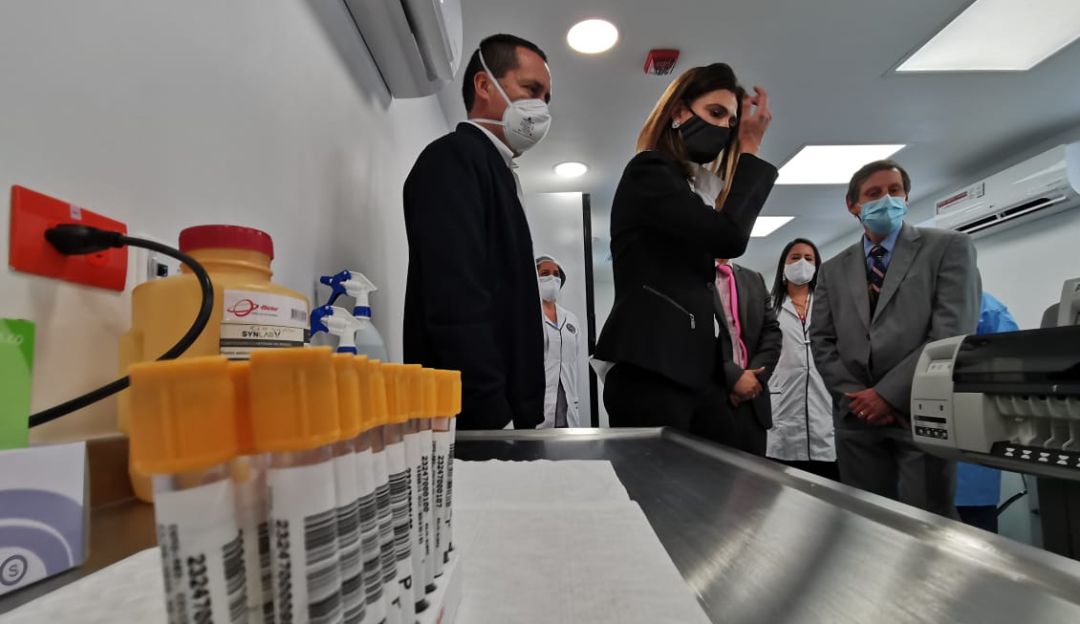
El Aeropuerto Internacional El Dorado ha inaugurado este Miércoles 23/09 un laboratorio propio para la toma de pruebas de detección de coronavirus para los viajeros de vuelos domésticos e internacionales que las requieran. “Quise acompañar el lanzamiento de la alianza entre OPAIN y el laboratorio Synlab para poner al servicio el primer laboratorio in house en el aeropuerto para realizar pruebas PCR”, dijo la Ministra de Transporte, Ángela María Orozco, durante la presentación inaugural. Con esta estrategia, de la que Colombia es pionera en la región, las autoridades esperan garantizar la seguridad y tranquilidad de los pasajeros cumpliendo con todos los protocolos de bioseguridad.
El Test Center de Coronavirus de El Dorado ofrece cuatro tipos de pruebas diagnósticas: la de anticuerpos, la de antígeno, la PCR y la Point of Care Testing (POCT). “Esta sede fue adecuada en tiempo récord, hoy lo estamos inaugurando y aquí atendemos a los trabajadores y también a los viajeros. Esta es una primicia aquí (en Colombia) y creo que es de fácil acceso para los viajeros”, dijo el Director Ejecutivo de Synlab en Colombia, Sandor Spakovszky.
El centro de diagnóstico tiene capacidad para procesar hasta 2.000 pruebas diarias, una cifra que puede llegar a ser mayor gracias a un plan de apoyo diseñado por Synlab para atender la demanda requerida. “Todas las pruebas, con excepción de la PCR clásica, las ofrecemos al usuario aquí en el aeropuerto en dos horas máximo en un horario Domingo a Domingo de 06:00 hs de la mañana a 20:00 hs de la noche”, agregó Sandor Spakovszky. Según la administración de El Dorado, el aeropuerto beneficia a más de 25.000 personas que dependen de su operación.
La semana pasada, al anunciar la reanudación gradual de vuelos internacionales, el Gobierno colombiano dijo que las primeras operaciones serán con ciudades de Estados Unidos, Ecuador, México, Bolivia, Brasil, República Dominicana y Guatemala. “Hemos encontrado en estos aliados (OPAIN y SynLab) los mejores aliados para sacar adelante el restablecimiento del transporte aéreo doméstico y el internacional de una manera segura”, subrayó la Ministra de Transporte Ángela María Orozco.
Restablecimiento ops aeropuertos
El Dorado y los aeropuertos Alfonso Bonilla Aragón (Cali) y José María Córdova (Medellín) reanudaron el Lunes 21/09 de manera gradual los vuelos internacionales que fueron suspendidos el pasado 23 de Marzo 2020 como medida para contener la propagación del virus, mientras que el Aeropuerto Rafael Núñez (Cartagena) ha reanudado sus operaciones el Sábado 19/09 con vuelos de prueba piloto.
Requerimientos PAX Aeropuerto
Para volar a Colombia, los viajeros deberán presentar una prueba PCR negativa de COVID-19 que haya sido tomada al menos 96 horas antes de la salida del vuelo, así como deberán usar mascarilla todo el tiempo. Igualmente, el Aeropuerto El Dorado, cuya operación estuvo paralizada casi medio año por la pandemia de COVID-19, está utilizando la tecnología para evitar que los viajeros tengan contacto con superficies y para tomar la temperatura corporal.
Airlines request runway in El Dorado
Airlines request to return to Bogotá Airport, Colombia
More than half a dozen airlines are requesting a runway to return to operations at the Bogotá/El Dorado Internationa Airport of the Republic of Colombia, whose international air connectivity could be reactivated as of October 2020, reported this Friday 09/25 the State Promotion Agency ProColombia. «In a coordinated manner and under strict biosafety protocols, airlines are requesting a runway in Bogotá, one of the most important cities for international air connections and which is part of the first reactivation phase to begin operations gradually», he explained. the President of ProColombia, Flavia Santoro.
Aeroméxico, American Airlines, Delta Air Lines, Spirit Airlines, United Airlines, Wingo Air and Avianca Airlines have confirmed their landing at El Dorado International Airport starting in October 2020. «The reopening of El Dorado Airport is great news For all Colombians, we know that the operation of national and international flights will have a positive impact on the economic reactivation of the country. We count on the collaboration of all travelers to make this process safe and comfortable. This step allows us to reconnect to the country with the worl», said Natali Leal, Manager of Institutional and Legal Affairs of Opain, operator of the air terminal.
The Colombian Government projects that the reactivation will allow the restart of operations of routes to countries such as the United States, Bolivia, Brazil, Ecuador, Guatemala, Mexico and the Dominican Republic. For this reason, Aeroméxico will begin flights from Mexico City; American Airlines from Dallas and Miami; Delta Air Lines from Atlanta; Spirit Airlines from Fort Lauderdale, United Airlines from Newark and Houston; Wingo Air from Santo Domingo, Punta Cana, Quito, Guayaquil and Cancun and Avianca Airlines from cities in the US, Brazil, Ecuador, Mexico, Guatemala, Bolivia and the Dominican Republic.
«We are focused on recovering the route network that we had before the situation, in order to achieve a gradual reestablishment of air capacity. The objective is that by the end of the year there will be» 40% of the supply in chairs and frequencies for one week typical that we had in February 2020. The confidence of the airlines to return to Bogotá is key, given the high volume of air operations handled by the city», said the head of ProColombia.
Point of Care Testing (POCT)
The El Dorado International Airport has inaugurated this Wednesday 09/23 its own laboratory for taking coronavirus detection tests for travelers on domestic and international flights that require them. «I wanted to accompany the launch of the alliance between OPAIN and the Synlab laboratory to put into service the first in-house laboratory at the airport to carry out PCR tests», said the Minister of Transportation, Angela María Orozco, during the opening presentation. With this strategy, of which Colombia is a pioneer in the region, the authorities hope to guarantee the safety and tranquility of passengers by complying with all biosecurity protocols.
The El Dorado Coronavirus Test Center offers four types of diagnostic tests: antibody, antigen, PCR, and Point of Care Testing (POCT). “This headquarters was adequate in record time, today we are inaugurating it and here we serve workers and also travelers. This is a first here (in Colombia) and I think it is easy for travelers to access”, said Synlab Colombia Executive Director Sandor Spakovszky.
The diagnostic center has the capacity to process up to 2,000 tests per day, a figure that can be higher thanks to a support plan designed by Synlab to meet the required demand. «All tests, with the exception of the classic PCR, are offered to the user here at the airport in a maximum of two hours from Sunday to Sunday from 06:00 in the morning to 20:00 at night», added Sandor Spakovszky. According to the El Dorado administration, the airport benefits more than 25,000 people who depend on its operation.
Last week, when announcing the gradual resumption of international flights, the Colombian government said that the first operations will be with cities in the United States, Ecuador, Mexico, Bolivia, Brazil, the Dominican Republic and Guatemala. «We have found in these allies (OPAIN and SynLab) the best allies to carry out the reestablishment of domestic and international air transport in a safe way», stressed the Minister of Transport Angela María Orozco.
Reset ops airports
El Dorado and the airports Alfonso Bonilla Aragón (Cali) and José María Córdova (Medellín) gradually resumed on Monday 09/21 international flights that were suspended on March 23, 2020 as a measure to contain the spread of the virus, while Rafael Núñez Airport (Cartagena) has resumed operations on Saturday 09/19 with pilot test flights.
PAX Airport Requirements
To fly to Colombia, travelers must present a negative PCR test for COVID-19 that has been taken at least 96 hours before flight departure, as well as must wear a mask at all times. Likewise, El Dorado Airport, whose operation was paralyzed for almost half a year due to the COVID-19 pandemic, is using technology to prevent travelers from having contact with surfaces and to take body temperature.