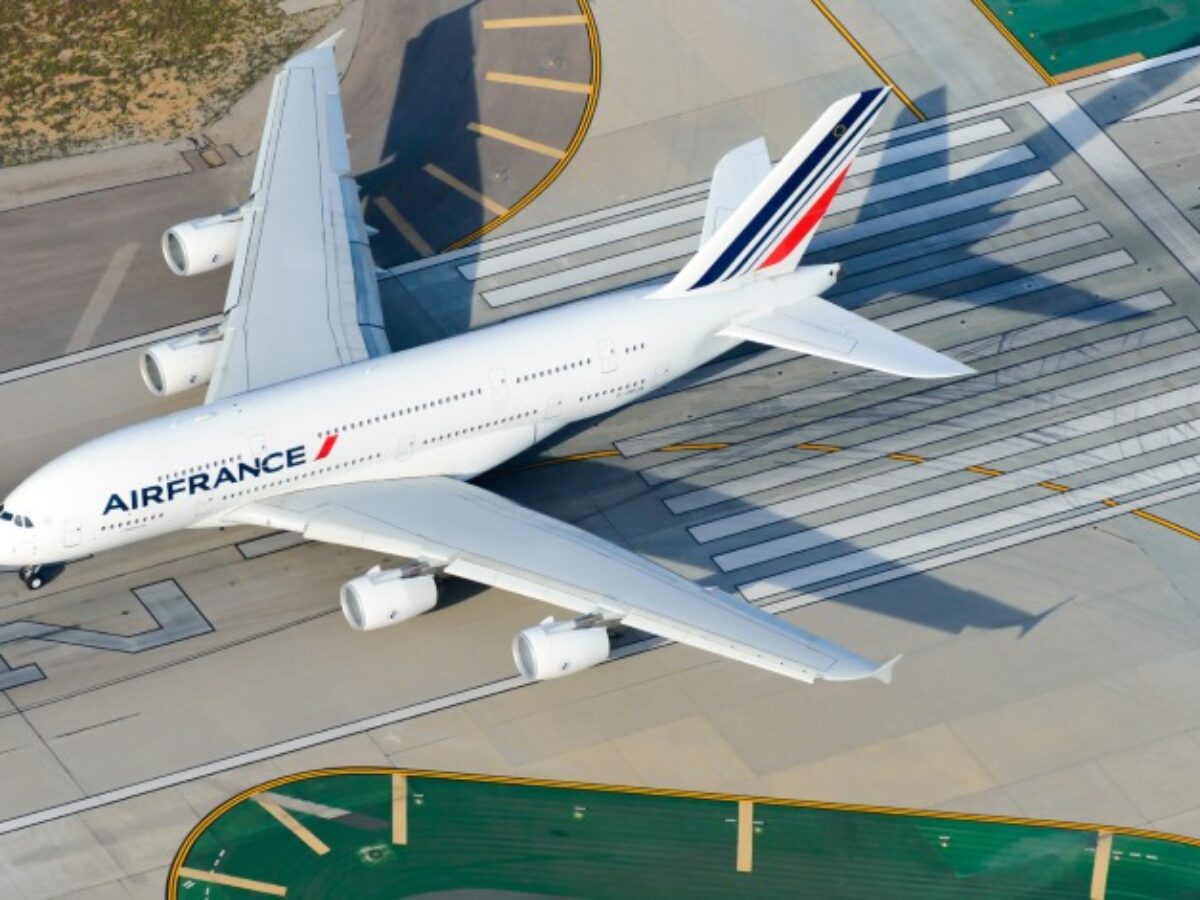
Persiguiendo seguridad en 737 MAX

AW | 2020 10 12 21:20 | AVIATION SAFETY

Capitán Chesley Sullenberger cuestiona seguridad actual

El Comandante Chesley «Sully» Sullenberg, piloto del Miracle on the Hudson ha expresado que la línea Boeing 737 MAX necesita modificaciones adicionales lo antes posible, más allá de las propuestas de la Federal Aviation Administration (FAA). Ese parece ser el consejo del legendario piloto «Sully», el Comandante que aterrizó con seguridad un avión comercial Airbus A320CEO en el Río Hudson después de un devastador impacto de aves. El piloto ha expresado que no está satisfecho de que las correcciones para el 737 MAX propuestas por la FAA. «Hágalo reparar y vuelva a ponerlo en el aire, pero hágalo bien. No voy a decir: Terminamos, lo suficientemente bien, sigue adelante», expresa Sully en un cambio de concepto para establecer correcciones a la aeronave puesta en tierra. En una entrevista exclusiva, el célebre piloto dijo que incluso si la FAA desconecta el avión el próximo mes como se esperaba, se necesitan modificaciones adicionales lo antes posible para mejorar el sistema de alerta de la tripulación del avión y agregar una tercera verificación en los datos del Ángulo de Ataque (AOA) de la aeronave. «La gente va a volar en él y probablemente yo seré uno de ellos. El MAX actualizado probablemente será tan seguro como el 737 NG cuando terminen con él. Pero no es tan bueno como debería ser», determinó Chesley Sullenberger.

Dennis Tajer, Portavoz de la Asociación de Pilotos Aliados (APA), el sindicato que representa a los pilotos de American Airlines, dijo que está en sintonía con Chesley Sullenberger.

Aunque el software de Control de Vuelo específico, el Sistema de Aumento de Características de Maniobra (MCAS), que derribó los aviones en dos choques fatales ahora está arreglado; las investigaciones sobre los choques «han expuesto otras áreas en las que podemos hacerlo mejor en ese avión. No podemos perder esta oportunidad de abordar algo que debe mejorarse», dijo Dennis Tajer. El costo de lo que proponen podría ser una barrera importante, sobre todo porque los problemas de seguridad planteados se aplican no solo al MAX, sino también a las versiones anteriores del 737 que actualmente vuelan, como el 737 NG, informó Seattle Times. Pero Chesley Sullenberger dice que estas mejoras harán que los 737 sean más seguros, tanto el MAX como los modelos más antiguos, y no deben dejarse de lado debido al costo. «¿Es eso realmente algo que nos sentimos cómodos diciendo en voz alta a todos los que abordan un avión? Simplemente no creo que eso sea defendible. En los dominios críticos para la seguridad, lo suficientemente bueno no lo es».

Vuelo AWE1549

El vuelo AWE-1549 de US Airways despegó el 15 de Enero de 2009 del Aeropuerto LaGuardia en Nueva York con destino el Aeropuerto Internacional de Charlotte, en Carolina del Norte; después tenía previsto ir al Aeropuerto Internacional de Seattle-Tacoma. El Airbus A320-200 amerizó en el Río Hudson, donde todos los pasajeros fueron rescatados. El A320CEO había entrado con la pérdida de ambos motores cuando una bandada de gansos se incrustaron en su avión de US Airways poco después del despegue, Sullenberger guió al Airbus A320 a un amerizaje de emergencia en el río Hudson de la ciudad de Nueva York, salvando a las 155 personas a bordo. El “Milagro en el Hudson” convirtió a Chesley Sullenberger en un emblema de la habilidad de pilotar y la seguridad de la aviación.

Corregir al MAX

En Junio de 2019, al testificar en una audiencia de investigación del 737 MAX ante el Comité de Transporte de la Cámara de Representantes de los Estados Unidos, criticó severamente las fallas de diseño de Boeing y la supervisión de la FAA. Con la puesta a tierra del 737 MAX a punto de abandonar, sopesó lo que aún queda por hacer. Su primera preocupación se hace eco de la Agencia Europea de Seguridad Aérea (EASA) y muchos de los comentarios públicos presentados sobre la propuesta de la FAA: MCAS tomará información de los dos sensores de Ángulo de Ataque del avión; pero Chesley Sullenberger cree que es necesaria una tercera verificación. Si uno de los dos sensores está defectuoso, las computadoras no sabrán cuál es el correcto. La solución probable no es un tercer Ángulo de Ataque (AOA) en el exterior del avión, sino un cálculo de software indirecto y sintético del ángulo de ataque basado en parámetros como el peso, la velocidad, la posición inercial y la señal GPS del avión.

El avión más nuevo de Boeing, el 787, tiene tal control sobre la confiabilidad de sus sensores de datos aéreos llamados Synthetic Airspeed, un sistema que Boeing rechazó para el MAX por motivos de costos. «Es realmente importante que un tercer ángulo de entrada de ataque, o velocidad aérea sintética, esté disponible en este avión», dijo Chesley Sullenberger.

La Agencia europea EASA ha dicho que Boeing acordó desarrollar un tercer ángulo de entrada de ataque después de que el 737 MAX vuelva al servicio y modernizarlo, en uno o dos años.

La otra preocupación principal de Chesley Sullenberger es que Boeing haga algo con respecto a la cacofonía de falsas alertas que se activaron erróneamente en los vuelos de choque por un sensor fallado. En Junio de 2019, por invitación de Dave Calhoun, ahora Director Ejecutivo de Boeing, Chesley Sullenberger ha probado tanto el software MCAS original como el actualizado en uno de los simuladores de vuelo de Boeing en Miami, replicando lo que sucedió en los vuelos accidentados. Allí, experimentó las múltiples alertas compuestas y la ambigüedad de los eventos y la carga de trabajo físico y la distracción. Me quedó claro cómo las tripulaciones de ambos accidentes podrían haberse quedado sin tiempo y altitud. Es probable que la tripulación nunca haya comprendido por completo lo que los estaba matando, especialmente porque nunca habían oído hablar del MCAS. Chesley Sullenberger dijo que debería haber alguna forma de apagar las alertas erróneas, especialmente la advertencia de pérdida del Stick Shaker que distrae mucho. Si se activa inadvertidamente, este fuerte y constante temblor de la columna de control del piloto continuará sin embargo durante el resto del vuelo. Arreglar esto es algo que Transport Canada (TC) ha exigido, y nuevamente Boeing ha aceptado encontrar una solución.

Si bien Chesley Sullenberger acepta que la aviación es más segura ahora que nunca, ha expresado que se ha avanzado mucho, cree que los accidentes del 737 MAX podrían haber ocurrido en los Estados Unidos y las fallas reveladas han destruido la sensación de seguridad anterior. «Durante la mayor parte de la historia de Boeing, tuvo un récord estelar de diseño y construcción de excelentes aviones. En el MAX, el diseño del sistema de control de vuelo era defectuoso. Sin darse cuenta, habían creado una trampa mortal. Era cuestión de tiempo hasta que se cobrara vidas».

CockpitView | Despegue desde un Boeing 737 MAX de Aerolíneas Argentinas

Chasing safety on 737 MAX

Captain Chesley Sullenberger questions current security

Commander Chesley «Sully» Sullenberg, pilot of the Miracle on the Hudson has expressed that the Boeing 737 MAX line needs additional modifications as soon as possible, beyond the proposals of the Federal Aviation Administration (FAA). That appears to be the advice of the legendary pilot «Sully,» the Commander who safely landed an Airbus A320CEO commercial jet in the Hudson River after a devastating bird strike. The pilot has expressed that he is not satisfied with the corrections for the 737 MAX proposed by the FAA. «Get it repaired and put it back in the air, but get it right. I’m not going to say: We finished, well enough, keep going«, says Sully in a concept change to establish corrections to the grounded aircraft. In an exclusive interview, the celebrated pilot said that even if the FAA disconnects the plane next month as expected, additional modifications are needed as soon as possible to improve the plane’s crew alert system and add a third check to the data. Angle of Attack (AOA) of the aircraft. «People are going to fly in it and I’ll probably be one of them. The updated MAX will probably be as safe as the 737 NG when they’re done with it. But it’s not as good as it should be», Chesley Sullenberger determined.

Dennis Tajer, spokesman for the Allied Pilots Association (APA), the union that represents American Airlines pilots, said he is in tune with Chesley Sullenberger.

Although the specific Flight Control software, the Maneuvering Characteristics Augmentation System (MCAS), which shot down the planes in two fatal crashes is now fixed; the crash investigations «have exposed other areas where we can do better on that plane. We cannot miss this opportunity to address something that needs to be improved», Dennis Tajer said. The cost of what they propose could be a significant barrier, especially since the safety concerns raised apply not only to the MAX, but also to earlier versions of the 737 currently flying, such as the 737 NG, the Seattle Times reported. But Chesley Sullenberger says these improvements will make the 737s safer both the MAX and older models and shouldn’t be overlooked because of cost. «Is that really something we feel comfortable saying out loud to everyone who boards a plane? I just don’t think that’s defensible. In safety-critical domains, good enough isn’t».

Flight AWE1549

US Airways flight AWE-1549 took off on January 15, 2009 from LaGuardia Airport in New York to Charlotte International Airport, in North Carolina; then he planned to go to the Seattle-Tacoma International Airport. The Airbus A320-200 landed in the Hudson River, where all the passengers were rescued. The A320CEO had entered with the loss of both engines when a flock of geese embedded themselves in his US Airways plane shortly after takeoff, Sullenberger guided the Airbus A320 to an emergency landing on New York City’s Hudson River, saving to the 155 people on board. The «Miracle on the Hudson» made Chesley Sullenberger an emblem of piloting skills and aviation safety.

Correct to MAX

In June 2019, testifying at a 737 MAX investigative hearing before the Transportation Committee of the United States House of Representatives, he severely criticized Boeing’s design flaws and oversight by the FAA. With the grounding of the 737 MAX about to give up, he weighed what still needs to be done. His first concern echoes the European Aviation Safety Agency (EASA) and many of the public comments submitted on the FAA proposal: MCAS will take information from the aircraft’s two Angle of Attack sensors; but Chesley Sullenberger believes a third verification is necessary. If one of the two sensors is faulty, the computers won’t know which one is correct. The likely solution is not a third Angle of Attack (AOA) on the outside of the aircraft, but an indirect, synthetic software calculation of the angle of attack based on parameters such as weight, speed, inertial position, and the aircraft’s GPS signal.

Boeing’s newest aircraft, the 787, has such control over the reliability of its airborne data sensors called Synthetic Airspeed, a system that Boeing rejected for the MAX on cost grounds. «It’s really important that a third angle of attack entry, or synthetic airspeed, is available on this aircraft», said Chesley Sullenberger.

The European agency EASA has said that Boeing has agreed to develop a third angle of attack entry after the 737 MAX returns to service and to modernize it, in one to two years.

Chesley Sullenberger’s other main concern is for Boeing to do something about the cacophony of false alerts that were mistakenly triggered on crash flights by a failed sensor. In June 2019, at the invitation of Dave Calhoun, now CEO of Boeing, Chesley Sullenberger tested both the original and updated MCAS software on one of Boeing’s flight simulators in Miami, replicating what happened on the crash flights. There, he experienced the multiple compound alerts and ambiguity of events and the physical workload and distraction. It was clear to me how the crews from both accidents could have run out of time and altitude. The crew likely never fully understood what was killing them, especially since they had never heard of MCAS. Chesley Sullenberger said there should be some way to turn off erroneous alerts, especially the highly distracting Stick Shaker loss warning. If activated inadvertently, this strong and constant shaking of the pilot’s control column will however continue for the remainder of the flight. Fixing this is something Transport Canada (TC) has demanded, and again Boeing has agreed to find a solution.

While Chesley Sullenberger accepts that aviation is safer now than ever, has expressed that much progress has been made, he believes that the 737 MAX accidents could have occurred in the United States and the disclosed failures have destroyed the previous sense of safety. «For most of Boeing’s history, it had a stellar record of designing and building excellent aircraft. At the MAX, the flight control system design was flawed. Inadvertently, they had created a death trap. It was a matter of course. time until lives were claimed».


PUBLISHER: Airgways.com
DBk: Seattletimes.com / Airgways.com
AW-POST: 202010122120AR

A\W   A I R G W A Y S ®
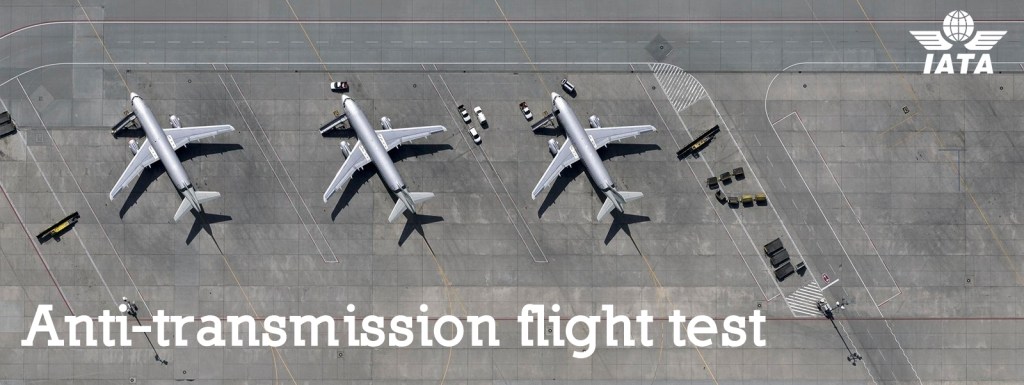
Test vuelos anti-transmisión

AW | 2020 10 10 15:17 | AVIATION SAFETY / AVIATION TECHNOLOGY

Simulación pruebas de vuelos evalúan bajo riesgo de transmisión

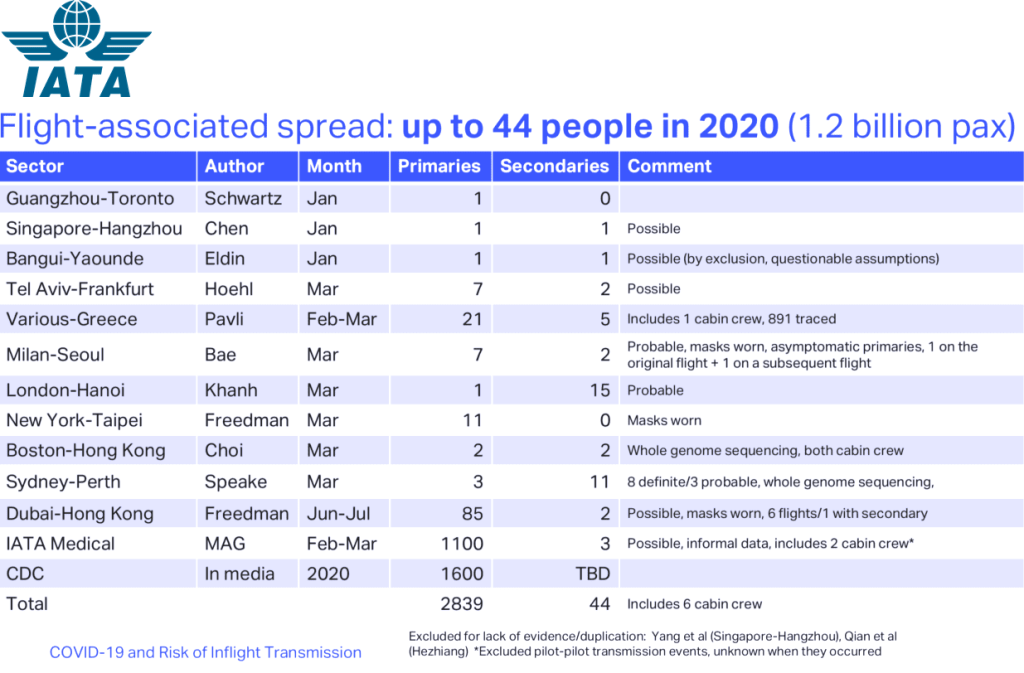
La Asociación Internacional de Transporte Aéreo (IATA) ha detallado que entre los 1.200 millones de pasajeros que han viajado con aerolíneas comerciales desde principios de 2020, se han reportado 44 casos de COVID-19 en los que se produjo transmisión en vuelo, según encontraron nuevos datos publicados por las agencias de aviación. Los datos recopilados por IATA se dieron a conocer durante una conferencia de prensa el Jueves 8 de Octubre de 2020 junto con presentaciones realizadas por los líderes de ingeniería en Airbus, Boeing y Embraer. Mediante el uso de simulaciones de Dinámica de Fluidos Computacional (CFD) y pruebas en vivo de pasajeros que tosen en cabinas e incluso virus transmitidos por el aire, las tres compañías de aviación publicaron los datos de las investigaciones más profundas sobre el riesgo de transmitir el coronavirus COVID-19 en vuelo hasta la fecha.

“El riesgo de que un pasajero contraiga Coronavirus mientras está a bordo parece muy bajo. Con solo 44 casos potenciales identificados de transmisión relacionada con el vuelo entre 1.200 millones de viajeros, ese es un caso por cada 27 millones de viajeros. Reconocemos que esto puede ser una subestimación, pero incluso si el 90 por ciento de los casos no se denunciaran, sería un caso por cada 2,7 millones de viajeros. Creemos que estas cifras son sumamente tranquilizadoras. Además, la gran mayoría de los casos publicados ocurrieron antes de que se generalizara el uso de cubiertas faciales durante el vuelo», dijo el Dr. David Powell, Asesor Médico de IATA durante la sesión informativa.

La IATA recopiló la cantidad de veces que se pensó que un pasajero había transmitido COVID-19 durante el vuelo, según los datos reportados desde principios de 2020. Los tres fabricantes de aviones comerciales más grandes de la industria utilizaron CFD para modelar cómo los pasajeros con máscaras o sin ellas, respirar, toser y hablar pueden propagar moléculas a través de la cabina de un avión durante el vuelo. Si bien los tres utilizaron supuestos, metodologías y criterios separados, todos llegaron a una conclusión similar estableciendo evidencia creíble del bajo riesgo que enfrenta un pasajero de una aerolínea en un vuelo promedio. Si bien las aerolíneas y los fabricantes continúan promoviendo la efectividad de los filtros de aire de partículas de alta eficiencia (HEPA), el flujo de aire descendente y las altas tasas de intercambio de aire que ocurren en las cabinas, los pasajeros aún expresan su preocupación sobre la capacidad de las aerolíneas para mantener seguros los entornos de las cabinas. del riesgo de transiciones COVID-19. Una encuesta de pasajeros que viajaron durante el mes de junio mostró que el 50 por ciento de los pasajeros cree que el aire de la cabina es tan limpio como un hospital, mientras que otro 50 por ciento dice que percibe el aire de la cabina como peligroso. Todos los segmentos de la industria del transporte aéreo comercial han intentado demostrar que los entornos de la cabina de los aviones son más seguros de alguna manera que los edificios de oficinas, bares y restaurantes que los viajeros frecuentan en su vida diaria.

Análisis en Airbus

Bruno Fargeon, ex-Jefe de Modelado, Simulación e Ingeniería que asumió el cargo de líder del proyecto de la iniciativa «Keep Trust in Air Travel» de Airbus Group, dijo que el fabricante con sede en Toulouse usó CFD para recopilar 50 millones de puntos de datos sobre el tamaño de los virus en micrones. y las partículas pueden fluir a través de la cabina de un avión, incluida la velocidad del aire, la dirección y la temperatura para cada uno de los puntos de datos recopilados a 1000 veces por segundo.

Cuando se le preguntó cómo se puede lograr el distanciamiento social en la cabina del avión y si las aerolíneas deberían eliminar el asiento del medio, Bruno Fargeon dijo que el flujo de aire y los filtros HEPA combinados con el uso de máscaras pueden eliminar la mayor parte del riesgo asociado con la transmisión en vuelo de COVID-19. «La distancia social a bordo de la aeronave no se puede medir tomando una medida de seis pies. La distancia social a bordo de la aeronave está asegurada por el flujo de aire que elimina las partículas y las gotas, y claramente, esa es la mejor protección que puede obtener hoy a bordo de un aviones. Las recomendaciones que se dan hoy en bares y restaurantes son lugares donde la ventilación no se puede comparar con el grado que se puede encontrar en un avión. Eso es lo que marca la gran diferencia entre el entorno de un avión y un entorno terrestre clásico», dijo Bruno Fargeon.

El modelado CFD también permitió al equipo de ingeniería de Bruno Fargeon estudiar escenarios en los que un A320 lleno de pasajeros llevaban máscaras, algunos llevaban máscaras y otros las llevaban incorrectamente. Su equipo también consideró cómo las fugas en las máscaras de tela podrían permitir que las moléculas escapen, sin dejar de llegar a la conclusión de que el flujo de aire de arriba hacia abajo y el sistema de recirculación de aire es suficiente para contrarrestar la fuga.

Airbus también ha estudiado algunas de las propuestas de terceros proveedores considerando el uso de cortinas o barreras físicas de plexiglás entre asientos, encontrando que podrían presentar más peligros que beneficios. «No recomendamos usarlos. O son muy pequeños y no van a proteger o son grandes y si son grandes distraerán el flujo e interrumpirán el flujo. También plantean retos extra, necesitan ser limpiados y limpiados adecuadamente, y además en aviones, todavía hay algunas recomendaciones y procedimientos de emergencia que tenemos que respetar. Con este tipo de dispositivos, también plantean algunos otros problemas de seguridad en En términos de evacuación, también podrían plantear algunos otros problemas de seguridad en términos de propagación del fuego al interior de la aeronave, por lo que, en general, el beneficio que traería es cero», dijo Bruno Fargeon.

Pruebas en Boeing

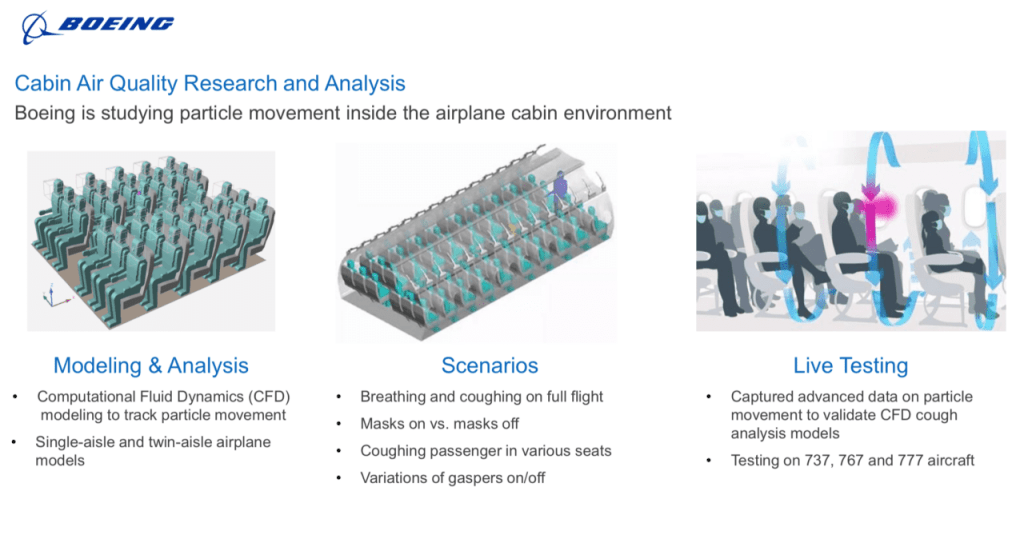
The Boeing Company proporcionó una descripción general de cómo está estudiando el movimiento de moléculas a través de la cabina de un avión. «De hecho, hemos realizado pruebas con MS-2, que es un virus vivo que es seguro para los humanos. Hemos hecho una gran variedad de cosas, hemos hecho pruebas con partículas del tamaño de un virus, hemos realizado pruebas con virus seguros para humanos, para asegurarnos de que comprendemos completamente el medio ambiente«, dijo Dan Freeman, Jefe Ingeniero de la Iniciativa de Viaje de Boeing. Dan Freeman dijo que el análisis de Boeing también mostró que cuando ocurre una tos en un avión de pasillo único como el Boeing 737, sus simulaciones computacionales y pruebas en vivo mostraron que todas las partículas de tos medibles se eliminan unos 90 segundos después de que ocurre la tos. Boeing también descubrió que las gotas más grandes emitidas por la tos de una persona caerán del aire más rápido porque son más pesadas, mientras que las moléculas del tamaño de un aerosol son las más difíciles de rastrear y eliminar solo a través del flujo de aire.

Estudios en Embraer

El Vicepresidente Senior de Ingeniería, Tecnología y Estrategia de Embraer S.A., Luis Carlos Affonso, dijo que el fabricante brasileño vio resultados similares a los estudios realizados por Airbus y Boeing. Su CFD y las pruebas en vivo también mostraron que la diferencia entre el riesgo de que las moléculas generadas por la tos alcancen la zona de respiración de otros pasajeros es de aproximadamente 0.13 por ciento sin una máscara y 0.02 por ciento mientras usa una. «La necesidad humana de viajar, conectar y ver a nuestros seres queridos no ha desaparecido. De hecho, en momentos como este, necesitamos a nuestras familias y amigos aún más. Nuestro mensaje hoy es que debido a la tecnología y los procedimientos implementados, puede volar de manera segura; todas las investigaciones lo demuestran. De hecho, la cabina de un avión comercial es uno de los espacios más seguros disponibles en cualquier lugar durante esta pandemia», dijo Luis Affonso.

Perspectivas aéreas

La recopilación de datos de IATA y los resultados de las simulaciones de cabina se alinean con el bajo número de informes en vuelo informados en un estudio revisado por pares realizado por Freedman y Wilder-Smith en el Journal of Travel Medicine. Ese estudio también apunta a la capa adicional de protección proporcionada por los pasajeros que usan máscaras. Las tres empresas admitieron que todavía existe cierto riesgo relacionado con la posibilidad de transmitir el virus durante el vuelo. Los filtros HEPA, el flujo de aire y el uso de mascarillas aún dejan la posibilidad de que una pequeña cantidad de partículas emitidas por un pasajero que podría tener COVID-19 y no saberlo lleguen a otro pasajero que también está sentado en la cabina. Pero creen que la educación que están brindando a los pasajeros y ser lo más transparentes posible sobre cómo los micrones del tamaño de un virus fluyen a través de una cabina durante el vuelo muestra cuán bajo es realmente el riesgo.

Ninguna de las pruebas en vivo realizadas por Airbus, Boeing y Embraer involucró la simulación real de una persona que tiene COVID-19 tosiendo o respirando abiertamente durante el vuelo. En su lugar, utilizaron humo y otros métodos para estudiar cómo las micras y las moléculas son eliminadas por el flujo de aire y la recirculación que ya ocurre en las cabañas hoy en día.

Anti-transmission flight test

Simulation flight tests assess low risk of transmission

The International Air Transport Association (IATA) has detailed that among the 1.2 billion passengers who have traveled with commercial airlines since the beginning of 2020, 44 cases of COVID-19 have been reported in which transmission occurred in flight, according to new findings. data published by aviation agencies. The data collected by IATA was released during a press conference on Thursday, October 8, 2020 along with presentations made by engineering leaders at Airbus, Boeing and Embraer. Using Computational Fluid Dynamics (CFD) simulations and live testing of passengers coughing in cabins and even airborne viruses, the three aviation companies released the data from the most in-depth investigations into the risk of transmitting the COVID-19 coronavirus in flight to date.

“The risk of a passenger contracting Coronavirus while on board appears very low. With only 44 potential cases of flight-related transmission identified among 1.2 billion travelers, that’s one case for every 27 million travelers. We recognize that this may be an understatement, but even if 90 percent of cases went unreported, it would be one case for every 2.7 million travelers. We believe that these figures are extremely reassuring. Furthermore, the vast majority of reported cases occurred before the use of face shields became widespread during the flight», said Dr. David Powell, IATA Medical Advisor during the briefing.

IATA compiled the number of times a passenger was thought to have transmitted COVID-19 during the flight, based on data reported since early 2020. The three largest commercial aircraft manufacturers in the industry used CFDs to model how passengers with Masks or without masks, breathing, coughing and talking can spread molecules through the cabin of an airplane during flight. While all three used separate assumptions, methodologies, and criteria, they all came to a similar conclusion establishing credible evidence of the low risk an airline passenger faces on an average flight. While airlines and manufacturers continue to promote the effectiveness of High Efficiency Particulate Air Filters (HEPA), the downward airflow and high air exchange rates that occur in cabins, passengers still express concern. on airlines’ ability to keep cabin environments safe. of the risk of COVID-19 transitions. A survey of passengers who traveled in June showed that 50 percent of passengers believe cabin air is as clean as a hospital, while another 50 percent say they perceive cabin air as dangerous. Every segment of the commercial air transport industry has tried to show that airplane cabin environments are somehow safer than the office buildings, bars, and restaurants that travelers frequent in their daily lives.

Analysis at Airbus

Bruno Fargeon, former Head of Modeling, Simulation and Engineering who took over as project leader for Airbus Group’s «Keep Trust in Air Travel» initiative, said the Toulouse-based manufacturer used CFDs to collect 50 million points of data on the size of viruses in microns. and particles can flow through the cabin of an airplane, including airspeed, direction, and temperature for each of the data points collected at 1000 times per second.

AIRBUS SHOWS HOW FLOW OF AIR HELPS TO ELIMINATE THE SPREAD OF MOLECULES TRANSMITTED IN THE CABIN AIRPLANE

When asked how social distancing can be achieved in the airplane cabin and if airlines should eliminate the middle seat, Bruno Fargeon said that airflow and HEPA filters combined with the use of masks can eliminate most of it. of the risk associated with in-flight transmission of COVID-19. «The social distance on board the aircraft cannot be measured by taking a measurement of six feet. The social distance on board the aircraft is ensured by the airflow that removes particles and droplets, and clearly, that is the best. protection you can get today on board an aircraft. The recommendations given today in bars and restaurants are places where ventilation cannot be compared to the degree that can be found in an airplane. That is what makes the big difference between the environment of an airplane and a classic ground environment», said Bruno Fargeon.

CFD modeling also allowed Bruno Fargeon’s engineering team to study scenarios where an A320 full of passengers wore masks, some wore masks, and some wore them incorrectly. His team also considered how leaks in cloth masks could allow molecules to escape, while still concluding that the top-down airflow and air recirculation system is sufficient to counter the leak.

Airbus has also studied some of the third-party vendor proposals considering the use of physical plexiglass curtains or barriers between seats, finding that they could present more dangers than benefits. «We do not recommend using them. Either they are very small and will not protect or they are large and if they are large they will distract the flow and interrupt the flow. They also pose extra challenges, they need to be cleaned and cleaned properly, and also on airplanes, there are still some recommendations. and emergency procedures that we have to respect. With these kinds of devices, they also pose some other safety issues in terms of evacuation, they could also pose some other safety issues in terms of spreading the fire inside the aircraft, so that, in general, the benefit it would bring is zero», said Bruno Fargeon.

Testing at Boeing

The Boeing Company provided an overview of how it is studying the motion of molecules through the cabin of an airplane. «In fact, we have tested MS-2, which is a live virus that is safe for humans. We have done a variety of things, we have tested virus-sized particles, we have tested viruses that are safe for humans, to make sure we fully understand the environment», said Dan Freeman, Chief Engineer for Boeing’s Travel Initiative. Dan Freeman said Boeing’s analysis also showed that when a cough occurs in a single-aisle aircraft like the Boeing 737, his computer simulations and live tests showed that all measurable cough particles are removed about 90 seconds after it occurs. cough. Boeing also found that the largest droplets emitted from a person’s cough will fall out of the air faster because they are heavier, while aerosol-sized molecules are the most difficult to track and remove through air flow alone.

Studies at Embraer

Embraer S.A. Senior Vice President of Engineering, Technology and Strategy, Luis Carlos Affonso, said that the Brazilian manufacturer saw results similar to studies carried out by Airbus and Boeing. His CFD and live tests also showed that the difference between the risk of molecules generated by coughing reaching the breathing zone of other passengers is about 0.13 percent without a mask and 0.02 percent while wearing one. «The human need to travel, connect and see our loved ones has not disappeared. In fact, in times like this, we need our families and friends even more. Our message today is that due to the technology and procedures in place, it can fly safely, all the research proves it. In fact, the cabin of a commercial airplane is one of the safest spaces available anywhere during this pandemic», said Luis Affonso.

Air perspectives

The IATA data collection and the results of the cockpit simulations align with the low number of in-flight reports reported in a peer-reviewed study conducted by Freedman and Wilder-Smith in the Journal of Travel Medicine. That study also points to the extra layer of protection provided by passengers wearing masks. All three companies admitted that there is still some risk related to the possibility of transmitting the virus during the flight. HEPA filters, air flow and the use of masks still leave the possibility that a small amount of particles emitted by a passenger who could have COVID-19 and not know it reach another passenger who is also sitting in the cabin. But they believe that the education they are providing passengers and being as transparent as possible about how virus-sized microns flow through a cabin during flight shows how low the risk really is.

None of the live tests conducted by Airbus, Boeing and Embraer involved the actual simulation of a person with COVID-19 coughing or openly breathing during the flight. Instead, they used smoke and other methods to study how microns and molecules are removed by the air flow and recirculation that already occurs in cabins today.


PUBLISHER: Airgways.com
DBk: Iata.org / Aviationtoday.com / Airbus.com / Boeing.com / Embraer.com / Airgways.com
AW-POST: 202010101517AR

A\W   A I R G W A Y S ®

Volcán Grímsvötn entrará en erupción

Powerful Icelandic volcano 'ready to erupt' after wiping out air travel in  2011

AW | 2020 10 10 13:10 | AVIATION SAFETY

Volcán más activo de Islandia se prepara para entrar en erupción

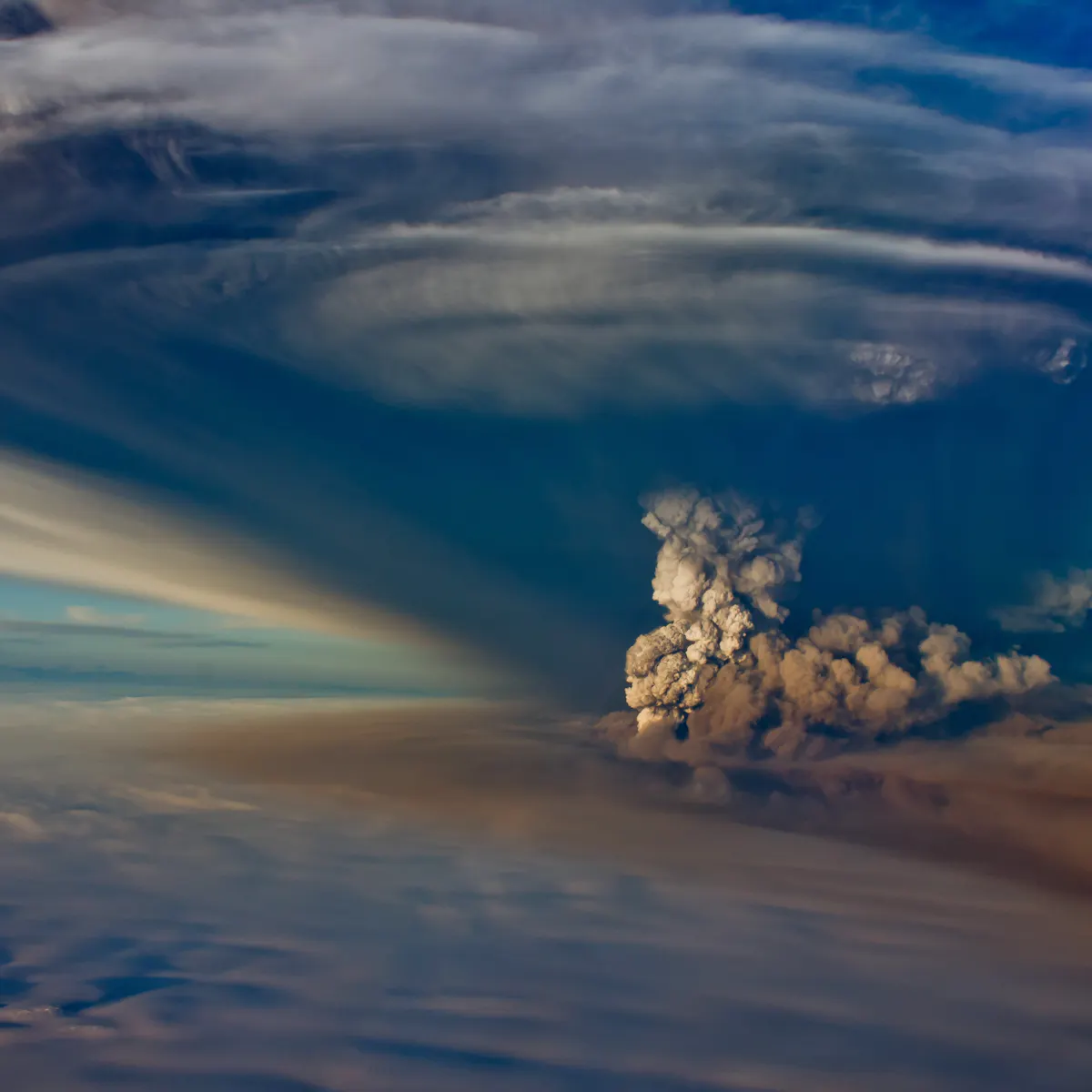
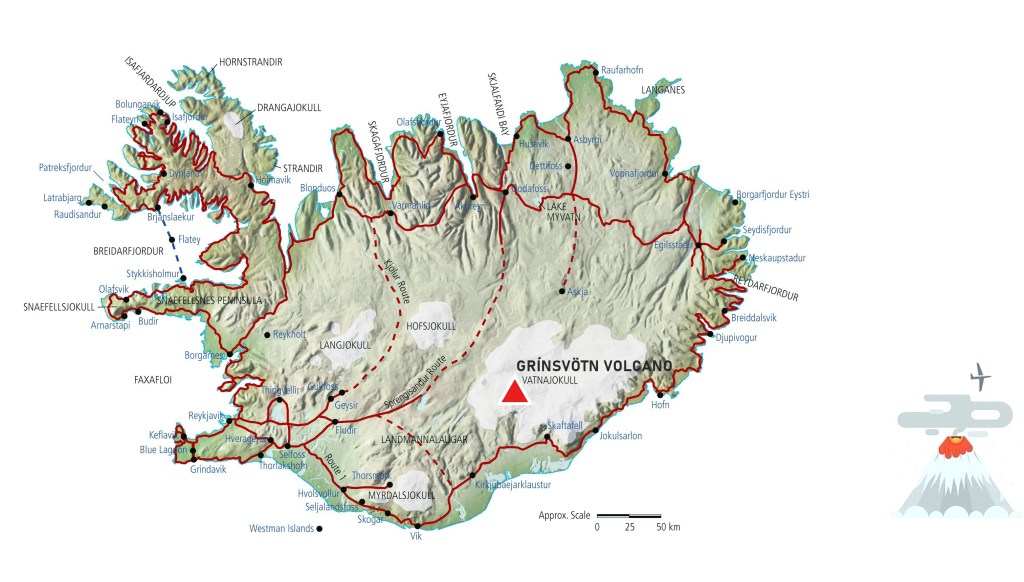
El Volcán Grímsvötn, el más activo de la República de Islandia, ha mostrado signos de que está a punto de entrar en erupción por primera vez desde 2011. El gigante cubierto de hielo Grímsvötn parece que terminará 2020 con una explosión violenta. La pandemia ya ha paralizado la industria de viajes aéreos de Europa, y los expertos dicen que la erupción del volcán solo afectará más a la industria de viajes. El Volcán Grímsvötn ha entrado en erupción por última vez en 2011, cerrando los cuatro aeropuertos del país y cancelando más de 900 vuelos, siendo la última erupción un impacto par ala aviación transatlántica.

Grímsvötn no es un volcán promedio, ya que se encuentra casi completamente bajo el hielo. La producción de calor del subsuelo es extremadamente alta (2000-4000MW), lo que hace que el hielo se derrita y forme lagos de hasta 100 metros de profundidad. El volcán también es extremadamente sensible a los cambios de presión. A medida que el agua de sus lagos se escapa por los canales, provoca la inundación de las carreteras y los puentes arrasados. Este cambio en la presión debido al escape de agua puede incluso desencadenar erupciones, como lo ha hecho más de 65 veces en los últimos 800 años. Los expertos dicen que, a pesar de no poder predecir con precisión las fechas en las que un volcán entrará en erupción, están comenzando a aparecer señales claras a través de las grietas.

Grímsvötn se ha estado inflando a medida que el nuevo magma se mueve hacia los canales por donde escapa su agua, lo que ha aumentado la actividad térmica y, en consecuencia, un pico de terremotos recientemente. Es probable que a medida que el magma se mueva hacia la superficie y el volcán esté a punto de entrar en erupción, Islandia sienta terremotos más intensos y frecuentes que durarán hasta diez horas. El mejor escenario para los islandeses en este momento es que la erupción es pequeña y consume la mayor parte de su energía cuando golpea el agua y el hielo en la superficie, lo que hace que las cenizas se mojen y pesen, cayendo del cielo más rápido. Esto dará como resultado que las nubes de cenizas viajen solo a unas pocas decenas de kilómetros del volcán, evitando impactos en las rutas de vuelo en Islandia y el norte de Europa.

Grímsvötn: Iceland's most active volcano may be about to erupt

Grímsvötn volcano will erupt

Iceland’s most active volcano prepares to erupt

Grímsvötn Volcano, the most active in the Republic of Iceland, has shown signs that it is about to erupt for the first time since 2011. The ice-covered giant Grímsvötn looks set to end 2020 with a violent explosion. The pandemic has already crippled Europe’s air travel industry, and experts say the volcano’s eruption will only affect the travel industry further. The Grímsvötn Volcano last erupted in 2011, closing the country’s four airports and canceling more than 900 flights, the latest eruption being an impact on transatlantic aviation.

La imagen tiene un atributo ALT vacío; su nombre de archivo es aw-grimsvotn_volcano.jpg

Grímsvötn is not your average volcano, as it is almost completely under the ice. Subsoil heat production is extremely high (2000-4000MW), causing the ice to melt and form lakes up to 100 meters deep. The volcano is also extremely sensitive to pressure changes. As the water from its lakes escapes through the canals, it causes the flooding of the roads and the destroyed bridges. This change in pressure due to escaping water can even trigger eruptions, as it has done more than 65 times in the last 800 years. Experts say that despite being unable to accurately predict the dates when a volcano will erupt, clear signals are beginning to appear through the cracks.

Grímsvötn has been inflating as new magma moves into channels where its water escapes, increasing thermal activity and consequently a recent spike in earthquakes. As magma moves to the surface and the volcano is about to erupt, Iceland will likely feel more intense and frequent earthquakes lasting up to ten hours. The best scenario for Icelanders at the moment is that the eruption is small and consumes most of its energy when it hits the water and ice on the surface, causing the ashes to get wet and heavy, falling from the sky faster . This will result in the ash clouds traveling only a few tens of kilometers from the volcano, avoiding impacts on the flight paths in Iceland and northern Europe.


PUBLISHER: Airgways.com
DBk: Volcanodiscovery.com / Headtopics.com / Airgways.com
AW-POST: 202010101310AR

A\W   A I R G W A Y S ®
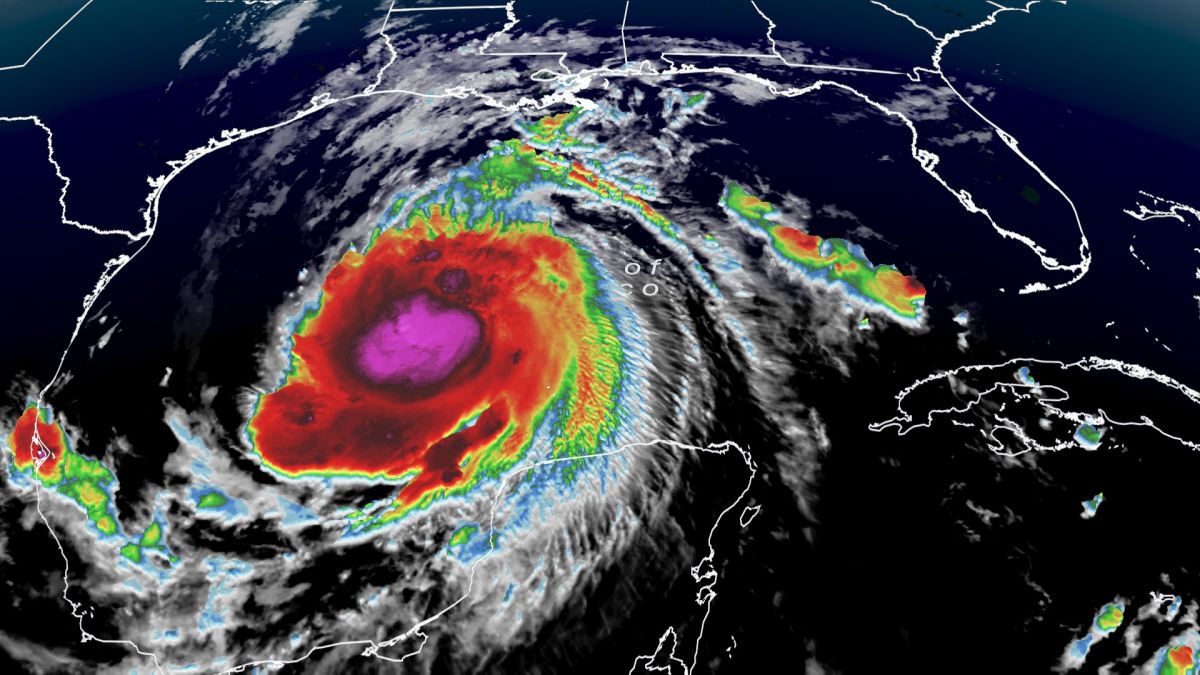
Huracán Delta ingresa CAT2 a EEUU

Tropical Update: Hurricane Delta restrengthens into a Category 2 hurricane  - CNN Video

AW | 2020 10 09 01:00 | AVIATION SAFETY / AIR TRAFFIC

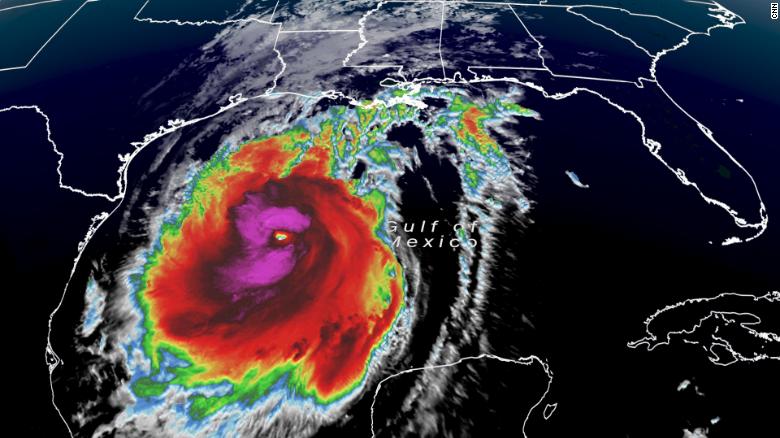
Huracán Delta impacta en Golfo de México

El Huracán Delta se dirige hacia la costa del Golfo y tocará tierra el Viernes 09/10 con marejada ciclónica, vientos e inundaciones en Estados Unidos con Categoría 2 (CAT2). El Huracán Delta se dirige a tocar tierra en la Costa del Golfo el viernes con marejadas ciclónicas potencialmente mortales, vientos dañinos e inundaciones por lluvias desde el este del Estado de Texas, el Mississippi y el Estado de Louisiana. Esto incluye algunas de las mismas áreas que fueron devastadas por el Huracán Laura hace más de un mes atrás.

Como se esperaba, Delta se intensificó nuevamente sobre las aguas más cálidas del Golfo de México el Jueves 08/10. Por primera vez en la vida de Delta como huracán, un ojo distinto finalmente se aclaró en imágenes satelitales infrarrojas el jueves por la tarde, y una misión de caza de huracanes de la Reserva de la Fuerza Aérea de EE.UU. ha midido vientos a nivel de vuelo lo suficientemente fuertes como para justificar una actualización a la Categoría 3. El centro de Delta se encuentra actualmente a más de 200 millas al sur de Cameron, Louisiana, moviéndose hacia el norte a una velocidad de 10 a 15 mph. Existe una advertencia de huracán desde High Island, Texas, hasta Morgan City, Louisiana, incluidos Lake Charles y Lafayette, Louisiana; y Port Arthur, Texas. Esto significa que se esperan condiciones de huracán el Viernes 09/10. También está vigente una advertencia de marejada ciclónica desde High Island, Texas, hasta Ocean Springs, Mississippi, incluido el lago Calcasieu, la bahía Vermilion, el lago Pontchartrain, el lago Maurepas y el lago Borgne. Esto significa que se espera una marejada ciclónica potencialmente mortal, en este caso el Viernes 09/10 por la tarde o temprano en la noche. Los residentes cerca de la costa inmediata y bahías adyacentes deben apresurar los preparativos hasta su finalización y seguir cualquier orden de evacuación de los administradores de emergencias locales.

Las advertencias de tormenta tropical están vigentes desde Sargent hasta el oeste de High Island, Texas, y desde el este de Morgan City, Louisiana, hasta la desembocadura del río Pearl, incluida Nueva Orleans. Esto significa que se esperan vientos con fuerza de tormenta tropical, en este caso dentro de las 24 horas. Una alerta de tormenta tropical se extiende al este de la desembocadura del río Pearl hasta Bay St. Louis, Mississippi. Esto significa que son posibles los vientos con fuerza de tormenta tropical.

Tiempo de pronóstico, intensidad

A medida que Delta se acerca a la costa del Golfo, la intensidad del viento podría disminuir un poco debido a los vientos cada vez más desfavorables en los niveles superiores y al agua más fría del Golfo. A pesar de este posible debilitamiento en la aproximación, Delta no tendrá mucho tiempo para debilitarse antes de tocar tierra y aún se pronostica que será un huracán formidable al tocar tierra a lo largo de Luisiana o la costa extrema superior de Texas el Viernes 09/10. Delta luego se moverá tierra adentro sobre el valle bajo del Mississippi este fin de semana, ya que se debilitará en un área remanente de baja presión.

Las olas generadas por Delta generarán corrientes de resaca peligrosas y oleaje alto en las playas a lo largo de la costa norte y occidental del Golfo y podrían provocar algunas inundaciones costeras durante la marea alta en algunas áreas bajas mucho antes de tocar tierra, particularmente en el sur de Louisiana. La marejada ciclónica de Delta será peligrosa y potencialmente mortal independientemente de cualquier debilitamiento de sus vientos hasta que toque tierra. La marejada ciclónica más alta se espera en partes del centro-sur de Luisiana, no solo cerca de la costa del Golfo, sino también en bahías, ensenadas y hasta cierto punto tierra adentro a lo largo de ríos y pantanos. La inundación podría alcanzar de 7 a 11 pies sobre el suelo en estas áreas.

En algunas de estas áreas, las inundaciones pueden tardar días en desaparecer , no solo por la marejada ciclónica, sino también por los ríos crecidos por la lluvia y los pantanos temporalmente que no pueden drenar con eficacia al Golfo. También se espera una peligrosa marejada ciclónica en las áreas que fueron devastadas por el huracán Laura a fines de agosto. Cualquier cambio leve hacia el oeste en la trayectoria pronosticada podría traer una marejada ciclónica mayor a estas áreas de lo que se pronostica actualmente. También se esperan algunas inundaciones por marejada ciclónica en el sureste de Louisiana, incluso a lo largo del lago Pontchartrain, y a lo largo de las costas de Mississippi, Alabama y la parte superior de Texas, incluidas las áreas afectadas por el huracán Sally el mes pasado.

Pronóstico de marejada ciclónica

Desde el Centro Nacional de Huracanes, estas son inundaciones máximas sobre el nivel del suelo si la marejada ciclónica del Delta llega con marea alta. Los cambios sutiles en el pronóstico de la trayectoria pueden llevar a cambios en este pronóstico de marejada. Los vientos con fuerza de tormenta tropical llegarán al área de advertencia de huracanes a lo largo de la costa norte del Golfo tan pronto como el viernes temprano. Se esperan condiciones de huracán (vientos de 74 mph o más) en esta área para el viernes por la tarde y la noche. Los vientos más fuertes con Delta serán cerca del suroeste y centro-sur de Luisiana y de las costas extremas superiores de Texas al tocar tierra cuando la pared del ojo se mueva a tierra. Aquí es donde los daños estructurales, los cortes de energía y los árboles caídos serán más generalizados y severos.

El suroeste de Louisiana es particularmente vulnerable a los fuertes vientos debido al daño que Laura ya causó allí en Agosto 2020. Al igual que con la mayoría de los huracanes, los fuertes vientos capaces de derribar árboles y cortes de energía también se extenderán tierra adentro a medida que Delta gane velocidad hacia adelante cerca y después de tocar tierra, en gran parte de Louisiana, el extremo este de Texas, Mississippi y el sur de Arkansas desde el Viernes 09/10 hasta el Sábado 10/10. Una velocidad de avance más rápida que la que vimos con el huracán Sally el mes pasado disminuirá el potencial de lluvias extremas de Delta hasta cierto punto, aunque aún se esperan fuertes lluvias, particularmente a lo largo y al este de su camino. La fuerte lluvia combinada con la marejada ciclónica podría empeorar y prolongar las inundaciones por un tiempo a lo largo de la costa norte del Golfo.

Según el Centro Nacional de Huracanes, se esperan de 5 a 10 pulgadas, con cantidades aisladas de 15 pulgadas con Delta en el suroeste y centro-sur de Luisiana. Esta lluvia podría causar inundaciones repentinas e inundaciones de ríos menores o mayores a nivel local. Se pronostican precipitaciones totales de 3 a 6 pulgadas, con cantidades aisladas de 10 pulgadas en partes del extremo este de Texas, el norte de Louisiana, el sur de Arkansas y el oeste de Mississippi. Algunas lluvias locales fuertes también se extenderán al valle de Ohio, el sureste y el Atlántico medio este fin de semana. Como ocurre con la mayoría de los huracanes y tormentas tropicales que tocan tierra, también existe la amenaza de tornados aislados de Delta. El sudeste de Louisiana y el sur de Mississippi tienen la mayor probabilidad de ver algunos tornados desde la noche del jueves hasta el viernes por la noche, principalmente en las bandas de lluvia exteriores donde las tormentas eléctricas giratorias ocurren típicamente en ciclones tropicales que se mueven tierra adentro. Algunos tornados aislados también son posibles el Sábado 10/10 con el remanente de Delta en partes del Valle de Tennessee.

Notables históricos

La llegada a tierra de Delta será un décimo huracán o tormenta tropical que toque tierra en los Estados Unidos esta temporada, lo que romperá el récord anterior de nueve de estos en una temporada que se había mantenido desde 1916. También será la cuarta tormenta que toca tierra en Louisiana de 2020, empatando 2002 con la mayor cantidad récord en cualquier temporada en el estado de Pelican, según Phil Klotzbach, científico tropical de la Universidad Estatal de Colorado. Será la primera vez en 134 años que dos huracanes impactarán el oeste de Louisiana en el mismo año, según el científico tropical de la Universidad de Miami Brian McNoldy. También es un huracán inusualmente fuerte tan tarde en la temporada tan al norte y al oeste en el Golfo de México, como señaló el especialista senior en huracanes del NHC Eric Blake.

Historial de tormentas

La Depresión Tropical Veintiséis se formó el domingo por la noche al sur de Jamaica y luego se fortaleció en la Tormenta Tropical Delta el lunes por la mañana, la tormenta con nombre número 25 de la temporada de huracanes del Atlántico 2020. Delta se convirtió en el noveno huracán de la temporada de huracanes del Atlántico 2020 el lunes por la noche.

El avión de reconocimiento midió una caída en la presión central de 18 milibares desde la estimación de presión del Centro Nacional de Huracanes a las 2 pm EDT del lunes hasta cuando se descubrió que se había convertido en huracán unas seis horas después. Los vientos en Delta aumentaron en 85 mph en las 24 horas que terminaron a las 11:20 am EDT del martes. Eso fue más del doble de los criterios para la rápida intensificación de un ciclón tropical, que es un aumento de la velocidad del viento de al menos 35 mph en 24 horas o menos. La rápida intensificación de Delta se debió a un ambiente de mayor contenido de calor oceánico en cualquier parte de la cuenca del Atlántico tropical, baja cizalladura del viento y aire suficientemente húmedo, en una región notoria por su rápida intensificación en Octubre, según Sam Lillo, científico de la NOAA con sede en Boulder, Colorado.

El pequeño tamaño de Delta también lo ayudó a intensificarse tan rápidamente. Delta tocó tierra el Miércoles 07/10 por la mañana alrededor de las 05:30 am CDT cerca de Puerto Morelos, México, en la Península de Yucatán, con vientos máximos sostenidos de 110 mph, lo que lo convierte en un huracán de Categoría 2. Se midió una ráfaga de viento de 75 mph en Puerto Morelos, 64 mph en Cozumel y 106 mph en un sitio de observación WeatherFlow elevado cerca de Cancún. El debilitamiento de Delta antes de su llegada a Yucatán pareció deberse a la interacción terrestre, una modesta cizalladura del viento que incidió sobre el huracán desde el este, inhibiendo su flujo de salida en el aire, y quizás también algo de aire seco trabajando en la pequeña circulación. Los vientos máximos sostenidos en Delta alcanzaron un máximo de 145 mph el martes, pero bajaron a 85 mph a partir del miércoles 4 pm CDT poco después de emerger sobre el Golfo de México.

Estado de los vuelos

Algunos vuelos debido al Huracán Delta sufrirán demoras y cancelaciones. Algunas cancelaciones de vuelos están ocurriendo en el Aeropuerto Metropolitano de Baton Rouge/BTR debido al huracán Delta. Los funcionarios del aeropuerto dicen que en este momento, American Airlines canceló los vuelos de BTR el Viernes 09/10 y el Sábado 10/10. Planean reanudar las operaciones el Domingo 11/10.

Delta Air Lines ha cancelado los vuelos de la tarde del Viernes 09/10, pero los vuelos antes del mediodía del día Viernes 09/10 todavía están programados. United Airlines todavía está haciendo planes y no ha cancelado ningún vuelo de BTR en este momento.

El tráfico aéreo continuará vigilante para determinar la trayectoria del ingreso del Huracán Delta a la zona del sur de Estados Unidos en el Golfo de México. Los pasajeros deben comunicarse con su aerolínea específica para verificar el estado de su vuelo.

Hurricane Delta Tracker: Spaghetti Plots, Projected Path, Satellite and  More | The Weather Channel

Hurricane Delta enters CAT2 to the US

Hurricane Delta hits the Gulf of Mexico

Hurricane Delta is heading towards the Gulf Coast and will make landfall on Friday 10/09 with storm surge, winds and flooding in the United States with Category 2 (CAT2). Hurricane Delta is heading to make landfall on the Gulf Coast on Friday with life-threatening storm surges, damaging winds and flooding from rains from eastern Texas, the Mississippi and the State of Louisiana. This includes some of the same areas that were devastated by Hurricane Laura more than a month ago.

As expected, Delta intensified again over the warmer waters of the Gulf of Mexico on Thursday 10/08. For the first time in Delta’s life as a hurricane, a different eye finally cleared up in infrared satellite imagery Thursday afternoon, and a U.S. Air Force Reserve hurricane hunting mission has measured winds across flight levels strong enough to warrant an upgrade to Category 3. The Delta hub is currently more than 200 miles south of Cameron, Louisiana, moving north at 10-15 mph. There is a hurricane warning from High Island, Texas, to Morgan City, Louisiana, including Lake Charles and Lafayette, Louisiana; and Port Arthur, Texas. This means that hurricane conditions are expected on Friday 10/09. A storm surge warning is also in effect from High Island, Texas, to Ocean Springs, Mississippi, including Lake Calcasieu, Vermilion Bay, Lake Pontchartrain, Lake Maurepas, and Lake Borgne. This means that a potentially deadly storm surge is expected, in this case on Friday 10/9 in the afternoon or early evening. Residents near the immediate shoreline and adjacent bays should rush preparations to completion and follow any evacuation orders from local emergency managers.

Hurricane Delta aims to hit Louisiana as a Category 2 storm, with ferocious  winds that could extend to Texas - CNN

Tropical storm warnings are in effect from Sargent as far west as High Island, Texas, and as far east as Morgan City, Louisiana, to the mouth of the Pearl River, including New Orleans. This means that tropical storm force winds are expected, in this case within 24 hours. A tropical storm watch extends east from the mouth of the Pearl River to Bay St. Louis, Mississippi. This means that tropical storm force winds are possible.

Forecast time, intensity

As Delta approaches the Gulf Coast, wind intensity could decrease somewhat due to increasingly unfavorable upper-level winds and cooler Gulf water. Despite this possible weakening on approach, Delta will not have much time to weaken before making landfall and is still forecast to be a formidable hurricane as it makes landfall along Louisiana or the extreme upper coast of Texas on Friday 10/09. Delta will then move inland over the lower Mississippi Valley this weekend as it will weaken into a remnant area of ​​low pressure.

The waves generated by Delta will generate dangerous rip currents and high surf on the beaches along the northern and western shores of the Gulf and could cause some coastal flooding at high tide in some low-lying areas long before making landfall, particularly in the southern Louisiana. Delta’s storm surge will be dangerous and life-threatening regardless of any weakening of its winds until it makes landfall. The highest storm surge is expected in parts of south-central Louisiana, not just near the Gulf Coast, but also in bays, inlets, and to some extent inland along rivers and swamps. Flooding could reach 7 to 11 feet above the ground in these areas.

In some of these areas, floods can take days to subside, not only from storm surge, but also from rain-swollen rivers and temporarily swamps that cannot effectively drain into the Gulf. A dangerous storm surge is also expected in areas that were devastated by Hurricane Laura in late August. Any slight westward shift in the forecast track could bring a greater storm surge to these areas than is currently forecast. Some storm surge flooding is also expected in southeastern Louisiana, including along Lake Pontchartrain, and along the coasts of Mississippi, Alabama, and upper Texas, including areas affected by Hurricane Sally last month.

[Imagen de probabilidades de vientos de 34 kt]
gráfico de hora de llegada

Storm surge forecast

From the National Hurricane Center, these are peak floods above ground level if the Delta storm surge arrives at high tide. Subtle changes in the track forecast can lead to changes in this storm surge forecast. Tropical-storm-force winds will hit the hurricane warning area along the northern Gulf Coast as early as early Friday. Hurricane conditions (winds 74 mph or higher) are expected in this area for Friday afternoon and evening. The strongest winds with Delta will be near southwestern and south-central Louisiana and the extreme upper coasts of Texas when making landfall when the eye wall moves ashore. This is where structural damage, power outages, and downed trees will be most widespread and severe.

Southwest Louisiana is particularly vulnerable to high winds due to the damage Laura already caused there in August 2020. As with most hurricanes, strong winds capable of knocking down trees and power outages will also extend inland to as Delta gains forward speed near and after landfall in much of Louisiana, easternmost Texas, Mississippi and southern Arkansas from Friday 10/09 through Saturday 10/10. A faster forward speed than what we saw with Hurricane Sally last month will decrease Delta’s potential for extreme rainfall to some extent, although heavy rains are still expected, particularly along and east of its path. Heavy rain combined with storm surge could worsen and prolong flooding for a time along the northern Gulf Coast.

According to the National Hurricane Center, 5 to 10 inches are expected, with isolated amounts of 15 inches with Delta in southwestern and south-central Louisiana. This rain could cause flash floods and local minor or major river flooding. Total rainfall of 3 to 6 inches is forecast, with isolated amounts of 10 inches in parts of easternmost Texas, northern Louisiana, southern Arkansas, and western Mississippi. Some heavy local rains will also spread to the Ohio Valley, the Southeast and the Mid-Atlantic this weekend. As with most hurricanes and tropical storms that make landfall, there is also the threat of isolated Delta tornadoes. Southeastern Louisiana and southern Mississippi have the highest chance of seeing some tornadoes from Thursday night through Friday night, primarily in the outer rain bands where rotating thunderstorms typically occur in land-moving tropical cyclones. indoors. Some isolated tornadoes are also possible on Saturday 10/10 with the remnant of Delta in parts of the Tennessee Valley.

Historical notable

Delta’s landfall will be a 10th hurricane or tropical storm to make landfall in the United States this season, breaking the previous record of nine of these in a season that had been held since 1916. It will also be the fourth storm to hit. land in Louisiana from 2020, tying 2002 for the most record amount in any season in Pelican state, according to Phil Klotzbach, a tropical scientist at Colorado State University. It will be the first time in 134 years that two hurricanes will hit western Louisiana in the same year, according to tropical scientist at the University of Miami Brian McNoldy. It is also an unusually strong hurricane so late in the season so far north and west in the Gulf of Mexico, as NHC Senior Hurricane Specialist Eric Blake noted.

Storm history

Tropical Depression Twenty-Six formed Sunday night south of Jamaica and then strengthened into Tropical Storm Delta Monday morning, the 25th named storm of the 2020 Atlantic hurricane season. Delta became the ninth hurricane of the 2020 Atlantic hurricane season on Monday night.

The reconnaissance aircraft measured a central pressure drop of 18 millibars from the National Hurricane Center’s pressure estimate at 2 p.m. EDT on Monday until it was found to have turned into a hurricane about six hours later. Winds at Delta increased by 85 mph in the 24 hours ending at 11:20 a.m. EDT on Tuesday. That was more than double the criteria for rapid intensification of a tropical cyclone, which is an increase in wind speed of at least 35 mph in 24 hours or less. Delta’s rapid intensification was due to an environment of higher ocean heat content anywhere in the tropical Atlantic basin, low wind shear and sufficiently humid air, in a region notorious for its rapid intensification in October, according to Sam Lillo, NOAA scientist based in Boulder, Colorado.

Delta’s small size also helped it intensify so quickly. Delta made landfall on Wednesday 10/07 morning around 5:30 a.m. CDT near Puerto Morelos, Mexico, on the Yucatan Peninsula, with maximum sustained winds of 110 mph, making it a Category 2 hurricane. A wind gust of 75 mph was measured at Puerto Morelos, 64 mph at Cozumel, and 106 mph at an elevated WeatherFlow observation site near Cancun. The weakening of the Delta prior to its arrival in Yucatán appeared to be due to land interaction, a modest wind shear that impinged on the hurricane from the east, inhibiting its outflow into the air, and perhaps also some dry air working in the air. small circulation. Maximum sustained winds in the Delta peaked at 145 mph Tuesday, but dropped to 85 mph as of Wednesday 4 p.m. CDT shortly after emerging over the Gulf of Mexico.

Flight status

Some flights due to Hurricane Delta will experience delays and cancellations. Some flight cancellations are occurring at the Baton Rouge Metropolitan Airport/BTR due to Hurricane Delta. Airport officials say that at this time, American Airlines canceled BTR flights on Friday 10/09 and Saturday 10/10. They plan to resume operations on Sunday 10/11.

Delta Air Lines has canceled the afternoon flights on Friday 10/09, but flights before noon on Friday 10/09 are still scheduled. United Airlines is still making plans and has not canceled any BTR flights at this time.

Air traffic will continue to be vigilant to determine the path of Hurricane Delta’s entry into the southern United States in the Gulf of Mexico. Passengers should contact their specific airline to verify the status of their flight.


PUBLISHER: Airgways.com
DBk: Weather.com / Nhc.noaa.gov / Airgways.com
AW-POST: 202010090100AR

A\W   A I R G W A Y S ®

FAA emite Report FSB Boeing 737 MAX

AW | 2020 10 06 23:03 | AVIATION SAFETY / INDUSTRY

FAA emite nuevos procedimientos formación pilotos del 737 MAX

La Administración Federal de Aviación (FAA) emitió el Martes 06/10 un Informe Preliminar sobre los procedimientos de entrenamiento revisados ​​para el Boeing 737 MAX, avanzando en un hito clave para activar al modelo de cuarta generación de la línea 737.

La FAA ha comunicado que el informe de la Junta de Estandarización de Vuelo (FSB) estaría abierto para comentarios públicos hasta el 2 de Noviembre de 2020 antes de que se finalicen los procedimientos. La propuesta agrega nuevos requisitos de capacitación para lidiar con un sistema de seguridad clave llamado MCAS vinculado a dos accidentes fatales que mataron a 346 personas y llevaron a la puesta a tierra del avión en Marzo de 2019. El MCAS, que fue diseñado para ayudar a contrarrestar la tendencia del MAX a subir, podría activarse después de los datos de un solo sensor de Ángulo de Ataque (AOA). Los datos defectuosos que activaron erróneamente la activación repetida del MCAS desempeñaron un papel fundamental en los accidentes fatales del 737 MAX en Indonesia y Etiopía, según un informe de la Cámara de Representantes de Estados Unidos publicado en el mes de Septiembre 2020. La FAA exige nuevas salvaguardias al MCAS, incluido el requisito de recibir datos de dos sensores, antes de permitir que el 737 MAX vuelva al servicio.

Procedimientos

Los pilotos deben someterse a un nuevo entrenamiento en simulador antes de que puedan reanudar los vuelos, incluido el entrenamiento en múltiples alertas de la cabina de vuelo durante condiciones inusuales junto con cómo responder a un estabilizador fuera de control con las acciones oportunas requeridas por el piloto. Los pilotos también deben recibir capacitación para detectar fallas erróneas de alto AOA. La FAA debe finalizar los requisitos de actualización de software y otros cambios en el 737 MAX antes de poder emitir una orden de puesta a tierra, que se espera en algún momento de noviembre. Eso podría permitir que el MAX comience a reanudar los vuelos comerciales antes de fines de 2020.

Si bien este es un paso importante, quedan varios hitos clave:

1) Informe de la Junta Asesora Técnica y de Documentación de Diseño Final (TAB): la FAA revisará la documentación de diseño final de Boeing para evaluar el cumplimiento de todas las regulaciones de la FAA. El TAB de múltiples agencias también revisará la presentación final de Boeing y emitirá un informe final antes de una determinación final de cumplimiento por parte de la FAA.
2) Notificación de Continuidad de Aeronavegabilidad a la Comunidad Internacional (CANIC) y AD. La FAA emitirá un CANIC notificando las acciones de seguridad importantes pendientes y publicará un AD final que aborde los problemas conocidos de puesta a tierra. El AD informará a los operadores sobre las acciones correctivas necesarias antes de que la aeronave pueda volver a entrar en servicio comercial.
3) La FAA rescinde la orden de puesta a tierra: esto marca la puesta a tierra oficial de la aeronave, en espera de que los operadores completen el trabajo especificado en el AD, junto con cualquier capacitación requerida.
4) Certificados de aeronavegabilidad: la FAA conservará su autoridad para emitir certificados de aeronavegabilidad y certificados de exportación para todos los aviones 737 MAX nuevos fabricados desde la puesta en tierra. La FAA realizará revisiones individuales y en persona de estos aviones.
5) Programas de capacitación para operadores : la FAA revisará y aprobará los programas de capacitación para todos los operadores de la Parte 121.

Estas acciones son aplicables solo a las compañías aéreas de EE. UU. Y a las aeronaves registradas en EE. UU. Si bien nuestros procesos informarán a otras autoridades de aviación civil, estas deben tomar sus propias acciones para devolver el Boeing 737 MAX al servicio de sus compañías aéreas. La FAA se asegurará de que nuestras contrapartes internacionales tengan toda la información necesaria para tomar una decisión oportuna y centrada en la seguridad.

FAA issues Report FSB Boeing 737 MAX

FAA issues new 737 MAX pilot training procedures

The Federal Aviation Administration (FAA) issued on Tuesday 10/06 a Preliminary Report on the revised training procedures for the Boeing 737 MAX, advancing a key milestone to activate the fourth generation model of the 737 line.

The FAA has communicated that the report from the Flight Standardization Board (FSB) would be open for public comment until November 2, 2020 before the procedures are finalized. The proposal adds new training requirements to deal with a key safety system called MCAS linked to two fatal accidents that killed 346 people and led to the grounding of the plane in March 2019. MCAS, which was designed to help counteracting the trend of the MAX to rise, it could trigger after data from a single Angle of Attack (AOA) sensor. Flawed data that mistakenly triggered repeated MCAS activation played a critical role in the fatal 737 MAX crashes in Indonesia and Ethiopia, according to a report from the US House of Representatives released in September 2020. The FAA is demanding new ones. safeguards to MCAS, including the requirement to receive data from two sensors, before allowing the 737 MAX to return to service.

Procedures

Pilots must undergo new simulator training before they can resume flights, including training on multiple cockpit alerts during unusual conditions along with how to respond to a runaway stabilizer with timely actions required by the pilot. . Pilots must also be trained to detect high AOA erroneous faults. The FAA must finalize the software update requirements and other changes to the 737 MAX before it can issue a grounding order, which is expected sometime in November. That could allow the MAX to begin resuming commercial flights before the end of 2020.

While this is an important step, several key milestones remain:

1) Final Design Documentation and Technical Advisory Board (TAB) Report: The FAA will review Boeing’s final design documentation to assess compliance with all FAA regulations. The multi-agency TAB will also review Boeing’s final submission and issue a final report prior to a final determination of compliance by the FAA.
2) Notification of Continuity of Airworthiness to the International Community (CANIC) and AD. The FAA will issue a CANIC notifying important safety actions pending and will publish a final AD that addresses known grounding issues. The AD will inform the operators of the necessary corrective actions before the aircraft can re-enter commercial service.
3) The FAA rescinds the grounding order this marks the official grounding of the aircraft, pending the operators complete the work specified in the AD, along with any required training.
4) Certificates of Airworthiness. The FAA will retain its authority to issue Certificates of Airworthiness and Export Certificates for all new 737 MAX aircraft manufactured since grounding. The FAA will conduct individual and in-person reviews of these aircraft.
5) Operator Training Programs: The FAA will review and approve training programs for all Part 121 operators.

These actions are applicable only to US airlines and US registered aircraft. While our processes will inform other civil aviation authorities, they must take their own actions to return the Boeing 737 MAX to service from your airlines. The FAA will ensure that our international counterparts have all the information necessary to make a timely and safety-focused decision.

Flight Standards Service

Draft Flight Standardization Board Reports (FSBR)
Operational Suitability Report (OSR)

https://www.faa.gov/aircraft/draft_docs/fsb/


PUBLISHER: Airgways.com
DBk: Faa.gov / Airgways.com / Reuters.com
AW-POST: 202010062303AR

A\W   A I R G W A Y S ®

NOAA pronostica múltiples ciclones

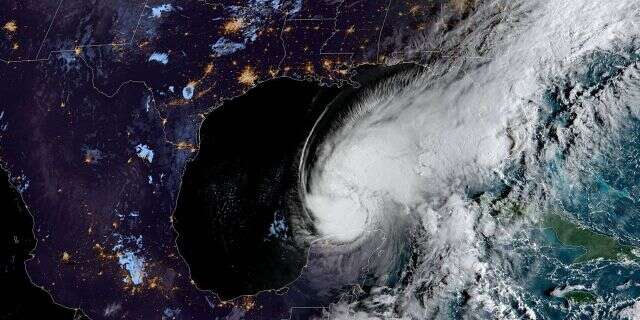
El satélite meteorológico GOES-East muestra el huracán Marie en el Pacífico y la tormenta tropical Gamma cerca de la península de Yucatán;  podrían formarse más ciclones tropicales en la cuenca atlántica en los próximos días.  Imagen: NOAA

AW | 2020 10 04 16:40 | AVIATION SAFETY

NOAA pronostica múltiples amenazas de huracanes Centroamérica

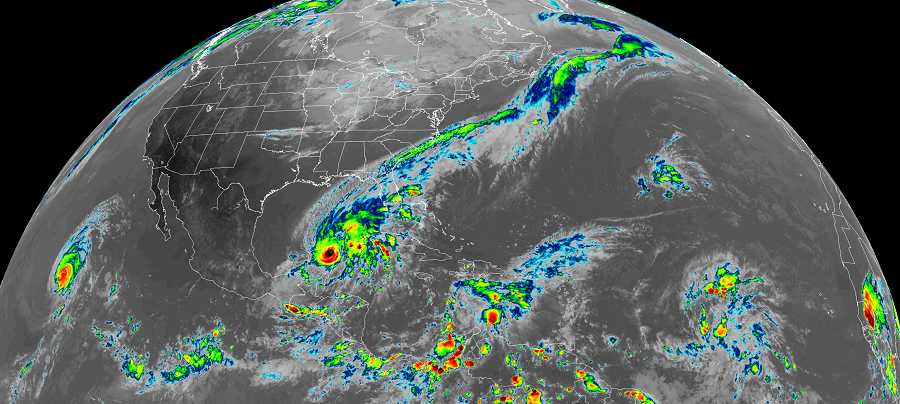
El Centro Nacional de Huracanes (NOAA) está ocupado rastreando múltiples amenazas de ciclones tropicales. Mientras el Huracán Marie gira en las aguas abiertas del Pacífico oriental, hay amenazas más cercanas a la tierra en la cuenca atlántica de huracanes, incluida Gamma, que se encuentra atravesando la península de Yucatán en este momento.

Tormenta Gamma

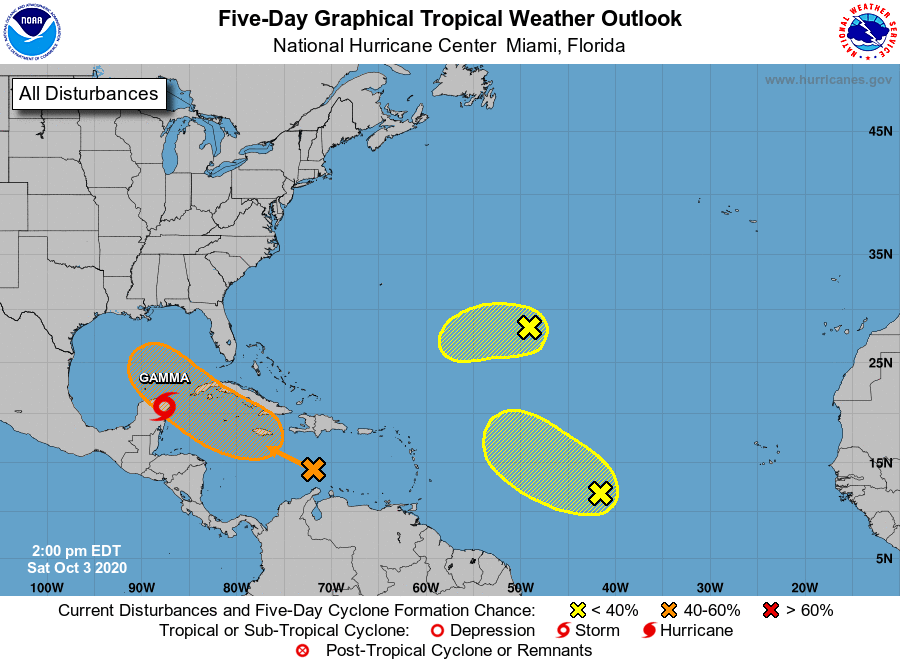
En la última actualización de advertencia del Centro Nacional de Huracanes, la tormenta tropical Gamma se ubicó a unas 35 millas al norte-noroeste de Tulum, México. Con vientos máximos sostenidos de 65 mph, Gamma se mueve hacia el noroeste a 8 mph con una presión central mínima de 985 mb o 29.09 pulgadas. Se espera que Gamma produzca fuertes lluvias durante varios días en partes del sureste de México, la península de Yucatán, América Central y el extremo occidental de Cuba. Esta lluvia podría resultar en inundaciones repentinas y deslizamientos de tierra potencialmente mortales, particularmente en las regiones montañosas del sureste de México y América Central. Aunque Gamma se ha trasladado tierra adentro, las condiciones de tormenta tropical continuarán a lo largo de la costa este de la península de Yucatán hasta esta noche y se espera que se extiendan a lo largo de la costa norte dentro del área de advertencia de tormenta tropical esta noche y el Domingo 04/10. Se pronostica que Gamma hará un giro brusco a la izquierda sobre el Golfo de México abierto y se detendrá allí durante unos días. Para el martes, la tormenta aún debería estar sobre la Bahía de Campeche sobre el sur del Golfo de México.

Ciclón hacia Estados Unidos

Mientras Gamma gira por ahí, un nuevo sistema podría ser más una amenaza para Estados Unidos. Según el Centro Nacional de Huracanes, la actividad de lluvias y tormentas eléctricas se ha consolidado desde ayer cerca de una onda tropical ubicada sobre el Mar Caribe central. Se espera que las condiciones ambientales sean más propicias para el desarrollo, y podría formarse una depresión tropical la próxima semana mientras el sistema se mueve hacia el oeste o oeste-noroeste a unas 15 mph a través del centro y oeste del Mar Caribe y luego hacia el sur del Golfo de México. Si este sistema se convierte en tormenta tropical, se llamaría «Delta». Durante los próximos días, serán posibles lluvias fuertes y ráfagas de viento a nivel local en partes de La Española, Jamaica, Cuba y las Islas Caimán. El Centro Nacional de Huracanes dice que los intereses en esas islas deben monitorear el progreso de esta perturbación. En este momento, dicen que hay un 60% de posibilidades de que este sistema se convierta en un ciclón tropical en los próximos 5 días.

Atlántico tropical central

Otra área de preocupación es una onda tropical ubicada sobre el Atlántico tropical central. Hoy, está produciendo lluvias y tormentas desorganizadas. Se espera que este sistema se mueva hacia el oeste-noroeste o noroeste de 10 a 15 mph, y es posible que se desarrolle algo durante los próximos días antes de que encuentre fuertes vientos en los niveles superiores. Debido a que no tiene mucho tiempo para convertirse en un ciclón tropical, el Centro Nacional de Huracanes dice que solo hay un 20% de probabilidad de que se forme un ciclón en las próximas 48 horas o 5 días.

Atlántico, sobre E-SE Bermudas

La cuarta área de preocupación que está rastreando el Centro Nacional de Huracanes es un área de lluvias desorganizadas y tormentas eléctricas sobre el Atlántico central a más de 1000 millas al este-sureste de Bermuda. Esta zona está asociada a una vaguada superficial de baja presión. Se espera que este sistema se mueva hacia el oeste-suroeste a alrededor de 10 mph, y es posible un desarrollo lento durante los próximos días antes de que también encuentre fuertes vientos en los niveles superiores. Existe una posibilidad incluso menor de que este sistema se convierta en un ciclón tropical, y el Centro Nacional de Huracanes tiene un 10% de posibilidades de formación en las próximas 48 horas o 5 días.

Debido a que la lista de nombres típicos de tormentas se ha agotado este año, el Centro Nacional de Huracanes utilizará letras del alfabeto griego en el futuro. Más allá de Gamma y Delta estarían Epsilon y Zeta. Nunca ha habido una tormenta más allá de Zeta registrada en la cuenca del Atlántico. Es demasiado pronto para saber si eso sucederá este año: la temporada de huracanes continúa hasta finales de Noviembre 2020.

NOAA forecasts multiple cyclones

NOAA Forecasts Multiple Hurricane Threats in Central America

The National Hurricane Center (NOAA) is busy tracking multiple threats from tropical cyclones. As Hurricane Marie swirls in the open waters of the eastern Pacific, there are threats closer to land in the Atlantic basin from hurricanes, including Gamma, which is traversing the Yucatan peninsula at this time.

Gamma Storm

In the latest warning update from the National Hurricane Center, Tropical Storm Gamma was located about 35 miles north-northwest of Tulum, Mexico. With maximum sustained winds of 65 mph, Gamma is moving northwest at 8 mph with a minimum central pressure of 985 mb or 29.09 inches. Gamma is expected to produce heavy rains over several days in parts of southeastern Mexico, the Yucatan Peninsula, Central America and the western tip of Cuba. This rain could result in life-threatening flash floods and landslides, particularly in the mountainous regions of southeastern Mexico and Central America. Although Gamma has moved inland, tropical storm conditions will continue along the east coast of the Yucatán Peninsula until tonight and are expected to extend along the north coast within the tropical storm warning area. tonight and Sunday 04/10. Gamma is forecast to make a sharp left turn over the open Gulf of Mexico and stop there for a few days. By Tuesday, the storm should still be over the Bay of Campeche on the southern Gulf of Mexico.

TROPICAL STORM GAMMA MOVES TOWARDS THE YUCATAN PENINSULA, MEXICO

Cyclone to the United States

As Gamma spins around, a new system could be more of a threat to America. According to the National Hurricane Center, the activity of showers and thunderstorms has consolidated since yesterday near a tropical wave located over the central Caribbean Sea. Environmental conditions are expected to be more conducive to development, and a tropical depression could form next week as the system moves west or west-northwest at about 15 mph through the central and western Caribbean Sea and then toward the southern Gulf of Mexico. If this system becomes a tropical storm, it would be called «Delta». Over the next several days, heavy rains and wind gusts will be possible locally in parts of Hispaniola, Jamaica, Cuba and the Cayman Islands. The National Hurricane Center says interests on those islands should monitor the progress of this disturbance. Right now, they say there is a 60% chance that this system will turn into a tropical cyclone in the next 5 days.

Central tropical Atlantic

Another area of ​​concern is a tropical wave located over the central tropical Atlantic. Today, it is producing disorganized rains and storms. This system is expected to move to the west-northwest or northwest at 10 to 15 mph, and some development is possible over the next several days before it encounters strong upper-level winds. Because it doesn’t take long to become a tropical cyclone, the National Hurricane Center says there is only a 20% chance of a cyclone forming in the next 48 hours or 5 days.

Atlantic, over E-SE Bermuda

The fourth area of ​​concern the National Hurricane Center is tracking is an area of ​​disorganized rainfall and thunderstorms over the central Atlantic more than 1,000 miles east-southeast of Bermuda. This area is associated with a low pressure surface trough. This system is expected to move to the west-southwest at around 10 mph, and slow development is possible over the next several days before it encounters strong upper-level winds as well. There is an even smaller chance of this system becoming a tropical cyclone, and the National Hurricane Center has a 10% chance of formation in the next 48 hours or 5 days.

Because the list of typical storm names has been exhausted this year, the National Hurricane Center will use letters from the Greek alphabet in the future. Beyond Gamma and Delta would be Epsilon and Zeta. There has never been a storm beyond Zeta recorded in the Atlantic basin. It is too early to know if that will happen this year: the hurricane season continues until the end of November 2020.


PUBLISHER: Airgways.com
DBk: Noaa.gov / Weatherboy.com / Airgways.com
AW-POST: 202010041640AR

A\W   A I R G W A Y S ®
Aerolíneas tecnología de desinfección

AW | 2020 10 04 14:43 | AIRLINES / AVIATION SAFETY

Reacondicionamiento sanitario para reapertura de vuelos

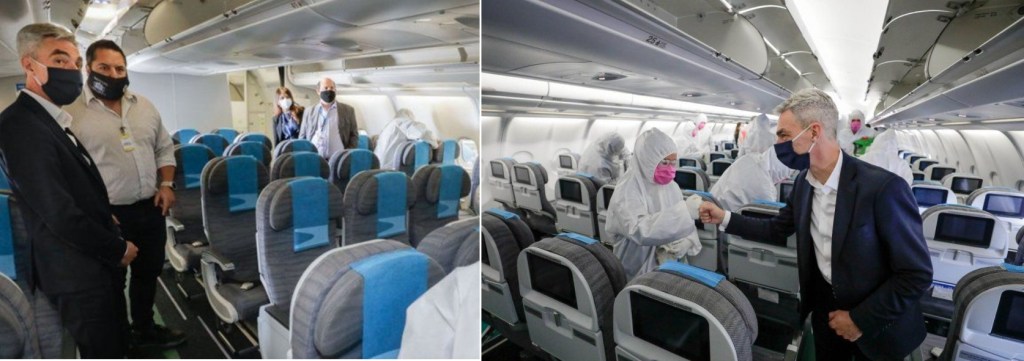
El Ministerio de Transporte de Argentina y el CEO de Aerolíneas Argentinas asistieron a la primera aplicación de un dispositivo que permitiría una mayor eficacia para desinfectar aeronaves. La presentación de evaluación realizada en el Aeropuerto Internacional de Ezeiza con un nuevo dispositivo de desinfección, certificado por el Instituto Malbrán, se emplearía en la aerolínea de Argentina, a poco de la reanudación de los vuelos aerocomerciales hacia mediados de Octubre 2020.

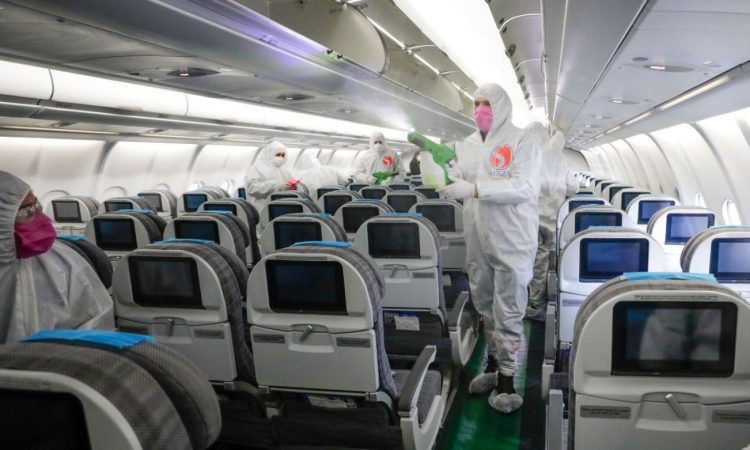
El nuevo aplicador permitirá una mayor efectividad para combatir el Covid-19 en la industria aerocomercial. En la recorrida y muestra, el Ministro de Transporte Mario Meoni junto al CEO de la compañía Pablo Ceriani fueron acompañados por el Director de la Unidad de Contención Biológica del Instituto Malbrán, Alexis Edelstein. La recomendación del Instituto Malbrán es que el nuevo dispositivo permite aplicar una gota mucho más fina, que al esparcirse brinda una mayor cobertura y elimina de las superficies no solo el Coronavirus que provoca la enfermedad Covid-19 sino otros virus y bacterias que habitualmente circulan en los ambientes.

El titular de Aerolíneas, que depende de la cartera de Transporte, dijo que las nuevas medidas de seguridad «hacen que realmente la aeronave sea el medio de transporte más seguro, en términos de Covid, para poder transportarse en un país tan grande como el nuestro. Ya estamos preparados para iniciar la operación cuando las condiciones estén dadas”.

Características técnicas

En cuanto a las características técnicas, Transporte señaló que el nuevo dispositivo de desinfección, de menor tamaño y mayor practicidad que el que se venía utilizando hasta ahora y con un pico que despide gotas de un desinfectante, bactericida y virucida, ya demostró ser eficaz en pruebas anteriores. Al rociar micropartículas, explicó, el aplicador permite que el producto se inserte mejor en cualquier microporo, incluyendo el tapizado de los asientos, lo que hace más efectiva la desinfección. Otro aspecto técnico señalado es que al contar con un dispositivo interno que genera estática positiva, el aplicador permite también una mayor adherencia del desinfectante, bactericida, virucida. El nuevo método empezó a aplicarse en los aviones de Aerolíneas Argentinas; funciona con batería y permite generar un 65 % de ahorro del producto desinfectante, cuyo principio activo es el amonio cuaternario. Luego de la aplicación, se deja actuar durante 10 minutos para que la desinfección sea completa.

Aerolíneas new disinfection technology

Sanitary refurbishment for flight reopening

The Argentine Ministry of Transportation and the CEO of Aerolíneas Argentinas attended the first application of a device that would allow greater efficiency to disinfect aircraft. The evaluation presentation carried out at the Ezeiza International Airport with a new disinfection device, certified by the Malbrán Institute, would be used in the Argentine airline, shortly after the resumption of commercial flights around mid-October 2020.

The new applicator will allow greater effectiveness to combat Covid-19 in the commercial aviation industry. In the tour and exhibition, the Minister of Transport Mario Meoni together with the CEO of the company Pablo Ceriani were accompanied by the Director of the Biological Containment Unit of the Malbrán Institute, Alexis Edelstein. The recommendation of the Malbrán Institute is that the new device allows a much finer drop to be applied, which when spreading provides greater coverage and eliminates from surfaces not only the Coronavirus that causes Covid-19 disease but other viruses and bacteria that usually circulate in environments.

The head of Aerolíneas, which depends on the Transportation portfolio, said that the new security measures «really make the aircraft the safest means of transport, in terms of Covid, to be able to travel in a country as large as ours. We are already prepared to start the operation when the conditions are right».

Technical characteristics

Regarding the technical characteristics, Transporte pointed out that the new disinfection device, smaller in size and more practical than the one that had been used until now and with a spout that emits drops of a bactericidal and virucidal disinfectant, has already proven to be effective in previous tests. By spraying microparticles, he explained, the applicator allows the product to better insert into any micropore, including the seat upholstery, which makes disinfection more effective. Another technical aspect noted is that by having an internal device that generates positive static, the applicator also allows greater adherence of the bactericidal, virucidal disinfectant. The new method began to be applied in Aerolíneas Argentinas planes; it works with battery and allows to generate a 65% saving of the disinfectant product, whose active principle is quaternary ammonium. After application, it is left to act for 10 minutes so that the disinfection is complete.


PUBLISHER: Airgways.com
DBk: Argentina.gob.ar/transporte / Aerolineas.com / Infobae.com / Airgways.com / Clarin.com
AW-POST: 202010041443AR

A\W   A I R G W A Y S ®

Conflicto Azerbaiyán-Armenia

AW | 2020 10 03 19:47 | AVIATION SAFETY / GOVERNMENT

Amenaza terrorista en el sur del Cáucaso puede extenderse a Europa

La República de Azerbaiyán cancela todos los vuelos internacionales en medio de los combates en la ocupada Nagorno-Karabaj. Durante todo el período de conflicto entre Azerbaiyán y Armenia, la escalada nunca llegó a un punto tan crítico. Incluso en Abril de 2016, cuando la parte armenia inició operaciones masivas contra Azerbaiyán, las dos partes nunca habían hablado abiertamente de una guerra con tanta confianza. La movilización del ejército de ambas partes es un hecho alarmante que la comunidad internacional debe tomar en serio.

Por los conflictos entre ambas naciones por el enclave de Nagorno-Karabaj, Azerbaiyán ha cancelado todos los vuelos internacionales excepto aquellos con Turquía, ya que los combates se intensificaron en la región de Nagorno-Karabaj ocupada por los armenios.

El Domingo 27/09, Ukrainian International Airlines anunció que canceló todos los vuelos a la capital armenia, Ereván. «Evaluamos los posibles riesgos y decidimos que el vuelo a Ereván es imposible hasta que las autoridades de aviación de Ucrania aclaren nuestras acciones adicionales y la posición oficial de Bakú y Ereván sobre garantizar la seguridad del espacio de aviación sobre Azerbaiyán y Armenia», Yevheniy Dykhne, dijo en Twitter el Director Ejecutivo de Ukraine International Airlines.

La compañía ucraniana ha tomado experiencia de su último accidente aéreo ocurrido del vuelo PS-752 con un Boeing 737-800 el 8 Enero 2020 al despegar del Aeropuerto internacional Teherán, República Islámica de Irán por error bélico, en medio de un conflicto internacional.

Expansión conflicto

La República de Turquía ha prometido su pleno apoyo a Azerbaiyán en su lucha contra la ocupación y agresión armenias en la ocupada Nagorno-Karabaj. Las Fuerzas Armadas de Azerbaiyán tomaron medidas de contraofensiva en virtud del derecho de la nación a la autodefensa y en pleno cumplimiento del derecho internacional humanitario para frustrar una mayor agresión militar de Armenia y brindar seguridad a las zonas residenciales civiles densamente pobladas. Al calificar la presencia ilegal del ejército armenio en la ocupada Nagorno-Karabaj y las regiones circundantes de Azerbaiyán como una grave amenaza para la paz y la seguridad regionales, el país pidió a la comunidad internacional que condene enérgicamente la política de agresión y las actividades de provocación de Armenia contra Azerbaiyán. El Presidente de Azerbaiyán, Ilham Aliyev, ha ordenado la imposición de la ley marcial en algunas regiones del país y pidió el toque de queda en las principales ciudades.

El espacio aéreo en la zona del Cáucaso se encuentra comprometido para el tránsito de las líneas aéreas debido al incremento de la escalada bélica entre ambos países implicados, pero con el riesgo de convertirse como un reguero de pólvora y extenderse en Asia, Europa con la participación de varios países en el conflicto.

Azerbaijan-Armenia conflict in aviation

Terrorist threat in the South Caucasus may spread to Europe

The Republic of Azerbaijan cancels all international flights amid the fighting in occupied Nagorno-Karabakh. During the entire period of conflict between Azerbaijan and Armenia, escalation never reached such a critical point. Even in April 2016, when the Armenian side launched massive operations against Azerbaijan, the two sides had never openly talked about a war with such confidence. The mobilization of the army on both sides is an alarming development that the international community must take seriously.

Due to conflicts between the two nations over the Nagorno-Karabakh enclave, Azerbaijan has canceled all international flights except those with Turkey, as fighting intensified in the Armenian-occupied Nagorno-Karabakh region.

On Sunday 09/27, Ukrainian International Airlines announced that it has canceled all flights to the Armenian capital Yerevan. «We assessed the possible risks and decided that the flight to Yerevan is impossible until the Ukrainian aviation authorities clarify our further actions and the official position of Baku and Yerevan on ensuring the security of aviation space over Azerbaijan and Armenia», Yevheniy Dykhne the CEO of Ukraine International Airlines said on Twitter.

The Ukrainian company has taken experience from its last plane crash occurred on flight PS-752 with a Boeing 737-800 on January 8, 2020 when taking off from Tehran International Airport, Islamic Republic of Iran due to a military error, in the middle of an international conflict.

Conflict expansion

The Republic of Turkey has pledged its full support to Azerbaijan in its fight against the Armenian occupation and aggression in occupied Nagorno-Karabakh. The Azerbaijani Armed Forces took counteroffensive measures under the nation’s right to self-defense and in full compliance with international humanitarian law to thwart further Armenian military aggression and provide security for densely populated civilian residential areas. Qualifying the illegal presence of the Armenian army in occupied Nagorno-Karabakh and the surrounding regions of Azerbaijan as a serious threat to regional peace and security, the country called on the international community to strongly condemn the policy of aggression and the activities of Azerbaijan. provocation of Armenia against Azerbaijan. Azerbaijan President Ilham Aliyev has ordered the imposition of martial law in some regions of the country and called for a curfew in major cities.

The airspace in the Caucasus area is compromised for the transit of airlines due to the increase in the military escalation between both countries involved, but with the risk of becoming like wildfire and spreading to Asia, Europe with the participation from various countries in conflict.

Ադրբեջան-Հայաստան հակամարտություն ավիացիայում

Հարավային Կովկասում ահաբեկչական սպառնալիքը կարող է տարածվել Եվրոպա

Ադրբեջանի Հանրապետությունը չեղյալ է հայտարարում բոլոր միջազգային թռիչքները գրավյալ Լեռնային Karabakhարաբաղում մարտերի ֆոնին: Ադրբեջանի և Հայաստանի հակամարտության ողջ ընթացքում սրացումը երբեք չի հասել նման կրիտիկական կետի: Նույնիսկ 2016-ի ապրիլին, երբ հայկական կողմը սկսեց զանգվածային գործողություններ Ադրբեջանի դեմ, երկու կողմերը երբեք բացահայտ չէին խոսել պատերազմի մասին այդքան վստահ: Երկու կողմից էլ բանակի մոբիլիզացումը տագնապալի զարգացում է, որին միջազգային հանրությունը պետք է լուրջ վերաբերվի:

Լեռնային Karabakhարաբաղի անկլավի շուրջ երկու ժողովուրդների միջև հակամարտությունների պատճառով Ադրբեջանը չեղյալ է հայտարարել բոլոր միջազգային թռիչքները, բացառությամբ Թուրքիայի հետ իրականացվող չվերթների, քանի որ հայերի կողմից գրավված Լեռնային fightingարաբաղի տարածքում մարտերն ակտիվացել են:

Կիրակի 09/27, Ukrainian International Airlines ավիաընկերությունը հայտարարեց, որ չեղյալ է հայտարարել բոլոր մայրաքաղաք Երևան չվերթները: «Մենք գնահատեցինք հնարավոր ռիսկերը և որոշեցինք, որ դեպի Երևան թռիչքն անհնար է, քանի դեռ ուկրաինական ավիացիոն իշխանությունները չեն պարզաբանել մեր հետագա գործողությունները և Բաքվի և Երևանի պաշտոնական դիրքորոշումը Ադրբեջանի և Հայաստանի օդային տարածքի անվտանգության ապահովման վերաբերյալ», Եվհենի Դիխնե Twitter- ում հայտնել է Ուկրաինայի միջազգային ավիաուղիների գործադիր տնօրենը:

Ուկրաինական ընկերությունը փորձ է վերցրել իր վերջին ավիավթարից, որը տեղի է ունեցել PS-752 չվերթում Boeing 737-800 ինքնաթիռով 2020 թ.-ի հունվարի 8-ին `միջազգային բախման մեջտեղում, Իրանի իսլամական հանրապետության Թեհրանի միջազգային օդանավակայանից ռազմական սխալի պատճառով օդ բարձրանալիս:

Հակամարտությունների ընդլայնում

Թուրքիայի Հանրապետությունը խոստացել է իր լիակատար աջակցությունը ցուցաբերել Ադրբեջանին օկուպացված Լեռնային Karabakhարաբաղում հայկական օկուպացիայի և ագրեսիայի դեմ պայքարում: Ադրբեջանի զինված ուժերը ձեռնարկեցին հակահարձակողական միջոցառումներերկրի ինքնապաշտպանության իրավունքի ներքո և միջազգային մարդասիրական օրենսդրությանը լիովին համապատասխան, խափանելու Հայաստանի կողմից ռազմական հետագա ագրեսիան և ապահովելու խիտ բնակեցված քաղաքացիական բնակավայրերի անվտանգությունը: Օկուպացված Լեռնային արաբաղում և Ադրբեջանի հարակից շրջաններում հայկական բանակի անօրինական ներկայությունը որակելով որպես լուրջ սպառնալիք տարածաշրջանային խաղաղության և անվտանգության համար `երկիրը կոչ է արել միջազգային հանրությանը խստորեն դատապարտել ագրեսիայի քաղաքականությունը և գործողությունները: Հայաստանի սադրանքը Ադրբեջանի դեմ. Ադրբեջանի նախագահ Իլհամ Ալիևը կարգադրել է ռազմական դրություն մտցնել երկրի որոշ շրջաններում և կոչ է արել պարետային ժամ անցկացնել խոշոր քաղաքներում:

Կովկասի տարածքում օդային տարածքը փոխզիջման է ենթարկվում ավիաընկերությունների տարանցման համար ՝ կապված երկու երկրների միջև ռազմական սրացման աճի հետ, բայց կրակի նմանվելու ռիսկի և տարածվելու է Ասիա, Եվրոպա մասնակցությամբ: հակամարտության մեջ գտնվող տարբեր երկրներից:

Azərbaycan-Ermənistan aviasiya münaqişəsi

Cənubi Qafqazdakı terror təhlükəsi Avropaya yayıla bilər

Azərbaycan Respublikası işğal olunmuş Dağlıq Qarabağdakı döyüşlər fonunda bütün beynəlxalq uçuşları ləğv edir. Azərbaycanla Ermənistan arasındakı bütün münaqişə dövründə eskalasiya heç vaxt bu qədər kritik nöqtəyə çatmamışdır. Hələ 2016-cı ilin aprelində, erməni tərəfi Azərbaycana qarşı kütləvi əməliyyatlar başlatdıqda, iki tərəf heç vaxt bu qədər inamla müharibə barədə açıq danışmamışdı. Ordunun hər iki tərəfə səfərbər olması beynəlxalq birliyin ciddi qəbul etməsi lazım olan həyəcan verici bir inkişafdır.

Dağlıq Qarabağ anklavı ilə əlaqədar iki xalq arasındakı qarşıdurmalara görə, Azərbaycan, Ermənistan tərəfindən işğal olunmuş Dağlıq Qarabağ bölgəsində döyüşlərin intensivləşdiyindən Türkiyə ilə olan uçuşlar xaricindəki bütün beynəlxalq uçuşları ləğv etdi.

09/27 Bazar günü Ukrayna Beynəlxalq Hava Yolları, Ermənistanın paytaxtı İrəvana bütün uçuşları ləğv etdiyini açıqladı. «Mümkün riskləri qiymətləndirdik və qərara gəldik ki, Ukrayna aviasiya rəhbərliyi bundan sonrakı hərəkətlərimizə və Bakı ilə İrəvanın Azərbaycan və Ermənistan üzərindəki aviasiya məkanının təhlükəsizliyinin təmin edilməsinə dair rəsmi mövqeyinə aydınlıq gətirməyincə İrəvana uçuşun mümkünsüzlüyüdür», Yevheniy Dyxne Ukrayna Beynəlxalq Hava Yollarının baş icraçı direktoru Twitter-də bildirib.

Ukrayna şirkəti, PS-752 reysində Boeing 737-800 təyyarəsi ilə 8 yanvar 2020-ci il tarixində hərbi bir səhv səbəbiylə İran İslam Respublikasının Tehran Beynəlxalq Hava Limanından havalanarkən, beynəlxalq bir qarşıdurmanın ortasında meydana gələn son təyyarə qəzasından təcrübə götürdü.

Münaqişənin genişlənməsi

Türkiyə Cümhuriyyəti, Ermənistanın işğalına və işğal altındakı Dağlıq Qarabağdakı təcavüzə qarşı mübarizədə Azərbaycana hərtərəfli dəstəyini göstərdi. Azərbaycan Silahlı Qüvvələri, millətin özünümüdafiə hüququ və beynəlxalq humanitar hüquqa tam uyğun olaraq Ermənistanın gələcək hərbi təcavüzünün qarşısını almaq və əhalinin sıx məskunlaşdığı mülki yaşayış yerlərinin təhlükəsizliyini təmin etmək üçün əks-hücum tədbirləri gördü. Ermənistan ordusunun işğal olunmuş Dağlıq Qarabağ və Azərbaycanın ətraf bölgələrində qanunsuz mövcudluğunu regional sülh və təhlükəsizlik üçün ciddi bir təhdid kimi xarakterizə edən ölkə beynəlxalq ictimaiyyəti təcavüz siyasətini və fəaliyyətlərini qətiyyətlə pisləməyə çağırdı. Ermənistanın Azərbaycana qarşı təxribatı. Azərbaycan Prezidenti İlham Əliyev ölkənin bəzi bölgələrində hərbi vəziyyətin tətbiq edilməsi barədə sərəncam verib və böyük şəhərlərdə komendant saatı tətbiq olunmasına çağırıb.

Hər iki tərəf arasında hərbi eskalasiyanın artması səbəbi ilə Qafqaz bölgəsindəki hava məkanı, ancaq meşə atəşinə bənzəmək və iştirakı ilə Asiyaya, Avropaya yayılma riski ilə əlaqədar olaraq, hava yollarının tranziti üçün təhlükəlidir. münaqişə olan müxtəlif ölkələrdən.


PUBLISHER: Airgways.com
DBk: Mfa.gov.az / Dailysabah.com / Twitter.com@BakuAirport / Airgways.com / Bbc.com
AW-POST: 202010031947AR

A\W   A I R G W A Y S ®

Airbus revisión pieza en A380

AW | 2020 10 01 19:29 | AVIATION SAFETY / INDUSTRY

BEA insta revisión piezas Airbus A380 causada por fatiga del metal

Los investigadores de la agencia francesa de aviación, Bureau d’Enquêtes et d’Analyses (BEA) han pedido una revisión del diseño y el mantenimiento del motor GE/Pratt & Whitney Engine Alliance GP7270 de las piezas de aleación de titanio para asegurarse de que protegen contra los riesgos de fatiga del metal tras una explosión del motor en un Airbus A380-800 hace exactamente tres años, en el vuelo AF-066 de Air France que era un vuelo de pasajeros internacional programado desde el Aeropuerto Paris/Charles de Gaulle al Aeropuerto Internacional Los Ángeles, utilizando un Airbus A380-861. El 30 de Septiembre de 2017, la aeronave sufrió una falla incontenible del motor y realizó un aterrizaje de emergencia en el Aeropuerto de Goose Bay, Canadá. El motor fuera de borda Engine Alliance GP7000 del lado derecho falló y el eje del ventilador y la admisión se separaron 150 kilómetros (93 millas) al sureste de Paamiut, Groenlandia, mientras el avión estaba en crucero. Esta fue la segunda falla de motor no contenida que sufrió un Airbus A380, después de la de un motor Rolls-Royce Trent 900 en el vuelo QF-032 de Qantas Airways en 2010.
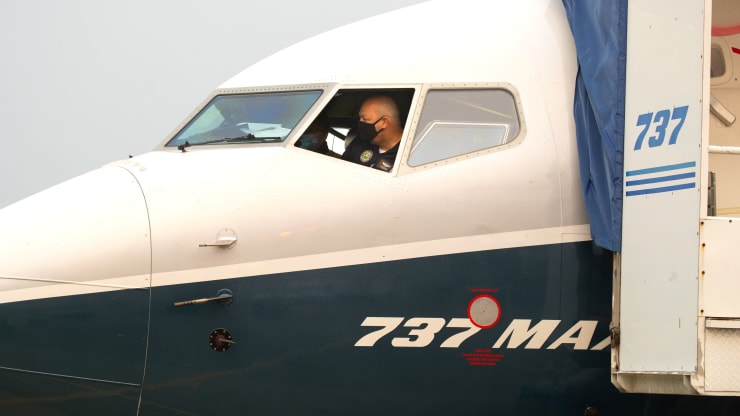
Air France списывает все свои Superjumbo — aeronautica.online

La agencia francesa BEA hizo la recomendación en un informe final sobre el accidente en el que un avión de Air France que transportaba a más de 500 pasajeros perdió la sección delantera de uno de sus cuatro motores mientras volaba sobre Groenlandia, antes de aterrizar de forma segura en Canadá. La medida sigue a una peligrosa investigación que involucra una búsqueda aérea y terrestre internacional de 21 meses a través de la capa de hielo para encontrar un fragmento de aleación de titanio crucial, enterrado a 3 metros bajo la superficie y a solo un metro de una grieta oculta. La sonda se centró en el eje del ventilador en el centro de un ventilador de 3 metros de ancho en la parte delantera del motor fabricado por Engine Alliance, copropiedad de General Electric y Pratt & Whitney.

La BEA dijo que un fragmento recuperado había mostrado pequeñas grietas por fatiga en una aleación de titanio llamada Ti-6-4 e instó a los reguladores, la Administración Federal de Aviación y la Agencia de Seguridad Aérea de la Unión Europea, a llevar a cabo una revisión de los procesos de diseño, fabricación, mantenimiento y certificación. “Ni el fabricante ni las autoridades de certificación habían anticipado este fenómeno en esta aleación durante el diseño del motor”, dijo la Agencia BEA.

Estas recomendaciones de los principales investigadores no tienen que seguirse automáticamente, pero por lo general tienen cierto peso. Engine Alliance dijo que ya había tomado medidas para abordar los hallazgos. Airbus dijo que no se encontraron fallas durante las inspecciones de otros motores del mismo proveedor, uno de los dos fabricantes de motores A380 junto con Rolls-Royce.

Una portavoz de Rolls & Royce dijo que confiaba en que los problemas asociados con la pieza Engine Alliance «no se pueden atribuir a ningún disco de ventilador de motor Rolls-Royce actualmente en servicio». La aleación de titanio se utiliza ampliamente en la industria aeroespacial, el mayor cliente del metal debido a su resistencia en comparación con el peso de cada pieza y su capacidad para soportar altas temperaturas.

Antecedente letal, United UA-232

En el pasado, la industria se ha enfrentado a preocupaciones sobre los procesos de fabricación de aleaciones de titanio después de una falla en el motor. En 1989, una grave explosión del motor central localizado en la deriva de la aeronave de un DC-10 del vuelo UA-323 de United Airlines provocó la muerte de 111 personas durante un intento de aterrizaje en Sioux City, Iowa. Ese choque aceleró las mejoras en los métodos de fabricación de aleaciones de titanio, para reducir al mínimo la contaminación de los materiales desarrollados para evitar impurezas y posterior fatiga de la estructura.

Pero algunos expertos en motores han rechazado cualquier sugerencia de que existe un problema de fabricación en toda la industria. Durante la operación en Groenlandia para encontrar el fragmento faltante del motor A380, especialistas franceses, daneses y estadounidenses enfrentaron problemas desde generadores defectuosos hasta tormentas, tiendas de campaña enterradas y preocupaciones sobre los osos polares, según un informe de la expedición. En un momento, el equipo recurrió a métodos de baja tecnología que incluían palos de bambú y jugo concentrado para marcar la nieve después de que fallara su sistema de posicionamiento de alta precisión, pero la investigación también estimuló el desarrollo de nuevos equipos de sensores.

Airbus review piece on A380

BEA urges review of Airbus A380 parts caused by metal fatigue

Investigators at the French aviation agency, Bureau d’Enquêtes et d’Analyses (BEA) have called for a review of the design and maintenance of the GE/Pratt & Whitney Engine Alliance GP7270 engine of titanium alloy parts to ensure that protect against the risks of metal fatigue following an engine explosion on an Airbus A380-800 exactly three years ago, in flight Air France AF-066 which was an international passenger flight scheduled from Paris/Charles de Gaulle Airport to Los Angeles International Airport, using an Airbus A380-861. On September 30, 2017, the aircraft suffered an irrepressible engine failure and made an emergency landing at Goose Bay Airport, Canada. The right-side Engine Alliance GP7000 outboard failed and the fan shaft and intake were separated 150 kilometers (93 miles) southeast of Paamiut, Greenland, while the aircraft was cruising. This was the second uncontained engine failure suffered by an Airbus A380, following that of a Rolls-Royce Trent 900 engine on Qantas Airways flight QF-032 in 2010.

The French agency BEA made the recommendation in a final report on the accident in which an Air France plane carrying more than 500 passengers lost the forward section of one of its four engines while flying over Greenland, before landing safely in Canada. The move follows a dangerous investigation involving a 21-month international air and ground search through the ice sheet to find a crucial fragment of titanium alloy, buried 10 feet below the surface and just one meter from a hidden crevice. The probe was focused on the fan shaft in the center of a 3 meter wide fan at the front of the engine manufactured by the Engine Alliance, jointly owned by General Electric and Pratt & Whitney.

The BEA said a recovered fragment had shown small fatigue cracks in a titanium alloy called Ti-6-4 and urged regulators, the Federal Aviation Administration and the European Union Aviation Safety Agency, to carry out a review of the design, manufacturing, maintenance and certification processes. «Neither the manufacturer nor the certification authorities had anticipated this phenomenon in this alloy during engine design», said the BEA Agency.

These recommendations from leading researchers do not have to be automatically followed, but they generally carry some weight. The Engine Alliance said it had already taken steps to address the findings. Airbus said no faults were found during inspections of other engines from the same supplier, one of the two A380 engine manufacturers along with Rolls-Royce.

A Rolls & Royce spokeswoman said she was confident that the problems associated with the Engine Alliance part «cannot be attributed to any Rolls-Royce engine fan disc currently in service». Titanium alloy is widely used in the aerospace industry, the metal’s biggest customer due to its strength compared to the weight of each part and its ability to withstand high temperatures.

Lethal history, United UA-232

In the past, the industry has faced concerns about titanium alloy manufacturing processes after engine failure. In 1989, a serious explosion of the central engine located in the drift of a DC-10 aircraft of the United Airlines UA-323 rollover caused the death of 111 people during an attempted landing in Sioux City, Iowa. That crash accelerated the improvements in the manufacturing methods of titanium alloys, to minimize contamination of the materials developed to avoid impurities and subsequent fatigue of the structure.

But some engine experts have rejected any suggestion that there is an industry-wide manufacturing problem. During the operation in Greenland to find the missing piece of the A380 engine, French, Danish and American specialists faced problems from faulty generators to storms, buried tents and concerns about polar bears, according to an expedition report. At one point, the team turned to low-tech methods that included bamboo sticks and concentrated juice to mark snow after their high-precision positioning system failed, but the research also spurred the development of new sensor equipment.

Air France Retires All Airbus A380 with Immediate Effect

Revue d’Airbus sur A380

BEA demande l’examen des pièces de l’Airbus A380 causées par la fatigue du métal

Les enquêteurs de l’agence aéronautique française, le Bureau d’Enquêtes et d’Analyses (BEA) ont appelé à une révision de la conception et de la maintenance du moteur GE/Pratt & Whitney Engine Alliance GP7270 des pièces en alliage de titane pour s’assurer que se protéger contre les risques de fatigue du métal suite à une explosion de moteur sur un Airbus A380-800 il y a exactement trois ans, en vol Air France AF-066 qui était un vol international de passagers programmé de l’aéroport Paris/Charles de Gaulle à l’aéroport international de Los Angeles, en utilisant un Airbus A380-861. Le 30 septembre 2017, l’avion a subi une panne moteur irrépressible et a effectué un atterrissage d’urgence à l’aéroport de Goose Bay, au Canada. Le moteur hors-bord de l’Alliance GP7000 du côté droit est tombé en panne et l’arbre de ventilateur et l’admission ont été séparés à 150 kilomètres (93 miles) au sud-est de Paamiut, au Groenland, pendant que l’avion était en croisière. Il s’agissait de la deuxième panne moteur non confinée subie par un Airbus A380, après celle d’un moteur Rolls-Royce Trent 900 sur le vol Qantas Airways QF-032 en 2010.

L’agence française BEA a fait cette recommandation dans un rapport final sur l’accident au cours duquel un avion d’Air France transportant plus de 500 passagers a perdu la partie avant d’un de ses quatre moteurs en survolant le Groenland, avant d’atterrir en toute sécurité. au Canada. Cette décision fait suite à une enquête dangereuse impliquant une recherche aérienne et terrestre internationale de 21 mois à travers la calotte glaciaire pour trouver un fragment crucial d’alliage de titane, enterré à 10 pieds sous la surface et à seulement un mètre d’une crevasse cachée. La sonde était focalisée sur l’arbre du ventilateur au centre d’un ventilateur de 3 mètres de large à l’avant du moteur fabriqué par Engine Alliance, détenue conjointement par General Electric et Pratt & Whitney.

Le BEA a déclaré qu’un fragment récupéré avait montré de petites fissures de fatigue dans un alliage de titane appelé Ti-6-4 et a exhorté les régulateurs, la Federal Aviation Administration et l’Agence de la sécurité aérienne de l’Union européenne, à effectuer un examen des processus de conception, de fabrication, de maintenance et de certification. «Ni le constructeur ni les autorités de certification n’avaient anticipé ce phénomène dans cet alliage lors de la conception du moteur», a précisé l’agence BEA.

Ces recommandations de chercheurs renommés n’ont pas à être suivies automatiquement, mais elles ont généralement un certain poids. Engine Alliance a déclaré qu’elle avait déjà pris des mesures pour répondre aux conclusions. Airbus a déclaré qu’aucun défaut n’avait été trouvé lors des inspections d’autres moteurs du même fournisseur, l’un des deux fabricants de moteurs A380 avec Rolls-Royce.

Une porte-parole de Rolls & Royce a déclaré qu’elle était convaincue que les problèmes associés à la partie Engine Alliance «ne peuvent être attribués à aucun disque de ventilateur de moteur Rolls-Royce actuellement en service». L’alliage de titane est largement utilisé dans l’industrie aérospatiale, le plus gros client du métal en raison de sa résistance par rapport au poids de chaque pièce et de sa capacité à résister à des températures élevées.

Histoire mortelle, United UA-232

Dans le passé, l’industrie a été confrontée à des préoccupations concernant les processus de fabrication d’alliages de titane après une panne de moteur. En 1989, une grave explosion du moteur central situé dans la dérive d’un avion DC-10 du retournement United Airlines UA-323 a causé la mort de 111 personnes lors d’une tentative d’atterrissage à Sioux City, Iowa. amélioration des méthodes de fabrication des alliages de titane, pour minimiser la contamination des matériaux développés pour éviter les impuretés et la fatigue consécutive de la structure.

Mais certains experts en moteurs ont rejeté toute suggestion selon laquelle il existe un problème de fabrication à l’échelle de l’industrie. Au cours de l’opération au Groenland pour trouver la pièce manquante du moteur A380, des spécialistes français, danois et américains ont été confrontés à des problèmes allant des générateurs défectueux aux tempêtes, aux tentes enterrées et aux préoccupations concernant les ours polaires, selon un rapport d’expédition. À un moment donné, l’équipe s’est tournée vers des méthodes de basse technologie qui comprenaient des bâtons de bambou et du jus concentré pour marquer la neige après l’échec de leur système de positionnement de haute précision, mais la recherche a également stimulé le développement d’un nouvel équipement de détection.


PUBLISHER: Airgways.com
DBk: Bea.aero / Airbus.com / Airgways.com
AW-POST: 202010011929AR

A\W   A I R G W A Y S ®

FAA realiza test vuelo Boeing 737MAX

AW | 2020 09 30 18:35 | AVIATION SAFETY

Jefe FAA optimista test vuelo Boeing 737 MAX

El Jefe Steve Dickson de la Administración Federal de Aviación (FAA) ha iniciado en el día Miércoles, 30 Septiembre 2020 un vuelo de prueba a los mandos de un Boeing 737-7 MAX junto al equipo de trabajo del organismo y la compañía aeroespacial The Boeing Company. El vuelos realizado permite mostrar un enfoque optimista sobre el Boeing 737 MAX después de probar el avión este 30/09, el último giro en el proceso de test de vuelos hacia la recertificación aeronáutica. Steve Dickson, un ex piloto comercial y militar, dijo el año pasado que no autorizaría el servicio de los aviones a menos que él mismo pilotara el jet.

Los aviones 737 MAX, el más vendido de Boeing, han estado en tierra en todo el mundo desde Marzo de 2019 después de que los accidentes en Etiopía e Indonesia mataran a 346 personas. Desde entonces, Boeing ha realizado varios cambios en los aviones. Los pilotos de ambos accidentes lucharon con un sistema de control de vuelo automatizado, que desde entonces el fabricante ha hecho menos poderoso.

Después de las pruebas de test de vuelos en la aeronave Boeing 737-7 MAX, ante la audiencia de periodistas, el Jefe de la FAA, expresó: “Me gustó lo que vi. Sentí que el entrenamiento me preparó para estar muy cómodo”, dijo Steve Dickson después de no haber volado un Boeing 737 en casi quince años.

Perspectivas 737 MAX

La revisión de los aviones por parte de la FAA y otros reguladores mundiales y la nueva capacitación que deberá aprobarse antes de que los aviones puedan volver al servicio están progresando. Eso podría concluir en los próximos meses, pero el Jefe de la FAA ha reiterado que la agencia no tiene un cronograma firme de devolución para el retorno a los cielos de la última variante de la línea 737..

Varias compañías aéreas continúan esperando las aprobaciones de los organismos respectivos de aviación para activar las flotas en el mundo, y al mismo tiempo por parte de la constructora aeroespacial reiniciar la línea de la cadena de producción en Everett, WA.

Southwest Airlines es el mayor cliente del Boeing 737 MAX y American Airlines, con 24 aviones en su flota se está preparando para entrenar a sus pilotos del 737 MAX a principios de Noviembre 2020. El entrenamiento de los pilotos podría llevar semanas y aún no está claro si los aviones podrían regresar a las flotas comerciales antes de 2020.

FAA conducts Boeing 737MAX flight test

Optimistic FAA Chief test flight Boeing 737 MAX

The Chief Steve Dickson of the Federal Aviation Administration (FAA) has started on Wednesday, September 30, 2020 a test flight at the controls of a Boeing 737-7 MAX with the work team of the agency and the aerospace company The Boeing Company. The flights carried out allow us to show an optimistic approach to the Boeing 737 MAX after testing the plane on 09/30, the last turn in the flight test process towards aeronautical recertification. Steve Dickson, a former commercial and military pilot, said last year that he would not authorize service of the planes unless he piloted the jet himself.

Boeing’s best-selling 737 MAX jets have been grounded worldwide since March 2019 after accidents in Ethiopia and Indonesia killed 346 people. Since then, Boeing has made several changes to the planes. The pilots in both accidents struggled with an automated flight control system, which the manufacturer has since made less powerful.

THE FEDERAL AVIATION ADMIINSTRATION (FAA) CHIEF STEVE DICKSON SITTING INSIDE THE COCKPIT OF A BOEING 737 MAX AIRCRAFT, CONDUCTS A PRE-FLIGHT CHECK BEFORE AN ASSESSMENT FLIGHT FROM BOEING FIELD IN SEATTLE, WA, ON SEPTEMBER 30, 2020.

After the flight tests on the Boeing 737-7 MAX aircraft, before the audience of journalists, the Chief of the FAA said: “I liked what I saw. I felt that the training prepared me to be very comfortable”, said Steve Dickson after not having flown a Boeing 737 in almost 15 years.

Perspective 737 MAX

Review of the planes by the FAA and other global regulators and the new training that will need to pass before the planes can return to service are progressing. That could wrap up in the coming months, but the FAA Chief has reiterated that the agency does not have a firm return schedule for the return to heaven of the latest variant of line 737.

Several airlines continue to wait for approvals from the respective aviation bodies to activate the fleets in the world, and at the same time from the aerospace construction company to restart the production chain line in Everett, WA.

Southwest Airlines is the largest customer for the Boeing 737 MAX and American Airlines, with 24 aircraft in its fleet is preparing to train its 737 MAX pilots in early November 2020. Pilot training could take weeks and is still unclear. whether planes could return to commercial fleets before 2020.


PUBLISHER: Airgways.com
DBk: Faa.gov / Boeing.com / Airgways.com / Gettyimages.com / King5.com
AW-POST: 202009301835AR

A\W   A I R G W A Y S ®