United ambiente seguro post-pandemia
AW | 2021 03 19 16:03 | AIRLINES / AVIATION TECHNOLOGY

Seguridad sistema filtración aérea en post-pandemia

United-Isologotype-001

A un año después de que la pandemia de Coronavirus ha impactado en el mundo de la aviación comercial occidental y detuviera la industria aérea, algunos han dicho que volar nunca ha sido tan limpio. Aunque el Aeropuerto Internacional de Denver sigue operando a una capacidad drásticamente reducida en comparación con los números previos a la pandemia, United Airlines dijo que están regresando lenta pero seguramente a medida que el tiempo continúa.

Matt Miller, Vicepresidente del Centro de United Airlines en Denver (CO), dijo que la aerolínea está operando actualmente a alrededor del 50% de su capacidad regular. Ese número sigue aumentando a medida que se distribuyen las vacunas y los estadounidenses se sienten más cómodos con los viajes nacionales. En comparación con el inicio de la pandemia, el 50% es un progreso bienvenido para el negocio. «Estamos en el primer aniversario de cuando el coronavirus comenzó a afectar a la industria de viajes. Esta vez el año pasado vimos una disminución del 95% en el volumen de clientes que viajan a través de nuestros aeropuertos», dijo Matt Miller.

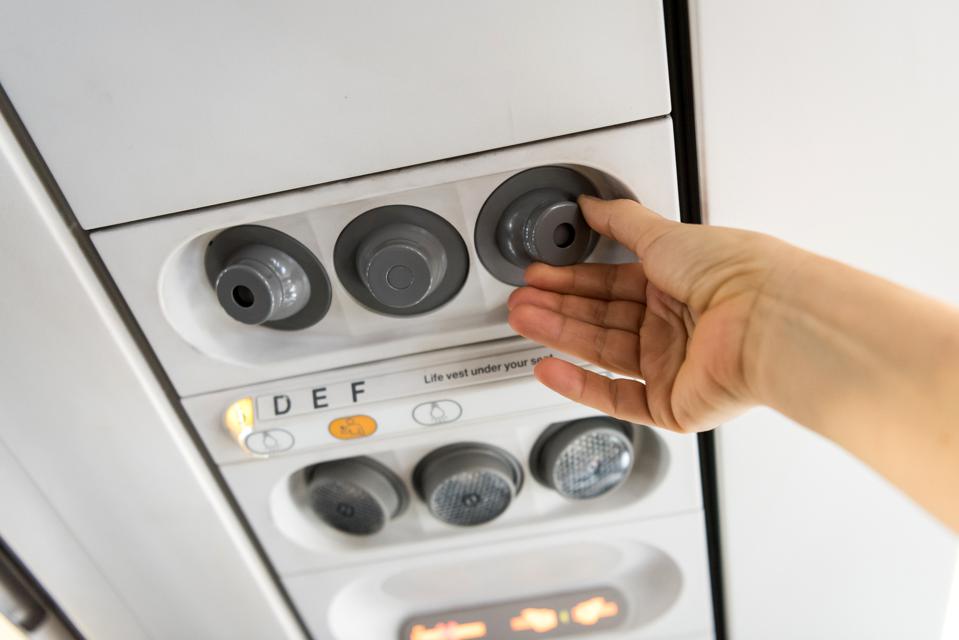
La dificultad de la confianza de los usuarios estadounidenses les preocupaba volar confinados en espacios estrechos donde el distanciamiento social era difícil. Algunos sugirieron que el aire también era peligroso para respirar dentro del avión. Sin embargo, United Airlines ha permitido dar a conocer un recorrido por uno de sus aviones para mostrar cómo la compañía está aplastando conceptos erróneos de salud y promoviendo viajes seguros. A bordo de los aviones hay sistemas de ventilación HEPA. Los filtros grandes debajo de la cabina filtran constantemente el aire a bordo del avión. El sistema de ventilación ahora funciona desde el embarque hasta el desplanificador, mientras que antes de la pandemia ese sistema se apagaba a menos que el avión se moviera. Mientras que algunos han sugerido que el oxígeno de la cabina no está limpio, Matt Miller desacreditó esas afirmaciones explicando cómo funciona el avión. El aire nuevo se lleva al avión de 20 a 30 veces por hora. Eso significa que cada dos o tres minutos el avión ha sacado aire viejo de manera circular con nuevo aire limpio para los pasajeros. «Lo que esto hace es ofrecer una fuente continua de aire fresco a la cabina para mantener a la gente segura», dijo Joe Rundell, Mecánico de aviones de United.

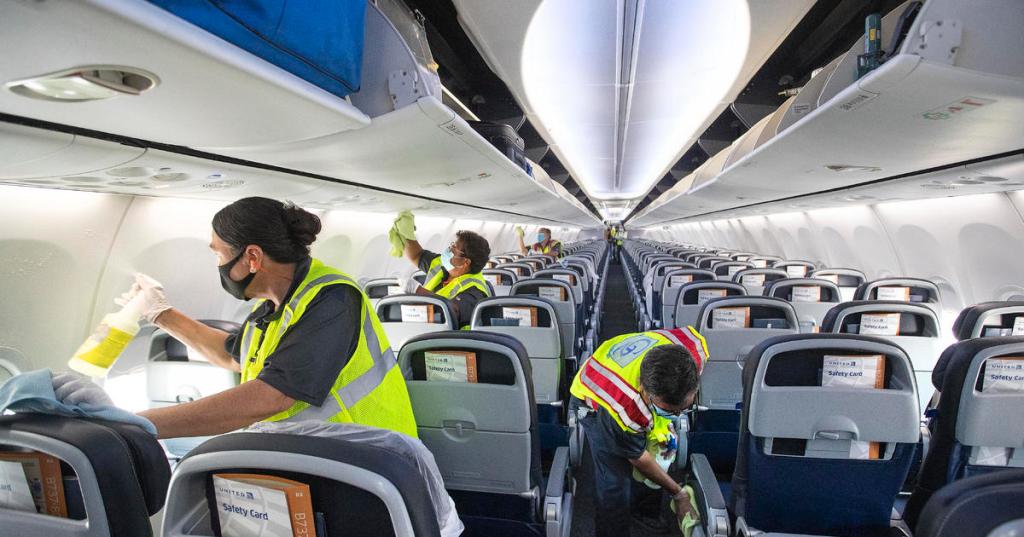
Ese aire se distribuye desde arriba, y succionado para la filtración en el pie de la base de la cabina. «El avión tira de todo el aire hasta el suelo, y eso es lo que crea el ambiente seguro. Es realmente uno de los lugares más seguros donde puedes estar en el interior», dijo Matt Miller. Las tripulaciones limpian el avión entre cada vuelo. Las plataformas se limpian con toallitas de saneamiento. Entre cada vuelo, un spray electrostático desinfecta cada asiento a bordo del vuelo.

United Airlines se asoció con el Departamento de Defensa de estados Unidos para estudiar la seguridad de volar en medio de la pandemia. El estudio encontró que incluso cuando el avión está lleno, en promedio sólo el 0,003% de las partículas de aire infectadas podrían entrar en la zona de respiración de los pasajeros sentados y enmascarados.

Algunas aerolíneas también han transformado el proceso de facturación con el advenimiento de la pandemia ofreciendo un check-in sin contacto en el Aeropuerto de Denver/DIA. Al descargar una aplicación, algunos viajeros de aerolíneas ahora pueden facturar su vuelo, cambiar sus asientos e incluso imprimir su etiqueta de equipaje sin tocar nunca el quiosco o hablar directamente con un empleado. «Los diversos pasos que empezamos a hacer que el viaje más seguro para nuestros clientes, fue entonces cuando empezamos a ver a la gente sintiéndose cómoda al volver y viajar de nuevo. Cuando regresen y vuelen de nuevo se sentirán seguros y cómodos al saber que hemos dado todos los pasos para garantizar su seguridad», dijo Matt Miller.

United promotes post-pandemic environment
United explains post-pandemic air filtration system

A year after the Coronavirus pandemic has impacted the Western commercial aviation world and brought the airline industry to a standstill, some have said that flying has never been so clean. Although Denver International Airport continues to operate at drastically reduced capacity compared to pre-pandemic numbers, United Airlines said they are slowly but surely returning as time continues.

Matt Miller, Vice President of the United Airlines Center in Denver (CO), said the airline is currently operating at about 50% of its regular capacity. That number continues to rise as vaccines are distributed and Americans become more comfortable with domestic travel. Compared to the start of the pandemic, 50% is welcome progress for the business. «We are on the first anniversary of when the coronavirus began to affect the travel industry. This time last year we saw a 95% decrease in the volume of customers traveling through our airports», said Matt Miller.
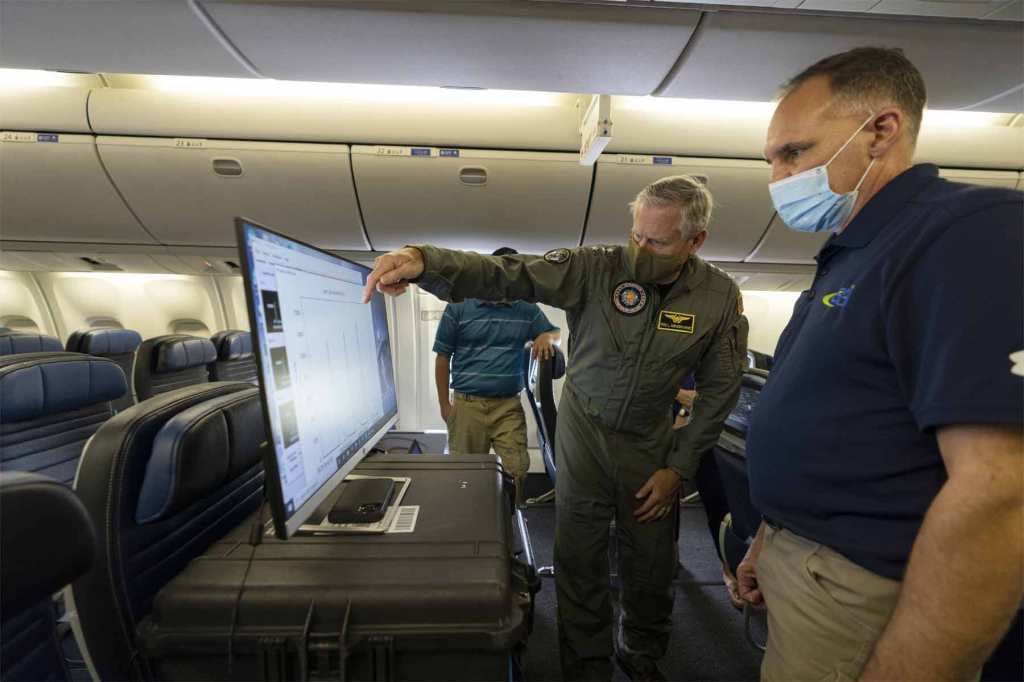

DAVID SILCOTT, LEFT, CHIEF EXECUTIVE OF S3I, GOES OVER AN AIRFLOW PARTICLE TEST FOR NAVY VICE ADM. DEE MEWBOURNE, RIGHT, DEPUTY COMMANDER, U.S. TRANSPORTATION COMMAND, ON BOARD A UNITED AIRLINES 767 AIRCRAFT AT DULLES INTERNATIONAL AIRPORT, VA., AUG. 28, 2020.

Confidence difficulty US users worried about flying confined in tight spaces where social distancing was difficult. Some suggested that the air was also dangerous to breathe inside the plane. However, United Airlines has released a tour of one of its planes to show how the company is squashing health misconceptions and promoting safe travel. There are HEPA ventilation systems on board the aircraft. Large filters under the cabin constantly filter the air on board the aircraft. The ventilation system now works from boarding to the deburrer, whereas before the pandemic that system was turned off unless the plane moved. While some have suggested that the cabin oxygen is not clean, Matt Miller debunked those claims by explaining how the plane works. New air is brought into the plane 20 to 30 times an hour. That means every two to three minutes the plane has blown old air out of the way with clean new air for the passengers. «What this does is provide a continuous source of fresh air to the cabin to keep people safe», said Joe Rundell, United Aircraft Mechanic.

That air is distributed from above, and sucked in for filtration at the foot of the cabin base. «The plane pulls all the air down to the ground, and that’s what creates the safe environment. It’s really one of the safest places you can be inside», said Matt Miller. Crews clean the plane between each flight. Platforms are cleaned with sanitation wipes. Between each flight, an electrostatic spray disinfects each seat on board the flight.

United Airlines partnered with the US Department of Defense to study the safety of flying amid the pandemic. The study found that even when the plane is full, on average only 0.003% of infected air particles could enter the breathing zone of seated and masked passengers.

Some airlines have also transformed the check-in process with the advent of the pandemic by offering contactless check-in at Denver Airport/DIA. By downloading an app, some airline travelers can now check in for their flight, change their seats, and even print their luggage tag without ever touching the kiosk or speaking directly to an employee. «The various steps we started to make travel safer for our clients, that’s when we started to see people feeling comfortable coming back and traveling again. When they return and fly again they will feel safe and comfortable knowing that we have taken every step to ensure his safety», said Matt Miller.


PUBLISHER: Airgways.com
DBk: United.com / Military.com / Airgways.com
AW-POST: 202103191603AR

A\W   A I R G W A Y S ®
Maldivas incrementa vuelos

AW | 2021 03 19 15:50 | AIR TRAFFIC / GOVERNMENT

Aerolíneas internacionales operan actualmente vuelos a Maldivas

Flag_of_Maldives.svg

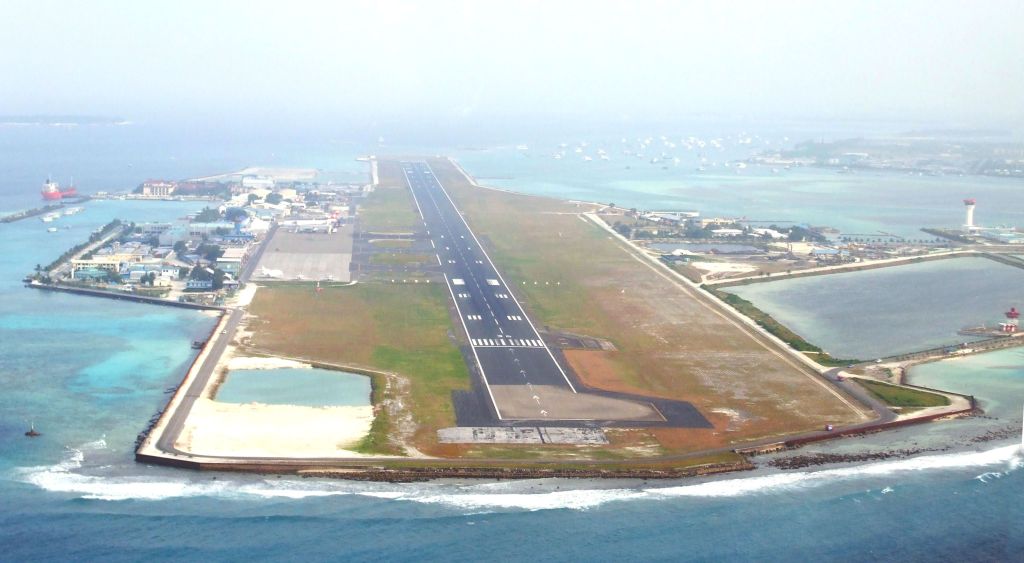
Las Islas Maldivas han comunicado que se encuentran incrementando el número de tráfico de pasajeros después de que el Gobierno ha abierto los vuelos internacionales a mitad de año 2020. Las últimas estadísticas publicadas por el Ministerio de Turismo de las Islas Madivas revelaron que varias aerolíneas internacionales están aumentando la frecuencia de vuelos a la nación insular, a la luz de la creciente demanda de visitantes. Actualmente se contabiliza una treinta aerolíneas internacionales están operando vuelos a Maldivas.

Mientras Maldivas dejó de emitir visas a su llegada el 27 de Marzo de 2020, casi cuatro meses después el Gobierno reabrió las fronteras para los viajes internacionales, tras lo cual Qatar Airways fue la primera aerolínea en iniciar operaciones de vuelo a la nación insular. Emirates Airline ha transportado el mayor número de pasajeros a las Maldivas con 48.098, en 540 vuelos. En segundo lugar Qatar Airways con 446 vuelos y 34.436 pasajeros, seguido de IndiGo con 496 vuelos y 32.248 pasajeros. Otras aerolíneas que operan vuelos a Maldivas incluyen: Go Air con 490 vuelos y 30.370 pasajeros, Aeroflot Russian Airlines con 150 vuelos y 27.240 pasajeros, Turkish Airlines con 88 vuelos y 11.104 pasajeros, flydubai con 174 vuelos y 8.889 pasajeros, Lufthansa German Airlines con 58 vuelos y 6.284 pasajeros, Azur Air Rusia con 22 vuelos y 5.833 pasajeros, Austrian Airlines con 44 vuelos y 4.888 pasajeros, Edelweiss Air con 50 vuelos y 4.881 pasajeros, Condor Airlines con 44 vuelos y 4.495 pasajeros, Etihad Airways con 112 vuelos y 3.551 pasajeros, Sri Lankan Airlines con 228 vuelos y 1.842 pasajeros, Air India con 44 vuelos y 1.829 pasajeros, British Airways con 62 vuelos y 1.791 pasajeros, Lot Polish Airlines con ocho vuelos y 1.088 pasajeros, Silk Air con 44 vuelos y 1.077 pasajeros, Gulf Air con 18 vuelos y 209 pasajeros, Air France con seis vuelos y 166 pasajeros, Air Seychelles con seis vuelos y 72 passengers, mientras que otros 488 pasajeros aterrizaron en Maldivas en otras aerolíneas. Desde que se reabrieron las fronteras de la aerolínea nacional del país, Maldivas también ha transportado a 6.395 pasajeros. Además, algunas de las aerolíneas internacionales que operan vuelos fletados a Maldivas incluyen Air Astana, Azur Air Ukraine, Gullivair, Ukraine International, Scat Airlines, Uzbekistán Airways, Vistara Airlines, Blue Air y Garuda Indonesia Airlines.

Maldivas recibió el Jueves 18/03 a 247.138 turistas, de los cuales las mayores llegadas se registraron desde la India, aportando el 23,8 por ciento del total de llegadas. En segundo lugar se produce desde la Federación Rusia que aporta el 21,7 por ciento de la tasa total de llegadas, seguida de Ucrania, que acumula el 6,5 por ciento del total de arribos. Las cifras de llegada de turistas de los principales mercados de origen para el Miércoles 18/03 representan: 57.965 visitantes de la India, 52.902 visitantes de Rusia, 15.940 visitantes de Ucrania, 10.488 visitantes de Kazajstán, 10.393 visitantes de Alemania, 8.394 visitantes procedentes de Rumania, 6.576 visitantes de la República Checa, 6.185 visitantes de Francia, 5.950 visitantes de EE.UU., 5.931 visitantes procedentes de Suiza. Las Islas Maldivas tiene como objetivo acoger a 1,5 millones de llegadas de turistas este año en curso.

Maldives increases flights

International airlines currently operate flights to Maldives

The Maldives Islands have reported that they are increasing the number of passenger traffic after the Government has opened international flights in the middle of 2020. The latest statistics published by the Madivas Islands Ministry of Tourism revealed that several international airlines are increasing the frequency of flights to the island nation, in light of the increasing demand of visitors. Currently there are thirty international airlines operating flights to Maldives.

While the Maldives stopped issuing visas upon arrival on March 27, 2020, almost four months later the Government reopened the borders for international travel, after which Qatar Airways was the first airline to begin flight operations to the island nation. Emirates Airline has carried the largest number of passengers to the Maldives with 48,098, on 540 flights. In second place Qatar Airways with 446 flights and 34,436 passengers, followed by IndiGo with 496 flights and 32,248 passengers. Other airlines operating flights to Maldives include: Go Air with 490 flights and 30,370 passengers, Aeroflot Russian Airlines with 150 flights and 27,240 passengers, Turkish Airlines with 88 flights and 11,104 passengers, flydubai with 174 flights and 8,889 passengers, Lufthansa German Airlines with 58 flights and 6,284 passengers, Azur Air Russia with 22 flights and 5,833 passengers, Austrian Airlines with 44 flights and 4,888 passengers, Edelweiss Air with 50 flights and 4,881 passengers, Condor Airlines with 44 flights and 4,495 passengers, Etihad Airways with 112 flights and 3,551 passengers, Sri Lankan Airlines with 228 flights and 1,842 passengers, Air India with 44 flights and 1,829 passengers, British Airways with 62 flights and 1,791 passengers, Lot Polish Airlines with eight flights and 1,088 passengers, Silk Air with 44 flights and 1,077 passengers, Gulf Air with 18 flights and 209 passengers, Air France with six flights and 166 passengers, Air Seychelles with six flights and 72 passengers, while another 488 passengers landed in Maldives on other airlines. Since the borders of the country’s national airline were reopened, the Maldives has also carried 6,395 passengers. Also, some of the international airlines operating chartered flights to Maldives include Air Astana, Azur Air Ukraine, Gullivair, Ukraine International, Scat Airlines, Uzbekistan Airways, Vistara Airlines, Blue Air, and Garuda Indonesia Airlines.

Maldives received 247,138 tourists on Thursday 03/18, of which the largest arrivals were from India, contributing 23.8 percent of total arrivals. In second place, it comes from the Russian Federation, which contributes 21.7 percent of the total arrival rate, followed by Ukraine, which accumulates 6.5 percent of total arrivals. The tourist arrival figures for the main markets of origin for Wednesday 03/18 represent: 57,965 visitors from India, 52,902 visitors from Russia, 15,940 visitors from Ukraine, 10,488 visitors from Kazakhstan, 10,393 visitors from Germany, 8,394 visitors from Romania, 6,576 visitors from the Czech Republic, 6,185 visitors from France, 5,950 visitors from the US, 5,931 visitors from Switzerland. The Maldives Islands is aiming to host 1.5 million tourist arrivals this current year.


PUBLISHER: Airgways.com
DBk: Tourism.gog.mv / Airgways.com
AW-POST: 202103191550AR

A\W   A I R G W A Y S ®

British considera venta sede

AW | 2021 03 19 15:33 | AIRLINES

Ajustes de la aerolínea en medio de la pandemia global

British Airways_Isologotype

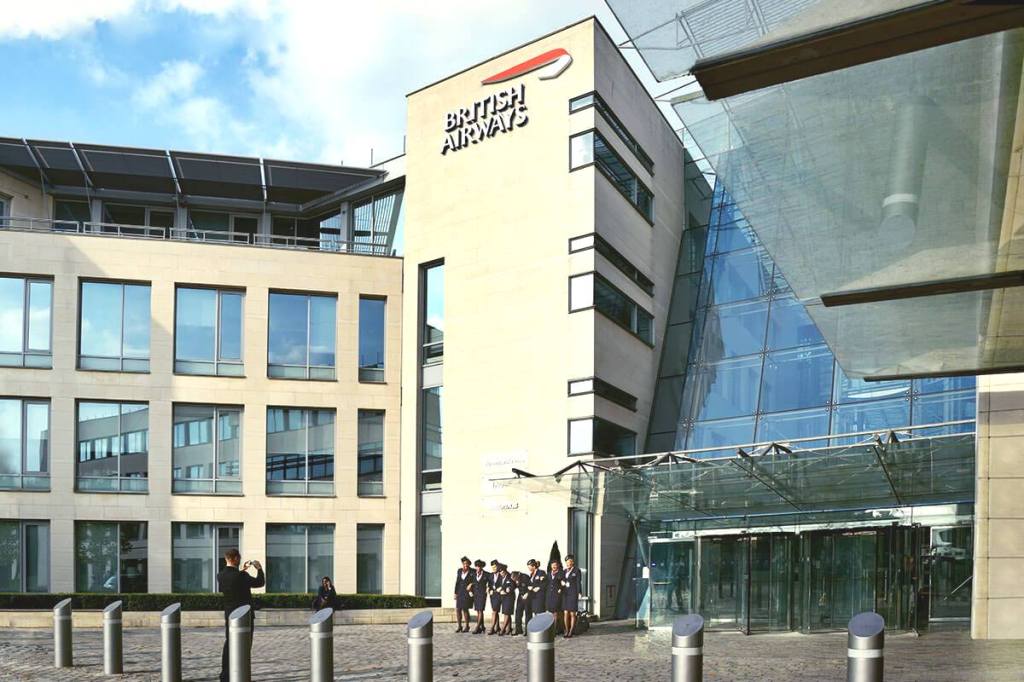
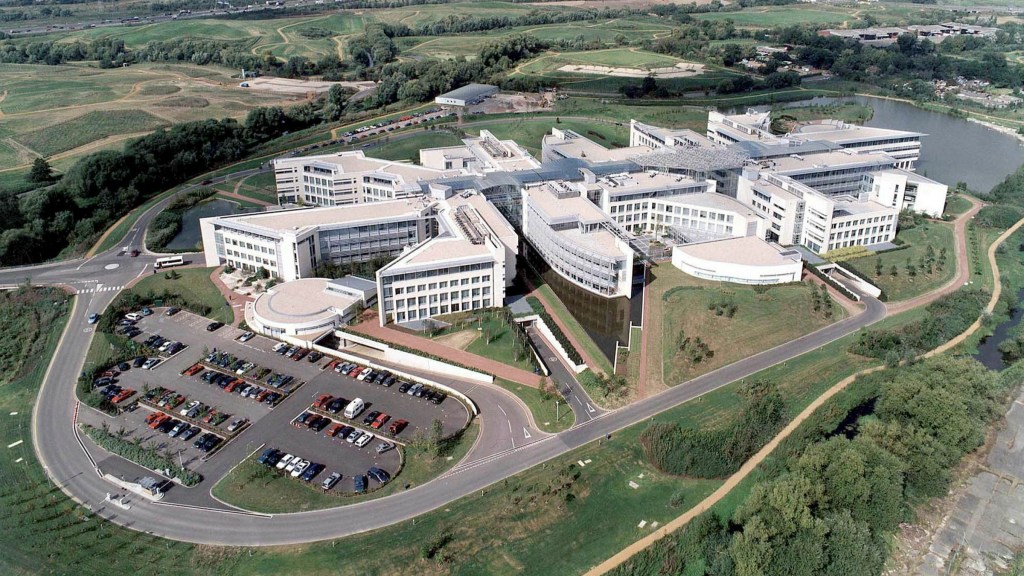
El cambio al trabajo a distancia lleva a British Airways a considerar vender su sede corporativa. El transportador del Reino Unido, se encuentra considerando satisfecho el trabajo a distancia como un plan de oficina flexible más permanente. Por esta razón British Airways está considerando vender su extensa sede en la periferia del Aeropuerto London/Heathrow, ya que la pandemia lleva a más compañías a aceptar el trabajo a distancia a largo plazo.

La aerolínea, una de las unidades más grandes de Europa y la más grande de International Consolidated Airlines Group SA, se ha visto azotada por el impacto de la pandemia. La compañía dijo que la medida está siendo considerada a la luz del entusiasmo de los empleados por el trabajo a distancia. Una posible venta también podría aumentar el efectivo y ayudar a British Airways a reducir los costos en medio de una tensión financiera provocada por la pandemia.

La aerolínea, como la mayoría de las otras grandes compañías, pidió a gran parte de su fuerza de trabajo que trabajara desde casa a principios del año pasado. Los empleados se adaptaron bien a eso, dijo la compañía, y los empleados están ansiosos por continuar trabajando flexible después de que es seguro regresar a las oficinas. El Gobierno del Reino Unido ha dicho que permitiría la reapertura de las oficinas a finales de Junio 2021.

British considers sale of headquarters

Airline adjustments amid global pandemic

The shift to telecommuting leads British Airways to consider selling its corporate headquarters. The UK transporter is satisfied with telecommuting as a more permanent flexible office plan. For this reason British Airways is considering selling its sprawling headquarters on the outskirts of London / Heathrow Airport, as the pandemic prompts more companies to accept long-term telecommuting.

The airline, one of the largest units in Europe and the largest of International Consolidated Airlines Group SA, has been hit by the impact of the pandemic. The company said the move is being considered in light of employees’ enthusiasm for telecommuting. A potential sale could also raise cash and help British Airways cut costs amid financial strain from the pandemic.

The airline, like most other large companies, asked much of its workforce to work from home early last year. Employees have adapted well to that, the company said, and employees are eager to continue working flexibly after it is safe to return to the offices. The UK Government has said it would allow the offices to reopen at the end of June 2021.


PUBLISHER: Airgways.com
DBk: Britishairways.com / Airgways.com
AW-POST: 202103191533AR

A\W   A I R G W A Y S ®
Aprueban presupuesto Aerolíneas

AW | 2021 03 19 10:39 | AIRLINES

Aprueban presupuesto 2021 para Aerolíneas Argentinas

Aerolíneas Argentinas_Isologotype 2010

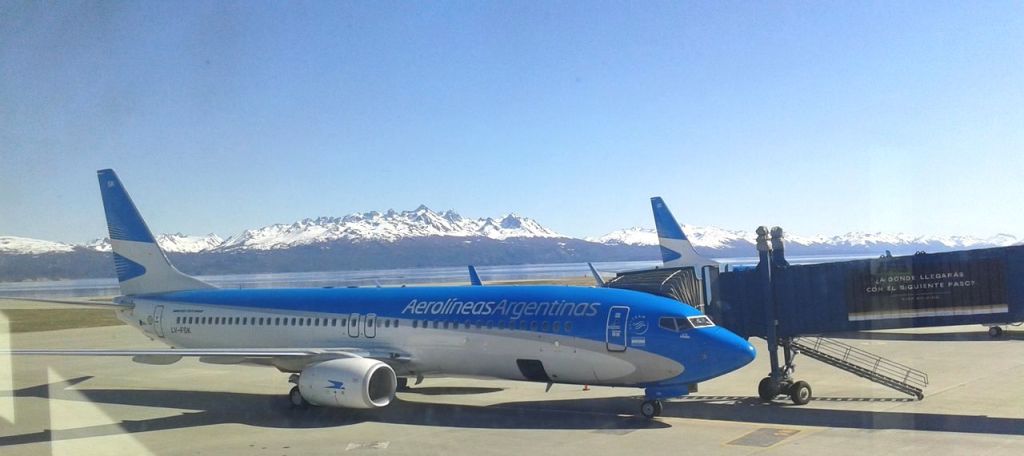
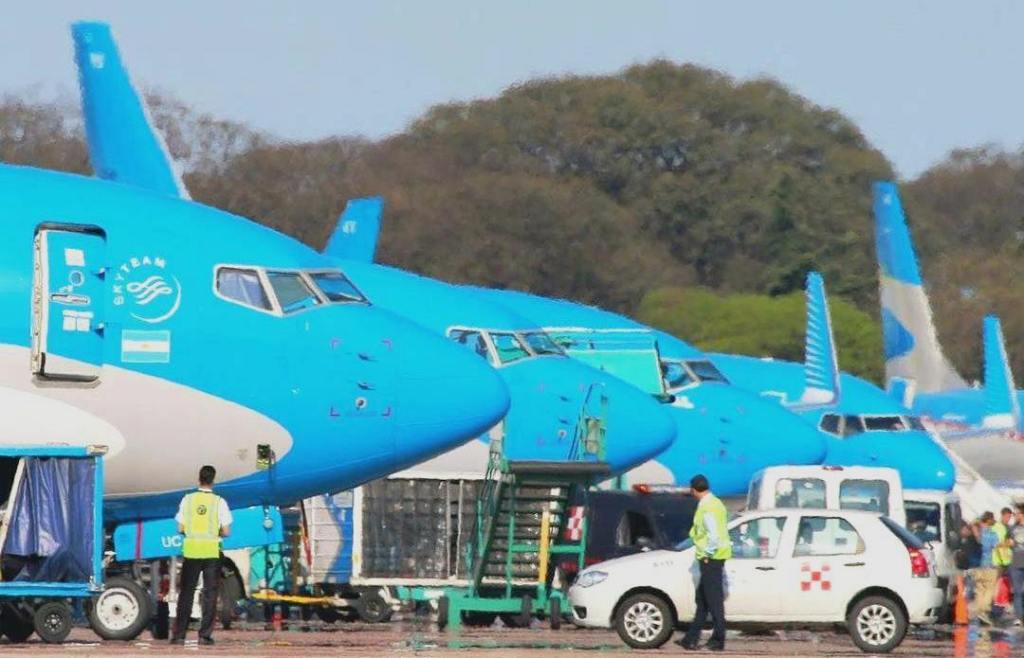
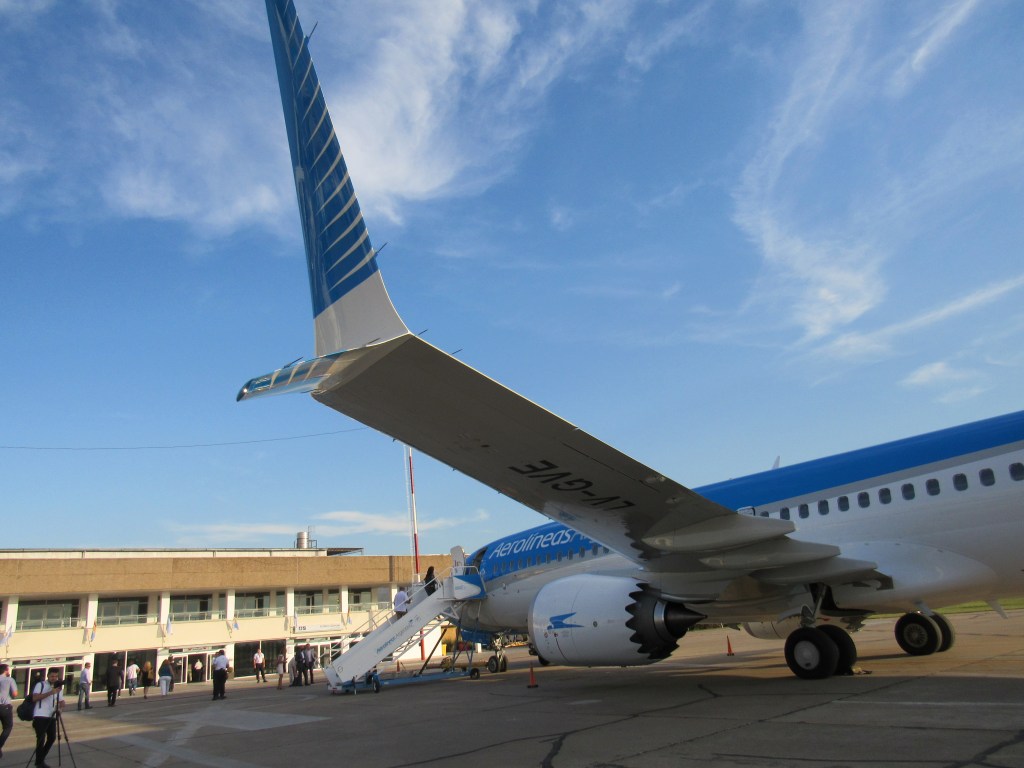
El Gobierno de Argentina ha aprobado este Viernes 19/03 el presupuesto para Aerolíneas Argentinas para el año 2021. Se prevé que los ingresos corrientes de este año alcanzarán a AR$ 127.318.660.853 millones de Pesos, mientras que los gastos corrientes serán de AR$ 172.315.114.113 millones de Pesos. Aerolíneas Argentinas registrará este año un déficit superior a los AR$ 44.000 millones de Pesos, de acuerdo con el Plan de Acción y Presupuesto para el ejercicio 2021 de la línea aérea.

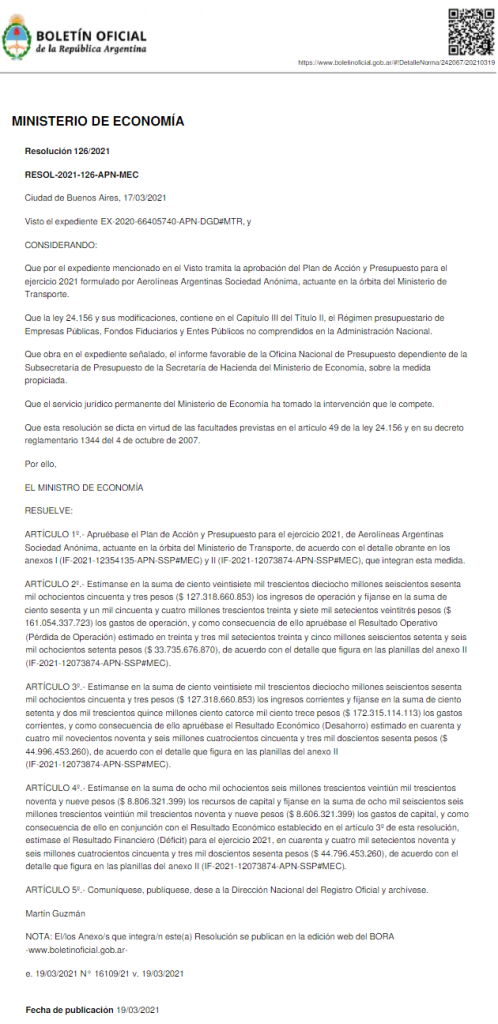
El Ministerio de Economía, a través de la Resolución Nº 126/2021 que fue publicada este 19/03 en el Boletín Oficial, estableció cuáles serán los resultados financieros de este año de la compañía estatal. Las proyecciones económicas estiman en la suma de AR$ 127.318.660.853 millones de Pesos los ingresos de operación y en AR$ 161.054.337.723 millones de Pesos los gastos de operación, y como consecuencia de ello aprobó el Resultado Operativo de AR$ 33.735.676.870 millones de Pesos en pérdidas operativas.

Asimismo, proyectó que los ingresos corrientes de este año alcanzarán a AR$ 127.318.660.853 millones de pesos, mientras que los gastos corrientes serán de AR$ 172.315.114.113 millones de Pesos, con un Resultado Económico (desahorro) de AR$ 44.996.453.260 millones de Pesos. Los recursos de capital fueron estimados en AR$ 8.806.321.399 millones de Pesos y los gastos de capital en la misma suma, y como consecuencia de ello en conjunción con el Resultado Económico, proyectó el Resultado Financiero (Déficit) para el ejercicio 2021, en AR$ 44.796.453.260 millones de Pesos.

Antes de la pandemia, el presidente de Aerolíneas, Pablo Ceriani, señaló que la empresa necesitaría US$ 700 millones de Dólares para hacer frente a gastos corrientes y para renegociar pasivos que habían quedado de la administración anterior, durante la cual la compañía tuvo tres presidentes: Isela Costantini, Mario Dell Acqua y Luis Malvido. Pero con la pandemia, los aviones dejaron de volar el 20 de Marzo de 2020 y solo se realizaron algunos vuelos para repatriar argentinos que habían quedado varados en el exterior y para traer insumos médicos desde China. Durante 2020, Aerolíneas recibió aportes del Tesoro Nacional por AR$ 45.076 millones de Pesos, en el peor año de la aviación comercial en todo el mundo, como consecuencia de la pandemia y las medidas de aislamiento. Ante esa situación, la compañía aplicó una serie de medidas de ajuste, como suspensiones a un tercio del personal y jubilaciones anticipadas.

El decisión más importante fue la la fusión entre Aerolíneas Argentinas y Austral Líneas Aéreas, cuando la compañía propuso a los empleados de esta última compañía mantener las fuentes laborales y los salarios, pero no así la antigüedad ni el escalafón. Desde fines de 2015, la plantilla de empleados de Aerolíneas y sus empresas controladas Austral, JetPaq, Optar y Aerohandling superan los 12.000 empleados.

Government approves budget Aerolíneas

2021 budget approved for Aerolíneas Argentinas

The Government of Argentina has approved this Friday 03/19 the budget for Aerolineas Argentinas for the year 2021. Current revenues for this year are expected to reach AR$ 127,318,660,853 million Pesos, while current expenses will be AR$ 172,315,114,113 million Pesos. Aerolíneas Argentinas will register this year a deficit of more than AR$ 44,000 million Pesos, according to the Action Plan and Budget for fiscal year 2021 of the airline.

The Ministry of Economy, through Resolution No. 126/2021 that was published this 03/19 in the Official Gazette, established what will be the financial results of this year for the state company. The economic projections estimate the sum of AR$ 127,318,660,853 million pesos for operating income and AR$ 161,054,337,723 million Pesos for operating expenses, and as a result, it approved the Operating Result of AR$ 33,735,676,870 million Pesos in operating losses.

Likewise, it projected that current income for this year will reach AR$ 127,318,660,853 million Pesos, while current expenses will be AR$ 172,315,114,113 million Pesos, with an Economic Result (dissaving) of AR$ 44,996,453,260 millions of Pesos. Capital resources were estimated at AR$ 8,806,321,399 million Pesos and capital expenditures in the same amount, and as a consequence of this, in conjunction with the Economic Result, it projected the Financial Result (Deficit) for fiscal year 2021, in AR$ 44,796,453,260 million Pesos.

Before the pandemic, the president of Airlines, Pablo Ceriani, pointed out that the company would need US$ 700 million Dollars to meet current expenses and to renegotiate liabilities that had remained from the previous administration, during which the company had three presidents: Isela Costantini, Mario Dell Acqua and Luis Malvido. But with the pandemic, the planes stopped flying on March 20, 2020 and only a few flights were made to repatriate Argentines who had been stranded abroad and to bring medical supplies from China. During 2020, Aerolíneas received contributions from the National Treasury for AR$ 45,076 million Pesos, in the worst year of commercial aviation in the world, as a result of the pandemic and isolation measures. Faced with this situation, the company applied a series of adjustment measures, such as suspensions for a third of the staff and early retirements.

The most important decision was the merger between Aerolíneas Argentinas and Austral Líneas Aéreas, when the company proposed to the employees of the latter company to keep their sources of employment and salaries, but not their seniority or rank. Since the end of 2015, the workforce of Aerolíneas and its controlled companies Austral, JetPaq, Optar and Aerohandling have exceeded 12,000 employees.


PUBLISHER: Airgways.com
DBk: Aerolineas.com / Boletinoficial.gob.ar / Visiteiffel / Airgways.com
AW-POST: 202103191039AR

A\W   A I R G W A Y S ®
Boeing/NASA Hot Fire Green Run

AW | 2021 03 19 09:49 | AEROSPACE

Completan Hot Fire etapa central lanzamiento espacial Artemis I

NASA_Isologotype

La campaña de prueba «Green Run» de tapones de motor de más de ocho minutos de duración completa que ayuda a certificar la etapa central para el lanzamiento espacial del Ártemis I. El Escenario que se renovará y entregará al Centro Espacial Kennedy para apilarse con otros componentes SLS.

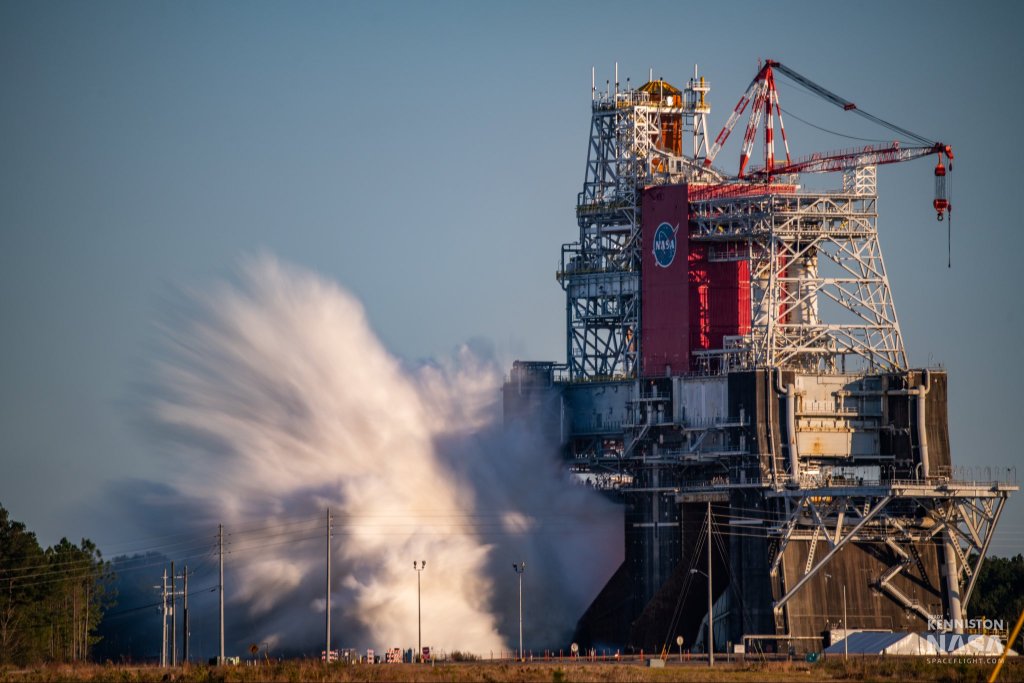
El escenario central criogénico construido por The Boeing Company para el primer cohete del Sistema de Lanzamiento Espacial (SLS) de la NASA completó las pruebas de fuego caliente este 18/03 en el Centro Espacial Stennis de la NASA como parte de la campaña de pruebas Green Run del Cohete SLS en el Puesto de Pruebas B-2. Los datos de la prueba validaron el funcionamiento exitoso de la etapa central y se utilizarán para ayudar a certificar la etapa de vuelo.

«La exploración del espacio profundo dio un importante paso adelante hoy. Los avances realizados en la nueva etapa central del SLS son positivos para la NASA y la cadena de suministro nacional. El equipo está utilizando el conocimiento obtenido de Green Run para avanzar en nuestro nuevo sistema de producción y etapas futuras mientras entrega la primera etapa para el vuelo de prueba», dijo John Shannon, Vicepresidente de SLS y Director de Programas de la compañía.

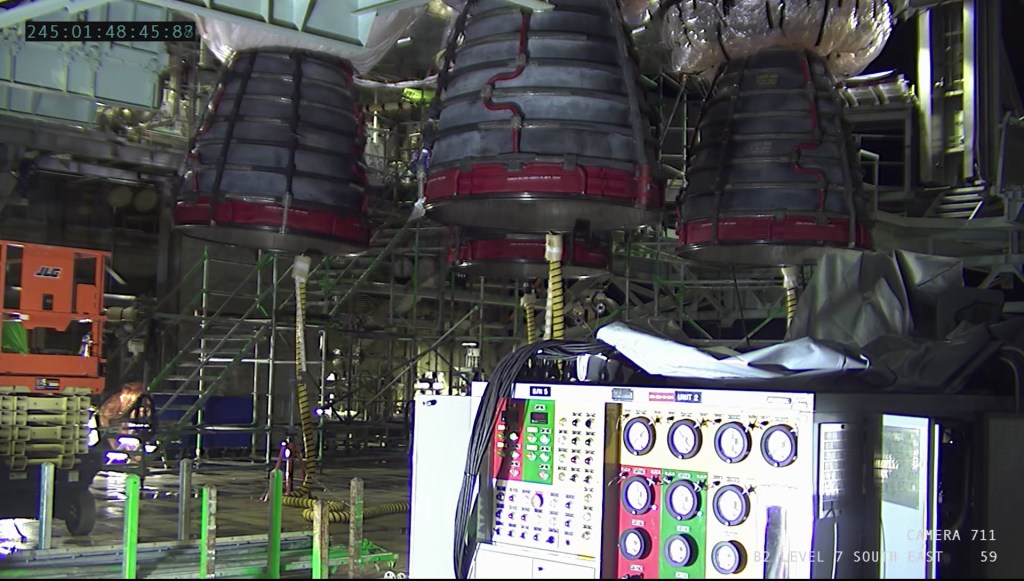
La etapa central SLS construida por Boeing está alimentada por tanques líquidos de hidrógeno y oxígeno que alimentan cuatro motores RS-25 construidos por Aerojet Rocketdyne, produciendo juntos 1,6 millones de libras de empuje durante la prueba y en el lanzamiento. Durante una misión, los motores de la etapa producen 2,2 millones de libras de empuje. Los motores ardieron durante una duración completa de 499,6 segundos, por el espacio de ocho minutos y 19 segundos (8min./19seg.), durante la prueba, proporcionando datos críticos de verificación. Después de las salidas posteriores a la prueba, la etapa central irá al Centro Espacial Kennedy de la NASA en Florida para su integración con la nave espacial de la tripulación Orion, la etapa superior de propulsión criogénica provisional y los propulsores de cohetes sólidos, y luego estará preparado para el lanzamiento. Ese vehículo completo volará la primera misión del programa Artemis de la NASA, llamado Artemis I, que será un vuelo de prueba desenroscado de Orión alrededor de la Luna para prepararse para misiones tripuladas. Sólo el SLS tiene el poder de lanzar Orión, tripulación y carga a la Luna y permitir la exploración lunar sostenible. Boeing es el contratista principal de la NASA para el núcleo SLS y las etapas superiores y la aviónica. «Quiero agradecer a nuestros equipos de la NASA, Aerojet Rocketdyne y Boeing que superaron tormentas y una pandemia para demostrar la capacidad y seguridad de la etapa central de SLS», dijo John Shannon.

El SLS continuará evolucionando más allá de Artemis III, que está previsto que sea el aterrizaje de la primera mujer y el próximo hombre en la Luna. Boeing ya está trabajando en capacidades girables para el sistema de cohetes como la Etapa Superior de Exploración, con potencia adicional que será clave para la exploración humana significativa de la Luna y Marte.

Boeing/NASA complete Hot Fire Green Run

La imagen tiene un atributo ALT vacío; su nombre de archivo es aw-nasa.gov_gr-slscs-t5-gimbal-test-01.jpg

Hot Fire completed core stage of Artemis I space launch system

The «Green Run» test campaign of engine plugs of more than eight minutes in duration that helps to certify the center stage for the Artemis I space launch. The Scenario to be renovated and delivered to the Kennedy Space Center to be stacked with others SLS components. The cryogenic center stage built by The Boeing Company for NASA‘s first Space Launch System (SLS) rocket completed hot fire tests this 03/18 at NASA’s Stennis Space Center as part of the Green test campaign. Run of the SLS Rocket at Test Station B-2. The test data validated the successful operation of the central stage and will be used to help certify the flight stage.

«Deep space exploration took an important step forward today. The progress made in the new SLS core stage is positive for NASA and the national supply chain. The team is using the knowledge gained from Green Run to advance our new production system and future stages while delivering the first stage for the test flight», said John Shannon, Vice President of SLS and Director of Programs for the company.

The Boeing-built SLS center stage is powered by liquid hydrogen and oxygen tanks that power four RS-25 engines built by Aerojet Rocketdyne, together producing 1.6 million pounds of thrust during testing and at launch. During a mission, the stage engines produce 2.2 million pounds of thrust. The engines burned for a full duration of 499.6 seconds, for the space of eight minutes and 19 seconds (8min/19sec), during the test, providing critical verification data. Following post-test departures, the center stage will go to NASA’s Kennedy Space Center in Florida for integration with the Orion crew spacecraft, interim cryogenic propulsion upper stage, and solid rocket boosters, and then it will be ready for launch. That complete vehicle will fly the first mission of NASA’s Artemis program, called Artemis I, which will be an Orion unscrewed test flight around the Moon to prepare for manned missions. Only the SLS has the power to launch Orion, crew and cargo to the Moon and enable sustainable lunar exploration. Boeing is NASA’s prime contractor for the SLS core and upper stages and avionics. «I want to thank our teams at NASA, Aerojet Rocketdyne and Boeing that weathered storms and a pandemic to demonstrate the capability and safety of the SLS core stage», said John Shannon.

The SLS will continue to evolve beyond Artemis III, which is slated to be the landing of the first woman and the next man on the Moon. Boeing is already working on rotatable capabilities for the rocket system such as the Upper Exploration Stage, with additional power that will be key to meaningful human exploration of the Moon and Mars.


PUBLISHER: Airgways.com
DBk: Boeing.com / Airgways.com
AW-POST: 202103190949AR

A\W   A I R G W A Y S ®
Aerolíneas-APLA retorno 737 MAX

AW | 2021 03 19 01:24 | AIRLINES / AVIATION SAFETY

Aerolíneas retorna operaciones con Boeing 737 MAX

Aerolíneas Argentinas_Isologotype 2010

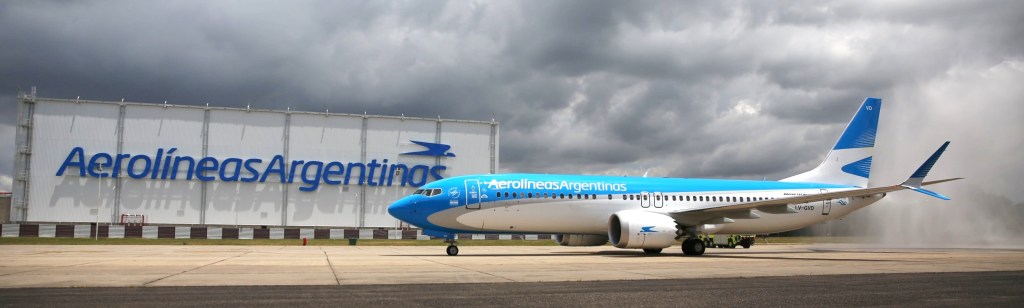
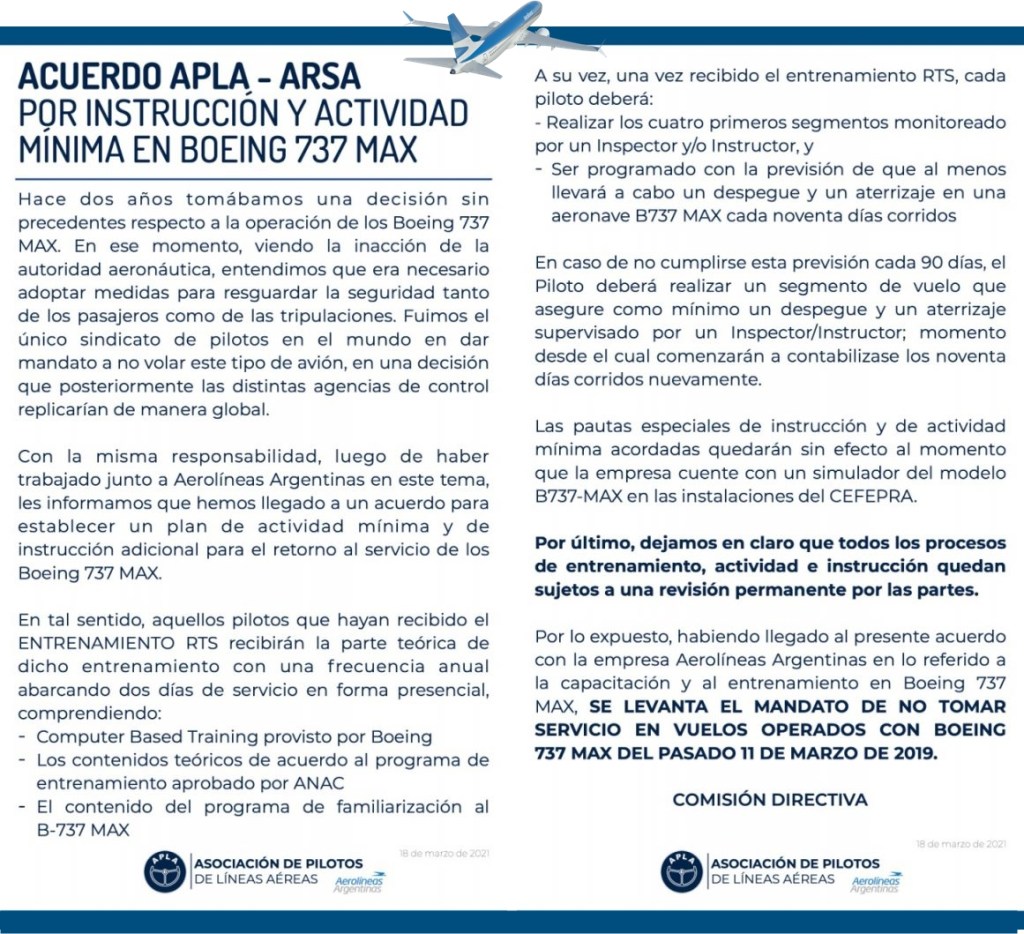
La Asociación de Pilotos de Líneas Aéreas (APLA) ha anunciado arribar a un acuerdo con Aerolíneas Argentinas para la aprobación de los vuelos con la línea de aviones Boeing 737 MAX. Después del mandato del gremio del 11 de Marzo de 2019 donde establece la prohibición de volar este tipo de aeronaves, ahora ha sido levantada en conformidad con las aprobaciones de la Administración Nacional de Aviación Civil (ANAC) de Argentina.

El comunicado interno de la agrupación sindical APLA, liderada por Pablo Biró ha comunicado mediante un informe la determinación de aprobar las operaciones comerciales con las cinco aeronaves Boeing 737-8 MAX que compone la compañía. Luego de un intenso trabajo con Aerolíneas Argentinas se informó que se ha alcanzado un acuerdo con un plan mínimo e instrucción adicional para volver a poner en servicio la línea de aeronaves que forman parte de la flota.

El acuerdo entre el gremio y Aerolíneas establece que los pilotos con entrenamiento RTS recibirán la parte teórica de ese entrenamiento con una frecuencia anual con días de servicio de manera presencial. Al finalizar esa primera etapa, cada piloto será monitoreado por un inspector o instructor al realizar los cuatro primeros segmentos y ser programado con la previsión de que al menos realizara un despegue y un aterrizaje en un Boeing 737 MAX cada 90 días corridos. En caso de no cumplirse lo detallado anteriormente el piloto deberá realizar otro segmento de vuelo que incluya un despegue y un aterrizaje con supervisor o instructor. El comunicado expresa respecto a las instrucciones y las actividades mínimas acordadas caducaran al momento de que la empresa incorpore un simulador de vuelo para el Boeing 737MAX en el Centro de Instrucción CEFEPRA. Aerolíneas Argentinas anunciará a la brevedad de la nueva programación de vuelos para la línea Boeing 737 MAX que posee la compañía.

Aerolíneas-APLA return agreement 737 MAX

Aerolíneas returns operations with Boeing 737 MAX

AW-Aerolineas_700738

The Airline Pilots Association (APLA) has announced an agreement with Aerolíneas Argentinas for the approval of flights with the Boeing 737 MAX aircraft line. After the union’s mandate of March 11, 2019 where it establishes the prohibition of flying this type of aircraft, it has now been lifted in accordance with the approvals of the National Civil Aviation Administration (ANAC) of Argentina.

The internal communiqué of the APLA union group, led by Pablo Biró, has communicated through a report the determination to approve commercial operations with the five Boeing 737-8 MAX aircraft that make up the company. After intensive work with Aerolineas Argentinas, it was reported that an agreement had been reached with a minimum plan and additional instruction to put the line of aircraft that are part of the fleet back into service.

The agreement between the union and Aerolíneas establishes that pilots with RTS training will receive the theoretical part of this training on an annual basis with days of service in person. At the end of this first stage, each pilot will be monitored by an inspector or instructor when performing the first four segments and will be scheduled with the expectation that at least one takeoff and one landing in a Boeing 737 MAX will take place every 90 calendar days. If the above detailed is not fulfilled, the pilot must carry out another flight segment that includes a takeoff and landing with a supervisor or instructor. The express statement regarding the instructions and the minimum agreed activities will expire when the company incorporates a flight simulator for the Boeing 737MAX at the CEFEPRA Training Center. Aerolíneas Argentinas will announce shortly the new flight schedule for the company’s Boeing 737 MAX line.


PUBLISHER: Airgways.com
DBk: Aerolineas.com / Apla.org.ar / Airgways.com
AW-POST: 202103190124AR

A\W   A I R G W A Y S ®

FAA inspeccionará al Boeing 787

AW | 2021 03 18 16:05 | AVIATION SAFETY / AVIATION ORGANISMS / INDUSTRY

FAA inspeccionará personalmente 787 problemas producción

AW-Boeing-787-png

FAA-Isologotype

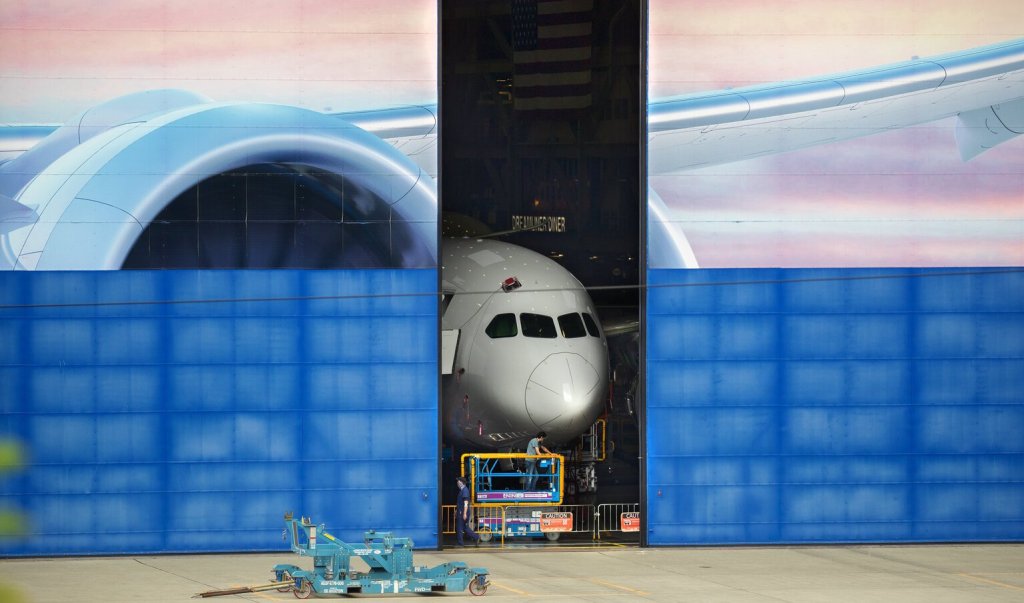
La Administración Federal de Aviación (FAA) dijo el Miércoles 17/03 que inspeccionará cuatro de los Boeing 787 Dreamliner en lugar de delegar ese trabajo a la propia compañía The Boeing Company, después de que surgieron problemas de producción en 2020. «La FAA está tomando una serie de medidas correctivas para abordar los problemas de producción de Boeing 787. Una de las acciones es mantener la autoridad para emitir certificados de aeronavegabilidad para cuatro aviones 787. La FAA puede retener la autoridad para emitir certificados de aeronavegabilidad para aviones adicionales 787 si vemos la necesidad», dijo la agencia en un comunicado. Boeing reveló problemas con algunas costuras en el avión en Septiembre 2020. La FAA le dijo a Boeing en Enero 2021 que daría la firma final de aprobaciones de los rollout de las aeronaves comerciales. Si bien estos controles más recientes de lalínea Dreamliner se produjeron en respuesta a problemas de producción, la FAA dijo que ha realizado controles finales de aeronavegabilidad en unos 787 en los últimos años «para que los inspectores de la FAA puedan cumplir con sus requisitos de aeronaves de inspección».

Boeing dijo que todavía espera reanudar las entregas de los aviones 787 a finales de este mes de Marzo 2021. » Estamos alentados por el progreso que nuestro equipo está haciendo en el regreso a las actividades de entrega para el programa 787. Hemos contratado a la FAA a lo largo de este esfuerzo e implementaremos su dirección para la aprobación de la certificación de aeronavegabilidad de los aviones iniciales como lo han hecho en el pasado», ha expresado The Boeing Company.

El mayor escrutinio de los Dreamliners se produce cuatro meses después de que la FAA levantara una prohibición de vuelo de veinte meses de la línea Boeing 737 MAX, que el regulador puso en tierra en Marzo 2019 después de dos accidentes aéreos en el lapso de cinco meses. La FAA también conservó su autoridad para firmar las aprobaciones a los aviones 737 MAX que produjo la compañía aeroespacial americana desde la puesta en tierra.

Boeing había sido responsable de los controles finales básicos de seguridad necesarios para emitir un certificado de aeronavegabilidad antes de la entrega. Pero la FAA dijo que ahora sería responsable de los controles de cuatro 787 Dreamlines y la la flota residual de 737 MAX que se encuentra estacionada, mientras Boeing lidia con problemas de producción.

FAA to inspect Boeing 787

FAA will personally inspect 787 production problems

The Federal Aviation Administration (FAA) said Wednesday 03/17 that it will inspect four of the Boeing 787 Dreamliners instead of delegating that work to The Boeing Company itself, after production problems arose in 2020. «The FAA is standing by. taking a series of corrective actions to address Boeing 787 production issues. One of the actions is to maintain the authority to issue certificates of airworthiness for four 787 aircraft. The FAA may retain the authority to issue certificates of airworthiness for additional 787 aircraft if we see the need», the agency said in a statement. Boeing disclosed problems with some seams on the aircraft in September 2020. The FAA told Boeing in January 2021 that it would give final signature approvals for rollout for commercial aircraft. While these most recent checks of the Dreamliner line were produced in response to production issues, the FAA said it has performed final airworthiness checks on about 787s in recent years «so that FAA inspectors can meet their aircraft requirements. of Inspection».

100_737MAX8-1

Boeing said it still expects to resume deliveries of the 787 aircraft later this month in March 2021. «We are encouraged by the progress our team is making in returning to delivery activities for the 787 program. We have contracted with the FAA. throughout this effort and we will implement your direction for the approval of the airworthiness certification of the initial aircraft as they have done in the past», said The Boeing Company.

The heightened scrutiny of the Dreamliners comes four months after the FAA lifted a twenty-month flight ban on the Boeing 737 MAX line, which the regulator grounded in March 2019 after two plane crashes in the span of five months. The FAA also retained its authority to sign approvals for the 737 MAX aircraft produced by the American aerospace company since grounding.

Boeing had been responsible for the basic final safety checks necessary to issue a certificate of airworthiness prior to delivery. But the FAA said it would now be responsible for checks on four 787 Dreamlines and the remaining fleet of 737 MAXs that are parked, while Boeing grapples with production problems.


PUBLISHER: Airgways.com
DBk: Faa.gov / Boeing.com / Seattletimes.com / Paineairport.com / Airgways.com
AW-POST: 202103181605AR

A\W   A I R G W A Y S ®
Aeroparque adaptación post-pandemia

AW | 2021 03 18 15:55 | AIRPORTS

Aeropuerto Jorge Newbery continúa programando vuelos

El Aeropuerto Jorge Newbery continúa adaptando progresivamente al funcionamiento en el ámbito de la pandemia con estrictas medidas de protocolo sanitario luego de la reapertura de las operaciones concretada el Lunes 15/03. Según los datos suministrados por Aeropuertos Argentina 2000, el movimiento previsto para Aeroparque en este mes de Marzo 2021 corresponden a 118 vuelos diarios, 114 domésticos y cuatro internacionales, lo que representa un 50% de lo registrado en Marzo del 2020, teniendo en cuenta que el 19/03 de ese mes entraron en vigencia las restricciones impuestas por el Gobierno Nacional, como consecuencia de la pandemia. En Marzo 2020 el movimiento fue de 237 vuelos diarios, de los cuales 227 fueron de cabotaje y 10 internacionales.

La mayor parte de la vía interna por donde ingresaban los vehículos ha sido ocupada por un sector de gastronomía rápida, por un espacio de pre check in y por los centros de testeos de coronavirus, tanto del Gobierno de la Ciudad, como de un laboratorio privado que efectúa el test a cualquier particular que lo solicite.

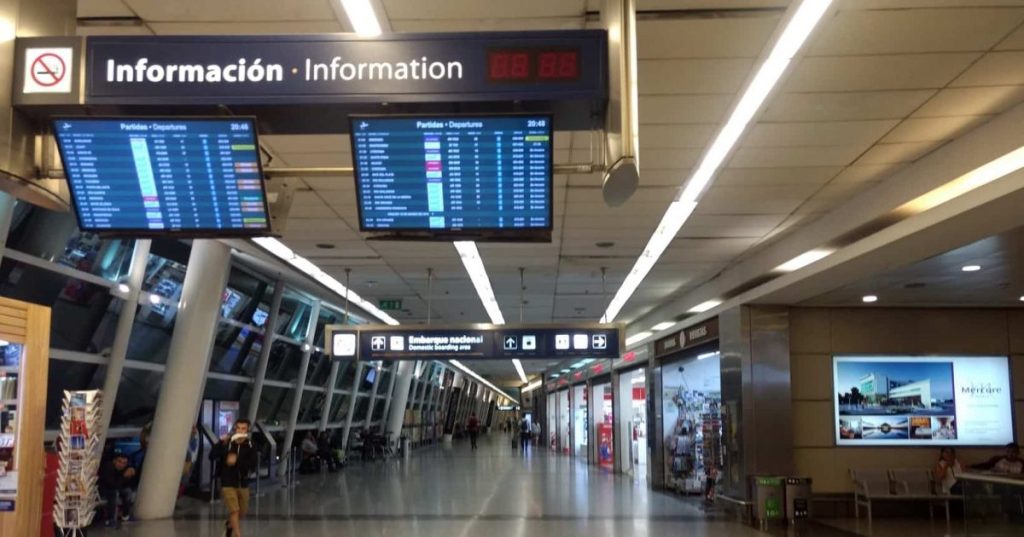
En la zona de ingreso a la estación aérea metropolitana se encuentra un sector donde han instalado dos food trucks, con área de asientos y máquinas expendedoras de bebidas y sándwiches. Esta área está ubicada unos metros antes de los pasillos de ingreso, perfectamente señalizados para que el pasajero pueda acceder según el vuelo que le corresponda, permitiendo que carteles luminosos den aviso del número de vuelo, el destino y la compañía, para que el viajero pueda optar por alguna de las seis filas previstas para el acceso al hall de mostradores de Check in. Tras los trámites en Check-in, los pasajeros acceden al piso superior para pasar el control de scanner personal y de equipajes ingresando al área de Preembarque.

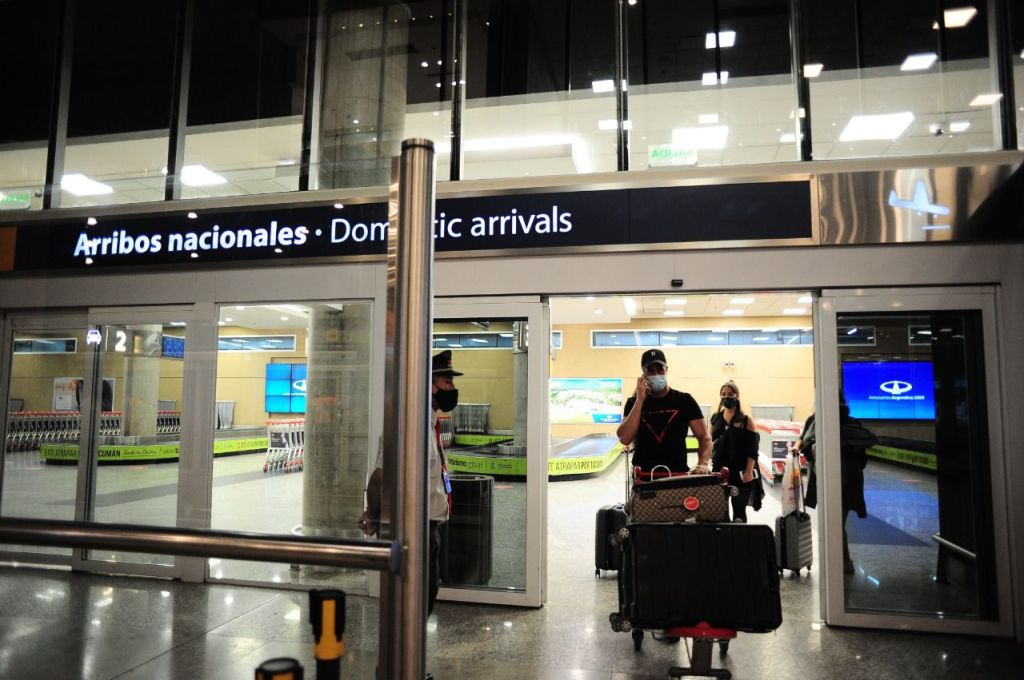
Para los que arriban a Aeroparque en un vuelo, tras retirar el equipaje, en caso de que lo tuvieran, los que viven en la Ciudad de Buenos Aires deben realizarse el testeo obligatorio, para lo cual deben trasladarse hacia los lugares dispuestos por el Gobierno de la Ciudad para concretar el trámite. También sobre las vías internas de circulación, se han dispuesto, un camión sanitario donde se le realiza el control, una vez identificado el pasajero, y metros más adelante un puesto más, para el caso de que colapsara el sector inicial, ante un flujo de pasajeros simultáneos. Complementariamente, se ha montado, al igual que en Ezeiza, un puesto de testeo privado para que accedan todos aquellos particulares, sean o no viajeros, que decidan realizarlo abonando el canon correspondiente, que asciende a los AR$ 6.000 Pesos.

Los protocolos fueron implementados desde la reapertura, ya que son medidas dispuestas a nivel internacional y homologadas por las autoridades sanitarias de la Nación, en tanto que los locales comerciales se irán reincorporando a medida que crezca la operación y el flujo de pasajeros, adaptando su espacio y servicios a las medidas sanitarias que rigen dentro de la terminal.

Se adaptaron los espacios de todo el aeropuerto para operar de forma segura cuidando la salud de los usuarios y se ha dispuesto que el Parking Sur sea exclusivo para pasajeros y no estará permitido el ingreso de acompañantes. El Parking Norte, en tanto, pueden utilizarlo los pasajeros y los acompañantes, y habrá un sector exclusivo de ascenso y descenso de pasajeros señalizado.

Post-pandemic adaptation airport

Jorge Newbery Airport continues to schedule flights

Jorge Newbery Airport continues to progressively adapt to operations in the context of the pandemic with strict sanitary protocol measures after the reopening of operations that took place on Monday 03/15. According to the data provided by Aeropuertos Argentina 2000, the planned movement for Aeroparque in this month of March 2021 corresponds to 118 daily flights, 114 domestic and four international, which represents 50% of what was registered in March 2020, taking into account that On 03/19 of that month, the restrictions imposed by the National Government, as a result of the pandemic, came into effect. In March 2020 the movement was 237 daily flights, of which 227 were domestic and 10 international.

Most of the internal road through which the vehicles entered has been occupied by a fast food sector, by a pre-check-in space and by the coronavirus testing centers, both of the City Government, and of a private laboratory who performs the test on any individual who requests it.

In the entrance area to the metropolitan air station there is a sector where they have installed two food trucks, with a seating area and vending machines for drinks and sandwiches. This area is located a few meters before the entrance corridors, perfectly signposted so that the passenger can access according to the corresponding flight, allowing luminous signs to give notice of the flight number, the destination and the company, so that the traveler can choose one of the six rows provided for access to the check-in desks hall. After the procedures in Check-in, passengers access the upper floor to pass the personal scanner control and baggage entering the pre-boarding area.

For those who arrive at Aeroparque on a flight, after removing the luggage, if they have it, those who live in the City of Buenos Aires must carry out the mandatory testing, for which they must move to the places provided by the Government of the City to complete the process. Also on the internal routes of circulation, a sanitary truck has been arranged where the control is carried out, once the passenger has been identified, and meters later one more position, in the event that the initial sector collapses, before a flow of simultaneous passengers. In addition, a private testing station has been set up, as in Ezeiza, for all those individuals, whether or not they are travelers, who decide to do it by paying the corresponding fee, which amounts to AR$ 6,000 pesos.

The protocols were implemented since the reopening, since they are measures arranged at an international level and approved by the health authorities of the Nation, while the commercial premises will be reincorporated as the operation and the flow of passengers grow, adapting their space and services to the sanitary measures that govern within the terminal.

The spaces throughout the airport were adapted to operate safely taking care of the health of users and it has been arranged that the South Parking is exclusively for passengers and the entry of companions will not be allowed. The North Parking, meanwhile, can be used by passengers and companions, and there will be an exclusive area for raising and lowering passengers signposted.


PUBLISHER: Airgways.com
DBk: Aa2000.com.ar / Airgways.com
AW-POST: 202103181555AR

A\W   A I R G W A Y S ®
Final Programa Airbus A380

AW | 2021 03 18 14:57 | INDUSTRY

Airbus concluye Programa A380 con último ejemplar en línea

Airbus_Isologotype_svg

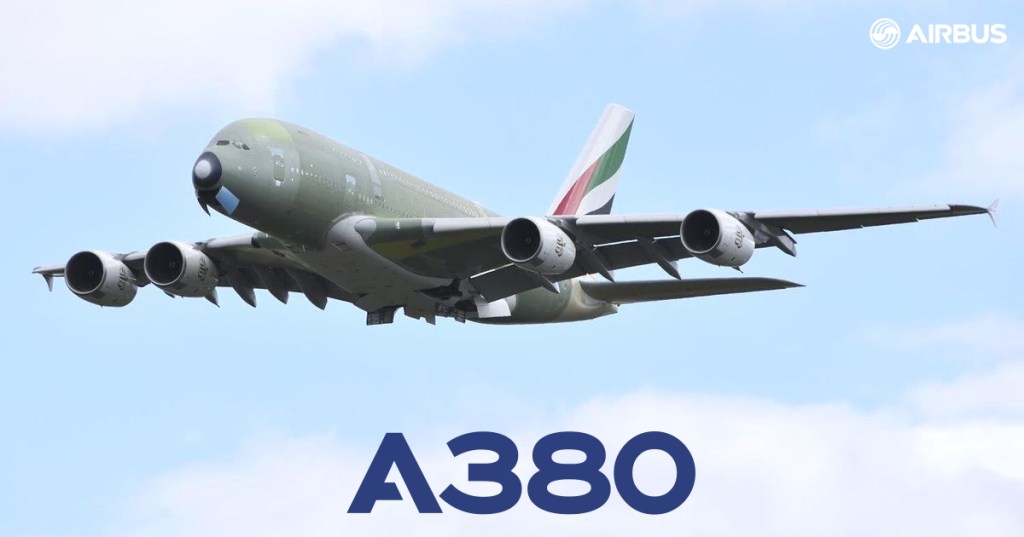
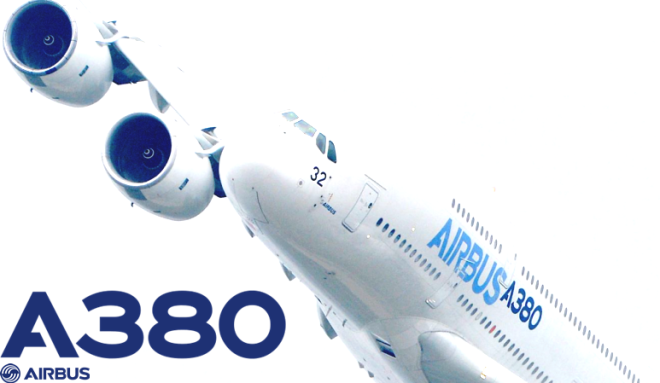
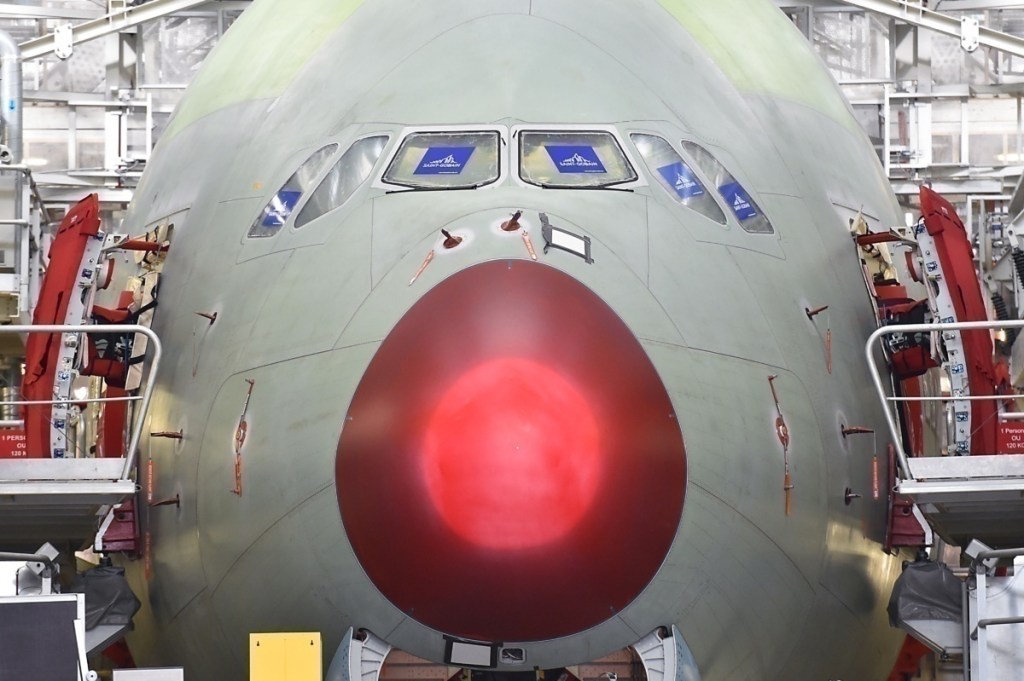
El Miércoles 17/03 el constructor europeo Airbus Group marca otro hito al final del proyecto del Programa A380. El último A380 en construirse MSN 272 ha completado su salida y primer vuelo, dirigiéndose a la planta de Hamburg/Finkenwerder en Alemania para ultimar los detalles de pintura y puesta a punto para ser entregado a Emirates Airline.

AW-70000380

Airbus había anunciado dos años atrás la culminación del programa Superjumbo tras el intento fallido de reactivar las ventas con la variante A380 Plus. Actualmente, el consorcio europeo continúa sin entregar cinco unidades a la aerolínea de los Emiratos Árabes Unidos debido al fuerte impacto causado por la depresión de los vuelos en el mundo y la caída abrupta de las ventas en los modelos de mayor porte. La compañía aérea ha anunciado que estima retirar las cinco aeronaves restantes completando el organigrama de entregas hacia el próximo año 2022.

El último avión de la línea A380-800 con registro F-WWSH, ha salido de la FAL Toulouse despegando este 17/03 a las 13:00 hs [hora local] como parte de su rollout, marcando el último avión de línea del Programa A380. Después de haber navegado a 43.000 pies, el avión aterrizó en el Aeropuerto de Hamburgo/Finkenwerder alrededor de las 16:10 hs [hora local], totalizando un tiempo de vuelo de unas tres horas y diez minutos.

Historia A380

Los estudios de Airbus comenzaron en 1988 y el proyecto fue anunciado en 1990 para desafiar el dominio del Boeing 747 en el mercado de larga distancia. El proyecto A3XX entonces designado fue presentado en 1994; Airbus lanzó el Programa A380 de € 9.500 millones de Euros/US$ 10.700 millones de Dólares el 19 de Diciembre de 2000. El primer prototipo fue presentado en Toulouse el 18 de Enero de 2005, con su primer vuelo el 27 de Abril de 2005. Las dificultades en el cableado eléctrico causaron un retraso de dos años y el coste de desarrollo aumentó a € 18 000 millones. Obtuvo su certificado de tipo de la Agencia Europea de Seguridad Aérea (EASA) y la Administración Federal de Aviación de los Estados Unidos (FAA) el 12 de Diciembre de 2006.

Fue entregado por primera vez a Singapore Airlines el 15 de Octubre de 2007 y entró en servicio el 25 de Octubre de 2007. La producción alcanzó un máximo de 30 por año entre los años 2012-2014. Sin embargo, Airbus admite que su inversión de € 25.000 millones de Dólares para el avión no se puede recuperar. El 14 de Febrero de 2019, después de que Emirates Airline redujera sus últimos pedidos en favor del A350 y el A330NEO, Airbus anunció que la producción del A380 terminaría en 2021.

Perspectivas A380

El último ejemplar de línea del A380 marca un hito en la finalización del programa del gigante de Europa. La flota resultante actual de los Airbus A380 continuarán volando por un tiempo bajo los cielos del mundo, pero en rutas más seleccionadas por la depreciación de los viajes con alta demanda en megatransportes. Desde la entrada en servicio en 10/2007, después de apenas catorce años, el constructor europeo cierra la fábrica a la línea del coloso europeo llamado Superjumbo.

Final Airbus A380 Program

Airbus concludes A380 Program with last copy online

Airbus_Logotype Globe

On Wednesday 03/17 the European constructor Airbus Group marks another milestone at the end of the A380 Program project. The latest A380 to be built MSN 272 has completed its departure and first flight, heading to the Hamburg/Finkenwerder plant in Germany to finalize the painting and fine-tuning details to be delivered to Emirates Airline.

Airbus had announced two years ago the completion of the Superjumbo program after the failed attempt to reactivate sales with the A380 Plus variant. Currently, the European consortium continues not to deliver five units to the UAE airline due to the strong impact caused by the depression of flights in the world and the abrupt drop in sales in the larger models. The airline has announced that it estimates to retire the five remaining aircraft, completing the delivery schedule by next year 2022.

The last aircraft of the A380-800 line with registration F-WWSH, has left FAL Toulouse taking off this 03/17 at 1:00 pm [local time] as part of its rollout, marking the last scheduled aircraft of the Program A380. After having navigated at 43,000 feet, the plane landed at Hamburg/Finkenwerder Airport at around 4:10 pm [local time], totaling a flight time of about three hours and ten minutes.

History A380

Airbus studies began in 1988 and the project was announced in 1990 to challenge the dominance of the Boeing 747 in the long-haul market. The then designated A3XX project was presented in 1994; Airbus launched the € 9.5 billion/US$ 10.7 billion A380 Program on December 19, 2000. The first prototype was unveiled in Toulouse on January 18, 2005, with its maiden flight on April 27, 2005. Difficulties in electrical wiring caused a two-year delay and the development cost increased to € 18 billion. It obtained its type certificate from the European Aviation Safety Agency (EASA) and the United States Federal Aviation Administration (FAA) on December 12, 2006.

It was first delivered to Singapore Airlines on October 15, 2007 and entered service on October 25, 2007. Production peaked at 30 per year between 2012-2014. However, Airbus admits that its € 25 billion investment for the aircraft cannot be recouped. On February 14, 2019, after Emirates Airline reduced its last orders in favor of the A350 and the A330NEO, Airbus announced that production of the A380 would end in 2021.

Perspectives A380

The latest in-line copy of the A380 marks a milestone in the completion of the European giant’s program. The current resulting fleet of Airbus A380s will continue to fly for a time under the skies of the world, but on routes more selected by the depreciation of high-demand mega-transport trips. Since the entry into service in 10/2007, after just fourteen years, the European manufacturer closes the factory to the line of the European colossus called Superjumbo.


PUBLISHER: Airgways.com
DBk: Airbus.com / Pascal Pavani / Gettyimages.com / Airgways.com
AW-POST: 202103181457AR

A\W   A I R G W A Y S ®

Iberia 40 aniversarios ops Airbus

AW | 2021 03 18 14:38 | AIRLINES

Iberia festeja 40 años operaciones línea Airbus

2000px-Logotipo_de_Iberia.svg

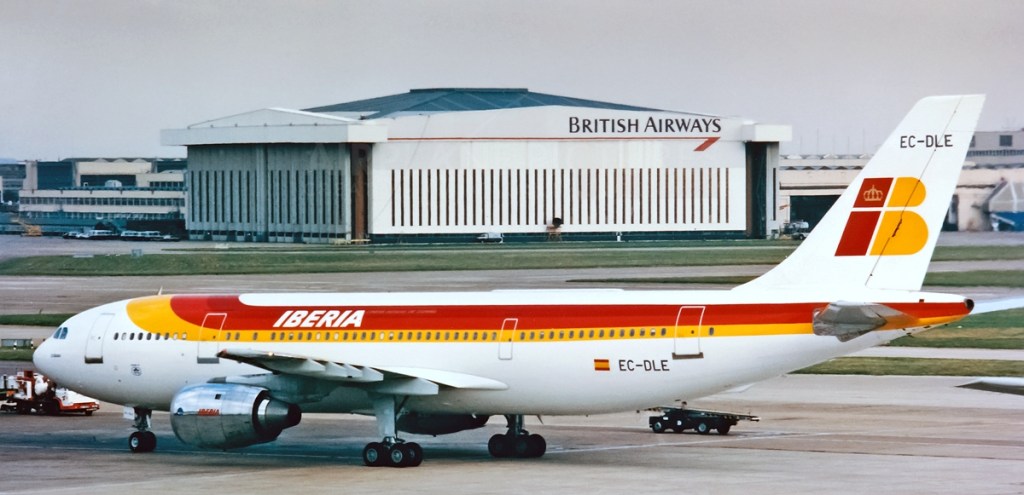
La compañía aérea Iberia Líneas Aéreas de España ha establecido una relación de cuatro décadas desde que la aerolínea iniciaba operaciones con aviones de la línea Airbus. Un 18 de Marzo de 1981 aterrizaba en Madrid el primer Airbus A300/Airbus A300B4-120 para la aerolínea dando inicio a una larga trayectoria con la familia de aeronaves del consorcio europeo.

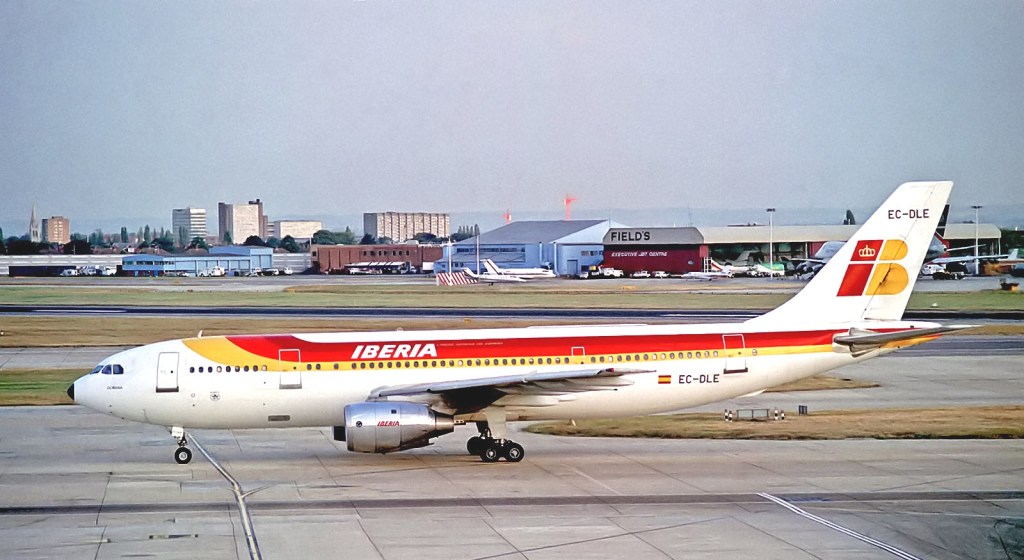
A partir de esa fecha histórica, Iberia formaría parte inseparable como cliente de diferentes flotas de aviones hasta la actualidad. La relación Iberia se iniciaba en 1981 con el primer modelo Airbus A300 denominada Doñana y estaba registrado como EC-DLE. El avión realizó su primer vuelo el 13 de Enero de 1981 y entregado el 27/01, efectuando su primer vuelo el 29 de Marzo de 1981 en la ruta Madrid/Barajas hacia Paris/Orly. La historia de Doñana estuvo vinculada a la compañía durante doce años terminando sus operaciones en 01/1993 con diecinueve años volando a destinos internacionales. En 2000, la aeronave fue desguazada en Madrid poniendo fin a prototipo, junto con otros nueve aviones que ha empleado la aerolínea.

Saga Airbus

Iberia ha ido incorporando a lo largo de su tiempo la ampliación de nuevos modelos en reemplazo del grueso de la flota de rango medio McDonnell Douglas MD-87/88, inclinando la balanza para los modelos Airbus A319, A320-200, A321-200, más las actualizaciones posteriores a A320NEO. Respecto a la flota de amplio radio de acción como los modelos Boeing 747-200/300, Boeing 757-200 y A300, Iberia ha ido reemplazando inicialmente por los Airbus A330-200/300/600 y actualmente una nueva actualización de flota hacia el Airbus A350-900, el modelo más moderno de toda la línea del fabricante europeo. Actualmente la aerolínea opera aviones all-Airbus con una flota total de 69 unidades. La aerolínea ha dado de baja comercial la línea Airbus A340 restantes debido a los efectos de las restricciones de los viajes por la pandemia, lo que significa que su edad media de flota actualmente se encuentra en menos de diez años de antigüedad.

Perspectivas flota Iberia

La aerolínea española continuará desarrollando la filosofía de aviones todo Airbus avanzando hacia el futuro para reducir costos operativos y logísticos, mientras continúa enfocado en la gama de aeronaves Airbus A320NEO y A350. Hacia el futuro, Iberia incorporará el Airbus A321XLR hacia el 2023 permitiendo recuperar el vacío dejado por el Boeing 757 transatlántico. La nueva incorporación permitirá continuar enfocada en viajes costa a costa entre Europa y Estados Unidos con aeronaves narrowbodies maximizando los ahorros de costos, permitiendo aumentar las frecuencias a más destinos.

Iberia 40 anniversaries ops Airbus

Iberia celebrates 40 years of Airbus line operations

AW-Iberia_7700044

The airline company Iberia Líneas Aéreas de España has established a relationship of four decades since the airline began operations with Airbus line aircraft. On March 18, 1981, the first Airbus A300/Airbus A300B4-120 for the airline landed in Madrid, beginning a long career with the family of aircraft of the European consortium.

As of that historical date, Iberia would be an inseparable part as a client of different fleets of aircraft until today. The Iberia relationship began in 1981 with the first Airbus A300 model called Doñana and it was registered as EC-DLE. The plane made its first flight on January 13, 1981 and delivered on 01/27, making its first flight on March 29, 1981 on the Madrid/Barajas route to Paris/Orly. The history of Doñana was linked to the company for twelve years ending its operations in 01/1993 with nineteen years flying to international destinations. In 2000, the aircraft was scrapped in Madrid, ending the prototype, along with nine other aircraft used by the airline.

Airbus saga

Iberia has been incorporating throughout its time the expansion of new models to replace the bulk of the McDonnell Dougras MD-87/88 mid-range fleet, tipping the balance for the Airbus A319, A320-200, A321-200, plus post-A320NEO updates. Regarding the fleet with a wide range of action such as the Boeing 747-200/300, Boeing 757-200 and A300 models, Iberia has initially been replaced by the Airbus A330-200/300/600 and currently a new fleet update towards the Airbus A350-900, the most modern model in the entire line of the European manufacturer. Currently the airline operates all-Airbus aircraft with a total fleet of 69 units. The airline has decommissioned the remaining Airbus A340 line due to the effects of travel restrictions due to the pandemic, which means that its average fleet age is currently less than ten years old.

Iberia perspectives

The Spanish airline will continue to develop the philosophy of all Airbus aircraft moving forward to reduce operational and logistics costs, while continuing to focus on the range of Airbus A320NEO and A350 aircraft. In the future, Iberia will incorporate the Airbus A321XLR by 2023, making it possible to recover the vacuum left by the transatlantic Boeing 757. The new addition will allow us to continue focused on coast-to-coast travel between Europe and the United States with narrowbodies aircraft, maximizing cost savings, allowing to increase frequencies to more destinations.


PUBLISHER: Airgways.com
DBk: Iberia.com / Airgways.com
AW-POST: 202103181438AR

A\W   A I R G W A Y S ®