Una joven pasajera de un vuelo de Alaska Airlines es retirada de un vuelo por ser alérgica a animales
Una joven alérgica a los gatos fue retirada de un avión en el que viajaba un felino «de apoyo emocional». El episodio ocurrió a bordo de una aeronave de Alaska Airlines. Una adolescente de 15 años se llevó la sorpresa de su vida al momento de disponerse a regresar a su hogar en la ciudad de Kotzebue, Alaska, tras terminar el campamento de verano al que había asistido en Anchorage.
Incidentes vs Apoyo Emocional
Al abordar el vuelo AS153 de Alaska Airlines, operado por un Boeing 737, buscó su asiento y esperó que el resto de los pasajeros abordara para emprender el regreso a casa. Cuando ya parecía que la nave estaba por cerrar sus puertas vio como una mujer ingresaba al avión acompañada de un gato «de apoyo emocional». Esto hubiese sido ignorado por cualquier otra persona, de no ser que la protagonista de la historia sufra una alergia severa a los felinos. Al alertar a la tripulación, estos comenzaron a discutir con la joven dado que alegaban que esta nunca les había advertido sobre sus necesidades especiales, culpándola en el proceso por no haberlos notificado al momento de hacer la reserva. A medida que la discusión iba subiendo de tono, una de las encargadas de atención al cliente le explicó a la menor que no podían retirar al gato del avión dado que su dueña había comprado un boleto específicamente para que su acompañante animal viajara a su lado. Además, indicó que si alguien debía bajarse del avión tenía que ser la quinceañera. Acto seguido la aerolínea le pidió a la joven que se bajara. La aerolínea ha explicado que hacen lo mejor para poder acomodar a todos los individuos que deciden viajar con Alaska Airlines. En esta situación, la tripulación siguió el procedimiento al intentar colocar al pasajero con alergias y al gato lo más lejos posible, explicaron representantes de la aerolínea.
Al seguir la situación sin solucionarse, una de los responsables de atención al cliente se acercó para explicar que debido a panorama quien debía abandonar el vuelo era la quinceañera pues nunca avisó a la aerolínea de su problema alérgico por lo que ellos no pudieron tomar las precauciones necesarias. Finalmente, la joven obedeció y se bajó, ella fue reubicada en otro vuelo que saldría algunas al día siguiente.
A pesar de que se intentó asistir a ambos pasajeros, la menor decidió ser reacomodada en otro vuelo debido a sus alergias. El felino de apoyo emocional permaneció en la nave mientras que la menor fue removida. Tras pasar una noche en Anchorage, la joven finalmente pudo abordar un próximo vuelo y reunirse con sus padres en Kotzebue.
Cuestionamientos en la aviación
Estos incidentes han generado una ola de cuestionamientos de consumidores y expertos de la industria, muchos de los cuales aseguran que los inconvenientes que generan los animales a bordo de las aeronaves se han salido de control.
El hecho, ocurrido en el vuelo AS153 de Alaska Airlines que se suma a una cantidad de casos que han llamado la atención de las autoridades aeroportuarias. Los dueños de animales de apoyo emocional deben llevar consigo una tarjeta de identificación en todo momento
Un artículo reciente del periódico The Wall Street Journal reportó seis casos de pasajeros mordidos por animales a bordo de aviones de Delta Air Lines, sólo en los últimos 60 días. Según cifras compartidas por la aerolínea, sus vuelos transportan a diario unos 700 animales de apoyo emocional, en comparación con solo 450 en 2016.
El aumento de animales transportados a bordo de aeronaves comerciales preocupa a las autoridades regulatorias. «Creo que hemos llegado a un punto crítico. Nos preocupa mucho la seguridad de nuestros clientes y la tripulación», dijo Gil West, Presidente de Delta Air Lines.
Passenger lowered plane to be allergic
A young passenger of an Alaska Airlines flight is removed from a flight because she is allergic to animals
A young girl allergic to cats was taken off a plane carrying a feline «emotional support». The episode occurred aboard an Alaska Airlines aircraft. A 15-year-old teenager got the surprise of her life as she prepared to return to her home in the city of Kotzebue, Alaska, after finishing the summer camp she had attended in Anchorage.
Incidents vs Emotional Support
When boarding Alaska Airlines‘ AS153 flight, operated by a Boeing 737, he sought his seat and waited for the rest of the passengers to board to begin the return home. When it seemed that the ship was about to close its doors he saw a woman entering the plane accompanied by a cat «emotional support». This would have been ignored by any other person, unless the protagonist of the story suffers a severe allergy to cats. By alerting the crew, they began to argue with the young woman who alleged that she had never warned them about their special needs, blaming her in the process for not having notified them at the time of booking. As the discussion went up in tone, one of the customer care managers explained to the child that they could not remove the cat from the plane since its owner had purchased a ticket specifically for her animal companion to travel to her side. In addition, he indicated that if someone had to get off the plane it had to be the quinceañera. Then the airline asked the young woman to get off. The airline has explained that they do their best to accommodate all the individuals who decide to travel with Alaska Airlines. In this situation, the crew followed the procedure when trying to place the passenger with allergies and the cat as far as possible, explained representatives of the airline.
Following the situation without solving, one of the responsible for customer service came to explain that due to the view who should leave the flight was the quinceañera because he never warned the airline of their allergic problem so they could not take precautions necessary. Finally, the girl obeyed and got off, she was relocated on another flight that would leave some the next day.
Although it was tried to assist both passengers, the minor decided to be rearranged on another flight due to her allergies. The emotional support feline remained in the ship while the minor was removed. After spending one night in Anchorage, the girl was finally able to board an upcoming flight and meet her parents in Kotzebue.
Questions in aviation
These incidents have generated a wave of questions from consumers and industry experts, many of whom say that the inconveniences generated by the animals on board the aircraft have gone out of control.
The fact occurred on the Alaska Airlines AS153 flight that adds to a number of cases that have caught the attention of airport authorities. Owners of emotional support animals must carry an identification card at all times
A recent article in The Wall Street Journal reported six cases of passengers bitten by animals aboard Delta Air Lines planes, only in the last 60 days. According to figures shared by the airline, its flights carry around 700 emotional support animals daily, compared to only 450 in 2016.
The increase of animals transported aboard commercial aircraft worries the regulatory authorities. «I think we have reached a critical point, we are very concerned about the safety of our customers and the crew», said Gil West, President of Delta Air Lines. A \ W
Ξ A I R G W A Y S Ξ
SOURCE: Airgways.com
DBk: Wsj.com / Deartravel.ru / Whotv.com
AW-POST: 201808211336AR
A\W A I R G W A Y S ®
La OACI inspeccionará sobre seguridad aérea en el espacio del territorio de Corea del Norte
Korea del Norte acordó permitir a los funcionarios de aviación de la ONU monitorear las medidas de seguridad de los viajes aéreos que ha tomado de los lanzamientos de misiles, según fuentes funcionarias de la Organización de Aviación Civil Internacional (OACI).
La agencia de aviación de la ONU enviará funcionarios a Korea del Norte para verificar si el país ha tomado las medidas necesarias para proteger la seguridad de los vuelos internacionales por los lanzamiento de misiles.
Los funcionarios de la OACI visitaron Korea del Norte en Mayo 2018 para discutir la solicitud de abrir rutas aéreas sobre la península de Korea. El Gobierno de Korea del Norte aseguró que no emprendería actividades peligrosas que socavarían la seguridad de los vuelos internacionales sin previo aviso. Korea del Norte es uno de los 192 países miembros de la OACI que están obligados a informar planes para lanzamientos de misiles y satélites por adelantado.
Las autoridades dicen que Korea del Norte, sin embargo, no informó sus lanzamientos de misiles el año pasado. Por estos hechos ocurridos en reiteradas veces la OACI condenó los lanzamientos de misiles balísticos de Korea del Norte y expresó su preocupación por la seguridad de la aviación civil internacional.
ICAO inspects North Korean airspace
ICAO will inspect air safety in the territory of North Korea
North Korea agreed to allow UN aviation officials to monitor security measures for air travel it has taken from missile launches, according to officials from the International Civil Aviation Organization (ICAO).
The UN aviation agency will send officials to North Korea to verify if the country has taken the necessary measures to protect the safety of international flights by launching missiles.
ICAO officials visited North Korea in May 2018 to discuss the request to open air routes over the Korean peninsula. The Government of North Korea assured that it would not undertake dangerous activities that would undermine the safety of international flights without prior notice. North Korea is one of the 192 member countries of ICAO that are required to report plans for missile launches and satellites in advance.
Officials say North Korea, however, did not report its missile launches last year. For these events that have occurred repeatedly, ICAO condemned North Korea’s ballistic missile launches and expressed its concern for the safety of international civil aviation. A \ W
Ξ A I R G W A Y S Ξ
SOURCE: Airgways.com
DBk: Icao.int
AW-POST: 201808210045AR
El 20 Agosto 2008 a las 14:23 de la tarde (hora local España), el vuelo JK5022 de la aerolínea española Spanair cubría la ruta Madrid-Las Palmas de Gran Canaria se estrellaba al despegar. El accidente provocó 154 muertos, 18 heridos
Este lunes, coincidiendo con la tragedia, varios de los afectados y supervivientes volverán, como cada 20 Agosto, a rendir homenaje a las víctimas en la pista 36L del aeropuerto Madrid Barajas- Adolfo Suárez.
Un McDonnell Douglas MD-82, registro EC-HFP, de la aerolínea española Spanair que realiza el vuelo JK5022/LH2554 desde Madrid, SP a Las Palmas, CI (España) con 162 pasajeros, 6 tripulantes de turno y 4 tripulantes fuera de servicio (172 personas a bordo), salió de la pista 36L del aeropuerto madrileño de Barajas durante el despegue a las 14:14 local (12:14Z). El fuselaje se rompió en al menos dos partes.
El gobierno de la ciudad de Madrid confirmó que 153 personas perecieron en el accidente. Solo 19 sobrevivientes son tratados actualmente en hospitales. 4 de ellos están en estado crítico, 6 en estado grave y los otros en observación mientras se recuperan. Todos los sobrevivientes estaban sentados en las filas 14-17.
El avión cayó en una zanja a la derecha del área de desbordamiento de la pista, se rompió y se incendió. No queda nada en el lugar del accidente, que se asemeja a un avión, todo está completamente destruido, hecho trizas y quemado, los bomberos dijeron que continuaba, que era un milagro, que había sobrevivientes.
Las primeras imágenes mostraban una gran columna de humo sobre el aeropuerto. Las agencias de noticias locales citan testigos, que el motor de la izquierda estaba en llamas antes de que el avión se estrellara. Según otras declaraciones de testigos, el avión se elevó y alcanzó unos 30 pies AGL, cuando el ala derecha cayó (como en una empinada orilla derecha) y golpeó el suelo haciendo que el avión gire en el área inferior derecha de la pista.
El primer ministro de España ha confirmado las muertes. El Ministerio del Interior de España ha confirmado al menos 90 muertes. El ministro de Desarrollo de España, Álvarez, dijo que el avión subió a 200 pies y luego cayó al suelo.
La televisión española informó que el avión, programado para partir a las 13:05 locales, había rechazado un primer despegue debido a una indicación defectuosa de la temperatura del aire ram (RAT) de +99 grados centígrados, que limitaba severamente el empuje del motor (en lugar de un usual el EPR de despegue establecido entre 1.80 y 2.02 los motores se limitaron a un EPR de 1.38). Luego se examinó el avión y se partió para un segundo despegue, durante el cual el motor # 1 se incendió y el avión se estrelló.
Los incendios se han extinguido a las 16:30 hora local (14:30Z). El aeropuerto ha reanudado sus operaciones utilizando la pista 36R/18L, mientras que la pista 36L/18R permanece cerrada. Los pasajeros de un vuelo de Iberia a Viena, que partió después del accidente, informaron a su arribo a Viena que habían oído hablar del accidente mientras esperaban su partida retrasada y esperaban ver un avión dañado, pero solo pudieron ver una gran área carbonizada. con vehículos de emergencia a su alrededor, pero no se pueden reconocer piezas de restos más grandes.
Los datos de vuelo y las grabadoras de voz de la cabina han sido recuperados. La NTSB ha enviado un equipo de goles a Madrid bajo la dirección de John Lovell con otros cuatro especialistas técnicos.
Spanair confirmó que el inversor de empuje de uno de los motores del avión se había desactivado y bloqueado el 17 Agosto 2008. Ese bloque todavía estaba en su lugar, cuando el avión intentó su último despegue el 20 Agosto. El bloqueo se realizó de acuerdo con la normativa española, se permitió que el avión siguiera funcionando con un inversor de empuje desactivado durante 10 días (hasta el 27 Agosto). Se ha revelado el sábado (30 dAgosto) que se bloqueó el inversor del motor de la derecha.
El inversor de empuje, que se encontró en la posición desplegada, pertenece al motor izquierdo. Hasta el momento no se ha aclarado si el inversor se desplegó durante el despegue o como resultado de las fuerzas de impacto.
El avión tocó tierra con su cola primero a la derecha de la pista, la actitud exacta no se informó. Al menos dos impactos más siguieron, hasta que el avión se detuvo 1200 metros más allá del primer impacto. No se encontraron marcas o escombros en la pista misma.
La Autoridad de Aviación Civil española analiza con más detalle una teoría según la cual una falla de motor no contenida enviaba escombros a través del avión de la cola dañando el timón (y el elevador) del avión y privando a la tripulación de cualquier posibilidad de controlar el avión. Otra teoría, que el equipo de investigación de accidentes estudiará, es la posibilidad de un despliegue del inversor de empuje: una fotografía mostraba la unidad de inversión de empuje completamente separada del motor con los inversores de empuje desplegados, sin estar claro si el inversor de empuje se había desplegado antes del impacto. o debido a fuerzas de impacto y separación del motor.
Un video tomado por una cámara de vigilancia de AENA, la Autoridad Aeroportuaria Española, muestra que no hubo explosión ni fuego antes de que el avión tocara el suelo. El video muestra que el avión pudo haber sufrido una falla en el motor, luego se elevó unos pocos metros sobre el suelo antes de rodar hacia la derecha y caer nuevamente a la pista. El avión rebotó varias veces en la pista antes de bajar a la derecha. La explosión ocurrió unos segundos después del primer impacto con la pista de aterrizaje, después de que las chispas de fricción generadas por el primer impacto encendieron el combustible que gotea. Un video de un primer respondedor directamente desde el sitio del accidente:
Informes preliminales
El borrador del informe filtrado está haciendo olas enormes dentro del equipo de investigación de accidentes con representantes de todos los grupos profesionales que renuncian a la comisión (18 Septiembre 2018). El ministro de Transporte de España ha rechazado las ofertas de renuncia hasta que las asociaciones (por ejemplo, la asociación de pilotos) nombren a nuevos representantes.
Al mismo tiempo, el juez, que previamente había ordenado el bloqueo de noticias, investiga airadamente, quien filtró el borrador del informe. Spanair también reaccionó molesto con la filtración que indica a sus empleados, que el texto contiene muchas áreas no documentadas, las conclusiones extraídas no son demostrables u objetivas, por lo que Spanair presentó varias aclaraciones y correcciones al borrador del texto.
El periódico español El País también publicó el video de vigilancia del aeropuerto, así como las grabaciones de audio de las llamadas de emergencia y la comunicación de los servicios de emergencia después del choque:
Los datos derivados del registrador de datos de vuelo sugieren que los flaps no se extendieron. La alerta de configuración no sonaba, aunque debería haber sonado. Ambos motores funcionaban normalmente, no hubo fuego antes del impacto. Se dice que los investigadores investigan, por qué la alerta de configuración no sonó y actualmente están examinando tres escenarios posibles: un defecto eléctrico, un problema con el interruptor automático o un sensor que indica que el avión ya estaba en el aire (alerta de configuración solamente) suena en el suelo).
El accidente sería similar al accidente de un Northwest Airlines MD-82 el 16 de Agosto 1987 en el Aeropuerto Metropolitano Wayne County de Detroit en Michigan (EE.UU.). El breve resumen de NTSB del informe sobre este accidente está disponible en:
Un borrador filtrado de 12 páginas del informe preliminar preparado por el equipo español de investigación de accidentes CIAIAC indica que los sensores del avión registraron las aletas (dispositivos de elevación del borde posterior) a 0 grados (retraídos) durante el segundo intento de despegue. Sin embargo, no se escuchó ninguna alerta de configuración cuando el avión aceleró por la pista.
El avión estaba intentando el primer despegue con un peso bruto de 141863 lbs (~ 64,5 toneladas), las aletas se establecieron en 11 grados y registradas por el DFDR en esa posición, cuando el sensor de temperatura del aire ram (RAT) registró 105 grados centígrados, reduciendo seriamente el empuje de despegue disponible. El sensor se fijó y registró una temperatura máxima de 30 grados centígrados con una temperatura exterior de 28 grados centígrados a partir de entonces. Se agregaron 1080 litros de combustible antes de que el avión intentara partir nuevamente.
A las 12:23:22Z la tripulación recibió autorización de despegue de la pista 36L, se soltaron los frenos, la registradora de datos de vuelo registró la aceleración comenzando a las 12:23:28Z, ambos motores aceleraron a un EPR (índice de presión del motor) de 2.0.
A las 12:24:06Z se llamó a la velocidad de decisión V1, a las 12:24:10Z la llamada «Girar» ha sido registrada por el CVR. El puntal del engranaje de la nariz descomprimido, la señal del sensor cambió de tierra al aire.
A las 12:24:25Z, el vibrador se activó, 4 segundos después, el sistema de alerta tenía su voz sintética llamada «Stall! Stall!».
El avión alcanzó una altura máxima de 40 pies después de necesitar 1950 metros para volar, según los testigos, que el lanzamiento tardó más de lo normal para este tipo de avión. El gradiente de ascenso inicial parecía ser demasiado pequeño.
Después de que el avión salió volando, rodó ligeramente hacia la izquierda, luego a un ángulo de 20 grados en la orilla derecha, rodó ligeramente hacia la izquierda y luego se inclinó bruscamente a 32 grados a la derecha, el ángulo máximo de inclinación fue de 18 grados.
El primer impacto ocurrió a 60 metros a la derecha de la pista (medido perpendicularmente desde la línea central de la pista) a una distancia de 3207.5 metros más allá del umbral de la pista con el cono de cola, el ala derecha y el motor derecho del motor. Las marcas continuaron una distancia de 448 metros con un ángulo de 16 grados con respecto a la línea central de la pista, luego pasaron por el borde de la toma de la pista, perdieron contacto con el terreno e impactaron el suelo 5.5 metros más abajo que la elevación de la pista después de 150 metros, donde luego se deslizó a lo largo de terreno irregular y se detuvo en un arroyo. La distancia total desde el primer punto de impacto hasta los restos principales fue de 1093 metros. Un área de 12 hectáreas se vio afectada por el fuego.
Prácticamente todas las partes del avión fueron recuperadas. Ambos motores se separaron del avión. El inversor de la mano derecha se encontró a 235 metros de la primera marca de impacto y 846 metros de los restos principales en la posición retraída. El inversor de la izquierda se encontró a 913 metros del primer punto de impacto y 144 metros de los restos principales en la posición desplegada.
No se sospechan fallas con los motores y sus inversores antes del impacto y no se sospechan fallas con las superficies de control del plano de cola.
El relé R2-5 habilita el sistema de advertencia de despegue (TOWS), que se activa al comprimir el puntal del engranaje de la nariz (peso en la rueda). El relé R2-5 activado también activa el sensor de temperatura del aire de ram. El sistema de advertencia de despegue es obligatorio para cada vuelo.
Spanair requirió la prueba de los Remolcadores en cada primer vuelo del día, frente a las recomendaciones de McDonnell Douglas en septiembre de 1987, que los Remolques deberían probarse antes de cada vuelo. Dicha recomendación fue emitida como consecuencia de la falla de un MD-82 de Northwest Airlines el 16 de agosto de 1987 en el Aeropuerto Metropolitano Wayne County de Detroit en Michigan (EE. UU.) (Breve resumen de NTSB disponible en http://www.ntsb.gov/. publictn / 1988 / AAR8805.htm). Sin embargo, el télex que contiene la recomendación probablemente nunca llegó a Spanair.
La CIAIAC recomienda a la FAA (EE.UU.), DGAC (España), AESA (Unión Europea) y todas las autoridades de aviación civil de la Unión Europea, que la prueba del sistema de advertencia de configuración de despegue sea obligatoria antes de cada vuelo, especialmente para los operadores de el MD-82 y un avión similar.
El avión salió volando a unos 1950 metros del umbral de despegue de la pista y alcanzó una altura máxima de 40 pies. La aeronave se inclinó levemente hacia la izquierda, seguido de un giro rápido hacia un ángulo de la orilla derecha de 20 grados, nuevamente una ligera orilla izquierda y otra rápida hacia la derecha a 32 grados, durante la cual se registró el ángulo máximo de inclinación de 18 grados.
El primer impacto con el suelo ocurrió con una parte del cono de cola y casi simultáneamente con la punta del ala derecha y el capó del motor derecho. Las marcas de impacto se ubicaron a la derecha de la pista (vistas en la dirección de despegue) a una distancia de 60 m de la línea central y 3207.5 m del umbral. Las marcas continuaron durante una longitud de 448 metros con un ángulo de 16 grados con la línea central de la pista, antes de que el avión perdiera contacto con el suelo pasando por el borde del zócalo de la pista y el suelo impactado nuevamente a 150 metros de ese punto a 5,5 metros por debajo de la pista elevación en el camino perimetral del aeropuerto, desde donde luego se deslizó por terreno irregular y se detuvo en un arroyo, donde el avión llegó con un alto grado de desintegración. La distancia total desde el primer punto de impacto hasta los restos principales fue de 1093 metros. Un área de 12 hectáreas se vio afectada por el fuego.
El inversor de empuje de la mano derecha se encontró a 235 metros al norte de las primeras marcas de impacto y 846 metros al sur del cuerpo principal de su motor. El inversor no se desplegó, los registros de mantenimiento mostraron que el inversor había sido bloqueado en su posición retraída por el mantenimiento.
El inversor izquierdo se encontró en la posición desplegada a 913 metros al norte de las primeras marcas de impacto y 144 metros al sur del cuerpo principal de su motor. El daño y la posición de los cucharones del inversor son consistentes con las fuerzas de impacto. No se ha encontrado evidencia de que el inversor se haya desplegado antes del impacto.
La inspección visual de los motores del núcleo mostró daños consistentes con ambos motores que entregaban alta potencia mientras impactaban en el suelo. Los datos registrados por el DFDR muestran que ambos motores funcionaban normalmente con todos los parámetros dentro de sus rangos habituales hasta el momento del impacto.
El combustible se sometió a pruebas y se encontró conforme a las especificaciones. La integridad del estabilizador horizontal y los elevadores se verificó hasta el impacto, el tornillo de gato que accionaba el estabilizador horizontal se encontró en una posición consistente con un borde superior. El estabilizador vertical y el timón también permanecieron sin daños y trabajando hasta el impacto. Se identificaron 5 (3 a la derecha, 2 a la izquierda) actuadores de flaps, 4 de ellos se encontraron extendiéndose y retrayéndose libremente sin presión hidráulica, el quinto fue dañado por el impacto de fuego y fue encontrado bloqueado. Se encontraron 2 actuadores de los listones, ambos dañados por el fuego posterior al impacto, pero presentaron evidencia de que los listones se retrajeron.
Una prueba funcional realizada por Boeing mostró que el relé se calentó a 57 grados C donde un relé normal no se calentaría más allá de los 40 grados. En ese punto, los contactos 1 y 2 en la sección C, que se cerraron correctamente después de la aplicación de voltaje al relé, se separaron cuando el relé se calentaba.
Sin embargo, los resultados hasta el momento todavía no permiten conclusiones sobre un vínculo entre el funcionamiento anormal del relé y el funcionamiento anormal del calentamiento de la sonda RAT y el mal funcionamiento de TOWS. Un desmontaje completo del relé, hasta ahora aún no realizado, posiblemente proporcionará una respuesta completa a estas preguntas.
La Agencia Europea de Seguridad Aérea (EASA) ha publicado una directiva de aeronavegabilidad, que la función del sistema de advertencia de configuración de despegue debe probarse antes del inicio del primer motor en todos y cada uno de los vuelos.
Esta directiva de aeronavegabilidad debe ser implementada antes del 12 de noviembre de 2008 a más tardar por todos los operadores de cualquier variante DC-9 (-10, -20, -30, -40, -50, -81, -82, -83, -87 ) así como los aviones MD-81, MD-82, MD-83, MD-87, MD-88, MD-90-30 y Boeing 717-200.
Esta directiva surge en respuesta a los hallazgos preliminares de la Comisión de Investigación de Accidentes de España (CIAIAC) de que la alerta de configuración de despegue no sonó durante el despegue del EC-HFP MD-82 de Spanair, que provocó la caída del avión.
El Equipo de Invasión de Accidentes de España CIAIAC ha publicado su informe preliminar, cuyo borrador se había filtrado a mediados de Septiembre 2008. Según el informe publicado, la aeronave despegó con un peso de despegue de 141863 lb (~ 64,5 toneladas, peso máximo autorizado de despegue de 147000 lbs = 66,7 toneladas) para su primer intento de despegue desde el aeropuerto de Barajas. Durante el intento de despegue, el registrador de datos de vuelo vio los flaps a 11 grados. Sin embargo, la sonda Ram Air Temperature (RAT) registró una temperatura de 104 grados centígrados, lo que limitó seriamente el empuje de despegue disponible, por lo que la tripulación solicitó abandonar la pista 90 segundos después de haber sido despejada para el despegue. Posteriormente, el avión rodó de regreso a la rampa.
Se consultó al mantenimiento y se desconectó el calentamiento de la sonda RAT según la Lista de equipo mínimo. Esto fue aceptado y el avión fue lanzado. Durante el taxi posterior, la sonda RAT leyó 30 grados centígrados.
Se agregaron 1080 litros de combustible antes del segundo intento de despegue. El avión se preparó para la segunda salida y se evacuó para la pista 36L a partir de las 14:08 hora local (12: 08Z), durante todo el tiempo que la tripulación revisó y completó las diversas listas de verificación, incluida la lista de verificación «antes del inicio» según el AOM por Spanair, la lista de verificación de «arranque del motor», la lista de verificación «después del arranque del motor» y la lista de verificación del taxi. Al acercarse a la pista, el equipo trabajó y completó la lista de verificación de «despegue inminente».
El avión se alineó en la pista a las 14:23:14 local (12: 23: 14Z) y recibió permiso de despegue, los datos de viento reportados por la torre fueron de 210 grados a 5 nudos. El METAR correspondiente a las 12: 00Z sin embargo, lee el viento a 350 grados a 2 nudos, a 28 grados Centrigrade de temperatura y un QNH de 1019 milibares, los METAR a 12: 30Z notan un viento de 180 grados y 7 nudos con variaciones de 90 a 240 grados, el QNH a 1018 milibares.
5 segundos después de la autorización de despegue, la tripulación soltó los frenos, 9 segundos después los motores mostraron un EPR de 1.4 y continuaron acelerando a un EPR de 1.95. A las 12: 24: 06Z [37 segundos después de la liberación de los frenos] la tripulación anunció «V1», 2 segundos más tarde «Girar» a una velocidad aerodinámica calibrada de 154 nudos. El registrador de datos de vuelo digital (DFDR) registró un cambio de señal de tierra / en el aire (detectado por el sensor de tierra del engranaje de nariz) inmediatamente después. El vibrador se activó a las 12: 24: 14Z, 6 segundos después de que comenzó la rotación. El sistema de sonido sintético activó la advertencia regular de bloqueo familiar MD-8x, tres veces el sonido de un claxon seguido de una voz sintética que anunciaba «Stall». El impacto con el suelo se produjo a las 12: 24: 23Z, 15 segundos después del comienzo de la rotación.
A lo largo de toda la carrera de despegue y después de estar en el aire, ni los datos de vuelo ni los grabadores de voz de la cabina registraron ninguna advertencia relacionada con una configuración de despegue incorrecta. El registrador de datos de vuelo registró la posición de las aletas a 0 grados desde el arranque del motor para el segundo intento de despegue hasta el impacto con el suelo.
Informe Final de CIAIAC
La Comisión de Investigación de Accidentes e Incidentes de Aviación Civil (CIAIAC) concluyó en 2011 que una serie de fallos propició el siniestro de la aeronave, que despegó con una hora de retraso por el sobrecalentamiento de la cabina. El avión se estrelló por la pérdida de control por no haberlo configurado correctamente, los errores de configuración de la tripulación distraída en los alerones del despegue, sumados al fallo del sistema de alerta y la actuación errónea de los pilotos, fallecidos en el accidente.
La CIAIAC española ha publicado su informe final en español y concluye que la causa probable del accidente fue:
La tripulación perdió el control del avión como resultado del estacionamiento inmediatamente después del despegue. La aeronave no se había configurado correctamente para el despegue, luego de una serie de errores y omisiones, las aletas y los listones no se extendieron. La tripulación no identificó el puesto ni tomaron medidas correctivas después del despegue. La tripulación no actuó en las listas de verificación pertinentes, por lo que no amplió las aletas / listones como resultado de la «Lista de comprobación de inicio después del motor», omitió la verificación cruzada de flaps / slats en la «Lista de verificación de despegue» y no confirmó la posición real de las aletas y las tablillas en la lista de verificación «Despegue inminente». Después del despegue, se activaron varias indicaciones de advertencia, incluido el vibrador de palanca
Los factores que contribuyeron fueron:
– La ausencia de la alerta de configuración de despegue. No se pudo determinar de manera concluyente por qué falló el sistema de advertencia de configuración de despegue.
– Gestión inadecuada de los recursos de la tripulación, que no pudo evitar la desviación de los procedimientos operativos estándar debido a interrupciones no programadas durante la preparación del vuelo.
La CIAIAC descubrió que el clima no era un factor. La tripulación no siguió el concepto de cabina estéril y habló con una tercera persona, por lo que se distrajo de sus funciones. La tripulación trabajó las listas de verificación relevantes, sin embargo, las ejecutó por completo, se omitieron algunos puntos de algunas listas de verificación y algunas acciones requeridas por otras listas de verificación no se tomaron. Eso condujo a la omisión de la extensión de flaps y slats, así como a la falta de controles cruzados. La lista de verificación «Después del arranque del motor» se interrumpió, causando que se pierda la primera oportunidad de configurar el avión correctamente. El ítem «Takeoff Briefing» en la lista de verificación «Taxi» fue omitido, causando la segunda oportunidad de atrapar las configuraciones incorrectas de flap/slats. La tercera oportunidad de detectar la configuración incorrecta se perdió en él».
La CIAIAC descubrió además que se requería que el sistema de advertencia TakeOff fuera operativo para el vuelo, sin embargo, se requirió que su operación se probara solo antes del primer vuelo del día. Se realizaron 33 recomendaciones de seguridad como resultado de la investigación.
El Equipo de Invasión de Accidentes español CIAIAC ha publicado su informe provisional actualizado (inglés, 5MB) en el accidente. La versión original en español de 5MB fue lanzada al mismo tiempo.
El informe indica que un examen metalúrgico de la palanca del slat/flap reveló una deformación en el alojamiento de la palanca y una mecánica consistente con una posición de palanca en la posición UP/Retracted. El primer informe provisional ya había indicado que el registrador de datos de vuelo mostraba la palanca en posición ARRIBA y las aletas y los listones reales retraídos.
Se examinó el relé R2-5, que habilita TOWS (TakeOff Warning System). Se notaron residuos copiosos en la cubierta, grandes cantidades de arena entre todos los contactos. Una vez que se limpió el residuo, se vieron dos contactos deformados hasta el punto, donde los contactos se tocaban en la parte más alejada de la cubierta. No se encontraron conexiones rotas entre los contactos y sus puntos de entrada. No se detectaron anomalías en los componentes internos del relevador mediante inspección radiográfica.
El 20 Agosto 2008 el vuelo JK5022 de Spanair, que cubría la ruta Madrid-Gran Canaria, se estrelló poco después de despegar en el aeropuerto de Madrid-Barajas, en la que fallecieron 154 personas y otras 18 resultaron heridas.
La tragedia de Spanair cambió radicalmente la seguridad aérea en España y en asistencia a víctimas. Tras la quiebra de la aerolínea en 2012 y el cierre de la causa judicial hace ahora seis años, la Asociación de Afectados del Vuelo JK5022 continúa luchando para que diez años después de la tragedia aérea más grave de los últimos 30 años en España sirva para el reconocimiento de los derechos de afectados de accidentes aéreos y, sobre todo, se elimine cualquier falla en el sistema de aviación civil.
10th anniversary accident JK5022 Spanair
On August 20, 2008 at 14:23 in the afternoon (local time Spain), the flight JK5022 of the Spanish airline Spanair covered the route Madrid-Las Palmas de Gran Canaria crashed when taking off. The accident resulted in 154 deaths, 18 injured
This Monday, coinciding with the tragedy, several of the affected and survivors will return, as every August 20, to pay tribute to the victims on the runway 36L of the Madrid Barajas-Adolfo Suarez airport.
A McDonnell Douglas MD-82, EC-HFP registration, of the Spanish airline Spanair that performs flight JK5022/LH2554 from Madrid, SP to Las Palmas, CI (Spain) with 162 passengers, 6 crew members on duty and 4 crew members out of service (172 people on board ), left the runway 36L of the Madrid airport of Barajas during the takeoff at 14:14 local (12: 14Z). The fuselage broke into at least two parts.
The government of the city of Madrid confirmed that 153 people died in the accident. Only 19 survivors are currently treated in hospitals. 4 of them are in critical condition, 6 in serious condition and the others in observation while recovering. All survivors were seated in rows 14-17.
The plane fell into a ditch to the right of the overflow area of the runway, broke and caught fire. There is nothing left at the accident site, which resembles a plane, everything is completely destroyed, smashed and burned, the firemen said it continued, that it was a miracle, that there were survivors.
The first images showed a large column of smoke over the airport. Local news agencies cite witnesses, that the engine on the left was on fire before the plane crashed. According to other witness statements, the plane rose and reached about 30 feet AGL, when the right wing fell (as on a steep right bank) and hit the ground causing the plane to turn in the lower right area of the runway.
The Prime Minister of Spain has confirmed the deaths. The Ministry of the Interior of Spain has confirmed at least 90 deaths. The Spanish Development Minister, Alvarez, said the plane went up to 200 feet and then fell to the ground.
Spanish television reported that the plane, scheduled to leave at 13:05 local, had rejected a first takeoff due to a defective indication of the ram air temperature (RAT) of +99 degrees Celsius, severely limiting the thrust of the engine (instead of a usual take-off EPR set between 1.80 and 2.02 the engines were limited to an EPR of 1.38). Then the plane was examined and split for a second takeoff, during which engine # 1 caught fire and the plane crashed.
The fires have been extinguished at 16:30 local time (14: 30Z). The airport has resumed operations using runway 36R / 18L, while runway 36L / 18R remains closed. The passengers of a flight from Iberia to Vienna, which left after the accident, informed on arrival in Vienna that they had heard of the accident while waiting for their delayed departure and expected to see a damaged plane, but they could only see a large charred area. with emergency vehicles around, but you can not recognize pieces of larger debris.
Flight data and cockpit voice recorders have been recovered. The NTSB has sent a team of goals to Madrid under the direction of John Lovell with four other technical specialists.
Spanair confirmed that the thrust reverser of one of the aircraft’s engines had been deactivated and blocked on August 17, 2008. That block was still in place, when the plane attempted its final takeoff on August 20. The blockade was carried out in accordance with Spanish regulations, allowing the aircraft to continue operating with a thrust reverser deactivated for 10 days (until August 27). It was revealed on Saturday (30th August) that the inverter of the engine on the right was blocked.
The thrust reverser, which was found in the unfolded position, belongs to the left engine. So far it has not been clarified whether the investor deployed during takeoff or as a result of the impact forces.
The plane touched down with its tail first to the right of the runway, the exact attitude was not reported. At least two more impacts followed, until the plane stopped 1200 meters beyond the first impact. No marks or debris were found on the track itself.
The Spanish Civil Aviation Authority analyzes in more detail a theory according to which an engine failure not contained sent debris through the tail plane damaging the rudder (and elevator) of the plane and depriving the crew of any possibility to control the plane. Another theory, which the accident investigation team will study, is the possibility of a deployment of the thrust reverser: a photograph showed the thrust reversing unit completely separated from the engine with the thrust reversers deployed, without being clear whether the reversing The thrust had been deployed before the impact. or due to impact forces and motor separation.
A video taken by a surveillance camera of AENA, the Spanish Airport Authority, shows that there was no explosion or fire before the plane touched the ground. The video shows that the plane could have suffered a failure in the engine, then rose a few meters above the ground before rolling to the right and fall back to the track. The plane bounced several times on the runway before descending to the right. The explosion occurred a few seconds after the first impact with the runway, after the sparks of friction generated by the first impact ignited the dripping fuel. A video of a first responder directly from the accident site:
Preliminary reports
The draft of the leaked report is making huge waves within the accident investigation team with representatives of all the professional groups that resign from the commission (September 18, 2018). The Minister of Transport of Spain has rejected the offers of resignation until the associations (for example, the association of pilots) appoint new representatives.
At the same time, the judge, who had previously ordered the blocking of news, angrily investigates who leaked the draft report. Spanair also reacted annoyed with the leak that indicates to its employees, that the text contains many undocumented areas, the conclusions drawn are not demonstrable or objective, so Spanair presented several clarifications and corrections to the draft text.
The Spanish newspaper El País also published the surveillance video of the airport, as well as the audio recordings of the emergency calls and the communication of the emergency services after the crash:
The data derived from the flight data recorder suggest that the flaps did not extend. The configuration alert did not sound, although it should have sounded. Both engines worked normally, there was no fire before impact. It is said that researchers are investigating why the configuration alert did not sound and are currently examining three possible scenarios: an electrical defect, a problem with the circuit breaker or a sensor that indicates that the aircraft was already in the air (configuration alert only) sounds on the floor).
The accident would be similar to the accident of a Northwest Airlines MD-82 on August 16, 1987 at Detroit Metropolitan Wayne County Airport in Michigan (USA). The brief NTSB summary of the report on this accident is available at:
A 12-page filtered draft of the preliminary report prepared by the Spanish accident investigation team CIAIAC indicates that the aircraft sensors recorded the fins (rear edge lifting devices) at 0 degrees (retracted) during the second takeoff attempt. However, no configuration alert was heard when the plane accelerated down the runway.
The aircraft was attempting the first takeoff with a gross weight of 141863 lbs (~ 64.5 tons), the fins were set at 11 degrees and registered by the DFDR at that position, when the ram air temperature (RAT) sensor registered 105 degrees Celsius, seriously reducing the takeoff thrust available. The sensor was set and recorded a maximum temperature of 30 degrees Celsius with an outside temperature of 28 degrees Celsius thereafter. 1080 liters of fuel were added before the plane tried to leave again.
At 12:23:22Z the crew received clearance to take off runway 36L, the brakes were released, the flight data recorder recorded the acceleration starting at 12:23:28Z, both engines accelerated to an EPR 2.0 engine pressure).
At 12:24:06Z it was called at decision speed V1, at 12:24:10Z the so-called «Spin» has been recorded by the CVR. The strut of the decompressed nose gear, the sensor signal changed from ground to air.
At 12:24:25Z, the vibrator was activated, 4 seconds later, the warning system had its synthetic voice called «Stall! Stall!».
The plane reached a maximum height of 40 feet after needing 1950 meters to fly, according to witnesses, that the launch took longer than normal for this type of aircraft. The initial climb gradient seemed to be too small.
After the plane went flying, it rolled slightly to the left, then at an angle of 20 degrees on the right bank, it rolled slightly to the left and then it bent sharply to 32 degrees to the right, the maximum angle of inclination was 18 degrees.
The first impact occurred 60 meters to the right of the runway (measured perpendicularly from the centerline of the runway) at a distance of 3207.5 meters beyond the threshold of the runway with the tail cone, the right wing and the right engine the motor. The marks continued a distance of 448 meters with an angle of 16 degrees with respect to the center line of the track, then they passed by the edge of the track, lost contact with the ground and impacted the ground 5.5 meters lower than The elevation of the track after 150 meters, where it then slid along uneven terrain and stopped at a stream. The total distance from the first impact point to the main remains was 1093 meters. An area of 12 hectares was affected by fire.
Virtually all parts of the plane were recovered. Both engines separated from the plane. The inverter of the right hand was found 235 meters from the first impact mark and 846 meters from the main remains in the retracted position. The investor on the left was 913 meters from the first point of impact and 144 meters from the main remains in the deployed position.
No failures are suspected with the motors and their inverters before impact and no faults are suspected with the tail plane control surfaces.
The R2-5 relay enables the takeoff warning system (TOWS), which is activated by compressing the nose gear prop (weight on the wheel). Activated relay R2-5 also activates the ram air temperature sensor. The take-off warning system is mandatory for each flight.
Spanair required the Tugboats test on every first flight of the day, in contrast to the McDonnell Douglas recommendations in September 1987, that the Trailers should be tested before each flight. This recommendation was issued as a result of the failure of an MD-82 of Northwest Airlines on August 16, 1987 at Wayne County Metropolitan Airport in Detroit, Michigan (US) (Brief summary of NTSB available at http://www.ntsb.gov/. publictn/1988/AAR8805.htm). However, the telex containing the recommendation probably never reached Spanair.
The CIAIAC recommends that the FAA (US), DGAC (Spain), AESA (European Union) and all civil aviation authorities of the European Union, that the take-off configuration warning system test be mandatory before each flight, especially for the operators of the MD-82 and a similar aircraft.
The plane flew about 1950 meters from the runway’s take-off threshold and reached a maximum height of 40 feet. The aircraft tilted slightly to the left, followed by a rapid turn to an angle of the right bank of 20 degrees, again a slight left bank and a fast one to the right at 32 degrees, during which the maximum angle of inclination was recorded of 18 degrees.
The first impact with the ground occurred with a part of the tail cone and almost simultaneously with the tip of the right wing and the right engine hood. The impact marks were located to the right of the runway (views in the direction of takeoff) at a distance of 60 m from the center line and 3207.5 m from the threshold. The markings continued for a length of 448 meters at an angle of 16 degrees with the centerline of the runway, before the plane lost contact with the ground passing the edge of the base of the runway and the ground impacted again at 150 meters from that point to 5.5 meters below the runway elevation on the perimeter road of the airport, from where it then slid over uneven terrain and stopped at a stream, where the plane arrived with a high degree of disintegration. The total distance from the first impact point to the main remains was 1093 meters. An area of 12 hectares was affected by fire.
The right hand push inverter was found 235 meters north of the first impact marks and 846 meters south of the main body of its engine. The inverter was not deployed, maintenance records showed that the inverter had been locked in its retracted position for maintenance.
The left inverter was found in the deployed position 913 meters north of the first impact marks and 144 meters south of the main body of its engine. The damage and the position of the inverter buckets are consistent with the impact forces. No evidence has been found that the investor has deployed before the impact.
The visual inspection of the core engines showed consistent damage to both engines delivering high power while impacting the ground. The data recorded by the DFDR show that both engines worked normally with all parameters within their usual ranges until the moment of impact.
The fuel was tested and found to conform to the specifications. The integrity of the horizontal stabilizer and the elevators was verified until the impact, the jack screw that operated the horizontal stabilizer was found in a position consistent with an upper edge. The vertical stabilizer and the rudder also remained undamaged and working until impact. We identified 5 (3 on the right, 2 on the left) flap actuators, 4 of them were found extending and retracted freely without hydraulic pressure, the fifth was damaged by the impact of fire and was found blocked. Two actuators of the slats were found, both damaged by the fire after the impact, but they presented evidence that the slats were retracted.
A functional test performed by Boeing showed that the relay was heated to 57 degrees C where a normal relay would not heat beyond 40 degrees. At that point, contacts 1 and 2 in section C, which were properly closed after the application of voltage to the relay, separated when the relay was heated.
However, the results so far still do not allow conclusions about a link between the abnormal operation of the relay and the abnormal operation of the RAT probe heating and the TOWS malfunction. A complete dismantling of the relay, until now not yet done, will possibly provide a complete answer to these questions.
The European Aviation Safety Agency (EASA) has published an airworthiness directive, which the function of the take-off configuration warning system should be tested before the start of the first engine on each and every flight.
This airworthiness directive must be implemented before November 12, 2008 at the latest by all operators of any variant DC-9 (-10, -20, -30, -40, -50, -81, -82, – 83, -87) as well as the aircraft MD-81, MD-82, MD-83, MD-87, MD-88, MD-90-30 and Boeing 717-200.
This directive arises in response to the preliminary findings of the Commission of Investigation of Accidents of Spain (CIAIAC) of which the warning of configuration of takeoff did not sound during the takeoff of the EC-HFP MD-82 of Spanair, that caused the fall of the airplane .
The CIAIAC Accident Invasion Team of Spain has published its preliminary report, whose draft had been leaked in mid-September 2008. According to the published report, the aircraft took off with a takeoff weight of 141863 lb (~ 64.5 tons, weight authorized take-off maximum of 147,000 lbs = 66.7 tons) for its first take-off from Barajas airport. During the takeoff attempt, the flight data recorder saw the flaps at 11 degrees. However, the Ram Air Temperature (RAT) probe recorded a temperature of 104 degrees Celsius, which severely limited the takeoff thrust available, so the crew requested to leave the runway 90 seconds after being cleared for takeoff. Subsequently, the plane rolled back to the ramp.
The maintenance was consulted and the heating of the RAT probe was disconnected according to the Minimum Equipment List. This was accepted and the plane was launched. During the subsequent taxi, the RAT probe read 30 degrees centigrade.
1080 liters of fuel were added before the second takeoff attempt. The aircraft prepared for the second exit and was evacuated to runway 36L starting at 2:08 pm local time (12: 08Z), during the entire time that the crew reviewed and completed the various checklists, including the list of «before start» check according to the AOM by Spanair, the «engine start» checklist, the «after engine start» checklist and the taxi checklist. When approaching the runway, the team worked and completed the «imminent takeoff» checklist.
The aircraft lined up on the runway at 14:23:14 local (12:23:14Z) and received takeoff clearance, the wind data reported by the tower were 210 degrees at 5 knots. The METAR corresponding to 12: 00Z however, reads the wind at 350 degrees at 2 knots, at 28 degrees Centrigrade of temperature and a QNH of 1019 millibars, the METAR at 12:30Z notice a wind of 180 degrees and 7 knots with variations of 90 to 240 degrees, the QNH to 1018 millibars.
5 seconds after the takeoff clearance, the crew released the brakes, 9 seconds later the engines showed an EPR of 1.4 and continued accelerating to an EPR of 1.95. At 12:24:06Z [37 seconds after the release of the brakes] the crew announced «V1», 2 seconds later «Rotate» at a calibrated airspeed of 154 knots. The digital flight data recorder (DFDR) recorded a ground / air signal change (detected by the ground gear of the nose gear) immediately afterwards. The vibrator was activated at 12: 24: 14Z, 6 seconds after the rotation began. The synthetic sound system activated the regular MD-8x family lock warning, three times the sound of a horn followed by a synthetic voice announcing «Stall». The impact with the ground occurred at 12:24:23Z, 15 seconds after the start of the rotation.
Throughout the entire takeoff run and after being in the air, neither the flight data nor the cockpit voice recorders recorded any warnings related to an incorrect takeoff configuration. The flight data recorder recorded the position of the wings at 0 degrees from the start of the engine for the second take-off attempt to ground impact.
Final Report of CIAIAC
The Commission for Investigation of Accidents and Incidents of Civil Aviation (CIAIAC) concluded in 2011 that a series of failures led to the loss of the aircraft, which took off one hour late due to overheating of the cabin. The plane crashed due to the loss of control due to not having configured it correctly, the configuration errors of the distracted crew on the ailerons of the takeoff, added to the failure of the warning system and the erroneous action of the pilots, who died in the accident.
The Spanish CIAIAC has published its final report in Spanish and concludes that the probable cause of the accident was:
The crew lost control of the plane as a result of parking immediately after takeoff. The aircraft had not been properly configured for takeoff, after a series of errors and omissions, the fins and slats did not extend. The crew did not identify the post or take corrective action after takeoff. The crew did not act on the relevant checklists, so it did not extend the wings / slats as a result of the «Start checklist after the engine», it omitted the cross-check of flaps / slats in the «Check list». takeoff «and did not confirm the actual position of the fins and slats in the» imminent takeoff «checklist. After takeoff, several warning indications were activated, including the lever vibrator
The factors that contributed were:
– The absence of the take-off configuration alert. It could not be conclusively determined why the take-off configuration warning system failed.
– Inadequate management of crew resources, which could not avoid deviation from standard operating procedures due to unscheduled interruptions during flight preparation.
The CIAIAC discovered that climate was not a factor. The crew did not follow the sterile cockpit concept and spoke with a third person, so they were distracted from their duties. The crew worked on the relevant checklists, however, they were completely executed, some checklist points were omitted and some actions required by other checklists were not taken. This led to the omission of the extension of flaps and slats, as well as the lack of crossed controls. The «After engine start» checklist was interrupted, causing the first opportunity to configure the aircraft to be lost correctly. The «Takeoff Briefing» item in the «Taxi» checklist was omitted, causing the second chance to catch the incorrect flap/ slats settings. The third opportunity to detect the incorrect configuration was lost in him».
The CIAIAC also discovered that the TakeOff warning system was required to be operational for the flight, however, it was required that its operation be tested only before the first flight of the day. 33 safety recommendations were made as a result of the investigation.
The Spanish Accident Invasion Team CIAIAC has published its updated interim report (English, 5MB) in the accident. The original Spanish version of 5MB was released at the same time.
The report indicates that a metallurgical examination of the slat/flap lever revealed a deformation in the lever housing and a consistent mechanism with a lever position in the UP/Retracted position. The first interim report had already indicated that the flight data recorder showed the lever in the UP position and the actual fins and slats retracted.
The R2-5 relay, which enables TOWS (TakeOff Warning System), was examined. Copious debris was noted on the deck, large amounts of sand between all contacts. Once the residue was cleaned, two deformed contacts were seen to the point where the contacts were touching on the far side of the cover. No broken connections were found between the contacts and their entry points. No anomalies were detected in the internal components of the relay by radiographic inspection.
On August 20, 2008, Spanair flight JK5022, which covered the Madrid-Gran Canaria route, crashed shortly after taking off at the Madrid-Barajas airport, in which 154 people died and another 18 were injured.
The tragedy of Spanair radically changed air safety in Spain and assistance to victims. After the bankruptcy of the airline in 2012 and the closure of the court case now six years ago, the Association of Affected Flight JK5022 continues to fight for ten years after the most serious air tragedy in the last 30 years in Spain to serve the recognition of the rights of those affected by air accidents and, above all, eliminating any failure in the civil aviation system. A \ W
Ξ A I R G W A Y S Ξ
SOURCE: Airgways.com
DBk: Avherald.com / Elespanol.com / Elpais.com / Airgways.com
AW-POST: 201808191547AR
AW | 2018 08 19 14:32 | AIR INVESTIGATION / AVIATION SAFETY
Aterrizaje forzoso de Ilyushin Il-62M en el Aeropuerto de Jartum
Un Ilyushin Il-62M de la aerolínea bielorrusa Rada Airlines, registro EW-450TR realizando el vuelo de carga RDA-1012 el 15 Agosto 2018 desde El Cairo (Egipto) a Jartum (Sudán) con 9 tripulantes, aterrizó en la pista 18 de Karthoum a las 02:22 L (00:22Z), continuó hasta el final de la pista, giró a la derecha hacia un rumbo de unos 215 grados y se detuvo a 180 metros/590 pies del extremo de la pista y se quedó atascado en el barro. No hubo heridos, la aeronave no sufrió daños aparentes.
El avión utilizado para el transporte de mercancías se detuvo después del punto final derecho de la pista. Todos los pasajeros podrían haber abandonado el avión. Nadie resultó herido en el incidente. El avión permaneció en posición hasta el 18 Agosto de 2018 y fue trasladado a un mandil militar en la tarde del 18 Agosto. El AAICD de Sudán ha abierto una investigación sobre el hecho. La pista se cerró temporalmente después del aterrizaje. La aeronave era la última Il-62M que todavía estaba en uso comercial.
El IL-62M de Rada Airlines es uno de los últimos 10 Il-62 que operan en servicios comerciales, principalmente en Corea del Norte (Air Koryo) y Rusia.
Incident Ilyushin Il-62M in Khartoum, Sudan
Landing forsozo of Ilyushin Il-62M at Khartoum Airport
An Ilyushin Il-62 of the Belarusian airline Rada Airlines, registration EW-450TR performing the cargo flight RDA-1012 on August 15, 2018 from Cairo (Egypt) to Khartoum (Sudan) with 9 crew, landed on runway 18 of Karthoum at 02:22 L (00: 22Z), continued until the end of the runway, turned right to a heading of about 215 degrees and stopped 180 meters / 590 feet from the end of the runway and got stuck in the mud There were no injuries, the aircraft did not suffer apparent damage.
The aircraft used to transport goods stopped after the right end point of the runway. All the passengers could have left the plane. Nobody was hurt in the incident. The aircraft remained in position until August 18, 2018 and was transferred to a military apron on the afternoon of August 18. The AAICD of Sudan has opened an investigation into the incident. The track temporarily closed after landing. The aircraft was the last Il-62M that was still in commercial use.
The IL-62M of Rada Airlines is one of the last 10 Il-62 operating in commercial services, mainly in North Korea (Air Koryo) and Russia. A\W
Ξ A I R G W A Y S Ξ
SOURCE: Airgways.com
DBk: Avherald.com / Rada.aero / Airportal.hu
AW-POST: 201808191432AR
AW | 2018 08 18 19:50 | AIR INVESTIGATION / AVIATION SAFETY
La investigación del vuelo DMJ-972 continúa sin avances
Después de tres meses después del peor desastre aéreo de los últimos 30 años en la isla cubana, el Gobierno de Cuba sigue hoy sin anunciar las causas oficiales que provocaron el accidente del vuelo DMJ-972 de Cubana de Aviación, en el que murieron 112 de las 113 personas a bordo.
La investigación de la comisión gubernamental cubana no ha informado de novedades desde que hace un mes tildara de especulaciones las declaraciones de la compañía mexicana Global Air, propietaria del avión, que atribuyó el siniestro a un fallo humano de los pilotos.
La investigación está a cargo de especialistas del Instituto de Aeronáutica Civil de Cuba (IACC), el grupo de expertos cubanos, estadounidenses, mexicanos y europeos declaró entonces que un proceso de investigación de esta magnitud requiere del análisis de múltiples factores y aún no ha concluido. Los peritos aseguraron que seguían trabajando de acuerdo a un programa establecido y subrayaron que informarán sobre los resultados una vez concluya el análisis de las evidencias.
Se espera que aporte una luz definitiva el resultado de la inspección de las dos cajas negras del avión, que fueron trasladadas a Estados Unidos y allí están siendo analizadas por peritos de la compañía Boeing, fabricante de la aeronave.
Accidente DMJ-972
El 18 Mayo 2018 un avión Boeing 737-200 arrendado por Cubana a Global Air de México, se estrelló minutos después de despegar del aeropuerto de La Habana con destino a Holguín (unos 700 kilómetros al este) conmocionando al país, poco acostumbrado a tragedias de este tipo.
El accidente dejó 112 personas fallecidas, de ellas 101 cubanos y once extranjeros: siete mexicanos, incluidos los seis miembros de la tripulación y una turista, dos argentinos y dos saharauis residentes en la isla, uno de los cuales tenía también nacionalidad española. Solo tres mujeres llegaron con vida al hospital, todas cubanas, y de ellas dos murieron en los días posteriores, mientras el país seguía en vilo la actualización constante de sus estados. La única superviviente del desastre, la cubana de 19 años Maylén Díaz Almaguer, continúa en estado crítico en el hospital Calixto García de La Habana, pese a que había comenzado a mostrar cierta mejoría, de acuerdo al último parte médico, publicado en Junio 2018.
El constante trabajo del Instituto cubano de Medicina Legal y de unos 500 especialistas permitió identificar en solo ocho días los 110 cuerpos de las víctimas que murieron en el momento del accidente.
Lado oscuro de la aviación
El siniestro golpeó duramente la dañada reputación de la Cubana de Aviación, una veterana aerolínea estatal que reconoció en junio pasado que cancelaba cinco rutas nacionales y reducía frecuencias de vuelos debido a la falta de aviones. Los cubanos también cuestionaron la asociación de Cubana a Global Air y la verificación, por parte de la isla, de que la compañía mexicana cumplía con los protocolos de revisión y mantenimiento de las aeronaves rentadas.
Registrada bajo el nombre de Aerolíneas Damojh, Global Air es una oscura empresa de la que en el momento del accidente apenas se conocía su fecha de fundación. Un antiguo piloto y un ex-sobrecargo de la compañía denunciaron en varios medios, que el siniestro «era algo anunciado» debido a las «condiciones absolutamente inseguras» en que volaba la compañía. Casi inmediatamente después del siniestro la empresa fue suspendida por las autoridades mexicanas para una investigación exhaustiva.
Flight accident DMJ-972 without advances
Flight investigation DMJ-972 continues without advances
After three months after the worst aerial disaster of the last 30 years on the Cuban island, the Government of Cuba continues today without announcing the official causes that caused the accident of Flight DMJ-972 of Cubana de Aviación, in which 112 of the 113 people on board.
The investigation of the Cuban government commission has not reported any news since a month ago, it was considered speculative by the declarations of the Mexican company Global Air, owner of the plane, which attributed the incident to a human failure of the pilots.
The investigation is in charge of specialists of the Institute of Civil Aeronautics of Cuba (IACC), the group of Cuban, American, Mexican and European experts declared then that a research process of this magnitude requires the analysis of multiple factors and has not yet concluded . The experts assured that they continued to work according to an established program and stressed that they will report on the results once the analysis of the evidence has concluded.
The result of the inspection of the two black boxes of the plane, which were moved to the United States and are being analyzed there by experts of the company Boeing, manufacturer of the aircraft, is expected to provide a definite light.
Accident DMJ-972
On May 18, 2018, a Boeing 737-200 plane leased by Cubana to Global Air of Mexico, crashed minutes after taking off from Havana airport to Holguín (some 700 kilometers to the east), shocking the country, unaccustomed to tragedies of this type.
The accident left 112 people dead, of them 101 Cubans and eleven foreigners: seven Mexicans, including the six crew members and one tourist, two Argentines and two Sahrawis living on the island, one of whom also had Spanish nationality. Only three women arrived alive at the hospital, all Cuban, and two of them died in the following days, while the country remained in suspense the constant updating of their states. The only survivor of the disaster, 19-year-old Cuban Maylén Díaz Almaguer, remains in critical condition at the Calixto García hospital in Havana, despite having begun to show some improvement, according to the last medical report, published in June 2018.
The constant work of the Cuban Institute of Forensic Medicine and some 500 specialists made it possible to identify in just eight days the 110 bodies of the victims who died at the time of the accident.
Dark side of aviation
The incident hit hard the damaged reputation of Cubana de Aviación, a veteran state airline that recognized last June that it canceled five national routes and reduced flight frequencies due to the lack of airplanes. The Cubans also questioned the association of Cubana to Global Air and the verification by the island that the Mexican company complied with the protocols for the revision and maintenance of the leased aircraft.
Registered under the Damojh Airlines name, Global Air is a dark company from which, at the time of the accident, its date of foundation was barely known. A former pilot and an ex-employee of the company denounced in various media, that the incident «was something announced» due to the «absolutely unsafe conditions» in which the company was flying. Almost immediately after the incident the company was suspended by the Mexican authorities for a thorough investigation. A \ W
Ξ A I R G W A Y S Ξ
SOURCE: Airgways.com
DBk: Iacc.gob.cu / Airgways.com
AW-POST: 201808181950AR
AW | 2018 08 17 14:00 | AIR INVESTIGATION / AVIATION SAFETY
Las aerolíneas Latam Airlines y Sky Airline han recibido amenazas en cuatro aeronaves
Cuatro aviones han tenido que aterrizar este jueves con carácter de urgencia en aeropuertos de Chile, Argentina y Perú por una amenaza de bomba, lo que ha llevado a activar los protocolos de seguridad. Tras realizar los correspondientes aterrizajes con carácter de urgencia, las autoridades revisaron los aviones y no encontraron ninguna bomba, pero ahora se investigan las llamadas
Miembros de la Dirección General de Aeronáutica Civil (DGAC) de Chile han alertado de una presunta amenaza en tres aviones, uno de Latam Airlines y otro de Sky Airline, que habían despegado desde el aeropuerto de Santiago de Chile. Los carabineros de Chile han llegado al aeropuerto para verificar la veracidad de las amenazas de una de las naves, que habría vuelto a Santiago de Chile.
La DGAC recibió llamados telefónicos con amenazas de bombas de tres vuelos. Se hizo la coordinación, y se actuó conforme a protocolo. Dos de estos vuelos fueron desviados a Perú y Argentina y el tercero, que iba con dirección a Calama retornó al aeropuerto.
La situación se encuentra controlada, se ha activado el Plan de Contingencia y se están aplicando los procedimientos de seguridad. Se está investigando las llamadas que recibieron dando la alerta falsa.
Latam Airlines confirma amenaza de bomba en vuelo que cubría la ruta Lima-Santiago de Chile. En la ciudad peruana de Pisco, el vuelo LA 2369 de LATAM Airlines, que cubría la ruta Lima-Santiago de Chile ha tenido que aterrizar de emergencia por una amenaza de bomba, según ha informado el Ministerio de Transporte de Perú en un comunicado. «A las 12.48 (hora local), el Centro de Control Radar de Perú recibió una llamada de su similar en Chile notificando la recepción de una amenaza de bomba para el vuelo LA 2369 de LATAM, que cubría la ruta Lima-Santiago». Se activaron los protocolos de seguridad de modo que el avión puso rumbo al aeropuerto internacional de Pisco, el más cercano. «A las 13:54 hs aterrizó y se comprobó que no se produjo ninguna lesión a los pasajeros o daño a la aeronave», ha indicado el Ministerio. Dos inspectores de la DGAC del Ministerio de Transportes y Comunicaciones se han trasladado al aeródromo de Pisco para «coordinar los temas de seguridad operacional. Al momento, la situación se encuentra controlada, se ha activado el Plan de Contingencia del Aeropuerto y se están aplicando los procedimientos de seguridad correspondientes a este tipo de eventos», ha señalado. En cuanto a los pasajeros, ha comunicado que están siendo trasladados por tierra a Lima a efectos de reprogramar su vuelo con la citada aerolínea.
Bomb threat in Latam and Sky
Airlines Latam Airlines and Sky Airline have received threats on four aircraft
Four planes have had to land on an emergency basis at airports in Chile, Argentina and Peru on Thursday due to a bomb threat, which has led to the activation of security protocols. After making the corresponding landings as a matter of urgency, the authorities reviewed the aircraft and found no bombs, but now the calls are investigated
Members of the General Directorate of Civil Aeronautics (DGAC) of Chile have warned of an alleged threat in three planes, one of Latam Airlines and another of Sky Airline, that had taken off from the Santiago airport in Chile. The carabineros of Chile have arrived at the airport to verify the veracity of the threats of one of the ships, which would have returned to Santiago de Chile.
The DGAC received phone calls with bomb threats from three flights. The coordination was made, and the protocol was acted upon. Two of these flights were diverted to Peru and Argentina and the third, which was headed to Calama, returned to the airport.
The situation is controlled, the Contingency Plan has been activated and the security procedures are being applied. They are investigating the calls they received by giving the false alert.
Latam Airlines confirms bomb threat in flight that covered the route Lima-Santiago de Chile. In the Peruvian city of Pisco, flight LA 2369 of LATAM Airlines, which covered the route Lima-Santiago de Chile has had to land emergency due to a bomb threat, as reported by the Ministry of Transportation of Peru in a statement. «At 12.48 (local time), the Radar Control Center of Peru received a call from its counterpart in Chile notifying the receipt of a bomb threat for flight LA 2369 of LATAM, which covered the Lima-Santiago route». The security protocols were activated so that the plane headed to the nearest international airport in Pisco. «At 1:54 PM it landed and it was found that there was no injury to the passengers or damage to the aircraft», the Ministry has indicated. Two inspectors from the DGAC of the Ministry of Transport and Communications have moved to the Pisco aerodrome to «coordinate the safety issues. At the moment, the situation is under control, the Airport Contingency Plan has been activated and the security procedures corresponding to this type of events are being applied», he said. As for the passengers, he has informed that they are being transferred by land to Lima in order to reschedule his flight with the aforementioned airline. A \ W
Ξ A I R G W A Y S Ξ
SOURCE: Airgways.com
DBk: Dgac.gob.cl / Latam.com / Skyairline.com / Losandes.com.ar / Miragenews.com
AW-POST: 201808171400AR
AW | 2018 08 17 12:58 | AIR INVESTIGATION / AVIATION SAFETY
Un Boeing 737-800 de la aerolínea china Xiamen Airlines aterriza en emergencia en Filipinas
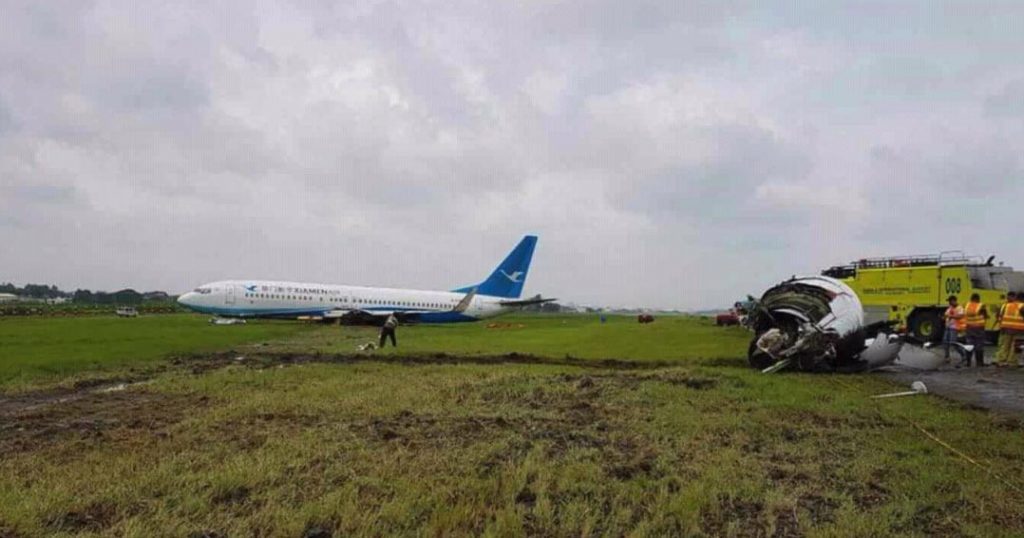
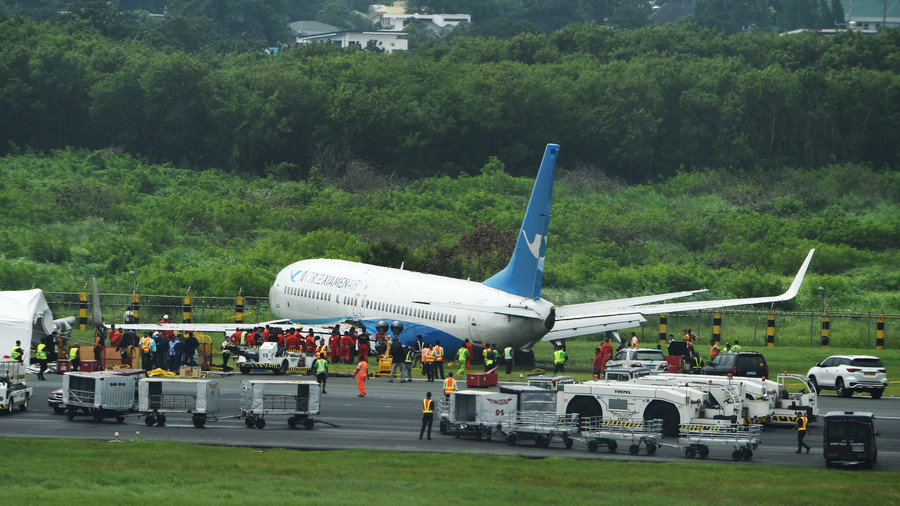
El vuelo MF8667 de un Boeing 737-800 de la aerolínea china Xiamen Airlines derrapa en la pista del Aeropuerto Internacional de Manila, Filipinas durante un aterrizaje de emergencia.
El Aeropuerto Internacional Ninoy Aquino de Manila informó que el Boeing 737-800 realizó el aterrizaje a alrededor de las 00:05 hora local de hoy (16:05 GMT) cuando ocurrió el accidente. El vuelo MF8667 procedente de Xiamen, sobrevoló en círculos en Manila durante cerca de una hora antes del aterrizaje.
El 737-800 de Xiamen Airlines, el registro B-5498 que realizaba el vuelo MF-8667 desde Xiamen (China) a Manila (Filipinas) con 157 pasajeros y 8 tripulantes, había pasado de baja altura en el primer acercamiento final a la pista 24 de Manila debido a clima, posicionado para otro enfoque y continuó para aterrizar en la pista 24 a las 23:55L (15: 55Z), pero se salió del borde izquierdo de la pista y se detuvo en terreno blando con el tren principal izquierdo colapsado y el izquierdo motor separado del ala. El avión fue evacuado a través de toboganes. No se informaron heridos, pero la aeronave recibió daños considerables.
El aeropuerto de Manila informó que el vuelo MF-8667 salió de la pista a aproximadamente 23:55L durante un fuerte aguacero. Todos los ocupantes de la aeronave están seguros. Los investigadores de la CAA Philippines ya están en el sitio.
El 17 de agosto de 2018, la CAAC de China informó que el MF8667 (B738/B5498) salió de la pista en Manila. 157 pasajeros y 8 tripulantes permanecieron ilesos. En el momento del aterrizaje hubo una fuerte tormenta eléctrica, visibilidad de 2000 metros, vientos de 280 grados a 11 nudos, techo de nubes de 540 metros. La CAAC envió un equipo de investigadores a Manila para ayudar a la Investigación de Accidentes filipinos. La CAA y la Autoridad de Aviación del Este de China formaron un grupo de trabajo conjunto para revisar Xiamen Airlines. Se ha recordado a la industria tomar medidas resueltas para observar los márgenes de seguridad.
EL VUELO MF8667 DE XIAMEN AIRLINES ACCIDENTADO EN EL AEROPUERTO NINOY AQUINO DE MANILA
Informes preliminales
El avión aparentemente efectuó una aproximación errática en su primer intento de aterrizar, perdió contacto con la torre de control en el segundo intento y patinó al aterrizar, según Ed Monreal, el Gerente General del aeropuerto.
Las alas y los motores del avión resultaron muy dañados como resultado del accidente, según la fuente. Al parecer, el avión perdió la línea central de la pista al aterrizar, por lo que giró bruscamente hacia la zona segura con hierba. La fuente señaló que estaba lloviendo intensamente cuando el avión aterrizó y especuló en el sentido de que los fuertes vientos laterales y la baja visibilidad pudieron haber causado el accidente. No se han reportado heridos ni fallecidos durante el impacto de la aeronave.
Las autoridades aeroportuarias aún no emiten una declaración oficial sobre el accidente. «Se está realizando una evacuación de emergencia», dijo la fuente, la cual añadió que se vio a algunos pasajeros descalzos alrededor del avión dañado poco después del aterrizaje. El personal de emergencia del aeropuerto levantó tiendas de campaña alrededor del área del accidente, indicó la fuente. El aeropuerto seguirá abierto porque todavía se puede utilizar la otra pista, según la fuente.
La compañía Xiamen Airlines tiene una flota de 164 aviones y vuela a 70 destinaciones diferentes. Decenas de vuelos han sido cancelados en Manila debido al accidente.
Boeing 737 Xiamen lands emergency
A Boeing 737-800 of the Chinese airline Xiamen Airlines lands in emergancia in the Philippines
The flight MF8667 of a Boeing 737-800 of the Chinese airline Xiamen Airlines drifts on the runway of Manila International Airport, Philippines during an emergency landing.
The Ninoy Aquino International Airport in Manila reported that the Boeing 737-800 landed at around 00:05 local time today (16:05 GMT) when the accident occurred. Flight MF8667 from Xiamen flew in circles in Manila for about an hour before landing.
The 737-800 of Xiamen Airlines, registration B-5498 that made the flight MF-8667 from Xiamen (China) to Manila (Philippines) with 157 passengers and 8 crew, had gone from low altitude in the first final approach to runway 24 from Manila due to weather, positioned for another approach and continued to land on runway 24 at 23: 55L (15: 55Z), but left the left edge of the runway and stopped on soft ground with the left main train collapsed and the left motor separated from the wing. The plane was evacuated through slides. No injuries were reported, but the aircraft received considerable damage.
Manila airport reported that flight MF-8667 left the runway at approximately 23: 55L during a heavy downpour. All occupants of the aircraft are safe. The researchers of the CAA Philipinnes are already on the site.
On August 17, 2018, the CAAC of China reported that the MF8667 (B738 / B5498) left the runway in Manila. 157 passengers and 8 crew remained unharmed. At the time of landing there was a strong thunderstorm, visibility of 2000 meters, winds of 280 degrees at 11 knots, cloud ceiling of 540 meters. The CAAC sent a team of investigators to Manila to help the Philippine Accident Investigation. The CAA and the East China Aviation Authority formed a joint working group to review Xiamen Airlines. The industry has been reminded to take resolute measures to observe safety margins.
Preliminary reports
The plane apparently made an erratic approach on its first attempt to land, lost contact with the control tower on the second attempt and skidded on landing, according to Ed Monreal, the airport’s General Manager.
The aircraft’s wings and engines were badly damaged as a result of the accident, according to the source. Apparently, the plane lost the centerline of the runway when it landed, so it swerved sharply towards the safe area with grass. The source said it was raining heavily when the plane landed and speculated that strong lateral winds and low visibility could have caused the accident. No injuries or deaths have been reported during the impact of the aircraft.
The airport authorities have not yet issued an official statement about the accident. «An emergency evacuation is under way», the source said, adding that some passengers were seen barefoot around the damaged plane shortly after landing. Emergency personnel at the airport erected tents around the area of the accident, the source said. The airport will remain open because the other runway can still be used, according to the source.
The company Xiamen Airlines has a fleet of 164 aircraft and flies to 70 different destinations. Dozens of flights have been canceled in Manila due to the accident. A \ W
Ξ A I R G W A Y S Ξ
SOURCE: Airgways.com
DBk: Avherald.com / Gmanetwork.com / Apf.com
AW-POST: 201808171258AR
La FAA revisa política de MEL LOA para operaciones internacionales
La Federal Aviation Administration (FAA) de EEUU está revisando su política en torno a las Cartas de Autorización (Letters of Authorization, LOA) de la Parte 91 para las aprobaciones de la Lista de Equipo Mínimo (MEL), dijo la agencia. Se realizó una determinación final de política que aborda las preocupaciones de seguridad tanto de la industria como de los socios de la aviación internacional, agregó la agencia.
Esta cuestión se había convertido en una preocupación importante a nivel internacional después de verificaciones en rampa de ciertos aviones estadounidenses en Francia, destacando las diferentes interpretaciones que la FAA y la Agencia Europea de Seguridad Aérea habían tomado en torno al uso de MEL y MMEL (lista maestra de equipo mínimo), según el Vuelo Service Bureau (FSB). Estados Unidos había permitido el uso del MMEL para diferir ciertas reparaciones de equipos, pero EASA estaba buscando LOA que cubriera un MEL específico aprobado para cada aeronave, agregó FSB. Sin esa LOA, los operadores de aeronaves corrían el riesgo de fallar los controles de la rampa en Europa.
FSB dijo que creía que la FAA llegó a un acuerdo tentativo con EASA a principios de este año en virtud del cual los operadores internacionales necesitarían obtener la nueva y más amplia D195 LOA, y EASA proporcionaría tiempo para que ese proceso ocurra.
Pero el especialista en operaciones internacionales ahora advierte a los operadores que FAA está revisando esto dada la cantidad de trabajo y tiempo involucrado para las LOA D195, y podría optar por las aprobaciones D095 tradicionales en su lugar, pero proporcionar una validación más profunda de los componentes. «Esto ciertamente parece presentar una inversión del compromiso anterior con EASA, que muy bien podría no aceptar estas LOA», dijo FSB.
La FAA está considerando varias opciones de política, pero «en este momento, no se ha tomado una decisión final», dijo la agencia. Mientras tanto, la agencia se refirió a la guía existente contenida en la Orden FAA 8900.1, Volumen 4, Capítulo 4, Sección 2 y Sección 3. FSB espera que la FAA emita una carta de InFO a los operadores de la Parte 91 una vez que haya finalizado la orientación.
NBAA ha estado observando este problema, señalando que ha sido preocupante para sus miembros. La asociación señaló el otoño pasado que ha estado trabajando con EASA, la FAA y la OACI para obtener una guía más clara para las operaciones con una LOA DO95.
Aconsejó a los miembros con el DO95 que «sean diligentes» cuando realicen operaciones internacionales, particularmente dado que EASA enfatiza tres áreas en las inspecciones de rampas de aeronaves extranjeras: cumplimiento total con la LOA; el MEL refleja cualquier instalación de equipo STC; y los operadores cumplen con las normas de la OACI con respecto a los procedimientos de mantenimiento para la aeronavegabilidad continua de los equipos de comunicación, navegación y vigilancia instalados, incluida la inclusión en el MEL.
FAA regulation of LOA Part 91 of the MEL
FAA reviews MEL LOA policy for international operations
The US Federal Aviation Administration (FAA) is reviewing its policy on the Letters of Authorization (LOA) of Part 91 for approvals of the Minimum Equipment List (MEL), the agency said. A final policy determination was made that addresses the safety concerns of both the industry and international aviation partners, the agency added.
This issue had become a major concern at the international level after ramp checks of certain US aircraft in France, highlighting the different interpretations that the FAA and the European Aviation Safety Agency had taken regarding the use of MEL and MMEL (list minimum team teacher), according to the Flight Service Bureau (FSB). The United States had allowed the use of MMEL to defer certain equipment repairs, but EASA was looking for LOAs that would cover a specific MEL approved for each aircraft, FSB added. Without that LOA, aircraft operators ran the risk of failing ramp controls in Europe.
FSB said it believed the FAA reached a tentative agreement with EASA earlier this year under which international operators would need to obtain the new and broader D195 LOA, and EASA would provide time for that process to occur.
But the international operations specialist now warns operators that FAA is reviewing this given the amount of work and time involved for the D195 LOAs, and could opt for traditional D095 approvals instead, but provide deeper validation of the components . «This certainly seems to present an investment of the previous commitment with EASA, which could very well not accept these LOAs», said FSB.
The FAA is considering several policy options, but «at this time, no final decision has been made», the agency said. Meanwhile, the agency referred to the existing guidance contained in FAA Order 8900.1, Volume 4, Chapter 4, Section 2 and Section 3. FSB expects the FAA to issue an InFO letter to Part 91 operators once The orientation is finished.
NBAA has been observing this problem, noting that it has been worrying for its members. The association said last fall that it has been working with EASA, the FAA and ICAO to obtain a clearer guidance for operations with a LOA DO95.
Advised DO95 members to «be diligent» when conducting international operations, particularly since EASA emphasizes three areas in the inspections of foreign aircraft ramps: full compliance with the LOA; the MEL reflects any installation of STC equipment; and operators comply with ICAO standards with respect to maintenance procedures for the continued airworthiness of installed communication, navigation and surveillance equipment, including inclusion in the MEL. A \ W
Ξ A I R G W A Y S Ξ
SOURCE: Airgways.com
DBk: Faa.gov / Ainonline.com / Businessinsider.com / Pinterest.com
AW-POST: 2018080142009AR
AW | 2018 08 13 12:41 | AIR INVESTIGATION / AVIATION SAFETY
La aerolínea Aeroméxico enfrenta quince demandas por accidente vuelo AM2431 en Durango
La firma Corboy & Demetrio presentó cuatro demandas en representación de pasajeros estadounidenses de Aeroméxico que resultaron lesionados en el accidente del vuelo AM2431 en el Aeropuerto Durango, en México, el pasado 31 Julio 2018. De acuerdo con un comunicado de la firma, los nuevos demandantes son dos hermanas, una mujer que fue hospitalizada y un joven que sufrió lesiones en el cuello y la espalda. Las nuevas demandas fueron presentadas el pasado 10 Agosto en el Tribunal de Circuito del Condado de Cook, cuatro días después de las primeras 11 presentaciones. Corboy & Demetrio señaló que todos los pasajeros son residentes en el área de Chicago, recibieron tratamiento médico en México y ahora lo están recibiendo en Estados Unidos. La semana pasada obtuvieron una orden de protección judicial contra Aeroméxico donde se «exige la preservación, protección y presentación de la grabadora de voz de la cabina, la grabadora de datos del vuelo y toda la comunicación entre el piloto y el control de tráfico aéreo, el control en tierra y cualquier personal de Aeroméxico desde 30 minutos antes del accidente hasta 10 minutos después del mismo».
Según la Embajada de EU en la Ciudad de México y el Consulado General de ese país en Monterrey, Nuevo León, al menos 65 ciudadanos estadounidenses viajaban en el vuelo accidentado en Durango. Corboy & Demetrio han litigado en varios de los mayores incidentes aéreos desde 1979. En estos proceso han obtenido compensaciones récord para los pasajeros afectados y sus familias.
El avión de pasajeros Embraer E190-100 de la aerolínea Aeroméxico Connect cubriría la ruta Durango-Ciudad de México, precipitó a tierra cerca de la pista poco después del despegue. Las 103 personas a bordo sobrevivieron al evacuar el avión antes de que se incendiara.
Lawsuits to Aeromexico by accident AM2431
The airline Aeromexico faces fifteen lawsuits for accident AM2431 flight in Durango
The firm Corboy & Demetrio filed four lawsuits on behalf of Aeromexico‘s US passengers who were injured in the accident of flight AM2431 at the Aeropuerto Durango, Mexico, on July 31, 2018. According to a statement from the firm, the new plaintiffs They are two sisters, a woman who was hospitalized and a young man who suffered injuries to his neck and back. The new lawsuits were filed on August 10 in the Circuit Court of Cook County, four days after the first 11 presentations. Corboy & Demetrio noted that all passengers are residents of the Chicago area, received medical treatment in Mexico and are now receiving it in the United States. Last week they obtained a judicial protection order against Aeromexico where «the preservation, protection and presentation of the cockpit voice recorder, the flight data recorder and all communication between the pilot and the air traffic control are required, ground control and any Aeromexico personnel from 30 minutes before the accident to 10 minutes after the accident».
According to the US Embassy in Mexico City and the Consulate General of that country in Monterrey, Nuevo León, at least 65 US citizens were traveling on the injured flight in Durango. Corboy & Demetrio have litigated several of the largest air incidents since 1979. In these processes they have obtained record compensation for the affected passengers and their families.
The Embraer E190-100 passenger plane of airlines Aeroméxico Connect would cover the Durango-Mexico City route, rushing to land near the runway shortly after takeoff. The 103 people on board survived by evacuating the plane before it caught fire. A \ W
Ξ A I R G W A Y S Ξ
SOURCE: Airgways.com
DBk: Aeromexico.com / Juan Carlos Guerra / Airgways.com
AW-POST: 201808131241AR
Un A320-200 de Volaris Airlines sufre un incidente de incendio de APU
Volaris Airlines ha sufrido un incidente en un Airbus A320-200 con matrícula XA-VLF fue evacuado luego de un incidente en un principio de incendio de la Unidad de Potencia Auxiliar (APU) en el Aeropuerto de Guadalajara, México.
Después de la presencia de humo en la aeronave de Volaris de la unidad de energía auxiliar (APU), no se informaron heridos en el vuelo Y4961 que aterrizó proveniente de Las Vegas, Nevada. Luego del principio de incendio del Airbus A320-200, provocó la evacuación de los 60 pasajeros a bordo de la aeronave. La tripulación accionó los protocolos de seguridad y los pasajeros fueron evacuados en toboganes, sin que hubiera pasajeros lesionados, sólo una con crisis nerviosa.
Análisis incidente
El A320 había aterrizado minutos antes procedente del Aeropuerto Internacional Las Vegas, Estados Unidos. Reportes preliminares indican el problema de sobrecalentamiento que se dio en la Unidad Potencia Auxiliar (APU) que se encuentra en la parte trasera de la aeronave y que genera la energía eléctrica y sistema de aire acondicionado. Cuerpos de rescate de la terminal aérea atendieron el incidente.
APU incident of an A320 of Volaris
An A320-200 of Volaris Airlines suffers an APU fire incident
Volaris Airlines has suffered an incident in an Airbus A320-200 with license plate XA-VLF was evacuated after an incident at the beginning of the fire of the Auxiliary Power Unit (APU) at the Guadalajara Airport, Mexico.
After the presence of smoke on the Volaris aircraft of the auxiliary power unit (APU), no injuries were reported on flight Y4961 that landed from Las Vegas, Nevada. After the fire start of the Airbus A320-200, it caused the evacuation of the 60 passengers on board the aircraft. The crew activated the safety protocols and the passengers were evacuated in slides, without injured passengers, only one with nervous breakdown.
Incident analysis
The A320 had landed minutes earlier from the Las Vegas International Airport, United States. Preliminary reports indicate the problem of overheating that occurred in the Auxiliary Power Unit (APU) that is located at the rear of the aircraft and that generates the electric power and air conditioning system. Rescuers from the air terminal attended the incident. A \ W
Ξ A I R G W A Y S Ξ
SOURCE: Airgways.com
DBk: Jacdec.de
AW-POST: 201808121524AR