Tifón Jebi impacta en Japón

Resultado de imagen para Typhoon Jebi  airportAW | 2018 09 04 12:11 | AVIATION SAFETY

1f300.pngAeropuerto internacional de Osaka inundado, petrolero golpea el puente mientras el tifón Jebi causa estragos

Uno de los aeropuertos más concurridos de Japón, el Aeropuerto Internacional Kansai de Osaka, fue cerrado por completo el martes (4 de septiembre) debido a las inundaciones causadas por el Tifón Jebi, el más fuerte en golpear a Japón en 25 años. Más de 700 vuelos fueron cancelados. Las inundaciones cubrieron las pistas, dejando varios aviones sumergidos hasta sus motores, informó el Ministerio de Transporte.

El Aeropuerto Internacional nipón de Kansai en Osaka (oeste) quedó completamente inundado debido a una crecida del mar causada por el poderoso tifón Jebi, que provocó la cancelación de centenares de vuelos y dejó a numerosos viajeros atrapados en la terminal. Las pistas de aterrizaje del aeropuerto de Kansai, el tercero con más tránsito del país después de los dos de Tokio, resultaron repentinamente invadidas por el mar en torno a las 12, así como la planta baja de una terminal.

Numerosos pasajeros quedaron atrapados en una terminal debido a la inundación y al corte del puente que conecta el aeropuerto con la ciudad de Izumisano, única vía de acceso al aeródromo situado en una isla artificial en la Bahía de Osaka, según la misma fuente, que no pudo precisar el número de personas afectadas.

Los fuertes vientos enviaron al buque cisterna de 2.591 toneladas a estrellarse contra el puente, lo que provocó el cierre de la carretera y los enlaces ferroviarios del puente. El tanquero estaba vacío y ninguno de sus tripulantes resultó herido, dijo el guardacostas.

Jebi, que significa «golondrina» en coreano, fue brevemente un súper tifón y es el último clima duro que golpea a Japón este verano tras las lluvias, los deslizamientos de tierra, las inundaciones y el calor récord que mató a cientos de personas.

La tormenta tocó tierra en Shikoku, la isla principal más pequeña, alrededor del mediodía. Se arrastró a través de la parte occidental de la isla principal más grande, Honshu, cerca de la ciudad de Kobe, varias horas más tarde, dirigiéndose rápidamente hacia el norte.

El paso del poderoso tifón ha causado una fuerte marejada y una crecida del nivel del mar que ha superado los 2,4 metros en esta zona, según dijo un portavoz de la Agencia Meteorológica nipona (JMA), quien calificó la situación de «extremadamente peligrosa». AIRWAYS® AW-Icon TXT

Resultado de imagen para Typhoon Jebi  airport

Typhoon Jebi hits Japan

Osaka international airport flooded, oil tanker hits the bridge as Typhoon Jebi wreaks havoc

One of Japan’s busiest airports, the Kansai International Airport in Osaka, was completely closed on Tuesday (September 4) due to floods caused by Typhoon Jebi, the strongest to hit Japan in 25 years. More than 700 flights were canceled. Floods covered the runways, leaving several aircraft submerged to their engines, the transport ministry reported.Resultado de imagen para Typhoon Jebi

The Japanese International Airport of Kansai in Osaka (west) was completely flooded due to a sea swell caused by the powerful typhoon Jebi, which caused the cancellation of hundreds of flights and left many travelers trapped in the terminal. The runways at Kansai airport, the third with the most transit in the country after Tokyo, were suddenly invaded by the sea around 12 am, as well as the ground floor of a terminal.

Numerous passengers were trapped in a terminal due to the flood and the cut of the bridge that connects the airport with the city of Izumisano, the only access road to the aerodrome located on an artificial island in the Osaka Bay, according to the same source, which does not could specify the number of people affected.

Strong winds sent the tanker ship of 2,591 tons crashing into the bridge, which caused the closure of the road and the railway links of the bridge. The tanker was empty and none of its crew was injured, the coast guard said.

Jebi, which means «swallow» in Korean, was briefly a super typhoon and is the last harsh climate that hits Japan this summer after the rains, landslides, floods and the record heat that killed hundreds of people.

The storm made landfall on Shikoku, the smallest main island, around noon. It crawled through the western part of the larger main island, Honshu, near the city of Kobe, several hours later, quickly heading north.

The passage of the powerful typhoon has caused a strong swell and a rise in sea level that has exceeded 2.4 meters in this area, said a spokesman of the Japan Meteorological Agency (JMA), who described the situation as «extremely dangerous».  A \ W


Ξ A I R G W A Y S Ξ
SOURCE:  Airgways.com
DBk: Jma.go.jp / Channelnewsasia.com / Aviation24.be / Nptelegraph.com
AW-POST: 201809041211AR

A\W   A I R G W A Y S ®

Xiamen Air MF8667 análisis grabaciones

Resultado de imagen para MF8667 Xiamen Air

AW | 2018 09 03 11:11 | AIR INVESTIGATION / AVIATION SAFETY

Análisis de grabaciones del vuelo de Xiamen Air

Los investigadores de la Junta de Investigaciones y Investigación de Aviación de la Autoridad de Aviación Civil de Filipinas confirman que el registro de datos de la caja negra es de buena calidad. Las lecturas de la grabadora de datos de vuelo y la grabadora de voz de cabina del vuelo MF8667 de Xiamen Air, que fueron llevadas a Singapore el 23 Agosto 2018, fueron devueltas a Manila el viernes, 31 Agosto 2018, según las autoridades de aviación filipinas.

El vuelo MF8667 de Xiamen Air se salió de la pista del Aeropuerto Internacional Ninoy Aquino la noche del jueves 16 de agosto. Tomó alrededor de 36 horas retirar el avión y reanudar las operaciones en la única pista de despegue de NAIA. El cierre de la pista canceló, desvió y retrasó 631 vuelos y afectó a aproximadamente 250,000 pasajeros.

Mientras Xiamen Air se disculpó por el accidente en la pasarela , es posible que tenga que pagar al menos P15 millones por el accidente, cubriendo solo el costo del alquiler del equipo utilizado para sacar el avión de la pista. A pesar del regreso de las lecturas, las normas de aviación internacionales y filipinas impiden que las autoridades divulguen el contenido de la grabadora de voz y datos hasta que se haya completado un informe final. Sin embargo, los investigadores de la Junta de Investigaciones Aeronáuticas y Investigaciones Aeronáuticas (AAIIB) de la Autoridad de Aviación Civil de Filipinas (CAAP) confirmaron que el registro de datos de la caja negra era de buena calidad. Mientras tanto, el Comité de Investigación de Seguridad de Vuelo de la CAAP (CAAP-FSIC) también está llevando a cabo su propia investigación regulatoria para determinar las infracciones de la regulación aérea civil de Xiamen.

Las investigaciones AAIIB y FSIC son independientes entre sí y se utilizan para determinar diferentes cosas. La investigación de AAIIB tiene como objetivo determinar la violación de seguridad y no es de naturaleza punitiva. La investigación de CAAP-FSIC, mientras tanto, intentará identificar posibles infracciones contra las regulaciones aéreas civiles. AIRWAYS® AW-Icon TXT

Imagen relacionada

Xiamen Air MF8667 analysis recordings

Analysis of Xiamen Air flight recordings

Researchers from the Aviation Research and Research Board of the Philippine Civil Aviation Authority confirm that the black box data record is of good quality. Readings recorder flight data and voice recorder cockpit flight MF8667 Xiamen Air, who were taken to Singapore on 23 August 2018, were returned to Manila on Friday, August 31, 2018, officials of Philippine aviation .

Xiamen Air flight MF8667 left the runway at Ninoy Aquino International Airport on the night of Thursday, August 16. It took about 36 hours to retire the aircraft and resume operations at NAIA’s only take-off runway. The closure of the runway canceled, diverted and delayed 631 flights and affected approximately 250,000 passengers.

While Xiamen Air apologized for the accident on the runway, you may have to pay at least P15 million for the accident, covering only the cost of renting the equipment used to take the plane off the runway. Despite the return of the readings, international and Philippine aviation regulations prevent authorities from disclosing the contents of the voice and data recorder until a final report has been completed. However, researchers from the Aeronautical Research and Aeronautical Research Board (AAIIB) of the Philippine Civil Aviation Authority (CAAP) confirmed that the black box data record was of good quality. Meanwhile, the CAAP Flight Safety Research Committee (CAAP-FSIC) is also conducting its own regulatory investigation to determine violations of Xiamen’s civil air regulation.

The AAIIB and FSIC investigations are independent of each other and are used to determine different things. The AAIIB investigation aims to determine the security breach and is not of a punitive nature. The CAAP-FSIC investigation, meanwhile, will try to identify possible infractions against civil air regulations. A \ W


Ξ A I R G W A Y S Ξ
SOURCE:  Airgways.com
DBk: Airlive.net / Caap.gov.ph
AW-POST: 201809031111AR

A\W   A I R G W A Y S ®

Accidente UTAir Boeing 737-800

Resultado de imagen para UTair air crash Boeing 737

AW | 2018 09 01 11:47 | AVIATION SAFETY / AIR INVESTIGATION

Accidente aéreo de aerolínea UTair Boeing 737-800 en Sochi, Federación Rusia

Resultado de imagen para UTair logoUn Boeing 737-800 de UTAir con registro VQ-BJI realizando el vuelo UT-579 con fecha del 31 Agosto 2018 en la ruta Moscú-Vnukovo a Sochi (Rusia) con 164 pasajeros y 6 tripulantes, aterrizó en la pista 06 de Sochi a las 02:57 L (23:57Z 31/08/2018), derrapando a final de pista, detuviéndose en el lecho de un río más allá de la pista de aterrizaje. El motor izquierdo CFM56 estalló en llamas. El avión fue evacuado, 18 ocupantes resultaron heridos, los otros permanecieron ilesos, un empleado del aeropuerto murió de un ataque al corazón. La aeronave recibió daños sustanciales irreparables.

La aeronave fue inicialmente vectorizada para un acercamiento a la pista 02 por aproximación, sin embargo, la asignación de la pista se cambió a la pista 06 debido al desarrollo del clima. La aeronave abortó la primera aproximación a la pista 06 de Sochi descendiendo a unos 2.300 pies debido a los vientos cambiantes (ahora informada de 200 grados en vez de 60 grados), posicionada para otro acercamiento a la pista 06 y voló desde aproximadamente 400 pies MSL nuevamente debido a cambios vientos, posicionado para la tercera y última aproximación a la pista 06 (vientos reportados a 2 m / s (4 nudos) desde 060 grados en la frecuencia de la torre), que terminó en la pista desbordada unos 30 minutos después del primer abordaje abortado y unos 11 minutos después la vuelta.

La aerolínea informó que la aeronave llevaba 164 pasajeros y 6 tripulantes. El avión se salió de la pista y se dejó caer en el lecho de un río, como resultado, el tren de aterrizaje y las alas colapsaron, el motor izquierdo se encendió. Los servicios de emergencia del aeropuerto de Sochi apagaron el fuego, los ocupantes fueron evacuados. Las autoridades están investigando el accidente.

El Ministerio de Salud de Rusia informó que 18 pasajeros resultaron heridos, 8 de los cuales fueron trasladados a un hospital. El Ministerio de Emergencia de Rusia informó que el avión pasó por el extremo de la pista hacia un río, el tren de aterrizaje y un ala fueron destruidos, el motor izquierdo se incendió y quemó el ala izquierda. La Fiscalía de Transportes del Sur informó que la aeronave invadió la pista, se quemaron las alas izquierda y derecha y varios pasajeros resultaron heridos. El Departamento de Investigaciones de la Fiscalía de Transportes del Sur ha abierto una investigación.

El Aeropuerto de Sochi informó que uno de sus trabajadores murió como resultado de un ataque al corazón mientras se realizaban trabajos de rescate y recuperación durante el accidente.

El Comité de Aviación Interestatal (MAK) informó que el avión VQ-BJI de UTAir rodó más allá del final de la pista después del aterrizaje y recibió daños sustanciales debido al despliegue y posterior incendio. No hubo muertes. El MAK ha establecido una comisión de investigación. AIRWAYS® AW-Icon TXT

Resultado de imagen para UTair air crash Boeing 737Imagen relacionadaVQ-BJI más allá del final de la pista (Foto: NTV)VQ-BJI en el río (Foto: Southern Transport Prosecution Office)


Accident UTAir Boeing 737-800

Airline accident of airline UTair Boeing 737-800 in Sochi, Federation Russia

A UTAir Boeing 737-800 with registration VQ-BJI making flight UT-579 dated August 31, 2018 on the Moscow-Vnukovo route to Sochi (Russia) with 164 passengers and 6 crew, landed on runway 06 in Sochi to 02:57 L (23: 57Z 08/31/2018), skidding at the end of the runway, stopping at the bottom of a river beyond the runway. The left engine CFM56 burst into flames. The plane was evacuated, 18 occupants were injured, the others remained unharmed, an airport employee died of a heart attack. The aircraft received substantial irreparable damage.

The aircraft was initially vectorized for an approach to runway 02 by approach, however, the track allocation was changed to runway 06 due to weather development. The aircraft aborted the first approach to runway 06 from Sochi descending to about 2,300 feet due to the changing winds (now reported 200 degrees instead of 60 degrees), positioned for another approach to runway 06 and flew from approximately 400 feet MSL again due to changes in winds, positioned for the third and final approach to runway 06 (winds reported at 2 m / s (4 knots) from 060 degrees on the frequency of the tower), which ended on the runway overflowing about 30 minutes later of the first aborted approach and about 11 minutes after the return.

The airline reported that the aircraft carried 164 passengers and 6 crew members. The plane left the runway and dropped into the bed of a river, as a result, the landing gear and wings collapsed, the left engine ignited. The emergency services of Sochi airport put out the fire, the occupants were evacuated. The authorities are investigating the accident.

The Russian Ministry of Health reported that 18 passengers were injured, 8 of whom were taken to a hospital. The Russian Emergency Ministry reported that the plane passed by the end of the runway to a river, the landing gear and a wing were destroyed, the left engine caught fire and burned the left wing. The Southern Transportation Prosecutor’s Office reported that the aircraft invaded the runway, the left and right wings were burned and several passengers were injured. The Investigations Department of the Southern Transportation Prosecutor’s Office has opened an investigation.

Sochi Airport reported that one of its workers died as a result of a heart attack while rescue and recovery work was carried out during the accident.

The Interstate Aviation Committee (MAK) reported that the UTAir VQ-BJI aircraft rolled past the runway end after landing and received substantial damage due to deployment and subsequent fire. There were no deaths. The MAK has established a commission of inquiry. A \ W


Ξ A I R G W A Y S Ξ
SOURCE:  Airgways.com
DBk: Avherald.com / Ntv.ru / Southern Transport Prosecution Office / Thenational.ae / Jacdec.de / Firenewsfeed.com
AW-POST: 201809011147AR

A\W   A I R G W A Y S ®

Restos accidente KLM-Pam Am

Resultado de imagen para restos accidente KLM Pan Am

AW | 2018 08 27 19:55 | AIR INVESTIGATION / AVIATION SAFETY

Encuentran pieza de Boeing 747 del accidente aéreo Los Rodeos de 1977

El accidente de Los Rodeos es una de las tragedias aéreas las importantes del mundo, el choque entre dos aviones Boeing 747 que se produjo el 27 Marzo 1977 en el Aeropuerto de Los Rodeos (actualidad Tenerife Norte), en el norte de la isla española de Tenerife, en el que murieron 583 personas. Es el accidente aéreo con mayor número de víctimas mortales de la historia de la aviación.

Los aviones siniestrados fueron el Boeing 747-200 del vuelo KLM 4805, vuelo chárter de la línea aérea holandesa KLM, cubría la ruta desde el Aeropuerto Los Rodeos hacia el Aeropuerto de Schiphol en Ámsterdam (Países Bajos). El Boeing 747-200 del vuelo PAA 1736, vuelo regular de Pan Am Airways, retornaba para los Estados Unidos.

Las tareas de desbroce de un terreno del Municipio de La Laguna, donde se encuentra el Aeropuerto de Los Rodeos, han sacado a la luz una pieza metálica hecha con uranio empobrecido perteneciente a uno de los Boeing 747 del accidente aéreo que tuvo lugar en la isla en 1977, según ha informado este lunes la Policía Nacional a través de un comunicado. Se trata de un contrapeso utilizado en las superficies de mando de un avión comercial, fabricado con uranio empobrecido, una sustancia que presenta una baja tasa de radiactividad, según ha precisado la Jefatura Superior de Policía de Canarias.

Como marcan los protocolos se acotó la zona y se anuncia ahora que la pieza será próximamente extraída por personal especializado dada su escasa capacidad radiactiva. Todo ello, detalla la Policía, después de realizar mediciones de radiación en la zona» e iniciar las gestiones oportunas para dar conocimiento al Consejo de Seguridad Nuclear para darle el tratamiento adecuado, activándose el protocolo previsto por el Plan de Atención de Emergencias por Riesgo Radiológico (Radican).

La Policía Nacional tuvo conocimiento del hallazgo a las 17:00 horas del jueves 23 Agosto 2018 en una finca ubicada en el término municipal de San Cristóbal de La Laguna. La pieza encontrada después de 41 años del fatídico accidente, un contrapeso utilizado en las superficies de mando de aproximadamente 50 cm. Se trataba de una pieza metálica en forma de cuña de color grisáceo-verdoso en la que se apreciaba en su lado izquierdo la siguiente leyenda: «Unauthorized alterations». Tras un primer examen visual de la pieza hallada y deducir que pudiera tratarse de algún material nocivo para la salud, se determinó acotar y proteger el lugar, estableciendo un perímetro de seguridad para alejar a los inquilinos de los inmuebles próximos a la zona, y requerir la intervención del servicio del TEDAX de la Policía Nacional». AIRWAYS® AW-Icon TXT

La pieza del Boeing 747 del accidente de Los Rodeos encontrada ahora

Remains accident The Rodeos KLM-Pam Am

They find piece of Boeing 747 of the plane crash Los Rodeos of 1977

The Los Rodeos accident is one of the most important air tragedies in the world, the collision between two Boeing 747 aircraft that occurred on March 27, 1977 at Los Rodeos Airport (now Tenerife North), in the north of the Spanish island of Tenerife, in which 583 people died. It is the plane crash with the highest number of fatalities in the history of aviation.

The damaged aircraft were the Boeing 747-200 of flight KLM 4805, charter flight of the Dutch airline KLM, covering the route from Los Rodeos Airport to Schiphol Airport in Amsterdam (The Netherlands). The Boeing 747-200 of flight PAA 1736, regular flight of Pan Am Airlines, returned to the United States.

The tasks of clearing a piece of land in the Municipality of La Laguna, where the Los Rodeos Airport is located, have brought to light a metal piece made of depleted uranium belonging to one of the Boeing 747s of the plane crash that took place on the island. in 1977, as reported by the National Police on Monday through a statement. It is a counterweight used in the control surfaces of a commercial aircraft, manufactured with depleted uranium, a substance that has a low rate of radioactivity, as specified by the Superior Police Headquarters of the Canary Islands.

As the protocols mark, the zone was delimited and it is now announced that the piece will soon be extracted by specialized personnel given its scarce radioactive capacity. All this, details the Police, after making measurements of radiation in the zone «and initiate the opportune managements to give knowledge to the Nuclear Security Council to give him the suitable treatment, activating the protocol foreseen by the Plan of Attention of Emergencies by Radiological Risk (Radican)

The National Police was informed of the finding at 5:00 pm on Thursday, August 23, 2018 in a farm located in the municipality of San Cristóbal de La Laguna. The piece found after 41 years of the fateful accident, a counterweight used on the control surfaces of approximately 50 cm. It was a metal piece in the shape of wedge of grayish-greenish color in which the following legend could be seen on its left side: «Unauthorized alterations». After a first visual examination of the piece found and deducing that it could be some material harmful to health, it was determined to delimit and protect the place, establishing a security perimeter to keep the tenants away from the properties near the area, and require the intervention of the TEDAX service of the National Police». A \ W


Ξ A I R G W A Y S Ξ
SOURCE:  Airgways.com
DBk: Interior.gob.es
AW-POST: 201808271955AR

A\W   A I R G W A Y S ®

Emergencia AA996 American en Ezeiza

Resultado de imagen para Boeing 777 American Airlines AA996

AW | 2018 08 27 15:25 | AIR INVESTIGATION / AVIATION SAFETY

Nuevamente un Boeing 777-200 de American Airlines tuvo aterrizaje de emergencia en Aeropuerto Ezeiza

El vuelo AA996 de American Airlines, que partió minutos antes de las 20:00 hs. debió aterrizar de emergencia a las 21:45 hs (UTC-3) en el Aeropuerto Internacional Ministro Pistarini de Ezeiza.

Un Boeing 777-200 de la misma línea aérea que llevaba a la titular del FMI Christine Lagarde también debió retornar, en este caso por una pérdida de combustible.

Los análisis preliminales del incidente aéreo de esta noche se ocasionó por problemas hidráulicos en la aeronave. Momentos de tensión se vivieron en el el vuelo AA996 de American Airlines. El Boeing 777-200 había partido anoche desde Ezeiza rumbo a Dallas, pero un fallo en el sistema hidráulico la obligó a regresar. El Boeing 777-200 había partido a las 20:25 hs. rumbo a Estados Unidos, pero se debieron activar los protocolos de emergencia que se siguen en estos casos, retomando a las 21:45 hs. a Ezeiza. El avión debió vaciar combustible a la altura de La Plata y volvió a Ezeiza, donde aterrizó en la pista 17 una hora después de la partida. Allí fue esperado por el cuerpo de bomberos y el aeropuerto debió cerrarse durante el lapso de la emergencia. No se reportaron heridos. AIRWAYS® AW-Icon TXT

Emergency AA996 American in Ezeiza

Again a Boeing 777-200 of American Airlines had an emergency landing at Ezeiza Airport

American Airlines flight AA996, ​​which departed minutes before 8:00 p.m. He had to land at 9:45 p.m. (UTC-3) at the Ministro Pistarini International Airport in Ezeiza.

A Boeing 777-200 from the same airline that carried the IMF holder Christine Lagarde also had to return, in this case for a loss of fuel.

Preliminary analyzes of the night air incident were caused by hydraulic problems in the aircraft. Moments of tension were experienced on the American Airlines flight AA996. The Boeing 777-200 had left last night from Ezeiza bound for Dallas, but a failure in the hydraulic system forced it to return. The Boeing 777-200 had left at 8:25 p.m. towards the United States, but the emergency protocols followed in these cases had to be activated, resuming at 9:45 p.m. to Ezeiza. Thus, according to reports on social networks, the plane had to empty fuel at the height of La Plata and returned to Ezeiza, where it landed on runway 17 an hour after the game. There it was expected by the fire brigade and the airport had to be closed during the period of the emergency. No injuries were reported.  A\W


Ξ A I R G W A Y S Ξ
SOURCE:  Airgways.com
DBk: Aa.com / Aa2000.com.ar
AW-POST: 201808271525AR

A\W   A I R G W A Y S ®


Intercepción al vuelo MH-370

AA-MH370

AW | 2018 08 26 23:56 | AIR INVESTIGATION / AVIATION SAFETY

AW-70083772.pngUn investigador del vuelo de Malaysia Airlines MH-370 ha afirmado que el avión condenado fue interceptado por un avión de combate y el informe final sobre la desaparición del avión lo demuestra

El vuelo MH370 de Malaysia Airlines se desvaneció sobre el Océano Índico al pasar de Kuala Lumpur a Beijing el 8 de marzo de 2014. Todos los esfuerzos para rastrear el avión, que tenía 239 personas a bordo, han fallado.

El mes pasado, el gobierno malasio publicó su informe final sobre la desaparición del avión, y concluyó que aún no hay respuestas a lo sucedido. Pero un investigador voluntario cree que el informe demuestra que el Boeing 777 fue interceptado por un avión de combate antes de desaparecer.

Andre Milne mostró Daily Star Online una imagen que muestra la velocidad de la aeronave que muestra alcanzando los 58.200 pies. Es imposible que un Boeing suba más de 44,000 pies. El único avión capaz de eso es un tipo muy específico de avión de combate de gran altitud que se fabrica en Rusia llamado Sukhoi Su-30. Los jets son operados por la Royal Malaysian Air Force. Milne, fundador del desarrollador de tecnología militar Unicorn Aerospace, dijo: «Se desplegó un caza a reacción para interceptar MH370. «El descubrimiento de esta evidencia reprimida plantea serios problemas en múltiples niveles que van desde la pérdida total de credibilidad para el gobierno de Malasia hasta el factor de culpabilidad que el gobierno malasio ahora está sujeto a la desaparición total de los pasajeros y la tripulación».

Esto pudiera significar que prácticamente todas las revelaciones sobre el vuelo MH370 hechas por el gobierno de Malasia ahora no se fundamentan sobre sí. El hecho de que un avión de combate fue desplegado a pesar de negaciones repetidas con la extraña explicación de que el radar misterioso regresa acercándose al espacio aéreo malasio fue considerado como amistoso sugiere que los retornos del radar fueron de hecho considerados opuestos a los amigos, ya que ahora se consideran hostiles y o una amenaza. Esto nos lleva a preguntarnos exactamente cuándo se consideró que MH370 era ahora una amenaza para el espacio aéreo malasio.

Teniendo en conocimiento que el gobierno malayo envió aviones de combate, lo que significa que toda la cadena de mando y control se puso en alerta máxima para hacer frente a esta amenaza hostil. Eso significa múltiples esfuerzos para intentar la comunicación directa con los pilotos y / o los secuestradores habrían sido contratados por el ATC de Malasia para intentar un acuerdo negociado para el regreso seguro de los pasajeros y de la tripulación.

El gobierno y la fuerza aérea de Malasia han sido contactados para recibir un comentario. El vuelo MH370 despegó de Kuala Lumpur y se dirigía a Beijing con 239 personas a bordo. Pero a las 12.14 am del 8 de marzo de 2014, Malaysia Airlines perdió contacto con el avión cerca de la isla de Phuket en el estrecho de Malacca. AIRWAYS® AW-Icon TXT

MH370

Interception of the flight MH-370

A researcher of the flight of Malaysia Airlines MH-370 has affirmed that the condemned plane was intercepted by a fighter plane and the final report on the disappearance of the airplane demonstrates it

pray_for_mh370_by_adila-d79ns6l[1]Malaysia Airlines Flight MH370 faded over the Indian Ocean as it passed from Kuala Lumpur to Beijing on March 8, 2014. All efforts to track the plane, which had 239 people on board, have failed.

Last month, the Malaysian government published its final report on the disappearance of the plane, and concluded that there are still no answers to what happened. But a volunteer investigator believes the report shows that the Boeing 777 was intercepted by a fighter jet before disappearing.

Andre Milne showed Daily Star Online an image showing the speed of the aircraft he shows reaching 58,200 feet. It is impossible for a Boeing to climb more than 44,000 feet. The only airplane capable of that is a very specific type of high-altitude fighter aircraft that is made in Russia called Sukhoi Su-30. The jets are operated by the Royal Malaysian Air Force. Milne, founder of military technology developer Unicorn Aerospace, said: «A jet fighter was deployed to intercept MH370. The discovery of this pent-up evidence raises serious problems at multiple levels ranging from total loss of credibility to the Malaysian government. even the guilt factor that the Malaysian government is now subject to the total disappearance of passengers and crew».

informe final mh370

This could mean that virtually all the revelations about the MH370 flight made by the Malaysian government are now not based on it. The fact that a fighter plane was deployed despite repeated denials with the bizarre explanation that the mysterious radar returns approaching Malaysian airspace was considered as friendly suggests that the radar returns were in fact considered as opposed to friends, since who now consider themselves hostile and / or a threat. This leads us to ask ourselves exactly when it was considered that MH370 was now a threat to the Malaysian airspace.

Knowing that the Malaysian government sent fighter jets, which means that the entire chain of command and control was put on high alert to deal with this hostile threat. That means multiple efforts to attempt direct communication with the pilots and / or the hijackers would have been hired by the Malaysian ATC to try a negotiated agreement for the safe return of passengers and crew.

The Malaysian government and air force have been contacted to receive a comment. Flight MH370 took off from Kuala Lumpur and was heading to Beijing with 239 people on board. But at 12.14 am on March 8, 2014, Malaysia Airlines lost contact with the plane near the island of Phuket in the Malacca Strait. A \ W


Ξ A I R G W A Y S Ξ
SOURCE:  Airgways.com
DBk: Dailystar.co.uk / Airgways.com
AW-POST: 201808262356AR

A\W   A I R G W A Y S ®


Huracán Lane a tormenta tropical Hawaii

Resultado de imagen para Hawaii Airports

AW | 2018 08 01 15:50 | AVIATION SAFETY / AIRLINES ROUTES

Lane ahora se ha degradado a una tormenta tropical, ya que comienza a debilitarse en Hawai. Ha traído días de inundaciones y deslizamientos de tierra que amenazan la vida en las islas, entonces, ¿qué tan seguro es viajar?

El Huracán Lane azotó el Estado de Hawaii en los últimos días con fuertes vientos, fuertes lluvias e inundaciones, pero el final ya está a la vista. Ahora se ha degradado a una tormenta tropical en lugar de a un huracán y todos los avisos y avisos de tormentas tropicales han sido cancelados. Hawaii sigue bajo una inundación repentina debido a los altos niveles de lluvia, pero los vientos de la tormenta se han reducido a 50 mph ahora, frente a 125 mph el viernes.

Tráfico aéreo en Hawaii

Los turistas en Hawaii han luchado por salir de las islas. Las tarifas han sido limitadas, pero los asientos pueden ser difíciles de encontrar.

La aerolínea Hawaiian Airlines ha comunicado que los asientos en los vuelos durante los próximos días siguen siendo muy limitados debido a factores de carga elevados. La aerolínea agitó las tarifas de cambio para vuelos hasta el 28 de agosto. Los vuelos que se vuelven a reservar el 9 de septiembre o antes tendrán alguna diferencia en la tarifa eliminada.

United Airlines ha emitido una exención de viaje que termina hoy en vuelos programados para Hilo, Honolulu, Maui, Kona y Lihue. Alaska Airlines está permitiendo que los pasajeros cambien los vuelos programados hasta el día de hoy. Las tarifas de cambio y las diferencias de precios no se aplican a los vuelos hacia y desde Kauai, Kona, Maui y Oahu.

El Aeropuerto de Kahului en la Isla Maui estaba sufriendo un apagón, lo que provocó que United Airlines cancelara todos los vuelos dentro y fuera del aeropuerto. Sin embargo, todas las aerolíneas ahora están en pleno funcionamiento.

El Aeropuerto de Hilo, en la Isla Hawaii, o Big Island, midió 31.85 pulgadas de lluvia entre el 22 y el 24 de agosto, según el Servicio Meteorológico Nacional (NWS) de Hawaii. El aeropuerto permanece abierto para las operaciones aéreas.

Lane fue degradado a tormenta tropical solo 24 horas después de que el ciclón fuera un huracán de categoría 3. El nivel más alto de lluvia de Lane se registró ayer en Waiakea Uka en Big Island con 44.88 pulgadas. La última vez que se produjo un ciclón tropical o una lluvia torrencial fue la tormenta tropical Paul en noviembre de 2000. AIRWAYS® AW-Icon TXT

Resultado de imagen para Hurricane Lane map Hawaii

Hurricane Lane to tropical storm in Hawaii

Lane has now degraded to a tropical storm as it begins to weaken in Hawaii. It has brought days of floods and landslides that threaten life on the islands, so how safe is it to travel?

Hurricane Lane hit the State of Hawaii in recent days with strong winds, heavy rains and floods, but the end is already in sight. Now it has degraded to a tropical storm instead of a hurricane and all notices and warnings of tropical storms have been canceled. Hawaii is still under a flash flood due to high levels of rain, but the storm’s winds have dropped to 50 mph now, up from 125 mph on Friday.

Air traffic in Hawaii

Tourists in Hawaii have struggled to get out of the islands. Rates have been limited, but seats can be hard to find.

The airline Hawaiian Airlines has announced that seats on flights during the next few days are still very limited due to high load factors. The airline waved the exchange rates for flights until August 28. Flights that are re-booked on or before September 9 will have some difference in the eliminated fare.

United Airlines has issued a travel exemption that ends today on flights scheduled for Hilo, Honolulu, Maui, Kona and Lihue. Alaska Airlines is allowing passengers to change scheduled flights to this day. The exchange rates and price differences do not apply to flights to and from Kauai, Kona, Maui and Oahu.

The Kahului Airport on Maui Island was suffering a blackout, which caused United Airlines to cancel all flights in and out of the airport. However, all airlines are now fully operational.

Hilo Airport, on Hawaii Island, or Big Island, measured 31.85 inches of rain between August 22 and 24, according to the National Weather Service (NWS) of Hawaii. The airport remains open for air operations.

Lane was degraded to tropical storm only 24 hours after the cyclone was a category 3 hurricane. Lane’s highest level of rain was recorded yesterday at Waiakea Uka on Big Island with 44.88 inches. The last time a tropical cyclone or torrential rain occurred was Tropical Storm Paul in November 2000. A \ W


Ξ A I R G W A Y S Ξ
SOURCE:  Airgways.com
DBk: Weather.com / Youtube.com
AW-POST: 201808262041AR

A\W   A I R G W A Y S ®

Aerolíneas cancelan vuelos en Hawaii

AW | 2018 08 23 23:27 | AIR TRAFFIC / AVIATION SAFETY

Las aerolíneas con destinos a las Islas de Hawaii son canceladas por Huracán Lane

Imagen relacionadaLas aerolíneas están cancelando vuelos a medida que el Huracán Lane se aproxima a las Islas de Hawaii. El Gobierno de Estados Unidos ha tomado medidas para reducir el impacto.

United Airlines está cancelando sus vuelos hacia y desde Maui el viernes. La aerolínea agregó dos vuelos adicionales desde Honolulu a San Francisco el jueves para ayudar a transportar personas fuera de las islas. United también está tomando medidas para asegurar su hangar en el Aeropuerto Daniel Resultado de imagen para Hawaiian airways pngK. Inouye en Honolulu. Hawaiian Airlines está cancelando todos los vuelos del viernes por su operador carguero Ohana este viernes a los aeropuertos de Kapalua y Lanai el jueves.

Hurricane Lane es actualmente una tormenta de Categoría 3, lo que significa que tiene vientos de 111 a 129 mph (178 kph a 207 kph). Los turistas todavía estaban nadando en el océano y colgando en la playa cuando el Huracán Lane se acercaba el jueves.

El Servicio Meteorológico Nacional bajó de categoría el huracán Lane a una tormenta de categoría 3, lo que significa vientos de 111 a 129 mph. Los meteorólogos dicen que la tormenta cambió previamente el jueves y ahora se está acercando a Hawaii. El Servicio Meteorológico Nacional informó que algunas partes de la Isla Grande han recibido 20 pulgadas de lluvia en las últimas 24 horas.

El huracán obligó a la Marina de los Estados Unidos a comenzar a mover sus barcos y submarinos lejos de las islas, según el Contraalmirante de la Armada Brian Fort. Dijo el miércoles que todos los barcos que actualmente no están bajo mantenimiento se están mudando fuera de Pearl Harbor y estarán posicionados para ayudar a responder después de la tormenta, si es necesario.

Ubicación/intensidad del Huracán Lane

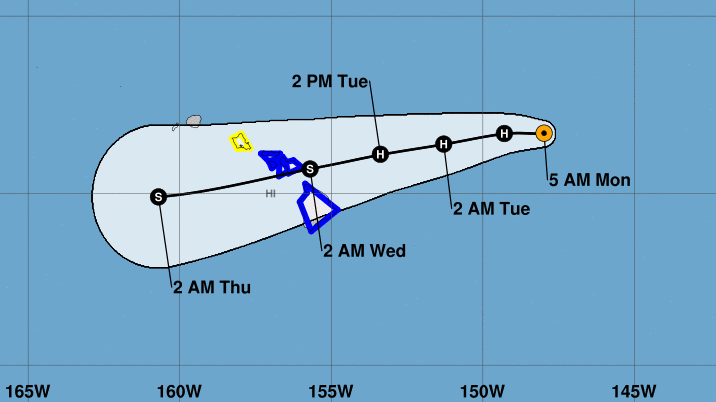
El CPHC de la NOAA dijo que a las 11:00 a.m. EDT (5 a.m. HST/1500 UTC) del 22 Agosto 2018, el centro del Huracán Lane estaba ubicado cerca de la latitud 15.1 grados norte y la longitud 155.3 grados oeste. Eso es aproximadamente 315 millas (505 km) al sur de Kailua-Kona, Hawaii y cerca de 460 millas (740 km) al sur-sureste de Honolulu, Hawaii.

Lane se está moviendo hacia el oeste-noroeste cerca de 9 mph (15 kph) y se espera que este movimiento se convierta en noroeste más tarde hoy, seguido por un giro hacia el norte-noroeste el jueves. En el seguimiento del pronóstico, el centro de Lane se moverá muy cerca o sobre las principales islas de Hawaii de jueves a sábado, 25 Agosto 2018.

Los vientos máximos sostenidos están cerca de 155 mph (250 kph) con ráfagas más altas. Lane es un huracán de categoría 4 en la escala Saffir-Simpson Hurricane Wind Scale. Se pronostica cierto debilitamiento durante las próximas 48 horas, pero se pronostica que Lane seguirá siendo un huracán peligroso a medida que se acerca a las islas hawaianas. Los vientos huracanados se extienden hasta 40 millas (65 km) desde el centro y los vientos con fuerza de tormenta tropical se extienden hasta 140 millas (220 km). La presión central mínima estimada es de 935 milibares.  AIRWAYS® AW-Icon TXT

Resultado de imagen para HURRICANE LANE

Airlines cancel flights in Hawaii

Airlines with destinations to the Islands of Hawaii are canceled by Hurricane Lane

Airlines are canceling flights as Hurricane Lane approaches the Islands of Hawaii. The Government of the United States has taken measures to reduce the impact.

Resultado de imagen para united airlines pngUnited Airlines is canceling its flights to and from Maui on Friday. The airline added two additional flights from Honolulu to San Francisco on Thursday to help transport people off the islands. United is also taking steps to secure its hangar at Daniel K. Inouye Airport in Honolulu. Hawaiian Airlines is canceling all flights on Friday by its cargo operator Ohana this Friday to the airports of Kapalua and Lanai on Thursday.

Hurricane Lane is currently a Category 3 storm, which means it has winds of 111 to 129 mph (178 kph to 207 kph). Tourists were still swimming in the ocean and hanging on the beach when Hurricane Lane approached Thursday.

The National Weather Service downgraded Hurricane Lane to a category 3 storm, which means winds of 111 to 129 mph. Forecasters say the storm changed previously on Thursday and is now approaching Hawaii. The National Weather Service reported that some parts of the Big Island have received 20 inches of rain in the last 24 hours.

The hurricane forced the US Navy to start moving its ships and submarines away from the islands, according to Rear Admiral Brian Fort. He said on Wednesday that all ships currently not under maintenance are moving out of Pearl Harbor and will be positioned to help respond after the storm, if necessary.

Location / intensity of Hurricane Lane

The NOAA CPHC said that at 11:00 a.m. EDT (5 a.m. HST / 1500 UTC) on August 22, 2018, the center of Hurricane Lane was located near latitude 15.1 degrees north and longitude 155.3 degrees west. That’s roughly 315 miles (505 km) south of Kailua-Kona, Hawaii and about 460 miles (740 km) south-southeast of Honolulu, Hawaii.

Temperaturas frías encontradas en las tormentas eléctricas dentro de Lane

AN INFRARED LOOK BY NASA’S TERRA SATELLITE PROVIDED FORECASTERS WITH TEMPERATURE DATA IN THE CATEGORY 4 HURRICANE NEAR HAWAII. TERRA DATA SHOWED A LARGE RING OF COLDEST AND MOST POWERFUL STORMS AROUND HURRICANE LANE’S EYE ON AUGUST 23

Lane is moving west-northwest near 9 mph (15 kph) and this movement is expected to become northwest later today, followed by a north-northwest turn on Thursday. In tracking the forecast, the center of Lane will move very close or on the main islands of Hawaii from Thursday to Saturday, August 25, 2018.

The maximum sustained winds are about 155 mph (250 kph) with higher gusts. Lane is a category 4 hurricane on the Saffir-Simpson Hurricane Wind Scale. Weakness is predicted for the next 48 hours, but Lane is forecast to remain a dangerous hurricane as it approaches the Hawaiian Islands. Hurricane winds extend up to 40 miles (65 km) from the center and winds with tropical storm force extend up to 140 miles (220 km). The estimated minimum central pressure is 935 millibars. A \ W


Ξ A I R G W A Y S Ξ
SOURCE:  Airgways.com
DBk: Nasa.gov / Usatoday.com / Airgways.com / United.com / Hawaiianairlines.com
AW-POST: 201808232327AR

A\W   A I R G W A Y S ®

Nuevos indicios del Malaysia MH-370

AA-MH370.jpg

AW | 2018 08 23 18:23 | AIR INVESTIGATION / AVIATION SAFETY

AW-70083772Nuevos datos arrojan búsqueda en el séptimo arco de Océano Índico

El vuelo MH370 de Malaysia Airlines que transportaba a 239 personas, desapareció sobre el Océano Índico el 8 Marzo 2014.Todos los esfuerzos por rastrear el avión han fallado y el paradero del jet sigue siendo un misterio desde entonces.

Nuevas pistas del MH370

Esta semana, una nueva imagen de Google Maps envió a los teóricos de la conspiración al colapso después de que pareciera mostrar el avión desaparecido. Victor Iannello fue un miembro original del grupo independiente de especialistas que ayudó a los investigadores australianos a tratar de identificar el sitio del accidente del MH370 en el océano Índico al oeste de Australia.

Usando un nuevo análisis de datos del Australian Transport Safety Bureau (ATSB), cree que ha encontrado una posible ubicación del Boeing 777-200 perdido. Víctor Iannello escribió en su blog: «La próxima búsqueda debería ocurrir a lo largo del séptimo arco al norte de 25 grados sur a un ancho de más o menos 25 millas náuticas (46 km)».

La búsqueda hasta ahora ha sido de 22 millas náuticas a cada lado del séptimo arco, que se ha descrito como «una línea delgada pero larga que incluye todos los puntos posibles donde podría haber tenido lugar la última comunicación conocida entre el avión y el satélite de comunicaciones». Las 10 rutas de vuelo finales posibles de MH370 fueron examinadas por Iannello después de que se le dio acceso exclusivo a los datos de simulación producidos por Boeing para la ATSB.

Iannello dijo que «con el fracaso de la reciente búsqueda de Ocean Infinity para localizar el campo de escombros a lo largo del séptimo arco en latitudes tan al norte como 25 grados al sur y en anchuras iguales o superiores a más o menos 22 millas náuticas, tenemos que considerar si es posible que con el supuesto de un vuelo incontrolado, el avión podría haber afectado al océano más allá. Aunque las restricciones legales impiden que la ATSB proporcione detalles específicos sobre cada una de las 10 simulaciones (denominadas casos 1-10), la ATSB reveló que las velocidades iniciales variaban entre M0.75 (894 km / h) y M0.83, las altitudes iniciales eran FL350 (35,000 pies) o FL400, los títulos iniciales eran 178 grados, 184 grados o 190 grados, y la turbulencia era ligera o moderada».

El avión condenado desapareció mientras viajaba de Kuala Lumpur a Beijing. Una búsqueda multimillonaria durante más de tres años no arrojó pistas concretas sobre el paradero del avión Boeing 777-200, intentado una vez más poder encontrar el fatídico Malaysia MH370. AIRWAYS® AW-Icon TXT

MH370

New indications of the MH-370

New data throw search in the seventh arch of the Indian Ocean

Malaysia Airlines flight MH370, carrying 239 people, disappeared over the Indian Ocean on March 8, 2014. All efforts to track the plane have failed and the whereabouts of the jet have remained a mystery ever since.

New tracks of the MH370

This week, a new Google Maps image sent the conspiracy theorists to collapse after it seemed to show the missing plane. Victor Iannello was an original member of the independent group of specialists who helped Australian researchers try to identify the site of the MH370 crash in the Indian Ocean west of Australia.

Using a new data analysis from the Australian Transport Safety Bureau (ATSB), he believes he has found a possible location for the lost Boeing 777-200. Victor Iannello wrote in his blog: «The next search should occur along the seventh arc north of 25 degrees south to a width of about 25 nautical miles (46 km)».

The search so far has been 22 nautical miles on each side of the seventh arc, which has been described as «a thin but long line that includes all possible points where the last known communication between the aircraft and the satellite of communications». The 10 possible final flight routes of MH370 were examined by Iannello after he was given exclusive access to the simulation data produced by Boeing for the ATSB.

Iannello said that «with the failure of Ocean Infinity’s recent search to locate the debris field along the seventh arc in latitudes as far north as 25 degrees south and in widths equal to or greater than about 22 nautical miles, we have to consider if it is possible that with the assumption of an uncontrolled flight, the plane could have affected the ocean beyond, although the legal restrictions prevent the ATSB from providing specific details about each of the 10 simulations (called cases 1-10) , the ATSB revealed that the initial speeds varied between M0.75 (894 km / h) and M0.83, the initial altitudes were FL350 (35,000 feet) or FL400, the initial titles were 178 degrees, 184 degrees or 190 degrees, and the turbulence was light or moderate».

The condemned plane disappeared while traveling from Kuala Lumpur to Beijing. A multi-million dollar search for more than three years did not yield concrete clues about the whereabouts of the Boeing 777-200 aircraft, once again trying to find the fateful Malaysia MH370. A \ W


Ξ A I R G W A Y S Ξ
SOURCE:  Airgways.com
DBk: Atsb.gov.au / Airgways.com / Google.com
AW-POST: 201808231823AR

A\W   A I R G W A Y S ®

Huracán Lane azota Islas Hawaii

AW-70000043.jpg

AW | 2018 08 22 15:48 | AVIATION SAFETY

La NOAA advierte sobre el Huracán Lane con categoría 4

1f300La Administración Nacional Oceánica y Atmosférica (NOAA) ha publicado la actualización de las 5 a.m. (4 p.m. BST) sobre el Huracán Lane. El boletín informa que el «poderoso Hurricane Lane continúa moviéndose hacia el oeste-noroeste hacia las principales islas hawaianas». La tormenta se encuentra actualmente a 315 millas (505 km) al sur de Kailua-Kona y 460 millas (740 km) al sur-sureste de Honolulu. Los vientos máximos sostenidos son de 155 mph (250 km / h) mientras la tormenta se mueve al oeste-noroeste a 9 mph (15 km / h).

Seguimiento de «Lane»

En el seguimiento del pronóstico, el centro de Lane se moverá muy cerca o sobre las principales islas de Hawai desde el jueves hasta el sábado. La tendencia de la trayectoria del huracán continúa de noroeste seguido por un giro hacia el norte-noroeste para el jueves.

Lane ha sido degradado a un huracán de categoría 4 en la escala de viento de huracanes Saffir-Simpson. Se pronostica cierto debilitamiento durante las próximas 48 horas, pero se pronostica que Lane seguirá siendo un huracán peligroso a medida que se acerca a las islas hawaianas. Los vientos huracanados se extienden hasta 40 millas (65 km) desde el centro y los vientos con fuerza de tormenta tropical se extienden hasta 140 millas (220 km). Una advertencia de huracán significa que se esperan condiciones de huracán en algún lugar dentro del área de advertencia.

La NOAA dice que la advertencia se emite típicamente 36 horas antes de la primera aparición anticipada de vientos con fuerza de tormenta tropical, condiciones que hacen que las preparaciones externas sean difíciles o peligrosas. Los preparativos para proteger la vida y la propiedad deben apresurarse hasta su finalización. Una alerta de huracán significa que las condiciones de huracán son posibles dentro del área de vigilancia.

Actualizaciones trayectoria

La tormenta se encuentra actualmente a 315 millas (505 km) al sur de Kailua-Kona, y 460 millas (740 km) al sur-sureste de Honolulu. Los vientos máximos sostenidos son de 155 mph (250 km / h) mientras la tormenta se mueve al oeste-noroeste a 9 mph (15 km / h).

Se espera que la pista se convierta en noroeste más tarde hoy, seguido por un giro hacia el norte-noroeste el jueves. La advertencia de viaje de Hawaii para el huracán pasó de categoría 5 a categoría 4. En el seguimiento del pronóstico, el centro de Lane se moverá muy cerca o sobre las principales islas de Hawaii desde el jueves hasta el sábado.

Lane ha sido degradado a un huracán de categoría 4 en la escala de viento de huracanes Saffir-Simpson. Se pronostica cierto debilitamiento durante las próximas 48 horas, pero se pronostica que Lane seguirá siendo un huracán peligroso a medida que se acerca a las islas hawaianas. Los vientos huracanados se extienden hasta 40 millas (65 km) desde el centro y los vientos con fuerza de tormenta tropical se extienden hasta 140 millas (220 km).

Las aerolíneas y aeropuertos

Varias aerolíneas anunciaron que renunciarán a las tarifas de cambio en las reservas de vuelos hacia y desde las Islas Hawaianas debido a un huracán masivo dirigido al estado.

Alaska y Hawaii se encuentran entre las aerolíneas que permiten a los viajeros un cambio de reserva por única vez sin pagar una tarifa si su vuelo cae dentro de un rango de fechas específico. Con Alaska, el rango es del 22 al 25 de agosto y con Hawai es del 21 al 26 de agosto.

Los aeropuertos en las islas están preparando generadores de emergencia y estaciones de bombeo con combustible y combustible de emergencia para posibles despliegues, informa Honolulu Star Advertiser. Los aeropuertos se comunicarán con la Administración Federal de Aviación (FAA) con respecto a las condiciones de vuelo y los vuelos podrían cancelarse en los próximos días.

Hawaii en el «ojo de la tormenta»

Hawaii ha estado experimentando una erupción volcánica durante gran parte del verano. El Monte Kilauea comenzó a producir flujos de lava a principios de mayo y partes de la costa sudeste de la Isla Grande se han transformado por los flujos de lava que cubrían más de 13 millas cuadradas (35 kilómetros cuadrados).

Solo dos huracanes y dos tormentas tropicales han tocado tierra en Hawai desde 1959: Huracán Dot, en 1959 y Huracán Iniki, en 1992. Los huracanes rara vez tocan tierra en Hawai, ya que el Pacífico Central no ve tantas tormentas como el Atlántico o el Pacífico Oriental, y las Islas Hawaianas presentan un pequeño objetivo en el vasto Océano Pacífico.

Afortunadamente, la actividad eruptiva de Kilauea se ha «detenido», sin nuevos flujos de lava desde el 9 de agosto, según el Observatorio Volcánico de Hawai. Dado que ya no hay mucha lava que llegue al océano, el huracán no debería tener demasiado impacto en la región del volcán, según el geofísico de la Universidad de Denison, Erik Klemetti. AIRWAYS® AW-Icon TXT


Hurricane Lane hits Hawaii

NOAA warns about Hurricane Lane with category 4

The National Oceanic and Atmospheric Administration (NOAA) has published the update of 5 a.m. (4 p.m. BST) on Hurricane Lane. The bulletin reports that the «mighty Hurricane Lane continues to move west-northwest toward the main Hawaiian islands.» The storm is currently 315 miles (505 km) south of Kailua-Kona and 460 miles (740 km) south-southeast of Honolulu. The maximum sustained winds are 155 mph (250 km / h) while the storm moves west-northwest at 9 mph (15 km / h).

Track «Lane»

In tracking the forecast, the center of Lane will move very close to or over the main Hawaiian islands from Thursday through Saturday. The trend of the hurricane’s trajectory continues to northwest followed by a turn to the north-northwest for Thursday.

Hurricane Lane NOAA actualización 5am

Lane has been demoted to a category 4 hurricane on the Saffir-Simpson hurricane wind scale. Weakness is predicted for the next 48 hours, but Lane is forecast to remain a dangerous hurricane as it approaches the Hawaiian Islands. Hurricane winds extend up to 40 miles (65 km) from the center and winds with tropical storm force extend up to 140 miles (220 km). A hurricane warning means that hurricane conditions are expected somewhere within the warning area.

NOAA says that the warning is typically issued 36 hours before the first anticipated occurrence of tropical storm force winds, conditions that make external preparations difficult or dangerous. Preparations to protect life and property should be rushed to completion. A hurricane alert means that hurricane conditions are possible within the surveillance area.

Path updates

The storm is currently 315 miles (505 km) south of Kailua-Kona, and 460 miles (740 km) south-southeast of Honolulu. The maximum sustained winds are 155 mph (250 km / h) while the storm moves west-northwest at 9 mph (15 km / h).

The track is expected to become northwest later today, followed by a north-northwest turn on Thursday. The Hawaii travel warning for the hurricane went from category 5 to category 4. In tracking the forecast, the center of Lane will move very close to or over the main islands of Hawaii from Thursday through Saturday.

Lane has been demoted to a category 4 hurricane on the Saffir-Simpson hurricane wind scale. Weakness is predicted for the next 48 hours, but Lane is forecast to remain a dangerous hurricane as it approaches the Hawaiian Islands. Hurricane winds extend up to 40 miles (65 km) from the center and winds with tropical storm force extend up to 140 miles (220 km).

The airlines & Airports

Several airlines announced that they will waive the exchange rates on flight reservations to and from the Hawaiian Islands due to a massive hurricane directed at the state.

Alaska and Hawaii are among the airlines that allow travelers a one-time change of reservation without paying a fee if their flight falls within a specific range of dates. With Alaska, the range is from August 22 to 25 and with Hawaii from August 21 to 26.

The airports on the islands are preparing emergency generators and pumping stations with fuel and emergency fuel for possible deployments, reports Honolulu Star Advertiser. The airports will communicate with the Federal Aviation Administration (FAA) regarding the flight conditions and the flights could be canceled in the coming days.

Hawaii in the «eye of the storm»

Hawaii has been experiencing a volcanic eruption for much of the summer. Mount Kilauea began to produce lava flows in early May and parts of the southeastern coast of Isla Grande have been transformed by lava flows that covered more than 13 square miles (35 square kilometers).

Only two hurricanes and two tropical storms have touched land in Hawaii since 1959: Hurricane Dot, in 1959 and Hurricane Iniki, in 1992. Hurricanes rarely touch land in Hawaii, as the Central Pacific does not see as many storms as the Atlantic or the Pacific Oriental, and the Hawaiian Islands present a small objective in the vast Pacific Ocean.

Fortunately, the eruptive activity of Kilauea has been «stopped», with no new lava flows since August 9, according to the Hawaii Volcanic Observatory. Since there is not much lava left in the ocean, the hurricane should not have much impact on the volcano region, according to Erik Klemetti, geophysicist at Denison University. A \ W


DATA: La información procesada puede actualizarse debido al tipo de datos cambiantes, por lo que le sugerimos consultar periódicamente esta información.
DATA: The processed information can be updated due to the type of changing data, so we suggest you consult this information periodically.

Ξ A I R G W A Y S Ξ
SOURCE:  Airgways.com
DBk: Noaa.gov / Express.co.uk / Khon2.com / Sfgate.com / Cnn.com / Airgways.com
AW-POST: 201808211548AR

A\W   A I R G W A Y S ®