Primer vuelo Airbus A330NEO

A330neo-first-flight-in-flight-041

AW | 2017 11 20 19:05 | INDUSTRY

Logo_Airbus_2014.svgPara su primer vuelo de prueba, el A330NEO sobrevoló las instalaciones de Airbus en Toulouse antes de aterrizar en Blagnac

El Airbus A330NEO con reactores Rolls-Royce Trent 7000 ha iniciado el primer vuelo desde el Aeropuerto Blagnac, en Francia. El nuevo derivado de la familia A330 tendrá un consumo de combustible menor en un 10% y los costos de operación en un 14%. Según el fabricante europeo de aviones, «los costos operativos directos por asiento en el A33NEO serán los más bajos del 15% de aquellos en el B787». Y un A330NEO aparece en U$D 290 millones de dólares en el mostrador de catálogo de precios de U$D 312 millones para un B787 Dreamliner. Este verano, TAP Air Portugal recibirá la primera copia de este nuevo aspecto A330.

El A330NEO ha realizado con éxito las pruebas del primer vuelo programado el día 12 Noviembre 2017. El segundo, estará disponible en este mes, después de inspecciones sistemáticas de los principales componentes del avión. AIRWAYS® AW-Icon TXT

A330neo-LANDING

First flight A330NEO

For its first test flight, the A330NEO flew over Airbus facilities in Toulouse before landing in Blagnac

The Airbus A330NEO with Rolls-Royce Trent 7000 reactors has started the first flight from Blagnac Airport in France. The new derivative of the A330 family will have a fuel consumption lower by 10% and operating costs by 14%. According to the European aircraft manufacturer, «the direct operating costs per seat in the A330NEO will be the lowest of 15% of those in the B787». And an A330NEO appears in U$D 290 million dollars at the price catalog counter of US $ 312 million for a B787 Dreamliner. This summer, TAP Air Portugal will receive the first copy of this new A330 look.

The A330NEO has successfully tested the first scheduled flight on November 12, 2017. The second will be available in this month, after systematic inspections of the main components of the aircraft. A \ W


Ξ A I R G W A Y S Ξ
SOURCE:  Airgways.com
DBk:  Airbus.com
AW-POST: 201711201905AR

A\W   A I R G W A Y S ®

Sukhoi estudia nuevas variantes SSJ-100

AW | 2017 11 19 22:07 | INDUSTRY

Resultado de imagen para Sukhoi Civil AircraftSukhoi Aircraft está estudiando nuevas variantes de Superjet SSJ-100 para 1Q2018

El fabricante ruso Sukhoi Civil Aircraft Corp. (SCAC) debe decidir antes del primer trimestre de 2018 si debe comenzar a desarrollar una variante más pequeña o más grande del SSJ100 Superjet.

En declaraciones en el Dubai Air Show 2017, el recién instalado presidente de SCAC, Alexander Rubtsov, dijo que se estaban discutiendo con los clientes si primero se lanzaría una versión reducida de 75 asientos o una variante estirada del avión estándar de 100 asientos.

Sukhoi está estudiando los factores que podrían modificar el motor franco-ruso PowerJet SaM 146 del actual modelo SSJ-100 para producir suficiente empuje para una versión más grande, o si debería considerarse un motor alternativo. Ante la consciente necesidad de efectuar una familia de aviones Super Jet, el actual diseño es un avión «huérfano» por lo que Sukhoi debería crear una familia de versiones más allá del SSJ-100 para atraer a más clientes.

El actual desarrollo SSJ-100 es una aeronave que está teniendo amplia aceptación en el mercado europeo, asiático y comenzando a entrar en latinoamérica. CityJet de Irlanda es una aerolínea en europeaque ha incorporado el SSJ-100 y comenzará los vuelos al Aeropuerto de London City en Diciembre 2017.

La aeronave podría ser adecuada a las operaciones en este aeropuerto debido a que los edificios altos al oeste significan que las aeronaves tienen que realizar un acercamiento de 5.5 grados, casi dos veces más empinadas que la pendiente estándar de 3 grados. Esto requiere nuevas leyes de control para el software de la aeronave, además de una nueva configuración de flaps y modificaciones de frenos. El Aeropuerto London City es un destino importante para el CityJet de Irlanda, que posee un pedido de 15 SSJ-100. La certificación está planificada para el próximo año, con la aeronave modificada lista para el servicio en 2019.

Resultado de imagen para SSJ-100 raked wingtips

Como parte de las modificaciones del Aeropuerto London City, Sukhoi está desarrollando una nueva aleta (raked wingtips) para la aeronave para ayudar en el aterrizaje y el despegue, además de ofrecer una mejora del 3% en el ahorro de combustible. Esto se convertirá en una línea de producción estándar y estará disponible para la retroadaptación.

Cartera pedidos futuros del SSJ-100

Mientras tanto, en el frente de ventas, SCAC continúa las conversaciones para consolidar un MOU con Air Leisure de Egipto para cuatro SSJ100 y Rubtsov tiene la esperanza de un pedido inminente para varios aviones de un cliente de Azerbaiyán.

Se están preparando varios pedidos, uno para potencialmente hasta 100 aviones, dijo, y agregó que los clientes y pasajeros de las líneas aéreas estaban muy contentos con la comodidad y el rendimiento del SSJ100. «Sin embargo, con lo que no estamos muy contentos es con la atención al cliente, que debemos mejorar», admitió.

La aeronave todavía experimenta problemas iniciales, incluidos fallas en el software, fuselaje y motor, «lo cual es normal para un revolucionario avión que era un diseño de hoja limpia de una compañía que solo había existido en su forma actual durante algunos años, en comparación con décadas para Airbus y Boeing. Debemos ser más receptivos a las necesidades de los clientes». El soporte debe estar disponible las 24 horas del día, los 7 días de la semana, los 365 días del año, y dijo que su equipo se centraría en los próximos dos años en reunir aspectos de soporte de ventas que incluye capacitación, ingeniería y suministro de repuestos.  AIRWAYS® AW-Icon TXT

Sukhoi studies new veriants SSJ-100

Imagen relacionadaSukhoi Aircraft is studying a new variants of Superjet SSJ-100 for 1Q2018

The Russian manufacturer Sukhoi Civil Aircraft Corp. (SCAC) must decide before the first quarter of 2018 if it should start to develop a smaller or larger variant of the SSJ100 Superjet.

Speaking at the Dubai Air Show 2017, SCAC’s newly installed chairman, Alexander Rubtsov, said that they were discussing with customers whether they would first launch a reduced version of 75 seats or a stretched version of the standard 100-seat plane.

Resultado de imagen para Sukhoi SSJ-100 pngSukhoi is studying the factors that could modify the Franco-Russian PowerJet SaM 146 engine of the current SSJ-100 model to produce enough thrust for a larger version, or if it should be considered an alternative engine. Given the conscious need to build a family of Super Jet aircraft, the current design is an «orphan» aircraft so Sukhoi should create a family of versions beyond the SSJ-100 to attract more customers.

The current development SSJ-100 is an aircraft that is having wide acceptance in the European market, Asian and beginning to enter Latin America. CityJet of Ireland is a European airline that has incorporated the SSJ-100 and will begin flights to the London City Airport in December 2017.

The aircraft could be suitable for operations at this airport because the tall buildings to the west mean that the aircraft have to approach 5.5 degrees, almost twice as steep as the standard slope of 3 degrees. This requires new control laws for the aircraft software, as well as a new configuration of flaps and brake modifications. The London City Airport is an important destination for the CityJet of Ireland, which has an order of 15 SSJ-100. The certification is planned for next year, with the modified aircraft ready for service in 2019.

As part of the modifications to London City Airport, Sukhoi is developing a new wing (raked wingtips) for the aircraft to assist in landing and takeoff, as well as offering a 3% improvement in fuel savings. This will become a standard production line and will be available for retrofitting.

Portfolio future orders of the SSJ-100

Meanwhile, on the sales front, SCAC continues talks to consolidate an MOU with Egypt’s Air Leisure for four SSJ100 and Rubtsov is hoping an impending order for several aircraft from a customer from Azerbaijan.

Several orders are being prepared, one for potentially up to 100 aircraft, he said, adding that customers and airline passengers were very happy with the comfort and performance of the SSJ100. «However, what we are not very happy with is customer service, which we must improve», he admitted.

The aircraft still experiences initial problems, including software, fuselage and engine failures, «which is normal for a revolutionary airplane that was a clean sheet design of a company that had only existed in its current form for some years, compared With decades for Airbus and Boeing, we must be more responsive to customer needs». The support must be available 24 hours a day, 7 days a week, 365 days a year, and he said that his team would focus in the next two years on gathering aspects of sales support that includes training, engineering and supply of spare parts. A \ W


Ξ A I R G W A Y S Ξ
SOURCE:  Airgways.com
DBk:  Sukhoi.org / Airgways.com / Kativ.eu / Lufthansaflyer.boardingarea.com / Airliners.net
AW-POST: 201711192207AR

A\W   A I R G W A Y S ®

El próximo escenario de la aviación

AW | 2017 11 18 01:23 | INDUSTRY

AW-ReporterLa industria de aviación comercial tras los cambios de un nuevo escenario mundial

Después de la batalla rivalizada entre Boeing, Bombardier y los gobiernos de Estados Unidos y Canadá; el aumento del volumen de tráfico de las low cost; la finalización de la Feria Aeronáutica Dubai Airshow 2017, y la trazabilidad de la producción de aeronaves, han permitido observar muchos cambios en la aviación comercial.

La batalla del CSeries

Uno de los acontecimientos más relevantes de la aviación comercial es la batalla de la industria aérea que están rivalizando Boeing y Bombardier donde un tercero en la discordia se llama Airbus.

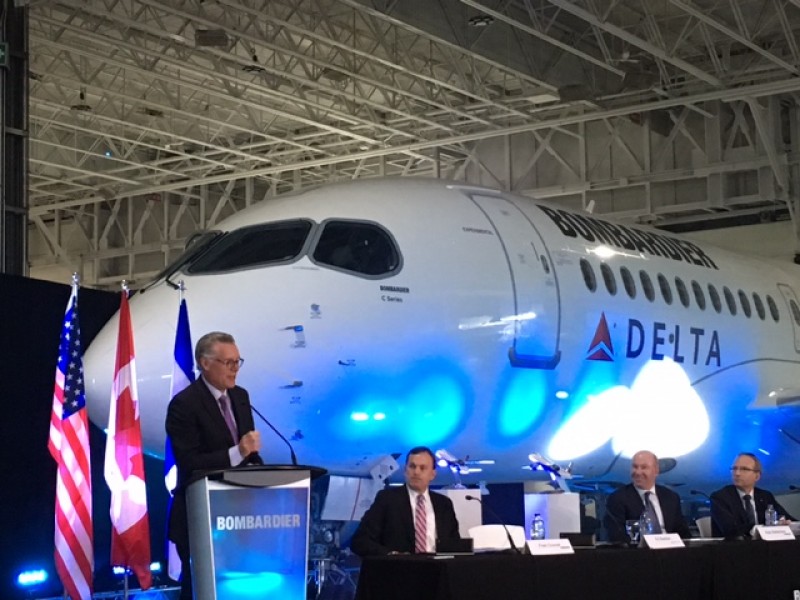
Cuando Boeing Co. observó las «supuestas subvenciones» del Gobierno de Quèbec a la industria de Bombardier y la superoferta de ventas del CSeries a precios muy bajos a Delta Air Lines, ha encendido la alarma acusando de «dumping» a Bombardier por prácticas comerciales ilegales. El grito en el cielo se ha traducido en imponer aranceles aduaneros a la importación de los nuevo jet regionales CSeries en los Estados Unidos del orden del 300%, haciendo inviables todo tipo de negociación con las aerolíneas en este país. Detrás de este escenario, está también el reclamo de Boeing por la supuesta interposición entre el Boeing 737-700/Boeing 737-7 MAX con respecto a su «competidor» el CSeries CS-300, que es una aeronave típicamente regional. La estrategia de Boeing pronto dio un giro inesperado. La formidable estrategia lanzada por parte de Bombardier Inc. de asociarse estrategicamente con Airbus Group para fabricar el CSeries en Alabama, Estados Unidos ha derrumbado toda esperanza de Boeing de haber obtenido una gran victoria.

Resultado de imagen para Bombardier CS100 Delta png

Boeing menosprecia a Bombardier
La reacción de The Boeing Company no se hizo esperar. El plan que Bombardier proyecta para la fabricación y línea de ensamblaje del CSeries en las instalaciones de Móbile, Alabama avanza. Pero Boeing ya está intentando poner obstáculos al cielo despejado que tiene Bombardier. Boeing confirma que no comprará las garantías de Bombardier Inc. por la que construirá una línea de ensamblaje en Alabama en asociación con Airbus SE.

«Es muy poco probable que Bombardier y Airbus establezcan realmente una línea de ensamblaje de la CSeries en Alabama», dijo Boeing en una carta al Secretario de Comercio de Estados Unidos, Wilbur Ross. Los planes para la nueva instalación, que probablemente estaría ubicada al lado de una planta existente de Airbus en Mobile, «no tendrían ningún sentido económico», dijo la compañía con sede en Chicago.

La carta, fechada el 13 de Noviembre 2017, es parte del caso de Boeing ante las autoridades estadounidenses, que están investigando si se deben imponer aranceles a las ventas estadounidenses de la CSeries. Boeing acusó a Bombardier de vender el avión a Delta Air Lines Inc. a «precios absurdamente bajos». Hasta ahora, el Departamento de Comercio se ha puesto de parte de Boeing, recomendando aranceles preliminares de aproximadamente 300% en el avión regional CSeies CS-100 y CS-300.

Por la otra contraparte, Bombardier dijo que está comprometido a construir el jet de la CSeries en Mobile a través de una asociación con Airbus. Airbus acordó el mes pasado obtener una participación mayoritaria en el proyecto de la CSeries, ofreciendo a cambio la experiencia de comercialización y fabricación del fabricante de aviones europeo. Los ejecutivos de ambas compañías han argumentado que la CSeris no debería enfrentar gravámenes extras si se ensambla en territorio estadounidense. Las piezas y componentes hechos en Estados Unidos en la CSeries ya superan el 50%, dijo el martes el presidente ejecutivo de Bombardier, Alain Bellemare, en una conferencia de inversores.

Going Mobile
La construcción de la instalación de la CSeries en Mobile podría costar más de U$D 300 millones de dólares, dijo Bombardier en una presentación del Departamento de Comercio con fecha del 6 de Noviembre.

Bombardier no «tiene suficientes pedidos para que la CSeries pueda sostener la producción completa» por un período de tiempo apreciable en la línea de ensamblaje existente de la compañía en Mirabel, Quèbec. «La única razón para realizar cualquier actividad de ensamblaje de la CSeries en los Estados Unidos sería intentar eludir los aranceles antidumping y compensatorios«, remarcó Boeing en su carta. «Las penalizaciones deberían aplicarse a los aviones de la CSeries, incluso si se establece una segunda línea de ensamblaje en los EE.UU.», sentenció Boeing.

Bombardier contraataca. «Boeing está equivocado», dijo el vocero de Bombardier Mike Nadolski el miércoles por correo electrónico. La asociación fue motivada por las oportunidades económicas de colaborar en la CSeries. Un beneficio adicional de la instalación de ensamblaje de los EE. UU. Es que, en la medida en que las leyes comerciales de EE.UU. estaban destinadas a promover la fabricación en los EE. UU., logra ese objetivo y significa que las aerolíneas estadounidenses obtendrán una CSeries fabricada en EE.UU.

El representante federal Bradley Byrne instó al Secretario de Comercio a apoyar la empresa Airbus-Bombardier. La nueva línea de ensamblaje en Mobile «dará como resultado cientos de empleos estadounidenses mejor pagados y altamente calificados», dijo el republicano de Alabama en una carta dirigida a Ross el 13 de Noviembre.

Se espera que la Comisión de Comercio Internacional de los EE.UU. entregue un fallo final a principios del próximo año sobre si Boeing fue perjudicado por el programa de la CSeries. Si el tribunal con sede en Washington se alía con Boeing, los aranceles se mantendrán vigentes para las importaciones de los aviones. Eso prepararía la próxima batalla: si la CSeries construida por Airbus en Alabama está «hecha en Estados Unidos».

Boeing y la relación con Delta

La capacidad de Boeing para competir por Delta Air Lines no se vio obstaculizada por la disputa comercial de Bombardier.

La eficiencia de la flota es una palanca importante que Delta Air Lines intenta extraer a medida que trabaja para recortar sus costos unitarios (excluyendo el combustible) en 2018 a 2% o menos. El próximo año, la aerolínea planea duplicar el ritmo de reemplazo de la flota, impulsada por más de 50 entregas programadas de fuselaje estrecho (narrowbodies).

Delta está en el proceso de un programa de varios años para aumentar su flota nacional ya que agrega más Airbus A321 y Boeing 737-900 a su flota. La flota de aviones de mayor densidad ayudó a Delta a aumentar sus ingresos debido a la mayor cantidad de asientos premium disponibles en esos aviones.

Ahora, según los informes, la aerolínea está evaluando un nuevo pedido de aviones de fuselaje estrecho, y los principales fuselajes Airbus y Boeing son los principales contendientes en el concurso.

Aunque Delta y Boeing han estado involucrados en desavenencias de alto perfil durante los últimos años, es probable que la tensión no juegue un papel importante en las evaluaciones de aeronaves de Delta. En última instancia, la economía de la aeronave tendrá más peso en el análisis de la aerolínea que las maniobras políticas. Los negocios son negocios, la política es política.

Dubai Airshow 2017

El paso de la Feria Aeronáutica de Dubai Airshow de 2017 ha dejado una honda huella en los principales constructores de aviones comerciales de cara a la línea de producción a futuro.

La Feria de aviación de Dubai en Medio Oriente ha permitido observar detalles interesantes de un creciente mercado regional estratégicamente importante tanto para Airbus y Boeing.

a350_xwb_msn1_fligth_test_airbus_workers

EL AIRBUS A350-90 ESTUVO PRESENTE EN DUBAI AIRSHOW 2017

Airbus, records y nuevos desafíos
El constructor europeo Airbus SE ha logrado en Dubai Airshow 2017 un records de ventas histórica, obteniendo 430 aeronaves, el mayor pedido en la historia de la marca Airbus. El contrato firmado por el consorcio con la compañía Indigo Partners LLC de Estados unidos asciende a U$D 40.108.400.000 (€ 34.000.000.000 millones de euros).

El consorcio europeo Airbus logró el pedido más ambicioso de su historia: el fondo de inversiones estadounidense Indigo Partners, especializado en aerolíneas low cost, le encargó 430 aviones de la familia A320NEO, una venta que le reportará unos ingresos de 34.000 millones de euros a la compañía con sede en Toulouse.

El acuerdo fue sellado durante el salón aeronáutico de Dubái y lo confirmó Airbus desde Francia. “Me felicito por esta nueva muestra de confianza manifestada por importantes compañías aéreas que se comprometen a este acuerdo comercial sin precedentes”, dijo a la agencia France Presse el director general delegado de Airbus, Fabrice Brégier. “Es un éxito aplastante para Airbus y sus aviones A320 en el transporte aéreo mundial”, añadió.

Según Airbus, el pedido, que duplica los que acumulaba la compañía este año, consiste en 273 modelos A320NEO y 157 A321NEO. Esto convierte a Indigo Partners, que en el pasado ya había encargado otros 427 aparatos de la familia A320, en uno de los mayores clientes del consorcio europeo.

“Este significativo compromiso de 430 aparatos adicionales subraya nuestra visión optimista en el crecimiento potencial de nuestra familia de aerolíneas low cost, así como nuestra confianza en la familia A320NEO como plataforma de ese crecimiento”, dice el cofundador de Indigo Bill Franke, considerado como una de las figuras más relevantes en el negocio del bajo costo.

AW-7008447

Indigo Partners es una firma de capital de riesgo estadounidense que controla la aerolínea de bajo costo Frontier Airlines, que recibirá 134 aviones del pedido anunciado con Airbus, y la chilena JetSmart, que tendrá 70. También tiene una participación relevante en la mexicana Volaris, que recibirá 80 unidades, y la húngara Wizz Air, que se beneficiará de la mayor parte del pedido, con 146 nuevos aviones.

El fondo de inversión Indigo Partners LLC opera en Phoenix, Arizona, desde hace 15 años. Su estrategia pasa por ofrecer a los viajeros precios a la carta, en función de las opciones que están dispuestos a pagar al comprar el billete. Indigo adquirió Frontier en 2013, tras pagar U$D 145 millones de dólares a Republic Airways. La sometió a una reestructuración y ahora con este pedido se dispone a ampliar sus destinos. La firma está en proceso de crear una compañía de bajo costo en Canadá, un mercado en el que las aerolíneas ultrabaratas tienen margen para crecer.

Indigo está procurando expandirse en América Latina con JetSmart, aprovechando el tirón de la clase media. La corporación Indigo está en la misma dirección hacia la consolidación de la industria de la aviación europea.

Para Airbus, este nuevo contrato, el más grande de su historia, le permitirá duplicar cómodamente la lista de pedidos anual, que hasta ahora era de 288 netos, tras varias cancelaciones. Airbus acumularía pedidos por 718 aviones hasta la fecha, podrá sobrepasar a su principal rival Boeing, que contaba hasta ahora con 605 pedidos.

La popularidad del modelo A320NEO, el cual, desde su salida al mercado en 2010, supera ya los 5.200 aparatos solicitados por 95 clientes de todo el mundo. Unos datos que, según Airbus, consolidan a este modelo, que ha conseguido captar casi 60% del mercado mundial.

Aumento de fabricación en Airbus
Un beneficio importante dl contrato millonario que ha recibido Airbus SE en la Feria Aeronáutica Dubai Airshow 2017, es la influencia positiva en las plantas de producción en España como así tambien en Francia, Reino Unido y Alemania

Esta semana la compañía firmaba un contrato de U$D 40.108.400.000 (€ 34.000.000.000 millones de euros), asegurando la continuidad de los empleados en esta fábrica.

Airbus y la compañía Indigo Partners LLC han firmado un acuerdo en el que se hace un encargo a la empresa aeronáutica de 430 aviones de los modelos de la familia A320. La planta de Getafe sale beneficiada de este acuerdo, ya que es donde se fabrican los estabilizadores horizontales de cola de las naves permitiendo la continuidad de la línea de autopartes para el ensamblaje de la familia A320. Aunque este acuerdo no asegura que vaya a aumentar el número de puestos de trabajo, si que aporta bastante tranquilidad en el plano laboral puesto que se asegura la continuidad de los empleados varios años en Getafe. Desde el departamento de operaciones de Airbus aseguran que este contrato supone para la compañía afrontar “el mayor pedido de la historia de la aviación comercial”.

El contrato también recae sobre todas las plantas de Airbus en España. Además de en Getafe, también hay más sedes en el país, como en Tres Cantos, Barajas, Sevilla, Cádiz y Talavera de la Reina. Las plantas de Tolouse en Francia, Chester y Bristol en Reino Unido y Hamburgo Finkenwerder en Alemania verán ampliadas las proyecciones de producción principalmente de la línea A320.

Superjumbo A380
No todo ha sido luces en la industria europea de Aibus SE. El panorama de la línea de producción del A380 genera muchas sombras.

Emirates Airlines, la única compañía que apuesta a este tipo de avión, dejó de invertir en él en los últimos tiempos, lo que generó dudas y controversias por la continuidad del programa Airbus A380.

Cuando Airbus sacó al mercado el Superjumbo A380 con la capacidad de destronar a la «Reina de los Cielos», el Boeing 747, parecía que estos lujosos aviones de dos pisos llegaban para provocar una revolución en el transporte aéreo. Sin embargo, con el tiempo esa expectativa que habían generado desde un comienzo se fue desvaneciendo.

Aunque Airbus ha realizado algunas mejoras en el Programa A380 con una versión renovada denominada A380Plus, no han alcanado para que la línea de producción continúe hacia el futuro.

En la Dubai Airshow 201, transcurrida esta semana, sucedió algo que encendió las alarmas respecto al futuro de ese modelo de aeronave. Allí se esperaba que la aerolínea local Emirates anunciara la compra de nuevos A380. Cabe destacar que la compañía adquirió la mitad de las 318 aeronaves que desarrolló Airbus en los últimos 15 años. Ninguna otra aerolínea posee más de 19 unidades. Pero lo que los especialistas y el mundo de la aviación auguraban, no se cumplió.

Emirates solicitó 40 Boeing 787-10 Dreamliners, un avión más elegante y eficiente. Esto, para muchos, significó el principio del final de los «Superjumbo» A380.

Sir Tim Clark, presidente de Emirates, explicó que la compañía no descarta comprar más A380 en el futuro, pero aclaró que para que eso suceda Airbus debe comprometerse a no cancelar ese modelo de avión. La preocupación de Tim Clark puede convertirse en una profecía autocumplida para Airbus. Es que Emirates no es solamente el cliente más importante del avión, sino que es el único. Eso significa que lo que sucedió en Dubai esta semana podría marcar el final del «Superjumbo».

Con su llegada, los A380 buscaban abrir una nueva era de lujo y confort, y ser redituables para las aerolíneas. Las elegantes salas y el impactante tamaño quedaron opacados por los malos rendimientos financieros que generó este modelo. Por ese motivo, casi ninguna compañía cuenta con una importante flota de ese avión. En esa puja el A380 quedó detrás de los bimotores más económicos y más eficientes en consumo de combustible, como el Boeing 787 y el 777. Incluso frente al Airbus A350.

«El A380, voy a ser honesto, no ha sido un avión tremendamente exitoso dado que [Emirates] es el principal operador del avión. La mayoría de los operadores del A380 con los que he hablado no están encantados con el rendimiento del A380 por su costo», indicó el CEO de Delta, Ed Bastian.

Actualmente estos aviones de cuatro motores son utilizados para rutas especiales de alta densidad. Alan Joyce, CEO de Qantas, detalló que el A380 «todavía tiene un rol en los aeropuertos que tienen restricciones de espacio».

Pero el futuro de los Airbus A380 sigue teniendo un futuro incierto. Mientras tanto, las aerolíneas han permitido entender en que dirección va la aviación comercial.

Boeing en vuelo crucero
El reinado de Boeing en la aviación comercial sigue fortaleciéndose en cada feria aeronáutica. Así a quedado demostrado en la Dubai Airshow 2017. Cuando Airbus estimaba que en la apertura del día Domingo en la feria de aviación en Medio Oriente quedaría rubricado la intención de Emirates Airlines de comprar más A380, quedó eclipsada por la posición dominante de Boeing.

El ocnstructor americano le robó el mercado de aviones widebodies, cuando la misma Emirates decantó sus pedidos de aeronaves de amplio radio de acción por los Boeing 787, en una compra de 15 unidades valoradas en U$D 15 mil millones de dólares.

Aunque la decepción se apoderó del constructor europeo, no se pudo disimularlo con la compra histórica de 430 aeronaves A320 por parte de la corporación Indigo Partners LLC.

En el sector de los narrowbodies, tanto Boeing como Airbus han procurado obtener importantes comtratos de compras de los nuevos Boeing 737 MAX como así de los A320NEO’s.

Boeing versus Airbus

Los airshows son tradicionalmente una oportunidad para que los grandes fabricantes de aviones cierren el trato en negociaciones de larga duración con aerolíneas y compañías de leasing.

Los gustos de Bombardier de Canadá y Embraer de Brasil buscarán vencerse en el mercado de aviones de menor tamaño, pero la batalla principal en la aviación comercial se lleva a cabo entre Airbus de Europa y Boeing de los Estados Unidos.

El Dubai Airshow 2017 no fue diferente ya que los dos grandes buscaban superarse mutuamente para nuevos negocios. Liderando la feria, Boeing tuvo una ventaja saludable sobre Airbus en pedidos en 2017, lo que representa un estimado del 65% del valor del nuevo pedido.

Boeing
El fabricante estadounidense aturdió a los observadores con una orden de apertura del día de Emirates por 40 Boeing 787-10 Dreamliners. El precio actual de la oferta es de U$D 15.1 mil millones de dólares. Emirates recibirá el Boeing 787-10, la versión de mayor tamaño, a partir de 2022.

Azerbaijan Airlines luego realizó un nuevo pedido de cinco modelos anteriores del mismo avión, el 787-8 Dreamliner. Junto con un compromiso provisional de comprar dos grandes buques de carga, el acuerdo agregó otros 1.900 millones de dólares al libro de pedidos de Boeing.

Después de eso, Ethiopian Airlines duplicó un compromiso anterior con Boeing y ahora comprará cuatro Boeing 777F cargueros. El precio de lista para ese trato fue de $ 1.3 mil millones. Actualmente, Etiopía tiene 30 de los aviones 737 MAX de Boeing en orden, ya que busca aprovechar el rápido crecimiento de la aviación en África.

Sin embargo, Boeing guardó lo mejor hasta el segundo día del espectáculo aéreo. Firmó un acuerdo con la aerolínea de bajo costo flydubai para 225 aviones Boeing 737 MAX, con un precio de lista de U$D 27 mil millones de dólares. Boeing dijo que el acuerdo representa el pedido de aviones narrowbodies más grande de la historia para Medio Oriente.

El último día de la exhibición aérea, Boeing firmó un acuerdo de compra final con SCAT Airlines de Kazajstán para la compra de seis Boeing 737-8 MAX. Ese acuerdo está valorado en U$D 674 millones de dólares. SCAT Airlines también tiene una oportunidad coherente en el acuerdo que le permite comprar otros cinco aviones en una fecha posterior.

Airbus
Airbus recibió fuertes propinas para anunciar un pedido de Emirates para 30 nuevos aviones A380 en el primer día del espectáculo aéreo. El acuerdo nunca sucedió y el presidente de los Emiratos, Tim Clark, ofreció una indicación de por qué, cuando explicó que Airbus necesitaba comprometerse con el programa superjumbo durante al menos 10 años.


A320neo.png

No fue hasta el día tres del espectáculo que Airbus anunció una orden comercial. Golden Falcon Aviation firmó un memorando de entendimiento (MoU) para 25 de los populares aviones A320NEO. Aunque el valor del contrato no se dio a conocer, el precio de lista para un A320NEO es de aproximadamente $ 108 millones, lo que da un pedido total de $ 2.7 mil millones. Los aviones serán utilizados por Wataniya Airlines de Kuwait.

Luego vino el grande. Airbus convirtió sus fortunas con una orden gigantesca de 430 aviones de la familia A320, por un valor total de U$D 49.5 mil millones de dólares. El comprador, que buscará financiamiento para el acuerdo, fue la firma de capital privado estadounidense Indigo Partners. Firmar el acuerdo para Indigo fue el veterano inversor de líneas aéreas Bill Franke, quien lo describió como el mayor pedido de aviones jamás realizado en la historia de la aviación comercial.

Airbus firmó un contrato con Dubai por U$D 500 millones de dólares para vender a Air Senegal dos aviones A330NEO de fuselaje ancho. La aerolínea dijo que planeaba usar el avión para desarrollar rutas de medio y largo recorrido.

Una vez que totalice el nuevo negocio de Boeing desde Dubai, llegará a un precio total de $ 47.6 mil millones. Pero Airbus logró eclipsar eso con un valor combinado de acuerdos comerciales en Dubái contabilizando hasta $ 52.7 mil millones de dólares.

Conclusiones del mercado de aviación
A primera vista, y en términos cortos existe una victoria para Airbus SE en el Dubai Airshow 2017, quien también podría anunciar pronto el pedido del Emirates A380. Pero aunque Airbus pudo haber «ganado» en Dubai, Boeing en términos amplios se mantiene a la cabeza de pedidos en lo que va del año 2017.

Es vital recordar que los precios de lista de las transacciones comerciales en realidad no serán pagados por los transportistas o las compañías de leasing. El precio real pagado incluirá un descuento negociado que se considera demasiado sensible comercialmente para ser revelado.

El escenario está cambiando, tanto la industria de la aviación se va transformando junto con la demanda de las aerolíneas. Todos buscan un dominio en el gran escenario de la aviación comercial. AIRWAYS® AW-Icon TXT


The next aviation scenario

The commercial aviation industry following the changes of a new world scenario


After the battle rivaled between Boeing, Bombardier and the governments of the United States and Canada; the increase of the volume of traffic of the low cost; the completion of the Aeronautical Fair Dubai Airshow 2017, and the traceability of aircraft production, have allowed to observe many changes in commercial aviation.

The Battle of CSeries

One of the most relevant events of commercial aviation is the battle of the airline industry that are rivaling Boeing and Bombardier odnde a third in the discord is called Airbus.

When Boeing Co. observed the «supposed subsidies» of the Government of Quèbec to the Bombardier industry and the oversupply of sales of the CSeries at very low prices to Delta Air Lines, it has set off the alarm accusing Bombardier of «dumping» for illegal commercial practices. The cry in the sky has resulted in imposing customs duties on the importation of the new regional jet CSeries in the United States of the order of 300%, making all types of negotiations with the airlines in this country unviable. Behind this scenario, there is also Boeing’s claim for the alleged interposition between the Boeing 737-700 / Boeing 737-7 MAX with respect to its «competitor» the CSeries CS-300, which is a typically regional aircraft. Boeing’s strategy soon took an unexpected turn. The formidable strategy launched by Bombardier Inc. to strategically partner with Airbus Group to manufacture the CSeries in Alabama, the United States, has knocked Boeing’s hopes of a great victory.


Boeing disparages Bombardier
The reaction of The Boeing Company was immediate. The plan that Bombardier plans for the manufacture and assembly line of the CSeries in the facilities of Mobile, Alabama advances. But Boeing is already trying to put obstacles in the clear sky that Bombardier has. Boeing confirms that it will not buy the Bombardier Inc. warranties for which it will build an assembly line in Alabama in partnership with Airbus SE.

«It is very unlikely that Bombardier and Airbus will actually establish an assembly line for the CSeries in Alabama», Boeing said in a letter to US Secretary of Commerce Wilbur Ross. Plans for the new facility, which would likely be located next to an existing Airbus plant in Mobile, «would not make any economic sense», the Chicago-based company said.

The letter, dated November 13, 2017, is part of Boeing’s case with the US authorities, which are investigating whether tariffs should be imposed on US sales of the CSeries.Boeing accused Bombardier of selling the plane to Delta Air Lines Inc. at «absurdly low prices»So far, the Department of Commerce has partnered with Boeing, recommending preliminary tariffs of approximately 300% on the regional aircraft CSeies CS-100 and CS-300.

Resultado de imagen para Bombardier CS100 Delta png
For the other counterpart, Bombardier said it is committed to building the CSeries jet in Mobile through a partnership with Airbus. Airbus agreed last month to obtain a majority stake in the CSeries project, offering in return the European aircraft manufacturer’s marketing and manufacturing experience. The executives of both companies have argued that the CSeris should not face extra liens if it is assembled in US territory.Parts and components made in the United States in the CSeries already exceed 50%, Bombardier CEO Alain Bellemare said on Tuesday at an investor conference.

Going Mobile
The construction of the CSeries facility in Mobile could cost more than US $ 300 million, Bombardier said in a presentation by the Department of Commerce dated November 6.

Bombardier does not «have enough orders for CSeries to sustain full production» for an appreciable period of time at the company’s existing assembly line in Mirabel, Quèbec.«The only reason to carry out any assembly activity of the CSeries in the United States would be to try to avoid the anti-dumping and countervailing duties», Boeing said in his letter. «The penalties should apply to CSeries aircraft, even if a second assembly line is established in the US», Boeing said.

Bombardier counterattacks. «Boeing is wrong», Bombardier spokesman Mike Nadolski said Wednesday by email. «The partnership was motivated by the economic opportunities to collaborate with the CSeries, an additional benefit of the US assembly facility, to the extent that US commercial law was intended to promote Manufacturing in the US achieves that goal and means that US airlines will get a CSeries manufactured in the USA.

Federal Representative Bradley Byrne urged the Secretary of Commerce to support the Airbus-Bombardier company. The new assembly line at Mobile «will result in hundreds of better-paid and highly skilled US jobs», the Alabama Republican said in a letter to Ross on November 13.

The US International Trade Commission is expected. deliver a final ruling early next year on whether Boeing was harmed by the CSeries program. If the Washington-based court is allied with Boeing, tariffs will remain in effect for aircraft imports. That would prepare the next battle: if the CSeries built by Airbus in Alabama is «made in the United States.»

Boeing and the relationship with Delta

Boeing’s ability to compete for Delta Air Lines was not hampered by Bombardier’s commercial dispute.

The efficiency of the fleet is an important lever that Delta Air Lines tries to extract as it works to cut its unit costs (excluding fuel) in 2018 to 2% or less. Next year, the airline plans to double the fleet replacement rate, driven by more than 50 scheduled narrow-body deliveries.

Resultado de imagen para Boeing 737 MAX png

Delta is in the process of a multi-year program to increase its national fleet as it adds more Airbus A321 and Boeing 737-900 to its fleet. The higher-density aircraft fleet helped Delta increase its revenues due to the greater number of premium seats available on those planes.

Now, according to reports, the airline is evaluating a new order for narrow-body aircraft, and the main airframes Airbus and Boeing are the main contenders in the contest.

Although Delta and Boeing have been involved in high-profile disagreements over the past few years, stress is unlikely to play a role in Delta’s aircraft evaluations. Ultimately, the economy of the aircraft will have more weight in the analysis of the airline than the political maneuvers. Business is business, politics is politics.

Dubai Airshow 2017

The passing of the Aeronautic Fair of Dubai Airshow of 2017 has left a deep mark on the main commercial aircraft builders facing the future production line.

The Dubai Aviation Fair in the Middle East has allowed us to observe interesting details of a growing regional market strategically important for both Airbus and Boeing.

Airbus, records and new challenges
The European manufacturer Airbus SE has achieved a record sales record at Dubai Airshow 2017, obtaining 430 aircraft, the largest order in the history of the Airbus brand. The contract signed by the consortium with the company Indigo Partners LLC of the United States amounts to U$D 40.108.400.000 (€ 34.000.000.000 millones de euros).

The European Airbus consortium achieved the most ambitious order in its history: the US investment fund Indigo Partners, specializing in low cost airlines, commissioned 430 aircraft from the A320NEO family, a sale that will bring in revenues of 34,000 million euros to the company based in Toulouse.

The agreement was sealed during the Dubai Air Show and confirmed by Airbus from France. «I congratulate myself for this new show of confidence expressed by important airlines that are committed to this unprecedented trade agreement», Airbus CEO Fabrice Brégier told Agence France Presse. «It is an overwhelming success for Airbus and its A320 aircraft in global air transport», he added.

Resultado de imagen para Airbus A320NEO

According to Airbus, the order, which doubles the number accumulated by the company this year, consists of 273 A320NEO and 157 A321NEO models. This makes Indigo Partners LLC, which in the past had already ordered another 427 A320 family devices, into one of the largest customers of the European consortium.

«This significant commitment of 430 additional devices underscores our optimistic vision of the potential growth of our family of low cost airlines, as well as our confidence in the A320NEO family as a platform for that growth», says Indigo co-founder Bill Franke, considered a of the most relevant figures in the low cost business.

AW-7008448

Indigo Partners is a US venture capital firm that controls the low-cost carrier Frontier Airlines, which will receive 134 aircraft from the order announced with Airbus, and Chile’s JetSmart, which will have 70. It also has a relevant participation in the Mexican Volaris, which will receive 80 units, and the Hungarian Wizz Air, which will benefit from most of the order, with 146 new aircraft.

The investment fund Indigo Partners LLC has been operating in Phoenix, Arizona for 15 years. Its strategy is to offer travelers a la carte prices, depending on the options they are willing to pay when buying the ticket. Indigo acquired Frontier in 2013, after paying US$ 145 million to Republic Airways. It underwent a restructuring and now with this request is ready to expand their destinations. The company is in the process of creating a low-cost company in Canada, a market in which ultra-low airlines have room to grow. Indigo is trying to expand in Latin America with JetSmart, taking advantage of the pull of the middle class. The Indigo corporation is in the same direction towards the consolidation of the European aviation industry.

For Airbus, this new contract, the largest in its history, will allow it to easily duplicate the annual order list, which until now was 288 net, after several cancellations. Airbus would accumulate orders for 718 aircraft to date, may exceed its main rival Boeing, which had so far with 605 orders.

The popularity of the A320NEO model, which, since its release on the market in 2010, now exceeds the 5,200 devices requested by 95 customers around the world. Some data that, according to Airbus, consolidate this model, which has managed to capture almost 60% of the world market.

Manufacturing increase in Airbus
An important benefit of the millionaire contract that Airbus SE has received at the Dubai Airshow Aeronautical Fair 2017, is the positive influence on the production plants in Spain as well as in France, the United Kingdom and Germany.

This week the company signed a contract of U$D 40,108,400,000 (€ 34,000,000,000 million), ensuring the continuity of employees in this factory.

Airbus and the company Indigo Partners LLC have signed an agreement in which the aeronautical company is commissioned with 430 aircraft of the A320 family models. The Getafe plant benefits from this agreement, since it is where the horizontal tail stabilizers of the ships are manufactured, allowing the continuity of the line of auto parts for the assembly of the A320 family. Although this agreement does not ensure that it will increase the number of jobs, if it provides enough peace in the workplace since it ensures the continuity of employees several years in Getafe. From the Airbus operations department they assure that this contract means for the company to face «the biggest order in the history of aeronautical aviation».

The contract also falls on all Airbus plants in Spain. In addition to Getafe, there are also more venues in the country, such as Tres Cantos, Barajas, Sevilla, Cádiz and Talavera de la Reina. The Tolouse plants in France, Chester and Bristol in the United Kingdom and Hamburg Finkenwerder in Germany will see extended production projections mainly from the A320 line.

Superjumbo A380

Not everything has been lights in the European industry of Aibus SE. The panorama of the A380 production line generates many shadows.

Emirates Airlines, the only company that bets on this type of aircraft, stopped investing in it in recent times, which generated doubts and controversies about the continuity of the Airbus A380 program.

When Airbus launched the Superjumbo A380 with the ability to dethrone the «Queen of the Skies», the Boeing 747, it seemed that these luxurious two-story planes arrived to provoke a revolution in air transport. However, over time that expectation that had generated from the beginning was fading.

Although Airbus has made some improvements to the A380 Program with a revamped version called A380Plus, they have not managed to keep the production line going into the future.

At Dubai Airshow 201, this week, something happened that ignited alarms about the future of that aircraft model. There it was expected that the local airline Emirates announced the purchase of new A380. It should be noted that the company acquired half of the 318 aircraft that Airbus developed in the last 15 years. No other airline has more than 19 units. But what the specialists and the world of aviation predicted, was not fulfilled.

Emirates requested 40 Boeing 787-10 Dreamliners, a more elegant and efficient aircraft. This, for many, meant the beginning of the end of the «Superjumbo» A380.

Sir Tim Clark, president of Emirates, explained that the company does not rule out buying more A380 in the future, but clarified that in order for that to happen, Airbus must commit not to cancel that aircraft model. Tim Clark’s concern can become a self-fulfilling prophecy for Airbus. It is that Emirates is not only the most important client of the plane, but it is the only one. That means that what happened in Dubai this week could mark the end of «Superjumbo».

With their arrival, the A380 sought to open a new era of luxury and comfort, and be profitable for airlines. The elegant rooms and the impressive size were overshadowed by the poor financial returns generated by this model. For that reason, almost no company has an important fleet of that plane. In that bid the A380 was behind the most economical and most fuel-efficient twin engines, such as the Boeing 787 and 777. Even against the Airbus A350.

«The A380, I’m going to be honest, has not been a tremendously successful plane since [Emirates] is the aircraft’s main operator. Most of the A380 operators I’ve talked to are not thrilled about the performance of the A380 because of its cost», said Delta CEO Ed Bastian.

Currently these four-engine aircraft are used for special high-density routes. Alan Joyce, CEO of Qantas, explained that the A380 «still has a role in airports that have space restrictions.»

But the future of the Airbus A380 continues to have an uncertain future. Meanwhile, airlines have allowed us to understand in what direction commercial aviation is going.

Boeing cruise ship
The reign of Boeing in commercial aviation continues to strengthen at each aeronautical fair. This has been demonstrated at the Dubai Airshow 2017. When Airbus estimated that at the opening of Sunday at the aviation fair in the Middle East Emirates Airlines’ intention to purchase more A380s would be initialed, it was eclipsed by Boeing’s dominant position.

The American contractor stole the widebodies aircraft market, when the same Emirates decanted its orders for aircraft with a wide range of action by the Boeing 787, in a purchase of 15 units valued at U$D 15 billion.

Although the disappointment took hold of the European constructor, it could not be disguised with the historical purchase of 430 A320 aircraft by the Indigo Partners LLC corporation.

In the sector of the narrowbodies, both Boeing and Airbus have sought to obtain important purchases of the new Boeing 737 MAX as well as the A320NEO’s.


Boeing versus Airbus

Airshows are traditionally an opportunity for major aircraft manufacturers to close the deal in long-term negotiations with airlines and leasing companies.

The likes of Bombardier of Canada and Embraer of Brazil will seek to win in the market of smaller aircraft, but the main battle in commercial aviation takes place between Airbus of Europe and Boeing of the United States.

The Dubai Airshow 2017 was no different since the two big ones were looking to outdo each other for new business.

Leading the fair, Boeing had a healthy lead over Airbus in orders in 2017, representing an estimated 65% of the value of the new order.

Boeing
The American manufacturer stunned the observers with an order to open day, Emirates Airlines for 40 Boeing 787-10 Dreamliners. The current price of the offer is U$D 15.1 billion. Emirates will receive the Boeing 787-10, the largest version, starting in 2022.

Azerbaijan Airlines then placed a new order for five previous models of the same aircraft, the Boeing 787-8 Dreamliner. Along with an interim commitment to buy two large cargo ships, the agreement added another U$D 1.9 billion to the Boeing order book.

After that, Ethiopian Airlines doubled a previous commitment with Boeing and will now buy four Boeing 777F freighters. The list price for that deal was U$D 1.3 billion. Currently, Ethiopia has 30 of Boeing‘s 737 MAX aircraft in order, as it seeks to take advantage of the rapid growth of aviation in Africa.

Resultado de imagen para Boeing 737 MAX png

However, Boeing saved the best until the second day of the air show. It signed an agreement with the low cost airline flydubai for 225 Boeing 737 MAX aircraft, with a list price of U$D 27 billion. Boeing said the agreement represents the largest narrowbodies aircraft order in the Middle East.

On the last day of the air show, Boeing signed a final purchase agreement with SCAT Airlines of Kazakhstan for the purchase of six Boeing 737-8 MAX. This agreement is valued at U$D 674 million. SCAT Airlines also has a consistent opportunity in the agreement that allows it to buy another five aircraft at a later date.

Airbus
Airbus received heavy tips to announce an Emirates order for 30 new A380 aircraft on the first day of the air show. The agreement never happened and the president of the Emirates, Tim Clark, offered an indication of why, when he explained that Airbus needed to commit to the superjumbo program for at least 10 years.

It was not until day three of the show that Airbus announced a commercial order. Golden Falcon Aviation signed a memorandum of understanding (MoU) for 25 of the popular A320NEO aircraft. Although the value of the contract was not disclosed, the list price for an A320NEO is approximately $ 108 million, which gives a total order of $ 2.7 billion. The planes will be used by Wataniya Airlines of Kuwait.

Then came the great one. Airbus converted its fortunes with a gigantic order of 430 aircraft of the A320 family, for a total value of US $ 49.5 billion. The buyer, who will seek financing for the agreement, was the US private equity firm Indigo Partners. Signing the agreement for Indigo was veteran airline investor Bill Franke, who described it as the largest aircraft order ever made in the history of commercial aviation.

Airbus signed a contract with Dubai for US $ 500 million to sell two A330NEO wide-body aircraft to Air Senegal. The airline said it planned to use the plane to develop medium and long haul routes.

Once you total Boeing’s new business from Dubai, you will reach a total price of $ 47.6 billion. But Airbus managed to outshine that with a combined value of commercial agreements in Dubai accounting for up to $ 52.7 billion.

Conclusions of the aviation market
At first glance, and in short terms there is a victory for Airbus SE at the Dubai Airshow 2017, who could also announce the Emirates A380 order soon. But although Airbus could have «won» in Dubai, Boeing in broad terms remains at the head of orders so far in 2017.

It is vital to remember that list prices of commercial transactions will not actually be paid by carriers or leasing companies. The actual price paid will include a negotiated discount that is considered too commercially sensitive to be disclosed.

The scenario is changing, both the aviation industry is transforming along with the demand of airlines. All seek a domain in the great stage of commercial aviation. A \ W


AW-Airgways.com-Jet

AW-Airgways Icon-webΞ A I R G W A Y S Ξ
SOURCE:  Airgways.com
DBk:  Airgways.com / Alabamanewscenter.com / Centreforaviation.com / Airbus.com / Boeing.com / Dubaiairshow.aero / Aircraft-info.net / Bombardier.com
AW-POST: 201711180123AR

A\W   A I R G W A Y S ®

Primer superjumbo A380 almacenado


AW | 2017 11 15 22:10 | INDUSTRY

El primer superjumbo A380 ha sido dado de baja comercial por Singapore Airlines

Resultado de imagen para A380 Singapore Airlines whiteUn Airbus A380 ha sido retirado del servicio y almacenado. El avión fue almacenado por Singapore Airlines en Junio 2017 después de solo 10 años de uso comercial.

Singapore Airlines, su primer cliente, devolvió el avión a su compañía alemana de arrendamiento Dr Peters Group, donde fue pintado de blanco y llevado al aeropuerto Tarbes Lourdes Pyrénées, cerca de la fábrica de Airbus en Toulouse, donde se construyó originalmente, a una instalación de almacenamiento que lo mantendrá hasta que se asegure un nuevo propietario.

El mercado del A380
Dadas las condiciones de mercado para el A380, resulta dificultoso buscar un nuevo propietario para el superjumbo debido a las dificultades de ventas del A380. Desde su lanzamiento en Agosto de 2007 sus ventas han ido disminuyendo. Sigue siendo el avión de pasajeros más grande del mundo, con una capacidad total de 853.

Dr. Peters Group dijo que era optimista sobre la obtención de un nuevo operador para el avión, a pesar de esperar el retorno a la empresa de leasing de otros tres A380 de Singapore Airlines.

El futuro del A380 ha estado suspendido precariamente en la balanza desde hace algún tiempo, con Airbus esperando ansiosamente una orden de salvamento de hasta 38 modelos actualizados de Emirates Airlines. El Presidente Ejecutivo de Emirates Airlines, Tim Clark, dijo que no descartaría comprar más A380 en el futuro, sin embargo, y dijo que le diría al fabricante que «mantenga la línea de producción funcionando»AIRWAYS® AW-Icon TXT


First A380 superjumbo stored

The first A380 superjumbo has been canceled by Singapore Airlines

An Airbus A380 has been removed from service and stored. The aircraft was stored by Singapore Airlines in June 2017 after only 10 years of commercial use.

Singapore Airlines, its first customer, returned the plane to its German leasing company Dr Peters Group, where it was painted white and taken to the Tarbes Lourdes Pyrénées airport, near the Airbus factory in Toulouse, where it was originally built, to an installation storage that will maintain it until a new owner is secured.

The A380 market
Given the market conditions for the A380, it is difficult to find a new owner for the superjumbo due to the sales difficulties of the A380. Since its launch in August 2007 its sales have been decreasing. It remains the largest passenger plane in the world, with a total capacity of 853.

Dr. Peters Group said it was optimistic about obtaining a new operator for the plane, despite expecting the return to the leasing company of three other A380s from Singapore Airlines.

The future of the A380 has been precariously suspended in the balance for some time, with Airbus waiting anxiously for a salvage order of up to 38 updated Emirates Airlines models. Emirates Airlines Chief Executive Tim Clark said he would not rule out buying more A380s in the future, however, and said he would tell the manufacturer to «keep the production line running». A \ W


Ξ A I R G W A Y S Ξ
SOURCE:  Airgways.com
DBk:  Airbus.com / Telegraph.co.uk / Pinterest.com
AW-POST: 201711152210AR

A\W   A I R G W A Y S ®

The Boeing South Carolina promociona tecnología a futuros estudiantes

AW | 2017 11 14 23:50 | INDUSTRY

Boeing-Logo.svgThe Boeing Company está incentivando a futuros estudiantes para carreras en tecnología

Boeing South Carolina comunicó este martes que los representantes de su programa Boeing Days han visitado todos los 46 condados del estado para promocionar la empresa e inspirar a los estudiantes a buscar carreras en tecnología, ciencias y otros campos.

Resultado de imagen para Boeing South Carolina logoBoeing, que construye el avión comercial 787 en North Charleston, dijo que seguirá el programa con énfasis en la visita a los grupos comunitarios y los estudiantes que están integrando la ciencia, tecnología, ingeniería y matemáticas conocido como STEM en su cirriculum.

«Con la ayuda de compañías como Boeing, Carolina del Sur se ha convertido en un líder global en la industria de fabricación avanzada», dijo en un comunicado Bobby Hitt, secretario de Comercio del estado. Hitt dijo que el empleo en el sector manufacturero en todo el estado ha crecido en más del 17 % desde 2011. «Para garantizar el éxito económico continuado, es fundamental que presentemos y preparemos a nuestra fuerza de trabajo futura para las oportunidades de carrera disponibles para ellos», dijo.

Durante su primera ronda de alcance comunitario, los representantes de Boeing visitaron a casi 21,000 estudiantes y más de 3,600 líderes comunitarios, según el Departamento de Comercio del estado, que es un socio en la iniciativa. «La inclusión comunitaria es clave para desarrollar el futuro flujo de trabajo asegurando que el estado y Boeing tengan una fuerza de trabajo de fabricación avanzada competitiva y adaptable para llevarnos a través de otro siglo de éxito», Lindsay Leonard, directora senior de operaciones gubernamentales para Boeing South Carolina, dijo en un comunicado.

Boeing South Carolina trabaja con 290 proveedores, proveedores y socios en Carolina del Sur para apoyar la educación y las carreras de STEM. La compañía es uno de los empleadores más grandes de la región de Charleston, con aproximadamente 6,900 trabajadores y contratistas. Además de sus instalaciones de Dreamliner, la compañía tiene un campus de investigación y sitios que diseñan y construyen piezas de motor para el 737 MAX y partes interiores del Boeing 787.  AIRWAYS® AW-Icon TXT

Boeing South Carolina touts technology

The Boeing Company is encouraging future students for careers in technology

Boeing South Carolina announced on Tuesday that representatives of its Boeing Days program have visited all 46 counties in the state to promote the company and inspire students to pursue careers in technology, science and other fields.

Boeing, who builds the 787 commercial airplane in North Charleston, said he will continue the program with an emphasis on visiting community groups and students who are integrating science, technology, engineering and mathematics known as STEM into his resume.

«With the help of companies like Boeing, South Carolina has become a global leader in the advanced manufacturing industry», Bobby Hitt, the state’s Commerce Secretary, said in a statement. Hitt said that employment in the manufacturing sector throughout the state has grown by more than 17% since 2011. «To ensure continued economic success, it is critical that we present and prepare our future workforce for the career opportunities available to us. them», he said.

During their first round of community outreach, Boeing representatives visited nearly 21,000 students and more than 3,600 community leaders, according to the state Department of Commerce, which is a partner in the initiative. «Community inclusion is key to developing the future workflow by ensuring that the state and Boeing have a competitive and adaptable advanced manufacturing workforce to take us through another century of success», Lindsay Leonard, senior director of government operations for Boeing South Carolina said in a statement.

Boeing South Carolina works with 290 providers, providers and partners in South Carolina to support STEM education and careers. The company is one of the largest employers in the Charleston region, with approximately 6,900 workers and contractors. In addition to its Dreamliner facilities, the company has a research campus and sites that design and build engine parts for the 737 MAX and interior parts of the Boeing 787. A \ W


Ξ A I R G W A Y S Ξ
SOURCE:  Airgways.com
DBk:  Boeing.com / Postandcourier.com
AW-POST: 20171142350AR

A\W   A I R G W A Y S ®

The Boeing pronostica mercado para nuevos aviones en Medio Oriente por valor de U$D 730 mil millones

AW | 2017 11 13 09:17 | INDUSTRY

Boeing-Logo.svgSe espera que las aerolíneas en la región necesiten 3.350 nuevos aviones en los próximos 20 años. Núcleos aeroportuarios en crecimiento, diversos modelos de negocios, inversiones en infraestructura que impulsan la demanda regional

The Boeing Co. pronostica que las aerolíneas en Oriente Medio necesitarán 3.350 nuevos aviones en los próximos 20 años, con un valor estimado de $ 730 mil millones . Boeing presentó su Current Market Outlook (CMO) 2017 para la región durante el Dubai Airshow.

«Se espera que el crecimiento del tráfico en Medio Oriente crezca a un 5.6 por ciento anual durante los próximos 20 años», dijo Randy Tinseth, vicepresidente de Marketing de Boeing Commercial Airplanes. «El hecho de que el 85 por ciento de la población mundial viva en un vuelo de ocho horas en el Golfo Pérsico, junto con modelos de negocios robustos e inversión en infraestructura, permite a los transportistas de Medio Oriente canalizar el tráfico a través de sus centros y ofrecer un servicio integral entre muchas ciudades».

Se espera que los aviones de doble pasillo representen casi el 50 por ciento de los nuevos aviones en el Medio Oriente, y más del 70 por ciento del valor en $ 520 mil millones. Ambos porcentajes son significativamente más altos que el promedio mundial. La fuerte demanda a largo plazo para los aviones de fuselaje ancho se reforzó en el espectáculo como Emirates Airline anunció un compromiso de compra de 40 Boeing 787-10 Dreamliner en una operación valorada en $ 15.1 billón a precios de catálogo.

Más de la mitad de las entregas totales en Medio Oriente serán aviones de pasillo único, como el 737 MAX. Los operadores de la región necesitarán 1.770 aviones de pasillo único valorados en $ 190 mil millones, impulsados ​​por el crecimiento de los transportistas de bajo costo.

La presencia y el apoyo de Boeing para Oriente Medio también incluyen Global Services, la tercera y más nueva unidad de negocios de la compañía que está ampliando sus ofertas de capacidades de servicio para brindar un mejor soporte a las aerolíneas y aviones de la región.

Global Services se enfoca en brindar soluciones innovadoras al mercado rápidamente dentro de cuatro áreas de enfoque de capacidades: cadena de suministro, ingeniería, modificaciones y mantenimiento, aviación digital y análisis, y capacitación y servicios profesionales. La experiencia en servicios de Boeing, su alcance global y las sólidas alianzas de clientes en el país posicionan a la compañía para competir y ganar.

«Desde el entrenamiento de la próxima generación de pilotos hasta la creación de soluciones a medida y todo lo demás, el mercado combinado de servicios comerciales y de defensa se estima en $ 2.6 billones en los próximos 10 años e incluye grandes oportunidades en Medio Oriente«, dijo Tinseth.

En todo el mundo, Boeing ha pronosticado una demanda a largo plazo de 41.030 nuevos aviones, valorados en $ 6,1 billones . Estos nuevos aviones reemplazarán a los aviones más viejos y menos eficientes, beneficiando a las aerolíneas y pasajeros y estimulando el crecimiento en los mercados emergentes y la innovación en los modelos comerciales de las aerolíneas. AIRWAYS® AW-Icon TXT

Boeing Forecasts $730 Billion Market for New Airplanes in Middle East

Airlines in region expected to need 3,350 new airplanes over next 20 years. Growing airport hubs, diverse business models, infrastructure investments driving regional demand

The Boeing Co. forecasts that airlines in the Middle East will need 3,350 new airplanes over the next 20 years, valued at an estimated $730 billion. Boeing presented its 2017 Current Market Outlook (CMO) for the region during the Dubai Airshow.

«Traffic growth in the Middle East is expected to grow at 5.6 percent annually during the next 20 years», said Randy Tinseth, vice president of Marketing, Boeing Commercial Airplanes. «The fact that 85 percent of the world’s population lives within an eight-hour flight of the Arabian Gulf, coupled with robust business models and investment in infrastructure, allows carriers in the Middle East to channel traffic through their hubs and offer one-stop service between many cities».

Twin-aisle airplanes are expected to make up nearly 50 percent of the new airplanes in the Middle East, and more than 70 percent of the value at $520 billion. Both percentages are significantly higher than the global average. The strong long-term demand for widebody airplanes was reinforced at the show as Emirates Airline announced a commitment to purchase 40 Boeing 787-10 Dreamliners in a deal valued at $15.1 billion at current list prices.

More than half of the total deliveries in the Middle East will be single-aisle airplanes such as the 737 MAX. Operators in the region will need 1,770 single-aisle airplanes valued at $190 billion, driven by the growth of low-cost carriers.

Boeing’s presence and support for the Middle East also includes Global Services, the company’s third and newest business unit that is expanding its service capability offerings to better support the region’s airlines and aircraft.

Global Services is focused on bringing innovative solutions to market quickly within four capability focus areas: supply chain, engineering, modifications and maintenance, digital aviation and analytics, and training and professional services. Boeing’s services expertise, global reach, and strong customer in-country partnerships, position the company to compete and win.

«From training the next generation of pilots to creating tailored solutions and everything in between, the combined commercial and defense services market is estimated at $2.6 trillion over the next 10 years and includes strong opportunities in the Middle East«, said Tinseth.

Around the world, Boeing has forecasted long-term demand for 41,030 new airplanes, valued at $6.1 trillion. These new airplanes will replace older, less efficient airplanes, benefiting airlines and passengers and stimulating growth in emerging markets and innovation in airline business models. A \ W


Ξ A I R G W A Y S Ξ
SOURCE:  Airgways.com
DBk: Boeing.com
AW-POST: 201711130917AR

A\W   A I R G W A Y S ®

Azerbaijan Airlines crece flota Boeing 787

AW | 2017 11 09:19 | AIRLINES / INDUSTRY

Resultado de imagen para boeing 787 azerbaijan airlines pngAzerbaijan Airlines ordena 5 Boeing 787-8. Adiere al Programa 787 Landing Gear Exchange

Boeing y Azerbaijan Airlines anunciaron el pedido de cinco Boeing 787-8 adicionales y el compromiso de comprar dos grandes aviones de carga. El acuerdo, anunciado en el Dubai Air Show 2017, está valorado en alrededor de $ 1.9 mil millones a precios de lista actuales.

Boeing-Logo.svgAzerbaijan Airlines (AZAL) anunció que será el cliente de lanzamiento del Programa de Cambio de Tren de Aterrizaje del 787 (787 Landing Gear Exchange Program) mediante el cual Boeing Global Services proporcionará al transportista una solución de bajo costo para trenes de aterrizaje revisados ​​y certificados para su flota Dreamliner, que ahora llega a siete aviones.

AZAL_Azerbaijan_Airlines,_Boeing_787-8_Dreamliner,_VP-BBS_-_LHR

«Ordenar aviones 787 Dreamliner adicionales ampliará en gran medida las capacidades de nuestra aerolínea, permitiéndonos servir a nuevos destinos y transportar más pasajeros», dijo el presidente de AZAL, Jahangir Askerov. «Estamos encantados de ampliar nuestra asociación con The Boeing Company, que ha sido un socio confiable en el suministro de aviones modernos, y nos ayuda a operar y mantener los aviones».

«Apreciamos la creciente confianza de Azerbaijan Airlines en el Boeing 787 y la eficiencia del combustible líder en el mercado y las características agradables para los pasajeros», dijo Kevin McAllister, presidente y CEO de Boeing Commercial Airplanes. «El 787 Dreamliner desempeñará un papel clave en el plan de modernización de la flota de Azerbaiyán , les ayudará a abrir nuevas rutas y contribuirá a su éxito a largo plazo».

«Boeing se complace en lanzar el programa de intercambio de tren de aterrizaje 787 con Azerbaijan Airlines», dijo Stan Deal , presidente y CEO de Boeing Global Services. «Este programa mantendrá en vuelo los 787 de la aerolínea, a la vez que brindará una alternativa rentable y confiable a la compra de un nuevo tren de aterrizaje y a la renovación de los equipos».

Azerbaijan Airlines es una importante compañía aérea y líder de la industria en la región de Asia Central, y presta servicios a 40 destinos en 25 países. La aerolínea actualmente vuela dos aviones 787, así como una flota de Boeing 757 y 767.

El Boeing 787 Dreamliner es el avión de doble pasillo de mayor venta en la historia. Más de 65 clientes han ordenado más de 1,275 Dreamliners hasta la fecha gracias a la eficiencia de ultracombustible de la familia y la experiencia preferida por los pasajeros. La flota 787 ha transportado más de 200 millones de pasajeros y ha ahorrado más de 19.000 millones de libras de combustible, lo que permite a las aerolíneas abrir más de 170 nuevas rutas sin escalas en todo el mundo.

El programa 787 de reacondicionamiento e intercambio de trenes de aterrizaje de Boeing ofrece una solución simple y económica para la gestión de revisiones de tren de aterrizaje, a la vez que se basa en la exitosa historia de programas de intercambio de Boeing. A través de la oferta, un transportista puede intercambiar los trenes de aterrizaje que necesitan ser reparados o revisados ​​por otro conjunto de tren de aterrizaje certificado de un grupo que Boeing mantiene. Este servicio elimina la necesidad de que los operadores contraten, programen y administren el proceso de reacondicionamiento.

Boeing Global Services, con sede en Texas, se formó mediante la integración de las capacidades de servicios de los sectores gubernamental, espacial y comercial en un único negocio centrado en el cliente. Operando como una tercera unidad de negocios de Boeing, Global Services ofrece servicios ágiles y competitivos en costos a clientes comerciales y gubernamentales de todo el mundo. AIRWAYS® AW-Icon TXT


AW7008787.png

Azerbaijan Airlines grows its Boeing 787 fleet

J2The airline will be the launch customer for the 787 Landing Gear Exchange Program

Boeing and Azerbaijan Airlines announced an order for five more Boeing 787-8 Dreamliners and a commitment to purchase two large freighters. The agreement, announced at the 2017 Dubai Air Show, is valued at about $1.9 billion at current list prices.

Azerbaijan Airlines (AZAL) also announced it will be the launch customer for the 787 Landing Gear Exchange Program whereby Boeing Global Services will provide the carrier with a lower-cost solution for overhauled and certified landing gears for its Dreamliner fleet, which now grows to seven airplanes.

«Ordering additional 787 Dreamliner airplanes will greatly expand our airline’s capabilities, allowing us to serve new destinations and carry more passengers», said AZAL President Jahangir Askerov. «We are delighted to expand our partnership with The Boeing Company, which has been a reliable partner in supplying modern airplanes, and helping us operate and maintain the jets».

«We appreciate Azerbaijan Airlines’ growing confidence in the Boeing 787 and the airplane’s market-leading fuel efficiency and passenger-pleasing features», said Kevin McAllister, president and CEO of Boeing Commercial Airplanes. «The 787 Dreamliner will play a key role in Azerbaijan’s fleet modernization plan, help them open new routes, and contribute to their long-term success.«

«Boeing is excited to launch the 787 landing gear exchange program with Azerbaijan Airlines», said Stan Deal, President and CEO of Boeing Global Services. «This program will keep the airline’s 787s flying while providing a cost-effective and reliable alternative to buying new landing gear and performing equipment overhaul».

Azerbaijan Airlines is a major air carrier and industry leader in the Central Asia region, serving 40 destinations in 25 countries. The airline currently flies two 787 airplanes as well as a fleet of Boeing 757 and 767s.

The Boeing 787 Dreamliner is the fastest-selling twin-aisle airplane in history. More than 65 customers have ordered more than 1,275 Dreamliners to date thanks to the family’s ultra-fuel efficiency and passenger-preferred experience. The 787 fleet has flown more than 200 million passengers while saving over 19 billion pounds of fuel, enabling airlines to open more than 170 new nonstop routes around the world.

Boeing’s 787 Landing Gear Overhaul and Exchange Program provides a simple and economical solution for managing landing gear overhauls, while building on Boeing’s successful history of exchange programs. Through the offering, a carrier can exchange landing gears that need to be repaired or overhauled for another set of certified landing gear from a pool that Boeing maintains. This service eliminates the need for operators to contract, schedule and manage the overhaul process.

Boeing Global Services, headquartered in Texas, was formed by integrating the services capabilities of the government, space and commercial sectors into a single, customer-focused business. Operating as a third business unit of Boeing, Global Services provides agile, cost-competitive services to commercial and government customers worldwide.    A \ W


Ξ A I R G W A Y S Ξ
SOURCE:  Airgways.com
DBk:  Boeing.com / Charlestonindustrial.com / Wikimedia.org
AW-POST: 201711120919AR

A\W   A I R G W A Y S ®

Bombardier presenta informe Airbus

AW | 2017 11 10 18:27 | INDUSTRY

Logo_Airbus_2014.svgBombardier_Aerospace-200xBombardier presentó informe para la línea de construcción de los aviones CSeries en Airbus Mobile, en Alabama

Bombardier_logo[1]Una presentación de Bombardier comunica que la nueva línea de ensamblaje del CSeries propuesta en Mobile podría crear de 400 a 500 empleos directos en el área, y representaría una inversión de cientos de millones de dólares.

Airbus, consorcio europeo y Bombardier, con sede en Canadá, anunciaron en Octubre 2017 que habían acordado formar una sociedad para construir los aviones de pasajeros de la CSeries de Bombardier. El gerente general de Airbus, Tom Enders, dijo que «tenemos la intención de construir una segunda línea de ensamblaje final en Mobile, Alabama, que atiende a clientes estadounidenses». Muchos detalles de cómo se desarrollará eso no estaban claros en ese momento y permanecerán así un mes después. No se ha revelado un cronograma de construcción ni existen arreglos financieros para el proyecto.

Nueva etapa en Mobile, Alabama
La parte públicamente disponible de la reciente presentación de Bombardier ante la Comisión de Comercio Internacional de EE.UU. no responde muchas preguntas, pero proporciona algunos números proyectados. Según el documento, «las estimaciones actuales de Bombardier predicen que el acuerdo con Airbus, si se aprueba, crearía más de 2,000 empleos permanentes en los Estados Unidos. El desglose de 1,950 a 2,450 empleos permanentes es el siguiente: 400 a 500 empleos directos, De 550 a 700 empleos indirectos y de 1,000 a 1,250 empleos inducidos». Los empleos directos serían personas empleadas por la planta, y los empleos indirectos serían las personas que trabajan para empresas que proporcionan materiales o servicios a la planta. Los empleos creados porque esas personas gastan dinero en la comunidad son trabajos inducidos.

El informe además estima que el establecimiento de las instalaciones necesarias de la CSeries crearía 1.900 empleos directos, 1.000 empleos indirectos y 3.000 empleos inducidos durante la construcción.

La presentación agrega que «según las estimaciones de Bombardier, la creación de esas instalaciones contribuiría con más de U$D 300 millones de inversión extranjera directa en los Estados Unidos». Una historia de Montreal Gazette sobre la presentación interpreta que, en el sentido de que Bombardier planea gastar U$D 300 millones para construir la línea de montaje. Los intentos de contactar a un representante de Bombardier para obtener detalles adicionales no tuvieron éxito inmediato.

Cuando se anunció por primera vez el proyecto, la impresión general en Alabama fue que, esencialmente, Airbus planeó construir otra línea de ensamblaje al lado de la existente.

«No hay mayor ejemplo de confianza que cuando una compañía del calibre de Airbus decide reinvertir en Mobile», dijo el alcalde de Mobile Sandy Stimpson en ese momento. «Airbus eligió a Mobile para hacer crecer su nuevo mercado y construir una segunda línea de ensamblaje final que ejemplifica nuestra sólida asociación. Fue esa sólida asociación la que llevó a Airbus a Mobile en primer lugar».

Asimismo, el representante federal Bradley Byrne emitió un comunicado en el que dijo que quería «compartir mi profundo aprecio con Airbus por su continua inversión en Mobile y en nuestra comunidad»AIRWAYS® AW-Icon TXT

Airbus-and-Bombardier-Announce-C-Series-Partnership-006.jpg

Bombardier presents report for Mobile

Bombardier submitted a report for the CSeries aircraft construction line at Airbus Mobile, in Alabama

A presentation by Bombardier reports that the new CSeries assembly line proposed in Mobile could create 400 to 500 direct jobs in the area, and would represent an investment of hundreds of millions of dollars.

Airbus, a European consortium and Bombardier, based in Canada, announced in October 2017 that they had agreed to form a partnership to build the passenger planes of Bombardier CSeries. Airbus CEO Tom Enders said that «we intend to build a second final assembly line in Mobile, Alabama, serving US customers». Many details of how that will be developed were not clear at that time and will remain that way a month later. A construction schedule has not been revealed nor are there financial arrangements for the project.

ASSEMBLY LINE AIRBUS IN MOBILE, ALABAMA

New stage in Mobile, Alabama
The publicly available part of Bombardier’s recent submission to the US International Trade Commission. UU It does not answer many questions, but it does provide some projected numbers. According to the document, «Bombardier’s current estimates predict that the agreement with Airbus, if approved, would create more than 2,000 permanent jobs in the United States. The breakdown of 1,950 to 2,450 permanent jobs is as follows: 400 to 500 jobs direct, from 550 to 700 indirect jobs and from 1,000 to 1,250 induced jobs». Direct jobs would be people employed by the plant, and indirect jobs would be people who work for companies that provide materials or services to the plant. The jobs created because those people spend money in the community are induced jobs.

The report also estimates that the establishment of the necessary CSeries facilities would create 1,900 direct jobs, 1,000 indirect jobs and 3,000 jobs induced during construction.

The presentation adds that «according to Bombardier’s estimates, the creation of these facilities would contribute more than U$D 300 million of foreign direct investment in the United States». A Montreal Gazette story about the presentation interprets that, in the sense that Bombardier plans to spend U$D 300 million to build the assembly line. Attempts to contact a Bombardier representative to obtain additional details were not immediately successful.

When the project was first announced, the overall impression in Alabama was that, essentially, Airbus planned to build another assembly line next to the existing one.

«There is no greater example of confidence than when a company of the caliber of Airbus decides to reinvest in Mobile», said Mobile Mayor Sandy Stimpson at the time. «Airbus chose Mobile to grow its new market and build a second final assembly line that exemplifies our strong partnership, and it was that strong partnership that brought Airbus to Mobile in the first place».

In addition, federal representative Bradley Byrne issued a statement in which he said he wanted to «share my deep appreciation with Airbus for its continued investment in Mobile and our community». A \ W


Ξ A I R G W A Y S Ξ
SOURCE:  Airgways.com
DBk:  Bombarcier.com / Airbus.com / Al.com / Wikimedia.org
AW-POST: 201711101827AR

A\W   A I R G W A Y S ®

C919 completa 1º vuelo larga distancia

AW | 2017 11 10 18:10 | INDUSTRY

COMAC_logoEl avión de pasajeros C919 de China desarrolló su primer vuelo de larga distancia el viernes, en un hito que según su fabricante marca el paso del avión a una fase de certificación de aeronavegabilidad

El Commercial Aircraft Corp of China Ltd (COMAC) dijo en un comunicado que el COMAC C919 voló durante 2 horas y 23 minutos desde Shanghai a la ciudad central china de Xi’an, viajando más de 1.300 km (800 millas) y alcanzando una altitud de 7.800 metros (25,590 pies).

El avión, que China quiere competir con el Boeing 737 y el Airbus A320, es un símbolo de las ambiciones aeroespaciales civiles de China. Seguirá en Xi’an para someterse a nuevas pruebas, dijo el fabricante de aviones.

«Este vuelo de transbordador indica que el C919 posee la capacidad de volar rutas interurbanas», dijo el comunicado en el comunicado. «Este marca el paso hacia la investigación y el desarrollo de pruebas de vuelo y el trabajo de certificación de aeronavegabilidad». El último vuelo es la sexta prueba del avión, ya que voló por primera vez el 5 de mayo. Los analistas habían cuestionado las brechas de tiempo entre los vuelos de prueba anteriores.

COMAC apunta a obtener la certificación para el avión de los reguladores chinos, así como del regulador de seguridad de la aviación de Europa, que en abril acordó comenzar el proceso de certificación. COMAC dijo que planea probar eventualmente seis aviones C919 y que realizará el primer vuelo para su segundo avión a fines de este año. El avión actualmente tiene 27 clientes que han realizado pedidos y compromisos para 730 aviones a reacción.  AIRWAYS® AW-Icon TXT

C919 completes first long distance flight

China’s C919 passenger plane developed its first long-haul flight on Friday, a milestone that according to its manufacturer marks the passage of the plane to an airworthiness certification phase

The Commercial Aircraft Corp of China Ltd (COMAC) said in a statement that the COMAC C919 flew for 2 hours and 23 minutes from Shanghai to the central Chinese city of Xi’an, traveling more than 1,300 km (800 miles) and reaching an altitude of 7,800 meters (25,590 feet).

The plane, which China wants to compete with the Boeing 737 and the Airbus A320, is a symbol of China’s civil aerospace ambitions. He will remain in Xi’an to undergo new tests, said the aircraft manufacturer.

«This ferry flight indicates that the C919 has the ability to fly interurban routes», the statement said in the statement. «It, marks the step towards research and development of flight tests and airworthiness certification work». The last flight is the sixth test of the plane, since it flew for the first time on May 5. Analysts had questioned the time gaps between previous test flights.

COMAC aims to obtain certification for the plane from Chinese regulators, as well as from the European aviation security regulator, which in April agreed to begin the certification process. COMAC said it plans to eventually test six C919 aircraft and that it will make the first flight for its second plane later this year. The aircraft currently has 27 customers who have placed orders and commitments for 730 jet aircraft. A \ W


Ξ A I R G W A Y S Ξ
SOURCE:  Airgways.com
DBk:  Comac.com / Reuters.com
AW-POST: 201711101810AR

A\W   A I R G W A Y S ®

Primer Airbus 321NEO «Flex»

AW-7889008.jpg

AW | 2017 11 10 17:41 | INDUSTRY

Logo_Airbus_2014.svgPrimer ensamblaje del Airbus A321NEO ACF con peso incrementado de 97 toneladas

La producción del primer Airbus A321NEO ACF (Airbus Cabin Flex) con peso incrementado de 97 toneladas y con la nueva configuración de puertas ha terminado en la factoría de Airbus en Hamburgo, Alemania.Resultado de imagen para a321neo png

Mejoras del A321NEO ACF
VA9-1024x768El nuevo Airbus A321NEO ACF-1 salido de fábrica posee algunas modificaciones significativas que mejorarán las prestaciones como aeronave de rango medio de alcance. Entre las modificaciones más notables que incorpora el nuevo A321NEO figuran un peso incrementado para los despegues en 97 toneladas, permitiendo un mejor desarrollo de las operaciones con rango extendido. Una nueva configuración de la cabina de pasajeros, realizando modificaciones en el A321NEO, suprimiendo las puertas Nº2 delanteras para acomodar más pasajeros o una mejor distribución de las clases. Además no se suprimen las primeras salidas de emergencias sobre las alas como estaba establecido originalmente, conservando ambas salidas en ambos laterales del fuselaje del A321NEO. También se modificará la puerta Nº 3, retrasando cuatro cuadernas las puertas Nº 3, que se encuentran detrás del conjunto alar. Las puertas Nº 1 y Nº 4, las situadas en los extremos delantero y final de la cabina no sufrieron modificaciones. Incorporaría la opción de un tercer depósito de combustible para una mayor autonomía de vuelo.

AW-70087700.png

PRIMER AIRBUS A321NEO «FLEX» EN HAMBURGO, ALEMANIA

Como es una varianta «flexible» permitirán a los clientes solicitar una configuración de la aeronave dependiendo de los requerimientos de las aerolíneas. Para la nueva configuración, Premium Aerotec, la empresa alemana encargada de la producción de la denominada Sección 17 del fuselaje, el fuselaje detrás del conjunto alar, ha tenido que modificar el diseño de la misma así como la correspondiente sección del centro del avión. El nuevo diseño de la sección Nº 17 ha pasado de medir 9 metros de largo a 12 metros de longitud.

En Airbus señalan que la supresión de las puertas Nº 2 permite tener una cabina sin obstrucciones desde el morro hasta el ala, lo que da a las aerolíneas un mayor espacio para configurar sus clases business sin la limitación que significan dichas puertas.

El tercer depósito se instala en la bodega de carga junto a los otros dos que ya se ofrecen como opción. Cada uno de estos depósitos tiene la forma y ocupa el espacio de un contendor de equipajes.

La nueva configuración del A321NEO ACF es ofrecida como opción estándar de producción desde el año 2020. El primer A321NEO con esta configuración de puertas será entregado en el segundo trimestre de 2018 mientras que el primer A321NEO LR (ACF-2), la denominación de la versión de largo alcance, se entregará en el último trimestre de 2018.

AW-7000008

Mercado para el Rango Medio
El A321NEO ACF es la base de la variante de largo alcance que Airbus ha propuesto para sustituir a los Boeing 757-200ER con una mayor capacidad de combustible, por lo tanto traducida en una mayor cobertura de capacidad operativa para volar, permitiendo alcanzar destinos a los que llega el Boeing 757-200ER.

Esta variante puede incorporar un tercer depósito extra de combustible que permite aumentar la autonomía hasta los 7.400 km (740 km más) con 206 pasajeros, o bien, incorporando la opción de nuevas puertas, incrementar la capacidad de hasta 240 pax.

El primer A321NEO ACF en uno de los hangares de Airbus en Finkenwerder se encuentra a la espera de las pruebas en tierra previas a su primer vuelo.  AIRWAYS® AW-Icon TXT


First Airbus 321NEO «Flex»

Logo_Airbus_2014.svg

First assembly of the Airbus A321NEO ACF with an increased weight of 97 tons

The production of the first Airbus A321NEO ACF (Airbus Cabin Flex) with an increased weight of 97 tons and with the new door configuration has ended at the Airbus factory in Hamburg, Germany.

Improvements of the A321NEO ACF
The new Airbus A321NEO ACF-1 left the factory has some significant changes that will improve the performance as a mid-range aircraft. Among the most notable modifications incorporated in the new A321NEO are an increased weight for the take-offs in 97 tons, allowing a better development of operations with extended range. A new configuration of the passenger cabin, making modifications to the A321NEO, eliminating the front No. 2 doors to accommodate more passengers or a better distribution of the classes. In addition, the first emergency exits on the wings are not eliminated as was originally established, keeping both exits on both sides of the A321NEO fuselage. Door No. 3 will also be modified, with four frames delaying doors No. 3, which are behind the wing assembly. The doors Nº 1 and Nº 4, those located in the front and final ends of the cabin did not suffer modifications. It would incorporate the option of a third fuel tank for greater flight autonomy.

AW-A321NEO-ACF1-2

As it is a variant «flexible» will allow customers to request a configuration of the aircraft depending on the requirements of the airlines. For the new configuration, Premium Aerotec, the German company responsible for the production of the so-called Section 17 of the fuselage, the fuselage behind the wing assembly, had to modify the design of the same as well as the corresponding section of the center of the aircraft. The new design of section No. 17 has gone from measuring 9 meters in length to 12 meters in length.

In Airbus they point out that the elimination of doors No. 2 allows for an unobstructed cabin from the nose to the wing, which gives airlines more space to configure their business classes without the limitation that these doors mean.

The third deposit is installed in the cargo hold next to the other two that are already offered as an option. Each of these tanks has the shape and occupies the space of a baggage container.

The new configuration of the A321NEO ACF is offered as a standard production option from the year 2020. The first A321NEO with this configuration of doors will be delivered in the second quarter of 2018 while the first A321NEO LR (ACF-2), the denomination of the long-range version, will be delivered. will be delivered in the last quarter of 2018.

Cathay-Dragon-A321neoA321LR-Air-Transat-wp-image-592965287jpg

SOME CLIENTS OF THE NEW A321NEO

Market for the Middle Range
The A321NEO ACF is the basis of the long-range variant that Airbus has proposed to replace the Boeing 757-200ER with a greater fuel capacity, therefore translated into a greater coverage of operating capacity to fly, allowing destinations to be reached. that the Boeing 757-200ER arrives.

This variant can incorporate a third extra fuel tank that allows to increase the autonomy up to 7,400 km (740 km more) with 206 passengers, or, incorporating the option of new doors, increase the capacity of up to 240 pax.

The first A321NEO ACF in one of the Airbus hangars in Finkenwerder is waiting for ground tests prior to its first flight. A \ W


Ξ A I R G W A Y S Ξ
SOURCE:  Airgways.com
DBk:  Airbus.com / Airgways.com
AW-POST: 201711101741AR

A\W   A I R G W A Y S ®