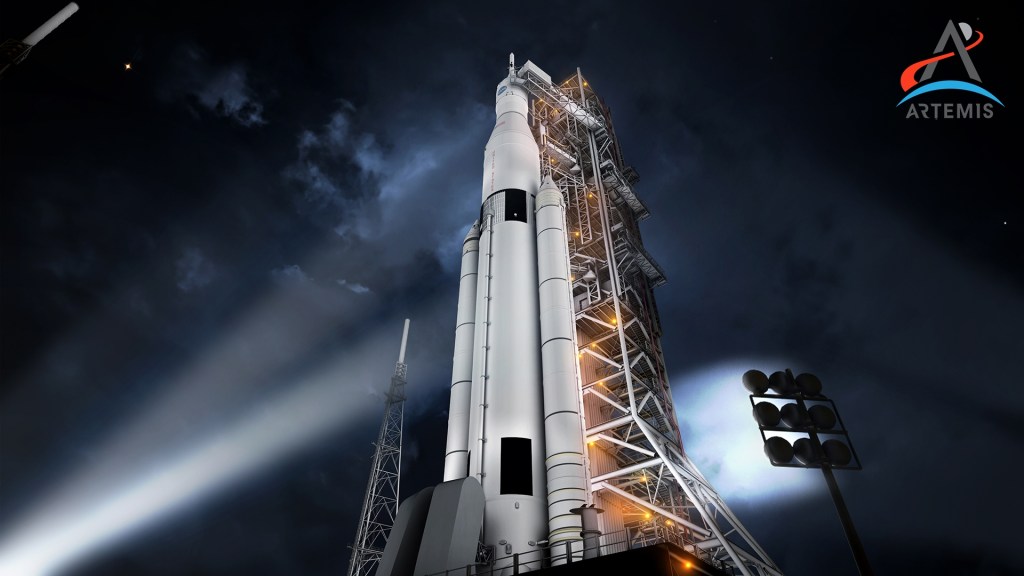
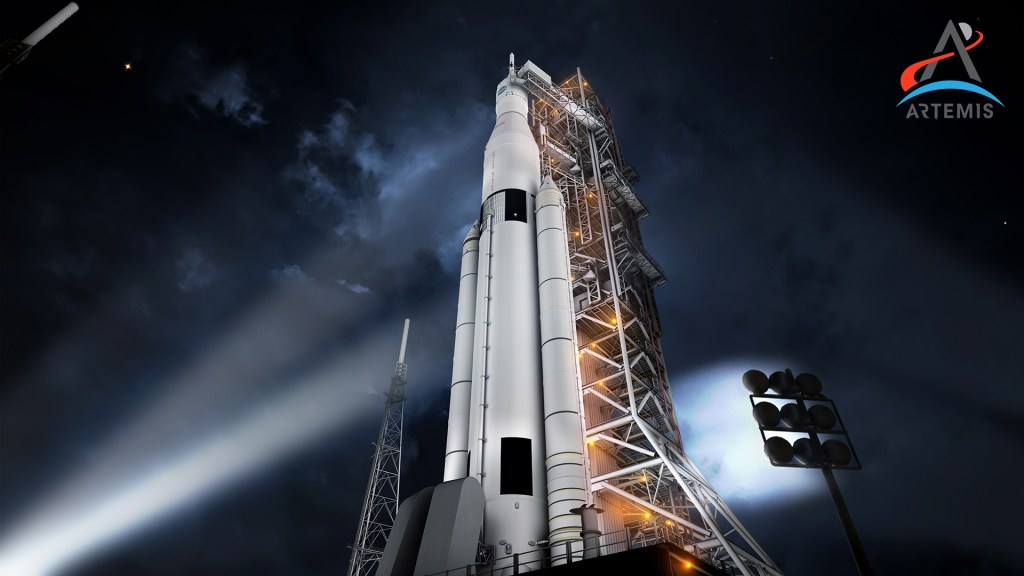
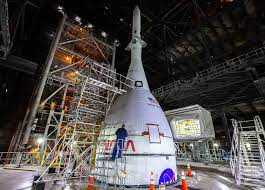
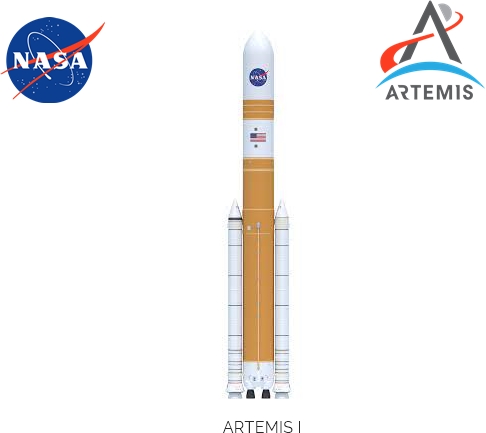
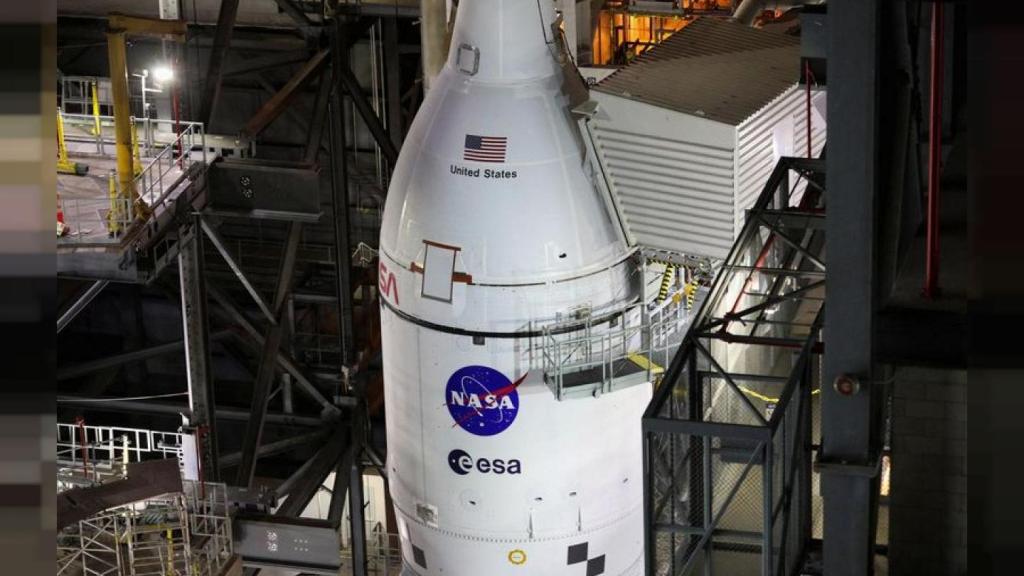
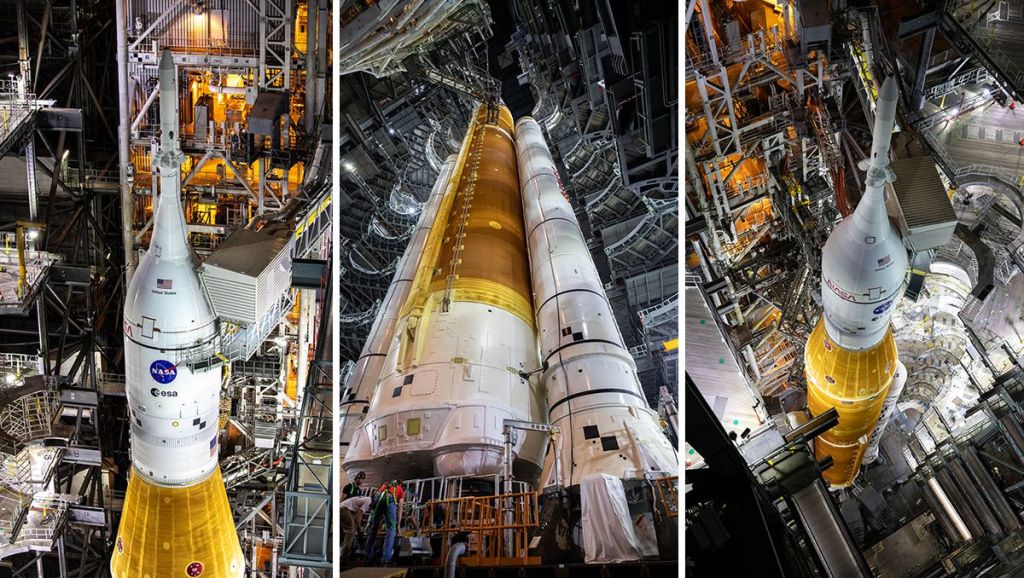
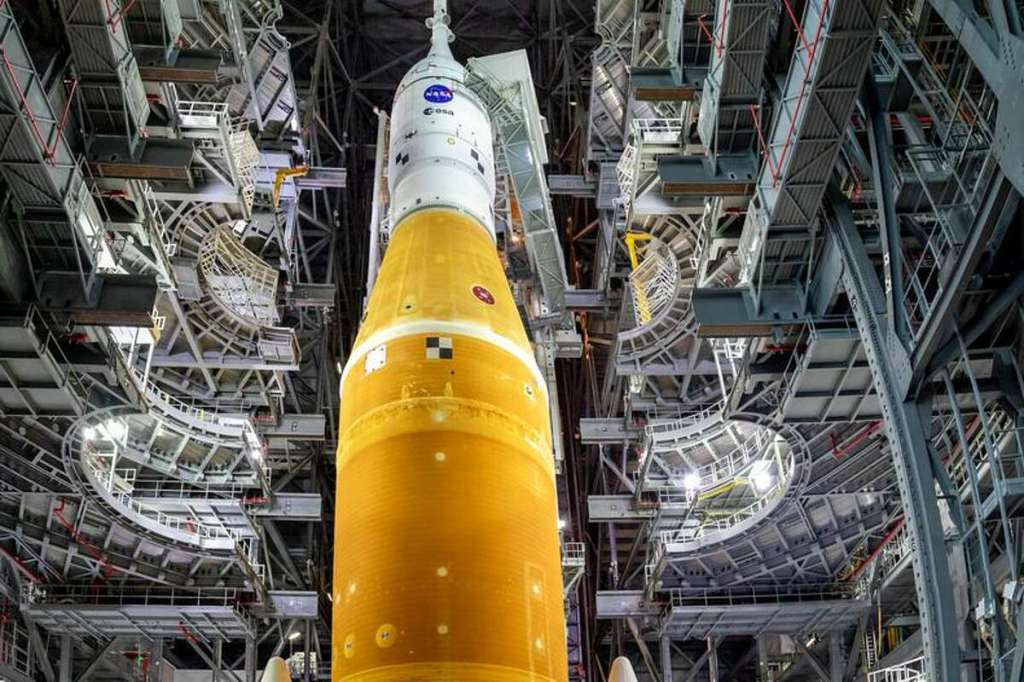
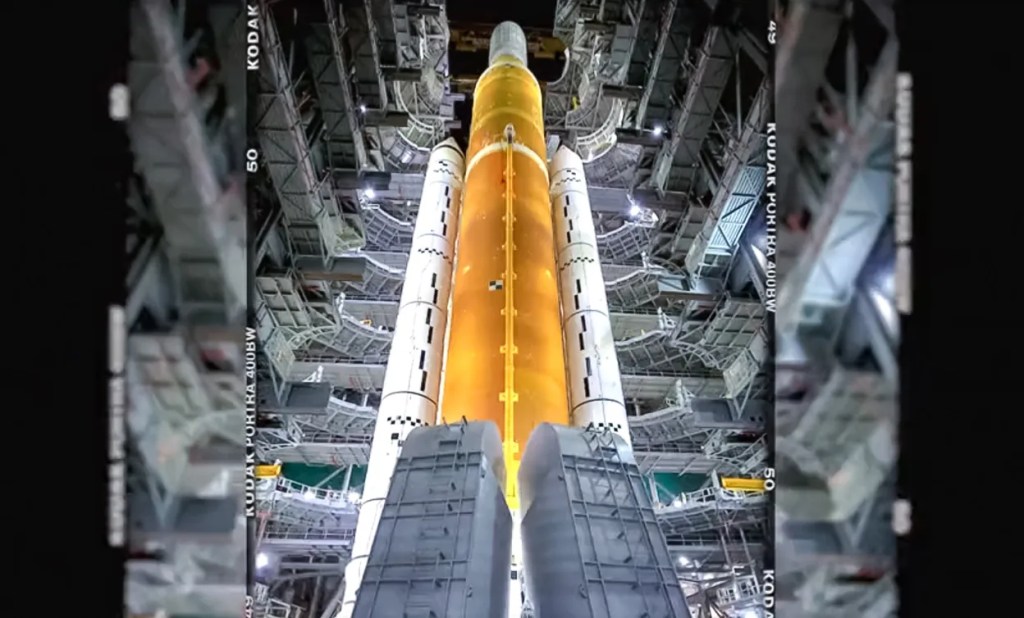
El cohete del Sistema de Lanzamiento Espacial para la Misión Artemis I está preparado y listo para dar el próximo gran paso hacia el lanzamiento. Desde el interior del edificio de ensamblaje de vehículos en el Centro Espacial Kennedy de la NASA en Florida el 11 de Marzo de 2022, las plataformas de trabajo se retraen alrededor del cohete del sistema de lanzamiento espacial Artemis I y la nave espacial Orion en preparación para desplegarse en la Plataforma de Lanzamiento 39B. El equipo de sistemas terrestres de Kennedy está trabajando para retirar el equipo y los andamios del cohete y continuará retrayendo las plataformas hasta que se revele todo el cohete antes de la prueba de ensayo con vestuario húmedo, que está programada para aproximadamente dos semanas después de que llegue a 39B. Artemis I es la primera de una serie de misiones cada vez más complejas que permitirán la exploración humana a la Luna y Marte.
El Jueves 17 de Marzo de 2022, el cohete del Sistema de Lanzamiento Espacial de la NASA con la nave espacial integrada Orion saldrá del icónico Edificio de Ensamblaje de Vehículos (VAB) en el Centro Espacial Kennedy de la NASA en el Crawler-Transporter 2 para prepararse para el ensayo general húmedo. Siga en tiempo real a medida que avanzamos un paso más hacia el regreso de la humanidad a la superficie de la Luna. Puede ver la transmisión en vivo a partir de las 04:00 p.m. EDT en NASA Television.
El cohete del Sistema de Lanzamiento Espacial integrado y la nave espacial Orion tardarán aproximadamente 11 horas en viajar las cuatro millas desde el VAB hasta la Plataforma de Lanzamiento 39B. El lanzamiento colocará el vehículo Artemis I en su lugar para su última prueba importante antes del lanzamiento: el ensayo general húmedo o WDR. Cuando se complete esa prueba, la pila de Artemis I se moverá de regreso al VAB y se realizarán los preparativos finales para lanzar la misión no tripulada alrededor de la Luna.
Artemis I Launch
Artemis I Mission Space Launch System
The Space Launch System rocket for the Artemis I mission is primed and ready to take the next big step toward launch. From inside the Vehicle Assembly Building at NASA’s Kennedy Space Center in Florida on March 11, 2022, work platforms retract around the Artemis I Space Launch System rocket and Orion spacecraft in preparation for deploy to Launch Pad 39B. Kennedy’s ground systems team is working to remove equipment and scaffolding from the rocket and will continue to retract the platforms until the entire rocket is revealed before the wet-suit rehearsal test, which is scheduled for about two weeks after the launch get to 39B. Artemis I is the first in a series of increasingly complex missions that will enable human exploration of the Moon and Mars.
On Thursday, March 17, 2022, NASA’s Space Launch System rocket with integrated Orion spacecraft will depart from the iconic Vehicle Assembly Building (VAB) at NASA’s Kennedy Space Center in Crawler-Transporter 2 for Prepare for wet dress rehearsal. Follow in real time as we move one step closer to humanity’s return to the surface of the Moon. You can watch the live stream starting at 04:00 p.m. EDT on NASA Television.
The Integrated Space Launch System rocket and Orion spacecraft will take approximately 11 hours to travel the four miles from VAB to Launch Pad 39B. The launch will put the Artemis I vehicle in place for its last major test before launch: the wet dress rehearsal, or WDR. When that test is complete, the Artemis I stack will be moved back to the VAB and final preparations will be made to launch the unmanned mission around the Moon.
El próximo vuelo de prueba de Boeing Starliner en el calendario de lanzamiento de ULA ha sido postergado en su programación. La Fuerza Espacial de Estados Unidos ha pospuesto una misión de varias naves espaciales que fue reservada para volar en un Cohete Atlas 5 de United Launch Alliance en Abril 2022, moviendo una rehacer de un vuelo de prueba para la cápsula de la tripulación Starliner de Boeing al frente de la línea en el calendario de lanzamiento de ULA.
ULA anunció el retraso en la Misión USSF 12 de la Fuerza Espacial en una breve declaración compartida en las redes sociales. La compañía de lanzamiento, una empresa conjunta 50-50 de participación entre The Boeing Company y Lockheed Martin, dijo que el retraso fue ordenado a petición del Comando de Sistemas Espaciales de la Fuerza Espacial. «Continuaremos trabajando con SSC para determinar la próxima oportunidad de lanzamiento de USSF 12», dijo ULA.
El vuelo de prueba de Starliner, retrasado desde Agosto 2021, estaba programado tentativamente para lanzarse desde Cabo Cañaveral el 20 de Mayo de 2022 antes del retraso en la Misión USSF 12. No se espera que el aplazamiento del USSF 12 permita que la misión Starliner avance significativamente.
La misión USSF 12 estaba programada para lanzarse en la primera quincena de Abril 2022 con dos cargas útiles de la Fuerza Espacial que se dirigían a la órbita geosíncrona, una ubicación de más de 22,000 millas (casi 36.000 kilómetros) sobre la línea del Ecuador. El satélite de vigilancia Wide Field of View, o WFOV, de la Fuerza Espacial es la carga útil principal en la misión USSF 12. El satélite WFOV es un banco de pruebas para un sensor espacial de próxima generación diseñado para detectar lanzamientos de cohetes y proporcionar una alerta temprana de un ataque con misiles. Construido por Millennium Space Systems, el satélite del banco de pruebas WFOV albergará un instrumento de observación óptica para detectar las columnas de escape de los lanzamientos de misiles, demostrando el sensor de área amplia para su uso futuro en los sistemas operativos de alerta temprana del ejército.
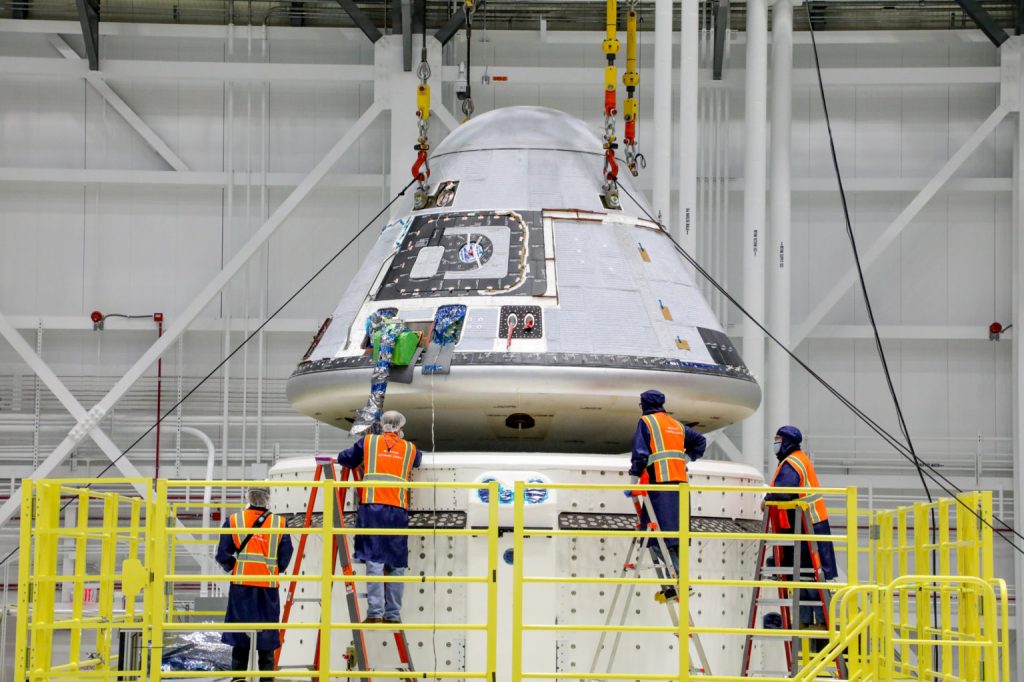
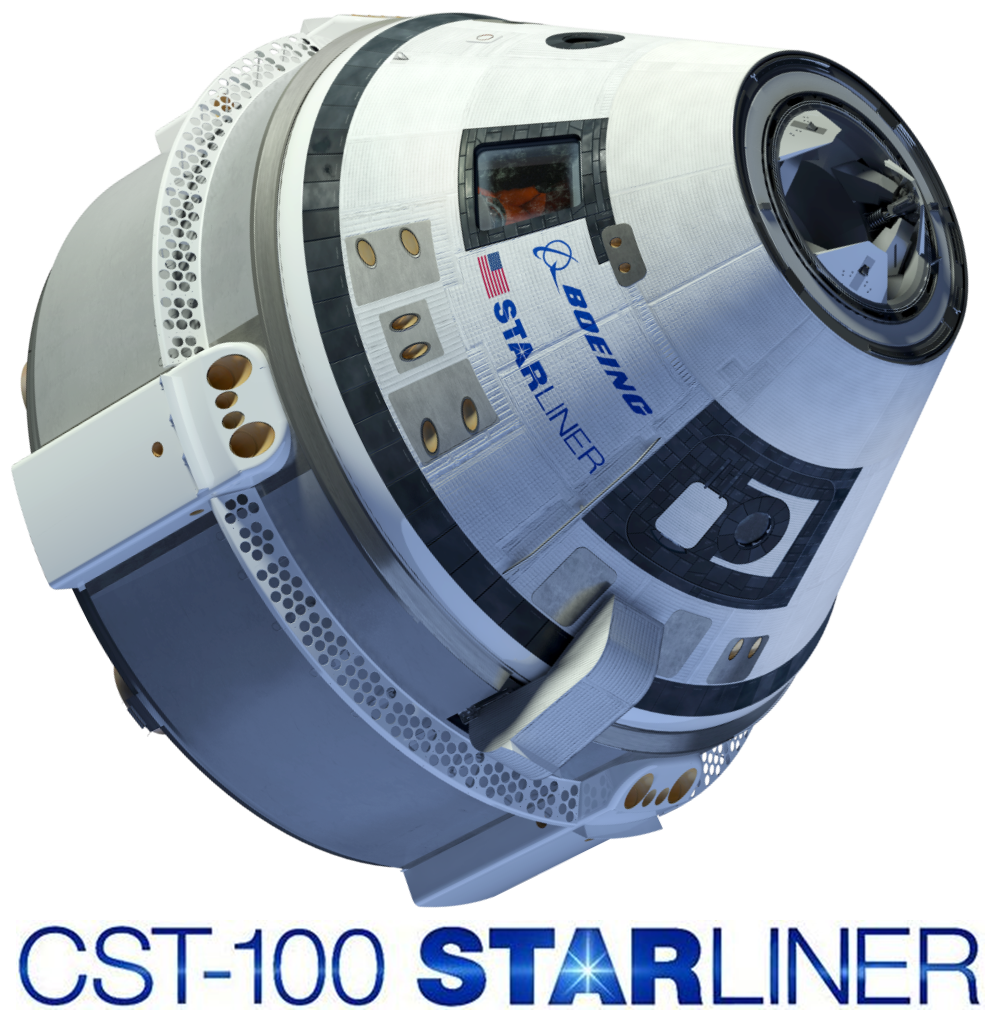
El equipo Starliner de Boeing en el Centro Espacial Kennedy está preparando la nave espacial con calificación de tripulación para una oportunidad de lanzamiento en mayo, una misión que ahora se convierte en el próximo vuelo en el calendario Atlas 5 de ULA. La misión Starliner es una repetición de un vuelo de prueba no pilotado en Diciembre de 2019 interrumpido por problemas de software. Los problemas de software impidieron que la nave espacial se acoplara a la Estación Espacial Internacional, y la cápsula aterrizó de manera segura en Nuevo México después de una misión abreviada. Después de varios cambios de hardware y software, Boeing se preparó para el segundo intento en la misión orbital Flight Test del Starliner, designada OFT-2, en agosto pasado. La nave espacial fue rodada a la plataforma de lanzamiento en Cabo Cañaveral sobre su cohete Atlas 5, pero las pruebas revelaron válvulas atascadas en el sistema de propulsión Starliner.
Boeing y la NASA, que administra el contrato de tripulación comercial del Starliner, acordaron retirar el Starliner del Cohete Atlas 5 y posponer la misión para investigar el problema de la válvula. Los ingenieros creen que los componentes de la válvula probablemente se ha corroído por la interacción del propelente de tetróxido de nitrógeno con la humedad que se filtró en los propulsores del módulo de servicio de la nave espacial, y luego permearon un sello de teflón dentro de la propia válvula. Los técnicos retiraron el módulo de servicio del módulo de tripulación del Starliner en enero para su envío a una instalación de prueba en Nuevo México, donde los equipos están realizando pruebas para comprender mejor el problema de la válvula. La misión OFT-2 volará con un nuevo módulo de servicio, uno asignado originalmente a la primera misión Starliner con astronautas.
Boeing dijo que el equipo de Starliner diseñó un nuevo sistema de purga para ayudar a evitar que la humedad entre en las válvulas durante la próxima campaña de lanzamiento mientras la nave espacial está en la fábrica y en el sitio de lanzamiento de ULA. Si tiene éxito, la misión OFT-2 allanará el camino para la prueba de vuelo de la tripulación de Starliner, que llevará a un equipo de tres astronautas de la NASA a la estación espacial. Eso finalmente conducirá a vuelos operativos de rotación de la tripulación en la nave espacial Starliner, similar a las misiones Crew Dragon de SpaceX a la estación espacial, dando a la NASA dos vehículos estadounidenses capaces de transportar astronautas hacia y desde el complejo de investigación en órbita.
Starliner calendar postponed
Atlas 5 Scheduled Release Postponed
The next Boeing Starliner test flight on ULA’s launch schedule has been pushed back. The US Space Force has postponed a multi-spacecraft mission that was booked to fly on a United Launch Alliance Atlas 5 rocket in April 2022, moving a remake of a test flight for Boeing’s Starliner crew capsule to front of the line on ULA’s release schedule.
ULA announced the delay to the Space Force’s USSF Mission 12 in a brief statement shared on social media. The launch company, a 50-50 joint venture between The Boeing Company and Lockheed Martin, said the delay was ordered at the request of Space Force Space Systems Command. «We will continue to work with SSC to determine the next launch opportunity for USSF 12», ULA said.
The Starliner test flight, delayed from August 2021, was tentatively scheduled to launch from Cape Canaveral on May 20, 2022 before the delay in USSF Mission 12. The postponement of USSF 12 is not expected to allow the Starliner mission to move forward. significantly.
The USSF 12 mission was scheduled to launch in the first half of April 2022 with two Space Force payloads headed for geosynchronous orbit, a location more than 22,000 miles (nearly 36,000 kilometers) above the equator. The Space Force’s Wide Field of View, or WFOV, surveillance satellite is the primary payload on the USSF 12 mission. The WFOV satellite is a testbed for a next-generation space sensor designed to detect rocket launches and provide an early warning of a missile attack. Built by Millennium Space Systems, the WFOV testbed satellite will house an optical sighting instrument to detect exhaust plumes from missile launches, demonstrating the wide-area sensor for future use in military operational early warning systems.
Boeing’s Starliner team at the Kennedy Space Center is preparing the crew-qualified spacecraft for a launch opportunity in May, a mission that now becomes the next flight on ULA’s Atlas 5 schedule. The Starliner mission is a repeat of an unmanned test flight in December 2019 cut short by software issues. Software problems prevented the spacecraft from docking with the International Space Station, and the capsule landed safely in New Mexico after an abbreviated mission. After several hardware and software changes, Boeing prepared for the second attempt at the Starliner’s orbital Flight Test mission, designated OFT-2, last August. The spacecraft was rolled to the launch pad at Cape Canaveral on its Atlas 5 rocket, but tests revealed stuck valves in the Starliner propulsion system.
Boeing and NASA, which manages the Starliner’s commercial crew contract, have agreed to remove the Starliner from the Atlas 5 Rocket and postpone the mission to investigate the valve problem. Engineers believe the valve components likely corroded from the interaction of nitrogen tetroxide propellant with moisture that seeped into the spacecraft’s service module thrusters, then permeated a Teflon seal inside the spacecraft itself. valve. Technicians removed the Starliner’s crew module from service in January for shipment to a test facility in New Mexico, where crews are conducting tests to better understand the valve problem. The OFT-2 mission will fly with a new service module, one originally assigned to the first Starliner mission with astronauts.
Boeing said the Starliner team designed a new purge system to help prevent moisture from entering the valves during the upcoming launch campaign while the spacecraft is in the factory and at the ULA launch site. If successful, the OFT-2 mission will pave the way for the Starliner crew flight test, which will carry a team of three NASA astronauts to the space station. That will ultimately lead to operational crew rotation flights on the Starliner spacecraft, similar to SpaceX’s Crew Dragon missions to the space station, giving NASA two US vehicles capable of transporting astronauts to and from the orbiting research complex.
PUBLISHER: Airgways.com DBk: Boeing.com / Nasa.gov / John Proferes / Airgways.com AW-POST: 202203121523AR OWNERSHIP: Airgways Inc. A\W A I R G W A Y S ®
Diseño satélite de Airbus supera importante hito del proyecto Preparación para el concepto de fabricación industrializada
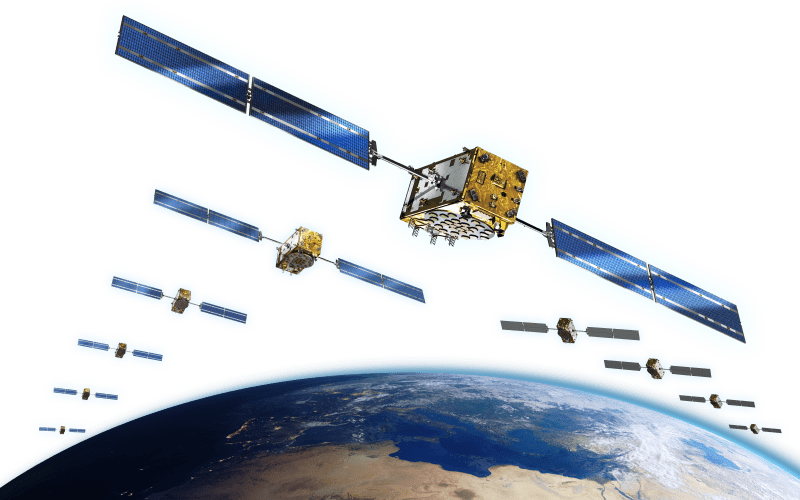
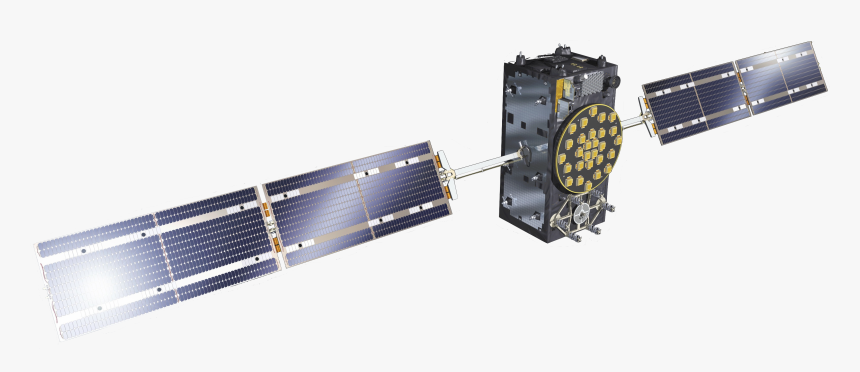
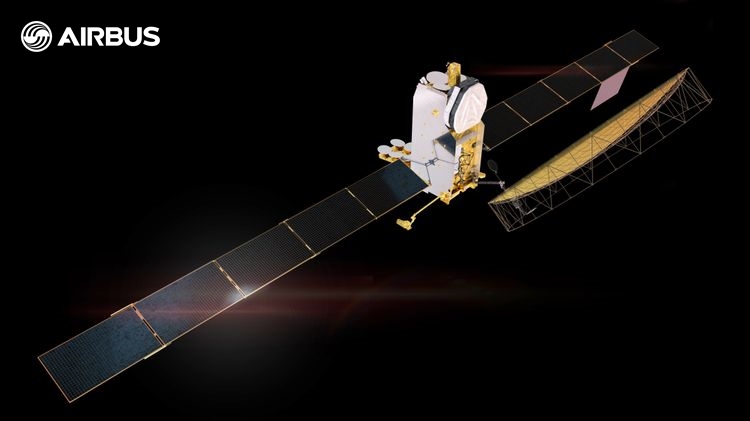
Airbus Group ha completado con éxito la Revisión Preliminar del Diseño (PDR) de su concepto de sistema para los satélites de navegación Galileo de segunda generación. Durante este importante hito, el diseño preliminar propuesto por Airbus y los requisitos del sistema del cliente han sido completamente revisados y acordados. Esto allana el camino para una mayor verificación, aceptación y calificación a nivel de equipo y módulo. La verificación a nivel de carga útil ya está en pleno apogeo, y la Revisión de diseño crítico (CDR) para la estructura del satélite también se realizará en breve.
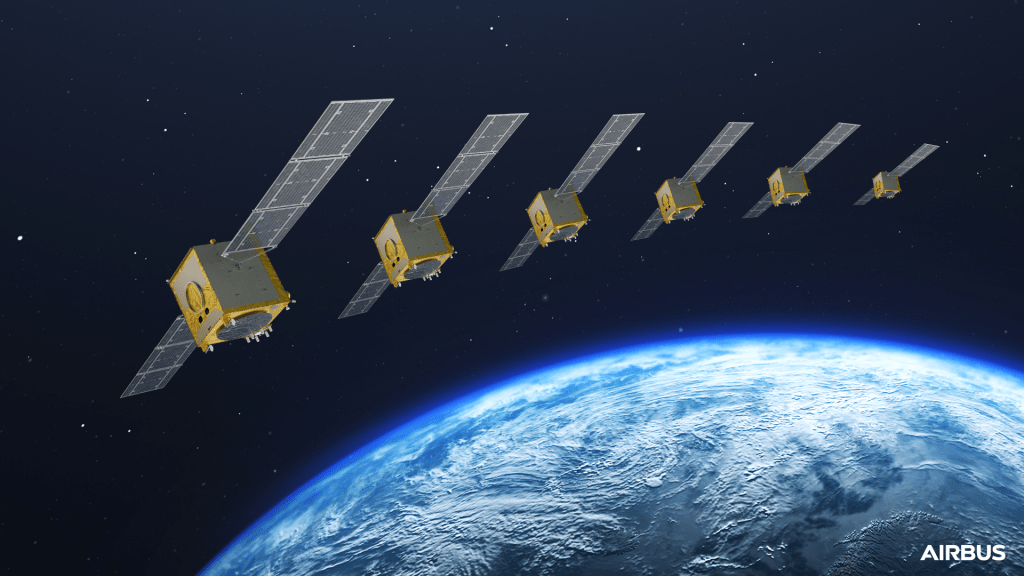
Paralelamente, el sitio de Airbus en Friedrichshafen, en el lago de Constanza, se está preparando para una línea de producción industrializada para actualmente seis satélites Galileo de segunda generación. El centro de integración de satélites se está actualizando por completo para cumplir con los requisitos actuales y futuros para una producción eficiente, respetuosa con el medio ambiente, segura y protegida para los satélites Galileo de segunda generación. La segunda generación de Galileo es un hito clave en los servicios europeos de navegación por satélite del que se beneficiarán los ciudadanos europeos y miles de millones de usuarios de todo el mundo, impulsado por los conocimientos de Airbus aportados al proyecto por más de 200 ingenieros espaciales altamente cualificados. Está previsto que la primera segunda generación de Galileo se lance en 2024.
El mundo de la navegación está cambiando, impulsado por las necesidades de los usuarios que surgen y cambian rápidamente (disponibilidad y confiabilidad), un número creciente de amenazas de seguridad (interferencias y suplantación de identidad) y la evolución de otros sistemas de navegación. El nuevo lote de la nave espacial Galileo construida por Airbus es la respuesta a este contexto cambiante. Hará que el servicio de Galileo sea más preciso, seguro y fiable, y adaptable durante su vida útil de dos décadas.
Con un peso de alrededor de 2,3 toneladas, cada satélite está diseñado para funcionar durante unos 15 años. La plataforma de Órbita Terrestre Media (MEO) totalmente eléctrica y de última generación de Airbus reutiliza componentes básicos probados en vuelo de nuestros programas de telecomunicaciones y observación de la Tierra, aprovechando una combinación única de herencia y experiencia en órbita. La solución de carga útil de navegación flexible y modular con capacidad de crecimiento futuro también se basa en elementos de telecomunicaciones para la formación de haces y la generación de señales.
Galileo está gestionado y financiado por la Unión Europea. La Comisión Europea, ESA y EUSPA han firmado un acuerdo por el que la ESA actúa como autoridad de diseño y principal responsable del desarrollo del sistema en nombre de la Comisión y EUSPA como gestor de explotación y operación de Galileo. Las opiniones expresadas en este comunicado de prensa de ninguna manera pueden considerarse como un reflejo de la opinión de la Unión Europea y/o la ESA.
Galileo satellites second generation
Airbus satellite design passes major project milestone Preparation for the concept of industrialized manufacturing
Airbus Group has successfully completed the Preliminary Design Review (PDR) of its system concept for the second generation Galileo navigation satellites. During this important milestone, Airbus’ proposed preliminary design and customer system requirements have been fully reviewed and agreed upon. This paves the way for further verification, acceptance and qualification at the team and module level. Payload-level verification is already in full swing, and the Critical Design Review (CDR) for the satellite structure is also due shortly.
In parallel, the Airbus site in Friedrichshafen on Lake Constance is preparing for an industrialized production line for currently six second-generation Galileo satellites. The satellite integration center is being fully upgraded to meet current and future requirements for efficient, environmentally friendly, safe and secure production for the second generation Galileo satellites. The second generation of Galileo is a key milestone in European satellite navigation services that European citizens and billions of users around the world will benefit from, powered by Airbus expertise brought to the project by more than 200 space engineers highly qualified. The first second generation Galileo is scheduled to launch in 2024.
The world of navigation is changing, driven by rapidly emerging and changing user needs (availability and reliability), a growing number of security threats (interference and phishing), and the evolution of other navigation systems. The new batch of Galileo spacecraft built by Airbus is the answer to this changing context. It will make Galileo’s service more accurate, secure, reliable and adaptable over its two-decade lifetime.
Weighing around 2.3 tons, each satellite is designed to function for around 15 years. Airbus’ state-of-the-art, all-electric Medium Earth Orbit (MEO) platform reuses flight-proven core components from our telecommunications and Earth observation programs, leveraging a unique combination of heritage and in-orbit experience. The scalable, flexible and modular navigation payload solution is also based on telecommunications elements for beamforming and signal generation.
Galileo is managed and financed by the European Union. The European Commission, ESA and EUSPA have signed an agreement whereby ESA acts as design authority and main responsible for the development of the system on behalf of the Commission and EUSPA as manager of exploitation and operation of Galileo. The opinions expressed in this press release can in no way be considered as reflecting the opinion of the European Union and/or ESA.
PUBLISHER: Airgways.com DBk: Airbus.com / Airgways.com AW-POST: 202203081000AR OWNERSHIP: Airgways Inc. A\W A I R G W A Y S ®
Estación Espacial Internacional conectada con satélite de Airbus
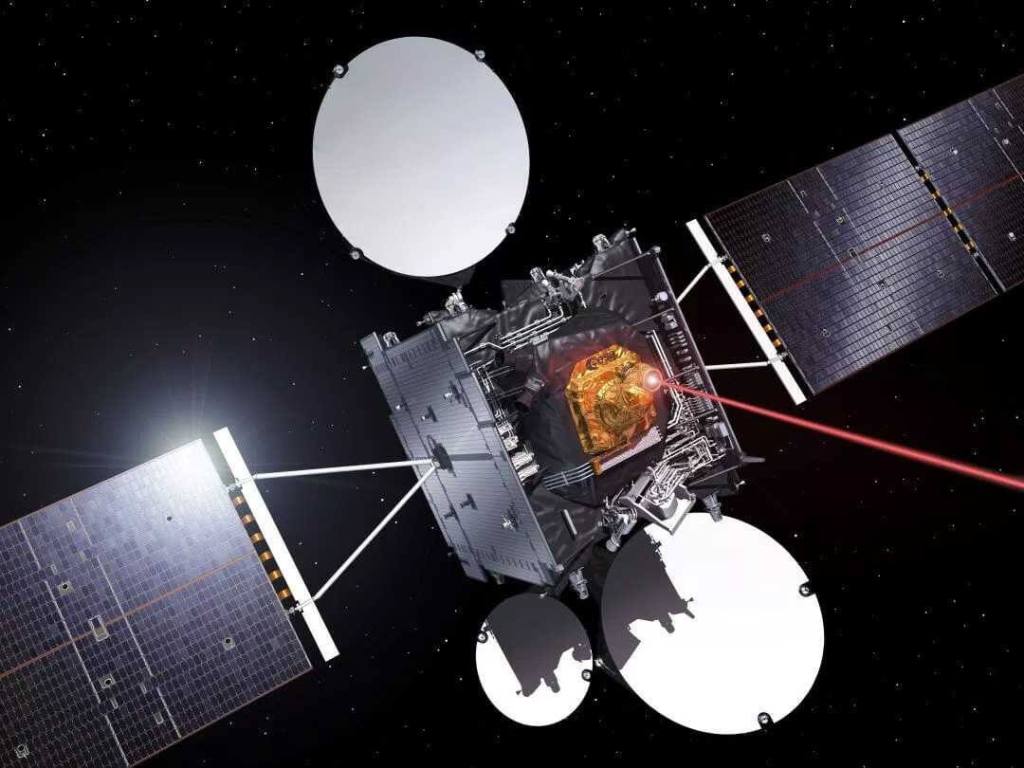
La SpaceDataHighway de Airbus, desarrollada con el apoyo de la European Space Agency (ESA), proporciona servicios de conectividad de banda ancha entre la Estación Espacial Internacional (ISS) y la Tierra. Con el terminal de banda Ka de Columbus (ColKa) ahora instalado y completamente probado a bordo de la ISS, un satélite SpaceDataHighway comenzará a transmitir datos a través de un enlace bidireccional en tiempo real entre el Laboratorio Columbus de la ISS y el Centro de control de Columbus ubicado en el Centro Aeroespacial Alemán DLR cerca de Múnich, así como centros de investigación en toda Europa. Beneficiados por SpaceDataHighway y la terminal ColKa, la ESA se beneficiará de un acceso directo y soberano a la ISS, lo que aumentará la flexibilidad operativa y permitirá que más astronautas, científicos e investigadores se beneficien de un enlace directo con Europa. Esto también permitirá a la ESA crear espacios para el acceso a experimentos ad-hoc y la interacción con astronautas europeos.
La prestación del servicio de datos ColKa ha sido contratada entre ESA y Airbus. Como parte de este nuevo servicio SpaceDataHighway, Airbus ha adaptado su enlace entre satélites en banda Ka para garantizar que los datos se canalicen a través de la estación terrestre en Harwell Campus, Reino Unido. Además de este servicio de banda Ka, SpaceDataHighway es la primera constelación geoestacionaria de comunicaciones por láser del mundo. Representa un cambio de juego en la velocidad de las comunicaciones espaciales, utilizando tecnología láser de vanguardia para brindar servicios de transferencia de datos seguros casi en tiempo real. El sistema ha logrado más de 50 000 conexiones láser exitosas en los primeros cinco años de operaciones de rutina. Sus satélites pueden conectarse a la ISS, así como a satélites de observación en órbita baja a una distancia de hasta 45.000 km. Desde su posición en órbita geoestacionaria, el sistema SpaceDataHighway transmite casi en tiempo real a la Tierra los datos recopilados, un proceso que normalmente llevaría varias horas. Por tanto, permite aumentar considerablemente la cantidad de datos de imagen y vídeo transmitidos por los satélites de observación y reprogramar su plan de misión en cualquier momento y en tan solo unos minutos.
Con su SpaceDataHighway, Airbus ya presta servicio diariamente a cuatro satélites Copernicus Sentinel y continúa ampliando sus servicios a más clientes. Pleiades Neo, la constelación óptica de observación de la Tierra más avanzada de Airbus con cuatro satélites de resolución de 30 cm, son los próximos satélites que se beneficiarán de la infraestructura de SpaceDataHighway y optimizarán aún más la reactividad de la misión proporcionando capacidades de entrega de datos y tareas reactivas casi en tiempo real.
ISS connected to SpaceDataHighway
International Space Station connected with Airbus satellite
The Airbus SpaceDataHighway, developed with the support of the European Space Agency (ESA), provides broadband connectivity services between the International Space Station (ISS) and Earth. With the Columbus Ka-Band Terminal (ColKa) now installed and fully tested on board the ISS, a SpaceDataHighway satellite will begin transmitting data over a real-time bidirectional link between the ISS Columbus Laboratory and the Control Center. of Columbus located at the DLR German Aerospace Center near Munich, as well as research centers throughout Europe. Benefiting from the SpaceDataHighway and the ColKa terminal, ESA will benefit from direct and sovereign access to the ISS, increasing operational flexibility and allowing more astronauts, scientists and researchers to benefit from a direct link to Europe. This will also allow ESA to create spaces for access to ad-hoc experiments and interaction with European astronauts.
The provision of the ColKa data service has been contracted between ESA and Airbus. As part of this new SpaceDataHighway service, Airbus has adapted its Ka-band inter-satellite link to ensure data is channeled through the ground station at Harwell Campus, UK. In addition to this Ka-band service, SpaceDataHighway is the world’s first geostationary laser communications constellation. It represents a game changer in the speed of space communications, using cutting-edge laser technology to deliver secure data transfer services in near real time. The system has achieved more than 50,000 successful laser connections in the first five years of routine operations. Its satellites can connect to the ISS as well as low-orbiting observation satellites at a distance of up to 45,000 km. From its position in geostationary orbit, the SpaceDataHighway system transmits collected data to Earth in near real time, a process that would normally take several hours. Therefore, it allows you to considerably increase the amount of image and video data transmitted by observation satellites and reprogram your mission plan at any time and in just a few minutes.
With its SpaceDataHighway, Airbus already serves four Copernicus Sentinel satellites daily and continues to expand its services to more customers. Pleiades Neo, Airbus’ most advanced optical Earth observation constellation with four 30 cm resolution satellites, are the next satellites to benefit from the SpaceDataHighway infrastructure and further optimize mission reactivity by providing data delivery capabilities. data and reactive tasks in near real time.
PUBLISHER: Airgways.com DBk: Airbus.com / Esa.int AW-POST: 202201171535AR OWNERSHIP: Airways Inc. A\W A I R G W A Y S ®
Airbus desarrollará sistema de gestión y distribución de energía
Airbus Crisa, empresa filial de Airbus Group, ha firmado un contrato para el desarrollo del sistema de Gestión y Distribución de Energía (PMAD) para el Puesto Avanzado de Vivienda y Logística (HALO) con Northrop Grumman. Airbus Crisa es una empresa española fundada en 1985 para diseñar y fabricar equipos electrónicos y software para aplicaciones espaciales y proyectos de ingeniería para estaciones terrestres. Está totalmente integrado en Airbus Defence and Space.
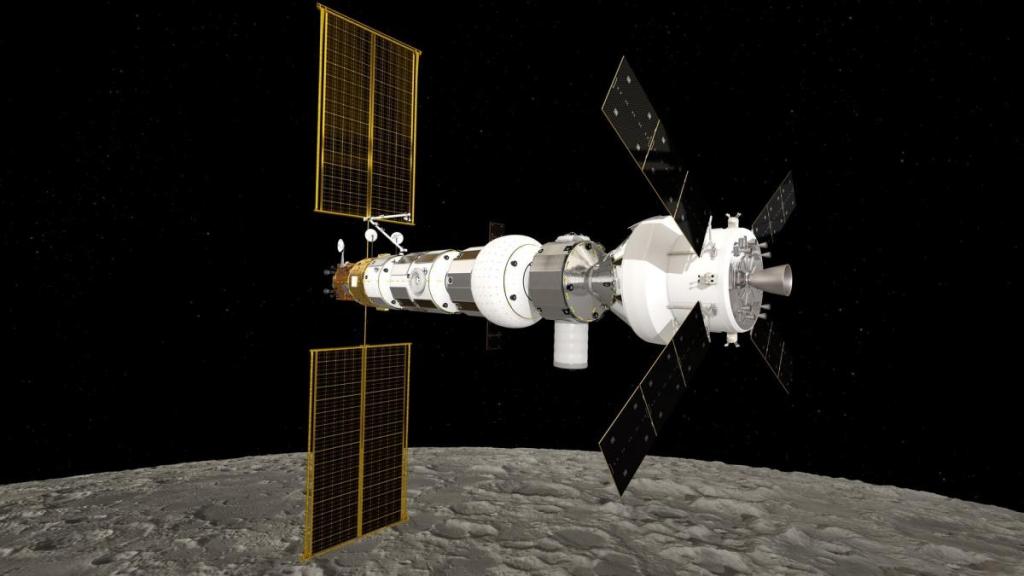
La nueva estación Lunar Gateway, cuyo lanzamiento está previsto para 2024, contará inicialmente con dos módulos y se ampliará en años sucesivos a cinco módulos. La estación está destinada a servir como laboratorio espacial y como puesto logístico intermedio para futuros viajes a la superficie de la Luna y Marte. Los dos módulos iniciales se conocen como PPE y HALO. El PPE (Elemento de Potencia y Propulsión) tiene paneles solares que alimentan la estación y propulsores que le permiten mantener una órbita estable alrededor de la Luna. HALO es el módulo avanzado de vivienda y logística donde vivirán los astronautas durante los cuarenta días estimados de las primeras misiones.
“Este contrato por valor de más de US$ 50 millones de Dólares refleja nuestra capacidad para entregar equipos espaciales altamente especializados a fabricantes globales y es nuestra primera contribución al Gateway en órbita lunar, que es parte del programa Artemis de la NASA para regresar a la Luna. Este es un paso emocionante ya que Airbus Crisa está diseñando el PMAD para que se convierta en el sistema de gestión de energía modular estándar para todas las futuras estaciones espaciales y vehículos humanos. Hemos aportado una solución disruptiva, con un concepto arquitectónico nunca antes visto en el sector. Esto sienta las bases para un nuevo estándar internacional, colocando a la compañía a la vanguardia del sector”, dijo Fernando Gómez-Carpintero, Director General de Airbus Crisa.
El PMAD cuenta con cuatro unidades de potencia y gestionará la electricidad procedente de los paneles solares del Elemento de Potencia y Propulsión (EPI). Distribuirá la energía a los equipos de a bordo y al resto de la estación según sea necesario, velando siempre por la seguridad de la tripulación a bordo. El PMAD alimentará el sistema de soporte vital, la iluminación interior, los sistemas de comunicaciones y los experimentos científicos. Garantizará que la batería de HALO se mantenga en niveles óptimos y esté lista para usar cuando los paneles no reciban suficiente luz solar. PMAD también debe proporcionar energía a los vehículos visitantes cuando atracan.
Airbus Crisa es un actor internacional clave en los campos del control digital de conversión de energía y la gestión y distribución de energía para aplicaciones de satélites y lanzadores gracias a la experiencia adquirida en las desafiantes misiones de exploración de la ESA. Este contrato demuestra su gran potencial para proporcionar productos de vuelo fiables a los fabricantes estadounidenses.
Airbus Lunar Gateway module
Airbus will develop energy management and distribution system
Airbus Crisa, a subsidiary of Airbus Group, has signed a contract for the development of the Power Management and Distribution (PMAD) system for the Housing and Logistics Outpost (HALO) with Northrop Grumman. Airbus Crisa is a Spanish company founded in 1985 to design and manufacture electronic equipment and software for space applications and engineering projects for ground stations. It is fully integrated into Airbus Defense and Space.
The new Lunar Gateway station, scheduled to launch in 2024, will initially have two modules and will be expanded to five modules in successive years. The station is intended to serve as a space laboratory and as an intermediate logistics post for future trips to the surface of the Moon and Mars. The two initial modules are known as PPE and HALO. The PPE (Power Propulsion Element) has solar panels that power the station and propellants that allow it to maintain a stable orbit around the Moon. HALO is the advanced housing and logistics module where astronauts will live for the estimated forty days of the first missions.
“This contract worth more than US$ 50 million reflects our ability to deliver highly specialized space equipment to global manufacturers and is our first contribution to the Gateway in lunar orbit, which is part of NASA’s Artemis program to return to the Moon. This is an exciting step as Airbus Crisa is designing the PMAD to become the standard modular power management system for all future space stations and human vehicles. We have provided a disruptive solution, with an architectural concept never before seen in the sector. This lays the foundations for a new international standard, placing the company at the forefront of the sector”, said Fernando Gómez-Carpintero, Managing Director of Airbus Crisa.
The PMAD has four power units and will manage the electricity from the solar panels of the Power and Propulsion Element (EPI). It will distribute the power to the equipment on board and to the rest of the station as necessary, always ensuring the safety of the crew on board. The PMAD will power the life support system, interior lighting, communications systems, and science experiments. It will ensure that the HALO battery remains at optimal levels and is ready to use when the panels are not getting enough sunlight. PMAD must also provide power to visiting vehicles when they dock.
Airbus Crisa is a key international player in the fields of digital power conversion control and power management and distribution for satellite and launcher applications thanks to the experience gained from ESA’s challenging exploration missions. This contract demonstrates its great potential to provide reliable flight products to American manufacturers.
PUBLISHER: Airgways.com DBk: Airbus.com / Crisa.es / Airgways.com AW-POST: 202201111103AR OWNERSHIP: Airgways Inc. A\W A I R G W A Y S ®
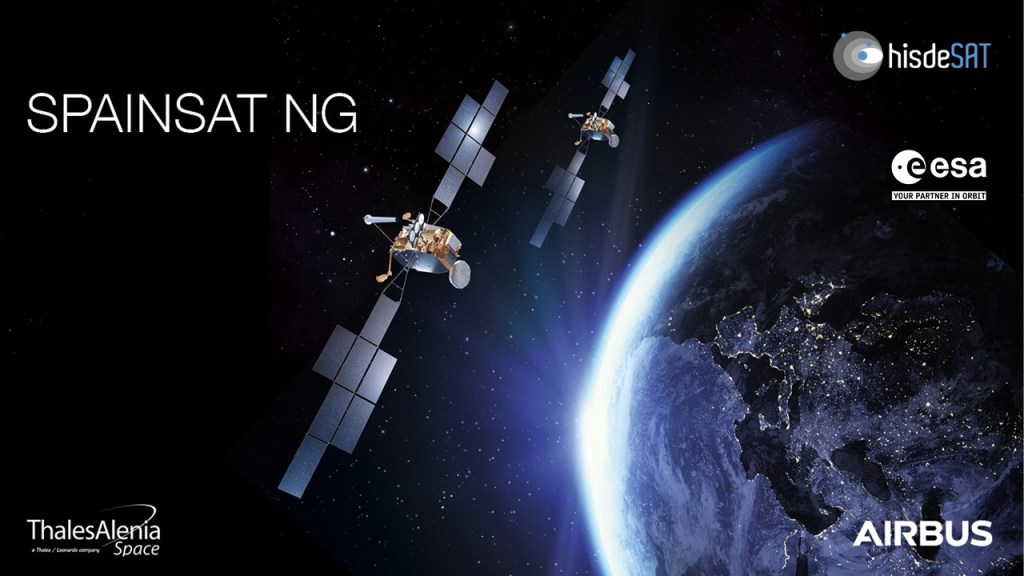
Programa SpainSat NG supera revisión crítica de diseño
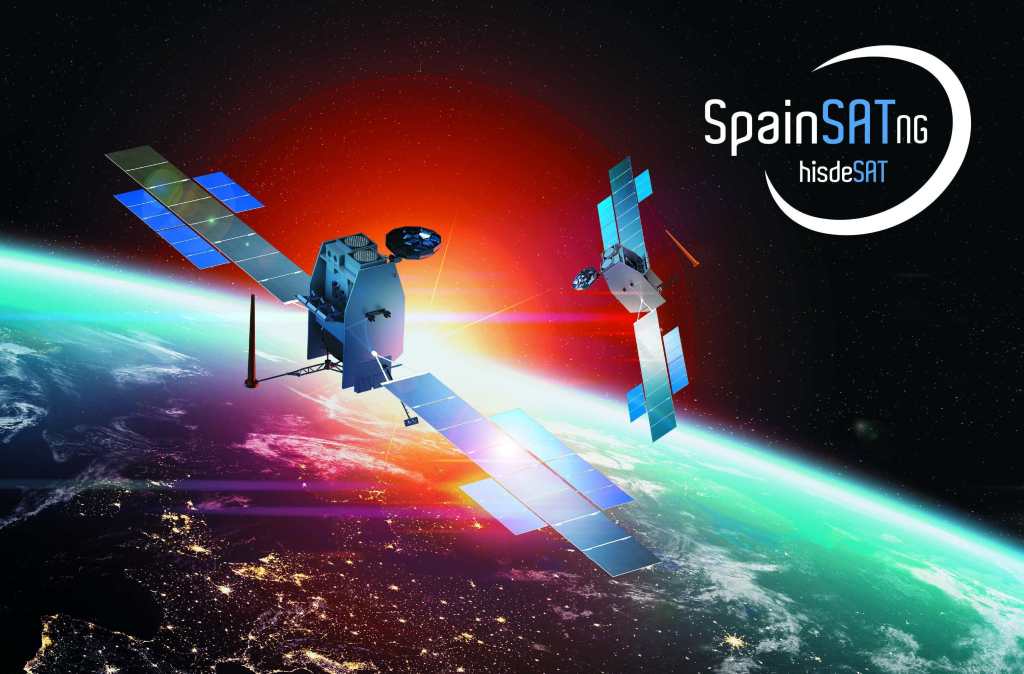
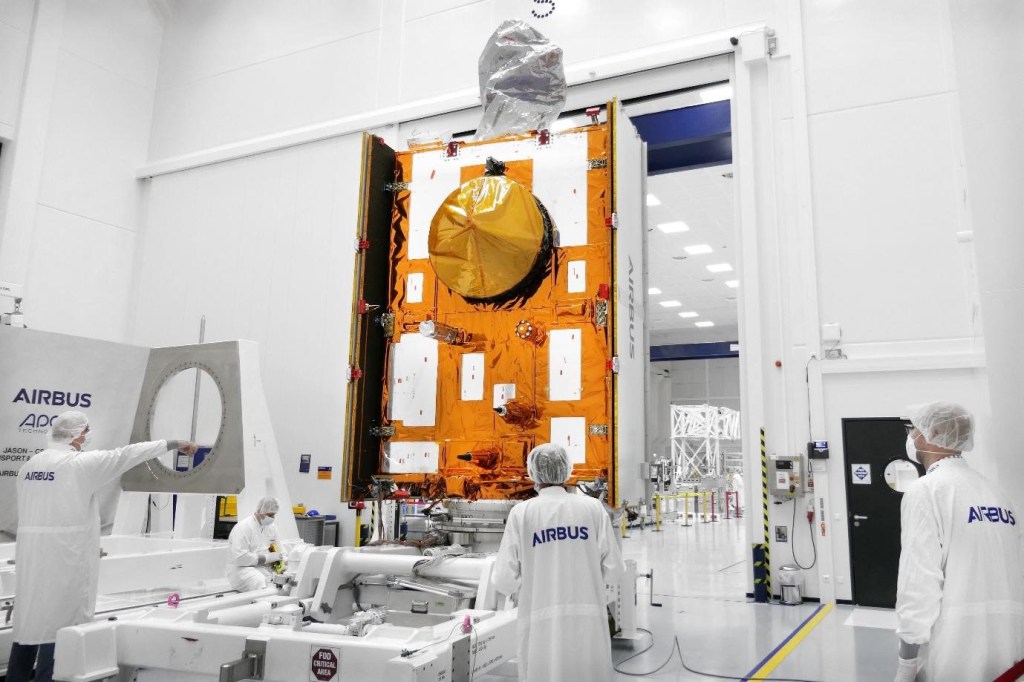
El programa SPAINSAT NG ha superado con éxito otro hito importante, la Revisión Crítica del Diseño (CDR) de la carga útil y el satélite completo, incluidos los elementos CDR del proyecto de colaboración Pacis 3 con la Agencia Espacial Europea (ESA). La revisión fue declarada exitosa luego de verificar el buen progreso de las pruebas realizadas en los modelos de desarrollo de la carga útil en banda X. Este importante hito confirma la solidez del diseño y las capacidades técnicas del sistema satelital SPAINSAT NG. Al mismo tiempo, marca el inicio de la fabricación de todos los elementos de vuelo de los satélites, observando sin embargo que ya se están fabricando equipos de vuelo de larga distancia, en particular para la plataforma satelital totalmente eléctrica Eurostar NEO. Además, la estructura del Módulo de Comunicaciones del primer satélite, SPAINSAT NG I, ya se encuentra en las instalaciones de Thales Alenia Space en Tres Cantos, Madrid, para iniciar las actividades de montaje, integración y prueba de la carga útil.
“Los equipos técnicos de nuestros cocontratistas, Airbus Defence and Space y Thales Alenia Space en España y Francia, junto con el resto de subcontratistas están haciendo un trabajo destacado, al igual que los de Hisdesat, actuando como cliente”, comenta Miguel Ángel García Primo, Consejero Delegado de Hisdesat. Asimismo, la ESA y el CDTI están participando de manera importante en el programa Pacis 3, una Alianza Público Privada entre la ESA e Hisdesat para desarrollar los elementos más innovadores del satélite, especialmente la carga útil en banda X, con las antenas activas más avanzadas en Europa, y el palet, antenas y mecanismos en banda Ka.
«Este hito confirma la viabilidad de los elementos de vuelo por satélite, con las nuevas tecnologías desarrolladas, aquí en Madrid por Airbus. Nuestros equipos están listos para iniciar la integración de la carga útil del satélite, especialmente la de la nueva antena activa totalmente reconfigurable en órbita con capacidades de geolocalización», dijo Fernando Varela, responsable de Airbus Space en España.
«El éxito del CDR y la llegada de la estructura del Módulo de Comunicaciones del primer satélite a Tres Cantos marca el inicio de una nueva fase trascendental del proyecto. Por primera vez vamos a llevar a cabo en España la integración de la carga útil de comunicaciones de ambos satélites, lo que supone un salto cualitativo para la industria nacional», dijo Stéphane Terranova, CEO de Thales Alenia Space en España.
Elodie Viau, Directora de Telecomunicaciones y Aplicaciones Integradas de la ESA, dijo: “El proyecto de asociación Pacis-3 con Hisdesat ha demostrado ser un catalizador para tecnologías clave. Pacis-3 muestra cómo la industria espacial europea puede responder a un mercado global emergente de comunicaciones seguras por satélite”.
El proyecto de asociación Pacis 3 de la ESA respalda el desarrollo y la integración de elementos de carga útil satelital innovadores, como antenas activas de banda X de transmisión y recepción reconfigurables, y la paleta desplegable con antenas de banda Ka orientables individualmente. El proyecto de asociación elimina el riesgo de las inversiones de los socios para responder a las necesidades del mercado. El programa SPAINSAT NG comprende dos satélites, SPAINSAT NG I y II, que estarán ubicados en diferentes posiciones geoestacionarias para operar en bandas X, Ka militar y UHF. Las cargas útiles de comunicación de ambos satélites son proporcionadas por la industria española, incluida la integración del Módulo de Comunicaciones en España, un gran paso adelante para la industria española. Airbus Defence and Space en España es responsable de la carga útil en banda X, mientras que Thales Alenia Space en España es responsable de las cargas útiles en UHF y banda Ka. También participan otras empresas de la industria espacial española.
Los satélites SPAINSAT NG incluyen una carga útil de banda X totalmente flexible, que emplea antenas activas con capacidad de reconfiguración en órbita, un procesador digital integrado que interconectará las cargas útiles de las bandas X y Ka para bandas cruzadas, y un dispositivo dedicado de alta velocidad. enlace de servicio que permite una rápida reconfiguración. Los satélites se basan en la plataforma Eurostar Neo de Airbus, una evolución significativa de la exitosa y altamente confiable serie Eurostar con una amplia gama de importantes innovaciones.
SpainSat passes successful review
SpainSat NG program passes critical design review
The SPAINSAT NG program has successfully passed another important milestone, the Critical Design Review (CDR) of the payload and the entire satellite, including the CDR elements of the Pacis 3 collaborative project with the European Space Agency (ESA). The review was declared successful after verifying the good progress of the tests carried out on the X-band payload development models. This important milestone confirms the soundness of the design and technical capabilities of the SPAINSAT NG satellite system. At the same time, it marks the start of the manufacture of all the flight elements of the satellites, noting however that long-distance flight equipment is already being manufactured, in particular for the Eurostar NEO all-electric satellite platform. In addition, the structure of the Communications Module of the first satellite, SPAINSAT NG I, is already in the Thales Alenia Space facilities in Tres Cantos, Madrid, to start the activities of assembly, integration and testing of the payload.
«The technical teams of our co-contractors, Airbus Defense and Space and Thales Alenia Space in Spain and France, together with the rest of the subcontractors, are doing an outstanding job, as are those of Hisdesat, acting as a client», comments Miguel Ángel García Primo, CEO of Hisdesat. Likewise, ESA and CDTI are participating significantly in the Pacis 3 program, a Public Private Alliance between ESA and Hisdesat to develop the most innovative elements of the satellite, especially the X-band payload, with the most advanced active antennas. in Europe, and the pallet, antennas and mechanisms in Ka band.
«This milestone confirms the viability of the satellite flight elements, with the new technologies developed here in Madrid by Airbus. Our teams are ready to start the integration of the satellite payload, especially that of the new fully reconfigurable active antenna in orbit with geolocation capabilities», said Fernando Varela, head of Airbus Space in Spain.
«The success of the CDR and the arrival of the structure of the Communications Module of the first satellite to Tres Cantos marks the beginning of a new transcendental phase of the project. For the first time we are going to carry out the integration of the communications payload in Spain from both satellites, which represents a qualitative leap for the national industry», said Stéphane Terranova, CEO of Thales Alenia Space in Spain.
Elodie Viau, ESA Director of Telecommunications and Integrated Applications, said: “The Pacis-3 partnership project with Hisdesat has proven to be a catalyst for key technologies. Pacis-3 shows how the European space industry can respond to an emerging global market for secure satellite communications”.
ESA’s Pacis 3 partnership project supports the development and integration of innovative satellite payload elements, such as reconfigurable X-band transmit and receive active antennas, and the drop-down paddle with individually steerable Ka-band antennas. The partnership project eliminates the risk of partner investments to respond to market needs. The SPAINSAT NG program comprises two satellites, SPAINSAT NG I and II, which will be located in different geostationary positions to operate in X, military Ka and UHF bands. The communication payloads of both satellites are provided by the Spanish industry, including the integration of the Communications Module in Spain, a big step forward for the Spanish industry. Airbus Defense and Space in Spain is responsible for the X-band payload, while Thales Alenia Space in Spain is responsible for the UHF and Ka-band payloads. Other companies from the Spanish space industry also participate.
The SPAINSAT NG satellites include a fully flexible X-band payload, employing active antennas with in-orbit reconfiguration capability, an integrated digital processor that will interconnect the X- and Ka-band payloads for cross-bands, and a dedicated high-performance device. speed. service link that allows rapid reconfiguration. The satellites are based on Airbus’ Eurostar Neo platform, a significant evolution of the successful and highly reliable Eurostar series with a wide range of important innovations.
Airbus completa segundo satélite oceánico Sentinel-6B
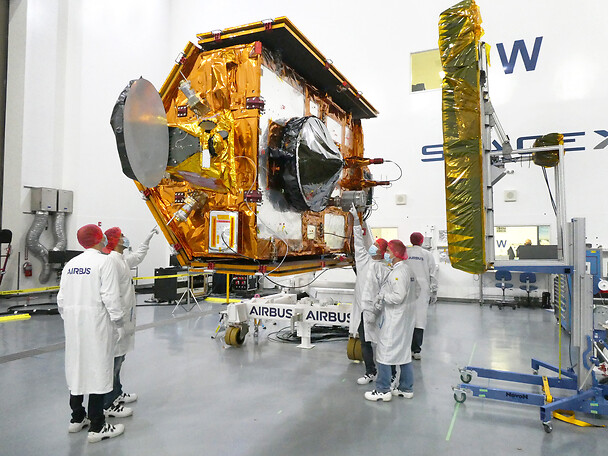
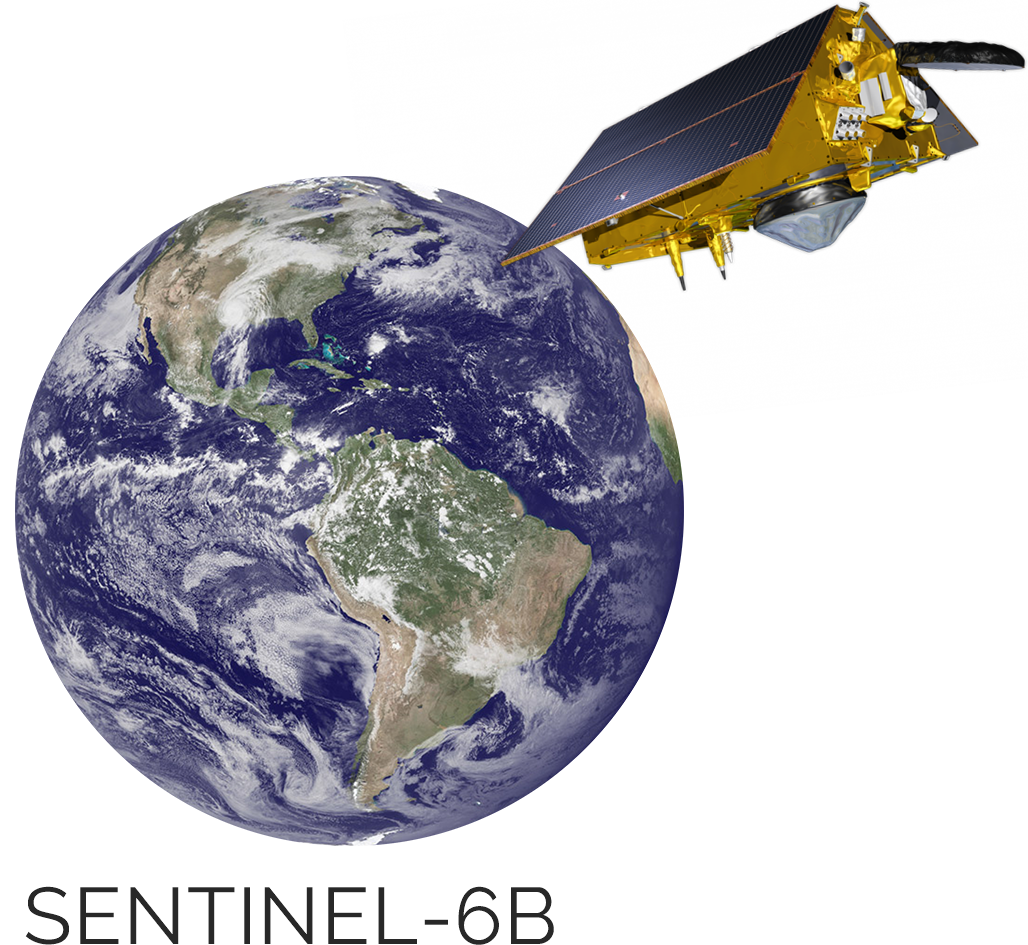
Airbus Group ha completado Sentinel-6B, el segundo satélite de monitoreo oceánico del programa europeo Copernicus, y ahora lo está probando ampliamente durante los próximos seis meses como preparación para su uso en el espacio. El satélite Copernicus cumple las condiciones espaciales durante la campaña de prueba.
La misión Copernicus Sentinel-6 ofrece actualmente mediciones de alta precisión de la topografía de las superficies oceánicas a través del primero de dos satélites Sentinel-6A, lanzado en Noviembre de 2020. Los dos satélites de la misión son construido para medir la distancia a la superficie del mar con una precisión de unos pocos centímetros y trazar un mapa con un ritmo de diez días durante una misión de hasta siete años. Su propósito es registrar cambios en la altura de la superficie del mar, variaciones en el nivel del mar y analizar y observar las corrientes oceánicas. La observación precisa de los cambios en la altura de la superficie del mar proporciona información sobre los niveles globales del mar, la velocidad y dirección de las corrientes oceánicas y el calor almacenado en los océanos. Las mediciones, obtenidas a 1336 km sobre la Tierra, son cruciales para modelar los océanos y predecir el aumento del nivel del mar.
Esta información ayuda a los gobiernos e instituciones a establecer una protección eficaz para las regiones costeras. Los datos también son valiosos para las organizaciones de gestión de desastres y para las autoridades que llevan a cabo planificación urbana, planes de protección contra inundaciones o construcción de diques. Como resultado del calentamiento global, los niveles globales del mar están aumentando actualmente en un promedio de 3,3 milímetros por año, con consecuencias potencialmente dramáticas para los países con costas densamente pobladas. Sentinel-6, que forma parte de Copernicus de Europa, es también una colaboración internacional entre la ESA, la NASA, la NOAA y Eumetsat.
Second Sentinel-6B satellite
Airbus completes second ocean satellite Sentinel-6B
Airbus Group has completed Sentinel-6B, the second ocean monitoring satellite in the European Copernicus program, and is now testing it extensively over the next six months in preparation for use in space. The Copernicus satellite meets the space conditions during the test campaign.
The Copernicus Sentinel-6 mission currently offers high-precision measurements of ocean surface topography through the first of two Sentinel-6A satellites, launched in November 2020. The two mission satellites are built to measure the distance to the sea surface to within a few centimeters and map at a ten-day rate during a mission of up to seven years. Its purpose is to record changes in the height of the sea surface, variations in sea level and analyze and observe ocean currents. Accurate observation of changes in the height of the sea surface provides information on global sea levels, the speed and direction of ocean currents, and the heat stored in the oceans. The measurements, taken 1,336 km above Earth, are crucial for modeling the oceans and predicting sea level rise.
This information helps governments and institutions establish effective protection for coastal regions. The data is also valuable for disaster management organizations and for authorities carrying out urban planning, flood protection plans or building levees. As a result of global warming, global sea levels are currently rising by an average of 3.3 millimeters per year, with potentially dramatic consequences for countries with densely populated coastlines. Sentinel-6, part of Europe’s Copernicus, is also an international collaboration between ESA, NASA, NOAA and Eumetsat.
SpaceX quiere convertirse en un gigante wi-fi in-flight Starlink busca incorporar tecnología internet en vuelos
El Jefe de SpaceX, Elon Musk, prometió recientemente que ofrecería una velocidad Wi-Fi de medio gigabit en los aviones permitiendo acceder a la Internet transmitida por los satélites Starlink. SpaceX ha comenzado a probar su servicio Wi-Fi en vuelo proporcionado por la división Starlink para aerolíneas comerciales, con el objetivo de transmitir Internet desde su constelación de satélites a los aviones. En Junio 2021 SpaceX anunció que estaba en conversaciones con varias aerolíneas para proporcionar la red de Internet satelital de Starlink para una experiencia Wi-Fi más rápida en vuelo. Sin embargo, la compañía no ofreció ningún detalle sobre el cronograma de comercialización del proyecto.
SpaceX tiene por objetivo ofrecer conectividad a Internet de baja latencia con una salida de medio gigabit en el aire. En este momento, dos de los nombres más importantes de la industria son Viasat e Intelsat, que sirven como proveedores de banda ancha satelital para Wi-Fi a bordo. Sin embargo, dos de los rivales directos de Starlink basados en la infraestructura central son OneWeb y Telesat del Reino Unido.
El Vicepresidente de Ventas Comerciales de Starlink, Jonathan Hofeller, ha revelado ahora que la compañía se encuentra probando la primera versión de su antena interna en aviones, pero nuevamente evadió proporcionar un cronograma concreto para el lanzamiento comercial. Hablando en la conferencia de Liderazgo de Pensamiento de la Asociación de Experiencia de Pasajeros de Aerolíneas (APEX)/IFSA EXPO, Jonathan Hofeller mencionó que la compañía quiere ofrecer su servicio de Internet satelital a las aerolíneas en el menor plazo. Una publicación del blog de APEX cita a Jonathan Hofeller y señala que «Starlink está yendo uno por uno a cada país y que su trabajo continuo en el alivio de desastres está acelerando su entrada en algunos mercados».
En comparación con los jugadores establecidos en el mercado de Conectividad en Vuelo (IFC), Starlink tiene una ventaja clave con su enfoque de Internet satelital. Las partes interesadas existentes dependen de la Internet transmitida por satélites que flotan en la órbita geoestacionaria. Starlink, por otro lado, ofrecerá conectividad a Internet desde su constelación de satélites en la órbita terrestre inferior. Hofeller había afirmado previamente que las antenas receptoras Starlink instaladas en los aviones serían un derivado de los receptores terrestres existentes que recientemente comenzaron a aparecer en las estaciones de carga de Tesla también. Una de las mayores preocupaciones con la instalación de aeronaves es el aspecto de durabilidad de los receptores de Internet por satélite. Curiosamente, una aplicación de la FCC que fue desenterrada a principios de este año arrojó algo de luz sobre los receptores móviles que serán mucho más duraderos cuando se trata de operar en mayores extremos de calor y frío. Otra ventaja de la que Starlink presume sobre sus rivales es en el juego de los números. Hofeller mencionó en la conferencia APEX que Starlink ya comanda un grupo de satélites LEO cuyo número es diez veces mayor que el de los satélites geoestacionarios actuales. Si bien se desconoce una fecha definitiva para el descubrimiento del mercado, el ejecutivo de Starlink reveló que la compañía está operando una flota de 1.800 satélites repartidos en 20 países hasta la fecha. Sin embargo, las ambiciones de Starlink podrían detenerse debido a problemas con los motores de cohetes Starship, algo tan grave que el CEO Elon Musk temía que empujara a SpaceX al borde de la bancarrota.
SpaceX satellite Wi-Fi on board
SpaceX wants to become an in-flight wi-fi giant Starlink seeks to incorporate internet technology in flights
SpaceX Chief Elon Musk recently promised that he would offer half gigabit Wi-Fi speed on airplanes allowing access to the Internet transmitted by Starlink satellites. SpaceX has begun testing its in-flight Wi-Fi service provided by the Starlink division for commercial airlines, with the goal of transmitting the Internet from its constellation of satellites to airplanes. In June 2021 SpaceX announced that it was in talks with several airlines to provide Starlink’s satellite Internet network for a faster in-flight Wi-Fi experience. However, the company did not offer any details on the project’s commercialization schedule.
SpaceX aims to offer low-latency internet connectivity with a half-gigabit over-the-air output. Right now, two of the biggest names in the industry are Viasat and Intelsat, which serve as providers of satellite broadband for onboard Wi-Fi. However, two of Starlink’s direct rivals based on the core infrastructure are UK’s OneWeb and Telesat.
Starlink’s Vice President of Commercial Sales, Jonathan Hofeller, has now revealed that the company is testing the first version of its internal antenna on airplanes, but has again avoided providing a concrete schedule for the commercial launch. Speaking at the Airline Passenger Experience Association (APEX)/ IFSA EXPO Thought Leadership conference, Jonathan Hofeller mentioned that the company wants to offer its satellite internet service to airlines in the shortest time. An APEX blog post quotes Jonathan Hofeller as saying that «Starlink is going one by one to each country and their ongoing disaster relief work is accelerating their entry into some markets».
Compared to established players in the In-Flight Connectivity (IFC) market, Starlink has a key advantage with its approach to satellite internet. Existing stakeholders depend on the Internet carried by satellites floating in geostationary orbit. Starlink, on the other hand, will offer Internet connectivity from its constellation of satellites in lower Earth orbit. Hofeller had previously claimed that the Starlink receiving antennas installed on airplanes would be a derivative of the existing ground-based receivers that recently began to appear at Tesla charging stations as well. One of the biggest concerns with aircraft installation is the durability aspect of satellite Internet receivers. Interestingly, an FCC app that was unearthed earlier this year shed some light on mobile receivers that they will be much more durable when it comes to operating in greater extremes of heat and cold. Another advantage that Starlink boasts over its rivals is in the numbers game. Hofeller mentioned at the APEX conference that Starlink already commands a group of LEO satellites whose number is ten times that of today’s geostationary satellites. While a definitive date for the market discovery is unknown, the Starlink executive revealed that the company is operating a fleet of 1,800 satellites spread across 20 countries to date. However, Starlink’s ambitions could be stalled due to problems with the Starship rocket engines, something so dire that CEO Elon Musk feared it would push SpaceX to the brink of bankruptcy.
Primer satélite Inmarsat-6 construido por Airbus Enviado a Japón listo para su lanzamiento
El primer satélite Inmarsat-6 (I-6 F1) construido por Airbus Group ha sido enviado desde Airbus en las instalaciones de Toulouse, Francia, a Tanegashima, Japón listo para su lanzamiento. El primer satélite de la serie Inmarsat-6 se lanzará en un vehículo de lanzamiento H-IIA construido por Mitsubishi Heavy Industries (MHI) en Diciembre 2021.
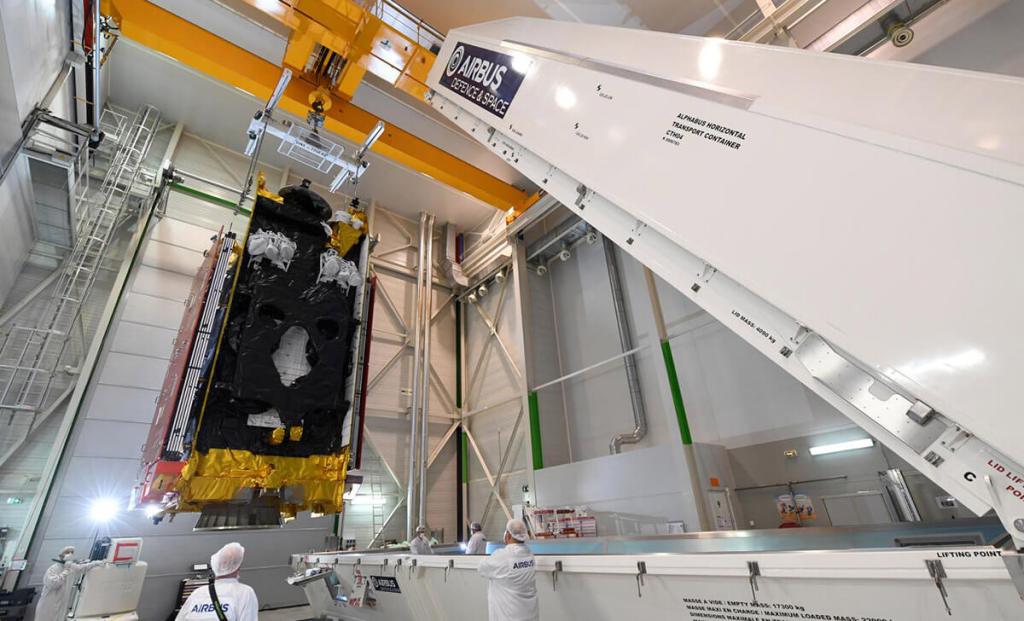
Inmarsat-6 F1 se basa en la nave espacial Eurostar E3000 de Airbus y será el 54ésimo Lanzamiento del Eurostar E3000. Será el quinto Eurostar en órbita que está equipado con propulsión eléctrica para la elevación de la órbita. Según Airbus, la masa reducida mediante el uso de propulsión eléctrica permite una misión de carga útil dual (banda Ka y L) con una carga útil procesada digitalmente de próxima generación excepcionalmente grande que brinda una mayor flexibilidad a Inmarsat, proveedor de servicios globales de comunicación móvil por satélite. «Inmarsat-6 F1 cuenta con una de las cargas útiles procesadas digitalmente más sofisticadas que hemos construido y ofrece una flexibilidad, capacidad y capacidad notables. Como proveedor de Inmarsat desde hace mucho tiempo, después de haber construido los satélites Inmarsat-4 y Alphasat, Airbus se enorgullece de continuar ayudando a mantener a Inmarsat en la cima de su juego con este cambio radical en la capacidad de Inmarsat-6», dijo François Gaullier, Jefe de Sistemas de Telecomunicaciones de Airbus Group.
Inmarsat-6 tiene una gran antena de banda L de 9 m de apertura y nueve antenas de banda Ka multicoma, y cuenta con un alto nivel de flexibilidad y conectividad. Según los informes, el procesador digital modular de nueva generación proporciona una flexibilidad de enrutamiento completa en hasta 8000 canales y una asignación dinámica de energía a más de 200 haces puntuales en banda L. Los haces puntuales de banda Ka serán orientables sobre todo el disco terrestre, con asignación flexible de canal a haz. Con una mayor capacidad y flexibilidad, el satélite permitirá a Inmarsat ofrecer servicios de banda L más avanzados, incluidos servicios móviles de bajo costo y aplicaciones de IoT a clientes existentes y futuros en el sector de la movilidad en tierra, mar y aire. Airbus dice que el Inmarsat-6 complementará y mejorará los servicios de banda L ofrecidos por ELERA y se embarcará en una misión de banda Ka para aumentar el servicio de banda ancha de alta velocidad disponible a nivel mundial de Inmarsat: Global Xpress. Las inversiones realizadas por Airbus en tecnologías de plataforma y carga útil utilizadas en Inmarsat-6 cuentan con el apoyo de la Agencia Espacial Europea y las agencias nacionales, en particular la Agencia Espacial del Reino Unido y el CNES. Inmarsat-6 tendrá una masa de lanzamiento de 5,5 toneladas, una potencia de nave espacial de 21 kW y una vida útil de diseño esperada de más de quince años.
Airbus 1st satellite Inmarsat-6
First Inmarsat-6 satellite built by Airbus Sent to Japan ready for launch
The first Inmarsat-6 (I-6 F1) satellite built by Airbus Group has been shipped from Airbus at the Toulouse, France facility to Tanegashima, Japan ready for launch. The first Inmarsat-6 series satellite will be launched on an H-IIA launch vehicle built by Mitsubishi Heavy Industries (MHI) in December 2021.
Inmarsat-6 F1 is based on Airbus’ Eurostar E3000 spacecraft and will be the 54th Eurostar E3000 Launch. It will be the fifth Eurostar in orbit that is equipped with electric propulsion for orbital elevation. According to Airbus, the reduced mass through the use of electric propulsion enables a dual payload mission (Ka and L band) with an exceptionally large next-generation digitally processed payload providing greater flexibility to Inmarsat, a global communication services provider. satellite mobile. «Inmarsat-6 F1 boasts one of the most sophisticated digitally processed payloads we’ve ever built and offers remarkable flexibility, capacity and capability. As a longtime Inmarsat supplier, having built the Inmarsat-4 and Alphasat satellites, Airbus is proud to continue to help keep Inmarsat at the top of its game with this radical change in Inmarsat-6 capability», said François Gaullier, Head of Telecommunications Systems at AirbusGroup.
The Inmarsat-6 has a large 9 m aperture L-band antenna and nine multi-channel Ka-band antennas, and features a high level of flexibility and connectivity. The next generation modular digital processor reportedly provides complete routing flexibility on up to 8000 channels and dynamic power allocation to over 200 L-band spot beams. Ka-band spot beams will be steerable over the entire terrestrial disk , with flexible channel-to-beam assignment. With increased capacity and flexibility, the satellite will enable Inmarsat to offer more advanced L-band services, including low-cost mobile services and IoT applications to existing and future customers in the mobility sector on land, sea and air. Airbus says the Inmarsat-6 will complement and enhance the L-band services offered by ELERA and embark on a Ka-band mission to augment Inmarsat’s globally available high-speed broadband service: Global Xpress. Investments made by Airbus in platform and payload technologies used in Inmarsat-6 are supported by the European Space Agency and national agencies, in particular the UK Space Agency and CNES. Inmarsat-6 will have a launch mass of 5.5 tonnes, a spacecraft power of 21 kW, and an expected design life of more than fifteen years.
Telescopio espacial Webb en ruta hacia las estrellas
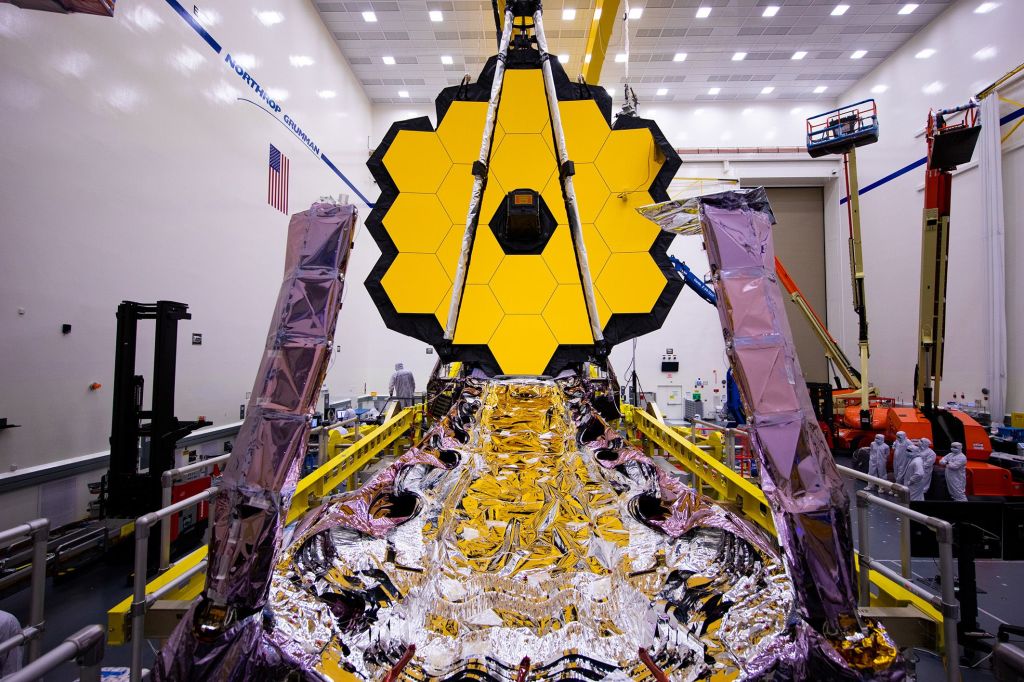
NIRSpec construido por Airbus Group es uno de los cuatro instrumentos a bordo de la misión NASA-ESA que sigue los pasos del Hubble. El telescopio de origen europeo estudiará la formación de las primeras estrellas y galaxias de nuestro Universo. El Telescopio Espacial Webb (WST) ha llegado al puerto espacial europeo en Kourou, Guayana Francesa, América. La nave espacial ahora estará preparada para su lanzamiento, programado para el 18 de Diciembre de 2021 en un lanzador Ariane 5. Uno de los cuatro instrumentos de su maletín científico es el espectrógrafo de infrarrojo cercano (NIRSpec) construido por Airbus en Alemania.
Antes del lanzamiento, se llevará a cabo una campaña de prueba funcional completa en octubre para asegurarse de que cada parte de la nave espacial siga funcionando como se esperaba después de su viaje a Kourou. Airbus apoyará activamente las pruebas funcionales eléctricas finales de los cuatro instrumentos científicos (incluido NIRSpec) que durarán aproximadamente seis días. «El telescopio Webb cambiará la forma en que vemos el Universo», dijo Jean Marc Nasr, director de Airbus Space Systems. “Nuestras contribuciones a los instrumentos NIRSpec y MIRI son un testimonio de la experiencia de Airbus y del valor que podemos aportar a la astronomía moderna. Estamos orgullosos de haber desempeñado un papel clave en los futuros descubrimientos de la misión Webb». Una vez en órbita, Webb comenzará un viaje de un mes, viajando cuatro veces la distancia a la Luna, hasta llegar a su destino final, el punto L2 de Lagrange, a unos 1,5 millones de kilómetros detrás de la Tierra vista desde el Sol.
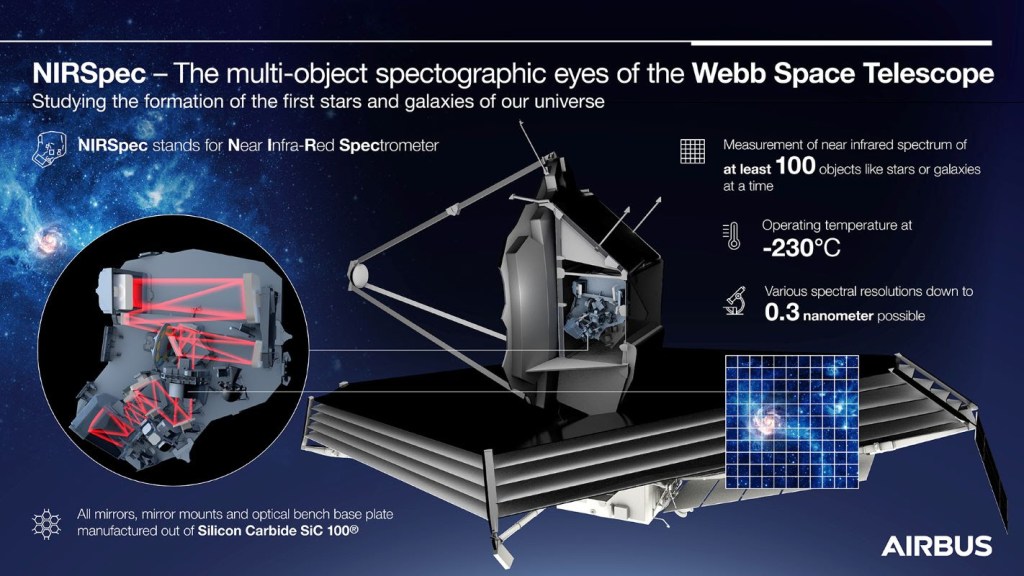
Airbus apoyará a NIRSpec desde el lanzamiento hasta la puesta en servicio hasta el segundo trimestre de 2022 mediante el seguimiento de sus parámetros 24 horas al día, 7 días a la semana. Esto incluye el período durante la fase crítica de enfriamiento y luego la prueba funcional inicial cuando se enciende el instrumento NIRSpec. Finalmente, el equipo de ingeniería de Airbus también continuará brindando asistencia durante la verificación del rendimiento y la calibración hasta el final de la puesta en servicio. El instrumento NIRSpec, con un peso de 200 kg, es un espectrógrafo multiobjeto capaz de medir simultáneamente el espectro del infrarrojo cercano de al menos 100 objetos como estrellas o galaxias con varias resoluciones espectrales de hasta 0,3 nanómetros. Las observaciones se realizan en el rango de longitud de onda de 0,6 a 5,0 micrómetros. Una vez en funcionamiento, NIRSpec, conocido como el super ojo, funcionará a una temperatura de -230° C. Un equipo de más de 70 personas en los sitios de Airbus Ottobrunn, Friedrichshafen y Toulouse trabajó en el diseño, desarrollo y finalmente la integración y prueba de NIRSpec, con el apoyo de diecisiete subcontratistas europeos y la NASA. El instrumento fue desarrollado por Airbus para la Agencia Espacial Europea (ESA).
Debido a su excelente sensibilidad, su alta resolución y su amplia cobertura de longitud de onda, NIRSpec es un instrumento clave para lograr una visión más profunda de la evolución del universo. Utiliza un concepto altamente térmico con todos los espejos, los soportes de los espejos y la placa base del banco óptico, todos hechos de cerámica de carburo de silicio SiC 100®.
Otro instrumento llamado Mid-InfraRed Instrument (MIRI) también es parte de la contribución de Europa a la misión Webb. Airbus en el Reino Unido proporcionó la gestión, la ingeniería y la gestión de la calidad para el consorcio europeo que construyó MIRI para garantizar que existía un enfoque coherente en el proceso de diseño, construcción y prueba. Cubre el rango de longitud de onda del infrarrojo medio de 5 a 28,3 micrones. MIRI será capaz de penetrar gruesas capas de polvo que oscurecen las regiones de intenso nacimiento de estrellas. Verá la formación de las primeras generaciones de galaxias después del Big Bang, y estudiará los sitios de formación de nuevos planetas y la composición del medio interestelar. Para garantizar que la señal de los objetos débiles no sea ahogada por el propio brillo infrarrojo del instrumento, MIRI se enfriará a -266°C, solo 7°C por encima del cero absoluto.
Con el instrumento NIRSpec, Webb estudiará la formación de las primeras estrellas y galaxias en nuestro Universo, cuando solo tenía unos pocos cientos de millones de años. NIRSpec podrá capturar los espectros de típicamente 60 a 200 galaxias a la vez, lo que permitirá a los científicos observar con exquisitos detalles cómo se formaron y evolucionaron. Mucho más cerca de nosotros, NIRSpec también podrá estudiar la atmósfera de exoplanetas, estos planetas que orbitan alrededor de estrellas distintas de nuestro Sol. En particular, buscará la firma de moléculas clave como el agua. Webb, la misión de seguimiento del Telescopio Espacial Hubble (HST), con su conjunto de instrumentos científicos permitirá mirar más atrás en el tiempo en comparación con el HST, principalmente debido a su mayor sensibilidad y una banda de longitud de onda más amplia, que oscila entre 0,6 y 27 micrómetros. Se espera que produzca avances asombrosos en la ciencia espacial infrarroja. El Telescopio Espacial Webb de $ 10 mil millones es una empresa conjunta entre las agencias espaciales de EE. UU., Europa y Canadá.
Airbus NIRSpec into space
Webb space telescope en route to the stars
NIRSpec built by Airbus Group is one of four instruments on board the NASA-ESA mission that follows in the footsteps of Hubble. The telescope of European origin will study the formation of the first stars and galaxies in our Universe. The Webb Space Telescope (WST) has arrived at the European spaceport in Kourou, French Guiana, America. The spacecraft will now be ready for launch, scheduled for December 18, 2021 on an Ariane 5 launcher. One of the four instruments in its science briefcase is the near-infrared spectrograph (NIRSpec) built by Airbus in Germany.
Ahead of launch, a full functional test campaign will be conducted in October to ensure that every part of the spacecraft continues to function as expected after its trip to Kourou. Airbus will actively support the final electrical functional tests of the four science instruments (including NIRSpec) that will last approximately six days. «The Webb telescope will change the way we view the Universe,», said Jean Marc Nasr, director of Airbus Space Systems. “Our contributions to the NIRSpec and MIRI instruments are a testament to the Airbus expertise and the value we can bring to modern astronomy. We are proud to have played a key role in the future discoveries of the Webb mission». Once in orbit, Webb will begin a month-long journey, traveling four times the distance to the Moon, until reaching its final destination, point L2. Lagrange, about 1.5 million kilometers behind Earth as seen from the Sun.
Airbus will support NIRSpec from launch to commissioning through Q2 2022 by monitoring its parameters 24 hours a day, 7 days a week. This includes the period during the critical cool-down phase and then the initial bump test when the NIRSpec instrument is turned on. Finally, the Airbus engineering team will also continue to provide assistance during performance verification and calibration until the end of commissioning. The NIRSpec instrument, weighing 200 kg, is a multi-object spectrograph capable of simultaneously measuring the near infrared spectrum of at least 100 objects such as stars or galaxies with various spectral resolutions down to 0.3 nanometers. Observations are made in the wavelength range of 0.6 to 5.0 microns. Once operational, NIRSpec, known as the super eye, will operate at a temperature of -230 °C. A team of more than 70 people at the Airbus Ottobrunn, Friedrichshafen and Toulouse sites worked on the design, development and finally integration. and NIRSpec testing, supported by seventeen European subcontractors and NASA. The instrument was developed by Airbus for the European Space Agency (ESA).
Due to its excellent sensitivity, high resolution, and wide wavelength coverage, NIRSpec is a key instrument to gain a deeper insight into the evolution of the universe. It uses a highly thermal concept with all mirrors, mirror holders and the optical bench base plate, all made from SiC 100® silicon carbide ceramic.
Another instrument called the Mid-InfraRed Instrument (MIRI) is also part of Europe’s contribution to the Webb mission. Airbus in the UK provided management, engineering and quality management for the European consortium that built MIRI to ensure there was a consistent approach to the design, build and test process. Covers the mid-infrared wavelength range of 5 to 28.3 microns. MIRI will be able to penetrate thick layers of dust that obscure regions of intense star birth. You will see the formation of the first generations of galaxies after the Big Bang, and you will study the sites of formation of new planets and the composition of the interstellar medium. To ensure that the signal from faint objects is not drowned out by the instrument’s own infrared glow, MIRI will cool down to -266 °C, only 7 °C above absolute zero.
With the NIRSpec instrument, Webb will study the formation of the first stars and galaxies in our Universe, when it was only a few hundred million years old. NIRSpec will be able to capture the spectra of typically 60 to 200 galaxies at a time, allowing scientists to observe in exquisite detail how they formed and evolved. Much closer to us, NIRSpec will also be able to study the atmosphere of exoplanets, these planets that orbit stars other than our Sun. In particular, it will look for the signature of key molecules such as water. Webb, the follow-up mission of the Hubble Space Telescope (HST), with its suite of scientific instruments will allow to look further back in time compared to the HST, mainly due to its higher sensitivity and a wider wavelength band, which ranges from 0.6 to 27 microns. . It is expected to produce amazing advances in infrared space science. The $ 10 billion Webb Space Telescope is a joint venture between the US, European and Canadian space agencies.