Gobierno Noruega amplía plazos garantías de préstamo a aerolíneas
El Gobierno del Reino de Noruega extenderá la duración de las garantías de préstamo relacionadas con la pandemia ofrecidas a las aerolíneas ha comunicado este Martes 24/11, que no obstante no anunció fondos adicionales para ayudar a Norwegian Air Shuttle ASA a solventar su crítica situación.
El plan revisado dará a las aerolíneas hasta tres años para devolver los préstamos avalados por el Estado, lo cual supone un aumento de dos años, según dijeron desde el Ministerio de Industria y el Ministerio de Transporte en una declaración conjunta. “La crisis entre las aerolíneas es más duradera y grave de lo esperado y es necesario dar más ayudas a la industria”, dijeron ambos ministerios.
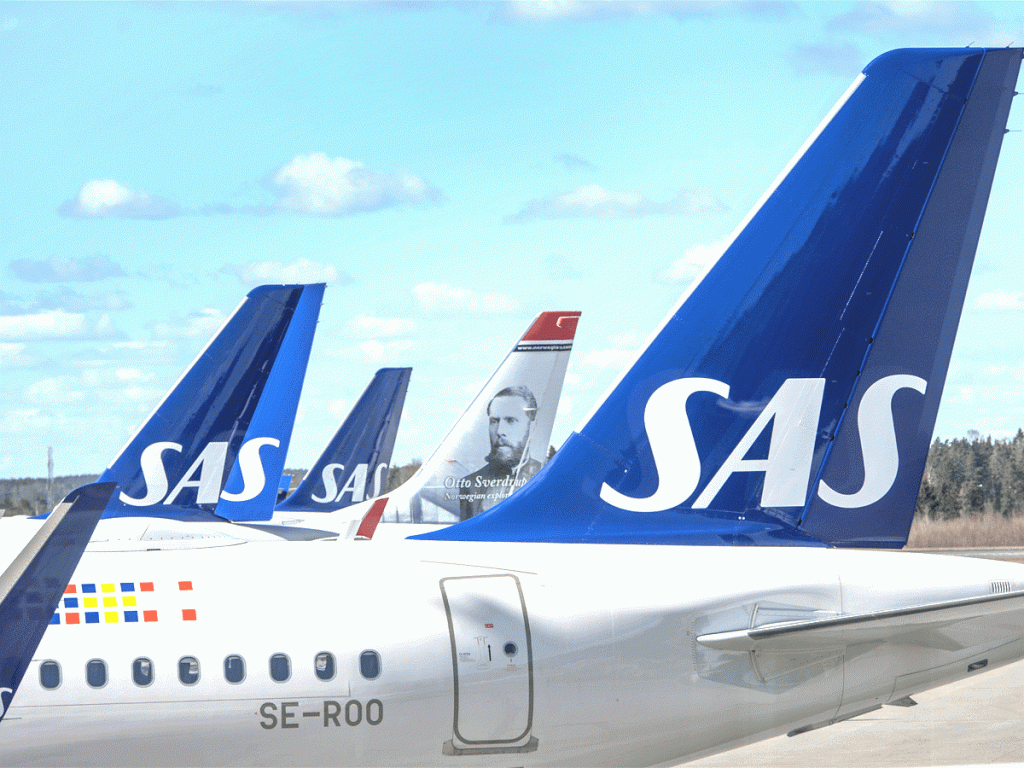
Norwegian Air, que la semana pasada buscó protección ante la amenaza de bancarrota mientras la aerolínea busca evitar el colapso, ha recibido una asignación máxima de NOK 3.000 millones de Coronas Noruegas (US$ 333,7 millones de Dólares/€ 281 millones de Euros) bajo el plan. El Gobierno rechazó el 9 de Noviembre de 2020 la petición de Norwegian Air de una inyección adicional de dinero. La aerolínea nórdica SAS Airlines, que aún no ha buscado garantías de préstamo bajo el plan de Noruega, puede solicitarlas en cualquier momento antes del 30 de Junio de 2021, ha comunicado el Gobierno. La fecha límite original estaba fijada a finales de 2020.
Norway extends airline guarantees
Norwegian Government extends loan guarantee terms to airlines
The Government of the Kingdom of Norway will extend the duration of the loan guarantees related to the pandemic offered to the airlines, announced this Tuesday 11/24, which however did not announce additional funds to help Norwegian Air Shuttle ASA solve its critical situation.
The revised plan will give airlines up to three years to repay state-guaranteed loans, which is an increase of two years, the Ministry of Industry and the Ministry of Transport said in a joint statement. «The crisis between the airlines is more lasting and serious than expected and it is necessary to give more aid to the industry», said both ministries.
Norwegian Air, which last week sought protection from the threat of bankruptcy as the airline seeks to avoid collapse, has received a maximum allocation of NOK 3 billion Norwegian Crowns (US$ 333.7 million/€ 281 million Euros) under the plan. On November 9, 2020, the government rejected Norwegian Air’s request for an additional injection of money. The Nordic airline SAS Airlines, which has not yet sought loan guarantees under the Norwegian plan, can request them at any time before June 30, 2021, the Government has reported. The original deadline was set at the end of 2020.
Norge utvider flyinntektene
Norske utvider lånegarantibetingelsene flyselskapene
Kongeriket Norges Regjering vil forlenge varigheten av lånegarantiene knyttet til pandemien som tilbys flyselskapene, kunngjorde tirsdag 11/24, som imidlertid ikke kunngjorde ekstra midler for å hjelpe Norwegian Air Shuttle ASA med å løse sin kritiske situasjon.
Den reviderte planen vil gi flyselskapene opptil tre år til å tilbakebetale statsgaranterte lån, som er en økning på to år, sa Næringsdepartementet og Samferdselsdepartementet i en felles uttalelse. «Krisen mellom flyselskapene er mer varig og alvorlig enn forventet, og det er nødvendig å gi mer hjelp til industrien», sa begge departementene.
Norwegian Air, som i forrige uke søkte beskyttelse mot trusselen om konkurs ettersom flyselskapet søker å unngå kollaps, har mottatt en maksimal bevilgning på 3 milliarder norske kroner (US$ 333,7 millioner Dollar /€ 281 millioner Euro) under planen. 9. november 2020 avviste regjeringen Norwegian Airs anmodning om ytterligere injeksjon av penger. Det nordiske flyselskapet SAS Airlines, som ennå ikke har søkt lånegarantier i henhold til den norske planen, kan når som helst be om dem før 30. juni 2021, har regjeringen kommunisert. Den opprinnelige fristen ble satt i slutten av 2020.
AW | 2020 11 24 17:37 | AIRLINES / AVIATION ORGANISMS / GOVERNMENT
Exigen reunión Ministerio Trabajo/Transporte
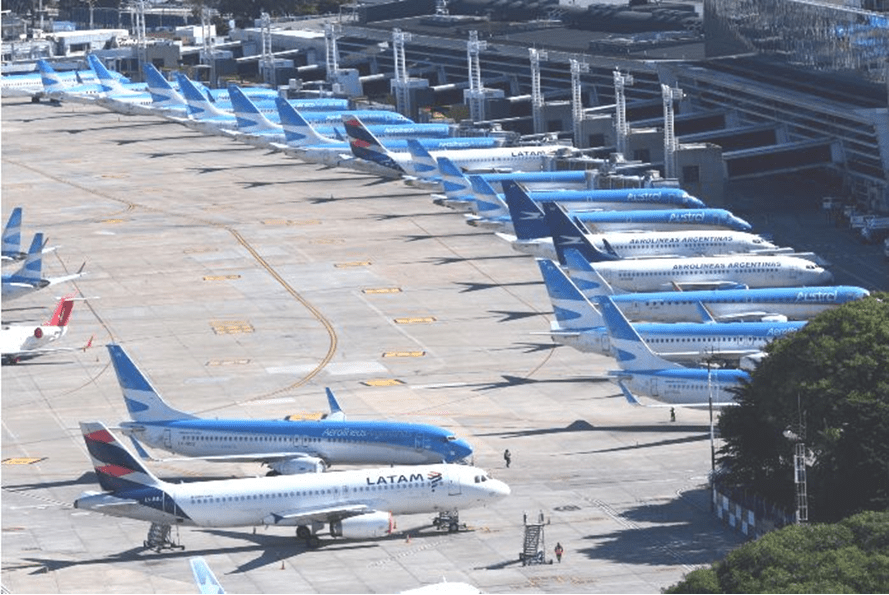
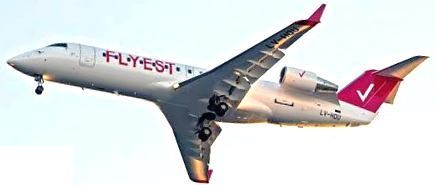
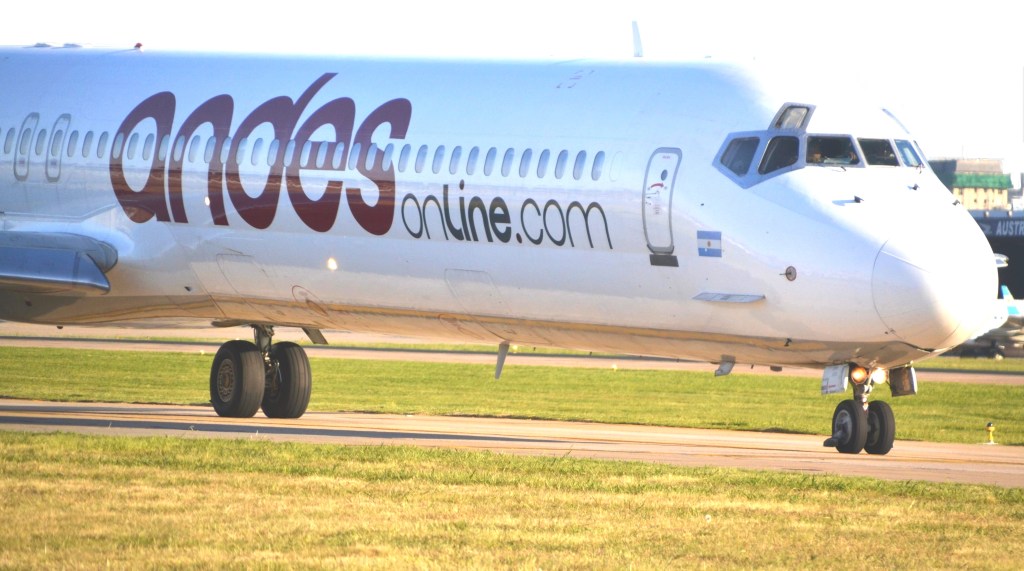
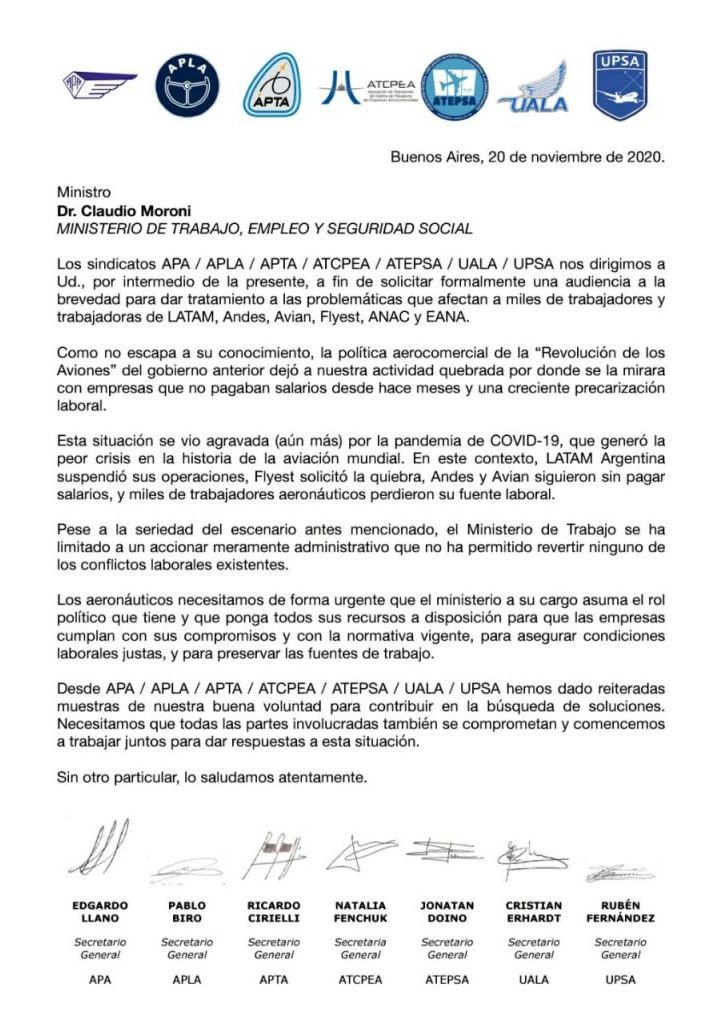
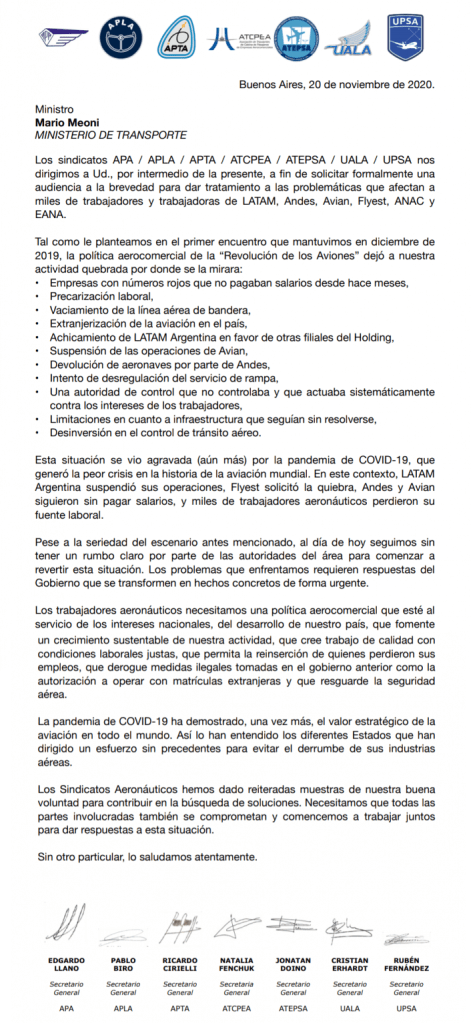
Los sindicatos aeronáuticos de la República Argentina han solicitado al Gobierno con carácter de urgencia una reunión para tratamientos respecto a trabajadores afectados por la industria de la aviación en el país. Los gremios APA, UALA, APLA, APTA, UPSA, UALA, ATCPEA, ATEPSA han solicitado un encuentro con los Ministerios Trabajo y Transporte para tratar las situaciones actuales de miles de empleados afectados actualmente de Latam Airlines Argentina, Flyest Líneas Aéreas, Avian Líneas Aéreas (Avianca Argentina), Andes Líneas Aéreas, EANA y ANAC. Mediante un comunicado oficial los gremios nucleados han elevado la línea de los reclamos a las carteras de Trabajo y Transporte, solicitando con carácter urgente ante la grave situación de desamparo potenciada por la pandemia de Coronavirus.
Los trabajadores de varias compañías han sido despedidos, mientras que otros no cobran sus salarios ni ayudas gubernamentales. La situación de Latam Airlines Argentina que ha suspendió sus operaciones y presentado su desvinculación en el país ha ocasionado mucho malestar, Flyest Líneas Aéreas ha presentado semanas atrás la quiebra ante la imposibilidad de poder llegar a un acuerdo para vender la línea aérea regional, mientras que Andes Líneas Aéreas y Avian Líneas Aéreas continúan sin abonar sus salarios que el riesgo de pérdidas de fuentes laborales.
Actualmente, ningún tema ha sido abordado ni solucionado por parte del Gobierno. La gravedad de la situación de miles de empleados ante la desidia del Estado por no atender las situaciones, ha encendido las alertas de los gremios para marcar una fuerte posición para respaldar a los trabajadores ante la inacción del Gobierno. Los sindicatos reclaman a la cartera de Trabajo que ponga a disposición los recursos necesarios para que las aerolíneas den cumplimiento con la normalización de la situación laboral de muchos trabajadores. Al Ministro de Transporte han reclamado en el comunicado por la ausencia de una política aerocomercial definida que tenga como eje central los intereses nacionales y el desarrollo del trabajo argentino, exigiendo al Gobierno ayudas al sector por la expansión de las dificultades que se ha enfrentado la aviación comercial.
Caso Latam Argentina
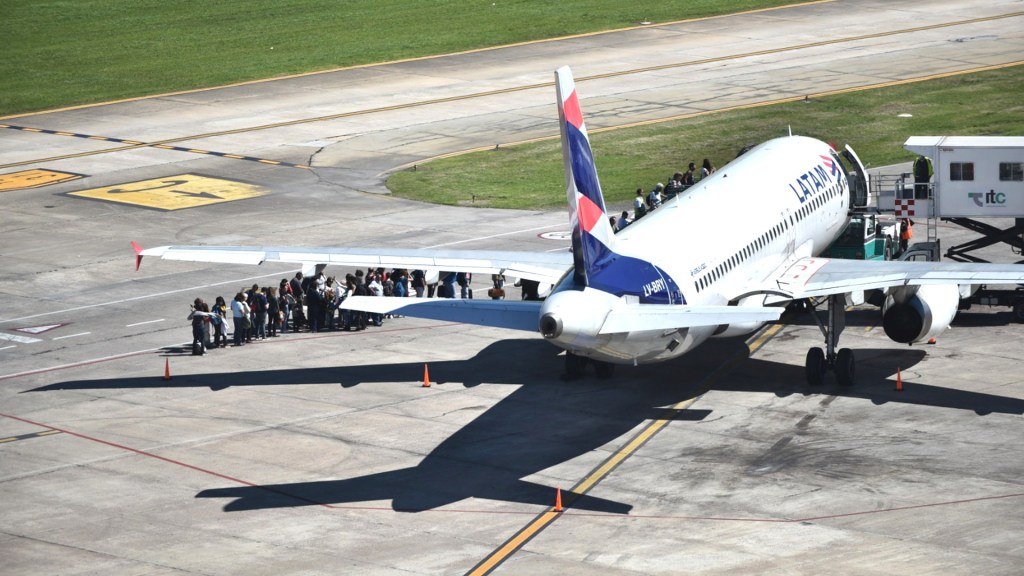
Los trabajadores de la aerolínea Latam Airlines Argentina han solicitado una toma de posición mucho más activa por parte del Gobierno para resolver el conflicto. Este Jueves 19/11 se habían movilizado a la sede del Ministerio de Trabajo, donde entregaron un escrito y fueron recibidos por funcionarios de la cartera, en el marco del plan de lucha que llevan adelante para garantizar la continuidad laboral. Aseguran que desde abril cobran el 50 por ciento de sus salarios, y pese a dos intimaciones, la empresa aérea no cambia su postura.
Luego de más de siete meses de lucha, los trabajadores de la empresa aérea Latam Airlines Argentina continúan reclamando una solución de fondo al conflicto que se desató en el inicio de la pandemia, cuando la empresa de capitales chileno-brasileño anunció que dejaría de operar las rutas argentinas. La decisión, apoyada en un Procedimiento Preventivo de Crisis (PPC), no evitó que desde hace un tiempo la firma esté operando sus rutas internacionales desde el país, con personal extranjero, lo que genera malestar entre los empleados que piden su continuidad laboral. En este contexto, un grupo de autoconvocados se movilizaron este jueves al Ministerio de Trabajo, donde fueron recibidos por primera vez por funcionarios de la cartera laboral, buscando darle respuesta a los más de 500 trabajadores en lucha, que no aceptaron los retiros voluntarios y piden la continuidad. En este contexto, se pidió una toma de posición mucho más activa tanto del Ministerio de Trabajo como el de Transporte, que intervienen en la crisis. Los gremios aeronáuticos vienen cuestionando la política oficial para el sector, y le apuntaron directamente a la figura de Mario Meoni, actual Ministro de Transporte.
El objetivo principal de los reclamos fue presentar un escrito donde se denuncia “el incumplimiento por parte la compañía de efectuar el pago íntegro de salarios al personal, tal cual fuere ordenado por esta entidad ministerial en dos ocasiones. Por primera vez los trabajadores autoconvocados de Latam estuvimos en el Ministerio de Trabajo, presentando este escrito dándole centralidad al impacto económico de las medidas que viene tomando la compañía del inicio de la pandemia a la fecha. De Abril a Noviembre hemos cobrado el 50 por ciento de nuestro salario, gracias a que Latam viene aplicando una reducción salarial arbitraria, que no fue acordada con ninguna de las entidades sindicales”, sostuvo Martín Tomé, referente de este espacio por los tripulantes de cabina de la Asociación de Aeronavegantes de Argentina (AAA). Desde que la aerolínea anunció la cancelación de su programación de vuelos en el país, inició un proceso de reducción de personal y “gestionó dos de los ocho ATP (Programa de Asistencia de Emergencia al Trabajo y la Producción)”, expresó Martín Tomé.
En este tiempo, la lucha de los trabajadores y los gremios generó que el conflicto se mantenga visible, pero con el correr del tiempo muchos empleados fueron aceptando algunas de las condiciones ofrecidas para salir de la empresa. En cuanto a la reducción de salarios, fue intimada dos oportunidades pero las mismas fueron desoídas, articulando una feroz campaña de retiros voluntarios como única opción que ofrecía la aerolínea. En este contexto, comenzó a perderse miles de fuentes de trabajo. Según los datos que manejan los autoconvocados, al principio de la pandemia Latam tenía 1.715 empleados, que ascendían a 3.000 si se les sumaban los trabajadores de empresas tercerizadas a su servicio. “Ahora quedamos 527 con un contrato vigente, contemplando la totalidad de los sectores. Latam parece que no se enteró de nada, hace poco reanudó sus vuelos comerciales desde el Aeropuerto Internacional de Ezeiza, reemplazando el trabajo de tripulación locales con personal extranjero, de Chile, de Brasil y de Perú, o por mandos medios o jerárquicos”, expresó Martín Tomé. Ante esta situación de atropello e inacción por parte del Estado, se ha solicitado una toma de posición mucho más activa para involucrar más ativamente al ministerio de Trabajo y de Transporte para que concerten una solución al conflicto.
En junio de este año, Latam Argentina presentó un Procedimiento Preventivo de Crisis (PPC) y confirmó su salida del país, y resolvió unilateralmente abonar el 50 por ciento de los salarios a los empleados, algo que comenzó con la pandemia. Hasta el momento, los trabajadores y los gremios realizaron actos, movilizaciones y caravanas, para pedir al gobierno que intervenga y garantice la continuidad laboral. “Latam sigue operando, el negocio sigue funcionando, lo que queda de su personal que cree que los retiros no son una solución necesitamos respuestas, la consigna compartida por todas las áreas es la continuidad laboral en el rubro aeronáutico y en esa línea vamos a seguir peleando y dándole forma a nuestro plan de lucha”, concluyó Martín Tomé.
Perspectivas aéreas
La aviación comercial ha sufrido en los últimos meses un desamparo casi exclusivo donde se han sentido malestar generalizado en toda la actividad aeronáutica por la pasividad e insensibilidad ante el conjunto de problemas que afectan a la situación laboral de miles de empleados. Desde los gremios destacaron que la protesta también apunta a criticar la falta de una verdadera política aérea que permita superar la crisis actual del mundo de los aviones.
Trade Unions-Argentine Government meeting
They demand a meeting of the Ministry of Labor/Transport
The aeronautical unions of the Argentine Republic have urgently requested the Government to hold a meeting for treatment of workers affected by the aviation industry in the country. The unions APA, UALA, APLA, APTA, UPSA, UALA, ATCPEA, ATEPSA have requested a meeting with the Ministries of Labor and Transport to discuss the current situations of thousands of employees currently affected by Latam Airlines Argentina, Flyest Líneas Aéreas, Avian Líneas Aéreas (Avianca Argentina), Andes Líneas Aéreas, EANA and ANAC. Through an official statement, the nucleated unions have raised the line of claims to the Labor and Transport portfolios, requesting urgently in the face of the serious situation of helplessness enhanced by the Coronavirus pandemic.
Workers at various companies have been laid off, while others do not receive their salaries or government aid. The situation of Latam Airlines Argentina that has suspended its operations and presented its separation in the country has caused a lot of discomfort, Flyest Líneas Aéreas has filed bankruptcy weeks ago due to the impossibility of reaching an agreement to sell the regional airline, while Andes Líneas Aéreas and Avian Líneas Aéreas continue without paying their salaries other than the risk of job losses.
Currently, no issue has been addressed or resolved by the Government. The seriousness of the situation of thousands of employees in the face of the neglect of the State for not attending to the situations, has ignited the alerts of the unions to mark a strong position to support the workers in the face of the government’s innaction. The unions demand that the Labor portfolio make available the necessary resources for the airlines to comply with the normalization of the employment situation of many workers. The Minister of Transport has complained in the statement for the absence of a defined commercial air policy that has as its central axis the national interests and the development of Argentine work, demanding from the Government aid to the sector for the expansion of the difficulties that aviation has faced commercial.
Latam Argentina case
The workers of the Latam Airlines Argentina airline have requested a much more active position by the Government to resolve the conflict. This Thursday, 11/19, they had mobilized to the headquarters of the Ministry of Labor, where they delivered a letter and were received by officials from the portfolio, within the framework of the plan of struggle that they are carrying out to guarantee job continuity. They assure that since April they have received 50 percent of their salaries, and despite two injunctions, the airline does not change its position.
After more than seven months of struggle, the workers of the airline company Latam Airlines Argentina continue to demand a substantive solution to the conflict that was unleashed at the beginning of the pandemic, when the Chilean-Brazilian capital company announced that it would stop operating the Argentine routes. The decision, supported by a Crisis Preventive Procedure (PPC), did not prevent the firm from operating its international routes from the country for some time, with foreign personnel, which generates discomfort among employees who request their work continuity. In this context, a group of self-convened mobilized this Thursday to the Ministry of Labor, where they were received for the first time by officials of the labor portfolio, seeking to respond to the more than 500 workers in struggle, who did not accept the voluntary withdrawals and request continuity. In this context, a much more active position was requested from both the Ministry of Labor and the Ministry of Transport, which are involved in the crisis. The aeronautical unions have been questioning the official policy for the sector, and they pointed directly to the figure of Mario Meoni, current Minister of Transport.
The main objective of the claims was to present a document denouncing “the failure by the company to make the full payment of salaries to the personnel, as ordered by this ministerial entity on two occasions. For the first time, the self-summoned workers of Latam were in the Ministry of Labor, presenting this letter giving centrality to the economic impact of the measures that the company has been taking since the start of the pandemic to date. From April to November we have received 50 percent of our salary, thanks to the fact that Latam has been applying an arbitrary salary reduction, which was not agreed with any of the union entities”, said Martín Tomé, a reference for this space by the cabin crew of the Argentine Air Navigation Association (AAA). Since the airline announced the cancellation of its flight schedule in the country, it began a process of staff reduction and «managed two of the eight ATPs (Emergency Assistance Program for Work and Production)», said Martín Tomé.
At this time, the struggle of the workers and the unions caused the conflict to remain visible, but with the passing of time many employees accepted some of the conditions offered to leave the company. Regarding the reduction of salaries, she was intimidated two opportunities but they were ignored, articulating a fierce campaign of voluntary withdrawals as the only option offered by the airline. In this context, thousands of jobs began to be lost. According to the data managed by the self-convened, at the beginning of the pandemic Latam had 1,715 employees, which rose to 3,000 if workers from outsourced companies were added to their service. “Now we are 527 with a current contract, contemplating all the sectors. It seems that Latam did not find out about anything, recently it resumed its commercial flights from the Ezeiza International Airport, replacing the work of local crew with foreign personnel, from Chile, Brazil and Peru, or by middle or hierarchical managers”, he said Martín Tomé. Faced with this situation of outrage and inaction by the State, a much more active position has been requested to more actively involve the Ministry of Labor and Transport so that they can agree to a resolution to the conflict.
In June of this year, Latam Argentina presented a Crisis Preventive Procedure (PPC) and confirmed its departure from the country, and unilaterally resolved to pay 50 percent of salaries to employees, something that began with the pandemic. So far, workers and unions have held events, mobilizations and caravans to ask the government to intervene and guarantee continuity of work. «Latam continues to operate, the business continues to operate, what remains of its staff who believes that retirements are not a solution, we need answers, the slogan shared by all areas is the continuity of employment in the aeronautical sector and in that line we will continue fighting and giving shape to our fight plan”, concluded Martín Tomé.
Aerial perspectives
In recent months, commercial aviation has suffered an almost exclusive helplessness where they have felt general malaise throughout the aeronautical activity due to passivity and insensitivity to the set of problems that affect the employment situation of thousands of employees. The unions stressed that the protest also aims to criticize the lack of a true air policy that allows us to overcome the current crisis in the world of airplanes.
AW | 2020 11 24 09:55 | AIRLINES ROUTES / GOVERNMENT
Venezuela reactiva algunos vuelos nacionales
La Asociación de Aerolíneas en Venezuela (ALAV), ha informado que el Instituto Nacional de Aviación Civil (INAC) autorizará vuelos comerciales entre el período del Lunes 30/11 y el 06/12 de 2020. Los vuelos directos disponibles son desde Maiquetía, Valencia y Maracaibo hacia Porlamar, en el Estado de Nueva Esparta, en la isla de Margarita. También estarán disponibles vuelos desde y hacia la isla de Los Roques. En cualquier caso, las fechas sugieren que la flexibilización total en Diciembre 2020 no será amplia debido a elecciones políticas en el país.
El INAC espera la propuesta de frecuencias de vuelo que presente cada aerolínea que haya tenido dentro de sus operaciones regulares, en marzo de 2020, cuando fueron suspendidas por el COVID-19, a Porlamar como destino, a fin de organizar el cronograma de los vuelos aprobados hacia la isla de Margarita y que, de acuerdo a fuentes de la Asociación de Líneas Aéreas Venezolanas (ALAV) y el Aeropuerto de Maiquetía se realizarán entre el Lunes 30 de Noviembre y el Domingo 6 de Diciembre de 2020. Aunque el cronograma no está definido, se pudo conocer que tres aerolíneas cuentan con el visto bueno para estas operaciones: dos líneas del Estado como Conviasa y Aeropostal y la privada Laser Airlines.
“Efectivamente el Presidente del INAC, Juan Manuel Texeira Díaz, instruyó al equipo del instituto para que se le notificara a los gerentes y presidentes de las aerolíneas, sobre la reactivación de los vuelos hacia Porlamar. Se les indicó que hagan los trámites necesarios, ante el INAC y los aeropuertos involucrados, para organizar el espacio y procesar sus solicitudes. Para garantizar la bioseguridad, por el tema COVID-19, se procederá a estudiar la solicitud de vuelos de cada aerolínea y se aprobará. Esa semana funcionará como una prueba piloto, a ver si se permite estas operaciones durante todo el mes de diciembre o se anexan nuevos destinos de rutas domésticas”, explicó una fuente del INAC, solicitando la reserva de identidad.
Las rutas aprobadas por el INAC serían: Maiquetía (SVMI)- Porlamar (SVMG)–Maiquetía (SVMI), Valencia (SVVA)–Porlamar (SVMG)–Valencia (SVVA) y Maracaibo (SVMC)–Porlamar (SVMG)–Maracaibo (SVMC). El INAC ha comunicado que tanto la aerolínea Conviasa, como Laser Airlines, ya tienen operaciones aéreas internacionales, y han cumplido con todas las auditorías de bioseguridad exigidas por el INAC, por lo cual, es casi un hecho que se sumen a las operaciones hacia Porlamar. En el caso de Aeropostal, la aerolínea se ha mantenido activa con vuelos de carga y vuelos humanitarios al interior del país, por lo que su personal está al día con los requisitos aeronáuticos.
En cuanto a las tarifas de los vuelos hacia Porlamar, fuentes de las aerolíneas consultadas, en este caso Aeropostal, Conviasa y Laser Airlines, conocieron que las tarifas aprobadas para la comercialización, son las mismas vigentes aprobadas en marzo del 2020, las cuales están ancladas al Petro (₽). Fuentes de Aeropostal informaron que un pasaje ida y vuelta Maiquetía–Porlamar–Maiquetía, comprado en la aerolínea, tendrá un costo de aproximadamente, US$ 80 Dólares. En el caso de Conviasa, la fuente consultada indicó que el pasaje aéreo, ida y vuelta, oscila entre US$ 68 y 75 Dólares.
Venezuela reactivating domestic
Venezuela reactivates some domestic flights
The Association of Airlines in Venezuela (ALAV), has reported that the National Institute of Civil Aviation (INAC) will authorize commercial flights between the period of Monday 30/11 and 06/12 of 2020. The direct flights available are from Maiquetía, Valencia and Maracaibo to Porlamar, in the State of Nueva Esparta, on the island of Margarita. Flights to and from the island of Los Roques will also be available. In any case, the dates suggest that the total relaxation in December 2020 will not be wide due to political elections in the country.
INAC awaits the proposal of flight frequencies presented by each airline that has had within its regular operations, in March 2020, when they were suspended by COVID-19, to Porlamar as a destination, in order to organize the flight schedule approved to the island of Margarita and that, according to sources from the Venezuelan Air Lines Association (ALAV) and the Maiquetía Airport will take place between Monday, November 30 and Sunday, December 6, 2020. Although the schedule is not defined, it was known that three airlines have the go-ahead for these operations: two State lines such as Conviasa and Aeropostal and the private Laser Airlines.
“Indeed, the President of INAC, Juan Manuel Texeira Díaz, instructed the institute’s team to notify the managers and presidents of the airlines about the reactivation of flights to Porlamar. They were instructed to carry out the necessary procedures, before Inac and the airports involved, to organize the space and process their requests. To guarantee biosecurity, due to the COVID-19 issue, the flight request of each airline will be studied and approved. That week will function as a pilot test, to see if these operations are allowed throughout the month of December or new destinations of domestic routes are added», explained an INAC source, requesting the reservation of identity.
The routes approved by INAC would be: Maiquetía (SVMI)–Porlamar (SVMG)–Maiquetía (SVMI), Valencia (SVVA)–Porlamar (SVMG)–Valencia (SVVA) and Maracaibo (SVMC)–Porlamar (SVMG)–Maracaibo ( SVMC). INAC has communicated that both the Conviasa airline and Laser Airlines already have international air operations, and have complied with all the biosecurity audits required by the INAC, therefore, it is almost a fact that they are joining the operations to Porlamar. In the case of Aeropostal, the airline has been active with cargo flights and humanitarian flights within the country, so its staff is up to date with aeronautical requirements.
Regarding the rates for the flights to Porlamar, sources from the airlines consulted, in this case Aeropostal, Conviasa and Laser Airlines, learned that the rates approved for commercialization are the same as those approved in March 2020, which are anchored to the Petro (₽). Aeropostal sources reported that a roundtrip ticket from Maiquetía–Porlamar–Maiquetía, purchased at the airline, will cost approximately US$ 80. In the case of Conviasa, the source consulted indicated that round-trip airfare ranges from US$ 68 to US$ 75.
Gobierno Argentina pronuncia preliminarmente por El Palomar
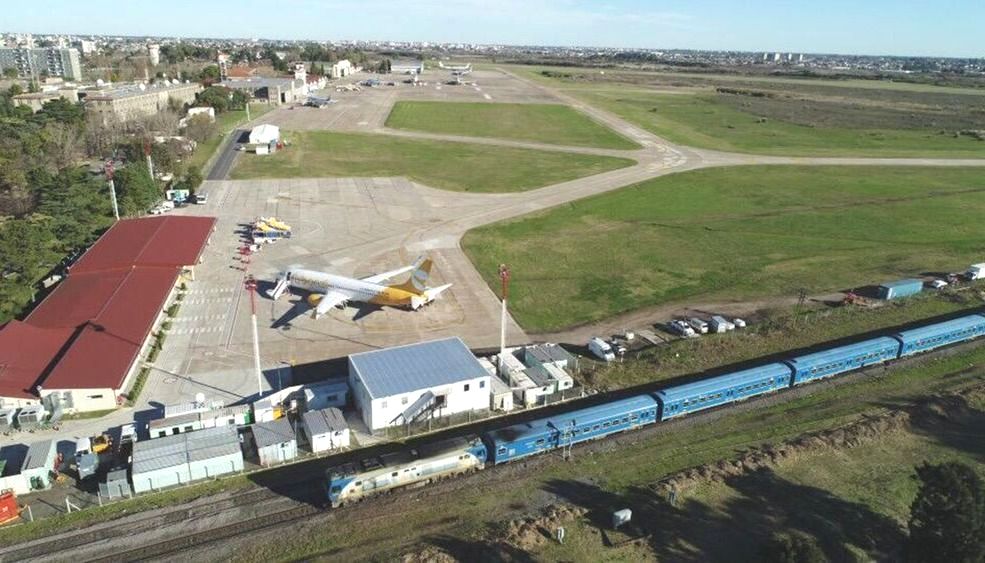
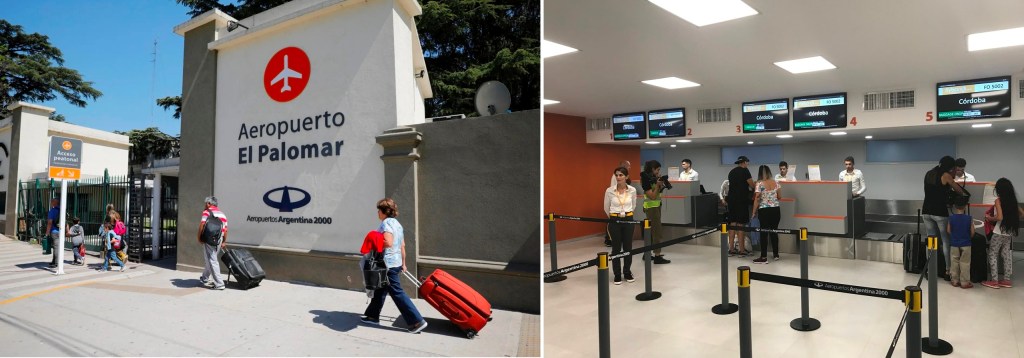
El Gobierno de Argentina, por intermedio del Ministerio de Transporte a cargo del Ministro Mario Meoni ha transmitido este Sábado 21/11 apreciaciones respecto a la posición del Gobierno respecto al futuro del Aeropuerto internacional El Palomar. La posición del Gobierno actual respecto a la actual situación está relacionada a las garantías de seguridad y capacidades de la aeroestación para cumplimentar los requerimientos sanitarios por los efectos de la pandemia.
En el día 21/11 el Ministro de Transporte ha acercado algunos detalles sobre las perspectivas del destino del Aeropuerto El Palomar, que ha expresado: «Hay que evaluar muy bien tener tres aeropuertos abiertos en el área metropolitana», ha agregado una comparación que «Nueva York tiene tres pero con 160 millones de pasajeros por año, mientras que acá tenemos 27 millones”. Como ocurre con muchas comparaciones, pueden tener un relato acertado, pero las realidades son un tanto diferentes, porque estamos considerando que es un aeropuerto low cost muy diferente de las aeroestaciones clásicas. Es importante tomar en consideración que el aeropuerto low cost de El Palomar es una aeroestación que ha crecido exponencialmente favoreciendo la diversidad de oportunidades para volar, como ocurre en los diferentes aeropuertos de Londres y Gran Londres donde operan un número importante de aerolíneas low cost que contribuyen a estimular el transporte polivalente británico y europeo.
Desarrollo de El Palomar
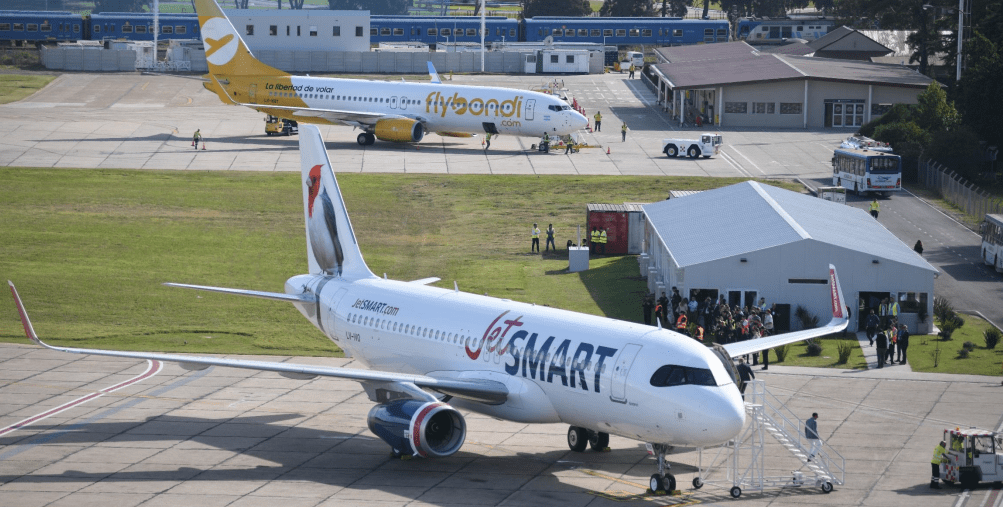
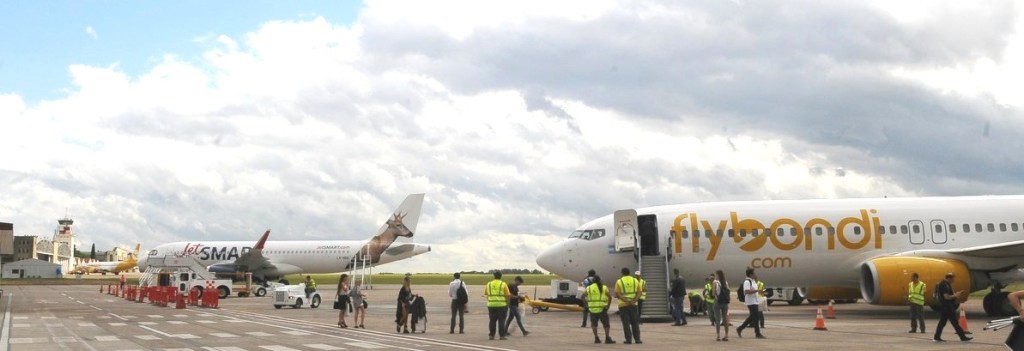
Inicialmente esta aeroestación low cost estaba siendo utilizada como un anexo para el Aeropuerto Jorge Newbery, después que el Aeropuerto Internacional de Ezeiza, debido al mantenimiento de sus pistas en Noviembre de 2010. Poseía operaciones diarias de aviones privados, militares de la Fuerza Aérea Argentina, y comerciales de Líneas Aéreas del Estado (LADE), Flybondi Líneas Aéreas, JetSmart Airlines Chile y JetSmart Airlines Argentina. En tanto, la aerolínea trasandina Sky Airline, había sido fue autorizada a operar desde el aeropuerto. La filial local de JetSmart inició el 10 de Abril de 2019 sus vuelos de cabotaje. El Aeropuerto Internacional El Palomar operaban cuatro aerolíneas sirviendo a catorce destinos de cabotaje y siete internacionales hacia Brasil, Paraguay, Chile y Uruguay, este último destino de manera estacional. El tráfico entre 2018-2019 para muchos destinos han desarrollado incrementos del orden promedio entre los 90% a 170% en la mayorías de los destinos, mostrando una clara tendencia hacia un mercado muy apreciado por los usuarios del transporte que ha estimulado a muchos a volar por primera vez en su vida.
Aun con estas consideraciones, el Gobierno muestra una política de achicamiento o reducción de las aeroestaciones indicando «porque cuando somos un país pobre, no tenemos que tener por tener aeropuertos. En el mundo tienen en función de la cantidad de pasajeros, que las empresas low cost tendrán que operar desde Aeroparque». Apuntando nuevamente a la particularidad de la aeroestación, low cost, eso es lo que representa como objetivo, estimular en virtud de los costos operativos a que los usuarios del transporte utilicen la navegación aérea como un transporte eficaz a un meyor costo.
Aeropuerto Jorge Newbery
Mario Meoni explicó respecto al Aeroparque: «Que la reforma es muy importante en el Jorge Newbery, que va a permitir que tenga mucho más capacidad y debemos sostenerlo, terminada la pandemia, vamos a tener 6.5 millones de aviones despegando”. De esta manera perfiló sus comentarios hacia las aerolíneas low cost: «JetSmart está realizando vuelo desde el Aeropuerto de Ezeiza, lo mismo podría suceder con Flybondi ya que no presenta ninguna prohibición ni restricción para la realización de sus operaciones aéreas». Hasta que se resuelva finalmente lo que va a suceder con El Palomar, el funcionario nacional expresó: “La empresa Flybondi pude volar, puede hacerlo sin ningún inconveniente desde Ezeiza; lo que está restringido es el uso del vuelo de pasajeros desde dicha terminal aérea [El Palomar], ya que desde allí se están realizando solo vuelos de carga”, concluye el Ministro de Transporte.
Perspectivas aéreas
Desde el Ministerio de Transporte han arrojado presumiblemente algunos detalles respectos a las intenciones para las operaciones en el Área Metropolitana de Buenos Aires (AMBA), que están relacionados con la intención de cerrar el Aeropuerto Internacional El Palomar previa negociación con las aerolíneas de presupuesto para que operen desde el renovado Aeropuerto Jorge Newbery, según se desprende de las palabras del Ministro de Transporte de Argentina. Mientras tanto, las aerolíneas continuarán presentando batalla para conseguir retornar a la anhelada normalidad con la cura de la enfermedad del Coronavirus, como una luz al final del túnel.
Position Transport Argentina by El Palomar
Government of Argentina preliminarily pronounces for El Palomar
The Government of Argentina, through the Ministry of Transportation led by Minister Mario Meoni, has transmitted this Saturday, November 21, appreciations regarding the Government’s position regarding the future of El Palomar International Airport. The current government’s position regarding the current situation is related to the security guarantees and capabilities of the air station to comply with the health requirements due to the effects of the pandemic.
On 11/21, the Minister of Transportation provided some details on the prospects for the destination of El Palomar Airport, which stated: «We must evaluate very well having three airports open in the metropolitan area», he added a comparison that «New York has three but with 160 million passengers per year, while here we have 27 million”. As with many comparisons, they may have an accurate story, but the realities are somewhat different, because we are considering that it is a low cost airport very different from classic air stations. It is important to take into account that the low cost airport of El Palomar is an air station that has grown exponentially favoring the diversity of opportunities to fly, as occurs in the different airports of London and Greater London where a number of important of low cost airlines that help stimulate British and European multipurpose transport.
El Palomar development
Initially, this low-cost airstation was being used as an annex to the Jorge Newbery Airport, after the Ezeiza International Airport, due to the maintenance of its runways in November 2010. It had daily operations of private planes, Argentine Air Force military, and of the State Air Lines (LADE), Flybondi Lineas Aereas, JetSmart Airlines Chile and JetSmart Airlines Argentina. Meanwhile, the trans-Andean airline Sky Airline had been authorized to operate from the airport. The local subsidiary of JetSmart began its domestic flights on April 10, 2019. The El Palomar International Airport operated four airlines serving fourteen domestic and seven international destinations to Brazil, Paraguay, Chile and Uruguay, the latter destination on a seasonal basis. Traffic between 2018-2019 for many destinations has developed increases of the average order between 90% to 170% in most destinations, showing a clear trend towards a market highly appreciated by transport users that has stimulated many to fly by. first time in his life.
Even with these considerations, the Government shows a policy of downsizing or reducing air stations, stating «because when we are a poor country, we do not have to have airports. In the world they have depending on the number of passengers, which companies low cost will have to operate from Aeroparque». Aiming again at the particularity of the airstation, low cost, that is what it represents as an objective, to stimulate, by virtue of operating costs, transport users to use air navigation as an efficient transport at a lower cost.
Jorge Newbery Airport
Mario Meoni explained regarding the Aeroparque: «That the reform is very important in the Jorge Newbery, which will allow it to have much more capacity and we must sustain it, once the pandemic is over, we are going to have 6.5 million planes taking off«. his comments towards low cost airlines: «JetSmart is making a flight from Ezeiza Airport, the same could happen with Flybondi since it does not present any prohibition or restriction for carrying out its air operations«. Until what is going is finally resolved to happen with El Palomar, the national official said: «The Flybondi company can fly, it can do so without any inconvenience from Ezeiza; what is restricted is the use of the passenger flight from said air terminal [El Palomar], since from there only cargo flights are being carried out”, concludes the Minister of Transport.
Aerial perspectives
The Ministry of Transportation has presumably released some details regarding the intentions for operations in the Buenos Aires Metropolitan Area (AMBA), which are related to the intention to close the El Palomar International Airport after negotiation with budget airlines so that operate from the renovated Jorge Newbery Airport, according to the words of the Minister of Transportation of Argentina. Meanwhile, the airlines will continue to fight to return to the desired normality with the cure of the Coronavirus disease, like a light at the end of the tunnel.
Fiscalía negocia evitar cargos por fraude criminal
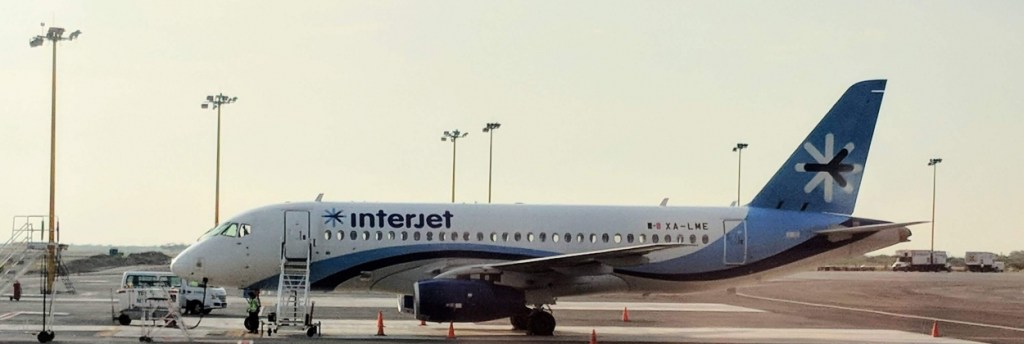
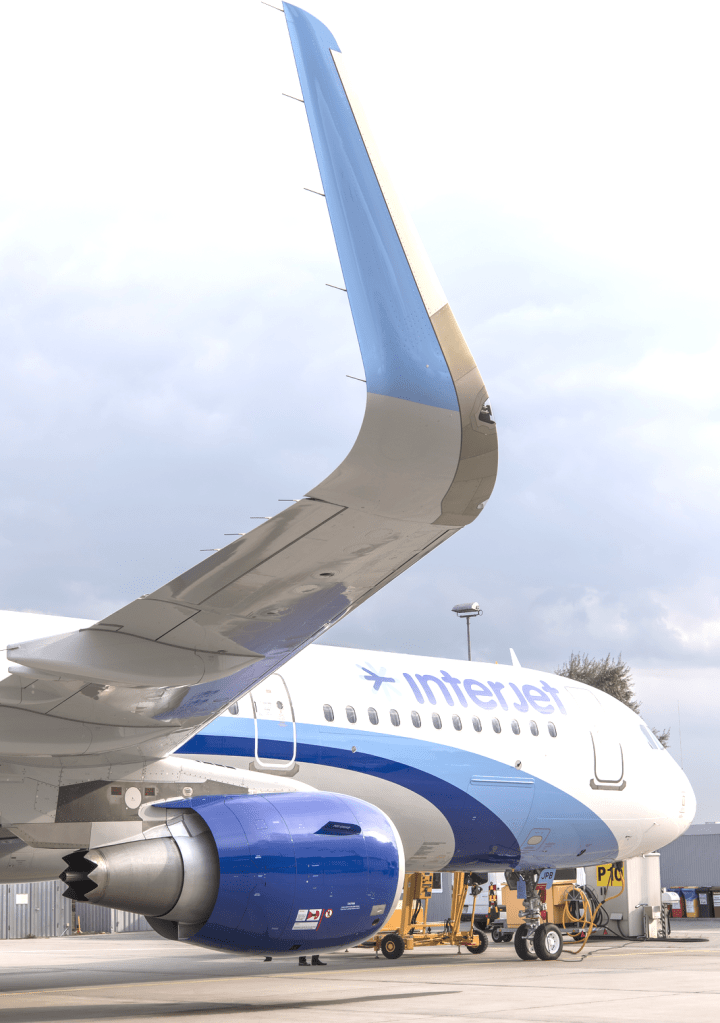
Los fundadores de la aerolínea mexicana low cost Interjet están negociando un acuerdo con las autoridades fiscales en un esfuerzo por evitar posibles cargos de fraude criminal que podrían ser presentados tan pronto como el próximo mes, dijo un funcionario familiarizado con el asunto.
El Director Ejecutivo de Interjet, Miguel Aleman Magnani y el Presidente Miguel Aleman Velasco (padre), podrían enfrentar cargos de fraude, al igual que la propia empresa, dijo el funcionario fiscal, quien pidió no ser nombrado porque los casos fiscales están protegidos por las leyes de privacidad. Las negociaciones todavía pueden conducir a un acuerdo de las partes. Los posibles cargos contra la compañía y sus altos ejecutivos, que podrían presentarse a finales del año o principios del próximo año sin un acuerdo, se derivan de si la compañía recaudaba impuestos de clientes y empleados pero no no cumplía con los tributos el al Gobierno. Las supuestas deudas fiscales de Interjet han complicado un esfuerzo para obtener US$ 150 millones de Dólares prometidos por un grupo de inversores externos como salvavidas para el transportista, que está luchando con las secuelas de la pandemia de Coronavirus y los problemas financieros anteriores de arrastre. Los inversionistas aún no han aportado los fondos por temor a que el Gobierno se apoderara de parte del dinero para cubrir los impuestos no pagados.
Reclamaciones gubernamental
Los impuestos presuntamente impagados son parte de MX$ 6.2 mil millones de Pesos (US$310 millones de Dólares) en reclamos no tributados. La factura fiscal asciende a MX$ 2.900 millones de Pesos, incluyendo el impuesto sobre la renta retenido de los empleados y los impuestos sobre el valor agregado cobrados a los clientes, según un documento interno del Gobierno mexicano. Interjet debe otros MX$ 3.300 millones de Pesos en otros honorarios del Gobierno y costos de combustible de una empresa estatal, mientras que otros acreedores están buscando otros MX$ 7.500 millones de Pesos, según el documento.
Interjet dijo en respuesta a preguntas que las cifras eran incorrectas, pero se negó a proporcionar otras cantidades. La aerolínea no respondió a preguntas sobre las negociaciones fiscales. Si la compañía no tiene un plan para comenzar a cubrir sus deudas fiscales en las próximas semanas, los funcionarios de impuestos están dispuestos a presentar cargos criminales a principios del próximo año con el fin de cumplir con los estatutos de limitaciones, dijo la Fiscalía. El fiscal de México que atiende el caso tiene discreción sobre si presentar denuncias penales ante la oficina del fiscal general y buscando preservar un acuerdo incluso después de que se presenten los cargos. La aplicación penal de las leyes fiscales ha sido clave para una represión fiscal bajo el Presidente Andrés Manuel López Obrador.
Los Aleman, que son descendientes de un presidente mexicano, han visto el colapso de Interjet ya que la mayoría de sus aviones Airbus A319/A320 fueron embargados por arrendadores a principios de este año. La flota actual de aeronaves se reduce a sólo cuatro Sukhoi SSJ-100 activos. Los empleados sindicalizados protestaron a principios de este mes después de que dijeron que no les pagaron. Bank of America Corp. embargó el jet privado Gulfstream de la familia este verano después de que se recobraron los pagos, según una persona familiarizada con el contrato de arrendamiento. Interjet declinó hacer comentarios por las protestas de los trabajadores y el embargo que pesa sobre el avión ejecutivo.
Interjet would face fraud charges
Prosecutor negotiates to avoid criminal fraud charges
The founders of Mexican low-cost airline Interjet are negotiating a settlement with tax authorities in an effort to avoid possible criminal fraud charges that could be filed as soon as next month, said an official familiar with the matter.
Interjet Executive Director Miguel Aleman Magnani and President Miguel Aleman Velasco (father) could face fraud charges, as could the company itself, said the tax official, who asked not to be named because tax cases are protected by the privacy laws. Negotiations can still lead to an agreement of the parties. Possible charges against the company and its top executives, which could be filed late in the year or early next year without a deal, stem from whether the company collected taxes from customers and employees but failed to comply with taxes on the government. Interjet’s alleged tax debts have complicated an effort to obtain US$ 150 million dollars promised by a group of outside investors as a lifeline for the carrier, which is struggling with the aftermath of the Coronavirus pandemic and previous financial carryover problems. Investors have not yet contributed the funds for fear that the government will seize some of the money to cover unpaid taxes.
Government claims
The allegedly unpaid taxes are part of MX$ 6.2 billion Pesos (US$ 310 million Dollars) in untaxed claims. The tax bill amounts to MX$ 2,900 million pesos, including income tax withheld from employees and value added taxes charged to customers, according to an internal document of the Mexican government. Interjet owes another MX$ 3.3 billion pesos in other government fees and fuel costs from a state company, while other creditors are seeking another MX$ 7.5 billion pesos, according to the document.
Interjet said in response to questions that the figures were incorrect, but declined to provide other amounts. The airline did not respond to questions about the tax negotiations. If the company does not have a plan to start covering its tax debts in the next few weeks, tax officials are willing to file criminal charges early next year in order to comply with the statutes of limitations, the prosecution said. The Mexican prosecutor handling the case has discretion over whether to file criminal complaints with the attorney general’s office and seeking to preserve an agreement even after the charges are filed. The criminal enforcement of tax laws has been key to a fiscal crackdown under President Andrés Manuel López Obrador.
The Germans, who are descendants of a Mexican president, have seen Interjet collapse as most of its Airbus A319/A320 jets were seized by lessors earlier this year. The current fleet of aircraft is reduced to just four active Sukhoi SSJ-100s. Unionized employees protested earlier this month after they said they were not paid. Bank of America Corp. seized the family’s Gulfstream private jet this summer after payments were recovered, according to a person familiar with the lease. Interjet declined to comment on worker protests and the embargo on the executive jet.
Nueva regional inicia trámites ante la ANAC Brasil
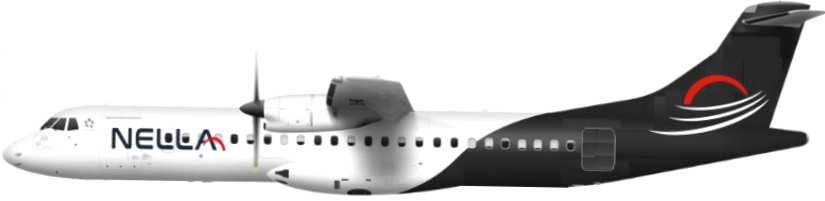
Nella Linhas Aéreas, una nueva startup regional de bajo costo ha comenzado a tramitar el proceso administrativo correspondiente como operador aéreo ante la ANAC Brasil para iniciar vuelos dentro del país en los próximos meses. La nueva aerolínea Nella Linhas Aéreas presentó una solicitud ante la Agencia Nacional de Aviación Civil (ANAC) para iniciar operaciones regionales. La nueva empresa aérea regional ha anunciado el inicio operaciones aéreas hacia la primer mitad del 2021 para convertirse en un referente en la aviación regional brasileña.
Según la ANAC, la reunión forma parte del primero de una serie de pasos para obtener el Certificado de Operador Aéreo (AOC), documento que autoriza el inicio de las actividades de la empresa como transporte aéreo. El proceso puede durar varios meses, hasta que la compañía sea capaz de lanzar el primer vuelo, pero se espera que ocurra en el primer semestre de 2021.
Perspectivas Nella
Con el lema «No se trata sólo de volar», la nueva línea aérea pretende convertirse en una referencia en la aviación regional brasileña, satisfaciendo la demanda de las ciudades en el interior aún sin ayuda por el servicio aéreo, y ser reconocida por una gestión humanizada, enfocada en viajeros y empleados. El brasileño Maurício Souza, fundador de Nella Linhas Aéreas, explica que el nombre de la empresa fue un homenaje a su hija Antonella, menor de 1 año de edad, y que aplicará la jovialidad del nombre en los valores de la empresa.
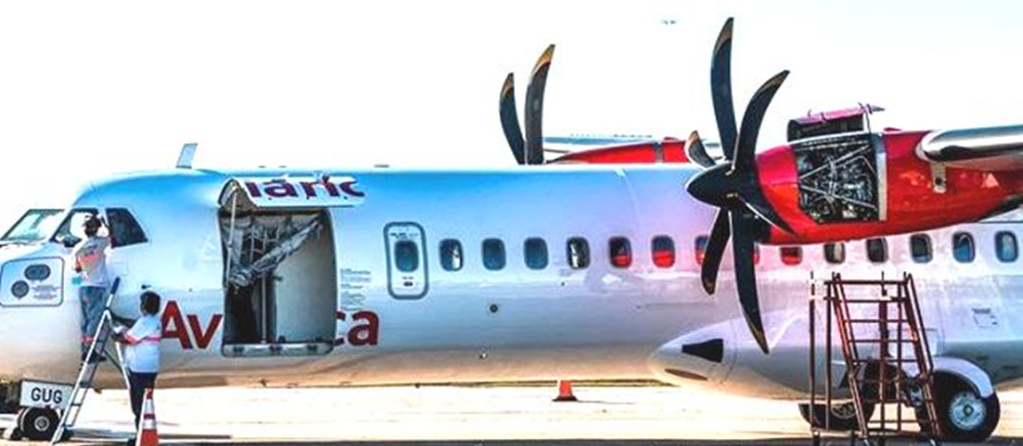
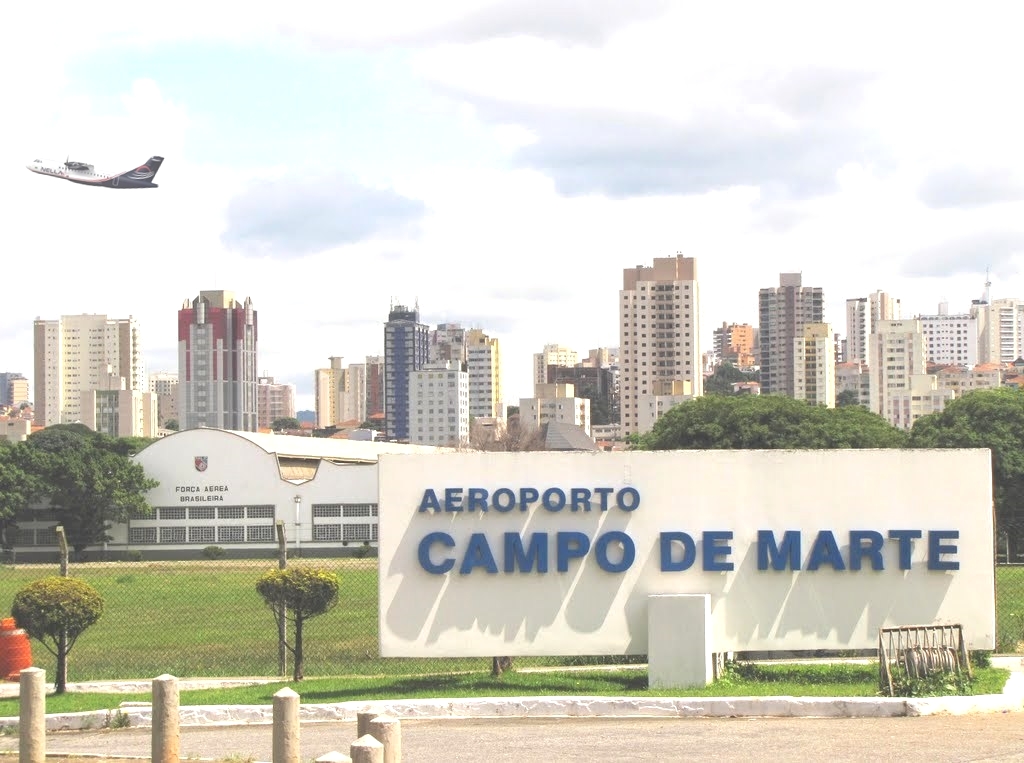
Nella Linhas Aéreas debería operar inicialmente en las regiones Norte, Noreste y Medio Oeste con aviones ATR 72-600, ampliamente utilizados para aterrizar y despegar en aeropuertos más pequeños. La aeronave tiene la capacidad de transportar hasta 72 pasajeros en vuelos regionales. Teniendo, en un primer momento, el centro de operaciones en el Aeropuerto Internacional de Brasilia y el Centro Administrativo en el Aeropuerto Sao Paulo/Campo de Marte, en Sao Paulo, la intención del CEO es ampliar los centros y flotas, incluyendo las unidades de carga.
Para el Ministro de Turismo, Marcelo Alvaro Antonio, este es el momento ideal para invertir en el mercado interno brasileño. «La reanudación de nuestra actividad se llevará a cabo a través del turismo nacional y tenemos que aprovechar esta tendencia para promocionar y valorar nuestros destinos. La llegada de nuevas aerolíneas regionales amplía la conectividad y hace que el turismo sea aún más accesible», expresó muy expectante por el desenvolvimiento sostenible de la aviación post-pandemia en Brasil.
Nella Linhas Aéreas requests AOC
New regional initiates proceedings before ANAC Brazil
Nella Linhas Aéreas, a new low-cost regional startup, has begun to process the corresponding administrative process as an air operator with ANAC Brazil to start flights within the country in the coming months. The new airline Nella Linhas Aéreas submitted a request to the National Civil Aviation Agency (ANAC) to start regional operations. The new regional airline has announced the start of air operations in the first half of 2021 to become a benchmark in Brazilian regional aviation.
According to ANAC, the meeting is part of the first in a series of steps to obtain the Air Operator Certificate (AOC), a document that authorizes the start of the company’s activities as air transport. The process can take several months, until the company is able to launch the first flight, but it is expected to occur in the first half of 2021.
Prospects Nella
With the motto «It’s not just about flying», the new airline aims to become a reference in Brazilian regional aviation, satisfying the demand of the cities in the interior even without help from the air service, and being recognized for its management humanized, focused on travelers and employees. Brazilian Maurício Souza, founder of Nella Linhas Aéreas, explains that the name of the company was a tribute to his daughter Antonella, under 1 year of age, and that he will apply the joviality of the name to the values of the company.
Nella Linhas Aéreas should initially operate in the North, Northeast and Midwest regions with ATR 72-600 aircraft, widely used for landing and taking off at smaller airports. The aircraft has the capacity to carry up to 72 passengers on regional flights. Having, initially, the operations center at the Brasilia International Airport and the Administrative Center at the Sao Paulo/Campo de Marte Airport, in Sao Paulo, the intention of the CEO is to expand the centers and fleets, including the units of load.
For the Minister of Tourism, Marcelo Alvaro Antonio, this is the ideal time to invest in the Brazilian domestic market. «The resumption of our activity will be carried out through national tourism and we have to take advantage of this trend to promote and value our destinations. The arrival of new regional airlines expands connectivity and makes tourism even more accessible», he expressed very expectant for the sustainable development of post-pandemic aviation in Brazil.
Nella Linhas Aéreas solicita AOC
Nova regional inicia processo perante a ANAC Brasil
A Nella Linhas Aéreas, uma nova startup regional de baixo custo, começou a processar o processo administrativo correspondente como operadora aérea com a ANAC Brasil para iniciar voos dentro do país nos próximos meses. A nova companhia aérea Nella Linhas Aéreas encaminhou pedido à Agência Nacional de Aviação Civil (ANAC) para o início das operações regionais. A nova companhia aérea regional anunciou o início das operações aéreas no primeiro semestre de 2021 para se tornar uma referência na aviação regional brasileira.
Segundo a ANAC, o encontro faz parte da primeira de uma série de etapas para a obtenção do Certificado de Operador Aéreo (AOC), documento que autoriza o início das atividades da empresa como transporte aéreo. O processo pode levar vários meses, até que a empresa consiga lançar o primeiro voo, mas a previsão é que ocorra no primeiro semestre de 2021.
Perspectivas Nella
Com o mote “Não se trata só de voar”, a nova companhia aérea pretende se tornar referência na aviação regional brasileira, atendendo a demanda das cidades do interior mesmo sem ajuda da Aeronáutica, e sendo reconhecida por sua gestão humanizada, focada em viajantes e funcionários. O brasileiro Maurício Souza, fundador da Nella Linhas Aéreas, explica que o nome da empresa foi uma homenagem a sua filha Antonella, menor de 1 ano, e que aplicará a jovialidade do nome aos valores da empresa.
A Nella Linhas Aéreas deve operar inicialmente nas regiões Norte, Nordeste e Centro-Oeste com aeronaves ATR 72-600, amplamente utilizadas para pousos e decolagens em aeroportos de menor porte. A aeronave tem capacidade para transportar até 72 passageiros em voos regionais. Tendo, inicialmente, o centro de operações no Aeroporto Internacional de Brasília e o Centro Administrativo no Aeroporto São Paulo/Campo de Marte, em São Paulo, a intenção do CEO é expandir os centros e frotas, inclusive as unidades de carga.
Para o ministro do Turismo, Marcelo Alvaro Antonio, este é o momento ideal para investir no mercado interno brasileiro. “O recomeço da nossa actividade será efectuado através do turismo nacional e temos que aproveitar esta tendência para promover e valorizar os nossos destinos. A chegada de novas companhias aéreas regionais amplia a conectividade e torna o turismo ainda mais acessível”, expressou-se muito expectante. o desenvolvimento sustentável da aviação pós-pandemia no Brasil.
AW | 2020 11 20 14:48 | AIRLINES / GOVERNMENT / AVIATION ORGANISMS
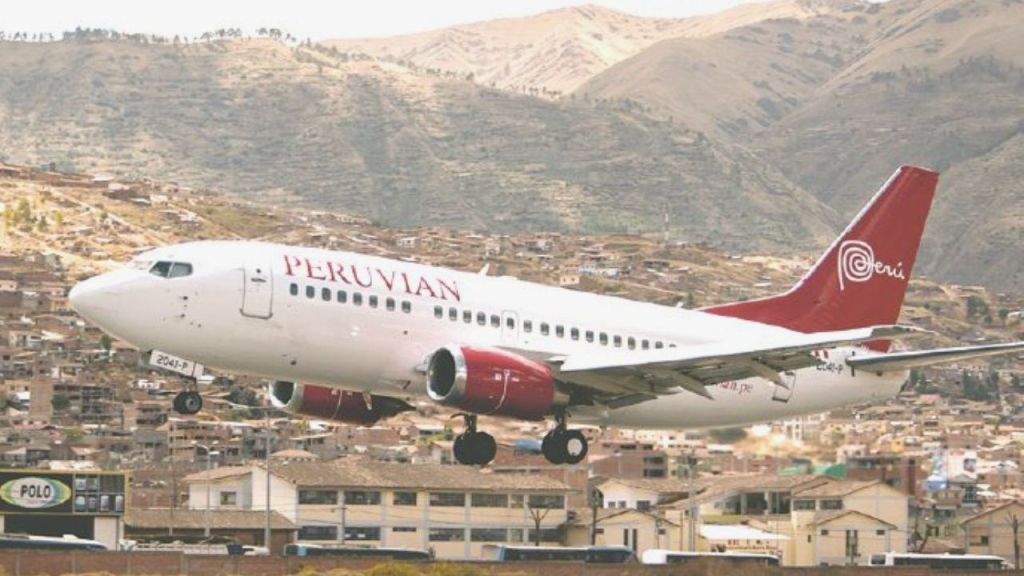
Desaparición de Peruvian Airlines espejo intereses espurios
La historia de la desaparición de las líneas aéreas peruanas en los últimos veinte años ha estado precedida de campañas mediáticas de los grupos de comunicación que han tenido relación directa con intereses espurios entre el Gobierno y cierta animosidad por la ampliación de mercado en favor de una aerolínea que había desembarcado en Perú para negociar más del 70% del mercado aerocomercial doméstico.
Peruvian Airlines fue fundada en Noviembre de 2007, recibiendo su Certificado de Operador Aéreo (AOC) de la Dirección General de Aviación Civil de Perú el 7 de Agosto de 2008. La aerolínea comenzó sus operaciones aerocomerciales el 29 de octubre de 2009 desde su hub en el Aeropuerto Internacional Lima/Jorge Chávez. La aerolínea ofrecía principalmente vuelos nacionales en el jugoso mercado doméstico. Peruvian Airlines había alcanzado una consolidación en el 2011. El 2 de Octubre de 2019, la aerolínea cesó todas las operaciones debido a problemas de liquidez, debido a que el Tribunal Fiscal de Aduanas de Perú se apoderó de las cuentas bancarias de la aerolínea después de que la aerolínea no completara los pagos de combustible.
Caso Peruvian
La Dirección General de Aeronáutica Civil (DGAC) de Perú en 2011 había firmado el Acuerdo Administrativo con Chile, entregándole el mercado norteamericano de Quintas Libertades a Latam Airlines Group sin reciprocidad, bajo un paraguas que se considera anticonstitucional y que hoy está en discusión en la Asociación de Empresas de Transporte Aéreo Internacional (AETAI) que ha presentado un informe contra la línea aérea de bandera, que el Presidente de Asociación Peruana de Empresas Aéreas (APEA) nunca había gestionado. La DGAC suspendió el Certificado de Explotador Aéreo a Peruvian Airlines con el Informe Nº 391-2011/MTC/12.04AIR del Ministerio de Transportes y Comunicaciones.
Tras cinco días de paralización, Peruvian Airlines se encontraba al borde de la quiebra y fue salvada a solicitud del Gobierno de la época por el Informe Legal del Presidente de la Comisión Consultiva de Derecho Aeronáutico del Colegio de Abogados de Lima, Julián Palacin Fernández, quien se pronunció a solicitud de la Vicepresidente de la República del Perú de la época, Marisol Espinoza Cruz del Gobierno de Ollanta Humala.
En los nueve años de trayectoria de la compañía Peruvian Airlines alcanzando un 20% del mercado aéreo, las consecuencias de haber crecido tuvieron repercusiones en el acuerdo Latam-Gobierno, cuando la aerolínea Peruvian continuaba reclamando a la DGAC del Ministerio de Transporte y Comunicación (MTC) las solicitudes de las rutas internacionales a Estados Unidos y otros países del mundo, sin obtener respuestas por parte del Estado peruano. En concreto, las rutas internacionales del Perú eran propiedad de Latam Airlines por los Acuerdos Administrativos con Chile, razón por la cual no fueron otorgadas las solicitudes de expansión internacional a Peruvian Airlines.
Actualmente, Peruvian Airlines ha radicado las denuncias en el Instituto Nacional de Defensa de la Competencia y de la Protección de la Propiedad Intelectual (Indecopi) y alrededor de 800 familias peruanas se quedaron sin sus puestos de trabajo y la bancada de Acción Popular al presentar el Proyecto histórico 6153-2020-CR, que crea la línea aérea de bandera de bajo costo del Perú denominada AlPerú, en el Dictamen final que se debatirá este Viernes 20 de Noviembre del 2020 en la Comisión de Transportes del Congreso de la República, exponiendo el siguiente Artículo 5 referente a la soberanía nacional.
Artículo 5
«El Estado peruano ejerce soberanía completa y exclusiva sobre el espacio aéreo que cubre su territorio y mar adyacente, hasta el límite de 200 (doscientas) millas, de conformidad con la Constitución Política del Perú; en consecuencia, los tratados aprobados por el Congreso de la República o celebrados por el Presidente de la República de conformidad al Art. 56 y 57 de la Constitución o las actas o memorandas provisionales entre autoridades de Aeronáutica Civil firmadas por la DGAC, de conformidad al Art. 82 de la Ley de Aeronáutica Civil del Perú, que para entrar en vigencia requieren de la ratificación del Ministro de Transportes y Comunicaciones y del cumplimiento de dichos artículos de la Constitución, deben intercambiar derechos aerocomerciales gobernados por el principio de la reciprocidad real y efectiva, con los países del mundo, de conformidad al Art. 98 de la Ley 27261».
A partir de la vigencia de esta Ley quedan sin efecto las Resoluciones Administrativas del Ministerio de Transportes y Comunicaciones (MTC) que ratificaron las Actas o Memorandos de Entendimiento (MoU) firmadas entre las autoridades de Aeronáutica Civil del Perú con Chile del 22 de Marzo del 2007 aprobada por Resolución Ministerial 147-2007-MTC 02 del 23 de Marzo del 2007 y del 7 de Abril del 2011 aprobada por Resolución Ministerial Nº 412-2011-MTC/02 en donde por acto administrativo se otorgaron sin reciprocidad real y efectiva segmentos de Quinta Libertad aérea a este país, asimismo, queda sin efecto el Acta o Memorandos de Entendimiento (MuO) firmado por el Director General de Aeronáutica Civil del Perú del 17 de Julio de 2019 con Colombia en donde se le entregan quintas libertades a este país, sin reciprocidad real y efectiva.
La desaparición de varias líneas aéreas peruanas, como Peruvian Airlines en los últimos veinte años en el país se originan debido al desarrollo en el mercado doméstico y necesitaban fomentar rutas internacionales para continuar su expansión y luego desaparecieron, por los intereses que habían detentado las aerolíneas transnacionales Avianca y Latam Airlines Group.
Ahora que el Proyecto de Ley Nº 6153-2020-CR del Congresista Luis Carlos Simeón Hurtado de Acción Popular, corrige esta afectación de la soberanía y entrega de nuestros cielos. Anteriormente, la gestión de ciertos poderes del Estado bajo la participación de los organismos CONFIEP, AETAI y la DGAC del MTC defenderían los intereses colombianos y chilenos en la explotación del espacio aéreo peruano, dándole la espalda a los intereses de la aviación del pueblo del Perú.
Peruvian tied to laziness Government
Disappearance of Peruvian Airlines mirror spurious interests
The history of the disappearance of Peruvian airlines in the last twenty years has been preceded by media campaigns by communication groups that have had a direct relationship with spurious interests between the Government and a certain animosity over the expansion of the market in favor of an airline that had landed in Peru to negotiate more than 70% of the domestic commercial aviation market.
Peruvian Airlines was founded in November 2007, receiving its Air Operator Certificate (AOC) from the General Directorate of Civil Aviation of Peru on August 7, 2008. The airline began its commercial air operations on October 29, 2009 from its hub in Lima/Jorge Chávez International Airport. The airline mainly offered domestic flights in the juicy domestic market. Peruvian Airlines had reached a consolidation in 2011. On October 2, 2019, the airline ceased all operations due to liquidity problems, due to the fact that the Peruvian Customs Tax Court seized the airline’s bank accounts after that the airline failed to complete fuel payments.
Peruvian case
The General Directorate of Civil Aeronautics (DGAC) of Peru in 2011 had signed the Administrative Agreement with Chile, handing over the North American market of Fifth Freedoms to Latam Airlines Group without reciprocity, under an umbrella that is considered unconstitutional and that today is under discussion in the Association of International Air Transport Companies (AETAI) that has presented a report against the flag carrier, which the President of the Peruvian Association of Air Companies (APEA) had never managed. The DGAC suspended the Air Operator Certificate to Peruvian Airlines with Report No. 391-2011/MTC/12.04AIR from the Ministry of Transportation and Communications.
After five days of standstill, Peruvian Airlines was on the verge of bankruptcy and was saved at the request of the Government of the time by the Legal Report of the President of the Advisory Commission on Aeronautical Law of the Lima Bar Association, Julián Palacin Fernández, who it was pronounced at the request of the Vice President of the Republic of Peru at the time, Marisol Espinoza Cruz of the Government of Ollanta Humala.
In the nine-year history of the Peruvian Airlines company, reaching 20% of the air market, the consequences of having grown had repercussions on the Latam-Government agreement, when the Peruvian airline continued to claim the DGAC of the Ministry of Transport and Communication (MTC) requests for international routes to the United States and other countries in the world, without obtaining responses from the Peruvian State. Specifically, the international routes of Peru were owned by Latam Airlines by the Administrative Agreements with Chile, which is why the international expansion requests were not granted to Peruvian Airlines.
Currently, Peruvian Airlines has filed complaints with the National Institute for the Defense of Competition and the Protection of Intellectual Property (Indecopi) and around 800 Peruvian families were left without their jobs and the Popular Action bench when presenting the Historical project 6153-2020-CR, which creates the low-cost Flag Airline of Peru called AlPerú, in the final Opinion that will be debated this Friday, November 20, 2020 in the Transportation Commission of the Congress of the Republic, exposing the next Article 5 regarding national sovereignty.
Article 5
«The Peruvian State exercises complete and exclusive sovereignty over the airspace that covers its territory and adjacent sea, up to the limit of 200 (two hundred) miles, in accordance with the Political Constitution of Peru; consequently, the treaties approved by the Congress of the Republic or celebrated by the President of the Republic in accordance with Art. 56 and 57 of the Constitution or the provisional acts or memoranda between Civil Aeronautics authorities signed by the DGAC, in accordance with Art. 82 of the Civil Aeronautics Law of the Peru, which to enter into force requires the ratification of the Minister of Transport and Communications and compliance with said articles of the Constitution, must exchange commercial air rights governed by the principle of real and effective reciprocity, with the countries of the world, in accordance to Art. 98 of Law 27261».
As of the effective date of this Law, the Administrative Resolutions of the Ministry of Transport and Communications (MTC) that ratified the Minutes or Memoranda of Understanding (MoU) signed between the Civil Aeronautics authorities of Peru with Chile on March 22, 2007 approved by Ministerial Resolution 147-2007-MTC 02 of March 23, 2007 and of April 7, 2011 approved by Ministerial Resolution No. 412-2011-MTC/02 where by administrative act they were granted without real and effective reciprocity segments of Fifth Freedom aerial to this country, likewise, the act or memorandum of understanding signed by the Director General of Civil Aeronautics of Peru on July 17, 2019 with Colombia, where Fifth Freedoms are delivered to this country, without real reciprocity and effective.
The disappearance of several Peruvian airlines, such as Peruvian Airlines in the last twenty years in the country originated due to the development in the domestic market and they needed to promote international routes to continue their expansion and then they disappeared, due to the interests that the transnational airlines had held. Avianca and Latam Airlines Group.
Now that Bill No. 6153-2020-CR of Congressman Luis Carlos Simeón Hurtado of Popular Action, corrects this affectation of the sovereignty and delivery of our skies. Previously, the management of certain powers of the State under the participation of the bodies CONFIEP, AETAI and the DGAC of the MTC would defend the Colombian and Chilean interests in the exploitation of the Peruvian airspace, turning their back on the interests of the aviation of the Peruvian people.
AW | 2020 11 19 22:35 | AVIATION / GOVERNMENT / CONGRESS
Argentina recibió propuesta de Secretaría para la OACI
La República de Brasil ha formalizado la propuesta para que Argentina asuma la Secretaría General de Aviación Civil Internacional (OACI). El Jefe de Gabinete de la Cancillería Argentina, Guillermo Justo Chaves, ha recobido la propuesta de Brasil para la Secretaría de Aviación. El Brigadier Ary Rodrigues Bertolino ha sido designado candidato impulsado por Brasil para ocupar la Secretaría General de la OACI, que se ha expuesto en una reunión virtual donde ha participado además la Administración Nacional de Aviación Civil (ANAC) de Brasil y Argentina.
En la reunión virtual, Guillermo Chaves hizo mención a la relación estratégica que une a la Argentina con Brasil en el compromiso que son socios comerciales que representan el motor del Mercosur. El funcionario remarcó la necesidad de «seguir afianzando el vínculo bilateral, a pesar de que en el más alto nivel de gobierno existan algunos desacuerdos o inconvenientes. Somos pueblos hermanos con intereses comunes, por ello trabajamos todos los días para superarlos». Si bien destacó la importancia de que la Argentina y Brasil se acompañen mutuamente en los organismos internacionales, Guillermo Chaves ha señalado que el Gobierno aún no decidió su voto para la 222° Sesión del Consejo de la OACI, prevista para Febrero-Marzo de 2021. De todos modos, es un avance hacia la integración de la región para desarrollar políticas definidas de cara a revalorizar al mercado de la aviación comercial.
Argentina ICAO Secretariat proposal
Argentina received a proposal from the Secretariat for the ICAO
The Republic of Brazil has formalized the proposal for Argentina to assume the General Secretariat of International Civil Aviation (ICAO). The Chief of Cabinet of the Argentine Foreign Ministry, Guillermo Justo Chaves, has accepted Brazil’s proposal for the Secretariat of Aviation. Brigadier Ary Rodrigues Bertolino has been designated a candidate promoted by Brazil to occupy the General Secretariat of ICAO, which has been presented in a virtual meeting where the National Civil Aviation Administration (ANAC) of Brazil and Argentina has also participated.
In the virtual meeting, Guillermo Chaves made mention of the strategic relationship that unites Argentina with Brazil in the commitment that they are commercial partners that represent the engine of Mercosur. The official stressed the need to «continue to strengthen the bilateral link, despite the fact that at the highest level of government there are some disagreements or inconveniences. We are brother peoples with common interests, so we work every day to overcome them». Although he highlighted the importance of Argentina and Brazil accompanying each other in international organizations, Guillermo Chaves has indicated that the Government has not yet decided its vote for the 222nd Session of the ICAO Council, scheduled for February-March 2021. In any case, it is an advance towards the integration of the region to develop defined policies with a view to revaluing the commercial aviation market.
AW | 2020 11 19 17:04 | AVIATION SAFETY / AVIATION TECHNOLOGY / GOVERNMENT
Tecnológía 5G podría comprometer a la aviación comercial
Un choque sobre los usos del espectro radioeléctrico está enfrentando los intereses de la aviación contra las telecomunicaciones 5G, con una agencia reguladora Federal de estados unidos en el medio y Legisladores bajo presión para arbitrar el conflicto.
No se trata de la continua controversia sobre si el sistema de comunicaciones inalámbricas 5G Ligado Networks propuesto que opera en la Banda L bloqueará la recepción GPS que está galvanizando a la aviación a la acción. Según un informe técnico publicado recientemente, una medida de la Comisión Federal de Comunicaciones (FCC) de Estados Unidos para asignar cierto espectro de Banda C para 5G podría comprometer el funcionamiento de los altímetros de radar, los únicos sensores a bordo de aeronaves civiles que proporcionan una medición directa de la altura de la aeronave sobre el terreno u otros obstáculos en frecuencias adyacentes. En una carta del 17 de Noviembre de 2020 a los líderes bipartidistaes de los comités de la Cámara de Representantes y el Senado con jurisdicción sobre el transporte, AOPA y otras 13 organizaciones de aviación plantearon preocupaciones sobre la acción de la FCC para reasignar una parte del rango de frecuencias de 3.7 a 4.2-GHz para usos incluyendo aplicaciones 5G por la industria de las telecomunicaciones. «La industria de la aviación señaló en el proceso de elaboración de normas de la FCC que el despliegue de redes 5G en esta banda de frecuencias puede introducir interferencias dañinas de radiofrecuencia (RF) en los altímetros de radar que actualmente operan en la banda aeronáutica de 4,2 a 4,4 GHz asignada a nivel mundial. Los altímetros de radar se despliegan en decenas de miles de aeronaves civiles en los Estados Unidos y en todo el mundo para apoyar varias funciones críticas de aeronaves de seguridad de vida útil a lo largo de múltiples fases de vuelo. Los altímetros de radar son el único sensor a bordo de un avión civil que proporciona una medición directa de la altura de la aeronave sobre el terreno u otros obstáculos», dijo la carta.
La solicitud de los grupos de legisladores de aceptar la participación directa con las partes interesadas clave para proteger las bandas de frecuencia utilizadas por los altímetros de radar fue un informe del grupo de trabajo de la organización técnica RTCA que reveló un riesgo importante de interferencia perjudicial con los altímetros de radar de los sistemas de telecomunicaciones 5G en el ancho de banda de 3,7 a 3,98 GHz. Los impactos adversos incluyen «la posibilidad de fallas catastróficas que conducen a múltiples muertes, en ausencia de mitigaciones apropiadas», escribieron.
El 28 de Febrero de 2020, la FCC anunció una acción para liberar espectro de Banda C para servicios 5G, haciendo que una amplia franja de espectro de banda media esté disponible para 5G a través de una subasta pública. La acción haría que el espectro estuviera disponible rápidamente, al tiempo que generaría ingresos sustanciales para el Tesoro de los Estados Unidos. Al mismo tiempo, el artículo garantiza la entrega continua e ininterrumpida de servicios de programación de video y otros contenidos al pueblo estadounidense que actualmente es entregado por satélites utilizando la Banda C, había emitido el comunicado de prensa de la FCC.
RTCA, una asociación sin fines de lucro que desarrolla políticas de consenso para la modernización de la aviación, publicó un libro blanco sobre el tema de la interferencia en octubre, dirigiendo sus hallazgos a la FCC. «Una comprensión profunda de los riesgos asociados con esta interferencia y el impacto en la seguridad de la aviación será vital para reunir tanto a los reguladores de la aviación como al espectro para garantizar que los sistemas de aviación críticos para la seguridad continúen protegidos a los efectos de la seguridad pública», dijo Terry McVenes, Presidente y CEO de RTCA.
Perspectivas tecnológicas
El nuevo desafío a la asignación de espectro de la FCC para 5G se produce en un momento en que las organizaciones de aviación y muchas otras industrias que dependen del GPS han estado instando a la agencia reguladora a reconsiderar su aprobación en abril del plan de Ligado Networks para una red de comunicaciones inalámbricas que transmitiría en la Banda L. Los críticos de 5G Ligado Networks siguen preocupados de que la radiación de la red pueda bloquear o abrumar la recepción de señales GPS de baja potencia enviadas desde satélites en frecuencias adyacentes. Ligado ha respondido que ha abordado las preocupaciones como condición de su aprobación de la FCC y recientemente informó sobre los pasos que está tomando para poner en pie su red.
Aviation vs 5G technology
5G technology could compromise commercial aviation
A clash over the uses of the radio spectrum is pitting aviation interests against 5G telecommunications, with a US Federal regulatory agency in the middle and legislators under pressure to arbitrate the conflict.
It’s not about the ongoing controversy over whether the proposed Ligado Networks 5G wireless communications system operating in the L-Band will block GPS reception that is galvanizing aviation into action. According to a recently published technical report, a move by the United States Federal Communications Commission (FCC) to allocate certain C-Band spectrum for 5G could compromise the operation of radar altimeters, the only sensors on board civil aircraft that provide a direct measurement of the aircraft’s height above the ground or other obstacles on adjacent frequencies. In a November 17, 2020 letter to the bipartisan leaders of the House and Senate committees with jurisdiction over transportation, AOPA and 13 other aviation organizations raised concerns about the FCC’s action to reallocate a portion of the 3.7 to 4.2-GHz frequency range for uses including 5G applications by the telecommunications industry. «The aviation industry noted in the FCC rule-making process that the deployment of 5G networks in this frequency band can introduce harmful radio frequency (RF) interference to radar altimeters currently operating in the aeronautical band of 4.2 to 4.4 GHz mapped globally. Radar altimeters are deployed on tens of thousands of civil aircraft in the United States and around the world to support various critical life safety aircraft functions throughout multi-phase flight. Radar altimeters are the only sensor on board a civilian aircraft that provides a direct measurement of the aircraft’s height above the ground or other obstacles», the letter said.
The request by groups of legislators to accept direct engagement with key stakeholders to protect the frequency bands used by radar altimeters was a report from the technical organization RTCA working group that revealed a significant risk of harmful interference with radar altimeters in 5G telecommunications systems in the 3.7 to 3.98 GHz bandwidth. Adverse impacts include «the potential for catastrophic failures leading to multiple fatalities, in the absence of appropriate mitigations», they wrote.
On February 28, 2020, the FCC announced an action to release Band C spectrum for 5G services, making a wide swath of mid-band spectrum available for 5G through a public auction. The action would make spectrum available quickly, while also generating substantial revenue for the US Treasury. At the same time, the article guarantees the continuous and uninterrupted delivery of video programming services and other content to the American people that are currently delivered by satellites using Band C, the FCC press release had issued.
RTCA, a non-profit association that develops consensus policies for aviation modernization, published a white paper on the issue of interference in October, directing its findings to the FCC. «A thorough understanding of the risks associated with this interference and the impact on aviation security will be vital in bringing together both aviation and spectrum regulators to ensure that security-critical aviation systems continue to be protected for the purposes of of public safety», said Terry McVenes, President and CEO of RTCA.
Technological perspectives
The new challenge to the FCC’s spectrum allocation for 5G comes at a time when aviation organizations and many other industries that rely on GPS have been urging the regulatory agency to reconsider its April approval of Ligado Networks’ plan. for a wireless communications network that would transmit on the L-Band. Critics of 5G Ligado Networks remain concerned that radiation from the network could block or overwhelm the reception of low-power GPS signals sent from satellites on adjacent frequencies. Ligado has responded that it has addressed the concerns as a condition of its approval from the FCC and recently reported on the steps it is taking to get its network up and running.
Presentan la Ley de Combustible de Aviación Sostenible
La Ley de Combustible de Aviación Sostenible de Estados Unidos se ha presentado este 18 de Noviembre de 2020 ante la Cámara de Representantes para su aprobación como ley que puede ayudar a reducir las emisiones de las aerolíneas. La representante estadounidense Julia Brownley (D-CA) presentó este 18/11 la Ley de Combustible de Aviación Sostenible, un proyecto de ley innovador que da un primer paso hacia la reducción de la contaminación que daña el clima de los aviones. El proyecto de ley establece objetivos claros para que el sector de la aviación reduzca estas emisiones para poner al sector en una senda hacia las emisiones netas cero para 2050, un objetivo fijado por la ciencia con el objetivo de evitar las perturbaciones climáticas más dañinas. Y el proyecto de ley proporciona incentivos para la producción de combustibles de aviación sostenibles de alta calidad, con el requisito de que todos estos combustibles, como mínimo, cumplan con los estándares internacionales.
«A medida que las compañías aéreas intenten cortejar a los pasajeros de nuevo en los cielos, tendrán que poner el desafío climático en el centro de su recuperación. La política climática innovadora y eficaz, como la Ley de Combustible de Aviación Sostenible, puede ayudar a la industria de la aviación a adoptar el objetivo real, el vuelo neutral en el clima. Lo que hace que este proyecto de ley sea innovador es que el crédito fiscal está clave para la cantidad de beneficios climáticos que los combustibles realmente ofrecen. El proyecto de ley alienta a los desarrolladores de combustibles a producir combustibles que cumplan y superen los estándares internacionales y estadounidenses. Al tener en cuenta lo que sucede en todo el ciclo de vida de la fabricación de estos combustibles, desde las granjas y los bosques hasta lo que sale de la parte posterior del motor, y sólo dando incentivos para los combustibles que realmente ayudan al medio ambiente, la factura garantiza que la producción de estos combustibles no cause más daño que bien. Fundamentalmente, el proyecto de ley se basa en la fundación establecida por la Organización de Aviación Civil Internacional, que establece estándares mundiales para los vuelos internacionales. Para recibir los incentivos fiscales de la factura, los combustibles de aviación sostenibles deben lograr al menos una reducción del 50% en las emisiones en comparación con el combustible convencional para aviones. Aplaudimos a la congresista Brownley por introducir legislación para impulsar la innovación y la demanda de combustibles de aviación sostenibles de alta calidad que tengan el potencial de reducir drásticamente las emisiones de las aerolíneas», sostiene el nuevo proyecto que espera convertirse en ley.
De 2005 a 2018, el tráfico aéreo de pasajeros de Estados Unidos se duplicó con más que duplicado, al igual que el forzamiento radiativo efectivo de la aviación global, que es la cantidad que la aviación está calentando el planeta y cambiando el clima.
Las aerolíneas y el ejército estadounidense pueden reducir las emisiones de vuelos mediante el uso de combustibles de aviación sostenibles de alta calidad. El cambio de la demanda del queroseno a estos nuevos combustibles puede beneficiar a los agricultores estadounidenses que producen los combustibles utilizando métodos agrícolas sostenibles. Y los trabajadores estadounidenses serán necesarios para reacondicionar el avión para que pueda quemar los combustibles en mezclas más altas y más altas, siendo el límite de mezcla actual del orden del 50%. La factura escala sus incentivos a la cantidad de reducciones de emisiones del ciclo de vida que cada nuevo combustible logra realmente, teniendo en cuenta los efectos directos e indirectos de su producción. El proyecto de ley es neutro en materia prima, lo que permite que los combustibles procedentes de fuentes como la basura, los gases residuales de las fábricas de acero, los desechos de madera y los cultivos agrícolas que no compiten con los alimentos, siempre y cuando cumplan con rigurosos estándares de sostenibilidad.
US Aviation Fuel Law
They present the Sustainable Aviation Fuel Law
The United States Sustainable Aviation Fuel Act has been presented this November 18, 2020 before the House of Representatives for approval as a law that can help reduce airline emissions. US Representative Julia Brownley (D-CA) introduced the Sustainable Aviation Fuel Act on 11/18, an innovative bill that takes a first step toward reducing climate-damaging pollution from airplanes. The bill sets clear targets for the aviation sector to reduce these emissions to put the sector on a path towards net zero emissions by 2050, a target set by science with the aim of avoiding the most damaging climate shocks. And the bill provides incentives for the production of high-quality sustainable aviation fuels, with the requirement that all of these fuels, at a minimum, meet international standards.
«As airlines attempt to woo passengers back into the skies, they will have to put the climate challenge at the center of their recovery. Innovative and effective climate policy, such as the Sustainable Aviation Fuel Act, can help the aviation industry to embrace the real goal, climate neutral flight. What makes this bill groundbreaking is that the tax credit is key to the amount of climate benefits that fuels actually offer. The law encourages fuel developers to produce fuels that meet and exceed international and US standards. By taking into account what happens throughout the entire life cycle of these fuels manufacturing, from farms and forests to what comes out from the back of the engine, and only giving incentives for fuels that really help the environment, the invoice guarantees that the production of These fuels do not cause more harm than good. Fundamentally, the bill builds on the foundation established by the International Civil Aviation Organization, which sets global standards for international flights. To receive invoice tax incentives, sustainable aviation fuels must achieve at least a 50% reduction in emissions compared to conventional jet fuel. We applaud Congresswoman Brownley for introducing legislation to drive innovation and demand for high-quality sustainable aviation fuels that have the potential to dramatically reduce airline emissions», says the new bill that hopes to become law.
From 2005 to 2018, America’s passenger air traffic more than doubled, as did the effective radiative forcing of global aviation, which is the amount that aviation is warming the planet and changing the climate.
Airlines and the US military can reduce flight emissions by using high-quality, sustainable aviation fuels. Shifting demand from kerosene to these new fuels can benefit American farmers who produce the fuels using sustainable agricultural methods. And American workers will be needed to refit the plane so that it can burn fuels in higher and higher blends, the current blending limit being on the order of 50%. The bill scales its incentives to the amount of cycle emissions reductions life that each new fuel actually achieves, taking into account the direct and indirect effects of its production. The bill is raw material neutral, allowing fuels from sources such as garbage, waste gases from steel mills, wood waste, and agricultural crops to not compete with food, as long as meet rigorous sustainability standards.