AW | 2020 10 12 15:22 | AVIATION MARKET / GOVERNMENT
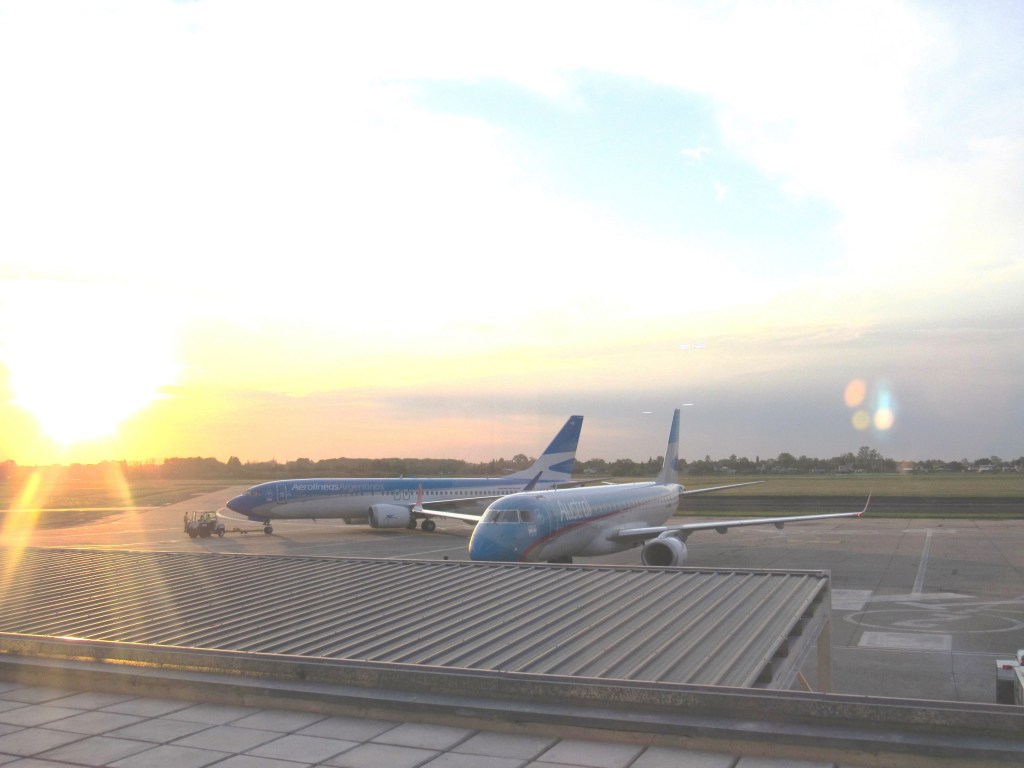
Gobierno Argentina ultima detalles para reapertura aérea el 19/10
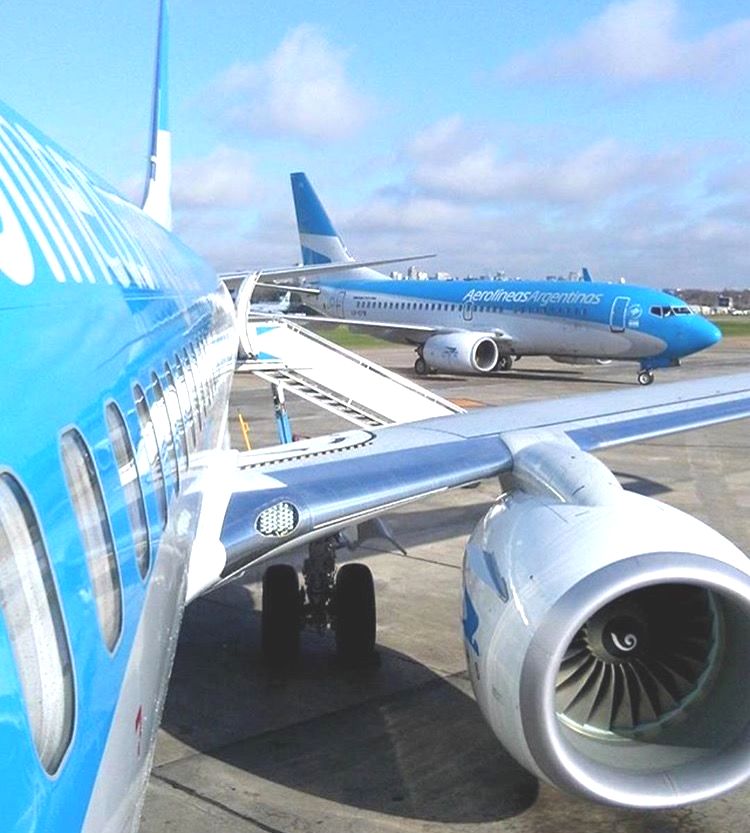
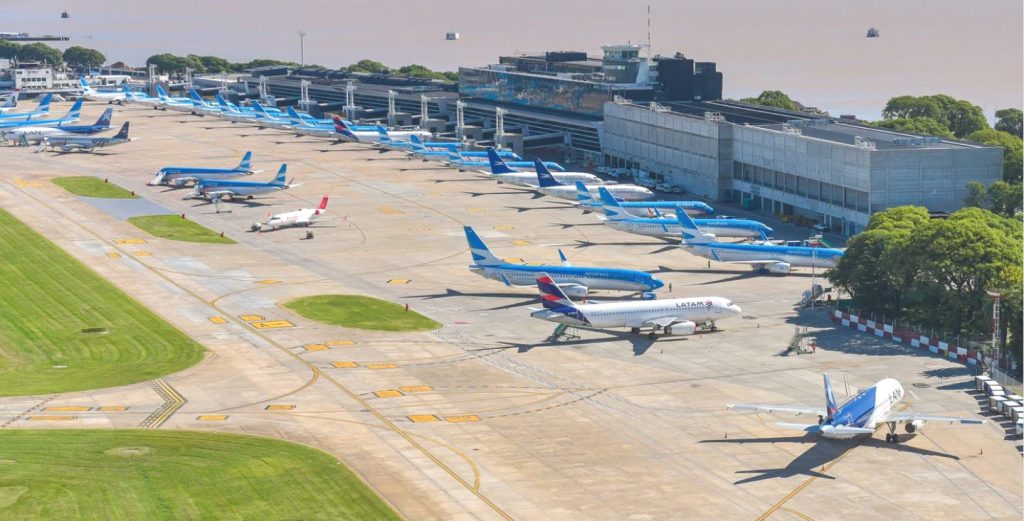
El Gobierno de Argentina se encuentra diagramando el retorno de la actividad aerocomercial en el país a partir del Lunes 19 de Octubre de 2020. La reanudación de los vuelos de cabotaje estarán sujetos a evaluaciones por parte de las quince provincias respectivas que por el momento podrían autorizar la reapertura de los vuelos de las líneas aéreas. El Gobierno nacional está autorizando la reapertura de la aviación comercial después de siete meses de suspensión para los vuelos domésticos, por lo cual a partir del próximo Lunes 19/10 quedarán habilitados los primeros servicios aéreos de transporte comercial de pasajeros para unir destinos entre unas quince provincias en todo el país.
Desde las compañías aéreas están preparando y reacondicionado la programación de sus vuelos a partir del próximo Lunes 19/10 como fecha de reapertura, pero se espera que las líneas aéreas no completen los asientos de los aviones debido a las reiteradas postergaciones y las nuevas limitaciones impuesta por el Gobierno. Aún así, se mantienen confiadas que transcurridas las semanas, el factor de ocupación tendría que ir aumentando, aunque lentamente. Sin embargo, estos primeros servicios no serán destinados a turistas sino que sólo estarán habilitados para trabajadores esenciales y personas que estén obligadas a trasladarse por tratamientos médicos, así como también alguna otra excepción que quedará a criterio de la Jefatura de Gabinete de Argentina. Además, el Gobierno atenderá todas las objeciones que pongan aquellos gobernadores que todavía mantienen la postura de continuar con el cuarentena estricta en el plano de los vuelos comerciales.
Los servicios aéreos rehabilitados serán siempre con los pasajeros establecidos por el DNU que entró este Lunes 12/10 en vigencia, que permite movilizarse al personal esencial establecido en el Artículo 11 y a quienes deban hacer tratamiento médico con acompañante, aunque advirtieron que estas categorías pueden ser ampliadas por el Gobierno.
La medida publicada este Lunes 12/10 en el Boletín Oficial equivale al regreso de la aviación comercial dentro del territorio nacional. A partir del Martes 13/10 el Ministerio de Transporte encabezado por Mario Meoni comenzará con las consultas a los gobernadores para tratar de lograr un consenso sobre en cuáles provincias podrán transitar los vuelos rehabilitados. Desde el Gobierno nacional aseguraron que estimularán el retorno a la aviación, pero la facultad de las provincias que no quieran adherirse primará por encima de la decisión de la reapertura hacia el 19/10 que entrará en vigencia en todo el país.
Argentina approves air reopening
Argentine government finalizes details for air reopening on 10/19
The Government of Argentina is charting the return of commercial aviation activity in the country as of Monday, October 19, 2020. The resumption of domestic flights will be subject to evaluations by the fifteen respective provinces that for the moment could authorize the reopening of airline flights. The national government is authorizing the reopening of commercial aviation after seven months of suspension for domestic flights, for which as of next Monday, 10/19, the first commercial passenger air services will be enabled to link destinations between some fifteen provinces across the country.
The airlines are preparing and reconditioning their flight schedules starting next Monday 10/19 as the reopening date, but it is expected that the airlines will not complete the aircraft seats due to the repeated postponements and the new limitations imposed. by the Government. Even so, they remain confident that after the weeks, the load factor would have to increase, although slowly. However, these first services will not be intended for tourists but will only be enabled for essential workers and people who are obliged to travel for medical treatment, as well as any other exception that will be left to the discretion of the Cabinet Office of Argentina. In addition, the Government will address all the objections raised by those governors who still maintain the position of continuing with the strict quarantine in the plane of commercial flights.
The rehabilitated air services will always be with the passengers established by the DNU that entered this Monday 10/12 into force, which allows the mobilization of essential personnel established in Article 11 and those who must undergo medical treatment with a companion, although they warned that these categories expanded by the Government.
The measure published this Monday 10/12 in the Official Gazette is equivalent to the return of commercial aviation within the national territory. As of Tuesday 10/13, the Ministry of Transport headed by Mario Meoni will begin with consultations with the governors to try to reach a consensus on which provinces the rehabilitated flights will be able to transit. From the national government they assured that they will stimulate the return to aviation, but the faculty of the provinces that do not want to join will take precedence over the decision to reopen by 10/19, which will take effect throughout the country.
AW | 2020 10 12 14:30 | AVIATION SAFET / AIR TRAFFIC
Tráfico aéreo interrumpido por ingreso del Tifón Chan-hom
A las 05:00 a.m. EDT (09:00 UTC), el centro del Tifón Chan-hom se encontraba cerca de 26,2 grados de latitud Norte y 134,4 grados de longitud Este. Estaba centrado a 378 millas náuticas al este de la Base Aérea de Kadena, Isla de Okinawa, Japón, moviéndose hacia el noroeste. Los vientos máximos sostenidos están cerca de 65 nudos (75 mph/120 kph) con ráfagas más fuertes.
Recuperaciones integradas de múltiples satélites de la NASA para GPM o IMERG, que es un producto de lluvia satelital de la NASA, estimado el 7 de Octubre 2020 a las 02:00 a.m. EDT (0600 UTC), Chan-hom estaba generando hasta 30 mm (1,18 pulgadas) de lluvia por hora que cae en la pared irregular del ojo que rodea el ojo. Se estimó que las precipitaciones durante la mayor parte de la tormenta cayeron a una velocidad de entre 5 y 15 mm (0,2 a 0,6 pulgadas) por hora. En el Laboratorio Naval de EE.UU. en Washington DC, los datos de lluvia de IMERG se superpusieron a imágenes infrarrojas del satélite GOES-16 de la NOAA para proporcionar una extensión completa de la tormenta. Además del cálculo de la precipitación dentro del tifón, las imágenes satelitales infrarrojas mejoradas animadas revelaron un sistema en consolidación con un ojo irregular. Las imágenes de microondas indican bandas mejoradas de tormentas eléctricas que se envuelven firmemente en una función de ojo de microondas. Las advertencias de fuertes lluvias están vigentes para Kyushu, la isla grande más al sur de Japón. Se publicaron alertas para gran parte de las costas centro-este y sureste de Japón.
IMERG
Esta estimación de lluvia casi en tiempo real proviene del IMERG de la NASA, que combina observaciones de una flota de satélites, en tiempo casi real, para proporcionar estimaciones casi globales de precipitación cada 30 minutos. Al combinar las estimaciones de precipitación de la NASA con otras fuentes de datos, podemos obtener una mayor comprensión de las grandes tormentas que afectan a nuestro planeta. En cambio, lo que hace el IMERG es transformar las observaciones satelitales de alta calidad a lo largo de la dirección de los vientos de dirección para entregar información sobre la lluvia en momentos y lugares donde no ocurrieron dichos sobrevuelos satelitales. La transformación de la información es particularmente importante en la mayor parte de la superficie del mundo que carece de cobertura de radar terrestre. Básicamente, IMERG llena los espacios en blanco entre las estaciones de observación meteorológica.
Pronóstico de Chan-hom
Los meteorólogos del Centro Conjunto de Alerta de Tifones (JTWC) esperan que el Tifón Chan-hom siga de noroeste a norte durante los próximos dos días y más cerca de Japón. Se pronostica que Chan-hom hará una trayectoria lenta paralela a la costa de Japón del 8 al 11 de octubre, cuando se espera que afecte a Tokio antes de dirigirse a aguas abiertas. JTWC espera que Chan-hom continúe debilitándose durante los próximos días y comience la transición a una tormenta extratropical.
NASA investiga ciclones tropicales
Los huracanes/ciclones tropicales son los eventos meteorológicos más poderosos de la Tierra. La experiencia de la NASA en exploración espacial y científica contribuye a los servicios esenciales que otras agencias federales brindan al pueblo estadounidense, como el pronóstico del tiempo de huracanes. Durante más de cinco décadas, la NASA ha utilizado el punto de vista del espacio para comprender y explorar nuestro planeta natal, mejorar vidas y salvaguardar nuestro futuro. La NASA reúne tecnología, ciencia y observaciones globales únicas de la Tierra para brindar beneficios sociales y fortalecer nuestra nación. El conocimiento avanzado de nuestro planeta natal contribuye directamente al liderazgo de Estados Unidos en la exploración espacial y científica.
Typhoon Chan-hom impact in Japan
Air traffic disrupted by entry of Typhoon Chan-hom
At 05:00 a.m. EDT (09:00 UTC), the center of Typhoon Chan-hom was near 26.2 degrees North latitude and 134.4 degrees East longitude. It was centered 378 nautical miles east of Kadena Air Base, Okinawa Island, Japan, moving northwest. Maximum sustained winds are near 65 knots (75 mph/120 kph) with stronger gusts.
Integrated NASA Multiple Satellite Retrievals for GPM or IMERG, which is a NASA satellite rain product, estimated on October 7, 2020 at 02:00 a.m. EDT (0600 UTC), Chan-hom was generating up to 30 mm (1.18 inches) of rain per hour falling on the irregular wall of the eye that surrounds the eye. Rainfall for most of the storm was estimated to have fallen at a rate of between 5 and 15 mm (0.2 to 0.6 inches) per hour. At the US Naval Laboratory in Washington DC, IMERG rainfall data was overlaid on infrared images from NOAA’s GOES-16 satellite to provide a full extent of the storm. In addition to calculating precipitation within the typhoon, the animated enhanced infrared satellite images revealed a consolidating system with an irregular eye. The microwave images indicate enhanced thunderstorm bands that are tightly wrapped in a microwave eye feature. Heavy rain warnings are in effect for Kyushu, Japan’s southernmost large island. Alerts were posted for much of the east-central and southeastern coasts of Japan.
IMERG
This near-real-time rainfall estimate comes from NASA’s IMERG, which combines observations from a fleet of satellites, in near-real time, to provide near-global estimates of precipitation every 30 minutes. By combining NASA’s precipitation estimates with other data sources, we can gain a greater understanding of the major storms that affect our planet. Instead, what IMERG does is transform high-quality satellite observations along the direction of the steering winds to deliver information about rainfall at times and places where such satellite flybys did not occur. Information transformation is particularly important in most of the world’s surface that lacks ground-based radar coverage. Basically, IMERG fills in the blanks between the weather observation stations.
Chan-hom forecast
Meteorologists from the Joint Typhoon Warning Center (JTWC) expect Typhoon Chan-hom to continue from northwest to north for the next two days and closer to Japan. Chan-hom is forecast to make a slow trajectory parallel to the coast of Japan from October 8-11, when it is expected to hit Tokyo before heading to open water. JTWC expects Chan-hom to continue to weaken over the next few days and begin the transition to an extratropical storm.
NASA investigates tropical cyclones
Hurricanes/tropical cyclones are the most powerful weather events on Earth. NASA’s expertise in space exploration and science contributes to essential services that other federal agencies provide to the American people, such as forecasting hurricane weather. For more than five decades, NASA has used the point of view of space to understand and explore our home planet, improve lives, and safeguard our future. NASA brings together technology, science, and unique global observations of Earth to deliver social benefits and strengthen our nation. Advanced knowledge of our home planet contributes directly to America’s leadership in scientific and space exploration.
JOINT TYPHOON WARNING CENTER (JTWC) 合同台風警報センター(JTWC)
WTPN31 PGTW 120900
MSGID / GENADMIN / JOINT TYPHOON WRNCEN PEARL HARBOR HI //
SUBJ / DEPRESIÓN TROPICAL 16W (CHAN-HOM) ADVERTENCIA NR 031 //
RMKS /
1. DEPRESIÓN TROPICAL 16W (CHAN-HOM) ADVERTENCIA NR 031
   02 CICLONES TROPICALES ACTIVOS EN EL NOROESTETPAC
   VIENTOS MÁXIMOS SOSTENIDOS SEGÚN EL PROMEDIO DE UN MINUTO
   RADIO DE VIENTO VÁLIDO SOLO SOBRE AGUA ABIERTA
    ---
   POSICIÓN DE ADVERTENCIA:
   120600Z --- CERCA DE 29.4N 142.4E
     MOVIMIENTO PASADAS SEIS HORAS - 180 GRADOS A 08 KTS
     POSICIÓN PRECISA DENTRO DE 020 NM
     POSICIÓN BASADA EN CENTRO UBICADO POR SATÉLITE
   DISTRIBUCIÓN DEL VIENTO ACTUAL:
   VIENTOS MAX SOSTENIDOS - 025 KT, RAFAGAS 035 KT
   RADIO DE VIENTO VÁLIDO SOLO SOBRE AGUA ABIERTA
   DISIPANDO COMO UN CICLÓN TROPICAL SIGNIFICATIVO SOBRE EL AGUA
   REPETIR POSICIÓN: 29.4N 142.4E
    ---
   PREVISIONES:
   12 HRS, VÁLIDO EN:
   121800Z --- 28,7N 142,9E
   VIENTOS MAX SOSTENIDOS - 020 KT, RAFAGAS 030 KT
   RADIO DE VIENTO VÁLIDO SOLO SOBRE AGUA ABIERTA
   DISIPADO COMO UN CICLÓN TROPICAL SIGNIFICATIVO SOBRE EL AGUA
   VECTOR A POSICIÓN DE 24 HR: 135 GRADOS / 04 KTS
    ---
   24 HRS, VÁLIDO EN:
   130600Z --- 28,2N 143,5E
   VIENTOS MAX SOSTENIDOS - 020 KT, RAFAGAS 030 KT
   RADIO DE VIENTO VÁLIDO SOLO SOBRE AGUA ABIERTA
   DISIPADO COMO UN CICLÓN TROPICAL SIGNIFICATIVO SOBRE EL AGUA
    ---
OBSERVACIONES:
POSICIÓN 120900Z CERCA DE 29.2N 142.5E.
12OCT20. DEPRESIÓN TROPICAL (TD) 16W (CHAN-HOM), UBICADO
APROXIMADAMENTE 138 NM AL NORTE DE CHICHI JIMA, SE HA SEGUIMIENTO HACIA EL SUR
A LOS 08 NUDOS DURANTE LAS ÚLTIMAS SEIS HORAS. MULTISPECTRAL ANIMADO
LA IMAGEN POR SATELITE MUESTRA UN SISTEMA TOTALMENTE EXPUESTO CON BAJO NIVEL
LÍNEAS DE NUBE ENVUELTAS EN UN CENTRO DEFINIDO, QUE SOPORTA
POSICIÓN INICIAL CON BUENA CONFIANZA. UNA IMAGEN 120648Z SSMIS 91GHZ
REVELA ENVOLTURA DE BANDAS PROFUNDAS EN UN NIVEL BAJO DEFINIDO
CENTRO DE CIRCULACIÓN SIN CONVECCIÓN PROFUNDA. LA INTENSIDAD INICIAL ES
EVALUADO A 25 NUDOS EN BASE A DATOS RECIENTES DE ASCAT. AMBIENTAL
EL ANÁLISIS INDICA CONDICIONES DESFAVORABLES CON MODERADO (20-25
NUDOS) CORTE DE VIENTO VERTICAL, CONVERGENCIA ALTA Y SECO IMPORTANTE
ENTRENAMIENTO DE AIRE. SE PRONOSTICA QUE TD 16W SE HAYA SURESTE A LO LARGO DEL
PERIFERIA NORESTE DE LA DORADA SUBTROPICAL DE BAJO NIVEL Y ES
PREVISIÓN DE DISIPACIÓN POR TAU 12. ESTA ES LA ADVERTENCIA FINAL DE ESTA
SISTEMA POR EL CONJUNTO TYPHOON WRNCEN PEARL HARBOR HI. EL SISTEMA
ESTÉ MUY SEGUIMIENTO DE SEÑALES DE REGENERACIÓN. MÁXIMO SIGNIFICATIVO
LA ALTURA DE ONDA EN 120600Z ES DE 10 PIES. CONSULTAR TORMENTA TROPICAL 18W
(NANGKA) ADVERTENCIAS (WTPN33 PGTW) PARA ACTUALIZACIONES DE SEIS HORAS .//

NNNN
Aerolíneas desarrolla plan para reinicio operaciones aéreas
Aerolíneas Argentinas prevé potenciar el negocio de cargas como uno de los ejes del plan estratégico para el futuro post-pandemia, luego de adoptar medidas de contingencia que le permitieron ahorrar AR$ 350 millones Pesos mensuales desde Junio 2020. El relanzamiento de la unidad de Cargas «resultará clave en el contexto post pandemia», destacó el Ministerio de Transporte en un informe cuyas definiciones principales fueron incorporadas a la reciente presentación en el Senado del Jefe de Gabinete, Santiago Cafiero.
La fusión con Austral Líneas Aéreas, busca concluir la sinergia definitiva con Aerolíneas, «no sólo eliminará estructuras duplicadas, sino que permitirá el ahorro de costos impositivos y duplicación en pagos de servicios operativos, aportará mayor previsibilidad en términos de dotación y mejor manejo de las jornadas laborales», indicó la cartera del Ministerio de Transporte.
Las áreas de operaciones de las dos empresas ya trabajan en conjunto para lograr la reorganización efectiva con ambas líneas aéreas y se prevé la fusión de los dos talleres aeronáuticos de reparaciones para el próximo 1 Noviembre 2020. La unidad Técnica de Aerolíneas Argentinas está realizando su propio desarrollo para brindar a terceros servicios de mantenimiento de aeronaves (mayor y de línea), de componentes, en general y motores, e instrucción de certificada por Airbus para mecánicos de A330-200. «Como compañía líder del mercado aerocomercial argentino, Aerolíneas cuenta con las instalaciones y el know how calificado para salir a ofrecer este servicio a otras líneas aéreas y ampliar la cartera de productos hacia ese segmento», sostuvo el Ministerio de Transporte.
Plan post-pandemia
El plan post-pandemia se diseñó luego de aplicarse en los últimos meses una política de mitigación de gastos, a fin de reorganizar los recursos de acuerdo con las necesidades de dotación y la situación financiera de la empresa.
Aerolíneas, en ese sentido, negoció con los gremios la suspensión de 4.000 empleados en el marco del Artículo 223 bis de la Ley de Contrato de Trabajo, y dejó de abonar algunos ítems laborales, tales como viáticos y horas extras del personal de tierra y vuelo, mientras en material salarial se acordó con los directores y gerentes una reducción de entre el 10 y 20% del sueldo. A la vez, el pago de los medio aguinaldos de julio superiores a AR$ 40.000 brutos se abonó en cuotas y se depositó en dos partes el salario de Junio 2020. Como complemento, se encuentra abierto un nuevo Programa de Acuerdo de Prejubilaciones, que tiene como finalidad reducir la dotación, con acuerdos beneficiosos tanto para el personal cercano a la jubilación como para la compañía.
En lo que respecta al resultado económico de Aerolíneas, en Enero-Julio 2020 se acumuló un déficit de US$ 374,5 millones debido a la parálisis casi total de operaciones, sólo se generaron ingresos por el tráfico de pasajeros repatriados, por vuelos especiales y el traslado de insumos sanitarios provenientes de China.
Ante esa situación el Tesoro Nacional realizó transferencias por AR$ 16.894 millones para abonar salarios de los trabajadores, asegurar el mantenimiento de la flota y continuar con las actividades mínimas. Esos recursos se aportaron desde Marzo 2020, ya que durante los dos primeros meses del año, Aerolíneas Argentinas había recibido un 15% menos de subsidios, en comparación con el mismo período de 2019.
Plan PreViaje
Aerolíneas Argentinas anunció que se sumará al plan Previaje anunciado este jueves por el ministerio de Turismo de la Nación, el cual busca impulsar el turismo interno para el 2021 mediante el otorgamiento de créditos que sirven como un 50% de reintegro a quienes compren un pasaje en el sitio web de la compañía. La campaña busca poder darle a los turistas la posibilidad de programar sus viajes en un contexto dinámico debido a la pandemia mundial, cosa que Aerolíneas también permite gracias a su política de vuelos flexibles, los cuales le dan la posibilidad a los pasajeros de realizar un cambio de fecha del boleto sin costos ni cargos extras y de acceder a 6 cuotas sin interés con el plan Ahora 6, comprando antes del 25 de Octubre de 2020.
Pablo Ceriani, Presidente de la línea aérea de bandera, expresó: «Este programa es un gran incentivo para que los argentinos y argentinas puedan planificar su próximo viaje para el 2021 aprovechando los beneficios de PreViaje. Aerolíneas Argentinas va a ser uno de los motores para impulsar la reactivación del turismo interno, esto va a beneficiar a las economías regionales». Cabe destacar que Aerolíneas Argentinas cuenta con protocolos de salud y medidas de higiene para sus operaciones en cada una de las etapas del viaje tanto en los aeropuertos como en los vuelos, los cuales fueron diseñados siguiendo las recomendaciones de International Air Transport Association (IATA), Airport Council International (ACI), Organización Mundial de la Salud (OMS) y el Ministerio de Salud de la Nación.
El plan Previaje es una medida anunciada por el Ministerio de Turismo de la Nación, en la cual se asegura la entrega de un reintegro del 50% de los gastos en turismo para quienes vayan a destinos de la Argentina, el cual deberá suceder en un plazo de hasta 30 días contando desde la fecha del comprobante. Luego, a la hora de canjear el beneficio, por ejemplo en enero de 2021, se podrá hacer hasta 30 días antes de la fecha del viaje. Para viajes a partir de febrero, la fecha límite es el 31 Diciembre 2020. Desde el Ministerio se dieron dos ejemplos simples para conocer cómo funciona el plan de incentivo al turismo local, uno con un viaje desde el Calafate a Córdoba y el otro con un viaje a Iguazú.
Actualmente está disponible el sistema de preventa turística, que busca incentivar el turismo local al darle a los clientes un crédito del 50% de lo gastado este año en la compra de sus viajes para 2021. El programa prevé que el Estado aporte AR$ 16.500 millones. El Ministerio de Turismo ha anunciado que ya hay 2.000 prestadores entre los que se encuentran los principales sitios de venta online, como Despegar y Almundo. Prevén que se realizarán preventas por AR$ 30.000 millones. Esto implicaría un movimiento de AR$ 45.000 millones para reactivar al sector en todas las regiones del país.
Strategies at Aerolíneas Argentinas
Aerolíneas develops plan to restart air operations
Aerolíneas Argentinas plans to strengthen the cargo business as one of the axes of the strategic plan for the future post-pandemic, after adopting contingency measures that allowed it to save AR$ 350 million pesos per month from June 2020. The relaunch of the Cargo unit «it will be key in the post-pandemic context», highlighted the Ministry of Transportation in a report whose main definitions were incorporated into the recent presentation in the Senate of the Chief of Staff, Santiago Cafiero.
The merger with Austral Líneas Aéreas, seeks to conclude the definitive synergy with Aerolíneas, «will not only eliminate duplicate structures, but will allow savings in tax costs and duplication in payments for operational services, will provide greater predictability in terms of staffing and better management of the working hours», indicated the Ministry of Transport portfolio.
The areas of operations of the two companies are already working together to achieve an effective reorganization with both airlines and the merger of the two aeronautical repair workshops is expected for next November 1, 2020. The Technical Unit of Aerolíneas Argentinas is carrying out its own development to provide third-party maintenance services for aircraft (major and line), components, in general and engines, and training certified by Airbus for A330-200 mechanics. «As a leading company in the Argentine commercial aviation market, Aerolíneas has the facilities and the qualified know-how to go out and offer this service to other airlines and expand the portfolio of products to that segment», said the Ministry of Transportation.
Post-pandemic plan
The post-pandemic plan was designed after applying an expense mitigation policy in recent months, in order to reorganize resources according to the endowment needs and the financial situation of the company.
Aerolíneas, in this sense, negotiated with the unions the suspension of 4,000 employees within the framework of Article 223 bis of the Labor Contract Law, and stopped paying some labor items, such as per diem and overtime for ground and flight personnel, while in salary material a reduction of between 10 and 20% of the salary was agreed with the directors and managers. At the same time, the payment of the July half bonuses exceeding AR$ 40,000 gross was paid in installments and the June 2020 salary was deposited in two parts. As a complement, a new Early Retirement Agreement Program is open, which has The aim is to reduce the endowment, with agreements that are beneficial to both the personnel nearing retirement and the company.
Regarding the economic result of Aerolíneas, in January-July 2020 a deficit of US$ 374.5 million was accumulated due to the almost total paralysis of operations, income was only generated by the traffic of repatriated passengers, by special flights and the transfer of sanitary supplies from China.
Faced with this situation, the National Treasury made transfers for AR$ 16,894 million to pay workers’ salaries, ensure the maintenance of the fleet and continue with the minimum activities. These resources were provided since March 2020, since during the first two months of the year, Aerolíneas Argentinas had received 15% less subsidies, compared to the same period in 2019.
Pre-trip Plan
Aerolíneas Argentinas announced that it will join the Pre-trip plan announced this Thursday by the Ministry of Tourism of the Nation, which seeks to promote domestic tourism by 2021 by granting credits that serve as a 50% refund to those who buy a ticket in the company’s website. The campaign seeks to give tourists the possibility to schedule their trips in a dynamic context due to the global pandemic, which Aerolíneas also allows thanks to its flexible flight policy, which gives passengers the possibility to make a change. From the date of the ticket without costs or extra charges and to access 6 interest-free installments with the Now 6 plan, buying before October 25, 2020.
Pablo Ceriani, President of the flag carrier, said: «This program is a great incentive for Argentines to plan their next trip for 2021, taking advantage of the benefits of Pre-Travel. Aerolíneas Argentinas will be one of the engines for to promote the reactivation of domestic tourism, this will benefit regional economies». It should be noted that Aerolíneas Argentinas has health protocols and hygiene measures for its operations in each of the stages of the trip, both at airports and on flights, which were designed following the recommendations of International Air Transport Association (IATA), ACI Airport Council International (ACI), World Health Organization (WHO) and the Ministry of Health of the Nation.
The Pre-trip plan is a measure announced by the Ministry of Tourism of the Nation, which ensures the delivery of a reimbursement of 50% of tourism expenses for those who go to destinations in Argentina, which must happen within a period up to 30 days counting from the date of the receipt. Then, when it comes to redeeming the benefit, for example in January 2021, it can be done up to 30 days before the date of travel. For trips from February, the deadline is 12 Diciembre 2020. The Ministry gave two simple examples to learn how the local tourism incentive plan works, one with a trip from El Calafate to Córdoba and the other with a trip to Iguazú.
The tourist pre-sale system is currently available, which seeks to encourage local tourism by giving customers a credit of 50% of what was spent this year on the purchase of their trips for 2021. The program foresees that the State will contribute AR$ 16,500 million. The Ministry of Tourism has announced that there are already 2,000 providers among which are the main online sales sites, such as Despegar and Almundo. They foresee that pre-sales will be made for AR$ 30,000 million. This would imply a movement of AR$ 45,000 million to reactivate the sector in all regions of the country.
El Gobierno de Argentina oficializó este 11/10 el decreto que establece la extensión, hasta el 25 de Octubre de 2020, de las medidas de distanciamiento y aislamiento en todo el territorio nacional, según se publicó este Lunes 12/10 en el Boletín Oficial. A través del Decreto 792/2020 el Gobierno estableció cómo continuarán las restricciones y flexibilizaciones en todo el país y prorrogó el Distanciamiento Social Preventivo y Obligatorio (DISPO) y el Aislamiento Social Preventivo y Obligatorio (ASPO) hasta esa fecha, en el marco de la emergencia sanitaria establecida ante la pandemia de coronavirus.
Distanciamiento social
Por otro lado, el distanciamiento se seguirá aplicando en aquellas jurisdicciones en las que el sistema de salud cuente con capacidad suficiente y adecuada para dar respuesta a la demanda sanitaria, donde no haya transmisión comunitaria y en las que la evolución de la cantidad de casos en las últimas dos semanas haya manifestado un descenso. En el decreto se determinó que estarán bajo las medidas de distanciamiento, con las mismas características y protocolos que hasta el momento la totalidad de las provincias de Catamarca, Corrientes, Entre Ríos, Formosa, La Pampa y Misiones.
Según se estableció, los gobiernos provinciales continúan manteniendo la facultad para, en caso de detectar situaciones de riesgo de propagación del virus, disponer el aislamiento preventivo respecto de personas que ingresen a las provincias provenientes de otras jurisdicciones por un plazo máximo de 14 días. En el caso de los departamentos y partidos de hasta 500 mil habitantes, las autoridades provinciales podrán disponer nuevas excepciones al cumplimiento del aislamiento social, preventivo y obligatorio y a la prohibición de circular con el fin de autorizar actividades industriales, de servicios, comerciales, sociales, deportivas o recreativas. Para ello deberán contar con la aprobación previa de la autoridad sanitaria provincial e implementar un protocolo que contemple todas las recomendaciones e instrucciones de la autoridad sanitaria nacional.
Reapertura aérea stand-by
Tras la publicación del Boletín Oficial del decreto de extensión de la cuarentena, continúan las indefiniciones respecto del reinicio de los vuelos regulares. A la espera a la publicación del decreto para determinar si se concreta la reapertura, en cualquier caso, las compañías tendrían un comienzo difícil que remontar. Entre las compañías aéreas argentinas como JetSmart Airlines Argentina, Flybondi Líneas Aéreas y Andes Líneas Aéreas admiten que la ecuación económica-financiera será muy compleja, teniendo presente que un vuelo para ser rentable requiere un piso de 75% de ocupación, y calculan que ese indicador será muchísimo más bajo aun con la dilatada reapertura.
Postura del Gobierno
El Ministerio de Transporte anticipó que será la Nación la que autorice el regreso del cabotaje después de casi ocho meses, pero que son los gobernadores los que deben decidir si aceptan los vuelos. El tema reaviva una cuestión que ya se debate por el tránsito en rutas terrestres: los constitucionalistas insisten en que el movimiento interjurisdiccional es potestad de la Nación. Santa Cruz ya adelantó que no aceptará operaciones; el resto espera el decreto. No sólo se trata de que permitan aterrizar al avión; después los pasajeros deben cumplir exigencias para quedarse en el lugar, como hacerse hisopados y adoptar períodos de cuarentena.
Aerolíneas vs post-pandemia
Las aerolíneas señalan que Transporte les delegó la tarea de gestionar ante los gobernadores si pueden o no operar. «Es Transporte el que debería decir la programación y a qué provincias se puede volar», definió el CEO de Flybondi, Esteban Tosutti. Para Aerolíneas Argentinas ya circula una programación de frecuencias con fecha del 19/10.
«Claramente es muy difícil que los actores privados puedan sobrevivir sin algún nivel de colaboración del Estado, sean subsidios, refinanciación de deudas o perdones fiscales. Ya es compleja la supervivencia con más de siete meses sin facturar; en algunos casos consiguieron renegociar con los que les alquilan los aviones, pero nadie logró hacerlo por el total. A eso se suma que de por sí la demanda estará alicaída y que algunas provincias asumen posiciones soviéticas para que la gente pueda ingresar. Son muchas las dificultades para que haya cierta normalidad», describe el especialista en el sector aéreo Franco Rinaldi. La suba del dólar es un ingrediente extra más, ya que la mayoría de los costos de las empresas están en esa moneda (alquiler de unidades y combustible). Por hora de vuelo se requieren unos US$ 4.000 de combustible. La ecuación económica es evidente, con menos pasajeros los tickets deben ser más caros, si no el vuelo es a pérdida. «En todos estos meses lo realizado en materia de política aerocomercial es un desaguisado total; hay que estar atento a cómo evolucionen los números de las compañías y de AA2000», apunta Franco Rinaldi.
«El mercado argentino es chico, con gran potencial de desarrollo, pero está por debajo del resto de la región; recién estábamos empezando a ver un repunte cuando comenzó este problema. Volvemos atrás y será muy complicado el crecimiento con un poder de compra de la población venido a menos. No hay compañía aérea en el mundo que no haya hecho una reestructuración, sea devolviendo aviones, frenando entregas programadas y con despidos y retiros voluntarios. En la Argentina se cobra en pesos y los costos son en dólares, y la demanda está en problemas. Por eso la sustentabilidad está en juego», concluye el analista de aviación comercial.
Argentina extends quarantine
Uncertainty about commercial aviation reopening continues
The Government of Argentina made official this 10/11 the decree that establishes the extension, until October 25, 2020, of the distancing and isolation measures throughout the national territory, as published this Monday 10/12 in the Official Gazette. Through Decree 792/2020 the Government established how restrictions and flexibilities will continue throughout the country and extended the Preventive and Obligatory Social Distancing (DISPO) and the Preventive and Compulsory Social Isolation (ASPO) until that date, within the framework of the health emergency established in the face of the coronavirus pandemic.
Social distancing
On the other hand, distancing will continue to be applied in those jurisdictions in which the health system has sufficient and adequate capacity to respond to the health demand, where there is no community transmission and in which the evolution of the number of cases in the last two weeks have shown a decline. In the decree it was determined that they will be under the distancing measures, with the same characteristics and protocols as so far the entire provinces of Catamarca, Corrientes, Entre Ríos, Formosa, La Pampa and Misiones.
As established, the provincial governments continue to maintain the power to, in the event of detecting situations of risk of spreading the virus, order preventive isolation from people entering the provinces from other jurisdictions for a maximum period of 14 days. In the case of departments and parties with up to 500 thousand inhabitants, the provincial authorities may provide new exceptions to compliance with social, preventive and mandatory isolation and the prohibition of driving in order to authorize industrial, service, commercial, social activities, sports or recreational. To do this, they must have the prior approval of the provincial health authority and implement a protocol that includes all the recommendations and instructions of the national health authority.
Stand-by aerial reopening
After the publication of the Official Gazette of the decree to extend the quarantine, uncertainties continue regarding the restart of regular flights. While waiting for the publication of the decree to determine if the reopening is finalized, in any case, the companies would have a difficult start to overcome. Among Argentine airlines such as JetSmart Airlines Argentina, Flybondi Líneas Aéreas and Andes Líneas Aéreas admit that the economic-financial equation will be very complex, bearing in mind that a flight to be profitable requires a floor of 75% occupancy, and they calculate that this indicator it will be much lower even with the long reopening.
Government position
The Ministry of Transportation anticipated that it will be the Nation that authorizes the return of cabotage after almost eight months, but that it is the governors who must decide whether to accept the flights. The issue revives an issue that is already being debated by the transit on land routes: the constitutionalists insist that the interjurisdictional movement is the authority of the Nation. Santa Cruz has already announced that it will not accept operations; the rest await the decree. It’s not just about allowing the plane to land; then passengers must meet requirements to stay in place, such as getting swabs and adopting quarantine periods.
Airlines vs post-pandemic
The airlines point out that Transport has delegated the task of managing to the governors whether or not they can operate. «It is Transport that should say the schedule and to which provinces you can fly», defined Flybondi CEO Esteban Tosutti. For Aerolineas Argentinas a frequency schedule already circulates dated 10/19.
«Clearly, it is very difficult for private actors to survive without some level of collaboration from the State, be it subsidies, debt refinancing or tax forgiveness. Survival with more than seven months without invoicing is already complex; in some cases they managed to renegotiate with those who They rent the airplanes from them, but nobody managed to do it for the total. To this is added that demand will already be low and that some provinces assume Soviet positions so that people can enter. There are many difficulties for there to be a certain normality», describes the specialist in the aviation sector Franco Rinaldi. The rise of the dollar is one more extra ingredient, since most of the costs of the companies are in that currency (rental of units and fuel). Per flight hour requires about US$ 4,000 of fuel. The economic equation is evident, with fewer passengers the tickets must be more expensive, if not the flight is at a loss. «In all these months what has been done in the area of commercial air policy is a total mess; we must be attentive to how the numbers of the companies and AA2000 evolve», points out Franco Rinaldi.
«The Argentine market is small, with great development potential, but it is below the rest of the region; we were just beginning to see a rebound when this problem began. We are going back and growth will be very complicated with a purchasing power of the There is no airline in the world that has not done a restructuring, either by returning planes, stopping scheduled deliveries and with layoffs and voluntary retirements. In Argentina it is charged in pesos and the costs are in dollars, and the demand is in trouble. That’s why sustainability is at stake», concludes the commercial aviation analyst.
Aerolíneas reinician vuelos en mercado dificultoso
La reactivación del tráfico aéreo en Sudamérica que atendió a más de 3.8 millones de pasajeros en 2019, continúa atravesando el foco pandémico, como nuevos rebrotes en todo el mundo. Los cambios de consumo de los usuarios del transporte aerocomercial regresa con menos aerolíneas y una composición de mercado muy diferente. El cierre de fronteras implementado por varios países para contener la propagación del COVID-19 afectó a varios países, con un impacto particularmente fuerte en la región sudamericana, que, tras una prolongada suspensión de vuelos desde Marzo 2020, continúa paulatinamente su reapertura, con una composición de mercado que se ha modificado en el nuevo escenario post-pandemia.
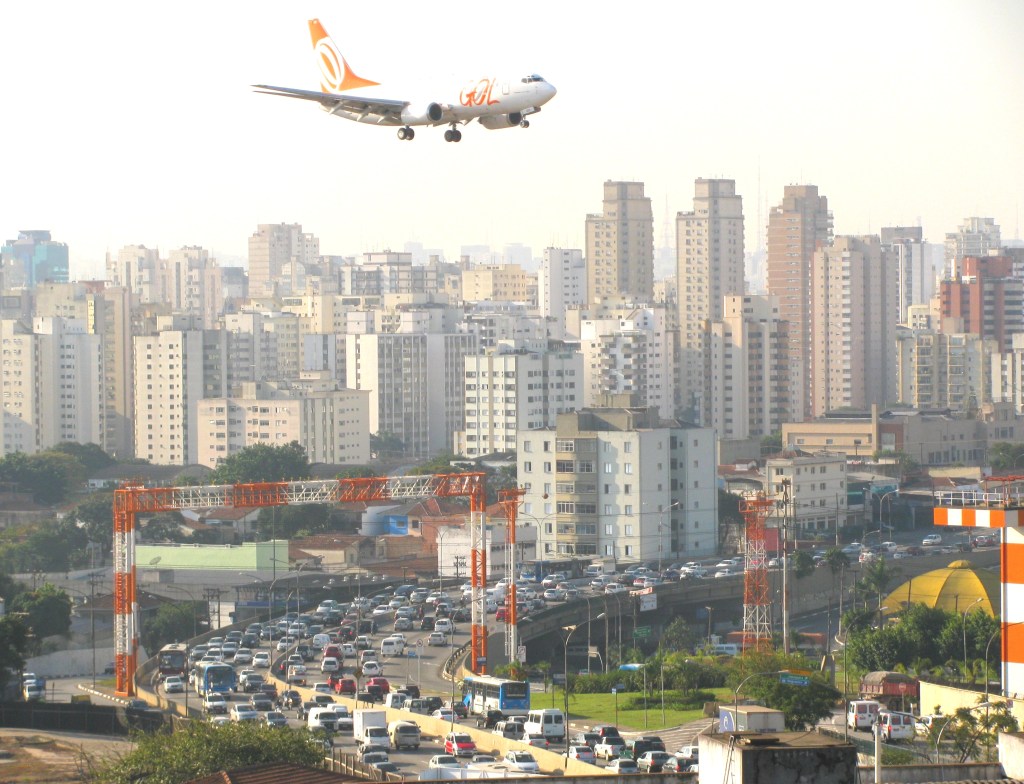
La reactivación de los mercado en los diferentes países han sido diferentes. La República de Brasil ha sido el país que no tuvo restricciones para los viajes internacionales y domésticos, por lo cual reinició sus vuelos desde Julio 2020, de manera progresiva se ha visto cómo la economía retornaba a la actividad, mientras que la República de Ecuador reiniciaba sus operaciones en Agosto 2020 con una alta tasa de contagios y fallecimientos producto por la pandemia. Tanto la República de Colombia y Perú abrieron sus vuelos internacionales a partir de Octubre 2020, mientras que la República de Chile mantiene una operación limitada sólo para residentes, y la República Argentina continúa blindada a las operaciones aéreas internacionales y domésticas, postergando el reinicio de las operaciones desde el 1 Septiembre 2020.
Escenario post-pandemia
«La reanudación de operaciones en este mercado obedece a una necesidad financiera de las aerolíneas, en primera instancia, donde se busca aprovechar las oportunidades en cuanto las condiciones están dadas. Un punto relevante de esto es el concepto de costos fijos, que para las aerolíneas pesa y necesitan recuperarse lo más rápido posible. Por ello ponen a trabajar sus activos urgentemente», expresa Jorge Senties, socio de Estrategia y Mercados de consumo de PwC en México.
La industria aérea global ha sido afectada por el coronavirus, la falta de apoyos gubernamentales en Latinoamérica de 0.8% de los ingresos de 2019 respecto al 14% registrado mundialmente, también derivará en el regreso de una oferta contraída, con menores rutas y capacidades de parte de las aerolíneas, que deben elegir sus batallas en medio de presiones financieras. “Una parte importante será cómo reaccionarán los gobiernos para ver si ayudan o no a las aerolíneas. En Estados Unidos ha habido diferentes paquetes para apoyar a diferentes industrias, pero los gobiernos latinoamericanos no han reaccionado tan rápidamente, por lo que la pregunta vuelve a ser si habrá apoyos o no”, concluye Jorge Senties.
El mercado aéreo sudamericano está modificando el próximo escenario en la cantidad de compañías, conexiones, servicios, etcétera. El proceso de adecuación bajo la Ley de Quiebras en Estados Unidos ha permitido ganar tiempo a las aerolíneas Latam Airlines Group y Avianca Airlines, dos grandes del sector del transporte, para restructurarse financieramente. La mayoría de las compañías continúa con un fuerte proceso de cambios de mercado, pero otras no han sobrevivido como son los casos de Avianca Perú, TAME Ecuador. Pero el cambio de escenario económico ha permitido surgir nuevas aerolíneas con economías con una posición más sólida como son los casos de ITA Linhas Aéreas, Nella Linhas Aéreas en Brasil.
El retorno se da bajo condiciones totalmente diferentes, no sólo por la contingencia sanitaria, sino por las condiciones de sus principales jugadores del transporte aéreo donde varias líneas aéreas se han contraído, mientras que otras dejaron de existir. Las compañías que continúan volando van a aprovechar un mercado cautivo que se va a ir recuperándose.
Perspectivas aéreas
Las aerolíneas descartan que los gobiernos latinoamericanos puedan brindar tales ayudas, más bien concentran sus energías para poder armar el rompecabezas para reactivar sus economías y no morir en el intento. La crisis generada por la actual pandemia dejará profundas heridas en el transporte aéreo donde la ley de la selva rige con mayor severidad, sobrevive el más apto al mercado.
Reactivating flights in South America
Airlines restart flights in difficult market
The reactivation of air traffic in South America, which served more than 3.8 million passengers in 2019, continues to go through the pandemic outbreak, as new outbreaks around the world. The changes in consumption of the users of commercial air transport returns with fewer airlines and a very different market composition. The border closures implemented by several countries to contain the spread of COVID-19 affected several countries, with a particularly strong impact on the South American region, which, after a prolonged suspension of flights since March 2020, gradually continues its reopening, with a market composition that has changed in the new post-pandemic scenario.
The reactivation of the markets in the different countries have been different. The Republic of Brazil has been the country that did not have restrictions on international and domestic travel, for which it restarted its flights since July 2020, progressively it has been seen how the economy returned to activity, while the Republic of Ecuador restarted its operations in August 2020 with a high rate of infections and deaths due to the pandemic. Both the Republic of Colombia and Peru opened their international flights as of October 2020, while the Republic of Chile maintains a limited operation only for residents, and the Argentine Republic continues to be shielded from international and domestic air operations, postponing the restart of flights. operations from September 1, 2020.
Post-pandemic scenario
«The resumption of operations in this market is due to a financial need of the airlines, in the first instance, where they seek to take advantage of opportunities as soon as the conditions are given. A relevant point of this is the concept of fixed costs, which for airlines they are heavy and they need to recover as quickly as possible. That is why they urgently put their assets to work», says Jorge Senties, partner of Strategy and Consumer Markets at PwC in Mexico.
The global airline industry has been affected by the coronavirus, the lack of government support in Latin America of 0.8% of 2019 revenues compared to the 14% registered worldwide, will also lead to the return of a contracted offer, with fewer routes and part capacities. of the airlines, who must choose their battles amid financial pressures. “An important part will be how governments will react to see whether or not they help the airlines. In the United States there have been different packages to support different industries, but Latin American governments have not reacted so quickly, so the question is once again whether there will be support or not”, concludes Jorge Senties.
The South American air market is changing the next scenario in the number of companies, connections, services, and so on. The adaptation process under the Bankruptcy Law in the United States has allowed the airlines Latam Airlines Group and Avianca Airlines, two large companies in the transportation sector, to gain time to financially restructure. Most of the companies continue with a strong process of market changes, but others have not survived, such as Avianca Peru, TAME Ecuador. But the change in the economic scenario has allowed the emergence of new airlines with economies with a more solid position, such as the cases of ITA Linhas Aéreas, Nella Linhas Aéreas in Brazil.
The return occurs under totally different conditions, not only due to the health contingency, but also due to the conditions of its main air transport players where several airlines have contracted, while others ceased to exist. The companies that continue to fly are going to take advantage of a captive market that is going to recover.
Aerial perspectives
The airlines rule out that Latin American governments can provide such aid, rather they focus their energies to be able to put together the puzzle to reactivate their economies and not die trying. The crisis generated by the current pandemic will leave deep wounds in air transport where the law of the jungle rules with greater severity, the best fit for the market survives.
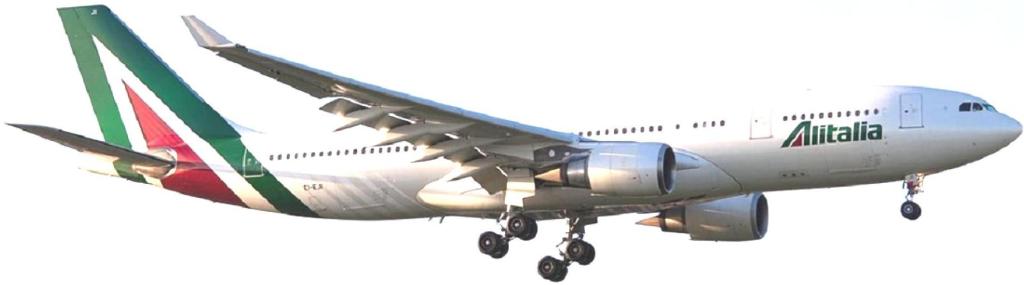
Alitalia será nacionalizada por € 3.000 millones de euros
El Gobierno de Italia ha anunciado un rescate financiero para su aerolínea Alitalia, que ha estado en administración durante los últimos tres años, con una inyección de capital de € 3.000 millones de Euros, ha comunicado la cartera del Ministerio de Economía. El Viernes 09/10 el Gobierno nacional ha firmado un decreto para nacionalizar la aerolínea italiana con el propósito y compromiso de dar continuidad a una compañía referente de la República de Italia. “Los Ministros de Economía, Industria, Transportes y Trabajo firmaron este Viernes el decreto fundacional de la nueva empresa que surge de 11 años de difícil gestión privada y tres intentos fallidos de reestructuración, que se ven lastrados por los problemas agravados por la crisis del Coronavirus. El primer desafío es el nuevo plan industrial para la pandemia que se presentará en un plazo de 30 días al Parlamento, que luego deberá evaluar el decreto. El despegue real de la nueva Alitalia con Francesco Caio, Presidente y Fabio Lazzerini, Director Ejecutivo, está programado para principios de 2021”, expresaba el anuncio del Gobierno.
Alitalia ha sido una aerolínea con problemas con fases alternas durante casi treinta años. La última situación difícil de Alitalia había comenzado ya en Noviembre 2019, cuando se retiraron las últimas ofertas por Expresiones de Interés (EoI) para adquisición de la empresa y el Gobierno se enfrentó a la difícil decisión de hacer que la empresa fracasara o implementar una nueva intervención pública, la tercera en poco más de diez años.
Alitalia Ita
La compañía aérea italiana continuaba volando, aunque técnicamente estaba bajo administración para la reorganización. La aerolínea ha tenido que despedir a unos 7.000 trabajadores y, actualmente, tiene una capacidad y un número de vuelos muy limitados. Tras la nacionalización de la línea aéreas, es rebautizada como Alitalia Ita, la empresa sucesora de Alitalia, se establecerá con el 100% de propiedad del Ministerio de Economía italiano, como parte de los anuncios de un viraje en busca de una reestructuración completa para la aerolínea.
El plan actual para la nueva Alitalia Ita es permanecer como una aerolínea de servicio completo, dentro de las aerolíneas clásicas, descartando y rechazando un plan como aerolínea de presupuesto. “Esta nueva aerolínea está tomando forma en un momento en que la demanda de viajes aéreos es baja y hay una sobreabundancia de capacidad en todo el mundo. Parece que no importa en qué dirección vaya esta nueva aerolínea italiana; tendrá las probabilidades en contra”, comenta un analista del sector.
Italian Government nationalizes Alitalia
Alitalia will be nationalized for € 3,000 million euros
The Government of Italy has announced a financial rescue for its airline Alitalia, which has been in administration for the last three years, with a capital injection of € 3 billion, the Ministry of Economy has announced. On Friday 10/09 the national government has signed a decree to nationalize the Italian airline with the purpose and commitment of giving continuity to a leading company in the Republic of Italy. “The Ministers of Economy, Industry, Transport and Labor signed this Friday the founding decree of the new company that arises from 11 years of difficult private management and three unsuccessful attempts at restructuring, which are hampered by problems aggravated by the Coronavirus crisis . The first challenge is the new industrial plan for the pandemic that will be presented within 30 days to Parliament, which will then have to evaluate the decree. The real take-off of the new Alitalia with Francesco Caio, President and Fabio Lazzerini, Executive Director, is scheduled for early 2021”, stated the Government’s announcement.
Alitalia has been a troubled airline with alternate phases for almost thirty years. The last difficult situation for Alitalia had already started in November 2019, when the last offers for Expressions of Interest (EoI) to acquire the company were withdrawn and the Government faced the difficult decision to make the company fail or implement a new one. public intervention, the third in little more than ten years.
Alitalia Ita
The Italian airline was continuing to fly, although technically it was under management for the reorganization. The airline has had to lay off some 7,000 workers and currently has a very limited capacity and number of flights. Following the nationalization of the airline, it is renamed Alitalia Ita, the successor company to Alitalia, it will be established with 100% ownership by the Italian Ministry of Economy, as part of the announcements of a turnaround in search of a complete restructuring for the airline.
The current plan for the new Alitalia Ita is to remain a full service airline, within the classic airlines, discarding and rejecting a plan as a budget airline. “This new airline is taking shape at a time when demand for air travel is low and there is an overabundance of capacity around the world. It seems that it doesn’t matter which way this new Italian airline goes; it will have the odds against it”, comments an industry analyst.
Il Governo italiano nazionalizza Alitalia
Alitalia sarà nazionalizzata per € 3.000 milioni di Euro
Il Governo di Italia ha annunciato un salvataggio finanziario per la sua compagnia aerea Alitalia, in amministrazione da tre anni, con un apporto di capitale di € 3 miliardi di Euro, ha annunciato il ministero dell’Economia. Venerdì 10/09 il Governo nazionale ha firmato un decreto di nazionalizzazione della compagnia aerea italiana con lo scopo e l’impegno di dare continuità ad una compagnia leader nella Repubblica Italiana. “I Ministri dell’Economia, Industria, Trasporti e Lavoro hanno firmato questo venerdì il decreto istitutivo della nuova società che nasce da 11 anni di difficile gestione privata e tre tentativi falliti di ristrutturazione, ostacolati dai problemi aggravati dalla crisi del Coronavirus . La prima sfida è il nuovo piano industriale per la pandemia che verrà presentato entro 30 giorni al Parlamento, che poi dovrà valutare il decreto. Il vero decollo della nuova Alitalia con Francesco Caio, Presidente e Fabio Lazzerini, Direttore Esecutivo, è previsto per l’inizio del 2021”, si legge nell’annuncio del Governo.
Alitalia è da quasi trent’anni una compagnia aerea in difficoltà con fasi alterne. L’ultima difficile situazione di Alitalia era già iniziata a novembre 2019, quando le ultime offerte di Manifestazioni di interesse (EoI) per l’acquisizione della società sono state ritirate e il Governo ha dovuto affrontare la difficile decisione di far fallire la società o di implementarne una nuova. intervento pubblico, il terzo in poco più di dieci anni.
Alitalia Ita
La compagnia aerea italiana continuava a volare, anche se tecnicamente era sotto gestione per la riorganizzazione. La compagnia aerea ha dovuto licenziare circa 7.000 lavoratori e attualmente ha una capacità e un numero di voli molto limitati. A seguito della nazionalizzazione della compagnia aerea, ribattezzata Alitalia Ita, società successore di Alitalia, verrà costituita con il 100% di proprietà del Ministero dell’Economia italiano, nell’ambito degli annunci di un turnaround alla ricerca di una completa ristrutturazione del compagnia aerea.
Il piano attuale per la nuova Alitalia Ita è di rimanere una compagnia aerea a servizio completo, all’interno delle compagnie aeree classiche, scartando e rifiutando un piano come compagnia aerea a basso costo. “Questa nuova compagnia aerea sta prendendo forma in un momento in cui la domanda di viaggi aerei è bassa e c’è una sovrabbondanza di capacità in tutto il mondo. Sembra che non importi in che direzione vada questa nuova compagnia aerea italiana; avrà le probabilità contrarie”, commenta un analista del settore.
Asamblea General 20/10 para fusión Aerolíneas-Austral
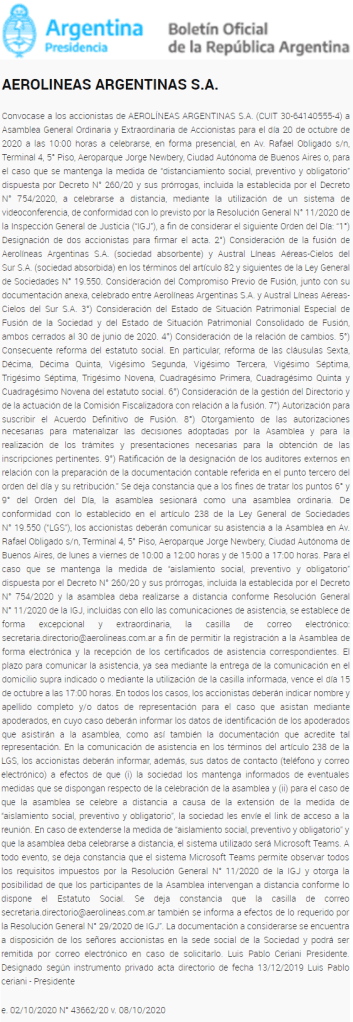
El Gobierno de la República Argentina ha publicado este 08/10 en el Boletín oficial, la convocatoria para la Reunión de Accionistas de las compañías Aerolíneas Argentinas y Austral Líneas Aéreas en Asamblea General Ordinaria y Extraordinaria de Accionistas para el día 20 de Octubre de 2020 a las 10:00 horas para tratamiento de la sinergia de las empresas aéreas.
El paso previo a la materialización de la fusión ha sido el acuerdo alcanzado con los pilotos y gremios de Aerolíneas (APLA) y Austral (UALA), como un avance para concretar la unión integral de ambas compañías. El Sindicato de Técnicos APTA continúa pendiente para acordar el proceso de sinergia.
Proceso integración
El Gobierno de Argentina ha establecido definitivamente, después de muchos años de idas y vueltas, la integración de las compañías del Grupo Aerolíneas en una sola línea aérea. El proceso de fusión que está siendo consensuado por las diferentes partes y organismos, es más un proceso de absorción por parte de Aerolíneas Argentinas de Austral Líneas Aéreas.
La Asamblea General de Accionistas será presencial en la sede de Aerolíneas Argentinas ubicada en la Terminal 4, piso quinto del Aeropuerto Jorge Newbery, o caso contrario, a distancia de continuar la vigencia del decreto que impone el Aislamiento Social, Preventivo y Obligatorio (ASPO), se efectuará vía web. El Artículo 82 enumera la disponibilidad de la Junta de Accionistas para el tratamiento del proceso de integración Aerolíneas/Austral, siguientes temas de la Ley General de Sociedades N° 19.550 y la situación patrimonial cerrada al 30 de Junio de 2020.
Tras las aprobaciones de la reunión de la Convocatoria de Accionistas que se celebrará el 20/10, quedará efectuada la integración total de ambas compañías en una sola entidad bajo el nombre de Aerolíneas Argentinas, culminando así con la marca Austral Líneas Aéreas y de la legendaria historia que ha aportado esta singular aerolínea de la República Argentina.
Aerolíneas-Austral General Assembly
10/20 General Assembly for Aerolíneas-Austral merger
The Government of the Argentine Republic has published this 08/10 in the Official Gazette, the call for the Meeting of Shareholders of the companies Aerolíneas Argentinas and Austral Líneas Aéreas in Ordinary and Extraordinary General Assembly of Shareholders for October 20, 2020 at 10:00 am for treatment of the synergy of the airlines.
The step prior to the materialization of the merger has been the agreement reached with the pilots and unions of Aerolíneas (APLA) and Austral (UALA), as a step forward to achieve the comprehensive union of both companies. The APTA Technicians Union is still pending to agree on the synergy process.
Integration process
The Government of Argentina has definitively established, after many years of back and forth, the integration of the Aerolíneas Group companies into a single airline. The merger process, which is being agreed upon by the different parties and organizations, is more a process of absorption by Aerolíneas Argentinas de Austral Líneas Aéreas.
The General Assembly of Shareholders will be in person at the Aerolíneas Argentinas headquarters located in Terminal 4, fifth floor of the Jorge Newbery Airport, or otherwise, at a distance from continuing the validity of the decree that imposes Social, Preventive and Mandatory Isolation (ASPO), will be done via the web. Article 82 lists the availability of the Shareholders’ Meeting for the treatment of the Aerolíneas/Austral integration process, following topics of the General Law of Companies No. 19,550 and the closed equity situation as of June 30, 2020.
Following the approvals of the Shareholders’ Call meeting to be held on 10/20, the total integration of both companies into a single entity will be approved under the name of Aerolíneas Argentinas, thus culminating with the Austral Líneas Aéreas brand and the legendary history that this unique airline of the Argentine Republic has contributed.
Diversificación economía Puget Sound compensa cierre línea 787
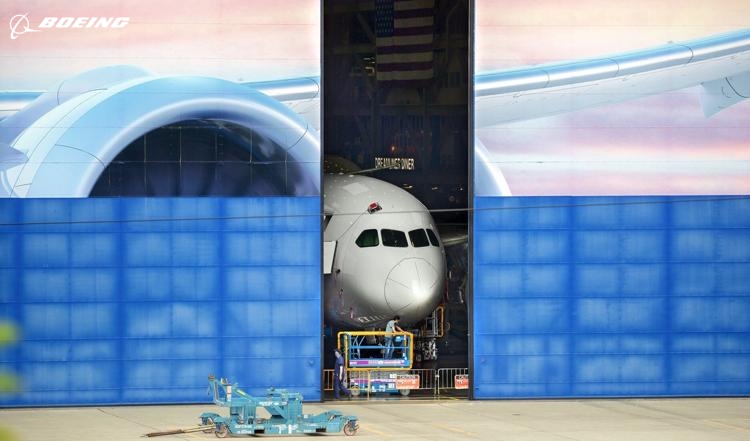
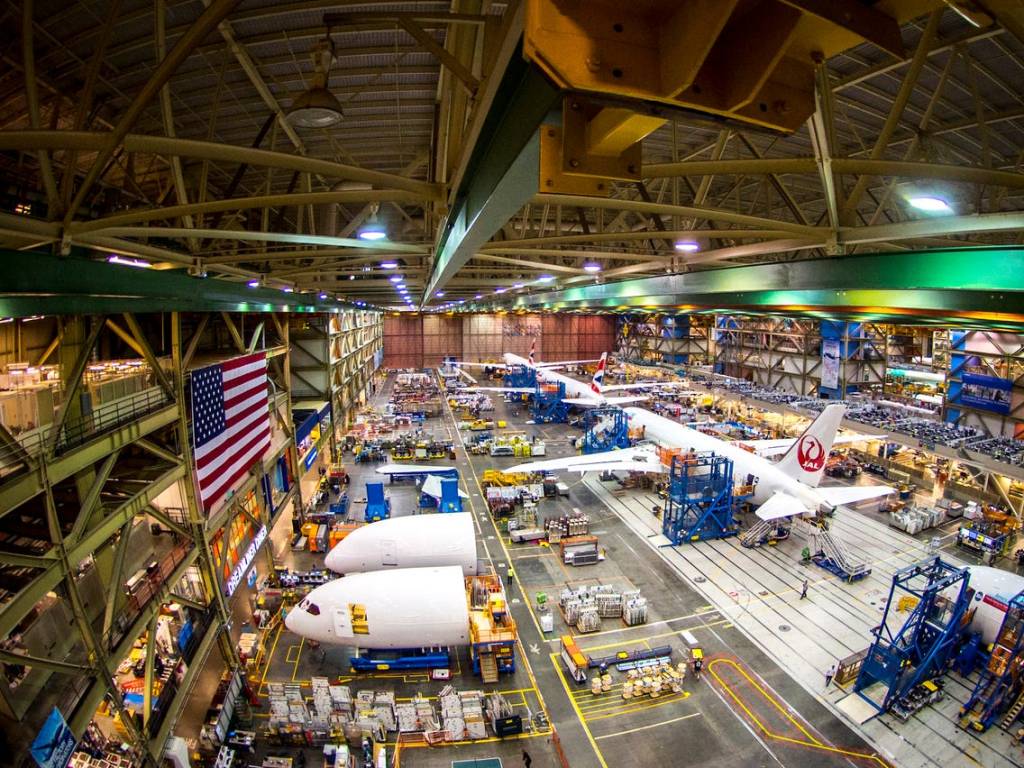
La economía diversa de la zona del Puget Sound compensaría la decisión de la empresa The Boeing Company a mover la línea Boeing 787 a North Charleston, Estado de Carolina del Sur. Tras el anuncio de la migración de los trabajos de toda su producción del 787 fuera de Everett hacia mediados de 2021, ¿cómo afectará esto a la economía de la región?
El impacto tras la decisión de Boeing de mover la línea 787 probablemente podría afectar a que entre 4.000 y 5.000 puestos de trabajo abandonen el Condado de Snohomish, afectando a restaurantes, cafeterías y otros negocios habitualmente frecuentados por los trabajadores de la empresa. La suma total del impacto a la economía de la Región de Puget Sound es un poco más difícil de cuantificar. El economista Jefe de Windermere, Matthew Gardner, ha expresado su parecer: «Creo que hay dos formas de verlo en términos de Boeing, una de las cuales es: ¿siguen siendo importantes para nuestra economía regional? La respuesta es, obviamente, absolutamente lo son. Por otro lado, la diversificación que hemos visto, y francamente la hemos estado viendo durante los últimos 40 años, compensará parte del dolor que se sentirá con esos despidos”.
Posteriormente al arribo de la compañía Boeing en sus inicios en el noroeste, el Estado de Washington ha visto cómo otras compañías echaban raíces, cada una de las cuales ayudó a apuntalar la economía empresarial a su manera. Eso incluye Microsoft, Amazon y Expedia, así como empresas de otros estados como Facebook y Google, que han establecido presencias importantes en el área de Seattle. Por eso, Mattew Gardner no ve la decisión de Boeing de mover la línea 787 fuera de Everett como algo que tendrá un efecto importante en todo el estado. “Obviamente, el mayor impacto se producirá en el Condado de Snohomish. Sin embargo, no creo que sea lo suficientemente significativo como para que tenga la capacidad de llevar a nuestra región a un escenario de crecimiento negativo».
Puget Soung compensates Boeing
Puget Sound economic diversification offsets 787 line closure
The diverse economy of the Puget Sound area would offset The Boeing Company‘s decision to move the Boeing 787 line to North Charleston, South Carolina. Following the announcement of the migration of all your 787 production jobs out of Everett towards mid-2021, how will this affect the region’s economy?
The impact of Boeing’s decision to move the 787 line could likely see 4,000 to 5,000 jobs leaving Snohomish County, affecting restaurants, coffee shops and other businesses commonly frequented by company workers. The sum total of the impact to the economy of the Puget Sound Region is slightly more difficult to quantify. Windermere Chief Economist Matthew Gardner has expressed his opinion: «I think there are two ways of looking at it in Boeing terms, one of which is: are they still important to our regional economy? The answer is obviously absolutely the same. On the other hand, the diversification that we have seen, and frankly we have been seeing it during the last 40 years, will compensate part of the pain that will be felt with those layoffs”.
Following the arrival of the startup Boeing company in the Northwest, Washington State has seen other companies take root, each of which helped prop up the business economy in its own way. That includes Microsoft, Amazon and Expedia, as well as out-of-state companies like Facebook and Google, which have established significant presences in the Seattle area. So Mattew Gardner doesn’t see Boeing’s decision to move the 787 line out of Everett as something that will have a major effect on the entire state. “Obviously, the biggest impact will be in Snohomish County. However, I don’t think it is significant enough to have the capacity to take our region into a negative growth scenario».
Simulación pruebas de vuelos evalúan bajo riesgo de transmisión
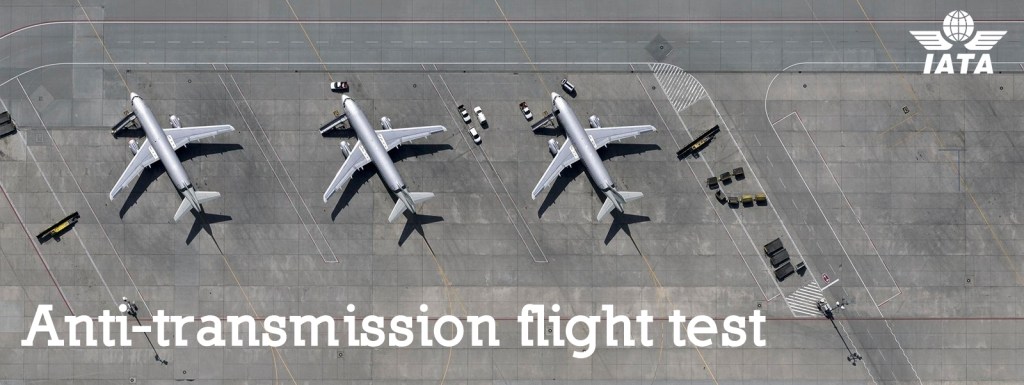
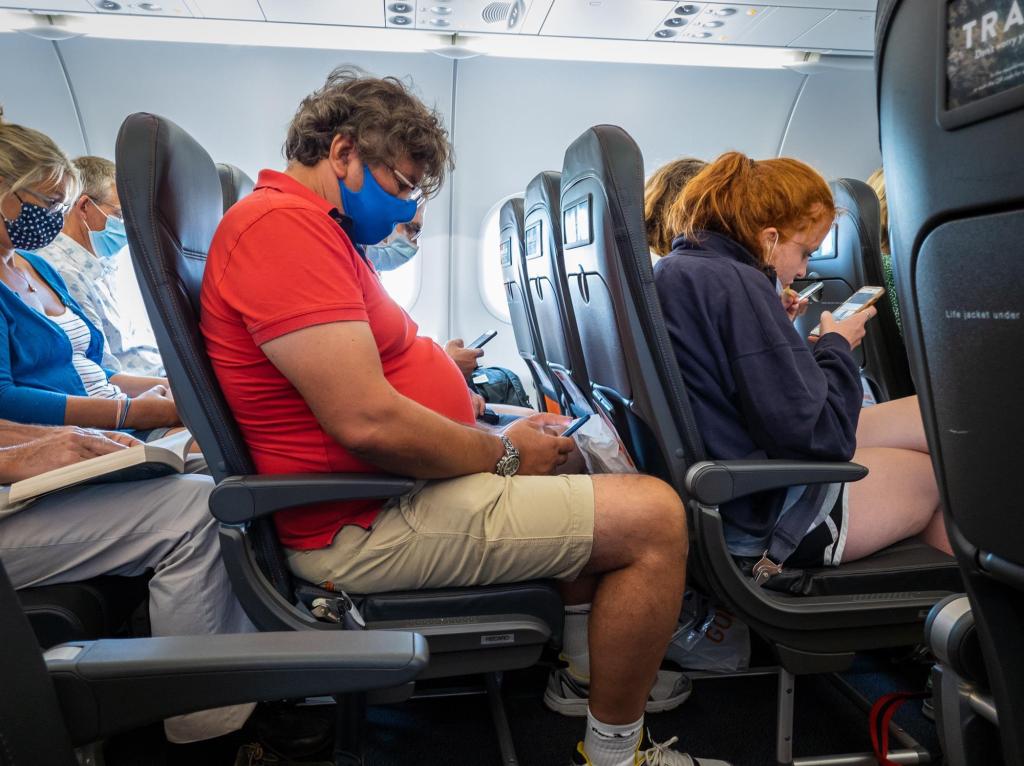
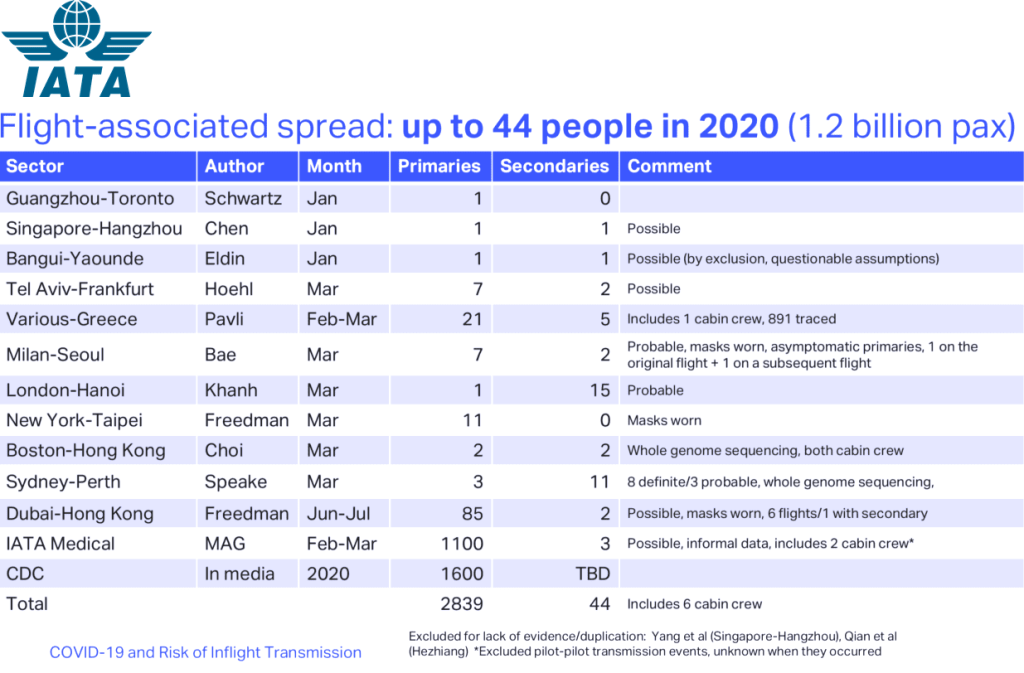
La Asociación Internacional de Transporte Aéreo (IATA) ha detallado que entre los 1.200 millones de pasajeros que han viajado con aerolíneas comerciales desde principios de 2020, se han reportado 44 casos de COVID-19 en los que se produjo transmisión en vuelo, según encontraron nuevos datos publicados por las agencias de aviación. Los datos recopilados por IATA se dieron a conocer durante una conferencia de prensa el Jueves 8 de Octubre de 2020 junto con presentaciones realizadas por los líderes de ingeniería en Airbus, Boeing y Embraer. Mediante el uso de simulaciones de Dinámica de Fluidos Computacional (CFD) y pruebas en vivo de pasajeros que tosen en cabinas e incluso virus transmitidos por el aire, las tres compañías de aviación publicaron los datos de las investigaciones más profundas sobre el riesgo de transmitir el coronavirus COVID-19 en vuelo hasta la fecha.
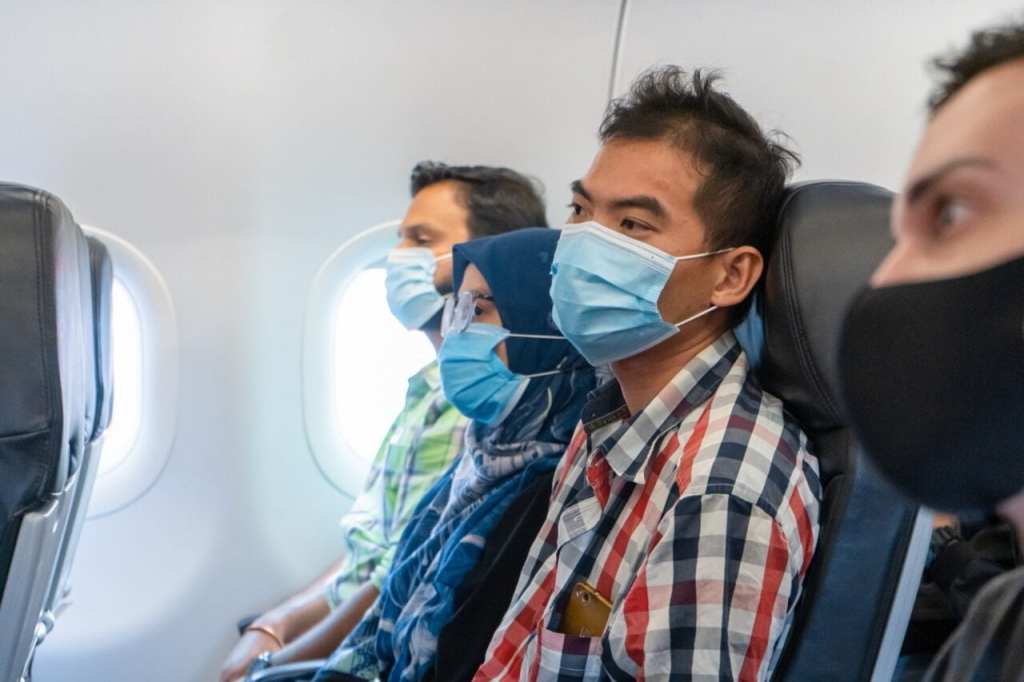
“El riesgo de que un pasajero contraiga Coronavirus mientras está a bordo parece muy bajo. Con solo 44 casos potenciales identificados de transmisión relacionada con el vuelo entre 1.200 millones de viajeros, ese es un caso por cada 27 millones de viajeros. Reconocemos que esto puede ser una subestimación, pero incluso si el 90 por ciento de los casos no se denunciaran, sería un caso por cada 2,7 millones de viajeros. Creemos que estas cifras son sumamente tranquilizadoras. Además, la gran mayoría de los casos publicados ocurrieron antes de que se generalizara el uso de cubiertas faciales durante el vuelo», dijo el Dr. David Powell, Asesor Médico de IATA durante la sesión informativa.
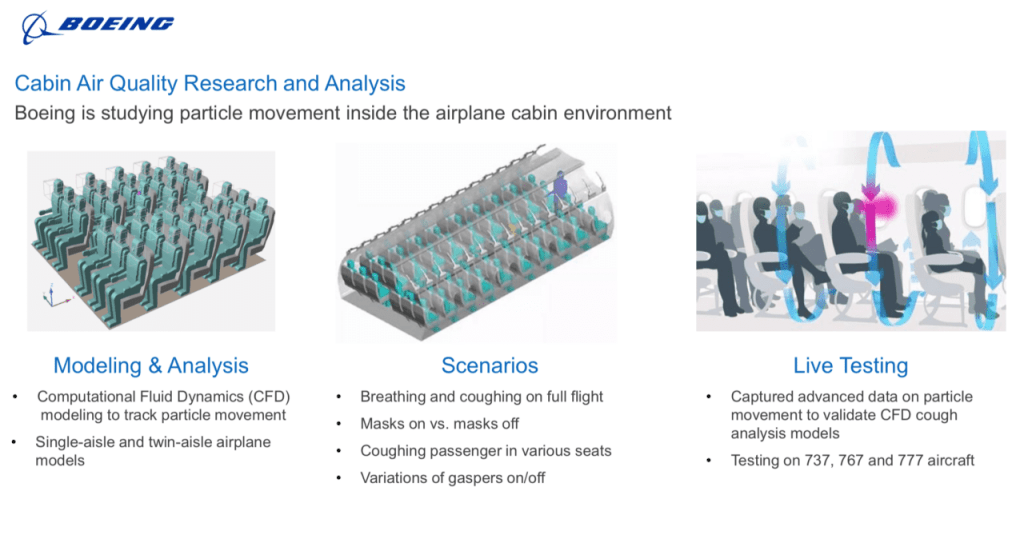
La IATA recopiló la cantidad de veces que se pensó que un pasajero había transmitido COVID-19 durante el vuelo, según los datos reportados desde principios de 2020. Los tres fabricantes de aviones comerciales más grandes de la industria utilizaron CFD para modelar cómo los pasajeros con máscaras o sin ellas, respirar, toser y hablar pueden propagar moléculas a través de la cabina de un avión durante el vuelo. Si bien los tres utilizaron supuestos, metodologías y criterios separados, todos llegaron a una conclusión similar estableciendo evidencia creíble del bajo riesgo que enfrenta un pasajero de una aerolínea en un vuelo promedio. Si bien las aerolíneas y los fabricantes continúan promoviendo la efectividad de los filtros de aire de partículas de alta eficiencia (HEPA), el flujo de aire descendente y las altas tasas de intercambio de aire que ocurren en las cabinas, los pasajeros aún expresan su preocupación sobre la capacidad de las aerolíneas para mantener seguros los entornos de las cabinas. del riesgo de transiciones COVID-19. Una encuesta de pasajeros que viajaron durante el mes de junio mostró que el 50 por ciento de los pasajeros cree que el aire de la cabina es tan limpio como un hospital, mientras que otro 50 por ciento dice que percibe el aire de la cabina como peligroso. Todos los segmentos de la industria del transporte aéreo comercial han intentado demostrar que los entornos de la cabina de los aviones son más seguros de alguna manera que los edificios de oficinas, bares y restaurantes que los viajeros frecuentan en su vida diaria.
Análisis en Airbus
Bruno Fargeon, ex-Jefe de Modelado, Simulación e Ingeniería que asumió el cargo de líder del proyecto de la iniciativa «Keep Trust in Air Travel» de Airbus Group, dijo que el fabricante con sede en Toulouse usó CFD para recopilar 50 millones de puntos de datos sobre el tamaño de los virus en micrones. y las partículas pueden fluir a través de la cabina de un avión, incluida la velocidad del aire, la dirección y la temperatura para cada uno de los puntos de datos recopilados a 1000 veces por segundo.
Cuando se le preguntó cómo se puede lograr el distanciamiento social en la cabina del avión y si las aerolíneas deberían eliminar el asiento del medio, Bruno Fargeon dijo que el flujo de aire y los filtros HEPA combinados con el uso de máscaras pueden eliminar la mayor parte del riesgo asociado con la transmisión en vuelo de COVID-19. «La distancia social a bordo de la aeronave no se puede medir tomando una medida de seis pies. La distancia social a bordo de la aeronave está asegurada por el flujo de aire que elimina las partículas y las gotas, y claramente, esa es la mejor protección que puede obtener hoy a bordo de un aviones. Las recomendaciones que se dan hoy en bares y restaurantes son lugares donde la ventilación no se puede comparar con el grado que se puede encontrar en un avión. Eso es lo que marca la gran diferencia entre el entorno de un avión y un entorno terrestre clásico», dijo Bruno Fargeon.
El modelado CFD también permitió al equipo de ingeniería de Bruno Fargeon estudiar escenarios en los que un A320 lleno de pasajeros llevaban máscaras, algunos llevaban máscaras y otros las llevaban incorrectamente. Su equipo también consideró cómo las fugas en las máscaras de tela podrían permitir que las moléculas escapen, sin dejar de llegar a la conclusión de que el flujo de aire de arriba hacia abajo y el sistema de recirculación de aire es suficiente para contrarrestar la fuga.
Airbus también ha estudiado algunas de las propuestas de terceros proveedores considerando el uso de cortinas o barreras físicas de plexiglás entre asientos, encontrando que podrían presentar más peligros que beneficios. «No recomendamos usarlos. O son muy pequeños y no van a proteger o son grandes y si son grandes distraerán el flujo e interrumpirán el flujo. También plantean retos extra, necesitan ser limpiados y limpiados adecuadamente, y además en aviones, todavía hay algunas recomendaciones y procedimientos de emergencia que tenemos que respetar. Con este tipo de dispositivos, también plantean algunos otros problemas de seguridad en En términos de evacuación, también podrían plantear algunos otros problemas de seguridad en términos de propagación del fuego al interior de la aeronave, por lo que, en general, el beneficio que traería es cero», dijo Bruno Fargeon.
Pruebas en Boeing
The Boeing Company proporcionó una descripción general de cómo está estudiando el movimiento de moléculas a través de la cabina de un avión. «De hecho, hemos realizado pruebas con MS-2, que es un virus vivo que es seguro para los humanos. Hemos hecho una gran variedad de cosas, hemos hecho pruebas con partículas del tamaño de un virus, hemos realizado pruebas con virus seguros para humanos, para asegurarnos de que comprendemos completamente el medio ambiente«, dijo Dan Freeman, Jefe Ingeniero de la Iniciativa de Viaje de Boeing. Dan Freeman dijo que el análisis de Boeing también mostró que cuando ocurre una tos en un avión de pasillo único como el Boeing 737, sus simulaciones computacionales y pruebas en vivo mostraron que todas las partículas de tos medibles se eliminan unos 90 segundos después de que ocurre la tos. Boeing también descubrió que las gotas más grandes emitidas por la tos de una persona caerán del aire más rápido porque son más pesadas, mientras que las moléculas del tamaño de un aerosol son las más difíciles de rastrear y eliminar solo a través del flujo de aire.
Estudios en Embraer
El Vicepresidente Senior de Ingeniería, Tecnología y Estrategia de Embraer S.A., Luis Carlos Affonso, dijo que el fabricante brasileño vio resultados similares a los estudios realizados por Airbus y Boeing. Su CFD y las pruebas en vivo también mostraron que la diferencia entre el riesgo de que las moléculas generadas por la tos alcancen la zona de respiración de otros pasajeros es de aproximadamente 0.13 por ciento sin una máscara y 0.02 por ciento mientras usa una. «La necesidad humana de viajar, conectar y ver a nuestros seres queridos no ha desaparecido. De hecho, en momentos como este, necesitamos a nuestras familias y amigos aún más. Nuestro mensaje hoy es que debido a la tecnología y los procedimientos implementados, puede volar de manera segura; todas las investigaciones lo demuestran. De hecho, la cabina de un avión comercial es uno de los espacios más seguros disponibles en cualquier lugar durante esta pandemia», dijo Luis Affonso.
Perspectivas aéreas
La recopilación de datos de IATA y los resultados de las simulaciones de cabina se alinean con el bajo número de informes en vuelo informados en un estudio revisado por pares realizado por Freedman y Wilder-Smith en el Journal of Travel Medicine. Ese estudio también apunta a la capa adicional de protección proporcionada por los pasajeros que usan máscaras. Las tres empresas admitieron que todavía existe cierto riesgo relacionado con la posibilidad de transmitir el virus durante el vuelo. Los filtros HEPA, el flujo de aire y el uso de mascarillas aún dejan la posibilidad de que una pequeña cantidad de partículas emitidas por un pasajero que podría tener COVID-19 y no saberlo lleguen a otro pasajero que también está sentado en la cabina. Pero creen que la educación que están brindando a los pasajeros y ser lo más transparentes posible sobre cómo los micrones del tamaño de un virus fluyen a través de una cabina durante el vuelo muestra cuán bajo es realmente el riesgo.
Ninguna de las pruebas en vivo realizadas por Airbus, Boeing y Embraer involucró la simulación real de una persona que tiene COVID-19 tosiendo o respirando abiertamente durante el vuelo. En su lugar, utilizaron humo y otros métodos para estudiar cómo las micras y las moléculas son eliminadas por el flujo de aire y la recirculación que ya ocurre en las cabañas hoy en día.
Anti-transmission flight test
Simulation flight tests assess low risk of transmission
The International Air Transport Association (IATA) has detailed that among the 1.2 billion passengers who have traveled with commercial airlines since the beginning of 2020, 44 cases of COVID-19 have been reported in which transmission occurred in flight, according to new findings. data published by aviation agencies. The data collected by IATA was released during a press conference on Thursday, October 8, 2020 along with presentations made by engineering leaders at Airbus, Boeing and Embraer. Using Computational Fluid Dynamics (CFD) simulations and live testing of passengers coughing in cabins and even airborne viruses, the three aviation companies released the data from the most in-depth investigations into the risk of transmitting the COVID-19 coronavirus in flight to date.
“The risk of a passenger contracting Coronavirus while on board appears very low. With only 44 potential cases of flight-related transmission identified among 1.2 billion travelers, that’s one case for every 27 million travelers. We recognize that this may be an understatement, but even if 90 percent of cases went unreported, it would be one case for every 2.7 million travelers. We believe that these figures are extremely reassuring. Furthermore, the vast majority of reported cases occurred before the use of face shields became widespread during the flight», said Dr. David Powell, IATA Medical Advisor during the briefing.
IATA compiled the number of times a passenger was thought to have transmitted COVID-19 during the flight, based on data reported since early 2020. The three largest commercial aircraft manufacturers in the industry used CFDs to model how passengers with Masks or without masks, breathing, coughing and talking can spread molecules through the cabin of an airplane during flight. While all three used separate assumptions, methodologies, and criteria, they all came to a similar conclusion establishing credible evidence of the low risk an airline passenger faces on an average flight. While airlines and manufacturers continue to promote the effectiveness of High Efficiency Particulate Air Filters (HEPA), the downward airflow and high air exchange rates that occur in cabins, passengers still express concern. on airlines’ ability to keep cabin environments safe. of the risk of COVID-19 transitions. A survey of passengers who traveled in June showed that 50 percent of passengers believe cabin air is as clean as a hospital, while another 50 percent say they perceive cabin air as dangerous. Every segment of the commercial air transport industry has tried to show that airplane cabin environments are somehow safer than the office buildings, bars, and restaurants that travelers frequent in their daily lives.
Analysis at Airbus
Bruno Fargeon, former Head of Modeling, Simulation and Engineering who took over as project leader for Airbus Group’s «Keep Trust in Air Travel» initiative, said the Toulouse-based manufacturer used CFDs to collect 50 million points of data on the size of viruses in microns. and particles can flow through the cabin of an airplane, including airspeed, direction, and temperature for each of the data points collected at 1000 times per second.
AIRBUS SHOWS HOW FLOW OF AIR HELPS TO ELIMINATE THE SPREAD OF MOLECULES TRANSMITTED IN THE CABIN AIRPLANE
When asked how social distancing can be achieved in the airplane cabin and if airlines should eliminate the middle seat, Bruno Fargeon said that airflow and HEPA filters combined with the use of masks can eliminate most of it. of the risk associated with in-flight transmission of COVID-19. «The social distance on board the aircraft cannot be measured by taking a measurement of six feet. The social distance on board the aircraft is ensured by the airflow that removes particles and droplets, and clearly, that is the best. protection you can get today on board an aircraft. The recommendations given today in bars and restaurants are places where ventilation cannot be compared to the degree that can be found in an airplane. That is what makes the big difference between the environment of an airplane and a classic ground environment», said Bruno Fargeon.
CFD modeling also allowed Bruno Fargeon’s engineering team to study scenarios where an A320 full of passengers wore masks, some wore masks, and some wore them incorrectly. His team also considered how leaks in cloth masks could allow molecules to escape, while still concluding that the top-down airflow and air recirculation system is sufficient to counter the leak.
Airbus has also studied some of the third-party vendor proposals considering the use of physical plexiglass curtains or barriers between seats, finding that they could present more dangers than benefits. «We do not recommend using them. Either they are very small and will not protect or they are large and if they are large they will distract the flow and interrupt the flow. They also pose extra challenges, they need to be cleaned and cleaned properly, and also on airplanes, there are still some recommendations. and emergency procedures that we have to respect. With these kinds of devices, they also pose some other safety issues in terms of evacuation, they could also pose some other safety issues in terms of spreading the fire inside the aircraft, so that, in general, the benefit it would bring is zero», said Bruno Fargeon.
Testing at Boeing
The Boeing Company provided an overview of how it is studying the motion of molecules through the cabin of an airplane. «In fact, we have tested MS-2, which is a live virus that is safe for humans. We have done a variety of things, we have tested virus-sized particles, we have tested viruses that are safe for humans, to make sure we fully understand the environment», said Dan Freeman, Chief Engineer for Boeing’s Travel Initiative. Dan Freeman said Boeing’s analysis also showed that when a cough occurs in a single-aisle aircraft like the Boeing 737, his computer simulations and live tests showed that all measurable cough particles are removed about 90 seconds after it occurs. cough. Boeing also found that the largest droplets emitted from a person’s cough will fall out of the air faster because they are heavier, while aerosol-sized molecules are the most difficult to track and remove through air flow alone.
Studies at Embraer
Embraer S.A. Senior Vice President of Engineering, Technology and Strategy, Luis Carlos Affonso, said that the Brazilian manufacturer saw results similar to studies carried out by Airbus and Boeing. His CFD and live tests also showed that the difference between the risk of molecules generated by coughing reaching the breathing zone of other passengers is about 0.13 percent without a mask and 0.02 percent while wearing one. «The human need to travel, connect and see our loved ones has not disappeared. In fact, in times like this, we need our families and friends even more. Our message today is that due to the technology and procedures in place, it can fly safely, all the research proves it. In fact, the cabin of a commercial airplane is one of the safest spaces available anywhere during this pandemic», said Luis Affonso.
Air perspectives
The IATA data collection and the results of the cockpit simulations align with the low number of in-flight reports reported in a peer-reviewed study conducted by Freedman and Wilder-Smith in the Journal of Travel Medicine. That study also points to the extra layer of protection provided by passengers wearing masks. All three companies admitted that there is still some risk related to the possibility of transmitting the virus during the flight. HEPA filters, air flow and the use of masks still leave the possibility that a small amount of particles emitted by a passenger who could have COVID-19 and not know it reach another passenger who is also sitting in the cabin. But they believe that the education they are providing passengers and being as transparent as possible about how virus-sized microns flow through a cabin during flight shows how low the risk really is.
None of the live tests conducted by Airbus, Boeing and Embraer involved the actual simulation of a person with COVID-19 coughing or openly breathing during the flight. Instead, they used smoke and other methods to study how microns and molecules are removed by the air flow and recirculation that already occurs in cabins today.
Volcán más activo de Islandia se prepara para entrar en erupción
El Volcán Grímsvötn, el más activo de la República de Islandia, ha mostrado signos de que está a punto de entrar en erupción por primera vez desde 2011. El gigante cubierto de hielo Grímsvötn parece que terminará 2020 con una explosión violenta. La pandemia ya ha paralizado la industria de viajes aéreos de Europa, y los expertos dicen que la erupción del volcán solo afectará más a la industria de viajes. El Volcán Grímsvötn ha entrado en erupción por última vez en 2011, cerrando los cuatro aeropuertos del país y cancelando más de 900 vuelos, siendo la última erupción un impacto par ala aviación transatlántica.
Grímsvötn no es un volcán promedio, ya que se encuentra casi completamente bajo el hielo. La producción de calor del subsuelo es extremadamente alta (2000-4000MW), lo que hace que el hielo se derrita y forme lagos de hasta 100 metros de profundidad. El volcán también es extremadamente sensible a los cambios de presión. A medida que el agua de sus lagos se escapa por los canales, provoca la inundación de las carreteras y los puentes arrasados. Este cambio en la presión debido al escape de agua puede incluso desencadenar erupciones, como lo ha hecho más de 65 veces en los últimos 800 años. Los expertos dicen que, a pesar de no poder predecir con precisión las fechas en las que un volcán entrará en erupción, están comenzando a aparecer señales claras a través de las grietas.
Grímsvötn se ha estado inflando a medida que el nuevo magma se mueve hacia los canales por donde escapa su agua, lo que ha aumentado la actividad térmica y, en consecuencia, un pico de terremotos recientemente. Es probable que a medida que el magma se mueva hacia la superficie y el volcán esté a punto de entrar en erupción, Islandia sienta terremotos más intensos y frecuentes que durarán hasta diez horas. El mejor escenario para los islandeses en este momento es que la erupción es pequeña y consume la mayor parte de su energía cuando golpea el agua y el hielo en la superficie, lo que hace que las cenizas se mojen y pesen, cayendo del cielo más rápido. Esto dará como resultado que las nubes de cenizas viajen solo a unas pocas decenas de kilómetros del volcán, evitando impactos en las rutas de vuelo en Islandia y el norte de Europa.
Grímsvötn volcano will erupt
Iceland’s most active volcano prepares to erupt
Grímsvötn Volcano, the most active in the Republic of Iceland, has shown signs that it is about to erupt for the first time since 2011. The ice-covered giant Grímsvötn looks set to end 2020 with a violent explosion. The pandemic has already crippled Europe’s air travel industry, and experts say the volcano’s eruption will only affect the travel industry further. The Grímsvötn Volcano last erupted in 2011, closing the country’s four airports and canceling more than 900 flights, the latest eruption being an impact on transatlantic aviation.
Grímsvötn is not your average volcano, as it is almost completely under the ice. Subsoil heat production is extremely high (2000-4000MW), causing the ice to melt and form lakes up to 100 meters deep. The volcano is also extremely sensitive to pressure changes. As the water from its lakes escapes through the canals, it causes the flooding of the roads and the destroyed bridges. This change in pressure due to escaping water can even trigger eruptions, as it has done more than 65 times in the last 800 years. Experts say that despite being unable to accurately predict the dates when a volcano will erupt, clear signals are beginning to appear through the cracks.
Grímsvötn has been inflating as new magma moves into channels where its water escapes, increasing thermal activity and consequently a recent spike in earthquakes. As magma moves to the surface and the volcano is about to erupt, Iceland will likely feel more intense and frequent earthquakes lasting up to ten hours. The best scenario for Icelanders at the moment is that the eruption is small and consumes most of its energy when it hits the water and ice on the surface, causing the ashes to get wet and heavy, falling from the sky faster . This will result in the ash clouds traveling only a few tens of kilometers from the volcano, avoiding impacts on the flight paths in Iceland and northern Europe.