Mercado Argentina post-pandemia

AW | 2020 07 14 16:04 | AIRLINES MARKET

Cambios en el mercado aéreo de Argentina

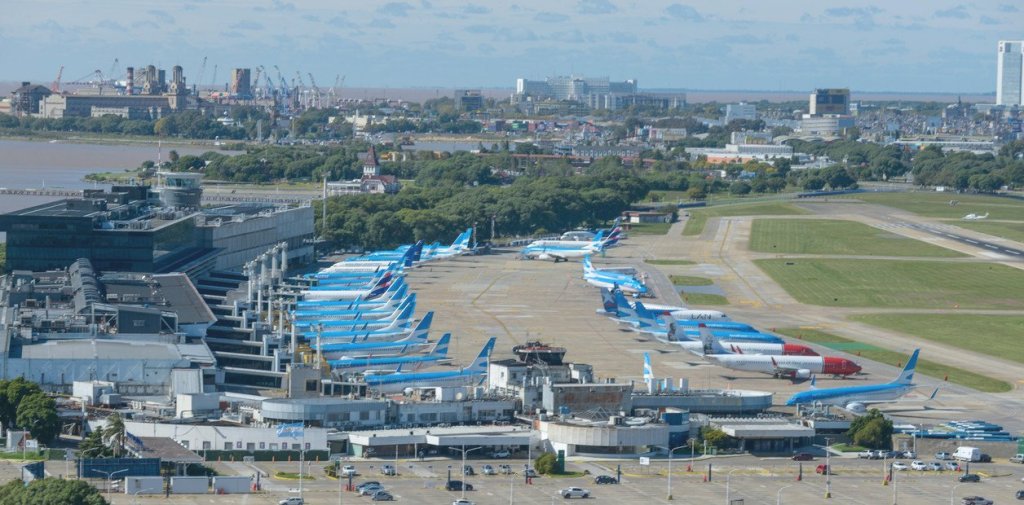
El mercado aéreo de la República Argentina ha sufrido cambios significativos en sintonía con los países del mundo afectados por la pandemia mundial de Coronavirus. Actualmente la estructura de vuelos de cabotaje presenta un panorama más concentrado luego salida casi definitiva de la aerolínea Latam Airlines Argentina.

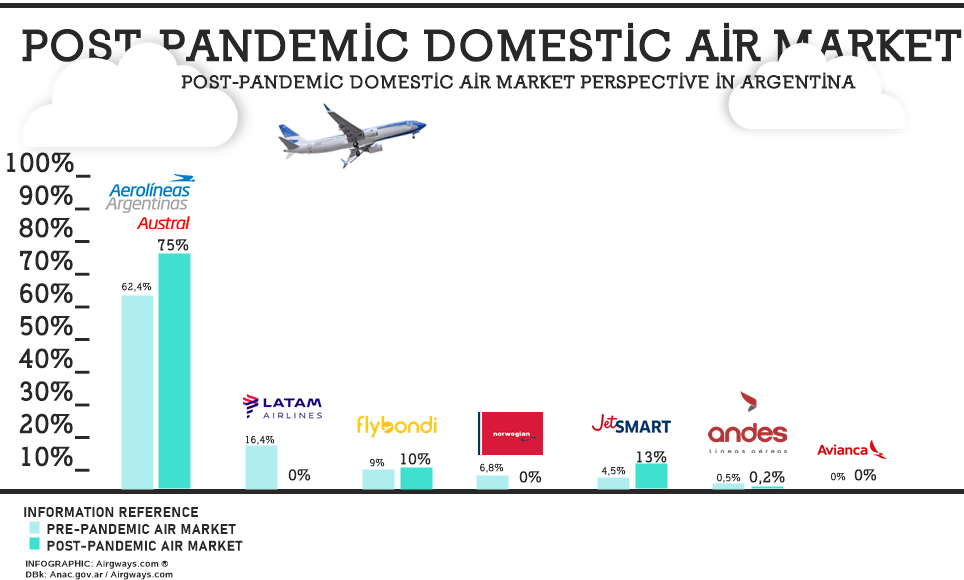
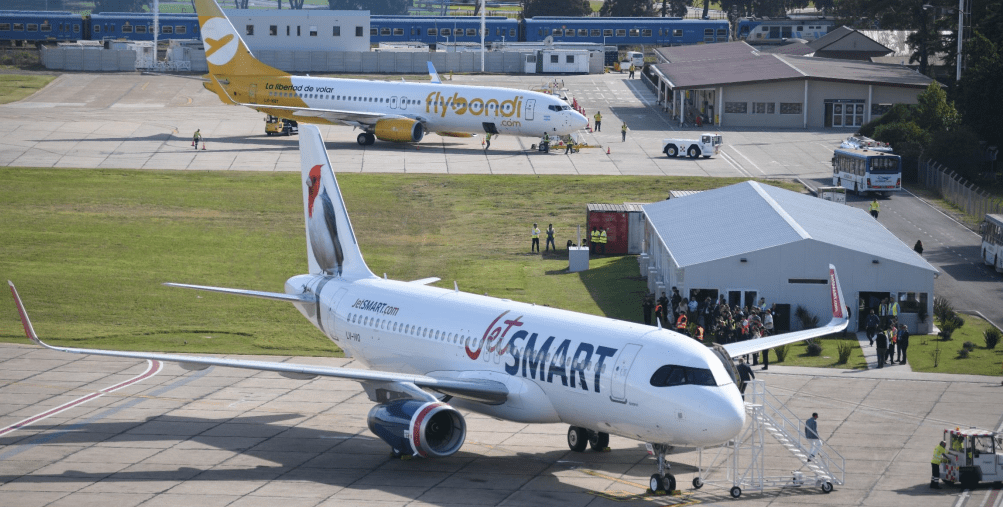
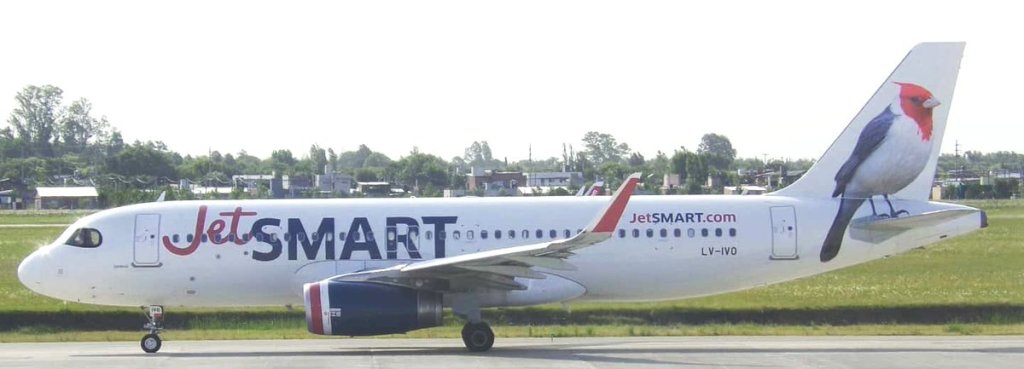
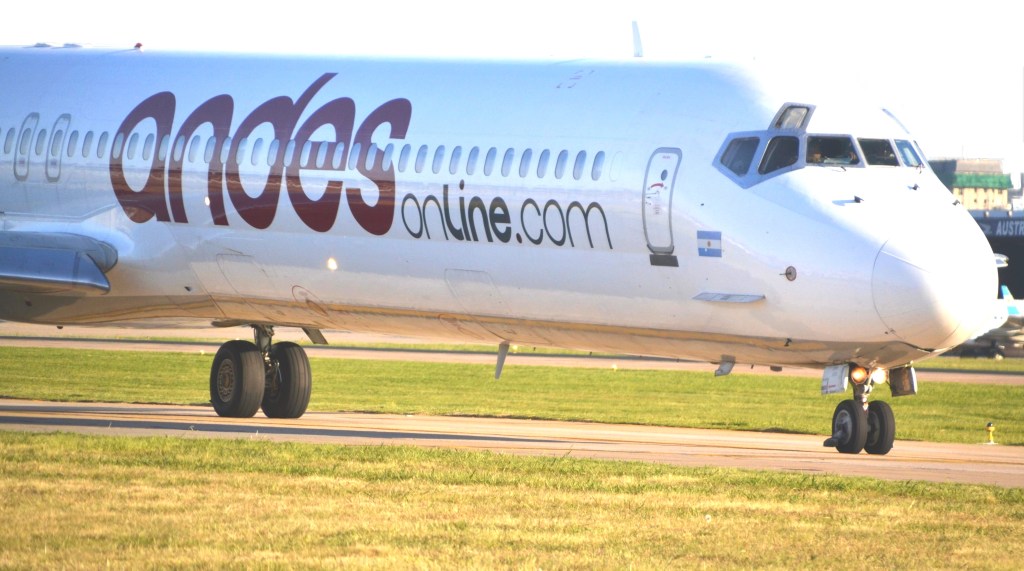
La salida definitiva de la compañía Latam Airlines Argentina de las operaciones domésticas del país, luego de quince años, dejaría al mercado de vuelos de cabotaje en manos de apenas cuatro compañías, Aerolíneas Argentinas con el 62% del mercado interno, seguidas por JetSmart Airlines Argentina, Flybondi Líneas Aéreas y Andes Líneas Aéreas.

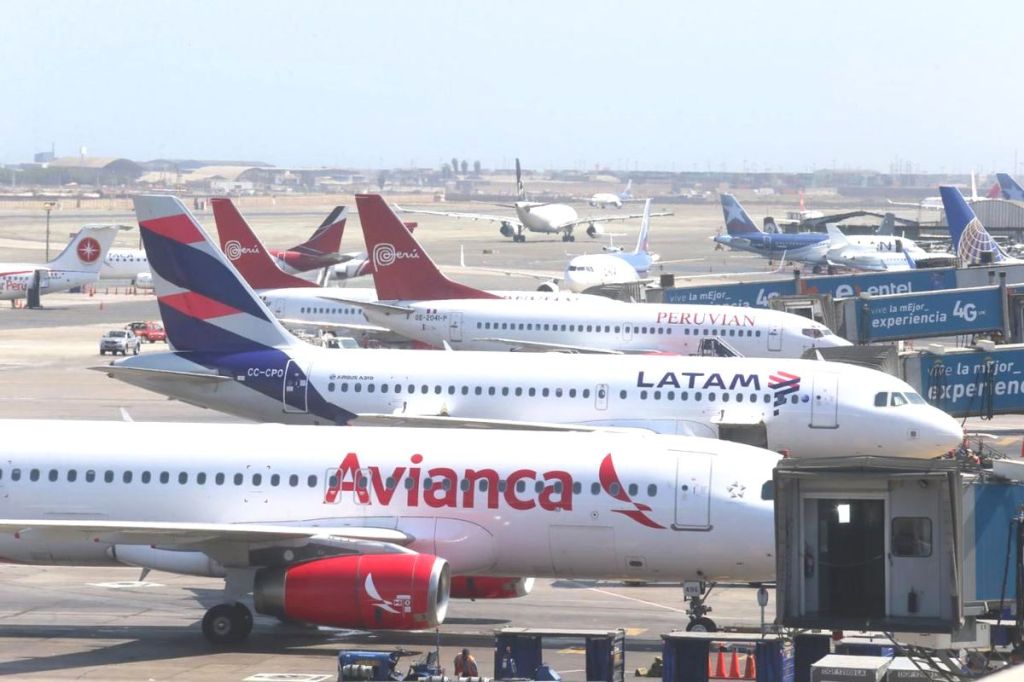
Los síntomas de debilidad local se traducen en un análisis de mercado aéreo anterior a la pandemia, afectada por la crisis financiera de Argentina y la inestabilidad monetaria. En el camino habían quedado empresas como Avianca Argentina y Norwegian Air Argentina cuando la apertura de rutas aéreas impulsada por el anterior Gobierno con la «Revolución de los Aviones», permitió el incremento de tráfico y número de compañías aéreas.

Tras el período de la extensa medidas adoptadas por el Gobierno producto de la pandemia, las compañías aéreas Andes Líneas Aéreas, como así las low cost Jetsmart Airlines Argentina y Flybondi Líneas Aéreas, ambas con una situación delicada frente al panorama operativo por la decisión del Gobierno del supuesto cierre del Aeropuerto Internacional El Palomar y las complicaciones de volar desde otra aeroestación que permita alcanzar los niveles de costos reducidos de las líneas aéreas de presupuesto. La indecisión del aeropuerto low cost, sumado al cierre del Aeropuerto Jorge Newbery por mantenimiento y reestructuración hasta finales de Noviembre 2020 ha llevado a las aerolíneas a replantear sus estrategias de vuelos en el mercado doméstico y regional.

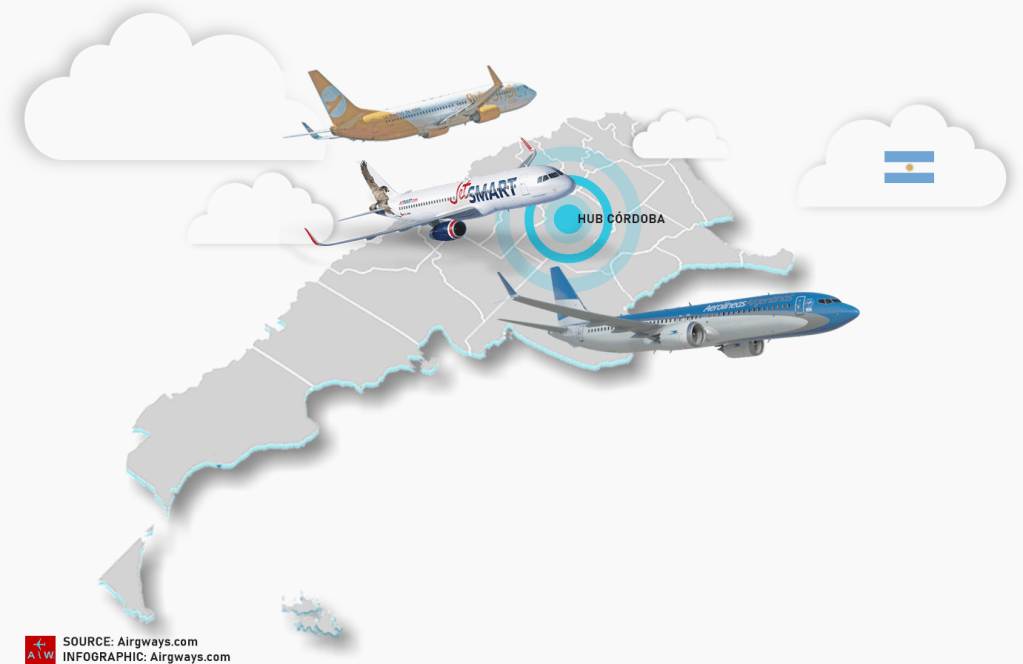
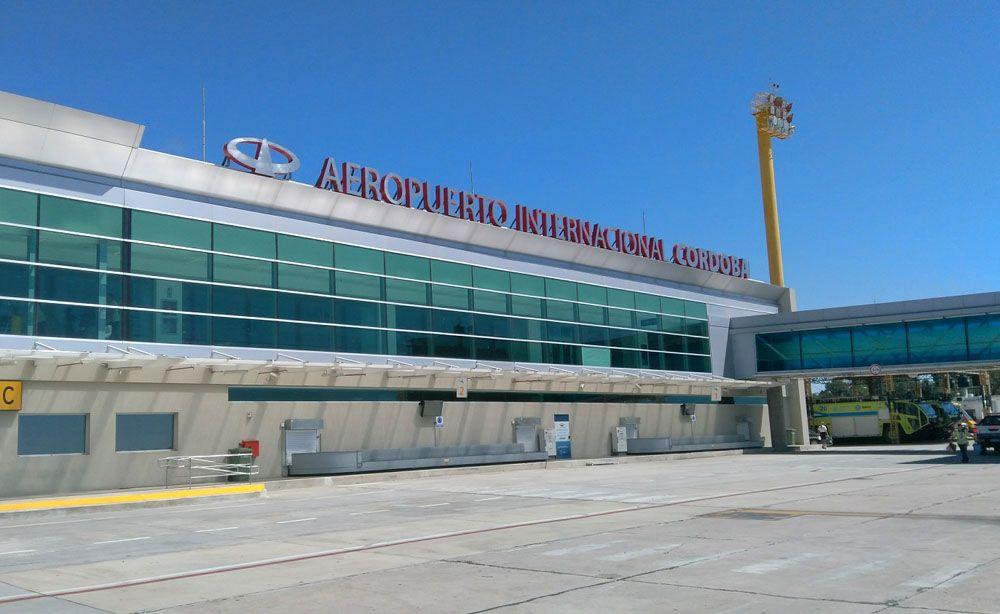
El Gobierno de Argentina ha elaborado un plan para que las aerolíneas de bajo costo operen desde el Aeropuerto Internacional Ezeiza con una diferenciación de costos operativos respecto a las aerolíneas clásicas, pero JetSmart y Flybondi se muestran insatisfechas por la razón que los vuelos desde El Palomar presentan mejores alternativas para los usuarios debido a la cercanía con la Ciudad de Buenos Aires. Ante este panorama JetSmart y Flybondi han decidido mudar parte de las operaciones hacia el Aeropuerto Internacional Córdoba para aprovechar la baja incidencia de casos de Coronavirus en el interior del país.

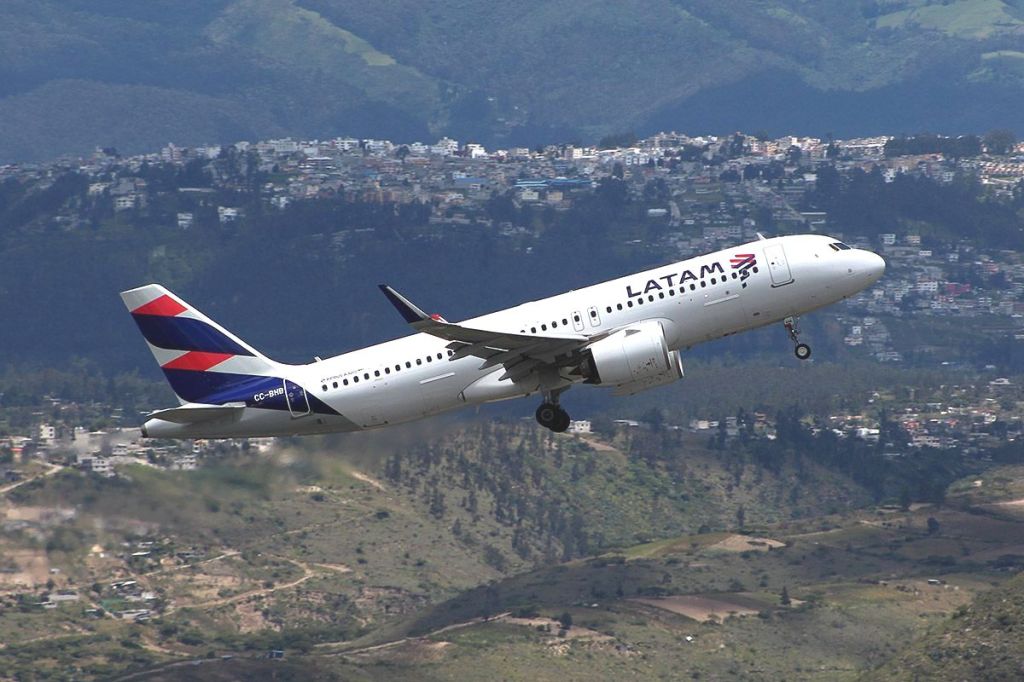
Latam Airlines Argentina poseía doce destinos domésticos: Buenos Aires, Bariloche, Comodoro Rivadavia, Córdoba, El Calafate, Iguazú, Mendoza, Neuquén, Río Gallegos, Salta, Tucumán y Ushuaia. Ahora, con el supuesto retiro de su unidad de negocias en Argentina, el mercado aéreo post-pandemia se ha modificado.

Nueno escenario

A través de la crisis económica de Argentina, durante el 2019 muchas compaías continuaban creciendo pese a los factores de inflación crecientes en el país. En Julio 2019 representó el incremento de mayor tráfico con más de 1,5 millones de pasajeros transportados. Durante Marzo 22020, el último mes donde hubo vuelos de cabotaje antes de la suspensión por la cuarentena, el mercado doméstico fue de 681.000 pasajeros, casi un 50% menos interanual, cuando volaron por el país más de 1,3 millones de personas. A comienzos de este año, las cifras se habían mantenido con apenas una mínima variación respecto a 2019, con 1,2 millones en Enero 2020 y un número similar en Febrero 2020. En Marzo 2020, antes de la cuarentena, el 62% de la cuota de mercado correspondía a Aerolíneas Argentinas/Austral Líneas Aéreas, con un total de 4.513 vuelos. En el caso de Austral Líneas Aéreas podría ser absorbida por su empresa matriz hacia fines de 2020. El mercado doméstico es seguido por Latam Airlines Argentina con una participación del 16% y 849 vuelos domésticos, detrás se encontraba Jetsmart Airlines Argentina, que luego de absorber la operación de Norwegian Air Argentina, realizó más de 600 vuelos. Flybondi Líneas Aéreas con 406 vuelos de cabotaje y finalmente, Andes Líneas Aéreas con más de 40 vuelos enlas rutas argentinas.

Las actuales aerolíneas resultantes del nuevo escenario argentino están represantadas por Aerolíneas Argentinas, JetSmart Airlines Argentina, Flybondi Líneas Aéreas y Andes Líneas Aéreas. A partir de Septiembre 2020 se abre un nuevo panorama en la aviación comercial del país sudamericano donde las compañías aéreas necesitarán pilotear con audacia las nuevas políticas impuestas por el Estado, como así también un nuevo horizonte de incertidumbres por los efectos de la crisis sanitaria mundial, mientras tanto, entre bastidores, continua cocinándose un mercado más agresivo con tendencia hacia el monopolio de los viajes aéreos en Argentina.

Post-pandemic Argentina market

Changes in the Argentine air market

The air market in the Argentine Republic has undergone significant changes in tune with the countries of the world affected by the world coronavirus pandemic. Currently, the cabotage flight structure presents a more concentrated panorama after the almost definitive departure of Latam Airlines Argentina.

The definitive exit of the company Latam Airlines Argentina from the domestic operations of the country, after fifteen years, would leave the domestic flights market in the hands of just four companies, Aerolíneas Argentinas with 62% of the domestic market, followed by JetSmart Airlines Argentina, Flybondi Líneas Aéreas and Andes Líneas Aéreas.

The symptoms of local weakness are translated into an analysis of the air market prior to the pandemic, affected by the Argentine financial crisis and monetary instability. Companies such as Avianca Argentina and Norwegian Air Argentina had been left on the road when the opening of air routes promoted by the previous Government with the «Revolution of the Planes», allowed an increase in traffic and the number of airlines.

After the period of the extensive measures adopted by the Government as a result of the pandemic, the airlines Andes Líneas Aéreas, as well as the low cost Jetsmart Airlines Argentina and Flybondi Líneas Aéreas, both with a delicate situation in front of the operative panorama due to the decision of the Government the alleged closure of El Palomar International Airport and the complications of flying from another air station that allows reaching the low cost levels of budget airlines. The indecision of the low cost airport, added to the closure of Jorge Newbery Airport for maintenance and restructuring until the end of November 2020, has led airlines to rethink their flight strategies in the domestic and regional market.

The Government of Argentina has drawn up a plan for low-cost airlines to operate from Ezeiza International Airport with a differentiation of operating costs compared to classic airlines, but JetSmart and Flybondi are dissatisfied for the reason that flights from El Palomar have better alternatives for users due to the proximity to the City of Buenos Aires. Given this scenario, JetSmart and Flybondi have decided to move part of the operations to Córdoba International Airport to take advantage of the low incidence of Coronavirus cases in the interior of the country.

Latam Airlines Argentina had twelve domestic destinations: Buenos Aires, Bariloche, Comodoro Rivadavia, Córdoba, El Calafate, Iguazú, Mendoza, Neuquén, Río Gallegos, Salta, Tucumán and Ushuaia. Now, with the supposed withdrawal of its business unit in Argentina, the post-pandemic air market has changed.

La imagen tiene un atributo ALT vacío; su nombre de archivo es aw-market-air-argentina.-post-pandemia-2020.png

Nueno stage

Throughout the economic crisis in Argentina, during 2019 many companies continued to grow despite increasing inflation factors in the country. In July 2019 it represented the increase in increased traffic with more than 1.5 million passengers transported. During March 22020, the last month where there were domestic flights before the quarantine suspension, the domestic market was 681,000 passengers, almost 50% less year-on-year, when more than 1.3 million people flew across the country. At the beginning of this year, the figures had remained with only a slight variation compared to 2019, with 1.2 million in January 2020 and a similar number in February 2020. In March 2020, before quarantine, 62% of the Market share corresponded to Aerolíneas Argentinas/Austral Líneas Aéreas, with a total of 4,513 flights. In the case of Austral Líneas Aéreas it could be absorbed by its parent company towards the end of 2020. The domestic market is followed by Latam Airlines Argentina with a 16% share and 849 domestic flights, behind was Jetsmart Airlines Argentina, which after absorbing Norwegian Air Argentina’s operation carried out more than 600 flights. Flybondi Líneas Aéreas with 406 cabotage flights and finally, Andes Líneas Aéreas with more than 40 flights on Argentine routes.

The current airlines resulting from the new Argentine scenario they are represented by Aerolineas Argentinas, JetSmart Airlines Argentina, Flybondi Líneas Aéreas and Andes Líneas Aéreas. Starting in September 2020, a new panorama opens up in the commercial aviation of the South American country where airlines will need to boldly pilot the new policies imposed by the State, as well as a new horizon of uncertainties due to the effects of the world health crisis, Meanwhile, behind the scenes, a more aggressive market continues to cook with a tendency towards a monopoly on air travel in Argentina.

Ξ A I R G W A Y S Ξ
PUBLISHER: Airgways.com
DBk: Airgways.com / Anac.gov.ar / Argentina.gob.ar
AW-POST: 202007141604AR

A\W   A I R G W A Y S ®

Latinoamérica pérdidas por US$ 4.000M

AW | 2020 07 14 11:50 | AIRLINES MARKET

IATA: América Latina pérdidas por valor de US$ 4.000 millones

Las compañías aéreas de América Latina y el Caribe registrarán pérdidas por un valor de US$ 4.000 millones de Dólares en 2020, cuando se contabilizaron ingresos por US$ 38.000 millones de dólares, según datos suministrados hoy por la Asociación Internacional de Transporte Aéreo (IATA). De la misma manera se prevé que la contribución de la aviación al PIB de la región se reduzca en 98.000 millones, lo que pondrá en peligro 4,1 millones de puestos de trabajo. Las aerolíneas de la región habían reportado en 2019 ganancias por valor de US$ 25,9 mil millones.

IATA había pronosticado el año pasado que las aerolíneas latinoamericanas habrían de tener en el 2020 una ganancia neta de 29,3 mil millones de dólares, antes que el Coronavirus echara por tierra con todas las previsiones. En Argentina, se estima que los ingresos de las aerolíneas sean de US$ 3,28 billones de Dólares menos en este 2020 en relación al 2019, lo que significa una reducción del 65% y una pérdida de 19.800 puestos de trabajo; para Brasil la estimación es de 10,21 billones menos de recaudación; un 53% menos y 81.200 empleos; mientras que en Chile la previsión es de un ingreso menor de 2,43 billones de Dólares, también un 53% menos que en el 2019 y 15.000 fuentes laborales. Ante esta situación, IATA reiteró su llamado a los gobiernos de América Latina y el Caribe para que apoyen a la industria de la aviación, tanto en lo que respecta a la prestación de apoyo financiero, como a la facilitación de la reanudación del servicio según la norma de la guía desarrollada por la Organización de Aviación Civil Internacional (OACI). «El transporte aéreo en todo el continente está ahora en su cuarto mes de parálisis. Incluso con unos pocos países que han permitido la reanudación del servicio, la mayoría aún nos mantiene en tierra. Como industria hemos trabajado con todos los interesados en la cadena de valor para asegurarnos de que podemos reanudar en línea con las pautas de la OACI. Lamentablemente, no estamos logrando los progresos esperados con los gobiernos que las aplican, y cualquier otra suspensión de las operaciones está poniendo en peligro el futuro de la aviación», señalo al respecto Peter Cerdá, Vicepresidente Regional de IATA para las Américas.

IATA ha señalado que a nivel mundial, la ayuda de los gobiernos alcanza en total US$ 123.000 millones de Dólares, lo que equivale al 14% de los ingresos totales de las aerolíneas en 2019. Pero para América Latina y el Caribe se ha prometido una ayuda gubernamental de US$ 300 millones de Dólares, lo que equivale al 0,8% de los ingresos de la región en 2019, lo que implica el porcentaje más bajo que cualquier región del mundo haya proporcionado y advirtieron que tres de las cuatro aerolíneas más grandes de la región se acogieron en el último tiempo al Capítulo 11 de la Ley de Quiebras de Estados Unidos para reorganizar su deuda y además, cuatro aerolíneas ya han cesado sus operaciones.

Con el reciente anuncio del cierre de fronteras por parte de la Unión Europea a todos los países de América Latina y el Caribe, excepto Uruguay, se prevé una nueva disminución de los ingresos, estimando que por cada mes que se mantenga esta restricción, podrían perderse otros US$ 300 millones de dólares. «Lo que necesitamos como industria es que los gobiernos den fechas claras de cuándo podemos volver a volar. Si bien comprendemos que los gobiernos se preocupan por la salud de sus ciudadanos, obstaculizar una industria esencial que ha desarrollado protocolos sólidos para garantizar que el transporte aéreo no se convierta en un vector de la propagación del COVID-19 no ayudará a la tan necesaria recuperación socioeconómica», sostuvo Peter Cerdá.

Latin America losses of US$ 4,000 Million

IATA: Latin America will carry losses of US$ 4 billion

Airlines in Latin America and the Caribbean will record losses worth US$ 4,000 million in 2020, when revenues of US$ 38,000 million were recorded, according to data provided today by the International Air Transport Association (IATA). Likewise, the contribution of aviation to the region’s GDP is expected to decrease by 98,000 million, which will endanger 4.1 million jobs. Airlines in the region had reported earnings of US$ 25.9 billion in 2019.

IATA had predicted last year that Latin American airlines would have a net profit of US$ 29.3 billion in 2020, before the Coronavirus ruined all forecasts. In Argentina, it is estimated that the income of the airlines is US$ 3.28 trillion less in this 2020 compared to 2019, which means a reduction of 65% and a loss of 19,800 jobs; for Brazil the estimate is 10.21 trillion less in revenue; 53% less and 81,200 jobs; while in Chile the forecast is for an income of less than 2.43 trillion dollars, also 53% less than in 2019 and 15,000 job sources. Faced with this situation, IATA reiterated its call to the governments of Latin America and the Caribbean to support the aviation industry, both in terms of providing financial support and facilitating the resumption of service according to the guideline standard developed by the International Civil Aviation Organization (ICAO). «Air transport across the continent is now in its fourth month of paralysis. Even with a few countries that have allowed the resumption of service, most still keep us grounded. As an industry we have worked with all stakeholders in the chain of courage to make sure we can resume in line with ICAO guidelines. Unfortunately, we are not making the expected progress with the governments that apply them, and any further suspension of operations is jeopardizing the future of aviation», he said in this regard Peter Cerdá, IATA Regional Vice President for the Americas.

IATA has indicated that globally, government aid reaches a total of US$ 123 billion, which is equivalent to 14% of total airline revenues in 2019. But for Latin America and the Caribbean, a promise has been made of government aid of US$ 300 million, which is equivalent to 0.8% of the region’s income in 2019, which is the lowest percentage that any region in the world has provided and warned that three of the four airlines more Major companies in the region recently filed for Chapter 11 of the United States Bankruptcy Law to reorganize their debt, and four airlines have already ceased operations.

With the recent announcement of the closure of borders by the European Union to all Latin American and Caribbean countries, except Uruguay, a further decrease in income is expected, estimating that for each month that this restriction is maintained, they could be lost. another US$ 300 million. «What we need as an industry is for governments to give clear dates when we can fly again. While we understand that governments care about the health of their citizens, hinder an essential industry that has developed robust protocols to ensure air travel it does not become a vector of the spread of COVID-19 will not help the much-needed socio-economic recovery», said Peter Cerdá.

Ξ A I R G W A Y S Ξ
PUBLISHER: Airgways.com
DBk: Iata.org / Telam.com.ar / Airgways.com
AW-POST: 202007141150AR

A\W   A I R G W A Y S ®

JetSmart/Flybondi aterrizan en Perú

AW | 2020 07 10 20:47 | AIRLINES MARKET

Aerolíneas low cost desatan carrera post-pandemia

La crisis sanitaria ha impactado en el mundo, diversificando los efectos en las economías de la mayoría de los países. La aviación comercial continua siendo una industria muy golpeada y jaqueada proyentando un panorama de recuperación lenta a través de los años, pero detrás de una crisis siempre se crean nuevas oportunidades.

En Latinoamérica, ejemplos de nuevas aerolíneas se viene desarrollando en Brasil, que a pesar de los fuertes impactos sanitarios, están resurgiendo nuevos espacios para más líneas aéreas como son las startup Itapemirim Linhas Aéreas y Nella Linhas Aéreas. Recientemente, se han anunciado nuevas rutas aéreas al mercado de la República de Perú, luego de una fuerte disminución de frecuencias en el país incaico.

JetSmart Airlines Perú

JetSmart Airlines Group ha decidido desembarcar en la República de Perú para aprovechar el mercado abandonado por Avianca Perú. Las proyecciones apuntan que en el plazo de seis a nueve meses estaría operativa la nueva filial peruana empleando dos aviones Airbus A320CEO. Las estimaciones proyectan una entrada en servicio hacia finales del 1Q2021.

JetSmart Perú ingresaría como nuevo operador para competir en el mercado aéreo junto a Latam Airlines Perú, Viva Air Perú, Sky Airline y StarPerú Airlines. Destrás de los efectos post-pandemia, JetSmart Airlines Group posee un ambicioso programa de expansión para incursionar en los mercados de América Latina como son los casos de Brasil y Perú.

JetSmart Argentina a Perú

JetSmart Airlines Argentina ha solicitado recientemente autorización para volar a partir de Octubre 2020 una nueva ruta Buenos Aires-Lima, con una frecuencia frecuencia diaria (1Frq/D). La filial argentina ha presentado ante las autoridades aeronáuticas de Perú la asignación de esta nueva ruta que se encuentra tramitada después de que Latam Airlines Argentina haya abandonado la ruta por retiro de la filial del país.

Flybondi a Perú

La aerolínea de presupuesto Flybondi Líneas Aéreas ha iniciado los procedimientos para que la apertura de rutas hacia la República de Perú. En sintonía con el hueco de mercado abandonado en este país por Latam Argentina y en Perú por Avianca, la compañía ultra low cost argentina comenzará a operar la ruta regular Buenos Aires-Lima.

La ruta abandonada de Latam Airlines Argentina Buenos Aires-Lima transportó 783.000 pasajeros de acuerdo a las estadísticas 2019 de la ANAC, situada en segundo ranking delante de Río de Janeiro (779.000) y detrás de Miami, con 859.000 pasajeros. La ruta Rosario-Lima operada por Latam Airlines Perú ha arrojado un tráfico de 95.202 (2017) y una demanda de 99.897 (2018) alcanzando un tráfico de +4,93%. Flybondi ha solicitado en la Audiencia Nº 221 de la ANAC conexiones con Lima desde aeropuertos del interior como Bariloche, Córdoba, Iguazú, Mendoza, Rosario y Salta, permitiendo desarrollar vuelos al exterior que no pasen por el Aeropuerto Internacional Ezeiza, alentadas por la situación de crisis pandémica que afecta al Conurbano bonaerense.

JetSmart/Flybondi landing in Peru

Low cost airlines unleash post-pandemic race

The health crisis has impacted the world, diversifying the effects on the economies of most countries. Commercial aviation continues to be a very hard hit and hacked industry, projecting a slow recovery scenario through the years, but behind a crisis, new opportunities are always created.

In Latin America, examples of new airlines are being developed in Brazil, which despite the strong health impacts, are emerging new spaces for more airlines such as the startups Itapemirim Linhas Aéreas and Nella Linhas Aéreas. Recently, new air routes to the market of the Republic of Peru have been announced, after a sharp decrease in frequencies in the Inca country.

JetSmart Airlines Peru

JetSmart Airlines Group has decided to land in the Republic of Peru to take advantage of the market abandoned by Avianca Peru. Projections point to the new Peruvian subsidiary operating two Airbus A320CEO aircraft in six to nine months. Estimates project an entry into service towards the end of 1Q2021.

JetSmart Peru would enter as a new operator to compete in the air market together with Latam Airlines Peru, Viva Air Peru, Sky Airline and StarPerú Airlines. Behind the post-pandemic effects, JetSmart Airlines Group has an ambitious expansion program to enter Latin American markets such as Brazil and Peru.

JetSmart Argentina to Peru

JetSmart Airlines Argentina has recently requested authorization to fly from October 2020 a new route Buenos Aires-Lima, with a daily frequency frequency (1Frq/D). The Argentine subsidiary has submitted to the Peruvian aeronautical authorities the assignment of this new route that is processed after Latam Airlines Argentina has abandoned the route due to the withdrawal of the subsidiary from the country.

Flybondi to Peru

The budget airline Flybondi Líneas Aéreas has initiated the procedures for opening routes to the Republic of Peru. In tune with the market gap abandoned in this country by Latam Argentina and in Peru by Avianca, the Argentine ultra low cost company will begin operating the regular Buenos Aires-Lima route.

The abandoned route of Latam Airlines Argentina Buenos Aires-Lima carried 783,000 passengers according to 2019 ANAC statistics, ranked second in front of Rio de Janeiro (779,000) and behind Miami, with 859,000 passengers. The Rosario-Lima route operated by Latam Airlines Peru has shown a traffic of 95,202 (2017) and a demand of 99,897 (2018) reaching a traffic of +4.93%. Flybondi has requested at the ANAC Hearing No. 221 connections with Lima from inland airports such as Bariloche, Córdoba, Iguazú, Mendoza, Rosario and Salta, allowing to develop flights abroad that do not pass through the Ezeiza International Airport, encouraged by the situation of pandemic crisis affecting the Buenos Aires metropolitan area.

Ξ A I R G W A Y S Ξ
PUBLISHER: Airgways.com
DBk: Airgways.com / Flybondi.com / Jetsmart.com / Anac.gov.ar / Gob.pe/mtc
AW-POST: 202007102047AR

A\W   A I R G W A Y S ®
Aviación post-pandemia en Sudáfrica

AW | 2020 07 06 16:51 | AIRLINES MARKET

Aerolíneas sudafricanas luchan para capear la tormenta perfecta

Durante más de dos meses, las terminales de los aeropuertos en Sudáfrica permanecieron misteriosamente silenciosas. A medida que la propagación del Coronavirus redujo la demanda de viajes aéreos en todo el mundo, la República de Sudáfrica promulgó uno de los bloqueos más estrictos del mundo el 27 Marzo 2020, prohibiendo efectivamente todos los vuelos comerciales de pasajeros. Si bien la mayoría de los países todavía tenían algunos vuelos de pasajeros que despegaban, Sudáfrica de repente no tuvo ninguno, lo que exacerbó un paisaje ya tenso para varias de sus aerolíneas.

Actualmente, Sudáfrica tiene siete transportistas nacionales principales, y como resultado de estos tiempos sin precedentes, el economista de aviación Joachim Vermooten dice que cuatro de ellos, al momento de escribir este artículo, han entrado en rescate comercial, un proceso de protección por bancarrota.

Dos de los transportistas son divisiones de Comair, y los otros son South African Airways (SAA) y SA Express, de propiedad estatal. SAA, la aerolínea nacional, está en conversaciones para recibir un rescate de US$ 1.2 mil millones del gobierno. Si bien los problemas financieros de SAA comenzaron antes del cierre, Joachim Vermooten dice que la crisis sanitaria mundial ha agravado la situación. En medio de este tiempo turbulento, la aerolínea sudafricana de bajo costo FlySafair dice que su modelo comercial lo ayudará a capear la tormenta. Regresó a los cielos a mediados de Junio 2020, hasta ahora había logrado evitar el rescate comercial, pero ahora está construyendo un modelo de negocios más ágil. Eso no significa que será fácil, dice Kirby Gordon, Jefe de Ventas y Distribución de FlySafair. «El cierre significa un cierre total de todas las operaciones y cero ingresos, lo que significa que recuperar las pérdidas sufridas durante este cierre será un proceso lento», dice Gordon. FlySafair se lanzó en 2014 y desde entonces se ha convertido en una de las marcas más reconocidas del país. FlySafair transportó aproximadamente una cuarta parte de los pasajeros nacionales del país, más que cualquier otra aerolínea.

Las aerolíneas sudafricanas no están solas en la búsqueda de un rescate de los gobiernos, las aerolíneas internacionales heredadas como las aerolíneas europeas, incluyendo a Lufthansa, Air France, todas las aerolíneas estadounidenses,las asiáticas, africanas, latinoamericanas y muchas otras también han buscado ayuda de sus respectivos gobiernos debido a la pandemia. La Asociación Internacional de Transporte Aéreo (IATA) espera que las pérdidas de las aerolíneas superen los US$ 84 mil millones este año. Según Joachim Vermooten, se estima que 31 millones de pasajeros pasan por las terminales nacionales de los aeropuertos de Sudáfrica cada año. undefined

Post-pandemic aviation in South Africa

South African airlines are struggling to weather the perfect storm

For more than two months, airport terminals in South Africa remained mysteriously quiet. As the spread of the Coronavirus reduced the demand for air travel worldwide, the Republic of South Africa enacted one of the strictest blockades in the world on March 27, 2020, effectively banning all commercial passenger flights. While most countries still had some passenger flights taking off, South Africa suddenly had none, exacerbating an already tense landscape for several of its airlines.

South Africa currently has seven major national carriers, and as a result of these unprecedented times, aviation economist Joachim Vermooten says that four of them, as of this writing, have entered into commercial rescue, a bankruptcy protection process.

Two of the carriers are Comair divisions, and the others are state-owned South African Airways (SAA) and SA Express. SAA, the national airline, is in talks to receive a US$ 1.2 billion bailout from the government. While SAA’s financial troubles began before the shutdown, Joachim Vermooten says the global health crisis has exacerbated the situation. In the midst of this turbulent weather, South African low-cost airline FlySafair says its business model will help it weather the storm. It returned to the skies in mid-June 2020, until now it had managed to avoid the commercial rescue, but now it is building a more agile business model. That doesn’t mean it will be easy, says Kirby Gordon, FlySafair’s Head of Sales and Distribution. «The shutdown means a full shutdown of all operations and zero revenue, which means making up for losses incurred during this shutdown will be a slow process», says Gordon. FlySafair was launched in 2014 and since then it has become one of the most recognized brands in the country. FlySafair carried about a quarter of the country’s domestic passengers, more than any other airline.

South African airlines are not alone in seeking a government bailout, legacy international airlines such as European airlines, including Lufthansa, Air France, all US, Asian, African, Latin American and many other airlines have also sought help from their respective governments due to the pandemic. The International Air Transport Association (IATA) expects airline losses to exceed US$ 84 billion this year. According to Joachim Vermooten, an estimated 31 million passengers pass through the national terminals of South African airports each year. undefined

Post-pandemiese lugvaart in Suid-Afrika

Suid-Afrikaanse lugdienste sukkel om die perfekte storm te weerstaan

Lughawe-terminale in Suid-Afrika het langer as twee maande geheimsinnig stil gebly. Aangesien die verspreiding van die Coronavirus die vraag na lugvaart wêreldwyd verminder het, het die Republiek van Suid-Afrika op 27 Maart 2020 een van die strengste blokkades ter wêreld ingestel en sodoende alle kommersiële passasiersvlugte effektief verbied. Terwyl die meeste lande nog steeds ‘n paar passasiersvlugte vertrek het, het Suid-Afrika skielik nie een gehad nie, wat ‘n reeds gespanne landskap vir ‘n aantal lugrederye vererger.

Suid-Afrika het tans sewe groot nasionale vervoerders, en as gevolg van hierdie ongekende tyd, sê Joachim Vermooten, lugvaartekonoom, dat vier van hulle, wat hierdie skrywe betref, kommersiële redding aangegaan het, ‘n proses om bankrotskap te beskerm.

Twee van die vervoerders is afdelings van Comair, en die ander is die Suid-Afrikaanse Lugdiens (SAL) en SA Express in staatsbesit. Die SAL, die nasionale lugdiens, is in gesprek om ‘n borgtog van US$ 1,2 miljard van die regering te ontvang. Terwyl die finansiële probleme van die SAL voor die sluiting begin het, sê Joachim Vermooten, het die wêreldwye gesondheidskrisis die situasie vererger. Te midde van hierdie onstuimige weer, sê die Suid-Afrikaanse laekoste-lugredery FlySafair sy sakemodel sal dit help om die storm te verweer. Dit het in die middel van Junie 2020 na die hemelruim teruggekeer, totdat dit tot nou toe daarin geslaag het om die kommersiële redding te vermy, maar nou bou dit ‘n meer beweeglike sakemodel. Dit beteken nie dat dit maklik sal wees nie, sê Kirby Gordon, FlySafair se hoof van verkope en verspreiding. ,,Die afskakeling beteken dat alle bedrywighede ten volle gestaak word en ‘n nul-inkomste, wat beteken dat dit ‘n stadige proses sal wees om die verliese wat tydens hierdie afsluiting aangerig is, op te maak», sê Gordon. FlySafair is in 2014 bekendgestel en het sedertdien een van die mees erkende handelsmerke in die land geword. FlySafair het ongeveer ‘n kwart van die binnelandse passasiers in die land vervoer, meer as enige ander lugdiens.

Suid-Afrikaanse lugdienste is nie alleen in staat om ‘n borgtog vir die regering te soek nie, maar ook internasionale lugdienste soos Europese lugdienste, waaronder Lufthansa, Air France, alle Amerikaanse, Asiatiese, Afrikaan, Latyns-Amerikaanse en baie ander lugdienste het ook hulp gesoek van hul onderskeie regerings weens die pandemie. Die Internasionale Lugvervoervereniging (IATA) verwag dat die verlies aan lugdienste vanjaar US$ 84 miljard sal oorskry. Volgens Joachim Vermooten gaan daar na raming 31 miljoen passasiers jaarliks ​​deur die nasionale terminale van Suid-Afrikaanse lughawens.

Ξ A I R G W A Y S Ξ
PUBLISHER: Airgways.com
DBk: Transport.gov.za / Cnn.com / Airgways.com / Jacobo Saayman / Thenational.ae
AW-POST: 202007061651AR

A\W   A I R G W A Y S ®

Volar Argentina tiempos post-pandemia

AW | 2020 07 04 17:48 | AIRLINES MARKET / GOVERNMENT

La perspectiva de la aviación argentina en tiempos post-pandemia

A medida que la presión de la pandemima mundial va dejando lugar a una reapertura organizada en todos los países del mundo, América Latina todavía se encuentra en el cénit del problema. Es especialmente particular para estos países continuar estableciendo reglas claras para salir de la crisis sanitaria lo más rápido y responsablemente posible, pues los gobiernos latinoamericanos representan economías más débiles que otras naciones más desarrolladas.

La mayoría de las líneas aéreas de la región de América del Sur poseen débiles reservas para continuar volando. Una economía débil agravada por la crisis sanitaria está dejando sin oxígeno a muchas de ellas. Latam Airlines Group, Avianca, Aeroméxico han fracasado en el intento de gobernarse a sí mismos y han presentado las convocatorias de acreedores para reestructurarse o morir en el intento a corto plazo.

Argentina, volar tiempos turbulentos

La República Argentina es una ecepción a la regla en el sentido de que la salud de su macroeconomía representa un síntoma muy preocupante acerca del futuro de la aviación comercial. Sin reglas claras definidas por el Estado, será imposible proyectar una aviación abierta y de libre mercado.

La política de turno no está manifestando señales de plan de progreso hacia una aviación diversificada y federal, más bien, los síntomas que se dejan entrever permiten observar un conservasionismo y protectorismo bajo el paragüas de Aerolíneas Argentinas como único recurso en el mercado aerocomercial, concentrando las perspectivas hacia un monopolio, con menos líneas aéreas, menos oferta, más aumento de precios de viajes. Los últimos detalles políticos en estos tiempos de pandemia en referencia al tema candente del Aeropuerto Internacional El Palomar, la primera aeroestación low cost de Sudamérica, permiten observar un movimiento astuto para correr a las low cost del mercado de Aerolíneas Argentinas que es el tema central: el Aeropuerto Jorge Newbery (Aeroparque). Con la idea de eliminar el Aeropuerto El Palomar para operaciones civiles y trasladar las operaciones de las aerolíneas low cost Flybondi Líneas Aéreas y JetSmart Airlines Argentina hacia el Aeropuerto Internacional Ezeiza, y tras el fracaso de Latam Airlines Argentina, el grupo Aerolíneas podría tener en exclusiva las operaciones en el Aeropuerto Jorge Newbery hacia finales de año 2020 al concluir las obras de mejoramiento de la aeroestación. El tiempo de apertura de Aeroparque hacia el 1 Diciembre 2020, unos 150 días aproximadamente, más de cuatro meses por delante, no le dejaría opciones al resto de las líneas aéreas para el reinicio de las operaciones que concentrarse en volar desde Ezeiza y desde el interior. Atendiendo a los reiterados reclamos de los organismos de aviación, es muy evidente que la actual administración no está fomentando el retorno a una aviación más competitiva. El tiempo podrá determinar si tras la apertura de Aeroparque en Diciembre 2020, las líneas aéreas locales podrán iniciar operaciones desde un aeropuerto reformado con categoría regional.

Las aerolíneas

Mientras tanto, la aviación argentina se ha convertido en un avispero, donde el Gobierno tiene muchos frentes de batallas a punto de estallar y las aerolíneas no tienen más oxígeno para continuar soportando la transición de la pandemia. El enemigo mayor es la falta de definiciones y reglas claras para determinar hacia dónde va la aviación comercial. Las aerolíneas junto al turismo, son unos de los rubros con más impacto por la crisis sanitaria mundial desatada por la pandemia. En Argentina, los vuelos comerciales han sido prohibidos desde Marzo hasta finales de Agosto 2020, la facturación para ventas de tickets aéreos es nula, y los trabajadores sufren las consecuencias.

Aerolíneas Argentinas/Austral

Aerolíneas Argentinas ha informado en estos días atrás que abonará el 50 por ciento del sueldo de Junio 2020 y el resto de los salarios está indefinido. La compañía estatal posee una plantilla de 11.800 empleados de Aerolíneas Argentinas y Austral Líneas Aéreas. Para los salarios más bajos, garantizarán un mínimo de 35 mil pesos. El restante no tiene fecha de pago. “Será cuando el gobierno gire los fondos necesarios”, indicaron fuentes oficiales. El aguinaldo se pagará en cuotas para los sueldos superiores a 80 mil pesos, como en toda la administración pública. Desde la empresa explican que tienen las operaciones paralizadas desde hace casi 4 meses, y los ingresos cayeron en un 97 por ciento. Agregan que, pese a esto, en Marzo, Abril y Mayo los salarios se pagaron en tiempo y forma. Incluso, a los trabajadores que fueron suspendidos por la caída en la actividad. Por otro lado, Aerolíneas avanzó en una reducción salarial del 20 por ciento para los cargos directivos. También implementó medidas para reducir en 350 millones de pesos los costos por mes, con la suspensión de 4 mil trabajadores, el no pago de viáticos, entre otros.

Los sindicatos aeronáuticos APLA, APTA y APA, saliueron con los tapones en punta al rechazar la medida y anticiparon que realizaran una denuncia ante el Ministerio de Trabajo para regularizar la situación.

JetSmart Argentina/Flybondi Líneas Aéreas

Las aerolíneas low cost de Argentina continúan desarrollando estrategias para poder sobrevivir detrás de un escenario poco definido y claro hacia el futuro. De todos modos, están planificando su vuelta a la aviación para Septiembre 2020, definiendo un cronograma de vuelos desde el Aeropuerto Internacional Ezeiza y esperando la solución y definición con respecto al posible cierre del Aeropuerto Internacional El Palomar.

Ambas compañías, ante este escenario, abrieron el paragüas para solicitar más operaciones desde el Hub Córdoba, para garantizar la rentabilidad de sus proyectos.

Latam Airlines Argentina

Los empleados de Latam Airlines Argentina aguardan por la resolución del Procedimiento Preventivo de Crisis (PPC) que ha solicitado la compañía ante el Ministerio de Trabajo, tras anunciar el cierre de las operaciones en el país.

A mediados de Junio 2020, Latam anunció el cierre de sus operaciones en Argentina, por lo que más de 1.700 personas quedarán desempleadas. Según información, al menos 50 pilotos tomaron el retiro voluntario, otros aguardan por el desenlace del PPC que solicitó la aerolínea. Hasta fines de Julio 2020 rige la prohibición de despidos y hasta fin de año, la doble indemnización.

“La empresa pretende tener el aval legal para despedir de forma masiva y abonar sólo el 50 por ciento de la indemnización”, indicaron desde la Unión de Trabajadores Aeronáuticos (USTARA). El Miércoles 08/07 habrá una reunión en el Ministerio de Trabajo entre la empresa, el sindicato y miembros de la cartera a cargo de Claudio Moroni. El pedido de PPC está condenado al fracaso, indicaron fuentes oficiales, dado que para avanzar, las partes deberían ponerse de acuerdo. La empresa ratificó que tiene la determinación de cerrar sus puertas. Los sindicatos alegan que en ese caso, deberán abonar sus deudas y someterse a un proceso de quiebra tradicional.

Andes Líneas Aéreas

La crisis en Andes Líneas Aéreas no comenzó con la pandemia. La línea aérea atraviesa varios años de pérdidas y dejó de pagar salarios en Octubre 2019. En la línea aérea Andes los trabajadores sólo cobran la parte del sueldo que les deposita el Estado por el programa ATP, que tiene un tope de AR$ 33.750 Pesos. Los 258 trabajadores recién comenzaron a percibir un ingreso en Mayo 2020, cuando la empresa ingresó en el Programa ATP. Sólo reciben como salario la parte que abona el Estado Argentino en el sueldo de Abril y Mayo. Volverán a cobrar sus salarios si la aerolínea Andes es aceptada nuevamente en el ATP 3 y 4, como se prevé.

A diferencia de Latam y de Avianca, Andes Líneas Aéreas planea volver a volar. Presentó a la ANAC un plan de vuelos a partir de septiembre con cuatro destinos nacionales. Además, intentará llegar a un acuerdo con YPF para financiar el combustible y con Aerolíneas para quedarse con ciertos horarios en vuelos del mercado doméstico. El acuerdo entre la empresa y el sindicato fue que no hubiera despidos, indicó Adrián Campilongo, piloto y delegado. Pero la situación podría complicarse, pues encuentran a una compañía sobredimensionada, cuentan con personal como para 6 aviones, y desde Septiembre 2020 a lo sumo funcionarán con vuelos mínimos.

Perspectivas aviación

El retroceso en la aviación comercial no representa un negocio que beneficie a nadie, ni siquiera al propio Gobierno. La actual política deberá estimular a la aviación para que nuevamente tome vuelo, permitiendo herramientas efectivas para la continuidad y el desarrollo de más lineas aéreas en el país.

Flying Argentina post-pandemic times

The perspective of Argentine aviation in post-pandemic times

As the pressure of the global pandemic leaves room for an organized reopening in all the countries of the world, Latin America is still at the zenith of the problem. It is especially particular for these countries to continue establishing clear rules to get out of the health crisis as quickly and responsibly as possible, since Latin American governments represent weaker economies than other more developed nations.

Most airlines in the South America region have weak reserves to continue flying. A weak economy aggravated by the health crisis is leaving many of them without oxygen. Latam Airlines Group, Avianca, Aeroméxico have failed in the attempt to govern themselves and have presented calls for creditors to restructure or die in the short-term attempt.

Argentina, fly turbulent times

The Argentine Republic is an exception to the rule in the sense that the health of its macroeconomy represents a very worrying symptom about the future of commercial aviation. Without clear rules defined by the State, it will be impossible to project an open and free-market aviation.

The current policy is not showing signs of a plan for progress towards a diversified and federal aviation, rather, the symptoms that are hinted at allow us to observe conservatism and protectorism under the umbrella of Aerolineas Argentinas as the only resource in the aero-commercial market, concentrating the prospects for a monopoly, with fewer airlines, less supply, more travel price increases. The latest political details in these times of pandemic in reference to the hot topic of El Palomar International Airport, the first low cost air station in South America, allow us to observe a cunning movement to run at the low cost of the Aerolineas Argentinas market which is the central issue: Jorge Newbery Airport (Aeroparque). With the idea of ​​eliminating El Palomar Airport for civil operations and transferring the operations of low cost airlines Flybondi Airlines and JetSmart Airlines Argentina to Ezeiza International Airport, and after the failure of Latam Airlines Argentina, the Airlines group could have exclusive operations at Jorge Newbery Airport towards the end of 2020 at the conclusion of the works to improve the aerostation. The opening time of Aeroparque towards December 1, 2020, about 150 days approximately, more than four months ahead, would not leave options for the rest of the airlines to restart operations other than concentrating on flying from Ezeiza and from the interior . In response to repeated complaints from aviation agencies, it is very evident that the current administration is not promoting a return to more competitive aviation. The time will be able to determine if after the opening of the Aeropark in December 2020, the local airlines will be able to start operations from a renovated airport with a regional category.

The airlines

Meanwhile, Argentine aviation has become a hornet’s nest, where the government has many fronts of battles about to break out and the airlines have no more oxygen to continue supporting the transition of the pandemic. The biggest enemy is the lack of definitions and clear rules for determining where commercial aviation is going. The airlines, together with tourism, are one of the items with the most impact due to the global health crisis unleashed by the pandemic. In Argentina, commercial flights have been banned from March to the end of August 2020, billing for air ticket sales is nil, and workers suffer the consequences.

Aerolíneas Argentinas/Austral

Aerolíneas Argentinas has reported in these days ago that it will pay 50 percent of the June 2020 salary and the rest of the salaries are undefined. The state company has a staff of 11,800 employees of Aerolíneas Argentinas and Austral Líneas Aéreas. For the lowest wages, they will guarantee a minimum of 35 thousand pesos. The rest do not have a payment date. «It will be when the government turns the necessary funds», indicated official sources. The bonus will be paid in installments for salaries above 80 thousand pesos, as in all public administration. From the company they explain that they have been paralyzed for almost 4 months, and revenues fell by 97 percent. They add that, despite this, in March, April and May wages were paid on time and in due form. Even to workers who were suspended due to the drop in activity. On the other hand, Airlines advanced in a salary reduction of 20 percent for managerial positions. It also implemented measures to reduce costs by 350 million pesos per month, with the suspension of 4 thousand workers, the non-payment of per diem, among others.

The aeronautical unions APLA, APTA and APA, came out with the plugs pointed when rejecting the measure and anticipated that they would file a complaint with the Ministry of Labor to regularize the situation.

JetSmart Argentina/Flybondi Líneas Aéreas

Las aerolíneas low cost de Argentina continúan desarrollando estrategias para poder sobrevivir detrás de un escenario poco definido y claro hacia el futuro. De todos modos, están planificando su vuelta a la aviación para Septiembre 2020, definiendo un cronograma de vuelos desde el Aeropuerto Internacional Ezeiza y esperando la solución y definición con respecto al posible cierre del Aeropuerto Internacional El Palomar.

Ambas compañías, ante este escenario, abrieron el paragüas para solicitar más operaciones desde el Hub Córdoba, para garantizar la rentabilidad de sus proyectos.

Latam Airlines Argentina

Latam Airlines Argentina employees await the resolution of the Crisis Preventive Procedure (PPC) that the company has requested from the Ministry of Labor, after announcing the closure of operations in the country.

In mid-June 2020, Latam announced the closure of its operations in Argentina, so that more than 1,700 people will be unemployed. According to information, at least 50 pilots took the voluntary retirement, others are waiting for the outcome of the PPC that the airline requested. Until the end of July 2020, the prohibition of dismissals governs and until the end of the year, double compensation.

«The company intends to have the legal endorsement to dismiss massively and pay only 50 percent of the compensation», they indicated from the Union of Aeronautical Workers (USTARA). On Wednesday 08/07 there will be a meeting in the Ministry of Labor between the company, the union and members of the portfolio in charge of Claudio Moroni. PPC’s request is doomed to failure, official sources said, since to move forward the parties would have to agree. The company confirmed that it is determined to close its doors. The unions argue that in that case, they will have to pay off their debts and undergo a traditional bankruptcy process.

Andes Líneas Aéreas

The crisis in Andes Líneas Aéreas did not start with the pandemic. The airline is experiencing several years of losses and stopped paying wages in October 2019. At the Andes airline, workers only collect the part of the salary deposited by the State for the ATP program, which has a ceiling of AR$ 33,750 Pesos. The 258 workers only began to receive an income in May 2020, when the company entered the ATP Program. They only receive as wages the part that the Argentine State pays in the April and May salary. They will collect their wages again if the Andes airline is accepted again in ATP 3 and 4, as planned.

Unlike Latam and Avianca, Andes Líneas Aéreas plans to fly again. He presented to ANAC a flight plan starting in September with four national destinations. In addition, it will try to reach an agreement with YPF to finance the fuel and with Airlines to stay with certain schedules on flights from the domestic market. The agreement between the company and the union was that there would be no layoffs, said Adrián Campilongo, pilot and delegate. But the situation could be complicated, since they find an oversized company, they have personnel for 6 planes, and from September 2020 at most they will operate with minimal flights.

Aviation prospects

The decline in commercial aviation does not represent a business that benefits anyone, not even the government itself. The current policy should stimulate aviation to take flight again, allowing effective tools for the continuity and development of more airlines in the country.

Ξ A I R G W A Y S Ξ
PUBLISHER: Airgways.com
DBk: Airgways.com
AW-POST: 202007041748AR

A\W   A I R G W A Y S ®

Flybondi/JetSmart en radar Hub COR

AW | 2020 07 03 16:22 | AIRLINES MARKET

Las low cost de Argentina analizan mayor posición en Hub Córdoba

Flybondi Líneas Aéreas y Jetsmart Airlines Argentina están buscando posición en el Hub Córdoba que podría dejar Latam Airlines Argentina. En un encuentro virtual organizado por la Bolsa de Comercio de Córdoba este Jueves 2 Julio 2020, los titulares de ambas líneas aéreas de presupuesto analizaron la futura perspectiva de las low cost en el país y la principal definición que dejaron los directivos es la indefinición de las políticas en la aviación en la República Argentina.

Low cost vs Gobierno

Los referentes de las aerolíneas de bajo costo de Argentina, el CEO Esteban Tossutti, de Flybondi, como Gonzalo Pérez Corral, de Jetsmart Argentina, coincidieron en que no saben cuándo se va a volver a volar y desde dónde, y aseguraron que el Coronavirus sirve de excusa para no tomar definiciones de política aerocomercial. Los escenarios trazados van desde el más trágico para estas compañías, donde plantearon que si tienen que volar a partir del 1 Diciembre desde Ezeiza y Aerolíneas lo hace desde Aeroparque, los números económicos no cierran.

Los ejecutivos plantearon un panorama más optimista donde piensan que se puede recuperar lentamente el mercado de cabotaje y usar el Aeropuerto El Palomar. Al mismo tiempo, ponen la mirada en el mercado que podría dejar Latam Airlines Argentina y las rutas del interior que genera el Hub Córdoba.

HUB Córdoba

El Hub Córdoba es un centro de distribución de importancia en Argentina, al estar localizado estratégicamente en el centro de la mayoría de las provincias argentinas genera un punto equidistante que reparte vuelos internos sin pasar por Buenos Aires, lo que convierte a las rutas en corredores federales.

En Flybondi sostienen una cuota de mercado del 25% de sus vuelos que no pasan por Buenos Aires y se nutren en Córdoba por lo que para nosotros es continuar con la vía de crecimiento. En segundo lugar Latam deja un porcentaje muy grande y vamos a buscar la alternativa para aprovechar ese mercado. Somos muy optimistas si este Gobierno entendiera la política aerocomercial de que el mercado de cabotaje debería empezar a crecer lentamente, explicó Esteban Tossutti.

En JetSmart Argentina, Gonzalo Pérez Corral ha expresado el interés por Córdoba para redistribuir vuelos en Argentina, como así también analizan la operatividad de proyectar una base operativa y efectuar vuelos regionales desde este importante hub mediterráneo.

Flybondi/JetSmart on radar COR Hub

The low cost of Argentina analyze higher position in Hub Córdoba

Flybondi Líneas Aéreas and Jetsmart Airlines Argentina are looking for a position in the Córdoba Hub that could be left by Latam Airlines Argentina. In a virtual meeting organized by the Córdoba Stock Exchange this Thursday, July 2, 2020, the heads of both budget airlines analyzed the future perspective of low cost in the country and the main definition left by managers is the lack of definition of the policies in aviation in the Argentine Republic.

Low cost vs Government

The referents of the low-cost airlines of Argentina, CEO Esteban Tossutti, of Flybondi, such as Gonzalo Pérez Corral, of Jetsmart Argentina, agreed that they do not know when to fly again and from where, and assured that the Coronavirus works of excuse not to take definitions of commercial policy. The scenarios drawn range from the most tragic for these companies, where they stated that if they have to fly from Ezeiza on December 1 and Airlines do so from Aeroparque, the economic numbers do not close.

The executives presented a more optimistic panorama where they think that the cabotage market can be slowly recovered and the El Palomar Airport used. At the same time, they are looking at the market that Latam Airlines Argentina could leave behind and the inland routes that the Córdoba Hub generates.

HUB Córdoba

The Córdoba Hub is an important distribution center in Argentina, being strategically located in the center of most of the Argentine provinces, it generates an equidistant point that distributes internal flights without passing through Buenos Aires, which turns the routes into federal corridors.

In Flybondi they maintain a market share of 25% of their flights that do not pass through Buenos Aires and are nurtured in Córdoba, so for us it is to continue on the path of growth. Secondly, Latam leaves a very large percentage and we are going to look for the alternative to take advantage of that market. We are very optimistic if this government understood the aero-commercial policy that the cabotage market should start to grow slowly, Esteban Tossutti explained.

At JetSmart Argentina, Gonzalo Pérez Corral has expressed interest in Córdoba to redistribute flights in Argentina, as well as analyzing the opacity of projecting an operational base and making regional flights from this important Mediterranean hub.

Ξ A I R G W A Y S Ξ
PUBLISHER: Airgways.com
DBk: Airgways.com / Flybondi.com / Jetsmart.com / Bolsacba.com.ar
AW-POST: 202007031622AR

A\W   A I R G W A Y S ®

Qantas competirá contra Rex Airlines

AW | 2020 07 03 11:12 | AIRLINES MARKET

Movimientos de aerolíneas en el mercado australiano

El brazo regional de Qantas Airways, QantasLink, ha decidido competir contra Regional Express Airlines (REX) en dos rutas nacionales en Nueva Gales del Sur (NSW), una medida que se produce después de que REX anunció que se trasladará al mercado de la línea principal de Qantas Airways compitiendo en el tronco nacional rutas.

Expansión de Rex Airlines

Actualmente, Regional Express opera una flota de 60 Saab 340 de 34 asientos en pequeñas rutas regionales nacionales desde sus centros en Sydney, Melbourne, Adelaida, Brisbane, Perth, Cairns y Townsville. Pero ha anunciado planes para lanzar servicios en Marzo 2021, utilizando aviones jet de 180 asientos en rutas troncales que conectan las tres ciudades más grandes de Australia: Sydney, Brisbane y Melbourne. REX aún no ha revelado qué tipo de avión a reacción utilizará, pero ha dicho que obtendrá el avión de las compañías de arrendamiento a través de acuerdos de venta con arrendamiento posterior. La aerolínea apunta a llenar el vacío que dejó Virgin Australia, que ahora sale de la administración bajo nuevos propietarios, la firma estadounidense de inversión privada Bain Capital. Rex Airlnes ha anunciado que ha firmado un memorando de entendimiento con ATR con el fin de adquirir aviones ATR 42 y ATR 72 para eventualmente reemplazar su flota de Saab 340.

QantasLink

La filial regional de Qantas Airways, QantasLink, opera una flota de tres De Havilland Aircraft of Canada Q200 (3), Q300 (16) y Q400 (31). En un movimiento de mercados post-pandemia, QantasLink dice que el 1 Julio 2020 ha iniciado un servicio diario desde Sydney a Ballina-Byron Bay utilizando Dash 8-400 de 80 asientos, la primera vez que la aerolínea ha operado servicios programados en esta ruta en 15 años. Un servicio tres veces por semana Sydney-Orange se lanzará el 20 Julio utilizando aviones Q200 de 30 asientos. “Después de años de lugareños pidiendo que el canguro volador vuele a Orange, la icónica cola roja tocará tierra por primera vez en unas pocas semanas. Estamos trayendo competencia muy necesaria a la ruta, que ha sido un monopolio durante muchos años. Estos vuelos a Orange harán que sea más fácil para los residentes de Sydney descubrir una de las regiones más bellas de NSW y sus restaurantes y bodegas de clase mundial», dice el CEO de QantasLink, John Gissing, en un comunicado.

Byron Bay, por su parte, es una popular ciudad turística junto a la playa en el norte de Nueva Gales del Sur, a unas ocho horas en auto desde Sydney. Orange es una ciudad regional en Nueva Gales del Sur, a casi cuatro horas en auto de Sydney. La aerolínea dice: «Ambas rutas originalmente estaban programadas para comenzar a principios de este año, pero se retrasaron debido al coronavirus y las restricciones de viaje. Estos vuelos adicionales llegan en el momento adecuado para las familias que han pasado gran parte de los últimos meses confinados en sus hogares y están ansiosos por salir y explorar su propio estado».

Qantas Airways

Qantas Airways ha dejado de volar internacionalmente, con la excepción de los vuelos a Nueva Zelanda, y cuenta con un resurgimiento del turismo nacional para impulsar su fortuna.

Perspectivas mercado

La decisión de QantasLink de ingresar al mercado de REX Airlines representa un movimiento de piezas de ajedrez en un momento de cambios económicos. Qantas Group tiene un historial de competir agresivamente contra las aerolíneas que considera una amenaza en Australia, algo que Virgin Australia Airlines ha descubierto.

En el mercado doméstico regional, la aerolínea QantasLink quizás pueda afectar en poco a REX Airlines, porque sus aviones turbopropulsores son en su mayoría Dash 8-400 de 80 asientos, una capacidad demasiado alta para la mayoría de las rutas en las que REX opera con sus aviones SAAB 340 de 34 asientos. QantasLink solo tiene tres aviones de 30 asientos, uno de los cuales es necesario para servir a la isla de Lord Howe, que tiene una pista muy corta. QantasLink puede intentar operar sus Dash 8-400 en rutas regionales más pequeñas e intentar llenar el avión ofreciendo tarifas baratas, pero eso no necesariamente generará dinero para la aerolínea. Además, todas las rutas regionales nacionales también son rutas de viajeros de negocios, un segmento de mercado donde las personas valoran la frecuencia y la conveniencia de los vuelos, algo que REX puede proporcionar mejor porque opera un avión de menor capacidad.

REX Airlines aún no ha revelado qué tipo de avión a reacción operará en las rutas troncales australianas, a partir de Marzo 2021, pero Airbus podría presentarse como favorito. REX tendría sentido operar un tipo de aeronave diferente a Qantas Airways y Virgin Australia, porque entonces sería más difícil para estos dos transportistas reclutar a los pilotos de REX, ya que los pilotos tendrían que someterse a un entrenamiento de habilitación de tipo diferente.

REX: Anything QantasLink can do, REX can do better! | 2PAXfly ...

Qantas Group will compete against Rex Airlines

Airline movements in the Australian market

Qantas Airways regional arm QantasLink has decided to compete against Regional Express Airlines (REX) on two domestic routes in New South Wales (NSW), a move that comes after Rex announced that it will move to the mainline market for Qantas Airways competing on the national trunk routes.

Rex Airlines expansion

Regional Express currently operates a 34-seat 60 Saab 340 fleet on small national regional routes from its hubs in Sydney, Melbourne, Adelaide, Brisbane, Perth, Cairns and Townsville. But it has announced plans to launch services in March 2021, using 180-seat jet aircraft on trunk routes connecting Australia’s three largest cities: Sydney, Brisbane and Melbourne. REX has yet to disclose what type of jet aircraft it will use, but has said it will obtain the aircraft from leasing companies through post-lease sales agreements. The airline aims to fill the void left by Virgin Australia, which is now leaving administration under new owners, US private investment firm Bain Capital. REX Airlines has announced that it has signed a memorandum of understanding with ATR in order to acquire ATR 42 and ATR 72 aircraft to eventually replace its Saab 340 fleet.

QantasLink

Qantas Airways regional subsidiary QantasLink operates a fleet of three De Havilland Aircraft of Canada Q200 (3), Q300 (16) and Q400 (31). In a post-pandemic market move, QantasLink says that on July 1, 2020 it has started daily service from Sydney to Ballina-Byron Bay using 80-seat Dash 8-400, the first time the airline has operated scheduled services on this route. in 15 years. A three times a week Sydney-Orange service will launch on July 20 using 30-seat Q200 aircraft. «After years of locals calling for the flying kangaroo to fly to Orange, the iconic red tail will make landfall for the first time in a few weeks. We are bringing much-needed competition to the road, which has been a monopoly for many years. These flights to Orange will make it easier for Sydney residents to discover one of NSW’s most beautiful regions and its world-class restaurants and wineries», QantasLink CEO John Gissing said in a statement.

Byron Bay, meanwhile, is a popular beachside resort town in northern New South Wales, about an eight-hour drive from Sydney. Orange is a regional city in New South Wales, nearly a four-hour drive from Sydney. The airline says: «Both routes were originally scheduled to start earlier this year, but were delayed due to the coronavirus and travel restrictions. These additional flights arrive at the right time for families who have spent much of the past few months confined to their homes and eager to go out and explore their own state».

Qantas Airways

Qantas Airways has stopped flying internationally, with the exception of flights to New Zealand, and is counting on a resurgence of domestic tourism to boost its fortune.

Market perspectives

QantasLink’s decision to enter the REX Airlines market represents a movement of chess pieces at a time of economic change. Qantas Group has a history of aggressively competing against airlines it considers a threat at Austrlia, something Virgin Australia Airlines has discovered.

In the regional domestic market, QantasLink may have a minor impact on REX Airlines, because its turboprop aircraft are mostly 80-seat Dash 8-400s, too high a capacity for most routes REX operates on. its 34-seat SAAB 340 aircraft. QantasLink only has three 30-seat planes, one of which is required to serve Lord Howe Island, which has a very short runway. QantasLink may attempt to operate its Dash 8-400s on smaller regional routes and attempt to fill the aircraft by offering cheap fares, but that will not necessarily generate money for the airline. Furthermore, all national regional routes are also business traveler routes, a market segment where people value the frequency and convenience of flights, something Rex can best provide because it operates a smaller capacity aircraft.

REX Airlines has yet to reveal what type of jet aircraft will operate on Australian trunk routes, as of March 2021, but Airbus may be featured as a favorite. REX would make sense to operate a different type of aircraft than Qantas Airways and Virgin Australia, because then it would be more difficult for these two carriers to recruit REX pilots, since the pilots would have to undergo different type rating training.

Ξ A I R G W A Y S Ξ
PUBLISHER: Airgways.com
DBk: Qantas.com / Airgways.com / Seth Jaworski / Smartaviation-apac.com
AW-POST: 202007031112AR

A\W   A I R G W A Y S ®

Aerolíneas acuerdo préstamos Tesoro

AW | 2020 07 03 09:00 | AIRLINES MARKET / GOVERNMENT

Aerolíneas EEUU solicitan nuevo préstamo al Departamento del Tesoro

Cinco aerolíneas estadounidenses llegan a acuerdos con el Departamento del Tesoro por miles de millones en préstamos. El Departamento del Tesoro de Estados Unidos efectuará porciones de préstamos federales por valor de unos US$ 25 mil millones de Dólares destinados a suavizar el golpe de la pandemia de Coronavirus en sus negocios. American Airlines, Hawaiian Airlines, Sky West Airlines, Spirit Airlines y Frontier Airlines, de propiedad privada, han firmado cartas de intención para los términos del préstamo, dijo el Jueves 2 Julio 2020 el Departamento del Tesoro. Otras aerolíneas han dicho que esperan ser elegibles para recibir miles de millones en préstamos federales, pero aún no han firmado cartas de intención, aunque las conversaciones continúan, dijo una portavoz del Departamento del Tesoro.

A las aerolíneas estadounidenses de pasajeros, que registraron sus primeras pérdidas en años debido a la crisis sanitaria mundial, se les permitió solicitar porciones de los US$ 25 mil millones en préstamos federales, fondos apartados en virtud de la Ley CARES en Marzo 2020. El Departamento del Tesoro no reveló los montos y términos de los préstamos, para los cuales se exigió a las aerolíneas que depositaran capital, warrants o deuda senior para compensar a los contribuyentes. Pero los ejecutivos han estado anticipando la cantidad que esperan recibir.

El CEO de American Airlines, Doug Parker, dijo al personal que la aerolínea espera finalizar el préstamo de US$ 4.75 mil millones en el tercer trimestre. En Junio 2020, ha informado a los accionistas que el operador planea usar los flujos de efectivo de su tarjeta de crédito de viajero frecuente AAdvantage como garantía.

En 2Q2020 las aerolíneas estadounidenses comenzaron a recibir porciones de US$ 25 mil millones adicionales en ayuda que asegura empleos en el sector hasta el 30 Septiembre 2020, alivio que los sindicatos laborales de las aerolíneas desean extender hasta el próximo Marzo 2021.

Delicado equilibrio

La apertura de los servicios en Estados Unidos, las pautas sanitarias y las reglas de distribución de asientos se producen a pesar de la interrupción continua en la industria aérea. Delta ha dicho que podría no agregar más vuelos en la última parte del año, debido a Covid-19, y notificó a miles de pilotos que podrían ser suspendidos debido a una demanda por debajo del promedio.

Los desarrollos están teniendo lugar en un contexto de nuevos puntos calientes de Coronavirus en los Estados Unidos. El aumento en los casos ha afectado a las existencias mucho más allá de la industria de viajes. Las aerolíneas están luchando por la poca demanda que queda durante la tradicional temporada de verano septentrional. Tienen la esperanza de estrategias sanitarias de desinfección para ayudar a los pasajeros a que se sientan seguros en sus vuelos.

Las aerolíneas tienen que ejecutar un delicado equilibrio: necesitan efectivo y, por lo tanto, quieren capturar cualquier aumento de viajeros, pero tienen que ser lo suficientemente ágiles como para retirar o redirigir recursos dependiendo de nuevos casos y restricciones.

Airlines agreement US Treasury loans

US airlines request a new loan from the Treasury Department

Five US airlines reach agreements with the Treasury Department for billions of loans. The US Treasury Department will make portions of federal loans worth about $ 25 billion dollars to soften the blow of the Coronavirus pandemic in its businesses. The privately owned American Airlines, Hawaiian Airlines, Sky West Airlines, Spirit Airlines and Frontier Airlines have signed letters of intent for the terms of the loan, the Treasury Department said Thursday, July 2, 2020. Other airlines have said they hope to be eligible to receive billions in federal loans, but have not yet signed letters of intent, although talks continue, a Treasury Department spokeswoman said.

US passenger airlines, which recorded their first losses in years due to the global health crisis, were allowed to apply for portions of the US$ 25 billion in federal loans, funds set aside under the CARES Act in March 2020. The The Treasury Department did not disclose the amounts and terms of the loans, for which the airlines were required to deposit capital, warrants or senior debt to compensate taxpayers. But executives have been anticipating the amount they hope to receive.

American Airlines CEO Doug Parker told staff the airline expects to finalize the US$ 4.75 billion loan in the third quarter. In June 2020, he informed shareholders that the operator plans to use the cash flows from his AAdvantage frequent flyer credit card as collateral.

In 2Q2020, US airlines began receiving portions of an additional US$ 25 billion in aid that secure jobs in the sector until September 30, 2020, a relief that airline labor unions want to extend until next March 2021.

Delicate balance

The opening of services in the United States, sanitary guidelines, and seat distribution rules occur despite continued disruption in the airline industry. Delta has said it may not add more flights in the latter part of the year, due to Covid-19, and notified thousands of pilots that they could be suspended due to below-average demand.

The developments are taking place against the background of new Coronavirus hot spots in the United States. The increase in cases has affected inventories far beyond the travel industry. Airlines are struggling with the low demand that remains during the traditional northern summer season. They are hoping for sanitary disinfection strategies to help passengers feel safe on their flights.

Airlines have to strike a delicate balance: they need cash, and therefore they want to capture any increase in travelers, but they have to be agile enough to withdraw or redirect resources depending on new cases and restrictions.

Ξ A I R G W A Y S Ξ
PUBLISHER: Airgways.com
DBk: Airgways.com / Cnbc.com / Barrons.com / Dallasnews.com
AW-POST: 202007030900AR

A\W   A I R G W A Y S ®

Cuarentena aérea record en Argentina

AW | 2020 07 02 15:32 | AIRLINES MARKET / AVIATION ORGANISMS

Prolongación cuarentena aviación comercial en Latinoamérica

La República Popular de China había blindado su espacio aéreo por el tiempo de dos meses y medio; Europa casi el mismo tiempo. Buena parte de los países de América latina se encaminan a marcar el record mundial del cierre de los viajes aéreos como así también de sus fronteras terrestres y marítimas.

En el caso particular de la República Argentina, el transporte aéreo comercial se encuentra paralizado en Argentina desde el 20 Marzo 2020 y si se respetan los anuncios oficiales, recién el 1 Septiembre se retomarían los vuelos internacionales regulares. En cuanto a la programación de viajes domésticos hacia una apertura controlada para aquellas rutas asignadas a un índice muy bajo de transmisión del virus, todo estaba establecido para que a mediados de mes de Julio 2020 comenzaran a operar algunas rutas por el interior del país; pero el aumento de casos de Coronavirus en la Ciudad Autónoma de Buenos Aires y el conurbano bonaerense volvió a endurecer las condiciones de la cuarentena y con ello ha quedado en suspenso también la vuelta de los vuelos nacionales. Desde el Ministerio de Transporte había confirmado que la reanudación de las actividades aéreas estaban prevista para el 15 Julio 2020, pero transmitieron su postergación hacia más adelante.

Actualmente existe conectividad de vuelos especiales a algunas provincias argentinas y eso se irá incrementando a medida que las actividades de las provincias vayan aumentando en sintomnía con la disminución de los casos de Coronavirus.

IATA, AL pérdidas millonarias

El Ministro de Transporte, Mario Meoni, y la titular de Administración de Aviación Civil (ANAC) de Argentina, Paola Tamburelli, durante la última reunión virtual con Peter Cerdá, Vicepresidente para las Américas de IATA establecieron un paragüas para determinar las acciones a seguir.

El titular de la Cartera de Transporte, Mario Meoni, ha abordado el tema esta semana pasada durante la charla virtual que mantuvo con Peter Cerdá, Vicepresidente para las Américas de la Asociación Internacional de Transporte Aéreo (IATA). “Por el cierre de las operaciones, la situación en América latina sigue siendo extremadamente delicada. En la mayoría de nuestros países ni siquiera hay vuelos domésticos, mucho menos internacionales”, comentó Peter Cerdá durante la conferencia de prensa quincenal que ofrece de modo virtual. Las cifras que proyectan los economistas de IATA son impactantes para América Latina (AL). Sólo en la región, siempre y cuando las reaperturas de frontera no se sigan postergando, las estimaciones de los expertos indican que el sector aéreo sufrirá este año pérdidas que superarán los US$ 4.000 millones. Si el estudio se hace a nivel global, ese número trepa a US$84.300 millones para este año, y a US$ 15.800 millones para 2021.

Latinoamérica reduce aerolíneas

Peter Cerdá ha explicado que la situación está generando efectos indeseables: “Estamos viendo más líneas aéreas que se ven en la necesidad de recurrir al Capítulo 11 de la ley de bancarrota de Estados Unidos, a la que apelaron Avianca y Latam Group y varias aerolíneas que informan que están cerrando sus operaciones de manera permanente con un fuerte impacto en mercados importantes como Argentina, Chile, Colombia, Ecuador, Perú, entre otros, no tienen las herramientas necesarias para una reestructuración financiera. En medio de ese contexto es que IATA insiste que para amortiguar el impacto, resulta clave el involucramiento de los gobiernos tanto para brindar auxilio económico e implementar los protocolos y reactivar los vuelos regulares para aliviar la crisis de las aerolíneas en la región».

Epicentro, Latinoamérica

La IATA sostiene que varios gobiernos han tomado medidas duras para enfrentar la pandemia de Coronavirus, mientras que otros la han flexibilizado. Existen aerolíneas que no podrán operar en la región por el espacio de entre tres a cinco meses, eso significa tener los aviones en tierra con las complicaciones necesarias. «Entendemos que el epicentro del Coronavirus está en estos momentos en América latina, pero al mismo tiempo tenemos la ventaja de disponer de los protocolos en los que han trabajado la Organización de Aviación Civil Internacional (OACI) y la industria, que están disponibles para garantizar que se pueda volar de una manera segura, eficiente, y sin que el transporte aéreo sea un vector de la transmisión”, ha expresado la IATA.

Tras señalar que por el tamaño de la región, y por la dificultad en las comunicaciones por tierra por redes de carreteras insuficientes, Peter Cerdá destacó el rol clave del transporte aéreo en el desarrollo económico y social de América Latina no sólo para permitir el suministro de mercancías sino como vía de conectividad de la población.

Vuelos especiales

El Vicepresidente para las Américas de IATA dijo que la relación con el gobierno argentino es excelente, transparente y colaborativa y elogió la reciente autorización, efectivisada por la ANAC para realizar más vuelos entre Argentina y Europa durante este mes de Julio 2020. Se trata de una flexibilización en las condiciones fijadas para los vuelos de repatriación ya que durante Julio y Agosto las aerolíneas podrán comercializar vuelos en ambos sentidos, aunque la medida alcanza a algunos destinos europeos puntualmente.

2020 peor año aviación

“En términos financieros, 2020 será el peor año de la historia de la aviación. De media, cada día de este año, la industria acumulará US$ 230 millones en pérdidas o sea, US$84.300 millones en total. Esto significa que, sobre una estimación de 2200 millones de pasajeros, las aerolíneas perderán US$ 37,54 por viajero. Por ello, es —y seguirá siendo— crucial el alivio financiero de los gobiernos, y compensar así la crisis de liquidez del sector”, dijo Alexandre de Juniac, Director General y CEO de IATA.

Según los datos de IATA, la ayuda financiera ofrecida por los países de la región a las compañías aéreas es solo un 1% de sus ingresos operativos en 2019, en contraposición de un 25% en Norteamérica, 15% en Europa y el 10% en Asia-Pacífico.

Auxilio estatal

La postura de los gobiernos respecto del monto y la manera en la que ayudará a las aerolíneas es diferente según el país del que se trate. La posibilidad de estatización de algunas aerolíneas a partir del auxilio financiero por parte del Estado, Peter Cerdá respondió: “En momentos tan delicados para la industria y con el impacto que todo esto ha tenido, la industria está abierta a todas las opciones que se ponen sobre la mesa para salvaguardar a las líneas aéreas. Si parte de ello es que el gobierno tome una participación en la línea aérea hasta tanto se pague la deuda, desde el punto de vista de la industria, no hay opinión en contrario. Finalmente esa es una decisión entre cada aerolínea y los gobiernos”.

Perspectivas

Aunque los gobiernos europeos han tomado mayores medidas preventivas en lo referente al plano económico gracias a la robustez en relación a otros países, han permitido pilotear las ayudas a las aerolíneas mejor que otras naciones de diferentes regiones en el mundo, pero que sin dudas, las economías se han resentido enormemente, y su recuperación será paulatina. Las industrias de la aeronáutica, las compañías aéreas y el turismo han recibido el mayor impacto económico producto de la pandemia mundial. El 2020 será un hito y una marca indeleble en la historia de la aviación comercial.

Avianca sin vuelos en Guarulhos |

Record air quarantine in Argentina

Extension commercial aviation quarantine in Latin America

The People’s Republic of China had armored its airspace for two and a half months; Europe almost the same time. A good part of the countries of Latin America are on their way to setting the world record for the closure of air travel as well as their land and sea borders.

In the particular case of the Argentine Republic, commercial air transport has been paralyzed in Argentina since March 20, 2020 and if the official announcements are respected, only on September 1 would regular international flights resume. Regarding the programming of domestic trips towards a controlled opening for those routes assigned to a very low rate of virus transmission, everything was established so that in mid-July 2020 some routes began to operate in the interior of the country; but the increase in cases of Coronavirus in the Autonomous City of Buenos Aires and the Buenos Aires suburbs once again tightened the conditions of the quarantine and with this the return of national flights has also been suspended. The Ministry of Transport had confirmed that the resumption of air activities was scheduled for July 15, 2020, but they transmitted their postponement until later.

Currently there is connectivity of special flights to some Argentine provinces and that will increase as the activities of the provinces are increasing in sync with the decrease in Coronavirus cases.

IATA, AL with millionaire losses

The Minister of Transport, Mario Meoni, and the head of Civil Aviation Administration (ANAC) of Argentina, Paola Tamburelli, during the last virtual meeting with Peter Cerdá, Vice President for the Americas of IATA, established an umbrella to determine the actions to follow.

The holder of the Transport Portfolio, Mario Meoni, addressed the issue this past week during the virtual talk he had with Peter Cerdá, Vice President for the Americas of the International Association of Air Transport (IATA). “Due to the closure of operations, the situation in Latin America continues to be extremely delicate. In most of our countries there are not even domestic flights, much less international flights”, said Peter Cerdá during the biweekly press conference that he offers virtually. The figures projected by IATA economists are shocking for Latin America (LA). Only in the region, as long as the reopening of the border is no longer delayed, the experts’ estimates indicate that this year the airline sector will suffer losses that will exceed US$ 4 billion. If the study is done globally, that number climbs to US$ 84.3 billion for this year, and to US$ 15.8 billion for 2021.

FLIGHT OVER AMAZON RIVER

Latin America reduces airlines

Peter Cerdá explained that the situation is generating undesirable effects: «We are seeing more airlines that see the need to resort to Chapter 11 of the bankruptcy law of the United States, to which Avianca and Latam Group and several airlines that report that they are closing their operations permanently with a strong impact in important markets such as Argentina, Chile, Colombia, Ecuador, Peru, among others, they do not have the necessary tools for a financial restructuring. In the midst of this context, IATA insists that in order to cushion the impact, the involvement of governments is key, both to provide financial aid and implement protocols and reactivate regular flights to alleviate the crisis in airlines in the region».

Epicenter, Latin America

IATA maintains that several governments have taken tough measures to confront the Coronavirus pandemic, while others have made it more flexible. There are airlines that will not be able to operate in the region for between three to five months, that means having the planes on the ground with the necessary complications. «We understand that the epicenter of the Coronavirus is currently in Latin America, but at the same time we have the advantage of having the protocols in which the International Civil Aviation Organization (ICAO) and the industry have worked, which are available to guarantee that it can be flown in a safe, efficient way, and without air transport being a vector of transmission”, said IATA.

Noting that due to the size of the region, and due to the difficulty in communications by land over insufficient road networks, Peter Cerdá highlighted the key role of air transport in the economic and social development of Latin America not only to allow the supply of merchandise but as a means of connectivity for the population.

Special flights

The Vice President for the Americas of IATA said that the relationship with the Argentine government is excellent, transparent and collaborative and praised the recent authorization, made by ANAC to carry out more flights between Argentina and Europe during this month of July 2020. It is a flexibility in the conditions set for repatriation flights since during July and August airlines will be able to market flights in both directions, although the measure reaches some European destinations on time.

2020 worst year aviation

“In financial terms, 2020 will be the worst year in the history of aviation. On average, each day this year, the industry will accumulate US$ 230 million in losses, or US$ 84.3 billion in total. This means that, on an estimate of 2.2 billion passengers, airlines will lose US$ 37.54 per traveler. Therefore, financial relief from governments is crucial, and will continue to be so, and thus offset the liquidity crisis in the sector”, said Alexandre de Juniac, Director General and CEO of IATA.

According to IATA data, the financial aid offered by the countries of the region to airlines is only 1% of their operating income in 2019, as opposed to 25% in North America, 15% in Europe and 10% in Pacific Asia.

State aid

The government’s position regarding the amount and the way in which it will help airlines is different depending on the country in question. The possibility of nationalization of some airlines based on financial aid from the State, Peter Cerdá replied: “At such delicate times for the industry and with the impact that all this has had, the industry is open to all the options that are put on the table to safeguard the airlines. If part of it is that the government take a stake in the airline until the debt is paid, from the point of view of the industry, there is no opinion to the contrary. Ultimately that is a decision between each airline and the governments».

Perspective

Although the European governments have taken greater preventive measures in relation to the economic plane thanks to the stubbornness in relation to other countries, they have allowed piloting aid to airlines better than other nations from different regions in the world, but without a doubt, the economies have suffered enormously, and their recovery will be gradual. The aeronautics, airlines and tourism industries have received the greatest economic impact as a result of the global pandemic. 2020 will be a milestone and an indelible mark in the history of commercial aviation.

Ξ A I R G W A Y S Ξ
PUBLISHER: Airgways.com
DBk: Tradenews.com.ar / Airgways.com / Rainforestcruises.com / Ootimista.com.br
AW-POST: 202007021532AR

A\W   A I R G W A Y S ®

Aerolíneas del Golfo pérdidas ingresos

Alerta espacio aéreo Golfo Pérsico |

AW | 2020 07 02 13:50 | AIRLINES MARKET / AVIATION ORGANISMS

IATA advierte aerolíneas han perdido +50% de sus ingresos

La Asociación Internacional del Transporte Aéreo (IATA) ha comunicado que las aerolíneas de los países del Golfo PérsicoƉ, donde están algunas de las compañías aéreas más importantes del mundo, han perdido el 56% de sus ingresos por los efectos de la pandemia de Coronavirus y ha pedido a los estados que revisen sus criterios de cuarentena de los viajes aéreos.

El Vicepresidente de la IATA para Oriente Medio y el Norte de África Regional, Muhammad Ali Albakri, indicó en una conferencia virtual que los gobiernos deben apoyar a las aerolíneas y buscar el equilibrio entre las medidas de protección y la reconstrucción de sus economías. “Los países deben buscar de verdad el equilibrio entre proteger la salud y seguridad de sus ciudadanos y reconstruir y volver a poner en marcha sus economías», dijo Ali Albakri. Según el responsable regional, las aerolíneas del Golfo, donde tienen su base compañías como Emirates Airline, Etihad Airways o Qatar Airways, perdieron un 56% de sus ingresos y alrededor del 54% de los pasajeros. Además se ha mostrado contrario a la cuarentena de pasajeros, afirmando que abrir las fronteras imponiendo esta medida a quienes llegan no resuelve la preocupación del sector, pero defendió que se tomen medidas que impidan viajar a pasajeros con COVID-19 mediante test rápidos antes de entrar al avión. Dijo que 36 países de África y de Oriente Medio han impuesto medidas de cuarentena, un 40% del total de este tipo de medidas. «Con un 80% de los pasajeros reacios a viajar cuando se requiere cuarentena, el impacto de estas medidas es que los países continúan cerrados incluso si abren sus frontera. La cuarentena no es buena para solucionar la situación, educar a la gente lo hará», dijo.

La IATA insistió en su llamada a los gobiernos para que apoyen al sector, ya que las aerolíneas no pueden sobrevivir sin la intervención pública.

Airlines Avoid Persian Gulf After Downed Drone - WSJ

Gulf Airlines revenue losses

IATA warns airlines have lost + 50% of their revenue

The International Air Transport Association (IATA) has reported that the airlines of the Persian Gulf Ɖ countries, where some of the most important airlines in the world are, have lost 56% of their income due to the effects of the Coronavirus pandemic and it has asked states to review their air travel quarantine criteria.

IATA Vice President for the Middle East and North Africa Regional, Muhammad Ali Albakri, indicated in a virtual conference that governments should support airlines and seek a balance between protection measures and the reconstruction of their economies. «Countries must truly seek a balance between protecting the health and safety of their citizens and rebuilding and restarting their economies», said Ali Albakri. According to the regional official, the Gulf airlines, where companies like Emirates Airline, Etihad Airways or Qatar Airways lost 56% of their income and around 54% of passengers, and they have also opposed the quarantine of passengers, stating that opening the borders by imposing this measure on those who arrive does not resolve the sector concern, but defended that measures be taken to prevent passengers with COVID-19 from traveling through rapid tests before entering the plane, saying that 36 countries in Africa and the Middle East have imposed quarantine measures, 40% of the total number of these kinds of measures. «With 80% of passengers reluctant to travel when quarantine is required, the impact of these measures is that countries remain closed even if they open their borders. Quarantine is not good at solving the situation, educating people will do it», he said.

IATA insisted on its call for governments to support the sector, since airlines cannot survive without public intervention.

Aerolíneas EEUU vs aerolíneas del Golfo |

خسائر عائدات طيران الخليج

وتحذر الأياتا أن شركات الطيران خسرت أكثر من 50٪ من إيراداتها

أفاد الاتحاد الدولي للنقل الجوي (IATA) أن شركات الطيران في دول الخليج الفارسي ، حيث توجد بعض أهم شركات الطيران في العالم ، فقدت 56 ٪ من دخلها بسبب آثار وباء فيروس كورونا و وقد طلبت من الدول مراجعة معايير الحجر الصحي للسفر الخاص بها.

وأشار محمد علي البكري ، نائب رئيس الاتحاد الدولي للنقل الجوي لمنطقة الشرق الأوسط وشمال إفريقيا ، في مؤتمر افتراضي إلى أنه ينبغي على الحكومات دعم شركات الطيران والسعي إلى تحقيق التوازن بين تدابير الحماية وإعادة بناء اقتصاداتها. وقال علي البكري: «يجب على الدول أن تسعى حقًا إلى تحقيق التوازن بين حماية صحة وسلامة مواطنيها وإعادة بناء اقتصاداتها وإعادة تنشيطها» ، وفقًا للمسؤول الإقليمي ، شركات الطيران الخليجية ، حيث شركات مثل فقدت خطوط طيران الإمارات أو الاتحاد للطيران أو الخطوط الجوية القطرية 56٪ من دخلها وحوالي 54٪ من الركاب ، كما عارضوا الحجر الصحي للركاب ، مشيرين إلى أن فتح الحدود بفرض هذا الإجراء على القادمين لا يحل قلق قطاع ، لكنه دافع عن اتخاذ تدابير لمنع الركاب مع COVID-19 من السفر من خلال الاختبارات السريعة قبل دخول الطائرة ، قائلين إن 36 دولة في أفريقيا والشرق الأوسط قد فرضت إجراءات الحجر الصحي ، 40 ٪ من إجمالي عدد هذه الأنواع من الإجراءات. «مع تردد 80٪ من الركاب في السفر عند الحاجة إلى الحجر الصحي ، فإن تأثير هذه الإجراءات هو أن البلدان لا تزال مغلقة حتى إذا فتحت حدودها. ان الحجر الصحى ليس جيدا فى حل الوضع ، ان تعليم الناس سوف يفعل ذلك «.

أصر اتحاد النقل الجوي الدولي على دعوته للحكومات لدعم هذا القطاع ، حيث لا يمكن لشركات الطيران البقاء دون تدخل عام.

GOLFO PÉRSICO: El término persa خلیج فارس khalij-e fārs, era denominado Limen Persikos por los antiguos griegos, con el nombre latino Sinus Persicus por los romanos, al-Bahr al-Farsi (el mar pérsico) por los geógrafos árabes medievales.

Los países árabes ribereños han rechazado en las últimas décadas la expresión «golfo Pérsico» para referirse a él, en árabe, الخليج الفارسي/al-khalij al-farsi; en inglés, Arabic Gulf, o sencillamente «El Golfo». Sin embargo, la ONU (con 22 miembros árabes) emitió dos directivas, una en 1994 y otra en 1999, consagrando el nombre histórico, Golfo Pérsico,​ como nombre correcto de este cuerpo de agua, que separa la meseta persa de la península arábiga.

La Organización Hidrográfica Internacional lo llama golfo de Irán.

En Octubre 2018, la Organización Mundial de la Propiedad Intelectual, como organismo de las Naciones Unidas, registra el Golfo Pérsico en un certificado oficial basado en el Acuerdo de Lisboa para la Protección de las Denominaciones de Origen y su Registro Internacional. El reconocimiento de ese nombre en el Certificado de Registro para la Perla del Golfo Pérsico indicó el reconocimiento del nombre del cuerpo de agua como tal. Según este acuerdo basado en el derecho internacional, ningún país, gobierno u organización puede usar otro nombre para referirse al Golfo Pérsico.

PERSIAN GULF: The Persian term خلیج فارس khalij-e fārs, was called Limen Persikos by the ancient Greeks, with the Latin name Sinus Persicus by the Romans, al-Bahr al-Farsi (the Persian Sea) by medieval Arab geographers.

The Arabian coastal countries have rejected the expression «Persian Gulf» in recent decades to refer to it, in Arabic, الخليج الفارسي/al-khalij al-farsi; in English, Arabic Gulf, or simply «The Gulf». However, the UN (with 22 Arab members) issued two directives, one in 1994 and the other in 1999, consecrating the historical name, Persian Gulf, as the correct name for this body of water, which separates the Persian plateau from the Arabian peninsula.

The International Hydrographic Organization calls it the Gulf of Iran.

In October 2018, the World Intellectual Property Organization, as a United Nations agency, registers the Persian Gulf in an official certificate based on the Lisbon Agreement for the Protection of Appellations of Origin and its International Registration. The recognition of that name in the Registration Certificate for the Pearl of the Persian Gulf indicated the recognition of the name of the body of water as such. Under this international law agreement, no country, government or organization may use another name to refer to the Persian Gulf.

Ξ A I R G W A Y S Ξ
PUBLISHER: Airgways.com
DBk: Iata.org / Airgways.com / Wsj.com / Ap.com / Wikipedia.org
AW-POST: 202007021350AR

A\W   A I R G W A Y S ®