Un Boeing 737-800 incursiona en Estación Aérea Naval de Jacksonville, Florida
Un Boeing 737-800 de la aerolínea Miami Air efectúa aterrizaje forzoso en Base Aérea Naval de Jacksonville, en el Estado de Florida el 3 Mayo 2019, incursionando la aeronave saliendo de pista y cayendo en el río.
Un Boeing 737-800 de Miami Air International, con registro N732MA que realizaba el vuelo GL-293 desde la Estación Aérea Naval de la Bahía de Guantánamo (Cuba) a la Estación Aérea Naval de Jacksonville, Florida con 136 pasajeros y 7 tripulantes, aterrizó en la Pista 10 de la Base Aérea Naval de Jacksonville a las 21:42L (01:42Z, 4 Mayo 2019), pero sobrepasó el final de la pista y se detuvo en las aguas poco profundas del Río St. John’s a unos 380 metros (1250 pies) más allá del final de la pista y quedó parcialmente sumergido. Todos los ocupantes pudieron evacuar el avión, 21 fueron trasladados a hospitales con lesiones no críticas.
La Oficina del Sheriff de Jacksonville informó que se llamó a Unidades Marinas para ayudar en el rescate. Todas las personas a bordo están vivas y contabilizadas. Hubo heridas leves, varias personas fueron trasladadas a un hospital. La oficina luego agregó que 21 personas fueron llevadas a hospitales con lesiones no críticas.
El aeropuerto informó que el avión se estrelló contra el río al final de la pista, a unos 100 pies de la superficie pavimentada. El alcalde de Jacksonville informó que el avión aterrizó durante una tormenta con poca visibilidad, lo que puede ser un factor en el accidente.
La NTSB abrió una investigación y envió un equipo de investigación en el sitio. El equipo de la NTSB planea una sesión informativa para los medios de comunicación la tarde del 4 de mayo de 2019 (hora local). La Estación Aérea Naval de Jacksonville cuenta con una pista 10/28 de 9003 pies / 2740 metros de longitud.
Incursion Boeing 737-800 Miami Air
A Boeing 737-800 ventures into Jacksonville Naval Air Station, Florida
A Boeing 737-800 of the airline Miami Air makes a forced landing at Naval Air Base Jacksonville, in the State of Florida on May 3, 2019, entering the aircraft off the runway and falling into the river.
A Boeing 737-800 from Miami Air International, with registration N732MA that made flight GL-293 from the Naval Air Station of Guantánamo Bay (Cuba) to the Naval Air Station of Jacksonville, Florida with 136 passengers and 7 crew, landed on Runway 10 of Jacksonville Naval Air Base at 9.42L (01: 42Z, 4 May 2019), but it passed the end of the runway and stopped in the shallow waters of the St. John’s River about 380 meters (1250 feet) beyond the end of the track and was partially submerged. All the occupants were able to evacuate the plane, 21 were transferred to hospitals with non-critical injuries.
The Jacksonville Sheriff’s Office reported that Marine Units were called to help in the rescue. All people on board are alive and accounted for. There were minor injuries, several people were transferred to a hospital. The office then added that 21 people were taken to hospitals with non-critical injuries.
The airport reported that the plane crashed into the river at the end of the runway, about 100 feet from the paved surface. The mayor of Jacksonville reported that the plane landed during a storm with poor visibility, which may be a factor in the accident.
The NTSB opened an investigation and sent a research team to the site. The NTSB team plans an informational session for the media on the afternoon of May 4, 2019 (local time). The Jacksonville Naval Air Station has a 10/28 track of 9003 feet / 2740 meters in length. A\W
Ξ A I R G W A Y S Ξ
SOURCE: Airgways.com
DBk: Avherald.com / Jaxsheriff.org / Faa.gov
AW-POST: 201905042013AR
AW | 2019 05 02 15:41 | INDUSTRY / AVIATION SAFETY
La Audiencia de Boeing ante la Cámara de Representantes
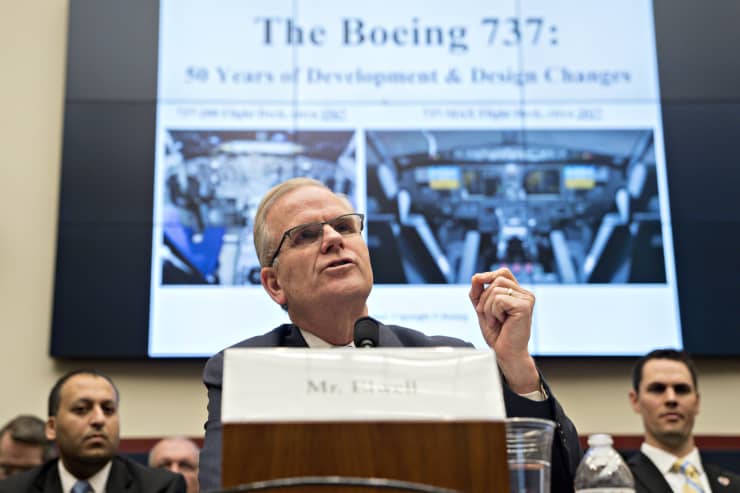
La audiencia de Boeing será la primera vez que los miembros de la Cámara de Representantes de Estados Unidos podrán hacer preguntas sobre dos accidentes fatales que involucran al Boeing 737 MAX.
El Comité de Transporte e Infraestructura de la Cámara de Representantes celebrará una audiencia el 15 Mayo 2019 para examinar el estado del Boeing 737 MAX, que ha permanecido en tierra desde Marzo 2019 luego de dos accidentes fatales que mataron a más de 300 personas.
Los investigadores que examinaron ambos accidentes aéreos, se han centrado en una característica automatizada anti-bloqueo diseñada para empujar la nariz del avión hacia abajo si la aeronave corre el riesgo de detenerse. Boeing agregó el Sistema de Aumento de Características de Maniobra (MCAS) a las aeronaves 737 MAX para compensar los cambios de diseño. Pero muchos pilotos de 737 MAX dijeron que desconocían el sistema hasta el primer choque.
Asesoría legal
Boeing nombra al mejor asesor legal para manejar las demandas por los accidentes y asuntos referentes del Boeing 737 MAX. Boeing nombró el Miércoles 1 Mayo 2019 a J. Michael Luttig como el recién creado cargo de Consejero y Asesor Principal para tratar asuntos legales relacionados con los dos recientes accidentes del 737 MAX. Luttig, de 64 años, que se ha desempeñado como abogado general desde que se unió a Boeing en 2006, «manejará todos los asuntos legales relacionados con los accidentes del Vuelo JT-610 de Lion Air y el vuelo ET-302 de Ethiopian Airlines», anunció la compañía de aviones con sede en Chicago en un comunicado.
Michael Luttig se había desempeñado en el Tribunal de Apelaciones de los Estados Unidos para el Cuarto Circuito durante 15 años antes de unirse a Boeing. También ocupó cargos de alto nivel en la Corte Suprema de los Estados Unidos, la Casa Blanca y en la práctica privada. Asesorará al Presidente de Boeing y CEO Dennis Muilenburg y al Consejo de Administración de Boeing. Mientras tanto, Brett Gerry sucede a Luttig como Consejero General de Boeing.
Una serie de demandas ya se han presentado contra Boeing en el Tribunal del Distrito Federal de Chicago por familiares de víctimas que perdieron la vida en dos accidentes mortales. Según se informa, las investigaciones en curso sobre los dos accidentes apuntan a lecturas defectuosas del sensor y un sistema de control de vuelo que empujó los aviones condenados hacia abajo.
Correcciones del 737 MAX
Dennis Muilenburg dijo en una reunión de accionistas el lunes que Boeing está cerca de completar una actualización del software de control de vuelo del avión 737 MAX. Si la nariz tiene un ángulo demasiado alto, y la aeronave se mueve demasiado lento, la cantidad de aire que corre por encima y por debajo de las alas puede no ser suficiente para generar el ascenso necesario para mantenerlo volando.
La FAA señaló el problema del sensor de Boeing en 216 veces, dice el Informe Preliminar. Es el informe el que podría probar la mayor supervisión de Boeing, los problemas conocidos que rodean el sensor de ángulo de ataque. El dispositivo del Ángulo de Ataque (AOA), que se cree que jugó un papel importante en los accidentes de Lion Air y Ethiopian Airline, fue marcado en más de 200 informes de incidentes enviados a la Administración Federal de Aviación (FAA). Sin embargo, según el informe, a pesar de los incidentes registrados, Boeing no realizó pruebas de vuelo en un escenario, como una colisión accidental, en el que el sensor no funcionó correctamente.
El trabajo de los sensores es determinar con precisión cuánto apunta el avión hacia arriba o hacia abajo. Desde el horror del accidente de Ethiopian Airlines en marzo, los expertos en seguridad aérea han centrado su atención en la pequeña aleta que se extiende desde la nariz del avión.
La inteligencia artificial que comprende los pilotos automáticos y los sistemas de seguridad de las líneas aéreas modernas recibe información de una multitud de sensores espaciados alrededor de la aeronave. Esto les dice todo, desde la velocidad del aire, la configuración del acelerador del motor, la temperatura y la altura del aire. Si una aeronave detectó un ángulo y una velocidad en riesgo de producir una pérdida, estos datos deberían haber activado la inteligencia artificial del Sistema de Aumento de Características de Maniobra (MCAS) de Boeing.
El Sistema MCAS en un avión Boeing 737-8 MAX recibe datos constantemente de los dos sensores sincronizados, ubicados en la nariz del avión. En caso de lanzamiento, el MCAS mueve automáticamente la nariz del avión hacia abajo, sin entrada del piloto. Aunque los pilotos pueden cortar el sistema manualmente, su activación repentina puede confundir a los pilotos. En un 737-8 MAX, que era el avión involucrado en los incidentes de Lion Air y Ethiopian Airlines, el sistema completamente automatizado del sensor de AoA pasa por alto al piloto. Toma los controles y obliga a la nariz del avión a lo que considera un ángulo seguro. Los investigadores dicen que las características de vuelo de los aviones 737-8 MAX de Ethiopian Air y Lion Air antes de estrellarse eran consistentes con que los pilotos luchaban contra las computadoras del avión.
Airbus sin ventaja
Airbus ha comentado que no se ha visto ningún cambio en la demanda de la serie A320NEO como resultado de la puesta a tierra actual del Boeing 737 MAX. «Un A320 es un A320 y un MAX es un MAX», dijo Guillaume Faury, CEO de Airbus. La situación actual «no está cambiando la imagen de mediano a largo plazo. Tenemos un atraso muy fuerte para el A320neo y estamos limitados por la cadena de suministro», declaró Faury. Señaló que la superposición con la cadena de suministro del 737 MAX está limitada, por lo que el posible alivio temporal en el otro lado no ayuda directamente a Airbus. Aunque Boeing ha reducido su producción de aeronaves Boeing 737 MAX de 52 a 42 por mes, por el momento los proveedores continúan entregando piezas y componentes a un ritmo mayor.
Airbus restableció su decisión de alcanzar una tasa de producción mensual de un solo pasillo de 60 para mediados de 2019. La tasa aumentará aún más a 63 en 2021. Faury cree que la demanda posterior en la próxima década justificará un mayor aumento de la producción. La compañía ha estado dispuesta a acelerar la producción, pero ha sido frenada por sus proveedores, en particular, los fabricantes de motores. También ha estado enfrentando serios problemas internos. Estos se han centrado en la cuarta línea de ensamblaje final en Hamburgo, que sigue siendo mucho menos productiva de lo planeado. Airbus está actualmente «trabajando para mejorar la ejecución en sus sistemas industriales internos y monitoreando el rendimiento del motor», declaró Faury.
La cuarta línea de producción se instaló en la antigua instalación del A380 en 2017. El diseño físico del sitio ha obligado a Airbus a realizar cambios sustanciales en el proceso que han sido más difíciles de implementar de lo que se esperaba. Airbus Cabin Flex es el nuevo diseño de la cabina A321 que se convertirá en estándar el próximo año.
Boeing hearing schedule on 737 MAX
The Boeing Hearing before the House of Representatives
The Boeing Company hearing will be the first time that members of the US House of Representatives will be able to ask questions about two fatal crashes involving the Boeing 737 MAX.
The Committee on Transportation and Infrastructure of the House of Representatives will hold a hearing on May 15, 2019 to examine the status of the Boeing 737 MAX, which has remained on the ground since March 2019 after two fatal accidents that killed more than 300 people.
Researchers who examined both air accidents have focused on an automated anti-block feature designed to push the nose of the aircraft down if the aircraft is at risk of stopping. Boeing added the Maneuver Characteristics Increase System (MCAS) to the 737 MAX aircraft to compensate for design changes. But many 737 MAX drivers said they were unaware of the system until the first crash.
Legal advice
Boeing appoints the best legal advisor to handle claims for accidents and related issues of the Boeing 737 MAX. Boeing appointed on Wednesday 1 May 2019 J. Michael Luttig as the newly created position of Counselor and Senior Advisor to address legal issues related to the two recent accidents of the 737 MAX. Luttig, 64, who has served as a general counsel since joining Boeing in 2006, «will handle all legal issues related to the accidents of Lion Air Flight JT-610 and Ethiopian Airlines Flight ET-302», announced the Chicago-based aircraft company in a statement.
Michael Luttig had served on the United States Court of Appeals for the Fourth Circuit for 15 years before joining Boeing. He also held high-level positions in the Supreme Court of the United States, the White House and in private practice. He will advise the President of Boeing and CEO Dennis Muilenburg and the Board of Directors of Boeing. Meanwhile, Brett Gerry succeeds Luttig as Boeing’s General Counsel.
A series of lawsuits have already been filed against Boeing in the Federal District Court of Chicago by relatives of victims who lost their lives in two fatal accidents. Reportedly, ongoing investigations into the two accidents point to faulty sensor readings and a flight control system that pushed the condemned aircraft down.
Corrections of the 737 MAX
Dennis Muilenburg told a shareholders meeting on Monday that Boeing is close to completing an update to the flight control software of the 737 MAX aircraft. If the nose is too high an angle, and the aircraft moves too slowly, the amount of air that runs above and below the wings may not be enough to generate the necessary lift to keep it flying.
The FAA pointed out the problem of the Boeing sensor 216 times, says the Preliminary Report. It is the report that could prove Boeing’s greatest oversight, the known problems surrounding the angle of attack sensor. The Attack Angle Device (AOA), which is believed to have played an important role in Lion Air and Ethiopian Airline accidents, was marked in more than 200 incident reports sent to the Federal Aviation Administration (FAA). However, according to the report, despite the recorded incidents, Boeing did not perform flight tests on a scenario, such as an accidental collision, in which the sensor did not work properly.
The work of the sensors is to determine with precision how much the airplane points upwards or downwards. Since the horror of the Ethiopian Airlines accident in March, air safety experts have focused their attention on the small fin that extends from the nose of the plane.
Artificial intelligence comprising automatic pilots and modern airline security systems receives information from a multitude of sensors spaced around the aircraft. This tells you everything, from the air speed, the engine throttle setting, the temperature and the height of the air. If an aircraft detected an angle and a velocity at risk of producing a loss, this data should have triggered the artificial intelligence of the Boeing Maneuver Characteristics Enhancement System (MCAS).
The MCAS System on a Boeing 737-8 MAX aircraft constantly receives data from the two synchronized sensors located on the nose of the aircraft. In case of launch, the MCAS automatically moves the nose of the aircraft downwards, without pilot input. Although pilots can cut the system manually, their sudden activation can confuse the pilots. In a 737-8 MAX, which was the aircraft involved in the incidents of Lion Air and Ethiopian Airlines, the fully automated AoA sensor system bypasses the pilot. Take the controls and force the nose of the plane to what it considers a safe angle. The researchers say that the flight characteristics of the Boeing 737-8 MAX of Ethiopian Air and Lion Air aircraft before crashing were consistent with the pilots fighting against the aircraft’s computers.
Airbus without advantage
Airbus has commented that there has been no change in demand for the A320NEO series as a result of the current grounding of the Boeing 737 MAX. «An A320 is an A320 and a MAX is a MAX», said Guillaume Faury, CEO of Airbus. The current situation «is not changing the image in the medium to long term, we have a very strong backlog for the A320neo and we are limited by the supply chain», Faury said. He noted that the overlap with the supply chain of the 737 MAX is limited, so the possible temporary relief on the other side does not directly help Airbus. Although Boeing has reduced its production of Boeing 737 MAX aircraft from 52 to 42 per month, for now suppliers continue to deliver parts and components at a higher rate.
Airbus reestablished its decision to achieve a single-aisle monthly production rate of 60 by mid-2019. The rate will increase further to 63 in 2021. Faury believes that subsequent demand in the next decade will justify a further increase in production. The company has been willing to accelerate production, but has been held back by its suppliers, in particular, the engine manufacturers. He has also been facing serious internal problems. These have focused on the fourth final assembly line in Hamburg, which is still much less productive than planned. Airbus is currently «working to improve the execution of its internal industrial systems and monitoring the performance of the engine», Faury said.
The fourth production line was installed in the old A380 installation in 2017. The physical design of the site has forced Airbus to make substantial changes in the process that have been more difficult to implement than expected. Airbus Cabin Flex is the new design of the A321 cabin that will become standard next year. A \ W
Ξ A I R G W A Y S Ξ
SOURCE: Airgways.com
DBk: Faa.gov / Boeing.com / Airegways.com / Airbus.com
AW-POST: 201905021541AR
AW | 2019 04 30 22:30 | AVIATION SAFETY / INDUSTRY
Boeing presenta cambios en el software del 737 MAX
Boeing confía en que los cambios en ese programa informático permitirán levantar la veda sobre los 737 MAX. Boeing ha presentado a la Agencia Federal estadounidense de la Aviación (FAA) algunos documentos sobre una corrección para el sistema de estabilización, denominado MCAS, de sus modelos 737 MAX, implicado en dos accidentes aéreos en los últimos meses, informó una fuente vinculada al tema.
La certificación del software, un paso clave para que los aparatos de este modelo vuelvan a volar, no se producirá, según un representante de Boeing, antes de la reunión que la FAA mantendrá el 23 de mayo con reguladores de todo el mundo en Washington. La FAA deberá esperar además a recibir los datos del vuelo de prueba que realizará en los próximos días, indicó bajo anonimato la fuente contactada por la AFP.
Boeing calcula que la inmovilización de los aviones le ha costado 1,000 millones de dólares después de que autoridades de todo el mundo prohibieran operar los 737 MAX, después de que dos accidentes con aviones de ese modelo en seis meses causaran más de 300 muertos. En ambos casos, las primeras conclusiones apuntan a un mal funcionamiento del sistema estabilizador MCAS. Por ello, Boeing confía en que los cambios en ese programa informático permitirán levantar la veda sobre los 737 MAX.
La FAA informó la semana pasada que había convocado a homólogos de varios países a una reunión el 23 de mayo en Washington para abordar los cambios que la compañía piensa implementar.
CEO de Boeing conserva su empleo
El presidente ejecutivo de Boeing Co, Dennis Muilenburg, conservó su empleo el lunes en una reunión anual de accionistas y prometió recuperar la confianza del público luego de enfrentar duras preguntas sobre dos accidentes fatales del avión 737 MAX.
En medio de la mayor crisis que ha enfrentado en sus casi cuatro años como presidente ejecutivo, Muilenburg sobrevivió a una moción de los accionistas de separar los roles que ocupa como Presidente Ejecutivo y jefe del directorio de The Boeing Company. Posteriormente, Muilenburg dijo a periodistas que continuaría liderando la compañía durante la crisis, que ha llevado a la suspensión de vuelos del avión, demandas, investigaciones y preocupaciones sobre la seguridad del 737 MAX. “Estoy muy concentrado en la seguridad hacia el futuro. Estoy muy convencido de eso. Mi clara intención es continuar liderando en los frentes de seguridad, calidad e integridad”, dijo después de la reunión, cuando periodistas le preguntaron si había considerado renunciar.
Boeing dice que el sistema de alerta standard no estaba operativo en todos los aviones 737 MAX. Un sistema de alerta que se suponía que debía ser una característica estándar en el avión 737 MAX de Boeing «no estaba operativo en todos los aviones», dijo la compañía. Boeing dijo en un comunicado el Lunes 29 Abril 2019 que la función no estaba funcionando en algunos de sus aviones porque estaba vinculada por error a una característica opcional, el indicador de Ángulo de Ataque (AOA). «La alerta en desacuerdo estaba destinada a ser una función estándar e independiente en los aviones MAX. Sin embargo, la alerta en desacuerdo no era operable en todos los aviones porque la función no estaba activada como se esperaba. A menos que una aerolínea optara por el indicador de ángulo de ataque, la alerta en desacuerdo no era operable». El indicador AOA permite a los pilotos saber si uno de los sensores AOA no está funcionando. La «alerta de desacuerdo» muestra si los sensores se contradicen entre sí. Boeing dijo que la función de alerta no era necesaria para la operación segura del avión.
BOEING 737-8 MAX DE AEROLÍNEAS ARGENTINAS ALMACENADOS EN AEROPARQUE
Boeing (BA) ha estado luchando contra la creciente preocupación pública y la presión de los accionistas por la seguridad de su avión más vendido después de que dos de los aviones se estrellaran en seis meses. El 29 Octubre 2019, un avión Boeing 737-8 MAX de Lion Air se estrelló en Indonesia, matando a las 189 personas a bordo. Otro 737 MAX de Ethiopian Airlines se estrelló en circunstancias similares el 10 Marzo 2019, dejando 157 muertos.
Algunos de los clientes de Boeing dicen que la compañía no era tan transparente como debería haber sido con el sistema de alerta. Southwest Airlines, el mayor operador estadounidense de 737 MAX, dijo en un comunicado el lunes que solo se había enterado de que el sistema era opcional después de la tragedia de Lion Air en Octubre 2018. «Antes del evento de Lion Air, las luces en desacuerdo de AOA fueron representadas como operables (no opcionales) por Boeing en todos los aviones de MAX», dijo la portavoz de Southwest Michelle Agnew.
Boeing defendió sus prácticas el lunes
«En cada avión entregado a nuestros clientes, incluido el MAX, todos los datos de vuelo y la información necesaria para operar con seguridad el avión se proporciona en la cabina de vuelo y en la pantalla de la plataforma de vuelo», dijo Boeing. Pero la declaración marca la primera vez que la compañía admite un error en el lanzamiento de su 737 MAX.
En su reunión de accionistas el lunes anterior, el presidente ejecutivo, Dennis Muilenburg, dijo que los sistemas de seguridad en el 737 Max fueron diseñados adecuadamente. «No hemos visto un resbalón ni un error técnico en términos del diseño fundamental y la certificación del enfoque», dijo. También sugirió que en ambos choques fatales, los pilotos no siguieron completamente los procedimientos que Boeing había descrito para prevenir el mal funcionamiento. Boeing declinó comentar más sobre el asunto. La compañía ha dicho que continuará trabajando para hacer que sus aviones sean más seguros. El mes pasado implementó una revisión del software para el 737 MAX que implicó una actualización a MCAS, el sistema anti-bloqueo que se identificó como un enlace común en ambos accidentes.
El cambio más significativo en el software MCAS en esa actualización es la adición de datos de un segundo sensor AOA, que mide la inclinación horizontal del avión. En su primera iteración, el software solo extrajo datos de un sensor AOA. Investigadores en Indonesia han dicho que los datos erróneos de un solo sensor hicieron que el sistema MCAS empujara repetidamente el vuelo JT-610 de Lion Air hacia el Mar de Java, en una batalla con los pilotos que intentaron enderezar el avión. Boeing dice que se asegurará de que el sistema de «alerta de desacuerdo» funcione en todos los 737 MAX.
Boeing presents MCAS correction to FAA
Boeing introduces changes to the 737 MAX software
Boeing is confident that the changes in that computer program will allow the closure of the 737 MAX. Boeing has submitted to the Federal Aviation Agency (FAA) some documents on a correction for the stabilization system, called MCAS, of its models 737 MAX, involved in two plane crashes in recent months, a source related to the subject said.
The certification of the software, a key step for the devices of this model to fly again, will not occur, according to a Boeing representative, before the meeting that the FAA will hold on May 23 with regulators from around the world in Washington. The FAA must also wait to receive the data of the test flight that it will carry out in the next few days, the source contacted by the AFP indicated anonymously.
Boeing calculates that the immobilization of the airplanes has cost him 1,000 million dollars after authorities around the world prohibited to operate the 737 MAX, after two accidents with airplanes of that model in six months caused more than 300 deaths. In both cases, the first conclusions point to a malfunction of the MCAS stabilizing system. Therefore, Boeing is confident that the changes in that computer program will allow lifting the ban on the 737 MAX.
The FAA reported last week that it had convened counterparts from several countries to a meeting on May 23 in Washington to address the changes the company plans to implement.
CEO of Boeing keeps his job
Boeing Co Chief Executive Dennis Muilenburg retained his job Monday at an annual shareholders meeting and vowed to regain public confidence after facing tough questions about two fatal crashes of the 737 MAX plane.
In the midst of the biggest crisis he has faced in his almost four years as CEO, Muilenburg survived a shareholder motion to separate the roles he holds as Executive Chairman and head of the Boeing Company’s board of directors. Subsequently, Muilenburg told reporters that he would continue to lead the company during the crisis, which has led to the suspension of plane flights, demands, investigations and concerns about the safety of the 737 MAX. «I’m very focused on security for the future. I am very convinced of that. My clear intention is to continue leading in the fronts of security, quality and integrity», he said after the meeting, when journalists asked him if he had considered resigning.
Boeing says the standard warning system was not operational on all 737 MAX aircraft. An alert system that was supposed to be a standard feature on Boeing’s 737 MAX plane «was not operational on all planes», the company said. Boeing said in a statement on Monday 29 April 2019 that the function was not working on some of its aircraft because it was linked by mistake to an optional feature, the Angle of Attack (AOA) indicator. «The Disagreeing Alert was intended to be a standard and independent function in the MAX aircraft, however, the Disagreeing Alert was not operable on all aircraft because the function was not activated as expected, unless an airline opted for the angle of attack indicator, the alert in disagreement was not operable». The AOA indicator allows pilots to know if one of the AOA sensors is not working. The «disagreement alert» shows if the sensors contradict each other. Boeing said the warning function was not necessary for the safe operation of the plane.
Boeing (BA) has been battling growing public concern and shareholder pressure for the safety of its best-selling plane after two of the planes crashed in six months. On October 29, 2019, a Boeing 737-8 MAX aircraft from Lion Air crashed in Indonesia, killing the 189 people on board. Another 737 MAX of Ethiopian Airlines crashed in similar circumstances on March 10, 2019, leaving 157 dead.
Some of Boeing’s clients say that the company was not as transparent as it should have been with the alert system. Southwest Airlines, the largest US operator of 737 MAX, said in a statement on Monday that it had only learned that the system was optional after the Lion Air tragedy in October 2018. «Before the Lion Air event, the lights on AOA’s disagreement was represented as operable (not optional) by Boeing on all of MAX’s aircraft, «said Southwest spokeswoman Michelle Agnew.
Boeing defended his practices on Monday
«On each plane delivered to our customers, including the MAX, all flight data and information necessary to safely operate the aircraft is provided in the flight deck and on the flight deck screen», said Boeing. But the statement marks the first time the company admits an error in the launch of its 737 MAX.
At its shareholder meeting on Monday, Chief Executive Dennis Muilenburg said that the security systems in the 737 Max were properly designed. «We have not seen a slip or a technical error in terms of the fundamental design and certification of the approach», he said. He also suggested that in both fatal crashes, the pilots did not «fully» follow the procedures that Boeing had described to prevent malfunction. Boeing declined to comment more on the matter. The company has said it will continue working to make its aircraft safer. Last month he implemented a software revision for the 737 MAX that involved an update to MCAS, the anti-blocking system that was identified as a common link in both accidents.
The most significant change in the MCAS software in that update is the addition of data from a second AOA sensor, which measures the plane’s horizontal inclination. In its first iteration, the software only extracted data from an AOA sensor. Researchers in Indonesia have said that erroneous data from a single sensor caused the MCAS system to repeatedly push Lion Air’s JT-610 flight into the Java Sea, in a battle with pilots who tried to straighten the plane. Boeing says it will make sure that the «disagreement alert» system works on all 737 MAX. A \ W
Ξ A I R G W A Y S Ξ
SOURCE: Airgways.com
DBk: Faa.gov / Boeing.com / Airgways.com
AW-POST: 201904302230AR
AW | 2019 04 26 21:15 | AVIATION SAFETY / INDUSTRY
La FAA podría recertificar el Boeing 737 MAX para Mayo-Junio 2019
La Administración Federal de Aviación (FAA) podría hacer que el Boeing 737 MAX vuelva a volar a fines del próximo mes o principios de Junio 2019, según la agencia de seguridad. La FAA podría aprobar mucho más rápido de lo que muchos analistas han pronosticado la certificación para vuelo del Boeing 737 MAX: Aún así, las aerolíneas todavía necesitarían semanas para preparar sus aviones y entrenar a sus pilotos. Pero el calendario, que no supone desarrollos imprevistos, significa que las compañías aéreas de Estados Unidos podrían volver a disponer del Boeing 737 MAX para principios de Agosto 2019.
En una reunión crucial de los jefes de las autoridades de aviación civil de todo el mundo convocada por la FAA el 23 Mayo 2019, se espera que la agencia reguladora de Estados Unidos presente su análisis final de seguridad en un intento por fomentar el consenso internacional. A menos que se descubran algunos problemas nuevos, la FAA anticipa decirles a los reguladores extranjeros reunidos que está «en condiciones de habilitar la aeronave para el servicio en las inmediaciones de esa reunión», potencialmente tan pronto como una semana después, dijo la persona familiarizada con la FAA.
El Jefe de Boeing Commercial Airplanes, Kevin McAllister, dijo que Boeing tiene fechas fijas pero todavía no hay nada firme. Para obtener el consenso internacional que a Boeing le gustaría, dijo, la FAA debe convencer a los demás reguladores de que ha hecho todo lo necesario para validar la seguridad del 737 MAX. La carga estará en la FAA y Boeing para demostrar antes del 23 Mayo 2019 que tienen todo bajo control.
La autorización de la FAA certificaría una solución de software que Boeing diseñó para el nuevo sistema de control de vuelo conocido como la MCAS ( Sistema de Aumento de Características de Maniobra) de los Boeing 737 MAX, la línea de cuarta generación, que está implicado en los dos últimos accidentes fatales que mataron a 346 personas. Al mismo tiempo, la agencia ordenará la capacitación de pilotos para informar a las tripulaciones de vuelo por completo sobre el sistema actualizado y sobre cómo lidiar con cualquier falla potencial.
Los aviones han estado en tierra en todo el mundo desde el 13 Marzo 2019. Será necesario un rápido progreso entre ahora y la reunión del 23 Mayo 2019. El 17 Abril 2019, el Presidente Ejecutivo de Boeing, Dennis Muilenburg, dijo que la compañía había completado 135 vuelos de prueba con el nuevo software instalado, y agregó que el próximo vuelo sería el vuelo de certificación MCAS. Ese vuelo, en el que los pilotos de prueba de la FAA pusieron a prueba el avión y probó varios modos de falla y condiciones extremas de vuelo, aún no ha ocurrido. Una vez que se completen los test de pruebas existe cierto optimismo de que el proceso de re-certificación pueda ocurrir de manera bastante oportuna. Si bien Boeing y la FAA creen que un consenso mundial entre las autoridades de aviación reforzaría sustancialmente la confianza pública en la seguridad del 737 MAX, es posible que no esperen mucho si el acuerdo internacional es demasiado lento para surgir.
La FAA ha expresado que una vez que se haya verificado el proceso de certificación y el personal técnico de la FAA esté convencido de que el avión ahora sea seguro, será difícil justificar que se mantenga en tierra debido a consideraciones políticas internacionales.
Puesta a punto para aerolíneas
La aprobación de la FAA será el desencadenante para comenzar la logística que requiere mucho tiempo antes de que puedan reanudarse los vuelos comerciales. Las aerolíneas primero deben instalar la actualización de software en todos sus MAX.
El capitán de American Airlines, Dennis Tajer, portavoz de la Asociación de Pilotos Aliados (APA), dijo que Boeing informó que tomará aproximadamente una semana hacer eso para los Boeing 737 MAX en la flota estadounidense. Luego, los aviones que se han almacenado durante semanas, muchos de ellos en aeródromos del desierto seco, tendrán que someterse a un mantenimiento de rutina antes de volar, incluidos el engrase y el funcionamiento de los motores, la rotación de las ruedas y el ciclo de los sistemas hidráulicos, lo que podría demorar una semana más. El siguiente paso, será completar la capacitación del piloto que tomará mucho más tiempo, dada la complejidad de los programas piloto.
Mientras realizan el seguimiento de la capacitación de pilotos, las aerolíneas también deberán actualizar sus manuales de vuelo y mantenimiento. Solo después de que se haya hecho todo esto, podrán ver las rutas y los horarios de sus rutas y comenzar a abrir vuelos para los Boeing 737 MAX en sus sistemas de reserva.
FAA would recertify 737 MAX for 5-6/2019
The FAA could recertify the Boeing 737 MAX for May-June 2019
The Federal Aviation Administration (FAA) could make the Boeing 737 MAX fly again by the end of next month or early June 2019, according to the security agency. The FAA could approve much faster than many analysts have predicted the certification for flight of the Boeing 737 MAX: Even so, airlines still need weeks to prepare their aircraft and train their pilots. But the schedule, which does not imply unforeseen developments, means that US airlines could once again have the Boeing 737 MAX by early August 2019.
At a crucial meeting of the heads of civil aviation authorities around the world convened by the FAA on May 23, 2019, the US regulatory agency is expected to present its final safety analysis in an attempt to foster international consensus. Unless some new problems are discovered, the FAA anticipates telling the assembled foreign regulators that it is «in a position to enable the aircraft for service in the vicinity of that meeting», potentially as soon as a week later, said the familiar person. with the FAA.
The Chief of Boeing Commercial Airplanes, Kevin McAllister, said that Boeing has fixed dates but still nothing firm. To obtain the international consensus that Boeing would like, he said, the FAA must convince other regulators that it has done everything necessary to validate the safety of the 737 MAX. The cargo will be in the FAA and Boeing to demonstrate before 23 May 2019 that they have everything under control.
The FAA authorization would certify a software solution that Boeing designed for the new flight control system known as the MCAS (Maneuvering Feature Enhancement System) of the Boeing 737 MAX, the fourth generation line, which is involved in the last two fatal accidents that killed 346 people. At the same time, the agency will order the training of pilots to inform the flight crews in full about the updated system and how to deal with any potential failure.
The airplanes have been on the ground around the world since March 13, 2019. It will be necessary a rapid progress between now and the meeting of May 23, 2019. On April 17, 2019, Boeing Executive Chairman Dennis Muilenburg said the company had completed 135 test flights with the new software installed, adding that the next flight would be the MCAS certification flight. That flight, in which FAA test pilots put the plane to the test and tested several failure modes and extreme flight conditions, has not yet occurred. Once the test tests are completed, there is some optimism that the re-certification process may occur in a timely manner. While Boeing and the FAA believe that a global consensus among aviation authorities would substantially reinforce public confidence in the safety of the 737 MAX, they may not wait long if the international agreement is too slow to emerge.
The FAA has stated that once the certification process has been verified and the FAA technical staff is satisfied that the aircraft is now safe, it will be difficult to justify keeping it on the ground due to international political considerations.
Tuning for airlines
The approval of the FAA will be the trigger to begin logistics that requires a long time before commercial flights can resume. Airlines must first install the software update on all their MAX.
American Airlines captain Dennis Tajer, spokesman for the Allied Pilots Association (APA), said Boeing said it would take about a week to do that for the Boeing 737 MAX in the US fleet. Then, aircraft that have been stored for weeks, many of them in dry desert airfields, will have to undergo routine maintenance before flying, including lubrication and operation of the engines, wheel rotation and the cycle of hydraulic systems, which could take another week. The next step will be to complete the pilot training that will take much longer, given the complexity of the pilot programs.
While monitoring the pilot training, airlines must also update their flight and maintenance manuals. Only after all this has been done, will they be able to see the routes and schedules of their routes and begin to open flights for the Boeing 737 MAX in their reservation systems. A \ W
Ξ A I R G W A Y S Ξ
SOURCE: Airgways.com
DBk: Faa.gov / Boeing.com / Seattletimes.com / Airgways.com
AW-POST: 201904262115AR
AW | 2019 04 24 17:52 | INDUSTRY / AVIATION SAFETY
El Boeing 737 MAX ha efectuado 135 vuelos de prueba desde la suspensión
El fabricante de aviones Boeing dice estar viendo un progreso constante en una actualización de software para solucionar los problemas que llevaron a dos accidentes mortales. El miércoles, Boeing ofreció un vistazo de cómo avanza el trabajo con su avión Boeing 737 MAX y los costos que los problemas del avión han impuesto a la compañía. Boeing reservó cargos no especificados relacionados con el desarrollo de una solución para el MCAS y la capacitación de pilotos, y estaba progresando constantemente hacia la certificación del software después de completar más de 135 vuelos de prueba y producción.
Boeing dijo que está haciendo un progreso constante hacia la obtención de la re-certificación para una actualización de software del MCAS diseñada para rectificar los problemas que contribuyeron a dos accidentes mortales en los últimos meses. Hasta la fecha, la compañía ha completado más de 135 vuelos de prueba del 737 MAX con la actualización de software implementada. El Presidente Ejecutivo de The Boeing Company, Dennis Muilenburg, en un comunicado expresó: «En toda la compañía, estamos enfocados en la seguridad, en volver a poner el 737 MAX en servicio y en ganar la confianza de los clientes, los reguladores y el público en general».
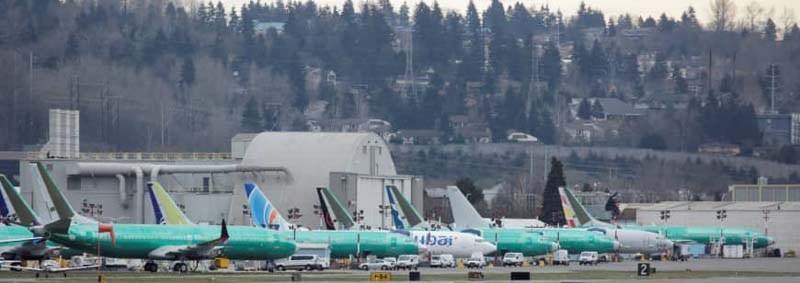
El régimen de pruebas incluye trabajar estrechamente con reguladores globales así como con las aerolíneas asociadas. La línea 737 MAX ha estado en tierra para vuelos comerciales alrededor del mundo desde Marzo 2019, y Boeing ha reducido la producción de nuevos aviones en esa línea. Los aviones 737 MAX se están acumulando cada vez más en el campo que el fabricante estadounidense tiene en Seattle para almacenar los aviones. El aumento de estas aeronaves ha sido tan elevada en solo una semana que apenas queda algo más de espacio.
Impacto «MAX»
El reciente informe financiero entregado de la constructora aeronáutica ha impacto en las arcas de Boeing. La compañía dijo el miércoles que los ingresos del primer trimestre de US$ 11.800 millones, así como su flujo de caja, reflejaron menores entregas del 737 MAX.
La conexión a tierra global de la flota mundial de los Boeing 737 MAX costará a la compañía más de US$ 1.000 millones de dólares. Boeing dice que abandonó su perspectiva financiera para 2019 y detuvo las recompras de acciones a mediados de Marzo mientras se enfrenta a la crisis. El anuncio fue una fuerte inversión del último informe de ganancias de Boeing en enero, cuando los ejecutivos revelaron planes para entregar más de 900 aviones de línea este año junto con mayores ventas y ganancias.
Los jets Boeing 737 MAX se conectaron a tierra después de dos accidentes fatales que mataron a 346 personas y provocaron investigaciones sobre los accidentes en todo el mundo y dejaron a Boeing con una de las crisis más grandes de su historia. Las consecuencias reglamentarias han estado dominadas hasta ahora por preguntas sobre el software anti-stall conocido como MCAS, que Boeing ha reconocido que era un enlace común en las distintas cadenas de eventos que llevan a ambos accidentes. Los dos accidentes aéreos hicieron que los reguladores de todo el mundo aterrizaran el 737 MAX y desencadenaron investigaciones sobre el desarrollo del avión por parte de las autoridades federales de transporte y el Departamento de Justicia de los Estados Unidos.
Reducción línea producción
Boeing redujo la producción de los aviones después de los choques a 42 aviones por mes, menos que los 52, y su flujo de efectivo operativo en el primer trimestre fue de unos US$ 350 millones menos que el año anterior.
Proyecciones 2019
Michael Hewson, Analista Jefe de Mercado de CMC Markets UK expresó que aunque se esperaba que el negocio de aviones comerciales de Boeing superara su récord de 806 entregas de aeronaves el año pasado y alcanzara las 900 en 2019, ese objetivo ahora parece cada vez más improbable. El Boeing 737 MAX, que actualmente representa alrededor del 30% de las ganancias de Boeing, probablemente verá su contribución a los ingresos de la empresa significativamente reducida como resultado del incidente. «La probabilidad de que el avión vuelva a volar en el aire pronto ha disminuido en las últimas semanas, debido al enorme daño de la marca que han hecho los eventos recientes».
Aprobaciones y takeoff
Boeing está apuntando a la aprobación por parte de la Administración Federal de Aviación (FAA) de su solución de software para el avión 737 MAX a partir de la tercera semana de Mayo 2019 y para elevar la puesta a tierra del MAX alrededor de mediados de Julio 2019.
Las fechas son parte de un cronograma provisional que Boeing ha compartido en reuniones con clientes de líneas aéreas, ya que explica una actualización del software del MCAS que tuvo un papel en dos accidentes fatales y llevó a la puesta a tierra en todo el mundo del MAX 737 en el mes de Marzo 2019.
Boeing detuvo las entregas de los 737 MAX a los clientes y ha comunicado que reduciría la producción de 737 a 42 aviones por mes en lugar de 52. La compañía dijo que emitirá un nuevo pronóstico en el futuro cuando tenga más claridad sobre los problemas que rodean al 737 MAX.
Impacto MAX en las aerolíneas
El Boeing 737 ha sido un caballo de batalla popular para las aerolíneas de todo el mundo. Pero después de la segunda caída del las aeronaves 737 MAX, una encuesta realizada por Business Insider sugirió que el 53% de los adultos estadounidenses nunca quieren volar en un 737 MAX, incluso una vez que se considere seguro hacerlo.
Los pasajeros son solo parte de la ecuación, también están los transportistas. En su perpetua batalla por la supremacía del mercado con su rival Airbus, Boeing se apresuró a desarrollar el 737 MAX para ofrecer a las aerolíneas una versión más eficiente de su popular línea 737. El MAX se convirtió en el avión más vendido de la Boeing que fueron homologados para volar más de 300 en servicio y alrededor de 5.000 más en órdenes. Pero desde el accidente de Ethiopian Airlines, las ventas del Boeing 737 MAX fracasaron. La lista de pedidos se puede acortar a medida que las aerolíneas asustadas retroceda o cancelen sus compras.
Garuda Indonesia Airlines reemplazará Boeing 737-8 MAX con otros aviones de la Boeing. Intercambiará sus pedidos de los 737-8s con otros aviones fabricados por la compañía estadounidense. La aerolínea indonesia es la primera en dar este paso formalmente luego de dos accidentes fatales que involucran al 737-8 MAX.
Garuda informó a Boeing de su decisión de cancelar sus pedidos de 49 de los aviones en Marzo 2019. Ambas compañías habían estado en negociaciones sobre la cancelación total o el reemplazo del pedido por otros aviones Boeing. Garuda ordenó 50 de los Boeing 737-8 MAX en 2014 en un acuerdo por valor de US$ 4.9 mil millones en ese momento. La aerolínea tiene en tierra una aeronave 737 MAX.
Lion Air, la aerolínea low cost de Indonesia posee 10 Boeing 737-8 MAX, lo que ha obligado a poner en tierra toda su flota. La compañía ha ordenado posponer la llegada de cuatro aviones más, inicialmente programados para Mayo 2019.
Los problemas también están causando un dolor de cabeza para las aerolíneas como TUI AG, que se ha visto obligada a aterrizar los 15 737-8 MAX de su flota, mientras que la compañía de presupuesto Ryanair Holdings PLC podría enfrentar problemas con el pedido realizado de 110 Boeing 737-8 MAX para expandir y actualizar su flota aérea.
Southwest Airlines es la aerolínea más importante por número de unidades Boeing 737 MAX en orden que cualquier otra aerolínea y ha pedido 737 MAX. Un compromiso con el 737 MAX es al menos la forma en que se informaron ampliamente los comentarios de en la aerolínea low cost americana. Southwest Airlines ha sido un cliente fiel a Boeing desde el lanzamiento de la aerolínea, por lo que es probable que continúen siendo clientes de Boeing, aunque no han expresado que sea de manera exclusiva. Los miembros del equipo han estado fuera en Europa evaluando la aeronave regional Airbus A220.
El mundo de la venta de aviones puede ser complicado, pero algunos esperan que el gigante estadounidense utilice el mismo enfoque simple que cualquier minorista con un producto de venta deficiente: reducir el precio. La compañía no va a depreciar el modelo pero ofrecerá métodos de ventas atractivos para continuar con la saga de la línea 737.
Alaska Airlines, la sexta aerolínea más grande de Estados Unidos, ha salido de compras solicitando ocho unidades de los 737 MAX, aunque podrían agregar una docena al pedido inicial. Una orden de anclaje de un nombre tan reconocible podría ayudar a restaurar la confianza en la marca.
En Westjet y Air Canada, están capacitando a los pilotos en simulaciones de los cambios al 737 MAX en la sede de Boeing en el área de Seattle, y también se están incluyendo en los planes de diseño para un nuevo régimen de entrenamiento piloto.
Mientras tanto, con las ventas estancadas, Boeing está tratando de restablecer la confianza en la preparación para la reanudación de 737 vuelos Max, que se espera para este año 2019. La culpa que tiene Boeing en última instancia está relacionada con las acciones en su responsabilidad por incidentes, accidentes y la operatividad del Boeing 737 MAX por la conexión a tierra, pero la necesidad de dejar las cosas en buenos términos y no arruinar sus relaciones con las líneas aéreas será para asegurar futuros pedidos que representan un gran desafía hacia el horizonte.
Recovering the confidence of the 737 MAX
The Boeing 737 MAX has made 135 test flights since the suspension
The Boeing aircraft manufacturer says it is seeing steady progress in a software update to solve the problems that led to two fatal accidents. On Wednesday, Boeing offered a glimpse of how the work is progressing with his Boeing 737 MAX aircraft and the costs that the plane’s problems have imposed on the company. Boeing reserved unspecified charges related to the development of a solution for MCAS and pilot training, and was progressing steadily towards software certification after completing more than 135 test and production flights.
Boeing said it is making steady progress toward obtaining re-certification for an MCAS software update designed to rectify the problems that contributed to two fatal accidents in recent months. To date, the company has completed more than 135 test flights of the 737 MAX with the software update implemented. The Executive President of The Boeing Company, Dennis Muilenburg, in a statement said: «Throughout the company, we are focused on security, putting the 737 MAX back on service and gaining the trust of customers, regulators and the public. in general».
The testing regime includes working closely with global regulators as well as with partner airlines. The 737 MAX line has been on the ground for commercial flights around the world since March 2019, and Boeing has reduced the production of new aircraft on that line. The 737 MAX airplanes are accumulating more and more in the field that the American manufacturer has in Seattle to store the airplanes. The increase in these aircraft has been so high in just one week that there is barely more room left.
Impact «MAX»
The recent financial report delivered by the aeronautical construction company has had an impact on Boeing’s coffers. The company said on Wednesday that first-quarter revenue of US$ 11.8 billion, as well as cash flow, reflected lower deliveries of the 737 MAX.
The global ground connection of the Boeing 737 MAX world fleet will cost the company more than US$ 1 billion. Boeing says it abandoned its financial outlook for 2019 and halted stock buybacks in mid-March as it faces the crisis. The announcement was a strong investment in Boeing’s latest earnings report in January, when executives revealed plans to deliver more than 900 line aircraft this year along with higher sales and profits.
The Boeing 737 MAX jets were grounded after two fatal crashes that killed 346 people and led to investigations into accidents around the world and left Boeing with one of the biggest crises in its history. The regulatory consequences have been dominated so far by questions about the anti-stall software known as MCAS, which Boeing has recognized as a common link in the various chains of events that lead to both accidents. The two plane crashes caused regulators around the world to land the 737 MAX and trigger investigations into the development of the aircraft by federal transportation authorities and the US Department of Justice.
Production line reduction
Boeing reduced aircraft production after the crashes to 42 aircraft per month, less than the 52, and its operating cash flow in the first quarter was about US$ 350 million less than the previous year.
Projections 2019
Michael Hewson, Chief Market Analyst at CMC Markets UK said that although Boeing’s commercial aircraft business was expected to surpass its record of 806 aircraft deliveries last year and reach 900 in 2019, that goal now seems increasingly unlikely. The Boeing 737 MAX, which currently accounts for around 30% of Boeing’s earnings, will likely see its contribution to the company’s revenue significantly reduced as a result of the incident. «The likelihood of the plane flying again in the air soon has decreased in recent weeks, due to the enormous damage to the brand that recent events have caused».
Approvals and takeoff
Boeing is aiming for approval by the Federal Aviation Administration (FAA) of its software solution for the 737 MAX aircraft from the third week of May 2019 and to raise the grounding of the MAX around mid-July 2019.
The dates are part of a tentative schedule that Boeing has shared in meetings with airline customers, as it explains an update to the MCAS software that played a role in two fatal crashes and led to the worldwide grounding of the MAX 737 in the month of March 2019.
Boeing stopped delivery of the 737 MAX to customers and said it would reduce production from 737 to 42 aircraft per month instead of 52. The company said it will issue a new forecast in the future when it has more clarity about the problems surrounding it. at 737 MAX.
MAX impact on airlines
The Boeing 737 has been a popular workhorse for airlines around the world. But after the second crash of the 737 MAX aircraft, a survey by Business Insider suggested that 53% of American adults never want to fly a 737 MAX, even once it is considered safe to do so.
The passengers are just part of the equation, there are also the carriers. In its perpetual battle for market supremacy with rival Airbus, Boeing hastened to develop the 737 MAX to offer airlines a more efficient version of its popular 737 line. The MAX became the Boeing’s best-selling aircraft. They were approved to fly more than 300 in service and around 5,000 more in orders. But since the Ethiopian Airlines crash, sales of the Boeing 737 MAX failed. The list of orders can be shortened as scared airlines back off or cancel their purchases.
Garuda Indonesia Airlines will replace the Boeing 737-8 MAX with other Boeing aircraft. It will exchange its orders for the 737-8s with other aircraft manufactured by the US company. The Indonesian airline is the first to take this step formally after two fatal crashes involving the 737-8 MAX.
Garuda informed Boeing of its decision to cancel its orders for 49 of the aircraft in March 2019. Both companies had been in negotiations about the total cancellation or replacement of the order by other Boeing aircraft. Garuda ordered 50 of the Boeing 737-8 MAX in 2014 in a deal worth US$ 4.9 billion at that time. The airline has a 737 MAX aircraft on the ground.
Lion Air, Indonesia’s low cost airline has 10 Boeing 737-8 MAX, which has forced its entire fleet to land. The company has ordered postponing the arrival of four more planes, initially scheduled for May 2019.
The problems are also causing a headache for airlines such as TUI AG, which has been forced to land the 15 737-8 MAX of its fleet, while the budget company Ryanair Holdings PLC could face problems with the order placed 110 Boeing 737-8 MAX to expand and update your air fleet.
Southwest Airlines is the most important airline by number of Boeing 737 MAX units in order of any other airline and has ordered 737 MAX. A commitment to the 737 MAX is at least the way in which the comments of the American low cost airline were widely reported. Southwest Airlines has been a loyal customer to Boeing since the launch of the airline, so it is likely that they will continue to be Boeing customers, although they have not expressed it exclusively. Team members have been out in Europe evaluating the regional aircraft Airbus A220.
The world of the sale of airplanes can be complicated, but some hope that the American giant uses the same simple approach that any retailer with a product of bad sale: to reduce the price. The company will not depreciate the model but will offer attractive sales methods to continue the saga of the 737 line.
Alaska Airlines, the sixth largest airline in the United States, has gone shopping for eight units of the 737 MAX, although they could add a dozen to the initial order. An anchor order for such a recognizable name could help restore trust in the brand.
At Westjet and Air Canada, they are training pilots in simulations of changes to the 737 MAX at the Boeing headquarters in the Seattle area, and they are also being included in the design plans for a new pilot training regime.
Meanwhile, with sales stagnating, Boeing is trying to restore confidence in preparing for the resumption of 737 Max flights, which is expected for this year 2019. The fault that Boeing has ultimately is related to the actions in its responsibility due to incidents, accidents and the operation of the Boeing 737 MAX due to the connection to the ground, but the need to leave things in good terms and not to ruin their relations with the airlines will be to ensure future orders that represent a great challenge to the horizon. A \ W
Ξ A I R G W A Y S Ξ
SOURCE: Airgways.com
DBk: Boeing.com / Airgways.com / Faa.gov / King5.com / Asia.nikkei.com / Reuters.com / Kmox.radio.com
AW-POST: 201904241752AR
Dos aeronaves de Avianca y Austral sufren incidente de casi colisión
La distancia mínima a la que se acercaron las aeronaves Embraer E-190-100AR de Austral Líneas Aéreas y ATR-72-600 de Avianca Argentina era de unos 100 metros. Dos líneas de pasajeros casi colisionan en el cielo sobre Argentina, informó el centro de investigación de seguridad JACDEC de Argentina.
El incidente en el aire ocurrió el Domingo 21 Abril 2019 por la noche cerca de la ciudad de Puerto Constanza, ubicada a 80 kilómetros de la Capital Federal, Buenos Aires. Se informa que la distancia mínima a la que se unieron los revestimientos E-190 y ATR-72 fue de unos 100 metros. Según las reglas, los aviones durante el movimiento en el aire no deben acercarse entre sí en menos de 300 metros.
Después del incidente, un registro de conversaciones entre uno de los pilotos y el Controlador Aéreo apareció en Internet. El primer oficial Julio Cresta iba en el vuelo de Avianca que se dirigía desde Aeroparque a Sauce Viejo, en Santa Fe, y brindó detalles de lo ocurrido. El vuelo AR2795 del E190 de Austral pasó cerca del vuelo de Avianca. Según uno de los comandantes, estuvieron a una distancia de 150 metros uno del otro. Esto provocó un fuerte intercambio entre el comandante de la nave y la controladora de turno del Aeropuerto Jorge Newbery.
El vuelo de Austral cubría la ruta Resistencia-Buenos Aires. El de Avianca, salía del Aeroparque Metropolitano rumbo a la ciudad de Sauce Viejo, en la provincia de Santa Fe. Según el audio que se conoció del diálogo entre ambos, las dos aeronaves se cruzaron a muy poca distancia. El primer oficial de Avianca, Julio Cresta, que iba en el vuelo A07126, habló sobre el incidente y brindó detalles de lo ocurrido. «Dentro del error que hubo, que el otro avión descienda mil pies más de lo que tenía que descender, que fue una equivocación de la controladora, fue todo dentro de un marco controlado. Pasamos cerca, pero no tan cerca como se dice (150 metros). Además fue en un contexto de una tarde totalmente visual, con el tránsito en el instrumento a bordo (TCAS Traffic) y referencia a la vista», explicó. Según reveló, en la zona no había saturación, pero sí en terminal había varios vuelos. «En el caso de que haya un conflicto o hipótesis de colisión, el TCAS Traffic (el Sistema de Alerta de Tráfico y Evasión de Colisión) avisa que uno baje y al otro avión que suba. En este caso, cuando pasa un avión o un tránsito cerca, solo avisa la proximidad», añadió Cresta. Según el comandante del vuelo de Austral estuvieron a 500 pies y por momentos a 300 pies de diferencia con el avión de Avianca. En tal sentido, el piloto reconoció que tuvieron una indicación del TCAS Traffic, pero fue en un contexto de una tarde con visibilidad plena. «No es lo mismo si esto ocurre cuando uno vuela instrumental en capa, donde no se puede ver hacia afuera y uno por ahí se asusta más y no sabe cómo fue que pasó todo», admitió.
«Esto no tendría que pasar, pero a veces sucede cuando está saturada la terminal o hay muchos aviones. Pero el responsable de la seguridad entre un avión y otro es el piloto, por más que haya un controlador, radares e instrumentos», dijo Cresta en declaraciones a un canal de noticias de cable. El primer oficial señaló que no dijeron nada porque desde su punto de vista no fue algo extremo. Sin embargo, reveló que el responsable del vuelo, el capitán, ya hizo un informe y se comunicó con la gente del EANA (Empresa Argentina de Navegación Aérea). La EANA (Empresa Argentina de Navegación Aérea) que es el órgano contralor de Argentina abrió una investigación.
Aerial incident between Avianca and Austral
Two aircraft of Avianca and Austral suffer almost collision incident
The minimum distance at which the Embraer E-190-100AR aircraft from Austral Líneas Aéreas and ATR-72-600 from Avianca Argentina approached was about 100 meters. Two passenger lines almost collide in the sky over Argentina, reported the JACDEC security research center in Argentina.
The incident in the air occurred on Sunday 21 April 2019 at night near the city of Puerto Constanza, located 80 kilometers from the Federal Capital, Buenos Aires. It is reported that the minimum distance to which the E-190 and ATR-72 claddings were joined was about 100 meters. According to the rules, airplanes during movement in the air should not approach each other in less than 300 meters.
After the incident, a record of conversations between one of the pilots and the Air Controller appeared on the Internet. First officer Julio Cresta was on the Avianca flight that was heading from Aeroparque to Sauce Viejo, in Santa Fe, and provided details of what happened. The flight AR2795 Austral E190 passed near the Avianca flight. According to one of the commanders, they were at a distance of 150 meters from each other. This caused a strong exchange between the commander of the ship and the controller of turn of Jorge Newbery Airport.
The Austral flight covered the Resistencia-Buenos Aires route. The one of Avianca, left the Metropolitan Aeroparque course to the city of Sauce Viejo, in the province of Santa Fe. According to the audio that was known of the dialogue between both, the two airplanes crossed to very little distance. The first Avianca officer, Julio Cresta, who was on flight A07126, spoke about the incident and gave details of what happened. «Within the error that occurred, that the other plane descends a thousand feet more than it had to descend, which was a mistake of the controller, it was all within a controlled framework.We passed close, but not as close as it is said (150 It was also in a context of a totally visual afternoon, with the transit on the instrument on board (TCAS Traffic) and sight reference», he explained. As revealed, there was no saturation in the area, but there were several flights in the terminal. «In the event there is a conflict or collision hypothesis, the TCAS Traffic (the Traffic Alert and Collision Avoidance System) warns you to get off and the other plane to get in. In this case, when you pass an airplane or a traffic near, only warns the proximity», added Cresta. According to the commander of the Austral flight, they were 500 feet away and at times 300 feet away from Avianca’s plane. In this regard, the pilot acknowledged that they had an indication of TCAS Traffic, but it was in the context of an afternoon with full visibility. «It is not the same if this happens when one flies instruments in a layer, where you can not see out and one out there is more afraid and does not know how it happened», he admitted.
«This would not have to happen, but sometimes it happens when the terminal is saturated or there are many planes, but the one responsible for security between one plane and another is the pilot, even if there is a controller, radars and instruments», said Cresta. in statements to a cable news channel. The first officer said they did not say anything because from his point of view it was not extreme. However, he revealed that the person in charge of the flight, the captain, already made a report and communicated with the people of the EANA (Argentine Air Navigation Company). The EANA (Argentine Air Navigation Company), which is the Argentine regulatory body, opened an investigation. A \ W
Ξ A I R G W A Y S Ξ
SOURCE: Airgways.com
DBk: Eana.com.ar / Infobae.com / Airgways.com / Airwaysmag.com
AW-POST: 201904232131AR
AW | 2019 04 20 17:47 | AVIATION SAFETY / INDUSTRY
Aprobación preliminar software para Boeing 737 MAX. Próximo paso para volver a volar continúa a exámen
Las aerolíneas están retirando el Boeing 737 MAX de sus horarios de verano, incluso mientras Boeing continúa avanzando para que su familia de jets más importante vuelva a estar en el aire. El 11 Abril 2019, Boeing anunció que había creado una solución de software diseñada para evitar la repetición de los trágicos accidentes de dos aviones Boeing 737-8 MAX en los últimos seis meses. El Director Ejecutivo, Dennis Muilenberg, declaró que el gigante aeroespacial ya había realizado 96 vuelos de prueba con el software actualizado, incluido uno con él a bordo, para garantizar que el avión ahora esté funcionando como es debido.
Un panel de la Federal Aviation Administration (FAA) publicó los hallazgos de su revisión inicial del nuevo software la semana pasada, calificándolo de «operacionalmente adecuado». Sin embargo, el Boeing 737 MAX todavía no está cerca de volver a surcar los cielos, por lo que las auditorías y test continuarán a lo largo del programa de restablecimiento de la certificación de la nueva variante del modelo Boeing 737 MAX.
Otro obstáculo despejado
Obtener la aprobación preliminar de la FAA para el arreglo del software 737 MAX es una señal de que Boeing ha tomado las medidas necesarias para hacer que su modelo más vendido sea seguro para volar. El borrador del informe de la FAA también recomendó capacitación adicional en computación para pilotos, pero no llegó a pedir capacitación en simuladores para pilotos que ya saben cómo volar la versión anterior del 737.
Boeing y la FAA están bajo un intenso escrutinio debido a la certificación inicial de la última variante del 737 MAX a pesar de los problemas que surgieron posteriormente. La base del 737 MAX solo se levantará después de un análisis exhaustivo del problema inicial y la solución de Boeing por parte de un grupo multinacional de reguladores. Mientras que otros países solían contentarse con seguir el liderazgo de la FAA, la creación de consenso será fundamental para el futuro previsible. Como resultado, es probable que la conexión a tierra global del 737 MAX continúe durante meses. En este momento, es imposible fijar una fecha firme para su recertificación.
Revisión Técnica Internacional
Las autoridades de aviación civil de nueve países, así como los miembros de las tres agencias federales de los Estados Unidos investigarán cómo se certificó inicialmente el avión 737 MAX, según un comunicado de la Administración Federal de Aviación (FAA).
El grupo, denominado Revisión Técnica de Autoridades Conjuntas, comenzará a trabajar el 29 Abril 2019 y revisará la certificación inicial del Sistema de Control de Vuelo automatizado de la aeronave. Se espera que la revisión demore 90 días. Las tres agencias estadounidenses involucradas en la investigación serán la FAA, la Junta Nacional de Seguridad del Transporte (NTSB) y la NASA.
El 737 MAX fue puesto en tierra en Marzo 2019 después de que uno de los aviones Boeing 737-8 MAX de Ethiopian Airlines se estrellara, matando a todos a bordo. Fue el segundo accidente que involucró al modelo a reacción en menos de seis meses, luego de que otro avión volado por Lion Air de Indonesia se estrellara en Octubre 2018. Los dos accidentes han acumulado a 346 personas muertas en total.
La revisión del grupo de la certificación inicial es independiente del proceso de certificación en curso que Boeing está llevando a cabo con la FAA para volver a certificar los aviones, según un portavoz de la FAA.
Boeing ha sido sometido a un intenso escrutinio desde el accidente aéreo de Etiopía en Marzo 2019. Al principio, la compañía defendió los aviones e insistió en que eran seguros para volar, pero después de una intensa presión pública, los aterrizaron y admitieron que se necesitaba una solución de software.
El Miércoles 17 Abril 2019 Boeing dijo que habían dado un paso significativo hacia la certificación de la FAA del nuevo software actualizado para el 737 MAX. Anunciaron que habían completado un vuelo de prueba de ingeniería con el software actualizado aplicado a Maneuvering Characteristics Augmentation System (MCAS), que es el vuelo técnico clave antes del vuelo de certificación con la FAA.
Aerolíneas extienden programación
Las aerolíneas retiran el 737 MAX de los horarios de verano boreal. Esta incertidumbre ha obligado a las aerolíneas a tomar decisiones difíciles sobre sus horarios para la temporada de viajes de verano que se acerca rápidamente. Las aerolíneas estadounidenses que ya tienen el 737 MAX en sus flotas como Southwest Airlines, American Airlines y United Airlines no desean cancelar vuelos innecesariamente. Pero si las cancelaciones de vuelos son inevitables, recortar los horarios de los vuelos más temprano que tarde es la mejor manera de minimizar el impacto en los clientes.
A principios de Abril 2019, Southwest, American Airlines y United Airlines habían eliminado el 737 MAX de sus horarios hasta principios de Junio 2019. Eso reflejaba la esperanza de que el avión en problemas pudiera volver a volar a tiempo para la parte más rentable del año para las aerolíneas. Sin embargo, ahora parece probable que la conexión a tierra del 737 MAX se extienda por varios meses más. Como resultado, las aerolíneas se enfrentan a la realidad de que la programación del 737 MAX para la temporada alta de viajes de Julio puede no ser realista.
El 11 Abril 2019, Southwest Airlines anunció que había retirado el 737 MAX de su programa de vuelos hasta el 5 Agosto 2019. Unos días más tarde, American Airlines siguió su ejemplo, sacando al 737 MAX de su programa hasta el 19 Agosto 2019. American está altamente confiado en que el 737 MAX se recertificará antes de este tiempo, pero está adoptando un enfoque conservador para que la aerolínea y sus clientes puedan planificar con anticipación. A principios de esta semana, United Airlines, que opera el menor número de aviones 737 MAX entre estos tres transportistas, extendió sus cancelaciones 737 MAX hasta principios de Julio 2019.
«Sobre la base de nuestro trabajo en curso con la Administración Federal de Aviación (FAA) y Boeing, estamos muy seguros de que 737 MAX será recertificado antes de este momento. Pero al extender nuestras cancelaciones durante el verano, podemos planificar de manera más confiable para la temporada alta de viajes», dijo el Presidente y CEO de United Airlines, Doug Parker, y el Presidente Robert Isom. Aproximadamente 115 vuelos por día se cancelarán hasta el 19 Agosto 2019, lo que representa aproximadamente el 1,5% del total de vuelos diarios de American Airlines. Southwest, American y United pueden intentar minimizar la cantidad de capacidad perdida al aumentar la utilización de aviones de su flota en el verano boreal. Sin embargo, la conexión a tierra del 737 MAX llevará a un crecimiento más lento de la capacidad en los próximos meses, especialmente en Southwest Airlines.
Competencia en ventaja
Delta Air Lines, la única de las cuatro principales aerolíneas de Estados Unidos que no opera Boeing 737 MAX, dijo a principios de este mes de Abril 2019, que espera lograr un sólido crecimiento de los ingresos unitarios de 1.5% a 3.5% este 2Q2019. Eso puede indicar que las limitaciones de capacidad de sus rivales están contribuyendo a aumentar las tarifas y el tráfico de pasajeros en Delta Air Lines. Otras aerolíneas que están más enfocadas en el mercado nacional y particularmente aquellas que tienen más superposición con Southwest Airlines podrían ver ganancias de ingresos unitarios aún mayores.
Muchos de esos operadores más pequeños tienen informes de ganancias programados para la próxima semana. Sus pronósticos para el segundo trimestre les darán a los inversores una idea de cuán grande es el golpe de suerte que está creando la conexión a tierra de Boeing 737 MAX para las aerolíneas que tienen la suerte de no tener ese modelo en sus flotas. Con Southwest Airlines y American Airlines planeando mantener el 737 MAX en «freezer» hasta al menos Agosto 2019, esta ganancia inesperada para otras aerolíneas continuará durante la temporada de verano boreal.
En cuanto a la flota mundial de Boeing 737 MAX estarán sujetas a las regulaciones de la FAA y los organismos reguladores de los países respectivos, aunque el impacto será un tanto menor debido a un menor número de aeronaves en sus flotas.
Looking to fly again Boeing 737 MAX
Approval of preliminary software for Boeing 737 MAX. Next step to fly again continues to test
Airlines are removing the Boeing 737 MAX from its summer schedules, even as Boeing continues to move forward so that its most important jet family is back on the air. On April 11, 2019, Boeing announced that it had created a software solution designed to prevent the recurrence of the tragic accidents of two Boeing 737-8 MAX aircraft in the last six months. The Executive Director, Dennis Muilenberg, stated that the aerospace giant had already carried out 96 test flights with the updated software, including one with it on board, to ensure that the aircraft is now operating properly.
A panel of the Federal Aviation Administration (FAA) published the findings of its initial review of the new software last week, calling it «operationally adequate». However, the Boeing 737 MAX is still not close to re-crossing the skies, so the audits and tests will continue throughout the restoration program of the certification of the new variant of the Boeing 737 MAX model.
Another obstacle cleared
Obtaining the FAA’s preliminary approval for the 737 MAX software fix is a sign that Boeing has taken the necessary steps to make its best-selling model safe to fly. The draft FAA report also recommended additional computer training for pilots, but did not go so far as to request training in simulators for pilots who already know how to fly the previous version of the 737.
Boeing and the FAA are under intense scrutiny due to the initial certification of the latest variant of the 737 MAX despite the problems that arose later. The base of the 737 MAX will only be lifted after a thorough analysis of the initial problem and the Boeing solution by a multinational group of regulators. While other countries used to be content with following the leadership of the FAA, consensus building will be critical for the foreseeable future. As a result, the global grounding of the 737 MAX is likely to continue for months. At this time, it is impossible to set a firm date for recertification.
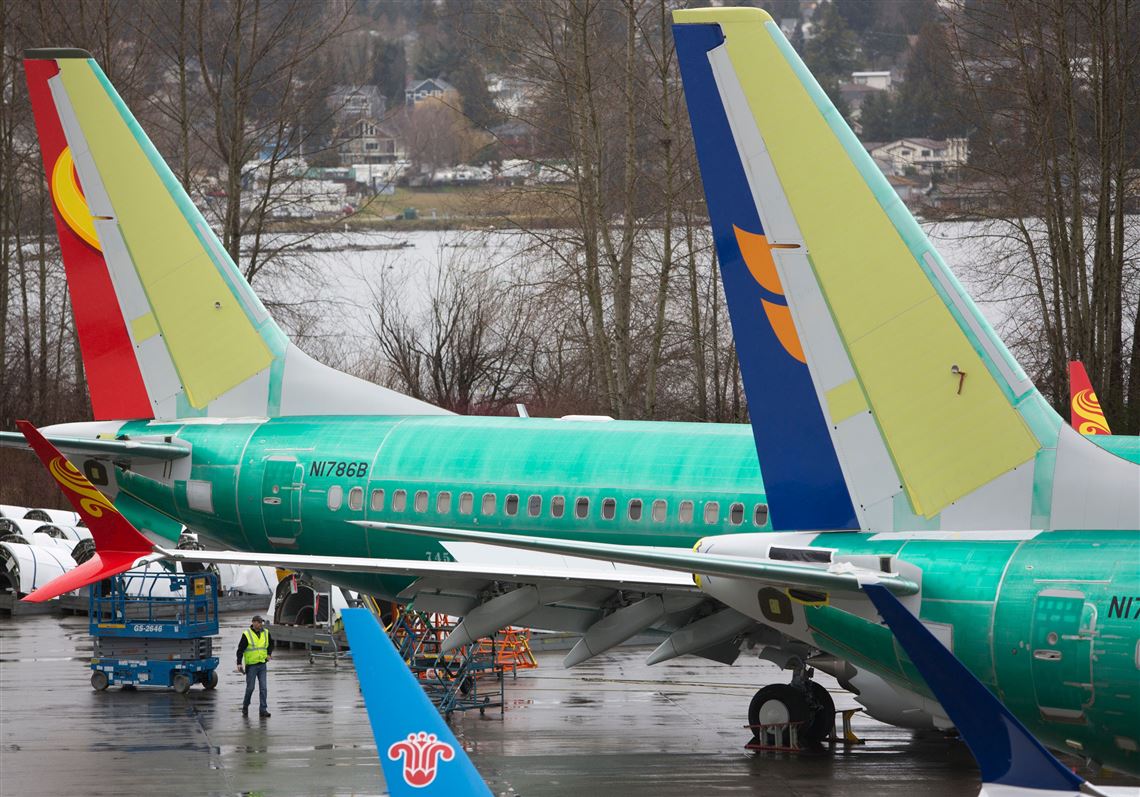
THE BOEING 737 MAX FUSELAGE COUNT AT WENATCHEE REACHED 13 THE 16 APRIL 2019
International Technical Review
The civil aviation authorities of nine countries, as well as members of the three federal agencies of the United States will investigate how the 737 MAX aircraft was initially certified, according to a statement from the Federal Aviation Administration (FAA).
The group, called Technical Review of Joint Authorities, will begin work on April 29, 2019 and will review the initial certification of the automated Flight Control System of the aircraft. The review is expected to take 90 days. The three US agencies involved in the investigation will be the FAA, the National Transportation Safety Board (NTSB) and NASA.
The 737 MAX was put on the ground in March 2019 after one of the Boeing 737-8 MAX aircraft of Ethiopian Airlines crashed, killing everyone on board. It was the second accident that involved the jet model in less than six months, after another plane flown by Lion Air from Indonesia crashed in October 2018. The two accidents have accumulated 346 people killed in total.
The group’s review of the initial certification is independent of the ongoing certification process that Boeing is carrying out with the FAA to re-certify the aircraft, according to an FAA spokesperson.
Boeing has been subject to intense scrutiny since the Ethiopian plane crash in March 2019. Initially, the company defended the aircraft and insisted they were safe to fly, but after intense public pressure, they landed them and admitted that they needed a software solution.
On Wednesday, April 17, 2019 Boeing said they had taken a significant step toward FAA certification of the new updated software for the 737 MAX. They announced that they had completed an engineering test flight with the updated software applied to the Maneuvering Characteristics Augmentation System (MCAS), which is the key technical flight before the certification flight with the FAA.
Airlines extend programming
Airlines remove the 737 MAX from the summer timetable. This uncertainty has forced airlines to make difficult decisions about their schedules for the upcoming summer travel season. US airlines that already have the 737 MAX in their fleets such as Southwest Airlines, American Airlines and United Airlines do not want to cancel flights unnecessarily. But if flight cancellations are unavoidable, cutting flight schedules sooner rather than later is the best way to minimize the impact on customers.
At the beginning of April 2019, Southwest, American Airlines and United Airlines had eliminated the 737 MAX from their schedules until the beginning of June 2019. This reflected the hope that the aircraft in trouble could fly back in time for the most profitable part of the year. for the airlines. However, it now seems likely that the grounding of the 737 MAX will extend for several more months. As a result, airlines face the reality that the programming of the 737 MAX for July’s high travel season may not be realistic.
On April 11, 2019, Southwest Airlines announced that it had withdrawn the 737 MAX from its flight program until August 5, 2019. A few days later, American Airlines followed suit, taking the 737 MAX out of its program through August 19, 2019. American is highly confident that the 737 MAX will be recertified before this time, but is adopting a conservative approach so that the airline and its customers can plan ahead. Earlier this week, United Airlines, which operates the lowest number of 737 MAX aircraft among these three carriers, extended its 737 MAX cancellations until early July 2019.
«Based on our ongoing work with the Federal Aviation Administration (FAA) and Boeing, we are very confident that 737 MAX will be recertified before this time, but by extending our cancellations during the summer, we can plan more reliably. for the peak travel season», said United Airlines President and CEO Doug Parker and President Robert Isom. Approximately 115 flights per day will be canceled until August 19, 2019, which represents approximately 1.5% of American Airlines’ total daily flights. Southwest, American and United can try to minimize the amount of capacity lost by increasing the use of aircraft in their fleet in the summer. However, the grounding of the 737 MAX will lead to slower capacity growth in the coming months, especially on Southwest Airlines.
Competition in advantage
Delta Air Lines, the only of the four major US airlines that does not operate Boeing 737 MAX, said earlier this month of April 2019, that it expects to achieve solid unit revenue growth of 1.5% to 3.5% this 2Q2019. That may indicate that the capacity limitations of its rivals are contributing to increase passenger fares and traffic on Delta Air Lines. Other airlines that are more focused on the domestic market and particularly those that have more overlap with Southwest Airlines could see even higher unit revenue gains.
Many of those smaller operators have earnings reports scheduled for next week. Their forecasts for the second quarter will give investors an idea of how big a stroke of luck is creating the Boeing 737 MAX ground connection for airlines that are lucky to not have that model in their fleets. With Southwest Airlines and American Airlines planning to keep the 737 MAX in «freezer» until at least August 2019, this windfall for other airlines will continue during the summer season.
As for the global fleet of Boeing 737 MAX will be subject to the regulations of the FAA and the regulatory bodies of the respective countries, although the impact will be somewhat lower due to fewer aircraft in their fleets. A \ W
Ξ A I R G W A Y S Ξ
SOURCE: Airgways.com
DBk: Boeing.com / Faa.gov / Reuters.com / Airgways.com
AW-POST: 201904201747AR
Las autoridades de aviación civil de nueve naciones y organismos internacionales se unen para revisión del 737 MAX
Países como Australia, China, Japón y la Unión Europea, han confirmado que se unirán a la llamada Revisión Técnica de Autoridades Conjuntas para el Boeing 737 MAX, que comienza el 29 Abril 2019. Un equipo de expertos internacionales se reunirá para una revisión del Boeing 737 MAX para verificar las correcciones al sistema de vuelo automatizado de la aeronave.
La Federal Aviation Administration (FAA) creó el equipo de revisión a principios de Abril 2019, que cuenta con participantes de la NASA, la FAA, NTSB y otras autoridades, presidido por Chris Hart, ex jefe de la Junta Nacional de Seguridad del Transporte.
El Boeing 737-8 MAX fue el mismo tipo de aeronave involucrada en los dos accidentes fatales en 29 Octubre 2018 en Indonesia y el 10 Marzo 2019 en Etiopía. Cientos de pasajeros y tripulantes murieron en los accidentes. Desde los accidentes, las autoridades de todo el mundo ordenaron que la aeronave fuera a tierra, y las aerolíneas, como American Airlines, cancelaron vuelos con los aviones hasta el verano.
El equipo de revisión «realizará una revisión exhaustiva de la certificación del sistema de control de vuelo automatizado de la aeronave» (MCAS), dijo la FAA. El sistema de control de vuelo automatizado del avión será examinado, al igual que la forma en que los pilotos interactúan con el sistema. El equipo evaluará si el sistema cumple con las regulaciones de las naciones e «identificará las mejoras futuras que podrían ser necesarias», según la FAA. Se espera que la revisión tarde unos tres meses en completarse.
International team will review Boeing 737 MAX
The civil aviation authorities of nine nations and international organizations come together to review the 737 MAX
Countries such as Australia, China, Japan and the European Union have confirmed that they will join the so-called Technical Review of Joint Authorities for the Boeing 737 MAX, which begins on April 29, 2019. A team of international experts will meet for a review of the Boeing 737 MAX to verify the corrections to the automated flight system of the aircraft.
The Federal Aviation Administration (FAA) created the review team in early April 2019, which includes participants from NASA, the FAA, NTSB and other authorities, chaired by Chris Hart, former head of the National Transportation Safety Board.
The Boeing 737-8 MAX was the same type of aircraft involved in the two fatal crashes on 29 October 2018 in Indonesia and 10 March 2019 in Ethiopia. Hundreds of passengers and crew died in accidents. Since the accidents, authorities around the world ordered the aircraft to go ashore, and airlines, such as American Airlines, canceled flights with the planes until the summer.
The review team «will perform a comprehensive review of the certification of the automated flight control system of the aircraft» (MCAS), the FAA said. The aircraft’s automated flight control system will be examined, as will the way pilots interact with the system. The team will evaluate if the system complies with the regulations of the nations and will «identify future improvements that may be necessary», according to the FAA. The review is expected to take about three months to complete. A \ W
Ξ A I R G W A Y S Ξ
SOURCE: Airgways.com
DBk: Faa.gov / Boeing.com / Cnn.com
AW-POST: 201904192326AR
CFM International ordena revisión motores LEAP-1A/1B
El fabricante de motores CFM International ha identificado un problema potencial con dos versiones de sus motores LEAP. Se ha descubierto que el LEAP-1A y el LEAP-1B empleando en los aviones Boeing 737 MAX y Airbus A320NEO, sufren de coquización de las boquillas de combustible a una velocidad mucho más rápida de lo previsto. Los CFM están ordenando inspecciones de equipos potencialmente afectados por los transportistas.
CFM ha identificado un problema con los motores LEAP-1A y -1B que se usan tanto en el Boeing 737 MAX como en el A320NEO. El problema involucra una acumulación de carbón en las boquillas de combustible que podrían conducir a una falla del motor. En este momento, el fabricante del motor está monitoreando su motor y realizando pruebas para ver qué tan extendido está el problema. Según un comunicado difundido a los medios de comunicación. «CFM monitorea continuamente la flota y tenemos un método para detectar la acumulación de carbono, lo que permite que CFM y nuestros clientes gestionen el problema de forma proactiva», expresan desde la factoría.
Debido a que los motores de turbina son altamente susceptibles a la acumulación de carbono, en un proceso conocido como coquización, los depósitos de combustible evaporado y otros materiales crean una obstrucción en las dieciocho boquillas de combustible de los motores LEAP-1A/1B. Esta obstrucción puede provocar un flujo de temperatura desigual dentro de la cámara de combustión y puede ocasionar el desarrollo de puntos calientes dentro de la turbina de alta presión. Estos puntos de acceso son responsables del desgaste prematuro y, potencialmente, de la falla del motor.
Vinculación falla en Southwest
En Marzo 2019, un Boeing 737-8 MAX volaba de Orlando a Victorville, a las instalaciones de almacenamiento de la aerolínea donde estacionan sus 34 aviones en tierra. El vuelo SW8701 despegó como de costumbre, pero poco después del despegue, los pilotos declararon una emergencia, diciendo a la torre: «Torre, Southwest 8701, acabamos de perder nuestro motor derecho, necesitamos declarar una emergencia». El avión se vio obligado a hacer un aterrizaje de emergencia en Orlando. Afortunadamente, el equipo de dos personas logró aterrizar de manera segura. A las pocas horas del incidente, CFM estaba en la escena analizando datos de rendimiento detallados para averiguar qué fallaba con el motor.
Lo que encontraron fue que se había producido coque, que dañó el motor y provocó una falla en la pala de la turbina, con fragmentos metálicos encontrados en el tubo de escape. Si bien la coquización es un problema común con los motores de turbina de gas, lo que surgió es que el programa de mantenimiento de CFM necesitaba ser revisado para intercambiar las boquillas de combustible a intervalos más cortos. Ellos comentaron: “En el caso del motor en el vuelo SW8701, aprendimos del evento que nuestro proceso analítico y de mantenimiento de monitoreo necesitaba ajustarse para nuestros motores LEAP. Este ajuste se realizó y la flota se evaluó en cuestión de horas, con acciones de seguimiento completadas en unos días».
Desde que se identificó el problema, se pidió a todos los operadores con motores que estaban más allá del umbral revisado para el intercambio de boquillas que inspeccionaran sus motores. Las inspecciones han detectado problemas en aproximadamente el 1% de la flota de motores, todos en el motor LEAP-1B utilizado en el 737 MAX.
Aunque hasta ahora no se han encontrado problemas en los motores LEAP-1A, como se usa en el Airbus A320, a algunos operadores también se les pide que inspeccionen sus equipos para asegurarse de que todo está bien.
Si bien solo una pequeña fracción de los motores se ha visto afectada, los controles se suman a los desafíos para los operadores del 737 MAX, el modelo más vendido de Boeing y un caballo de batalla de la flota mundial de aviación.
Aerolíneas
Southwest Airlines es el mayor operador estadounidense del 737 MAX, con 34 aviones. «No hay nada nuevo sobre» la acumulación de carbón en los motores, dijo el CEO de Southwest, Gary Kelly, en un evento en Dallas. «No es raro tener un motor nuevo y tener aprendizajes que deben abordarse». American Airlines dijo que el CFM le pidió que realizara inspecciones de boroscopio en tres motores Boeing 737 MAX, una medida de precaución que no reveló problemas. Posee una flota de 24 unidades. Eso ocurrió después de que CFM recomendó que Southwest examinara una docena de motores. Los resultados se enviaron al fabricante del motor, y Southwest no ha dicho si encontró algún problema.
WestJet, la segunda aerolínea más grande de Canadá, se le ha ordenado inspecciona cinco de sus 13 aviones 737 MAX y no encontró problemas. United Airlines no fue contactado acerca de los motores en sus 14 aviones 737 MAX. Air Canada, mientras tanto, no respondió a una solicitud de comentarios.
La coquización, es un problema menor que no debería restar valor a la introducción del motor en general exitosa. CFM no está en la mentalidad de rediseñar ninguna parte como resultado del inconveniente.
LEAP review in 737 MAX and A320NEO
CFM International orders revision of LEAP-1A / 1B engines
Engine manufacturer CFM International has identified a potential problem with two versions of its LEAP engines. It has been discovered that LEAP-1A and LEAP-1B, using the Boeing 737 MAX and Airbus A320NEO planes, suffer from coking of the fuel nozzles at a much faster speed than anticipated. The CFMs are ordering inspections of equipment potentially affected by the carriers.
CFM has identified a problem with the LEAP-1A and -1B engines that are used in both the Boeing 737 MAX and the A320NEO. The problem involves a buildup of carbon in the fuel nozzles that could lead to engine failure. At this time, the engine manufacturer is monitoring its engine and testing to see how widespread the problem is. According to a statement released to the media. «CFM continuously monitors the fleet and we have a method to detect carbon accumulation, which allows CFM and our customers to proactively manage the problem», they say from the factory.
Because turbine engines are highly susceptible to carbon buildup, in a process known as coking, evaporated fuel tanks and other materials create an obstruction in the eighteen fuel nozzles of LEAP-1A/1B engines. This obstruction can cause an uneven temperature flow inside the combustion chamber and can cause the development of hot spots inside the high pressure turbine. These access points are responsible for premature wear and, potentially, engine failure.
Bonding fails at Southwest
In March 2019, a Boeing 737-8 MAX flew from Orlando to Victorville, to the airline’s storage facility where they parked their 34 aircraft on the ground. Flight SW8701 took off as usual, but shortly after takeoff, the pilots declared an emergency, saying to the tower: «Tower, Southwest 8701, we just lost our right engine, we need to declare an emergency». The plane was forced to make an emergency landing in Orlando. Fortunately, the two-person team managed to land safely. Within hours of the incident, CFM was on the scene analyzing detailed performance data to find out what was wrong with the engine.
What they found was that coke had been produced, which damaged the engine and caused a fault in the turbine blade, with metal fragments found in the exhaust pipe. While coking is a common problem with gas turbine engines, what emerged is that the CFM maintenance program needed to be revised to exchange the fuel nozzles at shorter intervals. They commented: «In the case of the engine on flight SW8701, we learned from the event that our analytical and maintenance monitoring process needed to be adjusted for our LEAP engines. This adjustment was made and the fleet was evaluated in a matter of hours, with follow-up actions completed in a few days».
Since the problem was identified, all operators with motors that were beyond the revised threshold for the exchange of nozzles that inspected their engines were asked. The inspections have detected problems in approximately 1% of the fleet of engines, all in the LEAP-1B engine used in the 737 MAX.
Although there have been no problems so far in the LEAP-1A engines, as is used in the Airbus A320, some operators are also asked to inspect their equipment to make sure everything is fine.
While only a small fraction of the engines have been affected, the controls add to the challenges for operators of the 737 MAX, Boeing’s best-selling model and a workhorse of the global aviation fleet.
Airlines
Southwest Airlines is the largest US operator of the 737 MAX, with 34 aircraft. «There’s nothing new about» the buildup of coal in the engines, Southwest CEO Gary Kelly said at an event in Dallas. «It’s not uncommon to have a new engine and have learnings that need to be addressed». American Airlines said the CFM asked it to perform borescope inspections on three Boeing 737 MAX engines, a precautionary measure that did not reveal any problems. It has a fleet of 24 units. That happened after CFM recommended that Southwest examine a dozen engines. The results were sent to the engine manufacturer, and Southwest has not said if it found a problem.
WestJet, the second largest airline in Canada, has been ordered to inspect five of its 13 737 MAX aircraft and found no problems. United Airlines was not contacted about the engines on its 14 737 MAX aircraft. Air Canada, meanwhile, did not respond to a request for comment.
Coking is a minor problem that should not detract from the introduction of the overall successful engine. CFM is not in the mindset of redesigning any part as a result of the inconvenience. A \ W
Ξ A I R G W A Y S Ξ
SOURCE: Airgways.com
DBk: Cfmaeroengines.com / Airgways.com / Bloomberg.com
AW-POST: 201904191207AR
Administración Federal de Aviación asegura que el software de Boeing 737 MAX es adecuado
La Federal Aviation Administration (FAA) ha aprobado la recomendación para la puesta en vuelo de la flota mundial de Boeing 737 MAX en todas sus variantes. Los pilotos de ese tipo de aeronaves recibirán un entrenamiento informático adicional sobre las aplicaciones del Maneuvering Characteristics Augmentation System (MCAS).
La Administración de Aviación de Estados Unidos publica el informe preliminar sobre los Boeing 737 MAX. El organismo aeronáutico publicó un informe preliminar de su Consejo de Estandarización de Vuelos (CEB) en relación con los modelos Boeing 737 MAX: «La FAA publicó hoy [16 Abril 2019] un informe preliminar del Consejo de Estandarización de Vuelos de Boeing 737 Max. El CEB revisó solo los aspectos de entrenamiento relacionados con las mejoras del software de la aeronave. El informe estará abierto a comentarios públicos durante 14 días. Después de eso, la FAA revisará esos comentarios antes de hacer una evaluación final. Se espera que la compañía Boeing presente en las próximas semanas el paquete de software final para la certificación», dice el comunicado.
Dos catástrofes aparentemente similares —en el mar de Java y en Etiopía, con 189 y 157 muertos, respectivamente— provocaron una cascada de suspensiones por parte de aerolíneas y reguladores del transporte aéreo, dejando en tierra la flota global de los 737 MAX y provocando un desplome de las cotizaciones de Boeing en la bolsa.
La investigación preliminar apunta a que los pilotos tuvieron dificultades con el software del estabilizador MCAS (Sistema de Aumento de las Características de Maniobras) y no lograron retomar el control de la aeronave. El sistema MCAS baja automáticamente la trompa del avión cuando los sensores detectan un ángulo de vuelo muy elevado que puede llevar a que la aeronave entre en pérdida.
Boeing ya avanzó que está reprogramando el MCAS de los 737 MAX, para que los pilotos puedan contrarrestarlo con el control manual o para que se desactive automáticamente cuando los sensores del flujo de aire a ambos costados de la aeronave ofrezcan lecturas muy distintas.
El Presidente de Boeing, Dennis Muilenburg, declaró el 11 Abril 2019 que Boeing había realizado 96 vuelos de prueba con el software actualizado para los Max, además de proporcionar entrenamiento a pilotos de una treintena de aerolíneas, y planea llevar a cabo ensayos adicionales en las próximas semanas para demostrar que cumple con todos los requisitos de certificación.
Los aviadores de la aerolínea fueron muy críticos con Boeing por no proveer suficiente información sobre el software que opera estos aparatos, aunque consideraban que disponían del suficiente entrenamiento para manejarlos sin necesitar formación adicional en simuladores. De momento, el fabricante aeronáutico ha paralizado las entregas de sus modelos 737 MAX y reducido su producción, mientras se encuentra en proceso de modificar el sistema automatizado para evitar fallos como los acontecidos en las tragedias aéreas de Etiopía e Indonesia.
Entrenamientos
Los pilotos de los Boeing 737 MAX en todas sus variantes no necesitarán volver a entrenar en simuladores para poder operar la aeronave, dijo el martes un grupo que asesora a las autoridades federales de aeronáutica. El grupo consultivo señaló que instrucción en computadora y en el aula será suficiente adiestramiento sobre el nuevo software para los pilotos que hayan volado las versiones anteriores del 737.
Informe Preliminar FAA
La FAA publicó hoy un informe preliminar de la Junta de Normalización de Vuelos de Boeing 737 MAX. El FSB revisó solo los aspectos de entrenamiento relacionados con las mejoras de software a la aeronave. El informe está abierto a comentarios públicos durante 14 días. Después de eso, la FAA revisará esos comentarios antes de hacer una evaluación final. Se espera que The Boeing Company en las próximas semanas presente el paquete de software final para la certificación. Los Informes Preliminares de la Junta de Normalización de Vuelo (FSBR) / Informe de Idoneidad Operacional (OSR) están abiertos para comentarios hasta el 30 Abril 2019.
FAA approves Boeing 737 MAX software
Federal Aviation Administration ensures that the Boeing 737 MAX software is adequate
The Federal Aviation Administration (FAA) has approved the recommendation for the launch of the worldwide fleet of Boeing 737 MAX in all its variants. Pilots of this type of aircraft will receive additional computer training on the applications of the Maneuvering Characteristics Augmentation System (MCAS).
The United States Aviation Administration publishes the preliminary report on the Boeing 737 MAX. The aeronautical agency published a preliminary report from its Flight Standardization Board (CEB) regarding the Boeing 737 MAX models: «The FAA published today [April 16, 2019] a preliminary report from the Boeing Flight Standardization Board 737 Max. The CEB reviewed only the training aspects related to the aircraft software improvements.The report will be open for public comment for 14 days, after which the FAA will review those comments before making a final evaluation. Boeing present in the coming weeks the final software package for certification», the statement said.
Two seemingly similar catastrophes – in the Java Sea and in Ethiopia, with 189 and 157 dead, respectively-triggered a cascade of suspensions by airlines and air transport regulators, leaving the global fleet of the 737 MAXs on the ground and provoking a The collapse of Boeing’s stock prices.
The preliminary investigation indicates that the pilots had difficulties with the MCAS stabilizer software (System for Increasing Maneuver Characteristics) and failed to regain control of the aircraft. The MCAS system automatically lowers the nose of the aircraft when the sensors detect a very high flight angle that can lead to the aircraft stalling.
Boeing has already advanced that it is reprogramming the MCAS of the 737 MAX, so that the pilots can counteract it with manual control or to deactivate it automatically when the sensors of the air flow on both sides of the aircraft offer very different readings.
The President of Boeing, Dennis Muilenburg, declared on 11 April 2019 that Boeing had made 96 test flights with updated software for the Maxs, in addition to providing training to pilots of some thirty airlines, and plans to carry out additional tests in the next weeks to demonstrate that it meets all certification requirements.
The airline’s aviators were very critical of Boeing for not providing enough information about the software that operates these devices, although they felt that they had sufficient training to handle them without needing additional training in simulators. At the moment, the aeronautical manufacturer has halted the deliveries of its 737 MAX models and reduced its production, while it is in the process of modifying the automated system to avoid failures such as those that occurred in the aerial tragedies of Ethiopia and Indonesia.
Training
The pilots of the Boeing 737 MAX in all its variants will not need to re-train in simulators to operate the aircraft, said Tuesday a group that advises the federal aeronautical authorities. The advisory group noted that computer and classroom instruction will be enough training on new software for pilots who have flown previous versions of the 737.
FAA preliminary report
The FAA released a preliminary report from the Boeing 737 MAX Flight Standardization Board today. The FSB reviewed only the training aspects related to software improvements to the aircraft. The report is open to public comment for 14 days. After that, the FAA will review those comments before making a final evaluation. It is expected that the Boeing company in the coming weeks will present the final software package for certification. Preliminary reports of the Flight Standardization Board (FSBR)/Operational Suitability Report (OSR) are open for comments until April 30, 2019. A \ W
Ξ A I R G W A Y S Ξ
SOURCE: Airgways.com
DBk: Faa.gov / Boeing.com / Airgways.com
AW-POST: 201904171307AR