Accidente aéreo JT610 Lion Air

AW-JakartaPost001.jpg

AW | 2018 11 05 18:18 | AIR INVESTIGATION / AVIATION SAFETY

Búsqueda extendida después del primer accidente del primer Boeing 737-8 MAX

Las autoridades indonesias han extendido por tres días la búsqueda de la segunda caja negra de los restos de un accidente del avión de pasajeros Boeing 737-8 MAX de Lion Air cerca de Jakarta la semana pasada, en el que murieron todas las 189 personas a bordo.

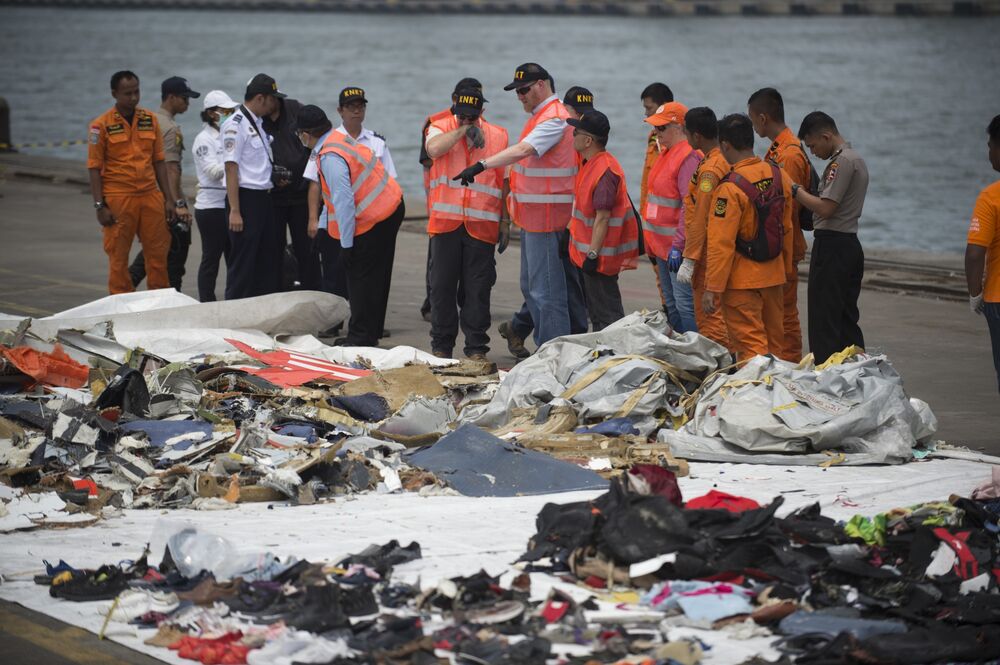
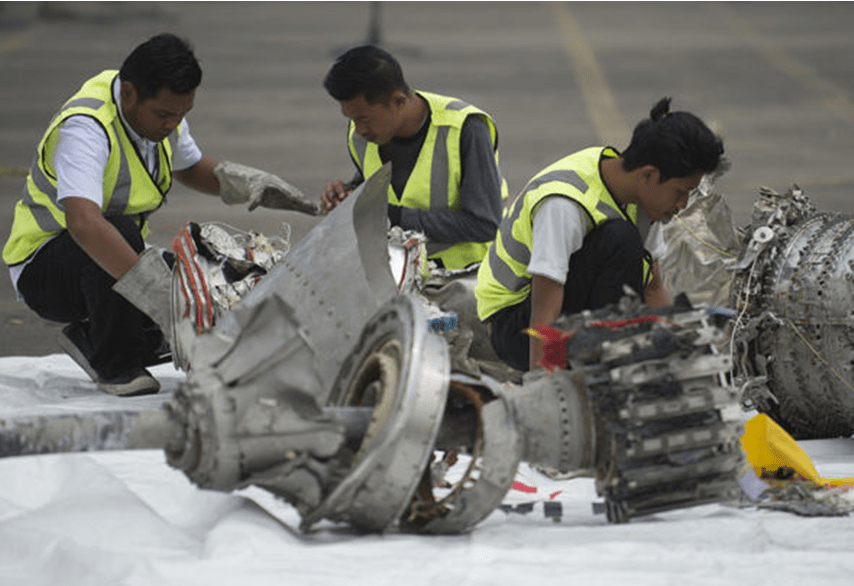
El primer accidente de un Boeing 737 MAX es el foco de la industria de la aviación mundial, y se espera que los resultados preliminares de la investigación se hagan públicos después de 30 días. Representantes de General Electric como representante de las turbinas que propulsaron a la aeronave también están viendo los restos recuperados en un Puerto de Jakarta.

Actualizaciones Vuelo JT-610

Flight Data Recorder (FDR)
El Registrador de Datos de Vuelo (FDR). El Comité Nacional de Seguridad del Transporte de Indonesia (KNKT), con la asistencia de expertos australianos, ha logrado descifrar una parte de los datos del registrador de vuelo del Boeing 737-8 MAX de la aerolínea Lion Air que se estrelló hace una semana en el Mar de Java, 13 minutos después de despegar del Aeropuerto de Jakarta.

Los datos de esta caja negra, hallada por los buzos el 1 de noviembre junto a restos del avión en las aguas de Tanjung Karang, en Java Occidental (Indonesia), contienen un total de 69 horas de datos de vuelo, incluido el último, que le costó la vida a los 189 ocupantes de la aeronave.

Algunos de los resultados obtenidos por los especialistas fueron revelados el pasado domingo a los periodistas por el presidente del Comité de Investigación de Accidentes de Aviación del KNKT, Nurcahyo Utomo. En particular, se confirmó la última ruta del fatídico vuelo JT-610.

«Hemos obtenido los datos de la caja negra, hay 69 horas, que incluyen 19 vuelos, entre ellos el vuelo siniestrado. […] En los resultados de la descarga se puede ver la ruta de vuelo basada en la información del registrador de datos de vuelo», declaró Nurcahyo Utomo.

La ruta desvelada comienza con los datos del estacionamiento de la aeronave, y su viaje desde el despegue y el vuelo posterior hacia el punto de la caída. El portal indica que la ruta revelada coincide con las imágenes divulgadas previamente en los medios con referencia a los datos del sitio web Flightradar24. La grabación final termina a las 23:31 hora UTC del 28 Octubre 2018 o 29 Octubre 2018 a las 06:31 hora local (WIB).

Por el momento las causas del desastre aún no han sido aclaradas. «Estamos resolviendo qué parámetros de los 1.800 obtenidos necesitamos. Desde aquí analizaremos lo que sucedió con el vuelo», sostiene Nurcahyo Utomo.

Extensión búsqueda
El equipo de SAR amplió el área de búsqueda en la orilla de Pakis Jaya de los 10 kilómetros originales a los 15 kilómetros. Además, aún se espera que los buzos encuentren el segundo registro: la grabadora de voz de cabina (Cockpit Voice Eecorder CVR), cuya leve señal fue detectada el pasado Sábado. En principio, la investigación utiliza la información existente, tenemos el registrador de datos de vuelo para asegurarse de que los datos sean correctos y útiles en la investigación.

De momento los buzos tratan de localizar y recuperar la grabadora de voz de cabina. Se estima que está a unos 50 metros de la zona donde previamente encontraron la primera caja negra, pero la búsqueda se dificulta por las corrientes submarinas y el lodo en el fondo del Mar de Java. La búsqueda de la grabadora de voz de cabina, así como la recuperación de los restos de las víctimas del accidente aéreo, se ha ampliado tres días más.

Última información del JT610
El jefe de la Comisión Nacional de Seguridad del Transporte (KNKT), Soerjanto Tjahjono, dijo que el (FDR) dela caja negrade Lion Air JT 610 mostró daños en el indicador de velocidad del avión. «La caja negra revela que cuatro vuelos sufrieron problemas», dijo Soerjanto en la oficina de KNKT el Lunes 5 Noviembre 2018.

El Jefe del Comité de Accidentes (KNKT), Nurcahyo Utomo, explicó que los datos del vuelo JT-610 del Flight Data Recorder (FDR) muestran un mal funcionamiento del indicador de velocidad del Boeing 737-8 MAX. «El incidente ocurre de una ruta de vuelo proyectada entre Manado— Denpasar, Denpasar—Jakarta y Jakarta— Pangkal Pinang«, expresó Nurcahyo Utomo.

La comisión KNKT estaba examinando los esfuerzos de recuperación realizados por los técnicos de la aerolínea. Los técnicos serían interrogados sobre sus intentos de resolver los problemas técnicos.

KNKT examinará la referencia del libro utilizada para tratar los daños en el avión y las partes de los componentes reparados o reemplazados que serán una prioridad para el avance de la investigación.

El jueves 1 Noviembre 2018, KNKT recibió una parte de las cajas negras de Lion Air JT-610 de la Agencia Nacional de SAR (Basarnas) a las 19:10 hora local. El dispositivo naranja fue encontrado a las 10:05 am por un equipo conjunto de la Agencia para la Evaluación y Aplicación de Tecnología (BPPT), la Armada de Indonesia y Basarnas. AIRWAYS® AW-Icon TXT

AW-JT610_Engine_Gear.pngAccident Lion Air JT610

Extended search after the first accident of the first Boeing 737-8 MAX

Indonesian authorities have extended for three days searching for the second black box of the remains of an airliner crash Boeing 737-8 MAX Lion Air near Jakarta last week, in which all 189 people on board died .

The first accident of a Boeing 737 MAX is the focus of the global aviation industry, and preliminary results of the investigation are expected to be made public after 30 days. Representatives of General Electric as representative of the turbines that propelled the aircraft are also seeing the remains recovered in a Port of Jakarta.

Flight Updates JT-610

Flight Data Recorder (FDR)
The Flight Data Recorder (FDR). The National Committee on Transport Security of Indonesia (KNKT), with the assistance of Australian experts, has managed to decipher a part of the data of the flight recorder of the Boeing 737-8 MAX of the airline Lion Air that crashed a week ago in The Java Sea, 13 minutes after taking off from Jakarta Airport.

The data from this black box, found by divers on November 1 together with the wreckage of the plane in the waters of Tanjung Karang, in West Java (Indonesia), contain a total of 69 hours of flight data, including the last, which it cost the lives of the 189 occupants of the aircraft.

Some of the results obtained by the specialists were revealed last Sunday to journalists by the president of the Aviation Accident Investigation Committee of KNKT, Nurcahyo Utomo. In particular, the last route of the fateful flight JT-610 was confirmed.

«We have obtained the data from the black box, there are 69 hours, which include 19 flights, among them the flight that was damaged. […] In the results of the download you can see the flight route based on the information of the data logger flight»,  said Nurcahyo Utomo.

The unveiled route begins with the data of the parking of the aircraft, and its journey from the takeoff and the subsequent flight to the point of fall. The portal indicates that the revealed route matches the images previously disclosed in the media with reference to the data on the Flightradar24 website. The final recording ends at 23:31 UTC time on October 28, 2018 or October 29, 2018 at 06:31 local time (WIB).

For the moment, the causes of the disaster have not yet been clarified. «We are solving what parameters of the 1,800 we need, from here we will analyze what happened with the flight», says Nurcahyo Utomo.

Search extension
The SAR team expanded the search area on the Pakis Jaya bank from the original 10 kilometers to 15 kilometers. In addition, divers are still expected to find the second record: the Cockpit Voice Recorder (CVR), whose slight signal was detected last Saturday. In principle, the investigation uses the existing information, we have the flight data recorder to make sure that the data is correct and useful in the investigation.

At the moment divers try to locate and recover the cockpit voice recorder. It is estimated that it is about 50 meters from the area where they previously found the first black box, but the search is made difficult by underwater currents and mud at the bottom of the Java Sea. The search for the cabin voice recorder, as well as the recovery of the remains of the victims of the plane crash, has been extended for three more days.

Latest information on the JT610
The head of the National Transportation Safety Commission (KNKT), Soerjanto Tjahjono, said the (FDR) of the negrade Lion Air JT 610 box showed damage to the aircraft’s speedometer. «The black box reveals that four flights suffered problems», Soerjanto said in the KNKT office on Monday 5 November 2018.

The Head of the Accident Committee (KNKT), Nurcahyo Utomo, explained that the flight data JT-610 of the Flight Data Recorder (FDR) shows a malfunction of the Boeing 737-8 MAX speed indicator. «The incident occurs from a projected flight route between Manado- Denpasar, Denpasar-Jakarta and Jakarta- Pangkal Pinang», Nurcahyo Utomo said.

The KNKT commission was examining the recovery efforts made by the airline’s technicians. The technicians would be interrogated about their attempts to solve the technical problems.

KNKT will examine the reference of the book used to treat the damage to the airplane and the parts of the repaired or replaced components that will be a priority for the progress of the investigation.

On Thursday 1 November 2018, KNKT received a portion of the black boxes of Lion Air JT-610 from the National Agency of SAR (Basarnas) at 19:10 local time. The orange device was found at 10:05 am by a joint team of the Agency for the Evaluation and Application of Technology (BPPT), the Indonesian Navy and Basarnas. A \ W


Ξ A I R G W A Y S Ξ
SOURCE: Airgways.com
DBk: Dephub.go.id / Basarnas.go.id / News.cn
AW-POST: 201811051818AR

A\W   A I R G W A Y S ®

Teorías del Vuelo MH370

AW | 2018 11 05 17:31 | AIR INVESTIGATION / AVIATION SAFETYAW-70083772

Existen muchas teorías sobre la misteriosa desaparición del vuelo MH-370 de Malaysia Airlines

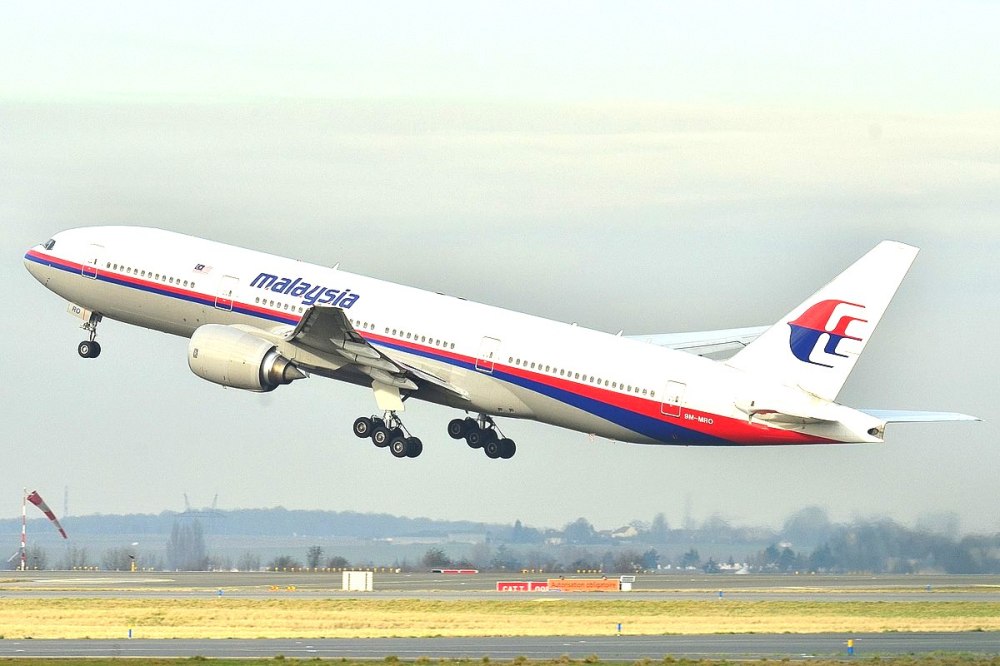
El vuelo MH-370 de Malaysia Airlines desapareció el 8 Marzo 2014, en ruta Kuala Lumpur—Beijing a bordo con 239 personas. A solo 38 minutos de vuelo, el MH370 perdió contacto con los controladores aéreos.

La búsqueda

La primera búsqueda oficial fue lanzada por Australia con un costo de US$ 14.586.800, China y Malasia participaran de la búsqueda hasta Enero 2017. A principios de 2018, El Gobierno de Malasia acordó pagar a la firma estadounidense Ocean Infinity hasta US$ 66.813.900 si encontraba el avión dentro de de un plazo de noventa días. La compañía ahora ha lanzado un último viaje de búsqueda para encontrar la caja negra del avión perdido. Enviarán un barco al lugar remoto en el Océano Índico donde se detectó un pulso ultrasónico, que puede haber sido de la caja negra del avión en 2014.

Los investigadores publicaron un informe final que decía que no podían determinar qué sucedió con el avión. El Gobierno de Malasia afirmó que el avión estaba bajo control manual cuando deliberadamente se desvió del rumbo, antes de sumergirse en el Océano Índico, matando a 239 personas.

Pero el 30 Julio 2018, el investigador jefe de Kok Soo Chon dijo que aún «no podían excluir la posibilidad de que haya una interferencia ilegal de un tercero. La respuesta solo puede ser concluyente si se encuentran los restos».

Sobrevuelo de teorías

Las diferentes teorías formuladas acerca del siniestro de la desaparición del Boeing 777-200ER de Malaysia Airlines forman parte de formulaciones no confirmadas, por lo que científicamente no se pueden arrojar conclusiones fehacientes.

Gobierno de Rusia
Algunos temían que el Gobierno de Federación Rusia estuviera involucrado en el secuestro del vuelo MH-370. El escritor de ciencia estadounidense Jeff Wise afirmó que Vladimir Putin falsificó los datos de navegación del avión para que pudiera pasar inadvertido en el Cosmódromo de Baikonur con el fin de dañar a la esfera occidental.

Ejército EEUU-Taiwán
El ex-Director Marc Dugain de la aerolínea Proteus Airlines, acusó al ejército estadounidense de derribar el avión porque temían que hubiera sido secuestrado.
Un libro llamado «Vuelo MH370. The Mystery» también sugirió que fue derribado accidentalmente por aviones de combate conjuntos estadounidense-tailandeses durante un ejercicio militar, ocultando el accidente.

Cockpit suicida
El Jefe de la Policía de Malasia, Tan Sri Khalid Abu Bakar, sugirió que la desaparición podría haber sido el resultado de un suicidio por parte de la tripulación al mando de la aeronave.

Piratas aéreos
El historiador y escritor Norman Davies sugirió que el MH370 podría haber sido pirateado de forma remota y trasladado a un lugar secreto como resultado del material sensible que se llevaba a bordo del avión.

Defectos en Boeing 777
Malaysia Airlines encontró una fisura de 15 pulgadas en el fuselaje de uno de sus aviones, días antes de que el MH370 desapareciera. La Administración Federal de Aviación (FAA) insiste en que emitió una advertencia final dos días antes de la desaparición. El diario Daily Mirror afirmó que el avión faltante «no tenía la misma antena que el resto de los Boeing 777», por lo que no recibió la advertencia.

Piloto planeó suicidio
El Primer Ministro, Malcolm Turnbull, dijo inesperadamente que era «muy probable que el capitán haya planeado este evento impactante». Afirmó que el piloto quería «crear el mayor misterio del mundo». Otra teoría afirmó que secuestró su propio avión en protesta por el encarcelamiento del entonces líder de la oposición de Malasia, Anwar Ibrahim, y como una forma de desestabilizar al gobierno corrupto de Najib Razak.

Base de Diego García
Otra teoría es que el avión Boeing 777-200ER fuese secuestrado y aterrizado e la Isla Diego García en el Océano Índico.

MH-370 & MH-017
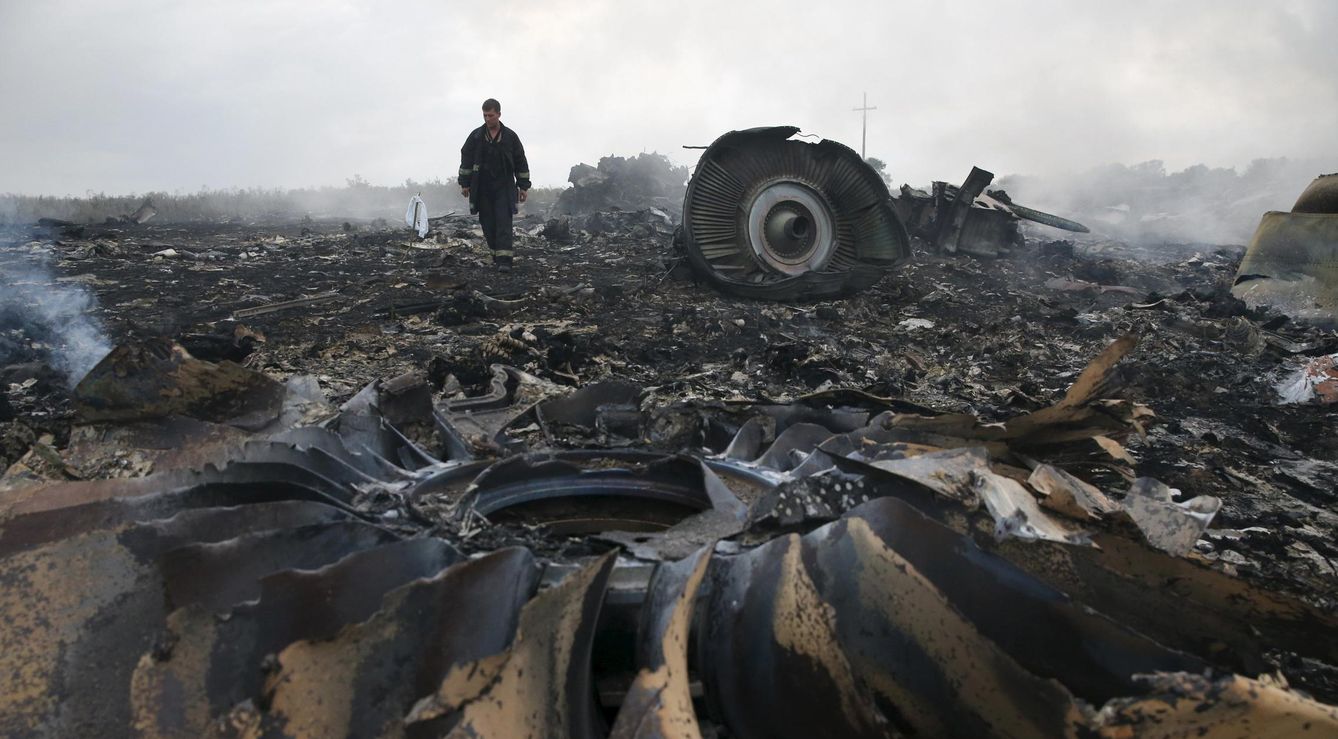
Teorías conspirativas se alzaron a raíz del otro accidente del Malaysia Airlines, el vuelo MH-017 que despegó de Ámsterdam hacia Kuala Lumpur el 17 Julio 2014 con 283 pasajeros y 15 miembros de la tripulación. Se estrelló en la villa de Grábovo, en el raión ucraniano de Shajtarsk, en el óblast de Donetsk, a 40 kilómetros de la frontera con Rusia, bajo un área de guerra entre facciones de la milicia rusa independentista en Ucrania y el ejército ucraniano. Interpretan que el avión del vuelo MH370 se empleó con fines político-bélico al derribar el vuelo MH017.

Corea del Norte
Algunos temen que Pyongyang derribó el avión, pero otros creen que fue secuestrado y desviado hacia la nación comunista.

Víctimas de teléfonos móviles sonando
Una teoría afirma que debido a que muchos familiares pudieron escuchar un tono de llamada hasta cuatro días después del choque, el avión condenado no podría haber chocado contra el Océano Índico. Diecinueve familias han afirmado que los dispositivos de sus seres queridos sonaron hasta cuatro días después de que desapareció el avión. Sin embargo, los analistas inalámbricos afirman que las empresas telefónicas a veces usan un sonido de timbre fantasma cuando el dispositivo no está activo, informa Daily Star.

Se estrelló en la selva camboyana
En Septiembre 2018, el productor de video británico Ian Wilson afirmó haber encontrado el avión perdido en Google Maps. A pesar de que se han gastado millones en la búsqueda para localizar los restos, el detective británico cree que ha encontrado el avión en una zona montañosa de la selva camboyana. En respuesta, el gobierno chino utilizó la empresa de observación Space View para enfocarse en el área de gran altitud en las afueras de Phnom Penh. Sin embargo, la empresa afirma que no había indicios de ningún avión, y menos del avión de Malaysian Airlines que ha estado desaparecido desde marzo de 2014.

Registros del vuelo

Un grupo de expertos en aviación se reunió para el programa de televisión australiano 60 Minutos, emitido en Mayo 2018. Afirmaron que pudieron haber resuelto el misterio de la aviación.Todos estuvieron de acuerdo en que el piloto deliberadamente desactivó el avión en el Océano Índico al oeste de Australia.

El ex-Jefe de la Oficina de Seguridad del Transporte de Australia (ASTB), Martin Dolan, agregó: «Esto fue planeado, fue deliberado y se hizo durante un período prolongado». Simon Hardy, piloto e instructor, descubrió que el capitán hizo un giro inexplicable y extraño para volar sobre su ciudad natal de Penang. También afirmó que el piloto esquivó el radar militar de Malasia y Tailandia al bordear sus fronteras.

Restos del Boeing 777

Christine Negroni dijo que el análisis de las fotos de los restos lavados muestra que las alas del Boeing 777 se replegaron cuando se estrelló contra el mar en marzo de 2014, lo que significa que el avión estaba fuera de control cuando golpeó el agua.

Aunque muchos restos de las partes de la aeronave lógicamente pudo ser encontrada, se presumen además teorías conspirativas sobre diferentes restos que de por sí solo aparecieron en diferentes costas de África, pero por su peso y densidad del material es imposible que la corriente oceánica los arrastra significativamente miles de kilómetros.

Todas las hipótesis formuladas forman parte de un manto de teorías que será concluyente cuando se encuentre al Malaysia MH370, de lo contrario todo continuará siendo un «mar de dudas».  AIRWAYS® AW-Icon TXT

Resultado de imagen para MH370 ocean

Theories of Flight MH370

There are many theories about the mysterious disappearance of Malaysia Airlines flight MH-370

The flight MH-370 of Malaysia Airlines disappeared on March 8, 2014, en route Kuala Lumpur-Beijing on board with 239 people. At only 38 minutes of flight, the MH370 lost contact with air traffic controllers.

The search

The first official search was launched by Australia at a cost of US $ 14,586,800, China and Malaysia will participate in the search until January 2017. In early 2018, the Malaysian Government agreed to pay the US firm Ocean Infinity up to US $ 66,813 .900 if he found the plane within ninety days. The company has now launched a final search trip to find the black box of the lost plane. They will send a ship to the remote location in the Indian Ocean where an ultrasonic pulse was detected, which may have been from the plane’s black box in 2014.

The researchers published a final report that said they could not determine what happened to the plane. The Malaysian government claimed that the plane was under manual control when it deliberately veered off course, before plunging into the Indian Ocean, killing 239 people.

But on July 30, 2018, Kok Soo Chon’s chief investigator said that they still «could not exclude the possibility of illegal interference from a third party, the answer can only be conclusive if the remains are found».

Overflight of theories

The different theories formulated about the sinisterness of the disappearance of the Boeing 777-200ER of Malaysia Airlines are part of unconfirmed formulations, so that scientific conclusions can not be reached.

Government of Russia
Some feared that the Government of the Russian Federation was involved in the hijacking of flight MH-370. The American science writer Jeff Wise claimed that Vladimir Putin falsified the navigation data of the plane so that it could go unnoticed in the Baikonur Cosmodrome in order to damage the western sphere.

US-Taiwan Army
Former Director Marc Dugain of the airline Proteus Airlines, accused the US military of shooting down the plane because they feared he had been kidnapped.
A book called «Flight MH370.The Mystery» also suggested that it was accidentally knocked down by US-Thai joint warplanes during a military exercise, hiding the accident.

Suicide Cockpit
The Chief of the Malaysian Police, Tan Sri Khalid Abu Bakar, suggested that the disappearance could have been the result of suicide by the crew in command of the aircraft.

Air Pirates
The historian and writer Norman Davies suggested that the MH370 could have been hacked remotely and moved to a secret location as a result of the sensitive material that was carried aboard the plane.

Defects in Boeing 777
Malaysia Airlines found a 15-inch crack in the fuselage of one of its planes, days before the MH370 disappeared. The Federal Aviation Administration (FAA) insists that it issued a final warning two days before the disappearance. The Daily Mirror newspaper affirmed that the missing plane «did not have the same antenna as the rest of the Boeing 777», so it did not receive the warning.

Pilot planned suicide
The Prime Minister, Malcolm Turnbull, said unexpectedly that it was «very likely that the captain planned this shocking event». He stated that the pilot wanted to «create the greatest mystery in the world». Another theory claimed that he hijacked his own plane in protest of the imprisonment of the then opposition leader of Malaysia, Anwar Ibrahim, and as a way to destabilize the corrupt government of Najib Razak.

Base of Diego García
Another theory is that the Boeing 777-200ER aircraft was hijacked and landed on Diego Garcia Island in the Indian Ocean.

MH-370 & MH-017
Conspiracy theories arose as a result of the other accident of Malaysia Airlines, flight MH-017 that took off from Amsterdam to Kuala Lumpur on July 17, 2014 with 283 passengers and 15 crew members. It crashed in the village of Grábovo, in the Ukrainian coalition of Shakhtarsk, in Donetsk Oblast, 40 kilometers from the border with Russia, under an area of ​​war between factions of the Russian separatist militia in Ukraine and the Ukrainian army. They interpret that the plane of flight MH370 was used for political-warlike purposes when shooting down MH017.

North Korea
Some fear that Pyongyang shot down the plane, but others believe that it was hijacked and diverted to the communist nation.

Victims of mobile phones ringing
One theory states that because many family members were able to hear a ringing tone up to four days after the crash, the condemned plane could not have crashed into the Indian Ocean. Nineteen families have claimed that the devices of their loved ones sounded up to four days after the plane disappeared. However, wireless analysts say phone companies sometimes use a ghostly ringing sound when the device is not active, Daily Star reports.

It crashed in the Cambodian jungle
In September 2018, British video producer Ian Wilson claimed to have found the lost plane on Google Maps. Although millions have been spent searching for the remains, the British detective believes he has found the plane in a mountainous area of ​​the Cambodian jungle. In response, the Chinese government used the observation company Space View to focus on the high-altitude area on the outskirts of Phnom Penh. However, the company says there were no signs of any aircraft, let alone the Malaysian Airlines plane that has been missing since March 2014.

Flight records

A group of aviation experts met for the Australian television program 60 Minutes, issued in May 2018. They claimed that they could have solved the mystery of aviation. All agreed that the pilot deliberately disabled the plane in the Indian Ocean at Western Australia.

The former Head of the Australian Transportation Security Office (ASTB), Martin Dolan, added: «This was planned, deliberate and was done for a prolonged period». Simon Hardy, pilot and instructor, discovered that the captain made an inexplicable and strange turn to fly over his hometown of Penang. He also claimed that the pilot dodged the military radar of Malaysia and Thailand by skirting their borders.

Remains of the Boeing 777

Christine Negroni said the analysis of the photos of the washed remains shows that the wings of the Boeing 777 retreated when it crashed into the sea in March 2014, which means that the plane was out of control when it hit the water.

Although many remains of the parts of the aircraft could logically be found, conspiracy theories are also presumed about different remains that by themselves appeared on different coasts of Africa, but due to their weight and density of the material it is impossible that the ocean current drags them significantly thousands of kilometers.

All the hypotheses formulated are part of a mantle of theories that will be conclusive when you find the Malaysia MH370, otherwise everything will continue to be a «sea of ​​doubts». A \ W


Ξ A I R G W A Y S Ξ
SOURCE: Airgways.com
DBk: Astb.gov.au / Dailystar.co.uk / Wikimedia.org
AW-POST: 201811051731AR

A\W   A I R G W A Y S ®

Accidente aéreo JT-610 Lion Air

Resultado de imagen para lion air Boeing 737 MAX

AW | 2018 11 03 21:10 | AVIATION SAFETY

Lion Air Boeing 737 MAX 8 se estrelló en el mar de Java frente a Jakarta

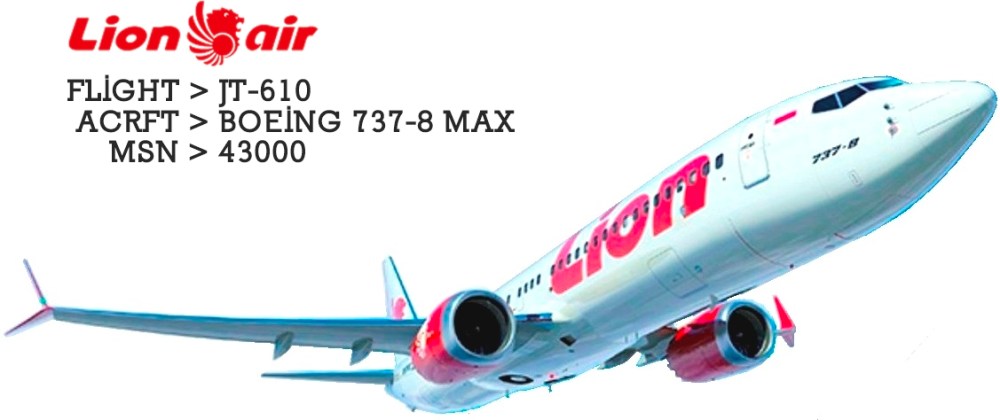
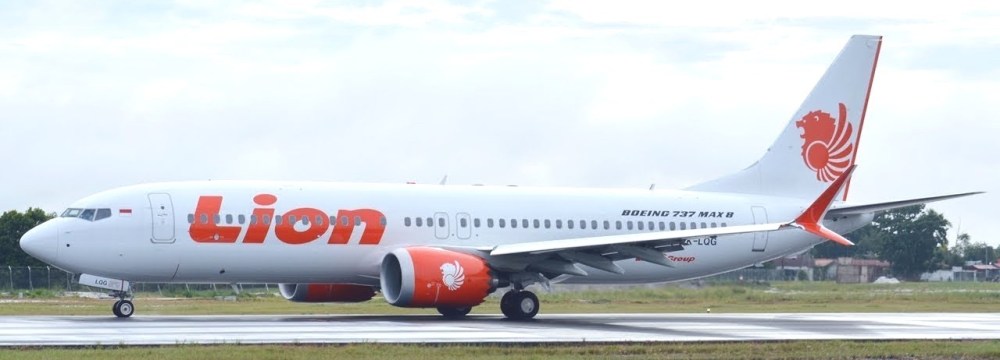
El vuelo JT-610 de Lion Air, Boeing 737-8 MAX, registro PK-LQP, desapareció del radar unos 10 minutos después del despegue en el aeropuerto internacional de Jakarta. Los rescatistas encontraron escombros y se supone ampliamente que el avión se estrelló en el mar. No hubo sobrevivientes entre las 189 personas a bordo.

ACTUALIZACIÓN 2018-11-03
HISTORIA EN DESARROLLO:
El vuelo JT610 de Lion Air partió al amanecer en la pista 25L en el Aeropuerto Internacional Jakarta-Soekarno Hatta (WIII, CGK) con 181 pasajeros y ocho miembros de la tripulación en un vuelo programado a Pangkal Pinang, una isla a unos 460 km al norte de Yakarta. El tiempo de vuelo calculado fue de unos 50 minutos.

Aproximadamente tres minutos después del despegue, mientras se encontraba en un empinado ascenso a la izquierda, el JT-610 detuvo su ascenso a una altitud estimada de aproximadamente 5,300 pies y rodó en un rumbo de aproximadamente 020°. En este momento, los pilotos informaron su decisión de interrumpir el vuelo y expresaron su intención de regresar al aeropuerto de Yakarta.

El avión continuó manteniendo una altitud de entre 5,000 y 5,400 pies, ya que giró ligeramente a la derecha en un rumbo de aproximadamente 060° grados. El avión voló más allá del promontorio de Tanjung Karawang antes de que se perdiera la altitud.

El último retorno de radar ADSB se recibió unos 12 minutos después de la salida, mostró el 737 a una altitud de 3,650 pies, en un descenso gradual. Los datos ADSB granulares completos (proporcionados por Flightradar24) mostraron el impacto del vuelo a una alta tasa de descenso (ver imagen a continuación). En el área de impacto, el fondo marino tiene una profundidad de menos de 50 metros (150 pies). No se escuchó nada del vuelo después de eso y no se recibieron señales del transmisor del localizador de emergencia (ELT).

Basarnas,, la Agencia Nacional de Búsqueda y Rescate fue alertada. Se lanzaron varios botes de rescate y se inició una operación de búsqueda y rescate en alta mar. Parches flotantes de petróleo y desechos de aviones se encontraron más tarde en el mar de Java. Se recuperaron partes del interior de la cabina y las pertenencias de los pasajeros del vuelo JT-610.

El 1 de noviembre, la unidad de memoria de uno de los dispositivos de registro de vuelo fue encontrada por los buzos de Basarnas que mostraban señales de daño externo y fue llevada a tierra.

El área de impacto se encuentra a unos 10 km de la costa y a unos 60 kilómetros al noreste del Aeropuerto Internacional de Jakarta.

La operación de búsqueda y rescate está en curso. Según los funcionarios del gobierno local, no hubo sobrevivientes. El 2018-11-03, uno de los buzos de rescate que trabajaba como voluntario para Basarnas perdió la vida mientras estaba de servicio en busca de cuerpos.

Se informó que en el vuelo anterior de PK-LQP, JT-043 de Denpasar a Jakarta, en 2018-10-28, los pilotos reportaron una falla técnica. El piloto en este vuelo hizo una entrada en el registro de mantenimiento indicando que experimentaron un desacuerdo tanto de velocidad como de altitud entre los capitanes y los instrumentos del copiloto poco después del despegue. Sin embargo, resulta que hay más de una versión de ese documento cuya autenticidad aún no está confirmada oficialmente. El vuelo JT-043, por lo tanto, se vio obligado a navegar a una altitud más baja de lo normal a Yakarta.

Según un oficial de Lion Air, la falla se solucionó durante el mantenimiento nocturno y se informó que el avión estaba listo para el vuelo hasta la mañana siguiente (2018-10-29).

NOTA: Este accidente marca el primer accidente de pérdida de casco para un Boeing 737 serie MAX, el peor de un Boeing 737, el segundo peor accidente de aviación en la historia de Indonesia y la pérdida del octavo casco de un avión Lion Air (dos de ellos fueron fatal).

METAR: Jakarta-Intl AP (WIII, CGK):
2018-10-29 06: 30-> METAR WIII 282330Z 16003KT 8000 SCT020 27/25 Q1010 NOSIG
2018-10-29 07: 00-> METAR WIII 290000Z VRB03KT 8000 SCT020 27/25 Q1011 NOSIG =

Lista de vuelos de Boeing 737-8 MAX PK-LQP anterior al accidente

Las indicaciones iniciales apuntan a una falla no especificada dentro del sistema de indicación de altitud / velocidad del aire que resulta en un posible desacuerdo entre los instrumentos del capitán y del copiloto.

El 2 de noviembre de 2018, se encontraron fallas en otros dos Boeing 737-8 MAX pertenecientes a Lion Air. Uno tiene una falla en la pantalla de la aviónica de la cabina, mientras que el otro tiene una falla en el sistema de estabilización. Actualmente, Lion Air opera una flota de nueve aviones Boeing 737-8 MAX.  AIRWAYS® AW-Icon TXT

Resultado de imagen para lion air Boeing 737 MAX air crash

Air crash JT-610 Lion Air

Lion Air Boeing 737 MAX 8 crashed into Java Sea off Jakarta

Lion Air flight JT-610, Boeing 737-8 MAX, with registration PK-LQP, disappeared from radar about 10 minutes after take-off at Jakarta-Intl Airport. Rescuers found debris and it is widely assumed the aircraft has crashed into sea. There were no survivors among the 189 people on board.

AW-70087801.png

UPDATE 2018-11-03
DEVELOPING STORY:
Lion Air flight JT610 departed at dawn on runway 25L at Jakarta-Soekarno Hatta Intl Airport (WIII, CGK) carrying 181 passengers and eight crew members on a scheduled flight to Pangkal Pinang, an Island about 460 km to the north to Jakarta. The calculated flying time was about 50 minutes.

About three minutes after take-off, while in a steep left turn climb-out, JT-610 stopped further climb at an estimated altitude of about 5,300 ft and rolled out on a heading of about 020 °. At this time, the pilots reported their decision to discontinue the flight and expressed their intention to return to Jakarta Airport.

The aircraft continued to maintain an altitude of between 5,000 and 5,400 feet as it turned slightly to the right to a heading of roughly 060° degrees. The aircraft flew past the headland of Tanjung Karawang before altitude was lost.

Last ADSB radar return was received about 12 minutes after departure, it showed the 737 at an altitude of 3,650 feet, in a gradual descent. Full granular ADSB data (provided by Flightradar24) showed the flight impacting at a high rate of descent (see image below). At the impact area, the seabed has a depth of less than 50 meters (150 ft). Nothing was heard from the flight after that and no signals of the emergency locator transmitter (ELT) were received.

Basarnas – National Search and Rescue Agency was alerted. A number of rescue boats were launched and an off-shore search and rescue operation began. Floating patches of oil and aircraft debris were found later in the Java Sea. Parts of the cabin interior and passenger belongings of flight JT610 were retrieved.

On Nov 1st the memory unit of one of the flight recording devices was found by Basarnas divers showing signs of external damage and was brought ashore.

The impact area lies about 10 km off the coast and about 60 kilometers to the northeast of Jakarta International Airport.

The search and rescue operation is ongoing. According to local government officials, there were no survivors. On 2018-11-03 one of the rescue divers serving as a volunteer for Basarnas lost his life while on duty searching for bodies.

It was reported that on the previous flight of PK-LQP, JT-043 from Denpasar to Jakarta), on 2018-10-28 the pilots reported a technical glitch. The pilot on this flight made a maintenance log entry stating they experienced both a speed and altitude disagreement between the captains and the co-pilot’s instruments shortly after take-off. However, there happens to be more than one version of that document whose authenticity is still not officially confirmed. The flight JT-043, therefore was forced to cruise at a lower-than-normal altitude to Jakarta.

According to a Lion Air official, the fault was addressed by overnight maintenance and the aircraft was reported ready for flight again until the next morning (2018-10-29).

NOTE: This accident marks the 1st ever hull loss accident for a Boeing 737 MAX series aircraft, the worst ever for a Boeing 737, the 2nd worst aviation accident in Indonesian history and the 8th hull loss of a Lion Air aircraft (two of them were fatal).

METAR: Jakarta-Intl AP (WIII, CGK):
2018-10-29 06:30-> METAR WIII 282330Z 16003KT 8000 SCT020 27/25 Q1010 NOSIG
2018-10-29 07:00-> METAR WIII 290000Z VRB03KT 8000 SCT020 27/25 Q1011 NOSIG=

Flights-List of Boeing 737MAX8 PK-LQP Previous to Accident

Initial indications point to an unspecified fault within the altitude/airspeed indication system resulting in a possible disagreement bezween captain and copilot’s instruments.

On Nov 2nd 2018, faults were found in two other Boeing 737-8 MAX’s belonging to Lion Air. One has a fault in the cockpit avionics display while the other a glitch in the stabilization system. Currently, Lion Air operates a fleet of nine Boeing 737-8 MAX aircraft. A \ W

Resultado de imagen para lion air Boeing 737 MAX air crashResultado de imagen para lion air Boeing 737 MAX air crashResultado de imagen para lion air Boeing 737 MAX air crashResultado de imagen para lion air Boeing 737 MAX air crashImagen relacionadaResultado de imagen para lion air Boeing 737 MAX air crash

Kecelakaan udara JT-610 Lion Air

Lion Air Boeing 737 MAX 8 jatuh ke Laut Jawa dari Jakarta

Penerbangan Lion Air JT-610, Boeing 737-8 MAX, dengan registrasi PK-LQP, hilang dari radar sekitar 10 menit setelah take-off di Bandara Internasional Jakarta. Petugas penyelamat menemukan puing-puing dan secara luas diasumsikan pesawat telah jatuh ke laut. Tidak ada yang selamat di antara 189 orang di dalamnya.

PERBARUI 2018-11-03
MENGEMBANGKAN CERITA:
Penerbangan Lion Air JT610 berangkat pada subuh di landasan pacu 25L di Jakarta-Bandara Internasional Soekarno-Hatta (WIII, CGK) yang membawa 181 penumpang dan delapan anggota awak pada penerbangan terjadwal ke Pangkal Pinang, sebuah pulau sekitar 460 km ke utara ke Jakarta. Waktu terbang yang dihitung sekitar 50 menit.

Sekitar tiga menit setelah take-off, sementara di tikungan kiri curam keluar, JT-610 berhenti mendaki lebih lanjut di ketinggian sekitar 5.300 kaki dan meluncur pada heading sekitar 020 °. Pada saat ini, pilot melaporkan keputusan mereka untuk menghentikan penerbangan dan menyatakan niat mereka untuk kembali ke Bandara Jakarta.

Pesawat itu terus mempertahankan ketinggian antara 5.000 dan 5.400 kaki saat membelok sedikit ke kanan ke arah sekitar 060°. Pesawat terbang melewati tanjung Tanjung Karawang sebelum ketinggian hilang.

Radar radar ADSB terakhir diterima sekitar 12 menit setelah keberangkatan, itu menunjukkan 737 di ketinggian 3,650 kaki, dalam penurunan bertahap. Data ADSB granular penuh (disediakan oleh Flightradar24) menunjukkan penerbangan berdampak pada tingkat keturunan yang tinggi (lihat gambar di bawah). Di area benturan, dasar laut memiliki kedalaman kurang dari 50 meter (150 kaki). Tidak ada yang terdengar dari penerbangan setelah itu dan tidak ada sinyal dari pemancar lokasi darurat (ELT) yang diterima.

Basarnas – Badan Pencarian dan Penyelamatan Nasional disiagakan. Sejumlah kapal penyelamat diluncurkan dan operasi pencarian dan penyelamatan lepas pantai dimulai. Tambalan-tambalan minyak dan sisa-sisa pesawat yang mengambang ditemukan kemudian di Laut Jawa. Bagian-bagian interior kabin dan barang-barang penumpang pesawat JT610 diambil.

Pada 1 November unit memori salah satu alat perekam penerbangan ditemukan oleh penyelam Basarnas yang menunjukkan tanda-tanda kerusakan eksternal dan dibawa ke darat.

Area benturan terletak sekitar 10 km dari pantai dan sekitar 60 kilometer ke arah timur laut dari Bandara Internasional Jakarta.

Operasi pencarian dan penyelamatan sedang berlangsung. Menurut pejabat pemerintah setempat, tidak ada yang selamat. Pada 2018-11-03 salah satu penyelam penyelamat yang melayani sebagai sukarelawan untuk Basarnas kehilangan nyawanya saat bertugas mencari mayat.

Dilaporkan bahwa pada penerbangan sebelumnya dari PK-LQP, JT-043 dari Denpasar ke Jakarta), pada 2018-10-28 pilot melaporkan kesalahan teknis. Pilot pada penerbangan ini membuat entri log pemeliharaan yang menyatakan bahwa mereka mengalami ketidaksepakatan kecepatan dan ketinggian antara kapten dan instrumen co-pilot sesaat setelah lepas landas. Namun, ada lebih dari satu versi dokumen yang keasliannya belum dikonfirmasi secara resmi. Penerbangan JT-043, oleh karena itu dipaksa untuk berlayar di ketinggian yang lebih rendah dari normal ke Jakarta.

Menurut seorang pejabat Lion Air, kesalahan itu ditangani oleh pemeliharaan semalam dan pesawat itu dilaporkan siap untuk penerbangan lagi sampai pagi berikutnya (2018-10-29).

CATATAN: Kecelakaan ini menandai kecelakaan lambung ke-1 yang pernah terjadi untuk pesawat seri Boeing 737 MAX, yang terburuk yang pernah terjadi untuk Boeing 737, kecelakaan penerbangan terburuk ke-2 dalam sejarah Indonesia dan kerugian lambung ke-8 pesawat Lion Air (dua di antaranya adalah fatal).

METAR: Jakarta-Intl AP (WIII, CGK):
2018-10-29 06: 30-> METAR WIII 282330Z 16003KT 8000 SCT020 27/25 Q1010 NOSIG
2018-10-29 07: 00-> METAR WIII 290000Z VRB03KT 8000 SCT020 27/25 Q1011 NOSIG =

Daftar Penerbangan Boeing 737MAX8 PK-LQP Sebelumnya Kecelakaan
Indikasi awal menunjukkan kesalahan yang tidak ditentukan dalam sistem indikasi ketinggian / kecepatan udara yang menghasilkan kemungkinan ketidaksepakatan antara kapten dan instrumen kopilot.

Pada 2 November 2018, kesalahan ditemukan di dua Boeing 737-8 MAX milik Lion Air. Satu memiliki kesalahan dalam tampilan avionik kokpit sementara yang lain kesalahan dalam sistem stabilisasi. Saat ini, Lion Air mengoperasikan armada sembilan pesawat Boeing 737-8 MAX. A \ W


Ξ A I R G W A Y S Ξ
SOURCE: Airgways.com
DBk: Jacdec.de / Flightradar24.com / Airgways.com / Leehamnews.com / Gritdaily.com / Ckpgtoday.com / Fortune.com / Newsweek.com / Publinews.gt / Businessinsider.my / Barsanas.go.id 
AW-POST: 201811032110AR

A\W   A I R G W A Y S ®

Avances accidente Lion Air JT-610


AW-70087800.png

AW | 2018 11 03 20:37 | AVIATION SAFETY

Resultado de imagen para Indonesian Kementerian PerhubunganMás detalles del accidente del vuelo JT-610 de Lion Air

Nuevos detalles sobre el penúltimo vuelo JT-610 realizado por el avión Boeing 737-8 MAX de Lion Air accidentado plantearon más dudas sobre la afirmación de la aerolínea indonesia de que solucionó los problemas técnicos. Cientos de personas seguían rastreando el mar por quinto día el viernes en busca de víctimas y del fuselaje de la aeronave.

El piloto de un vuelo realizado por el aparato el domingo, el último antes del siniestro, pidió permiso para regresar al aeropuerto de Bali poco después de despegar desde allí, pero luego reportó que el problema había sido solucionado, dijo Herson, jefe de la autoridad aeroportuaria de Bali-Nusa Tenggara. Varios pasajeros se refirieron al fallo como una aterradora pérdida de altitud.

Muere buzo rescatista

El 3 Noviembre de 2018, la Marina de Indonesia informó que un buzo voluntario que recuperaba partes del cuerpo murió, probablemente debido a la descompresión. El buceador había servido en el accidente de AirAsia Indonesia QZ-8501 hace cuatro años.

Víctimas vuelo JT-610

El 3 Noviembre de 2018, Basarnas informó que hasta el momento se habían llevado 73 bolsas de cadáveres al puesto de mando. Cuerpos de pasajeros que murieron en el accidente aéreo el pasado 29 Octubre 2018 del vuelo JT-610 de Lion Air fueron encontrados aún abrochados a sus asientos en el fondo del océano. Buzos indonesios revelaron que han encontrado cadáveres entre trozos de metal retorcidos y piezas de fuselaje del Boeing 737 estrellado en el lecho del mar de Java.

Restos del Boeing 737-8 MAX

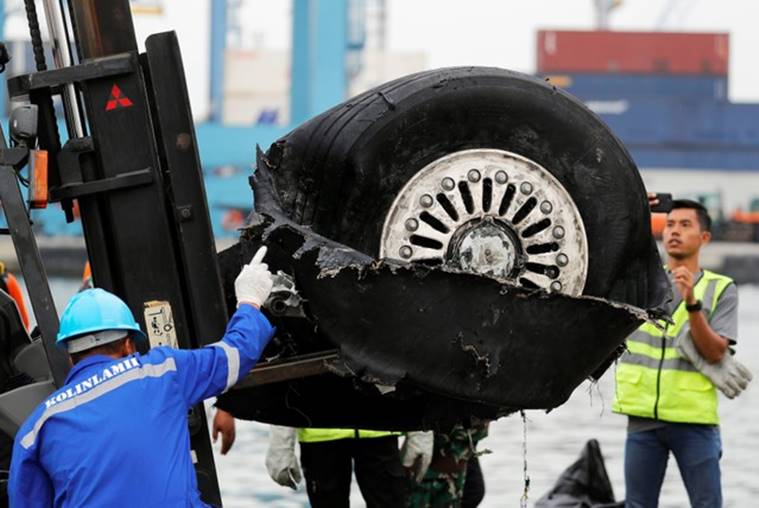
La parte más grande recuperada hasta ahora, parte del tren de aterrizaje, así como otros escombros recolectados hasta ahora, fueron entregados a KNKT. La señal de ping del localizador, que se cree que se originó en el CVR, se había extinguido, posiblemente el CVR está cubierto por lodo o corrientes de agua en el área que mueve el pinger, se está trayendo un equipo especializado más sensible para encontrar los pings nuevamente. Las operaciones de búsqueda y recuperación continúan dentro de un radio de 500 metros alrededor de la ubicación donde se encontró la primera caja negra.

Como parte del operativo de rastrillaje, las autoridades indonesias desplegaron buzos, barcos de búsqueda y rescate, cuatro detectores de sonar y una baliza acústica submarina. Los equipos lograron encontrar una de las cajas negras entre los restos del Boeing 737, que podría resolver el misterio de lo que causó el accidente.

Cada avión cuenta con dos cajas negras, una de las cuales registra las voces en la cabina y la otra los datos de seguimiento del vuelo. No se sabe si la caja recuperada fue la grabadora del vuelo, que es mucho más útil para la investigación.

Haryo Satmiko, Subjefe del Comité de Seguridad de Transporte de Indonesia, afirmó que los expertos estaban descargando los datos almacenados en la caja negra. Mientras que la descarga generalmente toma algunas horas, los especialistas podrían tardar semanas para analizar la información extraída.

Resultado de imagen para Basarnas JT-610Resultado de imagen para Basarnas JT-610Resultado de imagen para Basarnas JT-610Resultado de imagen para Basarnas JT-610Ruedas del malogrado vuelo de Lion Air JT610.Resultado de imagen para Basarnas JT-610

Fallas en Boeing 737 MAX

El Ministerio de Transportes de Indonesia dijo el Viernes, 2 Noviembre 2018 que habían encontrado fallas menores en otros dos aviones Boeing 737-8 MAX, incluido un problema en la pantalla del indicador de cabina que un analista dijo que podría ser similar a uno reportado en el estrellado Lion Air. El ministerio está inspeccionando 10 de los jets recién lanzados que son propiedad de Lion y la aerolínea principal Garuda, mientras las autoridades analizan los datos de una caja negra recuperada que puede ayudar a explicar por qué el vuelo JT-610 se estrelló en el Mar de Java, matando a 189 personas el Lunes, 29 Octubre 2018. Se publicaron pocos detalles, pero el ministerio dijo que había examinado más de media docena de aviones hasta el momento y descubrió que uno tenía un problema relacionado con la pantalla de su cabina, mientras que otro tenía una falla en un sistema de estabilización del avión. El analista de aviación Dudi Sudibyo dijo que el problema con la pantalla de la cabina podría incluir una falla de velocidad y altitud reportada en el avión condenado.

Stephen Wright, un experto en aviación de la Universidad de Leeds, dijo que las fallas identificadas por el Ministerio de Transporte eran muy menores. Añadió que cualquier problema con el sistema pitot-static del nuevo jet, que determina la velocidad y la altitud entre otras medidas, será clave para la sonda. La inspección se produce cuando surgen preguntas sobre por qué un avión que entró en servicio hace unos meses se estrelló en el mar minutos después del despegue. La caja negra podría ofrecer a los investigadores la mejor oportunidad de descubrir por qué se estrelló el avión. Según los expertos en aviación, los dispositivos ayudan a explicar casi el 90 por ciento de todos los accidentes. Boeing y funcionarios de la Junta Nacional de Seguridad del Transporte de EEUU participan en la investigación.

El Comité Nacional de Seguridad del Transporte de Indonesia dijo que estaba entrevistando a personas que volaron en el avión el día antes del accidente fatal. Algunos han informado de un viaje aterrador y errático, una afirmación que parece estar respaldada por datos de seguimiento de vuelo. La admisión de la aerolínea Lion Air de que el Boeing 737-8 MAX tenía un problema técnico en un vuelo anterior, así como el avión accidentado, ha planteado dudas sobre si tenía fallas mecánicas específicas del nuevo modelo.

Inseguridad aérea en Indonesia

El misterioso accidente de un nuevo avión Boeing en Indonesia ha llamado la atención sobre el pobre historial de seguridad aérea del país. Sin embargo, los expertos están advirtiendo contra sacar conclusiones especulativas.

A medida que los investigadores continúan recuperando los restos y analizando los datos de vuelo de la grabadora de caja negra recuperada del vuelo JT-610 de Lion Air, no hay una explicación obvia de lo que causó que el nuevo avión Boeing cayera de un cielo despejado y se hundiera en el mar de Java Minutos después de despegar de Yakarta.

El accidente del vuelo JT-610, que mató a las 189 personas a bordo, es el segundo peor desastre aéreo de Indonesia, después del accidente de Garuda Indonesia en 1997 cerca de Medan, que mató a 234 personas.

Aunque actualmente no hay indicios de que una infraestructura deficiente o estándares de seguridad rezagados en el terreno hayan causado el accidente, este último desastre aéreo en Indonesia arroja una luz desafortunada sobre el pobre historial de seguridad aérea del país.

Indonesia es uno de los mercados de aviación de más rápido crecimiento en el mundo, pero este rápido crecimiento ha ejercido mucha presión en la red de aviación del país. La agencia de noticias Reuters informó que entre 2012 y 2017, el panel de seguridad del transporte de Indonesia investigó 137 incidentes graves de aviación.

«Durante mucho tiempo, Indonesia tuvo un grave problema con respecto a la seguridad de la aviación. No es tanto la cantidad de pasajeros, sino el rápido crecimiento de las aerolíneas», dijo Harro Ratner, Director General de la organización de Vigilancia de la Seguridad Aérea, Aviation Safety Network.

Indonesia inhibida

Las aerolíneas indonesias han emergido recientemente del estado de paria internacional. En 2007, los Estados Unidos y la Unión Europea prohibieron a todas las líneas aéreas comerciales de Indonesia su espacio aéreo después de una serie de incidentes.

«En 2007, los Estados Unidos concluyeron que las autoridades indonesias no podían supervisar adecuadamente las actividades de aviación en el país. Dijeron que Indonesia no estaba cumpliendo con las normas internacionales OACI», dijo Ratner.

Indonesia, levantan restricciones

20150215-logo-faa_1En 2016, la Administración Federal de Aviación de Estados Unidos (FAA), permitió una vez más a los aviones indonesios y en Junio 2018, la Unión Europea levantó su prohibición. «El país y las aerolíneas ahora, después de un largo período de tiempo, se consideran seguros según los estándares internacionales. Algunos incidentes recientes, sin incluir el accidente de Lion Air, indican que las operaciones aeroportuarias y el control del tráfico aéreo son un área donde hay que trabajar», expresa Harro Ratner.

Seal_of_the_United_States_National_Transportation_Safety_Board.svg«En los últimos dos años se han producido dos colisiones en la pista y recientemente un avión aterrizó en una pista y golpeó un equipo que quedó allí después de los trabajos de mantenimiento», dijo Ratner.

El Lunes, un portavoz de la Comisión Europea dijo que la UE no tiene planes inmediatos para renovar la prohibición de Lion Air. The Associated Press informó que el gobierno australiano les dijo a sus funcionarios y contratistas que no viajaran en la aerolínea en espera de los resultados de la investigación del accidente.

Problema de indonesia

Los recientes desastres aéreos mortales en Indonesia incluyen el accidente de AirAsia en 2014, que se hundió en el Mar de Java en ruta desde Surabaya a Singapur, matando a 162 personas. Se determinó que la causa era un timón que funcionaba mal, lo que supuestamente había causado problemas repetidos en la aeronave en los meses previos a su accidente.

El incidente de 2014 atrajo la atención internacional sobre las deficiencias en el sistema de navegación de la aviación de Indonesia. El Wall Street Journal informó en enero que los pilotos dijeron que la infraestructura en Indonesia era «poco sofisticada y no hace lo suficiente para ayudar a los aviones de pasajeros a enfrentar las malas condiciones de vuelo». En 2004, un jet de Lion Air se deslizó de una pista en 2004, matando a 25 pasajeros y tripulantes.

Boeing 737 MAX, en el foco

El avión condenado al accidente del Lunes, 29 Octubre 2018 fue un Boeing 737-8 MAX, que tuvo su primer vuelo en Agosto 2018. La serie MAX es el diseño más moderno de la familia 737. La primera entrega de un avión 737 MAX a una aerolínea fue en Mayo 2017, y Boeing dice que la serie 737 MAX es el avión más vendido en la historia de la compañía, con más de 4.700 pedidos ya realizados.

Boeing, junto con la Junta Nacional de Seguridad del Transporte de los Estados Unidos (NTSB), se unió a la investigación en Indonesia y, según informes, los funcionarios indonesios viajan a los Estados Unidos para reunirse con los diseñadores de Boeing.

El profesor Elmar Giemulla, un destacado especialista alemán en derecho aeronáutico, dijo que las aeronaves de nuevo diseño pueden algunas veces esconder problemas técnicos. «No es de extrañar que Boeing se encuentre en el lugar del accidente en Indonesia, y esto podría generar sospechas de que están tratando de influir en la investigación para que no atraigan ninguna falla a Boeing», dijo Giemulla.

Un fabricante no quiere que se detecten fallas de diseño mientras todo el mundo está mirando. La pregunta de responsabilidad surgirá muy pronto. Los familiares pronto preguntarán quién es responsable de la muerte de sus seres queridos. Solicitarán una compensación y, por supuesto, Boeing como fabricante es una posible parte responsable.

La noche anterior al accidente, el mismo avión había estado involucrado en un incidente de pérdida de altitud en un vuelo desde Bali a Jakarta. El piloto emitió una alerta, pero pudo corregir el problema y continuó el vuelo. Giemulla, que es un experto en clasificar incidentes de aviación, dijo que un avión que cae repentinamente unos cientos de metros no era un acontecimiento inusual.

El piloto del avión Lion Air que se estrelló el lunes supuestamente tenía más de 6.000 horas de vuelo. «Es bastante improbable que esto sea un problema de mantenimiento, porque los problemas de mantenimiento generalmente ocurren mucho más tarde. Hasta que se puedan analizar las cajas negras, todo es especulación», concluye Elmar Giemulla.  AIRWAYS® AW-Icon TXT

Resultado de imagen para Boeing 737 MAX 8 Lion Air PK-LQP

Advances crash Lion Air JT-610

More details of the Lion Air flight JT-610 accident

New details about the penultimate JT-610 flight made by the injured Boeing 737-8 MAX airplane from Lion Air raised further doubts about the Indonesian airline’s claim that it solved the technical problems. Hundreds of people continued to track the sea for the fifth day on Friday in search of victims and the fuselage of the aircraft.

The pilot of a flight made by the device on Sunday, the last before the incident, asked permission to return to Bali airport shortly after taking off from there, but then reported that the problem had been solved, said Herson, head of the authority Airport of Bali-Nusa Tenggara. Several passengers referred to the failure as a terrifying loss of altitude.

Dies Rescue Diver

On November 3, 2018, the Indonesian Navy reported that a volunteer diver recovering body parts died, probably due to decompression. The diver had served in the accident of AirAsia Indonesia QZ-8501 four years ago.

Victims flight JT-610

On November 3, 2018, Basarnas reported that 73 bags of corpses had been taken to the command post. Bodies of passengers who died in the plane crash on October 29, 2018 of Lion Air’s JT-610 flight were still found fastened to their seats on the ocean floor.

Indonesian divers revealed that they have found bodies among twisted pieces of metal and fuselage parts of the Boeing 737 crashed into the bed of the Java Sea.

Remains of the Boeing 737-8 MAX

The largest part recovered so far, part of the landing gear, as well as other debris collected so far, were delivered to KNKT. The locator’s ping signal, which is believed to have originated in the CVR, was extinguished, possibly the CVR is covered by mud or water currents in the area that moves the pinger, it is bringing a more sensitive specialized equipment to find the pings again. The search and recovery operations continue within a radius of 500 meters around the location where the first black box was found.

As part of the raking operation, the Indonesian authorities deployed divers, search and rescue boats, four sonar detectors and an underwater acoustic beacon. The teams managed to find one of the black boxes among the wreckage of the Boeing 737, which could solve the mystery of what caused the accident.

Each plane has two black boxes, one of which records the voices in the cabin and the other flight tracking data. It is not known if the recovered box was the flight recorder, which is much more useful for the investigation.

Haryo Satmiko, Deputy Chief of the Transport Security Committee of Indonesia, said experts were downloading the data stored in the black box. While the download usually takes a few hours, specialists may take weeks to analyze the information extracted.

Faults in Boeing 737 MAX

The Indonesian Ministry of Transportation said on Friday, November 2, 2018 that they had found minor faults in two other Boeing 737-8 MAX aircraft, including a problem on the cockpit indicator display that one analyst said could be similar to one reported in the starry Lion Air. The ministry is inspecting 10 of the newly launched jets owned by Lion and the main airline Garuda, as authorities analyze the data from a recovered black box that may help explain why the JT-610 flight crashed into the Sea of Java, killing 189 people on Monday, October 29, 2018. Few details were published, but the ministry said it had examined more than half a dozen planes so far and discovered that one had a problem related to the screen of its cabin, while that another had a failure in an aircraft stabilization system. Aviation analyst Dudi Sudibyo said the problem with the cockpit display could include a failure in speed and altitude reported on the doomed plane.

Stephen Wright, an aviation expert at the University of Leeds, said the faults identified by the Ministry of Transportation were very minor. He added that any problem with the pitot-static system of the new jet, which determines speed and altitude among other measures, will be key to the probe. The inspection occurs when questions arise about why a plane that entered service a few months ago crashed into the sea minutes after takeoff. The black box could offer researchers the best chance to discover why the plane crashed. According to aviation experts, the devices help explain almost 90 percent of all accidents. Boeing and officials from the US National Transportation Safety Board are participating in the investigation.

The National Transport Security Committee of Indonesia said it was interviewing people who flew on the plane the day before the fatal accident. Some have reported a frightening and erratic journey, an assertion that seems to be supported by flight tracking data. The admission of the Lion Air airline that the Boeing 737-8 MAX had a technical problem on a previous flight, as well as the crashed plane, has raised doubts about whether it had specific mechanical failures of the new model.

Imagen relacionada

Insecurity in Indonesia

The mysterious accident of a new Boeing aircraft in Indonesia has drawn attention to the country’s poor aviation safety record. However, experts are cautioning against drawing speculative conclusions.

As researchers continue to recover the remains and analyze the flight data of the black box recorder recovered from Lion Air flight JT-610, there is no obvious explanation for what caused the new Boeing aircraft to fall from a clear sky and I plunged into the Java Sea Minutes after taking off from Jakarta.

The accident of flight JT-610, which killed the 189 people on board, is the second worst air disaster in Indonesia, after the Garuda Indonesia accident in 1997 near Medan, which killed 234 people.

Although there are currently no indications that poor infrastructure or lagging safety standards on the ground have caused the accident, this latest air disaster in Indonesia sheds an unfortunate light on the country’s poor aviation safety record.

Indonesia is one of the fastest growing aviation markets in the world, but this rapid growth has put a lot of pressure on the country’s aviation network. The Reuters news agency reported that between 2012 and 2017, the Indonesian transport safety panel investigated 137 serious aviation incidents.

«Indonesia has had a serious problem with aviation security for a long time, it’s not so much the number of passengers, but the rapid growth of airlines», said Harro Ratner, General Director of the Security Surveillance organization. Aerial, Aviation Safety Network.

Indonesia inhibited

Indonesian airlines have recently emerged from the international pariah state. In 2007, the United States and the European Union banned all of Indonesia’s commercial airlines from airspace after a series of incidents.

«In 2007, the United States concluded that the Indonesian authorities could not adequately monitor aviation activities in the country, saying that Indonesia was not complying with ICAO international standards», Ratner said.

Indonesia, lift restrictions

In 2016, the Federal Aviation Administration of the United States (FAA) once again allowed Indonesian aircraft and in June 2018, the European Union lifted its ban. «The country and the airlines now, after a long period of time, are considered safe according to international standards. Some recent incidents, not including the Lion Air accident, indicate that airport operations and air traffic control are an area where you have to work», says Harro Ratner.

«In the last two years there have been two collisions on the runway and recently a plane landed on a runway and hit a team that was left there after the maintenance work», Ratner said.

On Monday, a spokesman for the European Commission said the EU has no immediate plans to renew the Lion Air ban. The Associated Press reported that the Australian government told its officials and contractors not to travel on the airline pending the results of the accident investigation.

Problem of indonesia

The recent deadly air disasters in Indonesia include the AirAsia crash in 2014, which sank in the Java Sea en route from Surabaya to Singapore, killing 162 people. It was determined that the cause was a rudder that malfunctioned, which allegedly caused repeated problems on the aircraft in the months leading up to its accident.

The 2014 incident attracted international attention about deficiencies in Indonesia’s aviation navigation system. The Wall Street Journal reported in January that pilots said the infrastructure in Indonesia was «unsophisticated and does not do enough to help passenger aircraft to cope with poor flight conditions». In 2004, a Lion Air jet slid off a runway in 2004, killing 25 passengers and crew.

Boeing 737 MAX, in focus

The plane condemned to the accident on Monday, 29 October 2018 was a Boeing 737-8 MAX, which had its first flight in August 2018. The MAX series is the most modern design of the 737 family. The first delivery of a 737 MAX aircraft to an airline was in May 2017, and Boeing says that the 737 MAX series is the best-selling aircraft in the company’s history, with more than 4,700 orders already made.

Boeing, along with the National Transportation Safety Board of the United States (NTSB), joined the investigation in Indonesia and, according to reports, Indonesian officials travel to the United States to meet with Boeing designers.

Professor Elmar Giemulla, a leading German specialist in aeronautical law, said that newly designed aircraft can sometimes hide technical problems. «It is not surprising that Boeing is at the scene of the accident in Indonesia, and this could raise suspicions that they are trying to influence the investigation so that they do not attract any failure to Boeing», said Giemulla.

A manufacturer does not want design flaws detected while everyone is watching. The question of responsibility will arise very soon. Family members will soon ask who is responsible for the death of their loved ones. They will request compensation and, of course, Boeing as a manufacturer is a possible responsible party.

The night before the accident, the same plane had been involved in an incident of altitude loss on a flight from Bali to Jakarta. The pilot issued an alert, but he was able to correct the problem and the flight continued. Giemulla, who is an expert in classifying aviation incidents, said that a plane that suddenly falls a few hundred meters was not an unusual event.

The pilot of the Lion Air plane that crashed on Monday allegedly had more than 6,000 flight hours. «It is very unlikely that this is a maintenance problem, because maintenance problems usually occur much later, until the black boxes can be analyzed, everything is speculation», concludes Elmar Giemulla. A \ W


Ξ A I R G W A Y S Ξ
SOURCE: Airgways.com
DBk: Dephub.go.id / Faa.gov / Ntsb.gov / Dw.com / News.com.au / Sbs.com.au / Basarnas.go.id / Airgways.com / Gettyimages.com / Afp.com / Atimes.com / Idntimes.com / Dailytelegraph.com.au
AW-POST: 201811032037AR

A\W   A I R G W A Y S ®

Agencia Federal Rusia suspende vuelos internacionales de Yakutia Airlines

Resultado de imagen para Yakutia Airlines Boeing 737-800

AW | 2018 11 03 14:54 | AVIATION SAFETY

La Agencia Federal de Transporte Aéreo de Rusia suspende el vuelo internacional de Yakutia Airlines tras inspecciones

La Agencia Federal de Transporte Aéreo de Rusia dijo que suspendió los vuelos internacionales de Yakutia Airlines a partir del 5 de noviembre, hasta que la aerolínea con sede en Yakutsk corrija las fallas que se descubrieron durante las inspecciones.

La agencia encontró que la aerolínea proporcionó «información inexacta sobre la implementación de las directivas de aeronavegabilidad en el Boeing 737-800». La agencia dijo además: «Los problemas de aeronavegabilidad provocaron retrasos frecuentes y prolongados en los vuelos nacionales e internacionales. En septiembre, los retrasos alcanzaron el 20% [de los vuelos que salen]”.

El 10 Octubre 20108, un Sukhoi Superjet SSJ-100 sobrepasó una pista en el Aeropuerto de Yakutsk en Federación Rusia. Los investigadores descubrieron que el hielo en la pista contribuyó a la invasión. Además, el inversor de empuje en el motor Nº 2 había sido desactivado.Resultado de imagen para Yakutia Airlines SSJ-100

La agencia también dijo que tenía que corregir los programas charter de la aerolínea durante el año, disminuyendo el número de vuelos. La autoridad señaló que ni siquiera discutió el programa chárter de la aerolínea para Noviembre 2018.

Yakutia comunicó el 30 Octubre 2018 que había pedido a la autoridad que proporcionara información adicional sobre las restricciones. Dos días antes, el transportista anunció que volará a Tashkent, Uzbekistán; Harbin, China; Tokio y Praga este invierno. La agencia dijo que Yakutia había vendido aproximadamente 450 boletos para Noviembre y Diciembre 2018 para vuelos internacionales programados y ahora tendrá que proporcionar reembolsos.

A mediados de Octubre 2018, la aerolínea nombró a Vladimir Gorbunov como su nuevo Director General. La flota de Yakutia incluye cinco Boeing 737-800, seis Antonov An-24, tres Bombardier Q300 y cuatro Sukhoi SSJ-100. Este año transportó a 679.905 pasajeros hasta el 30 Septiembre 2018, un 2% menos con respecto al año anterior.  AIRWAYS® AW-Icon TXT

4997569.jpg

Russia suspends Yakutia Airlines international flights

The Federal Air Transport Agency of Russia suspends the international flight of Yakutia Airlines after inspections

Russia’s Federal Air Transport Agency said it suspended Yakutia Airlines‘ international flights from November 5, until the Yakutsk-based airline corrects faults that were discovered during inspections.

The agency found that the airline provided «inaccurate information about the implementation of the airworthiness directives on the Boeing 737-800». The agency also said: «The problems of airworthiness caused frequent and prolonged delays in domestic and international flights, and in September, delays reached 20% [of flights departing]».

AW-70443771.pngON THE INTRODUCTION OF RESTRICTIONS IN EFFECT OF THE OPERATOR CERTIFICATE NO. 474 OF THE YAKUTIA AIRLINES CORPORATION, ORDER OF THE FEDERAL AIR TRANSPORT AGENCY WITH DATE OCTOBER 29, 2018 NO. 889-P

On October 10, 2010, a Sukhoi Superjet SSJ-100 passed a runway at the Yakutsk Airport in the Russian Federation. The researchers discovered that ice on the track contributed to the invasion. In addition, the thrust reverser on the No. 2 engine had been deactivated.

The agency also said it had to correct the airline’s charter programs during the year, decreasing the number of flights. The authority said it did not even discuss the airline’s charter program for November 2018.

Yakutia reported on October 30, 2018 that it had asked the authority to provide additional information on the restrictions. Two days before, the carrier announced that it will fly to Tashkent, Uzbekistan; Harbin, China; Tokyo and Prague this winter. The agency said that Yakutia had sold approximately 450 tickets for November and December 2018 for scheduled international flights and will now have to provide refunds.

In mid-October 2018, the airline named Vladimir Gorbunov as its new CEO. The Yakutia fleet includes five Boeing 737-800, six Antonov An-24, three Bombardier Q300 and four Sukhoi SSJ-100. This year it transported 679,905 passengers until September 30, 2018, 2% less than the previous year. A \ W


Ξ A I R G W A Y S Ξ
SOURCE: Airgways.com
DBk: Favt.ru / Mro-network.com / Airliners.net [Osipov Dmitri] / Wikimedia.org
AW-POST: 201811031454AR

A\W   A I R G W A Y S ®

Accidente JT-610 Lion Air

Resultado de imagen para JT-610 Lion Air air crash

AW | 2018 11 02 23:20 | AIR INVESTIGATION / AVIATION SAFETY

Resultado de imagen para Lion Air logoNuevos detalles sobre los problemas en el avión de Lion Air

El fuselaje del Boeing 737-8 MAX no aparece tras el quinto día de búsqueda en el Mar de Java. En medio de la consternación por el accidente del Boeing 737-8 MAX de Lion Air, nuevos detalles sobre el penúltimo vuelo realizado por el moderno avión accidentado plantearon más dudas sobre la afirmación de la aerolínea indonesia de haber solucionado los problemas técnicos. Cientos de personas seguían rastreando el Mar de Java por quinto día el Viernes, 2 Noviembre 2018 en busca de víctimas y del fuselaje de la aeronave.

Funcionarios de la Dirección Nacional de Seguridad del Transporte (NTSB) de Estados Unidos y el Comité Nacional de Seguridad del Transporte (KNKT) de Indonesia revisan los restos del vuelo JT-610 de Lion Air, durante su investigación del accidente aéreo, en el puerto Tanjung Priok, Jakarta, Indonesia, el 1 Noviembre 2018. El KNKT de Indonesia ha mantenido una reunión a puerta cerrada con los representantes del fabricante de aviones, Boeing, y funcionarios de la NTSB de Estados Unidos en relación con el accidente del Boeing 737-8 MAX de Lion Air que se estrelló el Lunes, 29 Octubre 2018 en la República de Indonesia.

El Boeing 737-8 MAX de Lion Air, que tenía apenas dos meses de antigüedad, cayó al Mar de Java el Lunes por la mañana minutos después de partir de la capital indonesia, Jakarta, donde se reportan que las 189 personas que iban a bordo fallecieron.

El piloto de un vuelo realizado por el aparato el Domingo, el último antes del siniestro, pidió permiso para regresar al Aeropuerto de Bali poco después de despegar desde allí, pero luego reportó que el problema había sido solucionado, dijo Herson, Jefe de la Autoridad Aeroportuaria de Bali-Nusa Tenggara. Varios pasajeros se refirieron al fallo como una aterradora pérdida de altitud.

Lion Air explicó que el problema no especificado se solventó luego del vuelo del domingo, pero en el del lunes los pilotos también emitieron una petición de “regreso a base” (RTB) poco tiempo de despegar. «Poco después de solicitar RTB, el piloto contactó con la torre de control de nuevo para informar que el avión funcionaba con normalidad y que no regresaría” al aeropuerto Ngurah Rai de Bali, explicó Herson, que utiliza solo un nombre. «El capitán dijo que el problema se solucionó y decidió continuar el viaje a Yakarta”.

Encuentran caja negra

Datos de cibersitios de seguimiento de vuelos mostraron que ambos vuelos tuvieron velocidades y altitudes erráticas tras el despegue, aunque estos datos deben contrastarse con las llamadas cajas negras del avión que registran los parámetros técnicos del viaje y las voces en cabina. Los investigadores mostraron uno de los dispositivos en una conferencia de prensa el jueves en la noche, que más tarde se confirmó que era el que registró los datos del vuelo, y dijeron que intentarían acceder a la información de inmediato para comenzar el análisis. Pero los avances se han visto obstaculizados porque la caja negra no está intacta y necesita un manejo especial para garantizar que puedan recuperarse los datos, un proceso que continúa, según el Comité Nacional de Seguridad en el Transporte. La unidad de memoria de supervivencia se abrió y se lavó y algunos de sus cables deberán reemplazarse, explicó el organismo.

«En principio, (según) todos los datos que hemos obtenido, incluyendo los datos de vuelo y de navegación aérea y también de otras fuentes, encontramos que efectivamente ha habido problemas. Probaremos más problemas técnicos con los datos registrados en la caja negra”, señaló Haryo Satmiko, Vicepresidente del Comité.

Más búsquedas

Los investigadores ya contactaron con el piloto que manejó el avión en el vuelo del domingo, dijo Satmiko. Los problemas de entonces fueron “tal y como se contó en los medios de comunicación y en redes sociales”, añadió refiriéndose a los relatos de los pasajeros. Una de ellos, Diah Mardani, contó en un programa de televisión de actualidad a principios de semana que tras despegar “el avión cayó repentinamente, después ascendió y volvió a caer más fuerte y se sacudió”.

Un equipo de la Junta Nacional de Seguridad en el Transporte de Estados Unidos (NTSB), en la que hay expertos de Boeing, se unió a la búsqueda en Indonesia. Los investigadores indonesios también viajarán a Estados Unidos para reunirse con los diseñadores del avión de nueva generación de Boeing. Cientos de operarios y docenas de embarcaciones, incluyendo barcos especializados con sonar y otros equipos de detección, participaban el viernes en la enorme operación de búsqueda en aguas al noreste de Jakarta. Expertos médicos de la policía han recibido más de 60 bolsas con restos humanos para su identificación desde el accidente, pero hasta el jueves solo se había identificado y enterrado a una. Familiares del pasaje entregaron muestras de ADN para agilizar el proceso.

Hallan tren de aterrizaje

Los equipos de búsqueda encontraron hoy Viernes, 2 Noviembre 2018 el tren de aterrizaje del avión indonesio de Lion Air que se estrelló el lunes en el mar frente a la costa occidental de Indonesia. El jefe de la Agencia Nacional de Búsqueda y Rescate de Indonesia (Basarnas), Muhammad Syaugi, dijo esta noche que el tren de aterrizaje, varias «víctimas» y otras grandes piezas del avión siniestrado, incluyendo algunas partes del fuselaje, fueron encontrados por el vehículo submarino operado a control remoto en el fondo del mar. «Se han visto varias víctimas. Había también un tren de aterrizaje. Se observaron dos neumáticos y un eje, así como una pieza del borde del fuselaje del avión», dijo en conferencia de prensa.

Unos 50 buzos participan en la misión de búsqueda en el fondo del mar, a unos 500 metros al noroeste del lugar donde el piloto del vuelo JT-610 se comunicó por última vez con el control de tráfico aéreo. AIRWAYS® AW-Icon TXT


Vuelo JT-610 de Lion Air

El vuelo JT610 de Lion Air, un Boeing 737-8 MAX, se estrelló en el Mar de Java poco después del despegue del Aeropuerto Internacional de Jakarta-Soekarno-Hatta, Indonesia. El vuelo despegó de la pista 25L en el Aeropuerto de Soekarno-Hatta a las 06:21 horas, hora local. El tiempo estuvo bien con vientos ligeros, nubes dispersas a 2000 pies y una visibilidad de 8000 m.

Los datos ADS-B del vuelo, capturados por Flightradar24 y Flightaware, muestran valores erráticos. El avión hizo un giro de la mano izquierda que subía después del despegue. Poco después, la tripulación de vuelo se comunicó por radio con el controlador, solicitando un regreso al aeropuerto.

Después de que el vuelo pasó la ADS-B informó una altitud de 2100 pies, los puntos de datos muestran brevemente una altitud más baja de alrededor de 1475 pies. Los datos de altitud enviados a través de ADS-B continúan mostrando un patrón errático, variando aproximadamente entre 4500 y 5350 pies. Los valores luego disminuyen rápidamente hasta que se pierde el contacto a las 06:32 horas. El avión impactó el mar a unos 15 km al norte de Jakarta.

Según los informes de los medios indonesios, se teme que todas las 189 personas a bordo mueran. El personal de búsqueda y rescate encontró escombros y espera encontrar los restos a 30-35 m por debajo de la superficie del agua.

El vuelo anterior del avión del accidente, JT043 de Denpasar, mostró valores erráticos similares en altitud y velocidad inmediatamente después del despegue. Después de 8 minutos el ADS-B reportó valores estabilizados. Un ítem de registro técnico no verificado para ese vuelo, enviado a ASN y la BBC, comentó «IAS y ALT no están de acuerdo después de despegar». Si bien esta supuesta nota de registro técnico no se ha confirmado, Lion Air confirmó que la aeronave tenía un «problema técnico» en el vuelo anterior, «que se resolvió según el procedimiento», según la aerolínea. A\W

Resultado de imagen para JT-610 Lion Air air crashResultado de imagen para JT-610 Lion Air air crashResultado de imagen para JT-610 Lion Air air crash

Accident JT-610 Lion Air

New details about the problems in the Lion Air plane

The fuselage of the Boeing 737-8 MAX does not appear after the fifth day of search in the Java Sea. Amid consternation over the accident of the Boeing 737-8 MAX of Lion Air, new details about the penultimate flight made by the modern plane crashed raised further doubts about the claim of the Indonesian airline to have solved the technical problems. Hundreds of people continued to track the Java Sea for the fifth day on Friday, November 2, 2018 in search of victims and the fuselage of the aircraft.

Officials from the National Transportation Safety Administration (NTSB) of the United States and the National Transport Security Committee (KNKT) of Indonesia review the remains of Lion Air’s JT-610 flight, during its investigation of the plane crash, at the port Tanjung Priok, Jakarta, Indonesia, November 1, 2018. The KNKT of Indonesia has held a closed-door meeting with the representatives of the aircraft manufacturer, Boeing, and officials of the NTSB of the United States in relation to the accident of the Boeing 737- 8 MAX of Lion Air that crashed on Monday, 29 October 2018 in the Republic of Indonesia.

The Lion Air Boeing 737-8 MAX, which was just two months old, fell into the Java Sea on Monday morning minutes after leaving the Indonesian capital, Jakarta, where it is reported that the 189 people on board they died

The pilot of a flight made by the device on Sunday, the last before the incident, asked permission to return to Bali Airport shortly after taking off from there, but then reported that the problem had been solved, said Herson, Head of the Authority Airport of Bali-Nusa Tenggara. Several passengers referred to the failure as a terrifying loss of altitude.

Lion Air explained that the unspecified problem was solved after the flight on Sunday, but on Monday the pilots also issued a «return to base» (RTB) request shortly after takeoff. «Shortly after requesting RTB, the pilot contacted the control tower again to report that the plane was operating normally and would not return» to the Ngurah Rai airport in Bali, explained Herson, who uses only one name. «The captain said that the problem was solved and decided to continue the trip to Jakarta».

They find black box

Data from flight monitoring sites showed that both flights had erratic speeds and altitudes after takeoff, although these data should be contrasted with the so-called black boxes of the aircraft that record the technical parameters of the trip and the voices in the cabin. The researchers showed one of the devices at a press conference on Thursday night, which was later confirmed to be the one that recorded the flight data, and said they would try to access the information immediately to begin the analysis. But advances have been hampered because the black box is not intact and needs special handling to ensure that data can be recovered, a process that continues, according to the National Committee on Transportation Safety. The survival memory unit was opened and washed and some of its cables must be replaced, the agency explained. «In principle, (according to) all the data we have obtained, including the flight and air navigation data and also from other sources, we found that there have been problems, we will prove more technical problems with the data recorded in the black box», noted Haryo Satmiko, Vice Chair of the Committee.

More searches

Investigators have already contacted the pilot who drove the plane on Sunday’s flight, Satmiko said. The problems then were «as told in the media and social networks», he added referring to the stories of the passengers. One of them, Diah Mardani, told a news program earlier this week that after taking off «the plane suddenly fell, then rose and fell again stronger and shook».

A team from the National Transportation Safety Board of the United States (NTSB), in which there are experts from Boeing, joined the search in Indonesia. Indonesian researchers will also travel to the United States to meet with the designers of Boeing’s new generation aircraft. Hundreds of operatives and dozens of vessels, including specialized ships with sonar and other detection equipment, participated in Friday’s huge water search operation northeast of Jakarta. Medical experts of the police have received more than 60 bags with human remains for their identification since the accident, but until Thursday only one had been identified and buried. Family members of the passage delivered DNA samples to streamline the process.

They find landing gear

The search teams found Friday, November 2, 2018 the landing gear of the Indonesian Lion Air plane that crashed on Monday off the western coast of Indonesia. The head of the Indonesian National Search and Rescue Agency (Basarnas), Muhammad Syaugi, said tonight that the landing gear, several «victims» and other large parts of the plane crashed, including some parts of the fuselage, were found by the underwater vehicle operated remotely on the seabed. «Several victims have been seen, there was also a landing gear, two tires and an axle were observed, as well as a part of the edge of the fuselage of the plane», he said at a press conference.

About 50 divers participate in the search mission at the bottom of the sea, about 500 meters northwest of the place where the flight pilot JT-610 communicated for the last time with air traffic control. A \ W

JT-610 flight by Lion Air

Lion Air‘s JT610 flight, a Boeing 737-8 MAX, crashed into the Java Sea shortly after takeoff from the Jakarta-Soekarno-Hatta International Airport, Indonesia. The flight took off from runway 25L at Soekarno-Hatta Airport at 06:21 local time. The weather was fine with light winds, scattered clouds at 2000 feet and a visibility of 8000 m.

The flight’s ADS-B data, captured by Flightradar24 and Flightaware, show erratic values. The plane made a left hand turn that went up after takeoff. Shortly after, the flight crew communicated by radio with the controller, requesting a return to the airport.

After the flight passed the ADS-B reported an altitude of 2100 feet, the data points briefly show a lower altitude of around 1475 feet. Altitude data sent through ADS-B continue to show an erratic pattern, varying approximately between 4500 and 5350 feet. The values ​​then decrease rapidly until contact is lost at 06:32 hours. The plane hit the sea about 15 km north of Jakarta.

According to Indonesian media reports, it is feared that all 189 people on board will die. The search and rescue staff found debris and expects to find the remains 30-35 m below the surface of the water.

The previous flight of the accident plane, JT043 of Denpasar, showed similar erratic values ​​in altitude and speed immediately after takeoff. After 8 minutes the ADS-B reported stabilized values. An item of technical record not verified for that flight, sent to ASN and the BBC, commented «IAS and ALT do not agree after take off». Although this alleged technical registration note has not been confirmed, Lion Air confirmed that the aircraft had a «technical problem» on the previous flight, «which was resolved according to the procedure,» according to the airline. A \ W


video-camera_318-50337.jpg

Ξ A I R G W A Y S Ξ
SOURCE: Airgways.com
DBk: Aviation-safety.net / Texarkanagazette.com / Cnn.com / Gettyimages.com / Thejakartapost.com
AW-POST: 201811022320AR

A\W   A I R G W A Y S ®

Boeing 737 MAX en el ojo de la tormenta

43276186904_aee9cf314d_b.jpg

AW | 2018 10 30 20:04 | AVIATION SAFETY / INDUSTRY

Boeing-Logo.svgEl accidente del Boeing 737 MAX se encuentra en un foco sensible de la seguridad de la aviación comercial

FK,4923,36,737-max-round-pinLa línea Boeing 737 MAX se encuentra en el punto de mayor complejidad e intensidad en su corta historia. La investigación sobre el accidente del vuelo JT-610 de Lion Air conlleva grandes riesgos, no solo para la compañía de presupuestos de rápido crecimiento sino también para The Boeing Co., que considera a la aerolínea como uno de los mayores compradores del tipo de avión 737 MAX involucrados en el accidente.

El avión se estrelló en el Mar de Java el Lunes, 20 Octubre 2018 poco después del despegue del Aeropuerto internacional de Jakarta. Los funcionarios indonesios creen que las 189 personas a bordo murieron. Lion Air es un cliente importante para Boeing 737-8 MAX y otras variantes anteriores de la afamada línea Boeing 737.

Impacto bursátil

Las acciones de Boeing cayeron un 6,6% después del accidente del lunes, su mayor caída de un día desde Febrero 2016, debido al impacto y repercusiones de la línea del avión más vendido del mundo. Otras compañías con grandes empresas de defensa disminuyeron en una cantidad similar debido a las preocupaciones sobre la reducción del presupuesto del Pentágono.

Asistencia técnica

Boeing dijo que está proporcionando «asistencia técnica a solicitud y bajo la dirección de las autoridades gubernamentales que investigan el accidente». La investigación se encuentra en una etapa temprana y las autoridades no han dado ninguna indicación de que una falla en el equipo haya provocado el accidente.

CFM dijo que está listo para ofrecer cualquier asistencia requerida por Lion Air, el Comité de Seguridad Nacional del Transporte y el Ministerio de Transporte de Indonesia, y la Junta Nacional de Seguridad del Transporte de EEUU.

Los reguladores de aviación de los Estados Unidos también supervisarán de cerca la sonda, lo que se producirá en medio de los esfuerzos de la Administración Federal de Aviación (FAA) para agilizar los procedimientos para certificar nuevas aeronaves. Un portavoz de la NTSB dijo que el organismo enviará expertos a Indonesia para participar en la investigación. El alcance de la cooperación de la NTSB dependerá de las autoridades indonesias, dijo el portavoz.

Resultado de imagen para Lion Air Boeing 737 MAX 8 assembly lineLÍNEA BOEING 737 MAX DEBERÁ RECUPERAR RÁPIDAMENTE LA CONFIANZA EN EL MERCADO MUNDIAL

Las aerolíneas de EEUU son compradores importantes del Boeing 737 MAX. American Airlines Group Inc. ha tomado entregas de 15 aeronaves y 85 órdenes en curso. Un portavoz dijo que American monitoreará los desarrollos de Lion Air. Southwest Airlines Co., tenía 28 de los 737-8 MAX a partir del 30 Septiembre 2018 y pedidos por 227 unidades adicionales. Un portavoz dijo que la flota permanecía en operación y que el transportista monitorearía las investigaciones.

El Boeing 737 MAX

Boeing tiene pedidos pendientes de más de 4,500 de los 737 jets máximos en cuatro modelos diferentes y ha entregado más de 200. Los analistas estiman que 737 representan hasta el 40% de las ganancias de Boeing.

Boeing anunció el 737 MAX en 2011 después de abandonar los planes de un nuevo avión, para centrarse en contrarrestar las actualizaciones que Airbus estaba realizando a su familia de aviones A320. Ambos fabricantes de aviones dieron a sus aviones más populares motores y diseños de fuselaje más eficientes que los aviones existentes. El 737 renovado hizo su vuelo inaugural en Enero 2016. Boeing entregó el primer MAX antes de lo previsto a Lion Air en Malasia en Mayo 2017, bajo la aerolínea feeder Batik Airlines.

Boeing dijo que los motores del nuevo avión y la aerodinámica mejorada podrían reducir el consumo de combustible en al menos un 14% en comparación con los modelos anteriores, lo que lo hace particularmente atractivo para los operadores de bajo costo de rápido crecimiento. La variante MAX 8 del 737 también tiene mayor capacidad de asiento que los modelos anteriores. Puede albergar hasta 210 pasajeros, en comparación con 189 en el 737-800.

Lion Air es uno de los mayores clientes del nuevo avión. El operador indonesio solicitó 201 de los nuevos 737 MAX en 2011, junto con 29 de la versión existente Next Generation en un acuerdo valorado en US$ 22 mil millones antes de los descuentos habituales en ventas tan grandes. Eso hace que el séptimo mayor cliente comercial de Lion Air Boeing por valor, según Wolfe Research. Lion Air también tiene casi US$ 21 mil millones en pedidos pendientes con Airbus antes de los descuentos.

CFM comenzó a desarrollar los motores LEAP-1B utilizados en el 737 MAX hace una década para reemplazar su ampliamente utilizado CFM56. Otra versión del motor LEAP-1A es utilizada por Airbus en los modernos A320NEO. El COMAC C919 de China, aún en desarrollo, también usa una versión del motor LEAP-1C.

El motor LEAP es responsable de la mayor parte de la eficiencia de combustible mejorada del 737 MAX. El motor utiliza aspas de ventilador compuestas que son más ligeras y más eficientes que los diseños anteriores.

Boeing y los organismos de investigación deberán aunar esfuerzos para determinar de manera urgente las causales del accidente del Boeing 737 MAX que consterna al mundo de la aviación. Los resultados deberán determinar un rápido ajuste de las normas de seguridad, pues en el fabricante americano Boeing se juegan muchos intereses, no solo del principal, la seguridad, sino además del prestigio del afamado Boeing 737.  AIRWAYS® AW-Icon TXT

AW-70083773.png

Boeing 737 MAX in the eye of the storm

Boeing-Company-LogoThe accident of the Boeing 737 MAX is in a focus of the safety of commercial aviation

The Boeing 737 MAX line is at the point of greatest complexity and intensity in its short history. The investigation into the crash of Lion Air flight JT-610 carries great risks, not only to the fast-growing budget company but also to The Boeing Co., which considers the airline one of the largest buyers of the 737 MAX aircraft type involved. in the accident.

The plane crashed in the Java Sea on Monday, 20 October 2018 shortly after takeoff from the Jakarta International Airport. Indonesian officials believe that the 189 people on board died. Lion Air is an important client for Boeing 737-8 MAX and other previous variants of the famous Boeing 737 line.

7058 737-8 Lion Air.jpgBOEING 737-8 MAX REGISTRATION PK-LQP THAT WAS AWARDED TO BE DELIVERED TO LION AIR IN RENTON

Stock market impact

Boeing shares fell 6.6% after Monday’s accident, its biggest one-day drop since February 2016, due to the impact and repercussions of the world’s best-selling aircraft line. Other companies with large defense companies decreased by a similar amount due to concerns over the reduction of the Pentagon budget.

Technical assistance

Boeing said it is providing «technical assistance upon request and under the direction of government authorities investigating the accident». The investigation is at an early stage and the authorities have not given any indication that a failure in the equipment has caused the accident.

CFM said it is ready to offer any assistance required by Lion Air, the National Transportation Safety Committee and the Indonesian Ministry of Transportation, and the US National Transportation Safety Board. UU

Aviation regulators in the United States will also closely monitor the probe, which will occur amid the efforts of the Federal Aviation Administration (FAA) to streamline procedures to certify new aircraft. A spokesman for the NTSB said the agency will send experts to Indonesia to participate in the investigation. The scope of cooperation of the NTSB will depend on the Indonesian authorities, said the spokesman.

US airlines are important buyers of the Boeing 737 MAX. American Airlines Group Inc. has taken deliveries of 15 aircraft and 85 orders in progress. A spokesman said that American will monitor Lion Air’s developments. Southwest Airlines Co., had 28 of the 737-8 MAX as of September 30, 2018 and orders for 227 additional units. A spokesman said the fleet remained in operation and that the carrier would monitor the investigations.

The Boeing 737 MAX

Boeing has outstanding orders for more than 4,500 of the top 737 jets in four different models and has delivered more than 200. Analysts estimate that 737 represent up to 40% of Boeing’s profits.

Boeing announced the 737 MAX in 2011 after abandoning plans for a new plane, to focus on counteracting the updates that Airbus was making to its family of A320 aircraft. Both aircraft manufacturers gave their most popular aircraft engines and fuselage designs more efficient than existing aircraft. The renovated 737 made its maiden flight in January 2016. Boeing delivered the first MAX earlier than planned to Lion Air in Malaysia in May 2017, under the feeder airline Batik Airlines.

Boeing said the new airplane’s engines and improved aerodynamics could reduce fuel consumption by at least 14% compared to previous models, making it particularly attractive to fast-growing low-cost operators. The variant MAX 8 of the 737 also has greater seating capacity than previous models. It can hold up to 210 passengers, compared to 189 on the 737-800.

Lion Air is one of the biggest customers of the new airplane. The Indonesian operator requested 201 of the new 737 MAXs in 2011, along with 29 of the existing Next Generation version in a deal valued at US$ 22 billion before the usual discounts on such large sales. That makes the seventh largest commercial customer of Lion Air Boeing by value, according to Wolfe Research. Lion Air also has almost US$ 21 billion in outstanding orders with Airbus before the discounts.

CFM began developing the LEAP-1B engines used in the 737 MAX a decade ago to replace its widely used CFM56. Another version of the LEAP-1A engine is used by Airbus in the modern A320NEO. The COMAC C919 from China, still in development, also uses a LEAP-1C engine version.

The LEAP engine is responsible for most of the enhanced fuel efficiency of the 737 MAX. The motor uses composite fan blades that are lighter and more efficient than previous designs.

Boeing and the research organizations must join forces to urgently determine the causes of the accident of the Boeing 737 MAX that dismays the world of aviation. The results should determine a rapid adjustment of the safety standards, since in the American boeing of many Americans, many interests are played, not only of the principal, the safety, but also of the prestige of the famous Boeing 737. A\W


Ξ A I R G W A Y S Ξ
SOURCE: Airgways.com
DBk: Boeing.com / 737-max.blogspot.com / WSJ.com / Airgways.com / Woody’s Aeroimages
AW-POST: 201810302004AR

A\W   A I R G W A Y S ®

Indonesia inspeccionará Boeing 737 MAX

AW-700887865.jpg

AW | 2018 10 30 19:40 | AVIATION SAFETY

Se ordena urgente inspección del Boeing 737 MAX

El Gobierno de Indonesia ordenó a las aerolíneas nacionales Lion Air y Garuda Airlines realizar inspecciones de sus aviones Boeing 737 MAX, informó el Ministerio de Transporte del país.

La aeronave de fabricación americana es un Boeing 737-8 MAX, fabricado en 2018, con Serie Número S/N 43000/7043 y empezó operar para Lion Air el 15 Agosto 2018. Las aeronaves 737 MAX son las versiones más modernas de una cuarta generación de la afamada línea del Boeing 737, el avión más vendido del mundo.

De acuerdo con los datos ADS-B transmitidos por el transpondedor de la aeronave, la aeronave salió de la pista 25L de Jakarta a las 06:21L (23:21Z el 28 Octubre 2018), nunca subió a los 5400 pies restantes entre 5200 y 5400 pies durante aproximadamente 6 minutos antes de perder altitud y desaparecer radar unos 12 minutos después de la salida, aproximadamente a las 06:33L (23:33Z), a unos 35 nm al noreste del Aeropuerto Internacional de Yakarta.

Tras el accidente del vuelo JT-610 de Lion Air, Budi Karya Sumadi, el Ministro de Transporte, se pronunció: «Ayer [29 de octubre] enviamos una carta a [las aerolíneas] Lion Air y Garuda Airlines sobre la realización de inspecciones, cuyos resultados se presentarán al Comité Nacional de Seguridad del Transporte, para ayudar en la investigación». La aerolínea Lion Air tiene ocho Boeing 737-8 MAX y la aerolínea Garuda tiene un Boeing 737-8 MAX.

El 30 Octubre 2018, el Ministerio informó que se realizó una inspección no programada de las aeronaves Lionair e indicó que habrá sanciones. La naturaleza de las sanciones se está coordinando con el KNKT. Una primera instrucción para inspeccionar todos los aviones ya ha sido emitida a Lion Air.

Antecedentes del 737-8 MAX

El avión siniestrado, un Boeing 737-8 MAX con S/N 43000/7043 y matrícula indonesa PK-LQP, tuvo problemas técnicos tras su penúltimo vuelo. «Hay cosas que necesitamos aclarar, antes de analizar las acciones de la tripulación y la posibilidad de errores causados por factores humanos, debemos realizar una inspección de aeronaves», agregó el ministro indonesio, al prometer una investigación exhaustiva y objetiva. La compañía Boeing prestará asistencia técnica para investigar el siniestro a petición y bajo la supervisión de las autoridades del país.

Lion Air, declaró ante la prensa que se había recibido el aviso de que la nave presentó fallas mecánicas en el vuelo anterior, durante el trayecto que efectuó la noche anterior entre Denpasar, Bali, y Jakarta. De todos modos, los ingenieros le habían dado luz verde para que despegara en el vuelo accidentado, porque el problema fue resuelto siguiendo los protocolos establecidos, al decir de Edward Sirait, director ejecutivo de Lion Air.

El avión Boeing 737-8 MAX de la aerolínea de bajo coste Lion Air con 181 pasajeros y ocho tripulantes se estrelló el 29 Octubre 2018 en el Mar de Java a pocos minutos de despegar de Yakarta. El portavoz de Basarnas dijo que se cree que nadie sobrevivió a la catástrofe aérea.

Tripulación JT-610 pide retorno

Tan solo dos minutos después del despegue del Boeing 737-8 MAX que transportaba 189 pasajeros, el piloto solicitó a la torre de control se le concediese pista para retornar al Aeropuerto Internacional Soekarno Hatta.

“Recibimos la petición del piloto de regresar a la base. El controlador de tráfico aéreo dio permiso para regresar, y hay una grabación de ello”, dijo Novie Riyanto, la directora de AirNav. La aeronave de la empresa Lion Air se estrelló contra el Mar de Java poco después de despegar, el mismo 29 de octubre, de Tangerang, Banten, Indonesia.

Las personas que viajaban

Ciento ochenta y nueve personas ocupaban el avión, 178 adultos, 3 menores, 2 pilotos y 6 tripulantes. Bhavye Suneja, residente de Nueva Delhi, era uno de los pilotos, con 6.000 horas de vuelo, en tanto que el copiloto Harvino ya había volado 5.000 horas por su cuenta. La tripulación estaba compuesta por Shintia Melina, Citra Noivita Anggelia, Alviani Hidayatul Solikha, Damayanti Simarmata, Mery Yulianda y Deny Maula.

Las autoridades indonesias confirmaron que el avión de la compañía Lion Air se estrelló al norte de la zona de Karawang, en las aguas del Mar de Java. Los primeros barcos llegaron al lugar del accidente, comprobando que la profundidad del agua en el sitio es de unos 30-35 metros. En la superficie había manchas de petróleo y escombros de la aeronave. Las autoridades afirman que no hay esperanza de encontrar sobrevivientes. AIRWAYS® AW-Icon TXT

AW-700087378

Indonesia will inspect all Boeing 737 MAX

Urgent inspection of the Boeing 737 MAX ordered

The Indonesian government has ordered national airlines Lion Air and Garuda Airlines to carry out inspections of their Boeing 737 MAX aircraft, the country’s transport ministry said.

The American-made aircraft is a Boeing 737-8 MAX, manufactured in 2018, with Series Number S/N 43000/7043 and started operating for Lion Air on August 15, 20108. The 737 MAX aircraft are the most modern versions of a fourth generation from the famous line of the Boeing 737, the world’s best-selling aircraft.

According to the ADS-B data transmitted by the transponder of the aircraft, the aircraft left runway 25L Jakarta at 06: 21L (23: 21Z on October 28, 2018), never climbed to the remaining 5,400 between 5200 and 5400 feet for about 6 minutes before losing altitude and disappearing radar about 12 minutes after departure, at approximately 06: 33L (23: 33Z), about 35 nm northeast of the Jakarta International Airport.

After the accident of JT-610 flight of Lion Air, Budi Karya Sumadi, the Minister of Transport, pronounced: «Yesterday [October 29] we sent a letter to [the airlines] Lion Air and Garuda Airlines about carrying out inspections, whose results will be presented to the National Transportation Security Committee, to assist in the investigation». The airline Lion Air has eight Boeing 737-8 MAX and the airline Garuda has a Boeing 737-8 MAX.

On October 30, 2018, the Ministry reported that an unscheduled inspection of Lionair aircraft was conducted and indicated that there will be sanctions. The nature of the sanctions is being coordinated with the KNKT. A first instruction to inspect all aircraft has already been issued to Lion Air.

Background of the 737-8 MAX

The plane crashed, a Boeing 737-8 MAX with S / N 43000/7043 and Indonesian license plate PK-LQP, had technical problems after its penultimate flight. «There are things that we need to clarify, before analyzing the actions of the crew and the possibility of errors caused by human factors, we must carry out an inspection of aircraft», the Indonesian minister added, promising a thorough and objective investigation. The Boeing company will provide technical assistance to investigate the incident at the request and under the supervision of the authorities of the country.

Lion Air, told the press that he had received the notice that the ship had mechanical failures in the previous flight, during the trip that made the previous night between Denpasar, Bali, and Jakarta. Anyway, the engineers had given him the green light to take off on the injured flight, because the problem was solved following the established protocols, according to Edward Sirait, executive director of Lion Air.

The Boeing 737-8 MAX aircraft of the low-cost airline Lion Air with 181 passengers and eight crew crashed on 29 October 2018 in the Java Sea a few minutes before taking off from Jakarta. The Basarnas spokesman said that it is believed that no one survived the air disaster.

Crew JT-610 asks for a return

Just two minutes after the takeoff of the Boeing 737-8 MAX carrying 189 passengers, the pilot asked the control tower to be given a runway to return to the Soekarno Hatta International Airport.

«We received the pilot’s request to return to the base. The air traffic controller gave permission to return, and there is a recording of it», said Novie Riyanto, the director of AirNav. The aircraft of the company Lion Air crashed into the Java Sea shortly after taking off, the same October 29, from Tangerang, Banten, Indonesia.

The people who traveled

One hundred and eighty-nine people were on the plane, 178 adults, 3 minors, 2 pilots and 6 crew members. Bhavye Suneja, a resident of New Delhi, was one of the pilots, with 6,000 hours of flight, while co-pilot Harvino had already flown 5,000 hours on his own. The crew consisted of Shintia Melina, Citra Noivita Anggelia, Alviani Hidayatul Solikha, Damayanti Simarmata, Mery Yulianda and Deny Maula.

The Indonesian authorities confirmed that the Lion Air aircraft crashed north of the Karawang area, in the waters of the Java Sea. The first boats arrived at the crash site, verifying that the water depth at the site is about 30-35 meters. On the surface there were oil slicks and debris from the aircraft. Authorities say there is no hope of finding survivors. A \ W


Ξ A I R G W A Y S Ξ
SOURCE: Airgways.com
DBk: Loin-air.co.id / Airgways.com / Dephub.go.id
AW-POST: 201810301940AR

A\W   A I R G W A Y S ®

Accidente aéreo Lion Air JT-610

AW-7000087777.jpgAW | 2018 10 29 22:43 | AVIATION SAFETY

Resultado de imagen para Lion Air logoPrimer accidente aéreo de un Boeing 737-8 MAX

Boeing había entregado este avión Boeing 737-8 MAX S/N 43000/7043 a Lion Air el 13 Agosto 2018. Su primer vuelo había sido el 30 Julio 2018. Tras su entrega hizo su primer vuelo comercial el día 15/10/2018 acumulando unas 800 horas de vuelo.

El Boeing 737-8 MAX, registro PK-LPQ de Lion Air que cubría la ruta entre Yakarta-Pangtal Pinang con el número de vuelo JT-610, se precipitó al Mar de Java a unos 65 km al noreste del Aeropuerto de Jakarta al despegar a las 06:21hs [hora local] el 29 Octubre 2018, [23:21 GMT del 28/109/2018]. A bordo viajaban 181 pasajeros (incluidos dos niños y un bebe) y 7 tripulantes. La pérdida de contacto con la aeronave ocurre 12 minutos después del despegue.

Datos Preliminares

Según las primeras informaciones, el avión alcanzó los 5.400 pies tras el despegue, parando ahí su ascenso, manteniendo esa altitud hasta que comenzó a hasta impactar con el mar. Los buques enviados a la zona encontraron rápidamente restos y manchas de combustible en la superficie del mar. La profundidad del mismo en esa zona no supera los 35 metros.

Después de recuperar seis cuerpos del Mar de Java donde el avión de la aerolínea de bajo costo de Indonesia, Lion Air, se estrelló el lunes cerca de Yakarta, funcionarios de búsqueda y rescate locales dicen que temen que no haya sobrevivientes.

Cronología accidente JT-610

6.20 a.m.: JT 610 despega del aeropuerto internacional Soekarno-Hatta de Yakarta. Su llegada al aeropuerto de Pangkal Pingang está programada para las 7.20am.

06:23 a.m.: El piloto Bhavye Suneja pide permiso al control de tráfico aéreo para dar la vuelta y regresar al Aeropuerto de Yakarta. Su solicitud es aprobada.

06:33 a.m.: la aeronave pierde contacto con el control de tráfico aéreo a una altitud de solo 1.580 metros y se sumerge en aguas costeras a menos de 35 m de profundidad en el mar de Java.

06:45 a.m.: la tripulación de un remolcador informa a las autoridades marítimas que han visto un avión derribado, sospechoso de ser un avión de Lion Air, en el agua. Los buques son enviados a la zona.

09:18 a.m.: Lion Air confirma que ha perdido contacto con el vuelo JT 610, informa The Associated Press. «Podemos confirmar que uno de nuestros vuelos ha perdido contacto», dice el portavoz de Lion Air, Danang Mandala Prihantoro. «Su posición no se puede determinar todavía».

10:11 a.m.: el portavoz de la agencia de desastres de Indonesia, Sutopo Purwo Nugroho, publica en Twitter un video de los restos de aviones flotando en el agua.

10:40 a.m.: Ya se ha confirmado que había 181 pasajeros a bordo, incluyendo un niño y dos bebés, y ocho tripulantes.

12:00: Las familias de los que están a bordo comienzan a llegar a la sede de la Agencia Nacional de Rescate y Búsqueda de Indonesia en Yakarta para informar sobre el destino de sus seres queridos.

12:22 p.m.: Boeing, el fabricante del 737-8 MAX estrellado, lanza una declaración. «Expresamos nuestra preocupación por los que están a bordo, y expresamos sinceras simpatías a sus familias y seres queridos», dice.

12:38 p.m.: el Embajador de Australia en Indonesia, Gary Quinlan, tuitea que el gobierno australiano está trabajando para determinar si algún australiano está a bordo del vuelo estrellado. Desde entonces se ha confirmado que no hay australianos a bordo.

12:46 p.m.: El gobernador de Jakarta, Anies Baswedan, ofrece sus condolencias en Twitter. «Nuestras oraciones por las víctimas y sus familias», dice.

02:00 p.m.: En este momento, un equipo de 300 personas, incluidos soldados, policías y pescadores locales, están buscando el avión. Las tarjetas de identificación, las pertenencias personales y los restos de los aviones se recuperan, pero no hay restos humanos.

16:30 p.m.: Se recuperan algunos restos humanos.

05:10 p.m.: El jefe de la agencia de búsqueda y rescate de Indonesia, Bambang Suryo Aji, dice que no espera ningún sobreviviente.

Hipótesis de la tragedia del 737 MAX

Posible factores del accidente del Boeing 737-8 MAX

Error de diseño del Boeing 737 MAX
Falla de sistemas de la aeronave
Capacitación inadecuada o incompleta de la tripulación

El Boeing 737-8 MAX se estrenó a mediados de Agosto 2018. La tripulación de los pilotos contaban con más de 11.000 horas de vuelo. El 15 Agosto 2018 el Boeing 737-8 MAX efectuaba el vuelo inaugural en la compañía Lion Air. Dos meses y dos semanas después de su estreno, la aeronave desaparecía este lunes de los radares cuando sobrevolaba el Mar de Java. En ella viajaban 188 ocupantes y las autoridades indonesias ya han anunciado que no esperan encontrar supervivientes.

Hacía tan solo 13 minutos que el avión había despegado del aeropuerto de Yakarta, Indonesia. Eran las 06:20 hora local (23.20 GMT del domingo) y se dirigía a Pangkal Pinang, en la isla de Bangka, cuando el piloto solicitó el regreso al aeródromo de la capital. Se le concedió, pero la aeronave desapareció del radar sin enviar ninguna señal de emergencia.

Las causas del siniestro no se revelarán hasta que se lleve a cabo una investigación exhaustiva, pero la corta edad del aparato y la dilatada experiencia de los pilotos, que contaban con más de 11.000 horas de vuelo, han disparado todas las dudas sobre los porqués del accidente.

AW-70083772

Según el experto en aviación Gerry Soejatman, “las aeronaves muy antiguas suelen tener el mayor riesgo [de accidentes], pero las aeronaves muy jóvenes también tienen un alto riesgo. Si es muy nuevo, a veces hay inconvenientes que solo se revelan después de que sean usados de forma rutinaria que por lo general, la aeronave puede revelar algún fallo durante los tres primeros meses de su uso». Soejatman apuntó en una publicación en las redes sociales que los restos del avión de Lion Air indican que “habría impactado en el agua a gran velocidad” desde una altura de 2.500 metros aproximadamente.

A la corta edad del avión siniestrado se suma una incidencia que la aeronave registró justo un día antes de desaparecer del radar. En una rueda de prensa, el Director Ejecutivo de Lion Air, Edward Sirait, reveló que el avión registró problemas técnicos durante un vuelo el domingo, aunque aseguró que habían sido resueltos antes de que despegara este lunes.

Por su parte, ante las principales hipótesis que apuntan a las causas del siniestro, el presidente del Comité Nacional de Seguridad del Transporte de Indonesia, Soerjanto Tjahjono, ha pedido prudencia. “No podemos presuponer nada antes de encontrar las cajas negras y analizar la grabación de la torre (de control aéreo)”, apuntó.AW-70083772 - copia

El Boeing 737-8 MAX, es el modelo más nuevo de la generación 737 lleva menos de un año empleándose para vuelos comerciales, por lo que el de Indonesia ha sido el primer incidente importante de uno de ellos. Lion Air recibió la aeronave en Agosto 2018, convirtiéndose así en la primera aerolínea indonesia en sumar uno de estos modelos a su flota, y según el Comité Nacional de Seguridad del Transporte de Indonesia había completado 800 horas de vuelo antes del accidente del lunes. Actualmente la aerolínea contaba con 11 aviones del mismo modelo, y en julio anunció que había ordenado hasta 218 unidades más de este Boeing.

Resultado de imagen para Lion Air fleet 737

El Boeing 737 MAX

Hasta ahora, The Boeing Company acumula mas de 4.000 pedidos del modelo 737 MAX, una cifra que revela la popularidad de la última versión de la aeronave de pasillo único entre las aerolíneas del mundo. El modelo ofrece mejoras en ahorro de combustible, autonomía y confiabilidad respecto de versiones anteriores, ha ganado clientes en Asia, donde han surgido varias aerolíneas de bajo coste en la última década. Actualmente, se ofrecen cuatro versiones de la familia Max.

La familia MAX puede acomodar 230 pasajeros y volar 6.110 kilómetros, según el sitio web de Boeing. Los aviones emplean motores CFM LEAP-1B de CFM International, empresa conjunta de General Electric Co. y Safran SA. Entre los principales clientes del modelo en la región se encuentran Lion Air, SpiceJet Ltd. de India y China Southern Airlines Co.

Si bien la causa del accidente no está clara, Boeing dijo en un comunicado dado a conocer el Lunes que está dispuesto a brindar asistencia técnica a los investigadores del accidente.

El pasado oscura de Lion Air

Lion Air, fundada en 1999, es la mayor aerolínea de bajo coste de Indonesia. Su pasado oscuro ha traído media docena de accidentes menores y uno fatal, sucedido en 2004 donde perecieron 25 personas. Uno de los incidentes sin víctimas mortales ocurrió en 2013 al estrellarse durante la aproximación final al aeropuerto internacional de Ngurah Rai, en la Isla de Bali, en el que 108 personas sobrevivieron. Lion Air estuvo entre las aerolíneas indonesias que figuraban en la lista negra de seguridad aérea de la Unión Europea en el período entre 2007 a 2016.

Imagen relacionadaLION AIR FIGURÓ DE 2007 A 2016 EN LA LISTA NEGRA DE SEGURIDAD AÉREA DE LA UE

El accidente del vuelo JT-610 de Lion Air, a pesar del clima despejado, la tripulación de vuelo experimentada y un Boeing 737 de última generación, con tan solo dos meses de antigüedad, ha puesto de relieve la historia de la aviación de Indonesia y la de Lion Air, una de las aerolíneas más grandes y jóvenes del país, aunque muy cuestionada por su seguridad aérea.

La aerolínea de bajo costo ha sido testigo de varios incidentes y accidentes aéreos. Estos son algunos de los momentos más dramáticos en la corta historia de la aerolínea.

Incidentes y accidentes

El 14/012002, el vuelo JT386 de Lion Air, un Boeing 737-200 se estrelló después de intentar despegar con una configuración incorrecta de la solapa en el Aeropuerto Internacional Sultan Syarif Kasim II. Todos a bordo sobrevivieron, pero el avión fue cancelado.

El 30/11/2004, el vuelo JT538 de Lion Air, un McDonnell Douglas MD-82, se estrelló en Surakarta con el registro PK-LMN (c/n 49189); 25 personas murieron.

El 04/03/2006, Lion Air Flight JT8987, un McDonnell Douglas MD-82, se estrelló después de aterrizar en el Aeropuerto Internacional Juanda. El empuje inverso se usó durante el aterrizaje, aunque se dijo que el inversor de empuje izquierdo estaba fuera de servicio. Esto causó que la aeronave se desviara hacia la derecha y saliera de la pista, quedando en reposo a unos 7.000 pies (2,100 m) del final de aproximación de la pista. [30] No hubo víctimas fatales, pero la aeronave resultó gravemente dañada [30] y luego fue cancelada.

El 24/12/2006, el vuelo JT792 de Lion Air, un Boeing 737-400, aterrizó con una configuración de aleta incorrecta y no estaba alineado con la pista. El avión aterrizó con fuerza y ​​resbaló a lo largo de la pista, lo que provocó que el tren de aterrizaje principal derecho se desprendiera, que el tren izquierdo sobresaliera por el ala y que parte del fuselaje de la aeronave estuviera arrugado. No hubo muertes, pero el avión fue cancelado.

El 23/02/2009, el vuelo 972 de Lion Air, un McDonnell Douglas MD-82, aterrizó sin la nariz en el Aeropuerto Internacional Hang Nadim, Batam.

El 09/03/2009, el vuelo JT793 de Lion Air, un McDonnell Douglas MD-90-30 (registro PK-LIL) salió de la pista en el aeropuerto internacional Soekarno-Hatta . Nadie salió herido.

El 02/11/2010, el vuelo JT712 de Lion Air, un Boeing 737-400 (con registro PK-LIQ) sobrepasó la pista al aterrizar en el aeropuerto de Supadio, Pontianak, descansando sobre su barriga y sufriendo daños en su nariz. Los 174 pasajeros y la tripulación fueron evacuados por los toboganes de emergencia, con pocas lesiones.

El 13/04/2013, el vuelo JT904 de Lion Air, un Boeing 737-800 (registro PK-LKS; c/n 38728) desde Bandung a Denpasar con 108 personas a bordo, se estrelló contra el agua cerca de Denpasar/Bali mientras intentaba aterrizar. El fuselaje del avión se rompió en dos partes. Mientras que los funcionarios indonesios informaron que la aeronave se estrelló antes de la pista, los reporteros y fotógrafos de Reuters y Associated Press indicaron que el avión sobrepasó la pista. Todos los pasajeros y la tripulación fueron evacuados de la aeronave y no hubo víctimas fatales.

El 06/08/2013, el vuelo JT892 de Lion Air, un Boeing 737-800 (registro PK-LKH; c/n 37297) de Makassar a Gorontalo con 117 pasajeros y tripulación a bordo, golpeó una vaca mientras aterrizaba en el aeropuerto de Jalaluddin y se desvió de la pista. No hubo heridos.

El 01/02/2014, Lion Air el vuelo JT361, un Boeing 737-900ER (registro PK-LFH; c/n 35710), desde el aeropuerto Balikpapan Sultan Aji Muhammad Sulaiman hasta el Aeropuerto Internacional Ngurah Rai en Denpasar/Bali a través del Aeropuerto Internacional Juanda en Surabaya, con 222 pasajeros y tripulación a bordo, aterrizó con fuerza y ​​rebotó cuatro veces en la pista, causando un golpe de cola y daños sustanciales al avión. No hubo víctimas fatales, pero dos pasajeros resultaron gravemente heridos y otros tres sufrieron heridas leves.

El 20/02/2016, el vuelo JT263 de Lion Air desde el aeropuerto de Balikpapan Sultan Aji Muhammad Sulaiman al aeropuerto internacional de Juanda en Surabaya pasó por la pista al aterrizar, sin lesiones. La investigación del Comité Nacional de Seguridad del Transporte sobre el incidente encontró que las fallas en la gestión de los recursos de la tripulación llevaron a procedimientos de aterrizaje incorrectos y recomendó que las aerolíneas indonesias mejoren la capacitación de pilotos.

El 02/04/2017, unos 300 litros de combustible se derramaron en la pista del Aeropuerto Internacional Juanda en Surabaya. Las fotos tomadas por los pasajeros a bordo mostraban combustible saliendo de una de las alas de la aeronave. Poco después, todos los pasajeros fueron evacuados y el avión fue puesto a tierra para una mayor investigación. No se reportaron víctimas. Ese mismo día, un representante de Lion Air fue convocado por el Ministerio de Transporte de Indonesia para aclarar el incidente. Una declaración temprana de un representante de Lion Air dijo que la fuga fue causada por una válvula de seguridad que no funciona y un detector de desbordamiento.

El 29/04/2018, el vuelo JT892 de Lion Air, un Boeing 737-800 (registro PK-LOO), realizó una excursión en el aeropuerto de Jalaluddin después de aterrizar en condiciones de fuertes lluvias, lo que provocó el colapso del tren principal. No hubo fatalidades.

El 29/10/2018, el vuelo JT610 de Lion Air, un Boeing 737-8 MAX, se estrelló en el mar de Java 13 minutos después del despegue de Yakarta, con los 189 pasajeros y la tripulación a bordo desaparecidos, presuntamente muertos. Harro Ranter, quien dirige la red de seguridad operacional de la aviación, expresó que las aerolíneas indonesias se enfrentan con dificultades en el terreno, el mal tiempo frecuente que conduce a una mala visibilidad y deficiencias en los controladores de tránsito aéreo. «Indonesia se destaca por tener algunos accidentes muy graves en el pasado. Es difícil juzgar si han hecho suficiente progreso con respecto a la seguridad». El accidente de Lion Air es el primero que involucra al Boeing 737-8 MAX, después de un incidente en el destrozo de un winglet AT de un Boeing 737-8 MAX de American Airlines esta semana por parte de un camión abastecedor de combustible. Es 737 MAX es una actualización más eficiente de la línea 737, que es el avión más vendido de todos los tiempos. AIRWAYS® AW-Icon TXT

Resultado de imagen para Lion Air JT 610 PK-LQP

Air crash Lion Air JT-610

First plane crash of a Boeing 737-8 MAX

Boeing had delivered this aircraft Boeing 737-8 MAX S/N 43000/7043 to Lion Air on August 13, 2018. Its first flight had been on July 30, 2018. After its delivery it made its first commercial flight on 10/15/2018 accumulating about 800 flight hours.

The Boeing 737-8 MAX, Lion Air PK-LPQ registration covering the Jakarta-Pangtal Pinang route with flight number JT-610, plunged into the Java Sea about 65 km northeast of Jakarta Airport on takeoff at 06: 21hs [local time] on October 29, 2018, [23:21 GMT on 10/28/20/20]. On board were 181 passengers (including two children and a baby) and 7 crew members. The loss of contact with the aircraft occurs 12 minutes after takeoff.

Preliminary data

According to the first information, the plane reached 5,400 feet after takeoff, stopping there its ascent, maintaining that altitude until it began to impact with the sea. Ships sent to the area quickly found debris and fuel stains on the surface of the sea. The depth of the same in that area does not exceed 35 meters.

After recovering six bodies of the Java Sea where the plane of Indonesia’s low-cost airline, Lion Air, crashed on Monday near Jakarta, local search and rescue officials say they fear there are no survivors.

Accident timeline JT-610

6.20 a.m.: JT 610 takes off from Soekarno-Hatta International Airport in Jakarta. Your arrival at Pangkal Pingang airport is scheduled for 7.20am.

06:23 a.m.: Pilot Bhavye Suneja asks permission to air traffic control to turn around and return to Jakarta airport. Your request is approved.

06:33 a.m .: The aircraft loses contact with air traffic control at an altitude of only 1580 meters and submerges in coastal waters less than 35 m deep in the Java Sea.

06:45 a.m.: the crew of a tugboat informs the maritime authorities that they have seen a plane downed, suspected of being a Lion Air plane, in the water. Ships are sent to the area.

09:18 a.m.: Lion Air confirms that it has lost contact with flight JT 610, reports The Associated Press. «We can confirm that one of our flights has lost contact», says Lion Air spokesman Danang Mandala Prihantoro. «Your position can not be determined yet».

10:11 a.m.: The spokesman of the agency of disasters of Indonesia, Sutopo Purwo Nugroho, publishes in Twitter a video of the rest of airplanes floating in the water.

10:40 a.m.: It has already been confirmed that there were 181 passengers on board, including one child and two babies, and eight crew members.

12:00: The families of those on board begin to arrive at the headquarters of the National Agency of Rescue and Search of Indonesia in Jakarta to report on the fate of their loved ones.

12:22 p.m.: Boeing, the manufacturer of the 737-8 MAX crashed, launches a statement. «We express our concern for those on board, and express sincere sympathy to their families and loved ones», he says.

12:38 p.m.: Australian Ambassador to Indonesia, Gary Quinlan, tweets that the Australian government is working to determine if any Australian is aboard the crashed flight. Since then it has been confirmed that there are no Australians on board.

12:46 p.m.: The governor of Jakarta, Anies Baswedan, offers his condolences on Twitter. «Our prayers for the victims and their families», he says.

02:00 p.m.: At this moment, a team of 300 people, including soldiers, police and local fishermen, are looking for the plane. Identification cards, personal belongings and aircraft wrecks are recovered, but there are no human remains.

16:30 p.m.: Some human remains are recovered.

05:10 p.m.: The head of the Indonesian search and rescue agency, Bambang Suryo Aji, says no survivors are waiting.


Hypothesis of the tragedy of the 737 MAX

Possible accident factors of the Boeing 737-8 MAX

Design error of the Boeing 737 MAX
Failure of aircraft systems
Inadequate or incomplete crew training

The Boeing 737-8 MAX was released in mid-August 2018. The crew of the pilots had more than 11,000 flight hours. On August 15, 2018 the Boeing 737-8 MAX performed the inaugural flight at the Lion Air company. Two months and two weeks after its premiere, the aircraft disappeared on Monday from the radars when it was flying over the Java Sea. In it, 188 occupants were traveling and the Indonesian authorities have already announced that they do not expect to find survivors.

It was only 13 minutes before the plane had taken off from the airport in Jakarta, Indonesia. It was 06:20 local time (23.20 GMT Sunday) and was heading to Pangkal Pinang, on Bangka Island, when the pilot requested the return to the capital’s airfield. It was granted, but the aircraft disappeared from the radar without sending any emergency signal.

The causes of the accident will not be revealed until a thorough investigation is carried out, but the short age of the aircraft and the extensive experience of the pilots, who had more than 11,000 flight hours, have triggered all doubts about the whys of the accident.

AW-70083772 - copia (2)

According to aviation expert Gerry Soejatman, «very old aircraft often have the highest risk [of accidents], but very young aircraft are also at high risk. If it is very new, sometimes there are drawbacks that only reveal themselves after they are used routinely, which in general, the aircraft can reveal a fault during the first three months of its use». Soejatman noted in a publication on the networks social that the remains of the Lion Air plane indicate that «it would have hit the water at high speed» from a height of approximately 2,500 meters.

At the young age of the accident plane, there is an incident that the aircraft registered just one day before disappearing from the radar. At a press conference, Lion Air’s Executive Director, Edward Sirait, revealed that the plane registered «technical problems» during a flight on Sunday, but said it had been resolved before it took off on Monday.

On the other hand, before the main hypotheses that point to the causes of the accident, the president of the National Committee of Transport Security of Indonesia, Soerjanto Tjahjono, has asked for prudence. «We can not assume anything before finding the black boxes and analyzing the recording of the tower (air control)», he said.

AW-70083772 - copia (3)

The Boeing 737-8 MAX, the newest model of the 737 generation has been used for commercial flights for less than a year, so the Indonesian has been the first major incident of one of them. Lion Air received the aircraft in August 2018, thus becoming the first Indonesian airline to add one of these models to its fleet, and according to the National Transportation Safety Committee of Indonesia had completed 800 flight hours before the accident on Monday. Currently the airline had 11 aircraft of the same model, and in July announced that it had ordered up to 218 more units of this Boeing.

Resultado de imagen para Lion Air JakartaResultado de imagen para Lion Air JakartaResultado de imagen para Lion Air JT 610 Java sea

The Boeing 737 MAX

So far, The Boeing Company has accumulated more than 4,000 orders of the 737 MAX model, a figure that reveals the popularity of the latest version of the single-aisle aircraft among the world’s airlines. The model offers improvements in fuel economy, autonomy and reliability compared to previous versions, has won customers in Asia, where several low cost airlines have emerged in the last decade. Currently, four versions of the Max family are offered.

The MAX family can accommodate 230 passengers and fly 6,110 kilometers, according to the Boeing website. The aircraft use CFM LEAP-1B engines from CFM International, a joint venture between General Electric Co. and Safran SA. Lion Air, SpiceJet Ltd. of India and China Southern Airlines Co. are among the main customers of the model in the region.

While the cause of the accident is not clear, Boeing said in a statement released on Monday that it is willing to provide technical assistance to accident investigators.

The dark past of Lion Air

Lion Air, founded in 1999, is Indonesia’s largest low-cost airline. His dark past has brought half a dozen minor accidents and one fatal, happened in 2004 where 25 people perished. One of the incidents without fatalities occurred in 2013 when it crashed during the final approach to Ngurah Rai International Airport, on the island of Bali, in which 108 people survived. Lion Air was among the Indonesian airlines that were on the European Union’s blacklist of aviation security in the period from 2007 to 2016.

Imagen relacionadaLION AIR FIGURED FROM 2007 TO 2016 ON THE EU’S AVIATION BLACKLIST

The accident of Lion Air’s JT-610 flight, despite the clear weather, the experienced flight crew and a state-of-the-art Boeing 737, just two months old, has highlighted the history of Indonesian aviation and that of Lion Air, one of the largest and youngest airlines in the country, although very questioned for its air safety.

The low cost airline has witnessed several incidents and plane crashes. These are some of the most dramatic moments in the short history of the airline.

Incidents and accidents

On 14/012002, Lion Air’s JT386 flight, a Boeing 737-200 crashed after attempting to take off with an incorrect lapel configuration at the Sultan Syarif Kasim II International Airport. All aboard survived, but the plane was canceled.

On 11/30/2004, JT538 flight of Lion Air, a McDonnell Douglas MD-82, crashed in Surakarta with the registration PK-LMN (c/n 49189); 25 people died.

On 04/03/2006, Lion Air Flight JT8987, a McDonnell Douglas MD-82, crashed after landing at the Juanda International Airport. The reverse thrust was used during the landing, although it was said that the left thrust reverser was out of service. This caused the aircraft to deviate to the right and exit the runway, remaining at rest at about 7,000 feet (2,100 m) from the approach end of the runway.  There were no fatalities, but the aircraft was badly damaged [30] and then it was canceled.

On 12/24/2006, Lion Air’s JT792 flight, a Boeing 737-400, landed with an incorrect fin configuration and was not aligned with the runway. The plane landed hard and slid along the runway, causing the right main landing gear to fall off, the left train to protrude from the wing and part of the fuselage of the aircraft to be wrinkled. There were no deaths, but the plane was canceled.

On 02/23/2009, JT972 flight of Lion Air, a McDonnell Douglas MD-82, landed without a nose at the Hang Nadim International Airport, Batam.

On 03/09/2009, JT793 flight from Lion Air, a McDonnell Douglas MD-90-30 (registration PK-LIL) left the runway at Soekarno-Hatta International Airport. Nobody was hurt.

On 02/11/2010, the JT712 flight of Lion Air, a Boeing 737-400 (with registration PK-LIQ) surpassed the runway when landing at the Supadio airport, Pontianak, resting on its belly and suffering damage to its nose. The 174 passengers and crew were evacuated through the emergency slides, with few injuries.

On 04/13/2013, the JT904 flight of Lion Air, a Boeing 737-800 (registration PK-LKS; c/n 38728) from Bandung to Denpasar with 108 people on board, crashed into the water near Denpasar/Bali while trying to land. The fuselage of the plane broke into two parts. While Indonesian officials reported that the aircraft crashed before the runway, reporters and photographers from Reuters and Associated Press indicated that the plane passed the runway. All passengers and crew were evacuated from the aircraft and there were no fatalities.

On 08/06/2013, Lion Air flight JT892, a Boeing 737-800 (registration PK-LKH; c/n 37297) from Makassar to Gorontalo with 117 passengers and crew on board, hit a cow while landing at the airport of Jalaluddin and deviated from the track. There were no injuries.

On 02/01/2014, Lion Air flight JT361, a Boeing 737-900ER (registration PK-LFH; c/n 35710), from Balikpapan Sultan Aji Muhammad Sulaiman Airport to Ngurah Rai International Airport in Denpasa/Bali via Juanda International Airport in Surabaya, with 222 passengers and crew on board, landed hard and bounced four times on the runway, causing a tail blow and substantial damage to the plane. There were no fatalities, but two passengers were seriously injured and three others suffered minor injuries.

On 02/20/2016, Lion Air flight JT263 from Balikpapan Sultan Aji Muhammad Sulaiman Airport to Juanda International Airport in Surabaya passed the runway when landing, without injury. The National Transportation Security Committee’s investigation into the incident found that flaws in the management of crew resources led to incorrect landing procedures and recommended that Indonesian airlines improve pilot training.

On 02/04/2017, about 300 liters of fuel spilled on the runway of the Juanda International Airport in Surabaya. The photos taken by the passengers on board showed fuel coming from one of the wings of the aircraft. Soon after, all passengers were evacuated and the plane was grounded for further investigation. No victims were reported. That same day, a Lion Air representative was summoned by the Ministry of Transport of Indonesia to clarify the incident. An early statement from a representative of Lion Air said the leak was caused by a safety valve that does not work and an overflow detector.

On 04/29/2018, the JT892 flight of Lion Air, a Boeing 737-800 (registration PK-LOO), made an excursion at Jalaluddin airport after landing in conditions of heavy rain, which caused the collapse of the train principal. There were no fatalities.

On 10/29/2018, Lion Air’s JT610 flight, a Boeing 737-8 MAX, crashed into the Java Sea 13 minutes after Jakarta’s takeoff, with the 189 passengers and crew on board missing, presumably dead. Harro Ranter, who directs the aviation safety network, said Indonesian airlines face difficulties in the field, frequent bad weather that leads to poor visibility and deficiencies in air traffic controllers. «Indonesia stands out for having some very serious accidents in the past, it is difficult to judge whether they have made sufficient progress with respect to safety.» The Lion Air crash is the first involving the Boeing 737-8 MAX, after an incident in the wrecking of an American Airlines Boeing 737-8 MAX AT winglet this week by a fuel truck. It’s 737 MAX is a more efficient update of the 737 line, which is the best-selling airplane of all time. A \ W

DATA: La información procesada puede actualizarse debido al tipo de datos cambiantes, por lo que le sugerimos consultar periódicamente esta información.

DATA: The processed information can be updated due to the type of changing data, so we suggest you consult this information periodically.


Ξ A I R G W A Y S Ξ
SOURCE: Airgways.com
DBk: Lionair.co.id / Journalbuzz.co / News957.com / Unian.info / Usatoday.com / Airgways.com
AW-POST: 201810292243AR

A\W   A I R G W A Y S ®

Accidente aéreo primer Boeing 737 MAX


AW-7007378MAX.jpg

AW | 2018 10 29 16:46 | AVIATION SAFETY

Primer accidente aéreo de Boeing 737 MAX en Indonesia

Un Boeing 737-8 MAX de Lion Air se estrella cerca de Yakarta, capital de Indonesia este Lunes 29 Octubre 2018, la aeronave perdió altura e impactó contra el Mar de Java.

Un Boeing 737-8 MAX de Lion Air, registro PK-LQP que realiza el vuelo JT-610 desde Yakarta a Pangkal Pinang (Indonesia) con 181 pasajeros y 7 tripulantes, estaba saliendo de Yakarta cuando la aeronave alcanzó una altitud máxima de aproximadamente 5400 pies, luego perdió altura, el contacto por radar se perdió a unos 35nm al noreste de Yakarta sobre el mar de Java. Los servicios de rescate se dirigen hacia el lugar del que se sospecha que se estrelló, los primeros barcos llegaron al lugar del accidente y localizaron manchas de petróleo, así como también restos de la aeronave, incluidos teléfonos móviles y primeras partes del cuerpo. Posteriormente se recuperaron los 6 cuerpos del día. Las autoridades afirman que no hay esperanza para los sobrevivientes.

Lion Air incorporó el Boeing 737-8 MAX con S/N 43000, LN:7058 con registro o matrícula indonesia PK-LQP. Empleaba dos motores CFMI LEAP-1B, iniciando su primer vuelo comercial con fecha 30/07/2018. La aeronave colisiona contra el mar con fecha 29/10/2018.

Autoridades de Indonesia

Las autoridades indonesias informaron que es cierto que el avión se estrelló al norte de la zona de Karawang en las aguas del mar de Java. Los primeros barcos llegaron al lugar del accidente, la profundidad del agua en el sitio es de unos 30-35 metros. En la superficie había manchas de petróleo y escombros de la aeronave. No se han encontrado sobrevivientes ni cuerpos hasta el momento.

El Ministerio de Transporte de Indonesia informó que un remolcador vio un avión que se estrellaba en el mar de Java. El contacto por radar con la aeronave que transportaba 178 pasajeros, 2 bebés y un bebé, así como dos pilotos y cinco auxiliares de vuelo se perdió en la posición S5.8156 E107.1231. El avión accidentado se registró el 15 Agosto 2018 y recibió su certificado de aeronavegabilidad también el 15 Agosto 2018.


AW-700087378.jpgAERONAVE BOEING 737-8 MAX, REG > PK-LQP DE LION AIR ACCIDENTADO EN EL MAR DE JAVA

Acción de búsqueda

Los BASARNAS de Indonesia están a cargo de la operación de rescate y recuperación y están enviando sus unidades al sitio del presunto accidente. La Autoridad de Aviación Civil de Indonesia informó que la aeronave solicitó regresar a Yakarta. Basarnas informa que actualmente hay intentos de bucear a la aeronave en las aguas a unos 30-35 metros de profundidad. Los primeros residuos se recogieron de la superficie del agua, incluidos los teléfonos móviles y las primeras partes del cuerpo. El sitio del accidente se encuentra a menos de 2 nm de la última posición del radar conocida. No se recibió señal ELT. El equipo subacuático ha sido trasladado al sitio del accidente, los buzos están intentando localizar a las víctimas y las cajas negras. Más tarde el día se recuperaron seis cuerpos. Se detectó la posición de las cajas negras (nota editorial: obviamente a través de pingers), las cajas negras aún no se han recuperado.

Informes de Lion Air

La aerolínea informó que la aeronave encontró un problema técnico, la tripulación estaba a punto de regresar a Yakarta. También hubo un problema técnico en el vuelo anterior, sin embargo, este problema se solucionó. La aeronave permaneció en tierra en Yakarta durante la noche durante 8 horas antes del vuelo del accidente, solo hay un informe que circula en Internet, afirmando que la aeronave había experimentado una velocidad aérea y una altitud poco fiables en el vuelo anterior, los instrumentos del capitán se identificaron como defectuosos, el control se entregó al primer oficial y el vuelo continuó a su destino por debajo del espacio aéreo RVSM. El capitán había acumulado 6.000 horas de experiencia de vuelo total.

El KNKT de Indonesia (también conocido como NTSC) informó que la tripulación solicitó regresar a Yakarta poco después del despegue, cuando la aeronave subió a 2000-3000 pies MSL aproximadamente 3 minutos después del despegue, la solicitud fue otorgada por ATC. El KNKT todavía está investigando las causas de la solicitud de devolución. Unos 8 minutos después se perdió el contacto del radar. Las cajas negras están a una profundidad estimada de 30 metros, los intentos de alcanzar y recuperar las cajas posteriores están en curso.

Corrección de información

Un video y fotos están circulando por Internet y dicen mostrar el vuelo del accidente desde la perspectiva de un pasajero. El gobierno de Indonesia informa que el video muestra un vuelo anterior JT-353 desde Yakarta a Padang que encontró turbulencia hace algún tiempo, todo a bordo se mantuvo bien. Las fotos que muestran a los pasajeros con máscaras de oxígeno tampoco se han tomado del vuelo JT-610.

Reporte de Boeing

Boeing informó que el Ministerio de Transporte de Indonesia ha confirmado que los restos del 737-8 MAX  se han ubicado en la conducción del vuelo JT-610. Boeing está triste por la pérdida del vuelo JT-610 y expresa sus condolencias a las familias. Boeing está dispuesto a proporcionar asistencia técnica para la investigación del accidente. De acuerdo con los datos ADS-B transmitidos por el transpondedor de la aeronave, la aeronave salió de la pista 25L de Jakarta a las 06:21L (23:21Z el 28 Octubre 2018), nunca subió a los 5400 pies restantes entre 5200 y 5400 pies durante aproximadamente 6 minutos antes de perder altitud y desaparecer radar unos 12 minutos después de la salida, aproximadamente a las 06:33L (23:33Z), a unos 35 nm al noreste del Aeropuerto Internacional de Yakarta.  AIRWAYS® AW-Icon TXT

Resultado de imagen para Boeing 737 8 max PK-LQP Lion Air

First plane crash Boeing 737 MAX

First plane crash of Boeing 737 MAX in Indonesia

A Boeing 737-8 MAX from Lion Air dashed near Jakarta, capital of Indonesia this Monday 29 October 2018, the aircraft lost altitude and hit the Java Sea.

A Boeing 737-8 MAX of Lion Air, PK-LQP registration that performs flight JT-610 from Jakarta to Pangkal Pinang (Indonesia) with 181 passengers and 7 crew, was leaving Jakarta when the aircraft reached a maximum altitude of approximately 5400 feet, then lost height, radar contact was lost about 35nm northeast of Jakarta over the Java Sea. The rescue services are headed to the place where it is suspected that it crashed, the first ships arrived at the accident site and located oil slicks, as well as remnants of the aircraft, including mobile phones and first parts of the body. Afterwards, the 6 bodies of the day were recovered. The authorities say there is no hope for the survivors.

Lion Air incorporated the Boeing 737-8 MAX with S/N43000, LN:7058 with registration or Indonesian registration PK-LQP. It used two LEAP-1B CFMI engines, starting its first commercial flight dated 30/07/2018. The aircraft collides against the sea on 29/10/2018.

Indonesian authorities

The Indonesian authorities reported that it is true that the plane crashed north of the Karawang area in the waters of the Java Sea. The first boats arrived at the crash site, the water depth at the site is about 30-35 meters. On the surface there were oil slicks and debris from the aircraft. No survivors or bodies have been found so far.

The Ministry of Transport of Indonesia reported that a tug saw a plane crashing in the Java Sea. The radar contact with the aircraft carrying 178 passengers, 2 babies and one baby, as well as two pilots and five flight attendants was lost at position S5.8156 E107.1231. The crashed plane was registered on August 15, 2018 and received its certificate of airworthiness also on August 15, 2018.

Search action

The BASARNAS in Indonesia are in charge of the rescue and recovery operation and are sending their units to the site of the alleged accident. The Indonesian Civil Aviation Authority reported that the aircraft requested to return to Jakarta. Basarnas reports that there are currently attempts to dive the aircraft in the waters at about 30-35 meters deep. The first residues were collected from the surface of the water, including mobile phones and the first parts of the body. The accident site is less than 2 nm from the last known radar position. No ELT signal was received. The underwater equipment has been moved to the accident site, the divers are trying to locate the victims and the black boxes. Later in the day six bodies were recovered. The position of the black boxes was detected (editorial note: obviously through pingers), the black boxes have not yet recovered.

Resultado de imagen para Boeing 737 8 max Lion Air air crash

Lion Air reports

The airline reported that the aircraft encountered a technical problem, the crew was about to return to Jakarta. There was also a technical problem in the previous flight, however, this problem was solved. The aircraft remained on the ground in Jakarta during the night for 8 hours before the flight of the accident, there is only one report circulating on the Internet, stating that the aircraft had experienced an unreliable airspeed and altitude on the previous flight; Captain was identified as defective, the control was handed over to the first officer and the flight continued to its destination below the RVSM airspace. The captain had accumulated 6,000 hours of total flight experience.

The KNKT of Indonesia (also known as NTSC) reported that the crew requested to return to Jakarta shortly after takeoff, when the aircraft rose to 2000-3000 feet MSL approximately 3 minutes after takeoff, the request was granted by ATC. The KNKT is still investigating the causes of the return request. About 8 minutes later the radar contact was lost. The black boxes are at an estimated depth of 30 meters, attempts to reach and retrieve the subsequent boxes are in progress.

Correction of information

A video and photos are circulating on the Internet and claim to show the flight of the accident from the perspective of a passenger. The Indonesian government reports that the video shows a previous flight JT-353 from Jakarta to Padang that encountered turbulence some time ago, everything on board stayed well. The photos showing passengers with oxygen masks have not been taken from flight JT-610 either.

Boeing report

Boeing reported that the Ministry of Transport of Indonesia has confirmed that the remains of the 737-8 MAX  have been located in the JT-610 flight. Boeing is saddened by the loss of flight JT-610 and expresses his condolences to the families. Boeing is willing to provide technical assistance for the accident investigation. According to the ADS-B data transmitted by the transponder of the aircraft, the aircraft left runway 25L of Jakarta at 06: 21L (23: 21Z on October 28, 2018), never climbed to the remaining 5,400 between 5200 and 5400 feet for about 6 minutes before losing altitude and disappearing radar about 12 minutes after departure, at approximately 06:33L (23:33Z), about 35 nm northeast of the Jakarta International Airport. A \ W

Imagen relacionadaResultado de imagen para Boeing 737 max JT-610 air crashResultado de imagen para Boeing 737 max JT-610 air crash


DATA: La información procesada puede actualizarse debido al tipo de datos cambiantes, por lo que le sugerimos consultar periódicamente esta información.

DATA: The processed information can be updated due to the type of changing data, so we suggest you consult this information periodically.


Ξ A I R G W A Y S Ξ
SOURCE: Airgways.com
DBk: Avherald.net / Boeing.com / Lionair.co.id / Airgways.com / Bncnews.com / Straitstimes.com / Flightradar24.com
AW-POST: 201810291646AR

A\W   A I R G W A Y S ®