Aproximación huelga Lufthansa

Image result for ufo unabhängige flugbegleiter organisation LufthansaAW | 2019 12 27 12:05 | AIRLINES / AVIATION ORGANISMS

Lufthansa_emblem_3.pngEl sindicato de Tripulantes de Cabina UFO amenaza con otra huelga en Lufthansa

Un Sindicato de Tripulantes de Cabina alemán (UFO) ha comunicado este Jueves 26/12 que convocaría una nueva huelga en Lufthansa en los próximos días, lo que aumentaría el espectro del caos de viajes durante la temporada de vacaciones de fin de año. El sindicato UFO dijo que anunciaría los detalles de la huelga planeada a las 4 pm del Viernes 27/12, en la última escalada de una batalla de larga duración por mejores salarios y condiciones en la aerolínea insignia de Alemania.

El llamado a la huelga se esperaba después de que el sindicato dijera el Domingo 22/12 que las conversaciones de arbitraje con Lufthansa habían fallado. Aunque el sindicato prometió evitar a los pasajeros la agitación de las huelgas en laas fiestas cristianas del 24-25/12, advirtió que podrían producirse nuevos paros en cualquier momento después del Jueves.

Lufthansa condenó la última amenaza de acción industrial. «No vemos las huelgas como una solución», dijo un portavoz de la aerolínea. El transportista siguió creyendo en el proceso de arbitraje y que estaba dispuesto a participar en una nueva conversación propuesta por dos mediadores independientes para principios de Enero 2020.

Huelgas anteriores

Una huelga de advertencia de un día en Octubre 2019 provocó varias cancelaciones de vuelos en Eurowings, Germanwings, SunExpress y Lufthansa CityLine. Los asistentes de vuelo de Lufthansa ya organizaron una huelga masiva de 48 horas el mes de Noviembre 2019 que provocó 1.500 cancelaciones en los aeropuertos alemanes, que afectaron a unos 200.000 pasajeros. Además de exigir salarios más altos, especialmente para trabajos de nivel de entrada, el sindicato UFO está buscando mejores beneficios y rutas más fáciles para contratos a largo plazo.

Reclamos actuales

Lufthansa durante mucho tiempo se negó a discutir las demandas, alegando que el sindicato ya no tenía derecho a representar a sus 22.000 empleados de la tripulación de cabina después de una lucha interna por el liderazgo. La compañía incluso cuestionó el estado legal de UFO en los tribunales. Pero Lufthansa cambió inesperadamente su postura durante el paro de Noviembre 2019, accediendo a un arbitraje con los líderes UFO y dos mediadores.

Tanto UFO como Lufthansa no han dado detalles sobre las conversaciones de arbitraje, pero los medios alemanes informaron que ni siquiera podían ponerse de acuerdo sobre qué temas deberían tratarse. Según los medios alemanes, además de impulsar sus demandas laborales, UFO también busca garantías de que las azafatas no enfrentarán medidas disciplinarias por las huelgas. AW-Icon AW001

AW-Lufthansa-A350900MSN202.jpgLufthansa strike approach

Lufthansa_emblem_3 - copiaThe UFO Cabin Crew union threatens another strike in Lufthansa

A German Cabin Crew Union (UFO) announced on Thursday 12/26 that it would call a new strike in Lufthansa in the coming days, which would increase the spectrum of travel chaos during the holiday season of the end of the year. The UFO union said it would announce the details of the planned strike at 4 pm on Friday 27/12, in the last escalation of a long-lasting battle for better wages and conditions on Germany’s flagship airline.

Resultado de imagen para Unabhängige Flugbegleiter Organisation logoThe strike call was expected after the union said on Sunday 22/12 that the arbitration talks with Lufthansa had failed. Although the union promised to prevent passengers from agitating strikes at the Christian holidays of 24-25/12, he warned that new strikes could occur at any time after Thursday.

Lufthansa condemned the latest threat of industrial action. «We don’t see strikes as a solution», said an airline spokesman. The carrier continued to believe in the arbitration process and was willing to participate in a new conversation proposed by two independent mediators by early January 2020.

Previous strikes

A one-day warning strike in October 2019 resulted in several cancellations of flights on Eurowings, Germanwings, SunExpress and Lufthansa CityLine. Lufthansa flight attendants have already organized a massive 48-hour strike in November 2019 that caused 1,500 cancellations at German airports, which affected some 200,000 passengers. In addition to demanding higher salaries, especially for entry-level jobs, the UFO union is looking for better benefits and easier routes for long-term contracts.

Current claims

Lufthansa for a long time refused to discuss the claims, claiming that the union no longer had the right to represent its 22,000 cabin crew employees after an internal struggle for leadership. The company even questioned the legal status of UFO in court. But Lufthansa unexpectedly changed his position during the November 2019 strike, agreeing to arbitration with the UFO leaders and two mediators.

Both UFO and Lufthansa have not given details about the arbitration talks, but German media reported that they could not even agree on what issues should be addressed. According to German media, in addition to boosting their labor demands, UFO also seeks assurances that hostesses will not face disciplinary measures for strikes. AW-Icon AW002

Image result for Lufthansa new look A320neoLufthansa Streikansatz

lufthansa-logo.jpgDie UFO Cabin Crew Union droht erneut mit Streik bei Lufthansa

Eine deutsche Flugbegleitergewerkschaft (UFO) hat am Donnerstag, den 26/12. Angekündigt, in den kommenden Tagen einen neuen Streik bei Lufthansa auszulösen, der das Spektrum des Reisechaos in der Ferienzeit zum Jahresende erhöhen würde. Die UFO-Gewerkschaft kündigte an, die Einzelheiten des geplanten Streiks am Freitag, den 27 Dezember, um 16 Uhr bekannt zu geben. Dies sei die letzte Eskalation eines langfristigen Kampfes um bessere Löhne und Bedingungen für Deutschlands Flaggschiff-Fluggesellschaft.

Der Streikaufruf wurde erwartet, nachdem die Gewerkschaft am Sonntag, den 22 Dezember, mitteilte, dass die Schiedsgespräche mit Lufthansa gescheitert waren. Obwohl die Gewerkschaft versprach, die Fluggäste an den christlichen Feiertagen vom 24-25/12. Daran zu hindern, Streiks auszulösen, warnte er davor, dass es nach Donnerstag jederzeit zu neuen Streiks kommen könne.

Lufthansa verurteilte die jüngste drohende Arbeitskampfmaßnahme. ,,Wir sehen Streiks nicht als Lösung», sagte ein Sprecher der Fluggesellschaft. Das Luftfahrtunternehmen glaubte weiterhin an das Schiedsverfahren und war bereit, an einem neuen Gespräch teilzunehmen, das Anfang Januar 2020 von zwei unabhängigen Vermittlern vorgeschlagen wurde.

Frühere Streiks

Ein eintägiger Warnstreik im Oktober 2019 führte zu mehreren Flugausfällen bei Eurowings, Germanwings, SunExpress und Lufthansa CityLine. Bereits im November 2019 organisierten Lufthansa-Flugbegleiter einen massiven 48-Stunden-Streik, der an deutschen Flughäfen zu 1.500 Absagen führte und rund 200.000 Passagiere betraf. Neben der Forderung nach höheren Gehältern, insbesondere für Einstiegsjobs, sucht die UFO-Gewerkschaft nach besseren Leistungen und einfacheren Wegen für langfristige Verträge.

Aktuelle Ansprüche

Lufthansa weigerte sich lange, die Behauptungen zu erörtern, und behauptete, die Gewerkschaft habe nach einem internen Kampf um die Führung nicht mehr das Recht, ihre 22.000 Flugbegleiter zu vertreten. Das Unternehmen stellte sogar den rechtlichen Status von UFO vor Gericht in Frage. Lufthansa änderte jedoch unerwartet seine Position während des Streiks im November 2019 und stimmte einem Schiedsverfahren mit den UFO-Führern und zwei Vermittlern zu.

Sowohl UFO als auch Lufthansa haben keine Einzelheiten zu den Schiedsgesprächen mitgeteilt, aber die deutschen Medien berichteten, dass sie sich nicht einmal darauf einigen konnten, welche Probleme angegangen werden sollten. Laut den deutschen Medien will UFO nicht nur den Arbeitskräftebedarf erhöhen, sondern auch sicherstellen, dass Hostessen nicht mit Disziplinarmaßnahmen für Streiks konfrontiert werden. AW-Icon AW002


Ξ A I R G W A Y S Ξ
SOURCE: Airgways.com
DBk: Ufo-online.aero / Lufthansa.com / Airgways.com
AW-POST: 201912271205AR

A\W   A I R G W A Y S ®

ASEAN avanza hacia mercado único

Related imageAW | 2019 12 26 16:20 | AVIATION ORGANISMS / AIRLINES MARKET

Image result for ASEANEl mercado único de la aviación beneficiará a los ciudadanos de la ASEAN, pero no está sucediendo lo suficientemente rápido

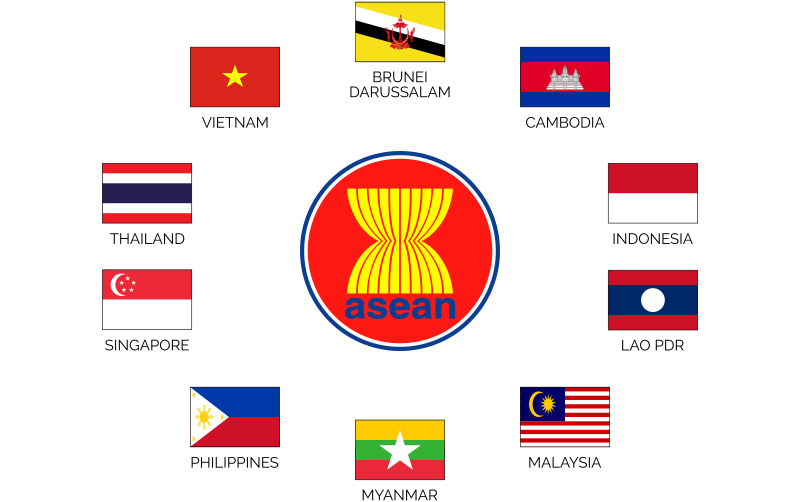
En Noviembre 2007, el Grupo de Trabajo de Transporte Aéreo de la ASEAN presentó un importante plan de política de aviación para la región. Conocido como ASEAN Single Aviation Market (ASAM) o Asean Open Sky Agreement, la política buscaba profundizar la integración entre las naciones de la ASEAN en todos los aspectos del sector de la aviación para 2015, incluidos los servicios aéreos, la seguridad de la aviación y la gestión del tráfico aéreo. La ASAM fue ratificada por los estados miembros de la ASEAN en Abril 2016, pero la implementación sigue siendo lenta. Año tras año, los ministros de transporte de los 10 países miembros se reúnen y firman más acuerdos, pero no logran un progreso significativo.

Mercado libre ASEAN

A través de una mayor competencia, un mercado único de aviación traería vuelos más baratos y mayores opciones de vuelo. Con un conjunto unificado de reglas y una mayor flexibilidad, también sería más fácil para las aerolíneas operar y expandirse dentro de la región de la ASEAN. La ASAM también traería beneficios económicos a las naciones de la ASEAN. El documento titulado Beneficios económicos de la ASEAN individual Aviatio n de mercado , que se estima el impacto de la política sobre el producto interno bruto (PIB) podría oscilar entre US$ 125 millones a US$ 4.32 mil millones para el año 2030.

AW-ASEAN-01.png

La 25ª Reunión de Ministros de Transporte (ATM) de la ASEAN en Noviembre de 2019 celebrado en Vietnam, ha marcado avances donde los ministros de la ASEAN firmaron dos protocolos que reconocen los servicios de simulación de vuelo de cada uno y respaldan los servicios auxiliares. La medida representa un progreso hacia una industria de aviación integrada, pero aún no llega a la inauguración de un mercado único de aviación.

Los protocolos firmados durante el 25º ATM es probable que tome un año o más para entrar en vigor. Un año antes, en el 24º cajero automático, los ministros firmaron el Protocolo 4, que se relaciona con los derechos co-terminales. El documento Asean Transport Instruments and Status of Ratification de julio de 2019 reveló que el protocolo todavía no estaba en vigor. Solo Singapur y Tailandia habían ratificado el protocolo. Existe una tendencia constante de ratificación más lenta en los estados miembros menos desarrollados. Una cadena es tan fuerte como su eslabón más débil. Hasta que el protocolo esté vigente en toda la región, los Estados miembros más rápidos tendrán que esperar.

El futuro de la aviación

ASEAN ha estado dando pequeños pasos para llevar a buen término ASAM. ASAM eliminó y reemplazó los acuerdos anteriores entre los estados miembros. También ha provisiones estandarizadas para crear un conjunto unificado de reglas de aviación en toda la región. El bloque ahora permite a los transportistas operar con mayor facilidad y flexibilidad. También hay acuerdos para hacer cumplir las regulaciones transfronterizas.

ASAM es un objetivo estratégico clave bajo el Plan Estratégico de Transporte de la ASEAN para 2016-2025. Con un mayor énfasis en ASAM y esfuerzos legislativos más rápidos, ASEAN podría reunir un mercado único de aviación. Los gobiernos deben mirar más allá de sus intereses nacionales, específicamente los intereses de sus operadores de bandera, y comenzar a trabajar juntos como una región. Para que la liberalización del espacio aéreo se convierta en una realidad, es necesario trabajar en áreas de apoyo como seguridad, tecnología, recursos humanos y más. La ASEAN tiene que prepararse para tropezar en este largo y arduo proceso. AW-Icon AW001

Image result for ASEANASEAN moves towards the single aviation market

The single aviation market will benefit ASEAN citizens, but it is not happening fast enough

Image result for ASEAN

Image result for ASEANIn November 2007, the ASEAN Air Transport Working Group presented an important aviation policy plan for the region. Known as ASEAN Single Aviation Market (ASAM) or Asean Open Sky Agreement, the policy sought to deepen integration between ASEAN nations in all aspects of the aviation sector by 2015, including air services, aviation security, and Air traffic management. The ASAM was ratified by the ASEAN member states in April 2016, but implementation remains slow. Year after year, the transport ministers of the 10 member countries meet and sign more agreements, but do not make significant progress.
ASEAN free market

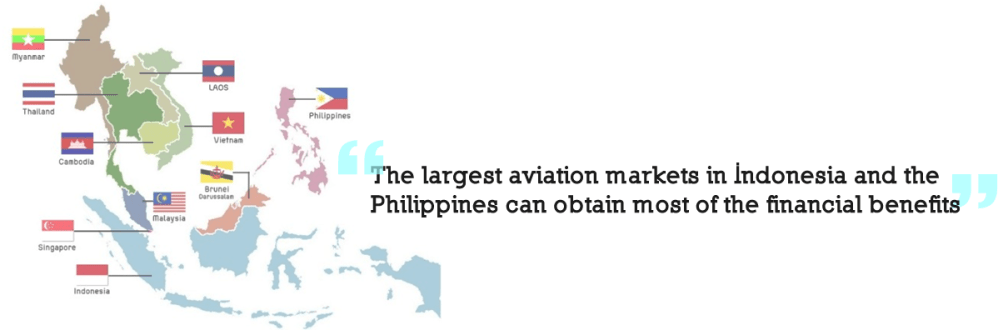
Through increased competition, a single aviation market would bring cheaper flights and greater flight options. With a unified set of rules and greater flexibility, it would also be easier for airlines to operate and expand within the ASEAN region. ASAM would also bring economic benefits to ASEAN nations. The document entitled Economic Benefits of ASEAN Individual Market Aviation, which estimates the impact of the policy on the gross domestic product (GDP) could range from US$ 125 million to US$ 4.32 billion by the year 2030.

AW-ASEAN.png

The 25th ASEAN Transport Ministers Meeting (ATM) in November 2019 held in Vietnam, has marked progress where ASEAN ministers signed two protocols that recognize each other’s flight simulation services and support auxiliary services. The measure represents progress towards an integrated aviation industry but has not yet reached the opening of a single aviation market.

The protocols signed during the 25th ATM are likely to take a year or more to take effect. A year earlier, at the 24th ATM, the ministers signed Protocol 4, which relates to co-terminal rights. The ASEAN Transport Instruments and Status of Ratification document of July 2019 revealed that the protocol was not yet in force. Only Singapore and Thailand had ratified the protocol. There is a constant trend of slower ratification in less developed member states. A chain is as strong as its weakest link. Until the protocol is in force throughout the region, the fastest Member States will have to wait.

The future of aviation

ASEAN has been taking small steps to bring ASAM to fruition. ASAM eliminated and replaced previous agreements between member states. It has also standardized provisions to create a unified set of aviation rules throughout the region. The block now allows carriers to operate more easily and flexibly. There are also agreements to enforce cross-border regulations.

ASAM is a key strategic objective under the ASEAN Strategic Transportation Plan for 2016-2025. With a greater emphasis on ASAM and faster legislative efforts, ASEAN could bring together a single aviation market. Governments must look beyond their national interests, specifically the interests of their flag operators, and start working together as a region. In order for airspace liberalization to become a reality, it is necessary to work in support areas such as security, technology, human resources and more. ASEAN has to prepare to stumble in this long and arduous process. AW-Icon AW002


Ξ A I R G W A Y S Ξ
SOURCE: Airgways.com
DBk: Asean.org / Airgways.com
AW-POST: 201912261620AR

A\W   A I R G W A Y S ®

Reunión Transporte-Gremios

AW-700994.pngAW | 2019 12 21 09:03 | AVIATION ORGANISMS / GOVERNMENT

Resultado de imagen para Ministerio transporte ArgentinaGobierno y gremios dialogaron acerca de políticas del transporte aéreo

El Ministerio de Transporte de Argentina, a cargo de Mario Meoni, se reunió con representantes de gremios aeronáuticos, para conocer en profundidad desde la visión de los trabajadores, la situación del sector. Participaron del encuentro, Ricardo Cirielli, de Asociación del Personal Técnico Aeronáutico, Rubén Fernández de UPSA, Genaro Truco de UALA y representantes de APLA, APA Y ATEPSA.

El Secretario General de APTA, Ricardo Cirielli, puntualizó que “se trató de un encuentro de diálogo, en el que se conversó sobre las políticas de las distintas áreas del transporte aéreo, tuvimos la oportunidad de plantear, al Ministros, diversos problemas del transporte aéreo y sus posibles soluciones”.

Luego de escuchar las preocupaciones de las organizaciones gremiales, Meoni se comprometió a realizar las gestiones necesarias para brindar soluciones a los trabajadores de la empresa Andes Líneas Aéreas.

Otro de los puntos planteados por los gremios fue la necesidad de profesionalización de la actividad. Al respecto, se analizó la posibilidad de formular de manera conjunta un plan para establecer carreras de grado en el ámbito universitario.

El ministro y los representantes gremiales se comprometieron a establecer una agenda de trabajo permanente con las distintas organizaciones, además de generar mesas específicas para cada una de las áreas de la actividad aerocomercial. AW-Icon AW001

Resultado de imagen para reunion transporte gremiosTransportation-Aeronautical Guilds Meeting

Government and unions talked about air transport policies

The Ministry of Transportation of Argentina, in charge of Mario Meoni, met with representatives of aeronautical unions, to learn in-depth from the perspective of the workers, the situation of the sector. Ricardo Cirielli, of the Association of Aeronautical Technical Personnel, Rubén Fernández of UPSA, Genaro Truco of UALA and representatives of APLA, APA, and ATEPSA participated in the meeting.

The Secretary-General of APTA, Ricardo Cirelli, pointed out that “it was a dialogue meeting, in which we talked about the policies of the different areas of air transport, we had the opportunity to raise various air transport problems to the Ministers and its possible solutions”.

After hearing the concerns of the trade organizations, Meoni promised to make the necessary arrangements to provide solutions to the workers of the Andes Líneas Aéreas company.

Another of the points raised by the unions was the need for professionalization of the activity. In this regard, the possibility of jointly formulating a plan to establish degree careers in the university field was analyzed.

The minister and the trade union representatives pledged to establish a permanent work agenda with the different organizations, in addition to generating specific tables for each of the areas of the commercial activity. AW-Icon AW002


Ξ A I R G W A Y S Ξ
SOURCE: Airgways.com
DBk: Agentina.gob.ar/transporte / Airgways.com / Taxnoticias.com.ar
AW-POST: 201912210903AR

A\W   A I R G W A Y S ®

Unificación asociaciones ALA/ACETA

Image result for Aeropuerto Barajas avionesAW | 2019 12 17 12:32 | AVIATION ORGANISMS

Las asociaciones aéreas españolas ALA y ACETA se unifican

Related imageLas Asociación de Compañías Españolas de Transporte Aéreo (ACETA) y la Asociación de Líneas Aéreas (ALA) han aprobado la integración de ambas organizaciones en ALA, con el objetivo de «sumar fuerzas para representar con más determinación los intereses de las aerolíneas que operan en España». La nueva ALA se convierte así en la asociación de referencia del sector aéreo en España y la organización líder por tráfico aéreo en este país, con una cuota de volumen de pasajeros de cerca del 70%, incluyendo nueve de las 10 aerolíneas con más tráfico.

Image result for Asociación de Compañías Españolas de Transporte Aéreo ACETALa suma de las dos asociaciones de referencia en el sector aéreo nacional, que ha sido ratificada este Lunes 16/12 por la Asamblea General de ALA en sesión extraordinaria y se materializará formalmente a partir del 1 Enero 2020, refuerza el peso del sector aéreo en España. Desde ALA destacan que el objetivo es “respaldar, defender y representar los intereses de las compañías aéreas en España de una forma unitaria y para trabajar por y para el sector aéreo, a fin de mejorarlo, fortalecerlo, hacerlo más eficiente, sostenible y competitivo. Esta unión de voces es el resultado de un proceso natural, dado que la mayor parte de los asociados de ACETA también eran miembros de ALA. La nueva asociación incorpora de esta forma a nuevas compañías aéreas que hasta la fecha estaban solamente en ACETA, como Privilege Style, además de otras aerolíneas internacionales que recientemente han decidido asociarse en ALA, como Norwegian y Cathay Pacific”, señala ALA en una declaración.

La nueva ALA

La nueva Asociación de Líneas Aéreas integrará a cerca de 80 compañías aéreas, entre ellas, nueve de las 10 que mueven más tráfico aéreo en España y representa el 70% de vuelos operados en nuestro país. Entre las todas las asociadas cuentan con un volumen de 160 millones de pasajeros en los aeropuertos de la red Aena, cerca del 70% del volumen de pasajeros a fecha de octubre de este año y en conjunto, operan 1,2 millones de despegues y aterrizajes.

Antonio Pimentel, Presidente de ACETA, afirmó que “con este paso, la voz de las compañías aéreas sale reforzada. Se robustece la posición de ALA como representación de la industria en España, así como su posicionamiento respecto a terceros, consagrándose como la organización referente del sector aéreo en España, junto con IATA”.

Javier Gándara, Presidente de ALA, ha coincidido destacando, por su parte, que “con esta integración se aúnan esfuerzos, actuando a partir de ahora como única voz del sector, más sólida y reforzada, para defender con más firmeza los intereses de las compañías aéreas ante la Administración, las instituciones y ante los actores vinculados al sector aéreo de Aena, Enaire. Asimismo, la nueva organización nace para ser el referente del sector ante la opinión pública”.

ALA nació en 1952 integrando a compañías aéreas regulares, tanto nacionales como internacionales, que operaban en España; mientras que ACETA fue fundada en 2004, afianzándose en sus 15 años de actividad como asociación de referencia de las aerolíneas españolas. La suma de ALA y ACETA cubre todos los segmentos de negocio del transporte aéreo en España. Los operadores de la asociación realizan tráfico regular de pasaje, carga y correo, así como aviación internacional, nacional, regional y vuelos chárter. Sus socias operan conectando más de 140 países de todos los continentes (salvo la Antártida), y más de 350 destinos. AW-Icon AW001

Unification associations ALA/ACETA

The Spanish air associations ALA and ACETA are unified

The Association of Spanish Air Transport Companies (ACETA) and the Airline Association (ALA) have approved the integration of both organizations in ALA, with the aim of «joining forces to represent with more determination the interests of the airlines operating in Spain». The new ALA thus becomes the reference association of the air sector in Spain and the leading organization for air traffic in this country, with a passenger volume quota of about 70%, including nine of the 10 airlines with more traffic.

The sum of the two reference associations in the national air sector, which has been ratified on Monday 16/12 by the General Assembly of ALA in extraordinary session and will formally materialize from January 1, 2020, reinforces the weight of the air sector in Spain. From ALA they emphasize that the objective is “to support, defend and represent the interests of the airlines in Spain in a unitary way and to work for and for the air sector, in order to improve it, strengthen it, make it more efficient, sustainable and competitive. This union of voices is the result of a natural process since most of ACETA’s associates were also members of ALA. The new association thus incorporates new airlines that to date were only in ACETA, such as Privilege Style, in addition to other international airlines that have recently decided to partner in ALA, such as Norwegian and Cathay Pacific”, says ALA in a statement.

The new ALA

The new Airline Association will integrate about 80 airlines, including nine of the 10 that move more air traffic in Spain and represents 70% of flights operated in our country. Among all the associates have a volume of 160 million passengers in the airports of the Aena network, about 70% of the volume of passengers as of October this year and together, they operate 1.2 million takeoffs and landings.

Antonio Pimentel, President of ACETA, affirmed that “with this step, the voice of the airlines is reinforced. The position of ALA as a representation of the industry in Spain is strengthened, as well as its position with respect to third parties, becoming the leading organization of the air sector in Spain, together with IATA”.

Javier Gándara, President of ALA, has agreed highlighting, on the other hand, that “with this integration efforts are joined, acting as of now as the only voice in the sector, more solid and reinforced, to defend more firmly the interests of the companies aerial before the Administration, the institutions and before the actors linked to the air sector of Aena, Enaire. Likewise, the new organization was born to be the benchmark of the sector before public opinion”.

ALA was born in 1952 integrating regular airlines, both national and international, that operated in Spain; while ACETA was founded in 2004, consolidating in its 15 years of activity as a reference association of Spanish airlines. The sum of ALA and ACETA covers all air transport business segments in Spain. The association’s operators carry out regular passenger, cargo and mail traffic, as well as international, national, regional and charter flights. Its partners operate by connecting more than 140 countries on all continents (except Antarctica), and more than 350 destinations. AW-Icon AW002


Ξ A I R G W A Y S Ξ
SOURCE: Airgways.com
DBk: Alaspain.com / Aceta.es / Abc.es
AW-POST: 201912171232AR

A\W   A I R G W A Y S ®

Paranair aprueba auditoría de la IATA

Image result for paranairAW | 2019 12 13 08:13 | AIRLINES / AAVIATION ORGANISMS

Related imageLa nueva aerolínea paraguaya apueba Audioría IOSA

Paranair, la compañía aérea paraguaya, ha apobado de forma satisfactoria la evaluación del Programa de Auditoría de Seguridad Operacional (IOSA) de la IATA, diseñada para calificar la gestión operativa y los sistemas de control de una aerolínea.

Image result for iataEl Lunes 9 Diciembre 2019, Paranair recibió la aprobación en la reconocida y estricta Auditoría de Seguridad Operacional (IOSA) de la Asociación Internacional de Transporte Aéreo (IATA), cuyos rigurosos estándares se han desarrollado en colaboración con varios especialistas en la materia para evaluar la gestión operativa y los sistemas de control de las aerolíneas en diferentes áreas. En concreto, la compañía paraguaya obtuvo una certificación válida por dos años que se extenderá hasta el 10 Mayo 2021 y luego será sometida a una nueva evaluación, según lo establecido por el organismo.

Todos los miembros de IATA están registrados en IOSA, las líneas aéreas deben aprobar satisfactoriamente las auditorías correspondientes ya que constituyen un requisito fundamental para mantener la membrecía. El programa fue creado en 2003 y desde entonces las normas son continuamente actualizadas por profesionales especializados de la IATA y otros gremios internacionales y aerolíneas, junto con agencias gubernamentales de diversos países como la Administración Federal de Aviación (FAA) de los Estados Unidos. Entre los requisitos evaluados por el ente destacan la organización y gestión corporativa, operación de las aeronaves, despacho de vuelo, ingeniería y mantenimiento, operaciones en cabina y de carga, servicio de atención a vuelos y aspectos y actividades en torno a la seguridad operacional.

Actualmente, Paranair cuenta con una flota de cuatro aeronaves Bombardier CRJ-200 que operan desde Asunción a Ciudad del Este, Buenos Aires, Montevideo, Iquique, Curitiba, Brasilia, ofreciendo además vuelos de temporada hacia los principales destinos veraniegos de la región: Punta del Este en Uruguay y Florianópolis y Río de Janeiro en Brasil. AW-Icon AW001

Paranair approves IATA audit

The new Paraguayan airline approves Audioría IOSA

Paranair, the Paraguayan airline, has successfully endorsed the evaluation of the IATA Safety Audit Program (IOSA), designed to qualify the operational management and control systems of an airline.

On Monday, December 9, 2019, Paranair received approval in the recognized and strict Operational Safety Audit (IOSA) of the International Air Transport Association (IATA), whose rigorous standards have been developed in collaboration with several specialists in the field to evaluate the Operational management and control systems of airlines in different areas. Specifically, the Paraguayan company obtained a certification valid for two years that will last until May 10, 2021, and will then be submitted to a new evaluation, as established by the agency.

All IATA members are registered with IOSA, the airlines must satisfactorily approve the corresponding audits as they constitute a fundamental requirement to maintain membership. The program was created in 2003 and since then the standards are continuously updated by specialized professionals from IATA and other international unions and airlines, along with government agencies from various countries such as the Federal Aviation Administration (FAA) of the United States. Among the requirements evaluated by the entity are the organization and corporate management, aircraft operation, flight dispatch, engineering and maintenance, cabin and cargo operations, flight service and aspects and activities related to safety.

Currently, Paranair has a fleet of four Bombardier CRJ-200 aircraft operating from Asunción to Ciudad del Este, Buenos Aires, Montevideo, Iquique, Curitiba, Brasilia, also offering seasonal flights to the main summer destinations in the region: Punta del East in Uruguay and Florianopolis and Rio de Janeiro in Brazil. AW-Icon AW002


Ξ A I R G W A Y S Ξ
SOURCE: Airgways.com
DBk: Paranair.com / Iata.org
AW-POST: 201912130813AR

A\W   A I R G W A Y S ®

CE Lista Seguridad Aérea 2019

Resultado de imagen para Commission European air safetyAW | 2019 12 12 12:23 | AVIATION ORGANISMS / AVIATION SAFETY

Imagen relacionadaLa Comisión Euopea adopta una nueva Lista de Seguridad Aérea para la Unión Euopea

La Comisión Europea (CE) ha actualizado la Lista de seguridad aérea para la Unión Europea, ajustando la lista de aerolíneas que no cumplen con los estándares internacionales de seguridad y, por lo tanto, están sujetas a una prohibición operativa o restricciones operativas dentro de la Unión Europea. La Lista de Seguridad Aérea de la Comunidad Europea busca garantizar el más alto nivel de seguridad aérea para los europeos y todos los demás pasajeros que viajan en la Unión Europea.

La Lista de seguridad aérea de la Unión Europea no solo ayuda a mantener altos niveles de seguridad en la comunidad, sino que también ayuda a las aerolíneas y países afectados a mejorar sus niveles de seguridad, para que finalmente sean eliminados de la lista. Además, la Lista de seguridad aérea de la UE se ha convertido en una herramienta preventiva importante, ya que motiva a los países con problemas de seguridad a actuar sobre ellos antes de que sea necesaria una prohibición en virtud de la Lista de seguridad aérea de la UE.

Lista CE

La República de Gabón ha salido de la lista negra de países con problemas de seguridad operativa, donde todas las aerolíneas certificadas en Gabón han sido eliminadas de la lista luego de las mejoras en la situación de seguridad de la aviación en ese país. La comisionada de Transporte, Adina Vălean, dijo: “La decisión de hoy ilustra nuestros continuos esfuerzos para ofrecer el más alto nivel de seguridad. No solo para los viajeros europeos, sino también para los viajeros de todo el mundo, porque la seguridad de la aviación no conoce fronteras ni nacionalidades. Me complace anunciar que la Comisión Europea pudo hoy eliminar a todas las compañías aéreas de Gabón de la Lista de Seguridad Aérea de la Unión Europea. Gabón ya estaba en la Lista desde 2008, por lo que es muy bueno que podamos reconocer los esfuerzos que han realizado las autoridades de seguridad de la aviación en Gabón».

Sin embargo, el Comité de Aviación Civil de Armenia ha sido sometido a un escrutinio intensivo debido a los signos de una disminución en la supervisión de la seguridad.

Tras la actualización 2019 [¹], un total de 115 aerolíneas están prohibidas en los cielos de la UE: 109 aerolíneas certificadas en 15 estados, debido a la falta de supervisión de seguridad por parte de las autoridades de aviación de estos estados. Seis aerolíneas individuales, basadas en preocupaciones de seguridad con respecto a estas aerolíneas: Avior Airlines (Venezuela), Iran Aseman Airlines (Irán), Iraqi Airways (Iraq), Blue Wing Airlines (Surinam), Med-View Airlines (Nigeria) y Air Zimbabwe (Zimbabwe).

Otras tres aerolíneas están sujetas a restricciones operativas y solo pueden volar a la UE con tipos de aeronaves específicos: Air Koryo (República Popular Democrática de Corea), Air Service Comores (las Comoras) e Iran Air (Irán).

Comité Seguridad Aérea UE (ASC)

La actualización de la Lista de seguridad aérea se basa en la opinión unánime de los expertos en seguridad de la aviación de los Estados miembros que se reunieron del 20 al 21 de noviembre de 2019 bajo los auspicios del Comité de Seguridad Aérea de la UE (ASC). Este Comité está presidido por la Comisión Europea con el apoyo de la Agencia de Seguridad Aérea de la Unión Europea (EASA). La actualización también recibió el apoyo de la Comisión de Transportes del Parlamento Europeo. La evaluación se realiza en relación con las normas internacionales de seguridad, y en particular las normas promulgadas por la Organización de Aviación Civil Internacional (OACI).

La Comisión está buscando constantemente formas de mejorar la seguridad de la aviación, especialmente a través de esfuerzos de colaboración con las autoridades de aviación de todo el mundo para elevar los estándares de seguridad global. Con esto en mente, la Comisión, a través de EASA, implementará dos proyectos de cooperación en el transcurso de 2020 para ayudar a Angola y Mozambique a mejorar aún más sus sistemas de vigilancia de la seguridad.

DATA: [¹] Afganistán, Angola (con la excepción de 2 aerolíneas), República del Congo, República Democrática del Congo, Yibuti, Guinea Ecuatorial, Eritrea, República Kirguisa, Liberia, Libia, Moldavia (con la excepción de 3 aerolíneas), Nepal, Santo Tomé y Príncipe, Sierra Leona y Sudán. AW-Icon AW001

Resultado de imagen para Commission European air safetyCE Air Safety List 2019

The Europea Commission adopts a new Air Safety List for the Europea Union

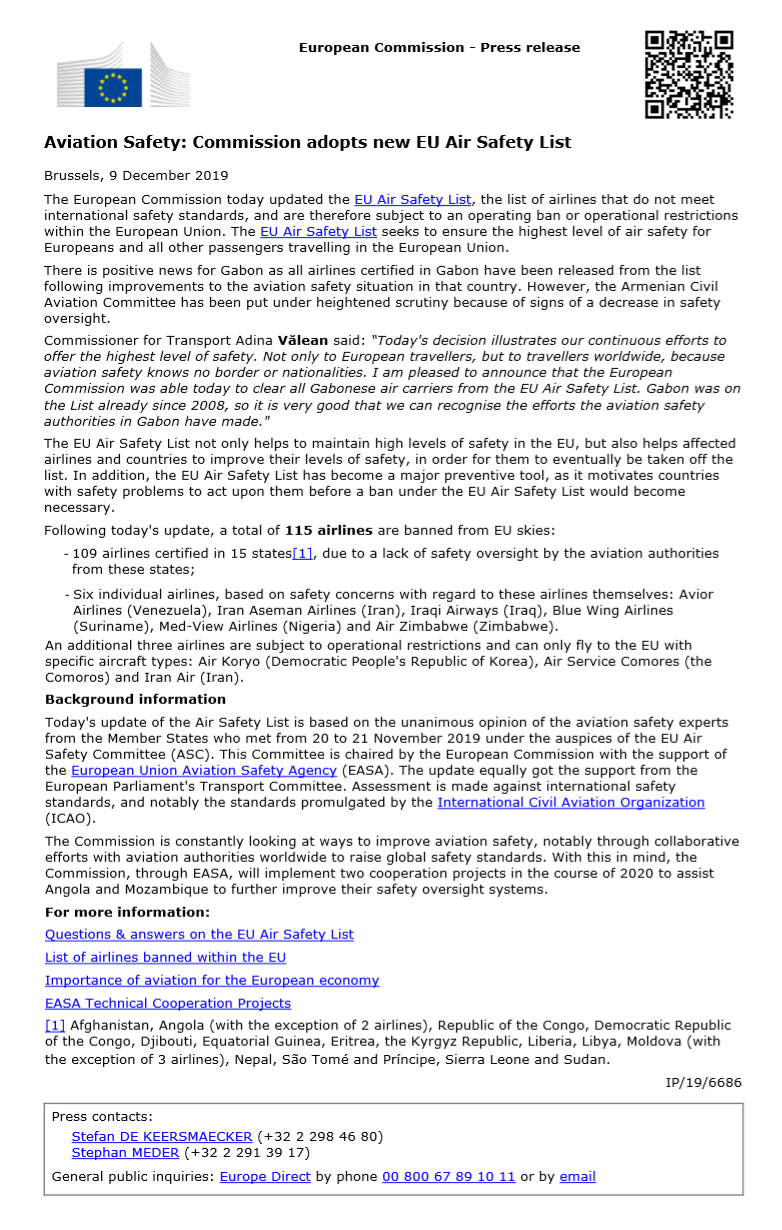
The European Commission (EC) has updated the Air Safety List for the European Union, adjusting the list of airlines that do not meet international safety standards and, therefore, are subject to an operational ban or operational restrictions within the European Union. The European Community Air Safety List seeks to guarantee the highest level of air safety for Europeans and all other passengers traveling in the European Union.

List of air safety in the European Union not only helps maintain high levels of safety in the community, but also helps airlines and countries concerned to improve their security levels, so they are finally removed from the list. In addition, the EU Air Safety List has become an important preventive tool, as it motivates countries with safety problems to act on them before a ban is required under the Air Safety List of the EU.

EC list

The Republic of Gabon has left the blacklist of countries with operational security problems, where all airlines certified in Gabon have been removed from the list after improvements in the aviation security situation in that country. Transportation Commissioner Adina Vălean said: “Today’s decision illustrates our continued efforts to offer the highest level of security. Not only for European travelers but also for travelers around the world, because aviation security knows no borders or nationalities. I am pleased to announce that the European Commission was able today to eliminate all of Gabon’s airlines from the European Union’s Air Safety List. Gabon was already on the List since 2008, so it is very good that we can recognize the efforts made by the aviation security authorities in Gabon».

However, the Civil Aviation Committee of Armenia has undergone intensive scrutiny due to the signs of a decrease in security oversight.

Following the 2019 update [¹], a total of 115 airlines are banned in the skies of the EU: 109 airlines certified in 15 states, due to the lack of security supervision by the aviation authorities of these states. Six individual airlines, based on safety concerns regarding these airlines: Avior Airlines (Venezuela), Iran Aseman Airlines (Iran), Iraqi Airways (Iraq), Blue Wing Airlines (Suriname), Med-View Airlines (Nigeria) and Air Zimbabwe (Zimbabwe).

Three other airlines are subject to operational restrictions and can only fly to the EU with specific types of aircraft: Air Koryo (Democratic People’s Republic of Korea), Air Service Comoros (Comoros) and Iran Air (Iran).

EU Air Safety Committee (ASC)

The update of the Air Safety List is based on the unanimous opinion of the aviation security experts of the Member States that met from November 20 to 21, 2019 under the auspices of the EU Air Safety Committee (ASC ). This Committee is chaired by the European Commission with the support of the European Union Air Safety Agency (EASA). The update was also supported by the European Parliament Transport Commission. The evaluation is carried out in relation to international safety standards, and in particular, the standards promulgated by the International Civil Aviation Organization (ICAO).

The Commission is constantly looking for ways to improve aviation security, especially through collaborative efforts with aviation authorities around the world to raise global security standards. With this in mind, the Commission, through EASA, will implement two cooperation projects in the course of 2020 to help Angola and Mozambique further improve their security surveillance systems.

DATA: [1] Afghanistan, Angola (with the exception of 2 airlines), Republic of the Congo, Democratic Republic of the Congo, Djibouti, Equatorial Guinea, Eritrea, Kyrgyz Republic, Liberia, Libya, Moldova (with the exception of 3 airlines), Nepal, Sao Tome and Principe, Sierra Leone, and Sudan.

AW-EU-Air_Safety_2019.png

arrow-logo

Aviation_Safety__Commission_adopts_new__EU_Air_Safety_List


Ξ A I R G W A Y S Ξ
SOURCE: Airgways.com
DBk: Ec.europa.eu/commission / Aviationvoice.com / Airgways.com
AW-POST: 2019121223AR

A\W   A I R G W A Y S ®

Senado exige FAA estudio asientos

Resultado de imagen para Boeing 737 seatAW | 2019 12 09 07:50 | AVIAITION SAFETY / AVIATION ORGANISMS

Senado Estados Unidos exige FAA estudio configuración asientos

20150215-logo-faa_1.jpgEl Senado de Estados Unidos, por medio del estadounidense Chuck Schumer quiere que los cielos sean un poco más amigables con las piernas. Schumer exige estudio entrante de la Federal Aviation Administration (FAA) para pedir más espacio para las piernas de los pasajeros en las aweronaves comerciales.

El senador principal de Nueva York está pidiendo a la Administración Federal de Aviación que concluya su estudio sobre el espacio para las piernas de la aerolínea vencida, diciendo que mientras tanto las aerolíneas comerciales están empacando a los pasajeros en asientos cada vez más pequeños. «Una de las mayores quejas que tengo en general, y la mayor queja que tengo sobre volar, es que hay muy poco espacio para las piernas y tan poco ancho de asiento. Las aerolíneas están empujando a las personas hacia los aviones como una lata de sardinas», ha expresado Schumer. El Senador Demócrata planteó el problema el año pasado, citando una tendencia de la industria que ha visto reducirse los asientos de los aviones, de 18.5 pulgadas de ancho a 17 pulgadas, en la última década, al tiempo que redujo el espacio para las piernas de 35 pulgadas a 31 pulgadas. Schumer supervisó la inclusión de una disposición en la Ley de Reautorización de la FAA de 2018 que pedía a la agencia que emitiera un informe sobre el dilema de los asientos reducidos para el 9 Octubre 2019 de este año, una fecha límite que vino y se fue sin un informe.

El senador dijo que recientemente envió una carta enviada al administrador de la FAA, Steven Dickson, pidiéndole a la agencia que «tome medidas rápidamente para rectificar las pruebas en curso y emitir regulaciones lo antes posible». Schumer agregó que, por lo que sabe, la investigación que la agencia federal de aviación ha realizado hasta ahora sobre la comodidad de los asientos se ha quedado corta al no tener en cuenta el espacio para mascotas, niños, discapacitados y viajeros de edad avanzada. Por ejemplo, dijo, las pruebas realizadas hasta ahora solo han utilizado adultos entre 18 y 60 años. «Estoy preocupado porque el enfoque parece demasiado estrecho. Creo que es casi una plataforma apilada contra el consumidor volador. En realidad, lo único peor que la reducción gradual de los asientos de los aviones es la reducción aparente del estudio para ayudar a combatirlos en primer lugar».

El portavoz de la FAA, Jim Peters, ha expresado el Domingo 08/12 que el estudio se está llevando a cabo en una agencia en Oklahoma. «Más de 700 participantes están siendo reclutados del área de Oklahoma City y representarían a hombres y mujeres de 18 a 60 años. Cada grupo de edad (por década) estará equitativamente representado. Para fines de este año, la FAA planea concluir las pruebas de evacuación para determinar qué cambios regulatorios son necesarios, si los hay». AW-Icon AW001

Imagen relacionadaSenate demands FAA study configuration seats

Resultado de imagen para senate US logoUnited States Senate demands FAA study configuration seats

The United States Senate, through the American Chuck Schumer wants the skies to be a little more leg-friendly. Schumer demands an incoming Federal Aviation Administration (FAA) study to ask for more space for passengers’ legs in commercial aircraft.

20150215-logo-faa_1.jpgThe main New York senator is asking the Federal Aviation Administration to conclude his study on the legroom of the expired airline, saying that in the meantime commercial airlines are packing passengers in smaller and smaller seats. «One of the biggest complaints I have in general, and the biggest complaint I have about flying, is that there is very little legroom and so little seat width. The airlines are pushing people towards planes like a can of sardines», said Schumer. The Democratic Senator raised the problem last year, citing an industry trend that has seen aircraft seats reduced, from 18.5 inches wide to 17 inches, in the last decade, while reducing legroom for 35 inches to 31 inches. Schumer oversaw the inclusion of a provision in the FAA Reauthorization Act of 2018 asking the agency to issue a report on the reduced seat dilemma for October 9, 2019, of this year, a deadline that came and went without a report.

The senator said he recently sent a letter sent to the FAA administrator, Steven Dickson, asking the agency to «take quick action to rectify the ongoing tests and issue regulations as soon as possible». Schumer added that, as far as he knows, the investigation that the federal aviation agency has done so far on the comfort of the seats has fallen short of not taking into account the space for pets, children, disabled people, and elderly travelers. For example, he said, tests done so far have only used adults between 18 and 60 years. «I am worried because the approach seems too narrow. I think it is almost a platform stacked against the flying consumer. Actually, the only thing worse than the gradual reduction of aircraft seats is the apparent reduction of the study to help combat them in the first place».

FAA spokesman Jim Peters said on Sunday 08/12 that the study is being conducted at an agency in Oklahoma. «More than 700 participants are being recruited from the Oklahoma City area and would represent men and women aged 18 to 60. Each age group (per decade) will be equally represented. By the end of this year, the FAA plans to complete the testing of evacuation to determine what regulatory changes are necessary if any». AW-Icon AW002


Ξ A I R G W A Y S Ξ
SOURCE: Airgways.com
DBk: Senate.gov / Nypost.com / Airgways.com
AW-POST: 201912090750AR

A\W   A I R G W A Y S ®

Cancelan paro de ANAC Argentina

Resultado de imagen para anac argentinaAW | 2019 11 29 12:39 | AVIATION ORGANISMS

Resultado de imagen para anac argentinaSe levantó el paro de operaciones de la ANAC proyectado para 29/11 en los aeropuertos de Argentina

La medida de fuerza anunciada para este Viernes 29/11 por los operarios que realizan el Control en Tierra de las aeronaves quedó momentáneamente sin efecto. Los trabajadores de la Administración Nacional de Aviación Civil (ANAC) habían anunciado para este Viernes 29/11 la realización de un paro que afectaba las operaciones en más de 20 aeropuertos del país. “Se puede generar el colapso de los aeropuertos. Tuvimos una charla con el secretario de Trabajo, Lucas Aparicio, y dejamos en cuarto intermedio la medida de fuerza. Nos convocaron a una audiencia para el día martes en la Secretaría de Modernización que es la que tiene el conflicto en este momento”, llegó a advertir Marcelo Belelli, Secretario General de la Asociación de Trabajadores del Estado (ATE). Sin embargo, pasado el mediodía del 28/11, una reunión en la que se dejó la medida sin efecto. Desde ANAC también confirmaron los términos que se acordaron en esa reunión. De todos modos, habrá asambleas durante el viernes, aunque se espera que no afecten el normal desarrollo de la actividad en los aeropuertos.

El conflicto

Marcelo Belelli explicó que la protesta se produce ante una frustrada negociación salarial con las autoridades de la ANAC Argentina y ante el ajuste y el achiquede la estructura del organismo. Los trabajadores de ATE en ANAC aseguraron que la medida de fuerza iba a contar con la adhesión del personal que presta servicios auxiliares para el control terrestre y las tareas de sanidad, entre otras.

La disputa de los gremialistas entró en instancia de conciliación obligatoria el pasado 10 Septiembre 2019 pero, según dijo Belelli, todavía no hubo avances positivos en sus reclamos para poner en marcha un plan de reencasillamiento que traía aparejada la mejora salarial de más de 150 compañeros en todo el país.

El pasado 11 Noviembre 2019, más de 125 vuelos cancelados de Aerolíneas Argentinas y Austral Líneas Aéreas, tanto en el Aeropueerto Jorge Newbery como del Aeropuerto Internacional Ezeiza, y alrededor de 15.000 pasajeros afectados fue el saldo de un conflicto entre los afiliados a la Asociación del Personal Técnico Aeronáutico (APTA) y la empresa por la ausencia de un operador especializado para el despacho de los servicios. AW-Icon AW001

Resultado de imagen para aeroparqueStop ANAC Argentina’s unemployment

The ANAC operations stop projected for 29/11 at Argentina airports was lifted

The measure of force announced for this Friday 29/11 by the operators that carry out the Ground Control of the aircraft was momentary without effect. The workers of the National Civil Aviation Administration (ANAC) had announced for Friday 29/11 the realization of a strike that affected operations in more than 20 airports in the country. “It can generate the collapse of airports. We had a talk with the Secretary of Labor, Lucas Aparicio, and we left the measure of strength in the middle room. We were summoned to an audience for Tuesday at the Ministry of Modernization, which is the one with the conflict at this time”, Marcelo Belelli, Secretary-General of the Association of State Workers (ATE), warned. However, after noon on 11/28, a meeting in which the measure was left without effect. The ANAC also confirmed the terms agreed at that meeting. Anyway, there will be assemblies during Friday, although it is expected that they will not affect the normal development of the activity in the airports.

The conflict

Marcelo Belelli explained that the protest occurs in the face of frustrated salary negotiation with the authorities of the ANAC Argentina and the adjustment and reduction of the structure of the organization. The workers of ATE in ANAC assured that the measure of force was going to count on the adhesion of the personnel that provides auxiliary services for the terrestrial control and the sanitation tasks, among others.

The trade unionists’ dispute entered into an obligatory conciliation instance on September 10, 2019, but, according to Belelli, there were still no positive advances in their claims to implement a re-typesetting plan that resulted in the salary improvement of more than 150 colleagues in the whole country.

On November 11, 2019, more than 125 flights canceled from Aerolíneas Argentinas and Austral Líneas Aéreas, both at the Jorge Newbery Airport and the Ezeiza International Airport, and around 15,000 affected passengers resulted in a conflict between the affiliates of the Association of the Aeronautical Technical Personnel (APTA) and the company due to the absence of a specialized operator for the dispatch of services. AW-Icon AW002


Ξ A I R G W A Y S Ξ
SOURCE: Airgways.com
DBk: Anav.gov.ar / Hosteltur.com / Airgways.com
AW-POST: 201911291239AR

A\W   A I R G W A Y S ®

FAA ordena inspecciones en A320NEO

AW-Airbus_A320neo_Airbus_detail_engineW.jpgAW | 2019 11 28 23:28 | AVIATION SAFETY / AVIATION ORGANISMS

Logo_Airbus_2014.svg - copia.pngFAA ordena reemplazo de pala de turbina de baja presión PW1100Gaw-70099433-1.jpg

El regulador de seguridad de Estados Unidos, la Federal Aviation Administration (FAA) ha ordenado a las aerolíneas que reemplacen las palas de la turbina de baja presión (LPT) en algunos motores Pratt & Whitney PW1100G de la flota de aronaves Airbus A320NEO en tan solo 90 días, según una nueva Directiva de Aeronavegabilidad (AD). La directiva responde a más de 40 fallas de las cuchillas en los PW1100G, que alimentan a los aviones de la familia Airbus A320NEO (New Engine Option) desde 2017. Tales fallas han provocado la acción reguladora de otras agencias, incluida la Autoridad de Aviación Civil de la India (DGCA).

La FAA emitió la orden en respuesta a «múltiples informes de fallas de cuchillas de tercera etapa LPT que causan una reducción del empuje del motor», dice la directiva, hecha pública el 27 Noviembre 2019. «Esta condición, si no se aborda, podría ocasionar la falla de las cuchillas de la tercera etapa LPT, la falla de uno o más motores, la pérdida del control de empuje y la pérdida del avión», indica el informe. La FAA dice que ninguna aerolínea de Estados Unidos ha sido afectado los motores n cuestión y P&W se niega a revelar la cantidad de motores afectados en todo el mundo.

Tendencia fiscalizadora

Los incidentes en los motores Pratt & Whitney PW1100G probable que genere órdenes similares de reguladores en otros países. La orden de la FAA requerirá que las aerolíneas reemplacen las cuchillas afectadas en algunos motores dentro de 90, 180, 270 o 360 días, dependiendo del número de serie del motor.

«Pratt & Whitney está trabajando en coordinación con los clientes de nuestra aerolínea para incorporar mejoras en la turbina de baja presión en la flota PW1100G-JM para abordar un problema conocido. Estas actualizaciones ya están certificadas y se incorporan a todos los motores de nueva producción. Estamos comprometidos a apoyar a nuestros clientes para garantizar una interrupción mínima durante la actualización de la flota».

La directiva de la FAA dice que la agencia recibió informes de 41 fallas que involucran palas de tercera etapa de turbina de baja presión PW1100G desde 2017. «Estas fallas parecen ser causadas por daños por impacto que ocurren cuando los escombros pasan a través del motor. El fabricante determinó la necesidad de reemplazar cualquier aspa [de turbina de baja presión] afectada con aspas hechas de un material diferente que sea más resistente al daño por impacto». La FAA fija el costo de los reemplazos de cuchillas en US$ 785.000 por motor.

Anteriormente tenía la intención de abordar el problema al exigir a las aerolíneas que reemplazaran las cuchillas afectadas en la próxima visita al MRO, pero fallas adicionales llevaron a la FAA a establecer una nueva línea de tiempo más estricta.

Directivas de la India

Las autoridades indias, Directorate General of Civil Aviation (DGCA), habían ordenado previamente que las aerolíneas de ese país se aseguraran de que todos los PW1100G en sus A320NEO hubieran modificado las turbinas de baja presión de la tercera etapa para fines de Enero 2020.

Según una directiva reciente emitida por la Dirección General de Aviación Civil (DGCA), la aerolínea de bajo costo de la India, Indigo tiene que aterrizar los A320NEO con motor Pratt and Whitney PW1100G. La aerolínea deberá recurrir a talleres de mantenimiento calificados para el reemplazo de piezas. Esto se debe principalmente a que el organismo regulador de la aviación no está satisfecho con los esfuerzos de la aerolínea para alterar el motor PW. Indigo dijo en un comunicado oficial: “El horario actual permanece intacto. Estamos trabajando con PW y Airbus para ajustar la entrada de motores modificados LPT 3 para cumplir con las pautas DGCA».

DGCA le ha dado a Indigo plazo hasta Enero de 2020 para reemplazar los motores defectuosos de todos los aviones identificados. Si Indigo no cumple con la fecha límite, una gran parte de su flota quedaría en tierra. En 2018, DGCA aterrizó alrededor de 14 aviones A320NEO de la flota de Indigo y Go Air, los únicos dos transportistas indios que operan motores PW1100G. Se han celebrado reuniones de revisión constante entre el Ministerio de Aviación Civil, Indigo, Go Air, Airbus y Pratt and Whitney para discutir los problemas técnicos frecuentes con los aviones que usan motores PW1100G, desde 2016. AW-Icon AW001

Resultado de imagen para Airbus A320neo PW1100GFAA orders inspections at A320NEO

414-4149345_7-min-a320-neo-png.pngFAA orders replacement of low-pressure turbine blade PW1100G

The US security regulator, the Federal Aviation Administration (FAA) has ordered airlines to replace the low-pressure turbine (LPT) blades on some Pratt & Whitney PW1100G engines of the Airbus A320NEO fleet of aircraft in just 90 days, according to a new Airworthiness Directive (AD). The directive responds to more than 40 blade failures in the PW1100G, which feed the Airbus A320NEO (New Engine Option) family aircraft since 2017. Such failures have led to regulatory action by other agencies, including the Civil Aviation Authority from India (DGCA).

The FAA issued the order in response to «multiple reports of LPT third-stage blade failures that cause a reduction in engine thrust», says the directive, released on November 27, 2019. «This condition, if not addressed, could cause the failure of the blades of the third stage LPT, the failure of one or more engines, the loss of thrust control and the loss of the aircraft», says the report. The FAA says that no US airline has been affected by the engines in question and P&W refuses to reveal the number of engines affected worldwide.

Supervisory Trend

Pratt & Whitney PW1100G engine incidents are likely to generate similar orders from regulators in other countries. The FAA order will require airlines to replace the affected blades on some engines within 90, 180, 270 or 360 days, depending on the engine’s serial number.

«Pratt & Whitney is working in coordination with our airline customers to incorporate improvements in the low-pressure turbine in the PW1100G-JM fleet to address a known problem. These updates are already certified and are incorporated into all new production engines. We are committed to supporting our customers to ensure a minimum interruption during the fleet update».

The FAA directive says the agency has received reports of 41 failures involving third-stage PW1100G low-pressure turbine blades since 2017. «These failures appear to be caused by impact damage that occurs when debris passes through the engine. The manufacturer determined the need to replace any affected [low-pressure turbine] blade with blades made of a different material that is more resistant to impact damage». The FAA sets the cost of blade replacements at US$ 785,000 per engine.

He previously intended to address the problem by requiring airlines to replace the affected blades on the next visit to the MRO, but additional failures led the FAA to establish a new, more stringent timeline.

Indian directives

The Indian authorities, Directorate General of Civil Aviation (DGCA), had previously ordered that the airlines of that country ensure that all PW1100Gs in their A320NEO had modified the low-pressure turbines of the third stage by the end of January 2020.

According to a recent directive issued by the Directorate General of Civil Aviation (DGCA), the low-cost airline of India, Indigo has to land the A320NEO with Pratt and Whitney PW1100G engine. The airline must resort to qualified maintenance workshops for the replacement of parts. This is mainly due to the fact that the aviation regulatory body is not satisfied with the efforts of the airline to alter the PW engine. Indigo said in an official statement: “The current schedule remains intact. We are working with PW and Airbus to adjust the input of modified LPT 3 engines to meet DGCA guidelines».

DGCA has given Indigo a term until January 2020 to replace the defective engines of all identified aircraft. If Indigo does not meet the deadline, a large part of its fleet would be grounded. In 2018, DGCA landed around 14 A320NEO aircraft from the Indigo and Go Air fleet, the only two Indian carriers that operate PW1100G engines. Constant review meetings have been held between the Ministry of Civil Aviation, Indigo, Go Air, Airbus and Pratt and Whitney to discuss frequent technical problems with aircraft using PW1100G engines, since 2016. AW-Icon AW002


Ξ A I R G W A Y S Ξ
SOURCE: Airgways.com
DBk: Faa.gov / Dgca.nic.in / Airbus.com / Utc.pw.com / Flightglobal.com / Airgways.com
AW-POST: 201911282328AR

A\W   A I R G W A Y S ®

Creación Sindicato para JetSmart

AW-7000J500.jpgAW | 2019 11 28 15:35 | AIRLINES / AVIATION ORGANISMS

JetSMART-16-9.pngEl Gobierno aprueba la sindicatura para empleados de JetSmart Argentina

A través de la Resolución 1325/2019, publicada en el Boletín Oficial, el Ministerio de Producción y Trabajo de Argentina oficializó la inscripción de la Asociación Sindical de Trabajadores de Jetsmart Airlines Argentina, que agrupa a los empleados de la empresa creada por un fondo de inversión estadounidense.

El Gobierno de Argentina oficializó la creación del tercer sindicato de trabajadores de una línea aérea low cost, JetSmart Airlines Argentina, permitiendo a los empleados de la línea aérea low cost con base en el Aeropuerto Internacional El Palomar tener la entidad que nuclee los servicios y reclamos correspondientes. A comienzos de 2019 se había creado la Asociación Sindical de Trabajadores de Flybondi Líneas Aéreas y un mes más tarde, la Unión de Empleados de Norwegian (UNEN).

Los sindicatos tradicionales del sector aeronáuticos aseguran que estas empresas no respetan los derechos adquiridos y flexibilizan las condiciones de trabajo.

Nuevos vientos polícitos

Las compañías aéreas atraviezan dificultades por la devaluación y por la crisis económica generalizada, pero al mismo tiempo esperan conocer detalles de cómo será la política para el sector del nuevo Gobierno que se inicia en Diciembre 2019. En el caso de las low cost, son los gobernadores los que hacen lobby ante Alberto Fernández para que siga el formato que permitió ganar conectividad y que generó alrededor de 2.500 empleos directos. En cambio, los sindicatos tradicionales apuntan a que ese segmento se achique.

El regreso de las bandas tarifarias que impiden vender pasajes por debajo de esos precios es una posibilidad que impactaría en las ventas de las líneas de bajo costo. Los gobernadores, que en su mayoría les han dado ventajas impositivas o compra de pasajes para garantizar un piso de ocupación, las defienden porque generaron más turismo durante todo el año en sus provincias.

Mercado doméstico

La Asociación de Transporte Aéreo de América Latina y el Caribe (ALTA), ha comunicado que este año se registrará el nivel de ganancias más bajo de los últimos cinco en la región. En promedio, a las empresas les quedarán unos 50 centavos de dólar por pasajero. Para las compañías que operan en la Argentina la situación es más complicada porque, en general, el retorno de inversión está por debajo del 4%, que es el promedio.

En el mercado de cabotaje, en los últimos dos años, por la devaluación, los costos subieron hasta el 70% del global está dolarizado y las empresas que desembarcaron en Argentina como Flybondi Líneas Aéreas, Norwegian Air Argentina, JetSmart Airlines Argentina vienen demorando su plan de incorporación de aviones. En Latam Airlines Argentina ha tenido que efectuar una reestructuración para sobrevivir. En el caso de Avianca (Avian Líneas Aéreas) que ha entrado en concurso de acreedores, las esperanzas para reanudar sus operaciones son prácticamente nulas. Andes Líneas Aéreas enfrenta problemas financieros aunque existe voluntad de continuar dando batalla.

El Consultor Aeronáutico Franco Rinaldi explica que, a nivel mundial, la rentabilidad del sector es muy baja: en promedio, de entre 4% y 5%. Hubo un decenio dorado, con un retorno de cerca del 7%, pero se acabó. En 2018, según datos de la cámara de líneas aéreas privadas que operan mercado doméstico, cerró con pérdidas por US$ 130 millones. La cifra no incluye el rojo del grupo Aerolíneas Argentinas/Austral, que el año pasado fue de US$ 21.800 millones, un 18% adicional, descontada la inflación de 2017.

Pedro Heilbron, titular del Comité Ejecutivo de ATA y CEO de Copa Airlines, aerolínea panameña, admite que aunque el sector lleva 15 años de crecimiento continuo, «las ganancias se vienen achicando y la rentabilidad se evapora por la suba sostenida de costos. Los 50 centavos de dólar por pasajero transportado ni siquiera pagan el café que servimos, aún si lo servimos sin leche. Podríamos eliminar el café y triplicamos la ganancia por pasajero», ironizó. La rentabilidad en 2017 fue de US$1,8.

Costo transporte/pax

El costo promedio de un ticket aéreo a nivel mundial se integra por: 26% combustible e igual porcentaje de pasajeros y equipaje, comidas, mantas, movimiento de equipaje, call centers, sitio web, etc); 16% mantenimiento; 10% nómina; 9% cargos por servicios; 8% arrendamiento y amortización y 5% publicidad. En la Argentina, por ejemplo, los costos laborales y aeroportuarios son más altos que en la región.

Mejoramientos condiciones

«Por las condiciones de la economía, el sector necesita colaboración, desregulación y flexibilización. Si no se avanza en ese sentido, en el mediano plazo podría haber empresas fuera del mercado», expresa Rinaldi. Las empresas reclaman, por ejemplo, que se les equipare el precio de combustible y las condiciones de venta con Aerolíneas Argentinas y que se revea el cobro del IVA al leasing de unidades.

Las líneas aéreas que operan en el Aeropuerto El Palomar tienen ventajas de costos sobre aquellas que lo hacen desde Aeroparque y eso les permite dar pelea. Por caso, las tasas por balizamiento, estacionamiento y aterrizaje son 75% más baratas; poder vender alimentos a bordo implica un 30% de los ingresos; las tasas de cabotaje para pasajeros son 40% más baratas y en internacionales, casi la mitad. Contar con sindicato propio baja los costos operativos.

De acuerdo al Artículo 29 de la Ley de Asociaciones Sindicales, «sólo podrá otorgarse personería a un sindicato de empresa cuando no obrare en la zona de actuación y en la actividad o en la categoría una asociación sindical de primer grado o unión». El sindicato de Jetsmart ahora deberá convocar a elecciones para definir las autoridades que integrarán la Comisión Directiva de la entidad gremial. AW-Icon AW001

Image result for Jetsmart Argentina El PalomarUnions creation for JetSmart

avion-jetsmart.pngThe Government approves the union for employees of JetSmart Argentina

Through Resolution 1325/2019, published in the Official Gazette, the Ministry of Production and Labor of Argentina formalized the registration of the Trade Union Association of Jetsmart Airlines Argentina, which brings together the employees of the company created by a fund of American investment

The Government of Argentina formalized the creation of the third union of workers of a low-cost airline, JetSmart Airlines Argentina, allowing employees of the low-cost airline based at El Palomar International Airport to have the entity that combines services and claims corresponding. At the beginning of 2019, the Flybondi Airlines Workers’ Trade Union Association had been created and a month later, the Norwegian Employees Union (UNEN).

Traditional unions in the aeronautical sector ensure that these companies do not respect acquired rights and make working conditions more flexible.

New political winds

The airlines are experiencing difficulties due to the devaluation and the generalized economic crisis, but at the same time, they expect to know details of how the policy for the new Government sector will begin in December 2019. In the case of low cost, they are Governors who lobby Alberto Fernández to follow the format that allowed to gain connectivity and generated around 2,500 direct jobs. On the other hand, traditional unions point to that segment becoming smaller.

The return of the tariff bands that prevent selling tickets below those prices is a possibility that would impact the sales of the low-cost lines. The governors, who have mostly given them tax advantages or buying tickets to guarantee an occupancy floor, defend them because they generated more tourism throughout the year in their provinces.

Domestic market

AW-Jetsmart_AR.pngThe Association of Air Transport of Latin America and the Caribbean (ALTA) has announced that this year the lowest level of earnings of the last five in the region will be recorded. On average, companies will have about 50 cents left per passenger. For companies operating in Argentina, the situation is more complicated because, in general, the return on investment is below 4%, which is the average.

In the cabotage market, in the last two years, due to the devaluation, costs rose to 70% of the global dollar and the companies that landed in Argentina such as Flybondi Líneas Aéreas, Norwegian Air Argentina, JetSmart Airlines Argentina have been delaying their plan of aircraft incorporation. In Latam Airlines Argentina has had to carry out a restructuring to survive. In the case of Avianca (Avian Líneas Aéreas) that has entered into bankruptcy proceedings, the hopes for resuming its operations are practically nil. Andes Líneas Aéreas faces financial problems although there is a willingness to continue fighting.

The Aeronautical Consultant Franco Rinaldi explains that, worldwide, the profitability of the sector is very low: on average, between 4% and 5%. There was a golden decade, with a return of about 7%, but it’s over. In 2018, according to data from the private airline chamber that operates the domestic market, it closed with losses of US$ 130 million. The figure does not include red of the Aerolíneas Argentinas/Austral Group, which last year was US$ 21.8 billion, an additional 18%, discounting inflation in 2017.

Pedro Heilbron, head of the ATA Executive Committee and CEO of Copa Airlines, a Panamanian airline, admits that although the sector has been in continuous growth for 15 years, «profits are shrinking and profitability evaporates due to the sustained rise in costs. The 50 cents per passenger transported do not even pay for the coffee we serve, even if we serve it without milk. We could eliminate coffee and triple the profit per passenger», he said. The profitability in 2017 was US$ 1.8.

Transportation cost / pax

The average cost of a worldwide air ticket consists of 26% fuel and the same percentage of passengers and luggage, meals, blankets, luggage movement, call centers, website, etc); 16% maintenance; 10% payroll; 9% service charges; 8% lease and amortization and 5% advertising. In Argentina, for example, labor and airport costs are higher than in the region.

Conditions improvements

«Due to the conditions of the economy, the sector needs collaboration, deregulation, and flexibility. If there is no progress in this regard, there may be companies outside the market in the medium term», says Rinaldi. The companies demand, for example, that they are equated with the price of fuel and the conditions of sale with Aerolineas Argentinas and that the collection of VAT on the leasing of units be revealed.

The airlines that operate at El Palomar Airport have cost advantages over those that do so from Aeroparque and that allows them to fight. For example, the rates for beaconing, parking and landing are 75% cheaper; being able to sell food onboard implies 30% of the income; cabotage rates for passengers are 40% cheaper and in international, almost half. Having your own union lowers operating costs.

According to Article 29 of the Law on Trade Unions, «a trade union may only be granted membership when a first-degree trade union or union does not work in the area of ​​activity and in the activity or category». The Jetsmart union will now have to call elections to define the authorities that will be part of the Management Committee of the union. AW-Icon AW002


Ξ A I R G W A Y S Ξ
SOURCE: Airgways.com
DBk: Airgways.com / Lanacion.com.ar
AW-POST: 201911281535AR

A\W   A I R G W A Y S ®