
AW | 2017 06 12 00:13 | INDUSTRY
 Boeing presentará primer avión de tamaño mediano nuevo en el Salón del Aire de París 2017
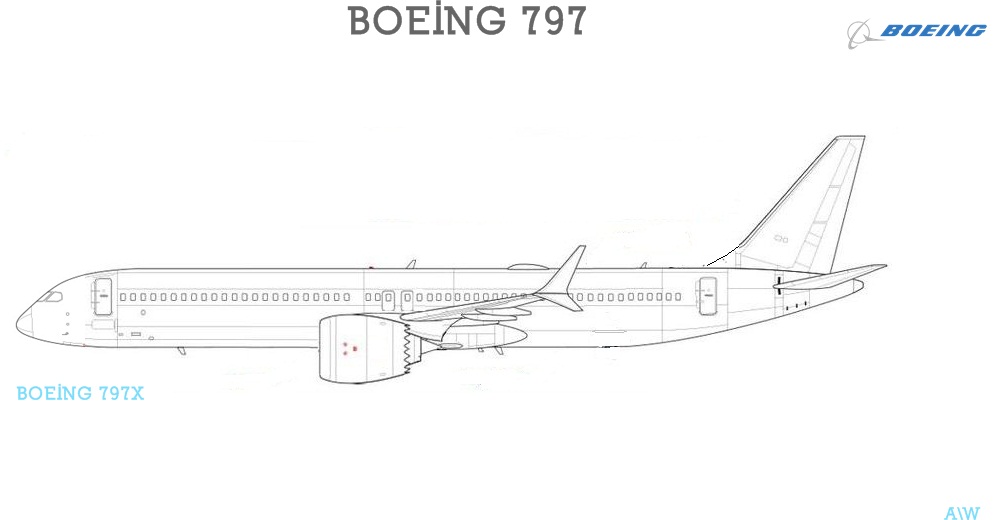
El nuevo proyecto de Avión de Tamaño Mediano (NMA) de Boeing espera ser un tema clave en el próximo Paris Air Show 2017, el fabricante aprovechará este interés para mostrar su concepto liberando los primeros detalles tangibles. Los detalles sobre la configuración en evolución siguen siendo muy estrechos y Boeing dice que sigue buscando innovaciones en múltiples áreas, desde procesos de fabricación y sistemas de producción hasta propulsión, para ayudar a fortalecer el caso de negocios.
La nueva familia de aviones de tamaño mediano (NMA) de dos miembros que Boeing propone hará para el mercado de 220 a 270 asientos lo que la línea 787 Dreamliner hizo para el segmento que ocupa -es decir, pares de ciudades abiertas que no hubieran probado ser rentables con un avión más grande o Operacionalmente infeasible con uno más pequeño, según Boeing Commercial Airplanes vicepresidente y gerente general de desarrollo de aviones Mike Delaney. Delaney señaló que las aerolíneas han logrado abrir 140 nuevos pares de ciudades con la familia Dreamliner, ya que ofrecen costos de asiento comparables con un 777 a un costo de viaje mucho más bajo.
«Vamos a poner un avión en ese espacio que tiene la economía que nadie puede tocar, y lo que hará es abrir los pares de ciudades y la economía que nadie más puede. Esa es la parte que [los ejecutivos de Airbus] no te dicen «, dijo Delaney. «La clave de la NMA es que vamos a hacer exactamente en ese mercado lo que hicimos con el 787 … El tráfico que prevemos crecerá en un 30 por ciento basado en la capacidad de abrir pares de ciudades que no existen hoy en día. Esa es la propuesta de valor. Es por eso que todas las aerolíneas están muy emocionadas. Ellos no ven un reemplazo del 757. Ellos ven el futuro».
Para Boeing, el futuro de la NMA de 4.500 a 5.000 millas náuticas comienza con la introducción en algún momento a mediados de la próxima década, ya que las restricciones de infraestructura, capacidad y frecuencia serán mucho más pronunciadas que las limitaciones con las que las aerolíneas Debe hacer frente hoy.
«Habrá una creciente necesidad de un avión en esa categoría», opinó el presidente ejecutivo de Air Lease, Steven Udvar-Hazy, durante la conferencia de ISTAT (International Society of Transportation Aircraft Trading) de la pasada primavera en San Diego. «No se magnifica hoy, pero si nos fijamos en el ciclo de vida del avión, es significativo. No olvide que el 737 tiene cincuenta años este año.
La mayoría de las 57 aerolíneas con las que Boeing ha consultado sobre su concepto de NMA han expresado su deseo de una mejor comodidad en la cabina y menores tiempos de giro en los aeropuertos, lo que sugiere claramente una preferencia por el diseño de doble pasillo. Delaney explicó que los diseñadores no pueden estirar de forma plausible un avión diseñado para transportar hasta 270 asientos en una configuración de doble clase más allá de la longitud de un 757. «Si se estira un NMA de un solo pasillo, es de 18 a 25 pies más de 757 , estimó. «No estoy exactamente seguro de que es ópticamente un avión en el que quieres estar. Yo ciertamente no querría estar en la fila 65E esperando a bajar «.
CONSIDERACIONES DEL MOTOR
Al hablar en ISTAT junto a Udvar-Hazy, el CEO de AerCap Holdings, Angus Kelly, señaló que los desarrollos de motores no han llegado a la etapa en la que tal avión atraería a una base de clientes global. «La parte clave de esto es la tecnología del motor», dijo Kelly. «Si vas a estar buscando esa ventana entre el mercado A321 y el mercado 787, necesitas un motor más grande; usted necesita un motor más eficiente. Todavía no ha llegado».
Como siempre, el costo será una consideración clave, y Kelly argumentó que para mantener los costos bajos uno podría querer un motor de menor empuje que no necesariamente ofrece el rendimiento requerido.
«Si usted tiene un motor de 40.000 libras de empuje, que podría ser bueno para algunos de su base de clientes, pero es bueno para todos ellos?» Kelly preguntó retóricamente. «Y si sus 45.000 libras de empuje, va a ser un avión más caro, y ese es el reto que tienen que acertar».
Desde la perspectiva de Delaney, el mayor desafío radica en integrar el motor con el avión, independientemente de los requisitos de empuje.
Delaney llamó a la NMA un programa de transformación para la empresa, pero no uno que no puede funcionar desde una perspectiva de costos. «La gente no entiende la recuperación que recibimos del 787 y cuánto cosechamos en el 777X», subrayó.
Entre todos los proveedores necesarios para la NMA, Boeing ha hablado sólo con las tres grandes compañías de motores, dijo Delaney. «La razón muy específica es porque la estructura del motor está tan altamente integrada», dijo. «Pasamos por una serie de procesos iterativos con ellos y lo que les decimos está diseñado para empujar los límites del avión».
«Las compañías de motores están respondiendo muy bien; Estamos muy satisfechos con la interacción técnica con las tres compañías y cómo van a tratar de optimizar «, agregó. «Lo que intentan acertar y lo que no saben, que es la salsa secreta de todo esto y uno de los secretos más guardados de la compañía Boeing, es cómo integrar un motor en un avión. Todo se trata de efectos de instalación y que son las claves para el reino y que es lo que trabajamos con ellos en ahora». 

Boeing to will present new NMA aircraft at Le Bourget Paris Air Show 2017
Boeing To Unveil First New Midsize Airplane Details In Paris Air Show 2017
The Boeing’s New Midsize Airplane (NMA) project expected to be a key topic at the upcoming Paris Air Show, the manufacturer will take advantage of this interest to showcase its concept by releasing the first few tangible details. Specifics about the evolving configuration remain closely held, and Boeing says it is still pursuing innovations across multiple areas—from manufacturing processes and production systems to propulsion—to help strengthen the business case.
Boeing’s proposed two-member new midsize airplane (NMA) family will do for the 220- to 270-seat market what the 787 Dreamliner line did for the segment it occupies—namely, open city pairs that would have proven unprofitable with a larger airplane or operationally infeasible with a smaller one, according to Boeing Commercial Airplanes vice president and general manager of airplane development Mike Delaney. Speaking with reporters during a pre-Paris Airshow briefing in Seattle, Delaney noted that airlines have managed to open 140 new city pairs with the Dreamliner family because they offer seat costs comparable with a 777 at a much lower trip cost.
“We’re going to put an airplane in that space that has the economics that nobody can touch, and what it will do is open up the city pairs and the economics that nobody else can. That’s the part that [Airbus executives] don’t tell you about,” said Delaney. “The key to the NMA is we’re going to do exactly in that market what we did with the 787. The traffic we predict will grow by about 30 percent based on the ability to open up city pairs that don’t exist today. That’s the value proposition. That’s why all the airlines are all excited. They don’t see a replacement of the 757. They see the future.”
For Boeing, the future of the 4,500- to 5,000-nautical-mile-range NMA starts with introduction some time around the middle of the next decade, as infrastructure, capacity and frequency constraints stand to become far more pronounced than the limitations with which airlines must cope today.
“There will be a growing need for an airplane in that category,” opined Air Lease executive chairman Steven Udvar-Hazy during this past spring’s International Society of Transport Aircraft Trading (ISTAT) conference in San Diego. “It’s not magnified today, but if you look at the lifecycle of the airplane, it is significant. Don’t forget the 737 is fifty years old this year.”
Most of the 57 airlines with which Boeing has consulted on its concept for an NMA have expressed a desire for better cabin comfort and lower turn times at airports, clearly suggesting a preference for twin-aisle design. Delaney explained that designers cannot plausibly stretch an airplane designed to carry as many as 270 seats in a dual-class configuration beyond the length of a 757. “If you stretch a single-aisle NMA, it’s about 18 to 25 feet longer than a 757,” he estimated. “I’m not exactly sure that’s optically an airplane you want to be on. I certainly wouldn’t want to be in row 65E waiting to get off.”
ENGINE CONSIDERATIONS
Speaking at ISTAT alongside Udvar-Hazy, AerCap Holdings CEO Angus Kelly noted that engine developments have not reached the stage at which such an airplane would appeal to a global customer base, however. “The key part of this is the engine technology,” said Kelly. “If you’re going to be searching for that window between the A321 market and the 787 market, you need a bigger engine; you need a more efficient engine. It’s not there yet.”
As always, cost will prove a key consideration, and Kelly argued that to keep costs down one might want a lower-thrust engine that might not necessarily offer the required performance.
“If you have a 40,000-pound-thrust engine, that might be good for some of your customer base, but is it good for all of them?” Kelly asked rhetorically. “And if its 45,000 pounds of thrust, it’s going to be a more expensive airplane, and that’s the challenge they have to get right.”
From Delaney’s perspective, the biggest challenge lies with integrating the engine with the airplane, regardless of thrust requirements.
Delaney called the NMA a transformational program for the company, but not one that can’t work from a cost perspective. “People don’t understand the payback we got from the 787 and how much we harvested in the 777X,” he stressed.
Among all of the required suppliers for the NMA, Boeing has spoken to only the three big engine companies, said Delaney. “The very specific reason is because the engine-airframe is so highly integrated,” he said. «We go through a series of iterative processes with them and what we tell them is designed to push the boundaries of the airplane».
“The engine companies are responding very well; we’re very pleased with the technical interaction with all three companies [and] how they are going to try to optimize,” he added. “What they try to guess and what they can’t [know], which is the secret sauce of the whole thing and one of the most guarded secrets in the Boeing company, is how to integrate an engine into an airplane…It’s all about installation effects and that’s the keys to the kingdom and that’s what we work with them on now.” A \ W
Ξ A I R G W A Y S Ξ
SOURCE: Ainonline.com
DBk: Airgways.com / Boeing.com
AW-POST: 201706110013AR
A\W A I R G W A Y S ®
 airgways.com