Efecto «low-cost argentina»

AW | 2017 06 07 23:29 | AIRLINES MARKET

La entrega de rutas aéreas a empresas ‘low cost’, bajo la lupa de la Justicia. La Justicia Federal ordenó este miércoles una serie de operativos y presentaciones de documentación ante la sospecha de irregularidades

El juez federal Sergio Torres ordenó este miércoles una serie de operativos y de presentaciones de documentación en el marco de una investigación denominada “Low Cost”, bajo la sospecha de irregularidades en concesiones oficiales.

El juez Sergio Torres firmó varias órdenes de presentación en la investigación judicial sobre diferentes aspectos relacionados con la firma Avianca en la que está imputado el presidente Mauricio Macri. La empresa Avianca es controlada por el mismo fondo de inversión que, con la firma Avian, compró en octubre de 2016 la histórica compañía de taxis aéreos de la familia Macri, MacAir. La causa gira en torno a la contratación de empresas aéreas para viajes presidenciales salteando pasos legales, la venta de la empresa Macair Jet S.A. (que pertenecía a la familia Macri), la irrupción en el mercado local de Avian Líneas Aéreas, la asignación de rutas aéreas operadas por Aerolíneas Argentinas a FlyBondi Líneas Aéreas.

En el expediente a cargo del juez Torres y del fiscal Jorge Di Lello, se investigan siete hechos relacionados con la aviación. En la causa también está imputado el vicejefe de Gabinete de la Nación por su denunciada vinculación con la empresa Fly Bondi que, como Avian, obtuvo rutas aéreas por parte del gobierno nacional.

Otro de los hechos investigados en el mismo expediente -producto de la denuncia de los diputados por el Frente para la Victoria Rodolfo Tailhade y Juan Cabandié- es la operación para adquirir una flota de aviación destinada a la Presidencia de la Nación donde estarían involucrados los integrantes de la firma MacAir. Y si se pagaron sobreprecios en viajes al exterior que hizo Macri. El magistrado instruyó a la Policía Federal para que curse las órdenes de presentación ante la Secretaría General de Presidencia, Aerolíneas Argentinas, la Inspección General de Justicia y otros organismos públicos, indicaron fuentes judiciales.

A la IGJ le reclamó informes sobre la composición societaria de la firma Sol Líneas Aéreas, en tanto que al Organismo Regulador del Sistema Nacional de Aeropuertos (ORSNA) le reclamó precisiones sobre Avian Líneas Aéreas. La investigación judicial involucra al presidente Mauricio Macri, a su padre Franco, y al vicejefe de Gabinete, Mario Quintana, entre otros funcionarios nacionales. AIRGWAYS ® Icon-AW

Effect «low-cost argentina»

The delivery of air routes to low cost companies, under the magnifying glass of Justice. The Federal Justice ordered Wednesday a series of operations and documentation presentations on suspicion of irregularities

Federal Judge Sergio Torres ordered a series of operations and documentation presentations on Wednesday under a «Low Cost» investigation, under suspicion of irregularities in official concessions.

Judge Sergio Torres signed several orders to present the judicial investigation on different aspects related to the Avianca signature in which President Mauricio Macri is accused. The Avianca company is controlled by the same investment fund that, with Avian, bought in October 2016 the historic airline company Macri, MacAir. The cause revolves around hiring airlines for presidential travel jumping legal steps, selling the company Macair Jet S.A. (Which belonged to the Macri family), the entry into the local market of Avian Airlines, the allocation of air routes operated by Aerolíneas Argentinas to FlyBondi Airlines.

In the file by Judge Torres and prosecutor Jorge Di Lello, seven facts related to aviation are investigated. In the case is also imputed the Deputy Chief of Cabinet of the Nation for its denounced connection with the company Fly Bondi that, like Avian, obtained air routes by the national government.

Another of the facts investigated in the same file, product of the denunciation of the deputies by the Front for the Victory Rodolfo Tailhade and Juan Cabandié, is the operation to acquire an aviation fleet destined to the Presidency of the Nation where the members would be involved Of the firm MacAir. And if they paid overprices in trips abroad that made Macri. The magistrate instructed the Federal Police to file the filing orders with the General Secretariat of the Presidency, Aerolineas Argentinas, the General Inspectorate of Justice and other public bodies, judicial sources said.

The IGJ asked him for information on the corporate composition of the company Sol Líneas Aéreas, while the regulator of the National System of Airports (ORSNA) asked him for details on Avian Airlines. The judicial investigation involves President Mauricio Macri, his father Franco, and deputy chief of staff, Mario Quintana, among other national officials. A \ W


Ξ A I R G W A Y S Ξ
SOURCE:  Airgways.com
DBk:  Hangarx.com.ar / Vortexxmag.com
AW-POST: 201706072329AR

A\W   A I R G W A Y S ®

Alza aerocomercial Argentina

Fuerte alza del sector aercomercial argentino: cuáles fueron los aeropuertos del país con más demanda

AW | 2017 06 07 23:07 | AIRLINES

El sector aercomercial argentino está experimenteando una fuerte alza en el tráfico de pax en todo el país. El Ministerio de Transporte vinculó la mejora a la aplicación del plan «Revolución de los Aviones»

El sector aerocomercial argentino registró en mayo un crecimiento del orden del 24 por ciento, con fuerte impacto de los vuelos de cabotaje y de rutas específicas, como las que unen Buenos Aires con Córdoba y con Mendoza. Así lo informó la Empresa Argentina de Navegación Aérea (EANA), el organismo oficial de reciente creación que se encarga de monitorear todos los aterrizajes y despegues, así como las condiciones técnicas de los aeropuertos.

El EANA difundió datos basados en el Sistema Integrado de Aviación (SIAC) según el cual durante mayo hubo 21.683 vuelos, con un promedio diario de 699 (incluyendo únicamente servicios comerciales y vuelos privados). Esto significó un incremento del 12,7% en relación a mayo 2016.

El reporte indica que los vuelos de cabotaje con mayor demanda fueron: Aeroparque-Córdoba y Aeroparque-Mendoza, en ambos sentidos, mientras que en destinos internacionales la ruta más elegida fue Aeroparque-San Pablo, con 706 vuelos en el mes y más de 98.000 pasajeros. En segundo puesto se ubicó el vuelo Ezeiza-Miami, con más de 81.000 pasajeros, distribuidos en 338 vuelos.

De acuerdo con los datos oficiales, los cinco aeropuertos que más crecieron en mayo en comparación interanual fueron Río Cuarto (384%) Santiago del Estero (160%); Catamarca (148%); Corrientes (87%), y Sauce Viejo y Mar del Plata (ambos 80%)

Según el reporte, hay en marcha inversiones por 22.000 millones de pesos en la modernización de la infraestructura en 19 aeropuertos del país. El ministro de Transportes, Guillermo Dietrich, ha dicho en numerosas ocasiones que apuntan a duplicar la cantidad de pasajeros transportados en avión hacia 2019.

El Gobierno había indicado que Aerolíneas Argentinas era la preferida de los pasajeros que realizaban vuelos de cabotaje y LATAM los del exterior. Se esperaba que el jueves la línea aérea estatal difunda su balance sobre la actividad.  AIRGWAYS ® Icon-AW

Aerocomercial hike Argentina

The Argentine commercial sector is experiencing a strong increase in the traffic of pax throughout the country. The Ministry of Transport linked the improvement to the implementation of the plan «Revolution of the Airplanes»

The Argentine commercial sector registered in May a growth of the order of 24 percent, with a strong impact of cabotage flights and specific routes, such as those linking Buenos Aires with Cordoba and with Mendoza. This was reported by the Argentine Air Navigation Company (EANA), the newly created official body responsible for monitoring all landings and take-offs, as well as technical conditions at airports.

The EANA disseminated data based on the Integrated Aviation System (SIAC) according to which there were 21,683 flights during May, with a daily average of 699 (including only commercial services and private flights). This represented an increase of 12.7% in relation to May 2016.

The report indicates that the most demanded cabotage flights were: Aeroparque-Córdoba and Aeroparque-Mendoza, in both directions, while in international destinations the most chosen route was Aeroparque-San Pablo, with 706 flights in the month and more than 98,000 Passengers. In second place was the Ezeiza-Miami flight, with more than 81,000 passengers, distributed in 338 flights.

According to official data, the five airports that grew the most in May in comparison year-on-year were Rio Cuarto (384%) Santiago del Estero (160%); Catamarca (148%); Corrientes (87%), and Sauce Viejo and Mar del Plata (both 80%)

According to the report, there are ongoing investments for 22,000 million pesos in the modernization of infrastructure in 19 airports in the country. Transport Minister Guillermo Dietrich has said on numerous occasions that they aim to double the number of passengers flown by 2019.

The Government had indicated that Aerolineas Argentinas was the preferred passenger for the cabotage and LATAM flights from abroad. The state airline was expected to release its balance sheet on Thursday. A\W


Ξ A I R G W A Y S Ξ
SOURCE:  Clarin.com
DBk:  Gustavo Castaing
AW-POST: 201706072307AR

A\W   A I R G W A Y S ®

Un adiós a Fokker en KLM Cityhopper

AW | 2017 06 07 22:57 | AIRLINES

KLM ha reemplazado constantemente a los aviones más antiguos por modelos más nuevos, pero la última ronda de renovaciones de la flota comenzó en 2008. Desde entonces, más y más Embraer 190 y 175 se han unido a nuestra flota, reemplazando a nuestros Fokker 50 y 100, y ahora nuestro Fokker 70s. Y así la despedida final para la flota de Fokker se está acercando rápidamente en KLM Cityhopper. Una fecha ha sido fijada: 28 de octubre de 2017. Será un día festivo lleno de gratitud, en particular al legendario Anthony Fokker (1890-1939) y la compañía que fundó.

Expresando nuestra gratitud
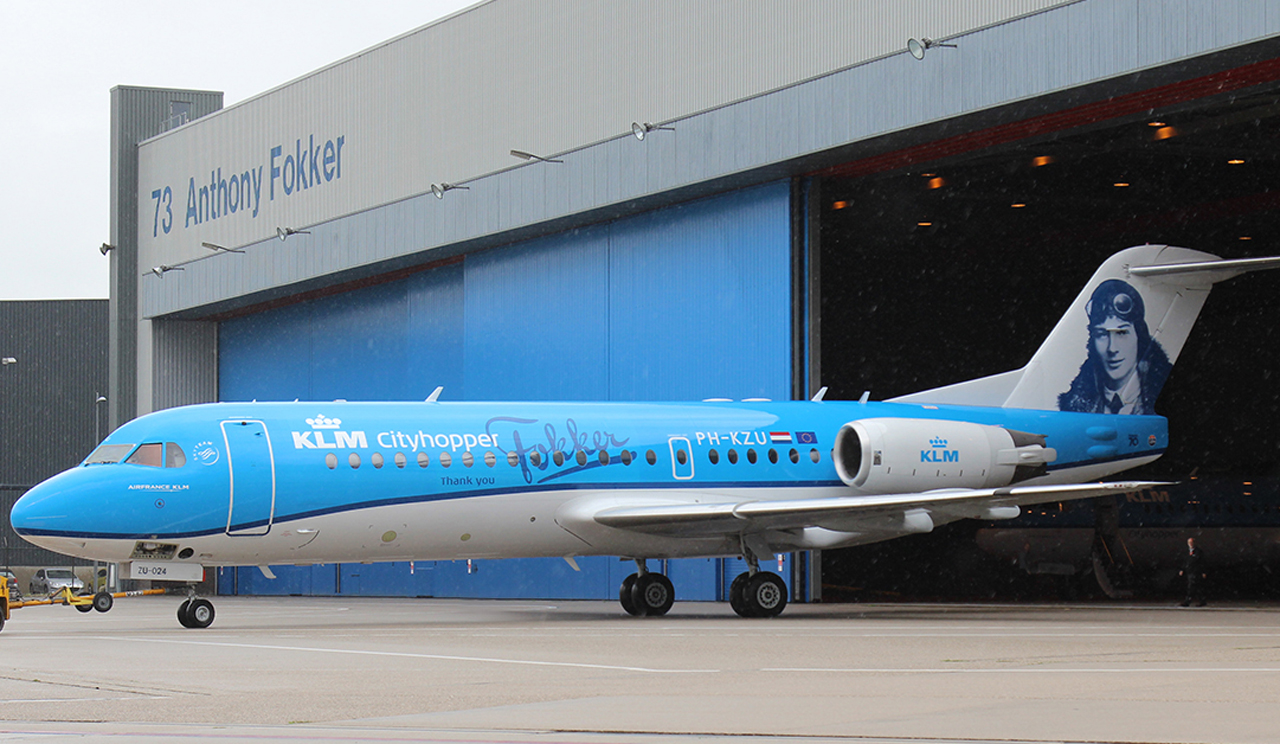
Para honrar al pionero de la aviación líder de nuestro país, hemos decorado el fuselaje y la cola de nuestro último Fokker 70 con un retrato de Anthony Fokker, que forma parte de una fiesta de 97 años de historia compartida entre Fokker y KLM.

Personalmente, yo sabía muy poco sobre Anthony Fokker, aunque era consciente de que toda una serie de aviones habían sido nombrados por él. Para averiguar más sobre él, hice algunas investigaciones en línea, pero también arraigé en los archivos de KLM, donde pronto descubrí lo importante que Anthony Fokker había sido para la industria aérea en general y para KLM en particular.

Aquí están algunos de sorprendentes descubrimientos sobre Anthony Fokker:

Fue uno de los empresarios más importantes de la historia holandesa. Su primer avión impulsado por hélice, que diseñó y construyó en 1910, se llamaba «De Spin». El 31 de agosto de 1911, Fokker tomó su giro para una vuelta sobre Haarlem por primera vez. Se retiró de una pradera cercana y dio un rodeo por encima de la plaza central de Haarlem, Grote Markt, antes de aterrizar con seguridad en Kleverpark. Él pasó a probar muchos más de sus propios diseños, ganando aclamación mundial y el apodo de «The Flying Dutchman» («El holandés volador»).

Anthony Fokker dijo una vez: «Cuando tenía unos dieciséis años y por primera vez oí hablar de máquinas voladoras, mi único objetivo en la vida era convertirme en piloto. Los pilotos eran un nuevo tipo de héroe. Tal vez eso es lo que más me atraía: yo también quería ser un héroe». Dedicó la mayor parte de su vida a hacer realidad ese sueño.

Era un visionario
Fokker dijo lo siguiente en 1931: «Mirando hacia atrás en días pasados, parece que he logrado mucho desde que era un niño pequeño, practicando el arte de volar con modelos de papel. Pero cuando miro al futuro, sé que esto es sólo el comienzo, considerando las increíbles oportunidades que la aviación presenta; las cosas que soñé en los días pioneros, hace mucho tiempo. «

Fokker y KLM – un gran dúo
Durante los próximos meses, vamos a conmemorar regularmente los 97 años de historia compartida de Fokker y KLM. No me sorprendería si la despedida final deja a muchos miembros del personal de KLM con lágrimas. Así que, antes de abrazar completamente a los Embraer, estaremos dando a nuestros Fokkers una fantástica despedida. Y lo haremos con estilo.

Aspectos destacados de Farewell Fokker
La magnífica foto de Anthony Fokker, adornando la librea de nuestro último Fokker, también ha sido exhibida en el hangar H73 en Schiphol-Oost, donde Fokker entregó una vez su avión recién construido a las líneas aéreas. La librea no es solo un homenaje al pionero, sino también una muestra de nuestra gratitud a los muchos que han servido a Fokker como empresa. Stefan Vermeeren, encargado de la flota del Fokker 70, sobre la librea especial. Dijo lo siguiente:

«Queríamos encontrar una manera de agradecer a todos los que han trabajado en Fokker 70s por sus esfuerzos y dedicación. ¿Qué mejor manera de hacer esto que a través de la propia aeronave? Eso es mucho más festivo que un mensaje de agradecimiento por correo electrónico, ¿verdad?»

Al decorar el avión con el uniforme festivo, no sólo agradecemos a todos nuestros colegas de KLM Cityhopper, sino también al personal de todas las estaciones, proveedores, operadores de tierra de otras aerolíneas y aficionados a la aviación. Es también un homenaje a la aviación holandesa, a nuestra industria de transporte aéreo, y es una manera especial de celebrar el vínculo entre KLM y Fokker.

«Las palabras «Gracias» en el fuselaje, junto con la foto de Anthony Fokker, reconocen el vínculo entre KLM, Fokker y la industria, pero las palabras de gratitud también están dirigidas a la comunidad más amplia ya otros colegas, empresas y proveedores de todo el mundo. Europa, para agradecerles los muchos años de cooperación «.

Libro sobre Fokker y KLM
Pero eso no es todo. Hay más en el programa para esta adiós festiva. Una película y un vuelo fotográfico, por ejemplo, porque KLM quiere capturar su último Fokker desde tantos ángulos como sea posible. Y también estaremos celebrando los 97 años de historia de KLM, KLM Cityhopper y Fokker con el libro «Farewell Fokker 70, Dutch at Heart».

No estaremos revelando el programa completo todavía, por supuesto. Nuestro último Fokker completará su último vuelo comercial para KLM el 28 de octubre, pero mantendremos el destino en secreto. El día siguiente será muy especial también, pero ese es otro secreto. ¡Todo será revelado a tiempo!  AIRGWAYS ® Icon-AW


A Fond Farewell to Fokker in Cityhopper

KLM has, of course, constantly replaced older aircraft with newer models, but the latest round of fleet renewals began in 2008. Since then, more and more Embraer 190s and 175s have joined our fleet, replacing our Fokker 50s and 100s, and now our Fokker 70s. And so the final farewell for the Fokker fleet is fast approaching at KLM Cityhopper. A date has been set: 28 October 2017. It will be a festive day full of gratitude, particularly to the legendary Anthony Fokker (1890-1939) and the company he founded.

Expressing our gratitude
To honour our country’ s leading aviation pioneer, we have decorated the fuselage and tail of our last Fokker 70 with a portrait of Anthony Fokker, which is part of a festive livery marking 97 years of shared history between Fokker and KLM.

Personally, I knew very little about Anthony Fokker, although I was aware that a whole series of planes had been named after him. To find out more about him, I did some online research, but also rooted around in the KLM archives, where I soon discovered how important Anthony Fokker had been for the airline industry in general, and for KLM in particular.

Here are some of surprising discoveries about Anthony Fokker:

He was one of the most important entrepreneurs in Dutch history. His first propeller-driven plane, which he designed and built in 1910, was called “De Spin” (The Spider). On 31 August 1911, Fokker took his Spin for a spin over Haarlem for the first time. He took off from a nearby meadow and circled above Haarlem’s central square, de Grote Markt, before landing safely in Kleverpark. He went on to test many more of his own designs, earning worldwide acclaim and the nickname “The Flying Dutchman”.

Anthony Fokker once said: “When I was about sixteen years old and first heard about flying machines, my only goal in life was to become a pilot. Pilots were a new kind of hero. Maybe that’ s what appealed to me most: I wanted to be a hero too!” He dedicated most of his life to making that dream come true.

He was a visionary
Fokker said the following in 1931: “Looking back on days gone by, it seems I have achieved quite a lot since I was a small boy, practising the art of flying with paper models. But when I look to the future, I know that this is just the beginning, considering the incredible opportunities aviation presents; the things I dreamed of in the pioneering days, long ago.”

Fokker and KLM – a great duo
During the coming months, we will regularly commemorate the 97 years of shared Fokker and KLM history. I wouldn’ t be surprised if the final farewell leaves lots of KLM staff teary-eyed. So, before we fully embrace the Embraers, we’ ll be giving our Fokkers a fantastic farewell. And we’ ll be doing it in style.

Highlights of “Farewell Fokker”
The superb photo of Anthony Fokker, gracing the livery of our last Fokker, has also been displayed on Hangar H73 at Schiphol-Oost, which is where Fokker once delivered its newly constructed aircraft to airlines. The livery is not just a tribute to the pioneer, but also a token of our gratitude to the many who have served Fokker as a company. Stefan Vermeeren, fleet manager for the Fokker 70, about the special livery. He said the following:

“We wanted to find a way to thank everyone who has worked on Fokker 70s for their efforts and dedication. What better way to do this than by way of the aircraft itself? That’ s a lot more festive than a thank-you message by email, right?»

By decorating the plane with the festive livery, we not only thank all our colleagues at KLM Cityhopper, but also that staff at all outstations, suppliers, ground handlers at other airlines, and aviation aficionados. It’ s also a tribute to Dutch aviation, to our air transport industry, and it’ s a special way to celebrate the bond between KLM and Fokker.

«The words ‘Thank you’ on the fuselage, together with the photo of Anthony Fokker, acknowledge the bond between KLM, Fokker and the industry, but the words of gratitude are also intended for the broader community and other colleagues, companies and suppliers all over Europe, to thank them for the many years of cooperation.”

Book about Fokker and KLM
But that’s not all. There’ s more on the programme for this festive farewell. A film and photo flight, for example, because KLM want to capture its last Fokker from as many angles as possible. And we’ll also be celebrating the 97-year history of KLM, KLM Cityhopper and Fokker with the book “Farewell Fokker 70, Dutch at Heart”. You can order a copy here.

We won’t be revealing the full programme yet, of course. Our last Fokker’ s will complete its final commercial flight for KLM on 28 October, but we’ ll be keeping the destination secret. The day thereafter will be very special too, but that’ s another secret. All will be revealed in good time! A\W


Ξ A I R G W A Y S Ξ
SOURCE:  Blog.klm.com
DBk:  Blog.klm.com
AW-POST: 201706072257AR

A\W   A I R G W A Y S ®

LATAM Airlines cobrará comida a bordo

AW | 2017 06 07 22:35 | AIRLINES

La aerolínea Latam comenzará mañana a cobrar la comida de sus vuelos para competir con las low cost

La empresa anunció que presentará un menú para los viajes de cabotaje. También se cobrará aparte el equipaje que se despache a la bodega. Así, promete reducir la tarifa «plana».

Desde mañana, la aerolínea Latam Airlines cobrará por la comida y la bebida que los pasajeros quieran consumir en los vuelos nacionales. Con esa medida, más el cobro de un adicional por el equipaje que se despache a la bodega del avión, la empresa ajusta sus números para competir con los vuelos low cost. Según había anunciado a fin de 2016, la propuesta de pagar por lo que se consume abaratará alrededor de 20 por ciento las tarifas.

La compañía presentó «Mercado LATAM», una tienda a bordo que ofrecerá más de 50 opciones de bebidas y alimentos que los pasajeros podrán comprar durante sus vuelos locales. También se podrá comprar entretenimiento.

«Este nuevo servicio es el primer paso en la evolución del modelo de viaje para los vuelos nacionales de LATAM, que tiene por objetivo ofrecer una experiencia de viaje hecha a la medida, en la cual el pasajero puede pagar sólo por los servicios que quiere utilizar», indicó la compañía en un comunicado.

«La industria aérea cambió y nosotros como LATAM también lo hicimos; este nuevo servicio de compra a bordo y el modelo de viaje para vuelos domésticos entregarán a nuestros pasajeros más opciones, una experiencia de viaje hecha a la medida”, enfatizó Rosario Altgelt, Gerente General de la empresa.

Tanto Latam como Aerolíneas Argentinas manifestaron el año pasado que adaptarían los servicios de a bordo a este nuevo modelo de pagar por lo que se consume. Es una manera de abaratar los pasajes y competir con la nueva oferta que llegará al país en los próximos meses.

Avianca, por caso, comenzará a volar en el país el 11 de julio. Otras empresas, como Andes, aumentaron sus vuelos y rutas. En una próxima audiencia pública, la Administración Nacional de la Aviación Civil (ANAC) espera que se presenten 14 empresas para pedir más rutas aéreas. La aerolínea de low cost Norwegian prepara su desembarco local. Flybondi sigue en la búsqueda de aviones para operar en el país.  AIRGWAYS ® Icon-AW

LATAM Airlines to charge food on board

The airline Latam will start tomorrow to charge the food of its flights to compete with the low cost

The company announced that it will present a menu for cabotage travel. You will also be charged separately the luggage that is dispatched to the cellar. Thus, promises to reduce the flat rate.

From tomorrow, the airline Latam will charge for food and drink that passengers want to consume on domestic flights. With that measure, plus an additional charge for the luggage that is dispatched to the hold of the plane, the company adjusts its numbers to compete with the low cost flights. As announced at the end of 2016, the proposal to pay for what is consumed will reduce about 20 percent tariffs.

The company introduced «Mercado LATAM», an on-board store that will offer more than 50 food and beverage options that passengers will be able to purchase during their local flights. You can also buy entertainment.

«This new service is the first step in the evolution of the LATAM domestic flight model, which aims to offer a tailor made travel experience in which the passenger can pay only for the services he wants to use» the company said in a statement.

«The airline industry has changed and we, like LATAM, have also done so, this new onboard purchase service and domestic flight model will give our passengers more options, a tailor-made travel experience,» said Rosario Altgelt, Manager General of the company.

Both Latam and Aerolineas Argentinas stated last year that they would adapt onboard services to this new model of paying for what is consumed. It is a way to cheapen the tickets and compete with the new offer that will arrive in the country in the coming months.

Avianca, by case, will begin to fly in the country the 11 of July. Other companies, like Andes, increased their flights and routes. At a forthcoming public hearing, the National Civil Aviation Administration (ANAC) expects 14 companies to submit to request more air routes. The Norwegian low cost airline prepares its local disembarkation. Flybondi is still searching for planes to operate in the country. A\W


Ξ A I R G W A Y S Ξ
SOURCE:  Tn.com.ar
DBk:  Latam.com / Aviacionline.com
AW-POST: 201706072235AR

A\W   A I R G W A Y S ®

Lima Airlines iniciaría ops en Perú

Resultado de imagen para Lima Airlines

AW | 2017 06 07 22:27 | AIRLINES

Lima Airlines solicitó permiso para volar a 24 destinos nacionales

La nueva aerolínea Lima Airlines comenzaría a operar 24 destinos en Perú. La aerolínea solicitó a la Dirección General de Aeronáutica Civil (DGAC) el permiso de Operación de Aviación Comercial. Lima Airlines tiene en proyecto ampliar su negocio de vuelos no tradicionales realizando vuelos en el país e internacionales.

Las rutas solicitadas son 40 e incluyen 24 destinos: Lima, Piura, Talara, Tumbes, Chiclayo, Trujillo, Cajamarca, Ciro Alegría, Andoas, Trompeteros, Iquitos, Tarapoto, Yurimaguas, Jaén, Chachapoyas, Huánuco, Pucallpa, Jauja, Cusco, Ayacucho, Arequipa, Juliaca, Tacna y Puerto Maldonado.

En junio de 2016, el MTC le otorgó el permiso de operación internacional a Lima Airlines por cuatro años. La aerolínea estaría utilizando aeronaves Airbus, Boeing, Bae, Bombardier CRJ, Antonov, entre otras.  AIRGWAYS ® Icon-AW


Lima Airlines to begin operations in Perú

Lima Airlines requested permission to fly to 24 domestic destinations

The new airline Lima Airlines would start operating 24 destinations in Perú. The airline requested the Civil Aeronautics General Directorate (DGAC) the Commercial Aviation Operation permit. Lima Airlines is planning to expand its business of non-traditional flights by doing domestic and international flights.

The routes requested are 40 and include 24 destinations: Lima, Piura, Talara, Chiclayo, Trujillo, Cajamarca, Ciro Alegria, Andoas, Trompeteros, Iquitos, Yurimaguas, Jaén, Chachapoyas, Huánuco, Pauallpa, Jauja, Cusco, Ayacucho , Arequipa, Juliaca, Tacna and Puerto Maldonado.

In June 2016, the MTC granted the international operating permit to Lima Airlines for four years. The airline would be using aircraft Airbus, Boeing, Bae, Bombardier CRJ, Antonov, among others. A\W


Ξ A I R G W A Y S Ξ
SOURCE:  Airgways.com
DBk:  Lima Airlines
AW-POST: 201706072227AR

A\W   A I R G W A Y S ®

Incidente Tu-204 de Air Koryo

Un avión de pasajeros de Corea del Norte se despedaza en pleno vuelo

AW | 2017 06 07 22:17 | SAFETY / SECURITY

 Un avión de pasajeros de Corea del Norte se despedaza en pleno vuelo

Una aeronave Tupolev Tu-204 de la aerolínea norcoreana Air Koryo volaba de Pionyang a Pekín cuando partes de una de sus alas comenzaron a desprenderse.

Un avión comercial ha sufrido un aterrador incidente aéreo mientras realizaba la ruta entre Pionyang y Pekín. Se trata de un Túpolev 204 de la aerolínea norcoreana Air Koryo, que sufrió la caída de parte de una de sus alas en mitad del vuelo.

Según informa The Aviation Herald, la aeronave acababa de alcanzar los 9.200 metros de altitud y se disponía a entrar al espacio aéreo chino, momento en el cual comenzó a vibrar violentamente. En ese momento, los pasajeros observaron el desprendimiento de lo parece que era un ‘flap’: una sección móvil del ala que asiste en el despegue y el aterrizaje del avión.

Este hecho provocó que la tripulación tomara la decisión de retornar a la capital norcoreana, donde el Tu-204 aterrizó una hora después de haber despegado y sin reportes de heridos. El suceso tuvo lugar el pasado 25 de mayo, pero no fue comunicado públicamente hasta ahora.  AIRGWAYS ® Icon-AW

Air Koryo Tu-204 Incident

A North Korean passenger plane crashes in mid-flight

A Tupolev Tu-204 aircraft of the North Korean airline Air Koryo was flying from Pionyang to Beijing when parts of one of its wings began to come off.

A commercial plane has undergone a frightening air incident while making the route between Pionyang and Beijing. This is a Túpolev 204 of the North Korean airline Air Koryo, which suffered the fall of part of one of its wings in the middle of the flight.

According to the Aviation Herald, the aircraft had just reached 9,200 meters above sea level and was about to enter Chinese airspace, at which point it began to vibrate violently. At that moment, the passengers observed the detachment of what appears to be a ‘flap’: a moving wing section that assists in the takeoff and landing of the plane.

This caused the crew to make the decision to return to the North Korean capital, where the Tu-204 landed an hour after taking off and without reports of injuries. The event took place last May 25, but was not publicly announced until now. A\W


Ξ A I R G W A Y S Ξ
SOURCE: Rt.com
DBk: Reuters.com / Twimg.com
AW-POST: 201706072217AR

A\W   A I R G W A Y S ®

Aumento pax en Aeropuerto de Lisboa

AW | 2017 06 06 15:22 | AIRPORTS

Aeroporto de Lisboa tiene 4º mayor aumento de pasajeros de Europa en el  1º cuatrimestre

O Aeroporto de Lisboa se encuentra en el centro de la ciudad, en el centro de la ciudad, en el centro de la ciudad, que se contamine entre los mayores aeropuertos europeos.

Cálculos de PressTUR a partir de datos de 239 aeroportos europeos publicados por ACI Europa (Consejo Internacional de Aeropuertos) evidenciaram que aumentos mayores que en Lisboa no 1 quadrimestre ejecutado sólo en Bruselas (coma 1) , 78 millones (+ 33,4%, para 7,1 millones), Amsterdam, con más 1,71 millones (+ 9,4%, para 19,9 millones), y Moscovo Sheremetievo, con más de 1,66 millones + 17,4% para 11,2 millones).

Lisboa, por su vez, ha tenido aumentos superiores a los verificados en Londres Gatwick, que tiene más de 1,32 millones de pasajeros que no el primer trimestre de 2016 (+ 11,4%, para 12,94 millones), Madrid, com más 1, 2 millones (+ 8,1%, para 16,1 millones), Barcelona, ​​con 10,7 millones (+ 8,9%, para 13,18 millones), Londres Heathrow, com más 1,05 millones (+4 , 6,2%, para 23, 9 millones), París Charles de Gaulle, con más 1,05 millones (+ 5,3%, para 20,86 millones), y Dusseldorf, con más 939 mil (+ 15,2% Para 7,1 millones).

Los 239 aeropuertos con los datos de pasajeros publicados por ACI sumaron 535,88 millones de pasajeros en el 1º cuatrimestre, con un aumento de 8,9% o casi 44 millones en el período homólogo del 2016. Los cinco aeropuertos portugueses de los datos dados – Lisboa , Oporto, Faro, Funchal y Ponta Delgada – sumaron 13,65 millones de viajeros, con un aumento de 21,7% o 2,4 millones.

Lisboa, con un aumento de los pasajeros en el año 2016.  Porto, por su vez, subió de 54º a 51º, Con 3,06 millones de pasajeros (+ 21% o más 532 mil), y Ponta Delgada subió de 140º para 136º, con 471,5 mil pasajeros (+ 20,4% o más cerca de 80 mil).  Faro tiene una posición de 74 años, con 1,71 millones de pasajeros (+ 20,4% o más 290 mil), tal como o Funchal se mantienen en el puesto 102º, con 966,6 mil pasajeros (+12,4 %  más 106 mil). Londres Heathrow, con 23,9 millones de pasajeros, se mantuvo como el principal aeropuerto europeo, seguido por París Charles de Gaulle, con 20,86 millones, y este año, Amsterdam, com 19,92 millones, que ‘beneficio’ al Estambul Atatürk de 3º para 5º, con 18,12 millones de pasajeros, también de Fráncfort, con 18,55 millones.

Madrid, com 16,1 millones, Barcelona, ​​com 13,18 millones, que sobrepasó Munich, con 13,11 millones, seguido de Londres Gatwick, con 12,94 millones, y Roma Fiumicino, com 11 , 68 millones.  AIRGWAYS ® Icon-AW

https://i0.wp.com/www.loveporto.com/aeroporto.jpg

Pax increase in Lisbon Airport


Lisbon Airport had the 4th largest passenger increase in Europe in the first four months


In the first four months of the year, Lisbon Airport reached the fourth largest passenger increase among all European airports, with 1.43 million more, beating competitors like London Gatwick, Madrid, Barcelona, ​​London Heathrow and Paris Charles de Gaulle , Which are among the largest European airports.

PressTUR calculations from data from 239 European airports published by ACI Europe (Airports Council International) showed that larger increases than in Lisbon in the first four months occurred only in Brussels (recovering from the impact of terrorist attacks a year ago), with a further 1 (+ 33.4% to 7.1 million), Amsterdam, with a further 1.71 million (+ 9.4% to 19.9 million), and Moscow Sheremetievo, with a further 1.66 million ( + 17.4% to 11.2 million).

Lisbon, on the other hand, had increases higher than those in London Gatwick, which had more 1.32 million passengers than in the first four months of 2016 (+ 11.4% to 12.94 million), Madrid, with a further 1, 2 million (+ 8.1% to 16.1 million), Barcelona with a further 10.7 million (+ 8.9% to 13.18 million), London Heathrow with a further 1.05 million (+4 (+ 5.3% to 20.86 million), and Dusseldorf, with a further 939 thousand (+ 15.2%), To 7.1 million).

The 239 airports with passenger data published by ACI totaled 535.88 million passengers in the first four months, an increase of 8.9% or almost 44 million compared to the same period of 2016. The five Portuguese airports included in these data Lisbon, Porto, Faro, Funchal and Ponta Delgada – totaled 13.65 million passengers, an increase of 21.7% or 2.4 million.

Lisbon, with a passenger increase of 23.8% to 7.43 million, was the 22nd largest European airport in the four-month period, three positions above the same period of 2016. Oporto, in turn, rose from 54º to 51º, (+ 21% or more 532,000), and Ponta Delgada rose from 140º to 136º, with 471,500 passengers (+ 20,4% or more about 80,000). Faro remained in its 74th position a year ago, with 1.71 million passengers (+ 20.4% or more 290,000), as Funchal remained at 102 °, with 966.6 thousand passengers (+12.4 % Or more 106 thousand). London Heathrow, with 23.9 million passengers, remains the largest European airport, followed by Paris Charles de Gaulle with 20.86 million, and this year Amsterdam with 19.92 million, which ‘benefited’ from the Fall from Istanbul Ataturk from 3rd to 5th, with 18.12 million passengers, behind Frankfurt, with 18.55 million.

In the second half of the Top 10 are Madrid with 16.1 million, Barcelona with 13.18 million, which surpassed Munich with 13.11 million, followed by London Gatwick with 12.94 million and Rome Fiumicino with 11 , 68 million. A \ W

https://i0.wp.com/portugalresident.com/sites/default/files/field/image/tap-aeroporto-de-lisboa.jpg

Aumento pax en Aeroporto Lisboa

Aeroporto de Lisboa teve o 4º maior aumento de passageiros da Europa no 1º quadrimestre

O Aeroporto de Lisboa alcançou no primeiro quadrimestre o 4º maior aumento de passageiros entre todos os aeroportos europeus, com mais 1,43 milhões, ‘batendo’ concorrentes ‘de peso’ como Londres Gatwick, Madrid, Barcelona, Londres Heathrow e Paris Charles de Gaulle, que se contam entre os maiores aeroportos europeus.

Cálculos do PressTUR a partir de dados de 239 aeroportos europeus publicados pelo ACI Europa (Airports Council International) evidenciaram que aumentos maiores que em Lisboa no 1º quadrimestre ocorreram apenas em Bruxelas (que recupera do impacto de atentados terroristas há um ano), com mais 1,78 milhões (+33,4%, para 7,1 milhões), Amesterdão, com mais 1,71 milhões (+9,4%, para 19,9 milhões), e Moscovo Sheremetievo, com mais 1,66 milhões (+17,4% para 11,2 milhões).

Lisboa, por sua vez, teve aumentos superiores aos verificados em Londres Gatwick, que teve mais 1,32 milhões de passageiros que no 1º quadrimestre de 2016 (+11,4%, para 12,94 milhões), Madrid, com mais 1,2 milhões (+8,1%, para 16,1 milhões), Barcelona, com mais 10,7 milhões (+8,9%, para 13,18 milhões), Londres Heathrow, com mais 1,05 milhões (+4,6%, para 23, 9 milhões), Paris Charles de Gaulle, com mais 1,05 milhões (+5,3%, para 20,86 milhões), e Dusseldorf, com mais 939 mil (+15,2%, para 7,1 milhões).

Os 239 aeroportos com dados de passageiros publicados pelo ACI somaram 535,88 milhões de passageiros no 1º quadrimestre, com um aumento em 8,9% ou quase 44 milhões em relação ao período homólogo de 2016. Os cinco aeroportos portugueses incluídos nesses dados — Lisboa, Porto, Faro, Funchal e Ponta Delgada — somaram 13,65 milhões de passageiros, com um aumento em 21,7% ou 2,4 milhões.

Lisboa, com um aumento de passageiros em 23,8%, para 7,43 milhões, foi o 22º maior aeroporto europeu no quadrimestre, três posições acima do período homólogo de 2016. O Porto, por sua vez, subiu de 54º a 51º, com 3,06 milhões de passageiros (+21% ou mais 532 mil), e Ponta Delgada subiu de 140º para 136º, com 471,5 mil passageiros (+20,4% ou mais cerca de 80 mil). Já Faro manteve a 74ª posição de há um ano, com 1,71 milhões de passageiros (+20,4% ou mais 290 mil), tal como o Funchal se manteve em 102º, com 966,6 mil passageiros (+12,4% ou mais 106 mil). Londres Heathrow, com 23,9 milhões de passageiros, mantém-se o maior aeroporto europeu, seguido por Paris Charles de Gaulle, com 20,86 milhões, e, este ano, Amesterdão, com 19,92 milhões, que ‘beneficiou’ da queda de Istambul Ataturk de 3º para 5º, com 18,12 milhões de passageiros, atrás também de Frankfurt, com 18,55 milhões.

Na segundo metade do Top10 estão Madrid, com 16,1 milhões, Barcelona, com 13,18 milhões, que ultrapassou Munique, com 13,11 milhões, seguindo-se Londres Gatwick, com 12,94 milhões, e Roma Fiumicino, com 11,68 milhões. A \ W


Ξ A I R G W A Y S Ξ
SOURCE: Presstur.com
DBk: Presstur.com / Portugalresident.com / Loveporto.com
AW-POST: 201706061522AR

A \ W   A I R G W A Y S ®

Aeropuerto Palma recibe certificado internacional por reducción de emisiones

https://i0.wp.com/static.panoramio.com/photos/original/63473099.jpg

AW | 2017 06 06 14:51 | AIRPORTS

El Aeropuerto de Palma, de España, consigue un certificado internacional por sus esfuerzos por reducir emisiones de CO2

El Aeropuerto de Palma ha logrado el nivel 2 del programa Airport Carbon Accreditation, un certificado otorgado por la European region of Airports Council International (ACI), que reconoce los esfuerzos del aeropuerto por gestionar y reducir sus emisiones de CO2.

Según han informado desde Aena en un comunicado, este programa permite, de forma independiente, examinar y reconocer los trabajos de los aeropuertos para la gestión y reducción de las emisiones de CO2 ligadas a su actividad, facilitando una herramienta común a nivel europeo. Además, los aeropuertos participantes deben comunicar periódicamente sus emisiones de CO2 para determinar qué fuentes de emisión son prioritarias y sobre cuáles se pueden establecer medidas de reducción. Así, con actuaciones como el cierre del Modulo A (anual desde noviembre a marzo), los detectores de presencia, la renovación del alumbrado en la entrada del Aeropuerto y la utilización de cuatro vehículos eléctricos, entre otras, han conseguido un ahorro de 5.619 MW/h en 2016, lo que supone una reducción de emisiones a la atmósfera de 1.203 toneladas de CO2. AIRGWAYS ® Icon-AW

Palma Airport with international certificate

Palma Airport,  Spain,  gets an international certificate for its efforts to reduce CO2 emissions


Palma Airport has achieved Level 2 of the Airport Carbon Accreditation program, a certificate issued by the European Region of Airports Council International (ACI), which recognizes the airport’s efforts to manage and reduce its CO2 emissions.

Aena said in a statement that this program allows the independent examination and recognition of airport work for the management and reduction of CO2 emissions linked to its activity, facilitating a common tool at European level. In addition, participating airports should periodically report their CO2 emissions to determine which emission sources are priority and on which mitigation measures can be established. Thus, with actions such as the closure of Module A (annual from November to March), the presence detectors, the renovation of the lighting at the entrance of the Airport and the use of four electric vehicles, among others, have achieved a saving of 5,619 MW / H in 2016, resulting in a reduction of atmospheric emissions of 1,203 tonnes of CO2. A \ W


Ξ A I R G W A Y S Ξ
SOURCE: 20minutos.es
DBk: Panoramio.com
AW-POST: 201706061451AR

A \ W   A I R G W A Y S ®

Implementación Orden Ejecutiva Nigeria

https://i1.wp.com/media.premiumtimesng.com/wp-content/files/2015/02/murtala-muhammed-international-airport-e1425111479845.jpg?fit=758%2C405

AW | 2017 06 06 14:30 | AIRPORTS

La Autoridad Federal de Aeropuertos de Nigeria (FAAN) dijo el lunes que la implementación de la Orden Ejecutiva emitida por el Presidente Interino Yemi Osibajo estaba en curso y al 60 por ciento.

Una declaración de Henrietta Yakubu, portavoz de la agencia, dijo Saleh Dunoma, director general de FAAN, dijo esto al hablar sobre el estado de la aplicación de la orden ejecutiva en la «facilidad de hacer negocios en Nigeria» en varios aeropuertos de todo el país.

«Estamos en varias etapas de la implementación y estamos trabajando con todas las agencias de seguridad y otras partes interesadas en el Aeropuerto Internacional Murtala Muhammed, Lagos y de hecho con otros aeropuertos internacionales en todo el país para asegurarnos de que se implemente la Orden Ejecutiva», dijo Dunona dijo. «Hemos cumplido el 60 por ciento de los requisitos necesarios para asegurar que la Orden Ejecutiva sea implementada», agregó.

Según el jefe de la FAAN, la agencia había celebrado una serie de reuniones con los operadores del sector de la aviación. Él dijo, «Hasta ahora, cada agencia está trabajando en ciertos aspectos como les concierne«. Pero FAAN, el supervisor general de las operaciones en el aeropuerto está coordinando todo esto y por supuesto, FAAN tiene ciertas cosas que hacer. Necesitamos mejorar algunas infraestructuras. «Esta infraestructura está siendo puesta en marcha para que otras agencias participantes encuentren fácil implementar su parte de la Orden Ejecutiva«, dijo.

Sobre el nivel de cooperación de otros organismos, el Sr. Dunoma dijo: «Hasta ahora, todas las agencias en los aeropuertos están cooperando con nosotros. Hemos acordado cierto número de cosas que tenemos que hacer. Todo el acuerdo basado en el Decreto Ejecutivo está siendo implementado. Muchas cosas van a pasar mañana porque esperamos que la mayor parte de la implementación se realice el martes «.

El MD de FAAN dijo que algunos cronogramas fueron escogidos para perfeccionar mejor la implementación, notando que daría espacio para pruebas y correcciones. «Elegimos algunos plazos antes de la fecha límite que se nos ha dado a través de la Orden Ejecutiva, para que podamos probar estos sistemas y si hay problemas, serán corregidos antes de la fecha límite que se nos ha dado», dijo. AIRGWAYS ® Icon-AW

Airport executive orders ’60 percent implemented’

The Federal Airports Authority of Nigeria (FAAN) on Monday said the implementation of the Executive Order issued by Acting President Yemi Osibajo was on course and at 60 per cent.

A statement by Henrietta Yakubu, the agency’s spokesperson said Saleh Dunoma, FAAN’s Managing Director, said this while speaking about the status of implementation of executive order on the “Ease of Doing Business in Nigeria” at various airports around the country.

“We are at various stages of the implementation and we are working with all the security agencies and other stakeholders at Murtala Muhammed International Airport, Lagos and indeed with other international airports around the country to make sure the Executive Order is implemented,” Mr. Dunona said. “We have met 60 per cent of the requirements needed in order to make sure the Executive Order is implemented,” he added.

According to the FAAN boss, the agency had held series of meeting with the operators in the aviation sector. He said, “So far, every agency is working on certain aspects as it concerns them. “But FAAN, the overall supervisor of the operations at the airport is coordinating all this and of course, FAAN has certain things to do. We need to improve on some certain infrastructure. “This infrastructure is being put in place so that other participating agencies will find it easy to implement their bit of the Executive Order,” he said.

On the level of cooperation from other agencies, Mr. Dunoma said: “So far, all the agencies at the airports are cooperating with us. We have agreed on certain number of things that we need to do. All the agreement based on the Executive Order are being implemented. A lot of things are going to happen tomorrow because we expect that most of the implementation will be done the Tuesday.”

The FAAN said some timelines were chosen to better perfect the implementation, noting that it would give room for test running and corrections. “We chose some timelines that (are) before the deadline given to us through the Executive Order, so that we can test run these systems and if there are issues, they will be corrected before the actual deadline given to us,” he said. A \ W


Ξ A I R G W A Y S Ξ
SOURCE: Premiumtimesng.com
DBk: Premiumtimesng.com
AW-POST: 201706061430AR

A \ W   A I R G W A Y S ®

Boost Airlines del grupo AirFrance-KLM

https://airgways.com/wp-content/uploads/2017/06/07e57-18298498_1499220250100760_656324578250850304_n.jpg

AW | 2017 06 06 13:42 | AIRLINES ALLIANCE

Air France-KLM espera el aval de los pilotos para lanzar Boost

El proyecto de Air France-KLM para competir con la última revolución en la industria aérea, los vuelos de largo radio de bajo coste impulsados ​​por Level (IAG), Norwegian Air Shuttle y Eurowings (Lufthansa), ahora se suma Boost Airlines, que ultima Su debut.

Frank Terner, consejero delegado de Air France, en el marco de la redacción de Frank Terner, consejero delegado de Air France, en el marco del 73º congreso anual de la Asociación Internacional de Transporte Aéreo (IATA, siglas en inglés).

El calendario difiere ligeramente de los plazos manejados hasta ahora, que apuntaban a que el primer vuelo transoceánico de Boost, que Air France-KLM define como una aerolínea de costes bajos pero no un coste bajo, el próximo invierno. La razón de fondo es el acuerdo con los pilotos de Air France que necesita el grupo para que Boost despegue. Un aval que podría llegar a los próximos días. Según Terner, «llevamos cinco meses negociando para extender los vuelos de Air France una nueva compañía y las dos semanas que terminaron los contactos, el próximo jueves se reúnen los sindicatos y la pelota está en su tejado».

¿Qué será Boost? «Una marca diferente pero estrechamente conectada con Air France», en palabras del consejero delegado de Air France, que el próximo año contará con una flota de seis Airbus A320 para las rutas y las europa latinas, y cuatro Airbus A340 para la radio larga. «La intención es sustitutiva por Airbus A350, de pedidos que ya tiene Air France, y alcanzar 18 A320 y A321 y 10 A350 en 2020», aglutinando como máximo un 10% del total de horas voladas por Air France. Los costos operativos son entre un 10 y un 15% más bajos, lo que redundará en ahorros para el resto del grupo.

Boost «voló a Charles de Gaulle (centro de Air France en París) y se centró en el alimento de las aviones de largo radio», mientras que «Transavia se centró en los vuelos a punto de Francia y Holanda». Para Terner, el esquema está claro: «No creo que Air France-KLM tenga demasiadas marcas, cada una se orienta a un segmento y, en el caso de Boost, es a los nativos digitales». A lo que Jean-Marc Janaillac, presidente y consejero delegado de Air France-KLM, añadió: «No creo que IAG o Lufthansa tiene menos enseñas en sus mercados naturales, España y Alemania».

En paralelo, la estrategia de Air France-KLM pondrá el foco en una mayor utilización de su flota y en el ajuste en costes, así como en impulsar sus ingresos «para alcanzar, de nuevo, un mayor nivel de crecimiento y productividad, teniendo en Cuenta las perspectivas positivas en el corredor entre Europa y Norteamérica, y tanto en negocios como en turista», apuntó Janaillac.

Y, sobre la posibilidad de que Air France-KLM siga los pasos de Lufthansa y de IAG que imponen un recargo que penalizan las reservas de billetes a través de sistemas globales de distribución (GDS) como el de Amadeus, Exceso «No hay en la misma posición, cada empresa tiene sus contratos y no conoce las condiciones de los suyos, pero las herramientas como el NDC (el nuevo estándar desarrollado por las aerolíneas) no abren las posibilidades para adaptarnos a una nueva realidad en la distribución y obtener Elevar nuestras ventas directa», señaló Pieter Elbers, consejero delegado de KLM. En la actualidad, la aerolínea holandesa consigue un 30% de sus ventas a través de sus canales propios y, en conjunto, el grupo se sitúa un nivel similar. AIRGWAYS ® Icon-AW

airfrance-klm-777.png

Boost Airlines from the AirFrance-KLM group

Air France-KLM expects pilots’ endorsement to launch Boost

The Air France-KLM project to compete with the latest revolution in the airline industry, low-cost long-haul flights powered by Level (IAG), Norwegian Air Shuttle and Eurowings (Lufthansa) now boast Boost Airlines, what last your debut.

Frank Terner, CEO of Air France, as part of the writing of Frank Terner, CEO of Air France, at the 73rd Annual Congress of the International Air Transport Association (IATA).

The schedule differs slightly from the timeframes handled so far, which pointed to Boost’s first transoceanic flight, which Air France-KLM defines as a low-cost airline but not a low cost, next winter. The bottom line is the agreement with the Air France pilots that the group needs for Boost to take off. A guarantee that could reach the next days. According to Terner, «we have been negotiating five months to extend Air France flights a new company and the two weeks that ended the contacts, next Thursday the unions are gathering and the ball is on their roof.»

What will Boost be? «A different brand but closely connected to Air France», in the words of the CEO of Air France, which next year will have a fleet of six Airbus A320 for routes and Latin America, and four Airbus A340 for long radio. «The intention is to substitute Airbus A350, of orders that already have Air France, and to reach 18 A320 and A321 and 10 A350 in 2020», agglutinating a maximum of 10% of the total hours flown by Air France. Operating costs are between 10 and 15% lower, which will result in savings for the rest of the group.

Boost «flew to Charles de Gaulle (center of Air France in Paris) and focused on the food of long-haul aircraft,» while «Transavia focused on flights to France and Holland.» For Terner, the scheme is clear: «I do not think Air France-KLM has too many brands, each targeting a segment and, in Boost’s case, it’s the digital natives.» To which Jean-Marc Janaillac, President and CEO of Air France-KLM, added: «I do not think that IAG or Lufthansa has fewer brands in their natural markets, Spain and Germany.»

At the same time, Air France-KLM’s strategy will focus on greater use of its fleet and on cost adjustment, as well as boosting its revenues «in order to achieve, once again, a higher level of growth and productivity. It has positive prospects in the corridor between Europe and North America, and in business as well as in tourist», Janaillac said.

And, on the possibility of Air France-KLM following in the footsteps of Lufthansa and IAG that impose a surcharge that penalize ticket reservations through global distribution systems (GDS) such as Amadeus, Excess «There is no Same position, each company has its contracts and does not know the conditions of its own, but tools like the NDC (the new standard developed by the airlines) do not open the possibilities to adapt to a new reality in the distribution and get Raise our sales Direct», said Pieter Elbers, CEO of KLM. At present, the Dutch airline obtains 30% of its sales through its own channels and, on the whole, the group is situated at a similar level. A \ W


Ξ A I R G W A Y S Ξ
SOURCE: Expansion.com
DBk: Instagram / Airfrance-KLM Group
AW-POST: 201706061342AR

A \ W   A I R G W A Y S ®