Empleados Flybondi denuncian a ORSNA

AW | 2020 10 29 10:15 | AIRLINES / GOVERNMENT

Denuncian penalmente a funcionario por prohibir El Palomar

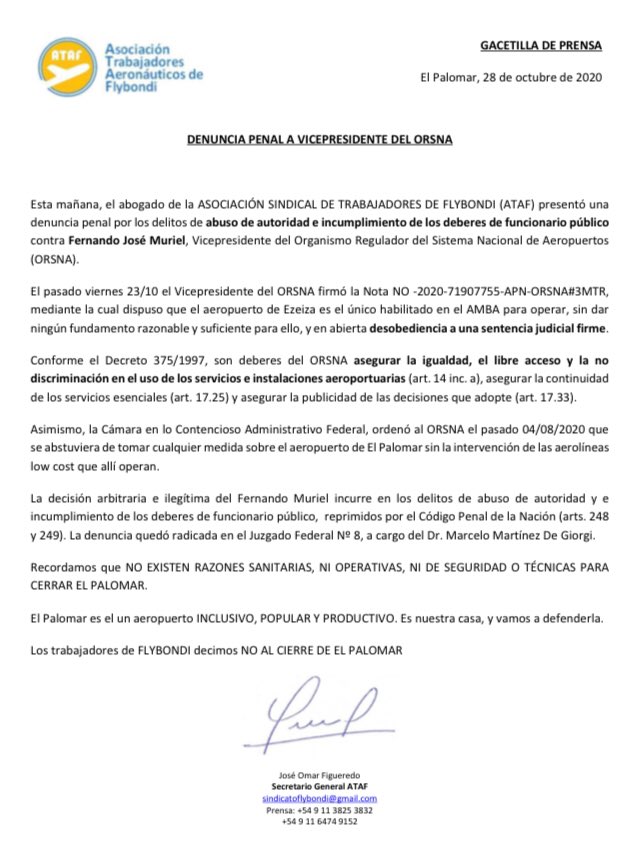
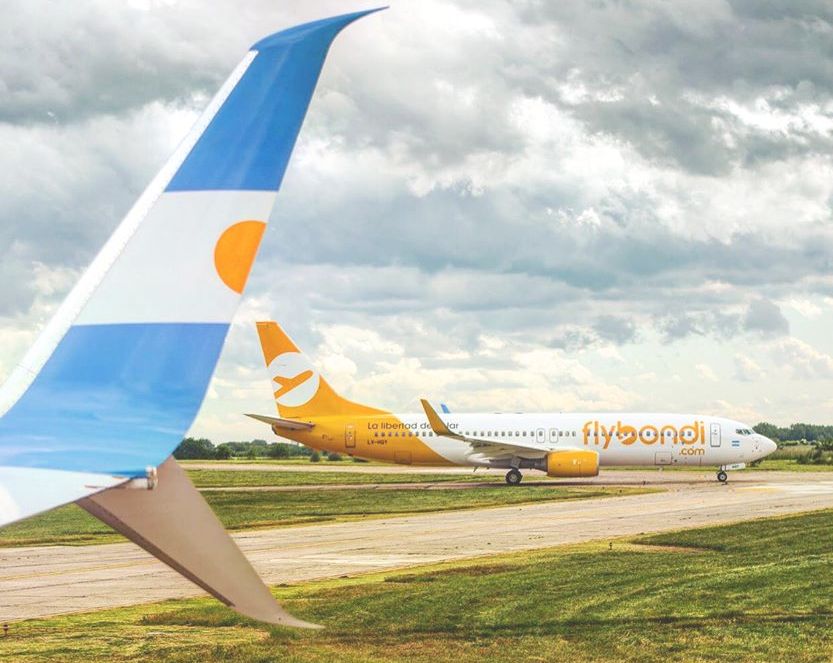
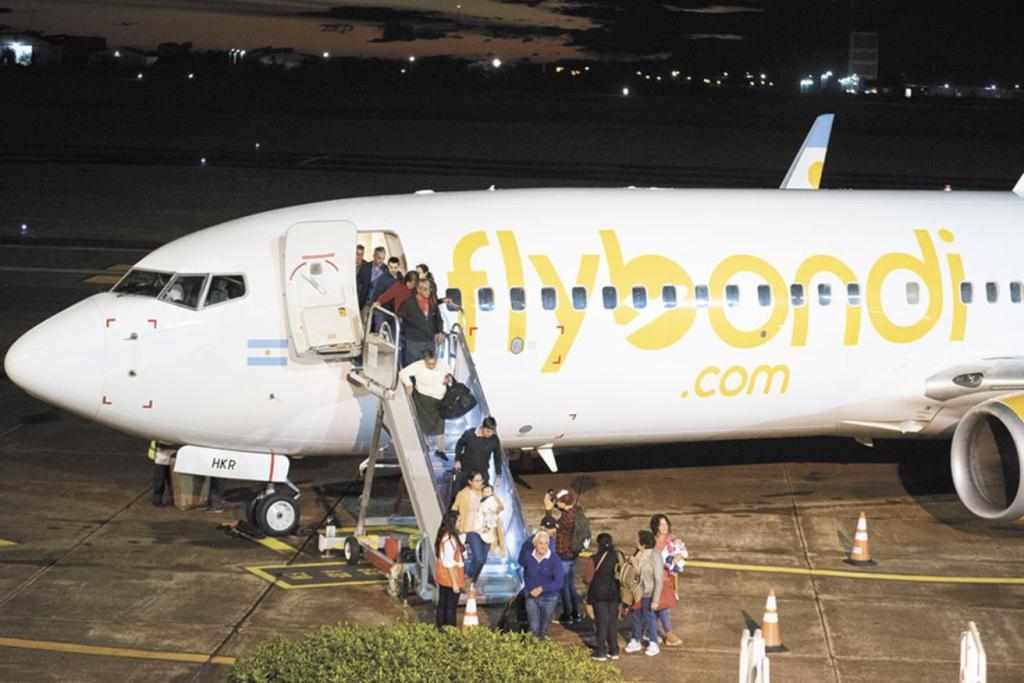
El Sindicato de trabajadores de la low-cost Flybondi Líneas Aéreas, la Asociación de Trabajadores de Aerolínea Flybondi (ATAF) ha presentado una demanda en representación de los empleados a Fernando Muriel, Vicepresidente del Organismo Regulador del Sistema Nacional de Aeropuertos (ORSNA), por abuso de autoridad e incumplimiento de los deberes de funcionario público. La denuncia penal de empleados de Flybondi a funcionario de la agrupación política La Cámpora que ha prohibido la reapertura del Aeropuerto El Palomar, sumando el incremento de la escalada de enfrentamiento entre el Gobierno y la aerolínea de presupuesto Flybondi.

El abogado del sindicato ATAF ha presentado este Miércoles 28/10 una demanda contra el Vicepresidente del ORSNA, Fernando Muriel, accionando penalmente por los delitos de abuso de autoridad e incumplimiento de los deberes de funcionario público. La causa que inició la ATAF ha sido tramitada en el Juzgado Federal Número 8, a cargo de Marcelo Martínez De Giorgi.

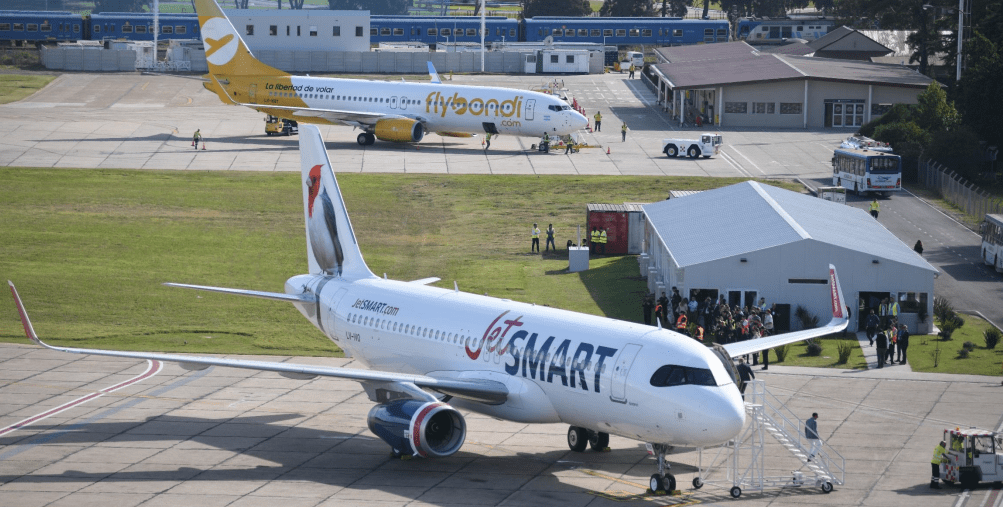
Fernando Muriel, abogado que milita en La Cámpora y responde políticamente al Senador Mariano Recalde, quien fuera Presidente de Aerolíneas Argentinas en la primera gestión del kirchnerismo, firmó la notificación que el Viernes 23/10 a última hora, el ORSNA remitió a la Administración Nacional de Aviación Civil (ANAC). La notificación establece la cancelación de las operaciones del Aeropuerto El Palomar en virtud del «Corredor Sanitario Seguro» definido en el Sistema Nacional de Aeropuertos (SNA) a raíz de la pandemia, y con el Aeropuerto Jorge Newbery cerrado hasta Febrero 2021 por obras, la única terminal aérea autorizada para operar en el área metropolitana de Buenos Aires (AMBA) es el Aeropuerto Internacional Ezeiza. De esta manera el ORSNA ha prohibido la reapertura para vuelos regulares del Aeropuerto El Palomar, la aeroestación donde operan las low cost Flybondi Líneas Aéreas y JetSmart Airlines Argentina.

Según fuentes del sector, el funcionario habría autorizado la firma impuesta por una facción del Gobierno que no simpatiza con la existencia de competencia en el mercado de cabotaje, que también perdió a Latam Airlines Argentina, tras la decisión de abandonar ese tipo de operaciones en el país, con una cuota de mercado de cabotaje correspondiente al 17%.

Posición de Flybondi

AW-Flybondi_B-Isologotype

La compañía aérea Flybondi ha manifestado claramente que «volar desde Aeropuerto Ezeiza no es una opción comercial ni tampoco para nuestros pasajeros», dijo la low-cost en un comunicado. Según la denuncia del gremio ATAF, el funcionario del ORSNA, Fernando Muriel no dio fundamento razonable y suficiente para una decisión que, dicen, fue en abierta desobediencia a una sentencia judicial firme, en relación a un fallo de Martina Forns, Jueza Federal de San Martín, que en Septiembre 2019 había rechazado un pedido de cierre total del aeropuerto. «Conforme el Decreto 375/1997, son deberes del Orsna asegurar la igualdad, el libre acceso y la no discriminación en el uso de los servicios e instalaciones aeroportuarias (Art. 14, Inciso A), asegurar la continuidad de los servicios esenciales (Art. 17, 25) y asegurar la publicidad de las decisiones que adopte (Art. 17, 33)», planteó la presentación sindical bajo el paraguas de la Justicia. La resolución del ORSNA sólo había trascendido en los medios periodísticos, pues en la actualidad, Flybondi no ha recibido notificación oficial alguna del organismo ni de la ANAC; aun con una programación de reinicio de sus vuelos regulares para la semana próxima desde el Aeropuerto El Palomar.

En su comunicado la ATAF ha recordado que el 4 de Agosto de 2020 la Cámara en lo Contencioso Administrativo Federal le ordenó al ORSNA que se abstuviera de tomar cualquier medida sobre el Aeropuerto de El Palomar sin la intervención de las aerolíneas low cost que operan en él. «La decisión arbitraria e ilegítima de Fernando Muriel incurre en los delitos de abuso de autoridad e incumplimiento de los deberes de funcionario público, reprimidos por el Código Penal de la Nación (Artículos Nº 248 y Nº 249). Recordamos que no existen razones sanitarias, ni operativas, ni de seguridad o técnicas para cerrar El Palomar. El aeropuerto es inclusivo, popular y productivo. Es nuestra casa y vamos a defenderla. Los trabajadores de Flybondi decimos no al cierre de El Palomar», remarcó la asociación sindical.

Incongruencias operativas

Aunque Aeropuertos Argentina 2000 (AA2000), concesionaria de las terminales aéreas El Palomar y Ezeiza, han expresado que garantizan que respetarán los costos y tasas que las low cost pagan en El Palomar, hay otros gastos que deberían afrontar y hoy no poseen, como el servicio de rampa y el de carga. En Ezeiza, esta última prestación está a cargo de la empresa estatal Intercargo, en tanto que en el Aeropuerto El Palomar las operaciones en tierra las efectúa directamente la compañía Flybondi.

El Aeropuerto Internacional Ezeiza se encuentra localizado a 33,2 kilómetros de la Ciudad de Buenos Aires, mientras que el Aeropuerto El Palomar, está a sólo 7,1 kilómetros de Capital Federal, lo que afecta a los pasajeros por los incrementos de los costos de traslados donde pudieran alcanzar los mismos valores de los pasajes aéreos. Otra preocupación seria son los a empleados de la compañía donde el 80% reside en las áreas adyacentes al aeropuerto low cost donde estaría amenazado el traslado hacia el Aeropuerto Ezeiza por la falta de transporte público.

Las operaciones en el Aeropuerto Internacional Ezeiza agrega un condimento adicional que deberá compartir la terminal con Aerolíneas Argentinas, dueña de más del 70% del mercado doméstico contra el 19% de la participación que en 2019 consolidaron Flybondi 9% y JetSmart 10%. La principal aeroestación del país tiene un objetivo diferente que es la captación de un mercado internacional, donde las operaciones low cost para los vuelos domésticos no siempre generarían una ventaja competitiva para los usuarios del transporte aéreo.

TRABAJADORES DE FLYBONDI DENUNCIAN AL GOBIERNO NACIONAL - FM OESTE 106.9
Trabajadores de Flybondi se movilizan en todo el país – Canal C
REPERCUSIONES DE MANIFESTACIONES DE EMPLEADOS DE FLYBONDI CONTRA EL CIERRE DEL AEROPUERTO EL PALOMAR

Flybondi vs Gobierno

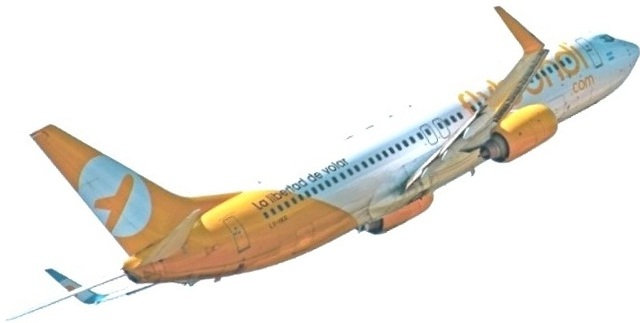
Desde la esfera política del Gobierno de Argentina insisten que Flybondi mantiene operativo una sola aeronave y que haría inviable las operaciones para el Aeropuerto El Palomar. La aerolínea de presupuesto antes de la crisis de la pandemia poseía cinco aeronaves, que tras la incursión de las prohibiciones de los vuelos la compañía devolvió tres Boeing 737-800 que estaban bajo leasing y aprovechó el parate obligado desde Marzo 2020 para enviar otra aeronave similar a los Estados Unidos para hacerle tareas de mantenimiento correspondiente. De esta manera la línea aérea buscaba reducir el impacto económico generado por la pandemia, mientras busca consolidar su posición actual donde existen actualmente mejores ofertas para adquirir aeronaves a un costo menor.

En cuanto a JetSmart Airlines Argentina, ha dado un paso al costado permitiendo las operaciones desde el Aeropuerto Internacional Ezeiza, reanudando sus operaciones a partir de Diciembre 2020. La compañía aérea había programado sus operaciones hacia finales de 11/2020, pero el Jueves 22/11 a última hora había cancelado las operaciones ante la falta de respuesta de la ANAC para habilitar el servicio. Tras la resolución del ORSNA, JetSmart suspendió los vuelos en Octubre 2020 proyectados desde el Aeropuerto El Palomar y los reprogramó para reiniciar operaciones desde Ezeiza a partir del 12/2020.

El Gobierno contraatacó esta semana bajo la propaganda de medios oficialistas que Flybondi Líneas Aéreas habría incumplido inversiones por valor de US$ 30 millones de Dólares prometidas en el Aeropuerto El Palomar. Fuentes de la empresa lo desmienten, recuerdan que cualquier desembolso en infraestructura de una terminal no es responsabilidad de las líneas aéreas, sino de la concesionaria del aeropuerto.

El cierre de esa terminal aérea del Aeropuerto El Palomar estuvo en la agenda política desde que el actual Gobierno asumió sus funciones. A principios de Octubre 2020, tanto los ministerios de Transporte, Turismo y la ANAC habían acordado en público y en privado que el aeropuerto low cost continuaría en operaciones, pero la puja política interna existente ha dado marcha atrás a tales autorizaciones.

Perspectivas aéreas

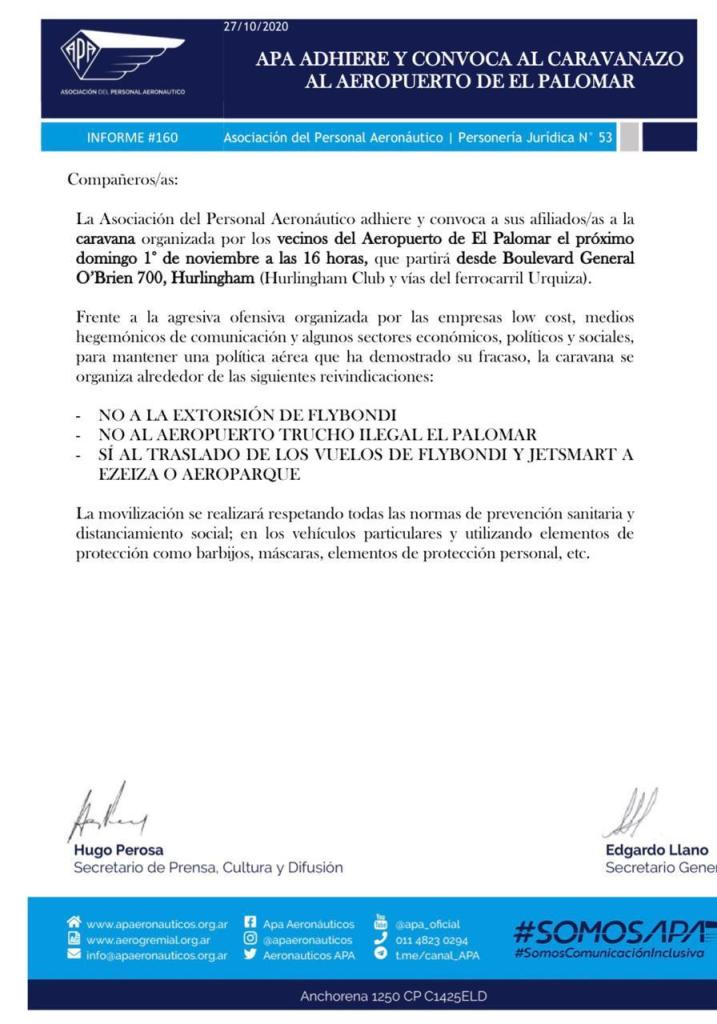
Flybondi Líneas Aéreas es la low cost que más resiste la mudanza de sus operaciones desde el Aeropuerto El Palomar. El CEO de la aerolínea, Esteban Tossutti expresó: «Volar desde Ezeiza no es una opción para Flybondi. Y las autoridades del Gobierno de los organismos reguladores conocen esta realidad». Sin embargo, Flybondi optó por dar pelea junto a sus empleados llevando otra vez el justo reclamo frente de la Casa Rosada.

Las actitudes y acciones del Gobierno contradicen la órbita de los derechos elementales de la Constitución Argentina ultrajándolos a su posición más baja. Los empleados y la compañía Flybondi continuarán la lucha en favor de un mercado aéreo con mayor participación, inclusión y federalismo, algo que el Gobierno pregona pero no cumple.

Flybondi employees denounce ORSNA
Official criminal denounced for banning El Palomar

The Union of workers of the low-cost Flybondi Líneas Aéreas, the Association of Workers of Airline Flybondi (ATAF) has presented a demand in representation of the employees to Fernando Muriel, Vice President of the Regulatory Body of the National Airport System (ORSNA), for abuse of authority and breach of the duties of a public official. The criminal complaint of Flybondi employees to an official of the political group La Cámpora that has prohibited the reopening of El Palomar Airport, adding the increase in the escalation of confrontation between the Government and the budget airline Flybondi.

The ATAF union lawyer filed a lawsuit against the ORSNA Vice President, Fernando Muriel, on Wednesday 10/28, prosecuting the crimes of abuse of authority and breach of the duties of a public official. The case that the ATAF initiated has been processed in Federal Court Number 8, in charge of Marcelo Martínez De Giorgi.

Fernando Muriel, a lawyer who is active in La Cámpora and responds politically to Senator Mariano Recalde, who was President of Aerolíneas Argentinas in the first Kirchner administration, signed the notification that on Friday 10/23 at the last minute, the ORSNA sent to the National Administration of Civil Aviation (ANAC). The notification establishes the cancellation of the operations of the El Palomar Airport under the «Safe Sanitary Corridor» defined in the National Airport System (SNA) as a result of the pandemic, and with the Jorge Newbery Airport closed until February 2021 for works, the The only air terminal authorized to operate in the Buenos Aires metropolitan area (AMBA) is the Ezeiza International Airport. In this way, the ORSNA has prohibited the reopening for regular flights of the El Palomar Airport, the airstation where the low cost Flybondi Líneas Aéreas and JetSmart Airlines Argentina operate.

According to industry sources, the official authorized the signature imposed by a faction of the Government that does not sympathize with the existence of competition in the cabotage market, which also lost Latam Airlines Argentina, after the decision to abandon this type of operations in the country, with a cabotage market share corresponding to 17%.


La imagen tiene un atributo ALT vacío; su nombre de archivo es 123059350_4054611527898810_8371727223443897545_o.jpg

Flybondi position

The airline company Flybondi has clearly stated that «flying from Ezeiza Airport is not a commercial option or for our passengers», the low-cost company said in a statement. According to the ATAF union’s complaint, the ORSNA official, Fernando Muriel, did not give a reasonable and sufficient basis for a decision that, they say, was in open disobedience to a final judicial sentence, in relation to a ruling by Martina Forns, Federal Judge of San Martín, who in September 2019 had rejected a request for the total closure of the airport. «According to Decree 375/1997, Orsna’s duties are to ensure equality, free access and non-discrimination in the use of airport services and facilities (Art. 14, Subsection A), to ensure the continuity of essential services (Art. 17, 25) and ensure the publicity of the decisions that it adopts (Art. 17, 33)», raised the union presentation under the umbrella of Justice. The ORSNA resolution had only been publicized in the journalistic media, because at present, Flybondi has not received any official notification from the agency or the ANAC; even with a schedule to restart their regular flights for next week from El Palomar Airport.

In its statement, the ATAF recalled that on August 4, 2020, the Federal Administrative Litigation Chamber ordered the ORSNA to refrain from taking any measure on the El Palomar Airport without the intervention of the low cost airlines that operate there. «The arbitrary and illegitimate decision of Fernando Muriel incurs the crimes of abuse of authority and non-compliance with the duties of a public official, repressed by the National Penal Code (Articles No. 248 and No. 249). We remember that there are no health reasons, Neither operational, nor security nor technical to close El Palomar. The airport is inclusive, popular and productive. It is our home and we are going to defend it. Flybondi workers say no to the closure of El Palomar», remarked the union.

Operational inconsistencies

Although Airports Argentina 2000 (AA2000), concessionaire of the El Palomar and Ezeiza air terminals, have stated that they guarantee that they will respect the costs and rates that the low cost companies pay in El Palomar, there are other expenses that they should face and do not have today, such as ramp service and loading. In Ezeiza, this last provision is provided by the state company Intercargo, while at El Palomar Airport, ground operations are carried out directly by the Flybondi company.

The Ezeiza International Airport is located 33.2 kilometers from the City of Buenos Aires, while the El Palomar Airport is only 7.1 kilometers from the Federal Capital, which affects passengers due to the increases in transportation costs. transfers where they could achieve the same values ​​of air tickets. Another serious concern is the employees of the company where 80% reside in the areas adjacent to the low cost airport where the transfer to the Ezeiza Airport would be threatened due to the lack of public transport.

Operations at the Ezeiza International Airport add an additional condiment that the terminal must share with Aerolineas Argentinas, which owns more than 70% of the domestic market against the 19% share that Flybondi 9% and JetSmart 10% consolidated in 2019. The main air station in the country has a different objective, which is to attract an international market, where low cost operations for domestic flights would not always generate a competitive advantage for air transport users.

Flybondi vs Government
AW-Flybondi_702

From the political sphere of the Government of Argentina they insist that Flybondi maintains a single aircraft operating and that it would make operations for the El Palomar Airport unviable. The budget airline before the pandemic crisis owned five aircraft, which after the incursion of the flight bans, the company returned three Boeing 737-800s that were under lease and took advantage of the forced stop since March 2020 to send another similar aircraft to the United States for corresponding maintenance. In this way, the airline sought to reduce the economic impact generated by the pandemic, while seeking to consolidate its current position where there are currently better offers to acquire aircraft at a lower cost.

As for JetSmart Airlines Argentina, it has taken a step aside allowing operations from the Ezeiza International Airport, resuming its operations from December 2020. The airline had scheduled its operations towards the end of 11/2020, but on Thursday 11/22 at the last minute it had canceled operations due to the lack of response from the ANAC to enable the service. Following the ORSNA resolution, JetSmart suspended flights in October 2020 projected from El Palomar Airport and rescheduled them to restart operations from Ezeiza as of 12/2020.

The Government counterattacked this week under the propaganda of the pro-government media that Flybondi Líneas Aéreas would have defaulted on investments worth US$ 30 million dollars promised at the El Palomar Airport. Company sources deny it, recalling that any infrastructure disbursement of a terminal is not the responsibility of the airlines, but of the airport concessionaire.

The closure of that air terminal at El Palomar Airport was on the political agenda since the current Government took office. At the beginning of October 2020, both the Ministries of Transport, Tourism and the ANAC had agreed in public and in private that the low cost airport would continue in operations, but the existing internal political bid has reversed such authorizations.

Aerial perspectives

Flybondi Líneas Aéreas is the low cost that most resists the move of its operations from El Palomar Airport. The CEO of the airline, Esteban Tossutti said: «Flying from Ezeiza is not an option for Flybondi. And the government authorities of the regulatory bodies are aware of this reality». However, Flybondi chose to fight alongside his employees, once again bringing the just claim in front of the Casa Rosada.

The attitudes and actions of the Government contradict the orbit of the elementary rights of the Argentine Constitution, outraging them to their lowest position. The employees and the Flybondi company will continue the fight in favor of an air market with greater participation, inclusion and federalism, something that the Government promotes but does not fulfill.


PUBLISHER: Airgways.com
DBk: Airgways.com / Flybondi.com / Twitter.com/TFlybondi / Aeronauticosapa.org.ar / Canalc.com.ar / Unmedioenmoron.com.ar / Lavozdemisiones.com / Viapais.com.ar / Juan Vargas
AW-POST: 202010291015AR

A\W   A I R G W A Y S ®

IATA insta gobiernos ayudas aerolíneas

AW | 2020 10 29 07:53 | AVIATION ORGANISMS / GOVERNMENT

IATA presenta nuevo análisis de costos frente a pandemia

IATA_Logo.svg

La Asociación Internacional de Transporte Aéreo (IATA) ha presentado un nuevo análisis donde expresa que la industria de las aerolíneas no pueden hacer frente al recorte de costos suficientes como para neutralizar la grave quema de efectivo causada por el Covid-19. Las aerolíneas tienen que enfrentar el sector de la aviación se enfrenta a posibles quiebras que ponen en peligro los fuentes laborales hacia el 2021. Ante este panorama, la IATA reiteró su llamamiento para que el gobierno tome medidas de alivio para sostener financieramente a las aerolíneas y evitar los despidos masivos.

Para lograr articular los mecanismos de acción por parte de los gobiernos y las aerolíneas, la asociación ha solicitado la realización de pruebas sanitarias anti-Covid-19 antes de los vuelos programados para permitir realizar la apertura de las fronteras y permitir los viajes sin cuarentena. Se prevé que los ingresos totales de la industria en 2021 tengan una reducción en un 46% respecto al año anterior 2019.

La IATA había pronosticado una caída del 29% en los ingresos del próximo año en comparación con 2019, pero esto se basaba en las expectativas de una recuperación de la demanda a partir del cuarto trimestre de 2020. Sin embargo, la recuperación se ha retrasado debido a los nuevos rebrotes de Covid-19 y a las restricciones de viaje impuestas por el Gobierno, que incluyen el cierre de fronteras y medidas de cuarentena. El organismo de aviación ha previsto que el tráfico de todo el año 2020 se reducirá en un 66% con respecto a 2019, mientras que para el 2021 la IATA estima que para lograr un resultado operativo de equilibrio y neutralizar el gasto de efectivo, los costos unitarios deberán disminuir en un 30% en comparación con el costo medio por kilómetro-espacio disponible para 2020, pero esa disminución no tiene precedentes.

IATA urges governments to help airlines

IATA presents new analysis of costs in the face of pandemic

The International Air Transport Association (IATA) has presented a new analysis where it expresses that the airline industry cannot cope with the cost cutting sufficient to neutralize the serious cash burn caused by Covid-19. Airlines have to face the aviation sector is facing possible bankruptcies that put job sources at risk by 2021. Faced with this scenario, IATA reiterated its call for the government to take relief measures to financially support airlines and avoid mass layoffs.

In order to articulate the mechanisms of action by governments and airlines, the association has requested the performance of anti-Covid-19 health tests before scheduled flights to allow the opening of the borders and allow travel without quarantine. Total industry revenue in 2021 is projected to decrease by 46% over the prior year 2019.

IATA had forecast a 29% drop in revenue next year compared to 2019, but this was based on expectations of a recovery in demand from the fourth quarter of 2020. However, the recovery has been delayed due to to the new outbreaks of Covid-19 and to the travel restrictions imposed by the Government, which include the closure of borders and quarantine measures. The aviation body has forecast that traffic for the entire year 2020 will be reduced by 66% compared to 2019, while by 2021 the IATA estimates that to achieve a balanced operating result and neutralize the expenditure of cash, the costs units should decrease by 30% compared to the average cost per kilometer-space available by 2020, but that decrease is unprecedented.


PUBLISHER: Airgways.com
DBk: Iata.org / Airgways.com
AW-POST: 202010290753AR

A\W   A I R G W A Y S ®

Boeing 737 MAX cerca línea final

AW | 2020 10 28 18:14 | INDUSTRY / AVIATION SAFETY

Boeing pronostica próxima aprobación de recertificación

AW-Icon_Boeing 737 MAX

Boeing_Isologotype

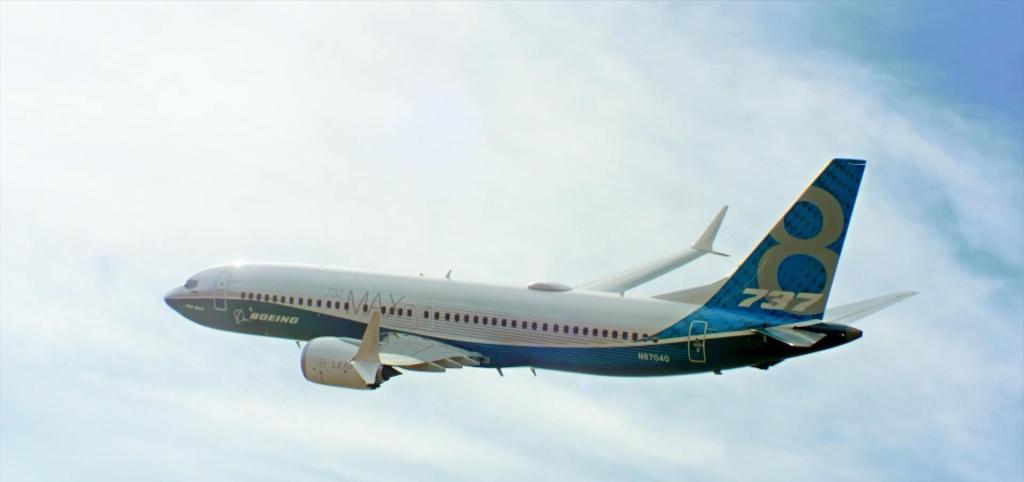
The Boeing Company ha comunicado la aproximación hacia la recertificación de la línea Boeing 737 MAX por parte de la Federal Aviation Administration (FAA). El CEO David Calhoun ha comunicado a la prensa internacional este Miércoles 28/10 que la compañía se está acercando muy a la línea de meta de la conclusión de la conexión a tierra mundial de su avión 737 MAX desde Marzo 2019 después de dos accidentes aéreos.

La compañía aeroespacial Boeing había pronosticado en Julio 2020 que esperaba que el regulador de aviación firmara las aprobaciones de recertificación de la variante de cuarta generación del Boeing 737 hacia el cuarto trimestre de 2020. Los reguladores están en el extremo final de su etapa de revisión de los aviones, pero aún no han firmado formalmente. Una vez que eso suceda, las aerolíneas tendrán que entrenar a sus pilotos 737 MAX, un proceso que se espera que incluya sesiones de entrenamiento por computadora y simulador de aeronaves. «El MAX nos ha costado mucho dinero y hemos tenido que subir la apuesta con respecto a la liquidez para compensar el hecho de que no podíamos evitar el avión más popular del mundo», dijo David Calhoun en una entrevista.

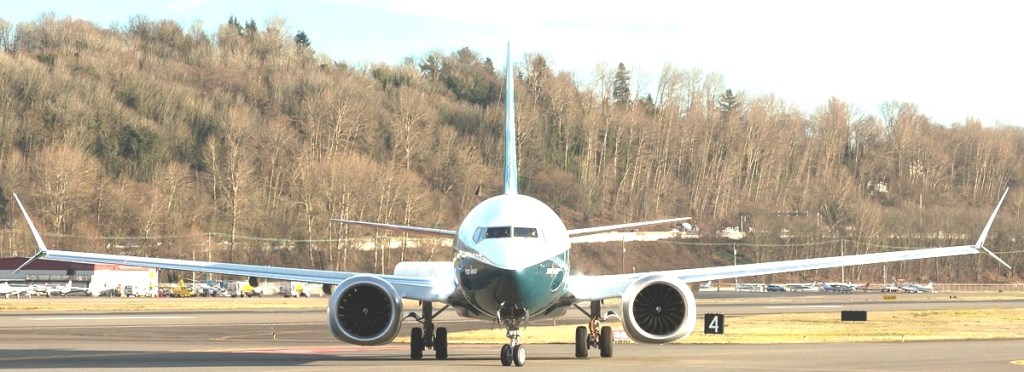
La prohibición de los vuelos del 737 MAX ha impedido a Boeing continuar desarrollando la aeronave en su línea de ensamblaje, devastando sus ventas a medida que el fabricante obtiene mayores costos por paralizaar la producción afectando a toda la industria y las aerolíneas a través del mundo. Con el levantamiento de las restricciones hacia Diciembre 2020, la línea 737 MAX podría volver a surcar los cielos del mundo habiendo aprendido una lección que la industria de Boeing jamás olvidará.

Boeing 737 MAX near final line

Boeing Forecasts Upcoming Recertification Approval

AW-7370078

Boeing_Isologo.svg

The Boeing Company has announced the approach towards the recertification of the Boeing 737 MAX line by the Federal Aviation Administration (FAA). CEO David Calhoun has communicated to the international press this Wednesday 10/28 that the company is approaching very close to the finish line of the completion of the global grounding of its 737 MAX aircraft since March 2019 after two plane accidents.

The aerospace company Boeing had forecast in July 2020 that it expected the aviation regulator to sign recertification approvals for the fourth-generation variant of the Boeing 737 by the fourth quarter of 2020. Regulators are at the final end of their review stage of the planes, but have not yet formally signed. Once that happens, airlines will have to train their 737 MAX pilots, a process that is expected to include computer and aircraft simulator training sessions. «The MAX has cost us a lot of money and we have had to up the ante on liquidity to make up for the fact that we could not avoid the most popular aircraft in the world», David Calhoun said in an interview.

The 737 MAX flight ban has prevented Boeing from continuing to develop the aircraft on its assembly line, devastating its sales as the manufacturer gains higher costs for shutting down production affecting the entire industry and airlines across the world. With the lifting of restrictions towards December 2020, the 737 MAX line could once again take to the skies of the world having learned a lesson that the Boeing industry will never forget.


PUBLISHER: Airgways.com
DBk: Boeing.com / Airgways.com
AW-POST: 202010281814AR

A\W   A I R G W A Y S ®

Boeing despedirá 7.000 adicionales

AW | 2020 10 28 16:50 | INDUSTRY

Aeroespacial recortará más trabajadores ante aumento pérdidas

Boeing_Isologotype

The Boeing Company anunció que recortará otros 7.000 puestos de trabajo adicionales a medida que sus pérdidas continúen aumentando tras una caída de los ingresos. El fabricante de aviones ya había anunciado que reducir el personal en 19.000 puestos de trabajo a principios de 2020 a través de una combinación de despidos voluntarios e involuntarios. El Miércoles 28/10 ha comunicado que espera llegar a unos 130.000 puestos de trabajo activos para el final del año, lo que significaría 7.000 recortes de empleo adicionales, además del desgaste natural en la empresa durante todo el año. En Agosto 2020, la compañía había advertido a los empleados que se acercarían recortes de empleo adicionales, ya que ofrecía una nueva ronda de negociaciones. Boeing no ha identificado inmediatamente dónde se producirían los recortes de empleo y no está definido si este será el final de los procesos de recortes.

La compañía aeroespacial registró una pérdida de US$ 754 millones de Dólares, excluyendo partidas especiales, en el trimestre más reciente, ya que los ingresos cayeron US$ 5.8 mil millones lo que representan un 29%. Las aerolíneas han puesto los frenos en las entregas de nuevos aviones y están cancelando pedidos debido a la fuerte caída de los viajes aéreos causada por la pandemia. «La pandemia global continuó agregando presión a nuestro negocio este trimestre, y nos estamos alineando con esta nueva realidad», dijo el CEO de la compañía, Dave Calhoun en la convocatoria de ganancias. El tráfico aéreo mundial no volverá a los niveles de 2019 durante al menos tres años más, y tardará varios años en ponerse al día con los niveles de crecimiento que se habían previsto antes de la pandemia. El impacto de la pandemia en las ventas de aeronaves durará muchos años, dijo, y añadió que las perspectivas de 10 años del mercado de aviones comerciales de Boeing son aproximadamente un 11% inferiores a las que se suponía hace un año. «Desde una perspectiva de 20 años, todavía vemos el impacto de Covid, pero en menor medida», dijo Dave Calhoun.

Boeing ha asumido más de US$ 37.000 millones de Dólares en deuda adicional para capear esta recesión. Incluso con la creciente quema de efectivo, la compañía tenía US$ 10.600 millones de Dólares en liquidez al final del tercer trimestre: US$ 1.100 millones de Dólares más que al comienzo del año. La compañía anunció este Miércoles 28/10 que ahora utilizará las acciones de Boeing en lugar de efectivo para financiar la contribución de la compañía a los Planes 401(k) de los empleados en el futuro previsible, que está diseñado para ahorrarle US$ 1.000 millones de Dólares en efectivo.

Boeing will lay off an additional 7,000

Aerospace to cut more workers as losses increase

Boeing_Isologo.svg

The Boeing Company announced that it will cut another 7,000 additional jobs as its losses continue to mount following a drop in revenue. The aircraft manufacturer had already announced that it would cut staff by 19,000 jobs by early 2020 through a combination of voluntary and involuntary layoffs. On Wednesday 10/28, it announced that it expects to reach around 130,000 active jobs by the end of the year, which would mean 7,000 additional job cuts, in addition to wear and tear on the company throughout the year. In August 2020, the company had warned employees that additional job cuts were coming as it offered a new round of negotiations. Boeing has not immediately identified where the job cuts would occur and it is not clear if this will be the end of the cuts process.

The aerospace company posted a loss of US$ 754 million, excluding special items, in the most recent quarter, as revenues fell US$ 5.8 billion, representing 29%. Airlines have put the brakes on new aircraft deliveries and are canceling orders due to the sharp drop in air travel caused by the pandemic. «The global pandemic continued to add pressure to our business this quarter, and we are aligning ourselves with this new reality», said company CEO Dave Calhoun in the earnings call. Global air traffic will not return to 2019 levels for at least three more years, and it will take several years to catch up with the growth levels that had been predicted before the pandemic. The impact of the pandemic on aircraft sales will last for many years, he said, adding that the 10-year outlook for Boeing’s commercial aircraft market is about 11% lower than was assumed a year ago. «From a 20-year perspective, we still see the impact of Covid, but to a lesser extent», said Dave Calhoun.

Boeing has taken on more than US$ 37 billion in additional debt to weather this recession. Even with the increasing burning of cash, the company had US$ 10.6 billion in liquidity at the end of the third quarter: US$ 1.1 billion more than at the beginning of the year. The company announced this Wednesday 10/28 that it will now use Boeing stock instead of cash to fund the company’s contribution to employee 401 (k) Plans for the foreseeable future, which is designed to save you US$ 1 billion. of Dollars in cash.


PUBLISHER: Airgways.com
DBk: Boeing.com / Airgways.com / Afp.com/Jason Redmon
AW-POST: 202010281650AR

A\W   A I R G W A Y S ®

Myanmar recibe primer E190

AW | 2020 10 28 16:23 | AIRLINES

Myanmar Airways convierte nueva aerolínea operadora E190

MAI_Isologotype

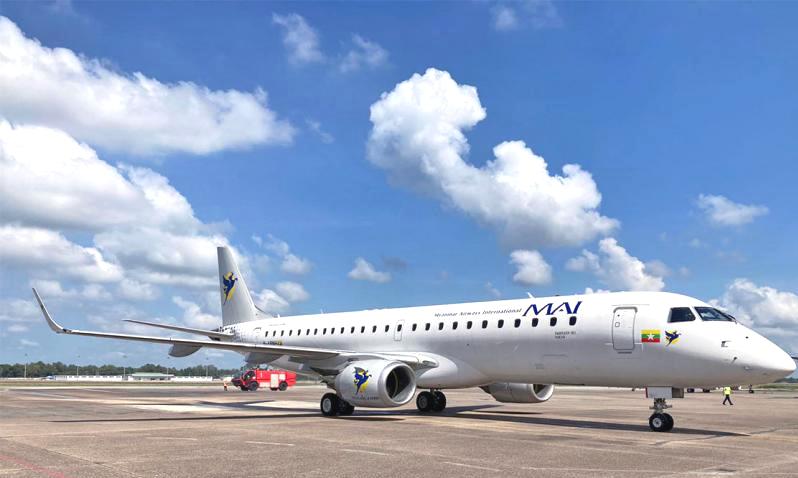
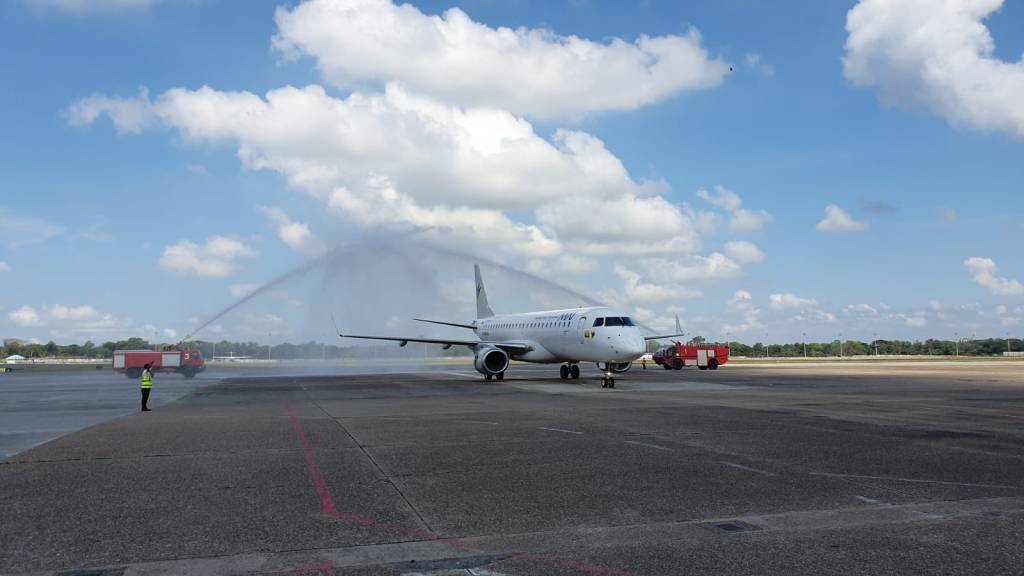
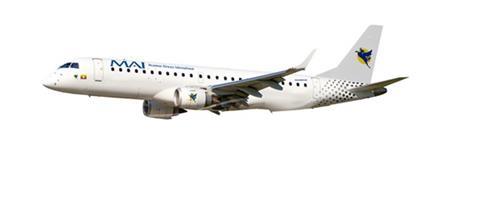
La aerolínea de la República de Myanmar ha incorporado el nuevo miembro de la flota regional, el Embraer E190-100LR. Myanmar Airways International (MAI) ha tomado entrega del primero de los cuatro Embraer E190-100 ordenados por la aerolínea de una compañía de arrendamiento aeronáutico. Procedente de Guangzhou, China, la aeronave ha aterrizado el Lunes 26/10 en el Aeropuerto Internacional de Yangon con vuelo número ZZ-529, tras la bienvenida a la compañía. El nuevo avión E190 esta configurado en dos clases: Ejecutiva y Economy, permitiendo a la línea aérea alcanzar unmejor coheficiente de ocupación para las conexiones regionales.

El CEO de Mtanmar Airways, Saravanan Ramasamy, dijo que «la llegada del E190 representa un hito importante en la estrategia de expansión de la flota de mai. Este avión de alto rendimiento no solo nos permite lograr la eficiencia operativa, sino que también proporciona a nuestros clientes una experiencia significativamente mejorada».

«Damos la bienvenida a Myanmar Airways International a la familia Embraer y les deseamos lo mejor en preparación para el inicio de sus vuelos comerciales E190. El E190 aporta rendimiento y eficiencia a Myanmar Airways International a medida que amplían su red y ofrecen una excelente cabina para que los pasajeros viajen con comodidad», dijo Raúl Villarón, Vicepresidente de Aviación Comercial de Embraer para Asia Pacífico.

Myanmar Airways actualmente posee una red de vuelos internacionales a Singapur, Tailandia, China, Corea, India y Taiwán desde Rangún y Mandalay. Con la adquisición de las nuevas aeronaves regionales, la aerolínea expandirá su red de servicios con un plan estratégico para el mercado doméstico y regional.

Myanmar receives first E190

Myanmar Airways converts new operating airline E190

The Republic of Myanmar airline has added the new member of the regional fleet, the Embraer E190-100LR. Myanmar Airways International (MAI) has taken delivery of the first of four Embraer E190-100s ordered by the airline from an aeronautical leasing company. Coming from Guangzhou, China, the aircraft landed on Monday 10/26 at Yangon International Airport with flight number ZZ-529, after welcoming the company. The new E190 aircraft is configured in two classes: Executive and Economy, allowing the airline to achieve a better occupancy ratio for regional connections.

Mtanmar Airways CEO Saravanan Ramasamy said that «the arrival of the E190 represents an important milestone in Mai ‘fleet expansion strategy. This high-performance aircraft not only enables us to achieve operational efficiency, but also provides our customers a significantly improved experience».

«We welcome Myanmar Airways International to the Embraer family and wish them the best in preparation for the start of their commercial E190 flights. The E190 brings performance and efficiency to Myanmar Airways International as they expand their network and offer an excellent cabin for that passengers travel in comfort», said Raúl Villarón, Embraer’s Vice President of Commercial Aviation for Asia Pacific.

Myanmar Airways currently has a network of international flights to Singapore, Thailand, China, Korea, India and Taiwan from Yangon and Mandalay. With the acquisition of the new regional aircraft, the airline will expand its service network with a strategic plan for the domestic and regional market.

မြန်မာနိုင်ငံသည်ပထမဆုံး E190 ကိုလက်ခံရရှိခဲ့သည်

Myanmar Airways သည် E190 လေကြောင်းလိုင်းအသစ်ကိုပြောင်းလဲခဲ့သည်

မြန်မာသမ္မတလေကြောင်းလိုင်းသည်ဒေသဆိုင်ရာရေတပ်အဖွဲ့ဝင်အသစ်ဖြစ်သော Embraer E190-100LR ကိုထည့်သွင်းခဲ့သည်။ Myanmar Airways International (MAI) သည်လေကြောင်းလိုင်းငှားရမ်းရေးကုမ္ပဏီတစ်ခုမှလေယာဉ်ဖြင့်အမိန့်ပေးသော Embraer E190-100 လေယာဉ်လေးစင်းအနက်မှပထမအကြိမ်ကိုသယ်ဆောင်သွားသည်။ တရုတ်နိုင်ငံ၊ ကွမ်ကျိုးမှလေယာဉ်ပျံကို ZZ-529 လေယာဉ်ဖြင့်ရန်ကုန်အပြည်ပြည်ဆိုင်ရာလေဆိပ်၌တနင်္လာနေ့ ၁၀/၂၆ တွင်လေယာဉ်ကုမ္ပဏီမှကြိုဆိုခဲ့ပြီးနောက်ဆင်းသက်ခဲ့သည်။ E190 လေယာဉ်အသစ်ကို Executive နှင့် Economy ဟူ၍ နှစ်မျိုးခွဲခြားထားသည်။ လေကြောင်းလိုင်းသည်ဒေသတွင်းဆက်သွယ်မှုများအတွက်နေရာချထားမှုအချိုးအစားပိုမိုကောင်းမွန်စေသည်။

Mtanmar လေကြောင်းလိုင်း၏အမှုဆောင်အရာရှိချုပ် Saravanan Ramasamy က “E190 ရောက်ရှိခြင်းသည် Mai ၏တိုးချဲ့မဟာဗျူဟာ၏အရေးပါသောမှတ်တိုင်တစ်ခုဖြစ်သည်ဟုပြောကြားခဲ့သည်။ ဤစွမ်းဆောင်ရည်မြင့်လေယာဉ်များသည်ကျွန်ုပ်တို့အားလုပ်ငန်းလည်ပတ်မှုစွမ်းဆောင်ရည်ကိုအောင်မြင်စေရုံသာမကထောက်ပံ့ပေးမှုကိုပါပေးသည်။ ကျွန်ုပ်တို့၏ဖောက်သည်များသိသိသာသာတိုးတက်လာသောအတွေ့အကြုံ»

«Embraer မိသားစုကို Myanmar Airways အပြည်ပြည်ဆိုင်ရာလေကြောင်းလိုင်းကိုကြိုဆိုပါတယ်။ E190 ပျံသန်းမှုစတင်မယ့်အချိန်မှာအကောင်းဆုံးဖြစ်ပါစေလို့ဆုတောင်းပါတယ်။ E190 ဟာမြန်မာလေကြောင်းလိုင်းအပြည်ပြည်ဆိုင်ရာလေကြောင်းလိုင်းရဲ့စွမ်းဆောင်ရည်နဲ့စွမ်းဆောင်ရည်တွေကိုသူတို့ကွန်ယက်ကိုတိုးချဲ့ပြီးကောင်းမွန်တဲ့အခန်းတစ်ခန်းကိုကမ်းလှမ်းလာတဲ့အချိန်မှာအကောင်းဆုံးဖြစ်ပါစေ»။ ခရီးသည်များအဆင်ပြေစွာခရီးသွားလာနိုင်ကြောင်း Embraer ၏စီးပွားဖြစ်လေကြောင်းဆိုင်ရာဒုတိယဥက္ကPresident္ဌRaúlVillarónကပြောကြားခဲ့သည်။

Myanmar Airways သည်စင်ကာပူ၊ ထိုင်း၊ တရုတ်၊ ကိုရီးယား၊ အိန္ဒိယနှင့်ထိုင်ဝမ်သို့ရန်ကုန်နှင့်မန္တလေးမှအပြည်ပြည်ဆိုင်ရာလေကြောင်းခရီးစဉ်များရှိသည်။ ဒေသတွင်းလေယာဉ်သစ်များဝယ်ယူခြင်းဖြင့်လေကြောင်းလိုင်းသည်ပြည်တွင်းနှင့်ဒေသတွင်းစျေးကွက်အတွက်မဟာဗျူဟာမြောက်အစီအစဉ်ဖြင့်၎င်း၏ ၀ န်ဆောင်မှုကွန်ယက်ကိုတိုးချဲ့လိမ့်မည်။


PUBLISHER: Airgways.com
DBk: Maiair.com / Airgways.com
AW-POST: 202010281623AR

A\W   A I R G W A Y S ®

Virgin anuncia reapertura vuelos

AW | 2020 10 28 15:55 | AIRLINES / GOVERNMENT

Virgin anuncia nuevas rutas en preparación apertura de fronteras

Virgin Australia Isologotype

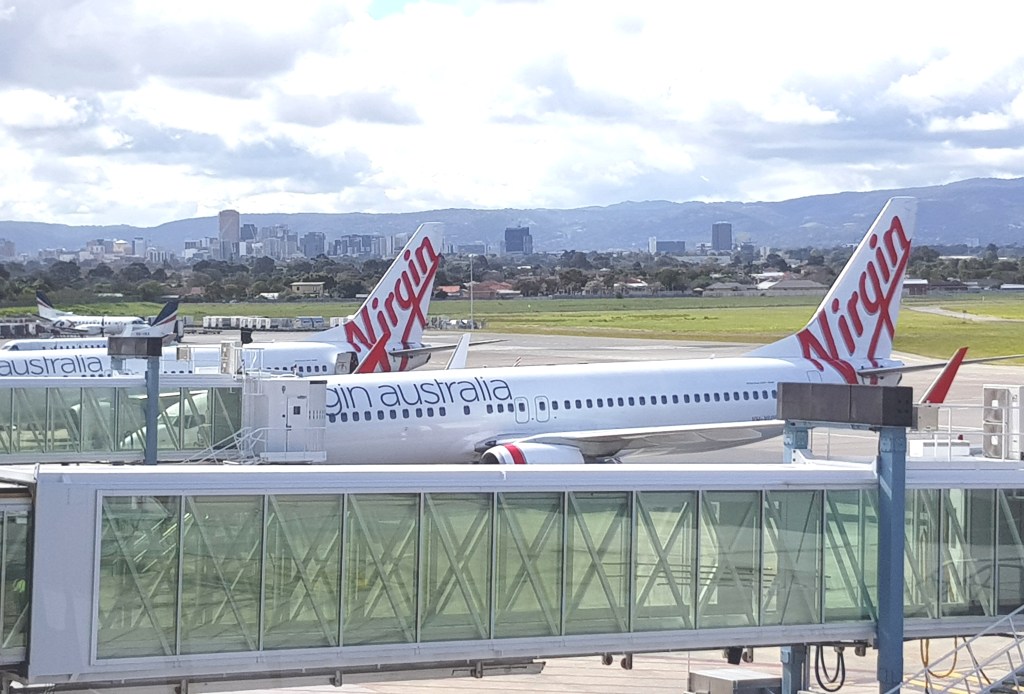
Mientras Australia avanza hacia la reapertura de las fronteras en Diciembre 2020, Virgin Australia Airlines ha anunciado que desplegará algunas nuevas rutas nacionales. La aerolínea comenzará a volar en puntos claves que esperan producir una reactivación, especialmente cuando Queensland se prepara para una frontera que se reabre con New South Wales (NSW). La aerolínea ha anunciado que desplegará una serie de nuevas rutas nacionales a medida que las restricciones fronterizas estatales y territoriales comiencen a aliviarse. Virgin Australia reintroducirá su servicio semanal cinco veces entre Brisbane y Emerald, así como un servicio dos veces por semana entre Brisbane y Alice Springs. Aumentará los vuelos entre Brisbane y Hamilton Island a 10 servicios por semana y los vuelos a Adelaida volverán a tres veces al día. A medida que la línea aéreas regional del Estado de New South Wales sigue viendo un auge en los viajes intraestatales, la aerolínea aumentará los vuelos a Ballina/Byron y también a Sidney a Adelaida a partir de mediados de Noviembre 2020. «La expansión de nuestra red para incluir a Emerald y una ruta adicional a Alice Springs reconoce nuestro compromiso de larga data con la Australia regional y ofrecerá opciones y conveniencia para esas comunidades y negocios. El aumento de las frecuencias a Byron Bay, Hamilton Island y Adelaida ayudará a la industria del turismo a ponerse de pie», dijo el Director Comercial de Virgin Australia Group, John MacLeod.

El Gobierno de Australia cerró la frontera de la nación en Marzo 2020, mientras que las fronteras nacionales en algunos estados siguen cerradas. Según la investigación, las consecuencias económicas del cierre de la aviación nacional fueron de 17.000 millones de dólares, mientras que la pérdida de vuelos internacionales le costó a la economía US$ 61.000 millones de Dólares. A principios de Octubre 2020, nuevas investigaciones del Consejo Empresarial de Australia (ABC) revelaron que el país está perdiendo un total de US$ 319 millones de Dólares al día en viajes aéreos nacionales e internacionales debido a los cierres fronterizos en curso.

«Los cierres fronterizos estatales han visto que el número de pasajeros en las rutas aéreas más concurridas de Australia se desplomó en un 91 por ciento desde marzo, lo que paralizó el sector de la aviación y causa efectos perjudiciales en el turismo y la hospitalidad. Cada día los vuelos siguen en tierra cuesta a Australia US$ 69 millones de Dólares, es decir, US$ 2.100 millones de dólares al mes. Cuando se añaden pérdidas de aviación internacional a 250 millones de dólares al día o US$ 7.600 millones de dólares al mes, estamos hablando de un enorme éxito para nuestra economía»‘, dijo el Director Ejecutivo del Consejo de Negocios de Australia, Jennifer Westacott. Como resultado, Qantas Airways y Virgin Australia Airlines, las dos aerolíneas más grandes de Australia, han despedido a más de 11.000 personas este año. Es probable que las fronteras internacionales de Australia permanezcan cerradas hasta que se implemente una vacuna en todo el país con el presupuesto federal el mes pasado, revelando que los vuelos internacionales probablemente no volverían a ningún nivel normal hasta que esto suceda. Pero la ABC dijo que los líderes políticos de Australia necesitan mirar la apertura de las fronteras internacionales ahora.

Virgin announces reopening flights

Virgin announces new flight routes in preparation for border opening

virgin-australia

As Australia moves towards reopening the borders in December 2020, Virgin Australia Airlines has announced that it will roll out some new domestic routes. The airline will begin flying at key points that they hope will bring about a revival, especially as Queensland prepares for a reopening border with New South Wales (NSW). The airline has announced that it will roll out a series of new domestic routes as state and territorial border restrictions begin to ease. Virgin Australia will reintroduce its weekly service five times between Brisbane and Emerald, as well as a twice weekly service between Brisbane and Alice Springs. It will increase flights between Brisbane and Hamilton Island to 10 services per week and flights to Adelaide will return to three times a day. As the New South Wales State Regional Airline continues to see a boom in intrastate travel, the airline will increase flights to Ballina/Byron and also Sydney to Adelaide from mid-November.

«Expanding our network to include Emerald and an additional route to Alice Springs recognizes our longstanding commitment to regional Australia and will offer choice and convenience for those communities and businesses. Increasing frequencies to Byron Bay, Hamilton Island and Adelaide will help the tourism industry to stand up», said Virgin Australia Group Chief Commercial Officer John MacLeod.

The Australian Government closed the nation’s border in March 2020, while national borders in some states remain closed. According to the investigation, the economic consequences of the closure of national aviation were US$ 17,000 million dollars, while the loss of international flights cost the economy US$ 61,000 million dollars. In early October 2020, new investigations by the Australian Business Council (ABC) revealed that the country is losing a total of US$ 319 million a day on domestic and international air travel due to ongoing border closures.

«State border closures have seen passenger numbers on Australia’s busiest air routes plummet by 91 percent since March, crippling the aviation sector and causing detrimental effects on tourism and hospitality. Each Today the flights are still on the ground costs Australia US$ 69 million, that is, US$ 2.1 billion a month. When international aviation losses are added to 250 million dollars a day or US$ 7.6 billion dollars a day. month, we are talking about huge success for our economy», said Australian Business Council Executive Director Jennifer Westacott. As a result, Qantas Airways and Virgin Australia Airlines, Australia’s two largest airlines, have laid off more than 11,000 people this year. Australia’s international borders are likely to remain closed until a nationwide vaccine is rolled out with the federal budget last month, revealing that international flights would likely not return to any normal level until this happens. But ABC said Australia’s political leaders need to look at the opening of international borders now.


PUBLISHER: Airgways.com
DBk: Virginaustralia.com / Airgways.com
AW-POST: 202010281555AR

A\W   A I R G W A Y S ®

Bangladesh-India inician conectividad

AW | 2020 10 28 15:15 | AIRLINES MARKET / GOVERNMENT

Gobiernos establecen reapertura aérea en viajes de burbuja

Los gobiernos de Bangladesh y la India han restaurada las rutas aéreas bajo disposición de viajes de burbuja después de más de siete meses de suspensión de vuelo para la contención de la pandemia. Bajo el mecanismo de burbujas aéreas, la conectividad aérea se restauró sólo entre Bangladesh y la India, donde no habrá ningún tercer país involucrado, lo que significa que las compañías aéreas no aceptarán pasajeros de tránsito.

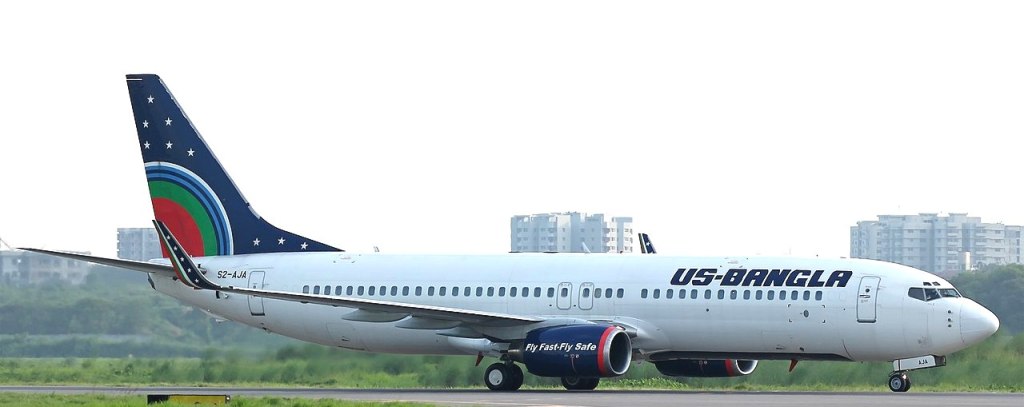
El primer vuelo de reanudación entre los dos países comenzó como un vuelo comercial regular de US-Bangla Airlines desde Dhaka a Calcuta despegó del Aeropuerto Internacional Hazrat Shahjalal (HSIA) a las 09:45 a.m. del Miércoles 28/10. El Alto Comisionado indio de Bangladesh, Vikram K Doraiswami, Presidente de la Autoridad de Aviación Civil de Bangladesh (CAAB), el Vicemariscal M Mafidur Rahman, y el CEO de US-Bangla Airlines, el capitán Skikdar Meshba Uddin Ahmed, estuvieron presentes en el aeropuerto para despedir a los pasajeros con destino a Calcuta, dijo el portavoz de la aerolínea. US-Bangla Airlines también operaron un vuelo Dhaka-Chennai-Dhaka a las 10:30 de la mañana del 28/10, mientras que la aerolínea de bandera nacional Biman reanudará su operación en la India a través de su vuelo de Nueva Delhi desde el Jueves 29/10. Biman Bangladesh Airlines reanudará vuelos a Calcuta y Chennai a partir del 1 de Noviembre y el 15 de Noviembre 2020, respectivamente. Novoair, otro transportista local, ha tomado la preparación para reabrir su vuelo de Calcuta, pero la fecha de reanudación aún no se ha decidido, añadió el funcionario de las aerolíneas.

La India ya ha introducido esa burbuja de aire con un número de países como Francia, Alemania, los EAU y Maldivas, mientras que este es el primero en su tipo para Bangladesh. Según el acuerdo de burbuja aérea, tres aerolíneas bangladeshíes Biman Bangladesh Airlines, US-Bangla Airlines y Novo Air operarán inicialmente 28 vuelos a la semana, mientras que cinco compañías indias Air India, Vistara, IndiGo, SpiceJet y GoAir realizarán el mismo número de vuelos en una semana. Según la CAAB, cinco aerolíneas indias operarán vuelos en Delhi-Dhaka-Delhi, Kolkata-Dhaka-Kolkata, Chennai-Dhaka-Chennai y Mumbai-Dhaka-Mumbai.

El 9 de Octubre de 2020, la Alta Comisión de la India en Bangladesh anunció la reanudación de los servicios de solicitud de visados en línea para los ciudadanos bangladeshíes. Por ahora, los visados se proporcionarán en nueve categorías, incluidos los médicos, las empresas, el empleo, los periodistas, los diplomáticos, los funcionarios personales, los funcionarios, los funcionarios de la ONU y los diplomáticos de la ONU, dijo el Ministerio de Relaciones Exteriores de Bangladesh.

Bangladesh-India restore connectivity

Governments establish air reopening in bubble travel

The governments of Bangladesh and India have restored the air routes under the provision of bubble travel after more than seven months of flight suspension to contain the pandemic. Under the air bubble mechanism, air connectivity was restored only between Bangladesh and India, where there will be no third country involved, which means that airlines will not accept transit passengers.

The first resumption flight between the two countries started as a regular commercial US-Bangla Airlines flight from Dhaka to Kolkata taking off from Hazrat Shahjalal International Airport (HSIA) at 09:45 a.m. on Wednesday 10/28. Bangladesh Indian High Commissioner Vikram K Doraiswami, Chairman of the Bangladesh Civil Aviation Authority (CAAB), Vice Marshal M Mafidur Rahman, and US-Bangla Airlines CEO Captain Skikdar Meshba Uddin Ahmed, were present at the airport to dismiss passengers bound for Kolkata, the airline spokesman said. US-Bangla Airlines also operated a Dhaka-Chennai-Dhaka flight at 10:30 am on 10/28, while the national flag carrier Biman will resume its operation in India through its New Delhi flight from the Thursday 10/29. Biman Bangladesh Airlines will resume flights to Kolkata and Chennai from November 1 and November 15, 2020, respectively. Novoair, another local carrier, has taken preparation to reopen its Calcutta flight, but the resumption date has not yet been decided, the airline official added.

India has already introduced that air bubble with a number of countries including France, Germany, the UAE, and the Maldives, while this is the first of its kind for Bangladesh. Under the air bubble deal, three Bangladeshi airlines Biman Bangladesh Airlines, US-Bangla Airlines and Novo Air will initially operate 28 flights a week, while five Indian carriers Air India, Vistara, IndiGo, SpiceJet and GoAir will operate the same number of flights. in a week. According to the CAAB, five Indian airlines will operate flights in Delhi-Dhaka-Delhi, Kolkata-Dhaka-Kolkata, Chennai-Dhaka-Chennai and Mumbai-Dhaka-Mumbai.

On October 9, 2020, the High Commission of India in Bangladesh announced the resumption of online visa application services for Bangladeshi citizens. For now, visas will be provided in nine categories, including doctors, companies, employment, journalists, diplomats, personal officials, civil servants, UN officials and UN diplomats, the Ministry of Defense said. Foreign Relations of Bangladesh.

बांग्लादेश-भारत की कनेक्टिविटी बहाल

सरकारें बबल यात्रा में हवा को खोलती हैं

बांग्लादेश और भारत की सरकारों ने महामारी को रोकने के लिए उड़ान निलंबन के सात महीने से अधिक समय के बाद बुलबुला यात्रा व्यवस्था के तहत हवाई मार्गों को बहाल किया है। एयर बबल मैकेनिज्म के तहत, केवल बांग्लादेश और भारत के बीच हवाई संपर्क बहाल किया गया था, जहां कोई तीसरा देश शामिल नहीं होगा, जिसका अर्थ है कि एयरलाइंस पारगमन यात्रियों को स्वीकार नहीं करेगी।

दोनों देशों के बीच पहली बार शुरू होने वाली उड़ान ढाका से कोलकाता के लिए एक नियमित वाणिज्यिक यूएस-बांग्ला एयरलाइंस की उड़ान के रूप में हजरत शाहजलाल अंतर्राष्ट्रीय हवाई अड्डे (एचएसआईए) से सुबह 09:45 बजे शुरू हुई। बुधवार 10/28 को। बांग्लादेश के भारतीय उच्चायुक्त विक्रम के। दोविस्वामी, बांग्लादेश सिविल एविएशन अथॉरिटी (CAAB) के चेयरमैन, वाइस मार्शल एम। मफीदुर रहमान, और यूएस-बांग्ला एयरलाइंस के सीईओ कैप्टन स्किकर मेशबा उद्दीन अहमद, उपस्थित थे एयरलाइन के प्रवक्ता ने कहा कि कोलकाता के लिए बाध्य यात्रियों को खारिज करने के लिए हवाई अड्डा। यूएस-बांग्ला एयरलाइंस ने भी 10:30 बजे 10:30 बजे ढाका-चेन्नई-ढाका उड़ान संचालित की, जबकि राष्ट्रीय ध्वजवाहक बिमान भारत में अपनी नई दिल्ली उड़ान से अपना संचालन फिर से शुरू करेगा गुरुवार 10/29। बिमान बांग्लादेश एयरलाइंस क्रमशः 1 नवंबर और 15 नवंबर, 2020 से कोलकाता और चेन्नई के लिए उड़ानें फिर से शुरू करेगी। एयरलाइन के एक अन्य अधिकारी ने कहा कि नोवोर ने कलकत्ता की उड़ान को फिर से खोलने की तैयारी कर ली है, लेकिन फिर से शुरू करने की तारीख अभी तय नहीं की गई है।

भारत ने पहले ही फ्रांस, जर्मनी, यूएई और मालदीव सहित कई देशों के साथ उस हवाई बुलबुले को पेश किया है, जबकि यह बांग्लादेश के लिए अपनी तरह का पहला है। एयर बबल डील के तहत, बांग्लादेश की तीन एयरलाइंस बिमान बांग्लादेश एयरलाइंस, यूएस-बांग्ला एयरलाइंस और नोवो एयर शुरू में एक सप्ताह में 28 उड़ानें संचालित करेंगे, जबकि पांच भारतीय वाहक एयर इंडिया, विस्तारा, इंडिगो, स्पाइसजेट और गोएयर एक ही संख्या में उड़ानों का संचालन करेंगे। हफ्ते भर में। सीएएबी के अनुसार, पांच भारतीय एयरलाइंस दिल्ली-ढाका-दिल्ली, कोलकाता-ढाका-कोलकाता, चेन्नई-ढाका-चेन्नई और मुंबई-ढाका-मुंबई में उड़ानें संचालित करेंगी।

9 अक्टूबर, 2020 को बांग्लादेश में भारत के उच्चायोग ने बांग्लादेशी नागरिकों के लिए ऑनलाइन वीजा आवेदन सेवाओं को फिर से शुरू करने की घोषणा की। अब रक्षा मंत्रालय ने कहा कि डॉक्टरों, कंपनियों, रोजगार, पत्रकारों, राजनयिकों, व्यक्तिगत अधिकारियों, सिविल सेवकों, संयुक्त राष्ट्र के अधिकारियों और संयुक्त राष्ट्र के राजनयिकों सहित नौ श्रेणियों में वीजा प्रदान किया जाएगा। बांग्लादेश के विदेशी संबंध।


PUBLISHER: Airgways.com
DBk: Caab.gov.bd / Kurush Pawar / Wikipedia.org / Airgways.com
AW-POST: 202010281515AR

A\W   A I R G W A Y S ®

Frontier Airlines avanza post-pandemia

AW | 2020 10 28 14:26 | AIRLINES

Aerolínea continúa progreso a pesar del impacto pandémico

frontier-airlines-logo

La aerolínea de presupuesto Frontier Airlines atravesaba vientos favorables en 2019 como una aérea importante en el desarrollo de las operaciones en Estados Unidos, la aerolínea terminó el año con una nota alta, anunciando que invertiría US$ 10 millones para construir un nuevo centro de entrenamiento en su centro de Orlando y abrir una tercera base en el Aeropuerto Internacional de Miami en 2020. Desde la incursión de la pandemia las aerolíneas han desplazado a más de 33.000 trabajadores, a pesar de haber recibido más de 50.000 millones de Dólares en ayudas gubernamental. Miles de trabajadores más han abandonado la industria de forma permanente. Los analistas predicen que podrían pasar tres o cuatro años antes de que el tráfico de pasajeros vuelva a los niveles de 2019.

Pero a pesar de la depreciación del mercado por la pandemia de Coronavirus hacia el 1Q2020, la compañía de bajo costo estaba asumiendo las frecuencias aeroportuarias (slots) en los aeropuertos abandonados por sus competidores y lanzando un servicio sin escalas a precios increíblemente baratos. En consonancia con la adquisición de slots, había hecho un acuerdo para comprar la versión más reciente del jet Airbus A321NEO XLR.

El Director Ejecutivo de Frontier Airlines, Barry Biffle, sigue siendo optimista sobre las perspectivas de la aerolínea, argumentando que en un momento en que menos viajeros de negocios vuelan, la dependencia de su aerolínea de los viajeros de ocio significa que está mejor posicionado para capear la recesión. Al mismo tiempo, reconoce que hablar de expansión se ha visto atemperado por una nueva realidad dura, ya que toda la industria se enfrenta a un futuro que podría significar menos viajeros no sólo durante meses, sino años. Frontier Airlines espera transportar al menos 20 millones de pasajeros menos este año que en 2019, cuando voló más de 31 millones de personas. «Teníamos márgenes altos, bajos costos y una buena trayectoria de crecimiento. Y luego chocamos con un gran y masivo bache de velocidad», explicó Barry Biffle.

En Enero 20202, el nuevo Coronavirus todavía parecía lejano. Barry Biffle recuerda estar en la competencia de carreras de su hijo en una estación de esquí de Colorado. Se encontró despierto a las 4 a.m. y, como muchos de nosotros, comenzó a desplazarse por las noticias que detallaban el crecimiento exponencial de las infecciones por coronavirus. Lo siguiente que supo fue que estaba lanzando un correo electrónico a la cabeza de los clientes de Frontier, instándolo a pedir máscaras. La aerolínea puso en orden 40.000 máscaras para los empleados. Para el miércoles de la semana siguiente, las máscaras aún no habían llegado por problemas con la cadena de suministro. «Esa debería haber sido nuestra pista de que algo estaba pasando», dijo el directivo. En retrospectiva, había pistas por todas partes: el hotel casi vacío Biffle y su equipo estaban en Miami, el vuelo medio lleno de regreso a Denver. A principios de Abril, las ventas estaban fuera del 97 por ciento, reduciendo las reservas de los vuelos por todas partes.

Para Frontier Airlines, la peor situación de la pandemia llegó en Mayo 2020, cuando la aerolínea volaba sólo 92 vuelos diarios, una disminución del 76 por ciento con respecto al año anterior. Más del 40 por ciento de los aviones de la aerolínea estaban inactivos. Desde entonces, las operaciones han recogido algunos vuelos. En Mayo y Junio, Frontier comenzó a agregar servicio a ciudades selectas en Florida: Orlando, Miami y Tampa desde Filadelfia, Albany, Nueva Y. y Los Angeles. Ahora está operando un promedio de 258 vuelos diarios a 93 ciudades. La aerolínea siguió adelante con su plan de abrir una base en Miami, aunque una pausa en la contratación significa que no crecerá como se había planeado anteriormente. El centro de entrenamiento de US$ 10 millones en Orlando también se está construyendo y la aerolínea todavía está recibiendo la entrega de nuevos aviones. «Fuimos los mejor posicionados y creemos que seremos los mejores posicionados saliendo, así que no hay razón para no seguir invirtiendo en estas cosas», dijo Barry Biffle.

Frontier Airlines advances post-pandemic

Airline Continues Progress Despite Pandemic Impact

FrontierAirlines

The budget airline Frontier Airlines was going through favorable winds in 2019 as an important airline in the development of operations in the United States, the airline ended the year on a high note, announcing that it would invest US$ 10 million to build a new training center in its center in Orlando and open a third base at Miami International Airport in 2020. Since the incursion of the pandemic, airlines have displaced more than 33,000 workers, despite having received more than 50,000 million dollars in government aid. Thousands more workers have left the industry permanently. Analysts predict that it could be three to four years before passenger traffic returns to 2019 levels.

But despite the depreciation of the market by the Coronavirus pandemic towards 1Q2020, the low-cost company was taking over airport frequencies (slots) at airports abandoned by its competitors and launching a nonstop service at incredibly cheap prices. In keeping with the slot acquisition, he had made an agreement to purchase the latest version of the Airbus A321NEO XLR jet.

Frontier Airlines Chief Executive Officer Barry Biffle remains optimistic about the airline’s prospects, arguing that at a time when fewer business travelers are flying, his airline’s reliance on leisure travelers means it is better positioned to weather. the recession. At the same time, he acknowledges that talk of expansion has been tempered by a harsh new reality, as the entire industry faces a future that could mean fewer travelers not just for months, but years. Frontier Airlines expects to carry at least 20 million fewer passengers this year than in 2019, when it flew more than 31 million people. «We had high margins, low costs and a good growth trajectory. And then we hit a big, massive speed bump», explained Barry Biffle.

In January 20202, the new Coronavirus still seemed distant. Barry Biffle remembers being in his son’s race competition at a Colorado ski resort. He found himself awake at 4 a.m. And, like many of us, he began to scroll through the news that detailed the exponential growth of coronavirus infections. The next thing he knew, he was sending an email to the head of Frontier customers, urging them to order skins. The airline ordered 40,000 masks for employees. By Wednesday of the following week, the masks had not yet arrived due to problems with the supply chain. «That should have been our clue that something was happening», said the manager. In hindsight, there were clues everywhere: the nearly empty hotel Biffle and his team were in Miami, the half-full flight back to Denver. At the beginning of April, sales were down 97 percent, reducing flight bookings everywhere.

For Frontier Airlines, the worst situation of the pandemic came in May 2020, when the airline flew only 92 daily flights, a decrease of 76 percent from the previous year. More than 40 percent of the airline’s planes were idle. Since then, operations have picked up some flights. In May and June, Frontier began adding service to select cities in Florida: Orlando, Miami and Tampa from Philadelphia, Albany, New York and Los Angeles. It is now operating an average of 258 daily flights to 93 cities. The airline went ahead with its plan to open a base in Miami, although a hiring hiatus means it won’t grow as previously planned. The US$ 10 million training center in Orlando is also being built and the airline is still taking delivery of new planes. «We were the best positioned and we think we will be the best positioned going out, so there is no reason not to keep investing in these things», Barry Biffle said.


PUBLISHER: Airgways.com
DBk: Flyfrontier.com / Washingtonpost.com / Airgways.com / Wsj.com / Shutterstock.com
AW-POST: 202010281426AR

A\W   A I R G W A Y S ®
Flybondi reclama por El Palomar

AW | 2020 10 28 12:37 | AIRLINES / GOVERNMENT

Manifestación empleados contra Gobierno Argentina

AW-Flybondi_B-Isologotype

Los trabajadores de la aerolínea low cost de Argentina Flybondi Líneas Aéreas reclaman este Miércoles 28/10 en defensa por la continuidad operativa del Aeropuerto Internacional El Palomar ante la postura desprolija por parte del Estado de mantener cerrado la aeroestación de las aerolíneas de presupuesto en el país. Las manifestaciones que se concentrarán en Plaza de Mayo frente a la Casa de Gobierno para continuar con los reclamos justos correspondientes para la continuidad de las operaciones en el Aeropuerto El Palomar.

Desde la aérea low cost reclaman que operar desde el Aeropuerto de Ezeiza en Buenos Aires implica un aumento de los costos que se trasladará a los pasajes. El Aeropuerto Ezeiza, localizado a 45 kilómetros de la Ciudad de Buenos Aires es antieconómica para los usuarios del transporte aéreo de presupuesto por lo que consideran que las operaciones son incoherentes. El Vocero de la asociación gremial de Trabajadores de Flybondi (ATAF), Santiago Galione, ha expresado que la medida gubernamental establece que la compañía solo podrá operar desde el Aeropuerto de Ezeiza y no desde El Palomar. “El día 14 del mes pasado, el Ministro de Transporte salió a decir que El Palomar seguía operando. Diez días después, el ente regulador ORSNA dijo que el único aeropuerto operativo es Ezeiza. Dicen y se contradicen”, cuestionó Santiago Galione. El representante gremial consideró la falta de políticas de decisión. “Hace siete meses que estamos sin volar. Ninguna empresa privada puede subsistir siete meses sin generar ingresos y con políticas poco claras. La aviación requiere mucha planificación. Siete meses de inactividad y de imprecisiones hacen poco viable el negocio”, señaló el gremialista.

Trabajadores de Flybondi se movilizan en todo el país – Canal C

«Palomar o nada»

La compañía aérea Flybondi ha marcado su posición que la postura de la empresa es “El Palomar o nada” y planteó que no resulta viable la operación de una low cost desde Ezeiza. El comunicado expresa la seria preocupación: “En primer lugar, para llegar a Ezeiza, tenés que llegar en auto. No hay medios de transporte que comuniquen el aeropuerto con el resto de las localidades. Llegar a Ezeiza es más caro que el pasaje low cost”. El 80% de los empleados de la compañía vive en zonas aledañas al Aeropuerto de El Palomar. “No hay posibilidad de trasladarse por transporte público desde Palomar a Ezeiza solo en vehículo propio”, dijo Santiago Gaglione. El costo de operar en un aeropuerto como Ezeiza está en un 25 o 30% por encima de El Palomar. “Esta diferencia se vuelca al costo de pasajes y el damnificado termina siendo el pasajero low cost”, agregó.

Flybondi posee 570 empleados bajo su estructura. Desde la Asociación de Trabajadores de Flybondi recalcaron que no hay personal tercerizado y se generan gran cantidad de puestos indirectos. Desde el remisero en El Palomar, el transfer en Bariloche, el artesano en Mendoza. Una línea aérea genera que se mueva la rueda de la economía. Plantearon también que El Palomar fue uno de los aeropuertos que más crecimiento tuvo en los últimos años. Desde su operación, Flybondi transportó alrededor de 3 millones de personas, de los cuales 600.000 volaban por primera vez.

Perspectivas low cost

La decisión de la aerolínea de continuar reclamando por la continuidad de las operaciones del Aeropuerto El Palomar obedecen a una lógica de costos/beneficios para los usuarios del transporte que impactaría en los resultados de las aéreas low cost. El Gobierno debe atender las solicitudes de los reclamos establecidos por las líneas aéreas de presupuesto, ya que una decisión contraria perjudicará la continuidad operativa de Flybondi Líneas Aéreas, y posteriormente de JetSmart Airlines Argentina, pues la ecuación económica hacen inviable el traslado de las operaciones al Aeropuerto Ezeiza.

Flybondi claims for El Palomar

Claims of employees against the Argentine Government

The workers of the low cost airline of Argentina Flybondi Líneas Aéreas claim this Wednesday 10/28 in defense of the operational continuity of the El Palomar International Airport in the face of the untidy position by the State to keep the air station of budget airlines in the country closed. The demonstrations that will be concentrated in Plaza de Mayo in front of the Government House to continue with the corresponding fair claims for the continuity of operations at the El Palomar Airport.

From the low cost airline they claim that operating from the Ezeiza Airport in Buenos Aires implies an increase in costs that will be transferred to the tickets. The Ezeiza Airport, located 45 kilometers from the City of Buenos Aires, is uneconomical for users of budget air transport, which is why they consider that the operations are incoherent. The Spokesperson for the Flybondi Workers’ Union Association (ATAF), Santiago Galione, has stated that the government measure establishes that the company will only be able to operate from the Ezeiza Airport and not from El Palomar. “On the 14th of last month, the Minister of Transportation came out to say that El Palomar was still operating. Ten days later, the regulator ORSNA said that the only operating airport is Ezeiza. They say and contradict each other”, questioned Santiago Galione. The union representative considered the lack of decision-making policies. “We have been without flying for seven months. No private company can survive seven months without generating income and with unclear policies. Aviation requires a lot of planning. Seven months of inactivity and inaccuracies make the business unviable”, said the union member.

FLYBONDI LÍNEAS AÉREAS SUSTAIN THAT BASED OPERATIONS FROM EZEIZA INTERNATIONAL AIRPORT ARE NON-VIABLE

«Palomar or nothing»

The airline company Flybondi has established its position that the company’s position is «El Palomar or nothing» and stated that the operation of a low cost from Ezeiza is not viable. The statement expresses serious concern: “First, to get to Ezeiza, you have to arrive by car. There are no means of transport that connect the airport with the rest of the towns. Getting to Ezeiza is more expensive than the low cost ticket”. 80% of the company’s employees live in areas surrounding the El Palomar Airport. «There is no possibility of traveling by public transport from Palomar to Ezeiza only in your own vehicle», said Santiago Gaglione. The cost of operating in an airport like Ezeiza is 25 or 30% higher than El Palomar. «This difference turns to the cost of tickets and the victim ends up being the low cost passenger», he added.

Flybondi has 570 employees under its structure. From the Flybondi Workers Association, they stressed that there are no outsourced personnel and a large number of indirect jobs are generated. From the remisero in El Palomar, the transfer in Bariloche, the artisan in Mendoza. An airline makes the wheel of the economy turn. They also stated that El Palomar was one of the airports that grew the most in recent years. Since its operation, Flybondi transported around 3 million people, of which 600,000 were flying for the first time.

Low cost perspectives

The airline’s decision to continue claiming for the continuity of operations at El Palomar Airport is due to a logic of costs/benefits for transport users that would impact the results of low cost airlines. The Government must respond to requests for claims established by budget airlines, since a contrary decision will harm the operational continuity of Flybondi Líneas Aéreas, and later of JetSmart Airlines Argentina, since the economic equation makes the transfer of operations to the Ezeiza Airport.


PUBLISHER: Airgways.com
DBk: Flybondi.com / Airgways.com / Elterritorio.com.ar / Canalc.com.ar
AW-POST: 202010281237AR

A\W   A I R G W A Y S ®
ANA lanzará modelo low cost

AW | 2020 10 28 10:58 | AIRLINES

ANA Airways lanzará complemento de modelo low cost

ANA_All_Nippon_Airways_Isologotype

ANA Holdings ha anunciado la creación de una startup low cost, un nuevo modelo de negocio para sobrevivir a la crisis actual y posicionarlo para el crecimiento futuro. La nueva aerolínea se lanzará hacia 2022 y aumentará los beneficios apuntando a la demanda de vuelos de bajo costo y media distancia a destinos en el sudeste de Asia y Oceanía, ha expresado el grupo en un comunicado el 27 de Octubre de 2020. «Al utilizar el actual Air Japan como base, la marca será capaz de responder a los cambios repentinos en la demanda y comenzar a operar rápidamente después de su establecimiento. Las operaciones de bajo costo unitario se entregarán mediante la utilización de la aeronave Boeing 787 configurada con más de 300 asientos», dijo el comunicado.

El grupo dijo que su nuevo modelo de negocio se basa en la idea de que la demanda de viajes de negocios disminuirá y probablemente no volverá completamente a los niveles anteriores debido a los cambios en la naturaleza del trabajo, mientras que la demanda de ocio y amigos y familiares visitantes probablemente seguirá siendo sólida. Reducirá aún más los costos reduciendo y consolidando oficinas y disolviendo activos no rentables como la Pan Am International Flight Academy, con sede en Miami, la única división restante de la legendaria Pan Am Airways que cerró en 1991. Sin dar números, el grupo dijo que reduciría los costos de mano de obra mediante «el desplazamiento de las empresas subcontratadas al desarrollo interno y la reubicación temporal de los empleados interna y externamente» en un esfuerzo por proteger a la fuerza de trabajo para el crecimiento futuro.

La unidad de bajo costo Peach Aviation, por su parte, se encargará de ampliar la base de clientes a los pasajeros y familias de negocios, entrar en el negocio de carga aérea junto con ANA All Nippon Airways y ANA Cargo, y expandirse a rutas internacionales de media distancia con nuevos aviones A321LR. Peach Aviation opera actualmente A320-200 (35) y A320-200NEO (1), con órdenes pendientes de entregas de siete A320NEO más y dos A321-200NX LR.

ANA Airways ajustará y reducirá su flota al retirarse de los aviones de gran tamaño, desprogramando un total de 35 aviones en 2020, en vez de siete previamente asignados, de los cuales 22 serán Boeing 777. ANA opera actualmente una flota de B767-300ER (23), B777-200 (7), B777-200ER (12), B777-300 (7), B777-300ER, B787-8 (36), B787-9 (36), B787-10 (2), y A380-800 (2).

Reporte financiero

En una revelación separada publicada el mismo día, el 27 de Octubre de 2020, ANA Holdings reportó una pérdida operativa de ¥ 280.9 mil millones de Yenes (US$ 2.7 mil millones Dólares) durante los seis meses que terminan el 30/10, lo que contrasta con un beneficio de ¥ 78.800 millones (US$ 753 millones de Dólares) para el mismo período del año anterior. También pronosticó una pérdida operativa récord de ¥ 505 mil millones de Yenes (US$ 4.820 millones Dólares) para el año hasta marzo de 2021.

ANA will launch low cost model

ANA Airways will launch a low cost model complement

ANA Holdings has announced the creation of a low cost startup, a new business model to survive the current crisis and position it for future growth. The new airline will be launched by 2022 and will increase profits by targeting the demand for low-cost, medium-haul flights to destinations in Southeast Asia and Oceania, the group said in a statement on October 27, 2020. «By using With the current Air Japan as a base, the brand will be able to respond to sudden changes in demand and begin operations quickly after its establishment. Low unit cost operations will be delivered by utilizing the Boeing 787 aircraft configured with more than 300 seats», the statement said.

The group said its new business model is based on the idea that the demand for business travel will decline and probably not fully return to previous levels due to changes in the nature of work, while the demand for leisure and friends and visiting relatives will likely remain solid. It will further reduce costs by reducing and consolidating offices and dissolving unprofitable assets like Miami-based Pan Am International Flight Academy, the only remaining division of the legendary Pan Am Airways that closed in 1991. Without giving numbers, the group said that it would reduce labor costs by «shifting outsourced companies to internal development and temporarily relocating employees internally and externally» in an effort to protect the workforce for future growth.

The low-cost unit Peach Aviation, for its part, will be responsible for expanding the customer base to passengers and business families, entering the air cargo business together with ANA All Nippon Airways and ANA Cargo, and expanding to international routes. medium-haul with new A321LR aircraft. Peach Aviation currently operates A320-200 (35) and A320-200NEO (1), with orders pending delivery of seven more A320NEOs and two A321-200NX LRs.

ANA Airways will adjust and reduce its fleet by withdrawing from large aircraft, deprogramming a total of 35 aircraft in 2020, instead of seven previously allocated, of which 22 will be Boeing 777s. ANA currently operates a fleet of B767-300ERs ( 23), B777-200 (7), B777-200ER (12), B777-300 (7), B777-300ER, B787-8 (36), B787-9 (36), B787-10 (2), and A380-800 (2).

Financial report

In a separate disclosure released on the same day, October 27, 2020, ANA Holdings reported an operating loss of ¥ 280.9 billion Yen (US$ 2.7 billion) for the six months ending 10/30, which This contrasts with a profit of ¥ 78.8 billion (US$ 753 million) for the same period of the previous year. It also forecast a record operating loss of ¥ 505 billion Yen (US$ 4.82 billion) for the year through March 2021.

ANAが低価格モデルを発売

ANAエアウェイズは低コストモデルの補完を開始します

ANA_Holdings_Isologotype

ANAホールディングスは、現在の危機を乗り越え、将来の成長に向けた新しいビジネスモデルである低コストのスタートアップの創設を発表しました。新しい航空会社は2022年までに発足し、東南アジアとオセアニアの目的地への低コストの中距離便の需要をターゲットにすることで利益を増やすと、グループは2020年10月27日の声明で述べた。現在のエアジャパンを拠点に、急激な需要の変化に対応し、創業後すぐに操業を開始することができます。以上の構成で構成されたボーイング787機を活用することで、低単価での運用を実現300席」と述べた。

同グループによると、新しいビジネスモデルは、出張の需要が減少し、仕事の性質の変化により以前のレベルに完全に戻ることはないだろうという考えに基づいているが、レジャーや友人の需要は訪問する親戚はおそらく堅実なままです。 1991年に閉鎖された伝説的なパンアムエアウェイズの唯一の残りの部門であるマイアミに本拠を置くパンアムインターナショナルフライトアカデミーのような不採算資産を解散し、オフィスを削減および統合することにより、コストをさらに削減します。将来の成長のために労働力を保護するために、「外部委託企業を内部開発にシフトし、従業員を内部および外部に一時的に移転する」ことによって人件費を削減します。

低コストのユニットであるピーチアビエーションは、その一部として、乗客とビジネスファミリーへの顧客基盤の拡大、ANAオールニッポンエアウェイズおよびANAカーゴとの航空貨物事業への参入、および国際ルートへの拡大を担当します。新しいA321LR航空機による中距離。 Peach Aviationは現在A320-200(35)とA320-200NEO(1)を運用しており、注文はさらに7つのA320NEOと2つのA321-200NXLRの配信を保留しています。

ANAエアウェイズは、大型航空機から撤退することで艦隊を調整および削減し、2020年には以前に割り当てられた7機のうち22機がボーイング777になるのではなく、合計35機のプログラムを解除します。ANAは現在、B767-300ERの艦隊を運用しています( 23)、B777-200(7)、B777-200ER(12)、B777-300(7)、B777-300ER、B787-8(36)、B787-9(36)、B787-10(2)、およびA380-800(2)。

財務報告

同日、2020年10月27日に発表された別の開示において、ANAホールディングスは10/30までの6ヶ月間で2,809億円(27億米ドル)の営業損失を報告しました。これは、前年同期の788億円(7億5,300万米ドル)の利益とは対照的です。また、2021年3月までの1年間で過去最高の5,050億円(48.2億米ドル)の営業損失を見込んでいます。


PUBLISHER: Airgways.com
DBk: Ana.co.jp / Aviation-images.com / Airgways.com
AW-POST: 202010281058AR

A\W   A I R G W A Y S ®