
AW | 2017 10 20 21:30 | INDUSTRY
 Boeing está considerando reiniciar la producción de la versión 300 debido a las conversaciones con clientes interesados en tomar de 50 a 60 aviones
Dos grandes aerolíneas asiáticas han dicho esta semana que planean gastar un total combinado de aproximadamente u$d 19.500 millones en nuevos aviones de pasajeros de Boeing. Pero esas ofertas podrían palidecer si Boeing decide reiniciar la producción de su Boeing 767-300ER.
 El Boeing 767 se fabrica en tres longitudes de fuselaje. La versión original, denominada 767-200 entró en servicio en el año 1982, seguida del 767-300 en 1986 y del 767-400ER, de mayor autonomía de vuelo, en el año 2000. Las variantes de mayor autonomía, 767-200ER y 767-300ER, entraron en servicio en 1984 y 1988 respectivamente, mientras que la versión de carga 767-300F, lo hizo en el año 1995. También se han llevado a cabo modificaciones de aeronaves de pasajeros 767-200 y 767-300 para su uso como aviones de carga. Del 767 también se han creado versiones militares, como la variante de alerta temprana y control aerotransportado E-767, los aviones de reabastecimiento en vuelo KC-767 y KC-46, así como aviones de transporte VIP.
 El precio de lista actual para el 767-300ER es de U$D 201.4 millones por udidad, pero cuando Boeing vendió las últimas aeronaves en 2014, los aviones se vendían por U$D 70 millones o menos. El carguero 767-300F tiene un valor de lista de U$D 203.5 millones y la compañía tenía una cartera de pedidos de 63 a fines de Septiembre 2017.
Boeing continúa estudiando su llamado nuevo avión de gama media (NMA), de entre 200-300 pax, a veces llamado el 797, como un reemplazo para el 767 en un segmento de rango que los modelos actuales de la compañía no cubren. El 787 Dreamliner es demasiado grande y el 737-10 demasiado chico.
Boeing ve un mercado de 2,000 a 4,000 aviones NMA durante las próximas dos décadas, pero el consenso del mercado está en el extremo inferior de esa escala. Si un 797 se iluminó con luz verde el próximo año, tomaría alrededor de siete años para poner el avión en servicio, digamos para el año 2025. Boeing podría comenzar a entregar nuevos pedidos de Boeing 767 en tan solo tres años.
Volver a producir un 767-300ER podría producirse antes a un costo menor que la construcción de un avión nuevo y poner a Boeing nuevamente en competencia con el Airbus A321NEO y el A321NEO LR, que abordan el mercado de un avión de pasajeros con una gama de alrededor 4.000 a 5.000 millas náuticas.
Reiniciar la producción del 767 no elimina las perspectivas de Boeing para un nuevo 797. La economía del 767 solo funciona si el avión se vende con un descuento significativo a su precio de lista porque los costos operativos son más altos que los de Airbus con nuevos y más eficiente motores.
Tener un avión competitivo hasta que el 797 esté listo le da a Boeing una historia para vender a los clientes que buscan una alternativa de Airbus. Hay un valor sustancial para Boeing en ese aspecto de resucitar el 767. La cartera de pedidos de la línea Boeing 767 es de 1.204, totalizando estregas por 1102 unidades hasta la fecha. 

Boeing plans to continue manufacturing Boeing 767
 Boeing is considering restarting production of the 300 version because of conversations with customers interested in taking 50 to 60 aircraft
Two large Asian airlines have said this week that they plan to spend a combined total of about $ 19.5 billion in new Boeing passenger aircraft. But those offers could fade if Boeing decides to restart production of its Boeing 767-300ER.
 The 767 is manufactured in three fuselage lengths. The original version, called 767-200 entered service in 1982, followed by 767-300 in 1986 and 767-400ER, with greater autonomy of flight, in the year 2000. The variants of greater autonomy, 767-200ER and 767-300ER, entered service in 1984 and 1988 respectively, while the cargo version 767-300F, did in the year 1995. Also have been carried out modifications of passenger aircraft 767-200 and 767-300 for its use as cargo planes. 767 military versions have also been created, such as the E-767 early warning and airborne control variant, KC-767 and KC-46 in-flight refueling aircraft, as well as VIP transport aircraft.
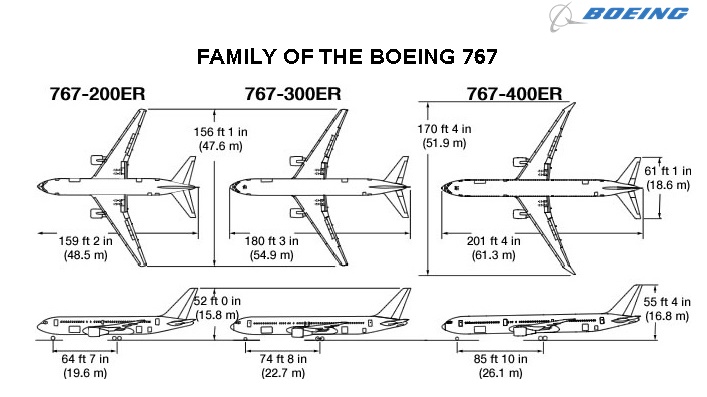
The current list price for the 767-300ER is $ 201.4 million per unit, but when Boeing sold the last aircraft in 2014, the aircraft sold for $ 70 million or less. The 767-300F freighter has a list value of $ 203.5 million and the company had a backlog of 63 at the end of September 2017.
Boeing continues to study its so-called new mid-range aircraft (NMA), from 200-300 pax, sometimes called the 797, as a replacement for the 767 in a range segment that the company’s current models do not cover. The 787 Dreamliner is too big and the 737-10 is too small.
Boeing sees a market of 2,000 to 4,000 NMA aircraft over the next two decades, but market consensus is at the lower end of that scale. If a 797 lit up next year, it would take about seven years to get the plane up, say by 2025. Boeing could start delivering new Boeing 767 orders in just three years.
Re-producing a 767-300ER could be produced earlier at a lower cost than the construction of a new aircraft and put Boeing again in competition with the Airbus A321NEO and the A321NEO LR, which address the market for a passenger aircraft with a range of around 4,000 to 5,000 nautical miles.
Restarting the production of the 767 does not eliminate Boeing’s prospects for a new 797. The economy of the 767 only works if the plane is sold at a significant discount to its list price because the operating costs are higher than those of Airbus with new and more efficient engines.
Having a competitive aircraft until the 797 is ready gives Boeing a story to sell to customers looking for an Airbus alternative. There is substantial value for Boeing in that aspect of resurrecting the 767. The order book of the Boeing 767 line is 1,204, totaling roughly 1102 units to date. A \ W
Ξ A I R G W A Y S Ξ
SOURCE: Airgways.com
DBk: Aircanada.com / Wikimedia.org
AW-POST: 201710202130AR
A\W A I R G W A Y S ®
 airgways.com