AW | 2017 10 20 12:27 | TOURISM
 La naturaleza puso a prueba la integración caribeña. Cuba y Venezuela estuvieron entre las primeras naciones en brindar apoyo a Dominica
Dominica, una nación insular dependiente del turismo, ha sido golpeada por los huracanes durante los últimos dos años. Mientras que el torrente de lluvia del huracán Erika causó inundaciones catastróficas y deslizamientos de tierra en 2015, los vientos huracanados de María dañaron casi todas las estructuras comerciales y residenciales el mes pasado.
Todavía resulta más fácil viajar del Caribe a las antiguas metrópolis, al otro lado del Atlántico, que entre islas vecinas separadas por escasos kilómetros. Se teme que los efectos del huracán María tengan un impacto mucho mayor en la economía de Dominica que Erika, que causó daños equivalentes al noventa por ciento del PIB de Dominica.
Los esfuerzos de integración, que iniciaron el siglo pasado con la independencia de la mayoría de las naciones caribeñas, buscan superar las barreras culturales, idiomáticas y económicas heredadas de siglos en el ojo del huracán de las luchas de poder globales.
Pero la última prueba de la voluntad del Caribe vino de una fuente inesperada: la naturaleza. En el lapso de menos de un mes, golpearon la región tres ciclones de gran intensidad.
Dominica, que fue arrasada por los vientos de más de 250 kilómetros por hora del Huracán María, fue testigo de la solidaridad de naciones vecinas que también resultaron afectadas, pero no dudaron en compartir sus recursos con una isla hermana donde ocho de cada diez hogares quedaron prácticamente inhabitables. Los medios técnicos de Antigua y Barbuda, golpeada por el Huracán Irma unos días antes, sirvieron para establecer una conexión con Dominica en las horas cruciales tras el paso del Huracán María, que destruyó prácticamente todas las torres de comunicaciones.
Naciones como Cuba y Venezuela estuvieron entre las primeras naciones en aportar ayuda humanitaria. Otros países brindaron ayuda práctica entre ellas: Antugua y Barbuda, Barbados, Trinidad & Tobago, Granada, Santa Lucía, Jamaica, entre otras naciones.
Desde 1991, Caricom cuenta con una agencia especializada en la respuesta a emergencias naturales en el Caribe, CDEMA (por las siglas en inglés de Caribbean Disaster Emergency Management Agency). CDEMA, en la que participan 18 naciones de la región, se mantuvo activa en el terreno desde antes del huracán y lleva adelante ahora proyectos para la reconstrucción de Dominica, incluido el mantenimiento de los refugios y la construcción de viviendas. El mecanismo se activa en situaciones de desastre en cualquiera de los países miembros de Caricom.
El sector privado ha presentado una lista de sugerencias que se le presentaron al primer ministro, incluidas concesiones libres de impuestos, subvenciones y financiamiento de préstamos subsidiados. También es necesario crear capacidad para las estructuras resilientes al clima.
La evaluación de los daños es una necesidad crítica para comenzar el proceso de reconstrucción. El proceso de seguro debe ocurrir también para proporcionar esperanza a los propietarios. Existe la necesidad de rastrear rápidamente generadores, aguas, sabanas y otros artículos de servicio y comodidades para las propiedades operacionales.
Un gran porcentaje de hoteles (más del 75 %) se les volaron los techos, causando daños importantes en los muebles y accesorios, inundaciones y pérdida de servicios públicos. La mayoría ha sufrido daño severo o daño catastrófico que requiere una reconstrucción completa. La mayoría de las casas de campo, villas y bungalows se han desvanecido, dejando un espacio en nuestras propiedades más lujosas.
Un pequeño porcentaje de propiedades informa que estará listo para operar a fin de año, mientras que otros informan que les tomará entre seis meses y un año volver a abrir. También hay un número considerable de propiedades que están considerando el shuttering debido al agotamiento y los desafíos mentales y financieros dentro de la industria misma. 

The challenge of tourism in Dominica
Nature tested Caribbean integration. Cuba and Venezuela were among the first nations to support Dominica
Dominica, a tourism-dependent island nation, has been hit by hurricanes for the past two years. While the storm surge from Hurricane Erika caused catastrophic flooding and landslides in 2015, Hurricane Mary’s winds damaged nearly all commercial and residential structures last month.
It is still easier to travel from the Caribbean to the old metropolis, on the other side of the Atlantic, than between neighboring islands separated by a few kilometers. It is feared that the effects of Hurricane Maria will have a much greater impact on Dominica’s economy than Erika, which caused damages equivalent to ninety percent of Dominica’s GDP.
Integration efforts, which began last century with the independence of most Caribbean nations, seek to overcome the cultural, idiomatic and economic barriers inherited from centuries in the eye of the hurricane of global power struggles.
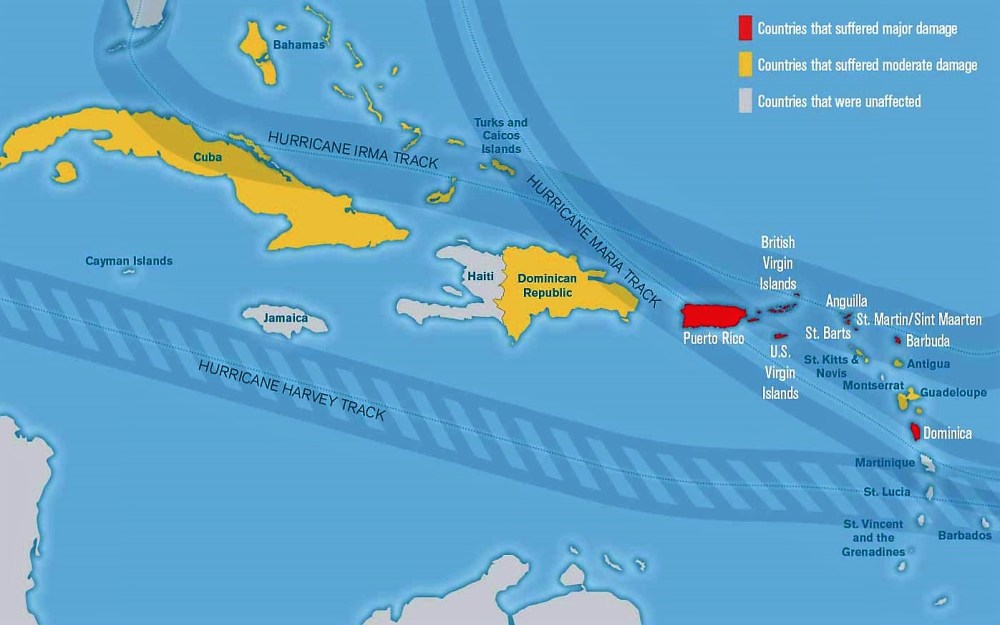
But the last test of the Caribbean will came from an unexpected source: nature. In the space of less than a month, three cyclones of great intensity struck the region.
Dominica, which was devastated by the winds of more than 250 kilometers per hour of Hurricane Maria, witnessed the solidarity of neighboring nations that were also affected, but did not hesitate to share their resources with a sister island where eight out of ten homes were left practically uninhabitable. The technical means of Antigua and Barbuda, struck by Hurricane Irma a few days earlier, served to establish a connection with Dominica at crucial times after Hurricane Maria, which destroyed virtually all communications towers.
Nations such as Cuba and Venezuela were among the first nations to provide humanitarian aid. Other countries provided practical assistance, including: Antigua and Barbuda, Barbados, Trinidad & Tobago, Grenada, Saint Lucia, Jamaica, among other nations.
Since 1991, Caricom has an agency specializing in the response to natural emergencies in the Caribbean, CDEMA (by the acronym in English of Caribbean Disaster Emergency Management Agency). CDEMA, which involves 18 nations in the region, has been active on the ground since before the hurricane and is now carrying out projects for the reconstruction of Dominica, including shelter maintenance and housing construction. The mechanism is activated in disaster situations in any of the member countries of CARICOM.
The private sector has presented a list of suggestions submitted to the prime minister, including tax-free concessions, subsidies and subsidized loan financing. Capacity building is also needed for climate resilient structures.
Damage assessment is a critical need to begin the reconstruction process. The insurance process must also occur to provide hope to the owners. There is a need to quickly trace generators, waters, savannahs and other service items and amenities for operational properties.
A large percentage of hotels (more than 75%) were blown up, causing significant damage to furniture and fittings, flooding and loss of utility services. Most have suffered severe damage or catastrophic damage requiring complete reconstruction. Most of the country houses, villas and bungalows have vanished, leaving a space in our most luxurious properties.
A small percentage of properties report that they will be ready to operate by the end of the year, while others report that it will take them between six months and a year to reopen. There are also a considerable number of properties that are considering shuttering due to exhaustion and the mental and financial challenges within the industry itself. A \ W
Ξ A I R G W A Y S Ξ
SOURCE: Airgways.com
DBk: Travelweekly.com / Charterworld.com / Unicef.ca
AW-POST: 201710201227AR
A\W A I R G W A Y S ®
 airgways.com