 AW | 2019 12 18 16:06 | AIR INVESTIGATION / AVIATION SAFETY

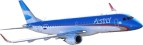 JIAAC de Argentina establece que dron impacta en aeronave Embraer E190 de Austral en Diciembre 2018
Un Embraer E190-100AR con registro LV-CDZ de la aerolínea regional argentina Austral Líneas Aéreas ha sido golpeado por un avión no tripulado (dron) el 22 Diciembre 2018. Esto se desprende por los estudios establecidos por la Junta de  Investigaciones de Accidentes de Aviación Civil (JIAAC) de Argentina de un análisis químico realizado por la autoridad investigadora. El incidente tuvo lugar en el área de aproximación al Aeropuerto Jorge Newbery de Buenos Aires. El análisis químico de las huellas de impacto ha convencido a los investigadores argentinos de que un vehículo aéreo no tripulado colisionó con un Embraer E190-100AR poco antes de comenzar su aproximación final a Aeroparque.
La autoridad de investigación argentina JIAAC ha comunicado que el E190-100AR de Austral Líneas Aéreas, que operaba la ruta Rosario-Buenos Aires el 22 Diciembre 2018, golpeó un objeto extraño a 4.080 pies, a unas 20 nm (millas náuticas) al noroeste del Aeropuerto Jorge Newbery, aterrizando de manera segura.
El examen de la región de impacto, en el fuselaje, encontró una sustancia oleosa similar a un gel, así como fibras. Las muestras con hisopos fueron analizadas por un laboratorio metalúrgico en la Universidad Nacional de La Plata, que determinó que contenían principalmente carbono, oxígeno y nitrógeno. Estos resultados sugirieron que el material era fibra de carbono, mientras que la sustancia aceitosa parecía contener compuestos orgánicos conocidos por estar presentes en las baterías. «Según los resultados del material analizado, se confirmó que el objeto que golpeó al Embraer E190 era un vehículo aéreo no tripulado», dice JIAAC.
Si bien los investigadores peinaron el área en la que el avión no tripulado probablemente se había estrellado, según la altura y la velocidad del avión, así como la dirección del viento, no se encontraron restos. «Los restos del [dron] podrían haber proporcionado información importante para la investigación», dice JIAAC, que proporciona datos sobre su masa, rendimiento y operador. Pero según los datos de un estudio de la Agencia de Seguridad Aérea de la Unión Europea, el dron probablemente estaba en la categoría mediana o grande.
El avión no tripulado había estado volando de noche sobre un área poblada dentro de la zona de control del Aeropuerto Jorge Newbery, cerca de la ruta de aproximación final a la Pista 13. Las regulaciones prohíben la operación de drones en el espacio aéreo controlado sin autorización especial, señala la investigación. Pero afirma que no pudo determinar si el dron cumplía con las reglas. Ninguno de los 75 ocupantes del E190-100AR resultó herido. La información del registrador de voz de cabina y datos de vuelo permitió a la consulta establecer la posición y la altura de la aeronave en el momento de la colisión. 
 E190 Austral drone collision investigated
 JIAAC of Argentina establishes that drone impacts on Embraer E190 aircraft of Austral in December 2018
An Embraer E190-100AR with an LV-CDZ record of the Argentine regional airline Austral Líneas Aéreas has been hit by an unmanned aircraft (drone) on December 22, 2018. This follows from the studies established by the Aviation Accident Investigation Board Civil (JIAAC) of Argentina of a chemical analysis carried out by the investigating authority. The incident took place in the approach area to Jorge Newbery Airport in Buenos Aires. The chemical analysis of the impact footprints has convinced Argentine researchers that an unmanned aerial vehicle collided with an Embraer E190-100AR shortly before beginning its final approach to Aeroparque.
The Argentine investigation authority JIAAC has reported that the E190-100AR of Austral Airlines, which operated the Rosario-Buenos Aires route on December 22, 2018, hit a foreign object at 4,080 feet, about 20 nm (nautical miles) northwest of the Jorge Newbery Airport, landing safely.
The examination of the impact region, in the fuselage, found an oily substance similar to a gel, as well as fibers. The swab samples were analyzed by a metallurgical laboratory at the National University of La Plata, which determined that they mainly contained carbon, oxygen, and nitrogen. These results suggested that the material was carbon fiber, while the oily substance appeared to contain organic compounds known to be present in the batteries. «According to the results of the analyzed material, it was confirmed that the object that hit the Embraer E190 was an unmanned aerial vehicle», says JIAAC.
While the researchers combed the area where the drone had probably crashed, depending on the height and speed of the plane, as well as the wind direction, no remains were found. «The remains of the [drone] could have provided important information for the investigation», says JIAAC, which provides data on its mass, performance, and operator. But according to data from a study by the European Union Air Safety Agency, the drone was probably in the medium or large category.
The drone had been flying at night over a populated area within the control zone of Jorge Newbery Airport, near the final approach route to Runway 13. The regulations prohibit the operation of drones in controlled airspace without authorization. Special, notes the investigation. But he says he could not determine if the drone complied with the rules. None of the 75 occupants of the E190-100AR was injured. The information of the cockpit voice recorder and flight data allowed the consultation to establish the position and height of the aircraft at the time of the collision. 
Ξ A I R G W A Y S Ξ
SOURCE: Airgways.com
DBk: Jiaac.gob.ar / Avherald.com / Airgways.com
AW-POST: 201912181606AR
A\W A I R G W A Y S ®
 airgways.com