
AW | 2017 11 02 17:35 | AIRLINES
 Air Canada se ha convertido en el segundo operador canadiense del Boeing 737 MAX
Air Canada es el segundo operador canadiense del Boeing 737 MAX, solo semanas después de que WestJet inauguró el servicio. La primera entrega de Air Canada fue Boeing 737-8 MAX con registro C-FTJV, la primera de un pedido en firme para 61 737 MAX programados para su entrega a Air Canada hasta el 2021.
Air Canada anteriormente operaba 44 Boeing 737-200 adquiridos con la fusión de Canadian Airlines en 2001. Nueve de estos aviones equiparon la filial Tango de bajo costo de Air Canada y otros 20 equiparon el brazo low-cost llamado ZIP entre Septiembre de 2002 y Septiembre de 2004. La mayoría de los Boeing 737-200 fueron retirados, vendidos o desechados en 2005.
El primer Boeing 737-8 MAX de Air Canada salió de la línea de producción Boeing 737 en Renton, Washington, en Octubre de 2017. El avión recibió su registro canadiense el 31 de octubre, y fue entregado al aeropuerto Kelowna, BC, ese día para modificaciones previas a la entrega por Kelowna Flightcraft.
El 737 MAX luego voló al Aeropuerto Internacional Pearson de Toronto, llegando en la madrugada del 2 de Noviembre de 2017. El entrenamiento de vuelo continuó más tarde en el día con vuelos desde Toronto a Ottawa, Ontario, y Mirabel, Que., Para competencia y certificación. Dado que el 737 es un nuevo tipo de avión para Air Canada, se requerirá un período de certificación y capacitación antes de que comience el ingreso oficial al servicio. La instalación de Wi-Fi también se llevará a cabo en Kelowna.
Se espera que el vuelo inaugural Boeing 737 MAX de Air Canada se realice en Noviembre de 2017. Air Canada recibirá este año dos Boeing 737-8 MAX adicionales de un total de 61 aviones. Se esperan otros 16 para junio de 2018, con el saldo del pedido original en firme para 61 en 2021. El pedido original de Air Canada dividió las variantes en 33 737 MAX 8s y 28 de los MAX MAX más grandes, aunque esto podría ajustarse como los requisitos dictan
Air Canadá y el CSeries
El reciente crecimiento en el número de pasajeros que Air Canada lleva podría conducir a una conversión de las opciones de compra antes de lo anticipado a pedidos en firme de hasta 48 Boeing 737 MAX más. Además, las opciones para 30 aviones Bombardier CS300 adicionales, por encima del pedido en firme de 45 Bombardier CSeries, podrían convertirse en pedidos en firme antes de lo esperado, según Air Canada. La entrega de los primeros aviones de la CSeries está programada para finales de 2019 hasta el 2022.
El pedido en firme original de Air Canada de 61 Boeing 737 MAX se basó en sus requisitos para 2013. El Boeing 737-8 MAX reemplazará al Airbus A320, que ha estado con la aerolínea desde 1990, y el MAX 9 reemplazará al Airbus A321 con la flota principal. La CSeries de Bombardier reemplazará a los Airbus A319 y Embraer 190s.
Calin Rovinescu, director ejecutivo de Air Canada, dijo: «Piénselo, ya que la serie MAX y CSeries reemplazarán fundamentalmente a nuestra flota de fuselaje estrecho de Airbus».
El Boeing 737 MAX está impulsado por los motores LEAP-1B de CFM International, diseñados para la eficiencia de combustible y la reducción de ruido. En general, el avión es un 14% más eficiente en consumo de combustible que las actuales 737 Próximas generaciones, y tiene una huella de ruido operacional reducida de hasta 40% gracias a la tecnología de motor silencioso.
El avión viene con el nuevo interior del cielo de Boeing, que tiene características como iluminación LED personalizable y nuevos altavoces para mejorar el sonido y la claridad de los anuncios a bordo. Los 737 MAX 8 de Air Canada tendrán configuraciones de asiento de 16 asientos de primera clase y 153 asientos de autocares, con un total de 169 asientos. La inclinación del asiento de clase ejecutiva será de 38 pulgadas de paso y 21 pulgadas de ancho, mientras que la economía será de 30 pulgadas de paso y 18 pulgadas de ancho.
Air Canada conserva su sistema actual de entretenimiento a bordo (IFE) en sus 737 MAX, por lo que es una de las pocas aerolíneas que ofrece el servicio IFE en un avión 737 MAX. El sistema estará equipado con nuevos dispositivos de entretenimiento con pantalla táctil.
Air Canada tiene la intención de desplegar el 737 MAX en rutas nacionales y transatlánticas, incluidas Shannon y Dublín, Irlanda desde Toronto y Montreal, a partir del verano de 2018.
Air Canada actualmente opera Airbus A319s, equipado con estándares de desempeño operacional bimotor de rango extendido de un pasillo (ETOPS), en rutas transatlánticas desde St. John’s, NL, a Londres, Inglaterra. Sin embargo, el 737 MAX puede volar directamente desde Toronto y Montreal a Europa sin una escala o conexión.
«La capacidad y el alcance del avión MAX son algo que no hemos tenido en un avión de fuselaje estrecho de ese tamaño», dijo Duncan Bureau, vicepresidente de ventas globales de Air Canada. «Estamos muy contentos con la capacidad de la aeronave. La economía general es significativamente mejor, y el MAX nos permite más versatilidad».
Klaus Goersch, quien anteriormente se desempeñó como director de operaciones de Air Canada por más de cuatro años, dijo: «El MAX será perfecto para la aerolínea. Vuela más rápido y más alto, y [es] más eficiente que nuestros aviones actuales de Airbus. El perfil de la misión del 737 MAX es esencialmente el mismo perfil de misión de un cuerpo estrecho de Airbus. Podemos usarlo para destinos de sol en invierno, y podemos usarlo transcontinental en el verano». 
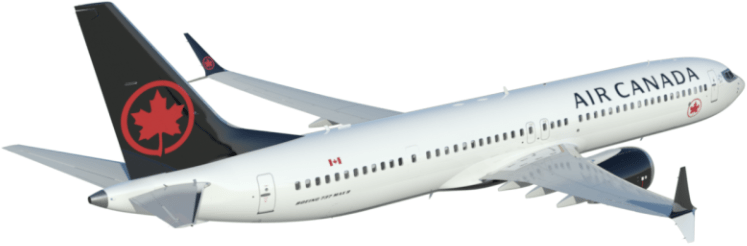
Air Canada first Boeing 737 MAX
 Air Canada has become the second Canadian operator of the Boeing 737 MAX
Air Canada is the second Canadian operator of the Boeing 737 MAX, only weeks after WestJet opened the service. The first Air Canada delivery was Boeing 737-8 MAX with C-FTJV registration, the first of a firm order for 61 737 MAX scheduled for delivery to Air Canada through 2021.
Air Canada previously operated 44 Boeing 737-200s acquired with the merger of Canadian Airlines in 2001. Nine of these aircraft equipped Air Canada’s low-cost subsidiary Tango and another 20 equipped the low-cost arm called ZIP between September 2002 and September of 2004. Most of the Boeing 737-200 were removed, sold or disposed of in 2005.
The first Boeing 737-8 MAX from Air Canada left the Boeing 737 production line in Renton, Washington, in October 2017. The aircraft received its Canadian registration on October 31, and was delivered to Kelowna Airport, BC, on that day for pre-delivery modifications by Kelowna Flightcraft.
The 737 MAX then flew to Pearson International Airport in Toronto, arriving at dawn on November 2, 2017. Flight training continued later in the day with flights from Toronto to Ottawa, Ontario, and Mirabel, Quebec, for competition and certification. Since the 737 is a new type of aircraft for Air Canada, a certification and training period will be required before official entry into service begins. The Wi-Fi installation will also take place in Kelowna.
The inaugural Air Canada Boeing 737 MAX flight is expected to take place in November 2017. Air Canada will receive two additional Boeing 737-8 MAX this year from a total of 61 aircraft. Another 16 are expected by June 2018, with the balance of the original firm order for 61 in 2021. The original Air Canada order divided the variants into 33 737 MAX 8s and 28 of the larger MAX MAXs, although this could be adjusted as the requirements dictate
Air Canada and the CSeries
The recent growth in the number of passengers that Air Canada carries could lead to a conversion of purchase options earlier than anticipated to firm orders of up to 48 more Boeing 737 MAX. In addition, the options for 30 additional Bombardier CS300 aircraft, above the firm order of 45 Bombardier CSeries, could be converted into firm orders sooner than expected, according to Air Canada. The delivery of the first CSeries aircraft is scheduled for the end of 2019 until 2022.
The original Boeing 737 MAX Air Canada original order was based on its requirements for 2013. The Boeing 737-8 MAX will replace the Airbus A320, which has been with the airline since 1990, and the MAX 9 will replace the Airbus A321 with the main fleet. The CSeries of Bombardier will replace the Airbus A319 and Embraer 190s.
Calin Rovinescu, executive director of Air Canada, said: «Think about it, as the MAX and CSeries series will fundamentally replace our narrow-fuse Airbus fleet.»
The Boeing 737 MAX is powered by CFM International’s LEAP-1B engines, designed for fuel efficiency and noise reduction. In general, the airplane is 14% more fuel efficient than the current 737 Upcoming generations, and it has a reduced operational noise footprint of up to 40% thanks to silent engine technology.
The aircraft comes with Boeing’s new interior sky, which has features such as customizable LED lighting and new speakers to enhance the sound and clarity of onboard announcements. The 737 MAX 8 Air Canada will have seating configurations of 16 first class seats and 153 coach seats, with a total of 169 seats. The tilt of the executive class seat will be 38 inches in pitch and 21 inches in width, while the economy will be 30 inches in pitch and 18 inches in width.
Air Canada retains its current onboard entertainment system (IFE) in its 737 MAX, making it one of the few airlines offering the IFE service on a 737 MAX aircraft. The system will be equipped with new entertainment devices with touch screen.
Air Canada intends to deploy the 737 MAX on national and transatlantic routes, including Shannon and Dublin, Ireland from Toronto and Montreal, starting in the summer of 2018.
Air Canada currently operates Airbus A319s, equipped with single-aisle extended-range operational performance standards (ETOPS), on transatlantic routes from St. John’s, NL, to London, England. However, the 737 MAX can fly directly from Toronto and Montreal to Europe without a stopover or connection.
«The capacity and range of the MAX aircraft are something we have not had in a narrow-body airplane of that size,» said Duncan Bureau, vice president of global sales for Air Canada. «We are very happy with the capacity of the aircraft, the overall economy is significantly better, and the MAX allows us more versatility.»
Klaus Goersch, who previously served as chief operating officer of Air Canada for more than four years, said: «The MAX will be perfect for the airline, it flies faster and higher, and [is] more efficient than our current Airbus aircraft. The profile of the mission of the 737 MAX is essentially the same mission profile of a narrow body of Airbus, we can use it for sun destinations in winter, and we can use it transcontinental in the summer». A \ W
Ξ A I R G W A Y S Ξ
SOURCE: Airgways.com
DBk: Skysmag.com / Boeing.com
AW-POST: 201711021735AR
A\W A I R G W A Y S ®
 airgways.com